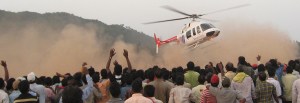
 BHUBANESHWAR, ORISSA: The helicopter landed in one of the most desolate and poorest parts Orissa’s Puri constituency in the usual swirl of anti-social blinding dust that heralds the arrival of top politicians on India’s general election trail. But that did nothing to deter the enthusiastic welcome of the crowds gathered to see their chief minister at Rulango in Dalang on Monday evening – and the man who alighted from the aircraft had none of the arrogant power-strutting swagger of many Indian politicians.
Instead, Naveen Patnaik, the 62-year old chief minister of Orissa, emerged as a very slightly stooping man with a friendly smile but sometimes stern eyes, who carefully kept those around him at a distance, but did so shyly without causing offence.
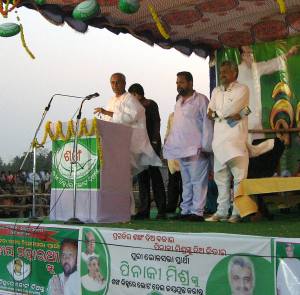 His smile was genuine as he went to the platform and read the first part of his speech in the local Orya language, which he cannot speak easily, and then, apologising, turned to his more comfortable Hindi. His manner was that of a kindly headmaster addressing an end of term pupils’ meeting as he spelt out his government’s successes, rarely raising his voice but receiving cheers at all the right moments.
“Nice to see you again”, he said to me as he walked away from the platform. I asked what his main issues were. “He’ll tell you,” he replied, waving at the agent of Pinaki Misra, the local parliamentary candidate. I reckoned that was one of the longest interviews Patnaik has given to a foreign correspondent. He is famous for saying little and rarely meeting journalists – and indeed rarely meeting anyone outside his small inner political circle. Almost a recluse in Bhubaneswar, he socialises little and reportedly even vets guest lists when he spends evenings with his two closest political friends and allies, member of parliament Jay Panda and Orissa minister A.U.Singh Deo.
Once a friend of Jacqueline Onassis and Mick Jagger, Patnaik unexpectedly abandoned a grand and exclusive international jet setting life-style for Orissa politics after the death 12 years ago of his father, Biju Patnaik, a popular politician and former chief minister. Known to his friends as Pappu, he did not seem to have the grit to remain in politics for long. Yet he now has a chance of breaking records by winning a third successive term as Orissa’s chief minister, having managed to carve out an image that appeals to the electorate, even though the state has sunk while he has been in power to become India’s poorest with 39.9% of the people below the poverty line. That is worse, amazingly, even than Bihar.
Searching for issues
I decided to come to Orissa to write about India’s general election and the state’s assembly election (the second and final stage of voting takes place today) because I thought the sleepy low-performing state was full of urgent social and other election issues.
My list included tribal clashes last year with attacks and killings of Christians, violent demonstrations and deaths over the use of agricultural and tribal land for big steel and other projects such as those planned by Posco, Tata and L.N.Mittal, plus a growing Naxalite threat (with 29 people killed on Orissa’s first polling day last week). Also on my list of course was Patnaik, who unexpectedly broke his Biju Janata Dal (BJD) party’s 11-year alliance with the Bharatiya Janata Party (BJP) last month and, to quote a journalist friend, “seems to have the state in his grip”.
That seemed a basket of important subjects – religion, land, lawlessness, dynasty, and coalitions – till I spoke to a friend in Bhubaneshwar and asked what the issues were. “Rice politics”, he replied, explaining that much of Patnaik’s popularity is based on having reduced rice to Rs2 a kilo for roughly half the state’s 37m population. “With rice, BJD schemes to get third-time lucky,” said a newspaper headline. Now Congress and the BJP have been promising to reduce that to Rs1.
It is of course, I thought, the same the world over. Between elections, all sorts of issues grab public and political attention, but when it comes to the time to vote in the next government, it is the price of food in the shops that counts. Yet when I arrived in Orissa I discovered that even though rice is perhaps the determining factor for many of the poor, there are few policy clashes. “The election is being fought without any issues,” says Sudhir Pattnaik, editor of Samadrushi, an Orya magazine. “There’s no difference between the parties”.
The BJP has certainly lost ground because of the anti-Christian riots at Kandhamal last August, with thousands of Christians still sheltering in relief camps, but that is being offset to some extent by criticism of the way Patnaik dumped the BJP.

 Riding the Elephant
Leave a comment