N Chandrasekaran, Ratan Tata’s choice of Tata Sons chairman, is out

Ratan’s legacy now in the hands of a half-brother who he did not rate

The unexpected announcement this week that Natarajan Chandrasekaran will not seek a third five-year term as executive chairman of Tata Sons, India’s biggest conglomerate, marks the climax of bitter family differences and ego clashes that have coloured events at the top of the $280bn group for decades. 

Noel Tata, chairman of the Tata Trusts that control the group, has come out the winner after a year of clashes, having triggered Chandrasekaran’s decision to leave when his current five-years end next February.

With Chandrasekaran going, Noel is gaining the group leadership that he was denied when his elder half-brother, Ratan Tata, retired as Tata Sons chairman in 2012. At the time, he was seen by many in Mumbai and elsewhere as the natural successor. 
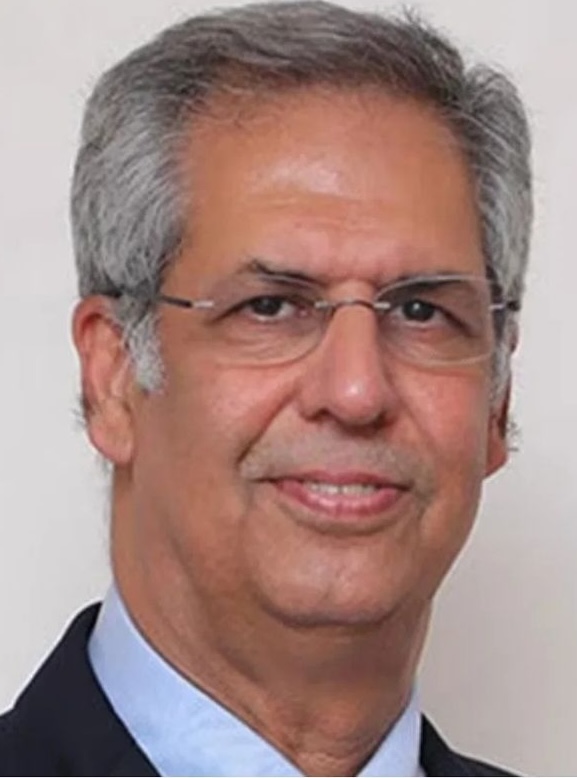
Noel Tata

Noel’s managerial advancement was also restricted by Ratan during the 21 years that he was chairman, allegedly because he doubted Noel’s ability, but basically, observers say, because of their family history.

Ratan Tata’s parents had a difficult divorce. His father later married Simone Dunoyer from Switzerland, and Noel was born. The two boys grew up separately and it seems that Ratan never accepted his stepmother or half brother. Noel then complicated the family base by marrying Aloo Mistry, the daughter of Pallonji Mistry whose Shapoorji Pallonji group is Tata’s largest minority shareholder with an 18% stake (which it now wants to sell).

Helped initially by his mother, Simone, who was regarded as a trailblazer in cosmetics and fashion retailing, Noel proved his ability by turning Tata’s Trent retail business into a success against strong competition, hitting $2bn revenues last year. He also developed Tata’s international trading company and had boardroom roles in various companies.

But Ratan is quoted in a recent biography saying, somewhat dismissively,  “perhaps, if Noel had had the experience of handling difficult assignments, he could have established his credentials more forcefully….For Noel to compete successfully for the top post he should have greater exposure than he has had….Partly, his not having it has been his own choice.”

Tata is generally revered as India’s most respectable large business devoted to charitable enterprise and patriotic principles that guide corporate decisions over its 1.1m employees and 30 operating companies ranging from salt to software and Jaguar cars, and hotels to aviation and defence,

The image however began to unravel after Ratan retired as chairman of Tata Sons in 2012. He remained head of the trusts that have a controlling 66% share in the group and, in 2016, age 78, staged a boardroom coup that ousted his chosen successor as chairman, 50-year-old Cyrus Mistry (brother of Noel’s wife). Ratan replaced him with Chandrasekaran, who ran the highly profitable Tata Consultancy Services software business, again sidelining Noel. (Cyrus died later in a car crash)
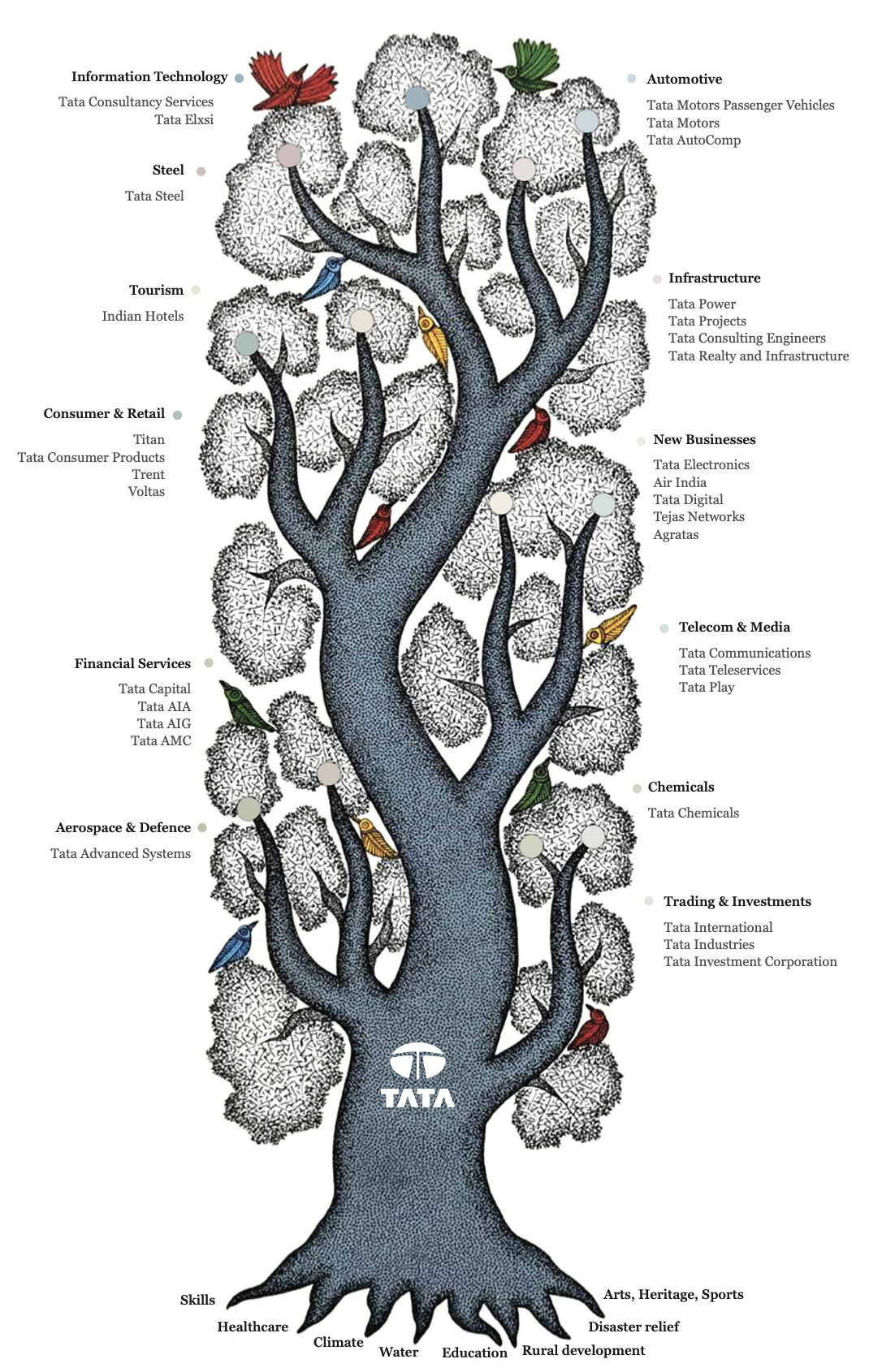
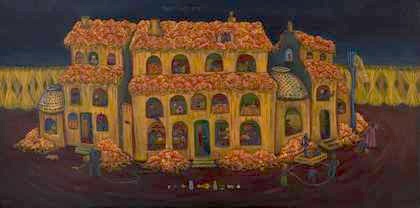
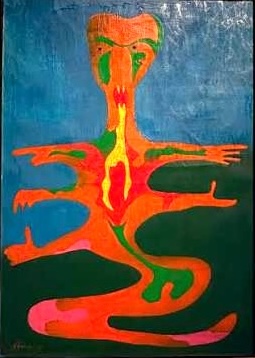
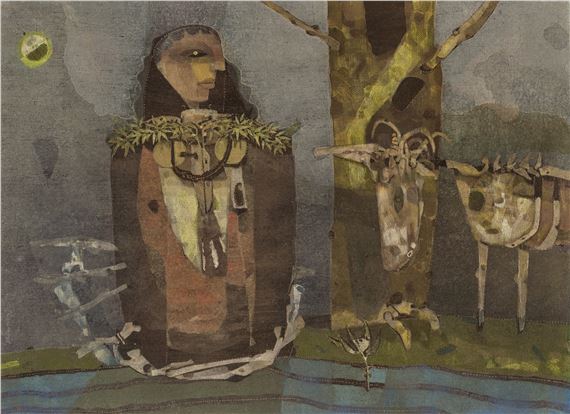
The Tata group tree, in the style of a Gond tribal painting – from the 2025-26 annual report

The coup was widely criticised. “The halo that once surrounded the Tata name has gone. The group looks like just one more conglomerate that has lost its way,” Swaminathan S Anklesaria Aiyar, a respected veteran economic affairs columnist, writing in The Economic Times at the time.

Mistry had not been removed for bad management, though there were criticisms of his style and some of his decisions. He went primarily because he did not show sufficient respect and deference to Ratan. Some of his more brash aides also upset the serenity of Tata’s Bombay House headquarters. 

Unlike Mistry, Chandrasekaran managed his relationship with Ratan expertly, but does not seem to have felt the need to do the same with Noel Tata, probably because, like others, he underestimated Noel’s ability to be tough and exert authority. 

Chandrasekaran has had some failures, notably trouble-prone Air India, and there have also been losses on new digital and other ventures with major expansion into AI. But growth has been good with revenues of $185bn, and many of the problems left by Ratan such as the Tata Motors’ declining Indian car business have been turned into successes. That is reflected in a bullish annual report for 2025-26. 

Air India’s losses more than doubled to nearly $3bn in 2025-26 and accounted for some 80% of the group companies’ total losses. The airline’s reputation has been hit by a fatal crash last year and by a pilot losing control of an aircraft for four seconds earlier this month. There have been a series of other problems, not least rising fuel costs and restrictions on international flight routes. The airline has just appointed a new chief executive – Tewolde Gebremariam who earlier ran Ethiopian Airlines.
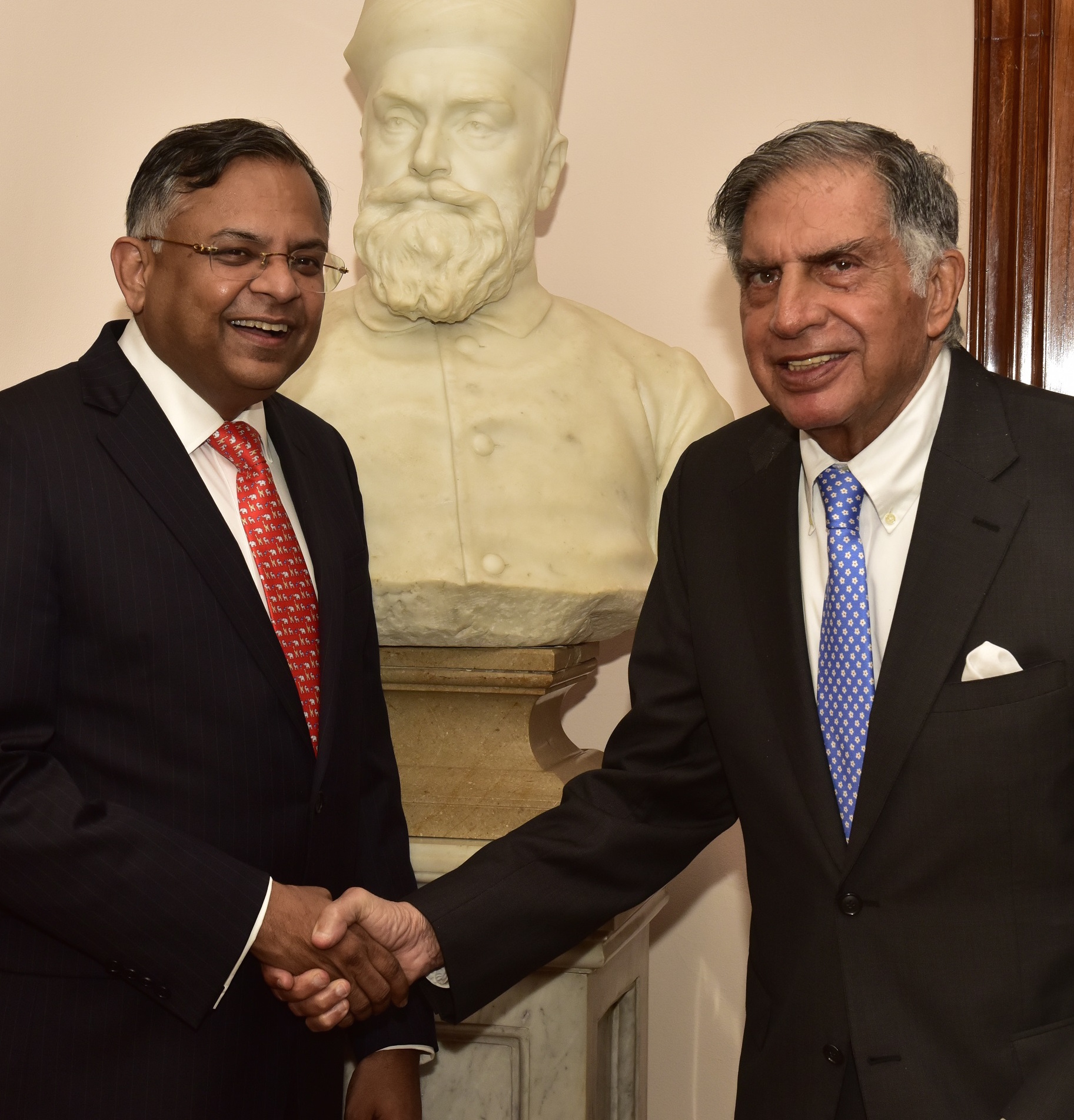
Chandrasekaran with Ratan Tata when he was appointed Tata Sons chairman in 2016

Tata bought Air India from the government in 2022. Ratan, who died in 2024, was still running the trusts and will have had some influence on the decision. Commercially that was a disaster, but it helped the government because there was no other viable buyer, and it was a homecoming for the group that founded the airline in 1932 and lost it to nationalisation in 1953.

There were splits among trustees throughout last year about appointments and governance issues. This escalated to the point where Chandrasekaran and Noel went to Delhi last October for a meeting with Amit Shah, the home minister and the prime minister’s troubleshooter, and Nirmala Sitharaman, the finance minister. Chandrasekaran had good links with the government because he had hired S.Jaishankar as a global affairs adviser for a few months in 2018-19 after Jaishankar retired as foreign secretary and before he was appointed foreign minister. But it seems he over-estimated the support that access could yield in his growing differences with Noel..

Despite the problems – and tensions over whether Tata Sons should follow a Reserve Bank of India instruction to be floated on the Bombay Stock Exchange – the two main trusts proposed Chandrasekaran for a third term. This however was questioned at a Tata Sons board meeting in February by Noel who was critical about losses. Not a risk-taker, Noel has also raised concern about Chandrasekaran’s $120bn five-year expansion plan for the group.

The proposal of the third term “was not carried through because one of the Board Members did not support it,” Chandrasekaran said in his resignation statement, referring to Noel without naming him. In the absence of unanimous support, Chandrasekaran said he had, as chairman, deferred the decision.  Noel apparently did nothing after that to solve the impasse, so Chandrasekaran announced his decision on August 12 as a public statement without apparently any warning or discussion with Noel.

The statement was apparently mean to avoid the risk of an embarrassing situation at Tata Sons’ annual general meeting that was due on August 18 [UPDATE : meeting adjourned because there was not a quorum following a separate problem involving shareholder trusts]. Chandrasekaran said his announcement would also leave enough time to find a successor.

Noel lacks Ratan’s commanding (though shy) presence, but now has the opportunity to prove that he can preside over the group as head of the trusts. He cannot also be chairman of Tata Sons because Ratan, after he retired from that position, changed the rules so that one person cannot hold both posts.

Ratan having not married, Noel is securing his own family’s role in Tata’s future. He has appointed his 32-year old son Neville, who has managerial roles in the retail businesses, to the two top trusts. Noel’s two daughters, Leah and Maya, are employed in the group’s hotels and in retail.

First however, Noel needs to lead the choice of a strong candidate to succeed Chandrasekaran, and then allow the winner freedom to run the group and be its public face.

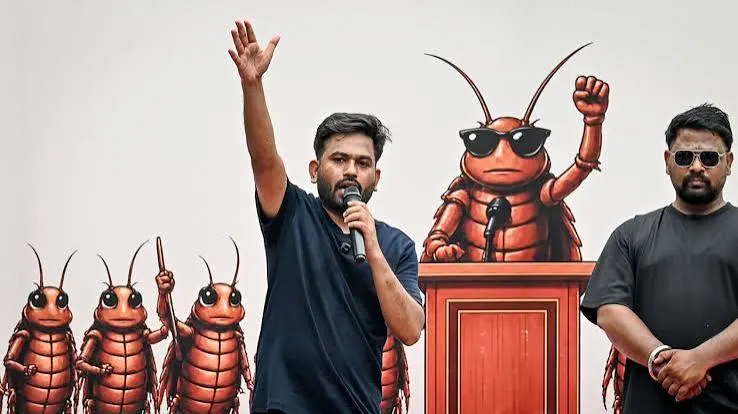
Narendra Modi has bowed to the demands of student protestors……

…..but a badly failing education system needs widespread reforms

Behind the emotional scenes and confrontations between brutal police and peaceful young demonstrators in Delhi that have gripped international attention in recent weeks, lies India’s unrealised “demographic dividend” which was expected to boost the country’s economy with expertise and drive.

For more than 25 years, India has revelled in the potential benefits of the high percentage of youth in what is now the 1.45bn population. Over 65% (950m people) are under 35 but as many as many as 40% (estimates vary) are unemployed or not in education, showing how the dividend has been wasted.

Successive governments have failed to rise to this challenge and reform corrupt and ineffective education systems and inadequate skill-learning opportunities. They have also failed to make a priority of generating adequate and appropriate job opportunities at all levels of economic activity. 

That has turned the dividend into a social liability and created political risk for the government. It has also disillusioned many of the young aspirational voters who will have voted in general elections for prime minister Narendra Modi and his Bharatiya Janata Party but now feel let down. 

The bitter frustrations caused by these government failures lay behind the demonstrations that started after more than 2.2m students sat for an entrance exam for healthcare colleges known as NEET-UG. Just over a week later, the authorities shocked the students when they cancelled the completed exam and ordered a resit because question papers had leaked and been available for sale.

Four days later, on 16 May, the students’ Cockroach Janta Party (CJP) was founded online, satirically named because India’s chief justice had compared unemployed youth to “cockroaches” and “parasites” who drifted into social media and allegedly undermined the Indian constitution. The next move came rapidly when, after just three weeks, the first CJP student demonstrations were held in Delhi, leading to a massive round-the-clock protest.

Widespread support for the protests quickly grew across India, especially when police and a para military force attacked the students violently, using teargas, anti-riot guns and plastic pellets . There was also concern for a veteran education reformer and climate activist, Sonam Wangchuk, who joined the protesters and became a symbol of the campaign when he went on an “indefinite” fast that lasted for 26 days.

This led last weekend to Modi caving-in to mass protests for the third, and most significant, time since he became prime minister in 2014. (The first was in 2019 when protests in north-east India and Delhi led to implementation  of controversial citizenship laws being delayed. Then, in 2021, contested agricultural laws were cancelled after over a year of mass protests by Punjab and Haryana famers, though that was partly due to imminent Punjab state elections).

Modi sacked the education minister, which was the students’ primary demand, having already removed the top education bureaucrat. He also tackled the protestors’ original complaint about mass leaking of exam papers, and appointed a task force to reform the examination system led by Nandan Nilekani, one of the founders of the Infosys IT company and respected creator of he Aadhar identity scheme.

Compensation was also agreed for the families of possibly as many as 21 would-be medical students who tragically died by suicide after they were told they had to re-sit the exams. 

Wasted dividend 

Investment brokers started talking up the demographic dividend in the mid-late 1990s, and in 2005 economists estimated that it opened a 50-year window of potential benefits lasting till 2055. 

No government however has developed a long-term plan and, with 21 of the 50 years gone, estimates of the numbers who do not have jobs vary from 16% aged 15-29, to 40% of a 15-25 age group.  

The problem affects all levels of employment – at the top, less than 7% of male graduates find a permanent salaried job within a year of graduating. 

For the past 15 to 20 years, there has been speculation about whether – and when – the masses of unemployed youth would erupt into a rebellion, echoing protests that escalated rapidly across the country over corruption and rape in 2011 and 2012-3 and rattled the then Congress-led government. 

When the Ministry of Railways announced recruitment drives in January 2022 for low-level entry posts, there were over 12m applications for just 35,000 jobs. Frustrated youth blocked tracks, clashed with security forces, and set train coaches on fire in the poor northern states of Bihar and Uttar Pradesh.

Similarly, the introduction in April 2022 of a new military recruitment policy caused immediate nationwide demonstrations because it replaced a permanent military career that poor rural youth depend on for a permanent career, with four-year contracts. This led to highway blockades, hunger strikes, and arson.

There have been many attempts by governments to generate jobs, but they have not met the main need – to create constructive gainful employment that would reap the dividend.

While economic growth has been strong at around 6%, there has been little impact on job creation. Traditional manufacturing industry, which used to absorb surplus labour, has stagnated at around 14-17% of gdp. Automation-driven technology and services have limited need for labour and mostly require specialised skills that the vast majority of Indian graduates do not possess due to a chronically and badly targeted education system that successive governments have failed to tackle.

There have been some successful initiatives such as the MGNREGA “right to work” begun in 2005 (replaced recently by a Modi government scheme) that guaranteed 100 days of unskilled labour a year for rural households. There have also been various skill development, micro-lending and other schemes along with macro initiatives such as Modi’s “Make in India” and “Startup India”.

But none of these have tackled the basic tasks of creating a variety of employment opportunities at all levels of the economy and educating youth equipped to take those jobs. 

The quality of public education remains poor, ranging from primary schools that lack books and reliable teachers to universities that are inadequate both in numbers of vacancies available and in the qualifications of the graduates they turn out. Interwoven is massive corruption at all levels, illustrated by the leaking exam papers.

If Modi wants his legacy to be a strong and stable economy along with his Hindu nationalism, he needs to reform the whole of the education system from the bottom upwards. At the top, he needs to ensure it provides graduates and other students with expertise that attracts Indian and foreign investment, while also maintaining social stability. He also needs to reverse education’s declining share of the government’s budget that has fallen from 4.6% to about 2.5% since he came to power.

Nandan Nilekani’s task force on examinations has been created to meet the immediate demands of the protestors, but it only covers a fraction of the overall demographic challenge.

Meanwhile, Modi’s authority has been diminished. The crisis has energised the weak Congress-led political opposition and created a new base for challenging the government, both in parliament, on the streets, and on social media.

Already an E20 Janta Party has been founded to oppose a widely opposed new fuel blend containing 20% ethanol. It has gained 34,000 followers within 24 hours of appearing on social media. Whether it can any way near the sort of support won by the Cockroach students remains to be seen, but it shows there is a new feeling of both freedom and confidence to challenge the government.

Kiran Nadar Museum mounts biggest show in the UK

Bharti Kher’s sculptures mix with older august styles at the V&A

The timing has not been coincidental. Attracted by cricket at Lords and the Wimbledon fortnight, Indians flocked to London in July, many looking to buy art, boosting demand from the South Asian diaspora. But it must break records for Sotheby’s and Christie’s both to open major exhibitions within three days of each other and then for the Victoria and Albert Museum to unveil sculptures by a leading Indian artist.

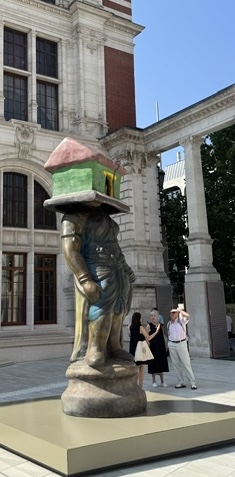
Bharti Kher’s “Giai” in the V&A courtyard – photo John Elliott

The auction houses are reflecting the current boom in South Asian modern art that has been evident in London with numerous exhibitions. Sotheby’s show is mostly for sale, while Christie’s, which is only for display, is a stepping stone for Delhi’s Kiran Nadar Museum of Art to become a leading international institution.

Called The Meeting Ground, it is the latest in Christie’s annual summer series and is probably South Asian art’s most substantial and wide-ranging display ever held in the UK. With a total of 180 works by 67 artists, it beats the 1982 Contemporary Indian Art exhibition at the Royal Academy of Arts that was held as part of the UK’s Festival of India with 45 artists and 133 works.

“International engagement is a pillar of our vision, opening up new frameworks  for dialogue and scholarship,” says Kiran Nadar, the museum’s founder.

The V&A motivation is more prosaic. Its South Asian gallery is closed for renovation till 2028, so it will be staging regular exhibitions to bridge the gap. It is showing four sculptures by Bharti Kher, a prominent Indian artist, who was born in south London and lives between here and Delhi.

Bharti Kher’s “Warrior with Cloud and Shield” at the V&A – photo John Elliott

Her newest work, Gaia, that was completed this year, has the prime spot of the V&A’s entrance courtyard. Described as a hybrid Mother Earth goddess, Gaia stands four metres high and depicts a female warrior with a house on her head, inspired by small clay sculptures known as Gulu figurines that are displayed in South Indian homes during festivals.

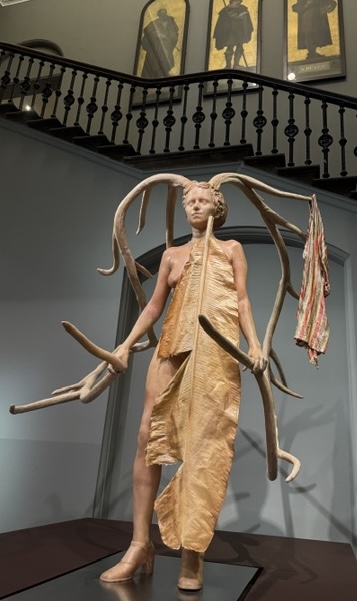
In the main sculpture gallery (access free), three of Kher’s works blend casually but strikingly with centuries old, mostly white, revered monuments, busts and statues. One of the three, titled Ghost (2024), shows a translucent shroud or sari enclosing a female figure.  

Animus Mundi (2018), which was included in the artist’s large exhibition that ran in Wakefield’s Yorkshire Sculpture Park till April last year, is an armless female body with a buffalo head. The oldest work, the golden Warrior with Cloud and Shield (2008), stands triumphantly at the end of the gallery looking both powerful and fragile.

“Sculpture is an animist force with energy,” says Kher, who describes such figures as “mythical urban goddesses, creatures who came out of femininity and the idea of womanhood”.

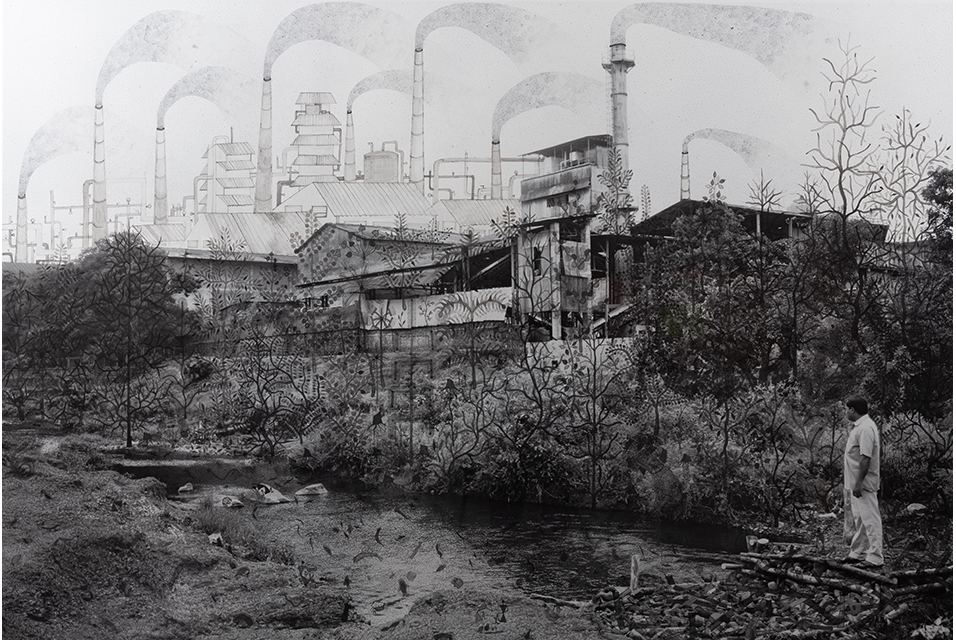
“Factory and River” by Gauri Gill and Rajesh C. Vanguard – image courtesy the artists and KNMA
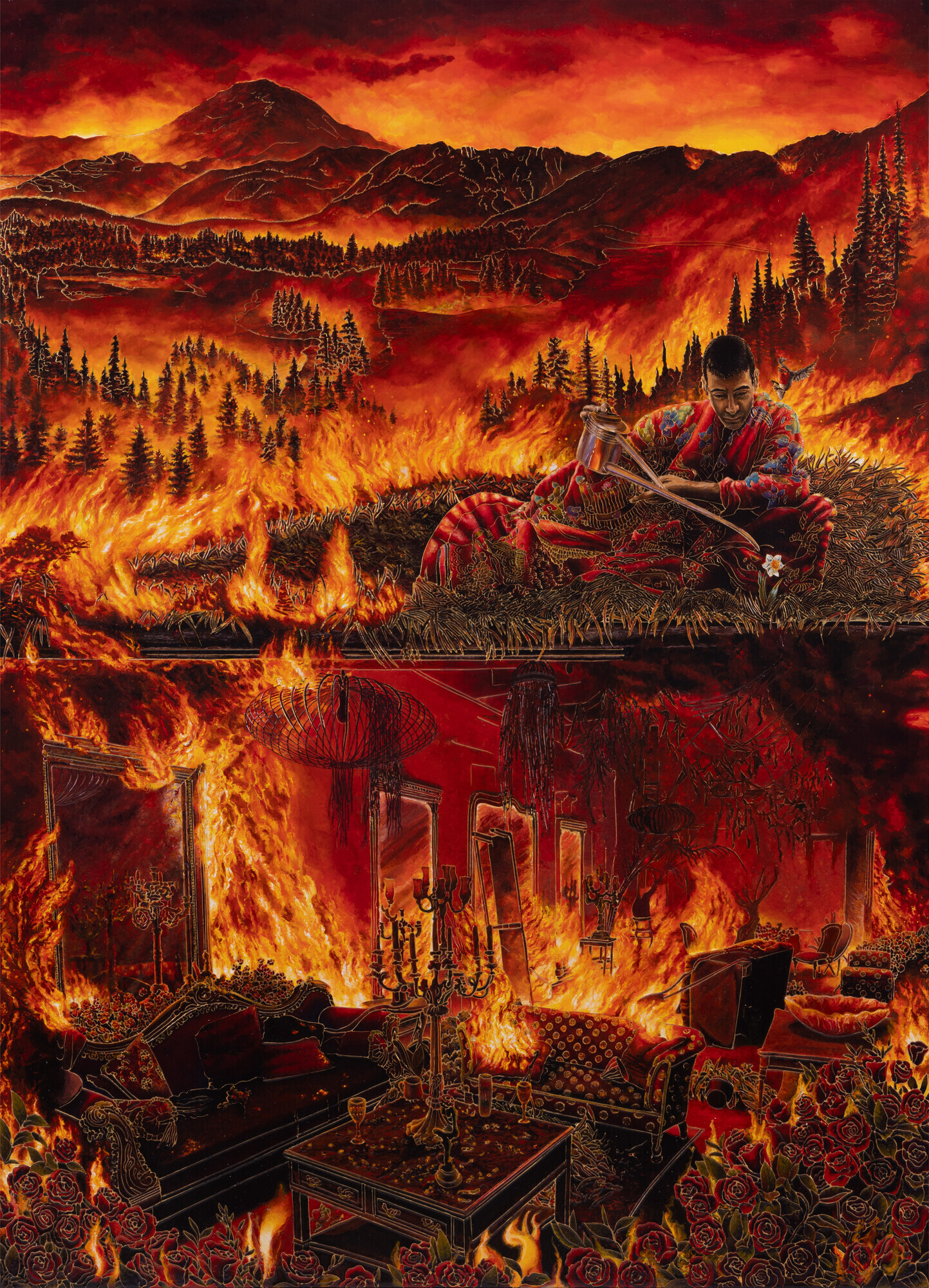
“When the Thing with Feathers Turned Red (after Tintoretto)” – by Kashmiri artist Raqib Shaw (2021-22) – depicting fires in Srinagar and the artist’s London studio. Image courtesy Raqib Shaw and KGMA

Christie’s handed all its Mayfair headquarters’ galleries to five of the KNMA’s curators led by Akansha Rastogi, an associate director, who worked with Damian Vesey, Christie’s South Asia head in London.

The works, dating from 1950, were transported from Delhi and will return there after the exhibition closes on August 21. About 50% of them have not been seen publicly since they entered Nadar’s collection.

Nadar started buying art in 1990, and the KNMA was established in 2010. A  new museum with over 1m sq ft (approx 93,000 sq metres) of space is being built near Delhi airport, transforming what started as a personal hobby into an internationally significant institution. 

“The vision is to have South Asian art on a global platform, making it accessible to all, not just in South Asia but globally,” explains Deepanjana Klein, KNMA’s acquisitions and development director, who earlier headed the subcontinent  at Christie’s. The new museum would be the world’s “greatest South Asian art institution,” and the Christie’s exhibition was part of an effort to “build an international audience”.

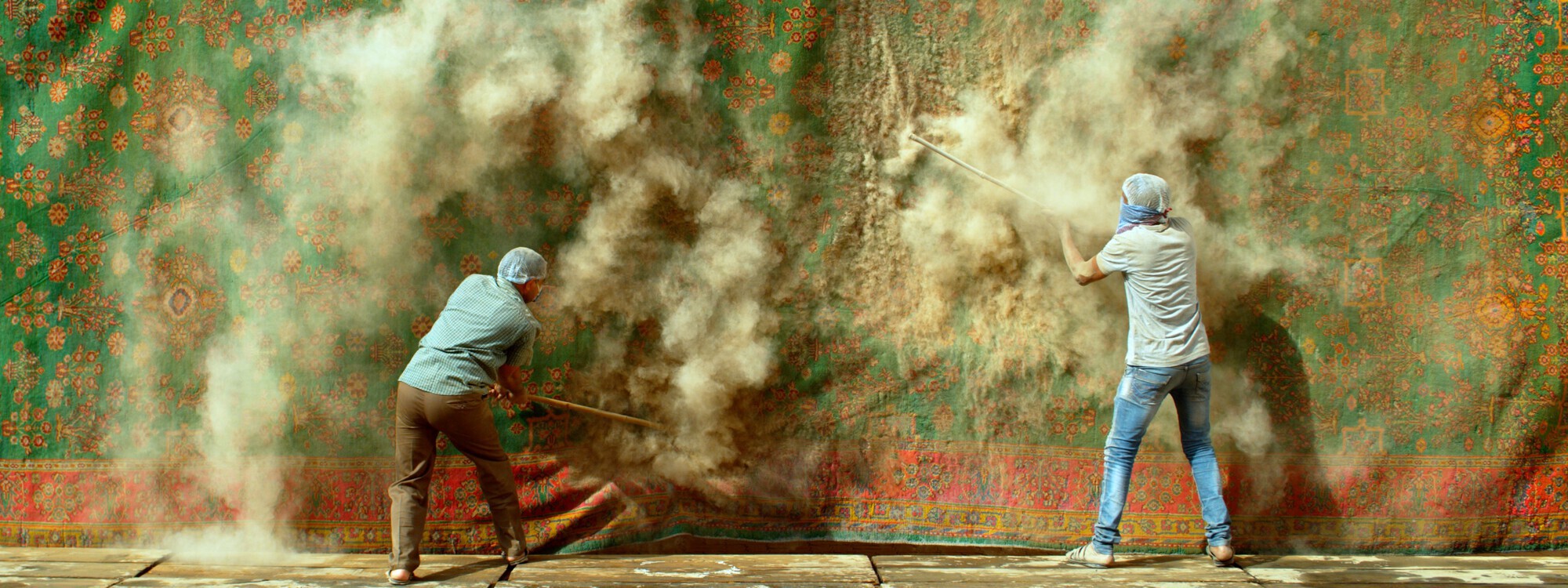
A video titled “Interference” by L.N.Tallur (2019) depicting a carpet over 200 years old from the Junagadh Museum in Gujarat being beaten to extract years of dust – questioning such abrasive restoration, or destruction

The exhibition consists of five interconnected scenes tracing “themes of memory, migration, labour, borders, body and camaraderie” with works ranging from modern and contemporary to folk and tribal. 

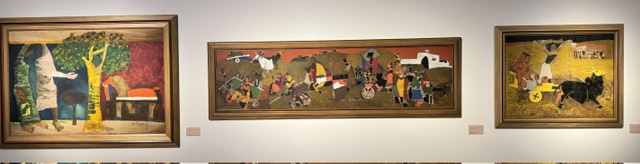
At the start, aside from a large and colourful gallery of the most famous auction-topping artists such as M.F.Husain and F.N.Souza, there is a sense of rebellion against destruction of human habitats, demonstrated in various ways (images above).

Three works by M.F.Husain at Christie’s

Montages of photos by Gauri Gill overlaid with ink drawings by Rajesh C. Vangad show scenes such as Factory and River (above) that depicts an industrial complex encroaching on indigenous peoples’ land. Sudhir Patwardhan, a well-known chronicler of Mumbai life has his The Clearing (2007) on show, depicting open land being swallowed by the relentlessly expanding urban sprawl.

Other artists follow a similar theme which includes Warli indigenous art from Maharashtra. That blends in another part of the exhibition with Gond tribal art from Madhya Pradesh, notably by the most famous Gond, Jangarh Singh Shyam.

Christie’s displays various artists in each gallery to develop its themes, whereas Sotheby’s focuses on a single artist in each of its sections.

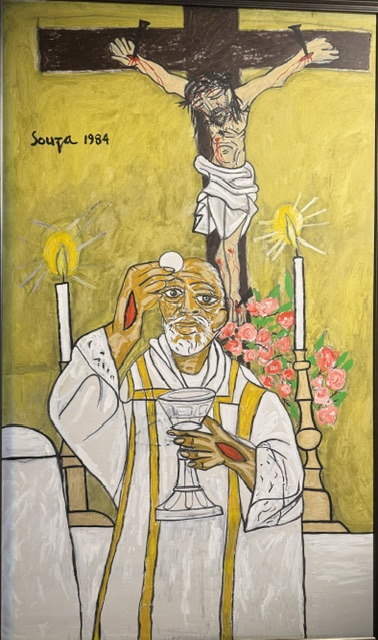
F.N.Souza’s “Crucifixion” – courtesy Alkazi Collection

Called The South Asia EditSotheby’s has works for sale by five famous artists that span painting, printmaking, sculpture and ceramics, plus four works that are not for sale by F.N.Souza, the famous Progressive, from the respected but rarely seen Alkazi Collection in Delhi. 

Souza’s dominant work is Crucifixion (1984), a  93in x 54in acrylic on canvas. He has painted this subject several times and he is usually seen as a critic and angry rebel against the Roman Catholic Church, in which he was raised in Goa.

He has however given himself a religious role as the priest serving communion in Crucifixion, with his hands showing the wounds of Christ hanging on the cross behind. One interpretation is that this shows Souza’s more tolerant view of religion later in his life, though his face has a rather questioning look that, as one would expect, contrasts and maybe lacks respect for what is happening.

The works of four of the other five artists come from their estates’ collections, providing strong provenance since they will have never been to the market. The artists are India’s Bhupen Khakhar and Mohan Samant, along with husband and wife Zahoor ul Akhlaq and Sherezade Alam from Pakistan whose works have been curated by Amrita Jhaveri of Jhaveri Contemporary. Then there is Indian-American Zarina with works from various private collections.

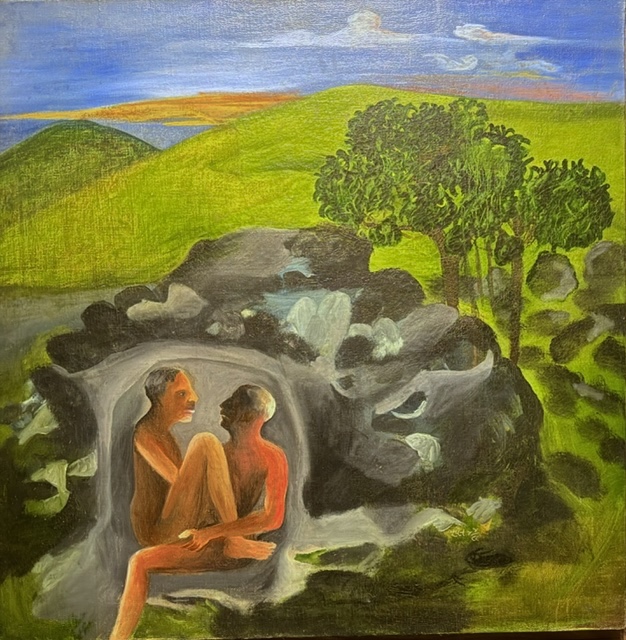
Bhupen Khakhar’s untitled work (1988) 37ix37in oil on canvas

The focal point for Bhupen Khakhar, India’s most prominent gay painter, is an untitled 36in x 36in oil on canvas (1988). Believed to be priced at £2m, it depicts in classic Khakhar style two men embracing with a rural landscape in the background.

More interesting though is a fascinatingly wide range of Khakhar’s drawings, etchings and prints that have never been seen before, many but not all with gay themes.

The works by Mohan Samant include the artists’ famous music and dance series, while Zarina has a range of printmaking, collages, and sculpture using handmade paper, woodcuts mixed with pewter and gold leaf. Sheherezade Alam’s show consists of 32 small ceramics while Zahoor ul Akhlaq has a range of brightly coloured acrylics and other works.

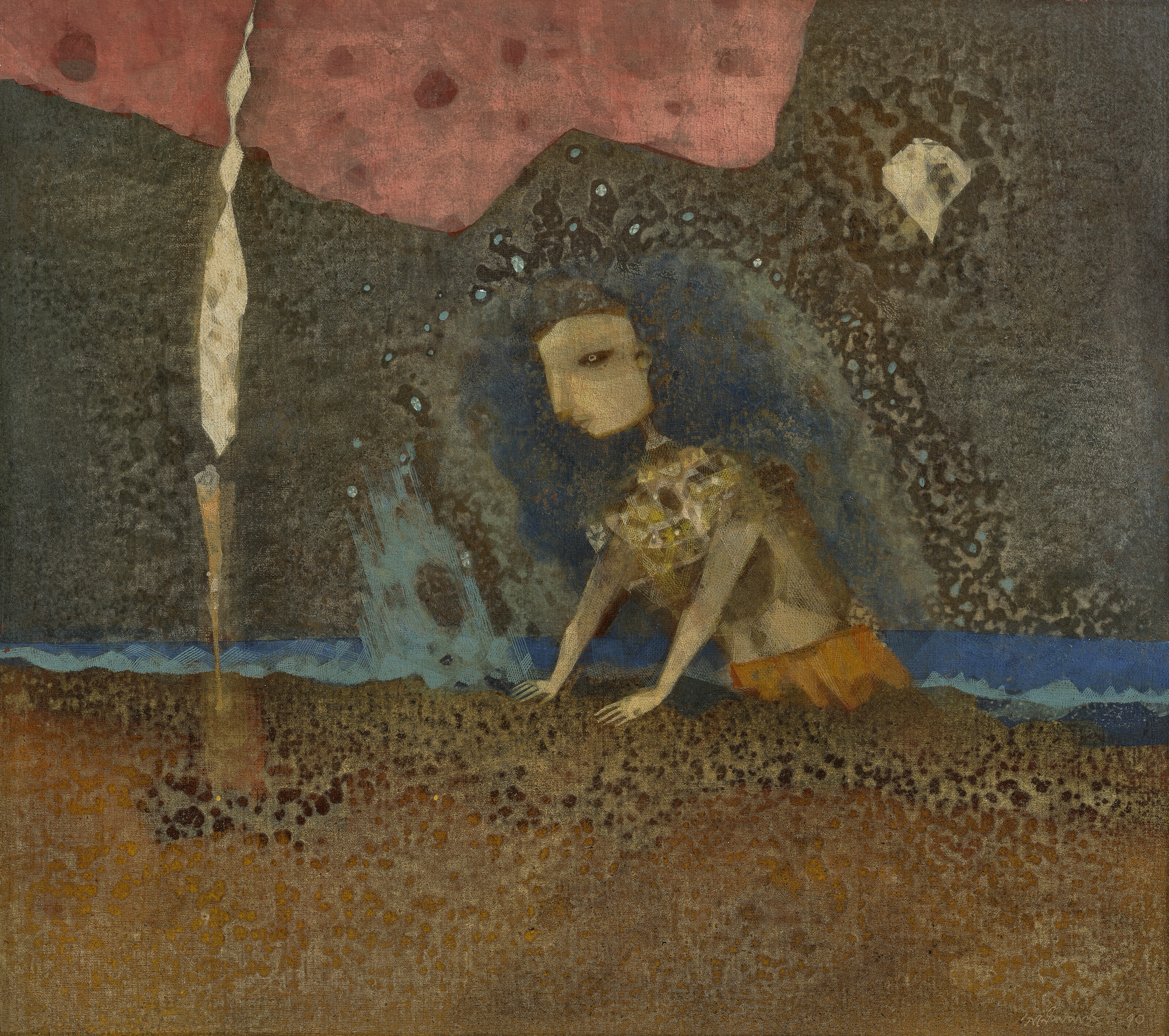
Mohan Samant’s “Kathakali Dancer” (1990), 67x60in oil, spackle, wire and mixed media on canvas

Manjari Sihari-Sutin, who heads South Asian art at Sotheby’s suggests that a for-sale exhibition gives buyers, including top collectors, a chance to acquire instantly instead of maybe losing at an auction. For sellers, prices could be higher because estimates were often pitched low in auction catalogues to draw in bidders.

This has been a hectic five weeks of Indian and other South Asian art in London. It followed on from a Saffronart auction in April, when two Indian tycoons created an $18m record for a single Indian work of art at auction, and began with Christie’s $25m sale of the Bengal-based Goodricke collection by the Camellia group.

Next came the opening of the Anish Kapoor exhibition at the Hayward Gallery and then the London galleries’ weekend splurge of events along with an opening at the Hepworth Gallery in Wakefield. Now there are these high profile and wide-ranging exhibitions that are notable, like the galleries’ weekend, for the growing recognition of work from Pakistan and other parts of South Asia as well as India.

Christie’s and Sotheby’s both staging exhibitions in July

Shows also at Wakefield’s Hepworth Gallery and in Bradford

The spread of South Asia’s modern artistic talent in Pakistan and Bangladesh as well as India is being demonstrated in the region’s current art boom that has led to a record activity in London this summer. Events have spread from small venues to Tate Britain, Christie’s and Sotheby’s. 

This underlines London’s central role that is evident, not just in auctions generating record prices for individual artists, but in the demand for private sales and in not-for-sale exhibitions.

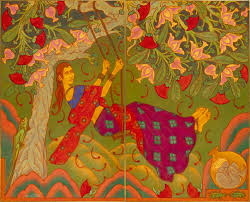
A.Ramachandran’s “Girl on the Swing” oil on canvas at Vadehra’s exhibition

Following the past month’s major £19m Christie’s auction of the Goodricke tea estate’s collection, and the opening of the Hayward gallery’s Anish Kapoor exhibition, Christie’s and Sotheby’s auction houses both have their first non-auction exhibitions next month.

Shows by many other galleries are under way, almost all leaving aside the famous Progressive group of artists that dominates the top end of auctions. 

The latest to open is Sakshi from Mumbai at London’s Mall Galleries, while Delhi-based Vadehra has a show at the Frieze in Mayfair, and Mumbai’s Jhaveri Contemporary opened an exhibition at its small private Kensington gallery last week. London galleries with exhibitions include the Victor Miro in Islington, the Grosvenor in Mayfair, and Tate Britain.  Outside London there are exhibitions in Wakefield and Bradford, both adaptations of London shows last year. 

Surendra Nair’s “Doctrine of the Forest” in Sakshi’s exhibition

Many of these exhibitions are aimed at buyers making a mid-summer visit from India and looking for art deals that they might continue negotiating when they return home. Some of the artists and galleries have also been at this year’s Venice Biennale where India had a substantial presence. 

Called Unfolding Narratives, Sakshi’s week-long show  celebrates the Mumbai gallery’s 40th anniversary and precedes a bigger institutional exhibition in London next year. 

Six contemporary artists – Amit Ambalal, Manjunath Kamath, Ravinder Reddy, Rekha Rodwittiya, Shine Shivan and Surendran Nair – reflect the traditions of tribal art by telling stories in a modern setting. “The narrative becomes fertile ground for playful reflection, speculation, autobiographical impulses, feminist resistance and socio-political critique,” says Geetha Mehra, the gallery’s founder and director. 

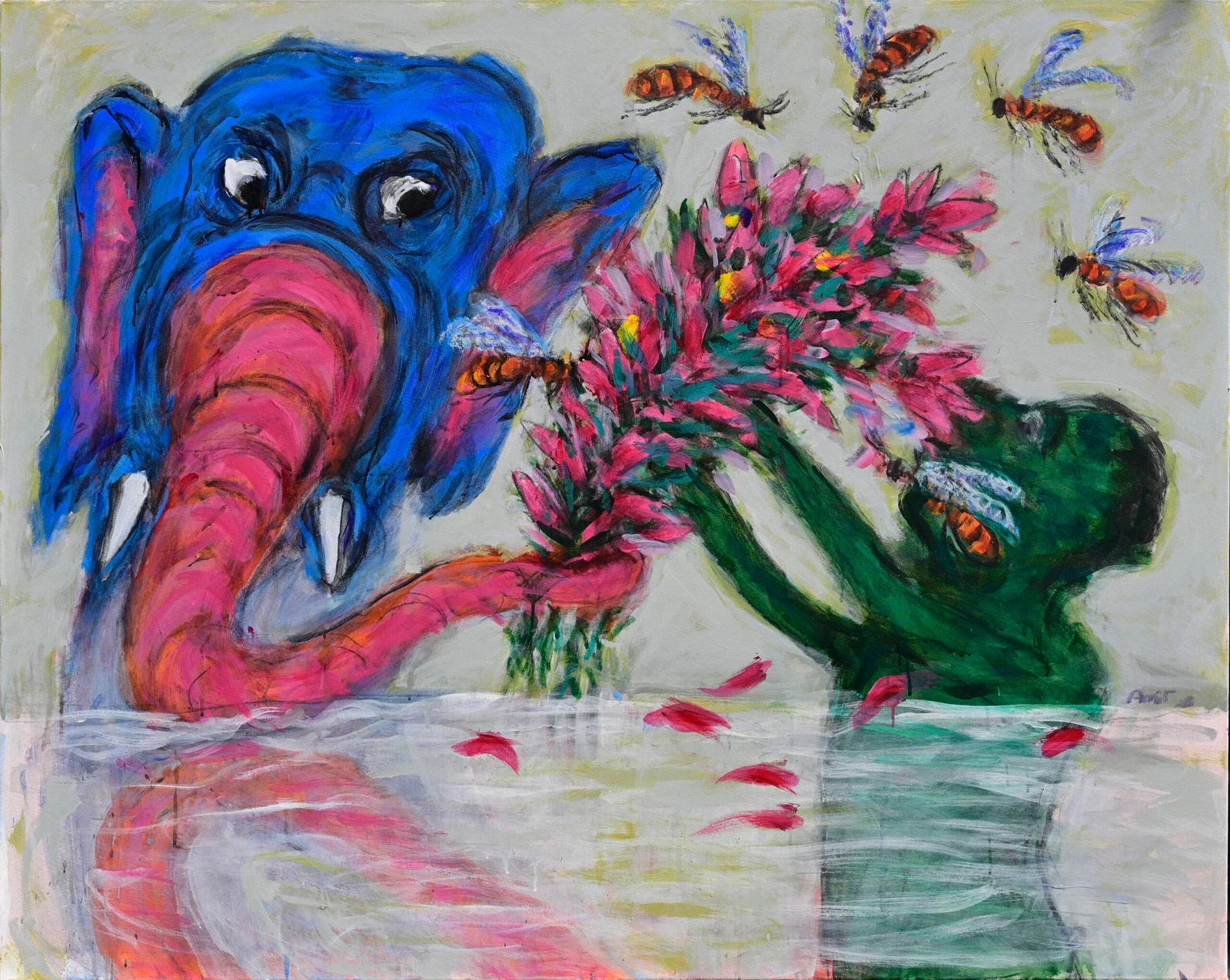
Amit Ambalal’s “The Bouquet” acrylic on canvas in Sakshi’s exhibition

Reddy is perhaps the most widely known with large scale brightly coloured sculptures of heads and female figures. Sakshi says they span secular and sacred crossroads. Reddy told me when we met at the Jaipur literature festival in January that he started by shunning modern sculpture, which was “alien” to him. Instead he looked at folk, tribal and temple art for inspiration, as well as art from places like Egypt, South America and elsewhere.

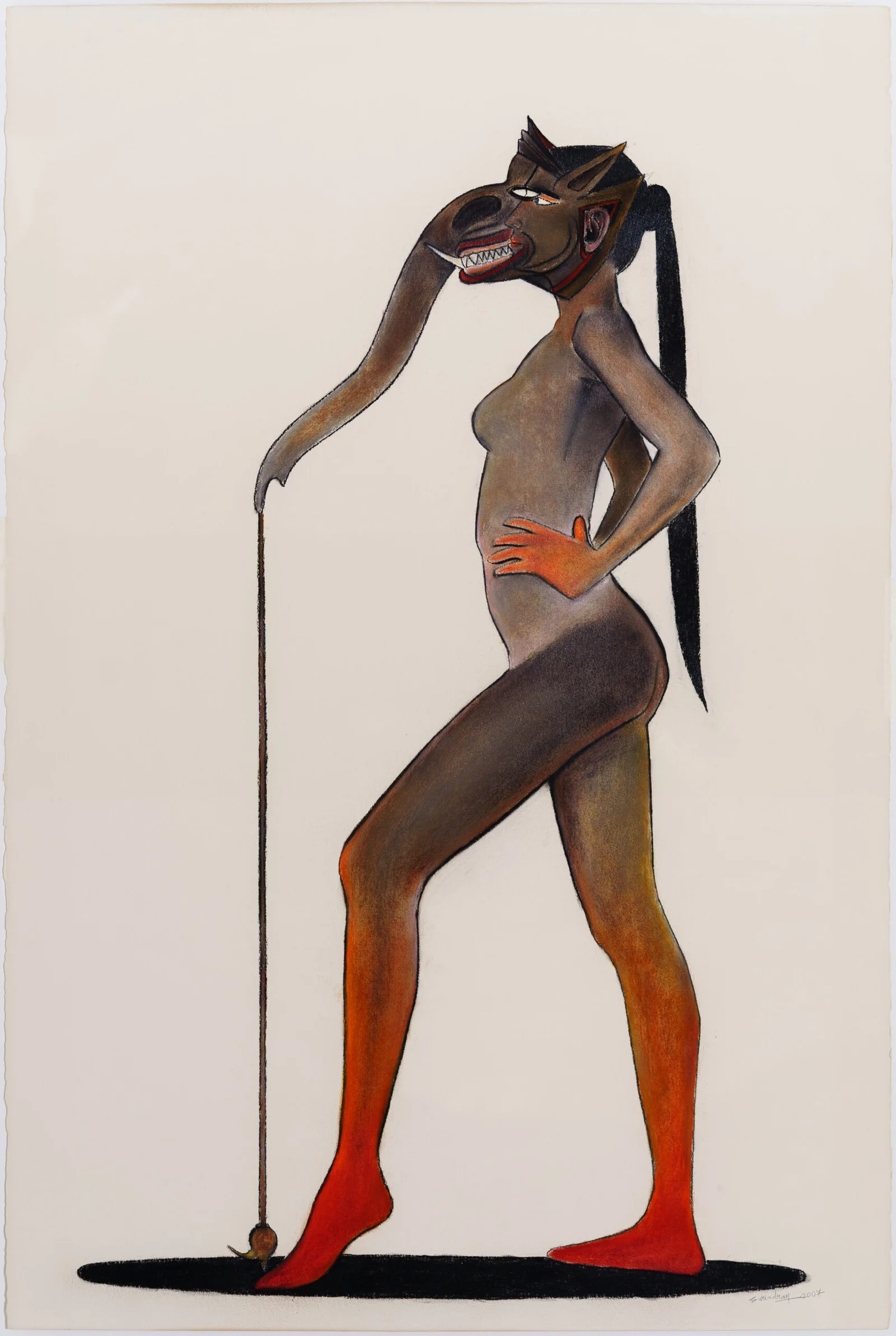
Other works include Ambalal’s fun depictions of animals including a happy elephant with a bouquet of flowers. Rekha Rodwittya, whose works have been described as “strong, politically vigilant feminist”, has two large water-colours over digital prints, one titled Home is Wherever You Are. Her partner Surendran Nair has striking human figures with distorted animal heads. All three are from Gujarat that is celebrated for its Baroda school of art.

“A Posh Supper” by Sabrina Tirvengadum at Jhaveri

At Jhaveri, Sabrina Tirvengadum, a deaf British Mauritian artist of Indian origin based in London, has works that stem from her family’s history as indentured labour. Using AI and digital printing with collages, she reimagines old family photographs into works that she produces in runs of five. (She was featured on May 9 in the FT Weekend Magazine)

Titled A singular Modernist, Vadehra is showing large paintings, drawings and sculptures by A. Ramachandran, a prolific artist who died in 2024, and is known for his rural and tribal focus on Rajasthan. Uma Nair, a leading Indian art critic, says that “the colours, the odhinis and turbans, dhotis and lehengas and lush tropicana and insects and lotuses all celebrate fauna and flora”. Also at the Frieze is a group show by the Mumbai gallery Project 88. 

Two leading artists, American-Pakistani Shahzia Sikander and  N.S.Harsha from Mysore in Karnataka, are on show at the Victoria Miro gallery. 

“Camel and the tent times” acrylic on canvas by NS Harsha at Victor Miro

All the works by Harsha, who is represented by Mumbai’s Chemould Gallery, are believed to have been placed with collectors. His intricate, large-scale paintings mix Indian miniature traditions with contemporary imagery including people at work in the fields of Karnataka, along with another popular theme of small lamps.

In an exhibition titled High Seas; Closed Skies the works by Lahore-born Sikandar are dominated by a powerful nine-minute animation called 3 to 12 Nautical Miles. This joins the popular negative theme of empire, trade and migration that was the focus of an animation at the Singh Twins exhibition in Kew Gardens six months ago. 

Started in 2015 (before the Singh Twins’ work), it is based on hand-painted images and traces the “entangled histories” of the British East India Company, the Mughal Empire and Qing dynasty along with “colonial extraction, the opium trade and contested sovereignty”. Drawing on miniature painting traditions, Sikander questions “power, identity and historical memory while offering poetic visions of resilience and renewal”.

An image from Shahzia Sikander’s “3 to 12 Nautical Miles” animation at Victor Miro

Mohammed Z. Rahman, a young British-Bengali artist, has a small innovative exhibition at Tate Britain titled Never the Same. It consists of two collections of small paintings, enclosed in open-sided timber framed pavilions, based on two works already in the Tate collection. One pavilion titled The Spaghetti House starts with a story the artist created with his six-year-old niece and continues the spaghetti theme inside. The Lovers starts with six people in a tight embrace and continues with a love and creation theme.

Mohammad Z. Rahman’s “The Spaghetti Hoiuse” at Tate Britain

Grosvenor Gallery in Mayfair will be showing paintings by Pakistani artist Jamil Naqsh, who is best known for his figurative oil paintings of women with pigeons,  from next week.

In Wakefield, there is a continuing exhibition at the well-known Hepworth Gallery of 150 works by Mrinalini Mukherjee and four other leading women sculptors. This moves on from a Mrinalini retrospective in London’s Royal Academy of Arts (RA) at the end of last year.

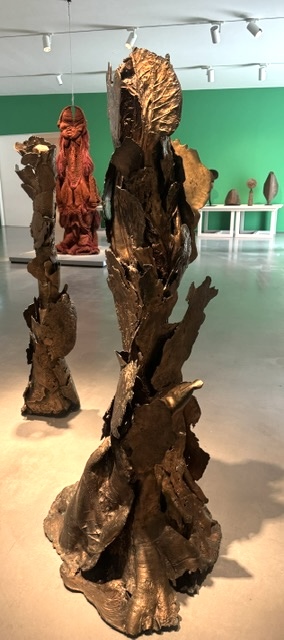
Mrinalini Mukherjee’s “Forest Flame” bronze sculpture with a large hanging hemp sculpture in the background at the Hepworth. Photo John Elliott

Titled Mrinalini Mukherjee: Unbound Forms – Women Sculptors of India and Bangladesh, it places Mrinalini, who died in 2015, with two other Indian Bengalis – her mother Leela and Meera Mukherjee (no relation) along with Novera Ahmed from Bangladesh and Pilloo Pochkhanawal from Maharashtra

The focus is on Mrinalini’s massive hanging textile sculptures and other striking bronze works. There are also drawings, etchings and watercolours, plus Ahmed’s sculptures. Here and elsewhere in the exhibition there is a backdrop of a strong green wall reminiscent of Bangladesh’s national colour, though officially it was chosen to set off the bronze sculptures.

The star piece, which was also at the RA, is Pakshi, Mrinalini’s iconic 7ft high suspended sculpture of voluminous golden-brown to pinkish red knotted hemp resembling both a deity and a human figure. Some people find works such as this one disturbing; others see sensuality and eroticism or spirituality. It is dramatically set off by larger bronze sculptures that Mrinalini worked on in her final years.

“They were five pioneers of modern art, working in the same direction in terms of craft traditions, spirituality, eroticism and the natural world,” says Laura Smith, the co-curator and Hepworth’s artistic director. “This constellation of interests and techniques is present across all of the work on show, from Mrinalini’s approach to macrame [knotting], the erotic, mythologies and nature, to Meera’s use of very traditional casting techniques and Pilloo’s incorporation of natural materials.”

“Snake painting” by Novera Ahmed – spray paint on canvas – at the Hepworth

In Bradford, 20 miles north of Wakefield the works of young contemporary artists from across South Asia are on show, following on from an exhibition at SOAS in London last year. This has drawn attention from the local Pakistani diaspora that makes up 25% of city’s population. 

The co-curator, Manmeet Walia, told the BBC that Bradford’s history as the wool capital of the UK led to the inclusion of textiles that had helped increase the number of South Asians visiting the gallery “to explore their shared history”. 

Next month’s exhibitions by Sotheby’s and Christie’s will be the first time that the two top international auctioneers have held coinciding exhibitions in London. They follow a large selling exhibition at Philips auction house last year. Both start within three days of each other in mid-July. 

Christie’s announcement came first, a month ago, saying it would be displaying not-for-sale works acquired by Kiran Nadar, India’s foremost collector, for her expanding museum activity in New Delhi. 

Sotheby’s followed this week, saying it would have works by six famous artists spanning painting, printmaking, sculpture and ceramics. Most will be for sale: those that are not will include works by F.N. Souza, a leading Progressive, from the Delhi-based Alkazi Collection of Art. 

Also underlining the role of London is AstaGuru, a Mumbai based online auctioneer, opening an office and small gallery in South Kensington and showing works by Krishen Khanna, a leading member of the Progressives. It generated auction sales of approximately $14m this month. Market leader Saffronart, which has had a gallery in Mayfair since 2008, had $11m sales, while London-based Bonhams had a live £2.1m auction.

Troubling undertones in enigmatic installations

Indian-born, British sculptor Anish Kapoor has hit the headlines with a dramatic exhibition at London’s Hayward Gallery that includes three massive red sculptures and over 80 other works, many creating the enigma and uncertainty for which the artist is famous.  

© John Elliott

This is the second solo exhibition at the Hayward for Sir Anish, 72, who has a rarely-mentioned British knighthood and is one of the world’s most famous and financially successful sculptors.

It opened last week and is a magnificent and rare return to the Hayward by the artist after his first solo show there in 1998, Twenty years earlier, when he was only 24, he had participated just after he left art college in a group show titled New Sculpture with an early version of his 1000 Names piles of coloured pigments 

The Hayward is one the most grim examples of Britain’s 1960s grey concrete architecture and Kapoor invades it with his strong red works. You can view them either simply as interesting visual compositions, or delve into the artist’s sometimes troubled thinking, with the aura of enigma constantly present.

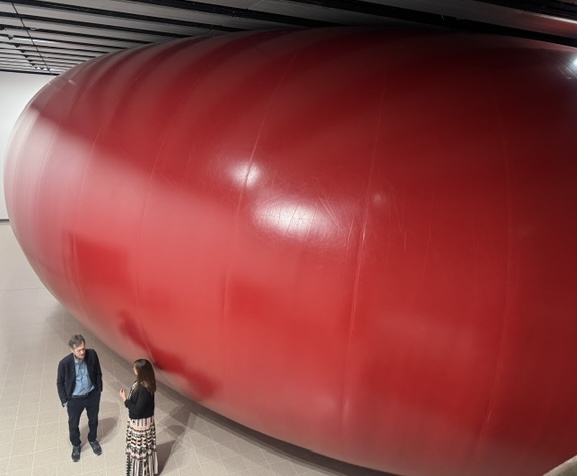
The entry to the exhibition, through one of the Hayward’s insignificant small doorways, presents the immediate shock of a bright red inflated bulbous PVC membrane. Called All of Nothing and completed this year, it fills half the huge room (below), reaching up six metres to the ceiling. 

Ralph Rugoff, the curator, being interviewed under “All or Nothing” (2026) © John Elliott

There are more massive shocks in red later – a monumental installation sprawling across a room suspended from the ceiling, and another built up like a mountain from the floor, though Kapoor told the Art Newspaper: “Just because a thing is big, it doesn’t mean it’s of any interest or even good”. All three go beyond what is usually thought of as a sculpture, each filling an entire section of the Hayward. 

Ralph Rugoff, who curated the exhibition and has just retired after 20 years as the gallery’s director, talked at the media preview about the PVC membrane as “this enormous bulging object….almost kissing the sides of the gallery”. It was “almost in an intimate relationship with this brutalist architecture and a love letter to this brutalist building”. 

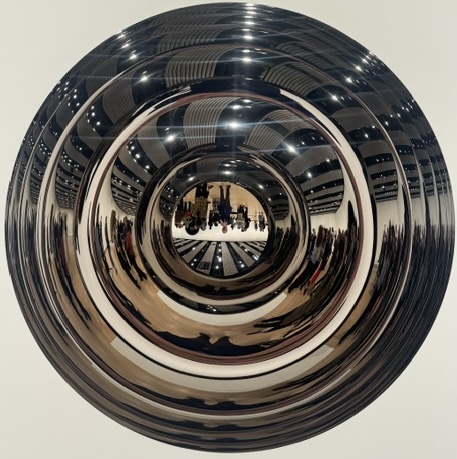
Conclave “Iris” (1998) that draws you in as you walk closer, upside down

He added that it was “an enigma that you can’t see the whole thing because it blocks your way, you can’t walk around it .…squeezed by this brutalist corset”. Kapoor has echoed the thought, talking about “the body being pushed into a particular relationship between the architecture and the object that’s very important”.

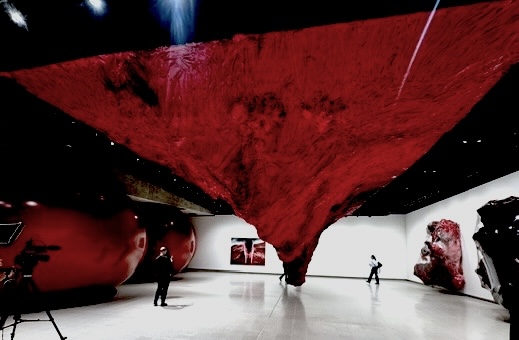
In the floor above the bulbous All of Nothing, hangs what looks like an upside-down  mountain suspended weirdly from the ceiling (below), creating the feeling up close of being smothered in a cave. Completed in 2022 and called Mount Moriah at the Gate of the Ghetto, it defies gravity as it plunges down to just a few inches above the gallery’s floor tiles. 

The title refers to the place where, in the Bible, God told Abraham to sacrifice his son Isaac. Art critics have interpreted the work as a mountain running red with blood as if the sacrifice had happened. “A pendulous mass of engorged scarlet and black paint on silicone, it crashes to a tip from the ceiling. An inverted mountain, the world up ended? Or cascading internal organs and raw flesh, the biblical sacrifice not averted?” suggests the FT

Mount Moriah at the Gate of the Ghetto” (2022) plunges down from he ceiling

On one side are three red inflatables, seemingly bulging up from the floor below as huge bags of blood.  On the other side are three sacrifice sculptures wrapped in PVC “resembling body bags bursting with butchered human remains”.

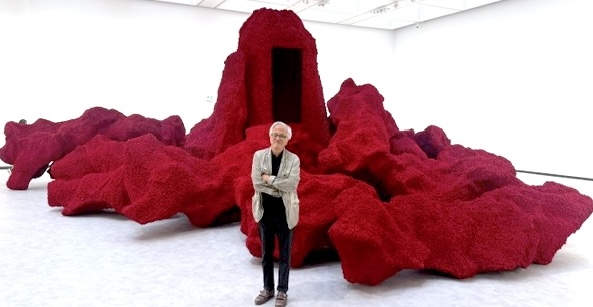
Next, on a floor above, is Ha Makom (two images below), which means both Place and God in Hebrew. (Kapoor was born in 1954 in Mumbai to a Jewish mother of Iraqi descent and a Hindu father).

“It’s a very big pigment piece and it is a very emphatic, insistent red made of bits that all sit in relation to each other,” he says. “So, what am I after? I’m after red, of course, in a very particular mood, but also otherness, the sense of this being, if you like, somewhere else, something else,” he adds, more enigmatically.

The Hayward says that the exhibition “highlights the artist’s ongoing exploration of perceptual illusions, including seemingly depthless ‘void’ works and sculptures coated with Vantablack, a light-absorbing nanotechnology so black it makes three-dimensional forms appear entirely flat when seen head-on”. The works “interrogate what Kapoor calls ‘the space of the object’, inviting us to look twice and question how we experience our environment.” 

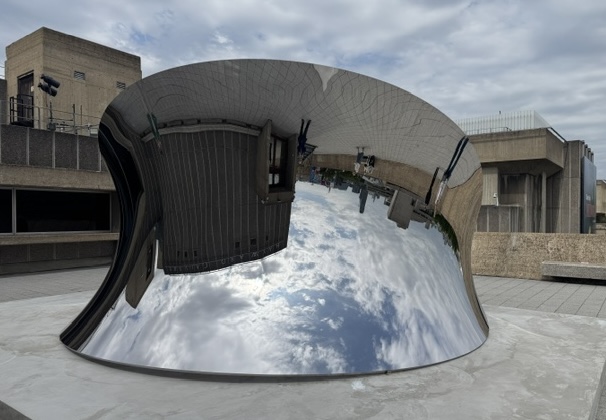
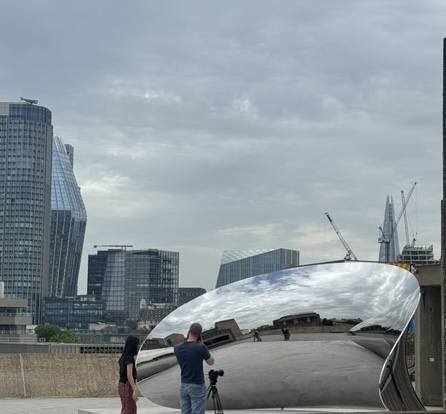
Large-scale mirrored steel sculptures stand on the Hayward’s outdoor terraces, creating reflections that distort the gallery’s rough concrete walls and London’s skyline, along with images of people viewing the works, often upside down. 

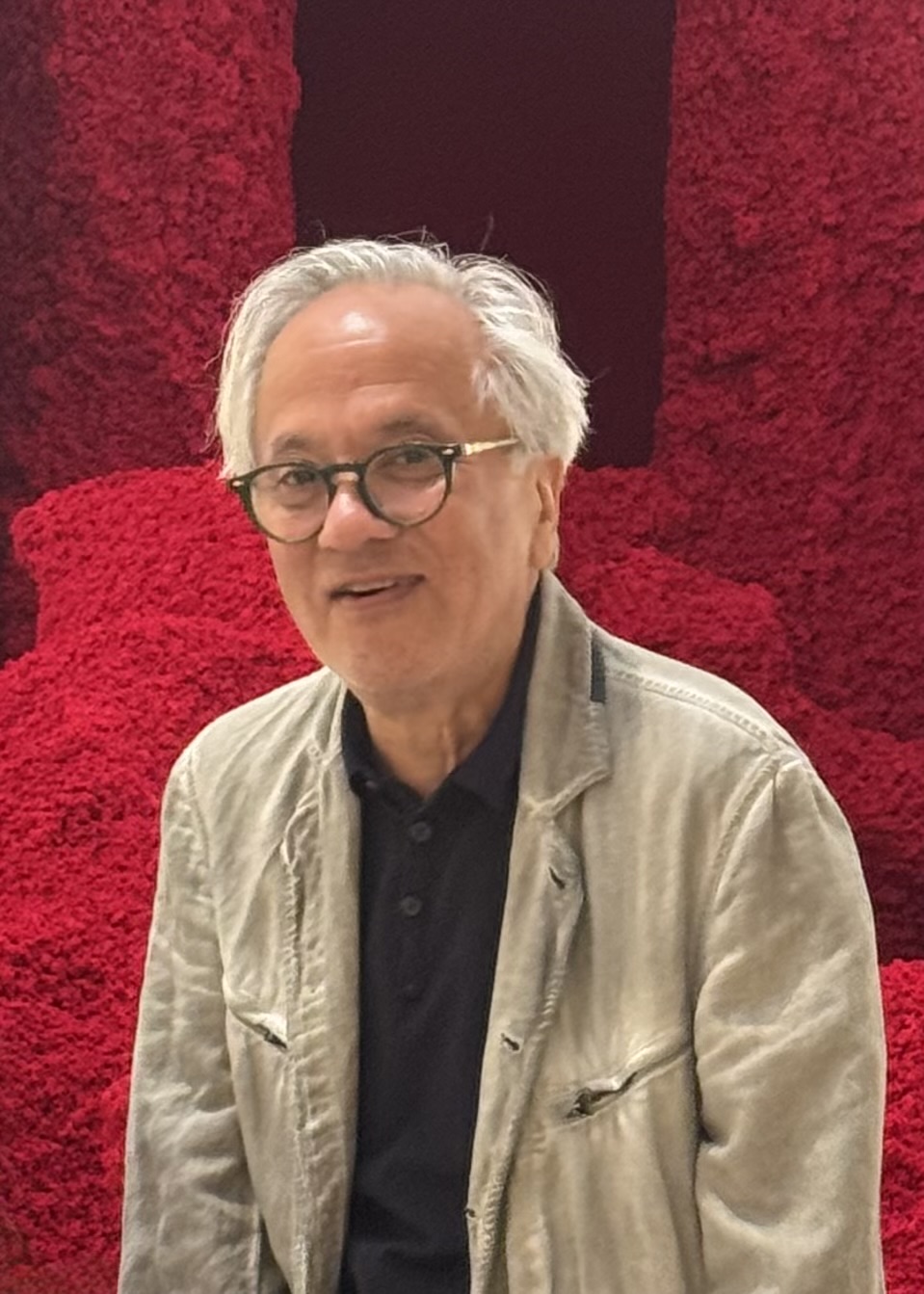
Anish Kapur with “Ha Makom” – “Place” or “God” in Hebrew (2026)

I first saw Kapoor’s sculptures at London’s Royal Academy in London in 2009 and then again in Delhi and Mumbai in 2010. There was more explicit active violence in those exhibitions.

In an installation called “Shooting Into The Corner“, an iron canon shot sticky chunks of red wax across a room repetitively every 20 minutes. In Mumbai, then marking the second anniversary of devastating terror attacks, this was seen by some as symbolic of repetitive shooting and the horrors of terrorism. 

“Tsunami” (2025) on the terrace

In London, a massive, tracked train-like block of blood-red wax, weighing more than 20 tonnes, squeezed its way through doorways linking galleries in the Royal Academy. Some saw that as a references to the Holocaust trains that carried WW2 Jewish prisoners to death camps. 

Now the active violence has been replaced with more thunderous static sculpture, which provoke thought about what has been created, so I asked Kapoor what had changed?

He replied that the violence of the 2009 work was specific to it and its context, which seems to have been to symbolise violence and tension in art-making and explore the paradoxical relationship between destruction and creation. “I carry on making my work in other ways,” Anish added. “What remains constant is a preoccupation with colour, form, and non form”. 

Kapoor was born in Mumbai (then Bombay) in 1954. London has been his main home since the 1970s, though he has properties in New York and the Bahamas. He was educated at The Doon School, known as India’s Eton, and then went to London’s Hornsey College of Art and Chelsea School of Art. Providing aid for displaced and homeless communities is one of his main charitable activities.

He still shows mixed reactions to his Indian origin, as he did 16 years ago. “I have always refused to be referred to as an Indian artist,” he said in the latest issue of the Apollo art magazine. “What’s important to me is to be referred to as an artist. I happen to be of Indian origin but that’s not my purpose”.

He was relaxed and happy doing endless interviews at the media preview. When I asked him if his Indian roots influenced his current work he said, “I am Indian, so I hope so, on much of my work. India is complex and my work is complex”.

The Goodricke Collection owned by Camellia sold as a non-core asset

Progressives replaced by Ganesh Pyne and other Bengal artists as auction leaders 

A rare auction with the entire 93 lots coming from a single collection produced record sales totalling £18,91m ($25.37m) at Christie’s in London yesterday. On offer was what is known in the art world as the Goodricke Collection, a name long connected with Calcutta and tea, or the Camellia Collection. 

The collection was formed during the 1990s and early 2000s with a focus on the artistic legacy of Bengal and the wider art of South Asia where a UK company, Camellia plc, has its origins in tea estates now managed by the Goodricke Group. 

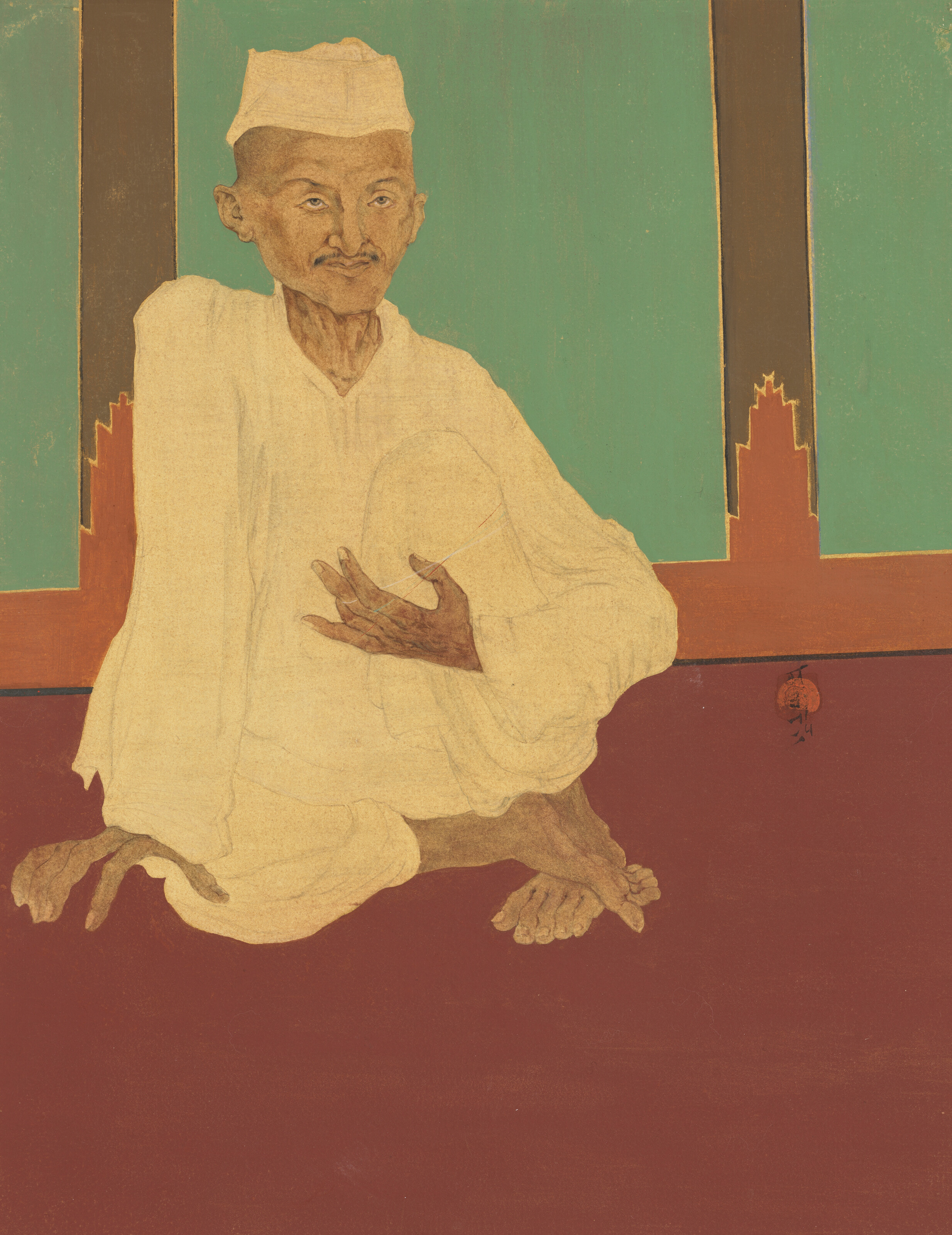
Abindranath Tagore’s “The Spinner of a Nation’s Destiny

The auction result was spectacular with all 93 lots sold, multiple times above estimates. They included 26 by Ganesh Pyne, a leading Bengali artist, that formed the core of the collection with five tempera paintings along with mixed media, fountain pen sketches and other jottings on paper or card. The collection has been widely considered one of the most culturally significant institutional archives of Pyne’s career.  

Christie’s, which had hoped to keep Camellia’s name secret at the company’s request, stopped holding annual auctions in London seven years ago. It returned yesterday as a one-off because Camellia’s base is near London, and the works are in the capital – plus of course the attraction of old colonial ties. Camel

This led to the £18.91m total being the highest ever for the auction house’s South Asian modern art sales in London. Seventeen artists achieved world records, including Pyne on his 89th birth anniversary (He died in 2013).

The record prices were perhaps not surprising at a time when the market for Indian and other South Asian art is booming. What was remarkable was that the auction was not led by the famous Bombay-based Progressive’s Group that began in the 1950s and usually dominates the top ends of auctions with names such as Tyeb Mehta, M.F.Husain, and F.N.Souza. 

Damien Vesey, a Christie’s specialist who headed the auction, reflected the excitement in the auction room when he described the result as “sublime”, picking up on the auction’s title, Sublime Shadows: South Asian Art From a Distinguished Collection.

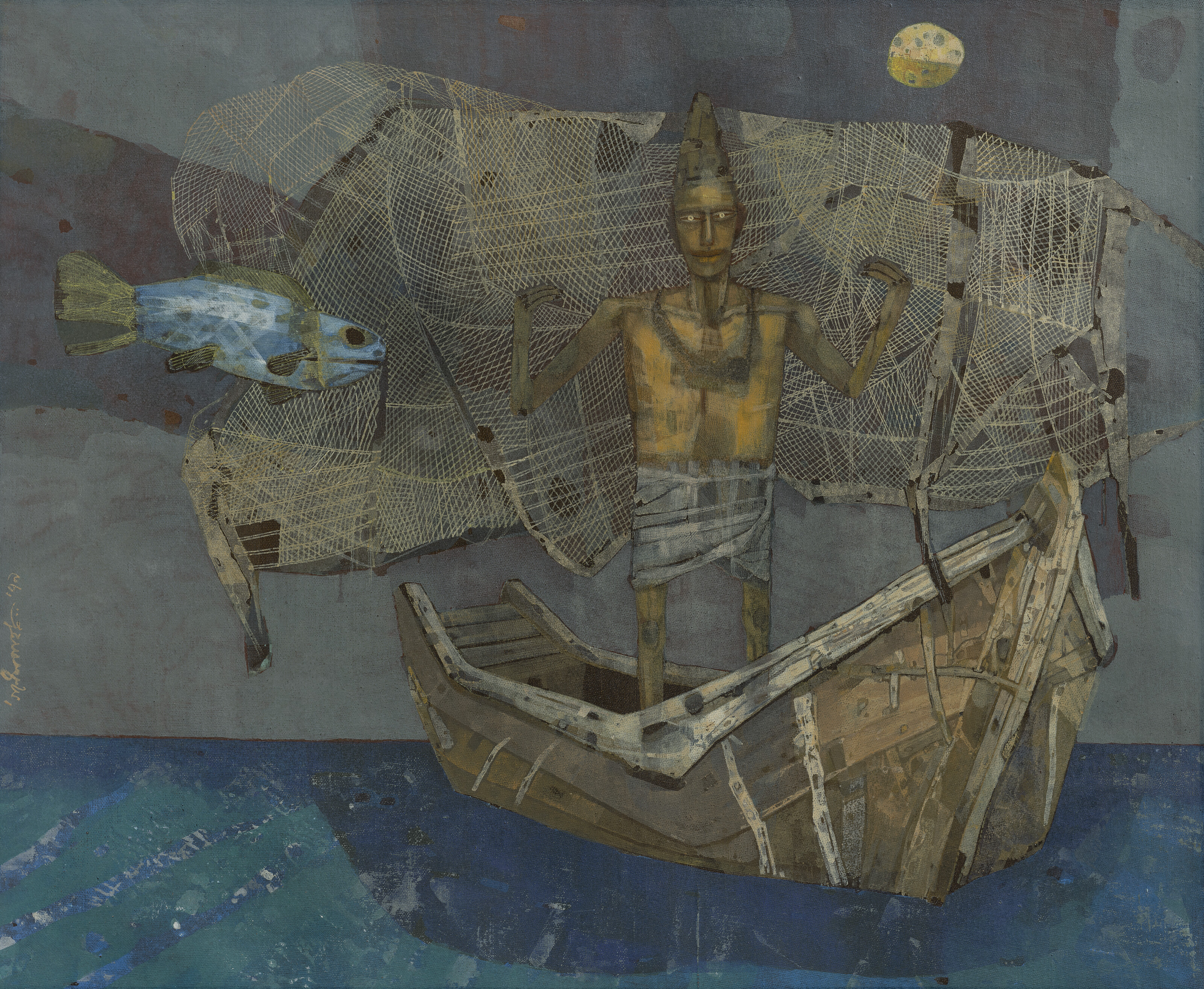
Ganesh Pyne’s “The Fisherman”

The auction drama started with the first lot (top) depicting Mahatma Gandhi, India’s independence leader, that hit a hammer price of £820,000 – £1.04m ($1.39m) including buyer’s premium – after some tough bidding on a surprisingly low estimate was £30,000-40,000. 

That was a record for a work on paper by the artist, Abindranath Tagore, a leading figure in Bengali culture and founder of India’s Bengal School of Art, who died in 1951. Titled, The Spinner of a Nation’s Destiny, it shows Gandhi’s fingers holding three barely visible strands of cotton in India’s national colours. 

A few minutes later, the eighth lot (above) brought the new Ganesh Pyne record of £3.8m ($5.0m) including buyer’s premium against a top estimate of £350,000. This beat his previous record of $2.51m set in March at a Christie’s auction in New York when Camellia first started selling Pyne’s works to “support the company’s value enhancement plan, which includes increasing investment into higher-return operating assets”.

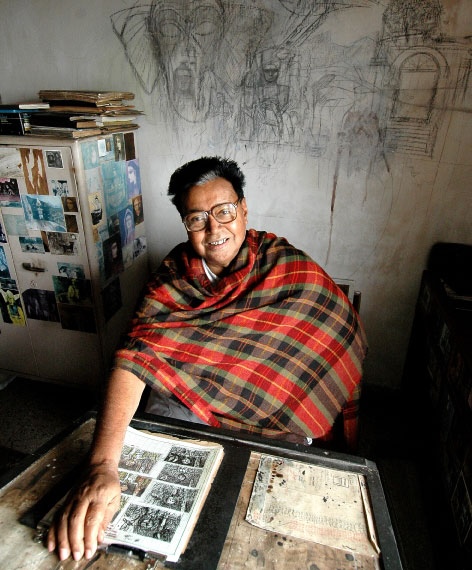
Ganesh Pyne

Titled The Fisherman and painted in 1979, this 18in x 22in tempera on canvas depicts what Christie’s describes as a “gaunt fisherman….monumental, suspended in time and inward looking”, standing in his wooden boat sailing across deep blue water. Two other similar Pynes (one below) each went for £2.37m including the premium against top estimates of £300,000.

Pyne was a reclusive modernist painter, influenced by Bengal School traditions with a romantic style incorporating the supernatural, mythology, and Bengali folklore plus what is described as poetic surrealism. Many of his works have dark moody overtones, maybe because he was deeply affected when he was nine by widespread killings in Calcutta (now Kolkata) a year before India’s independence in 1947. He gained national recognition after M.F.Husain named him the best painter in India.

It seemed something of a letdown when the auction moved away from the celebrations of Bengal art to offer a work by the esteemed V.S.Gaitonde, one of the Progressives. His 36in x 27in oil on canvas sold for a total of £2.25m, in line with expectations.

Ganesh Pyne’s “Under the Red Cloud” or “The Amphibian”, one of his two works that sold for £2.37m

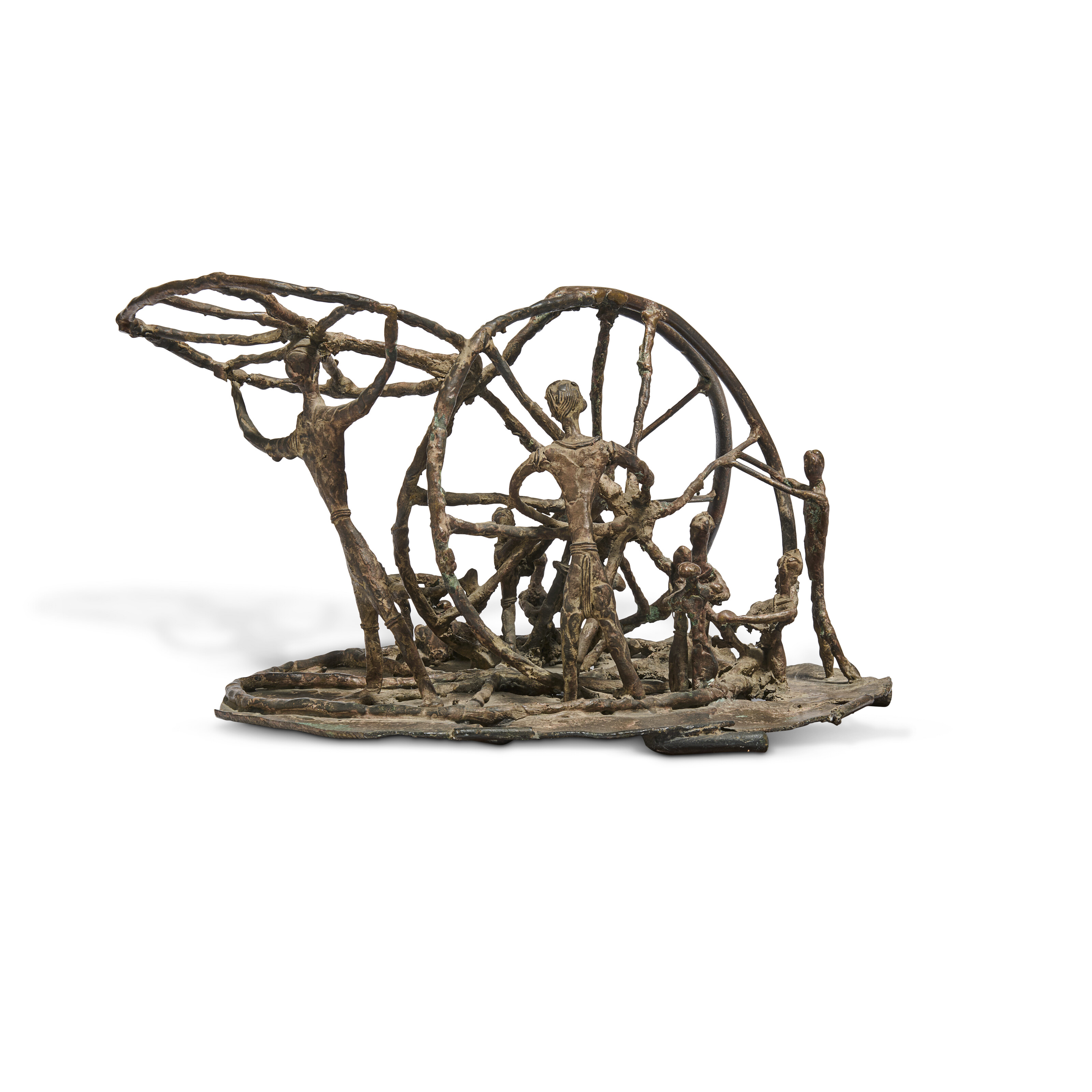
Moving back to Bengal, two small bronze sculptures by Meera Mukherjee sold well. One (bottom) depicted Wheel Builders and went for  £381,000, almost four times the top estimate, and a record for the artist. (Mukherjee’s works are currently on show at the Hepworth Gallery in the Yorkshire city of Wakefield along with three other female sculptors).

Other artists hitting record prices included K.K.Hebbar, Biren De, Ramkumar Baij, Badri Naryan and Arpana Caur.

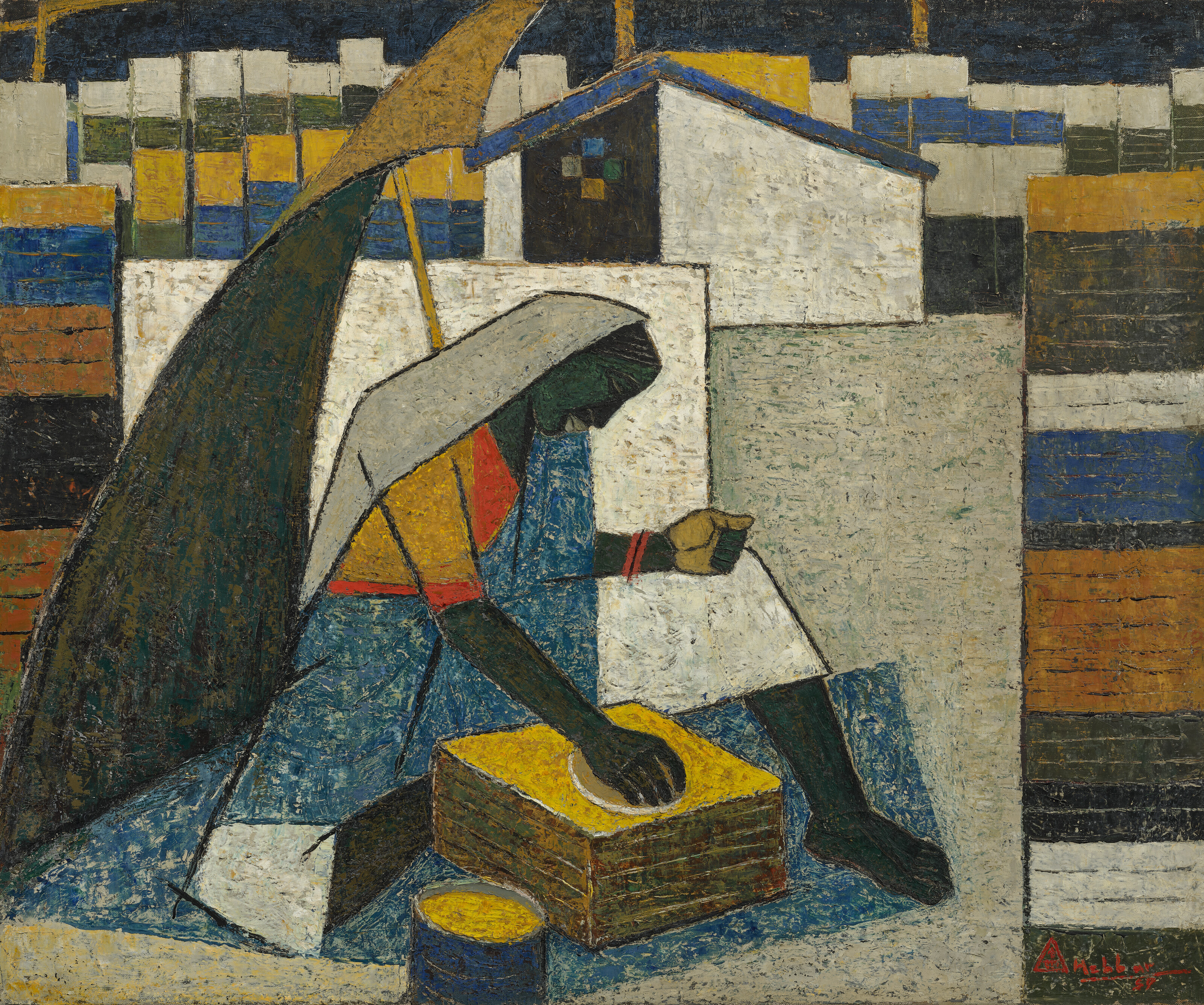
The Hebbar record was for Untitled (Gulmohar Tree), painted in 1962 which realised a total of £698,500, nearly six times the high estimate. The striking Hebbar work below, a 30in x 36in oil on canvas named Untitled (Women Making Chapatis), was painted in 1959 and sold for £406,400, five times the top estimate. 

Records were also set for relatively small amounts. Arpana Caur achieved a record for a work on paper  – £8,890, eleven times the low estimate, for Blue Buddha, 22in x 15in, and painted in 1991.

The Pyne works are discussed in detail in a book, Ganesh Pyne: Revelations, that was prepared in collaboration with Goodricke and published in 1999, documenting the Lawrie and Goodricke collection. Images of the works have appeared on the cover of the Goodricke house magazine.

K.K.Hebbar’s Untitled (Woman M<aking Chapatis)

The auction appears to have been triggered by a change of top management at Camellia. By the 1980s, it had become the world’s largest private producer of tea that now accounts for about 80% of turnover. It manages some 50,000 hectares of land with 76,000 employees in Bangladesh, India, Kenya, Malawi, South Africa, Tanzania, and Brazil. 

The collection has its origins in the purchase and merger of a large number of Indian tea estates in West Bengal and Assam in the 1960s and 1970s by an inspirational and reclusive Canadian investor, Gordon Fox. The estates included Alex Laurie and Jorhat Tea, estates owned by British tea planters and merchants and  at least eight UK Sterling tea companies. 

The Goodricke Group was established in 1977, to take over the extensive tea business operations and assets. It is 75% owned by Camellia plc, of which the majority shareholder (56%) is the charitable Camellia Foundation (Bermuda), that uses its dividends to fund charitable, educational & humanitarian causes.

Meera Mukherjee’s Wheel Builders

It was Fox who started corporate art acquisitions in India for Camellia. His focus was Company School art, Indian miniatures, botanical watercolours and stamp collections. Later the acquisitions evolved into contemporary works from Kolkata artists such as Ganesh Pyne. 

Fox retired in 1999 to Switzerland but remained a dominant investor till 2018 when he withdrew. That led to a complete change of management by 2023, after which the focus turned to disposing of non-core assets like Indian art and raising funds for core investments in the value enhancement plan, hence yesterday’s Christie’s auction.

But though Camellia was the actual owner of the collection, the name is not widely known. So, it was the name Goodricke that rang bells at yesterday auction, a reminder of the days long gone of British dominance in the Indian tea estates.

Significant win for Modi’s BJP in West Bengal state election

A blockbuster film star’s new political party tops Tamil Nadu poll 

The strength of India’s representative democracy, where voters produce surprise results that throw out long-established governments, has been demonstrated by results declared yesterday in the country’s recent state assembly elections, notably West Bengal and Tamil Nadu.

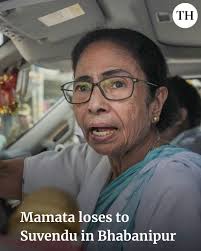
In Bengal the Hindu nationalist Bhartiya Janata Party (BJP) is launching a new political era with its defeat of the regional All India Trinamool Congress (TMC), founded and headed by Mamata Banerjee. The TMC has ruled for almost 15 years, following 23 years of continuous Communist (CPI-M) governments, and she has seemed almost unstoppable.

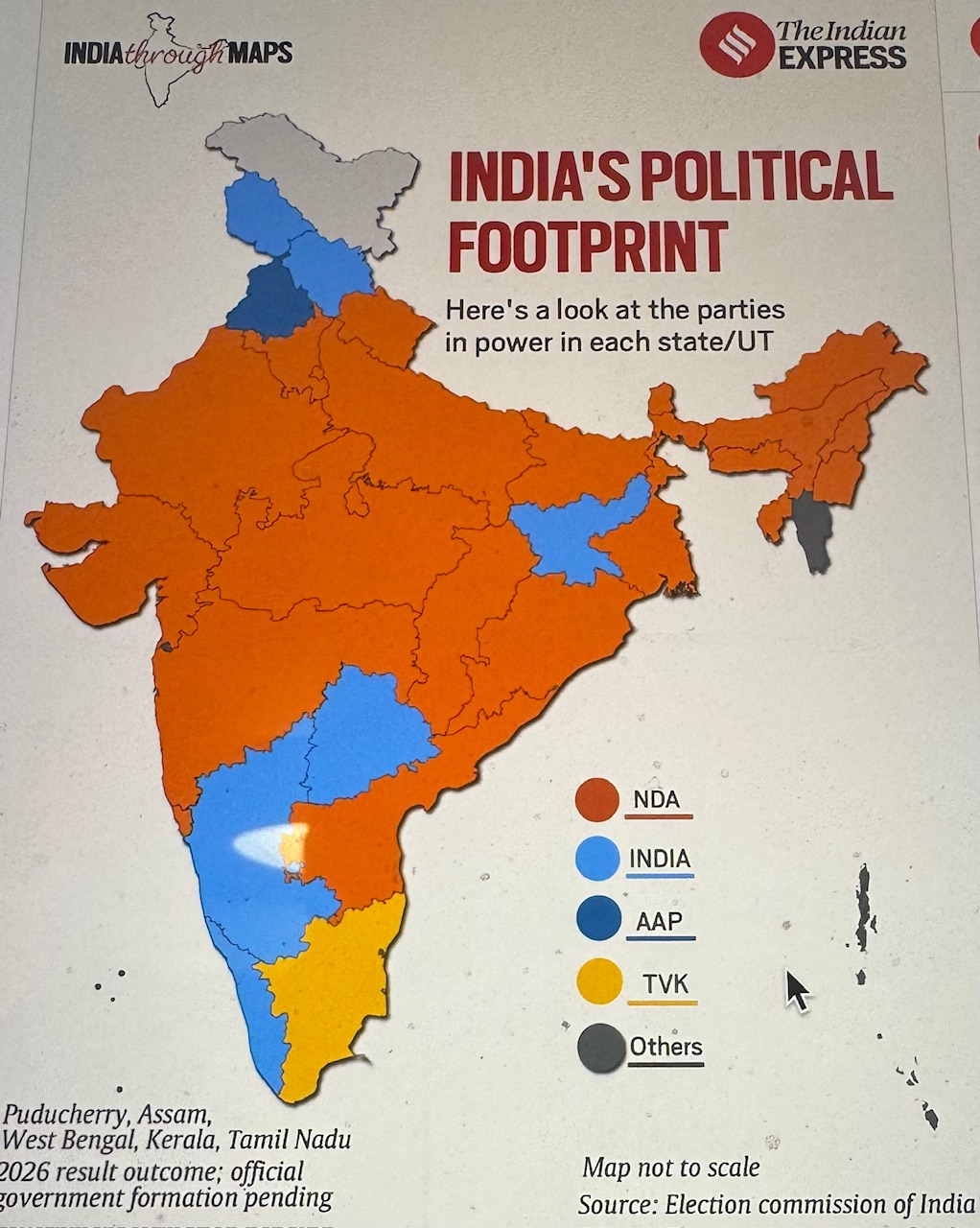
The map shows the states controlled by the BJP-led NDA in red and the Congress-led I.N.D.I.A group in blue

The result is a watershed victory for Narendra Modi, India’s prime minister, who had set Bengal as his next major target to build on the BJP’s established strength across east, west, and much of north India. Following yesterday’s results, it is in power in 22 states and union territories.

Banerjee played a major role among India’s opposition parties so her defeat is a blow for attempts to present a unified country-wide front against the BJP.

She lost her own seat and has alleged that the BJP “looted” more than 100 seats to give it around 206 out of a total 294. The TMC has won only 81.

There are likely to be more allegations of election fixing, and controversy over government control of the Election Commission – especially involving a recent election review that removed about 9m names from the voting lists to eliminate alleged illegal migrants from Bangladesh and duplicate entries. 

Tamil Nadu’s new political film star

In the southern India state of Tamil Nadu, a new party, the Tamizhaga Vettri Kazhagam (TVK) or Tamil Nadu Victory Federation founded just two years ago by Joseph Vijay, a top film star, has won control with 108 seats out of a total 234. This is not enough for a majority so the TVK will need to find allies to form a government.

The result confirms the power of the cinema in the state’s politics because the two long-running regional parties, the DMK and AIADMK, which the TVK is ousting, were also originally founded by film stars. Between them, they have governed since 1967

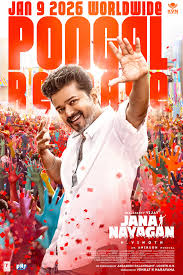
Sometimes called kaattin singam, which is Tamil for “lion of the jungle” Vijay, 51, has a big image and a charismatic presence.He said he was retiring from films when he founded his political party and is now known for his charity work with education, disaster relief and other social initiatives.

It was expected that he would make a mark, but the chances of him turning his film fan base into a political victory seemed impossible to most observers. It was forecast by only one out of half a dozen exit polls

Vijay in a poster for his yet to be released (and last) film

Vijay has promised a break from decades of corrupt dynastic rule with a focus on development and jobs for youth, emphasising Tamil regional pride and opposition to Hindu nationalism.

Also in southern India, a coalition headed by the Gandhi family’s India National Congress has won in Kerala after a decade in opposition, providing the party with a rare and much needed victory. Priyanka Gandhi, whose brother Rahul is the ineffectual leader of the party, holds a parliamentary seat in the state.

Significantly, the BJP has won only three seats in Kerala and one in Tamil Nadu, demonstrating Modi’s continued failure to win over the south apart from the tiny southern enclave of Puducherry where it is playing a small role in a victory of its National Democratic Alliance (NDA). The NDA is also holding on to power for a third consecutive term in the eastern state of Assam.

The West Bengal victory, which was far from certain, is a major boost for Modi’s image, though substantial credit will go to the BJP’s chief election strategist, Amit Shah, who is Modi’s main ally and tough home minister.

Modi’s problems – the economy and Trump

Modi has largely recovered from the BJP losing its absolute majority in the 2024 general election, but he has had recent setbacks, and India is facing economic problems from the US-Iran war, including rising energy prices. 

The government was defeated last month in parliament for the first time in more than a decade over legislation that would have reserved 33% seats for women in parliament’s Lok Sabha and state assemblies. It would however have also changed parliament’s seat allocation, reducing representation from areas that include southern India. 

A clip from “The Hindu” newspaper yesterday

Internationally, problems have escalated with US president Donald Trump, who has been developing a close relationship with Pakistan’s army chief, Asam Munir. That led to Pakistan achieving a level of international recognition that it has craved for decades when Trump picked Munir and Shehbaz Sharif, the prime minister, as mediators in the US-Iran war, with talks being held in the capital, Islamabad.

This shocked Modii’s government, which has painted Pakistan for many years as a virtually untouchable terrorist state. Foreign minister S.Jaishankar had been pursuing a policy of multi-alignment that straddled relations with the US, Russia and China as well as Israel and Iran, but had not envisaged Pakistan slipping through the network as a major player.

Modi said yesterday in a statement that the West Bengal victory “will be remembered forever. People’s power has prevailed, and BJP’s politics of good governance has triumphed. I bow to each and every person of West Bengal”.

He will however not find it easy to clamp the BJP’s nationalism on the state. He dreams of replacing regional identities with country-wide Hindu nationalism and the Hindi language, but he will encounter strong resistance because of strong Bengali loyalties, not least to the Bengali language.

The state suffers from slow industrial growth and serious unemployment so expectations will be high that the BJP will bring in a new era of job creation with investment, infrastructure development, and welfare schemes.

The BJP victory possibly reflects voter apathy for incumbent Banerjee and her TMC government more than it does desire for the BJP and all it stands for. The TMC has a strong grass roots network and continuing representation in local politics, so politically charged opposition and demonstrations, sometimes violent, are likely.

Shah managed to organise a victory, but ruling the Bengalis may not be so easy.

Veteran Indian tycoons Poonawala and Burman the buyer and the seller

Boom in India modern art market spreads through spring auctions

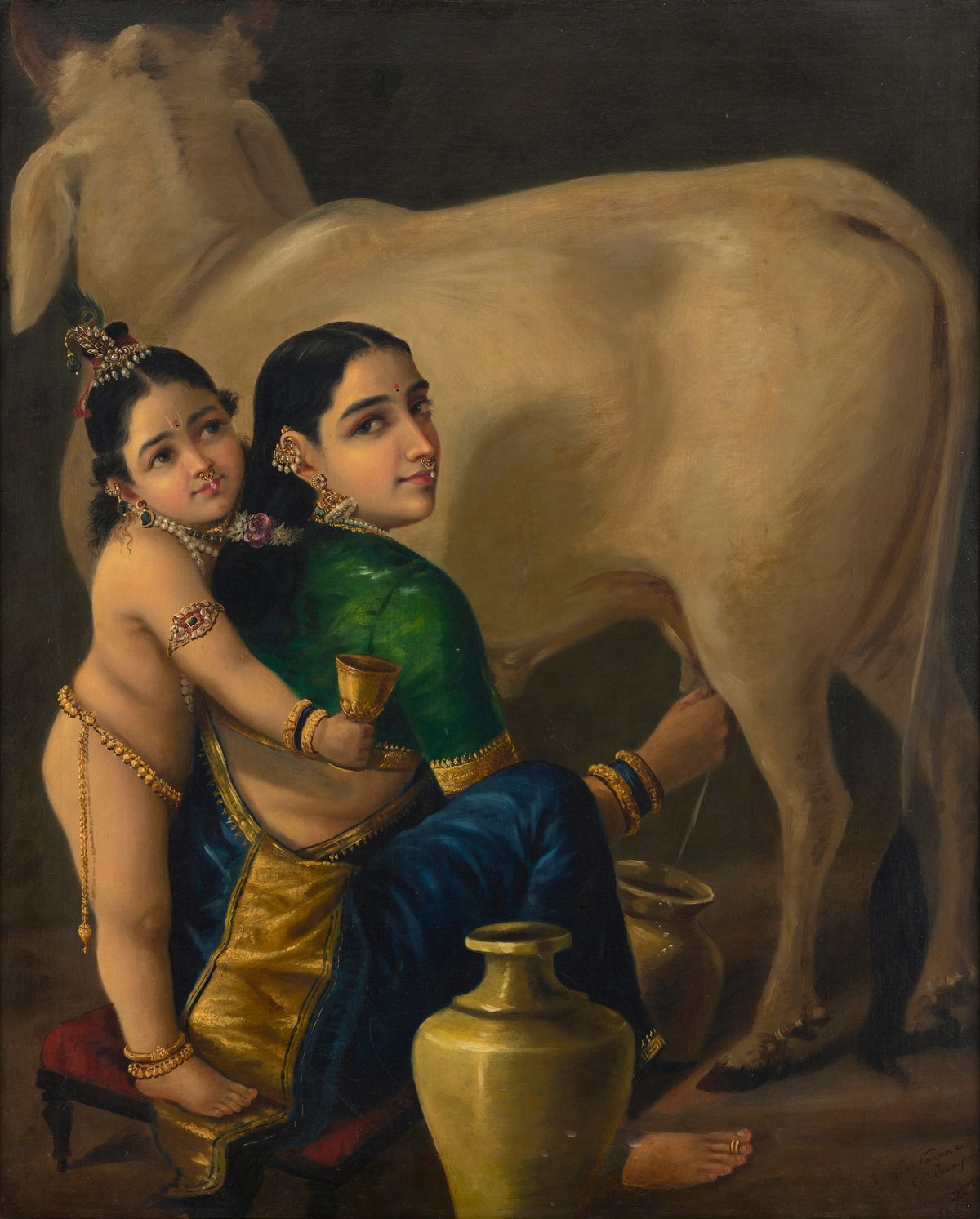
Octogenarian Indian tycoons in the pharma and consumer industries are believed to have been not only the buyer but also the seller of an oil on canvas (below) by Raja Ravi Varma, a famous and stylish 19th century artist, that set an unexpectedly high record price of nearly $18m for Indian art on April 2nd at a Saffronart auction in Mumbai.

This was one of many records set for artists during hugely successful South Asia spring auctions over the past month. Saffronart led with a total of $30.78m, while in New York Christie’s totalled $27.1m (the highest ever outside India), and Sotheby’s scored  $22.1m. In Mumbai, Pundole’s totalled $12.1m. (All include buyer’s premium)

Raja Ravi Varma's Yashoda and Krishna (1890s) is now the most expensive Indian painting sold at auction

Courtesy of Saffronart
“Yashoda and Krishna, the 35in x 28in record winning oil on canvas showing mythological figures of the infant Hindu god Lord Krishna and his foster mother Yashoda.

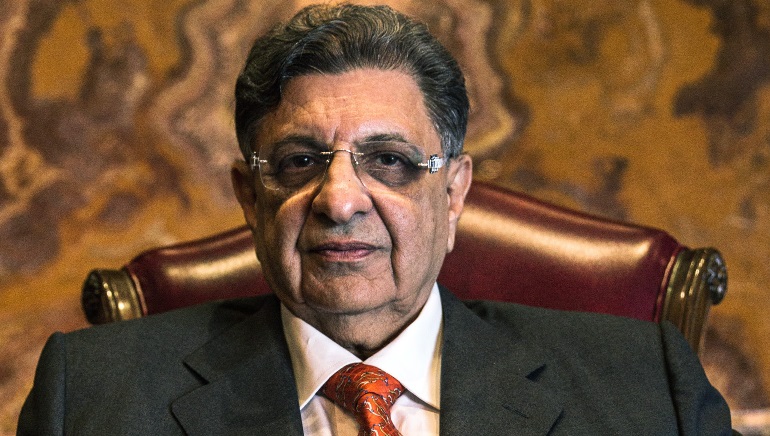
The buyer of the Ravi Varma was publicly announced by Saffronart – Cyrus Poonawala, 81, founder and managing director of Serum Institute of India, one of the world’s largest producers of vaccine, including for Covid.

That was a rare event because top buyers such as Delhi’s Kiran Nadar usually object to being named. Poonawala said he was “fortunate to out-bid” her. 

Market sources suggest that the seller was Vivek Burman, 88, former chair of Dabur, a prominent ayurvedic-to-consumer goods company, who was thought to possess the painting. The work however was being shown publicly for some years by the Delhi Art Gallery (DAG), including as recently as 2023 at the Art Mumbai art fair, making the ownership unclear – possibly joint between Burman and DAG. 

Poonawala’s winning bid (hammer price) of Rs140 crore ($11.29m) led to a total of Rs167 crore ($17.98m) including buyer’s premium. The previous record auction price of $13.5m was set a year ago at a Christie’s New York auction for a major work by M.F.Husain after an unexpectedly tough contest between two unusually persistent buyers, with Nadar winning for her large art museum, the KNMA, in Delhi.

It was not so much of a surprise that the sale of the Ravi Varma painting would set a new record. Dinesh Vazirani, Saffronart’s co-founder and ceo, seemed confident of a buyer when he showed the work with a $12m top hammer estimate in January on the margins of Delhi’s India Art Fair. Some viewers however were sceptical, given that Varma’s record then was just $5.3m, set in 2023

Dr. Cyrus S. Poonawalla
Cyrus Poonawala

“This strong result demonstrates a new sense of pride in the ownership of iconic works of Indian modern art for those who can afford it. The extraordinary heritage they embody is a great bonus,” said Hugo Weihe, an independent Indian art advisor.

For the market, the significance is that top prices have reached unexpectedly high levels at a time when the Indian economy is buoyant, with fresh buyers entering the market and pushing up prices at all levels. Uncertainties such as war seem to drive buyers and investors towards safe commodities like art.

“The glass ceiling has been broken,” said Conor Macklin, who runs the Indian art-oriented Grosvenor Gallery in London and is a co-founder of Art Mumbai. “New benchmarks are being set.” Ashish Anand, DAG’s ceo, called the sale “a defining moment for the Indian art market”.

Titled Yashoda and Krishna, the 35in x 28in oil on canvas shows mythological figures of the infant Hindu god Lord Krishna and his foster mother Yashoda. Saffronart’s catalogue says Varma was interpreting “the universally resonant theme of maternal love…a subject strongly embedded in Indian culture and devotional sentiment.”   

The Mona Lisa”

Anand described the work to the Indian Express as “a universal subject reminiscent as much of Madonna and Christ, or of any mother and child, and arguably the most iconic and desirable work, the Mona Lisa of Indian art”.

Varma died in 1906 so predates India’s leading modern artists such as M.F.Husain and Tyeb Mehta who usually top the auction sales. He married into the Keralan Travancore royal family and sought commissions from the rich and powerful in 19th century colonial India. Now he has a steady flow of buyers for his colourful and grand mix of European artistic styles and Indian life. Because of their vintage, his works are categorised as national treasures so cannot be exported, which vastly narrows the number of potential collectors.

Saffronart’s auction also included two works by M.F.Husain and S.H.Raza that exceeded $1m. Records up to and around $100,000 were set by other lesser known but significant artists such as Shanti Dave, Prakash Karmaker, Latika Katt and Haku Shah, showing how demand is increasing across various price ranges. 

Artwork by Ganesh Pyne, Crossing the Fountain, Made of tempera on canvas
Ganesh Pyne’s “Crossing the Frontier”

In the other auctions, Christie’s star artist was Ganesh Pyne, who died in 2013. His auction record was beaten twice (images above and below) for relatively small (16in x 22in) tempera on canvas works painted in 1974. Crossing the Fountain made a record $2.27m, more than seven times the low estimate. Just two lots later, Encounter in the Twilight Zone sold for $2.52m, ten times the low estimate. 

Artwork by Ganesh Pyne, Encounter in the Twilight Zone, Made of tempera on canvas
Ganesh Pyne’s “Encounter in the Twilight Zone”

Born in Kolkata, Pyne is one of the Bengal School of Art’s most notable contemporary artists. He developed his own style of what has been called “poetic surrealism, fantasy and dark imagery” around the themes of Bengali folklore and mythology with stories from his childhood. 

Christie’s $27m total was three times its total low estimate and saw eight artists’ records falling. The top result was Gesture, a 59in x 47in oil on canvas by Tyeb Mehta that went for almost twice its low estimate at $3.98m. 

M.F.Husain’s record breaking “Adam and Eve at the moment of expulsion from the Garden of Eden”

Sotheby’s auction was led by M.F. Husain’s large (48in x 75in) Second Act (1958), which sold for $5.1m, almost doubling the low estimate after a six-minute bidding battle. Sotheby’s says that the work alludes to “Adam and Eve at the moment of expulsion from the Garden of Eden” and “transforms a biblical narrative into a powerful meditation on exile, intimacy, and estrangement”. Sold from the New York gallery collection of Navin Kumar, the work was earlier in the famous American collection of Chester and Davida Herwitz.

The second highest price was achieved for an F.N.Souza work, Mountain with Houses, which sold for $2.3m, five times estimates. Records were set for works by Vivek Sundaram and K.K.Hebbar who are significant and, ranked below the top masters, are gaining prominence in auctions.

The highlight of the Pundole sale was S.H. Raza’s Satpura painted in t984 which sold for Rs18.4 crore, ($1.99m). A range of works by Ram Kumar, a member of the Husain/Raja/Mehta Progressives Group, did well including two of his earliest exhibited paintings from 1949 and 1950.

The boom in India art is also leading to fresh activity by auction houses. Christie’s is returning to London with an auction in June after a gap of seven years, and Asta Guru, a Mumbai based Saffronart rival, is setting up a London gallery. Cyrus Poonawala’s son Adar last year took a 20% stake in AstaGuru, which has spurred expansion, so the publicity for the Ravi Varma record purchase will have helped raise the family profile on the art scene at an opportune time.

This article was commissioned and first appeared on The Wire.in

The British monarchy is not in a state of collapse, even though it is an expensive dynastic anachronism and an outdated symbol of privilege. But the unprecedented arrest for nearly 12 hours at 8am on February 19 of the former Prince Andrew (also Duke of York) is Britain’s most serious constitutional upset for generations. 

The arrest is a warning to his elder brother, King Charles, and the whole “Royal Family” that, while antics by the King’s son Prince Harry (now living in Los Angeles with his American actor wife) might shock and even amuse, and while the King’s early adulterous life-style was tolerated and eventually forgiven, Andrew’s arrest for alleged “misconduct in public office” tied to the Jeffery Epstein sex scandals is a step too far.

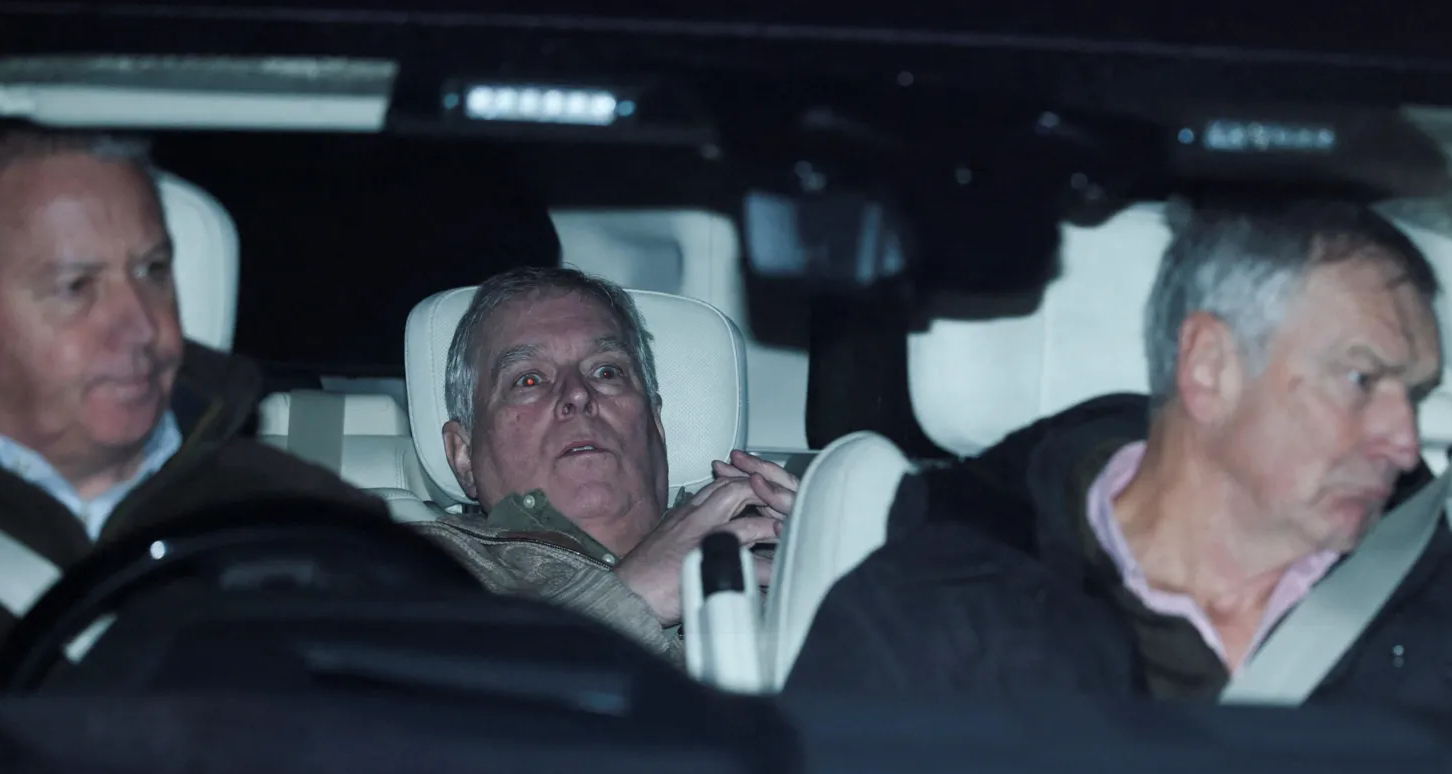
This photo of Andrew Mountbatten-Windsor being driven home
from Aylsham police station in Norfolk on Feb 19th evening has
been published worldwide photo by Phil Noble (Reuters) who
had a tipoff Aylsham was where the former prince would be held

The family clearly realises this and did its best to maintain its image as a secure and reliable national institution that was still at work, performing public duties, after the arrest of Andrew Mountbatten-Windsor, as he is now known having been stripped of his titles and privileges three months ago. 

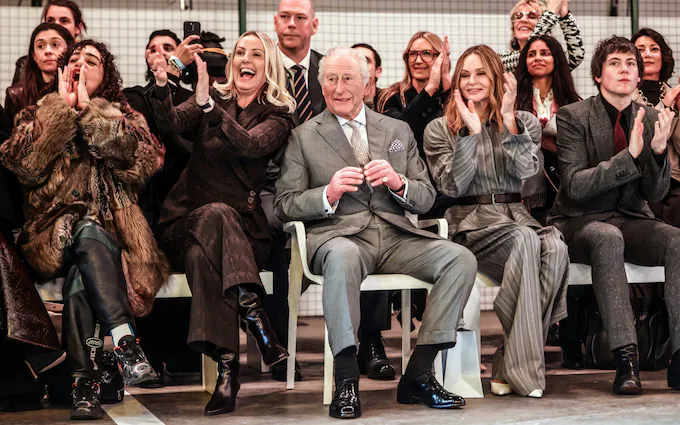
The King was met with applause when he attended, as planned, the opening of London Fashion Week (see below). His wife Queen Camilla met an internationally famous fashion editor and attended a concert in Westminster. Princess Anne, the hardest working “Royal” and Andrew and the King’s sister, ironically visited a prison in Leeds.

Andrew is no longer in a police cell, having been taken home on the 19th evening after spending his 66th birthday in custody at Aylsham police station an hour’s drive away. By then, detectives had finished searching the farmhouse on the family’s Sandringham estate in Norfolk where the King shifted him three months ago to remove him from public view. Andrew is known for his pomp and bluster, and it looks as though the police needed to secure him while the Sandringham search took place.
They also searched Royal Lodge, his previous grand home on the royal Windsor estate west of London. He remains formally “under investigation”, and the police are continuing with the search at Windsor where he lived from 2004.

The arrest was on suspicion of misconduct in public office (which he denies) for passing official and secret papers on British investment and other subjects to his friend Epstein while he was an official Special Representative for International Trade and Investment, a post he held between 2001 and 2011. He lost that jet-setting role because he continued the friendship after Epstein had been convicted as a sex offender in 2008. He was then confined to the UK where, it was announced, he would “continue to support business in the UK” and would not have a specialised role. 

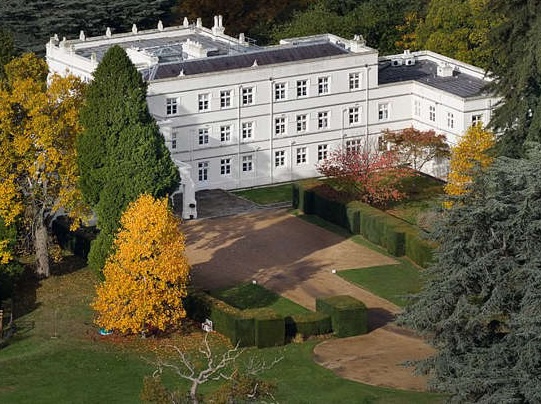
Royal Lodge in Windsor Great Park, Andrew’s 30-room home from 2004-2024

Illustrating the range of activities outside his brief, he liaised with Epstein during “private days” at the start of an official visit to China on an $8bn cash-for-oil swap between a Chinese sovereign wealth fund and the rulers of the United Arab Emirates while the disgraced financier was under house arrest for soliciting sex from an underage girl.

Andrew was dubbed Randy Andy in his youth, as The Times reported yesterday: “HRH Prince Andrew Albert Christian Edward, born at Buckingham Palace, had a reputation by the time he could walk. As a toddler he would kick the dogs and taunt the staff. As a five-year-old he was thrown in a dung heap by grooms at the Royal Mews in Windsor, sick of him taunting the horses with a stick. As a teenager he acquired the nickname Randy Andy, and as a young man his behaviour was so atrocious that a footman punched him in the face”.

But he was the late Queen Elizabeth’s favourite son and was protected till she died in September 2022 by her continued forgiveness and financial support. That support was perhaps the only major blunder in her much admired long reign. She is widely believed to have helped finance a $12m settlement paid to Virginia Giuffre who sued him, claiming he sexually assaulted her on three occasions when she was 17 and being trafficked by Epstein, allegations Andrew has repeatedly denied.  

Since then, stories of his involvement with Epstein have increased.  They escalated after President Trump authorised the US Department of Justice to release millions of files and images. That led to growing public pressure in the UK for Andrew to lose his royal status and also led to a formal demand for him to give evidence to the US Congress.

He previously resisted informal calls to appear before Congress. Now his arrest and continued police inquiries will ironically protect him, at least for some time, from the extreme embarrassment of a hostile Congress inquisition. Meanwhile there are calls for him to be removed soon from his position as eighth in the line of succession to the British throne.

It had been assumed that he would eventually be formally accused of sexual offences, maybe the rape alleged by Giuffre or for other paedophilia. But the revelations that he had handed over secret government information to Epstein quickly led to police inquiries and yesterday’s arrest and alleged “misconduct in public office”.

Legal experts say this common law offence is generally used only on misconduct by public servants when other offences, for example fraud, are not suitable. It can also often be very difficult to prove. Between 2014 and 2024, 92 per cent of those convicted of the offence were in the police forces or prison service. There have been no convictions of high-profile individuals for the offence in modern times. 
The King fulfilling a planned public engagement at the opening of London Fashion Week while his brother was in custody – photo credit: Richard Pohle/AFP via Getty Images

Till now, the royal family have only had minor skirmished with the law.  Princess Anne’s dog, a bull terrier, bit two girls in Windsor Great Park in 2002 after which she was fined £500. She was also fined £400 in 2001 for driving her Bentley at 93 mph in a 70-mph zone in Gloucestershire. 
Sir Keir Starmer, the UK prime minister, has said that “nobody is above the law” and the King has agreed to support police inquires. Saying yesterday that a “full, fair and proper process” must now take place, he added: “In this, as I have said before, they have our full and wholehearted support and co-operation. Let me state clearly: the law must take its course.”
Separately, Andrew might become linked with police inquiries into the use of Stansted airport, 30 miles from London, by private flights trafficking under-age girls that have emerged from the Epstein files. Former Prime Minister Gordon Brown has called for the police “urgently” to re-examine whether Epstein’s victims were trafficked within and outside of the UK.

These events have already led to demands by anti-royalists in the social media and elsewhere for the monarchy to be abolished, despite basic popular support.

A survey in January showed that views on the royal family had not changed much during the Epstein revelations. Britons were twice as likely to have a positive opinion of the King than a negative one (60% vs 31%). He has been admired for the way he has continued his role while being treated for cancer that was diagnosed two years ago.

Many anti-royalists argue that removing the royal family would begin to give Britain the social change that it needs. There can be no doubt that Britain’s multi-tiered hierarchical class system, with the Royal Family perched somewhat precariously at the peak, needs reform. Visitors from abroad can scarcely believe the complex social strata. 

The family is however almost certainly secure, providing it adapts as the Andrew saga unfolds, accepts considerably more disclosure and public accountability for its immense wealth and avoids Andrew-type excesses and scandals. 

It is also protected by the absence of any popular alternative system for head of state. At a time when respect for politicians is at what must be an all-time low, there is little appetite for changing benign King Charles, and even his heir Prince William, with someone from the political class. 

I

Posted by: John Elliott | February 15, 2026

Ai Weiwei and Tyeb Mehta star in Delhi’s art fair week

First retrospective of India’s leading “Progressive” modernist

Ai Weiwei balances criticism of China with views on India and the West

There were two stars during Delhi’s India Art Fair week earlier this month. One was Ai Weiwei, the leading Chinese dissident artist who was on his first major visit to the country.

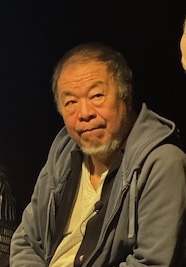
Ai Weiwei in Delhi© John Elliott

The other was Tyeb Mehta, possibly the most distinguished of India’s famous “modern” artists whose 100th birth anniversaries have been celebrated with major exhibitions in recent months.

Both Ai and Tyeb (as he is colloquially known) have tackled the issues and problems of their times. Ai, age 68, continues to attack China’s repression, state power and censorship, though he balanced this with criticisms of India and the West.

Tyeb, who died in 2009 age 83, sought with his peers to develop new artistic styles after India’s independence and reflect on traumas such as the 1947 partition of India creating Pakistan. 

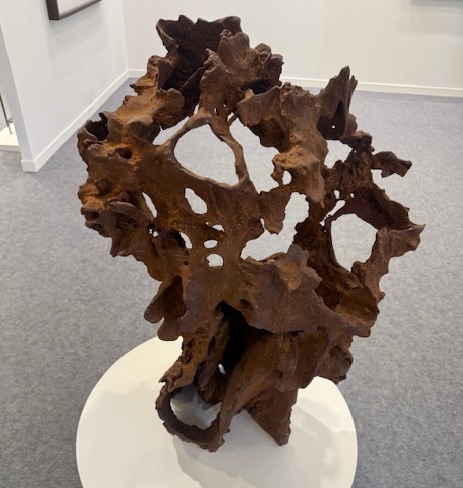
Ai was among the early visitors to the fair on the preview day when he stopped at the Nature Morte stand where one of his Iron Root cast iron sculptures was on view at EUR 300,000 and was later sold. 

Ai Weiwei’s “Iron Root” cast iron sculpture on the Nature Morte stand

I caught him for a few words as he arrived. I’ve always wondered how such a hounded artist keeps going, so asked him whether he had ever thought of giving up.

“I haven’t started yet and I’m quite confused because there is so much that is attractive but also not,” he said, fingering a loose button on my shirt collar. The button came off in his hand and he gave it to me saying “When I was young and a button came off, I kept it because I was so poor, though now I am no longer poor”.

Speaking during a series of events and interviews, he seemed to be taking care to balance his remarks on China with criticisms of India and the West. He visited China last December (2025) for the first time in 15 years to see his 93-year-old mother. He stayed three weeks without problems and left freely. Earlier he had been imprisoned (2011), had his passport confiscated and been harassed by police.

Tyeb Mehta, Falling Figure with bird, 2004
Tyeb’s “Falling Figure with Bird” (2004), image courtesy Tyeb Mehta Foundation

“Right now, India as a society may be more democratic, but there is also a lot of disparity … China is more even as a society, but it has a one-party system, which is a big difference,” he said while visiting Nature Morte’s gallery on the outskirts of Delhi for his first-ever solo exhibition in India.

In another interview he said: “Classically, the so-called West has pointed fingers at China or those with more authoritarian states, but I have been censored in the West very often. There is strong censorship in Western universities, in art, in writing, in media, in everything. No longer can fingers be pointed at China. If you are doing that, you are a hypocrite and have double standards”.

ai weiwei
Works at Ai Weiwei’s show at Nature Morte’s Dhan Mill gallery in Delhi, photo courtesy Nature Morte, Ai Weiwei Studio,and Galleria Continua

Tyeb retrospective

Attempts have been made to stage a Tyeb retrospective for 15 years or more. The success this month was due to an initiative started by the Saffronart Foundation, set up by the South Asian art auction market leader of that name. Saffronart approached the Tyeb Mehta Foundation, and then involved Delhi’s Kiran Nadar Museum of Modern Art (KNMA). That led to the show being curated by Roobina Karode, the museum’s artistic director, that is open till June. 

Tyeb paintingFalling Figure and Bird

“Tyeb came at a time of great struggle when all the Progressives were seeking foundational language in the name of modernism,” said Karode, referring to the Mumbai based group of artists founded in 1947. The question was “how to reflect the transformation that the country was going through”.

Tyeb was a leading member of the Progressives. Others included F.N. Souza (who died in 2002) and Krishen Khanna, now 100, both of whom have had recent commemorative exhibitions.  

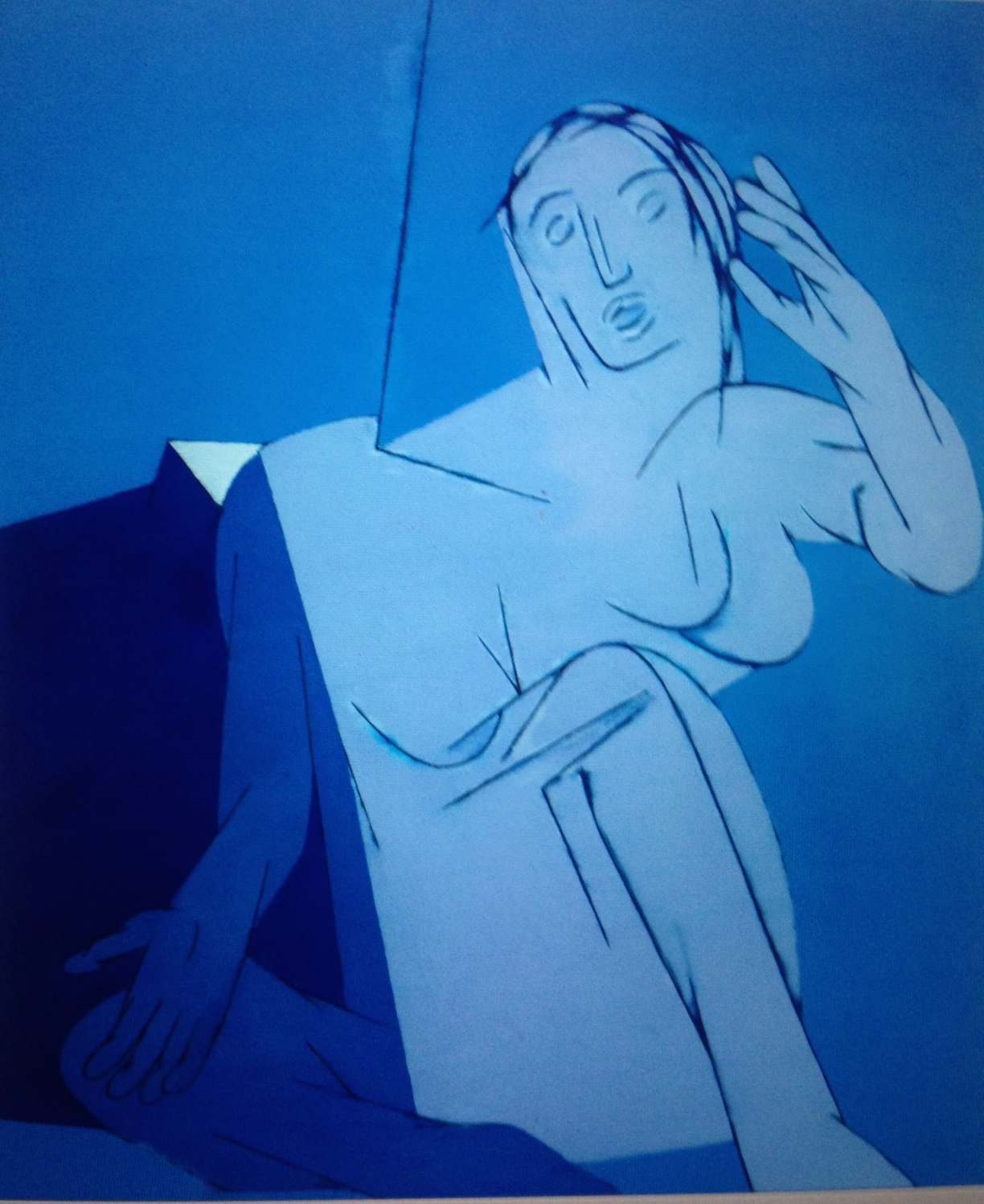
“:Blue Painting” (1982), one of Tyeb’s calmer works with “less angst” according to one observer

Tyeb was “the most introverted’ of the Progressives and stayed away from the limelight”. Krishen Khanna had said that he was “a better artist” than the rest of the group. He came from a cinema family and was initially drawn to films but switched to painting in art college.

Titled Bearing Weight (with the lightness of being), the KNMA exhibition consists of 120 works including 70 paintings along with drawings, sculptures and a 1970 film plus letters and other archival material.

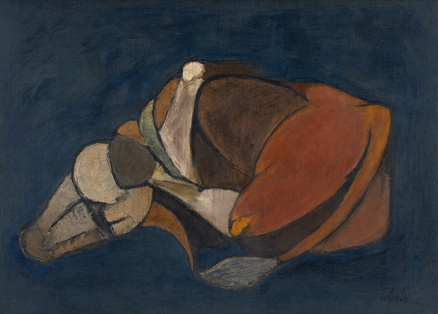
The works display Tyeb’s instantly recognisable themes and images of a rickshaw puller, a bull, a falling figure and a bird that dominate almost all his works. They demonstrate human hardships, conflict, violence and resilience. Often there is an iconic diagonal line to split the theme.

A bull was a compulsive image for Tyeb throughout his life from the time he drew them at an abattoir in the 1950s.

The exhibition includes Trussed Bull (1956). Loaned to the exhibition by its owner, this powerful painting is one of two works with this name sold at Saffronart auctions last year. This one fetched Rs 56.4 crore ($6,4m) in October 2025 but the other one was sold for Rs61.80 crore ($7.3m) six months earlier, making it the most valuable Tyeb Mehta work at auction.

Partition was a major theme, as it was for others of this generation including Satish Gujral, an artist, who died in 2020 and whose 100th birth anniversary has been celebrated with three exhibitions in Delhi. These include an expansive and dramatic retrospective in the National Gallery of Modern Art that shows how this reclusive artist (and architect), who suffered from a serious loss of hearing, stood aside from the Progressives and developed his own distinctive style.

At the art fair, Aicon Contemporary from New York showed this work by Debanjan Roy, which attacks so called tools of progress by attaching an image of Mahatma Gandhi, India’s leading independence campaigner, to a JCB digger

With 135 exhibitors including 83 galleries and 16 museums, the 17th edition of the art fair was its usual success, drawing in masses of young visitors as well as collectors ranging from beginners to top business people and museum owners. 

The fair took place at a time when galleries and auction houses say the majority of buyers are Indian and new to the market. Enthusiasm varied but good sales were reported by galleries such as Delhi’s Vadehra, DAG and Dhoomimal, and by Continua and David Zwirner from abroad.

Older Posts »

Categories