The Goodricke Collection owned by Camellia sold as a non-core asset
Progressives replaced by Ganesh Pyne and other Bengal artists as auction leaders
A rare auction with the entire 93 lots coming from a single collection produced record sales totalling £18,91m ($25.37m) at Christie’s in London yesterday. On offer was what is known in the art world as the Goodricke Collection, a name long connected with Calcutta and tea, or the Camellia Collection.
The collection was formed during the 1990s and early 2000s with a focus on the artistic legacy of Bengal and the wider art of South Asia where a UK company, Camellia plc, has its origins in tea estates now managed by the Goodricke Group.
The auction result was spectacular with all 93 lots sold, multiple times above estimates. They included 26 by Ganesh Pyne, a leading Bengali artist, that formed the core of the collection with five tempera paintings along with mixed media, fountain pen sketches and other jottings on paper or card. The collection has been widely considered one of the most culturally significant institutional archives of Pyne’s career.
Christie’s, which had hoped to keep Camellia’s name secret at the company’s request, stopped holding annual auctions in London seven years ago. It returned yesterday as a one-off because Camellia’s base is near London, and the works are in the capital – plus of course the attraction of old colonial ties. Camel
This led to the £18.91m total being the highest ever for the auction house’s South Asian modern art sales in London. Seventeen artists achieved world records, including Pyne on his 89th birth anniversary (He died in 2013).
The record prices were perhaps not surprising at a time when the market for Indian and other South Asian art is booming. What was remarkable was that the auction was not led by the famous Bombay-based Progressive’s Group that began in the 1950s and usually dominates the top ends of auctions with names such as Tyeb Mehta, M.F.Husain, and F.N.Souza.
Damien Vesey, a Christie’s specialist who headed the auction, reflected the excitement in the auction room when he described the result as “sublime”, picking up on the auction’s title, Sublime Shadows: South Asian Art From a Distinguished Collection.
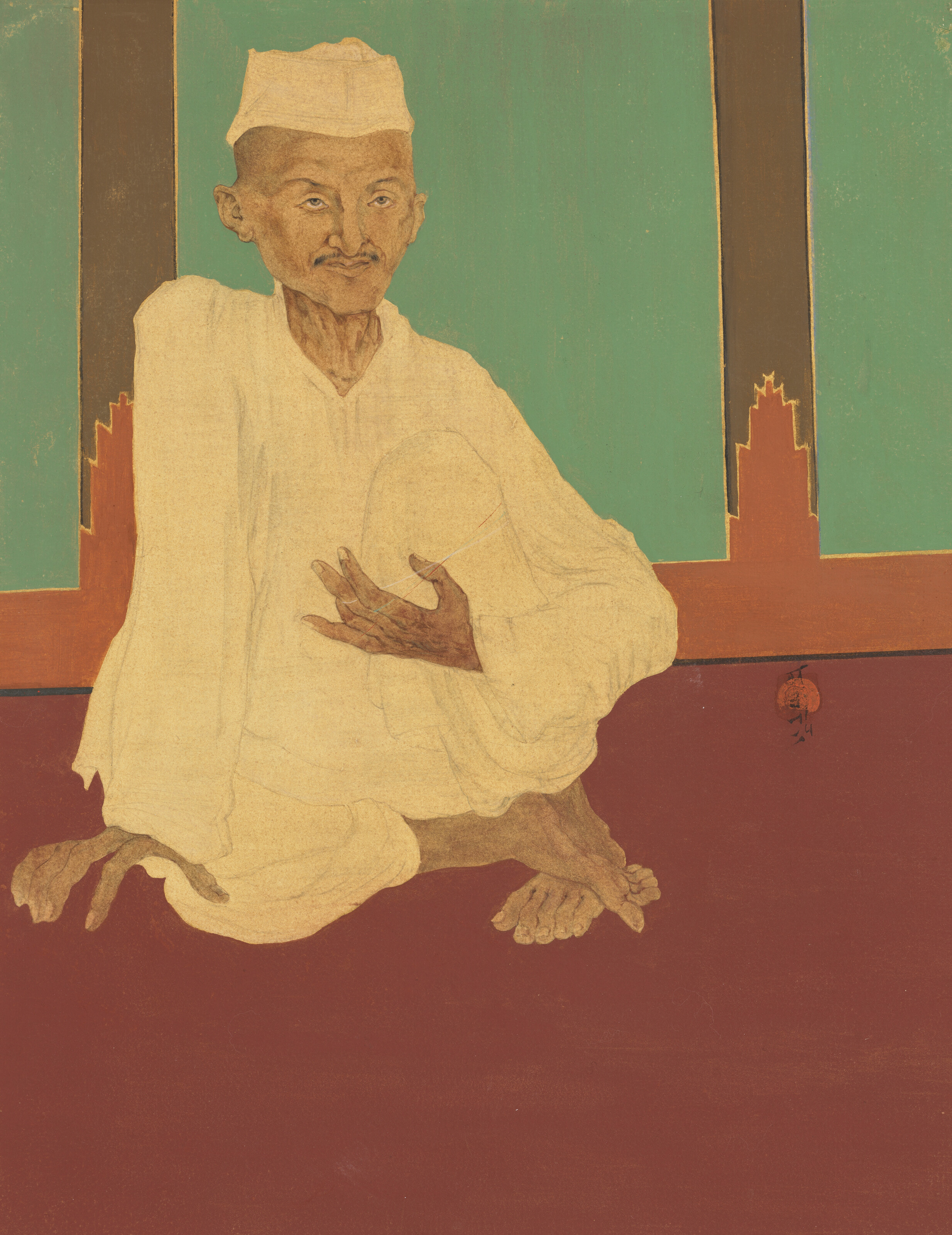
The auction drama started with the first lot (top) depicting Mahatma Gandhi, India’s independence leader, that hit a hammer price of £820,000 – £1.04m ($1.39m) including buyer’s premium – after some tough bidding on a surprisingly low estimate was £30,000-40,000.
That was a record for a work on paper by the artist, Abindranath Tagore, a leading figure in Bengali culture and founder of India’s Bengal School of Art, who died in 1951. Titled, The Spinner of a Nation’s Destiny, it shows Gandhi’s fingers holding three barely visible strands of cotton in India’s national colours.
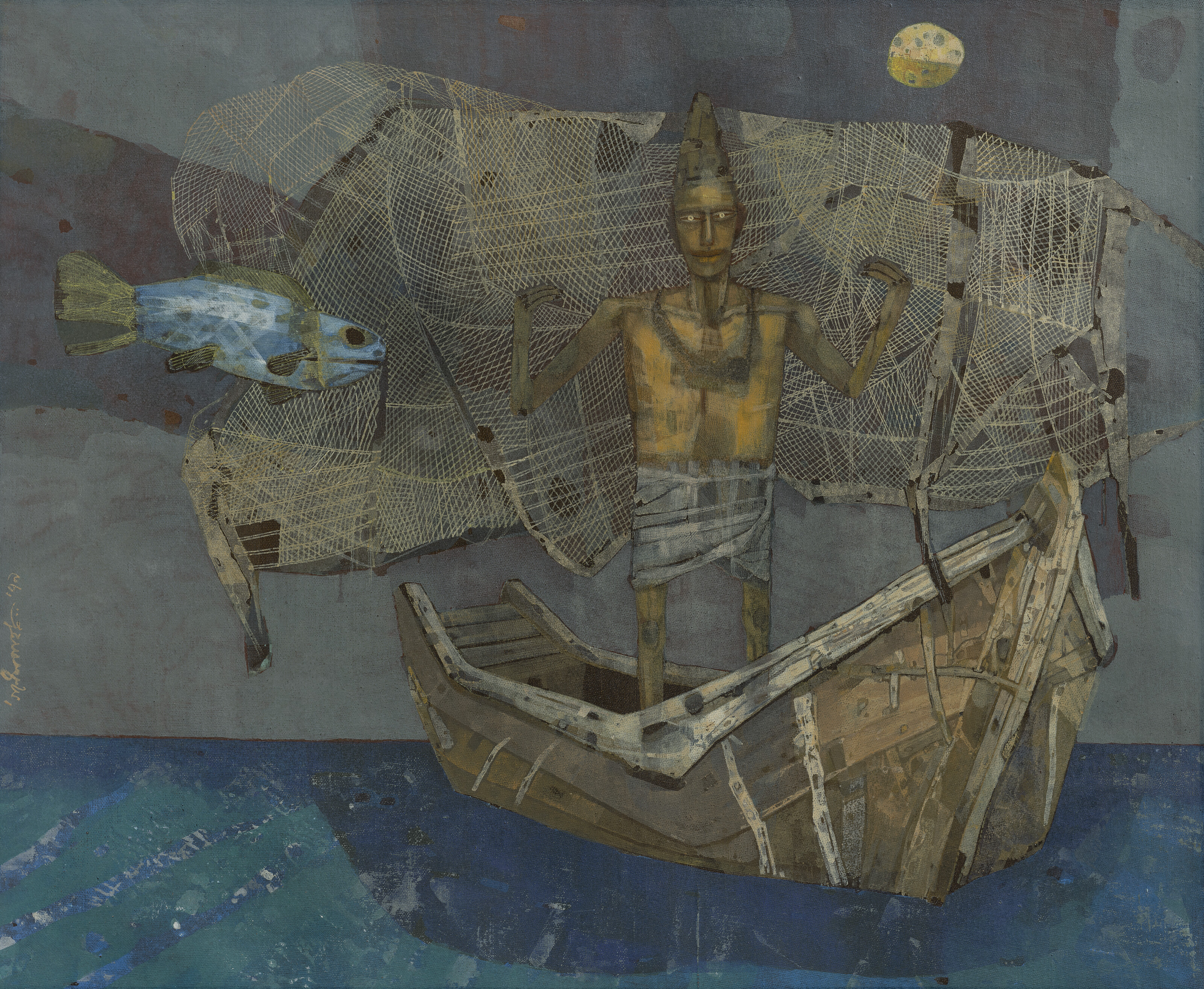
A few minutes later, the eighth lot (above) brought the new Ganesh Pyne record of £3.8m ($5.0m) including buyer’s premium against a top estimate of £350,000. This beat his previous record of $2.51m set in March at a Christie’s auction in New York when Camellia first started selling Pyne’s works to “support the company’s value enhancement plan, which includes increasing investment into higher-return operating assets”.
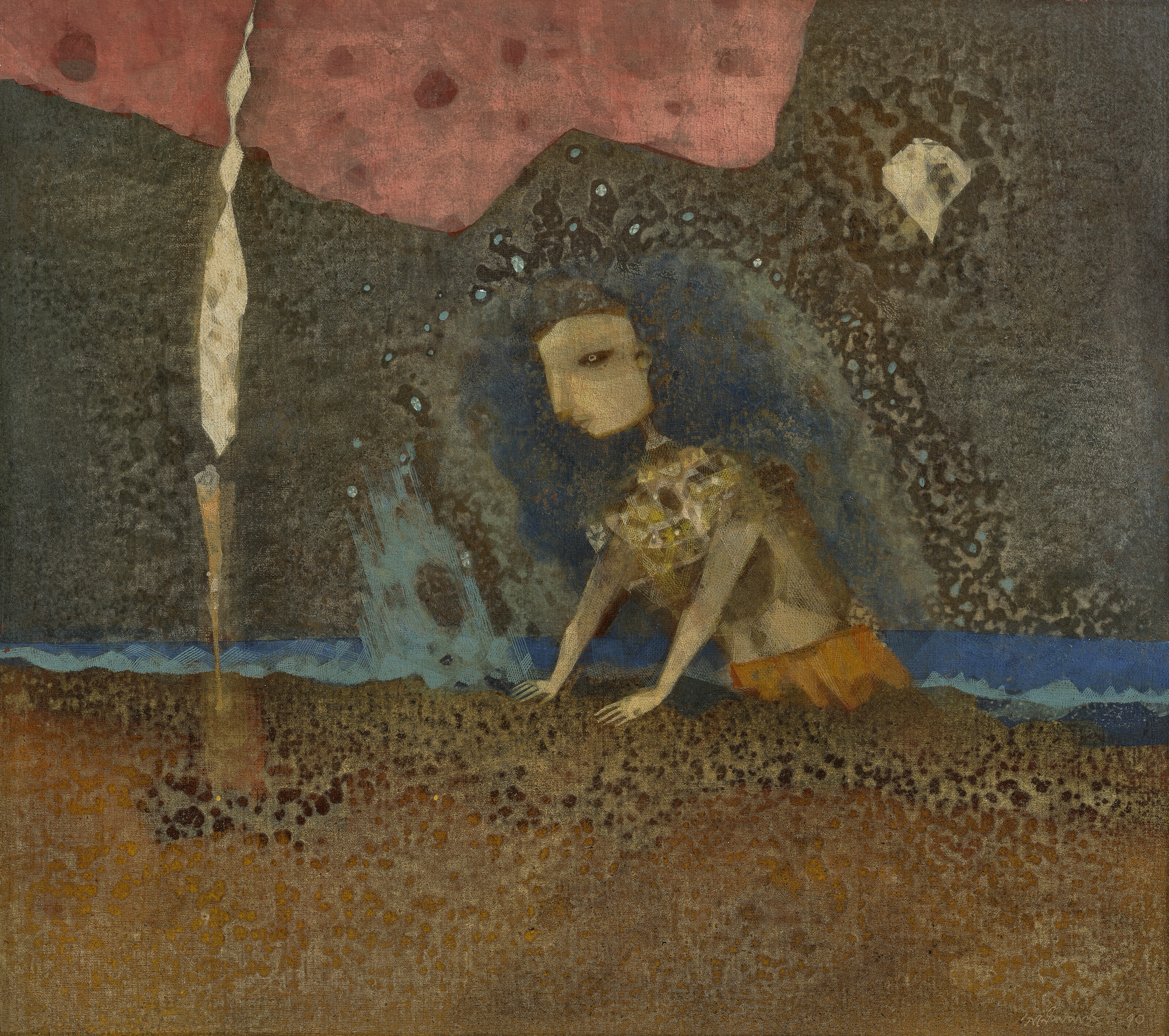
Titled The Fisherman and painted in 1979, this 18in x 22in tempera on canvas depicts what Christie’s describes as a “gaunt fisherman….monumental, suspended in time and inward looking”, standing in his wooden boat sailing across deep blue water. Two other similar Pynes (one below) each went for £2.37m including the premium against top estimates of £300,000.
Pyne was a reclusive modernist painter, influenced by Bengal School traditions with a romantic style incorporating the supernatural, mythology, and Bengali folklore plus what is described as poetic surrealism. Many of his works have dark moody overtones, maybe because he was deeply affected when he was nine by widespread killings in Calcutta (now Kolkata) a year before India’s independence in 1947. He gained national recognition after M.F.Husain named him the best painter in India.
It seemed something of a letdown when the auction moved away from the celebrations of Bengal art to offer a work by the esteemed V.S.Gaitonde, one of the Progressives. His 36in x 27in oil on canvas sold for a total of £2.25m, in line with expectations.
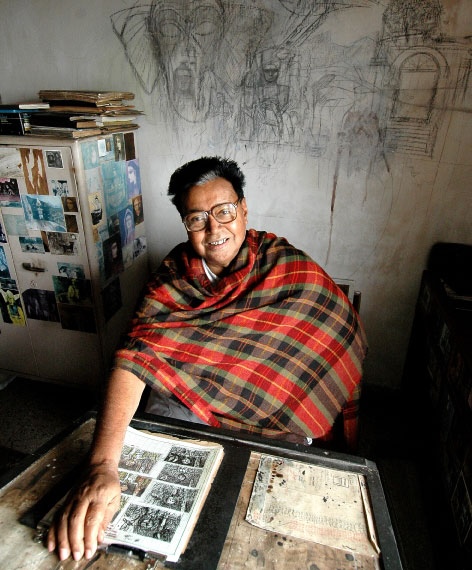
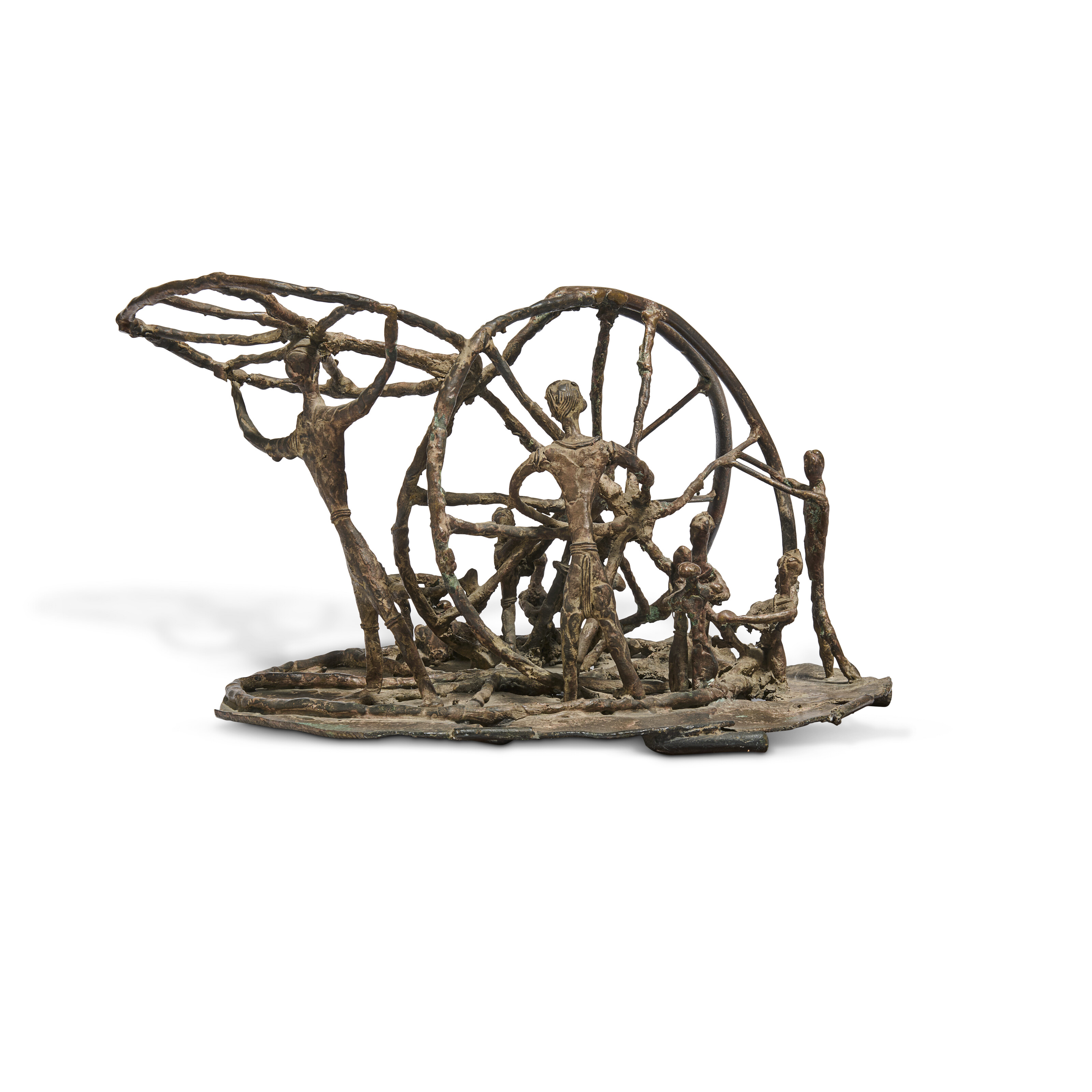
Moving back to Bengal, two small bronze sculptures by Meera Mukherjee sold well. One (bottom) depicted Wheel Builders and went for £381,000, almost four times the top estimate, and a record for the artist. (Mukherjee’s works are currently on show at the Hepworth Gallery in the Yorkshire city of Wakefield along with three other female sculptors).
Other artists hitting record prices included K.K.Hebbar, Biren De, Ramkumar Baij, Badri Naryan and Arpana Caur.
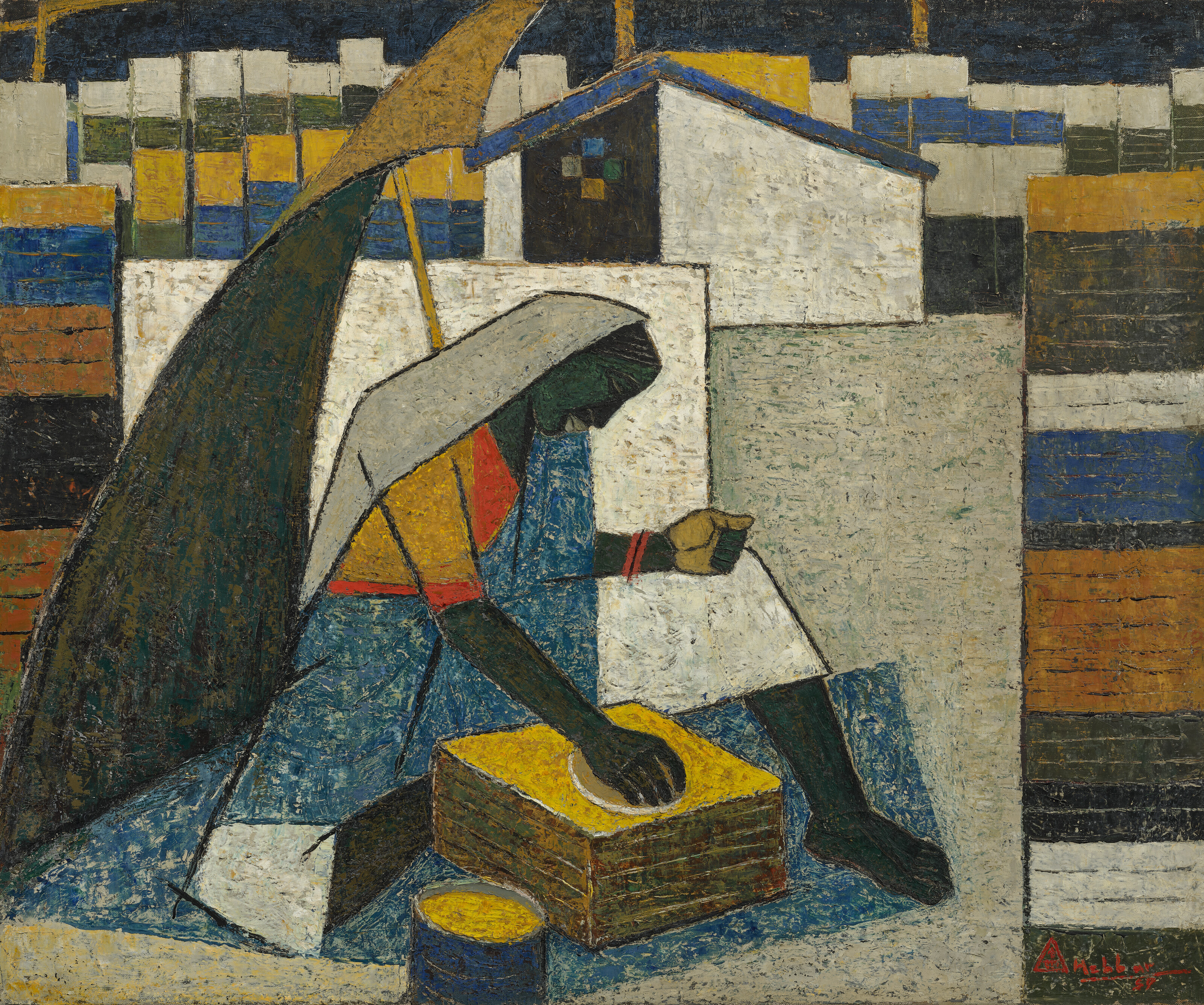
The Hebbar record was for Untitled (Gulmohar Tree), painted in 1962 which realised a total of £698,500, nearly six times the high estimate. The striking Hebbar work below, a 30in x 36in oil on canvas named Untitled (Women Making Chapatis), was painted in 1959 and sold for £406,400, five times the top estimate.
Records were also set for relatively small amounts. Arpana Caur achieved a record for a work on paper – £8,890, eleven times the low estimate, for Blue Buddha, 22in x 15in, and painted in 1991.
The Pyne works are discussed in detail in a book, Ganesh Pyne: Revelations, that was prepared in collaboration with Goodricke and published in 1999, documenting the Lawrie and Goodricke collection. Images of the works have appeared on the cover of the Goodricke house magazine.
The auction appears to have been triggered by a change of top management at Camellia. By the 1980s, it had become the world’s largest private producer of tea that now accounts for about 80% of turnover. It manages some 50,000 hectares of land with 76,000 employees in Bangladesh, India, Kenya, Malawi, South Africa, Tanzania, and Brazil.
The collection has its origins in the purchase and merger of a large number of Indian tea estates in West Bengal and Assam in the 1960s and 1970s by an inspirational and reclusive Canadian investor, Gordon Fox. The estates included Alex Laurie and Jorhat Tea, estates owned by British tea planters and merchants and at least eight UK Sterling tea companies.
The Goodricke Group was established in 1977, to take over the extensive tea business operations and assets. It is 75% owned by Camellia plc, of which the majority shareholder (56%) is the charitable Camellia Foundation (Bermuda), that uses its dividends to fund charitable, educational & humanitarian causes.
It was Fox who started corporate art acquisitions in India for Camellia. His focus was Company School art, Indian miniatures, botanical watercolours and stamp collections. Later the acquisitions evolved into contemporary works from Kolkata artists such as Ganesh Pyne.
Fox retired in 1999 to Switzerland but remained a dominant investor till 2018 when he withdrew. That led to a complete change of management by 2023, after which the focus turned to disposing of non-core assets like Indian art and raising funds for core investments in the value enhancement plan, hence yesterday’s Christie’s auction.
But though Camellia was the actual owner of the collection, the name is not widely known. So, it was the name Goodricke that rang bells at yesterday auction, a reminder of the days long gone of British dominance in the Indian tea estates.


[…] the past month’s major £19m Christie’s auction of the Goodricke tea estate’s collection, and the opening of the Hayward gallery’s Anish Kapoor […]
By: South Asian art spreads across London galleries’ summer shows | Riding the Elephant on July 1, 2026
at 5:27 am