Troubling undertones in enigmatic installations
Indian-born, British sculptor Anish Kapoor has hit the headlines with a dramatic exhibition at London’s Hayward Gallery that includes three massive red sculptures and over 80 other works, many creating the enigma and uncertainty for which the artist is famous.
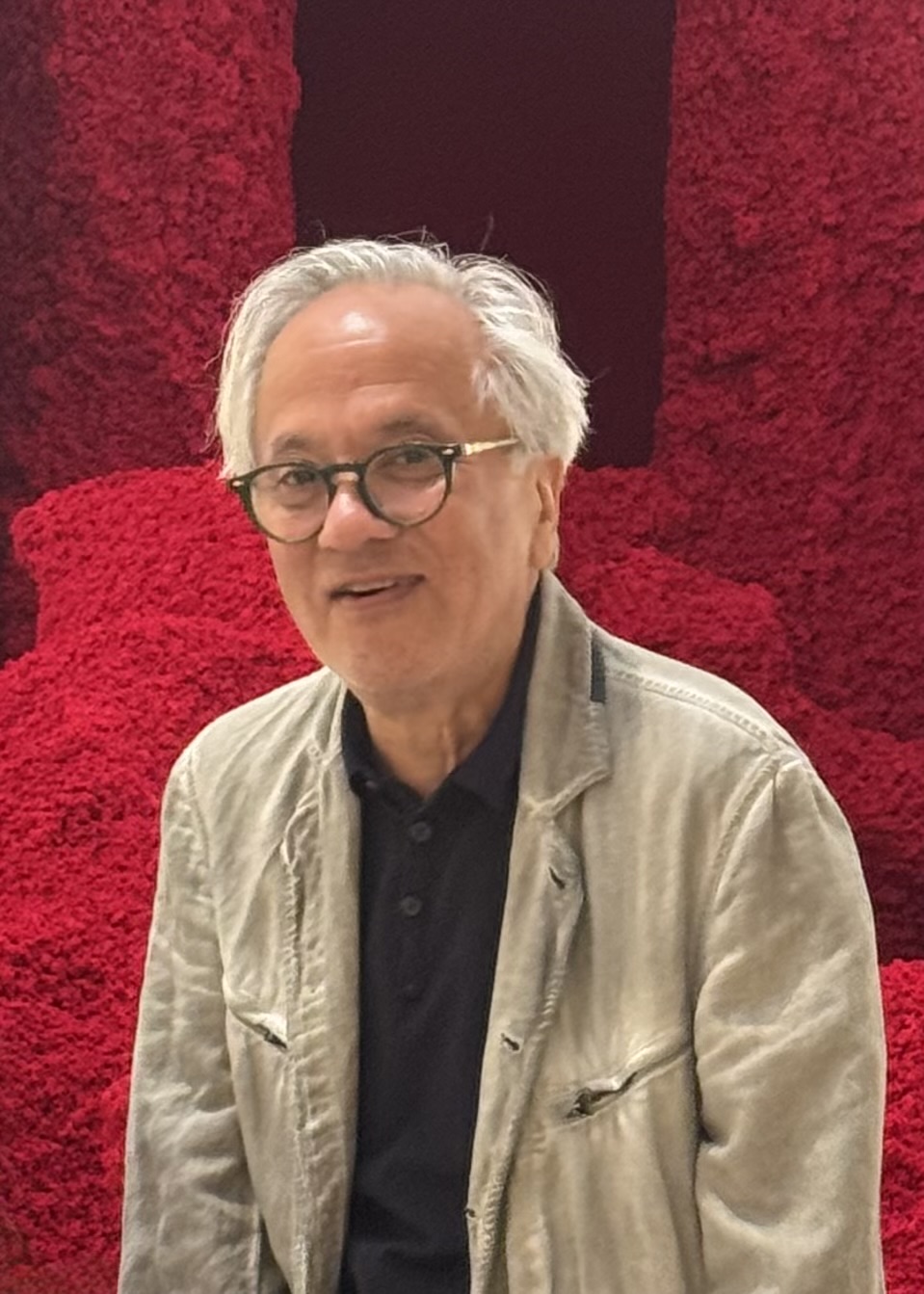
This is the second solo exhibition at the Hayward for Sir Anish, 72, who has a rarely-mentioned British knighthood and is one of the world’s most famous and financially successful sculptors.
It opened last week and is a magnificent and rare return to the Hayward by the artist after his first solo show there in 1998, Twenty years earlier, when he was only 24, he had participated just after he left art college in a group show titled New Sculpture with an early version of his 1000 Names piles of coloured pigments
The Hayward is one the most grim examples of Britain’s 1960s grey concrete architecture and Kapoor invades it with his strong red works. You can view them either simply as interesting visual compositions, or delve into the artist’s sometimes troubled thinking, with the aura of enigma constantly present.
The entry to the exhibition, through one of the Hayward’s insignificant small doorways, presents the immediate shock of a bright red inflated bulbous PVC membrane. Called All of Nothing and completed this year, it fills half the huge room (below), reaching up six metres to the ceiling.
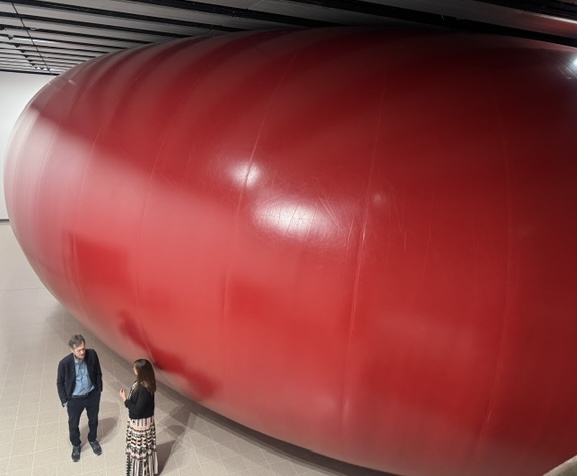
There are more massive shocks in red later – a monumental installation sprawling across a room suspended from the ceiling, and another built up like a mountain from the floor, though Kapoor told the Art Newspaper: “Just because a thing is big, it doesn’t mean it’s of any interest or even good”. All three go beyond what is usually thought of as a sculpture, each filling an entire section of the Hayward.
Ralph Rugoff, who curated the exhibition and has just retired after 20 years as the gallery’s director, talked at the media preview about the PVC membrane as “this enormous bulging object….almost kissing the sides of the gallery”. It was “almost in an intimate relationship with this brutalist architecture and a love letter to this brutalist building”.
He added that it was “an enigma that you can’t see the whole thing because it blocks your way, you can’t walk around it .…squeezed by this brutalist corset”. Kapoor has echoed the thought, talking about “the body being pushed into a particular relationship between the architecture and the object that’s very important”.
In the floor above the bulbous All of Nothing, hangs what looks like an upside-down mountain suspended weirdly from the ceiling (below), creating the feeling up close of being smothered in a cave. Completed in 2022 and called Mount Moriah at the Gate of the Ghetto, it defies gravity as it plunges down to just a few inches above the gallery’s floor tiles.
The title refers to the place where, in the Bible, God told Abraham to sacrifice his son Isaac. Art critics have interpreted the work as a mountain running red with blood as if the sacrifice had happened. “A pendulous mass of engorged scarlet and black paint on silicone, it crashes to a tip from the ceiling. An inverted mountain, the world up ended? Or cascading internal organs and raw flesh, the biblical sacrifice not averted?” suggests the FT.
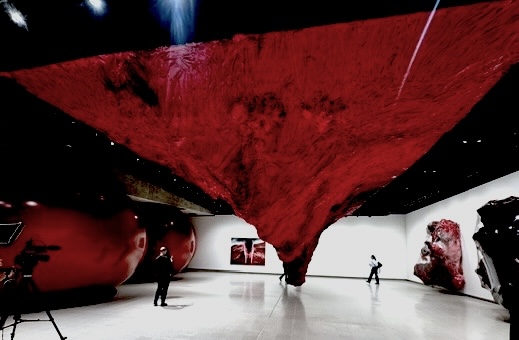
On one side are three red inflatables, seemingly bulging up from the floor below as huge bags of blood. On the other side are three sacrifice sculptures wrapped in PVC “resembling body bags bursting with butchered human remains”.
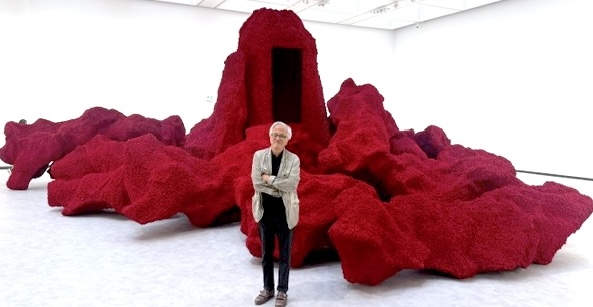
Next, on a floor above, is Ha Makom (two images below), which means both Place and God in Hebrew. (Kapoor was born in 1954 in Mumbai to a Jewish mother of Iraqi descent and a Hindu father).
“It’s a very big pigment piece and it is a very emphatic, insistent red made of bits that all sit in relation to each other,” he says. “So, what am I after? I’m after red, of course, in a very particular mood, but also otherness, the sense of this being, if you like, somewhere else, something else,” he adds, more enigmatically.
The Hayward says that the exhibition “highlights the artist’s ongoing exploration of perceptual illusions, including seemingly depthless ‘void’ works and sculptures coated with Vantablack, a light-absorbing nanotechnology so black it makes three-dimensional forms appear entirely flat when seen head-on”. The works “interrogate what Kapoor calls ‘the space of the object’, inviting us to look twice and question how we experience our environment.”
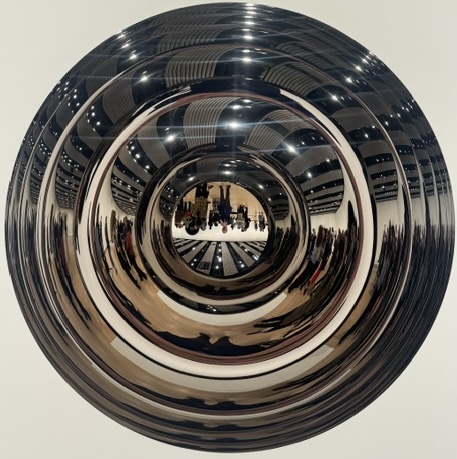
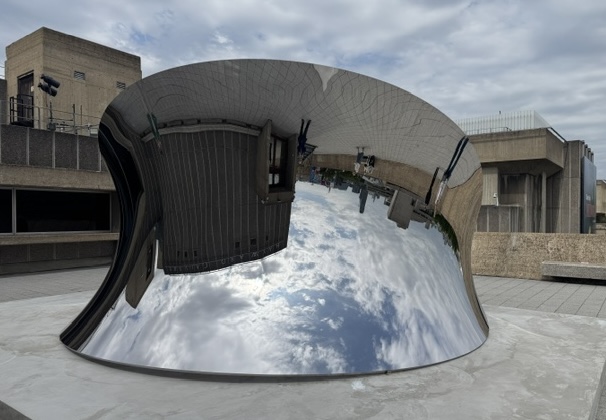
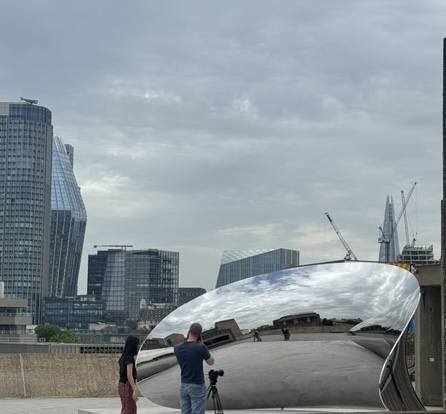
Large-scale mirrored steel sculptures stand on the Hayward’s outdoor terraces, creating reflections that distort the gallery’s rough concrete walls and London’s skyline, along with images of people viewing the works, often upside down.
I first saw Kapoor’s sculptures at London’s Royal Academy in London in 2009 and then again in Delhi and Mumbai in 2010. There was more explicit active violence in those exhibitions.
In an installation called “Shooting Into The Corner“, an iron canon shot sticky chunks of red wax across a room repetitively every 20 minutes. In Mumbai, then marking the second anniversary of devastating terror attacks, this was seen by some as symbolic of repetitive shooting and the horrors of terrorism.
In London, a massive, tracked train-like block of blood-red wax, weighing more than 20 tonnes, squeezed its way through doorways linking galleries in the Royal Academy. Some saw that as a references to the Holocaust trains that carried WW2 Jewish prisoners to death camps.
Now the active violence has been replaced with more thunderous static sculpture, which provoke thought about what has been created, so I asked Kapoor what had changed?
He replied that the violence of the 2009 work was specific to it and its context, which seems to have been to symbolise violence and tension in art-making and explore the paradoxical relationship between destruction and creation. “I carry on making my work in other ways,” Anish added. “What remains constant is a preoccupation with colour, form, and non form”.
Kapoor was born in Mumbai (then Bombay) in 1954. London has been his main home since the 1970s, though he has properties in New York and the Bahamas. He was educated at The Doon School, known as India’s Eton, and then went to London’s Hornsey College of Art and Chelsea School of Art. Providing aid for displaced and homeless communities is one of his main charitable activities.
He still shows mixed reactions to his Indian origin, as he did 16 years ago. “I have always refused to be referred to as an Indian artist,” he said in the latest issue of the Apollo art magazine. “What’s important to me is to be referred to as an artist. I happen to be of Indian origin but that’s not my purpose”.
He was relaxed and happy doing endless interviews at the media preview. When I asked him if his Indian roots influenced his current work he said, “I am Indian, so I hope so, on much of my work. India is complex and my work is complex”.
 Riding the Elephant
[…] major £19m Christie’s auction of the Goodricke tea estate’s collection, and the opening of the Hayward gallery’s Anish Kapoor exhibition, Christie’s and Sotheby’s auction houses both have their first non-auction […]
By: South Asian art spreads across London galleries’ summer shows | Riding the Elephant on July 1, 2026
at 5:27 am