Narendra Modi has bowed to the demands of student protestors……
…..but a badly failing education system needs widespread reforms
Behind the emotional scenes and confrontations between brutal police and peaceful young demonstrators in Delhi that have gripped international attention in recent weeks, lies India’s unrealised “demographic dividend” which was expected to boost the country’s economy with expertise and drive.
For more than 25 years, India has revelled in the potential benefits of the high percentage of youth in what is now the 1.45bn population. Over 65% (950m people) are under 35 but as many as many as 40% (estimates vary) are unemployed or not in education, showing how the dividend has been wasted.
Successive governments have failed to rise to this challenge and reform corrupt and ineffective education systems and inadequate skill-learning opportunities. They have also failed to make a priority of generating adequate and appropriate job opportunities at all levels of economic activity.
That has turned the dividend into a social liability and created political risk for the government. It has also disillusioned many of the young aspirational voters who will have voted in general elections for prime minister Narendra Modi and his Bharatiya Janata Party but now feel let down.

The bitter frustrations caused by these government failures lay behind the demonstrations that started after more than 2.2m students sat for an entrance exam for healthcare colleges known as NEET-UG. Just over a week later, the authorities shocked the students when they cancelled the completed exam and ordered a resit because question papers had leaked and been available for sale.
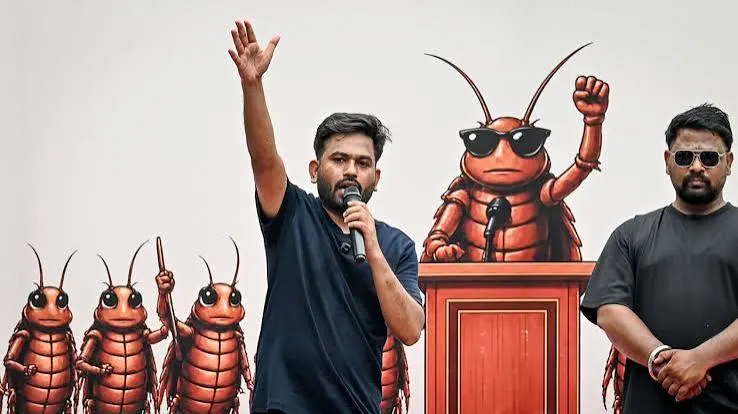
Four days later, on 16 May, the students’ Cockroach Janta Party (CJP) was founded online, satirically named because India’s chief justice had compared unemployed youth to “cockroaches” and “parasites” who drifted into social media and allegedly undermined the Indian constitution. The next move came rapidly when, after just three weeks, the first CJP student demonstrations were held in Delhi, leading to a massive round-the-clock protest.
Widespread support for the protests quickly grew across India, especially when police and a para military force attacked the students violently, using teargas, anti-riot guns and plastic pellets . There was also concern for a veteran education reformer and climate activist, Sonam Wangchuk, who joined the protesters and became a symbol of the campaign when he went on an “indefinite” fast that lasted for 26 days.
This led last weekend to Modi caving-in to mass protests for the third, and most significant, time since he became prime minister in 2014. (The first was in 2019 when protests in north-east India and Delhi led to implementation of controversial citizenship laws being delayed. Then, in 2021, contested agricultural laws were cancelled after over a year of mass protests by Punjab and Haryana famers, though that was partly due to imminent Punjab state elections).
Modi sacked the education minister, which was the students’ primary demand, having already removed the top education bureaucrat. He also tackled the protestors’ original complaint about mass leaking of exam papers, and appointed a task force to reform the examination system led by Nandan Nilekani, one of the founders of the Infosys IT company and respected creator of he Aadhar identity scheme.
Compensation was also agreed for the families of possibly as many as 21 would-be medical students who tragically died by suicide after they were told they had to re-sit the exams.
Wasted dividend
Investment brokers started talking up the demographic dividend in the mid-late 1990s, and in 2005 economists estimated that it opened a 50-year window of potential benefits lasting till 2055.
No government however has developed a long-term plan and, with 21 of the 50 years gone, estimates of the numbers who do not have jobs vary from 16% aged 15-29, to 40% of a 15-25 age group.
The problem affects all levels of employment – at the top, less than 7% of male graduates find a permanent salaried job within a year of graduating.
For the past 15 to 20 years, there has been speculation about whether – and when – the masses of unemployed youth would erupt into a rebellion, echoing protests that escalated rapidly across the country over corruption and rape in 2011 and 2012-3 and rattled the then Congress-led government.
When the Ministry of Railways announced recruitment drives in January 2022 for low-level entry posts, there were over 12m applications for just 35,000 jobs. Frustrated youth blocked tracks, clashed with security forces, and set train coaches on fire in the poor northern states of Bihar and Uttar Pradesh.
Similarly, the introduction in April 2022 of a new military recruitment policy caused immediate nationwide demonstrations because it replaced a permanent military career that poor rural youth depend on for a permanent career, with four-year contracts. This led to highway blockades, hunger strikes, and arson.
There have been many attempts by governments to generate jobs, but they have not met the main need – to create constructive gainful employment that would reap the dividend.
While economic growth has been strong at around 6%, there has been little impact on job creation. Traditional manufacturing industry, which used to absorb surplus labour, has stagnated at around 14-17% of gdp. Automation-driven technology and services have limited need for labour and mostly require specialised skills that the vast majority of Indian graduates do not possess due to a chronically and badly targeted education system that successive governments have failed to tackle.
There have been some successful initiatives such as the MGNREGA “right to work” begun in 2005 (replaced recently by a Modi government scheme) that guaranteed 100 days of unskilled labour a year for rural households. There have also been various skill development, micro-lending and other schemes along with macro initiatives such as Modi’s “Make in India” and “Startup India”.
But none of these have tackled the basic tasks of creating a variety of employment opportunities at all levels of the economy and educating youth equipped to take those jobs.
The quality of public education remains poor, ranging from primary schools that lack books and reliable teachers to universities that are inadequate both in numbers of vacancies available and in the qualifications of the graduates they turn out. Interwoven is massive corruption at all levels, illustrated by the leaking exam papers.
If Modi wants his legacy to be a strong and stable economy along with his Hindu nationalism, he needs to reform the whole of the education system from the bottom upwards. At the top, he needs to ensure it provides graduates and other students with expertise that attracts Indian and foreign investment, while also maintaining social stability. He also needs to reverse education’s declining share of the government’s budget that has fallen from 4.6% to about 2.5% since he came to power.
Nandan Nilekani’s task force on examinations has been created to meet the immediate demands of the protestors, but it only covers a fraction of the overall demographic challenge.
Meanwhile, Modi’s authority has been diminished. The crisis has energised the weak Congress-led political opposition and created a new base for challenging the government, both in parliament, on the streets, and on social media.
Already an E20 Janta Party has been founded to oppose a widely opposed new fuel blend containing 20% ethanol. It has gained 34,000 followers within 24 hours of appearing on social media. Whether it can any way near the sort of support won by the Cockroach students remains to be seen, but it shows there is a new feeling of both freedom and confidence to challenge the government.


Leave a Reply