Delhi-based AAP wins Punjab and emerges as a national player
Congress decline led by the Gandhis – Priyanka as well as Rahul
The likely trend of India’s politics and government for years ahead has been underlined today with state assembly election results producing unexpectedly substantial victories for Narendra Modi’s triumphant Bharatiya Janata Party, notably in politically significant Uttar Pradesh, and disastrous losses for the fading Congress Party in Punjab and elsewhere.
Alongside that story of relentless success and persistent decline is the arrival on the national scene of the Delhi-based Aam Aadmi Party, led by Arvind Kejriwal. The party won a dramatic victory in Punjab (forecast and explained here earlier this week) that ousted two political dynasties, including the Gandhis whose Congress was decimated, while keeping the BJP a fringe player.
The AAP now joins other regional parties with national aspirations, notably the West Bengal-based Trinamool Congress with its charismatic leader Mamata Banerjee. These parties could, if their leaders’ egos allowed, combine with the AAP into a possibly significant force for the next general election in 2024.
They could challenge the BJP though the chances of defeating it would probably have to wait for later – Modi understandably claimed in an election rally that “2022 has decided 2024”.
For the BJP, the results in UP and elsewhere demonstrate once again the overwhelming political appeal of Modi. That is despite the government in UP failing to handle Covid and the economy effectively, while generating social dissension with its basically anti-Muslim Hindu nationalism.
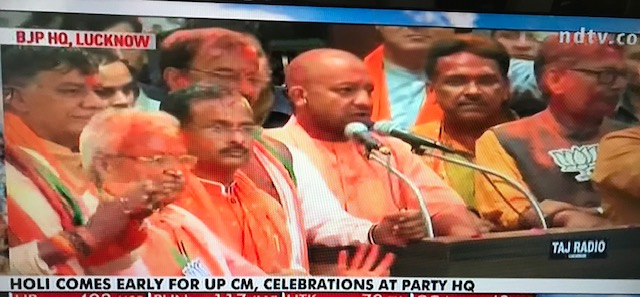
The UP victory also confirms the emergence of Yogi Adityanath, the state’s chief minister who is a controversial Hindu priest-turned-politician, as a potential party leader. Never since 1985 has the UP returned a party for a second term in government, a success today won jointly by Modi and Adityanath.
The special significance of the results for Congress, which also failed to capitalise on prospective gains in Goa and Uttarakhand, is that the Punjab loss was substantially caused by mismanagement of the party’s state leadership by Rahul Gandhi, the de facto but ineffectual party leader.
His sister, Priyanka Gandhi Vadra, who has always been seen as a charismatic and capable potential replacement for her brother, played a significant part in the Punjab mismanagement and had a lead role for the first time in Uttar Pradesh as the party’s general secretary. Her standing has therefore been diminished. Their mother, Sonia Gandhi, is the party president but is suffering from ill health and is rarely seen publicly.
The Congress is now in power in an all-time low of only two states, Rajasthan and Chhattisgarh, down from nine in 2014. It won just two seats UP with a vote share of just 2.3% despite high profile campaigning by the Gandhis. Rahul Gandhi says, as he often has before as the party’s fortunes have declined, that they “humbly accept people’s verdict – we’ll learn from this”.
Bourbon monarchy
The Congress came “across as the Bourbon monarchy trying to reinvent itself after the French Revolution has taken place,” wrote Pratap Bhanu Mehta, a leading political commentator and columnist in the Indian Express. Never known for understating his comments, he said that Congress had been “trumpeting entitlement from a position of non-achievement and weakness”.
There was, he added “weariness with old, corrupt, doddering, ancient regimes trying to reinvent themselves”.
That applied also to the Samajwadi Party in UP, which did well coming second after raising its percentage of the poll to its highest ever figure of 33%. But, though its leader Akhilesh Yadav has a young energetic image, he is the second generation a dynasty and brings back memories of the corruption and disastrous law and order during the family’s earlier times in power.
The BJP exceeded forecasts in UP, and looks like winning 274 seats (with its allies) in the 403-seat assembly. That is 48 lower than the number it won last time in 2017. The Samajwadi Party (and allies) is winning 124 seats, up 72, but it could not counter the strength of the BJP’s campaign and was let down by lack of support from the other two anti-BJP parties, Congress that got just two seats and the caste-based BSP with only one.
The return of the BJP government under Adityanath has come about despite his administration’s shortcomings that it was assumed would lead to a less favourable result. These include serious mismanagement of the Covid pandemic, poor performance on the economy and the creation of jobs, and a harsh Hindutva approach, especially the Love Jihad movement that punishes Muslims courting Hindus.

On the western side of this vast state, which has a 230m total population, there was also opposition to the BJP’s national farm reforms that led to a year of mass protests till the government withdrew the proposals last November.
The majority of voters seem however to have reacted positively, especially in poor villages, welcoming what has been achieved on the pandemic and other issues rather than reacting against the BJP for what has not been done.
Voters will also have been swung by Modi’s charismatic performances at widespread rallies. He raised national issues that even extended to claims that India’s growing standing internationally had helped it evacuate students from the Ukraine since the Russian invasion – though India’s efforts have been criticised by students and local Ukraine officials.
The BJP is also winning in Uttarakhand, Manipur, and Goa.
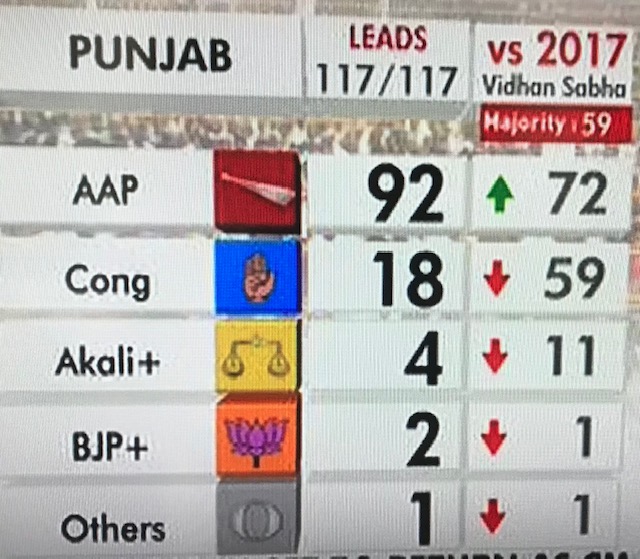
In the Punjab, the AAP has 92 of the 117 seats, up from just 20 in 2017, while Congress dropped 59 to 18 seats. The BJP won just two seats and the regional Akali party four. On vote share, the AAP rose to 42% compared with Congress’s 23%.
This unexpectedly big AAP majority followed a debacle over a former international cricketer who became a politician and, encouraged by the Gandhis, undermined the then Congress chief minister Captain Amarinder Singh, a veteran politician. Both the cricketer Navjot Singh Sidhu, and Amarinder Singh, failed to become elected, as did the chief minister candidate. (Click here for the Punjab story).
Kejriwal greeted his party’s victory in Punjab saying, “First this revolution happened in Delhi, then in Punjab and it will now happen all over country.”
Its first task however will be to learn how to run the Sikh-dominated Punjab, which will be a different – and bigger – challenge than Delhi where it has been in power since 2013 (apart from a one-year gap in 2014). It will not have to suffer the sort of interference from the Modi government that it has had in the capital, which does not have the status of a full state, but it will face new issues in this agrarian state including corruption in government, a lack of jobs for the youth, and a widespread illegal drugs trade.
Other AAP leaders talked today about the party emerging as a national force and as a natural replacement for Congress. That is taking what could happen too far. The AAP, which will have candidates in Gujarat assembly elections later this year, cannot expect instant success there or in any other state.
Its reach could however gradually grow, especially if it worked with other regional parties – and if the aloof Congress could shed the Gandhis’ sense of entitlement and join in because the Congress still has brand value.
Till that happens, the BJP will dominate and extend its Hindutva ambitions, where Muslims and other minorities have to accept that they live in a primarily Hindu nation.
When history is written, the Gandhis and the Congress Party will surely be condemned for not mounting the sort of opposition that is expected in a parliamentary democracy.
 Riding the Elephant
Leave a comment