Sunak is focussed and his Indian origin seems not to be an issue
Truss is brash, seeking instant headlines that lead to a major ‘U’ turn
On current trends, it looks as if Britain might get its next prime minister without even having a public debate about whether it wants someone of Asian origin in the post. Rishi Sunak, whose Indian parents moved to the UK via East Africa, was the front runner favoured by a majority of Conservative MPs when the contest for party leadership began.
All the opinion polls however are currently indicating that Sunak, till recently chancellor of the exchequer (finance minister), will be beaten by Liz Truss, the foreign secretary, who looked a gauche and unprepared candidate at the start but has now emerged as the favourite, winning growing support from leading newspapers and from senior cabinet colleagues who doubtless hope for jobs in her administration.
The Times on August 2 reported a YouGov opinion poll of 1,000 party members in the previous five days that showed Truss leading with 60% to Sunak’s 26% and 14% undecided or not voting. Nine out of ten of those polled said they had already decided who to vote for. That trend was strengthened with a poll from Conservative Home, an independent conservative news site, that gave Truss 58% and Sunak 26% with 12% undecided.

Both are reliable organisations and if their figures reflect what is really happening, Sunak will need a game changer to recover. Voting papers that were being sent out this week to some 160,000 party members have been delayed for several days because of the risk of cyber attacks. The deadline for voting is September 2, but many recipients are expected to fill in the forms and return them quickly by post or on-line, so Sunak may not have long to win supporters.
Television and other public debates will continue through August, unless one of the candidate (presumably Sunak) withdraws. The result is scheduled to be announced on September 5. The winner will replace the disgraced but unrepentant Boris Johnson, who is dreaming of prime ministerial resurrection, and move into Downing Street.
Sunak lucid on policy
Sunak is clearly the more competent of the two candidates. He argues his economic policies lucidly with confidence and a grasp of detail – even surviving with few bruises a half-hour interview with an aggressive television anchor, Andrew Neil, who frequently crushes his guests. Truss has declined an invitation from Neil, presumably fearing she would not do anywhere near so well.
Truss however appeals to the right-wing Conservatives with her tax and other policies and her tough line on Ukraine. She also has Johnson’s tacit support and has even defended himwhich means she wins over those who think he should not have been ousted.
Johnson’s supporters continually ask whether they can trust Sunak, citing the disloyalty he showed when he allegedly intentionally triggered the prime minister’s downfall by resigning as chancellor on July 5. That was quickly followed by some 50 other ministerial resignations. Sajid Javed, the health minister, resigned just before Sunak, but arguably that alone would not have been enough to lead to what Johnson described as the “herd instinct” departures. “It’s increasingly clear that for Sunak, there will be no overcoming that original sin,” says a Times columnist this morning.
Unlike Truss, Sunak lacks broad government experience, especially on foreign affairs, having only entered politics in 2015. He also lacks political judgement, which he showed when he allowed the tax affairs of his immensely wealthy wife, Akshata, to become a political issue earlier this year. The daughter of India’s leading IT tycoon, Infosys’s Narayana Murthy, Akshata had retained non-domicile status and used it to escape some £20m UK tax.
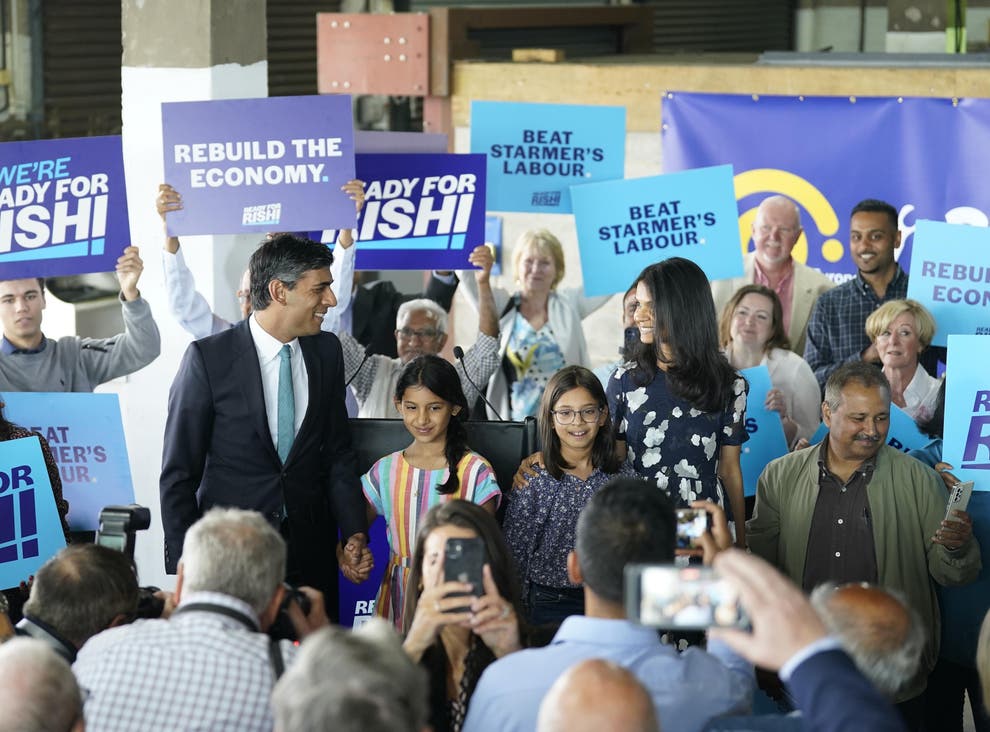
That became a major media story and was a setback for Sunak. It has now been corrected, but should have been changed in 2015, as should Sunak’s US green card that he kept after working as a Goldman Sachs investment banker in America. He also seemed not to realise that their combined wealth, which the Sunday Times Rich List puts at £730m, would become a political hazard that needed managing, especially for a finance minister and an aspiring prime minister.
But despite those limitations, Sunak is the natural choice for party voters wanting a well-informed leader who would be clearly focussed on devising and executing sound policies – in sharp contrast to Johnson and also in contrast to Truss who has tended in her campaign to devise policy initiatives that grab instant headlines.
Truss ‘U’ turn
Yesterday (August 2) Truss had to make an extremely embarrassing and high profile ‘U’ turn on a policy announced the night before as part of her keynote “war on Whitehall waste”. She had proposed the creation of regional public sector pay boards that would lead to pay cuts for government and other workers living outside London, including teachers and nurses. This idea had been thought about and abandoned for many years by successive governments, but Truss presumably latched on to it as a headline grabbing initiative that would, she said, ultimately save £9bn and help fund her tax cuts. Sounding rather like Johnson, she blamed others for misrepresenting the plan and denied points that she herself had made the day before. A Financial Times report said it inspired by the right-wing Taxpayers’ Alliance.
She has also shown herself to be brash on international affairs, making unnecessary threats to Vladimir Putin that prompted him to put Russia’s nuclear weapons on high alert at the end of February, and to Emmanuel Macron over recent travel delays across the English Channel.
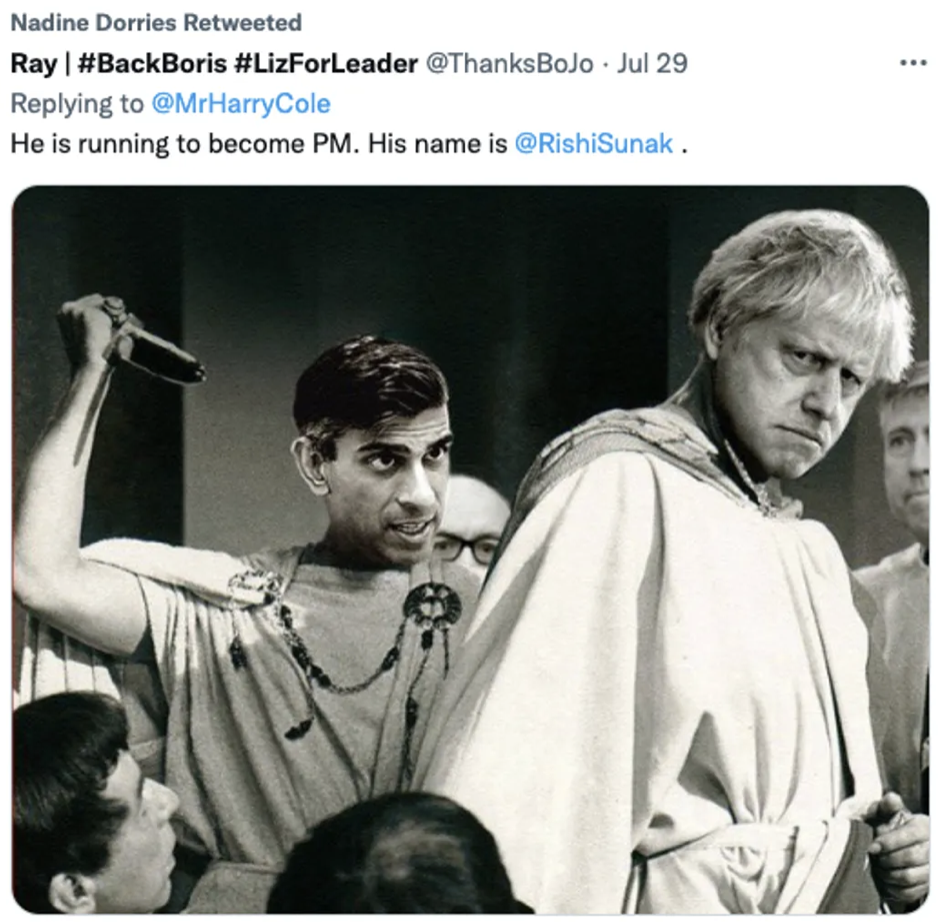
On August 1, she insulted Nicola Sturgeon, Scotland’s independence leader, saying she was an “attention seeker”. The best way to deal with her was “to ignore her” – the Sunak team more sensibly said Sturgeon should be tackled on her policies, not ignored. Truss also triggered talk of a general strike after she brusquely announced plans for measures to curb railway strikes, which are now hitting the UK.
The main policy debate has been on the economy at a time when there is a cost-of-living crisis with inflation is running at over 9% and virtually no economic growth. Truss is promising populist instant tax cuts funded by borrowing, which Sunak rejects because of rising national debt, though he has been forced to promise some tax cuts over seven years.
Truss might moderate her style if she was elected, but these recent events could cause some of her potential supporters to have second thoughts while they wait for ballot papers. Her approach is in line with her wish to be seen as tough and as effective as former prime minister Margaret Thatcher who she emulates – even dressing in Thatcher’s style on a visit to Russia.
A veteran right-wing political commentator, Charles Moore, wrote after an interview with Sunak, “how nice it was to talk to a politician who never bluffs about details, expresses himself so intelligently and genuinely enjoys policy argument” with a “cool, clear mind”. Moore noted Sunak’s “charm, which combines modesty of demeanour with mastery of the subject, as if he were a sympathetic surgeon ready to operate most delicately upon the nation’s troubled brain.”
But Moore, who is close to Johnson, opted for Truss mainly because of her energy and preparedness to branch out with a new approach, but also because Sunak’s “subliminal message is: ‘I know better than you’.”
Mansplaining
That implied criticism stemmed from the way that Sunak repeatedly interrupted and talked over Truss during tv debates, sparking allegations from her supporters and others of “aggressive mansplaining” and “shouty private school behaviour”. (Sunak went to the elite Winchester school in fashionable Hampshire while Truss went to a more politically acceptable comprehensive school in the north of England.)
Moore also tackled the question of Sunak’s origins. “I must also admit to a racial preference: I would love the Conservative Party, which scooped the first Jew and the first woman, now to be led by its first British Indian. (He was referring to Benjamin Disraeli, the 19th century prime minister whose father had Jewish origins but who was brought up a Christian, and to Thatcher).
Most commentators have steered clear of this, almost as if the subject was off limits because of sensitivities over race, ethnic origin and maybe even religion. Sunak is a practising Hindu and made his oath on the religion’s sacred Bhagavad Gita when he became an MP.
An Indian-origin businessman and Conservative Party donor, Lord Rami Ranger, suggested that Britain would be seen as racist if Sunak lost, but Sunak replied: “I absolutely don’t think that’s a factor in anyone’s decision. I just don’t think that’s right”.
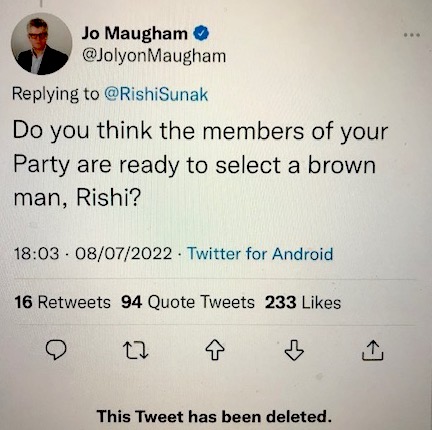
One notoriously controversial lawyer tweeted about whether the Conservatives would want a “brown man” as leader. That led to an uproar and the tweet was deleted, but it did lead to the thought that the traditionalist largely middle-class elderly voting members of the Conservative Party might be less willing than the general electorate to see Sunak in Downing Street.
Meanwhile, Johnson’s supporters are campaigning (fruitlessly) for his name to be on the ballot paper. Whoever wins will have to cope with his continued presence, not only as an MP and as a prominent columnist in the Daily Telegraph, but also because he seems to believe he will be called on to return as prime minister – as happened to his idol Winston Churchill.
That will not help the new prime minister deal with a mass of crises including inflation and the escalating the cost of living, serious labour shortages, and a series of public sector and other strikes that have already started on the railways and in telecommunications and also threaten schools and ports. There is even the vague threat of a general strike if Truss goes ahead with ill thought-through plans to stop trade unions causing major disruption.
The choice the Conservative voters are making is between Sunak, who would surely cope with these issues calmly and effectively, and Truss who wants to be seen as a second Maggie Thatcher, known as the ‘Iron Lady’.
This is a slightly extended version of an article on TheWire.in – https://thewire.in
 Riding the Elephant
Leave a comment