Pakistan’s “failed project 1947” on display at London literature festival
Government criticised for failing to build good relations with IMF
The depths of despondency and unhappiness in Pakistan about its failure to emerge as a successful nation after 75 years of independence were dramatically evident in London over the weekend when former top former government officials and others spoke out about the country’s current serious economic and political crises.
“The first thing we have to admit is that we have failed,” declared Shabbar Zaidi, a former chair of the Federal Board of Revenue and a partner at PwC Pakistan. “The project Pakistan launched in 1947 has not given the desired results”.
“Why have we lost so much hope that we cannot address this crisis?” asked Reza Bakir, a former governor of State Bank of Pakistan.
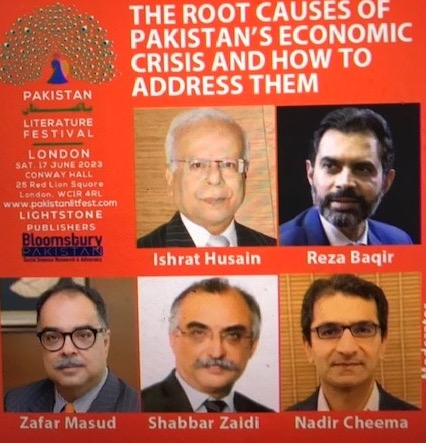
With other former senior officials, they were speaking at a session on the country’s economic crisis at a Pakistan Literature Festival in London’s Conway Hall on June 17. The audience of several hundred applauded loudly, especially when allusions were made to the negative role of Pakistan’s army in the running of the country.
That perhaps was not surprising because a diaspora is often highly critical of faults in its original country. What was remarkable was the outspoken criticisms from the speakers and others who live in Pakistan and maybe felt more free to speak out when abroad.
At a time when Pakistan is heading to a possible financial default, Bakir criticised the government’s failure to work constructively with the International Monetary Fund on a bale out. ”We cannot antagonise the people whose generosity we need. But it looks like that is not where it is headed,” he said.
“I am concerned because our relationship with the international financial community has not improved over the past few months…..The deterioration comes both in terms of substance and in terms of communications…..If we want to avoid default, we have to have a constructive relationship with those who may be there to give us a bit more breathing room, but that it looks like that is not there and we are just hurting ourselves”.
China, Pakistan’s close ally, was not mentioned in the discussion but, it emerged over the weekend, is giving a $1bn support package.
The festival’s despair was not just focussed on the economy but also ranged across politics, including the Pakistan army withdrawing support for Imran Khan, the popular cricketer-turned-populist politician who it earlier created as prime minister.
Sessions began with “Pakistan at the zero point” and followed with “Pakistan, the fault is not in our stars but in ourselves”. At the end came “The root causes of Pakistan’s economic crisis and how to address them”, though during the day there were sessions on education (also partly a problem) and most positive ones on poetry, literature, drama, music, dance.

“Our purpose is to project the real image of Pakistan and generate and stimulate debates on the issues facing us,” says Ameena Saiyid, the organiser and a publisher who also runs the annual Karachi literature festival. “We want to project a real picture, not a fake one which shows Pakistan as a terrorist country, nor one that says that all is well”. The sessions, she said, “reflect the current state of affairs in Pakistan – our purpose is to acknowledge that so we can then debate and look for solutions rather than go into denial”.
Pakistan’s economic crisis is centred on $1.2bn aid due from the IMF in October last year as part of an extended fund facility’s ninth review. That tranche has not materialised because Pakistan has not met the IMF’s stipulations on economic policy. Chances are fading for the revival of the current $6.5bn IMF programme before it expires on June 30, with $2.6bn not paid.
Throughout the day, the army’s role in running and removing governments was, as one speaker put it, “the elephant in the room that is not in the room”. When someone asked whether “the army is a strain on enterprises making profits”, loud applause turned to laughter with the brief non-reply – “I have to go back to Pakistan after this”.
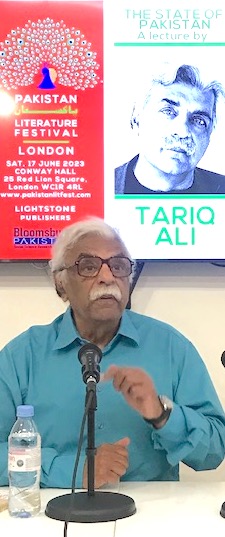
The day began with a predictable attack from Tariq Ali, the 79-year old British-Pakistani leftist and political activist, who complained that “the elite have run the country as a fiefdom”. Elections “don’t really matter” because the army was in control.
Ishrat Husain, the State Bank governor 20 years ago and an adviser on economic reforms to Imran Khan, forcefully, argued that Pakistan’s economic failures stemmed from “political instability that results from interventions by forces that don’t have to follow the constitutional role”. That was a reference to the army and maybe also to the supreme court that plays a significant political role.
Husain was implicitly criticising the army for scuppering economic reforms by removing prime ministers and governments before their terms had expired. Unlike India and Bangladesh, he said, where economic reforms had been continued by successive governments for decades, those in Pakistan were not completed and IMF support packages collapsed. Out of 24 IMF packages between 1988 and 2020 only four had been completed. “On 18, we drew the first tranche and said ‘bye bye, we are not going to do the reforms'”.
Shabbar Zaidi accused both the army and political parties of “never wanting to improve proper taxation system for the real estate sector”. Referring to his time as chair of the revenue board, he said “I was asked to reduce real estate valuations after I raised them”.
Solutions proposed by speakers included slashing subsidies for all but the poorest people and exporters and cutting back on defence spending that had been not less than 4% of GDP for most of the past 75 years. Positive encouragement was needed for manufacturing and for businesses that import and export, adding value as part of international production chains.
Raza Baqir said that three sets of partners should be encouraged to help – the domestic business community, overseas Pakistanis as investors, and the international finance.
In the “Fault is not in our stars but in ourselves” session, Azhar Abbas, the ceo of Geo News (tv), said “Our elite captures the system in a way that it is suffocating”. Amin Hashwani, part of a prominent business family and a social campaigner, thought a major problem was that “as a society we have stopped questioning” how the country was run. Political parties were supposed to be business friendly but were “more like the Sicilian mafia where an entire family is at the head of things”.
Foreign affairs and the influence of major powers were not discussed, but it seems that Pakistan is more alone and adrift than it has been in the past.
Relations with the US have not been consistent over the years and are now far from strong or positive. Washington has other priorities and is more concerned with building relations with India as a buffer with China than influencing Pakistan – prime minister Narendra Modi is on a state visit to the US later this week. (This was debated in a Democracy Forum online seminar yesterday [June 19] where two speakers said the US did not have sufficient “bandwidth” to help.)
Perhaps surprisingly, for Beijing, it seems that Pakistan is no longer primary or secondary in its priorities, but it does want stability with the military on side, and it also wants to rescue what it can from the the debt-ridden branch of its Belt and Road Initiative designed to run through Pakistan.
A general election is due later this year which will, it seems, probably return the ruling Sharif dynasty’s PML-N party to power on its own or in coalition with the Bhutto dynasty’s PPP, and with Imran Khan kept out of the action by the army that is dismembering its organisation.
Without any strong and experienced outside influence apparently being available to generate major changes, the prospects for a new era of success that will restore confidence in the 1947 Project Pakistan look remote.
 Riding the Elephant
I read through this and was rather surprised by what I felt was a sympathetic tone towards the PTI government of Imran Khan. Through the almost 4 years of this government’s tenure, there is hardly a single positive feature that can be mentioned and there are any number of negative ones, including, as it now appears corruption on an astoundingly bold scale. That matters little though, as all Pakistani governments have been thoroughly corrupt.
Imran’s government was the only one ever to be to be thrown out following a constitutional process – a process he did his very best to subvert. It was the only time when a government has been changed by no apparent direct input from the army. There was a no confidence motion that succeeded. Now it can be said that the army, which had brought Imran in, could have stopped it but did not. There is no evidence that they directly supported the other side. That is not tantamount to evidence of the army engineering his ouster.
After his ouster, Imran’s popularity sky rocketed. And he would have won an election had he and his party not mounted an attempt at mutiny in the army ranks. In any country anywhere on the planet, if that succeeds, you are in for a decade; if it fails, it is the firing squad. Imran’s apologists say this was a false flag operation conducted by the army itself but there are videos of senior figures of his party rampaging the streets on that day. Were they involved too?
It is entirely true that the army is to a great extent responsible for the country’s economic woes. However, a bigger part, perhaps, has been played by the judiciary and by politicians who have been, without exception, devious, corrupt and completely undemocratic in their thinking. The article mentions a statement that out of 24 IMF programmes, only 4 have been completed; that is because political governments find it suicidal to accept the harsh conditions the IMF lays down for economic reforms, and this is now more true than ever with the IMF demanding conditions that no government dependant on public support can ever agree too. And therefore it appears as if the one and only way forward is a civilian caretaker government of technocrats, but not for the next 6 months or a year, but for a much much longer period.
By: Shahed Sadullah on June 20, 2023
at 3:28 pm
The problem with Pakistan is the predominance of the Punjab over the smaller provinces since independence in 1947 . The power of the Punjabis in all aspects of the country’s political , economic and administrative life is exercised through the Army , which again is mainly comprised of Punjabi officers and and soldiers .
The first major consequence of the Army’s control was the disastrous loss of East Pakistan in 1971 . If the safety valve of democracy continues to be choked by the Army , then the future of Pakistan could be a fratricidal fragmentation eerily similar to the violent break up of Yugoslavia . The analogy can be taken further to the extent that the Punjabis are the Serbians of Pakistan , the Pathans are the Croatians , the Sindhis are the Bosnians and the Baluch are the Macedonians .
By: Saiful Haque on June 20, 2023
at 2:41 pm