G20 declaration a boost for Modi’s image and India’s world role
Not all the points made by the G20 operate in India
Narendra Modi’s inclination to demonstrate his power as India’s prime minister with surprise announcements has this past week hit a new level when he began, without any warning or discussion, what could be a process to emphasise Bharat rather than India as the name of the world’s most populous country.
His timing coincided with world leaders arriving in Delhi for the G20 summit which has been a dramatic success for the prime minister’s domestic image ahead of next year’s general election and for India’s international image as a power to be reckoned with.
The summit agreed the New Delhi Leaders’ Declaration yesterday (September 9), a day early, defying critics who argued that it would be impossible to bridge differences over Ukraine and other issues. That is a big plus for Modi and his team of ministers and officials, even though critics say that some of the statements on democracy, inclusiveness and protection of the environment ring hollow in India.

Modi’s stature can no longer be questioned. He has emerged since he became prime minister in 2014 as a charismatic work-obsessed leader, who takes no holidays but rules with authoritarian force that seems to his critics at home and abroad to defy the country’s reputation as a functioning parliamentary democracy.
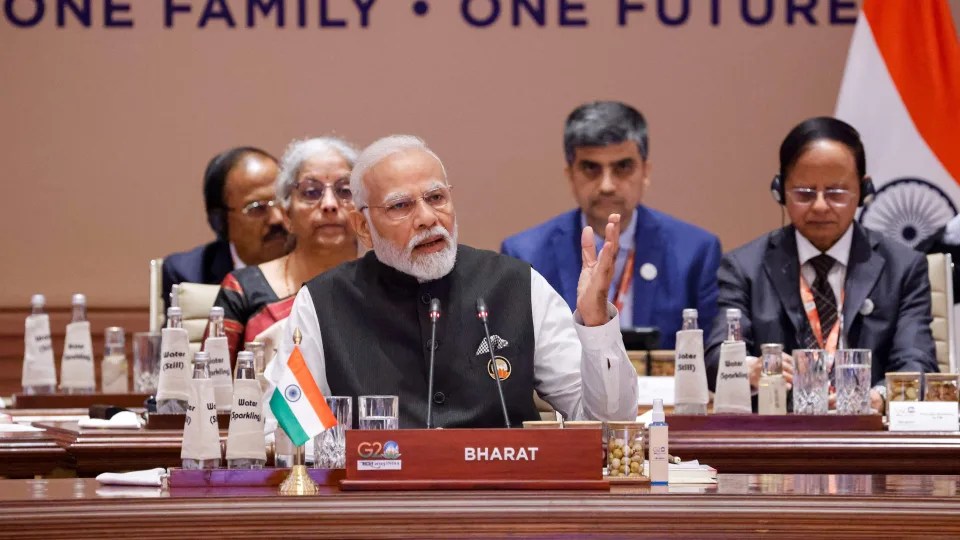
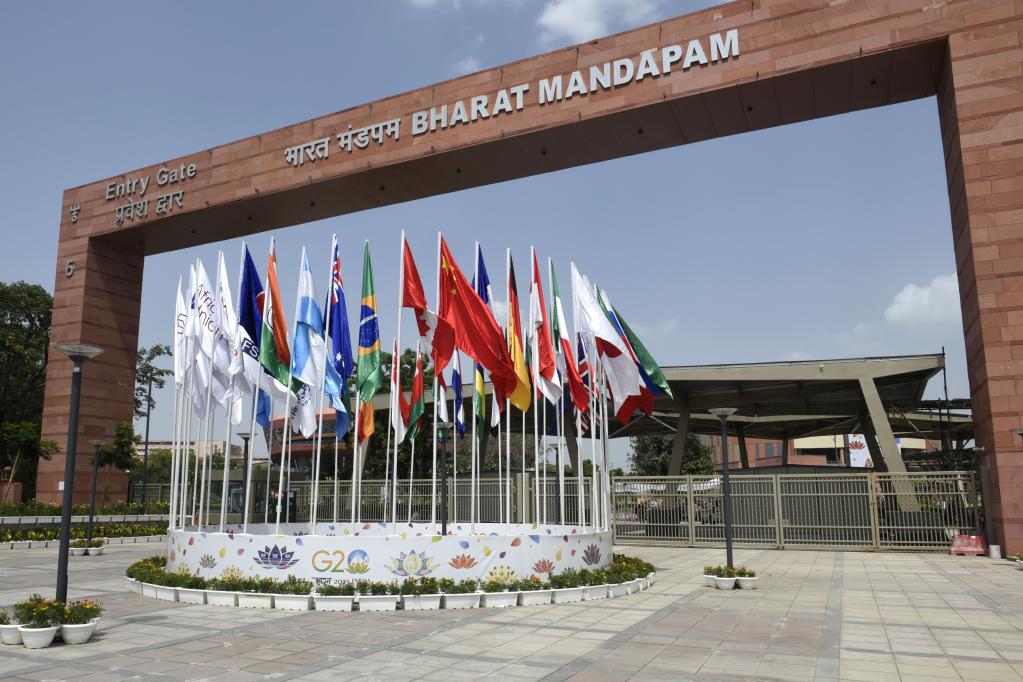
Bharat has been used on the names of new buildings that house the G20 summit, but it drew international attention when it appeared on social media with a picture of an invitation from the “President of Bharat” to the G20 banquet last night. It was already in a booklet for G20 foreign delegates, titled “Bharat, The Mother of Democracy”, which said, “Bharat is the official name of the country. It is mentioned in the Constitution as also in the discussions of 1946-48”.
It would be a massive exercise, with international ramifications, to make a complete change from India to Bharat, but suggestions that this could be a temporary move seemed to be confounded when the name card in front of Modi at G20 sessions this weekend said “Bharat”.
Both names have roots deep in history – India has more colonial associations but has origins in the Indus civilisation while Bharat, it is said, comes from an ancient Vedic tribe called Bharata.
Both are already in the Constitution, which says “India, that is Bharat, shall be a union of states”. That is the only time Bharat appears in the document. It was a compromise soon after the country’s independence when leaders debated between those two names along with Hindustan. Under Jawaharal Nehru, the prime minister, India prevailed though Bharat is often used in written and spoken Hindi. Bharat howe
There are mixed views in India about whether Modi adopted Bharat in order to undermine the Congress and other opposition parties that have recently decided to call themselves the Indian National Developmental Inclusive Alliance or I.N.D.I.A. Some political analysts say Modi and his Bharatiya Janata Party were rattled by the parties being able to electioneer with that title, hence the attempt to switch attention to Bharat.
The change however also fits with the way Modi is shedding the relics of British rule and of India’s colonial heritage, and trying to obliterate the history of Nehru and his Congress Party’s role in the country’s development. This is in line with a drive to establish a Hindu nation where religious minorities, notably Muslims but also Christians, have a minor imprint on how life is lived. In that context, India sounds more westernised than Hindu “Bharat”, even though both have ancient roots.
A year ago this week, Modi changed the name of Delhi’s revamped ceremonial road, which runs from the presidential palace to India Gate, from Rajpath to Kartavya Path – Path of Duty. It had been called the Kings Way before independence, and Modi said at the renaming ceremony that the two old names symbolised both the “power of the ruler” and “slavery”.
Formally changing the country’s name would require pushing amendments to the country’s constitution through parliament. Whether that is to be Modi’s next step could emerge at a special five-day session of parliament that has been called starting on September 18 without, so far, any public agenda. It had been thought the subject might be a controversial government plan to synchronise the date for the national general election (due by April-May next year) with state assembly elections in order to end the seemingly never-ending current cycle of electioneering.
G20 and Ukraine
The Delhi Declaration waters down the statement on Ukraine at the last G20 summit in Bali a year ago that referred to “aggression by the Russian Federation”. Delhi’s version merely calls for a “just and durable peace”. This ensured that China and Russia signed up to the declaration, which was presumably accepted by the US and other G20 members in order to ensure that a declaration was produced. The declaration does however also say that countries must “refrain from the threat or use of force to seek territorial acquisition” and that “the use or threat of use of nuclear weapons is inadmissible”.
Amitabh Kant, India’s leading G20 summit official, said there had been over 200 hours of “very tough, very ruthless negotiations”. Key roles had been played in getting Russia to agree to the wording by Brazil and South Africa, the next two G20 presidents, as well as Indonesia, Turkey and Mexico. A senior EU official told The Guardian that by Saturday, Russia was “cornered” in the negotiations.
India also successfully organised the induction of the African Union as the 21st member, and established itself as a leading voice in what has come to be called the Global South.
Failure to have a declaration would have been a major loss of face for Modi, who had already been slighted by China’s president Xi Jinping staying away for the first time from a G20 summit. Vladimir Putin also did not attend because of international warrants for his arrest.
Ambitious agenda
Modi stated that the summit was “the most ambitious in the history of G20″, adding that “with 112 outcomes and presidency documents, we have more than doubled the substantive work from previous presidencies”.
Alongside the pledges however, there were sharp contrasts with life in India. The resolution noted a UN document calling for “religious and cultural diversity, dialogue and tolerance”, and “freedom of religion or belief, freedom of opinion or expression”. As the BBC News reported on the eve of the summit, Modi frequently refers to India’s as the “mother of democracy” but “people are scared to challenge the government”.
The declaration also supports “environmentally sustainable and inclusive economic growth and development”. India however is in the process of removing any hope of independence in its 20-year-old environmental appeals body, the Central Empowered Committee, by shifting it from the Supreme Court system to the environment ministry. This is in line with the government curbing environmental opposition to infrastructure and other development projects. The ministry will now appoint the members and in effect rule on whether or not projects are environmentally sustainable.
Modi has made India’s year-long presidency a countrywide affair with some 220 meetings on various subjects being held in 50 cities, all decked out with placards of the G20 logo and the prime minister’s image along with celebrations.
That has all been an undoubted success – for India through most of the year and now it seems for Bharat.
 Riding the Elephant
Supporters of Modi’s moves to change India’s name to Bharat will no doubt point out that India’s National Anthem , ‘ Jana Gana Mana ‘ , composed by the great poet Rabindranath Tagore in 1905 , never uses the word India but has the words ” Bharat Bhagya Bidhata ” in the first stanza .
But it is intriguing that Modi appears to have have shied away from using the other , albeit much less frequently used , name of ” Hindustan ” ( Land of the Hindus ) which perhaps would have been more in keeping with Modi’s apparent ideology .
By: Saiful Haque on September 11, 2023
at 2:36 pm