Big setback for Modi’s aim to establish himself as invincible leader
India will now have a coalition government
Narendra Modi is set to become India’s prime minister for a third term following counting of votes in the country’s mammoth general election. But the face of Indian politics has changed dramatically with an unexpected resurgence of opposition regional parties and the Gandhi-led Congress Party, and declining support for Modi’s Bharatiya Janata Party (BJP).
Modi will be sworn in as prime minister on June 8 (or June 9), but his dreams of winning a dominant personal victory as a supreme leader have been shattered in one of the most unexpected reversals for many years.
The result proves the strength and power of India’s often criticised parliamentary democracy with 642m people voting in this election. It also marks the failure of Modi’s ambition to remove the Congress party and its Nehru-Gandhi dynasty leadership from active politics.
Modi’s personal pitch of projecting himself with an almost priestly Hinduism religious role seems to have failed to attract votes – it even failed in the constituency that contains the Ayodhya temple where he presided in January and where the BJP parliamentary candidate lost to the state-based Samajwadi Party. In his own constituency of Varanasi, Modi won with a majority of just 152,513 votes, down from 471,000 in 2019.
The hopes of Modi’s opponents that one day the political pendulum would swing against harsh autocratic Hindu nationalism has been vindicated. Till now, that seemed only a hope for the somewhat distant future – scarcely anyone had expected it to happen in this election.
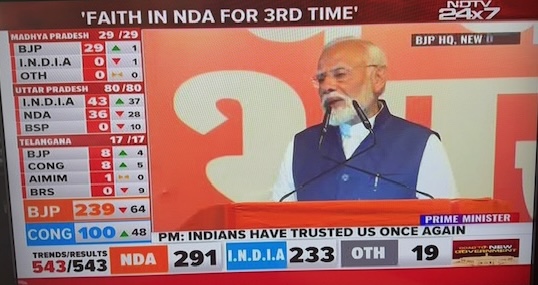
The results show the BJP’s National Democratic Alliance (NDA) with 293 seats in the Lok Sabha (lower house of parliament), and 232 for the I.N.D.I.A grouping that includes the Congress party. Other parties have 19 seats.
Significantly, these figures include the BJP with 240 seats, down 63 from 303 in the 2019 election, and 99 for Congress, up 47 from 2019.
There was only a 1% drop in the BJP’s vote share, but co-operation between opposition parties reduced competition in individual constituencies and led to its large loss of seats.
The BJP has therefore failed to reach the 272 majority mark so needs the active support of its coalition partners for the first time since it came to power in 2014. That will pose a personal test for Modi, who has run a centrally controlled government from his prime minister’s office with little notice being taken of alliance partners or other interests.
There were some suggestions as the results emerged that two regional coalition partners might switch to support the I.N.D.I.A, which would have removed the NDA’s majority and could have prevented Modi forming the government. That however is not to be happening. The parties are Bihar’s Janata Dal United (JDU) led by Nitish Kumar, which has 12 seats, and Andhra Pradesh’s Telegu Desam led by Chandrababu Naidu with 16. Both leaders have at different times supported and not supported the BJP, but both have pledged to join the government.
Part of the BJP’s problem was that there was no clear focus in its election campaign, apart from the presence of Modi, and there was a lack of firm polices for the future. This led to local issues and the role of regional parties becoming important in many constituencies. It was also the first time that Modi had faced a united opposition. Turn-out was low compared with earlier elections, suggesting that some BJP supporters had not voted, maybe because they felt that the government had not done enough to boost employment and curb price increases of basic goods. It is also possible that voters did not like extreme anti-Muslim tilt of Modi’s campaigning.
“Big decisions”
Modi put as brave a face as he could on the losses and is presenting the result as a victory for Indian democracy and a success for the BJP winning a rare third consecutive term with a sizeable majority over the I.N.D.I.A. Speaking alongside grim-faced fellow BJP leaders at a party rally when the results were clear, he said the government would now write a “new chapter of big decisions”.
That underlines the point that, while he might feel less confident about pushing Hindu nationalism and side-lining Muslims as a religious minority, and will be slowed down on that by coalition partners, he will now want to do more on economic reforms, social support systems for the poor, attracting foreign investment and building new technology-oriented industries. Some observers however suggest that he may not feel strong enough to carry out delayed and controversial reforms such as privatisation of state industries and changing labour practices.
In addition to failing to establish the country-wide endorsement for his leadership, the BJP only won one seat in southern states where Modi wanted it to establish a significant presence. It raised its percentage of the vote and gained one seat in Kerala but none in Tamil Nadu. It did however repeat its past success in Delhi where it won all the seven parliamentary seats, as it did in 2019.
In the state assembly election in Orissa, it won control for the first time, pushing out the state-level Biju Janata Dal led by Naveen Patnaik who has been chief minister for 24 consecutive years, the second longest of any chief minister in the country.
The BJP’s biggest setbacks that helped to swing the overall result came in two states. The main surprise was Uttar Pradesh where the I.N.D.I.A won 43 parliamentary seats out of a total of 80, whereas the NDA has only 36, down from 64 in 2019. This is unexpected because Yogi Adityanath, the Hindu priest-turned-chief minister, was reported to have built a good image for the BJP by strengthening law and order and boosting both development projects and care for the poor.
The result is a victory for Akhilesh Yadav, leader of the UP-based Samajwadi Party, working with Rahul Gandhi of the Congress party whose political future looks more assured than it has for many years.
Observers suggest that Yadav and Gandhi successfully worried members of India’s lowest castes that reservation schemes which provide them with jobs and other advantages might be cancelled by the Modi government amending the constitution.
In West Bengal, the reigning chief minister Mamata Banerjee’s Trinamool Congress saw off the NDA challenge and her party won 29 of the 42 parliamentary seats compared with the BJP’s 12. This is a major setback for Modi who wanted to establish the BJP as a significant political force in the state.
The overall result is specially surprising coming after exit polls published when voting ended on June 1. These indicated a massive swing in favour of the BJP with between 355 and 380 seats. That led to a surge on the Indian stock market with prices reaching record levels and a crash when the actual results began to appear today.
Whether the markets needed to be worried depends on how well Modi runs the coalition and carries the BJP’s allies with him on plans for economic reform. The results will not impede the government’s plans if, as Modi has said, they lead to renewed efforts to continue India’s development as the world’s third largest economy.
 Riding the Elephant
Good recount of post election situation.
I think now even the donations and fund flow to parties that was grossly uneven -,will hopefully be less unevenly provided also more readily after the judgment against electoral bonds by Supreme Court.
By: Sudhakar Singh on June 27, 2024
at 7:51 pm