AAP that won power in 2014 is defeated by voters wanting change
Boost for Narendra Modi after last year’s poor general election result
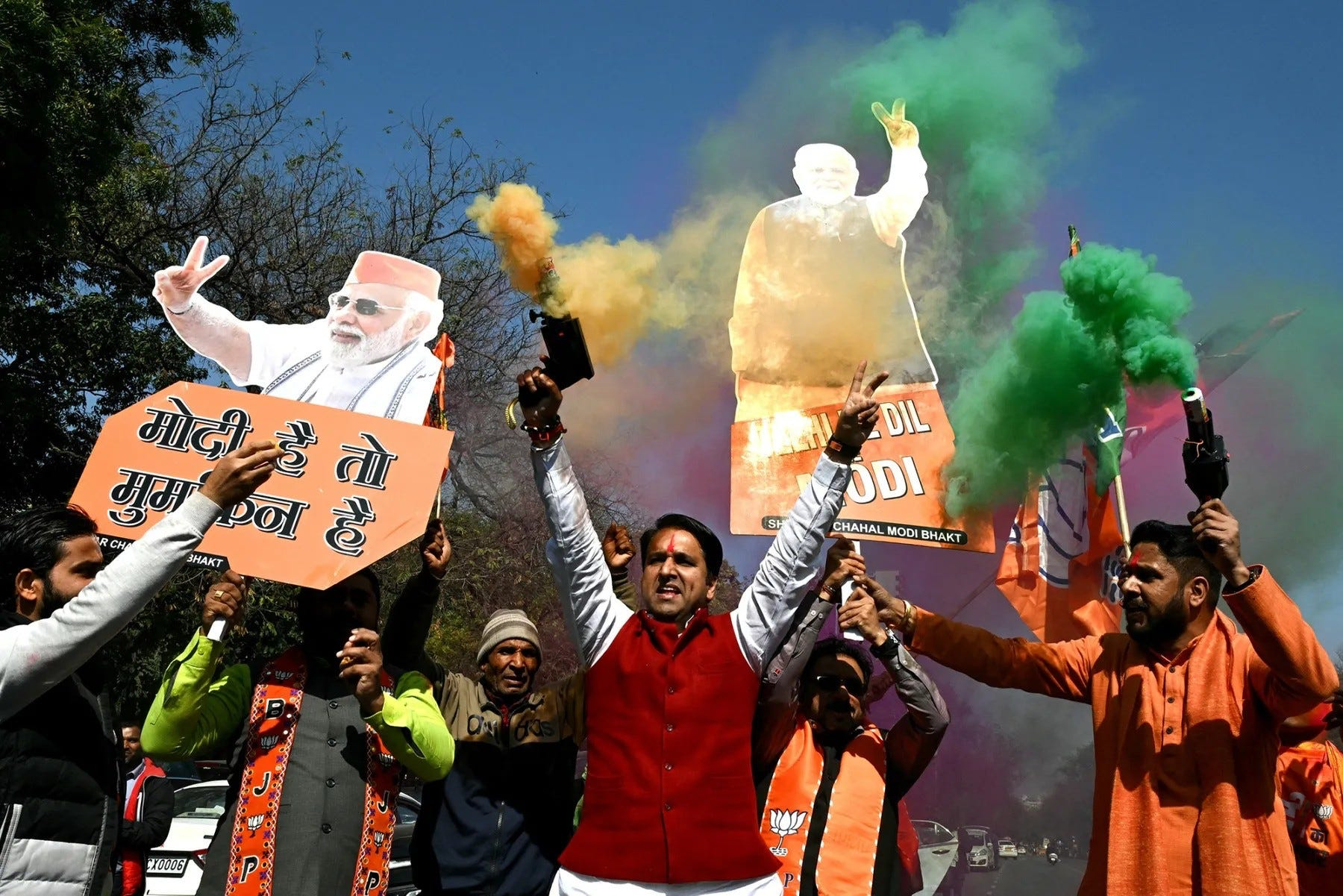
Narendra Modi’s political position as India’s prime minister received a significant boost yesterday (Feb 8) when his Bharatiya Janata Party won a resounding victory in polls for Delhi’s state assembly.
This is the BJP’s third state assembly election victory since last April’s general election, which forced the party into an active coalition with smaller parties. That was a serious personal setback for Modi and led to rumblings about his future, especially since he will be 75 in September, the assumed retiring age for BJP officials.
Unexpected BJP election victories last October in the Haryana and Maharashtra state assembly restored much of Modi’s authority, which is now strengthened by the party winning power in the city for the first time since 1998 – just a few days before he goes to Washington to meet President Trump.
The result is also significant because it punctures the national ambitions of the populist Aam Aadmi Party (AAP) that won in 2014 and 2019. And it is another dismal failure for the India National Congress whose leader, Rahul Gandhi, has failed to capitalise on gains made in the general election and emerge as a viable top politician.
The BJP won 48 seats in the 70-seat Delhi assembly, while the AAP won 22, down 40 from its 2019 score. The Congress failed to win any seats for the third time, having earlier ruled the city from 1998 to 2014. This will lead to grumbles about the Gandhi family dynasty’s leadership, but there is no prospect of any change.
There was little difference in the vote share however with the BJP winning 45.56% and the AAP 43.57%. Congress is now being attacked by opposition parties, which united in last year’s general election, for not working with the AAP, though Kejriwal apposed a link-up. This split the anti-BJP vote, but Congress leaders say that they did not trust the AAP to be a reliable and honest ally. Unity might have made a difference to the result in 13 seats where Congress won more votes than the BJP’s majority, which could have been enough to lead to a hung assembly.
The AAP grew out of a nationwide anti-corruption movement in 2011. Arvind Kejriwal, one of the leaders, broke away to enter active politics and led the party to its 2014 Delhi victory as the chief minister. This shocked and infuriated Modi, who had expected to win Delhi less than a year after he had swept to power nationally.

Since then, the Modi government has relentlessly taken measures to undermine Kejriwal, whose powers have been restricted because Delhi is a union territory, not a full state. This means that the chief minister shares power with a lieutenant governor who is appointed, not elected, and constitutionally takes his orders from the home minister – currently Amit Shah, Modi’s closest ally.
One of the issues that swayed some Delhi voters was the way that this political rivalry and administrative conflict harmed the city’s development and governance. The AAP had a good record on public health and education, but the central government runs policing and land. The lieutenant governor has also undermined the general operations of the government.
Presumably, Modi and Shah will now ensure that Delhi is run constructively on all fronts for the first time in ten years. Modi said yesterday that the BJP would “make Delhi a modern city”. Pointing out that the BJP is in now in power in all the National Capital Region that includes the states of Rajasthan, Uttar Pradesh, and Haryana, he said the governments would “focus on mobility and offer the youth new avenues for development”.
The election campaign was notable for the mass of “freebies” offered by all three political parties ranging from the BJP’s gas cylinders, financial assistance during pregnancy, and increased pensions to the AAP’s free student bus travel, free healthcare for the elderly and financial aid for priests.
Ironically since it grew out of an anti-corruption movement, the AAP has been riddled with allegations of widespread bribes and extortion on liquor procurement and licences, though none of these have yet been tested against detailed evidence in court. That led Kejriwal and his highly competent deputy, Manish Sisodia, to spend time in jail pending investigations and fresh charges. Both men lost their seats in the election, though by small margins that might have been reversed with Congress support.
More important for the middle-class voters, which make up a significant part of the population, were prices and taxation. Fortuitously, the annual budget that was announced on February 1 introduced tax breaks for middle income earners and small and medium sized businesses, just four days before voting on February 5.
Election rules
This arguably breached Election Commission rules that there should be no government announcements that could swing votes, yet the commission fixed the date of the polls and knew that February 1 is the traditional date for the Budget. (The Reserve Bank of India has just cut interest rates to boost growth, but that was on February 7, two days after the voting.)
The result raises questions about the future of the AAP, which has ambitions to be seen as a potential national party. It won power in Punjab with a resounding victory in 2022 and needs to win there again in 2027 to bolster its position after the Delhi loss.
For Kejriwal, the overall result and loss of his seat is a personal blow. He was seen when he came to power as a new style politician with no political baggage, a professional background (qualified mechanical engineer) and civil servant as well as a campaigner. That made his emergence a danger for both Congress and the BJP, but his reputation as a credible leader has declined, worsened by the corruption allegations.
The AAP has been increasingly seen as a nationalist party without the BJP’s dominant Hindutva overlay and standing for what some have called progressive patriotism. That made it a special threat to the BJP which gains backing for Hindutva from a growing nationalist mood as modern India produces new generations of aspirational middle class consumers.
Both for party political and personal prime ministerial reasons, Modi now needs to show Delhi – as well as voters across the country – that he can deliver on economic growth, inflation and jobs. That is a tough challenge.
 Riding the Elephant
ON MY FACEBOOK PAGE – https://www.facebook.com/john.elliott.212
Reshmi Ray Dasgupta
BJP won all seven Lok Sabha seats from Delhi for the past 3 elections and AAP won two assembly elections on freebies and glib talk. You wrote “ The AAP had a good record on public health, education and infrastructure”…. Infrastructure? The condition of roads has never been worse, especially ones inside neighbourhoods. Pavements are non existent in most places. The bus transport fleet is ageing and ill maintained. Schools have new buildings – guess who benefits from construction contracts? — and new teachers but independent (non govt) investigations have revealed how low achievers are weeded out of Delhi govt schools so that overall pass percentages would show a rise. As for health, the mohalla clinics are mostly shut and the ones that are open hardly have docs or other staff, not to mention medicines. Ask any one (except the media, which loves AAP) and they will confirm this. So on what basis do you assert that AAP has done well in those spheres? Have you come and seen/verified these or depended on hearsay ?
John Elliott
Ooops, I’d meant to delete infrastructure in draft, now done. Your unusually long message shows all the things that I’m sure can easily be achieved now the central government will be working in harmony with the state, harmony that has been absent for so long.
Nalin Gupta
being a delhiite & living in AAP constituency I totally agree with you and never ever have I seen worse in terms of infrastructure, garbage, etc etc the list is vast… good riddance!! Hopefully forever!! Amen!!
Reshmi Ray Dasgupta
Have you actually seen any of these supposed achievements or depended on hearsay?
Ashis Ray
John I wonder if you knew about this:
Between the 2020 assembly elections in Delhi and the general elections last year, there was a net addition of 4,16,648 voters to Delhi’s electoral roll. But just in the time period between the general elections and the assembly elections held last week an estimated 3,99,362 people were added to the list, Himanshi Dahiya notes. She also finds that in the New Delhi assembly seat – where Arvind Kejriwal lost to the BJP’s Parvesh Verma – there was a net decrease between the 2020 and 2025 assembly elections by 37,548 voters, or by 27.2%. (From today’s India Cable)
John Elliott
Thanks Ashis for mentioning this – I heard about it after I wrote the piece. What conclusion. do you draw?
Kejriwal was talking about it early December https://www.cnbctv18.com/…/large-number-of-voters…
‘Large number of voters deleted from electoral roll,’ alleges Kejriwal – CNBC TV18
CNBCTV18.COM
Reply
Ashis Ray
Reporting and comment only in the independent press. If AAP can extrapolate from the data and come up with probing questions as the Congress+ alliance have in respect of Maharashtra then there could be traction.
Logically over a 6 month period there could be a 10% increase in voters compared to 5 years. In Haryana it was 23%, in Maharashtra 125% and in Delhi over 90%.
John Elliott
On alleged electoral roll rigging in Maharashtra polls last year, Rahul Gandhi said: “The nice way of saying it is that the Election Commission has lost control of the voter list. The bad way of saying it is that the Election Commission has manipulated the list”
https://thewire.in/politics/kejriwal-rode-the-anti-corruption-wave-now-it-has-washed-him-away
By: John Elliott on February 12, 2025
at 11:15 am