“Island of Ireland JLF” programme will include India’s and Ireland’s shared colonial history
Reunification of Ireland debated at Jaipur lit fest last weekend
Shared experiences of British colonial rule will come to the fore when India’s Jaipur Literature Festival travels in May from Belfast to Dublin with a band of writers, commentators and artists, staging a total of four lit fests over ten days.
Announced last weekend at the 19th annual lit fest in Jaipur, this will be added to more than 12 destinations where the festival is held including London, Valladolid in Spain, New York and Colorado in the US, the Maldives, and Adelaide in Australia.
It will be the first time that JLF, as it is known, has toured with four linked events, and crossed a border. Called Island of Ireland JLF, it will also be the most politically and diplomatically sensitive festival because of the controversial history of empire. In the wings will be the sensitive issue of Irish reunification that would reverse the 1921 partition when the Anglo-Irish Treaty created Northern Ireland as a separate entity within the UK.
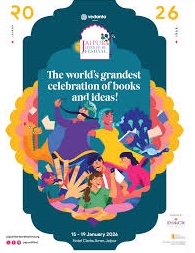
“This will be a platform for dialogue on shared histories and literary and cultural traditions between Ireland and India in what will be almost a caravan of literature moving from the north to the south through the border counties,” says Kevin Kelly, Ireland’s ambassador in New Delhi, who has been a driving force behind plans for the tour.
At last year’s Jaipur lit fest, there was strong criticism of empire in many sessions. That crystallised last weekend with special emphasis on the similarities between Ireland and India’s experiences with British colonialism and the horrors of partition, expanding to include Palestine and Israel.
Even Arun Maira, an uncontroversial economist and a former member of the Planning Commission, followed the growing trend of criticising British rule when he talked (accurately) about India’s economy being “denuded by the British”. That fits with the piece I wrote on January 10 about the Singh Twins’ art exhibition at Kew Gardens in London that exposes the role of Kew and its botanists in the British empire’s “darker side”.
“If you think the British mucked up India in 1947, just wait till you hear what they did in Palestine in 1948,” declared William Dalrymple, the lit fest’s co-director, referring to Pakistan’s partition from India and the creation of Israel, as he sat down on the festival stage to open a session on the subject.
“Ireland was the UK’s first colony, and it was a laboratory for empire,” Jane Ohlmeyer, a leading historian at Dublin University who is closely involved in the May tour, said during one of the sessions. Repeating what she had said last year at the festival, she explained that British colonisation “began in the 12th century [with mercenaries] and became intense [with direct rule] in the 17th century and then more acute” in the 20th century. “We are victims of colonialism and imperialism,” she declared.
Referring to Northern Ireland with its alternative name of Ulster, Ohlmeyer said Mahatma Gandhi, India’s freedom fighter, had declared, without success, that he did not want his country to be partitioned as the British had done with “Ulsterisation” in Ireland.
“We’ll be looking at some of the common issues of colonialism and imperialism, “says Sanjoy Roy, founder and head of Teamwork Arts that has produced the Jaipur festival for 19 years.
“There are the issues of famine and migration,” he added, linking the 1845 Irish potato famine with its mass starvation, disease and migration, with the Bengal famine in 1943 when the Britih prime minister Winston Churchill was condemned (fairly or unfairly) for diverting aid to World War 2 troops instead of helping Bengal.
The common themes seem endless. On top of partitions and famine, there are shared experiences of religious sectarianism, cultural clashes, violence, mass deaths, nationalism, identity, and migration.
There are also many links, some which even surprise those involved. Leo Varadkar, Ireland’s former Taoiseach (prime minster), whose father was born in the western Indian state of Maharashtra, told the festival last weekend that he discovered how his family had suffered from British imperialism when he paid an official visit to India in 2019.
He was clearly proud that two of his uncles were imprisoned by the British as freedom fighters, and that an aunt was involved in a march to Goa “to liberate it from the Portuguese”. Politics “was clearly in my blood,” said Varadkar, who is a strong supporter of reunification that he believes could happen in his lifetime.
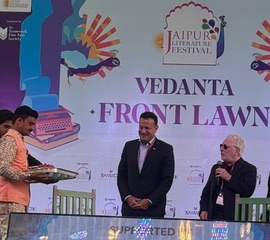
Ireland’s past under British rule helped him understand Palestinian sentiments. “When Britain tried to conquer Ireland, it justified its claim through religion. That history gives perspective,” he said, adding that the US finds it difficult to understand the Palestinian issue due to its close ties with Israel.
Notable Irish writers at the festival in recent years have included Booker Prize winner Colm Tóibín and novelist Michelle Gallen (both last weekend) as well as Jane Ohlmeyer. Earlier names have included Booker prize winners Anne Enright and Roddy Doyle
Also this year, journalists Finan O’Toole from Dublin and Sam McBride from the north discussed their jointly written book, For and Against a United Ireland, which was published in the UK last October. O’Toole echoed the growing support in the south for reunification and argued it would benefit the north’s declining economic prospects. The UK government agreed in 1998 that “it would go whenever Ulster people wanted it to” after holding a referendum.
McBride however saw “no logical argument” for uniting the country because of the currently manageable soft border, and the risk that extremist gangs could use a referendum “to drive us into violence”.
JLF’s association with Ireland began about ten years ago when the Arts Council of Northern Ireland urged Roy to stage a lit fest in Belfast, explaining that it would be more likely than a festival from the UK to attract audiences from both the Catholic and Protestant communities. That led to a successful event in 2019 though there were some tensions.
Roy says it led him to think of having a lit fest as a caravan travelling south from Belfast, as will happen for ten days from May 22, “pitching tents” on either side of the border at Armagh and Dundalk before finishing up in Dublin. “Can the art of conversation and dialogue be a way to explore these differences and overcome the fears generated by different religions?” he asks.
Like all the lively JLF festivals, the more controversial sessions will meld with the rest that will draw on Ireland and India’s culture, fiction, and the arts as well as wider issues.
 Riding the Elephant
Leave a comment