This article was commissioned and first appeared on The Wire.in
The British monarchy is not in a state of collapse, even though it is an expensive dynastic anachronism and an outdated symbol of privilege. But the unprecedented arrest for nearly 12 hours at 8am on February 19 of the former Prince Andrew (also Duke of York) is Britain’s most serious constitutional upset for generations.
The arrest is a warning to his elder brother, King Charles, and the whole “Royal Family” that, while antics by the King’s son Prince Harry (now living in Los Angeles with his American actor wife) might shock and even amuse, and while the King’s early adulterous life-style was tolerated and eventually forgiven, Andrew’s arrest for alleged “misconduct in public office” tied to the Jeffery Epstein sex scandals is a step too far.
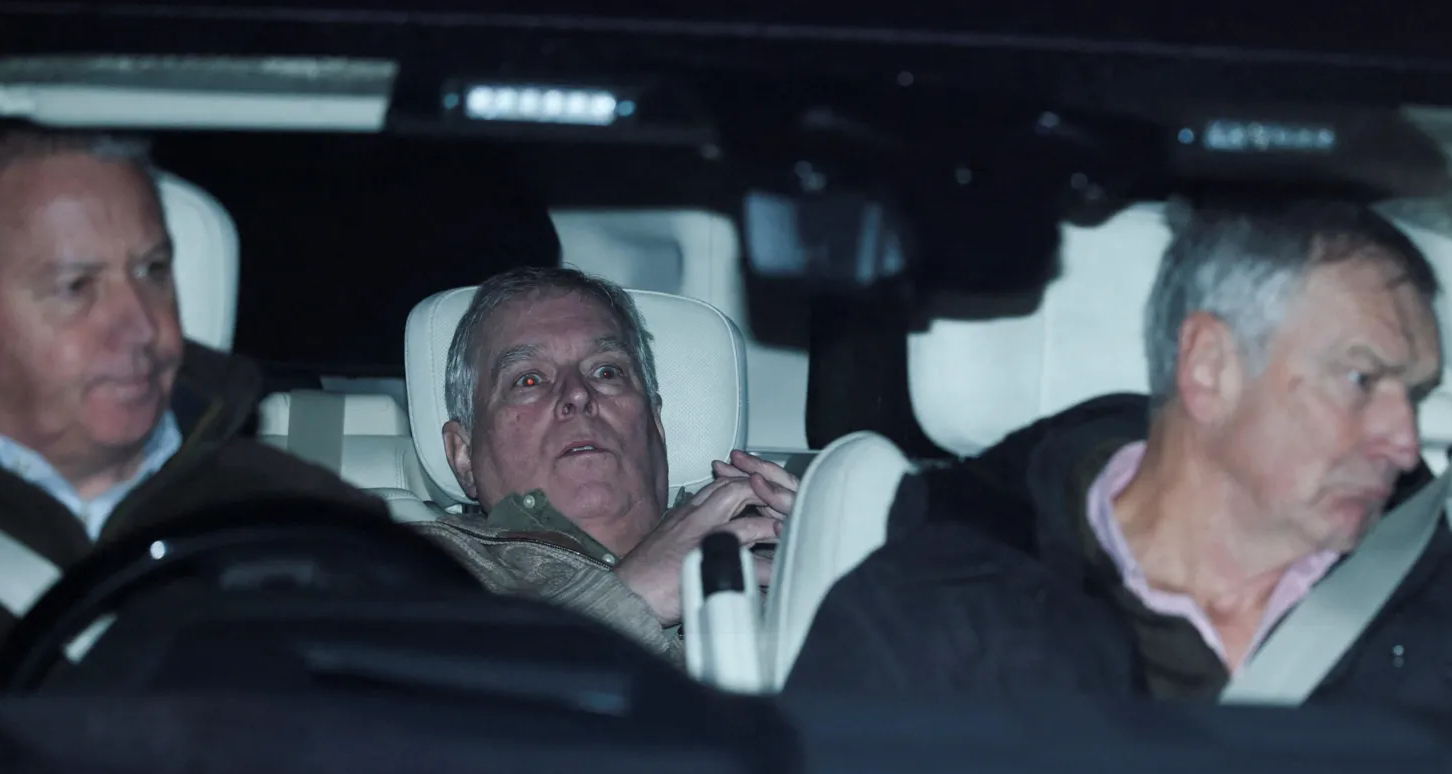
from Aylsham police station in Norfolk on Feb 19th evening has
been published worldwide – photo by Phil Noble (Reuters) who
had a tipoff Aylsham was where the former prince would be held
The family clearly realises this and did its best to maintain its image as a secure and reliable national institution that was still at work, performing public duties, after the arrest of Andrew Mountbatten-Windsor, as he is now known having been stripped of his titles and privileges three months ago.
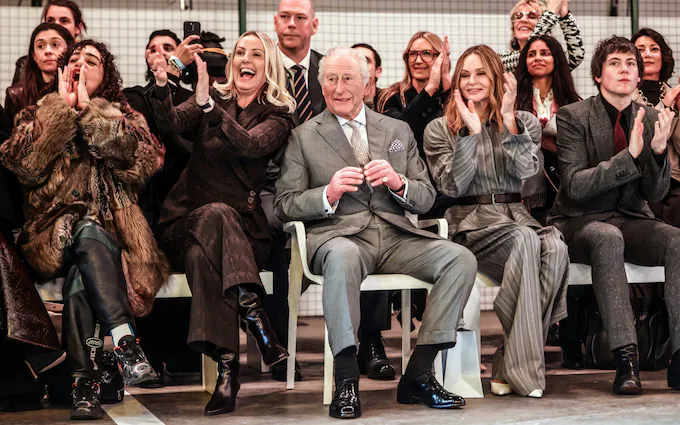
The King was met with applause when he attended, as planned, the opening of London Fashion Week (see below). His wife Queen Camilla met an internationally famous fashion editor and attended a concert in Westminster. Princess Anne, the hardest working “Royal” and Andrew and the King’s sister, ironically visited a prison in Leeds.
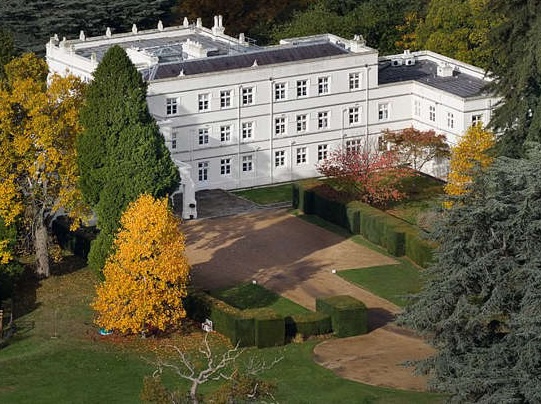
Andrew is no longer in a police cell, having been taken home on the 19th evening after spending his 66th birthday in custody at Aylsham police station an hour’s drive away. By then, detectives had finished searching the farmhouse on the family’s Sandringham estate in Norfolk where the King shifted him three months ago to remove him from public view. Andrew is known for his pomp and bluster, and it looks as though the police needed to secure him while the Sandringham search took place.
They also searched Royal Lodge, his previous grand home on the royal Windsor estate west of London. He remains formally “under investigation”, and the police are continuing with the search at Windsor where he lived from 2004.
The arrest was on suspicion of misconduct in public office (which he denies) for passing official and secret papers on British investment and other subjects to his friend Epstein while he was an official Special Representative for International Trade and Investment, a post he held between 2001 and 2011. He lost that jet-setting role because he continued the friendship after Epstein had been convicted as a sex offender in 2008. He was then confined to the UK where, it was announced, he would “continue to support business in the UK” and would not have a specialised role.
Illustrating the range of activities outside his brief, he liaised with Epstein during “private days” at the start of an official visit to China on an $8bn cash-for-oil swap between a Chinese sovereign wealth fund and the rulers of the United Arab Emirates while the disgraced financier was under house arrest for soliciting sex from an underage girl.
Andrew was dubbed Randy Andy in his youth, as The Times reported yesterday: “HRH Prince Andrew Albert Christian Edward, born at Buckingham Palace, had a reputation by the time he could walk. As a toddler he would kick the dogs and taunt the staff. As a five-year-old he was thrown in a dung heap by grooms at the Royal Mews in Windsor, sick of him taunting the horses with a stick. As a teenager he acquired the nickname Randy Andy, and as a young man his behaviour was so atrocious that a footman punched him in the face”.
But he was the late Queen Elizabeth’s favourite son and was protected till she died in September 2022 by her continued forgiveness and financial support. That support was perhaps the only major blunder in her much admired long reign. She is widely believed to have helped finance a $12m settlement paid to Virginia Giuffre who sued him, claiming he sexually assaulted her on three occasions when she was 17 and being trafficked by Epstein, allegations Andrew has repeatedly denied.
Since then, stories of his involvement with Epstein have increased. They escalated after President Trump authorised the US Department of Justice to release millions of files and images. That led to growing public pressure in the UK for Andrew to lose his royal status and also led to a formal demand for him to give evidence to the US Congress.
He previously resisted informal calls to appear before Congress. Now his arrest and continued police inquiries will ironically protect him, at least for some time, from the extreme embarrassment of a hostile Congress inquisition. Meanwhile there are calls for him to be removed soon from his position as eighth in the line of succession to the British throne.
It had been assumed that he would eventually be formally accused of sexual offences, maybe the rape alleged by Giuffre or for other paedophilia. But the revelations that he had handed over secret government information to Epstein quickly led to police inquiries and yesterday’s arrest and alleged “misconduct in public office”.
Legal experts say this common law offence is generally used only on misconduct by public servants when other offences, for example fraud, are not suitable. It can also often be very difficult to prove. Between 2014 and 2024, 92 per cent of those convicted of the offence were in the police forces or prison service. There have been no convictions of high-profile individuals for the offence in modern times.
Till now, the royal family have only had minor skirmished with the law. Princess Anne’s dog, a bull terrier, bit two girls in Windsor Great Park in 2002 after which she was fined £500. She was also fined £400 in 2001 for driving her Bentley at 93 mph in a 70-mph zone in Gloucestershire.
Sir Keir Starmer, the UK prime minister, has said that “nobody is above the law” and the King has agreed to support police inquires. Saying yesterday that a “full, fair and proper process” must now take place, he added: “In this, as I have said before, they have our full and wholehearted support and co-operation. Let me state clearly: the law must take its course.”
Separately, Andrew might become linked with police inquiries into the use of Stansted airport, 30 miles from London, by private flights trafficking under-age girls that have emerged from the Epstein files. Former Prime Minister Gordon Brown has called for the police “urgently” to re-examine whether Epstein’s victims were trafficked within and outside of the UK.
These events have already led to demands by anti-royalists in the social media and elsewhere for the monarchy to be abolished, despite basic popular support.
A survey in January showed that views on the royal family had not changed much during the Epstein revelations. Britons were twice as likely to have a positive opinion of the King than a negative one (60% vs 31%). He has been admired for the way he has continued his role while being treated for cancer that was diagnosed two years ago.
Many anti-royalists argue that removing the royal family would begin to give Britain the social change that it needs. There can be no doubt that Britain’s multi-tiered hierarchical class system, with the Royal Family perched somewhat precariously at the peak, needs reform. Visitors from abroad can scarcely believe the complex social strata.
The family is however almost certainly secure, providing it adapts as the Andrew saga unfolds, accepts considerably more disclosure and public accountability for its immense wealth and avoids Andrew-type excesses and scandals.
It is also protected by the absence of any popular alternative system for head of state. At a time when respect for politicians is at what must be an all-time low, there is little appetite for changing benign King Charles, and even his heir Prince William, with someone from the political class.
I
 Riding the Elephant
I’m normally an admirer (and promoter) of your work, John, and have been a regular reader of this blog for years now. But today you’ve thoroughly pissed me off!
“while antics by the King’s son Prince Harry (now living in Los Angeles with his American actor wife) might shock and even amuse…”
By: eileenscholes on February 21, 2026
at 3:22 pm