Posted by: John Elliott | December 24, 2023

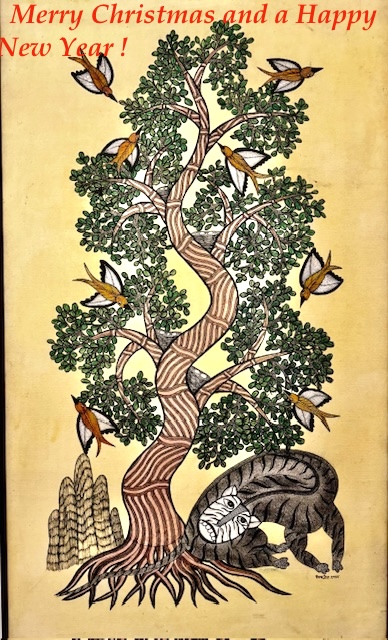
Merry Christmas!

Posted by: John Elliott | November 14, 2023

Sunak sacks troublesome Braverman and reinvents ex PM Cameron

Desperate attempt to get a government that works 

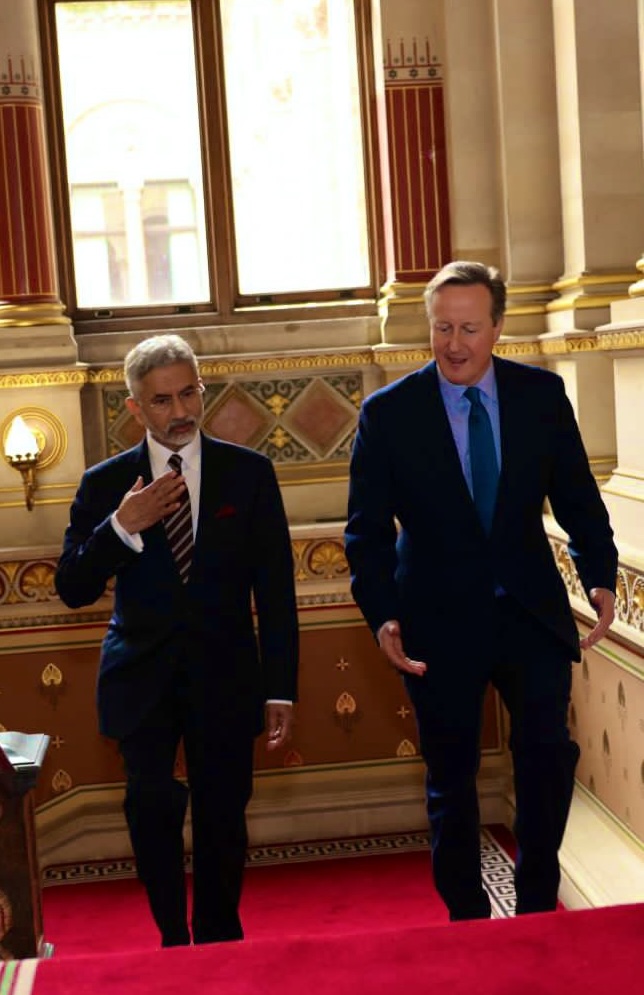
Lord Cameron meets Indian foreign minister Jaishankar

After weeks of declining popularity and effectiveness, Britain’s prime minister Rishi Sunak has made risky changes to his cabinet that will create major political problems for him through to the general election expected late next year. The moves, which include the astonishing return of the somewhat discredited former prime minister David Cameron to the cabinet, could however strengthen the stability and authority of his government.

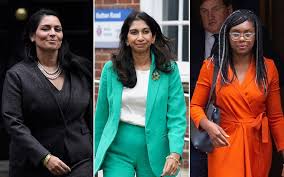
The problems and the stability both come from Sunak sacking Suella Braverman, the eruptive, headline-grabbing and arguably irresponsible home secretary, whose frequent controversial remarks climaxed with statements that exacerbated tensions at massive pro-Palestine demonstrations over the weekend.

David Cameron leaving No 10 Downing Street after being appointed Foreign Secretary

Braverman was sacked, a Downing Street spokesman has suggested, because of her (shrill) tone more than her policies and because she ignored collective cabinet responsibility. She was not it seems offered a new post and will now try to seal her role as a populist focal point for the turbulent right wing of the Conservative Party.

She might well become an active leadership challenger for Sunak, but he would have looked weak to the point of incompetence if he had not dared to sack her. He now faces potential unrest in the Conservative Party around the country where many ordinary members back her right wing views on blocking immigration and tougher police action.

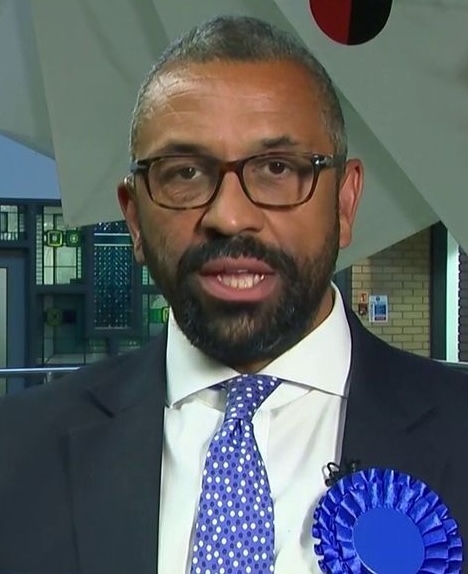
Her successor, James Cleverly, has risen in prominence as foreign secretary in the past year. He has brought respect and rationality to the role after three predecessors generally regarded as failures – Liz Truss (later briefly prime minister), Dominic Raab (now out of politics) and Boris Johnson (whose reputation as prime minister lies in tatters).

That left a vacancy as foreign secretary which Sunak could have filled uncontroversially with an existing member of the cabinet. Instead, he has brought the former prime minister David Cameron into the government, astonishing all political observers and MPs, and the international community. Cameron is not an MP so has been made a member of the House of Lords.

That appintment drove Braverman’s sacking off the day’s media top headlines, but it will be widely ridiculed by the Labour Opposition and others. Cameron’s foreign policy moves as prime minister remain highly controversial, notably Britain’s Brexit from the European Union that followed the referendum he called in 2016 assuming it would be in favour of remaining in Europe.

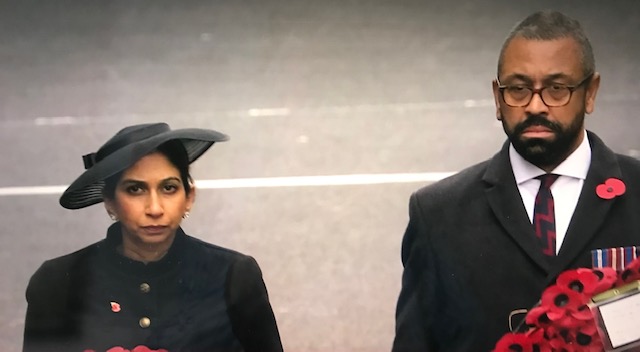
Suella Braverman and James Cleverly laying wreaths at the Remembrance Day ceremony in London on Sunday

He resigned in 2016 (having been prime minister since 2010) on the day the Brexit referendum result was announced and has been in the political wilderness since then. He has been looking lost without any role – nor any apparent prospect of one till Sunak came to the rescue. He was urged by Boris Johnson to try to become secretary general of NATO in 2017, but failed to secure the job and it seemed his public life was finished.

Since then his reputation has been harmed by lobbying he carried out for Greensill Capital, a scandal-hit financial services company that collapsed in 2021. His “significant lack of judgment” was criticised by a Treasury Committee. He has also lobbied for Chinese investment in Sri Lanka and elsewhere.

The reason Sunak has given him the job, rather than more obvious cabinet candidates, is presumably that Cameron is widely experienced politically and is well known internationally. He will gain respect for UK policies in foreign capitals and multi-national organisations, which is especially relevant in the current Middle East crisis, even though he was involved as prime minister in controversial decisions including support for a NATO-led military intervention in Libya in 2011 that toppled Moammar Gadhafi but led to chaos. In 2013, he tried and failed to gain Parliament’s backing for UK airstrikes against President Bashar al-Assad’s forces in Syria.

David Cameron’s first appointment was with India’s foreign minister S.Jaishankar who is visiting London

Foreign relations are an area where Sunak has little experience and, indeed, has at times seemed not to want to be involved. He did not go the UN general assembly earlier this year and tried to avoid the climate change Cop 27 summit last November. 

Politically, Cameron is in the centre of Conservative Party politics and his appointment will be welcomed in what are known as “the shires and “blue wall” areas where Tory voters might switch to other parties at the next election.

For India, the appointment is good news because Cameron tried, albeit with little success, to strengthen two-way trade and investment when he was prime minister. He made three visits to India in that role and hosted Narendra Modi in London in 2015. His last publicised visit was as a private individual in December 2016, when he was paid a rumoured £200,000 to speak at a Hindustan Times conference.

It remains to be seen how far Cameron tries to move British policy towards China, where a balance needs to be struck between limited co-operation on key issues and protecting security concerns on inward investment. As prime minister, he talked about a “golden age” in UK-China relations and welcomed Beijing’s investment in key UK nuclear power and iother infrastructure projects. He tried after stepping down to set up a $1bn UK-China investment fund, but that was abandoned two years ago because of deteriorating relations with Beijing, though he has remained active in this area.

Cameron will support cautious moves that Sunak has been making recently to grow closer to Europe, backed by Jeremy Hunt, who remains Chancellor of the Exchequer (finance minister).

Braverman leapt to national prominence in July 2022 when she announced on a late night political tv programme her candidacy to success Boris Johnson (who had not by then resigned as prime minister). She immediately broke convention by refusing to resign as attorney general, an early indication of her scant respect for parliamentary convention.

Braverman making her “the hurricane is coming” speech at the Conservative Party conference, October 2023

Her candidacy was not treated seriously, and she was quickly eliminated from the contest, but the move launched her rapid elevation with her extreme anti-immigration and pro law and order statements. 

Earlier this year, Braverman attracted widespread criticism when she said floods of people who come to the UK across the Channel in small boats “possess values which are at odds with our country” and there were “heightened levels of criminality”. She told The Guardian her claims were based on briefings from unnamed senior police officers, not data. 

A claim that Albanian people arriving in the UK by small boats were exploiting modern slavery laws was challenged in an analysis seen by the Guardian.

She became home minister under prime minister Liz Truss last year, but resigned just before Truss fell from office after being accused of breaching confidential guidelines. Sunak surprised commentators by reappointing her to the same job when he became prime minister – presumably because it was safer to have her in the cabinet than outside because of her outspoken right-wing views.

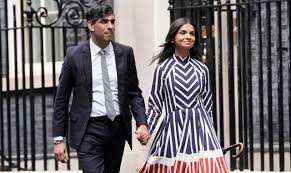
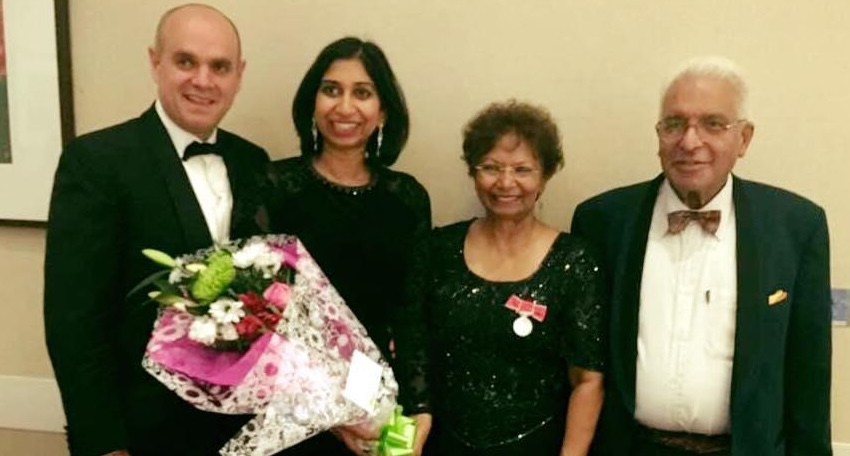
Suella Braverman with her husband and parents – photo The Times Nov 13 ’23

Throughout her time as Home Secretary, there has been a debate about whether her controversial speeches are made from conviction or are simply part of her campaign to become the next prime minister by winning support from grassroots Conservative members who align themselves with what she says.

She has a complex ethnic identity as the daughter of a Hindu Tamil mother from Mauritius and a Goan Christian father born in Kenya – they emigrated to the UK in the 1960s. She is a Buddhist, belonging to the sometimes controversial Triratna sect, and her husband is Jewish. They live in what a family friend has described as “a very Jewish part of the country in Hertfordshire,” adding: “She does have a strong relationship with the Jewish community. People have been very quick to say she is Machiavellian, but she sees this as a values issue.”

Despite this very wide multi-cultural background, Braverman delivered an incendiary speech at the Conservative party conference in October saying “multi-culturalism has failed because it allowed people to come to our society and live parallel lives in it”. 

‘The hurricane that is coming’

She also made a speech that had chilling echoes of a famous “rivers of blood” warning made in 1968 by Enoch Powell, a leading Conservative politician about how Britain would be swamped by immigrants “The wind of change that carried my own parents across the globe in the 20th century was a mere gust compared [with] the hurricane that is coming,” she said. “Because today, the option of moving from a poorer country to a richer one is not just a dream for billions of people. It’s an entirely realistic prospect.” 

In the last few weeks she drew criticism when she claimed that destitute people living rough on city pavements had made a “lifestyle choice”. 

Her remarks have escalated since pro-Palestine mass demonstrations have been held in London each Saturday involving over 100,000 people. Contrary to the evidence for anyone who watched the marches, she has said several times that they were “hate marches”. 

At the end  of last week she ignored requests from the prime minister’s office to tone down an incendiary article in The Times in which she said “we have seen with our own eyes that terrorists have been valorised, Israel has been demonised as Nazis and Jews have been threatened with further massacres” She also accused the London police of “playing favourites” towards Left-wing protesters. 

With this article, Braverman was behaving as no Home Secretary has done in living memory, stirring up hatred and undermining the police instead of showing calm leadership. It was an especially controversial time because it coincided with the weekend’s annual Remembrance ceremonies for those fallen in two world wars and other battles. She wanted the marches cancelled but the London police chief said that was neither necessary not justified by current laws.

She said she would not hesitate to change the terror laws “if there’s a need” in order to combat “utterly odious bad actors” exploiting gaps in the legislation to stir up anti-Semitism

‘No-one better than Suella…..’

The problems Sunak now faces were illustrated by Sir John Hayes, a prominent right-wing MP and a member of a group that wrote to the prime minister  this morning asking him not to sack Braverman. “There’s no one better than Suella Braverman to help Rishi Sunak deliver what he has made a defining (immigration) policy for him and the Government. I am sure they will collaborate to do so,” he told The Times (UK)

On policy, her main setback has been that she has failed to solve the major problem of stopping boat people crossing the Channel from France. The supreme court will rule on Wednesday on the lawfulness of the government’s controversial plan to deport plane-loads of these asylum seekers to Rwanda. Both Sunak and Braverman have seen this as a key policy. It will now become the first challenge for Cleverly – and an opportunity for Braverman to stake out her future policy priorities. 

The significance of her role as home secretary, and of her dismissal, goes far wider than the boatpeople. At a time of rising populism internationally and growing nationalism, her extreme views strike a chord among Conservative Party grassroots. She may have damaged her acceptability with her recent strident behaviour, but she remains a leading right-wing candidate to replace Sunak as party leader if, as seems likely, he loses the next election.

Anne Wright, probably the last of British expats who stayed after 1947

Born into an old colonial family she led the way on conservation

The recent death in central India of Anne Wright, age 94, marks the end of an era. This wildlife campaigner, tiger enthusiast, horse breeder, party lover, and friend of leading politicians and royalty, was one of the last – and maybe the last – of the British expatriates who stayed on after independence in 1947.

Anne during the Festival of Diwali in Delhi October 2019_Photo: Belinda Wright

Anne Wright died on October 4 after a long illness at her family’s Kipling Camp jungle resort on the edge of Kanha National Park in Madhya Pradesh. She was cremated, as she would have wished, in the jungle later that day under the stars. 

In 1929, she was taken when she was just a few months old to the wilds of central India where her father, Austen Havelock Layard, who was in the Indian Civil Service, was posted. She spent the rest of her life in the country, apart from schooling in the UK, and took Indian nationality in 1991.

One of her early memories was standing, when she was five, with her younger sister and governess on the Kings Way (later Rajpath and now Kartavya Path) in New Delhi. Wearing large white topis (sun hats), they were watching her father, by then the city’s Deputy Commissioner, process past with the Viceroy Lord Willingdon in 1934.

At Mahatma Gandhi’s cremation in Delhi in January 1948, she sat with members of the family of Lord Louis Mountbatten, the last British governor general. She remembered being terrified by the vast sea of people. While visiting her friend Rita Pandit, prime minister Jawaharal Nehru’s niece at his Teen Murti residence in Delhi, they went into his bedroom where she saw a photo of Edwina, Mountbatten’s wife, on the bedside table – poignant evidence of the Edwina-Nehru relationship.

It was a grand life. She told John Zubrzycki for a book he was writing on the Jaipur dynasty, how as a young bride in the 1950s she had gone as a guest of the royal family to the princely state of Cooch Behar in what is now West Bengal. At the age of ninety she could “still vividly recall landing on the state’s grass airstrip in the dilapidated DC3 being operated by Jamair”. On arrival, “guests would be met by elephants that would transport them and their luggage to the palace.” 

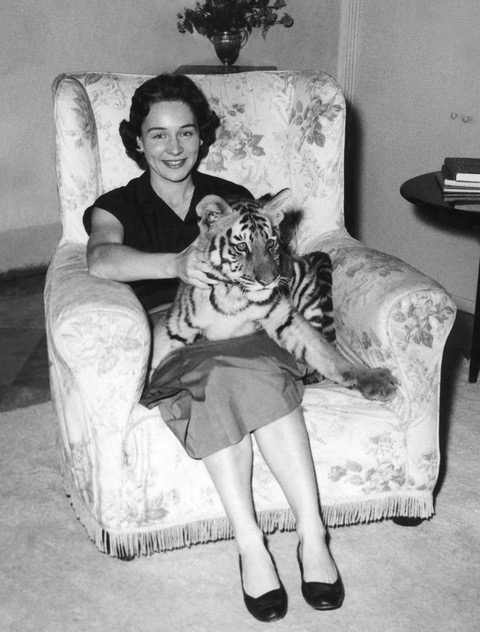
Anne with an orphaned tiger cub she raised – Calcutta 1956

A small, slight and elegant lady with a winning smile and sparkling eyes, she could be tough and determined. She showed this in an extraordinary exchange of letters asking Indira Gandhi, India’s prime minister, to lobby Pakistan’s and Afghanistan’s leaders at a Commonwealth summit meeting in 1983 about the plight of the Siberia cranes.

Gandhi was sceptical about the prospects, but later told Wright both countries had agreed to take protective measures. 

Jairam Ramesh, an Indian policy adviser-turned-politician, says he “spent hours” with Anne researching his book, “Indira Gandhi: A Life in Nature”. He writes that “an ecstatic Anne Wright” replied to the prime minister, and raised yet another subject – tapping a major river, the Teesta in north east India to save the Neora Valley. Gandhi later congratulated her on the work of World Wildlife Fund – India, of which Wright was a founder trusteein 1969. 

Dasho Benji Dorji, cousin and advisor to the former king of Bhutan, Jigme Singye Wangchuck, remembers how she encouraged him in the 1980s to save the habitat of rare black-necked cranes in the remote Bhutanese valley of Phobjikha that was threatened by plans to grow seed potatoes commercially. In Calcutta, says Dorji, he saw how “traders in wild-life parts were terrified of her – she used to take the police and get them all arrested”.

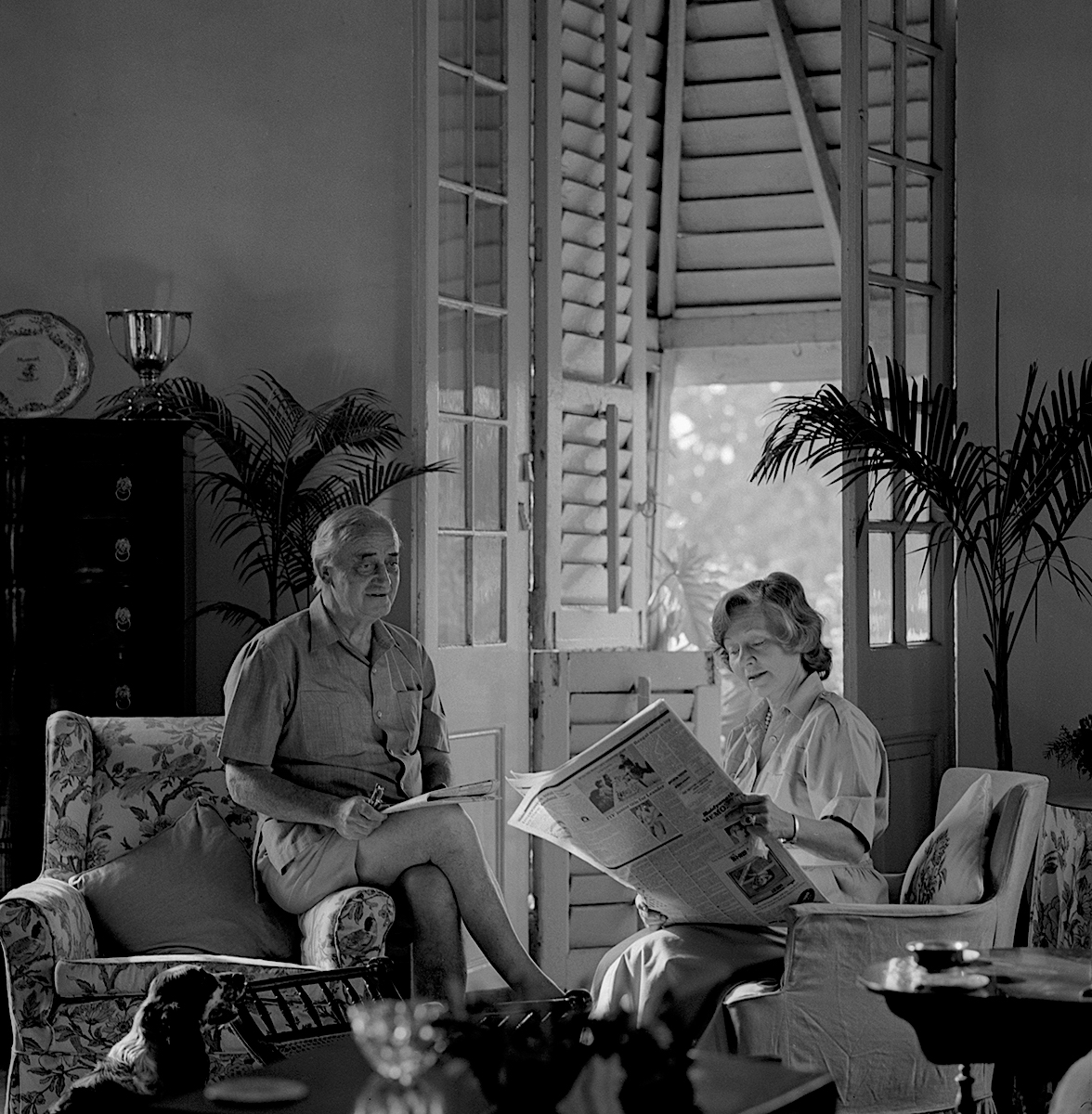
Anne & Bob Wright at Tollygunge Club_1988_© Derry Moore

Anne Layard was born in Hampshire on June 10, 1929 into a privileged British colonial family who had served in India and Ceylon for two centuries. They also included Sir Henry Layard who discovered Nineveh in what is now Iraq. Her father retired as Chief Secretary of the Central Provinces in 1947 and took on an advisory role as counsellor in the new UK High Commission in Delhi. That led her to a friendship with Pamela, Mountbatten’s daughter, one of many such illustrious connections – Mountbatten was in his final year in India.

Her early married life was spent in the social whirl of Calcutta, with her husband Bob who died in 2005. From their home in Calcutta’s prosperous area of Ballygunge, they became the centre of the energetic social life that the already dwindling British expatriate crowd continued through the 1950s and 1960s, India’s political capital had moved to Delhi but Calcutta, now Kolkata, remained a boisterous business hub with a social life that drew royalty from neighbouring Bhutan and Nepal as well as maharajas and other dignitaries.

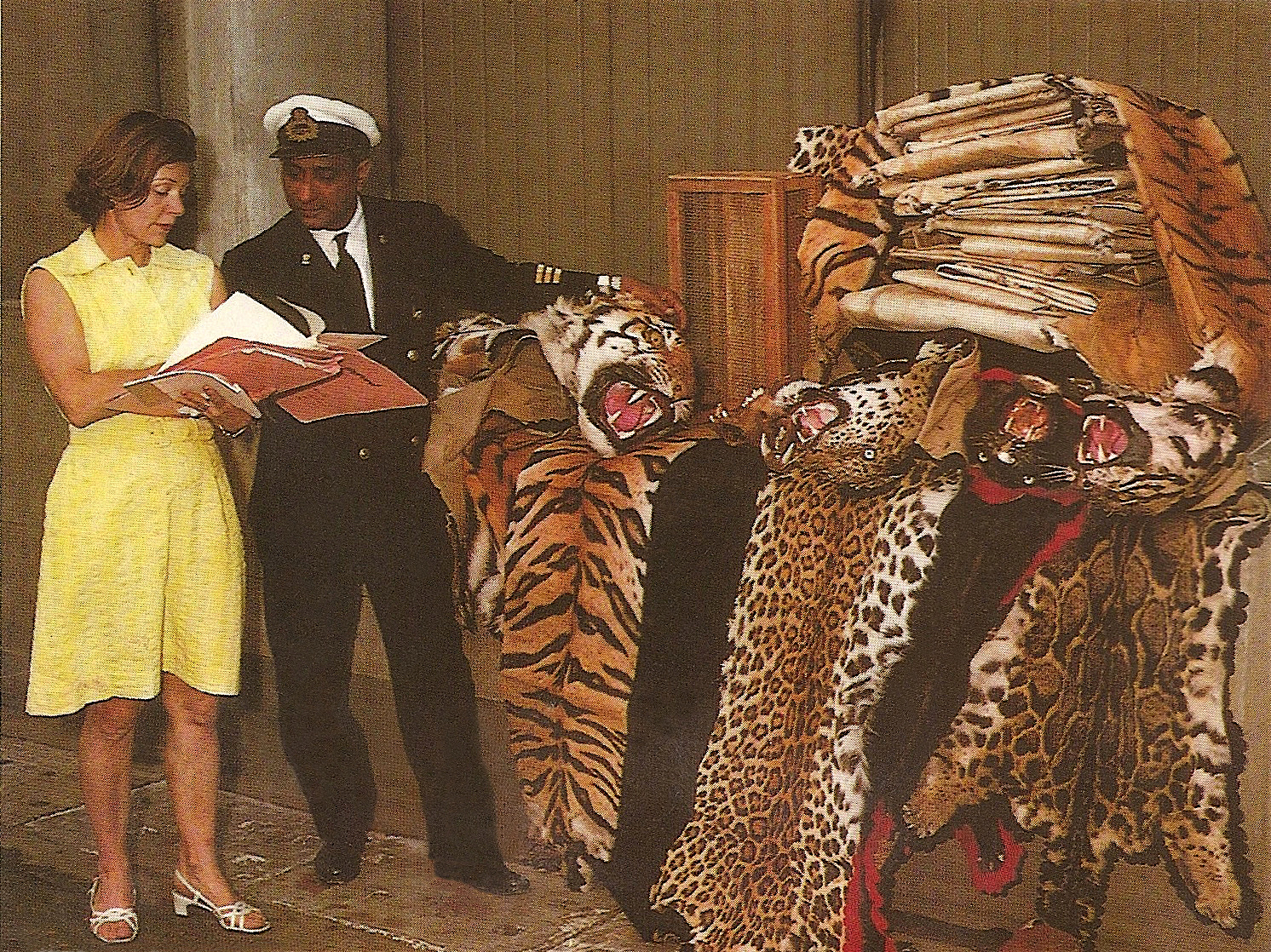
Anne Wright with a Customs official after she had passed on information that led to the seizure of skins at Calcutta’s DumDum Airport in 1972.

Bob held senior posts in business and was involved in numerus charities, but is best remembered for managing from 1972 to 1996 the city’s famous Tollygunge Club and acting as the UK’s unofficial but influential consul in West Bengal.

He and Anne were part of the hunting, shooting and polo crowd and raised an orphaned tiger cub and leopard in their home, but this was the generation that put their guns down and campaigned to save them. Their daughter Belinda is known internationally as one of India’s leading tiger conservationists, founding the Wildlife Protection Society of India (WPSI), which she runs. All three have the rare if not unique family distinction of being honoured for their work – Bob Wright and Belinda with OBEs and Anne with an MBE.

Anne in 2014

In 1970, Anne Wright wrote an explosive article that exposed the illegal trade of tiger skins in a Calcutta market. One of the first detailed documentations of the large-scale slaughter of wild tigers and leopards in India,t was published locally and republished by theNew York Times with the headline “Doom awaits tigers and leopards unless India acts swiftly”triggering a series of reforms. 

In 1972, Anne Wright was appointed a member of India’s elite Tiger Task Force, which produced a remarkable document titled “Project Tiger; a planning proposal for the preservation of tiger in India.” Launched the following year, initially with nine tiger reserves, this was the beginning of one of the most ambitious-ever wildlife conservation projects. She also worked on the drafting of the Wild Life (Protection) Act of 1972, and personally pushed through the creation of a number of protected areas. At the forefront of India’s conservation movement for decades, Wright served on the Indian Board for Wildlife and seven state boards for 19 years.

As a conservationist wrote on Twitter (now X) last week, “”We often speak of how hard it is to be a woman and be a wildlife conservationist in India. If it’s hard now, it was harder before us. Anne Wright tackled it all with courage and determination. And not the simple things — the tough ones of tackling poaching, building laws, and taking on illegal trade”. Wright received the Sanctuary Asia Lifetime Service Award in 2013.

If wildlife was her first priority, her other interest was horses. She played polo, competed in equestrian events and took up breeding thoroughbreds at her stud farm on the outskirts of Delhi. She kept her best for the Winter season of 2000-2001, where her mare, Fame Star, waltzed away with the Calcutta Gold Cup and The Indian Champion Cup.

Jon Ryan, a friend who took her to the secure stabling area at Royal Ascot to see the best thoroughbreds and talk to the stable staff, says “she seemed to find that far more exciting than the grandeur and the pomp of the royal meeting”.

Anne with Tara in 2011

Kipling Camp was the first private wildlife resort in central India when it was opened in 1981 by Bob and Anne – Rudyard Kipling featured the area in The Jungle Books, although he never actually went there.

It has been the home for the past 35 years of Tara, an elephant made famous by Mark Shand, the late brother of King Charles’ wife Queen Camilla, in his book “Travels on My Elephant”. Shand gifted Tara to the Wright family in 1988 after his 600-mile journey across India.

After the death of her husband, Anne lived partly in Delhi, where she was still breeding race horses, and Kipling Camp where she died.

There will no doubt be memorial services elsewhere that reflect her life and achievements but, the night following her death, after a brief Christian service in Hindi, she was cremated in a small, open-sided village cremation shed in the jungle, a few yards from the park alongside a burbling stream. Those present, says Belinda, included camp staff, past and present, local friends and villagers who knew her well, along with their two faithful dogs. “As we left the Camp there were alarm calls nearby , and the place was crowded with cheetal deer when we returned”. A suitable exit for such a courageous wildlife campaigner whose death marks the end of an era. 

Anne Wright is survived by a son Rupert and his children Helena and Tim, and her daughter Belinda.

A slightly shorter version of this obituary appeared in the Daily Telegraph on October 28, 2023 https://www.telegraph.co.uk/obituaries/2023/10/27/anne-wright-wildlife-campaigner-india-died-obituary/

India denies claim, but not in private talks say Canadian sources

Risk of Khalistan independence movement gaining some credibility

Careful diplomacy could have avoided the current crisis between Canada and India if the two countries’ proud and stubborn leaders had tried to compromise over the controversial assassination of an alleged Sikh terrorist in Vancouver. Instead, they let their personal differences, plus 20 years of clashes over the activities of separatists originating from the Indian state of Punjab, to burst unexpectedly across world headlines.

It is now ten days since Canadian prime minister Justin Trudeau caused worldwide shock and astonishment by telling his country’s parliament that its security agency was “actively pursuing credible allegations of a potential link between agents of the government of India and the killing of a Canadian citizen”.

Narendra Modi greets Justin Trudeau at the G20 summit – AP photo

The “citizen” was Hardeep Singh Nijjar, a 45-year-old Sikh separatist with a string of charges against him in India, whose anti-India activities included  organising an unofficial referendum within the Sikh diaspora. He was shot dead on June 18 in an incident involving six men and two vehicles while leaving his gurdwara (temple) in Surrey, a suburb of Vancouver that has a large Sikh community.

The shock was that India could be accused of doing such a deed, especially just as it was emerging as a significant and responsible world power. The astonishment was that Trudeau would suddenly make such a bald unsubstantiated parliamentary statement, challenging the increasingly influential prime minister Narendra Modi, whose stock had just risen with his hugely successful G20 summit in Delhi.

Trudeau told parliament that he had confronted Modi on the allegation “in no uncertain terms” during the G20 weekend. That is not how Modi is accustomed to being treated, nor talked about, though it was a sort of payback for an Indian media briefing around the G20 that said Modi had “scolded” Trudeau over Canada’s repeated failure to deal with Sikh extremists.

Khalistani protestors with Hardeep Singh Nijjar banner – AP photo

Modi had earlier sidelined Trudeau during an embarrassingly self-destructive visit to India by the Canadian prime minister in 2018.

“There is an element of personal pique against India due to what he perceived was a cold shoulder given to him on his previous visit to India in 2018,” former Indian foreign secretary Shyam Saran has written in a valuable analysis. “Trudeau himself described the visit as ‘a visit to end all visits’. It may be this personal antipathy to India which may have tipped the balance in favour of his going public with his outrageous allegations”.

In the “scolding” remarks that Modi’s office made public during the G20, Trudeau was blamed for allowing pro-Khalistan protests in Canada that were “promoting secessionism and inciting violence against Indian diplomats, damaging diplomatic premises and threatening the Indian community”.

Publicly, India has dismissed Trudeau’s assassination allegation as “absurd”, “politically motivated” and “unsubstantiated” (see MEA statement below). Modi told Trudeau they were “completely rejected”. This week (Sept 27) S. Jaishankar, India’s foreign secretary, said in New York that “we told the Canadians that this is not the government of India’s policy”.

Canada’s CBC news network however has been told by sources that “when pressed behind closed doors, no Indian official has denied the bombshell allegation”. 

Maybe significantly, the question in New York had come from a former US ambassador to India. It happened during a seminar at the Council on Foreign Relations, where Jaishankar added that India had said to Trudeau, “if you have something specific, if you have something relevant, let us know, we are open to looking at it”. 

Trudeau has not publicly released any details to support his claim, which is odd after ten days. As Jaishankar implied yesterday, India seems to be waiting for details, though some must have been handed over during meetings between the two countries’ national security advisers that took place in Delhi over several days in August and September, including during the G20 summit.

CBC News has been told by Canadian government sources that they have gathered both human and signals intelligence that reveals communications involving Indian officials including diplomats present in Canada. Some of the information was significantly provided by the US, and Trudeau shared the allegations with Washington and other members of the Five Eyes (Australia, New Zealand and the UK) before the G20. These countries have urged India to co-operate with Canada in its investigations, but that does not seem to have happened.

Security experts suggest that India certainly has the expertise to carry out targeted assassinations and could well have also developed the essential political will over the past ten years. There are reports that it has been behind killings in Pakistan but, experts suggest, it might need help (probably from Israel’s Mossad secret service) further afield in a place such as Canada.

Hardeep Sing Nijjar’s coffin is carried through the streets of Surrey, Vancouver, at the start of the funeral ceremony

“Israel has a remarkable record of targeted killing, an extremely close intelligence relationship with India, and a strategic relationship that encompasses the sanctum sanctorum of state security including space and nuclear,” says Pramit Chaudhuri, a former senior journalist and member of the National Security Advisory Board and now the India head of Eurasia, a US political risk consultancy. “I would argue no other country in the world is as trusted by the Indian security apparatus”.

One of the curiosities is that nothing has been heard from Ajit Doval, India’s usually high-profile national security adviser, who held the talks with his Canadian counterpart and is in effect in charge of the RAW intelligence agency.

How much of the alleged Indian involvement will ever actually emerge depends partly on how the current impasse is resolved. There are reports that President Biden and his top officials are trying to mediate between Trudeau’s assassination claim and India’s virtual denial and its insistence that Canada takes action against the extremists.

Split loyalties

The US loyalties are split since Canada is its neighbour and India an ally in many arras. But Jake Sullivan, its National Security Adviser, said: “There is not some special exemption you get for actions like this. Regardless of the country, we will stand up and defend our basic principles. And we will consult closely with our allies like Canada as they pursue their law enforcement and diplomatic process.”

Mediation is urgently needed because there is now a risk that the furore could give the Khalistan cause some international credibility as a freedom movement, which it does not warrant because there is no mainstream or even significant Sikh minority wanting to disturb Punjab’s status in India. 

Amrit Singh Gill on the BBC Newsnight programme

This risk emerged on a BBC Newsnight programme on September 20, where the interviewer referred to Sikhs’ right “to campaign for their homeland”. This was in response to a leading Scotland-based Khalistan campaigner, Amrit Singh Gill, chairman of the separatist Sikh Federation of the UK, who said “People of Scotland have a right [to campaign so] why do Sikhs not have a right in India?”.

That comparison may sound laughable, but the context was serious. Gill went on to say that, because of his activities, his family’s home in the Punjab had been raided last month by India’s anti-terrorist National Intelligence Agency. A relative had then been summoned to Delhi for questioning about his activities.

Taken against the backdrop of Modi’s strong Hindu nationalism, with reduced safety and status for Muslims and others, such media coverage could appear to human rights campaigners to be describing another example of minorities’ suppression that deserves international support, even though the actions of Khalistani supporters in Canada with alleged organised crime and terror activities are also getting considerable publicity.

The diaspora

India usually celebrates the activities of its diaspora abroad as emigrants have risen to the top of major companies such as Microsoft, Pepsi and Starbucks – and even to top political positions, notably in the UK with Rishi Sunak as prime minister. At least one Sikh is included in the list of successes – Ajay Banga, former ceo of Mastercard and now president of the World Bank.

For the Indian government however, it is the anti-India protests and other activities of the Khalistan movement that has caused increasing concern. The campaign, for the Indian state of Punjab (separate from Pakistan’s province of the same name) to be given independence as Khalistan (land of the pure) began 50 years ago, having been briefly debated before the partition of India and Pakistan in 1947. It led in the 1980s to an insurgency in Punjab, where there were genuine social, economic and other grievances. 

Aided by Pakistan – as it is now – with training and supplies (including Chinese arms), the insurgency led eventually to the assassination in October 1984 of India’s prime minister Indira Gandhi by her Sikh bodyguards. Tough police action suppressed the separatists by the early 1990s and the cause is now only pursued by an extreme fringe, often linked to rival gangs and groups. Punjab now has serious economic and social problems, but that is not leading to separatist activity. “Punjab is rich, but falling behind other states as it struggles to get away from a dependency on non-sustainable agriculture,” says Chaudhuri.

However the government needs to avoid condemning the separatists to such a degree that the Sikhs see it as an attack on their community. “One should also be careful that our diplomatic and public relations offensive against Trudeau does not, as a collateral, adversely impact the sentiments of the vast majority of Sikhs both in India and abroad”, says Saran. “One already sees signs of rising discomfort over this among people in Punjab. Interrupting family visits may not be the most effective way of displaying displeasure towards the Trudeau government,” he added, referring to India closing down its visa service in. Canada after Trudeau made his allegations.

Pierre Trudeau and Indira Gandhi in Delhi 1971

During the troubled years, Sikhs – including Khalistan extremists – fled abroad, notably to Canada but also the UK, Australia and elsewhere. Separatists then began to build the activity that led to the Nijjar’s shooting this June. 

There are an estimated 770,000 Sikhs in Canada, a politically significant 2% of the population. It is the country’s fastest-growing religious group with the biggest number of Sikhs outside India. In other countries they are far less significant, though in the UK the Khalistan activities have led India frequently to protest to the government, most recently for attacks on the high commission in London.

Canada’s soft reaction from the start caused Indira Gandhi to complain in 1982 to prime minister Pierre Trudeau, father of the current prime minister.

The motivation now is intensely political. A Sikh-led party, the New Democratic Party (NDP), is a small but essential partner in Trudeau’s governing coalition – if it withdrew, his government could collapse. Jaishankar dealt with that when he addressed the United Nations this week and said “political convenience” should not be allowed to determine a country’s response to “terrorism, extremism and violence”.

Astonishingly, Trudeau even failed to act when a 5km-long parade on June 4 in Brampton, Ontario included a rather crude tableau that seemed to celebrate the assassination of Indira Gandhi. It included a female figure in a blood-stained white saree, with her hands up, as turbaned men pointed guns at her. A poster read “Revenge for the attack on Darbar Sahib” – a reference to Gandhi ordering the army into the Sikhs’ Golden Temple in Amritsar to remove heavily armed Khalistan extremists in June 1984. 

To be a prisoner of a coalition partner to such an extent that this and other protests and gangster activities are allowed, does nothing for Trudeau’s reputation: nor does his failure to substantiate his assassination allegation. For now at least, he seems to be the loser.

Modi on the other hand has been strengthened ahead of a general election next year because India has united behind the government in dismissing Trudeau’s allegation, with almost unanimous condemnation across political lines and the media. India is also making the running with its allegations about the criminal and other activities of Khalistan separatists, and their support in Canada, even though there is international awareness of what its RAW security agency could carry out.

Posted by: John Elliott | September 20, 2023

Indian modern art hits new records at all levels

Top painting record rises twice in two weeks to $7.45m

Provenance of known collectors and fresh-to-market make highest prices

Fresh records are being set for works by Indian modern artists, not just at top levels where a painting was sold on September 16 for a new auction high of $7.45m, but also at lower price points where India’s economic growth has increased the interest among art buyers.

The $7.45m beat a record figure of $6.27m set just two weeks earlier on August 31. Both results came at the latest live sales by the Mumbai-based market leaders Saffronart and Pundole’s. 

The hammer falls on the record Rs52 crore ($6.28m) bid for the Amrita Sher-Gil’s “The Story Teller”

The records were achieved for works by two of the country’s leading 20th century artists, Amrita Sher-Gil and S.H.Raza.  

Pundole’s also produced a record total figure for a modern Indian art auction of £20.75m, slightly higher the $20.68m that Pundole’s hit in February last year.

These results confirm that the main focus for the auctions has moved from New York and London to India, with local firms displacing Christie’s that had an $11.02m auction in New York today (Sept 20) with some strong bidding for the best works. Sotheby’s has one in London next month. A smaller Mumbai auction house, AstaGuru, totalled £7.99m on-line sales on September 1-2.

“The Indian economy is very strong, and people have accumulated a lot of wealth that they are spending on real estate and other tangible assets so want to have the best works of art. That is in addition to established collectors who go for major works like the Amrita Sher-gil”  says Dinesh Vazirani, Saffronart’s co-founder and ceo.

“Gestation” by S.H.Raza that held the record price of $6.27m for two weeks after the Pundole’s auction

The results underline the importance of provenance in a market where there is always the risk of buying fakes. Saffronart’s top lot by Amrita Sher-gil came from a Delhi family that was close to the artist and acquired the work directly. It also included 16 works that sold well from prominent London and Dubai-based collectors, Jane and Kito de Boer.

Pundole’s auction provenance came from it consisting entirely of works from Masanori Fukuoka, a prominent Japanese collector, and from the Pundole family whose art gallery was one of the first set up in India.

“What is becoming clearer with each auction is that works that are fresh to the market, with impeccable and historically relevant provenance, command a substantial premium when they appear on the auction block,” says Dadiba Pundole’s, who runs the gallery with his name and has been a close friend of Fukuoka for many years.

“Watching” by Arpita Singh that set a new artist’s record at Pundole’s of $1.5m, three times the top estimate

In the $17.3m Saffronart auction a signficant work by V.S.Gaitonde, usually a top seller getting record prices, failed however to sell even though it had good Pundole-linked provenance. Slow bidding stopped at Rs16 crore ($1.93m), well under the low estimate of Rs20 crore ($2.44m). There is now a possibility of a private sale for a price around that estimate.

Saffronart’s record Amrita Sher-Gil work (above and below) was The Story Teller, a 23inx29in oil on canvas, which sold for a hammer price of Rs52 crore (Rs520m) – Rs61.8 crores or $7.45m including the buyer’s premium. Sher-Gil’s previous record was for a similar styled work,The Ladies’ Enclosure, that went at Saffronart in July 2021 for Rs37.8 cores ($5.14m) including the premium. 

Market sources suggest that The Story Teller was bought by Kiran Nadar, India’s most prominent collector, for her renowned Museum of Art in Delhi. The museum already has The Ladies’ Enclosure.

“Autobiography of an Insect in the Lotus Pond” which made a record $534,940, three times the top estimate, for A. Ramachandran at Saffronart

Sher-Gil died in 1941, at the early age of 28, just four years after painting The Story Teller. There are only 172 of her works documented, 95 of which are in Indian museums, notably the National Gallery of Modern Art. She has a special rarity value internationally because her works were declared “national treasures” by the Indian government in the 1970s, along with those of eight other artists, which means that works in India cannot leave the country.

Born in Budapest  in 1913 with an ill-suited Sikh aristocrat father and a Hungarian Jewish opera-singing mother, Sher-gil was brought up first in India and then Paris from the age of 8. The Story Teller belongs to an important period in the artist’s work, merging her European and Indian influences.

“Europe belongs to Picasso, Matiusse, Braque and many others. India belongs only to me,” she declared with what has been described as her “characteristic audacity”. Included in the auction were works from her childhood, which sold well above estimates.

“Winter Morning” that established a new $735,043 record for Ganesh Pyne at the AstaGuru auction

The auction also set world records for lesser-known artists such as A Ramachandran at $534,940 and K.K.Hebbar at $318,072 plus Antonio Piedade da Cruz, S Nandagopal and J Maggs.

At the AstaGuru auction, a record price of $735,043 was reached for Winter Morning by Ganesh Pyne, beating the artist’s previous $529,200 record established at Sotheby’s New York in March last year.

The evidence of less prominent artists attracting top prices was picked up by Dadiba Pundole who told me, “As we have also seen in our last few sales, the market is widening and consistently giving due recognition to more modern artists such as Jeram Patel, Somnath Hore and Bikash that go beyond the list of usual suspects. Like elsewhere in the world female artists such as Arpita Singh and Nalini Malani are also quickly moving up the ranks of India’s most sought-after artists. All these factors indicate a healthy and robust market that is steadily growing its collector base at all levels of value”.

The Rs51.75 crore ($6.27m) including buyer’s premium record at the Pundole’s sale was set for Gestation (above), a 69inx69in acrylic on canvas by S.H.Raza, one of India’s premier artists from the mid 20th century Progressive group.

“Two Heads”, a bronze by Tyeb Mehta that sold for $1.76m, a record for a modern Indian sculpture, at Pundole’s

Painted in 1989 in Raza’s typical bindu style, it came from the Pundole family’s collection and has been widely quoted in studies of the artist’s work. It fetched a hammer price of Rs45 crore ($5.4m), three times the low estimate.

Records were also set for works by two of Raza’s contemporaries. Hunger, a 69inx51in poly-vinyl acetate and oil on canvas by F.N.Souza sold for Rs34.5 crore ($4.18m) including the premium, and a bronze sculpture by Tyeb Mehta, better known for his large scale paintings, that set a world record for a modern Indian sculpture at Rs14.95 crore ($1.76m) at almost three times the top estimate.

Early works by Souza from the de Boer collection also did well at Saffronart including Lovers, a 1963 27inx38in mixed media on silk selling over three times the estimate at Rs81.61 lakhs ($98,313), and a 1958 8inx13in pen and ink urban landscape that sold for Rs 26.4 lakhs ($31,807), over five times its high estimate.

Overall, these results show how general optimism in India is feeding into activity in the auction rooms. The country’s modern and contemporary art market is still way behind China’s in terms of prices realised, but it is beginning to show growth that has not always been evident in recent years.

Saffronart’s record $7.45m Amrita Sher-Gil, “The Story Teller”
Posted by: John Elliott | September 14, 2023

Bharat or India? Narendra Modi reopens an old debate

This article, which expands on my G20 article on September 10, appears on the website of the “Round Table, the Commonwealth Journal of International Affairs”

The names of Indian cities such as Mumbai, Chennai and Bengaluru are regularly being changed to reflect aspects of their history or to emphasise their regional role. No-one however was ready for the big surprise that prime Minister Narendra Modi produced on the eve of recent G20 summit when his government began, without any warning or discussion, what looks like a process to emphasise Bharat rather than India as the name of the world’s most populous country.

Bharat means India in Hindi and other Indian languages and it had appeared in names of new buildings that housed the summit. That had not attracted any attention because it is widely used, both formally and in spoken and written Hindi.

Social media was activated with a picture of an invitation from the “President of Bharat”, not the usual India, to the formal G20 banquet on September 9. It then emerged that the name was already in a booklet for visiting G20 delegates titled “Bharat, The Mother of Democracy”, which said, “Bharat is the official name of the country. It is mentioned in the Constitution as also in the discussions of 1946-48”.

It would be a massive exercise, with international ramifications, to make a complete change from India to Bharat, but suggestions that this could be a just a temporary move seemed to be confounded when the country name card in front of Modi at G20 sessions last weekend said “Bharat”.

Both names have roots deep in history . Bharat is the older. According to tradition ‘Bharata’ the ancient  name for the Indian subcontinent, was derived from King Bharata, one of the key ancestral figures in the foundational Indian epic ‘The Mahabharata’, a major Sanskrit account of ancient India revered in Hinduism. India has origins with the Indus civilisation but has more colonial associations.

Soon after the country’s independence, leaders debated between the two names along with Hindustan (land of the Hindus). Under Jawaharal Nehru, the westernised prime minister, India prevailed even though the national anthem, composed by the famous poet Rabindranath Tagore in 1905 , does not contain the word India at all but begins with “Bharat Bhagya Bidhata” (Dispenser of Bharat’s destiny).

The country’s Constitution says “India, that is Bharat, shall be a union of states”, but that is the only time Bharat appears in the document.

There are mixed views in India about whether Modi adopted Bharat in order to undermine the Congress and other opposition parties that have recently decided to call themselves the Indian National Developmental Inclusive Alliance or I.N.D.I.A. Some political analysts say Modi and his Bharatiya Janata Party were rattled by the parties being able to electioneer with that title, hence the attempt to switch attention to Bharat.

Using Bharat instead of India fits with the wishes of the Rashtriya Swayamsevak Sangh (RSS), the umbrella organisation that embraces the BJP. Along with the BJP, it holds extreme views on India being a Hindu nation where religious minorities, notably Muslims but also Christians, have a minor imprint on how life is lived.

The political advantages however are not clear-cut because of the country’s north-south divide. Bharat will appeal in north India where Hindu nationalism is stronger, but it may be less positive i China-Britain Business Corporation. n the south where Sanskrit and its associations with Brahmins, India’s elite caste, can be a negative.

Congress leaders objected last week to the emergence of Bharat, though the complex cross-currents on the issue are illustrated by Rahul Gandhi, the Congress’s leader and Nehru’s great grandson, calling his 2,200-mile yatra (march) a year ago  a Bharat Jodo [Unite India].

Adopting Bharat is also in line with the way Modi is shedding what are perceived as the relics of British rule and of India’s colonial heritage. A year ago, he changed the name of Delhi’s revamped ceremonial road, which runs from the presidential palace to India Gate, from Rajpath to Kartavya Path – Path of Duty. It had been called the Kings Way before independence, and Modi said at the renaming ceremony that the two old names symbolised both the “power of the ruler” and “slavery”. 

Formally changing the country’s name would require pushing amendments to the country’s constitution through parliament. Such a move seems unlikely, but Modi’s next step could emerge at a special five-day session of parliament that has been called starting on September 18 without, so far, any public agenda.

It had been thought the subject might be a controversial government plan to synchronise the date for the national general election (due by April-May next year) with state assembly elections in order to end the seemingly never-ending current cycle of electioneering. Other possibilities include bringing in a Uniform Civil Code, a controversial Hindu nationalist move favoured by the government.

Whatever emerges, Modi has underlined his role as a strong leader determined to pursue an over-riding Hindu nationalist path – as the prime minister of Bharat.

G20 declaration a boost for Modi’s image and India’s world role

Not all the points made by the G20 operate in India

Narendra Modi’s inclination to demonstrate his power as India’s prime minister with surprise announcements has this past week hit a new level when he began, without any warning or discussion, what could be a process to emphasise Bharat rather than India as the name of the world’s most populous country.

His timing coincided with world leaders arriving in Delhi for the G20 summit which has been a dramatic success for the prime minister’s domestic image ahead of next year’s general election and for India’s international image as a power to be reckoned with.

The summit agreed the New Delhi Leaders’ Declaration yesterday (September 9), a day early, defying critics who argued that it would be impossible to bridge differences over Ukraine and other issues. That is a big plus for Modi and his team of ministers and officials, even though critics say that some of the statements on democracy, inclusiveness and protection of the environment ring hollow in India.

Modi’s stature can no longer be questioned. He has emerged since he became prime minister in 2014 as a charismatic work-obsessed leader, who takes no holidays but rules with authoritarian force that seems to his critics at home and abroad to defy the country’s reputation as a functioning parliamentary democracy.

Bharat has been used on the names of new buildings that house the G20 summit, but it drew international attention when it appeared on social media with a picture of an invitation from the “President of Bharat” to the G20 banquet last night. It was already in a booklet for G20 foreign delegates, titled “Bharat, The Mother of Democracy”, which said, “Bharat is the official name of the country. It is mentioned in the Constitution as also in the discussions of 1946-48”.

It would be a massive exercise, with international ramifications, to make a complete change from India to Bharat, but suggestions that this could be a temporary move seemed to be confounded when the name card in front of Modi at G20 sessions this weekend said “Bharat”.

Both names have roots deep in history – India has more colonial associations but has origins in the Indus civilisation while Bharat, it is said, comes from an ancient Vedic tribe called Bharata.

Both are already in the Constitution, which says “India, that is Bharat, shall be a union of states”. That is the only time Bharat appears in the document. It was a compromise soon after the country’s independence when leaders debated between those two names along with Hindustan. Under Jawaharal Nehru, the prime minister, India prevailed though Bharat is often used in written and spoken Hindi. Bharat howe

There are mixed views in India about whether Modi adopted Bharat in order to undermine the Congress and other opposition parties that have recently decided to call themselves the Indian National Developmental Inclusive Alliance or I.N.D.I.A. Some political analysts say Modi and his Bharatiya Janata Party were rattled by the parties being able to electioneer with that title, hence the attempt to switch attention to Bharat.

The change however also fits with the way Modi is shedding the relics of British rule and of India’s colonial heritage, and trying to obliterate the history of Nehru and his Congress Party’s role in the country’s development. This is in line with a drive to establish a Hindu nation where religious minorities, notably Muslims but also Christians, have a minor imprint on how life is lived. In that context, India sounds more westernised than Hindu “Bharat”, even though both have ancient roots.

A year ago this week, Modi changed the name of Delhi’s revamped ceremonial road, which runs from the presidential palace to India Gate, from Rajpath to Kartavya Path – Path of Duty. It had been called the Kings Way before independence, and Modi said at the renaming ceremony that the two old names symbolised both the “power of the ruler” and “slavery”.

Formally changing the country’s name would require pushing amendments to the country’s constitution through parliament. Whether that is to be Modi’s next step could emerge at a special five-day session of parliament that has been called starting on September 18 without, so far, any public agenda. It had been thought the subject might be a controversial government plan to synchronise the date for the national general election (due by April-May next year) with state assembly elections in order to end the seemingly never-ending current cycle of electioneering.

G20 and Ukraine

The Delhi Declaration waters down the statement on Ukraine at the last G20 summit in Bali a year ago that referred to “aggression by the Russian Federation”. Delhi’s version merely calls for a “just and durable peace”. This ensured that China and Russia signed up to the declaration, which was presumably accepted by the US and other G20 members in order to ensure that a declaration was produced. The declaration does however also say that countries must “refrain from the threat or use of force to seek territorial acquisition” and that “the use or threat of use of nuclear weapons is inadmissible”.

Amitabh Kant, India’s leading G20 summit official, said there had been over 200 hours of “very tough, very ruthless negotiations”. Key roles had been played in getting Russia to agree to the wording by Brazil and South Africa, the next two G20 presidents, as well as Indonesia, Turkey and Mexico.  A senior EU official told The Guardian that by Saturday, Russia was “cornered” in the negotiations.

India also successfully organised the induction of the African Union as the 21st member, and established itself as a leading voice in what has come to be called the Global South.

Failure to have a declaration would have been a major loss of face for Modi, who had already been slighted by China’s president Xi Jinping staying away for the first time from a G20 summit. Vladimir Putin also did not attend because of international warrants for his arrest.

Ambitious agenda

Modi stated that the summit was “the most ambitious in the history of G20″, adding that “with 112 outcomes and presidency documents, we have more than doubled the substantive work from previous presidencies”.

Alongside the pledges however, there were sharp contrasts with life in India. The resolution noted a UN document calling for “religious and cultural diversity, dialogue and tolerance”, and “freedom of religion or belief, freedom of opinion or expression”. As the BBC News reported on the eve of the summit, Modi frequently refers to India’s as the “mother of democracy” but “people are scared to challenge the government”.  

The declaration also supports “environmentally sustainable and inclusive economic growth and development”. India however is in the process of removing any hope of independence in its 20-year-old environmental appeals body, the Central Empowered Committee, by shifting it from the Supreme Court system to the environment ministry. This is in line with the government curbing environmental opposition to infrastructure and other development projects. The ministry will now appoint the members and in effect rule on whether or not projects are environmentally sustainable.

Modi has made India’s year-long presidency a countrywide affair with some 220 meetings on various subjects being held in 50 cities, all decked out with placards of the G20 logo and the prime minister’s image along with celebrations.

That has all been an undoubted success – for India through most of the year and now it seems for Bharat.

US-led sanctions and frugal engineering spurred space industry

Modi hails a ‘bugle call for a developed India’

Narendra Modi inevitably cashed in on India’s trail-blazing lunar landing by the Chandrayaan-3 spacecraft on August 23 with a ten-minute televised speech. No doubt he saw the notable success of India landing the first space­craft on the south pole of the moon as a winner for next year’s general election campaign.

The story behind the triumph however goes back to the scientific policies of the country’s first post-independence government and also, maybe surprisingly, to sanctions imposed by the US after India’s nuclear tests in 1974 and 1998.

Narendra Modi applauds on television as Chandrayaan-3 lands on the moon

Without those factors, the space sector may have drifted with the rest of Indian manufacturing and there might not even be the flourishing private sector start-ups that are developing alongside older companies and the respected public sector India Space Research Organisation (ISRO).

Add to that, the country’s world-recognised skills at what is called frugal engineering, which involves making the best of what is available at minimal cost. This was initially recognised in space technology when India became the first country in 2014 to launch, on its first attempt, a low-cost space orbiting mission to Mars.

‘India’s early leaders’

“What Chandrayaan-3 has achieved is the result of the vision put forward by India’s early leaders who believed that the country, though poor and developing, should create and nurture institutions of excellence pursuing the most advanced science and technology,” says Shyam Saran, a former top diplomat and now a noted columnist. “It is these early, far-sighted decisions, followed by the efforts of India’s scientists and technology workers, that have resulted in the success of India’s latest space mission”.

The opposition Congress Party said that Jawaharlal Nehru, the first prime minister, “believed that a critical commitment to science could drive the spirit of development of our newly independent nation”. He gave priority to science and to the involvement of private sector companies that helped, along with the public sector ISRO created in 1972, to build India’s success in space and rocket technology, manufacturing, and delivery.

This was also spurred by  the US and other countries imposing sanctions on high technology imports after the two nuclear tests.

Even before the tests, Indian companies had not been welcomed by the West for participation in strategic programmes because of international worries over leakage of dual-use technologies. America’s space agency (NASA) “would not consider co-operating”, I was told by Jamshyd Godrej, chairman of family-controlled Godrej & Boyce, for a book on India I was writing ten years ago. “We were isolated,” he said, so they had to go it alone.

The private sector had been demonstrating its ability to produce the necessary sophisticated engineering as early as the 1950s and 1960s, said Godrej. That was when his company built aluminium shells and research equipment for India’s first nuclear reactor at Trombay. By the mid-1980s, it was making rocket parts for the country’s space programme, along with Larsen & Toubro, a leading engineering construction company, and others.

The Godrej group and L&T contributed to the Mars mission, as did the Tata group and many smaller companies that have innovated and developed high technology over the years. That has been repeated on Chandrayaan-3, with Godrej for example supplying propulsion engines and satellite thrusters. India’s Business Standard has listed more than ten such companies and there are many more after a boom in space technology start-ups that the NYT reports are attracting substantial venture capital investment.

Contrast with defence

Contrast that with India’s defence industry, where bans on technology imports led not to the development of indigenous technology, but to the Soviet Union, the US, UK, France and other countries conniving with India’s defence establishment to export completed products ranging from fighter jets to night vision goggles. Till recently, as much as 70% of India’s defence orders were bought abroad amid allegations of widespread bribes and corruption. Domestic defence production was stalled while the deals went ahead.

Chandrayaan-3 had a budget of $75m – far lower than those of other countries. ISRO operates on only about $1.5bn a year, while NASA’s budget (for a much larger space programme) is nearly $25bn. In 2014, Modi proudly pointed out that India’s Mars probe cost $74m (similar to this week’s lunar landing), which he said was less than the budget of the Hollywood movie “Gravity.

Chandrayaan-3’s landing site as clicked by Vikram lander. Photo: ISRO via ANI

These modest India figures stem from frugal engineering plus other factors including vastly lower salaries.

Carlos Ghosn, former head of Renault and Nissan, is credited with bringing the phrase ‘frugal engineering’ to India in 2006. He was about to make a saloon car (which did not materialise) with the Mumbai-based Mahindra group and was impressed that the procurement costs were 15% below budget. “He asked me how we did it and said we must be emulating ‘frugal engineering’,” Anand Mahindra, head of the group, told me.

ISRO also saves fuel with the use of smaller rockets and plotting trajectories that make use of gravity. The Luna 25 Russian lunar spacecraft that crashed two days before the Indian landing, was taking just ten days for its lunar journey because it was using a powerful Soyuz-2 Fregat booster. Chandrayaan 3 took a month and ten days because its launch vehicle Mark-III M4 rocket needed five Earth-bound orbit-raising manoeuvres before entering the Moon orbit.

Celebrations broke out across India – seen here in central Delhi

But there are inevitably calls for bigger funding. “Frugal engineering is not enough, we need powerful rockets and advanced technology,” says K. Sivan, former head of ISRO. “We need bigger rockets and better systems”.

This was India’s second attempt to land a spacecraft on the moon. In 2019, ISRO’s Chandrayaan-2 mission successfully deployed an orbiter but its lander crashed. 

Modi said that the successful launch sounded a “bugle call for a developed India”. He was addressing ISRO’s space centre workers, and the nation, from an international BRICS conference in South Africa ahead of India hosting a G20 summit in Delhi next month. He clearly saw the landing as a major boost for India’s international standing among the countries, including Russia along with China, at BRICS, as well as a boost for the G20 and next year’s election.  

“India’s successful moon mission is not India’s alone,” said Modi. “Our approach of one earth, one family, one future is resonating across the globe…the moon mission is based on the same human centric approach. So, this success belongs to all of humanity,” he added, donning the style of a world leader.

As the Hindu newspaper put it in its splash headline “India lights up the dark side of the moon”.

Rasheed Araeen watches as children rearrange his Turbine Hall design

Rebel artist, 88, had to wait till his mid-70s for international recognition

It can’t often happen that an artist watches with pleasure while his work is dismantled by hordes of children who then form their own versions of what he or she has carefully designed as an ordered and meaningful display.

That is what happened to Rasheed Araeen, a controversial veteran British artist of Pakistani origin, in the vast Turbine Hall of London’s Tate Modern last weekend (see bottom photo). Age 88, Araeen told me he had never seen anything like it before, even though the minimalist display, Zero to Infinity, has been through many incarnations since he first created it in 1968.

We were watching from a gallery above the Turbine Hall floor. Araeen was visibly happy that the display of 400 brightly coloured lattice-construction cubes were giving so much constructive pleasure to more than 100 children (right) and a few adults – with more queuing to get access to the floor.

“I’ve done my job and now people can come and make their own work,” he had said at the launch a day earlier. So far more than 1,000 children have played with the display every day.

On a broader front, the display is especially significant because it brings focus to one of the most under-valued – and oldest – living artists from a South Asian background. Born in Karachi, Araeen has been politically controversial for most of his artistic life, which has not endeared him to many private collectors.

His works have tended to finish up more in public collections that realise his significance and feel they need to support ethnic minority artists, rather than on the walls of image-sensitive private buyers – his first private exhibition did not take place till he was 76 when it was staged at a London gallery run by New York-based Aicon that continues to handle his work.

Amazingly, only one of Araeen’s works has ever been auctioned, seemingly because there are not sufficient private owners to generate a secondary market. Small Blue, a 60×25.5×25.5cmpainted steel double cube fetched £18,900 as a charity item at Christie’s in London last October. (One of a series of five, it was donated by the artist and by London’s Grosvenor Gallery that has the rest of the series.)

It’s a long overdue tribute to Araeen that his display is in the iconic Turbine Hall. Tate Modern doesn’t often provide a major space for South Asian origin artists, though it seems to be becoming aware that it should do more for a region of some two million people with many internationally recognised figures. The last big event was a dramatic retrospective of a prominent gay Indian painter, Bhupen Khakhar, in 2016.

Rasheed Araeen being interviewed before the exhibition opened

An installation by India’s Vivan Sundaram is currently on show in one of its remote lower ground floor “tanks. Earlier there have been much smaller Araeen displays, including one in the tanks in 2016, though for many years the Tate resisted his approaches.

But even the Turbine Hall event is more serendipity than planned targeting. On a train to Hastings before the pandemic, Catherine Wood, Tate Modern’s director of programmes, met Janet Hodgson whose husband, Peter Fillingham, has been making Araeen’s sculptures in Hastings for over ten years. They started chatting and Wood remembered that she had admired Araeen’s work at Aicon’s London gallery in 2011. That chance meeting gradually led to what is now in the Turbine Hall.

Les Condition Postmodern (Anything Goes in Post Modernity)1996
Photographs, acrylic paint on plywood panels 72 x 78 in shown in the Grosvenor Gallery’s “63 Years of the Figural” exhibition
earlier this month

Araeen is a sculptor, painter, and an installation and video artist. He has also been a political activist and editor. He initially trained as a civil engineer in Pakistan, a background that feeds into his structural displays. In 1964 he moved to London and, discovering the work of the British sculptor Anthony Caro, decided to devote himself full-time to similar work but with symmetrical configurations.

Prajit Dutta of the Aicon gallery says his “pioneering role in minimalist sculpture, represented (in the late 1960s) what was arguably then the only minimalism in Britain.”

When Araeen arrived, he discovered that “racism was everywhere”, including the art world where he and other artists were being turned away by UK galleries. That led him in the mid-1970s to produce a series of political videos and performances, and he became the editor of a campaigning magazine, the Black Phoenix: Third World Perspective on Contemporary Art and Culture magazine. In the mid-1970s, he wrote a long essay that he called ‘Preliminary Notes for a BLACK MANIFESTO’ for the Black Phoenix, as an attack on imperialism and its perpetuation of “international domination”.

Aicon had an exhibition titled Islam and Modernism in New York last November

Perhaps his most controversial work – which did not endear him to any establishment – was Paki Bastard (Portrait of the Artist as a Black Person). Comprising 40 projected images/slides and sound, he produced it in 1977 for an exhibition staged by Artists for Democracy. The Grosvenor, which staged two retrospective exhibitions in London earlier this month of Araeen’s paintings and other works from 1960 to 2023 (priced from £25,000 to £500,00), calls it ” the best known of Araeen’s heavily political pieces” (it has a copy for sale at an undisclosed price).

Paki Bastard consists of a montage of images of Asian immigrants in the east end of London’s famous Brick Lane, mixed with press cuttings on race-related attacks and images of Araeen’s family and his minimalist structures. The soundtrack includes Handel’s Messiah, music from Bollywood films and racist chants by members of the extreme right-wing National Front.

A  breakthrough came in 1989 when London’s Hayward Gallery agreed to show The Other Story, which Araeen curated with an artist friend, Mahmood Jamal. They displayed works by “Asian, African and Caribbean artists living in post war Britain”, most of whom had not been sufficiently recognised.

Rhapsody in Four Colours 2018, coated aluminium 35 metres high at Aga Khan Foundation’s London  offices  

The art is not overtly religious, though religion features heavily. Araeen sees a link between his geometric abstractionism and Islamic art that he explores in Islam and Modernism, a book published last year by the Grosvenor Gallery. Islamic art, he says, “is a prime example of this geometric-based art which existed centuries before the movement in Europe and in many ways influenced the Western School”.

Zero to Infinity is on at the Tate till August 28, timed for the school holidays It’s part of what’s called the Uniqlo-sponsored Tate Play that was launched in 2021. From August 12, there will be an outside installation, Shamiyaana IV (Food for Thought: Thought for Change), comprising four colourful gazebos with tables and chairs for people to sit, eat and talk.

Meanwhile Fillingham is at the Tate mending cubes that children have broken and devising ways to make them stronger

In conversation, Rasheed frequently refers to his lack of recognition and acceptability down the years, though that is changing. In the past decade, he has had retrospectives in cities ranging from Lima, San Paolo and Sharjah to Venice, Geneva and Moscow. And he will surely always remember sitting in the Turbine Hall gallery last Saturday (below) watching the children play with his creation.

Pakistan’s “failed project 1947” on display at London literature festival

Government criticised for failing to build good relations with IMF

The depths of despondency and unhappiness in Pakistan about its failure to emerge as a successful nation after 75 years of independence were dramatically evident in London over the weekend when former top former government officials and others spoke out about the country’s current serious economic and political crises.

“The first thing we have to admit is that we have failed,” declared Shabbar Zaidi, a former chair of the Federal Board of Revenue and a partner at PwC Pakistan. “The project Pakistan launched in 1947 has not given the desired results”.

“Why have we lost so much hope that we cannot address this crisis?” asked Reza Bakir, a former governor of State Bank of Pakistan.

With other former senior officials, they were speaking at a session on the country’s economic crisis at a Pakistan Literature Festival in London’s Conway Hall on June 17. The audience of several hundred applauded loudly, especially when allusions were made to the negative role of Pakistan’s army in the running of the country.

That perhaps was not surprising because a diaspora is often highly critical of faults in its original country. What was remarkable was the outspoken criticisms from the speakers and others who live in Pakistan and maybe felt more free to speak out when abroad. 

At a time when Pakistan is heading to a possible financial default, Bakir criticised the government’s failure to work constructively with the International Monetary Fund on a bale out. ”We cannot antagonise the people whose generosity we need. But it looks like that is not where it is headed,” he said. 

“I am concerned because our relationship with the international financial community has not improved over the past few months…..The deterioration comes both in terms of substance and in terms of communications…..If we want to avoid default, we have to have a constructive relationship with those who may be there to give us a bit more breathing room, but that it looks like that is not there and we are just hurting ourselves”.

China, Pakistan’s close ally, was not mentioned in the discussion but, it emerged over the weekend, is giving a $1bn support package.

The festival’s despair was not just focussed on the economy but also ranged across politics, including the Pakistan army withdrawing support for Imran Khan, the popular cricketer-turned-populist politician who it earlier created as prime minister.

Sessions began with “Pakistan at the zero point” and followed with “Pakistan, the fault is not in our stars but in ourselves”. At the end came “The root causes of Pakistan’s economic crisis and how to address them”, though during the day there were sessions on education (also partly a problem) and most positive ones on poetry, literature, drama, music, dance.

from the left, Zafar Masud, Shabbar Zaidi, Ishrat Husain, Raza Baqir, Nadir Cheema (moderator)

“Our purpose is to project the real image of Pakistan and generate and stimulate debates on the issues facing us,” says Ameena Saiyid, the organiser and a publisher who also runs the annual Karachi literature festival. “We want to project a real picture, not a fake one which shows Pakistan as a terrorist country, nor one that says that all is well”. The sessions, she said, “reflect the current state of affairs in Pakistan – our purpose is to acknowledge that so we can then debate and look for solutions rather than go into denial”. 

Pakistan’s economic crisis is centred on $1.2bn aid due from the IMF in October last year as part of an extended fund facility’s ninth review. That tranche has not materialised because Pakistan has not met the IMF’s stipulations on economic policy. Chances are fading for the revival of the current $6.5bn IMF programme before it expires on June 30, with $2.6bn not paid.

Throughout the day, the army’s role in running and removing governments was, as one speaker put it, “the elephant in the room that is not in the room”. When someone asked whether “the army is a strain on enterprises making profits”, loud applause turned to laughter with the brief non-reply – “I have to go back to Pakistan after this”.

The day began with a predictable attack from Tariq Ali, the 79-year old British-Pakistani leftist and political activist, who complained that “the elite have run the country as a fiefdom”. Elections “don’t really matter” because the army was in control.

Ishrat Husain, the State Bank governor 20 years ago and an adviser on economic reforms to Imran Khan, forcefully, argued that Pakistan’s economic failures stemmed from “political instability that results from interventions by forces that don’t have to follow the constitutional role”. That was a reference to the army and maybe also to the supreme court that plays a significant political role.

Husain was implicitly criticising the army for scuppering economic reforms by removing prime ministers and governments before their terms had expired. Unlike India and Bangladesh, he said, where economic reforms had been continued by successive governments for decades, those in Pakistan were not completed and IMF support packages collapsed. Out of 24 IMF packages between 1988 and 2020 only four had been completed. “On 18, we drew the first tranche and said ‘bye bye, we are not going to do the reforms'”.

Shabbar Zaidi accused both the army and political parties of “never wanting to improve proper taxation system for the real estate sector”. Referring to his time as chair of the revenue board, he said “I was asked to reduce real estate valuations after I raised them”.

Solutions proposed by speakers included slashing subsidies for all but the poorest people and exporters and cutting back on defence spending that had been not less than 4% of GDP for most of the past 75 years. Positive encouragement was needed for manufacturing and for businesses that import and export, adding value as part of international production chains.

Raza Baqir said that three sets of partners should be encouraged to help – the domestic business community, overseas Pakistanis as investors, and the international finance.

In the “Fault is not in our stars but in ourselves” session, Azhar Abbas, the ceo of Geo News (tv), said “Our elite captures the system in a way that it is suffocating”. Amin Hashwani, part of a prominent business family and a social campaigner, thought a major problem was that “as a society we have stopped questioning” how the country was run. Political parties were supposed to be business friendly but were “more like the Sicilian mafia where an entire family is at the head of things”.

Foreign affairs and the influence of major powers were not discussed, but it seems that Pakistan is more alone and adrift than it has been in the past.

Relations with the US have not been consistent over the years and are now far from strong or positive. Washington has other priorities and is more concerned with building relations with India as a buffer with China than influencing Pakistan – prime minister Narendra Modi is on a state visit to the US later this week. (This was debated in a Democracy Forum online seminar yesterday [June 19] where two speakers said the US did not have sufficient “bandwidth” to help.)

Perhaps surprisingly, for Beijing, it seems that Pakistan is no longer primary or secondary in its priorities, but it does want stability with the military on side, and it also wants to rescue what it can from the the debt-ridden branch of its Belt and Road Initiative designed to run through Pakistan.

A general election is due later this year which will, it seems, probably return the ruling Sharif dynasty’s PML-N party to power on its own or in coalition with the Bhutto dynasty’s PPP, and with Imran Khan kept out of the action by the army that is dismembering its organisation.

Without any strong and experienced outside influence apparently being available to generate major changes, the prospects for a new era of success that will restore confidence in the 1947 Project Pakistan look remote.

« Newer Posts - Older Posts »

Categories