Modi’s BJP in line to win a rare second term in Uttar Pradesh
Exit polls indicate results ahead of official count on Thursday 10th
Two politically significant results emerged yesterday (March 7) in exit polls for five India state assembly elections held over the last four weeks. One is a likely historic win in Punjab for the Delhi-based Aam Aadmi Party (AAP), which would introduce a new player into national politics. The other is a notable win for Narendra Modi’s Bharatiya Janata Party (BJP) in the key state of Uttar Pradesh.
The polls were released when polling ended yesterday evening, and votes will be counted on March 10.
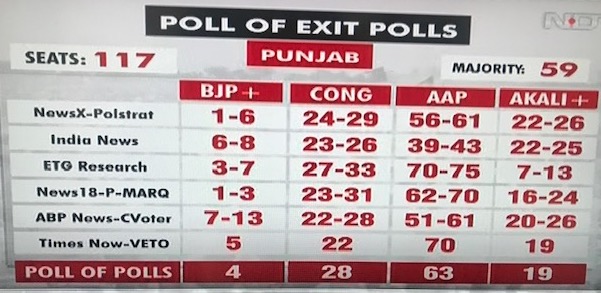
An average of six exit polls forecast that the AAP will win a workable majority with around 65 seats in Punjab’s 117-seat assembly, compared with just 28 for the Congress Party which is currently in power, and around 19 seats for the Shiromani Akali Dal (Alkalis), the main Sikh party. The BJP is forecast for maybe four seats. This is of course only based on exit polls and the final figures could vary.
This would be the AAP’s first win outside Delhi, and would allow it to run a state without interference from the national government. It has been in power in Delhi under the leadership of Arvind Kejriwal, the party’s founder and the capital city’s chief minister, since 2013 (apart from a one-year gap in 2014). The party’s roots are in a large-scale anti-corruption campaign a decade ago where Kejriwal, a former bureaucrat, played a prominent role. It also has candidates in the current Goa state election.
The likely Punjab result would be a blow for Modi, who has relentlessly tried to undermine the Kejriwal government since becoming prime minister in 2014. Delhi does not have the constitutional status of a full state, which means that the chief minister shares power with an appointed lieutenant governor, who exerts authority on behalf of the national government’s home ministry.
Stung by a massive defeat for the BJP in the capital’s 2015 assembly election, Modi defied the electoral choice of Delhi voters and set out to make Kejriwal’s administration as non-functional as possible by ordering the lieutenant governor to block legislative and administrative initiatives and appointments. This was reversed in July 2018 by the Supreme Court, which ruled that the national government should not interfere with, or attempt to undermine, Kejriwal’s administration. That however has not quelled the interference.
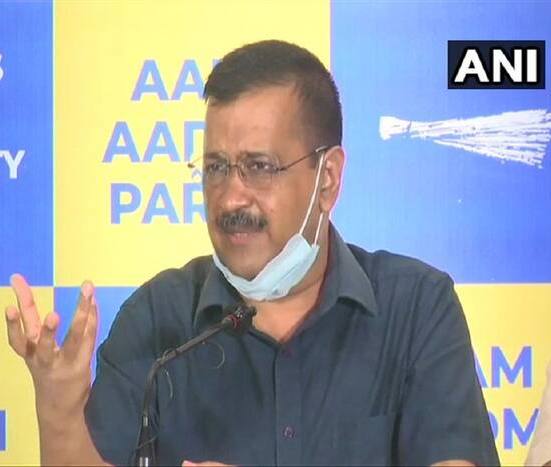
Arvind Kejriwal, AAP founder and leader and Delhi chief minister
Denigrated by many as an upstart that performs no better than long-established parties, the nine-year old AAP has made significant improvements in Delhi’s government schools and mohalla primary health clinics, and also on subsidised water and electricity.
The Punjab result would also be a disaster for the Congress and would reveal once again the Gandhi dynasty’s failings as leaders, though the party might be doing well this week in two other small states, Uttarakhand and Goa.
The Congress was led to a substantial victory in the last Punjab assembly elections in 2017 by Captain Amarinder Singh, a veteran politician who became chief minister for a second time. It won 77 seats against 20 for the AAP that was putting up candidates for in the state the first time. An alliance between the BJP and the Akalis won 15.
Age 80 on March 11, and a military historian as well as a politician, Singh was accused of being a remote and ineffectual chief minister who rarely emerged from his palatial residence and allowed rampant corruption and expansion of an illicit drug trade.
A rival emerged when Navjot Singh Sidhu, a former international cricket star, became active in politics and tried to unseat him, harnessing the support of Rahul Gandhi, the ineffectual Congress leader, and his sister, Priyanka Gandhi Vadra.
The Gandhis seemed to encourage Sidhu to undermine the proud chief minister’s authority and image. Knowing he had lost their support, Amarinder resigned last September and linked up with the BJP while Sidhu, who became rebellious and over-assertive, was sidelined to head the state’s party organisation.
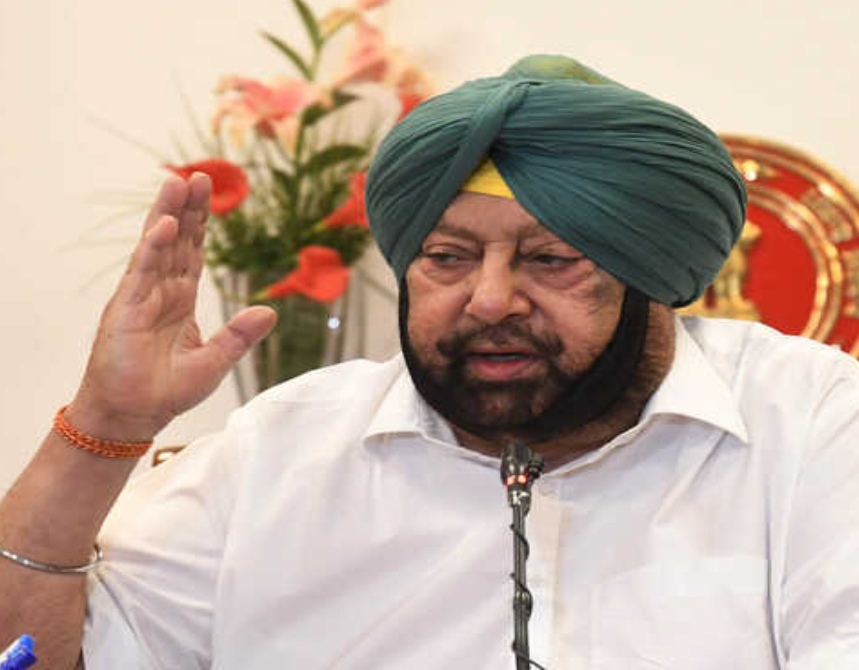
Amarinder Singh, former Punjab chief minister
Another Sikh politician, Charanjit Singh Channi, became chief minister and has led the Congress campaign. Channi is a Dalit, formerly known as “untouchables” at the bottom of the caste system. His appointment was seen partly as a bid to win this important part of the Punjab electorate votes.
Unsurprisingly, the Gandhi’s mishandling of the Amarinder Singh succession reduced Congress’s standing in the state, and enabled the AAP to emerge as a party that advocated strong governance and development without any religious or dynastic overtones.
In contrast to the Congress’s Gandhi manipulations, the AAP chose its chief ministerial candidate after a poll of members that backed Bhagwant Mann, a former stand-up comedian.
In an attempt to undermine the AAP in Punjab, there have been allegations – strongly denied – that it has links with leaders of the Khalistan movement that campaigned militantly for Punjab’s independence from India in the 1980s. The movement still has support abroad, particularly in Canada and the UK.
A letter allegedly issued by a banned pro-Khalistan group, Sikhs For Justice (SGJ), expressing support for the AAP spread across social media last month but was disowned both by the AAP and the group in a fact check run by India Todaymagazine.
The BJP supported the reports with Anurag Thakur, the information and broadcasting minister in the Modi government, repeating an allegation made by a former AAP member that Kejriwal had said he wanted to become the prime minister of “Khalistan”.
That is surely an unthinkable statement for a chief minister of Delhi who has national political ambitions.
Uttar Pradesh
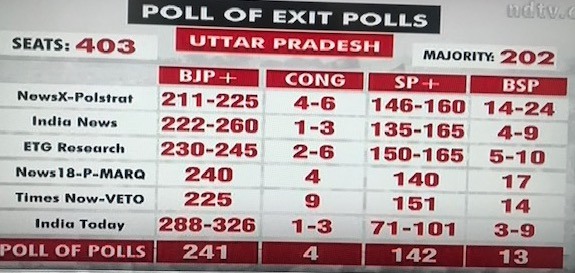
Meanwhile, an average of six Uttar Pradesh exit polls gives about 240 seats to the BJP with its main rival, the state-based Samajwadi Party having about 150 and the Congress just four to six.
This would be the first time a party in power has won a second term in the state since 1985. It will be seen as a vote both for the controversial Hindutva-based chief minister Yogi Adityanath, and also for Modi who stamped his image on the election with extensive campaigning.
That sets Modi with a strong platform to move ahead to the 2024 general election, as well as projecting Adityanath as an major BJP figure and leader for the future.
$15bn defence orders and historic links lead it to abstain at the UN
Biden to decide on India sanctions for Russia missile system order
“If Modi ji speaks to Putin, we are hopeful he will respond”, Igor Polikha, the Ukrainian ambassador to Delhi said on February 24 as Russian troops massed on his country’s borders, ready to strike.
“We highly appreciate India’s deep understanding of the current situation as well as the reasons that led to it. We expect India to support Russia at the UN Security Council,” Russia’s Charge d’affaires Roman Babushkin said in Delhi on February 25.
Neither diplomat had his way as India negotiated its approach for a meeting of the UN Security Council, where it is a temporary member, on the evening of the 25th. Vladimir Putin of course did not withdraw his massed armies as Polikha hoped, nor did India vote in favour of the Ukraine invasion as Russia wanted.
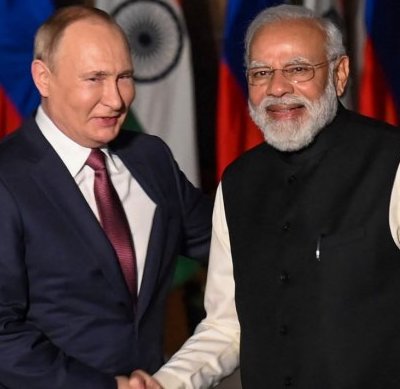
Vladimir Putin greeted by Narendra Modi in Delhi, December 2021 – they signed a ten-year defence co-operation agreement
Instead, it abstained, as it is expected to do this evening in a meeting of the full UN General Assembly. China and the UAE also abstained on the 25th from the UN draft resolution. “Deploring in the strongest terms Russia’s aggression against Ukraine”, it called on Russia, to “immediately cease its use of force against Ukraine”.
India took its position despite US president Joe Biden saying that “any nation that countenances Russia’s naked aggression against Ukraine will be stained by association”. Antony Blinken had urged India’s foreign minister Subrahmanyam Jaishankar to accept “the importance of a strong collective response to Russian aggression.”
India’s stance will disappoint and annoy the US and other western powers, but the reality is that India has no choice but to maintain tolerable relations with Russia.
In Washington a State Department spokesman seemed to recognise that on February 25 when he said, “India has a relationship with Russia that is distinct from the relationship that we’ve with Russia that is okay.” It remains to be seen how long that line lasts as sanctions increase.
In terms of history, Russia is seen as a long-term diplomatic supporter on international issues in the United Nations and elsewhere. On economics, it now accounts for 60% of India’s defence orders, but the support dates from the Soviet Union supplying low-cost (and low efficiency) steelworks, power projects and infrastructure for India’s developing economy.
The mutual trust was so great that rewards for loyal Soviet workers included holidays in secluded Indian seaside resorts – in the 1980s I saw a party arriving at a small Oberoi hotel on the Orissa coast. A banker friend remembers in 1982 travelling by car to an aluminium project in the state and seeing a signboard saying “ No Foreigners, Indians and Russians only”!
The US, on the other hand, which has wooed India for past 20 years with growing success, is seen warily as a fair-weather friend that wants India’s support now as a buffer against China, but cannot be wholly relied on if priorities change or India steps out of line.
‘Pragmatic tightrope walk’
“India’s stand on Ukraine is shaped by its national interest. It should continue to do so — ‘with us or against us’ doesn’t work”, said the Indian Express in an editorial headline the morning after the UN vote. The Business Standard said “India’s Ukraine move balances its principles with its interests” on a “pragmatic tightrope walk”.
“Both the US and Russia are essential partners for India; neither can replace the other,” Shivshankar Menon, a former foreign secretary and national security adviser, told me. Explaining why India cannot manage without the US, he said “Russia cannot substitute for the market, the civilian technologies, the education, and the financial system that the US offers India access to, all of which are essential for India’s transformation”.
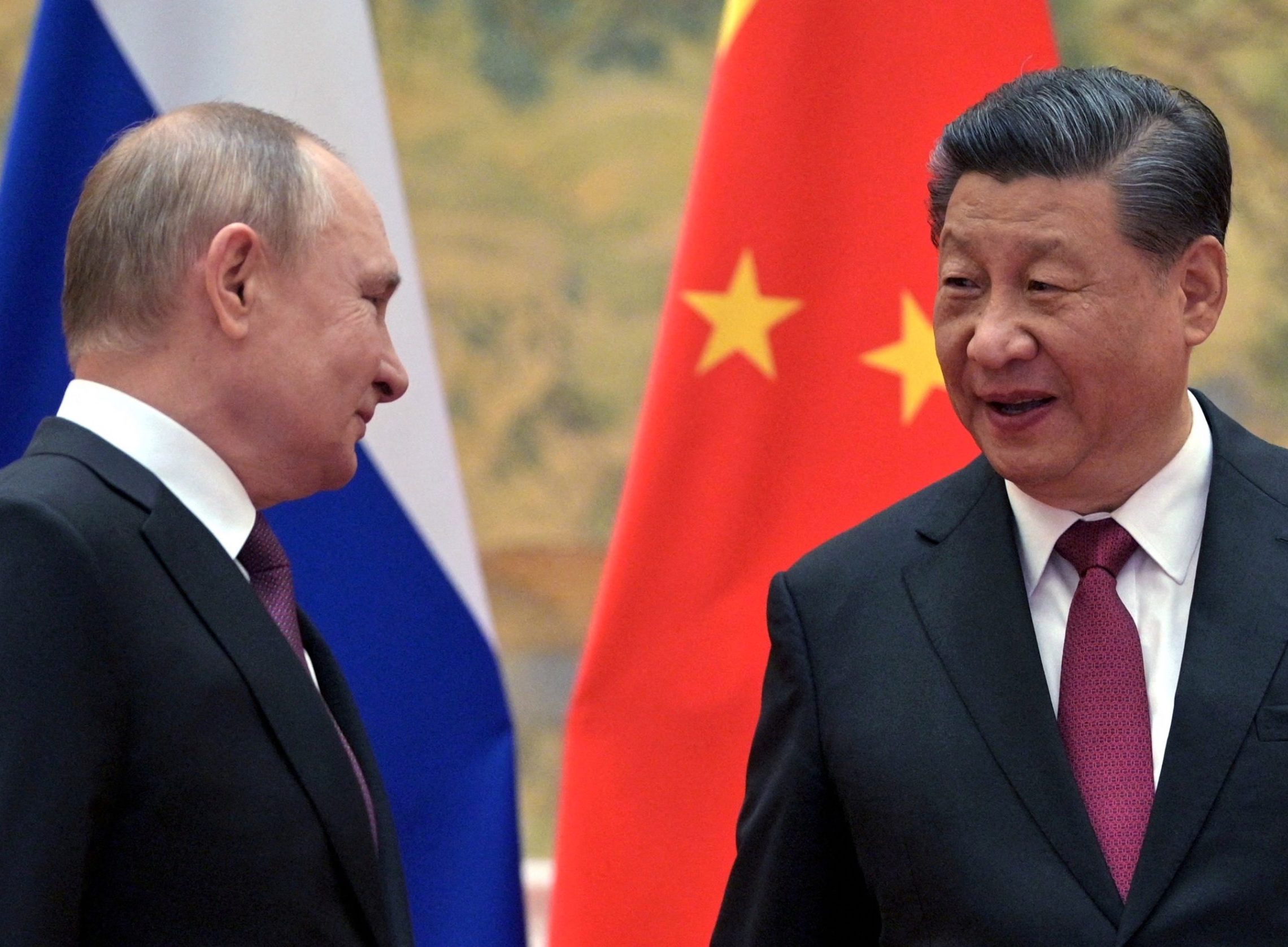
Vladimir Putin and Xi Jinping, Beijing Olympics Feb ’22
The refusal to step away from Russia is something that the US, UK and other western countries will have to learn to live with, at least for now, though international public opinion will inevitably swing against India for not condemning Putin’s brutal invasion.
India is seen internationally as a robust tolerant democracy despite its chaotic politics and growing Hindu nationalism. The view abroad is therefore that it should not be fence-sitting when Russia is breaching Ukraine’s national sovereignty – something that India accuses China of breaching on their disputed Himalayan border.
There is some concern in India about the line it is taking. Former foreign secretary Shyam Saran noted in theIndian Express on February 26 that “there is a rising level of discomfort among Russia’s friends who have chosen to look the other way”. He reckoned that “the geopolitical calculations that led to artful ambiguity in reactions to the Russian invasion are now shifting so as not to be stranded on the wrong side of the fence”. He added that “the Indian statement explaining its vote of abstention comes fairly close to criticising Russia’s resort to arms”.
Saran was reflecting liberal opinion in India that is concerned about the government not speaking out and regrets that India will be heavily criticised. The Congress Party is broadly backing the government line, but Shashi Tharoor, a leading Congress MP and former senior UN official, echoed Saran’s point and said on television that India had “placed itself on the wrong side of history”. Mainstream concerns however are more localised about its own tensions with China and Pakistan at a time of an escalating world crisis.
The Cold War
The diplomatic relationship goes back to the 1950s when Prime Minister Jawaharlal Nehru softened his non-aligned principles and moved closer to the Soviet Union at a time when the US was siding with Pakistan. The ties grew with the Indo–Soviet Treaty of Peace Friendship and Cooperation signed August 1971, which specified mutual strategic cooperation. It came after the creation of Bangladesh that India supported. President Richard Nixon, who once called Indians “slippery treacherous people”, ordered US ships to the Bay of Bengal in support of what was then East Pakistan. That has never been forgotten in Delhi.
I remember Indira Gandhi saying when she was prime minister in the early 1980s that the Soviet Union had never let India down. That contrasted with the US, which had done more than any other country to damage India strategically over 60 years (till relations began to improve 15 to 20 years ago). I was told some time ago by Kanwal Sibal, a former Indian foreign secretary and ambassador to Moscow. He cited US high technology sanctions “curbing the development of India’s strategic capabilities” till a nuclear deal was struck with the US in 2008.
Sibal takes a more pro-Moscow line than many of his peers. What he says however illustrates the legacy of history behind India’s current wish to remain at least partially non-aligned, with a tilt to Russia, while it has been growing closer to the US. It has been buying America’s defence equipment and has joined it in the counter-China link-up called The Quad along with Japan and Australia.
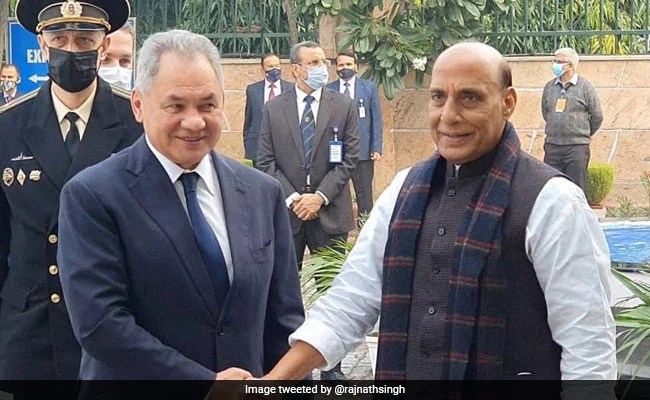
Russia’s defence minister Sergey Shoygu with Rajnath Singh, his Indian counterpart in Delhi Dec 2021.
It has however refused to allow the US to dictate policy on issues that it sees as being in the nation’s interest. It has insisted for example on maintaining diplomatic relations with Myanmar and Iran, moves that have been reluctantly accepted by successive American presidents Bill Clinton, Barack Obama and Donald Trump.
Defence orders
While history may be becoming less significant in the Russia relationship, India continues to be tied by large scale defence orders that amount to a priority catalogue of dependency.
Ajai Shukla, a former army colonel and now a defence analyst and columnist, estimates that India has defence orders totalling some $15bn with Russia, which for years has accounted for 50-60% of the country’s defence imports and was down to just under 50% in 2017-21 according to SIPRI, the Stockholm based defence think tank (India imports 70% of its defence equipment because it has failed to develop a manufacturing capability).
The orders include a $5.43bn missile defence system, the S-400, with deliveries under way. There is a $3bn order for four frigates, plus two to be made in India (complicated by the engines coming from Ukraine that also has a continuing contract for upgrading military transport aircraft).
Then there is a $3bn contract to lease a Russian nuclear attack submarine for ten years from 2025, and plans for an Indian factory to manufacture at least 750,000 AK-203 Kalashnikov rifles for the Indian Army. The Indian Air Force wants to buy and upgrade 21 MiG-29 fighters lying unused in Russia, and maybe build 18 Sukhoi-30MKI fighters plus 200 light helicopters worth about $2bn, says Shukla.
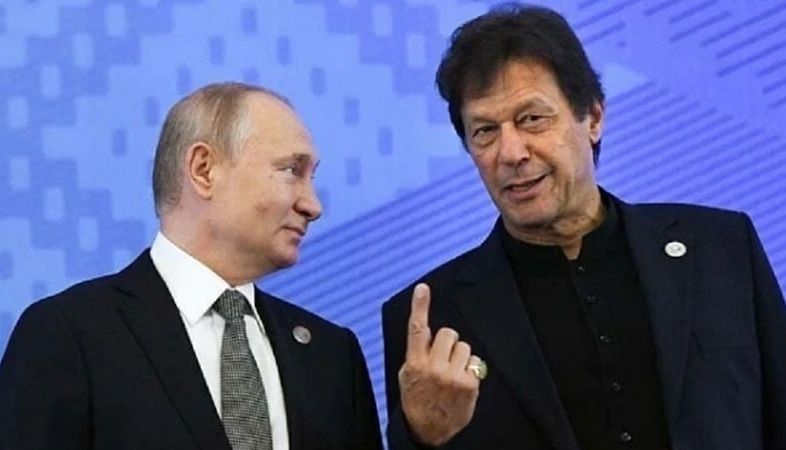
Vladimir Putin with Imran Khan in Moscow February 24 as Russian troops were massing on the Ukraine border – Putin not distancing himself for alleged Covid reasons as he did with other visitors over Ukraine
The list is endless stretching far into the future. India has been trying to reduce this reliance. [[INSERT MARCH 4: Donald Lu, the US Assistant Secretary of State for South and Central Asia, told members of the Senate Foreign Relations Subcommittee on March 2 that “India, in just the last few weeks, cancelled orders for MiG-29 (fighter jets), Russian helicopter and anti-tank weapons”. (The Indian Ministry of Defence has not confirmed this development.)]]
The US would be eager to replace some of the existing orders, but it is not willing to co-produce and co-develop advanced defence technologies with India in the way that Russia has, for example, on nuclear submarines, fighter jets and missiles.
Sanctions
The US pressed India to buy missile systems made by America’s Raytheon or Lockheed Martin instead of Russia’s S-400, but Delhi refused to switch.
A decision is pending from Biden on whether to impose sanctions on India under America’s Countering America’s Adversaries Through Sanctions Act (CAATSA). There seemed a chance he would find a way to excuse India, but the S-400 constitutes a “significant transaction” under the Act and there is now a real risk that Biden will refuse a waiver. That could cause a serious disruption to US-India ties.
India might face more sanctions and will also have problems making payments to Russia now that banking is being blocked. Reuters has reported that it is considering reviving an old rupee-rouble payment mechanism for trade that ended with the collapse of the Soviet Union because sanctions could disrupt vital supplies of Russian fertiliser. A payments system used for trade with Iran is another possibility.
Putin, Xi – and Imran
Relations with Russia have been complicated by Moscow growing closer to China and also, at a different level of importance, to Pakistan. There is rapport between Putin and Xi Jinping, China’s tough and ambitious president, and it seemed at first that Putin expected support for his Ukraine adventure.
But Xi is a cautious leader and he has his own battles to fight internationally, especially with the US. This has led to what a Financial Times headline called China’s “pro-Russia neutrality” after China abstained on the UN security council resolution
According to China’s Xinhua news agency, Xi told Putin during a telephone conversation on February 26 that China supported Russia’s and Ukraine’s resolving the issue through negotiation – which fell far short of endorsing the invasion and verged on opposing it.
China is however expected to offer Russia help over sanctions, with increased commodities trade arranged through state-owned banks that have less trouble circumventing US sanctions. “Look to North Korea for reference: All trade with them is banned under international sanctions and yet China accounts for 95 per cent of their foreign trade,” a US analyst told the FT.
That could lead to Putin becoming indebted to Xi, which would give the Chinese president an added pressure point against India. Relations between India and China are at a low point. Troops have been facing each other for two years in the Himalayas after serious clashes with fatalities in 2020.
India’s tortuous relationship with Pakistan, which is actively supported and armed by China, could also be affected. Imran Khan, Pakistan’s prime minister, clearly enjoyed parading last week through Beijing and then Moscow, meeting Xi and Putin, while the Ukraine crisis was developing.
After India’s abstention, Ukraine’s president Volodymyr Zelenskyy called Modi and sought India’s “political support”. Modi is reported to have expressed “deep anguish” over the loss of life and property, and to have reiterated India’s call for “immediate cessation of violence” and return to dialogue, indicating the furthest that India would go in condemning Putin.
Since then, Putin has escalated the crisis with attacks on Ukraine and putting nuclear forces on alert. This means that India will find it increasingly difficult to stand on the sidelines, calling for peace talks and an end to hostilities, at a time when other leading nations are imposing heavy sanctions. Despite that, India has a strong case for its current stance.
Top prices at Pundole auction for V.S.Gaitonde and Tyeb Mehta
Buoyant sales over two days of auctions as Ukraine crisis escalated
For the second time in less than two years, an auction consisting entirely of modern Indian art from a prominent Japanese collection has created record prices for leading masters. The total sale figure of $20.68m – for 57 lots – was also the highest ever for a single Indian art auction.
Run by Pundole, a long-established Mumbai gallery, the auction – and a second sale a day later – consisted of works from a collection built up over three decades by Masanori Fukuoka, a businessman living in the Kansai region of Japan. Fukuoka set up the Glenbarra Museum alongside his home.
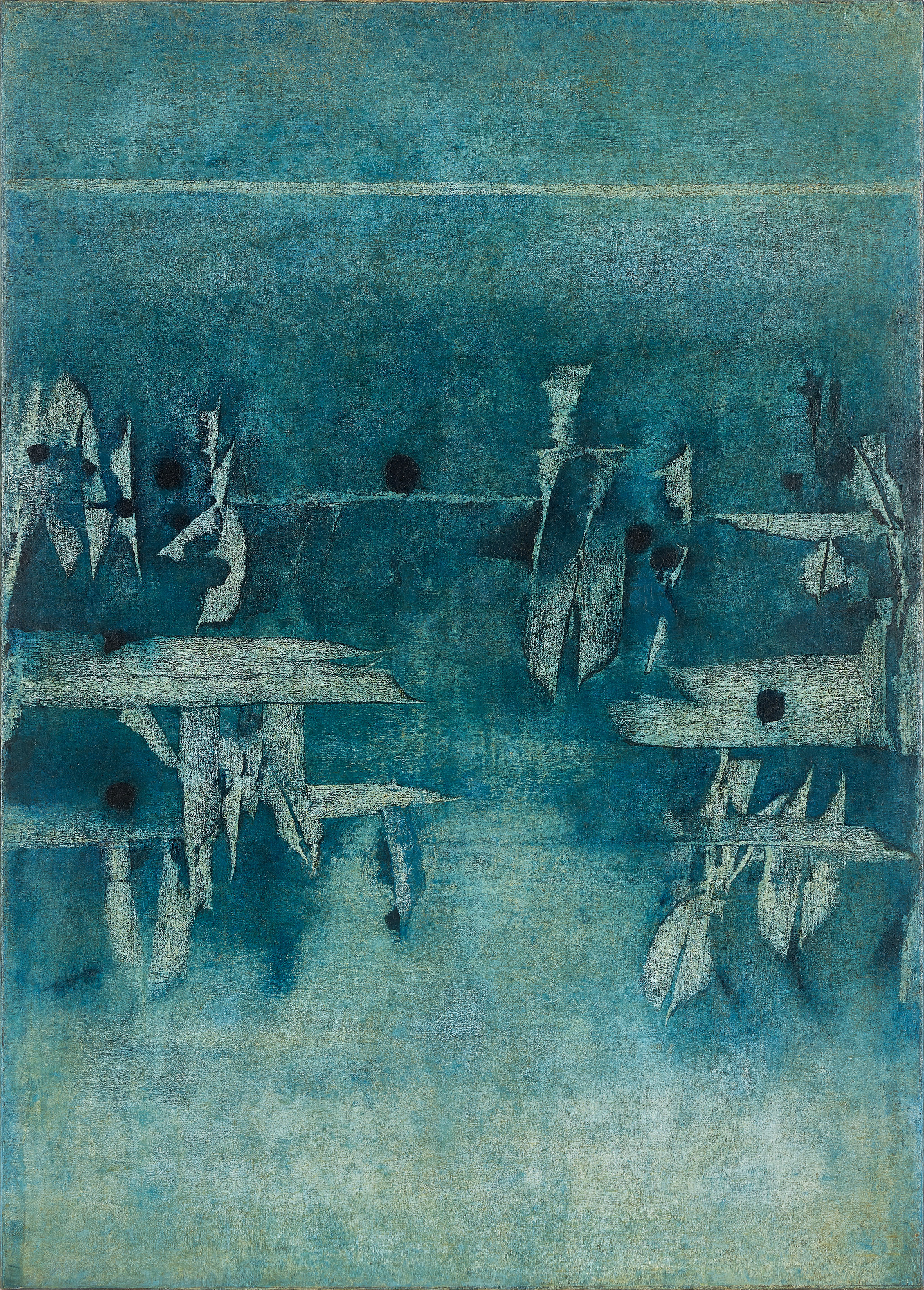
V.S.Gaitonde’s $6.44m abstract
The museum now has one of the most impressive and accessible international collections of Indian art, which Fukuoka, who was initially drawn to India as a place of Buddhist learning, occasionally prunes.
Works have been shown in India and lent abroad. An impressive collection of Jogen Chowdhury’s works has travelled to Kolkata, Mumbai, and Delhi, and a Nasreen Mohamedi exhibition will be staged later this year.
Fukuoka’s s first exclusive auction with Pundole was in September 2020.
This week’s two auctions (totalling $21m together) took place in Mumbai on February 24 and 25 just as the Russian invasion of Ukraine was under way.
All the 116 lots were sold and most exceeded estimates, maybe indicating as often happens that art is seen as a safer investment than the stock markets at a time of crisis.
A large 70inx50in abstract oil on canvas that was painted in 1969 by V.S.Gaitonde, a leading member of the mid-20th century Progressive group, set a new record for the artist with a Rs42 crore hammer price – $6.44m including a 15% buyer’s premium. This was the first time the painting has been auctioned and the price was the highest ever bid for a modern or contemporary Indian work. It beat the Rs32 crore – $5.02m including the premium – paid for another Gaitonde from the Glenbarra collection in September 2020.
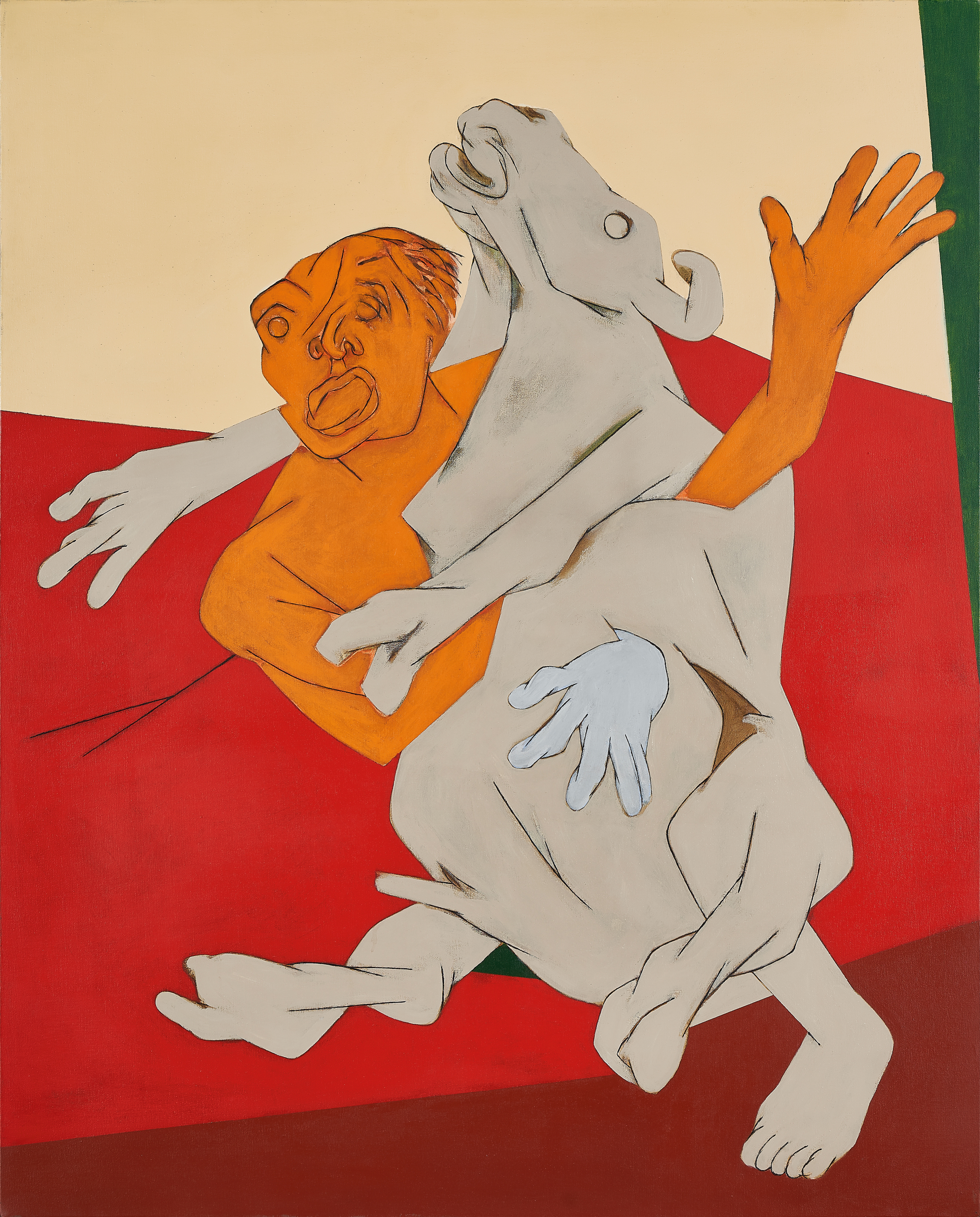
Tyeb Mehta’s $4.9m “Mahishasura”
The second highest price of Rs32 crores (hammer) – $4.9m including the premium – was bid for a 59inx47in acrylic on canvas by Tyeb Mehta, another leading member of the Progressives. Part of his Mahishasura series, it depicted a goddess and buffalo-demon enacting a sacrificial combat rite of fertility.
The price doubled the low estimate and beat Mehta’s previous record of Rs26.38 crore ($3.99m including premium) that was achieved at a Mumbai-based Saffronart auction in June 2018.
These prices confirm Gaitonde’s and Mehta’s position at the top of the Indian art market, where their paintings are regarded as both financially safe and visually important investments.
According to sources, the two works were bought by a (so far) un-named non-resident Indian with paddle number 1707, whose success as an apparently new buyer surprised established collectors based in India.
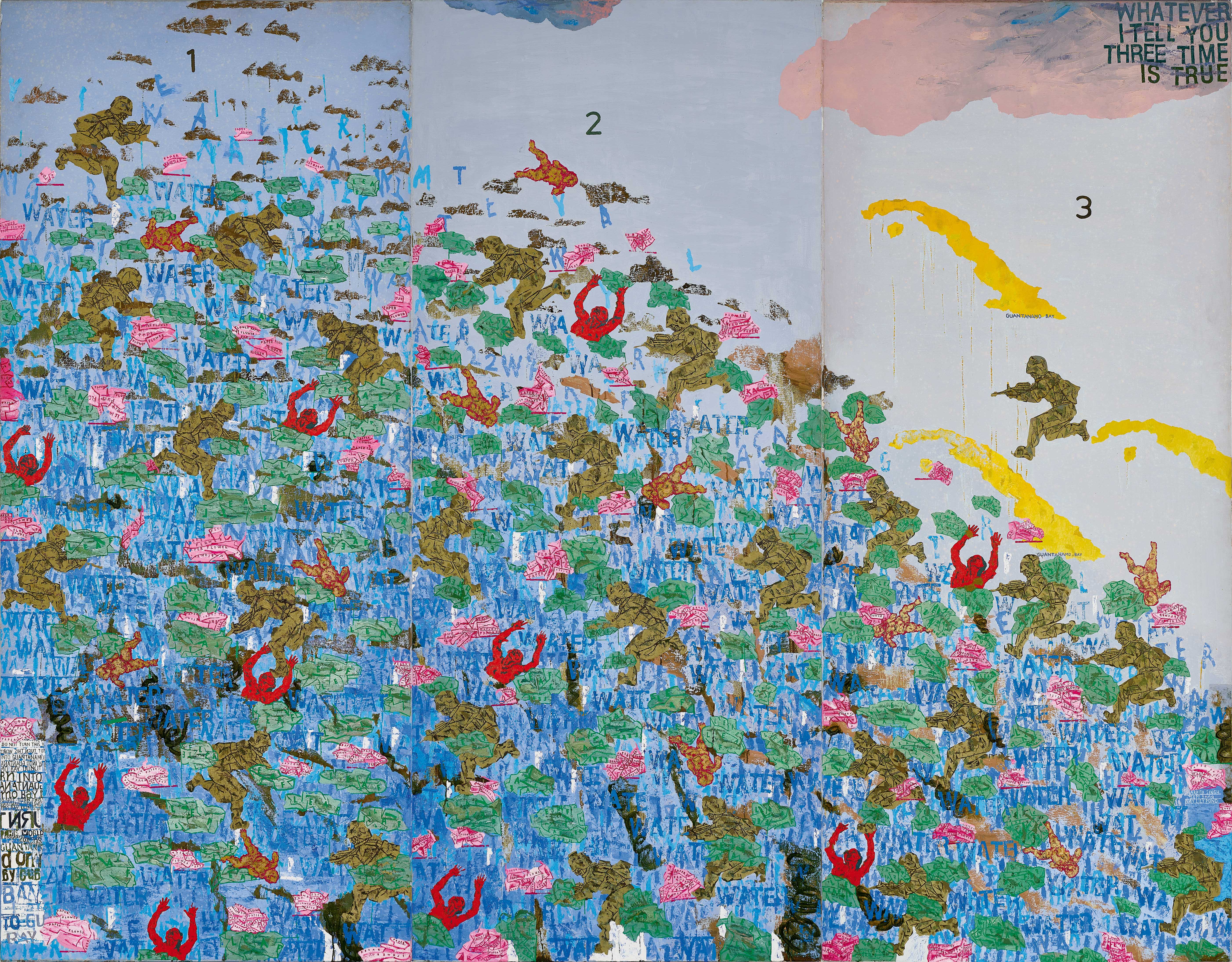
The same buyer won other works including an 84inx108in triptych oil on canvas titled My Lily Pond by Arpita Singh. Now in her mid-80s, Singh’s works were till recently under-recognised. Creating a new record for the artist, the painting was sold for three times the low estimate at a hammer price of Rs9 crore ($1.38m including premium).
At first glance it looks a calm mix of colours. The word WATER is repeated across the canvas with pinkish water lilies, but the detail – topically – reveals armed soldiers bearing down on drowning men.
Arpita Singh’s $1.38m “My Lily Pond”
Another prominent artist, Jagdish Swaminathan, doubled his record with a 61inx184in triptych oil on canvas titled The Altar from 1988. It sold for a hammer price of Rs22 crore ($3.73m including the premium) that more than tripled the low estimate.
The Indian art market is frequently hit by fake works of art so the reputation of the Glenbarra collection’s authenticity seems to reassure buyers. The total sale of on the first day of Rs155 crore ($20.68m) beat the previous auction record of $16m (Rs68.64 crore) that was set by Saffronart in the boom year of 2006 before prices crashed. That was followed by Rs97.65 crore ($14.7m) at a Christie’s auction in Mumbai in December 2015.
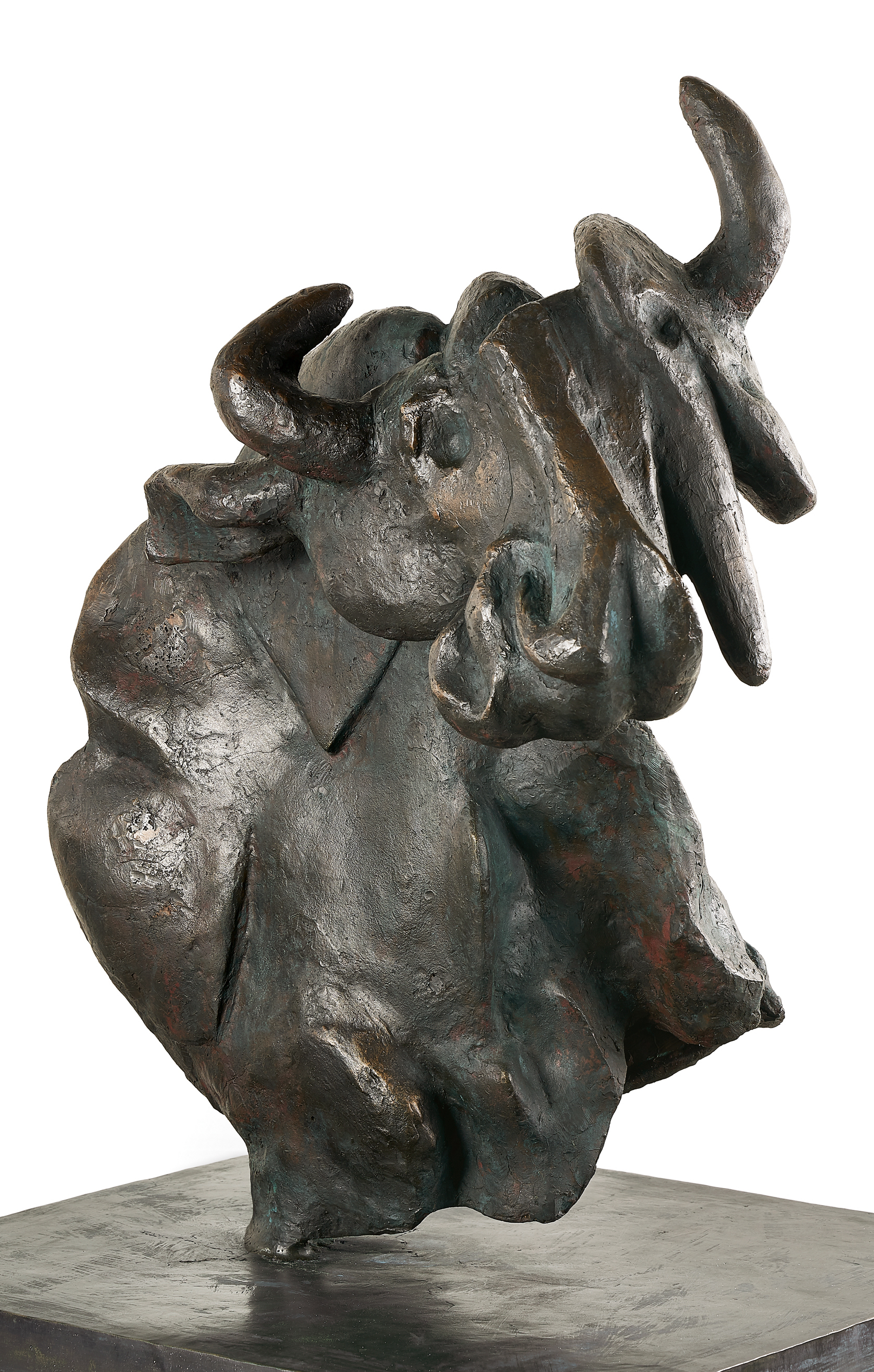
Bull”, a bronze sculpture by Tyeb Mehta that tripled its top estimate to sell for Rs9 crore ($1.38m including the premium)
Alongside the big names, there were many works by lesser know artists both in the February 24 auction and in the second sale of 59 works a day later. All the works sold. and many went well above estimates that seem to have been set low to pull in bids.
The auction catalogue says that, in his early years of collecting, Masanori Fukuoka had a “process of buying” that was “somewhat romantic, where emotional responses and gut reactions trump all practical considerations”.
He finished up with what he describes as “a few thousand” works and says he has been selling works at various auctions for several years, focussing since 2020 on the high profile single-owner sales with Pundole. He is still buying, having diversified into Japanese ceramics.
Dadiba Pundole, who owns the auction gallery, says that buyers on the two days included “a new generation of collectors” who “fulfilled Masanori’s dream of bringing a broad range of Indian artists into the sphere of international awareness and recognition”.
The results underline the growing significance of India-based auction houses that include Saffronart as well as Pundole and Asta Guru. That leaves the internationally known Christie’s, Sotheby’s and Bonhams with a lesser role.
Rahul Bajaj , a veteran Indian industrialist and the head of the Bajaj Auto group who died on February 12 aged 83, will always be remembered for standing up to power. At a business conference just over two years ago, he confronted Amit Shah, the Home Minister and Narendra Modi’s chief ally, and told him that the Bharatiya Janata government had created an “atmosphere of fear” which silenced critics and deterred investment (see article below). That was something his peers feared to say.
Known for decades of unguarded and often controversial public statements, Bajaj headed a family run group that was a world leader with its scooters, motorbikes and three wheeler auto-rickshaws. India has other industrialists who head bigger conglomerates and who may be regarded with awe, but Bajaj was proud, as he told me when I interviewed him for the FT in 1988, of his “family background of ethics, honesty and simplicity”. A fellow auto industry manufacturer described him as “intellectually honest, he spoke his mind and always thought about the nation.”
Modi pitches governance though Hindu nationalism is the creed
Lack of jobs an issue in state polls that continue till early March
Viewed from abroad, the best economic news out of India for some time has been the government finally privatising Air India, the heavy loss-making and inefficient national carrier that was handed over to the Tata group at the end of last month. There was also a constructive Budget on February 1 aimed at boosting infrastructure spending.
The major focus now is on assembly polls currently taking place in five states including Uttar Pradesh, India’s largest state with 105m voters. Prime minister Narendra Modi needs to curb his Bharatiya Janata Party politicians and activists propensity during elections to stir up their Hindu nationalist supporters, causing social unrest and generating fear among minorities, notably Muslims and Christians.
Taken together, the potential positive reform signal from the Air India sale plus the Budget’s growth potential and relative calm during the elections could help to improve India’s image abroad.
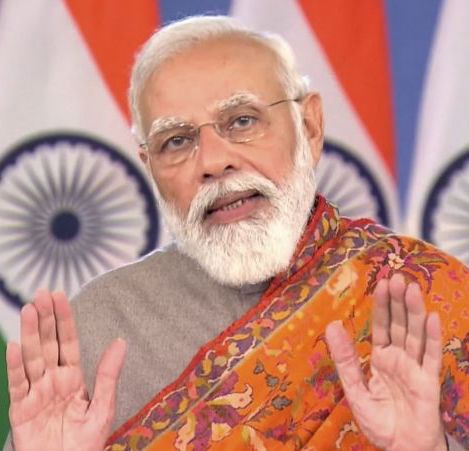
Narendra Modi interview with ANI news agency
Investors look for positive continuity in economic policy and are deterred by some retrospective changes of recent years. They also look for stability in governance.
Modi appears to have accepted that he needs to pitch governance rather than the raucous nationalism he often projects at election rallies. He showed this in a 70-minutes Indian news agency interview on February 9 where he talked (in Hindi) about government achievements. He focussed on Uttar Pradesh, the BJP’s top-priority state election where voting started a day later. Arguably the timing so close to the polls breached electoral conventions, but Modi has ignored the rules in earlier years.
Budget boost
The Budget attempted to provide some continuity with few tax changes. The government expects GDP to grow by 9.2% in the year ending March 31, reflecting some recovery from the pandemic, and 8%-8.5% in the coming year. That would be faster than other major economies.
With a focus on infrastructure spending including national highways, the budget had a 35% boost for capital expenditure. The government’s privatisation drive might however not move ahead as quickly as had been hoped in the two years before the next general election, despite the Air India success. A plan announced a year ago to monetise government assets is moving slowly and the budget’s divestment target was halved by finance minister Nirmala Sitharaman from the (grossly unrealistic) $23bn pitched for the current year (2021-22) to $8.75bn for the coming year.
Positive moves like Air India and the Budget, and Modi’s calm but authoritative tv interview, together with the fading of the Covid threat that ravaged India, are not however sufficient to allay concerns abroad. There are widespread worries about social upheavals caused by the relentless drive for Hindu-based nationalism along with the government’s restrictions on freedom of expression.
This is reflected by international media coverage. My old newspaper the FT had a headline calling Modi a “textbook fascist” on a January 28 piece by its US columnist Edward Luce, who was the Delhi-based South Asia correspondent a few years ago. The New York Times ran a February 9 headline “As Officials Look Away, Hate Speech in India Nears Dangerous Levels” plus “calls for anti-Muslim violence – even genocide – are moving from the fringes to the mainstream”. The report included calls by Hindu activists and spiritual leaders last December for genocide against Muslims.
Restrictions on journalists are being criticised, notably the arrest on February 4 and imprisonment for ten days, of a prominent Kashmir journalist, Fahad Shah, who is the editor of The Kashmir Walla, an independent internet news site, and who has reported for international newspapers. The government has also in the past few days tightened its ability to cancel journalists’ official accreditation with new rules that the Indian Express said “intrudes on rights of free press” and “attempts to shrink space for dissent”.
State assembly elections
Two of the five assembly elections are important for the future direction of Indian politics. The BJP needs to win in UP in order to project Modi’s supreme vote-winning image forward to the next general election in two years’ time, though victory is not assured.
The other is in Punjab, a sensitive border state where there is a risk of interference from neighbouring Pakistan. The election result will probably underline the supreme vote losing ability of the Congress party, which currently runs the state government. The Gandhi family that controls Congress has failed to ensure an orderly succession to Amarinder Singh, the party’s veteran state politician and until recently the chief minister. This has led to splits in the party that could lead to the Aam Aadmi Party, which is in power in Delhi and has its roots in anti-corruption campaigns, increasing its significance..
The first of seven stages of voting began in UP on February 10 with Goa and Uttarakhand following today (Feb 14) and Punjab and Manipur later in the month. Voting continues till March 7 and the count will take place on March 10.
Modi usually makes Hindu nationalism the core BJP appeal, but he has to cope with rising unemployment and concern about a lack of effective governance on jobs and allied issues. Especially serious is the plight of micro, small and medium enterprises (MSMEs) that were worst hit by the pandemic and by his de-monetisation of bank notes in 2016 and a complex introduction of a new Goods and Services Tax (GST) in 2017. These businesses usually employ some 110m workers and many have been crippled.
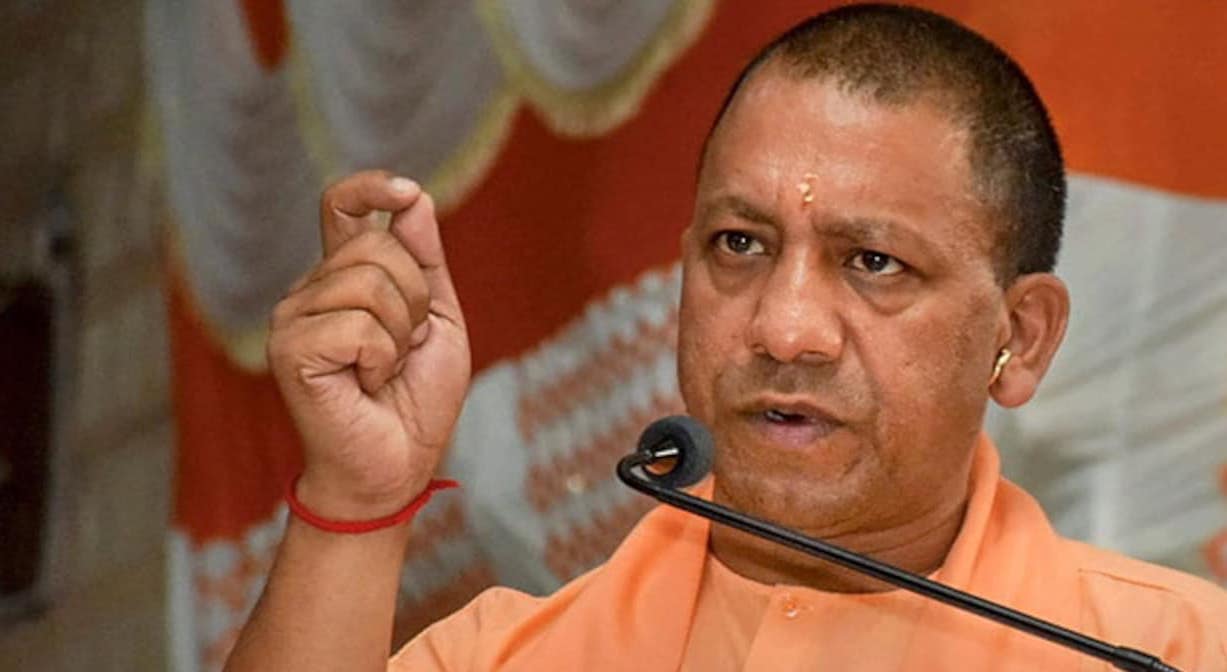
Yogi Adityanath during the election campaign – NDTV photo
In Punjab and UP there is also resentment about farming laws that were cancelled in December after more than a year of mass protests on highways approaching Delhi. There are therefore strong grounds for voting to swing away from the BJP.
For Modi, UP is the prize he needs to win. In 2017, he installed a firebrand and ambitious Hindu priest-turned-politician, Yogi Adityanath, as chief minister, who regularly stirs anti-Muslim sentiment, as he has done during the election campaign. He is seen by some as a future national party leader who might eventually take over from Modi and become prime minister – a development that would cause apprehensiveness about tough pro-Hindu policies.
Modi and Adityanath are facing a determined challenge from the state-based Samajwadi Party led by Akhilesh Yadav, who was chief minister from 2012 to 2017. The BJP has not been sufficiently effective on the economy since it won power in 2017, despite substantial infrastructure spending, but it has reduced the widespread lawlessness that was a feature of the Samajwadi years in power.
Akhilesh Yadavwhile campaigning
The state’s per capita income in PPP terms remains lower than Zimbabwe’s and is barely higher than Haiti’s according to Mihir Sharma, a prominent commentator and Bloomberg columnist. The Economistcompares UP with Afghanistan and Tajikistan, the only Asian countries below its $991 nominal GDP per person, which is less than half India’s average.
Yadav now has a chance to persuade the electorate that he has matured – aged 48 he is still young by Indian politics standards – and that he would lead a less harsh government than the BJP that would be more caring for the interests of minorities, and an effective provider of jobs.
Nationally, Modi remains the most popular prime minister since the Congress party’s Indira Gandhi half a century ago, and there is no national politician to challenge him. But his concern about losing ground is apparent from his relentless attacks on Rahul Gandhi, the ineffectual leader of Congress who could, were he more politically able and respected, lead a national opposition.
Modi wants to replace Gandhi’s grandfather, Jawaharlal Nehru, as India’s greatest leader by reversing what the BJP regards as centuries of decline and establishing a Hindu nation where minorities such as Muslims and Christians are accepted providing they recognise the overall nationalism.
A substantial victory in Uttar Pradesh would help him towards that goal, but defeat would encourage regional opposition parties, and maybe even the Congress, to mount a strong and unified challenge in 2024.
Defeat would also dent Modi’s supreme and powerful populist image. Voters of course often go for different parties in state and national elections, but he would need over the next two years to add positive policies that provide hope for the hundreds of millions of India’s poor. Focussing on defensive and negative attacks on the Gandhis and the disruptive rabble rousing of Hindu nationalism would not be enough.
Long history of rule breaking and surviving career crises
Eton school master criticised his lack of respect for rules age 17
If Boris Johnson was chairman of a big corporation, he would surely have had to resign on January 31 after an official report was published that condemned “failures of leadership and judgment” in his office and home at 10 Downing Street. The report, written by Sue Gray, a top civil servant, also covered the adjacent Cabinet Office and listed over a dozen potentially illegal parties that were held during the past two years of strict Covid lockdowns and social distancing.
Instead, Johnson gave a rumbustious and insensitive performance in parliament, where there were a few calls for him to resign that he rebutted.
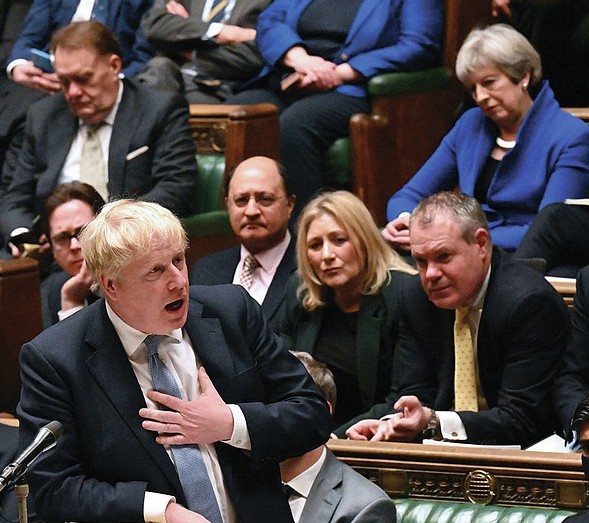
Boris Johnson apologising in parliament on January 31, watched (top right) by former prime minister Theresa May who challenged him to say whether he understood or just ignored lockdown rules – click for twitter video
Apologising for at least the third time in as many months for crises around his role as British prime minister, he took “full responsibility” for what had happened. That has become his confessional route of avoiding the need to acknowledge and absorb detailed criticism, but he showed no sign of changing his ways.
“I want to say sorry. Sorry for the things we simply did not get right and sorry for the way that this matter has been handled,” he said, humbly wagging his head. “It is not enough to say sorry. This is a moment when we must look at ourselves in the mirror and we must learn.” He then outlined planned organisational changes in Downing Street and the Cabinet Office that had been demanded in the report, but gave no hint however that he, personally, had to learn or change.
“I get it and I will fix it”, he added, no doubt hoping he was giving instant splash headlines for the next day’s papers that instead led with “A failure of leadership”, “Zero Shame”, “PM pleads for his job” and “Johnson rejects calls to quit”.
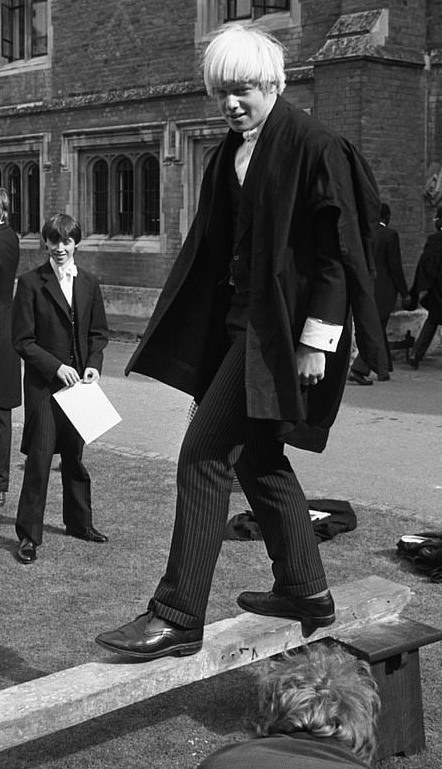
Boris Johnson at Eton
The report said that “at least some of the gatherings in question represent a serious failure to observe not just the high standards expected of those working at the heart of Government but also of the standards expected of the entire British population at the time”. There had been “too little thought given to what was happening across the country in considering the appropriateness of some of these gatherings, the risks they presented to public health and how they might appear to the public”.
He is now staging what must be the most audacious of the many recovery coups that have rescued his disaster-strewn career.
Despite all that, after two months of mounting crises with allegations of lying and misleading parliament (a resigning offence), Johnson has so far avoided being ousted from his post as prime minister.
Two weeks ago it looked as if his time in office was about to end, even though he had won a landslide general election victory for his Conservative Party in 2019, and then fulfilled his pledge to take Britain to its Brexit future outside the European Union. Last year he led a highly successful Covid vaccination programme. Britain acted faster and more effectively than most other countries in stark contrast to his unfocussed mismanagement of the pandemic early in 2019. Johnson then looked good for maybe ten years in power.
Throughout his career however he has displayed disdain for established institutions and scant respect for the truth. This has led to the current flood of crises, with his credibility plummeting both among Conservative members of parliament and the party’s countrywide membership. Last month it looked as though there might be a vote against his leadership, which needs to be triggered by 54 (15%) of the 359 Conservative MPs. Johnson’s allies have cajoled and bullied many of the likely rebels into line, but the number is still rising.
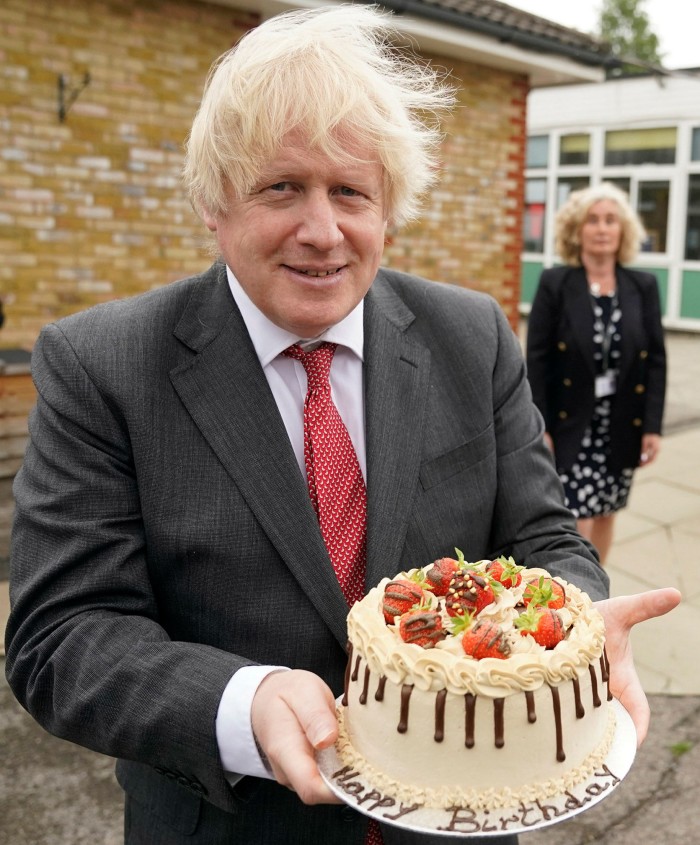
Boris Johnson was given a birthday cake on a school visit before his wife Carrie gave him one at a party during lockdown in Downing Street
The crisis built up from the end of November after a story in the Daily Mirror about Christmas drinks in Downing Street the previous year. That led to a stream of media reports of a total of 12 parties held in Downing Street offices and gardens between May 2020 and April 2021, with at least three being attended by the prime minister. Also leaked were details of three parties in the adjoining Cabinet Office and one in the education ministry.
One party was in Johnson’s private Downing Street flat (Nov 13, 2020), and one was in the Cabinet Room on his birthday (June 19, 2020) with a cake brought by his wife Carrie. Gatherings of two or more people indoors, and more than six outdoors, were prohibited at that time. (Sue Gray’s report has the restrictions’ details and dates)
One of the worst apparent breaches was a party in the Downing Street garden on May 20, 2020 organised by a top official with a “bring your own booze” invitation at a time when outside recreation was officially allowed with only one person.
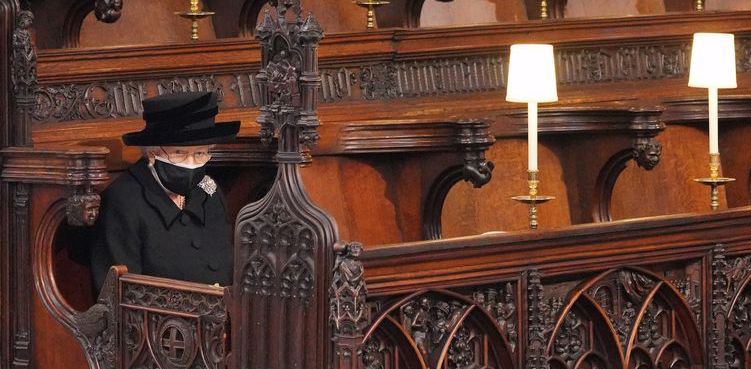
The most publicly shocking was a party (without Johnson present) that went on late into the night on April 16 2021, the eve of the funeral of 99-year old Duke of Edinburgh. That party was contrasted in the media with a striking picture of Queen Elizabeth (below) sitting in the funeral service the next day with no one alongside her because she was abiding by the Covid distancing rules.
Throughout, Johnson has obfuscated (some say lied) and never admitted that anything wrong was done. To begin with, he refused to admit to any knowledge of the parties, later claiming they were either work events or in line with Covid restrictions which they clearly were not. Asked in parliament on December 8 whether he would confirm the November 13 2020 event happened, Johnson replied: “No, but I am sure that whatever happened, the guidance was followed and the rules were followed at all times.”
Johnson fended off the stream of leaks by ordering an inquiry on December 8 by his cabinet secretary, who had to withdraw after a few days because of an on-line quiz that had taken place in his office. He was replaced on December 17 by Gray, who is a highly respected and experienced civil servant, but the leaks continued. Johnson swept them all aside saying “wait for the Sue Gray report”, but by the beginning of last week it was becoming apparent that her report would be damming with a massive amount of detail.
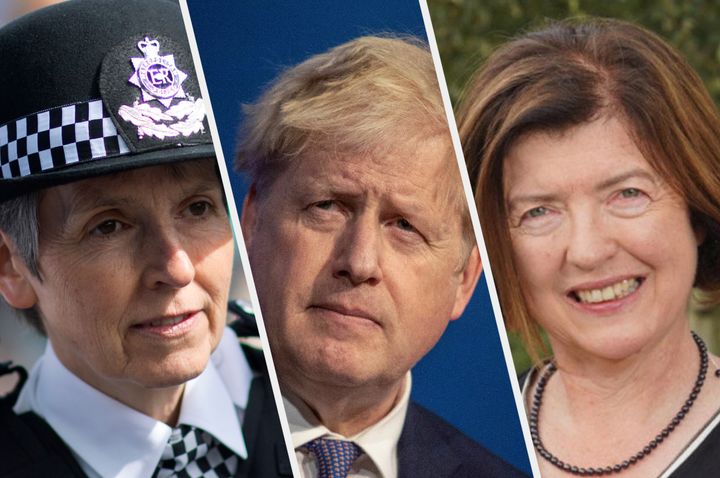
It is debatable whether what happened next was a clever plot or happenstance. It involves Cressida Dick, London’s highly controversial Commissioner of the Metropolitan Police. Dick’s five-year posting was extended last September for two years by Priti Patel, the home secretary and a committed Johnson supporter, who rejected widespread calls for the commissioner to be replaced.
Commissoner Cressida Dick, Johnson and Sue Gray – Huffington Post
On January 25, Dick unexpectedly announced that The Met was conducting inquiries into the parties, reversing the established police line that it was not looking into long-past Covid regulation cases. The Met then asked Gray to make “minimal reference” to eight events it was investigating.
Gray then did substantial redrafting over the weekend to remove the bulk of the report and she also downgraded the title to a mere “Update” because it contains none of the expected analysis of the 16 cases.
That suited Johnson because it prevented publication of potentially incriminating information that could escalate the crisis around his leadership, possibly showing, that he misled parliament, which would lead to widespread calls for his resignation.
The Metropolitan Police (The Met) said on Monday that it was reviewing “more than 300 images and over 500 pages of information” on the allegations. Some photos are reported to incriminate both Johnson and his wife Carrie who could be fined, along with officials and guests.
Police fines
The police intend to fine anyone found guilty of breaking the regulations – £200 (Rs20,200) for the first offence rising to a maximum of £6,400 (Rs6.5 lakhs) for repeat offences – but say they will not announce the names. Appeals will go to court for trial by judge and jury.
Under pressure from MPs, Johnson has reluctantly agreed to ask Gray for a further update when the police inquiries are completed, but it is not clear if he is still resisting publication of a full detailed report. His spokespeople have indicated he might be willing to say if he has been fined.
Johnson now hopes that the police inquiries, which could last weeks, will give him time to rebuild his prime ministerial momentum so that public interest in the parties scandal ebbs away and MPs decide not to try to evict him.
Substantial policy initiatives are planned and yesterday (Feb 1) he flew to Ukraine for crisis talks that provided photo-ops and sound bites. His authority however is waning – he was asked by the international media in Ukraine if he had the authority to speak for Britain, and a day earlier had to postpone a phone call with Vladimir Putin because he was dealing with his parliamentary session.
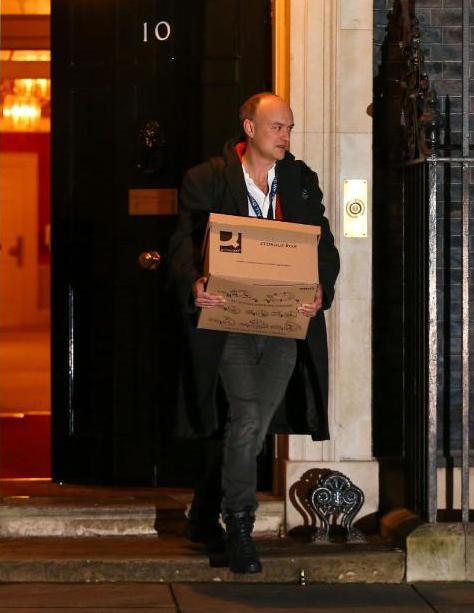
Many of the leaks about the parties have come from Dominic Cummings, Johnson’s maverick and divisive former chief of staff who he sacked in November 2020. Cummings is determined to get Johnson removed and can be expected to produce new leaks and allegations that have already started appearing in today’s (Feb 2) newspapers.
Dominic Cummings leaving Downing Street, October 2020
In a recent interview with the New York magazine, Cummings said removing Johnson from power was “an unpleasant but necessary job. It’s like sort of fixing the drains.”
Johnson has a history of rule breaking and re-emerging apparently unscathed. He was sacked as a graduate journalist trainee on The Times in 1988 over allegations he had fabricated a quote. In 2004 he was sacked as a front bench parliamentary spokesman and Conservative Party vice-chairman for allegedly lying to the party leader about an extra-marital affair he had with a colleague on The Spectator magazine where he was the editor.
There have been questions over a businessman helping to fund the £112,000 redecoration of his Downing Street flat and about the funding of two holidays in the Caribbean and Spain while he has been prime minister. An American woman, who claims she had a four-year (much photographed) affair with him when he was London mayor (2008-2016), is alleged to have received business favours.
It may seem odd that such a character with so little respect for conventions and rules can become prime minister. But these are deeply engrained life-long traits. His classics master when he was at school at Eton complained to his father than the 17-year-old thought he “should be free of the network of obligation that binds everyone”.
The reason for his success is that he exudes charm and panache and is a brilliant campaigner, which he has shown with Brexit and various elections. MPs and the party have supported him because they want him to win local council polls in the summer and a general election in 2024. They have known his limitations, which include a chaotic lack of interest in detailed policy issues and a short attention span, but thought they could tolerate them.
The question now is whether his lack of ethics is too serious for his supporters to tolerate and they dump him because he is no longer a vote winner. That would be the logical conclusion for any other politician, but so far his opponents have not united around a single cause and there are no outstanding characters to succeed him. So don’t write him off yet.
Prinseps and Artiana led the way last week with two sales
Big name auction houses cautious about South Asia digitals
Indian modern art is beginning to appear in the astonishing digital market as non-fungible tokens (NFTs) that can suddenly fetch millions of dollars – even though they exist somewhere out in the crypto stratosphere of Ethereum and Bitcoin blockchains and you can’t hang them on your wall as one-off creations.
Two relatively small South Asian art and collectibles auction houses, Prinseps of Mumbai and Dubai-based Artiana, launched NFTs last week. Others are planning launches and exploring the potential, trying to assess the appeal of the little-understood technology to existing art collectors and a wider range of speculative digital buyers.
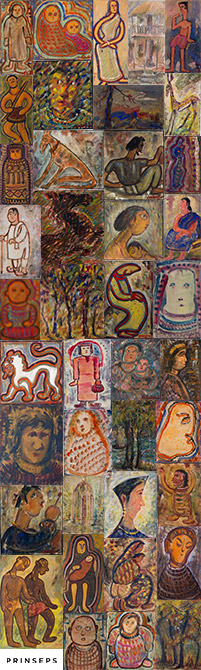
Prinseps 35 works by Gobardhan Ash
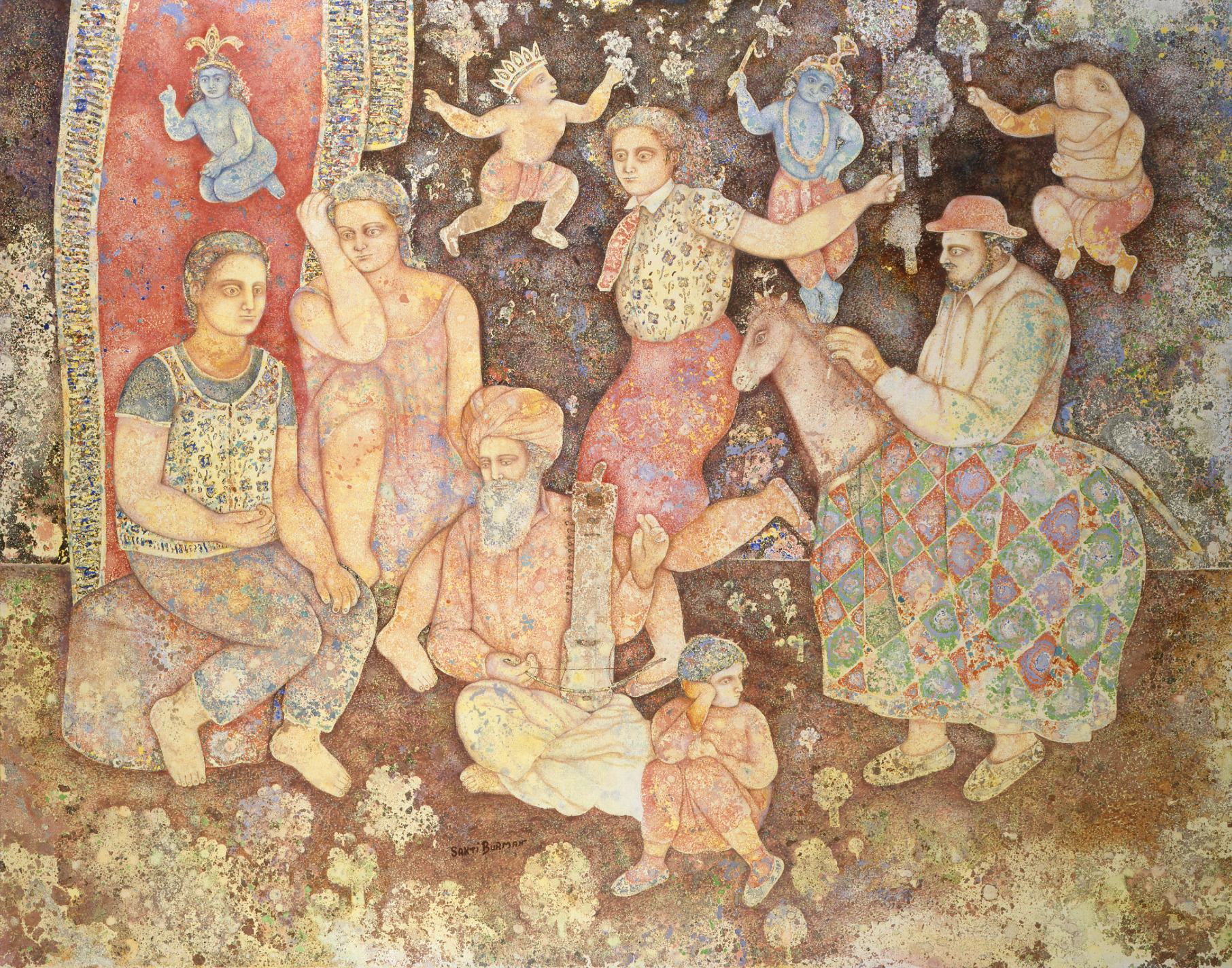
Prinseps has auctioned small relatively low-priced figurative works (right) painted in the late 1940s by Gobardhan Ash, a little-known but significant Bengal artist. Artiana has a fixed price sale of larger more expensive works by better-known Sakti Burman, who lives between Paris and Delhi and is still actively painting.
A different sort of NFT sale is planned by Kent Charugundla, a New York-based leading collector of Indian art and a blockchain specialist, with a massive work by the revered M.F.Husain. (He talks about that with Prinseps curators and others on this you-tube session that also covers the Gobardhan Ash works).
Many traditional collectors of Indian modern art are mystified and scathing about NFTs, which use the same technology as crypto currencies such as bitcoin to create a certificate of ownership over a specific digital file that cannot be copied or forged.
“It sounds like the world’s greatest Ponzi scheme,” said one, referring to the crypto market in general, while another thought that it “smacks of money laundering”.
But Pratap Bose, a long time Mumbai-based collector and dealer, who bought several of the tokens in the Prinseps auction, sees them as a good investment. “Like the stock market, it’s taking a punt,” he says, adding that much of Indian art is under-valued so there is strong potential.
For artists, the NFTs provide a way to benefit from the often substantial increases in prices that come after their works are initially painted and sold. In some countries, including the UK and EU, artists benefit from resale rights that give a percentage commission on their works in the secondary professional market. This lasts through their lifetime and for 70 years after their death. That does not apply in India, which will increase artists’ potential interest in having their works offered as tokens.
Estimates of NFT sales globally last year range from $18bn to $25bn, up from $94.9m in 2020. They vary “from cartoon apes to video clips” (as Reuters put it) with images, videos and even lands in virtual worlds.
The tokens broke onto an unsuspecting art world in March 2021 when a jpeg file collage (below) of tiny digital sketches done daily for over 13 years by South Carolina contemporary artist Beeple, sold for $69.3m at Christie’s. It had been launched with a $100 bid just two weeks earlier. The FT reports that “the artist, whose given name is Mike Winkelmann, summarised his reaction to the sale with a tweet: ‘holy f..k’ ”.
Major auction houses and artists have cashed in on the craze, but they seem wary of bringing South Asian art to the virtual table. Christie’s, Bonham’s and Sotheby’s have not yet decided what to do. Saffronart, the Mumbai-based market leader, is focussing instead on reinventing auctions with a new platform that Dinesh Vazirani, the founder and ceo, says he plans to launch next month.
Beelpe’s $69m collage
Deepanjana Klein, the head of Christie’s South Asian art business, gave me the best logic for what is happening:
“NFTs are an additional art form, such as photography, installations and digital art or AI that entered the art world at different moments in time,” she said. They were “about democratization of art and sharing of the digital art which goes with the NFT – anybody can download the art but the token belongs to only one person”.
The democratisation comes from everyone being able to access the token on the internet, while only the buyer has ownership of the token and can sell it – though arguably that can also be said of ordinary paintings whose images can be accessed and shared by anyone on the internet. The NFT owner can of course print out the image and put it on a wall, knowing he or she owns the digital token. The original painting could sometimes also be bought.
That is what Prinseps offered on January 14 in their auction of both the original painting and an NFT of 35 works by Gobardhan Ash (1907-1996). The paintings, oil on board and gouache on board or paper, varied in size, typically about 13in x 11in, and went for Rs50,000 to Rs100,000 or approx $670 to $1,340. The tokens fetched Rs12,500 to Rs35,000 – $170 to $470. That is in line with some market calculations that the tokens will fetch 25-30% of the original art. (Catalogue and explanation here)
Prinseps decided to launch itself into NFTs with Ash’s works from the 1940s because it felt his small paintings were in tune with the cryptopunk images’ primitive style and vibrant colours that fuelled last year’s enormous NFT growth. The works “were very avant-garde for the time – and 70 years later cryptopunks become commonplace,” says Brijeshwar Gohil, a Prinseps curator.
Cryptopunks
Some of Prinseps buyers went on January 14 for both the original and the token, while others chose only one. A few collectors tried to win as many as possible, judging by the frequency that some “alias numbers” appeared on the auction website during the bidding.
Among them was Bose, a former top advertising executive. He says that Ash is an under-recognised Bengal artist “who never got his due”. That intrigued him, not for hanging works on the walls of his home but as an crypto investment.
Prinseps’ next NFTs auction is likely to be fashion sketches by Bhanu Athaiya (1929-2020), a film costume designer and Oscar winner, whose works it has sold earlier.
‘The Mythical Metaverse’ – one of the Sakti Burman works being offered as an NFT, based on his 2009 painting titled ‘Music Illumines the World’
While Prinseps did a deal with Ash’s estate for the NFT rights and mounted the auction on its own website with purchases payable in Indian rupees, Artiana has worked out an arrangement with Sakti Burman and his family to sell 40 NFTs on the OpenSea crypto website. The works (one is above) are priced in OpenSea’s Ethereum crypto currency, accompanied by the conventional currency equivalents – roughly $20,000 to $40,000.
The dollar rates were negotiated by Lavesh Jagasia, who runs Artiana, with Burman according to what the artist felt he should receive relative to current market values – and what the buyers might accept, given that this is the first such Indian sale.
Jagasia says Burman’s works are specially suited to NFTs because of the fresco-like images produced by artist’s marbling oil on paper and canvas technique, which the artist was using between the 1980s and 2015.
An early 1981 (154x114cm) work in the series achieved the artist’s record auction price of $330,000 (approx Rs2.4 crore – Rs24m) in an Artiana sale last October. The paintings vary in size from 116x89cm to 162x130cm and sold, Artiana says, over the 35 years for between Rs50 and 85 lakhs (Rs5m – Rs8.5m) or $67,000 to $114,000 at current currency conversion rates.
The originals of the 40 works are now in private collections and Artiana is trying to find the owners so that it can offer them the NFT of their paintings. That process will end on February 8 (Burman’s 87th birthday), when the unsold tokens will be generally available on the OpenSea website.
The other current NFT investment offering, that lasts through 2022, is of tokens for a famous 60ft x 10ft mural, Lightning, by M.F.Husain, one of India’s leading modernists and a member of the mid-1900s Progressives. Charugundla bought the work (below), which was painted in 1975 and is Husain’s largest work, direct from the artist in 2002. It consists of 12 panels depicting galloping horses, a Husain favourite.
M.F.Husain’s largest painting, ‘Lightning’ that goes onto the crypto universe soon
The NFT “drop” is on a special platform lightning.io with Prinseps helping on marketing. Later secondary sales will be on OpenSea. Investors can buy small random parts or “traits” of NFTs at prices that Charugundla says will be set relatively low. Buyers who manage to assemble what is called a “royal flush” of 62 “traits” will be given an NFT of the whole work that can later be traded.
Although the virtual currency world has hit headlines because of astronomic increases in values like Beeple’s $69.3m sale, the craze for cryptopunks images was built on very low prices, which Prinseps has echoed with its Ash works. It remains to be seen whether there is a virtual market stretching up into the $20,000 to $40,000 that Artiana wants for its Burmans, and how much speculation there is on the Husain.
Scepticism remains. The total market value of NFTs on the Ethereum blockchain is held by just 9% of the accounts, according to one expert, rebutting the idea that they somehow democratically spread the assets widely.
The Washington Post reported last March that MetaKovan, who paid the $69.3m, was in fact driving up the value of NFTs he had created earlier. He had bought 20 other works by Beeple for $2.2m, divided them into 10m blockchain-based tokens, and sold 25% of them to the public. As bids for the new work kept rising, so did the value of those tokens, which reached about $51m by March 11, the day he won the Christie’s auction.
The Post’s conclusion? “The recent frenzy around digital art may be less a sign of an artistic revolution than a gold rush into highly speculative blockchain technology.”
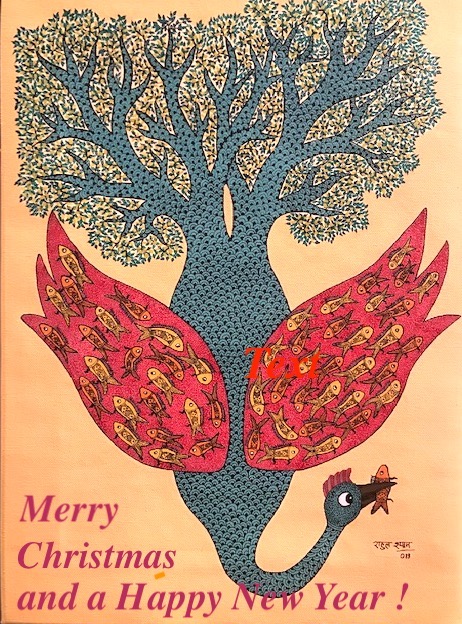
To all friends and followers of this blog, seasons greetings and all best wishes for 2022 – with this splendid painting of a Red-naped Ibisby a Gond artist from the Indian state of Madhya Pradesh
Farmers defeat the Government after a year occupying highways
Protests to continue till laws repealed and prices guaranteed
India’s prime minister Narendra Modi likes to spring surprises, and he’s produced three in the past three weeks. The first two were at the COP26 climate conference when he reversed policy with a 2070 target for zero emissions and then scuppered a resolution on cutting coal usage.
Today (Nov 19), in the third, he has announced that he is cancelling controversial agricultural laws that have led to 12 months of mass protests by farmers on highways around Delhi with violent police confrontations.
The farm decision is an uncharacteristic capitulation ahead of key state elections early next year, following poor results for Modi’s Bharatiya Janata Party in various recent by-elections. It undermines his political strong man image, but presumably he is confident that his national appeal will enable him to rid out the reversal.
Narendra Modi making his televised statement
Palaniappan Chidambaram, a former Congress government finance minister, made the primary political point when he tweeted, “PM’s announcement on the withdrawal of the three farm laws is not inspired by a change of policy or a change of heart. It is impelled by fear of elections!”
It was Modi’s personal arrogance that allowed the crisis to develop. He could have compromised after protests began to build up in November last year against the laws that had been suddenly rushed through parliament during the pandemic.
The laws were intended to enable farmers to sell their produce on the open market and also to become part of private sector contract farming. These arrangements operate in many parts of India, but had been resisted in the north where there are fears of contracts pushing down prices and of losing a government-backed minimum reserve price system.
Farmers’ leaders have welcomed Modi’s move, but say they will not be ending their protests till the laws have been repealed and the government has agreed to maintain the reserve prices. A rally is planned for November 26 to mark the first anniversary of the protests.
Modi showed over the past year that he did not understand the distinctive unity and determination of the Sikh community, which has been at the heart of the protests. Sikhs do not naturally subscribe to his Bharatiya Janata Party’s aim of recreating India as a Hindu nation, and the events have sharpened a sense of Sikh identity that was dramatically evident in the 1980s when there was a rebel call for an independent state of Khalistan.
Modi chose the primary Sikh festival of Guru Nanak Jayanti to announce in a television broadcast that the laws would be repealed – and to apologise for introducing them.
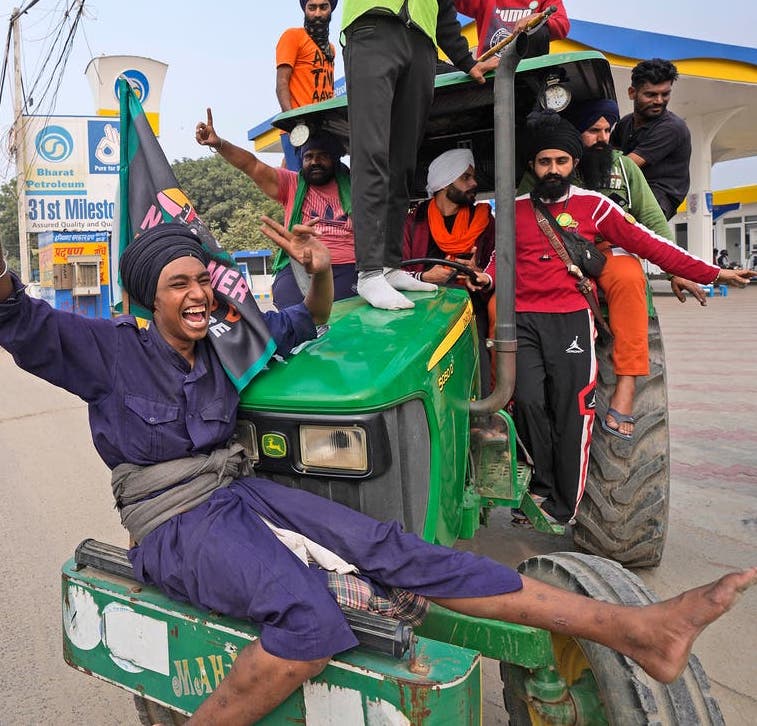
Sikh farmers celebrating
“Today, while apologising to the countrymen, I want to say with a sincere and pure heart that perhaps there must have been some deficiency in our efforts, due to which we could not explain the truth like the light of the lamp to some farmers,” was how he worded it, speaking in Hindi.
State assembly elections are due to take place by March next year in Punjab, the Sikhs’ main state, and, more crucially, in the large state of Uttar Pradesh (UP) which has a population of over 230m. Along with neighbouring Haryana, both states have had mass protests on highways leading into Delhi.
A poor result in UP would be seen as a serious setback for Modi and his home minister Amit Shah, and for Yogi Adityanath, the state’s tough chief minister and a controversial Hindu priest-turned politician who is seen by some as a future national party leader.
In Punjab, the BJP is weak but could now build a new base with Captain Amarinder Singh, the state’s veteran Congress chief minister, who was recently sacked from his post by the Gandhi family that dominates the Congress party. Singh is looking for a new political base and has been urging BJP leaders to abandon the laws.
Rushed laws
The laws were rushed into force last year without any parliamentary debate. Ordinances were passed in June and confirmed as legislation in September as part of a Covid-19 economic recovery package. Modi and Shah ignored calls for the usual detailed consideration and debate, assuming that they would not face significant opposition.
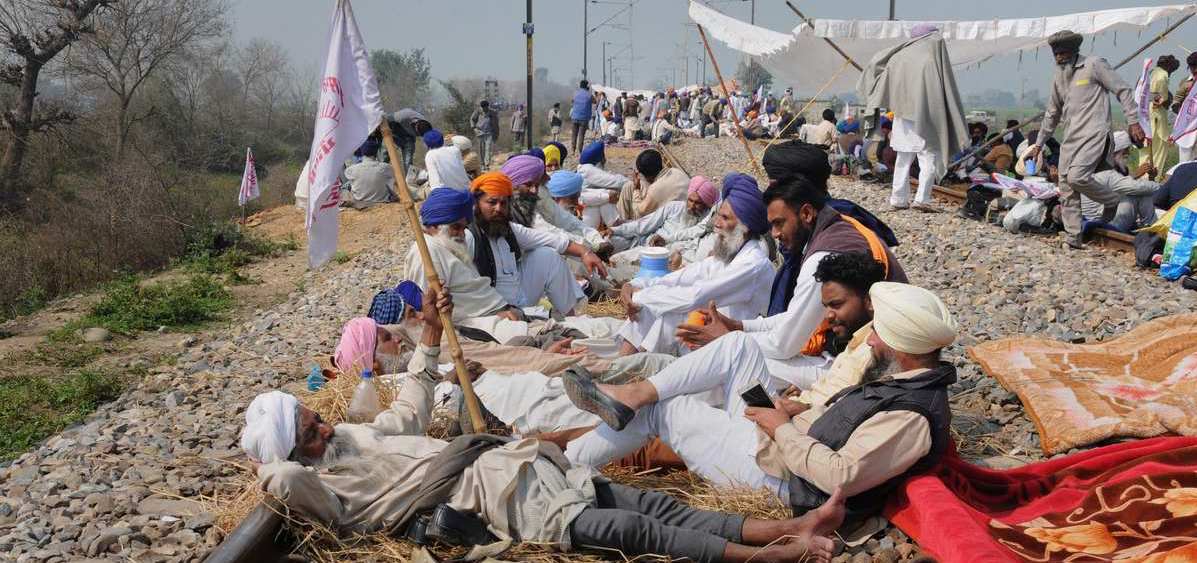
Sporadic protests grew into mass sit-ins on highways approaching Delhi in November and eventually led to several hundred deaths. Eleven rounds of talks between farmers’ leaders and the government led to deadlock because the farmers demanded that the laws should be repealed but the government was only prepared to amend them.
On Republic Day in late January, farmers staged mass tractor rallies into Delhi that led to violence and the invasion of the city’s Mughal era Red Fort. According to widespread reports, the violence was at least partly escalated by government loyalists planted in the crowds, which opened the way for the police to attempt to close down the protests on the highways that had grown into small townships in many areas with canteens and even schools.
The supreme court suspended the laws in January but still has outstanding cases calling for their repeal. There have been demonstrations and criticism of the government’s tactics in the US, UK and elsewhere abroad.
Farmers protesting on railway tracks a year ago
Agricultural reforms are urgently needed and have been proposed by successive governments for some 20 years – the Congress Party, which has been supporting protests, included the current measures in its last general election manifesto.
The measures have been partially implemented in southern states, but there has been repeated opposition in the north because of the sensitivities of hundreds of millions of farmers, many with tiny holdings, and because of vested interests ranging from large farmers to government market agents that benefit from the current trading systems for produce.
More than half India’s 1.4bn people live in rural areas and are linked to agriculture, which needs far wider reforms than the government’s proposed new laws. Once renowned as the grain and food bowl of India, the plains of Punjab and Haryana have been over-farmed for decades, depleting water supplies and the quality of the soil. That is fuelling the farmers’ frustrations and needs to be addressed along with other measures to boost productivity, develop farm-to-shop supply chains and curb widespread wastage
Modi has today tried to regain the initiative two or three months before the state assembly polls, But, while there were widespread celebrations on the highways today, his problems are far from over and the unity against the government does not look like reducing.
Modi praised for climate reforms then upset Glasgow Pact
Suggestions that China led India into negative stance
With hindsight, no-one should have been surprised when India unexpectedly insisted at the end of the COP26 negotiations last weekend that the Glasgow Climate Pact should only call for coal power to be “phased down” not “phased out”, thus upsetting a text that the organisers innocently assumed was agreed with universal support from nearly 200 countries.
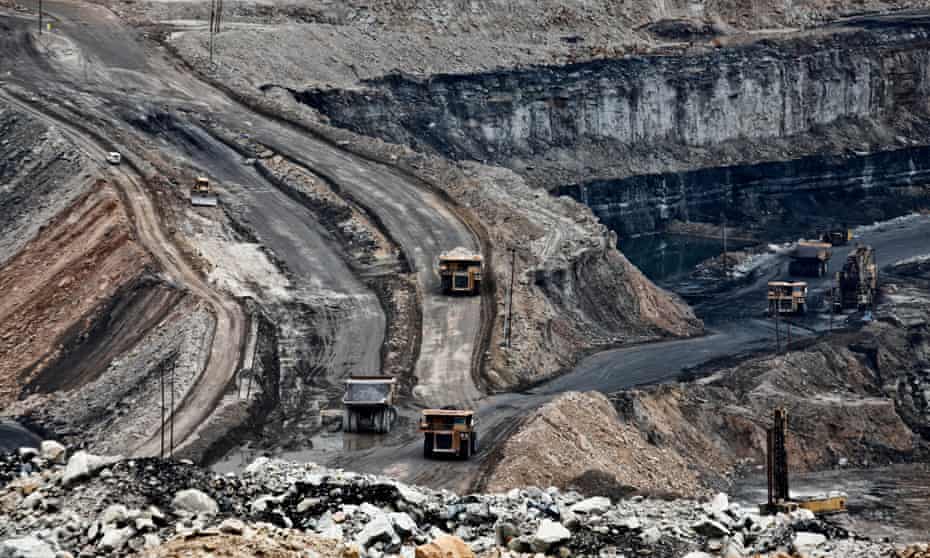
Coal is so central to India’s economic, social and political life that, realistically, it was unthinkable for it to have agreed to phase it out. It is currently offering 40 new mines to private sector companies – on forest land that will be destroyed – and is increasing imports,
Not only does coal fuel 70% of India’s power generation and employ millions of people directly and indirectly, it also enriches the frequently graft-based political-business nexus. Top private sector companies such as the Adani group, which is close to prime minister Narendra Modi, operate as major importers as well as having a growing role in the country’s vast and environmentally-damaging opencast mines.
Blindsided
Leaders of other countries and the conference organisers seem to have been blindsided by Narendra Modi’s appearance at the start of the summit where he sounded a committed and balanced advocate of climate action, even though his date for net zero emissions was 2070, not the 2050 pledged by the UK, US and other high-income countries, nor 2060 chosen by China, Russia and Saudi Arabia.
Even my old newspaper the Financial Times, usually an unrelenting Modi critic, ran an editorial on November 2 saying that it “was encouraging and a vital step in limiting global warming” for the world’s third-biggest emitter and most populous country to have set a target to reduce its emissions to virtually zero.
Nigahi coal mine, India’s largest open cast mine in the Singrauli coalfield. Photograph: Greenpeace/Sudhanshu Malhotra
India is the biggest producer and user of coal after China, but it is currently suffering from serious shortages because of inefficient mining and mismanagement of supplies, plus a post-pandemic surge in demand. Prices are rising, so it would have been politically highly risky the government to agree to phasing the fossil fuel out. “If the government had done that in Glasgow, and Delhi and Mumbai had shut down because there was no coal to run power plants, how would that have played out politically?”, one analyst asked me rhetorically.
There is also a suggestion that India was conned into insisting on phasing down by China; a move that might have appealed to Modi at a time when the two countries have had an 18-month long military confrontation on their Himalayan border. Indian government sources in New Delhi are now briefing journalists that India should not be blamed for the change, and Bhupendra Yadav the environment minister, spoke about it later (Nov 20).
“A perennial problem in Indian efforts at COPs in the past has been its tendency to provide cover for China,” according to the Business Standard, a leading Indian newspaper. “New Delhi allowed itself [in Glasgow] to play the bad guy and willy-nilly defend Beijing’s policy choices”.
India’s initiatives
Modi was taking an important step when he proposed the 2070 target because he was abandoning India’s previous pose of grumbling about developed countries while refusing to stake out its own contribution. The 2070 initiative reversed the established line of refusing to name a date and was apparently decided in his prime minister’s office without even the environment ministry knowing what was planned.
India is also committed, as Modi said in Glasgow, to obtaining 50% of India’s electric power from non-fossil energy resources by 2030 (building 450 gigawatts of solar and other renewable capacity) and, by the same year, reducing the carbon emissions’ intensity of the economy by 45% from the 2005 level. But it appears not to have signed a zero deforestation commitment.
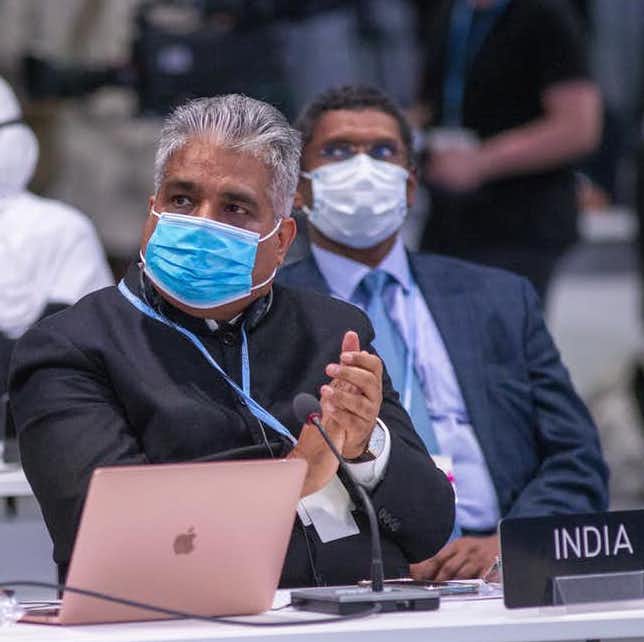
Bhupendra Yadav, India’s environment minister in Glasgow
It is not clear when Modi decided on the coal move – possibly it was not till after he had returned to Delhi, and maybe felt the heat from private sector miners and realised the political risks during coal shortages and the need for increased imports.
This was the first time that coal had been mentioned in a COP agreement and early drafts of the Glasgow Pact contained an commitment to phase out unabated coal (unabated means coal that is burned without emission-reducing carbon capture and storage technology).
Modi left the job of announcing the unpopular move of overturning what was to have been the final draft to Bhupendra Yadav, who should not have been under-estimated by other countries – he has a reputation as a shrewd lawyer and has written a book on environmental legislation.
China intervened
China seems to have intervened first, indicating it was prepared to de-rail the proposed pact. It argued that demands on countries to meet the primary average global temperature rise to 1.5 deg C. should be adjustable according to their need to eradicate poverty. India agreed with this and moved into the lead, with Yadav announcing the demand for a redraft in a plenary session last Saturday.
India and China are now being widely criticised for the disruption, though they would argue that, while they are among the biggest coal polluters, Australia and South Korea lead on a per capita basis. India’s per capita emission from coal power is considerably less than the global average.
Coal is mostly mined inefficiently by Coal India, a monopoly-oriented public sector corporation that has for decades resisted modernisation and accounts for some 80% of supplies. Most of the remaining 20% comes from Australia, Indonesia and South Africa, making India the world’s biggest importer.
Economic reforms have for years pushed for coal mining to be opened to the private sector. After a hiatus a decade ago caused by mining licences being corruptly awarded without open tendering, some 40 mines are now being operated by companies for their power and steel plants.
Narendra Modi and Boris Johnson in Glasgow (Getty Images)
This is now being expanded with the private sector tendering for 40 new mines with another 40 to follow later, involving a total of 55 billion tonnes of coal that can be sold on the market. Many of the mines are located on long-protected forest land which will be destroyed, along with habitats for local people.
This brings increased worries about environmental laws and regulations being broken or ignored because of the political clout of private sector companies that can stretch from the prime minister’s office down to environmental and other local government officials.
Lack of leadership
Part of the problem throughout the preparations for COP26 was a lack of British leadership. Alok Sharma, the COP president and a former Conservative government minister, has been admired for his stoicism but he is not enough of a political figure to break deadlocks.
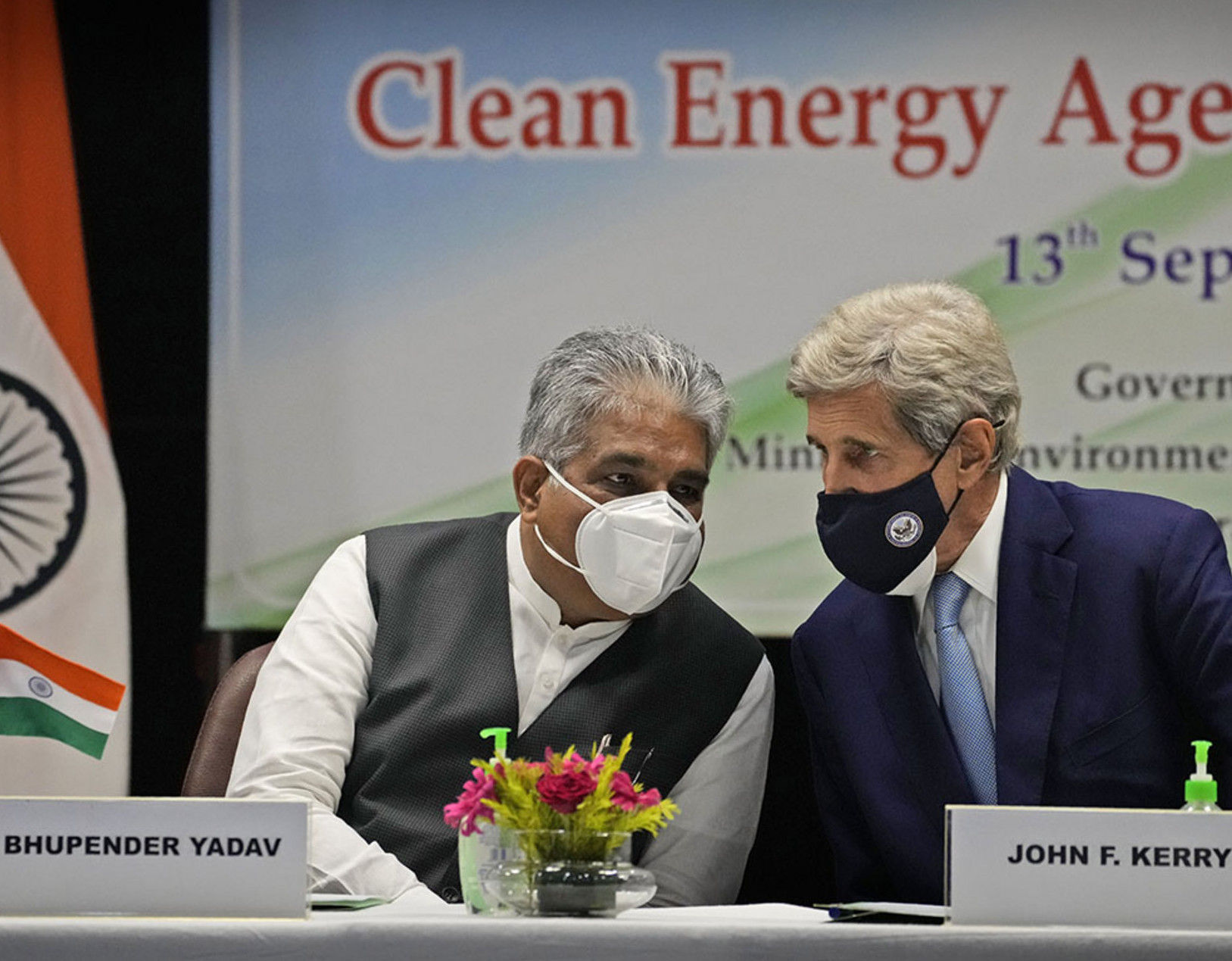
Bhupendra Yadav and John Kerry at a Delhi conference September 2021
That would have been fine if Boris Johnson had been fully focussed, but he has a short attention span and his lack of involvement was illustrated when he went on a Costa del Sol holiday a week before the Glasgow events began instead of lobbying internationally for a positive outcome.
John Kerry, the US climate envoy admitted as the events closed that he had not expected problems. “Did I appreciate we had to adjust one thing tonight in a very unusual way? No. But if we hadn’t done that we wouldn’t have a deal. I’ll take phase it down and take the fight into next year,” he said.
South Asian modern art auctions have maintained a strong trend set last year during the early stages of the pandemic with sales totalling over $30m in the autumn round – led by Sotheby’s with two London auctions totalling £ 8.4m ($11.6m), Mumbai-based Saffronart with two totalling $8.6m, and Christie’s in New York at $7.8m.
The Embarkation by Jehangir Sabavala
There were no big-ticket sales above $2m but a steady stream of activity at lower prices, notably for works new to market and a strong provenance, with many exceeding sensitively moderate estimates
In the Christie’s auction, where 74 buyers and bidders participated from 12 countries, an unusually high figure of 70% of the sales exceeded the top estimates, twice the usual amount.
This was led by The Embarkation, a 42in x 32in oil on canvas (left) by Jehangir Sabavala (1922-2011), that sold for $1.59m, more than five times the low estimate. It established a new auction record for the artist, a prominent modernist from a Mumbai Parsi family, almost doubling the last record set at Christie’s in September last year.
Painted in 1965, it depicts four ghostly figures in long yellow robes about to board two ships, and marked a significant trend in Sabavala’s work,
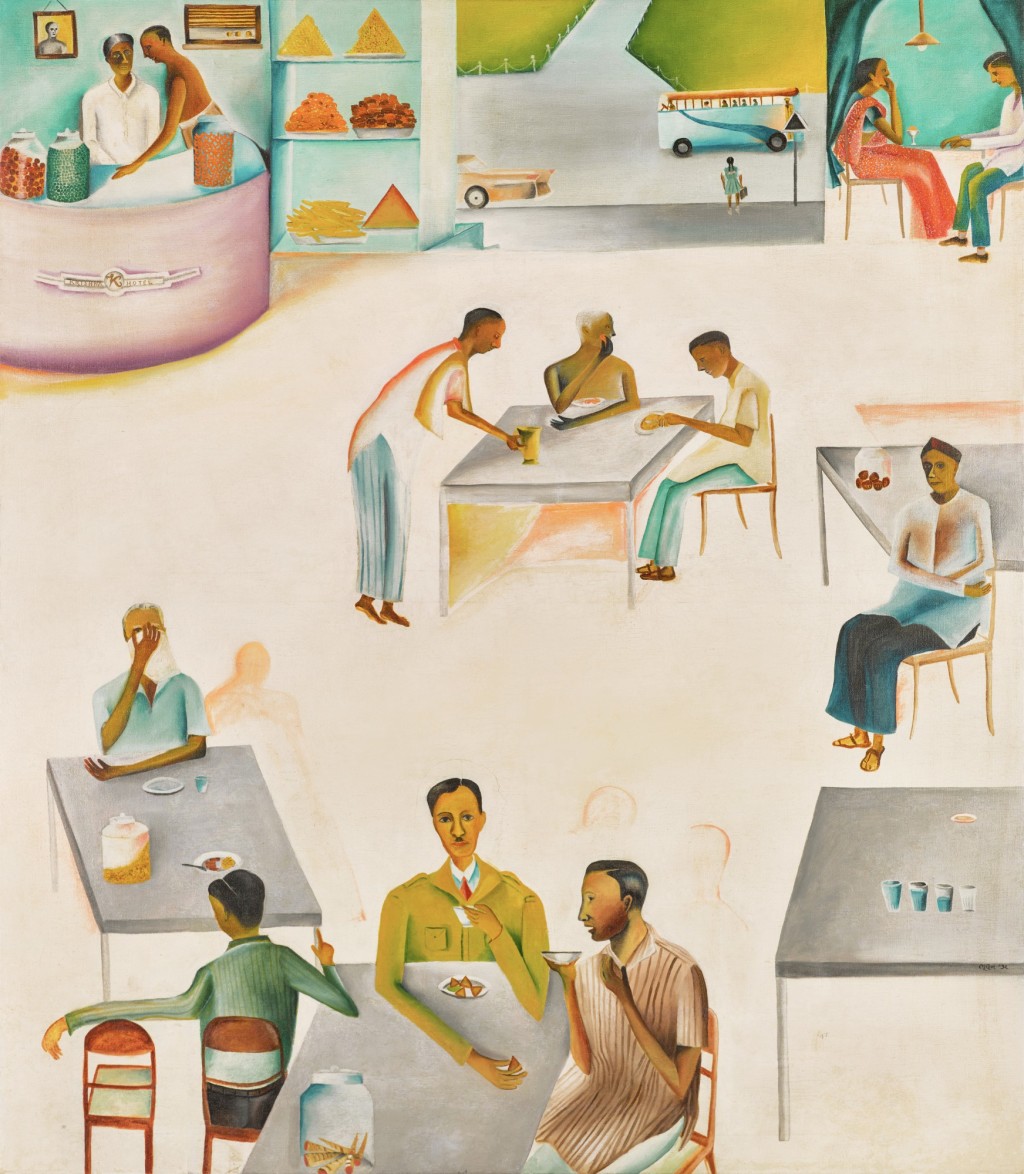
Bhupen Khakhar’s Krishna Hotel
Works by Bhupen Khakhar (1934-2004), an often controversial gay painter who has appeared frequently in auctions since a retrospective in London’s Tata Modern five years ago, have done well.
A record auction price of £2.54m was set at Sotheby’s two years ago and this week one of his less explicit works, a 48in x 42in oil on canvas titled Krishna Hotel (right), exceeded its lower estimate by more than five times at Sotheby’s in London. It sold for a hammer price of £1m (£1.23m including the premium) after a final tussle between two bidders
‘Krishna Hotel’ marked the start of Bhupen Khakhar’s Tradesmen series of paintings that showed scenes of people’s daily lives. It had not been seen publicly since 1971 after it was bought by an American architect, Christopher Benninger, who worked in India and became a friend of Bhupen.
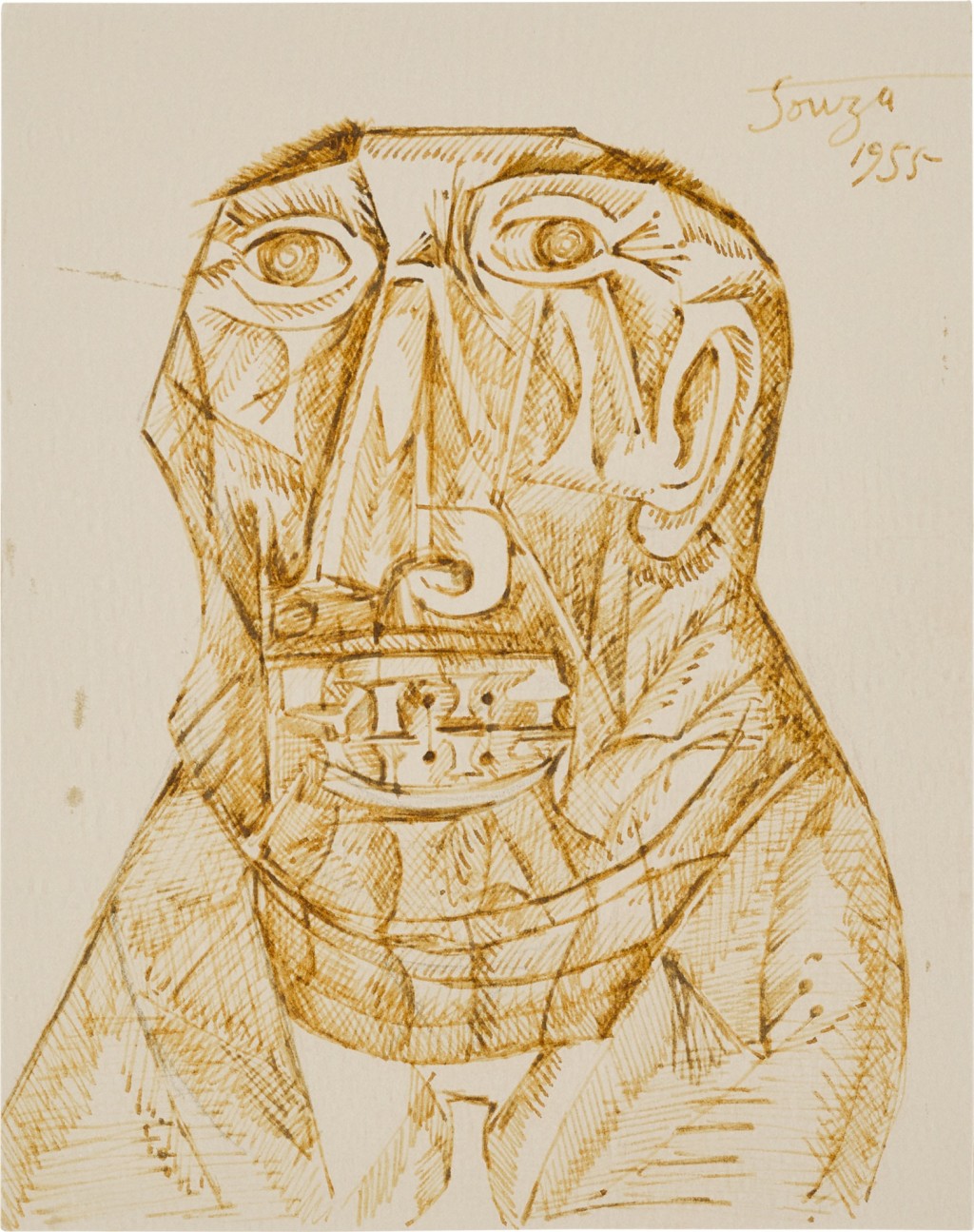
A Gentleman of our Times by F.N.Souza
The same artist also did well in Christie’s New York September sale where a brilliantly coloured 36in x 36in oil and gold paint on canvas of a tree in a walled garden sold for $990,000 (£720,000) including buyers’ premium against a low estimate of $350,000.
Sotheby’s had two auctions this week. Its main South Asia modern and contemporary sale produced a total of £5.4m ($7.4m) against £2.7m-£4m estimates. A third of the buyers were new to Sotheby’s and a similar figure were aged under 40.
Aside from the Bhupen Khakhar, Sotheby’s works included a rather dark landscape (red building) by F.N.Souza, a leading member of the Progressives group that came together in the mid 2000s. Acquired by its owner for the dollar equivalent of £100 in Detroit in the 1980s, it doubled estimates at £922,500 (including the premium).
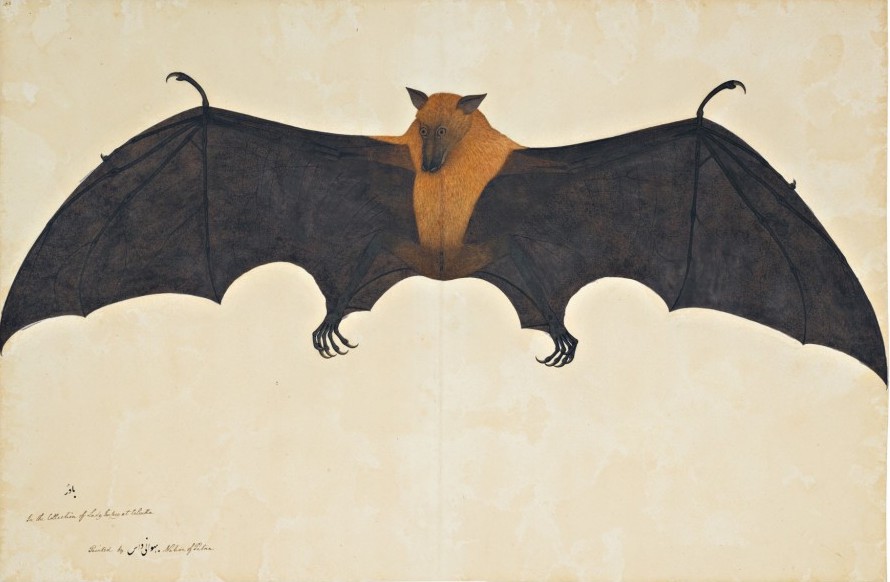
A Great Indian Fruit Bat circa 1778-83
An 8in x 6in ink and pencil on card drawing by Souza of a head (above) dubbed Gentleman of our Times also did remarkably well, selling for £12,600 including the premium, more than four times the top estimate.
The second auction called In an Indian Garden had a collection of company school paintings from the British colonial era with sales of £3m ($4.2m), nearly double the low estimate. A Great Indian Fruit Bat dated 1778-83 (above) topped the bidding at £644,200, more than double the low estimate
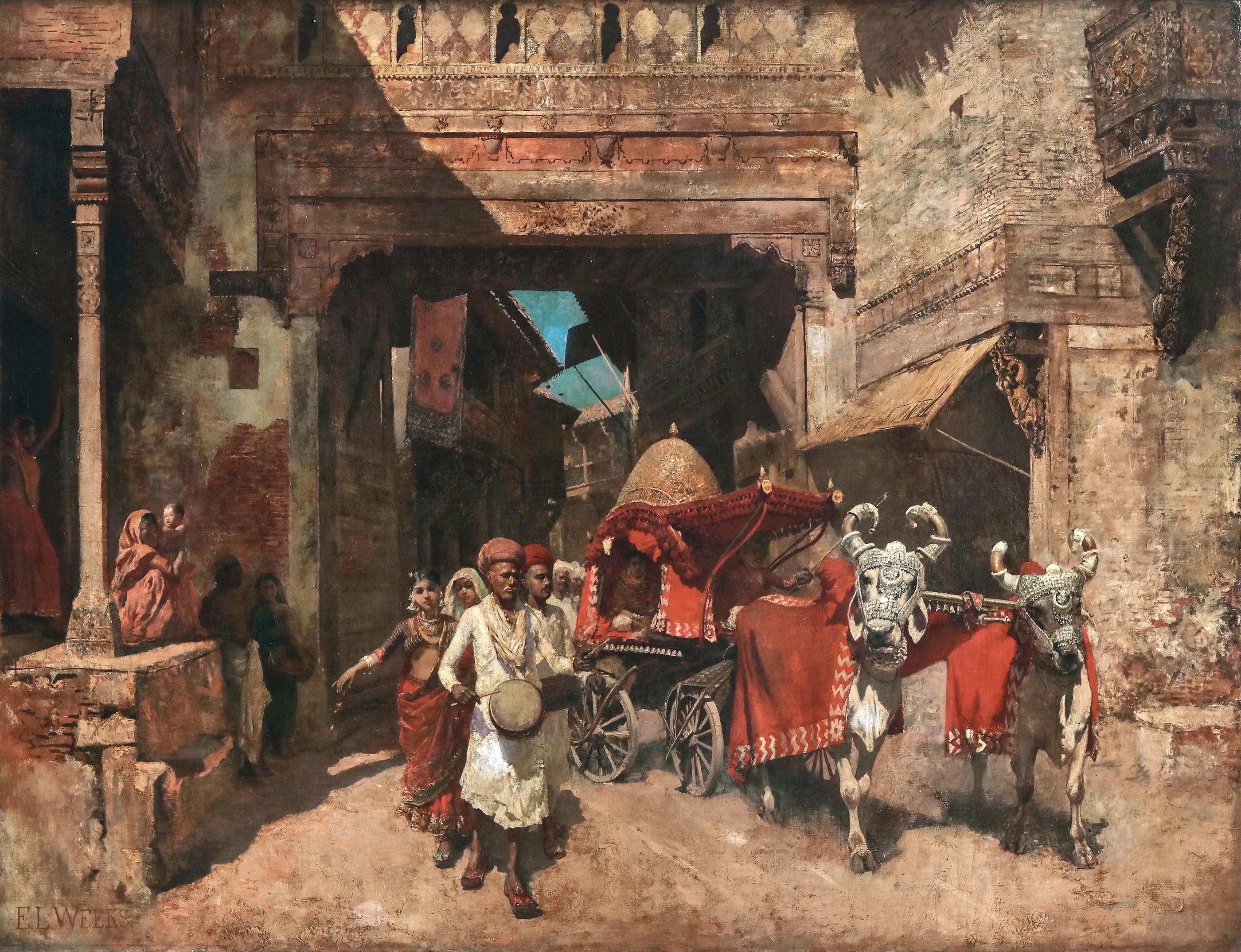
Among the biggest surprises in its live auction was a spectacular 56in x 75in oil on canvas (above) portrayal of a wedding procession in Ahmedabad – not by an Indian painter but by Edwin Lord Weeks, a late 19th century American Orientalist artist who worked extensively in India.
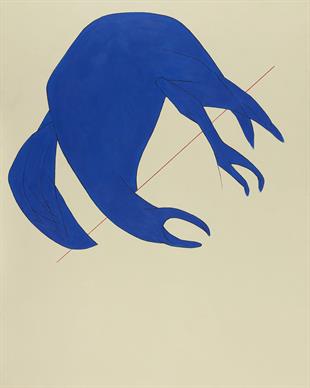
Blue Bird by Tyeb Mehta
Perhaps more important for recording historic detail than for artistic imagination, it more than doubled the low estimate at a hammer price of $900,000 that might have gone higher if a would-be bidder had reacted a second before the lot was closed. Including the buyers’ premium, the price was Rs7.99 crore ($1.08m).
Curiously, Saffronart’s on line sale included Blue Bird, a 49in x 39in Tyeb Mehta acrylic on canvas (left) with a top estimate of $1.35m – a level that’s more usual in a live auction. It did not draw its first bid till just seven minutes before the closing time and then rose slightly to sell at Rs7.54 crore ($1.02m) including the premium. Another work by the same artist, a dark figure of a woman oil on canvas, failed to draw any bids.
In addition to those international auction houses, India’s online Artiana had a five-day auction this month that totalled $2.39m.
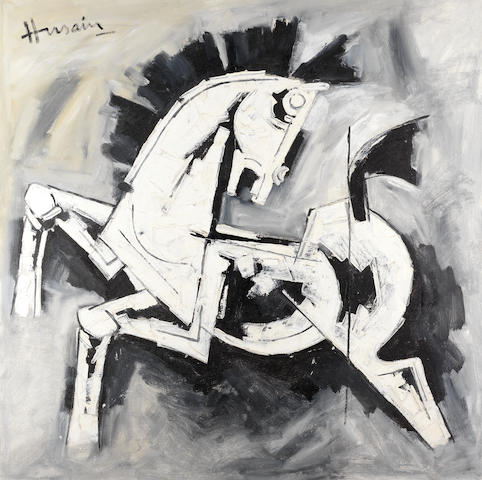
M.F.Huain’s untitled horee
Bonhams in London, though far down the value list at a total of just £706,000 ($900,000), was notable for being the only auction house to produce a paper catalogue – the others cashed in on a pandemic trend set last year and saved money by only sending out pdf copies, even for live auctions.
It withdrew three paintings by S.H.Raza, a doyen member of the Progressives, because of delayed authentication, but Bombay Street Scene, an early Raza 12in x 19in watercolour on paper, fetched more than seven times the top estimate at £75,250 ($103,728) including the premium.
A prancing horse (above) by M.F.Husain (1915-2011), one of the best known Progressives, sold for £106,500 ($146,805) including the premium, well above the top £60,000 estimate – enhanced perhaps by its provenance – it was given by Husain to Mohammed Rafi, a renowned singer.
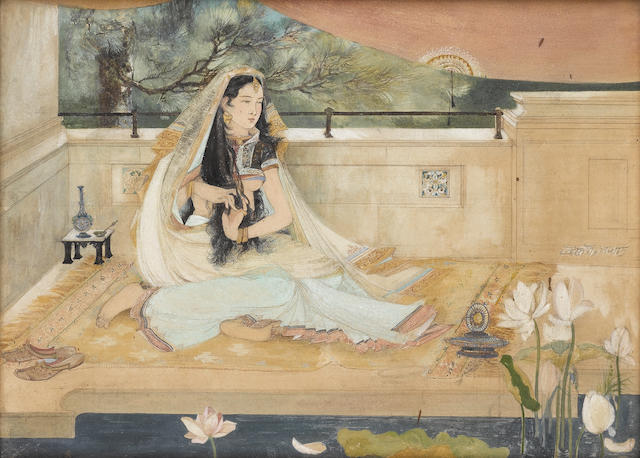
A 9in x 12in pencil pen and ink and watercolour, An Inmate of the Harem, (below) by Devi Prasad Roy Chowdhury sold at ten times the low estimate at £20,250 ($27,913) including the premium – a happy ending in the final week of the season’s modern art auctions.
An Inmate of the Harem by Devi Prasad Roy Chowdhury









 Riding the Elephant
Recent Comments