Sticks and stones were weapons in a dangerous escalation
Talks in progress to avoid further conflict between nuclear powers
Troops have been killed for the first time in 45 years during clashes on the undefined Line of Actual Control (LAC) that divides India and China. The confrontation took place in Ladakh, high in the Himalayas, and led to 20 confirmed deaths of Indian soldiers, and possibly more than 40 Chinese according to unconfirmed reports,
The deaths happened during hand to hand fighting – described by the Indian army as a “violent face-off” – which is not uncommon on the 3,488-km-long LAC. Indian media reports say that the weapons included iron rods, clubs armed with nails, barbed wire and stones (video – click here). There were suggestions that some deaths occurred when troops fell from a narrow ledge into a freezing river at the 16,000 ft high location.
 This was not a war situation between the two nuclear powers, nor were shots fired, but urgent diplomatic and military talks have been held between the two sides in an attempt to avoid further conflict.
The confrontation graphically illustrates the precarious state of security and international relations on India’s borders, especially at a time when Xi Jinping, China’s internationally ambitious president, is increasing his country’s territorial and other claims.
There are regular firings and deaths on India’s (defined though not permanent) Line of Control (LoC) with Pakistan, but Indian and Chinese politicians and army chiefs have been proud of the fact that no shots have been fired, nor deaths caused, on the 3,488 km LAC since the early 1970s.
It looks as if Monday night’s clashes were not pre-planned at a senior level, though this is not clear. India said there had been “an attempt by the Chinese side to unilaterally change the status quo”. China’s foreign ministry said India had been “provoking and attacking Chinese personnel” after crossing into its territory.
For more than six weeks there has been a stand-off at three locations along the LAC after China established posts in the disputed border area. Both countries moved additional troops to the area and there was hand-to-hand fighting at two locations in Ladakh and Sikkim last month. The main focus has been at the Galwan River where Monday night’s confrontation took place, and at the Pangong Tso glacial lake at 14,000 ft in the Tibetan plateau.The Galwan River was one of the early triggers of the 1962 India-China war, when India was humiliatingly defeated but India has always regarded it as an undisputed section of the LAC.
Military talks, supported by diplomatic contacts, last week led to an agreement that the two sides would disengage from their confrontational positions. India said China had withdrawn from some positions at Galwan.
China has objected to India building roads and air strips in the area, including the Galwan Valley. A Chinese military spokesperson on June 16 claimed “China always owns sovereignty over the Galwan Valley region”. On May 5, Beijing accused the Indian army of trespassing into its territory in its “attempt to unilaterally change the status” of the border in Sikkim and Ladakh.
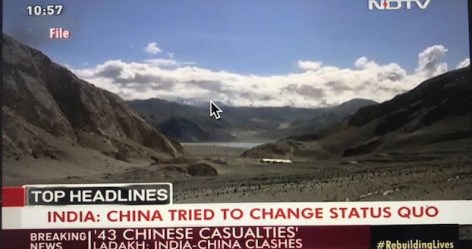
India countered that it was not trespassing, but carrying out routine infrastructure-development activities along its side of the disputed LAC. It blamed China for its aggression in building up bunkers on its side, hindering normal patrolling by Indian troops.
The last serious confrontation between the two countries took place three years ago in June-July 2017 with a 73-day stand-off – the longest ever – at Doklam, a Himalayan plateau in Bhutan at a border tri-junction. Chinese troop movements and road construction on the plateau threatened the security of India’s adjacent narrow Siliguri corridor that connects its north-eastern states with the rest of the country. That prompted India to move its troops onto the plateau to block China’s advance, triggering the stand-off.
Narendra Modi, India’s prime minister, stood firm and eventually after more than two months there was an understanding that enabled both sides to claim an advantage, though nothing was settled and China established a permanent position on the plateau.
Modi and Xi Jinping held an historic summit in April 2018 at Wuhan, made famous this year for starting the COVID-19 pandemic. This was intended to secure a basis for avoiding conflict and was followed by a similar meeting in India last October.
The current potential crisis needs to be seen against the backcloth of increased aggression by China internationally. Nepal, which borders both countries and is increasingly coming under China’s influence, has this week passed legislation that changes its maps and lays claim to land that is part of India.
On a wider front, Xi Jinping has been conducting aggressive policies ranging from a security clampdown on Hong Kong to trade differences with Australia, while also pushing its territorial claims in the South China Sea and over Taiwan.
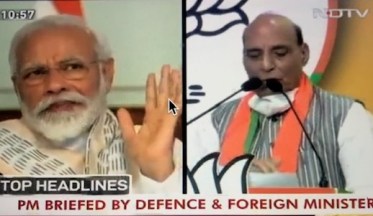
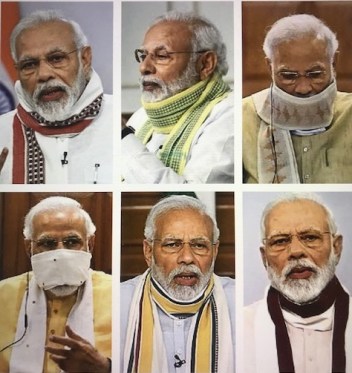
Narendra Modi and defence minister Rajnath Singh
With India, Xi’s aim may be to teach Modi a lesson for growing too close to the US and possibly siding with other countries, including Australia, over setting up an international inquiry on the Wuhan sources of COVID-19.
Relations between the two countries are usually stable providing India does not grow too close to the US and its allies. Modi has tried to strike a balance between increased defence and other co-operation with the US, and stable economic and diplomatic relations with China. He will be even more anxious to do this now when the country is coping with rapidly growing cases of COVID-19 and serious economic problems.
He is struggling with a precarious form of diplomacy, especially at a time when President Trump expects loyalty, not balanced relations, and Xi Jinping does not want a US ally on China’s border.
The deaths on the LAC show how precarious that is.







 They have also not met the need for an economic stimulus because they do little to accelerate demand. They ignore some key areas including the hard-hit tourism industry and private healthcare (though curiously there is a Rs500 crore allocation


 Tomorrow (April 5), Modi is trying to bring order to the potential devastation of the system caused by the coronavirus and by a consequential virtual economic shutdown that he ordered on March 24.

 In some homes, it was the staff who led the moves, going to the gates of homes. Indians living abroad who support Modi’s Bharatiya Janata Party also joined in. Some people, it seems, really believed Modi had found a way to defeat the virus.


 The highest price yesterday was achieved for a stylish 50 x 33in untitled oil on canvas by V.S.Gaitonde (left) with a winning $1.5m bid that matched the top estimate. Gaitonde was a member of the prominent group of modernist Progressives that began in the mid-20th century.
 The same collector (the paddle number was the same) bought a 47 x 35in oil on canvas board by Nasreen Mohamedi (left) at a record auction price of $437,500 including the premium ($350,000 hammer).
 The auction began unusually strongly with a 26 x 24in wood collage on board (right) by Zarina (Hashmi), an 83-year old Indian artist living in the US who is known professionally by her first name. The work fetched a hammer price of $70,000, nearly three times the top estimate – $87,500 including buyer’s premium.
 Christie’s South Asian auctions were scheduled for tomorrow (March 18), so it had more time than Sotheby’s to pull down the shutters, in line with the auction house’s other New York sales.

 The highlight of the visit was an astonishing rally (left) on February 24 of over 100,000 cheering supporters of Modi’s Bharatiya Janata Party, many sporting white caps with the words “Namaste Trump”. The crowds were mostly bussed into what is billed as the world’s biggest cricket stadium in Ahmedabad, the main city of Modi’s home state of Gujarat, to greet Trump and his wife Melanie a few hours after they arrived in India.


 Riding the Elephant
Recent Comments