Posted by: John Elliott | December 27, 2024

Manmohan Singh – India’s primary reformer

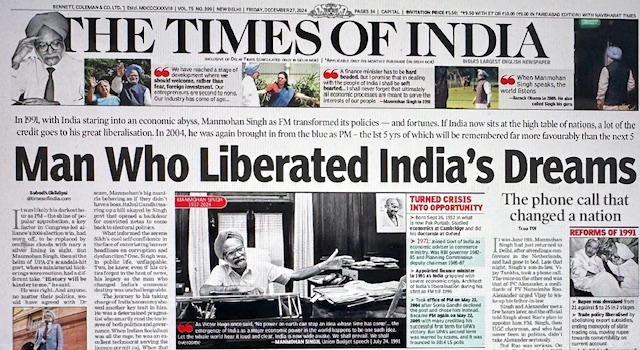
Manmohan Singh, who died on December 26 at the age of 92, was prime minister of India from 2004 to 2014, but he will be best remembered for launching economic reforms in 1991, paving the way for the emergence of today’s expanding and internationally significant economy. 

Primary credit for that dramatic political move should go to Narasimha Rao, who had become prime minister after a general election in the middle of a deep financial crisis. Rao appointed Singh to be his finance minister with a brief to dismantle India’s protectionism and isolation, unpicking what was known as the state capitalist-based economy’s “license raj” and releasing the private sector to expand. 

Respected as an economist, Singh had written about the problems in India’s Export Trends, his doctoral thesis published in 1964. He then realised how far India was slipping behind Southeast Asia’s emerging markets (because of leftist policies that he had helped implementing), when he spent three years from 1987 as secretary general of the development-oriented South Commission in Geneva.

Reformer

That made him a committed reformer. After devaluing the rupee in 1991, he quickly adopted and expanded plans already developed by top officials, dismantling decades of economic restrictions, liberalising trade, and introducing fiscal discipline. 

These changes energised economic growth, encouraged the beginnings of integration with the global economy, and began the emergence of India as a significant player in international markets. But Rao’s enthusiasm for reforms waned after Congress suffered state assembly election losses in December 1994, and Singh lacked the political stamina to fight for more reforms.

Singh’s contributions to modern India continued in 2004 when, aged 71, he was chosen to be prime minister by Sonia Gandhi, leader of the Indian National Congress and its United Progressive Alliance coalition that had just won a surprise general election victory. Gandhi did not want the job and Singh had for some time been mooted in the media as a possible prime minister. For dynasty-conscious Gandhi, he was a safe unambitious bridge between her late husband Rajiv, who had been prime minister in the 1980s and was assassinated in 1991, and their son Rahul. 

A book written by Singh’s media adviser, Sanjaya Baru, was titled The Accidental Prime Minister. The question that will always be asked is whether it would have been better if, after decades as a bureaucrat, leading economist and finance minister respected for his integrity and visible humility, he had retired to a distinguished public life away from government instead of accepting the prime ministership with limited authority.

Singh had a successful first five years as prime minister and built a strong international reputation, but in his second term from 2009 he became increasingly isolated looking, say observers, weak and lost. There were suggestions in 2012 that Pranab Mukherjee, then the finance minister, should become prime minister with Singh becoming president, but Sonia Gandhi would not agree because, for historic reasons, she did not trust Mukherjee.

Singh therefore remained prime minister without the power to control the corrupt and ineffective government. This paved the way for Narendra Modi’s Hindu nationalist Bharatiya Janata Party to sweep to victory in 2014 and pick up, with fresh energy and determination, initiatives that Singh had begun.
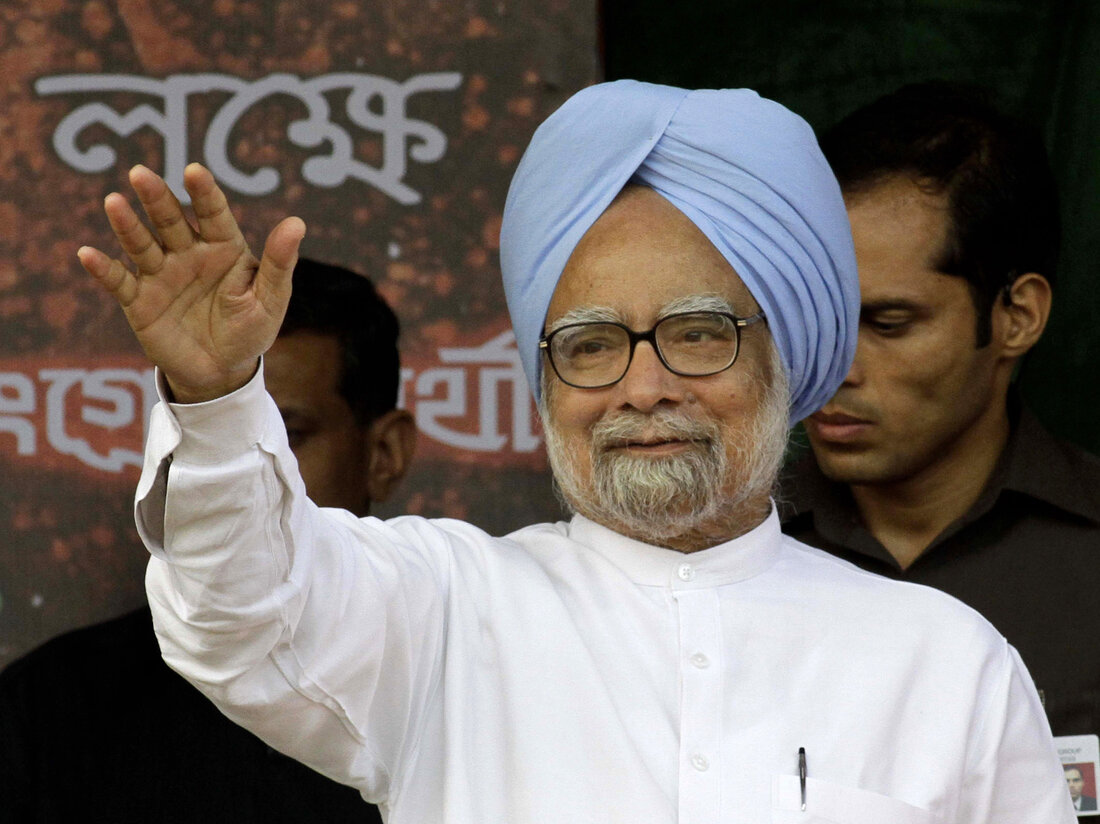
Manmohan Singh in 2011 (AP Photo/Bikas Das)

Singh has said that his “best moment” was signing a civil nuclear deal with the U.S. in 2008 during his first term after overcoming setbacks and considerable opposition with rarely seen political skill. This opened the way for India to access nuclear fuel and technology from abroad, though no US reactors have been built because of various issues including accident liability. More importantly, it paved the way for defence and other co-operation, which has led to much wider positive transformation in the two countries’ relationship. 

That deal, Singh said in his final press conference as prime minister, ended “the nuclear apartheid which had sought to stifle the processes of social and economic change and technical progress of our country in many ways”. He also said his biggest regret was not doing more on healthcare, especially for women and children. 

Reforms included legislation on a rural jobs scheme, food security, and the right to information. He also initiated moves on sales tax reform and on a digital identity scheme called Aadhaar that has led to paperless payment systems that specially benefit the poor. 

More could have been done had he not been hampered by a lack of backing from Gandhi who remained party leader, along with rebellious (and corrupt) ministers that he did not have the power to dismiss, plus rival Congress politicians who resented his presence and manoeuvred against him. 

He was heavily criticised for failing to assert his authority, which led him to say in his last press conference, “I honestly believe history will be kinder to me than the contemporary media or for that matter, the opposition parties in parliament”. 

The first member of India’s minority Sikh religious community to become prime minister, Singh was born on September 26, 1932, one of ten children, to a poor family in a Punjab village that is now part of Pakistan. Singh used to recall that his village had no doctor and that he walked miles to go to school before his family migrated to India when Pakistan became a separate, primarily Muslim country at independence in 1947.

Oxbridge

His education took him from Punjab University to the UK where he gained a first in economics at Cambridge University, followed by a doctorate at Oxford in 1962 that led to a book on Indian exports and prospects for growth.

Singh’s government career began in 1971 when he became economic adviser in the commerce ministry followed a year later by a similar but far more important post in the finance ministry. 

Later, in the 1980s, he became governor of the Reserve Bank of India and deputy chairman of the Planning Commission. I was then the Financial Time’s South Asia correspondent and valued my interviews with him when he willingly explained India’s problems and what was needed to overcome them.

He was chairman of the University Grants Commission when he was summoned by Narasimha Rao to be finance minister. He was so surprised to get the call, he told the BBC’s Mark Tully, that he didn’t at first take it seriously, delaying his meeting with Rao for a day.

That demonstrates the modesty of a distinguished public servant who is now remembered for his rare integrity and for his contributions to modern India.
Posted by: John Elliott | December 24, 2024

Merry Christmas!

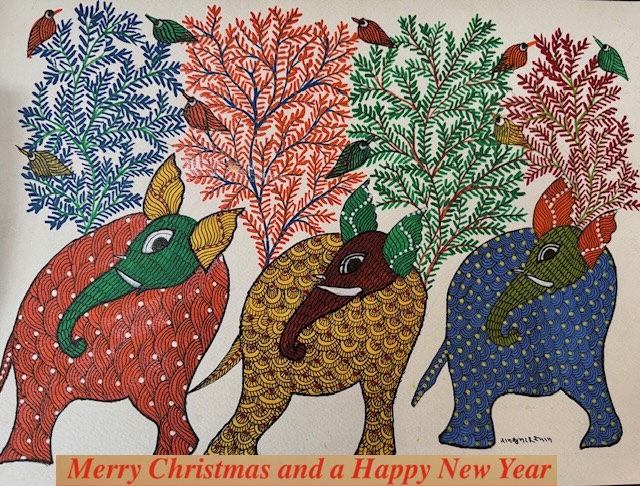
To all friends and followers of this blog, Seasons Greetings and all best wishes for 2025 – with this splendid painting by Jabbu, a Gond tribal artist from the Indian State oif Madhya Pradesh

Posted by: John Elliott | October 11, 2024

Ratan Tata – shy, tough and a trail-blazer

A young US-based architect who became India’s leading industrialist

Love of aircraft, cars and dogs influenced his business and his life 

Ratan Tata, who has died age 86, was the most notable Indian industrialist of his generation. No-one has bestraddled Indian business in the way that he did at Tata Sons, hugely expanding, and then presiding in semi-retirement, over a group that has revenues of some $150bn. At the same time, he trailblazed investment abroad and built the international image of Tata and of Indian business.

Tata wanted to be an architect and had no apparent wish to join, let alone run, India’s biggest and most respected conglomerate that bore his name. However in 1962, when he was working in Los Angeles after receiving an architecture and structural engineering degree at New York’s Cornell University, he was pulled back by his grandmother who wanted him at home in Bombay where his uncle, J.R.D.Tata, saw him as a possible successor to head the group.

Thus began the business career of this shy man, who loved cars, aircraft, and dogs. All three affected what happened at Tata. 

He had a famous collection of cars and, among several motor industry achievements, he personally led the purchase of the UK-based Jaguar-Land Rover group from Ford.

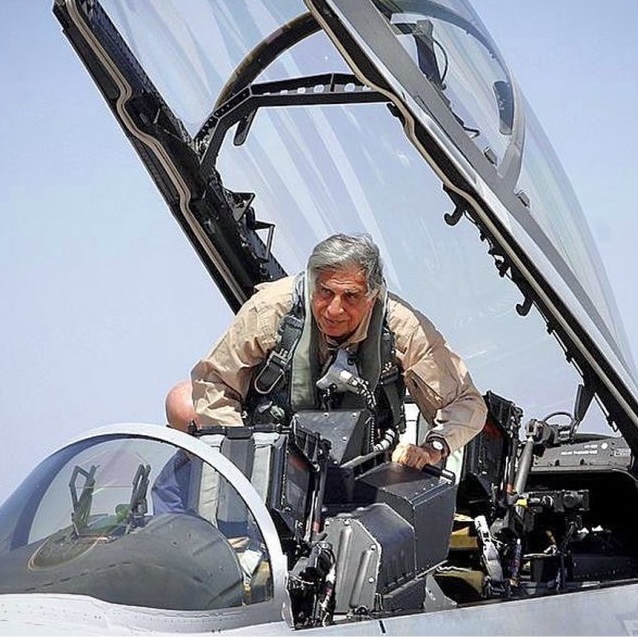
During seven years in the US, he learned to fly, once partially losing engine power in a helicopter and twice losing the single engine in his plane. “So, I had to glide in,” he told an interviewer. In 2007 he flew in the co-pilot’s seat in F-16 and F-18 fighter jets at the Bengaluru air show.

He pushed the group into aircraft and other defence manufacturing with Lockheed Martin, Boeing and others. He pursued various ventures with Singapore Airlines and, exerting influence after retirement, insisted the group bought floundering Air India out of public ownership in 2022, retrieving the national airline that Tata had founded and lost to nationalisation in 1953. 

His love of dogs led to them being allowed into the hallowed entrance hall of Tata’s head office in Mumbai where there was a specially built shelter. It also led to a close friendship with Shantanu Naidu that began ten years ago when Naidu and his friends designed dog collars with reflectors to help strays’ safety at night. Naidu became Tata’s protégé, and eventually the young general manager in his office. Yesterday, Naidu rode a motor bike in front of the coffin for part of the funeral procession though Mumbai. He told their story in a short book published three years ago I Came Upon a Lighthouse: A Short Memoir of Life with Ratan Tata.

A complex character, Ratan Tata never married, though he has said that he almost did four times, including to someone who did not join him when he left Los Angeles. For his women friends, he was a gallant and chivalrous, if somewhat reticent admirer. For other friends, acquaintances and staff, he mixed an extremely shy demeanour with firm executive toughness. Kumarmangalam Birla, a prominent Mumbai industrialist, said on India Today television yesterday that Tata had once told him “My worst fear is to face an audience”.

Watching him in the years following my first interview (for the FT) in the mid-1980s, when he had just been given executive authority for new investments, I realised how he tended to be over-trusting and how deeply he felt personal hurt. In 1996, after another interview, I wrote a piece in The Economist that was heavily edited. The published version compared him and his satraps with feudal rule in medieval England under the headline At the court of King Ratan. Unsurprisingly, Tata was not impressed.

This characteristic made him ultra-sensitive and unforgiving over slights, not just over what he regarded as unfair media coverage, but also with people in the group who displeased him. A senior executive, Mukund Rajan, said during India Today’s long special coverage yesterday, that in the 1990s Tata showed a great sense of humour with colleagues. The “jokes started vanishing” later and he became isolated from people he had trusted. 

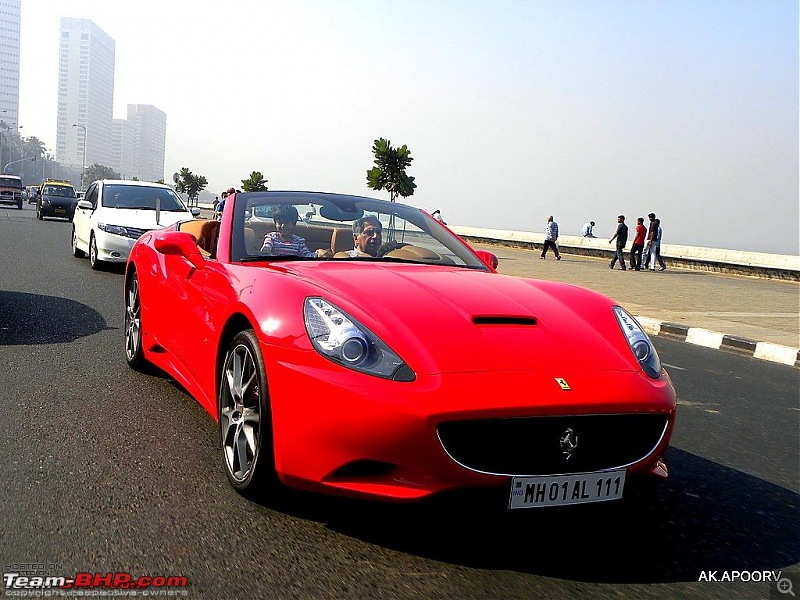
Ratan Tata in his famous red Ferrari

That isolation may have worsened the low point of Tata’s distinguished career after he chose Cyrus Mistry to succeed him in 2012 as executive chairman of Tata Sons, the group holding company. The Mistry family owns about a fifth of Tata Sons shares. Mistry, and abrasive advisers he brought with him, fell out with Ratan Tata, who organised a boardroom coup in 2016 to remove them.

Mistry (who died in a 2022 car crash), was replaced by a top group executive who Tata could trust – Natarajan Chandrasekaran, then heading the highly successful IT company, Tata Consultancy Services. Chandrasekaran has brought stability to the group and has managed in the last eight years to take top executive decisions without the octogenerian patriarch feeling shunned or excluded.  

Tata’s authority till the end has been as chairman of the charitable Tata Trusts that have a controlling interest of about 60%. He personally owned less than 1%. That marks the group out from other big family-owned Indian companies, giving it a philanthropic role along with its professional management.

Ratan Tata was born in 1937 to a family of Parsis, the well-educated and prosperous Zoroastrian community that plays a major role in Mumbai’s business life.

When he returned to India from the US, he started on the factory floor at the group’s big steel plant in Jamshedpur in eastern India, and then became technical assistant to the manager. In the early 70s, he turned round two problem companies making radios and televisions, but was disappointed to have failed to save a textiles business. In the mid-1980s, he was given charge of Tata Industries, a subsidiary that initiated and developed new investments.

In 2007, Ratan Tata flew in an FG-16 and F-18 fighter jet

In 1991, J.R.D.Tata, the revered head of the group, caused concern when he named Ratan Tata as his successor. “J.R.D. got clubbed with nepotism and I was branded as the wrong choice,” Tata said in a Facebook interview.

He was widely expected to fail, but instead he asserted his authority over the group that then had revenues of just $4bn. He gradually unified group companies, several run by powerful satraps who he retired. He closed some lossmakers and then set out to expand abroad. “It was the quest for growth and changing the ground rules to say that we could grow by acquisitions which earlier we had never done,” he said in 2013.

He started by buying UK-based Tetley Tea in 2000 for $432m, followed by the commercial vehicle unit of South Korea’s Daewoo Group for $102m. At the time, these were unprecedented acquisitions for Indian companies which, satisfied with the vast home market, never ventured abroad,. 

Next came the Anglo-Dutch steelmaker Corus in 2007 for $13bn, which Ratan Tata insisted on buying against the advice of senior executives. It has never been a success. That was followed by Jaguar Land Rover in 2008 for $2.3bn, where Tata introduced strong management and harnessed plans and designs that Ford had failed to implement. Though there have been problems, he made the troubled brands an international success. The group is now one of the biggest foreign investors in the UK.

In India, Tata Motors produced the Indica medium-sized saloon which was the first car designed and developed in the country. Later there was the unsuccessful Nano micro car, which Ratan Tata unwisely pursued as a personal crusade against advice from his executives.

After he retired in 2012, he became a significant investor in Indian start-ups that included digital payments firm Paytm and an electric scooter spin-off from Ola that rivals Uber. Another start-up, Goodfellows, founded by Naidu, that encouraged friendships between older and younger Indians in business and other professions, is said to have been a favourite.

Noel Tata

Honours have included India’s second highest award, the Padma Vibhushan. Abroad he has a British knighthood and awards from France, Italy and Japan. Among a mass of tributes yesterday, prime minister Narendra Modi said he was ” a visionary business leader, a compassionate soul and an extraordinary human being.”

He is survived by his younger brother Jimmy Tata who is not involved in the group, his 94-year old stepmother Simone Tata who has her own businesses, and stepbrother Noel Tata, 67, who heads part of the Tata group and has today been appointed chairman of Tata Trusts

That blend, between the professional management of Natarajan  Chandrasekaran as chairman of Tata Sons, and Noel Tata leading the family-controlled trusts, should ensure the continuity of a group that Ratan Tata built to such a size that it is too big and important to be allowed to fail.

1975-1998 art traces the impact of political and social change

Moves attention on from currently dominant “Progressives” generation

Ever since modern Indian art hit the international auction scene with a price boom in the early 2000’s, top prices and most public attention has involved artists who emerged in the mid-20th century. It has been the 100th birth anniversary this year of one of the most famous, F.N.Souza, whose works appropriately hit a new auction record of $4.89m at Christies New York in March.

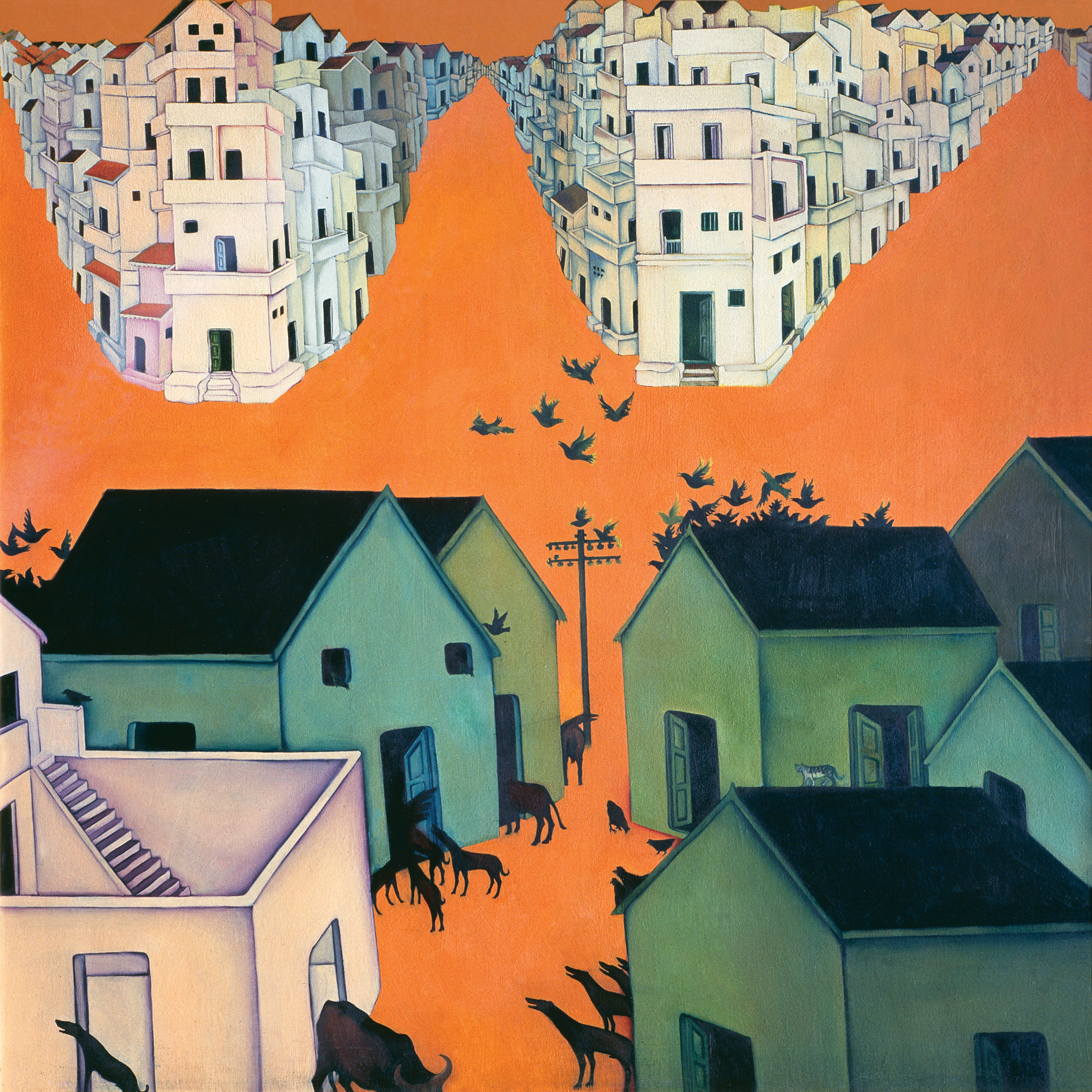
Gulammohammed Sheikh’s “Speechless City” 1975

An exhibition that has just opened at London’s Barbican gallery shifts the focus of collectors, auction houses and a wider audience on to more recent, mostly less widely known, and far less highly priced artists, working in the final 25 years of the last century. (There is a Youtube conversation with some of the artists here)

At first glance, the exhibition’s time period looks rather arbitrary. By focussing however on works done between the start of Indira Gandhi’s State of Emergency in 1975, which blocked personal freedoms and civil liberties, and the country’s nuclear tests in 1998 that generated what critics saw as un-Indian jingoism, the works show a development of socially conscious and even protest art.

“The years between 1975 and 1998 were a crucible of creativity, where artists harnessed their imaginations to reflect the evolving spirit of society,” Kiran Nadar, founder and chairperson Kiran Nadar Museum of Art, told me. More than half of the works in the exhibition come from the museum’s collection. The UK audience was being offered “a unique glimpse into this transformative era of artistic expression”. (Kiran Nadar was featured in this weekend’s FT).

Three of Bhupen Khakhar’s paintings 1991-1995

Curator Shanay Jhaveri sees 1979 as a “turning point” because of the focus artists brought to “shine light” on the period. The exhibition was an “attempt to bring exposure to the breadth of art from India which hasn’t been engaged with before”. 

At the start of the exhibition, there is Gulammohammed Sheikh’s Speechless City (above) painted in 1975 as the Emergency impacted on daily life. It is an appealing colourful urban landscape, but it is also graphic in its message with empty streets apart from a few dogs and birds in the air.

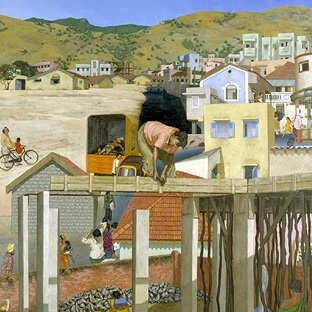
Sudir Patwarden’s “Town” 1984

Near the end, one is confronted by a forceful array of three explicit paintings (above) by Bhupen Khakhar, India’s best known gay painter who had a solo show at London’s Tate Modern in 2016.

The paintings are described in the catalogue as “renderings of villages and groups of romping men.…in all sorts of sexual encounters”. There is an even more graphic Two Men in Benares earlier in the exhibition. Khakhar, who died in 2003, bravely and controversially painted these works when homosexuality was banned in India. 

This is thought to be the first major exhibition of Indian art in London for 42 years (since the 1982 Festival of India}. Rather obscurely titled “The Imaginary Institution of India”, it runs till January 5 2025 and contains a total of over 150 works by 30 artists featuring painting, sculpture, photography, installation and film, mostly arranged chronologically.

Arpita Singh’s “My Mother” 1993

Some artists have more than one work on show so that, says Jhaveri, visitors can come to know them and follow how their art developed.

That however is not helped by the absence of any information about the works on the gallery walls – one has to hunt through a catalogue, often in dim lighting.

Khakhar has six paintings, as does Sudhir Patwardhan who has been depicting life and crumbling lifestyles (above) in the expanding metropolis of Mumbai for five decades. (Patwardhan also has a solo exhibition at a London gallery)

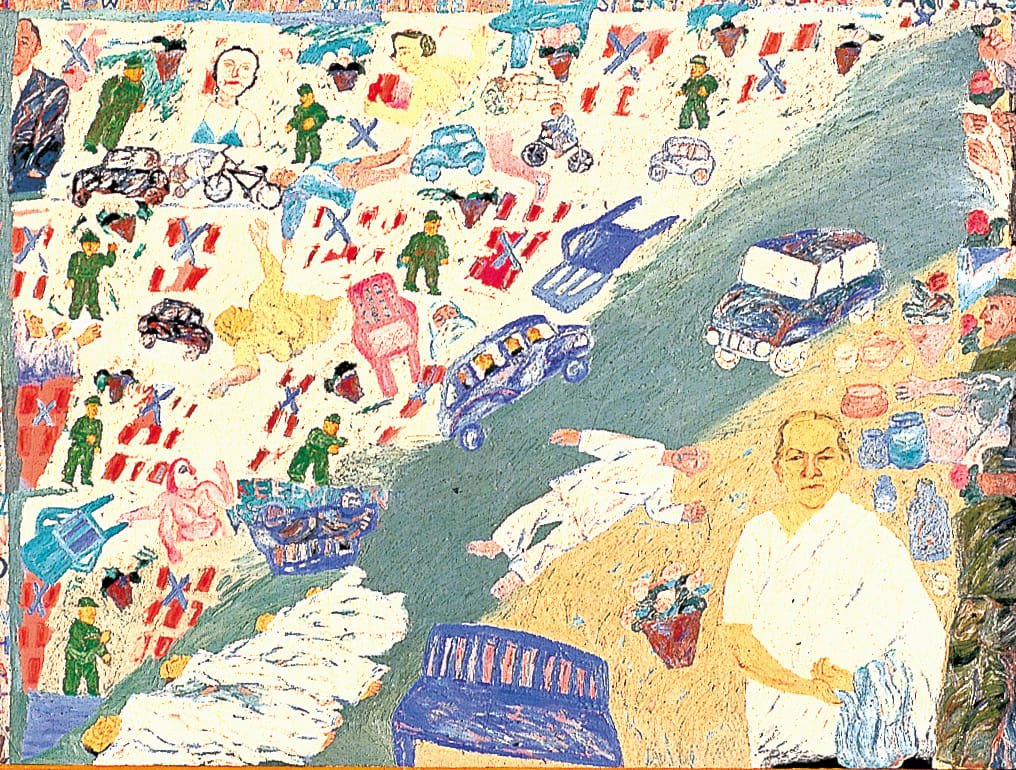
Arpita Singh has four works including a large 1993 canvas (above) that stems from widespread communal violence in 1991. Her mother stands firmly in the foreground while chaos spreads around her.

Meera Mukherjee’s bronzes including “Pilgrims to Haridwar’

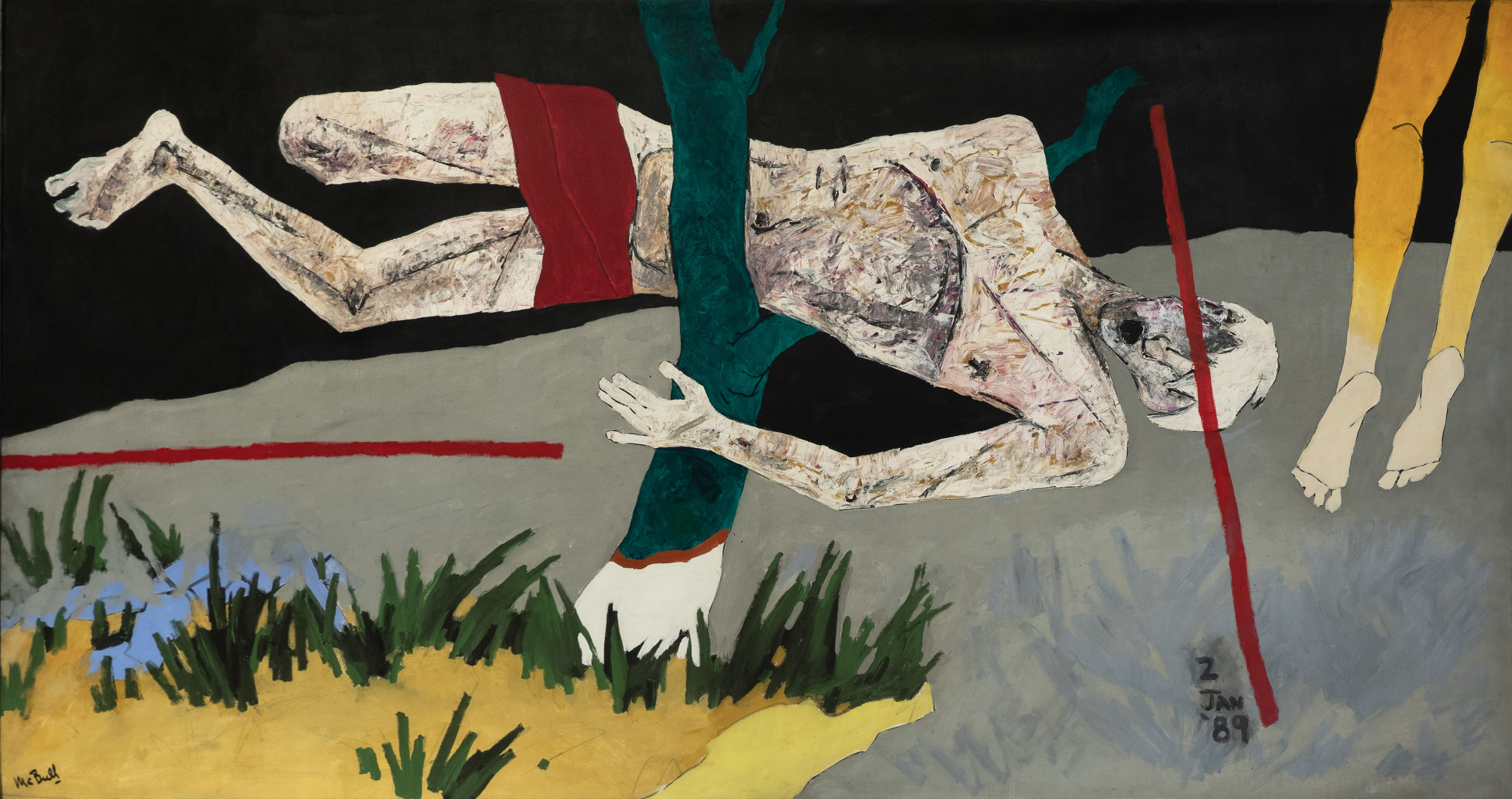
On the same theme of the 1991 riots, Gieve Patel has a horrifying “Battered body in a landscape”, also done in 1993. Tribal art is represented by Jangarh Singh Shyam, the veteran Gond painter who died in 2001, with a large acrylic on canvas and 14 works on paper.

Meera Mukherjee, who died in 1998, has bronzes that show aspects of India life including Pilgrims to Haridwar (left). Pablo Bartholomew has photographs from the devastating Bhopal gas disaster in 1984.

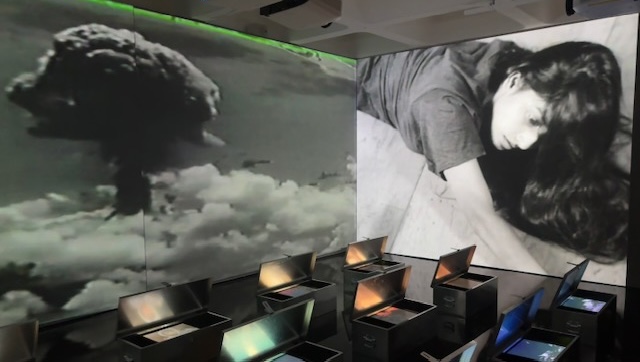
The post-1975 Emergency theme of protest, oppression and violence is well covered, but the show would have benefited from more evidence of how artists reacted to the nuclear tests. The only significant work stemming from 1998 is a multi-channel video installation (bottom of blog) by Nalini Malani. It is described as reflecting reaction to India’s (and Pakistan’s) tests, illustrating fears of the potential destruction that could follow.

Only two of the older Progressives appear, both with large acrylic-on-canvas works that fit the theme and show why they are so famous. Husain, who died in 2011, has a dramatic rendering (below) of the 1989 assassination of Safdar Hashmi, a Communist political activist, actor and playwright.

M.F.Husain’s Saldar Hashmi 1989

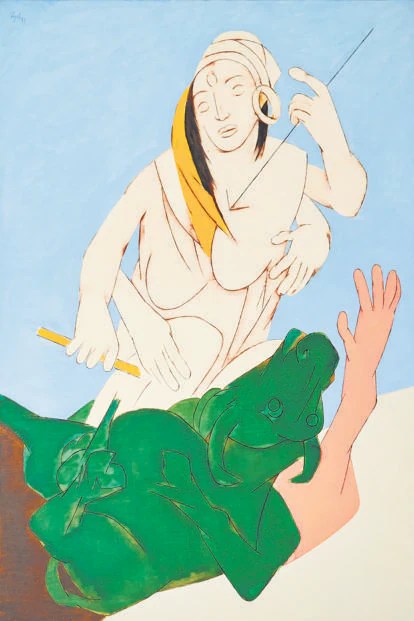
Tyeb Mehta, who died in 2009, has the Hindu goddess Durga slaying a buffalo demon (below). This reflects the horrors of the communal violence that followed the demolition by Hindu extremists of a famous mosque at Ayodhya in north India two years before it was painted in 1993. It has been loaned by Lakshmi Mittal, the London-based Indian-born international steel tycoon who bought it in 2018 at a Sotheby’s Mumbai auction.

Tyeb Mehta’s “Durga Mahisasura Mardini” 1993

The top auction price for an Indian work of $7.45m was achieved at Mumbai-based Saffronart in September 2023 for a work by Amrita Sher-Gil, who died in 1941 and is not on show at the Barbican. She is one of nine artists who pre-date the Progressives and are classified as national treasures, which means their works cannot be taken out of India. The next top price was achieved by S.H.Raza with $6.45m, two weeks before the Sher-Gil record.

The focus around Souza’s and Raza’s generation has centred on their Bombay-based Progressives group. Following the Souza’s $4.89m record in March for a 46x34in oil on board, another of his best-known contemporaries, M.F.Husain, hit £2.4m for the first time at Sotheby’s in London last month. Other famous Progressives include Tyeb Mehta, V.S.Gaitonde, Ram Kumar and Krishen Khanna who is still alive and painting. 

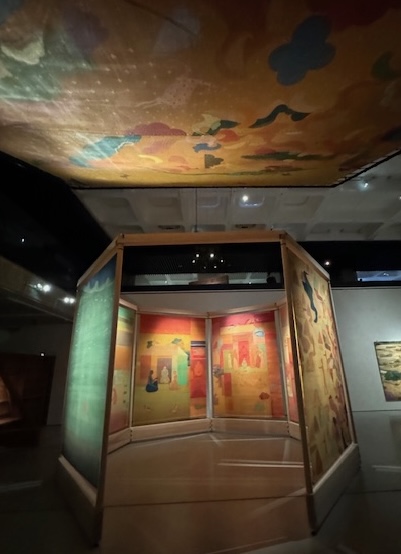
“Shamiana”, a hexagonal shelter of painted screens by Nilima Sheikh

Khakhar and Sheikh are the only artists in the exhibition (apart from Husain and Mehta) with works listed in Indian art’s top 30 auction prices, both having reached approximately $2.5m at Sotheby’s and Saffronart auctions last year.

Many status conscious collectors of modern Indian and other South Asian art seek these painters’ easily identifiable works for the walls of their homes and offices because they bring them instant prestige as well as being safe and probably profitable investments.

This is changing as new generations of buyers are appearing with smaller budgets and wider interests. They are looking at artists such as those at the Barbican including Khakhar, Ganesh Pyne, Rameshwar Broota, Arpita Singh, Gulammohammed Sheikh, and Nasreen Mohamedi.

There is nothing for sale at the Barbican, but the artists involved need to be watched in galleries and at future auctions to see how long it takes for the show to raise awareness and interest.

A multi-channel video installation by Nalini Malani, reflecting reaction to India’s (and Pakistan’s) 1998 nuclear tests with archival footage on small screens that include the aftermath of the Hiroshima and Nagasaki nuclear bombings

India losing regional influence to China, just as its global role grows 

Indian newspaper reports on possible US Bangladesh involvement

Adani projects at risk in Bangladesh and Sri Lanka

Regime change has come to South Asia for the second time in a few weeks with the election yesterday in Sri Lanka of a once-Marxist president, whose party has not held the office before. This peaceful transfer of power follows the ousting in Bangladesh last month, after violent demonstrations lasting weeks, of Sheikh Hasina who had been an increasingly controversial prime minister since 2009.

Anura Kumara Dissanayake after winning the election to be Sri Lanka’s new president yesterday

Both changes potentially increase China’s influence and underline the dichotomy of India losing power and influence with its neighbours at the same time as it is increasingly recognized internationally as a rising global and economic power.

Just as Anura Kumara Dissanayake, leader of the leftist Janatha Vimukthi Peramuna (JVP), was claiming victory in a second-stage run-off of Sri Lanka’s presidential election, India’s prime minister Narendra Modi was riding high in the US, meeting President Biden and other world leaders.

Modi was at the four-nation Quad grouping with Biden and the prime ministers of Australia and Japan. He also had talks with the US president, boosted his domestic political profile addressing thousands of Indian Americans in New York, and will be at a United Nations conference today (Sept 23).

Dissanayake’s JVP (People’s Liberation Front) was on the fringe of Sri Lanka’s politics for decades, adopting anti-American and anti-India lines at various times. In the 1970s, it led protests against the US over the Vietnam war and operated underground after being banned then and in the 1980s. Since the early 2000s (when Dissanayake was briefly a government minister), it has been involved in mainstream politics and is now part of the National People’s Power (NPP) coalition.

Its primary policies are anti-corruption and tax cuts and at times in the past it has criticised Sri Lanka’s debt crisis caused by Chinese investment. At his swearing in, Dissanayake said Sri Lanka did not have any geopolitical concerns and he was committed to whatever was in Sri Lanka’s best interests. “We need international help — so whatever geopolitical fractures exist around the globe, we will not be afraid to engage all in the best interest of Sri Lanka. We will work with the world”,

Dissanayake succeeds Ranil Wickremesinghe of the United National Party (UNP), who became the president in 2022 after an economic crisis and mass protests led to the resignation of President Gotabaya Rajapaksa, part of a powerful, controversial and corrupt dynasty.

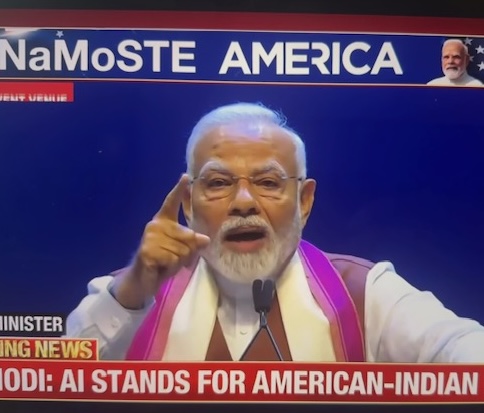
Narendra Modi addressing American Indians in New York yesterdayphoto from India Today tv

It is expected that Dissanayake will now call parliamentary elections. The risk then seems to be that, given his Marxist roots, there will be another South Asian government leaning away from India.

Coming rapidly after what was virtually a coup in Bangladesh last month, when India lost its direct influence with the resignation of its close ally, Prime Minister Sheikh Hasina, the Sri Lanka result is a double blow. Adding to its failures to deal with its neighbours, a pro-China government was elected in the Maldives earlier in the year.

That does not seem to affect India’s role on the world stage, which has increased significantly in the past ten years since Modi became prime minister.

Conversely, the more China strengthens its presence in the smaller South Asian countries, the more it is arguably necessary for the US and its allies to keep India as close onside as possible.

Biden illustrated his concerns about China’s regional role at the Quad meeting, where he is reported to have said (in what was supposed to have been a behind-closed-door meeting), that China “continues to behave aggressively, testing us all across the region”. That included South Asia. 

There has been considerable speculation in India about whether America’s concerns led to it being involved in the ousting of Sheikh Hasina. This surfaced internationally last month but did not have much traction, though the possibility has been widely rumoured in India. 

Yesterday it was set out in the Indian Express by Coomi Kapoor, a well-connected veteran columnist. She wrote that India was “realistic enough to trace the fingerprints of the US”.  Yunus was “a close friend of the Democratic party and of the Clinton Foundation”. 

Referring to Chinese defence and infrastructure projects (and also to Russian involvement), she wrote: “The US was unhappy with Bangladesh for permitting the Chinese to build Asia’s largest submarine base at Cox’s Bazar and construct the Padma bridge. Russia’s funding of a nuclear power plant at Rooppur was another black mark against Bangladesh, which is near Myanmar, a military dictatorship with extremely close ties to China.” (The submarine base was a reference to a naval base China has been building to house two submarines that Dhaka bought from Beijing in 2013, and maybe to service other Chinese subs). 

Kapoor added that Hasina had once claimed that US antagonism toward her regime was linked to its alleged (unsuccessful) efforts to gain a lease on her country’s St. Martin Island for use as a military base to monitor Chinese activity near the Strait of Malacca. This has been denied by the US.

Muhammad Yunus, Bangladesh government’s Chief Adviser

More widely discussed have been Washington’s persistent criticisms of her autocratic regime, her rigged elections (the latest in January), the radom imprisonments of opponents and critics, and the deaths of some 450 people during the student demonstrations that began in June and led to her downfall. 

Many observers however did not believe that these criticisms would lead to the US wanting to change a basically secular regime and risk Bangladesh becoming ruled by fundamentalist Muslim opposition parties.

Nevertheless, the speed with which the demonstrations escalated fed the rumours. In quick succession, Hasina fled at a few hours’ notice to India, Bangladesh’s army chief took over, and student leaders called for 84-year-old Muhammad Yunus, a respected but controversial Bangladeshi Nobel Peace laureate, to lead the government. Yunus immediately flew to Dhaka from Paris, where he was watching the Olympics, and was installed as chief adviser of the government along with other advisers. It all seemed so rapid and seamless that it led to speculation in India about whether there was outside involvement. 

No such suggestions are being made about the changes in Sri Lanka where India now needs to move adeptly to try to ensure that its substantial contributions to the vulnerable economy are valued.

Meanwhile, there are possible embarrassments waiting for Modi when he returns from the US involving Gautam Adani, India’s richest businessman and a close ally. 

Dissanayake has promised to scrap a wind power project funded by Adani, saying “this is clearly a corrupt deal, and we will definitely cancel it.”  Bangladesh owes Adani Power $500m unpaid dues for power supplied from an Indian plant which the new government says is one of various “opaque, expensive” deals it has inherited from Hasina. 

Sue Braverman accused by colleague of “performance art politics”

South Asian MPs back in force in new parliament and as Ministers

The ousting of Britain’s Conservative government this week is significant not just for the prospect of a more focussed Labour government to tackle the country’s chronic problems but also because it marks the end of the first administration where politicians of South Asian origin have played a leading but also often a significantly negative role.

The flow of members of parliament with parents of foreign origin looks set to continue, especially from South Asia that accounts for 26 Indian MPs in the new parliament according to one assessment posted on X (twitter).

In the outgoing government, two women ministers from the Conservative Party’s right wing have been widely criticised for pursuing their party leadership ambitions, courting the party’s grass roots members, rather than focussing on sound policies.

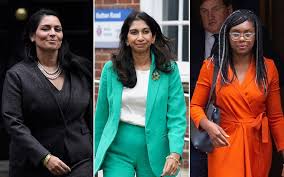
From the left, Priti Patel, Suella Braverman, and Kemi Badenoch

Priti Patel and Suella Braverman, both former home secretaries, pushed unsuccessful anti-immigration policies despite themselves being from immigrant families that benefitted from being accepted into the UK. They have become bracketed with Kemi Badenoch, who had Nigerian parents. She was a more constructive business and trade secretary though she also aggressively courted the mostly right-wing Conservative Party membership. 

Rishi Sunak was saddled with the task of managing the political debris he inherited from his prime ministerial predecessors Boris Johnson and Liz Truss. 

Sadly, even though he had built a sound reputation as chancellor of the exchequer (finance minister), he quickly showed that he lacked the political instinct and experience to lead and survive in a government torn by policy differences over a range of issues, notably immigration.

He called the election unexpectedly early without sufficient planning, and then had a series of fiascos. The worst was when he left France a day before other world leaders at World War Two’s 80th D-Day commemorations to return to Britain. That lead to massive criticism.  

His parents, of Indian origin, arrived in Britain from East Africa long after the war and it seems he failed to realise the importance of the event to those whose British parents were alive and maybe served in 1944. If there was a time when his origins counted against him (and I have never believed they were important), it was certainly then, significantly reducing his personal support in the middle of the election campaign. It prompted Nigel Farage, leader of the far-right Reform Party to say Sunak “doesn’t understand our history and culture”, a rare public reference to his background.

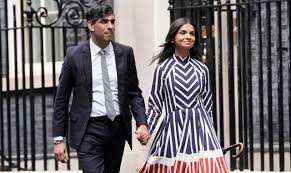
Rishi Sunak and his wife Akshata Narayana Murty leave Downing Street

Of the three women ministers, Braverman was – and is – the most brazenly focussed on the leadership. Born to Kenyan Indian and Mauritian parents, she adopted dangerously shrill anti-immigrant tone, breaching collective Cabinet responsibility and failing to solve the major and continuing problem of stopping boat people crossing the English Channel from France.

Such behaviour prompted Robert Buckland, a former justice minister to attack her indirectly when he said, after losing his seat in the general election: “I’m fed up with performance art politics. I’ve watched colleagues in the Conservative Party strike poses, write inflammatory op-eds and say stupid things they know have no evidence for instead of getting on with the job”.

British politics however is not rid of Braverman (who was sacked by Sunak), Badenoch, and Patel, 52, who was born in London to Ugandan-Indian parents. All three have been re-elected as MPs and all are likely contenders to take over from Sunak, who has agreed to remain as party leader and leader of the opposition till the succession is organised.  

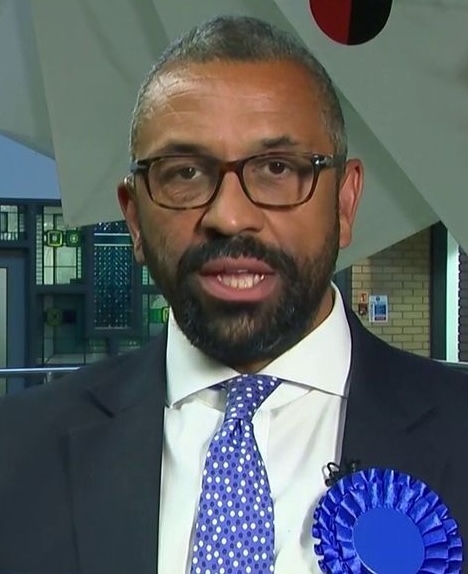
James Cleverly

Badenoch, 44, has the best chance of winning. The party might however go for more centrist candidates where the possible names include James Cleverly, also from an immigrant family with an English father and Sierra Leonean mother. He has built a solid repuation, first working with Boris Johnson and more recently as foreign secretary and home secretary and would be a strong contender against other middle-road possibilities.

Braverman (and possibly also Patel) is in favour of the Conservative Party admitting Farage, the charismatic politician whose Reform Party won an astonishing 14% of the votes in the general election, though only gained five seats in parliament.

The Conservative Party will now be split on how to handle Farage because he will always be trying to upstage them. But he has said his main target is Labour, where he wants to win voters at the next general election. Immigration will be the main policy battleground for this astute campaigner, following his earlier success as a crucial leader on Brexit.

Keir Starmer’s cabinet

In Keir Starmer’s new cabinet, there are three ministers with South Asian links, all getting posts in government for the first time. The new foreign secretary is David Lammy, 51, who was born in London to Guyanese parents, but had an Indian grandmother who was born in Calcutta and sent as indentured labour to Guyana. His mother went to the UK as part of the Windrush generation. 

Lammy, whose commitment to policies has varied in past years, has just been named along with his wife, portrait painter Nicola Green, as a surprise second on the up-market Tatler magazine Social Power Index – a rare event for a Labour politician.

Tatler” magazine’s power couple David Lammy and his wife Nicola Green

Starmer’s government has done extensive research and preparation on most major domestic issues, but it is weak on foreign affairs and Lammy has been on a steep learning curve after he was appointed shadow foreign secretary in 2021. He seems likely to visit India later this month.

He has had to row back from calling Donald Trump a “woman-hating, neo-Nazi sympathising sociopath” in a Time magazine article he wrote when the former president visited the UK in 2018. Recent trips to the US have included meetings with prominent Republican Party members, though there had been reports that he might have not been made foreign secretary

Shabana Mahmood, 46, whose family roots are in Azad (Pakistani) Kashmir, has been appointed the justice secretary. Brought up in Birmingham she has been a practising barrister specialising in professional indemnity cases.

Lisa Nandy, 44, whose father is from Calcutta and mother is British, has been made secretary of state for culture, media, and sport where she is likely to be a stauncher defender of the BBC than her Conservative predecessors over the past 14 years.

It looks as though what Sir Keir Starmer yesterday called “tribal politics” will not be prevalent in the new government, even though they are continuing to flourish in the Conservative Party’s search for a new leader. Without actually naming Boris Johnson or his successors, Starmer promised that the government would “turn its back” on “picking issues just for party politics”. 

Posted by: John Elliott | June 27, 2024

Modi’s election setback fuels recovery of the Gandhi dynasty

A united Opposition adopts Rahul Gandhi as its leader

Rahul’s sister Priyanka steps up to join him in parliament as an MP

Narendra Modi’s unexpected failure to achieve an outright parliamentary majority for his Bharatiya Janata Party in India’s recent general election will go down in history as the trigger for the revival of the country’s Nehru-Gandhi dynasty that seemed to be on a path of endless decline.

That is in addition to the election result being an historic personal setback for Modi’s now unreal dream of becoming an invincible Hindu nationalist leader facing virtually no opposition.

The revival became clear on June 25 when Rahul Gandhi, the dynasty’s heir apparent, was named leader of the Opposition in India’s parliament. Never before have other opposition parties, now working together for the first time in years, been willing to accept him as their leader.

How long the unity will last – and how successful a leader Gandhi will be – remains to be seen. But this is a new era in Indian politics, however much the government may be demonstrating continuity from before the election.

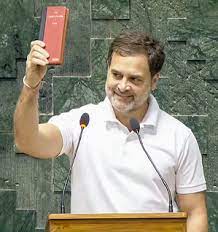
Rahul Gandhi being sworn in to parliament

Modi is facing the challenge, both in parliament and across the country, of managing opposition that he has never faced in his political career.

The BJP’s National Democratic Alliance (NDA) has just 293 seats in the Lok Sabha (lower house of parliament), while the I.N.D.I.A grouping that includes the Congress party has 232. Modi has to rely on two potentially unreliable regional NDA parties for a parliamentary majority.

“The space in the Indian political system has been blown open,” Gandhi told the Financial Times last week. “The idea of Mr Modi and the image of Mr Modi has been destroyed,” he added, with a tinge of exaggeration.

The Opposition leadership is – till now, power-shy – Gandhi’s first constitutional post after 21 years in politics. It is also the first time that he has accepted a formal role since 2019 when he resigned as president of the India National Congress party after years of election failures.

Aged 54, he has been groomed by his mother, Sonia Gandhi, to take on the mantle of her late husband and his father, former prime minister Rajiv Gandhi, who was assassinated in 1991. Italian born, Sonia has seemed to regard it as her duty to act as a bridge between the generations. She served for many years as the party president. 

Priyanka Gandhi Vadra, Rahul’s 52-year-old sister, has until recently remained mostly in the background, though she is a more instinctive and sharper politician. She sometimes has an air of dynastic entitlement and failed to make an impact in Uttar Pradesh state elections when she was in charge of the Congress campaign in 2022. She is now becoming a member of parliament for the first time and seems likely to emerge as her brother’s main support.

Rahul Gandhi with his sister Priyanka
Image Credit: ANI

Rahul entered politics in 2004, but his political performances have been erratic and his public appearances frequently underwhelming. He consistently resisted taking responsibility on a continuing basis and became famous for disappearing abroad at key times. He was regularly mocked by Modi and other opposition politicians as a privileged shehzada (prince) and there has been general despair about him ever growing up politically.

“Normally, after every election campaign, Gandhi used to board the next flight out of India to decompress”, Swati Chaturvedi, an experienced columnist, wrote this week. “The BJP waited eagerly for it [this time], created memes and content, yet despite the record heat in India touching 50 degrees in Delhi, Gandhi has not budged”. 

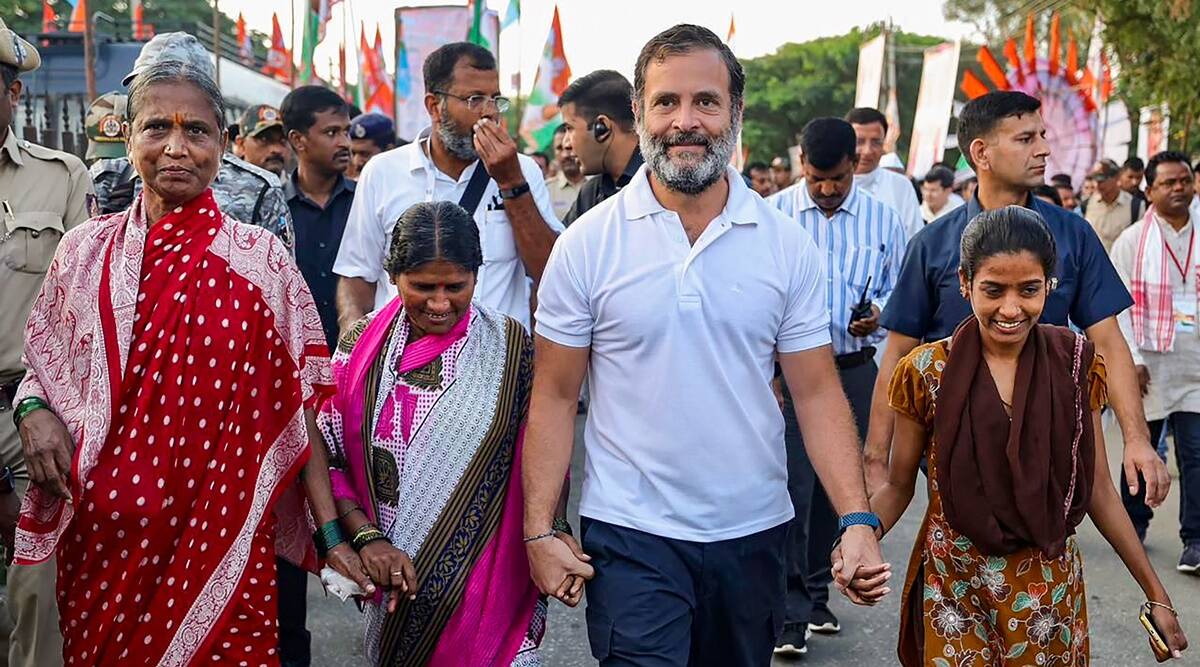
The changes have become visible in the past couple of years when Gandhi has made two long yatras (journeys), first walking 2,200 miles from the south to the north of the country 18 months ago, and then travelling from east to west earlier this year.

Observers have noted that Gandhi was developing a national profile and respect on this year’s yatra, even though he wasn’t (and still isn’t) in charge of the party officially – a non-Gandhi veteran politician, Mallikarjun Kharge, is the party president and his mother is chair of the Congress parliamentary party. 

“He has become a symbol for all those dissatisfied with the Narendra Modi rule. And the first choice of the minorities – wherever the Congress is in a position to get its act together,” Neerja Chowdhury, a veteran political columnist wrote in March.

This emerged especially in the politically sensitive state of Uttar Pradesh where Gandhi worked closely with Akhilesh Yadav, leader of the state-based Samajwadi Party, seemingly helping to pave the way for the Opposition leadership.

Rahul Gandhi on his first yatra in the southern state of Telengana

When I spoke to Gandhi in London just over year ago, he sounded confident and said that the Congress Party had the “ideological spine” and “foundational ideology” needed to defeat Modi.  Regional parties, now aligned with Congress, didn’t have “the necessary ideology” to tackle the BJP and its hardline mother organization, the Rashtriya Swayamsevak Sangh (RSS).

The regional party leaders probably wouldn’t agree with all of that, but there is no doubt that Congress is the only party that has the nation-wide reach needed to unite the opposition, even though its image has sunk in recent years. 

Gandhi made a good start in parliament with a short speech on June 26. Congratulating the BJP’s Om Birla on being re-elected speaker of the Lok Sabha, he said that Birla had the “duty of defending the Constitution of India” and was the “final arbiter of the voice of the people”. The Opposition now “represented…that voice significantly more” than it had in the last parliament. This was a plea for the opposition not to be silenced as it had been, and a warning that the BJP should not tamper with the constitution.

The Opposition now needs to develop positive policies for the future so that its political platform is not just opposing the Hindutva authoritarianism and nationalism of the Modi regime. 

Modi’s aim since he became prime minister 10 years ago has been to eliminate memories of the dynasty’s positive role in India’s development so that he could supplant Jawaharlal Nehru, Rahul Gandhi’s great grandfather, as the country’s greatest prime minister.

That looks far less likely to happen than it did just a few weeks ago.

**https://www.asiasentinel.com/p/resurgent-rahul-gandhi-girds-next-year-poll\

** India’s BJP hangs on to power but loses overall control

Posted by: John Elliott | June 4, 2024

India’s BJP hangs on to power but loses overall control

Big setback for Modi’s aim to establish himself as invincible leader

India will now have a coalition government

Narendra Modi is set to become India’s prime minister for a third term following counting of votes in the country’s mammoth general election. But the face of Indian politics has changed dramatically with an unexpected resurgence of opposition regional parties and the Gandhi-led Congress Party, and declining support for Modi’s Bharatiya Janata Party (BJP).

Modi will be sworn in as prime minister on June 8 (or June 9), but his dreams of winning a dominant personal victory as a supreme leader have been shattered in one of the most unexpected reversals for many years.

The result proves the strength and power of India’s often criticised parliamentary democracy with 642m people voting in this election. It also marks the failure of Modi’s ambition to remove the Congress party and its Nehru-Gandhi dynasty leadership from active politics.

Modi’s personal pitch of projecting himself with an almost priestly Hinduism religious role seems to have failed to attract votes – it even failed in the constituency that contains the Ayodhya temple where he presided in January and where the BJP parliamentary candidate lost to the state-based Samajwadi Party. In his own constituency of Varanasi, Modi won with a majority of just 152,513 votes, down from 471,000 in 2019. 

The hopes of Modi’s opponents that one day the political pendulum would swing against harsh autocratic Hindu nationalism has been vindicated. Till now, that seemed only a hope for the somewhat distant future – scarcely anyone had expected it to happen in this election.

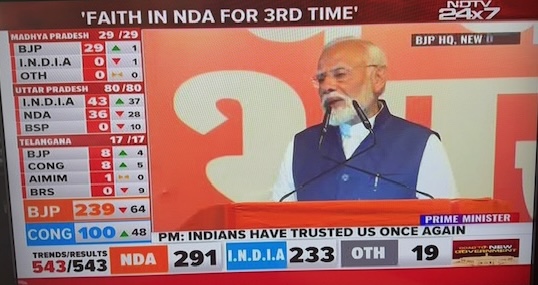
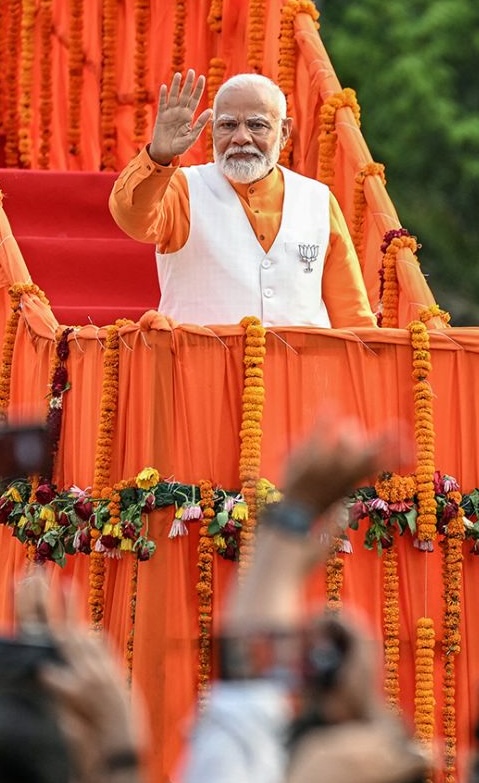
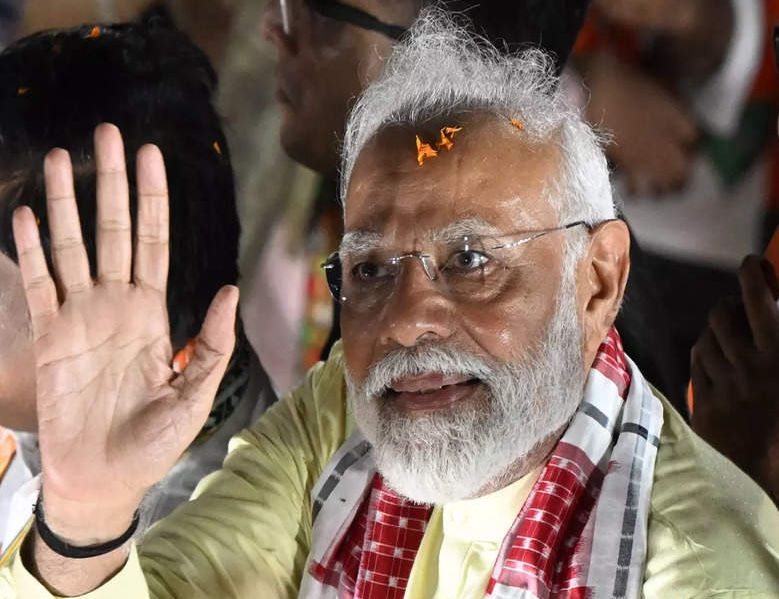
Narendra Modi addressing a BJP rally in Delhi on June 4 after the BJP’s losses had become clear

The results show the BJP’s National Democratic Alliance (NDA) with 293 seats in the Lok Sabha (lower house of parliament), and 232 for the I.N.D.I.A grouping that includes the Congress party. Other parties have 19 seats. 

Significantly, these figures include the BJP with 240 seats, down 63 from 303 in the 2019 election, and 99 for Congress, up 47 from 2019. 

There was only a 1% drop in the BJP’s vote share, but co-operation between opposition parties reduced competition in individual constituencies and led to its large loss of seats.

The BJP has therefore failed to reach the 272 majority mark so needs the active support of its coalition partners for the first time since it came to power in 2014. That will pose a personal test for Modi, who has run a centrally controlled government from his prime minister’s office with little notice being taken of alliance partners or other interests.

There were some suggestions as the results emerged that two regional coalition partners might switch to support the I.N.D.I.A, which would have removed the NDA’s majority and could have prevented Modi forming the government. That however is not to be happening. The parties are Bihar’s Janata Dal United (JDU) led by Nitish Kumar, which has 12 seats, and Andhra Pradesh’s Telegu Desam led by Chandrababu Naidu with 16. Both leaders have at different times supported and not supported the BJP, but both have pledged to join the government.

Part of the BJP’s problem was that there was no clear focus in its election campaign, apart from the presence of Modi, and there was a lack of firm polices for the future. This led to local issues and the role of regional parties becoming important in many constituencies. It was also the first time that Modi had faced a united opposition. Turn-out was low compared with earlier elections, suggesting that some BJP supporters had not voted, maybe because they felt that the government had not done enough to boost employment and curb price increases of basic goods. It is also possible that voters did not like extreme anti-Muslim tilt of Modi’s campaigning.

“Big decisions”

Modi put as brave a face as he could on the losses and is presenting the result as a victory for Indian democracy and a success for the BJP winning a rare third consecutive term with a sizeable majority over the I.N.D.I.A. Speaking alongside grim-faced fellow BJP leaders at a party rally when the results were clear, he said the government would now write a “new chapter of big decisions”.

That underlines the point that, while he might feel less confident about pushing Hindu nationalism and side-lining Muslims as a religious minority, and will be slowed down on that by coalition partners, he will now want to do more on economic reforms, social support systems for the poor, attracting foreign investment and building new technology-oriented industries. Some observers however suggest that he may not feel strong enough to carry out delayed and controversial reforms such as privatisation of state industries and changing labour practices.

In addition to failing to establish the country-wide endorsement for his leadership, the BJP only won one seat in southern states where Modi wanted it to establish a significant presence. It raised its percentage of the vote and gained one seat in Kerala but none in Tamil Nadu. It did however repeat its past success in Delhi where it won all the seven parliamentary seats, as it did in 2019.

In the state assembly election in Orissa, it won control for the first time, pushing out the state-level Biju Janata Dal led by Naveen Patnaik who has been chief minister for 24 consecutive years, the second longest of any chief minister in the country. 

The BJP’s biggest setbacks that helped to swing the overall result came in two states. The main surprise was Uttar Pradesh where the I.N.D.I.A won 43 parliamentary seats out of a total of 80, whereas the NDA has only 36, down from 64 in 2019. This is unexpected because Yogi Adityanath, the Hindu priest-turned-chief minister, was reported to have built a good image for the BJP by strengthening law and order and boosting both development projects and care for the poor.

The result is a victory for Akhilesh Yadav, leader of the UP-based Samajwadi Party, working with Rahul Gandhi of the Congress party whose political future looks more assured than it has for many years.

Observers suggest that Yadav and Gandhi successfully worried members of India’s lowest castes that reservation schemes which provide them with jobs and other advantages might be cancelled by the Modi government amending the constitution.

In West Bengal, the reigning chief minister Mamata Banerjee’s Trinamool Congress saw off the NDA challenge and her party won 29 of the 42 parliamentary seats compared with the BJP’s 12. This is a major setback for Modi who wanted to establish the BJP as a significant political force in the state.

The overall result is specially surprising coming after exit polls published when voting ended on June 1. These indicated a massive swing in favour of the BJP with between 355 and 380 seats. That led to a surge on the Indian stock market with prices reaching record levels and a crash when the actual results began to appear today.

Whether the markets needed to be worried depends on how well Modi runs the coalition and carries the BJP’s allies with him on plans for economic reform. The results will not impede the government’s plans if, as Modi has said, they lead to renewed efforts to continue India’s development as the world’s third largest economy.

Modi’s BJP will win when votes are counted on June 4

Do economic advances outweigh negatives of religious polarisation

As India enters the final stages of its general election with the expected Bharatiya Janata Party victory being announced when votes are counted on June 4, the questions whether Narendra Modi’s Hindu nationalist creed and authoritarian rule is good for India, along with the question “Where is India heading” will come into renewed focus. 

It is assumed that Modi’s BJP will return to power with a comfortable majority, though it is less certain that it will achieve the 303 seats (out of a total 543) that it won in the last general election in 2019, let alone reaching Modi’s loudly proclaimed target of 370.

This is partly because there has been no clear focus in the BJP campaign, apart from the towering figure of Modi himself. Maybe more importantly, the Congress and regional opposition parties have come together in the Indian National Developmental Inclusive Alliance (I.N.D.I.A).

This is the first time since he entered national politics as the BJP leader ten years ago that Modi has faced a united opposition, and it has injected both uncertainty and aggressiveness into his campaign. The result will indicate how far the vast mass of Indian voters react to the question about Modi being good for the country.

There are those who believe his rule is necessary and has proved to be good because economic and social development, and opportunities for the poor, are enormously better than they were before Modi came to power in 2014.

On the other hand, others condemn the fact that India is becoming an authoritarian, Hindu-centric country with weakened national institutions and where democracy is, according to some critics, threatened.

It is however widely recognised (even by many Muslims) that Modi has led the country into years of economic success. Growth figures of 6 or 7 per cent may not be the highest ever, and many of the achievements like new sales taxes, bankruptcy laws and social development were begun before he came to power, but Modi and his government have, especially in the last five years, provided the environment, initiatives and drive that were lacking in the past. This will continue with a range of reforms planned for the coming months.

The Modi “package”

People in India talk about having accepted the Modi “package” of authoritarianism and Hindu majoritarianism because of the way the country is progressing. “It’s what we need,” a 40-something businessman from a traditional Congress-supporting family told me at a social gathering recently. He intended to vote BJP in the general election for the first time. 

That partly reflects the failure in the past of the opposition parties to offer a viable alternative. But it also reflects recognition that India is an 80% Hindu country with a growing awareness of nationalistic pride as the country emerges on the world stage.

There is also a factor that is rarely mentioned – widespread antipathy among Hindus towards Muslims, not usually as individuals but in general. That sentiment has been exacerbated by what is called the “appeasement” of Muslims with favourable policies under past Congress governments. 

I have heard many examples, in London as well as India, where Indian liberals are horrified that old friends, for example from university in Delhi or elsewhere, air views that were not apparent before, supporting Hindu nationalism and the Modi regime and openly revealing anti-Muslim sentiments. It is as if having Modi in power has released views that till now would have remained hidden.

Even the harshest critics of the regime now acknowledge the achievements. An article in the Foreign Affairs journal by Ramachandra Guha, a widely respected commentator, in February was headlined “How Modi’s Supremacy Will Hinder His Country’s Rise”.

But it included acknowledgment for the government “supplying food and cooking gas at highly subsidized rates”, albeit branded as “Modi’s personal gifts”. Guha also mentioned promotion of digital technologies that “enabled the direct provision of welfare and the reduction of intermediary corruption,” plus substantial progress on infrastructure development “with spanking new highways and airports seen as evidence of a rising India on the march under Modi’s leadership.” 

Narasimhan Ram, a well-known former newspaper editor and Modi critic listed the negatives in a recent article in the UK’s Prospect magazine. They included: “targeted assaults on freedom of expression, media freedom, media independence and other fundamental rights”; using “anti-terror, sedition and other draconian laws to incarcerate journalists, students, human rights defenders… and troublesome critics of the government, often without bail or trial”; introducing “religion as a criterion for citizenship”, deploying “brutal force to suppress democratic protests”; and misusing anti-crime agencies “to go after and arrest political opponents, including ministers, chief ministers and legislators”.

The early successes helped Modi to achieve a massive victory in the 2019 election when border conflicts and terrorist raids linked with Pakistan provided a vote-winning backdrop. Modi’s first victory in 2014 had been fuelled by a widespread desire for a change from the years of Congress rule.  

Lack of clear focus

This time the focus is not so clear cut. Modi has personally towered over the election campaign with meetings virtually everywhere. His aim has been for his image to draw the votes, aided by his priest-like appearance that dominated the opening ceremony in January of the famous Hindu temple in Ayodhya.

But voter turnout over the past six weeks has been a few percentage points lower than in 2019, which has led to suggestions that Modi was failing to generate enough enthusiasm and that memories of his performance at Ayodhya were fading as a vote generator. “The temple issue peaked far too early and there is a law of diminishing returns when you repeat the same emotive issue in each election,” Coomi Kapoor, a columnist, wrote in the Indian Express.

Since voting began last month, Modi has sharpened his religious polarisation and Muslim rhetoric in campaign rallies, linking that with attacks on the Congress party. He has said that “Congress has hatched a deep conspiracy to snatch your property and distribute it among their special favourites”, by which he meant transferring wealth from Hindus to Muslims. He also said that Congress would “bulldoze” the new Ayodhya temple. 

The aim of these clearly incorrect remarks was to harness support for the BJP among Hindu voters, but the extent of such blatantly false allegations has been widely criticised, including by the Election Commission. In an apparent attempt to soften his image, Modi has given a series of carefully managed television interviews, which he has hardly ever done in the past, seemingly indicating his concern about where the election was heading.

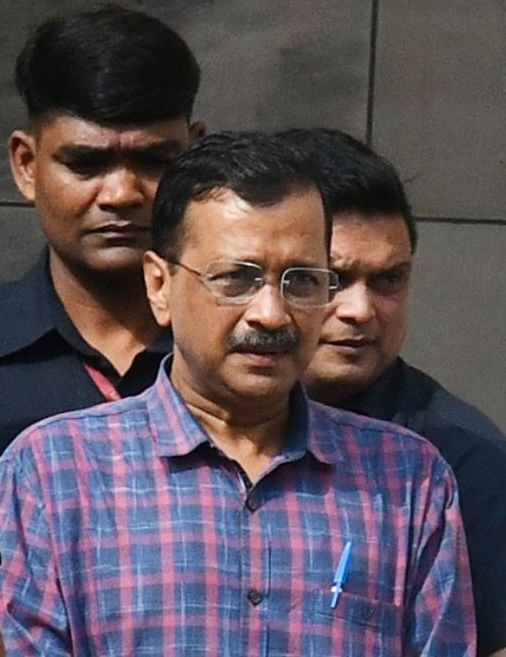
Arvind Kejriwal being arrested in March

Apart from the overall totals of parliamentary seats, there are two specific results which could seriously undermine Modi’s success. One is the southern states where the BJP may not do well, despite Modi having spent a large amount of time trying to achieve a breakthrough.

The other is Delhi where there may be an anti-BJP sympathy vote for the Aam Aadmi Party (AAP). A few days after the election dates were announced in March, the finance ministry’s enforcement directorate arrested Arvind Kejriwal, Delhi’s AAP chief minister.

The directorate was investigating long-running corruption charges on a liquor licence scam and had already detained the deputy chief minister. This was part of a Modi campaign to remove Kejriwal and break the AAP that dates back to the small party gaining power in 2015 when the BJP had expected to win. 

The supreme court released Kejriwal on bail on May 10 so that he could take part in the general election amid widespread condemnation for the way that the government was using the enforcement directorate and other crime agencies to undermine non-BJP parties in various states.

What seems to be certain is that Modi will be forming a new government next week and that there is no prospect of the focus on establishing a dominant Hindu nation being reduced – indeed, the reverse is likely, for better or for worse. 

Takes unprepared MPs and Ministers by surprise as inflation falls

Big Labour victory expected in polls on July 4th

The days of Britain having a prime minister of Indian origin are almost over, for several years at least. Rishi Sunak declared yesterday that there will be a general election on July 4, several months earlier than had been expected. There is little prospect of his Conservative Party being re-elected. 

Indeed, the chances of Sunak winning are no more likely than Narendra Modi doing seriously badly in India’s current election. Sunak may not lose as disastrously as most pundits are forecasting with his party being virtually wiped out, and Modi may not win as overwhelmingly as seemed likely, but the results are as certain as can be, and Sir Keir Starmer, leader of the Labour Party, can expect to become prime minister on July 5.

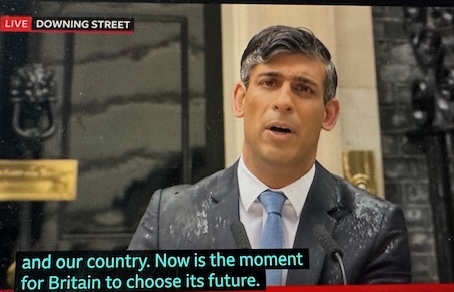
Sunak stood in pouring rain yesterday evening in Downing Street to announce that he was calling the election. His speech was heavily focussed on the economy and security at “this most uncertain of times”. The visual image was spoiled by Sunak being drenched in the rain and the audio by sounds of the Labour Party-favoured song “Things Can Only Get Better” being boomed out at the end of the street.

It has for some months seemed to be the time for Sunak and his government to pack up and go. He was elected by Conservative MPs to be their leader, and thus the prime minister, in October 2022. The task was to bring some sanity and responsibility to Downing Street after two disastrous prime ministers, the blatantly dishonest rule-breaking Boris Johnson who led the UK into a much-regretted Brexit, and the 45 days of disastrous economic experiments from Liz Truss.

Sunak inherited the effects of the Covid pandemic and Russia’s invasion of Ukraine. He had early successes, including a long-delayed Brexit trade protocol for Northern Ireland in March last year. He also maintained Britain’s prominent role supporting Ukraine.  

But his personal popularity has slumped in recent months, and he has cut a lonely figure, lacking political charisma. He has an earnest energetic style that focusses on details rather than pitching a positive overall image that could have public appeal. Opponents on the right wing of his party were ready to mount a coup to oust him at the beginning of this month when the Conservatives did badly in local and regional elections, but he just survived.

The election announcement was totally unexpected yesterday. Most ministers and all MPs were assuming they would continue with their jobs for several more months . Rumours that might not happen started circulating among MPs and some journalists around midday when news spread that the foreign secretary, Lord (David) Cameron, was cutting short a trip to Albania. The defence minister Grant Shapps delayed a foreign trip, and other ministers readied for a cabinet meeting in the afternoon.

It appears that Sunak decided to go now rather than in the autumn because the economy is looking more buoyant than it has for some time, and there is little prospect of the government being able to afford popularity- boosting tax cuts in the autumn.

.It was announced yesterday morning that inflation dropped during April from 3.2% to 2.3%, the lowest since 2021 (with an 11% high in 2022), though food and other key prices remain high. Economic growth is also picking up – faster than in Germany and France, though it is still below 1%. 

Sunak must have reckoned that this is the best that it is likely to get because he can claim to have fulfilled two of five pledges he rashly made in January last year. The three he has failed on are curbing the flow of immigrant boats crossing the English Channel from France and despatching some to Rwanda, reducing National Health Service waiting lists and reducing national debit.

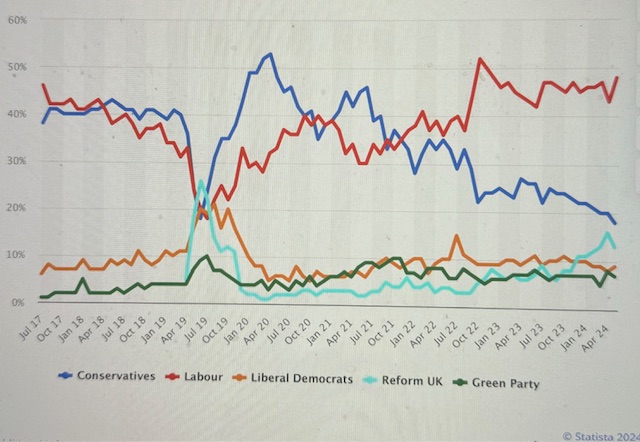
Popularity opinion polls show the Conservatives have been dropping sharply and are now down to 23%, way below Labour at 45%. Ominously for Sunak, the right-wing Reform Party (previously the Brexit Party) is on 11% with the Liberal-Democrats at 9%. Reform’s candidates will eat into the Conservative vote, strengthening Labour’s likely majority.

Labour’s problem however is that Starmer, who was awarded his knighthood after being the director of public prosecutions some years ago, does not have a strong public following. There is little evidence that voters see him as the essential prime minister that the UK needs. His competence is not in doubt, though he has not been tested in a ministerial post.

The Economist has a complex model with a range of options for the result centred on 381 seats for Labour (326 is needed for a majority) with the Conservatives on 192, the Liberal-Democrats on 22, the Scottish National Party on 27, and the right-wing Reform Party maybe 19. 

Commentary in the British newspapers yesterday evening was mostly critical of the decision to have the election now rather than towards the end of the year – the deadline is at the end of next January.

The FT headlined “A last gamble for a prime minister who has run out of road”, saying “with nothing on the horizon likely to dramatically improve, Sunak has decided to seize the economic moment”. The Economistsaid said “The prime minister’s decision makes little sense but it is good news all the same”, and The Times offered “Rishi Sunak surely cannot believe the Tories can win an election”. 

The Telegraph demonstrated its true-blue sympathies with a columnist writiing: “There are just 1,000 hours to save Britain. Rishi Sunak must expose Labour’s socialist agenda and give conservatives clear new reasons to back him.”

Crisis list

Whoever wins, there are numerous crises to be faced. A list has been drawn up by Sue Gray, a former top civil servant who is now Starmer’s chief of staff. Dubbed by a Labour MP as “Sue’s shit list”, it includes the potential financial collapse of the major Thames Water private sector utility, public sector pay negotiations, crisis-level overcrowding in prisons, universities finances “going under”, NHS funding shortfall, and bankrupt local councils.

The next government will also have to tackle how the public sector handles major crises, frequently burying them to protect those involved instead of finding solutions. There are two current examples in the news this week. One is an official report into the deaths of an astonishing total of 30,000 people as a result of contaminated blood transfusions given by the NHS in the 1970s and 1980s after childbirth, surgery, or major trauma. Other countries dealt with this crisis decades ago, but it has taken till now for an official report to be published. The other case involves the (privatised) Post Office, where hundreds of people running small post offices were wrongly prosecuted and convicted of embezzlement between 1999 and 2015 following cash losses that were being caused by a faulty Fujitsu computer system.

Sunak, whose parents moved to the UK from East Africa, has taken a huge gamble by going for the election now instead of waiting till the autumn or the end of the year, He probably hopes to minimise the size of the defeat, rather than actually expecting to win what would be a fifth consecutive victory for the Conservatives.

But he has never shown much skill at managing politics, so critics in his party and others are waiting to see whether this is his final big misjudgement because, if the Conservatives do seriously badly, he will be blamed for acting too hastily a few hours after the favourable inflation figures.

« Newer Posts - Older Posts »

Categories