Posted by: John Elliott | March 24, 2014

Kejriwal’s AAP offers India much-needed political disruption

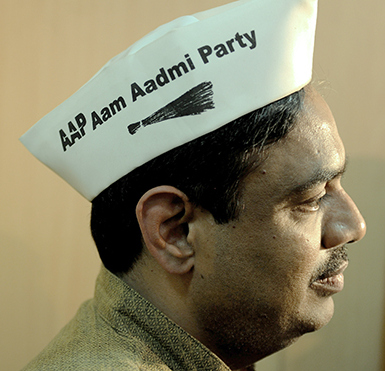
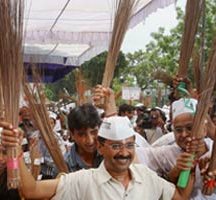
Indian voters have three basic choices in the coming general election. The bravest would be to vote for the Aam Aadmi (common man) Party, led by Arvind Kejriwal (below), in order to create the disruption that the operations of India’s political system and government machine desperately needs.

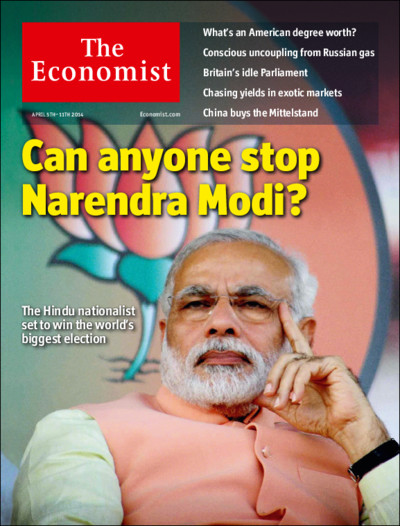
13kejri1 Redfiff.com - March 14 '14-001Most voters of course will not do that. It looks as if they will instead vote overwhelmingly for the Bharatiya Janata Party and Narendra Modi, its prime ministerial candidate, in order to get what they hope will be instant change in terms of economic growth and business confidence, while leaving unchanged most of the existing corrupt basic system of political power, graft and patronage.

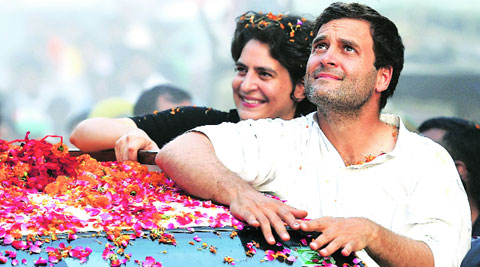
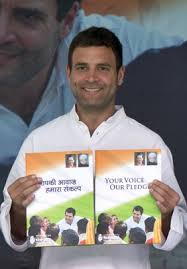
Others will vote despairingly for Congress led by Rahul Gandhi and his mother Sonia because they fear Modi’s controversial reputation as Gujarat chief minister and the BJP’s creeping Hindu nationalism that will insinuate its way divisively into people’s daily lives.

This means that the key unknowns in the election are not whether the BJP will win – it will – but whether the AAP will surprise critics and win support, and maybe even seats, across the country, not just in and around its power centre of Delhi. The other unknown is whether Congress will do so badly that it falls below 100 seats in the 543 seat elected legislature.

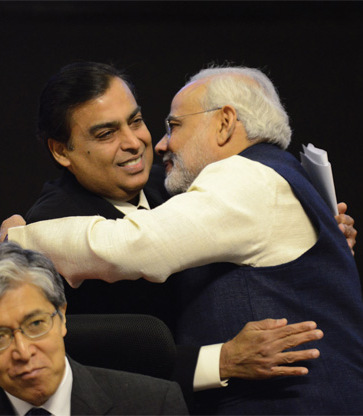
Critics like to call Kejriwal, the 45-year old former tax official who founded the AAP, an anarchist. Arun Jaitley, a top BJP politician, has dubbed him an  “Urban Maoists”, a phrase that has been gleefully repeated by BJP supporters – notably on a chat show on CNN-IBN, a tv channel financially controlled by Mukesh Ambani of the Reliance (RIL) group who is a keen Modi supporter (seen together below).

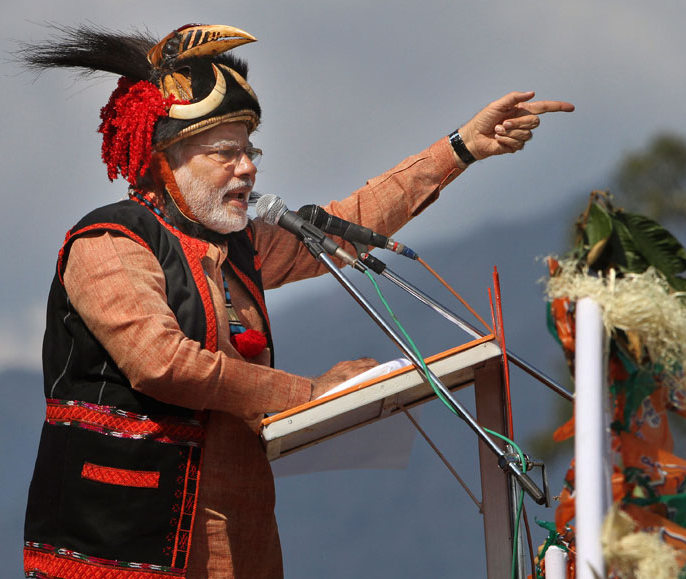
Narendra Modi in Arunachal Pradesh  wearing a the traditional dumluk headgear of the local Adi tribe

Narendra Modi in Arunachal Pradesh wearing a the traditional dumluk headgear of the local Adi tribe

Kejriwal and his people do show some aspects of anarchy because, expanding from their original anti-corruption base, they want to overthrow the current political order that they regard as immoral. Kejriwal says the AAP is “not in this for electoral politics but to change the system”.

And they do behave as agitators rather than conventional politicians.

They are however neither anarchists nor Maoists because they want to reform the parliamentary system from within, not overthrow it (which is the aim of India’s more rural Maoists, usually known as Naxalites).

Ahmed Rashid, a leading Pakistani journalist and regional analyst, who heard Kejriwal speak at the India Today Conclave earlier this month, told me that the AAP leader was what Imran Khan, the former cricketer and leader of a Pakistan political party, should have been. Imran wasn’t what was needed “because he doesn’t know the country”, whereas there was “no other politician like Kejriwal in South Asia because of his mastery of facts and figures on poverty and deprivation”. (Rashid could have added that Imran is widely regarded as intellectually “dim”, which Kejriwal is not).

The system certainly needs reforming if India is to avoid the gradual implosion of institutions that I describe in my recently published best-selling book ( click here and see below). Crony capitalism involving corrupt extortionist politicians and bureaucrats in league with business at all levels, together with corrupt judges and cruel and often corrupt police, are gradually whittling away at institutions and are crippling India’s economic and social base.

Modi can change some of that – dramatically compared with the way that the government has been run by prime minister Manmohan Singh and his political bosses Sonia and (recently) Rahul Gandhi. He can gradually introduce growth-oriented policies and, if he appoints competent ministers and strong top bureaucrats, can transform India’s short-term image. More on that nearer the elections

modi_ambani- AFPHe is reputed to run a basically clean government in Gujarat where he has been chief minister since 2002, but there are nevertheless widespread hints of crony capitalism.

Kejriwal has done the country a service by mentioning two groups in particular – Reliance, whose Ambani family originated in Gujarat, and the Gujarat-based Adani group that has grown exponentially in infrastructure and allied industries during the past ten or so years.

Politicians – and most other opinion formers – rarely dare to attack Reliance. Kejriwal’s allegations of Ambani holding hidden bank accounts abroad and  receiving business favours in Modi’s Gujarat were sensitive enough for Reliance to issue denials on social media with U-Tube videos.

Such disruptive allegations are not welcomed by India’s establishment, and indeed the AAP’s message of wider disruption is not welcomed by many Indian voters who habitually resist change and tolerate their lot. People grumble about corruption and bad governance and took to the streets three years ago in mass country-wide protests that led to the creation of the AAP. Now, however, most want Modi to produce growth and stop the more outrageous top-level corruption practised by the current government.

The way that the AAP behaved during the 49 days from last December that it ran the government of Delhi, with Kejriwal as chief minister, is widely criticised. Kejriwal and his ministers hit the headlines more for staging street-level demonstrations and other visible protests than for sitting in their offices taking conventional decisions. The law minister clashed with police when he tried to take over their job and ordered them around on the streets. But AAP spokesman, Rahul Mehra, lists the successes as tackling low-level corruption, especially in the police, and producing short-term solutions on electricity and water supplies.

Kejriwal resigned after the 49 days because the AAP’s anti-corruption (Lok Pal ombudsman) legalisation was blocked  by the central government, which now temporarily runs Delhi under what is know as president’s rule till new elections are held later in the year.

That failure to perform as a rational and conventional government has dismayed middle class supporters, though many of them are still prepared to give the AAP continued support. It also looks as if Kejriwal has expanded his base among the poorer groups, who recognise the value for them of what the AAP was trying to do in Delhi and have none of the middle-class aversion to the Kejriwal style of upheaval.

Kejriwal combines being an astute street-level performer with a serious side that he displays when he meets people in calmer situations.  I watched him impress the India Today Conclave audience when, apart from some probably valid but also over-egged criticisms of Modi’s Gujarat (where he had just made a high profile visit), he produced sound facts and reason to support his criticisms and claims. With smaller groups, he talks knowledgably about policies – for example on foreign investment in supermarkets, which the AAP blocked in Delhi but which Kejriwal is prepared to support if positive evidence is produced.

Neither he nor his party is however yet ready for government, not in Delhi and obviously not nationally. Their main value is that they are affecting the way parties think and speak – Rahul Gandhi in particular voices Kejriwal’s line about devolving power to the people and their local representatives.

The next few weeks will show how far the AAP can go. It has announced 350 candidates and there are more to come.

Kejriwal has sharpened the contest with Modi by announcing [March 25] that he is  standing against him in the key Uttar Pradesh constituency of Varanasi on the banks of the Ganges, which could generate violent clashes.

The candidates are an odd medley of activists, teachers, journalists, ex-bureaucrats and opportunistic politicians defecting from other parties. Inevitably, for such a new and rapidly growing party, there are multiple egos and little cohesion.

If the AAP only wins a few of Delhi’s seven parliamentary constituencies, it will be seen as locally significant but little more. It will be able to declare moderate success if it wins ten seats or more in other constituencies, maybe some adjacent to Delhi and others further away. Its success nationally will depend partly on whether it manages to draw voters away from regional parties, which logically it should be able to do in places like UP, Bihar, and Tamil Nadu where locally based parties are even more corrupt that the Congress and BJP.

Kejriwal claims – almost certainly unrealistically – that the AAP will win 100 seats, and that Congress will get below that number. That would make the party a leading opposition force, but the figure is regarded by almost all observers as unlikely. India, they say, is not yet ready for such a Tryst with Reality, or is it?

Photograph of Arvind Kejriwal courtesy: Uttam Ghosh/Rediff.com?

Details of where my best-selling book IMPLOSION – India’s Tryst with Reality can be bought:

HARD COPIES of IMPLOSION

INDIA – in all major bookshops and at Flipkart.com http://bit.ly/1ghRWnA  

PAKISTAN – available on pre-order from Liberty Books  http://bit.ly/1lgfcWh

SRI LANKA – available soon

INTERNATIONALLY – despatch by Amazon UK and US within a few weeks

E-BOOKS of IMPLOSION

INDIA AND INTERNATIONALLY – available on-line later this week

 E-SINGLE of SCAM ANDHRA in HARPER21 pre-election series

Harper Collins has issued a chapter from the book on Andhra Pradesh’s crony capitalism titled SCAM ANDHRA in a pre-election series of ten politics and governance e-singles – available from Rs16 and $0.77

INDIA – on Flipkart for Rs16 http://bit.ly/1jm7qKr

            – on Google on-line store for Rs21 http://bit.ly/1oTBc8q   

INTERNATIONALLY – Amazon.com at $0.77 or equivalent http://amzn.to/1fU2Mex

A few days after May 16, India’s Congress Party and the Gandhi family that heads it will have been swept from power and a new government led quite probably by Narendra Modi, the Hindu-nationalist driven and feared Bharatiya Janata Party chief minister of Gujarat, will take office. This will, if the BJP has a sufficiently large mandate, lead to significant changes across a wide range of policies, and will give the business community and financial markets a surge of optimism

The dates for the polls, which were announced by the Election Commission this morning, run from April 7 to May 12 and involve 814m voter (100m more than in 2009), and 930,000 voting stations (up 12%). The count will take place on May 16, and the results will be announced quickly on that day throughIndia’s electronic voting system. How quickly a government is formed will depend on how clear the result is, and whether the BJP needs to win support from more parties to add to its National Democratic Alliance (NDA) coalition total.

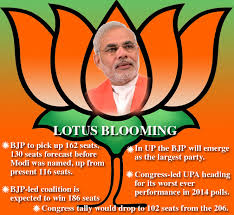
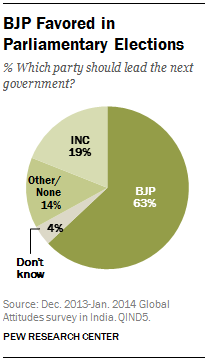
PG-indian-political-02-26-2014-01 It is of course impossible to forecast the result but, judging by recent polls,   (left and below) Congress and its underachieving leader Rahul Gandhi and his mother Sonia are heading for a catastrophic defeat. So great is the expected drubbing that some commentators are wondering whether Congress will survive till the next election, or whether it will splinter and reform in some way with a new anti-corruption Aam Aadmi Party (AAP) that did astonishingly well in Delhi state assembly elections at the end of last year

That is a rather extreme theory and whether it has any prospect of happening depends on the number of seats that Congress wins. If it manages 100, then Rahul Gandhi will surely be given a chance to fight another election, but if it were under say 40 or 50, all bets would be off.

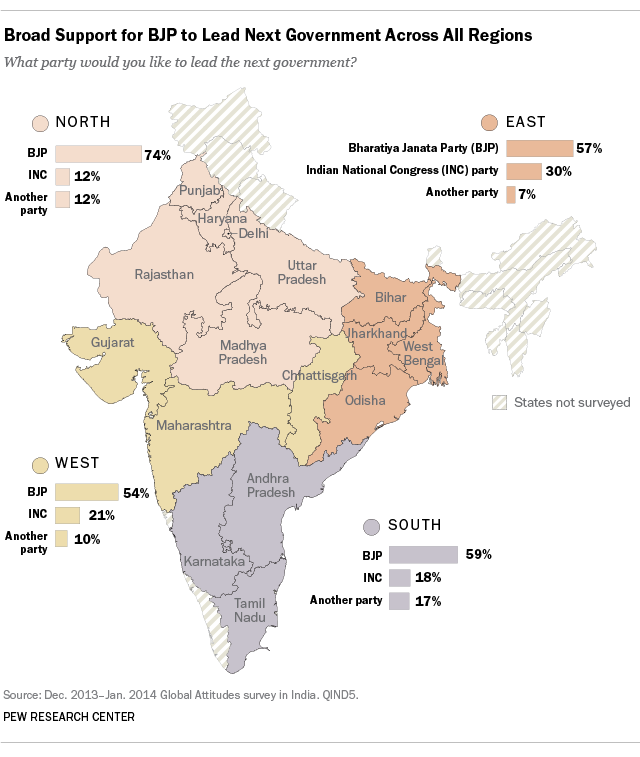
Polls indicate that Modi is gaining broad support across the country, including areas in the south (see map below) where the BJP has never had a base, as well as in the key northern state of Uttar Pradesh where Modi seems to be rebuilding the BJP’s former appeal. The question is whether that leads the BJP and its allies in the NDA to win 200 or more seats, and whether Modi would then be able to gain enough others parties’ support to reach the 272 needed for a majority in the Lok Sabha.

modi1_jpg_1583447gSuch a result seems probable following extensive campaigning by Modi who is establishing his potential as a national economic growth-oriented leader and, in the process, is reducing the negative effect of Gujarat’s 2002 riots for which he is widely held responsible, despite exoneration by the courts

The unknown here is the AAP, which ruled Delhi for just 45 days and then resigned because an anti-corruption Lok Pal (ombudsman) bill that it wanted to introduce was not allowed under the constitution.

During those 45 days, it ruled unconventionally and chaotically with its leader Arvind Kejriwal staging sit-ins and other street level demonstrations instead of conventional office and state assembly activities.

That has led the middle class, which formed Kejriwal’s original anti-corruption support base, to despair. But he has, reports suggest, increased his appeal among the less well off and the AAP is likely to do well in Delhi’s general election constituencies. It seems unlikely but not impossible that it will manage to repeat its Delhi type of surprise result elsewhere and win enough seats to become a significant player after the election.

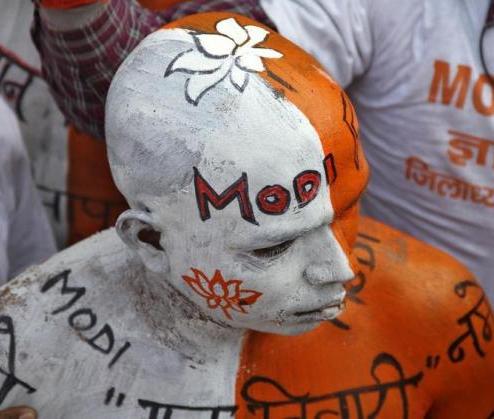
Modi supporter Lucknow - Reuters-PawanKumar March 2 '14-001If Modi fails to do as well as polls currently suggest, regional parties will become significant,  some of whom  last week formed what is termed a “third front”, raising the possibility of a muddled directionless coalition.

Various ambitious regional leaders are developing prime ministerial ambitions – they range from the erratic unpredictable Mamata Banerjee of West Bengal and the more middle class but unreliable J.Jayalalitha of Tamil Nadu, to Nitish Kumar of Bihar, whose political fortunes have slipped in recent months.

As a journalist I have often been queried on my use of the words ‘Hindu nationalist’ for the BJP, but Modi has disposed of that problem because he described himself as one in an interview last year with Reuters. “I am nationalist. I’m patriotic. Nothing is wrong. I am born Hindu. Nothing is wrong. So I’m a Hindu nationalist. So yes, you can say I’m a Hindu nationalist because I’m a born Hindu,” he told Reuters news agency in an interview in his official Gujarat residence in Gandhinagar.

So watch out for a nationalist Hindu-inclined surge across the country if the election produces the result that, on present indications, seems likely.

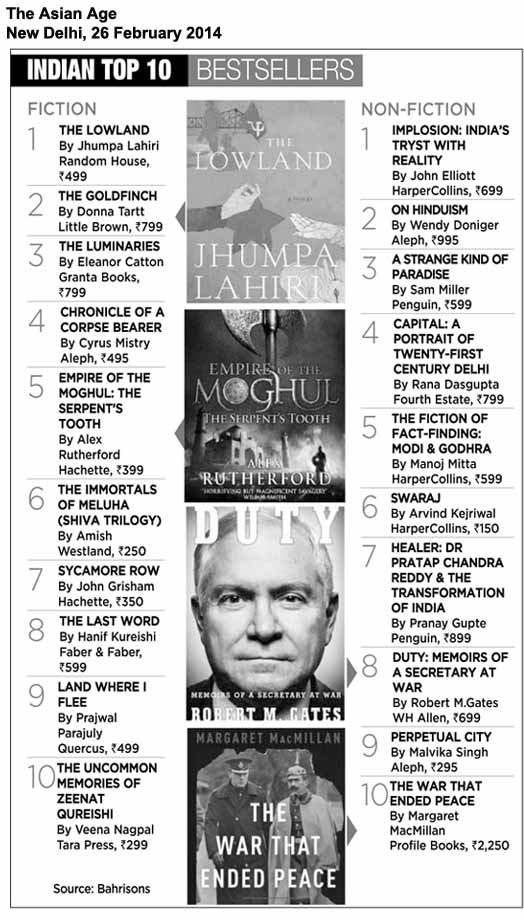
My book IMPLOSION: India’s Tryst with Reality has today topped Asian Age’s non-fiction sales for the second week running –  buy it at http://www.flipkart.com/implosion-indias-tryst-reality/p/itmdsw6npfv3evaf?pid=9789350297353 

PG_14.02.25_IndiaElection_640px

Posted by: John Elliott | February 26, 2014

My IMPLOSION book tops Best Seller list in Delhi!

My book  IMPLOSION: India’s Tryst with Reality is top of the Asian Age New Delhi non-fiction best seller list !

Asian Age New Delhi bestseller list April 26 '14

Posted by: John Elliott | February 23, 2014

MPs joke and laugh as the workings of parliament implode

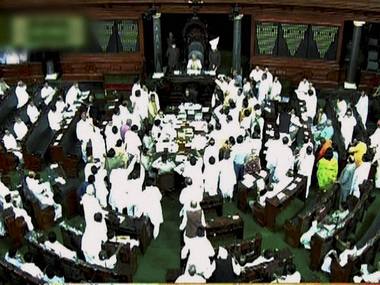
Government ministers, leaders of other political parties and MPs laughed and joked their way though the final session of India’s five year parliament even though it has been the worst ever in terms of achievements and performance, and has been marked more by protests and demonstrations than by debate and decisions.

Disruptions stopped parliament working for 37% of allotted time. More than 70 of the 289 bills introduced were not dealt with and lapsed and 20 were passed with debates lasting less than five minutes Violent attacks peaked when a pepper spray was used last week. That led to three Congress MPs acting as bouncers, standing close to Palaniappan Chidambaram, the finance minister, when he presented his pre-election mini-budget to ward off anyone who tried to assault him and grab his papers, as had happened to other speakers in recent months.

.

.

Such is the depths to which this pillar of India’s democratic institutions has sunk.

This illustrates the collapse of respect for institutions – and the gradual imploding of the institutions themselves – that is one of the themes of my new book IMPLOSION: India’s Tryst with Reality that was published this week and is now available in bookshops and on-line sales across India.

Yet MPs complimented and fawned on each other in the closing session last Friday. Sonia was “a graceful leader”, said Sushma Swaraj, the BJP’s leader of the opposition. The BJP veteran leader, L.K. Advani, was “seen with moist eyes” according to the Hindustan Times . Sushilkumar Shinde, the ineffectual Home Minister, told ” Swaraj your tone is sweet, sweeter than sweets “, even though she is better known for screeching. Mulayam Singh Yadav, leader of the Uttar Pradesh’s Samajwadi Party, thanked Sonia  Gandhi, saying she had always acted “whenever I passed on slips requesting something” – better slips than suitcases, or were they promissory notes, one might wonder!

The MPs have reason to be pleased with themselves because they know that India’s traditional tolerance of non-performance and corruption will enable them to return after the general election that is due in April-May and behave just as badly again. Though the BJP disrupted parliament for months during this parliament, the precedent was set by the Congress when it was in opposition during the 1998-2004 BJP government’s time. The MPs know that India is too large and diverse a society for them to be ousted in a coup or by Arab Spring type mass demonstrations, and many revel in the weakening of institutions because it increases their powers of patronage and opportunity for corrupt fixes.

.

.

In my book, I argue that the role of politics, democracy, governments, institutions, laws and regulations, which were lauded 20 to 30 years ago as India’s special strengths, have been progressively undermined. They have been replaced by arbitrary powers wielded by individuals, be they ministers, bureaucrats, policemen, or regional politicians and gang bosses.

Democracy, which provides for MPs and their equivalents in state assemblies to run riot instead of debating and passing laws, does India damage in other ways. In my book, the conclusions chapter says:

“India has been in a state of denial for years. It is rightly proud of its vibrant and chaotic democracy that has survived and been accepted almost without question across this vast and diverse country for over 65 years. But it is in denial because it has not been prepared to recognise that the vagaries of democracy are providing smokescreens that obfuscate many of the negative aspects of how the country works.

Democracy is a fig leaf

Democracy creates an environment where jugaad fixes are easy, and where the failures of the system in terms of poor governance and weakened institutions make the fatalism of chalta hai a welcome safe haven. Democracy has therefore become an unchallengeable fig leaf covering what is not achieved. It allows the negative and underperforming aspects of Indian life to flourish, and it blocks changes and acts as an excuse for what is not being achieved.

“The country can no longer afford to allow this to continue. If it does, systems will deteriorate further, possibly leading to implosions as the functioning of institutions is undermined and destroyed. India is far too large and diverse for a revolution to gain hold and dramatically change the way that it is run, but implosion, where  government authority crumbles, systems break down, society becomes more lawless, and investment and growth slumps, can
already be seen.

“This is not an argument for doing away with democracy, but to recognise and change the negative way in which it operates. Democracy has helped to hold India together since independence, providing an outlet for people’s frustrations and anger, sometimes ousting prime ministers, chief ministers and their governments.

“Though far from perfect, it has given the great mass of the population a feeling that they have a say in how the country is run, however faint and rare that may be and however much they are cheated and maltreated by those they elect.

“But it has also provided an excuse and a cover for the gradual criminalisation of politics that has been allowed to grow for decades to such an extent that election campaigns are distorted, large bribes are paid when coalitions are being formed, and many members of parliament and state assemblies have criminal charges pending against them, often for serious offences.

“Democracy is also used as an excuse for ineffective government…..But, while the recent years have been bad, the problems are deeper and will not be solved simply by switching to another prime minister or political party that carries the baggage of the past.

“The mission of legitimate governments should be to create inclusive economic development with a sharing of wealth and governance by strong, impartial institutions. On that count, India has failed as corruption and bad governance have facilitated the emergence of a self-serving political system, a politicised bureaucracy, an unprofessionaljudiciary, and mindless and often cruel policing.”

My book  IMPLOSION: India’s Tryst with Reality now at 30% discount on Flipkart http://www.flipkart.com/implosion-indias-tryst-reality/p/itmdsw6npfv3evaf?pid=9789350297353&utm_campaign=EM-U7UT4J9RT1KD&utm_medium=email&utm_source=promo&utm_content=click&affid=EM-U7UT4J9RT1KD&cmpid=email_promo_EM-U7UT4J9RT1KD …


British Council launch Feb 18 '14

IMPLOSION: India’s Tryst with Reality was launched with great success at the British Council in Delhi earlier this week and is now on saleIndia Today has put up on the internet a copy of a five-page spread that appeared in the magazine last weekend – here’s a report and excerpts:

‘The Inheritance of Loss – John Elliott describes Congress descent into chaos’ by Sharla Bazliel 

“John Elliott is an old India hand who belongs to that delightful breed of Englishmen for whom India became home without any obvious forethought or design. “I didn’t stay, I just never left. There is a difference,” Elliott is quick to emphasise…

book-mos_021514020242“Much like its subject itself, Implosion is a large, sprawling book, an excellent primer of sorts for anyone interested in learning why India has come to this impasse. Elliott goes to great lengths to examine how and why the nation has squandered its massive potential and fallen prey to greed, wastage and arrogant displays of wealth.

“Implosion is a refreshingly clear-eyed look at a society ridden by corruption and made ineffectual by an overwhelming dependence on the ‘national approach’ of jugaad and a chalta hai attitude. ‘I didn’t set out to write a negative book. It grew into one. India was a country which greatly appealed to me in the 1980s when I first came here. I once thought of it as a country that would only get better with time,’ Elliott says. But then it didn’t”

EXCERPTS……..

“We have got to get rid of the cobwebs,’ Prime Minister P.V. Narasimha Rao told top officials on 21 June 1991, the day he formed his new Congress government. Go away to your office, he said to Manmohan Singh, and work out some details.

Thus was born, with a classic understatement, India’s biggest burst of economic liberalization that, over the past 25 years, has touched almost every corner of this vast country and affected the lives of virtually everyone in the billion plus population. Chalta hai had been pushed aside by a dire financial crisis, but none of the officials in Rao’s office that morning could have dreamed of the long-term effects of the measures they would be launching, and nor could he. They knew they were about to remove industrial, trade and financial controls that would help to solve the crisis by freeing up economic activity and generating international trade.

What happened, however, was far more dramatic. The moves they initiated gradually unleashed previously repressed entrepreneurial drive, skills and aspirations. This was accelerated by unpredictably rapid expansion of information technology and the internet, plus India’s growing involvement in international business and trade. Manmohan Singh was at the meeting because he was about to be named finance minister-he was sworn in later in the day with the rest of the cabinet…

The ‘M’ document

The 1991 reforms first appeared publicly on 11 July 1990 as an unsigned article headed ‘Towards a restructuring of industrial, trade & fiscal policies’ that was spread across a page and a half of the Financial Express newspaper. A note by the editor (A.M. Khusro) said that there had been ‘some controversy’ over a government policy paper that was being considered by a committee of secretaries, so the Express was publishing it ‘to generate a public debate on matters raised in the document’.

No one knew for sure who wrote the document, but Montek Singh Ahluwalia, one of India’s leading economic policy makers who now runs the Planning Commission as deputy chairman, has revealed to me that he was the author. Who leaked what was later dubbed the ‘M’ document-with the title page removed to hide its source-remains a mystery. Maybe it was Ahluwalia himself!

I tracked down the article because I was convinced that Manmohan Singh was not the architect of the reforms and had heard that Ahluwalia was said to have written something called ‘What’s left to be done’ at the end of Rajiv Gandhi’s 1984-89 government. I followed the trail till Ahluwalia told me in June 2013 about the ‘M’ document and admitted authorship, though he did not have a copy.

The Indian Express then searched its Chandigarh archives and later in the year found it and I passed a photostat to Ahluwalia, who said, ‘it takes me really down memory lane’. Ahluwalia confirmed that he initially wrote the ideas as an overview of ‘what needed to be done’ late in Gandhi’s government when he was an economic adviser in the prime minister’s office… The ideas were discussed by a high-level committee of secretaries (the top level of the civil service) and that became the Financial Express leak… Ahluwalia says that the paper was specially significant because it pulled together a comprehensive approach for tackling India’s economic problems and set out a five-year plan with firm objectives though it acknowledged it was bound to create more controversy.

Sonia and Rahul

Sonia Gandhi’s central political importance was demonstrated by the UPA government’s erratic behaviour while she was away ill…

Did the disarray while she was away develop because the government was missing her and her advisers’ sure touch, and had she developed a little-known sense of what needed to be done politically? Or were ministers and officials scared to make decisions that might arouse her (or Rahul’s) wrath later? Or was it because the Gandhi dynasty dominated government channels of authority and decision-making to such an extent that the cabinet and administration could not function without her? Whatever the answer-and maybe it was a mixture of all three-it certainly demonstrated how lost the government was without her.

Rahul played little part ……His appearances in parliament were rare, and he made only three important speeches and interventions in his ten years as an MP….

I noticed his lack of presence in an informal atmosphere one afternoon in August 2012 at Delhi’s Visual Arts gallery where he and Sonia Gandhi had gone (with impressively minimal security) to see works by Devangana Kumar, daughter of the Lok Sabha Speaker, Meira Kumar. Although she looked tired and unwell, Sonia had a presence, but what struck me most was how unimpressive Rahul looked on an occasion when he was not performing publicly.

He dutifully followed his mother around the exhibition but he showed scant curiosity while she asked questions about the socially significant works (photographs of servants of the British Raj reproduced as large prints on velvet). He did not have any of the presence and charisma that one would expect from a 42-year old leader.

This reticence made me wonder whether he could ever grow into the top role……..That Saturday afternoon, he looked as if he just wanted to fade away.”

From the left, Vikram Chandra and Pramod Bhasin. Right, Swapan Dasgupta

From the left, Vikram Chandra and Pramod Bhasin. Right, Swapan Dasgupta

My book IMPLOSION: India’s Tryst with Reality is being launched this evening and is now in bookshops in Delhi and on line – soon it will be across India – sales abroad will come later

BN-BO316_implos_G_20140217225726This morning the Wall Street Journal’s India Real Time news website has run an except with the headline above – see below and click here for the full spread. In the foreign policy chapters, I question India’s limited role abroad and its reluctance to emerge as an international player:

“India has learned that it can say ‘no’ to the US…and the US has learned – maybe with some surprise – that India is not prepared to become an obedient ally, and that it will not dutifully follow American wishes on foreign policy or on quickly opening up foreign investment regulations to hungry US companies….

There are however sceptics about the relationship in India, as well as those in the US who strongly believe India should be more docile and subservient. There will always be headlines about differences. Usually these will be on issues such as Iran and there is also concern in India about how determined the US is to support Asian countries against the sort of Chinese aggression seen in the East China Sea.

There will also be unexpected rows, as happened in December 2013 when US law officers suddenly arrested Devyani Khobragade, India’s 39-year-old deputy consul general in New York, just as she was dropping her daughter at school…..

The sharp reaction – and media frenzy – in India flushed out a latent anti-America feeling born of resentment of the way the US threw its weight around. As Stephen Cohen of the Brookings Institution in Washington was reported saying in the Financial Times, ‘we have created a myth that India is pro-America and that is not the case’..

Before this row broke out, the relationship had been drifting because of a lack of care in both countries with a weakly-led Indian embassy in the US and an American ambassador in Delhi who, though able, could not excite political support back home. There were few, if any, committed supporters in the Obama administration, and there were many officials and commentators in India who enjoyed taking a more aggressive stance.

The drift had increased as the Indian government and the country’s economy became weaker. The strategic dialogue was continuing but no top leader in either country was consistently pushing it ahead…….

Much has however been achieved, and a lasting ‘strategic partnership, not an alliance’ (as Menon [national security advisor Shivshankar Menon] put it) is in place after a decade of work. How it develops will depend largely on how America’s initiatives in the Asia-Pacific region play out, especially with China.

India’s role will depend on its reactions as those events unfold, and whether it has the will – and maybe one day the economic strength – to play a leading role in world affairs. Either way, the new relationship with the US has to be seen as a positive development, provided India maintains its independence as a friend and occasional partner but not an ally.

Follow India Real Time on Twitter @WSJIndia

Posted by: John Elliott | February 14, 2014

‘Scam Andhra’ MPs cripple parliament to protect business deals

Unprecedented chaos and violence that closed India’s Lok Sabha parliamentary proceedings yesterday graphically demonstrates how respect for India’s most revered institutions is crumbling as greed and raw politics disrupt the functioning of government and the running of the country.

The protests were not even about the political issue being debated – a Bill was being tabled to split the southern state of Andhra Pradesh and create a new state of Telangana. They were primarily about protecting businessmen’s investments in Andhra’s capital of Hyderabad and elsewhere in the state, where crony capitalism and corruption ran rampant under a former chief minister, Y.S.Rajasekhara Reddy, who was killed in a helicopter crash in 2009. The businessmen who thrived under YSR’s rule and did deals with his  son Jagan (now facing corruption charges) originally came from other parts of the state and think they will lose their investments and political clout if Telangana is formed.

Rajagopal - exCong MP-002Among the MPs who were most at fault – using a pepper spray, smashing a glass table top and allegedly brandishing a knife – two have possibly vulnerable investments in the city and elsewhere.

The pepper spray was wielded by Lagadapati Rajagopal, (left) founder and chairman of the highly indebted Lanco infrastructure group, which is India’s biggest private sector power producer. Venugopal Reddy, (below) who smashed a microphone on a glass table top, heads the Ramky group that benefited under the YSR regime and is involved in the corruption charges.

But it is not only these MPs who are at fault. The crisis has been caused by the Congress Party led by Sonia Gandhi, which has gone ahead with the decades-old claim for Telangana – not for any good reason of governance, but because she believes it will could increase the number of seats her party wins in the coming general election.

My book IMPLOSION: India’s Tryst with Reality, which is being launched next week in Delhi by Harper Collins India (and is available here), has a chapter headed Scam Andhra. I describe the state as a microcosm of what is wrong in India because of “corruption and illicit links between companies and government that are now part of India’s political and business landscape”.

Implosion is defined as inward collapse when internal forces “gradually eat away at institutions, organizational procedures and the functioning of authority that are needed to run a country”.

.

.

Here are extracts from the chapter:

“The city has become a symbol of what is wrong with India. It embraces dynastic political ambitions based on personal greed and the lauding of companies that have grown fat on fraudulent land and other deals, literally plundering the state’s wealth. The trend first became widely noticed in 2009, when the Hyderabad-based Satyam, India’s fourth largest software company, collapsed in a fraud scandal involving local politicians and a prominent business family….

“Satyam and its allied infrastructure company, Maytas (Satyam spelt in reverse), were just the tip of a vast iceberg that gradually became exposed after the state’s Congress chief minister, Y.S. Rajasekhara Reddy (YSR), was killed in a helicopter crash in September 2009. YSR’s death, just a few months after being re-elected for a second term, triggered a series of events that led to widespread police inquiries, court cases, and the jailing of businessmen and politicians.

“Businessmen involved in the state’s companies form a new entrepreneurial community that is significant in the same way as clans such as the Marwaris or the Chettiars….With easily identifiable names like Reddy, Raju and Rao, the Andhra businessmen travelled [across] Andhra, bearing farming wealth from the state’s flourishing coastal regions to Hyderabad…..There they worked with politicians, and together grew rich in real estate, land deals and infrastructure projects – and then became involved in politics themselves….

“Among the most powerful and vocal anti-Telangana politicians have been Lagadapati Rajagopal, founder of the once rapidly-growing but now heavily-indebted Lanco Infratech infrastructure, power and construction group…..he was one of the financiers of a padayatra in 2003 by YSR that helped to bring him to power.  Rajagopal’s development plans in and around Hyderabad could be hit hard if the state is split.…

“YSR proved himself to be one of India’s most skilful regional politicians, seemingly working for the good of the state and the rural poor, while building himself an unassailable Congress power base by providing the Gandhi family with strong loyalty and support. That won him a comfortable re-election victory five months before he was killed, despite reports of widespread corruption and corporate cronyism that had been circulating about him and his son Jagan for some time….

”YSR’s significance was demonstrated by the huge mass of mourners – from Sonia Gandhi and Manmohan Singh to the rural poor – who gathered to pay their last respects at his funeral….If YSR had lived, it is reasonable to assume that the projects, corruption, kickbacks and funding would still be continuing today, with grateful Congress party leaders in Delhi doting on their loyal and valuable friend….

“Sonia Gandhi and her fellow national party leaders appear to have done nothing during YSR’s rule to stop the corrupt deals, even though they would have been fully aware of them. There were reports that YSR was ‘sending huge sums of money for the Congress in Delhi every month in the name of ‘organisational expenses’….

“YSR came from a tough and feudal society background in Rayalaseema, which is frequently named for its ‘bad lands’, and his rise reflects how many of India’s regional politicians have grown rich and powerful from poor origins. His family mixed Christian missionary work with business in the rough mining industry and there is death and brutality in the family’s history…..

“While he was chief minister, YSR moved on from the usual pattern of corruption – politicians and bureaucrats taking bribes in return for favours – and secured the loyalty of his supporters by providing business opportunities for contractors in unregulated, over-priced and scam-ridden irrigation, highways and other projects. The contractors and developers showed their gratitude by taking stakes in companies run by Jagan, mainly in a media business called Sakshi, and politicians and others cronies invested in the development and real estate schemes. Instead of just taking kickbacks, YSR’s family and political associates became joint investors and stakeholders with their business contacts…..

Venugopal Reddy - TDP-001“Along with other key companies that he controlled with investments totalling Rs 797 crore, Jagati Publications became a focal point in 2012 and 2013 for investigations into money laundering by India’s Enforcement Directorate, and for separate corruption inquiries by the CBI into Jagan’s alleged ‘disproportionate assets’….

“Companies caught up in the assets case included Tamil Nadu-based India Cements, run by N. Srinivasan, who has been a dominant figure in the politics of Indian cricket as the chairman of the Board of Control for Cricket in India (BCCI) from 2011. He was also involved in the IPL championship controversies…. The allegations [included] companies such as …. Ramky Group…. listed as allegedly providing funds for Bharathi Cement, Jagati Publications, Carmel Asia Holdings and other businesses run by Jagan, and receiving favours in return…..

GMR, GVK, Lanco

A clutch of Andhra companies that thrived….. went on to run big projects in the rest of India and then abroad. They include names such as Satyam in software, and GMR, GVK and Lanco in infrastructure… Lanco, is the most politically high profile of the three companies, having been led initially by Lagadapati Rajagopal, the Congress MP and a key YSR supporter…. His brother L. Madhusudan Rao and brother-in-law G. Bhaskara Rao now run the group, which claims to be India’s largest private sector power producer and also has coal mining interests in Australia. To improve its image, Lanco moved its headquarters from Hyderabad to Gurgaon on the outskirts of Delhi but it became over-extended and lost large-scale projects for lack of funds, pulled out of others, dismissed a large number of employees, and formally announced a debt-restructuring process in 2013…..

“Some time in the future, Andhra’s years of fraud and deception will almost certainly be seen, in the traditions of early American business, as merely one of the stepping stones that a new economy takes when it suddenly enjoys unexpected riches, and the prospect of much more, if politicians are suborned, rules bent and the state cheated”.

For now though, India faces creeping implosion.

Posted by: John Elliott | February 2, 2014

Moderate sales and lots of people keep the India Art Fair buoyant

IAFair 003-001Delhi’s annual India Art Fair, which closed tonight, is as important for the focus it brings to Indian art and for other events that happen at the same time across the city as it is for the show itself, which has settled into a predictable mould in its sixth year.

Indeed, the exhibitions away from the fair grounds that are featuring leading modern and contemporary artists are more exciting than the fair itself, which this year has lacked dramatic new contemporary displays. In a depressed market, galleries have been showing conventional works and there has been some criticism of a lack of consistent quality, especially with Indian galleries – “kitsch” was the unkind word used by one critic to describe some exhibits, responding to me saying it was all very “predictable”.

Maybe there is nothing wrong in that. Arguably, there is no reason why India should not produce its own version of art fairs in the same way that it challenges other foreign concepts of orderliness, quality and convention. That said, the fair does confound sceptics with its efficient organisation and presentation and, as I have written several times in earlier years, its importance is that it has successfully opened up interest in Indian modern and contemporary art both in India and abroad.

IAFair 007-001Thousands of visitors, including schoolchildren, who would never venture into formal art galleries, have been touring the stands, which provide them with access to culture that they would not otherwise experience. This is similar to the Jaipur Literature festival that I wrote about ten days ago, though there the audiences are building on their existing interest in books whereas the art fair is opening new vistas.

Established Indian collectors have been at the fair to see, and some to buy, instead of relying on internet images which, gallery owners tell me, astonishingly suffices for many buyers.

The fair also brings foreign visitors to Delhi – this year, for the first time, there is a group of gallery owners and collectors and artists from China, while Christie’s, one of the fair sponsors, has brought an international group. Neha Kirpal, the founder and director of he fair, says that last year 40% of the works sold went to first time buyers, some from what are known as second tier towns that do not have art events. Several gallery owners however are sceptical about that figure, echoing doubts about some of the claims of attendances in past years which Neha has comfortably and rounded off to a cumulative unchallengeable figure of 400,000 over the past five years.

IAFair 006The array of art on show has ranged from Picasso and Andy Warhol to India’s reliable body of progressives such as M.F. Husain, F.N.Souza and contemporary artists such as Atul Dodya and a spinning mud installation (left).

There were 91 exhibitors, the biggest of which is the Delhi Art Gallery with 330 works covering 400 sq metres. Nearly a third of the total exhibitors are from abroad, though some big international names, such as the Lisson Gallery from London and Hauser & Wirth from Zurich, have not returned after appearances four or five years ago.

This indicates some disappointment with a lack of sales to big buyers, and also frustration with shipping and other problems caused by India’s customs controls that make it impractical to bring many foreign works for sale.  “There is a risk of this not going much further if the organisers don’t develop a co-ordinated programme with collectors and corporate buyers,” says Carlos Cabral Nunes of Portugal’s Perve Galeria, reflecting the views of other foreign exhibitors.

A quick survey of stands this evening produced some unhappiness, like Nunes’ frustration about a lack of big sales, and most galleries that had done well sold works ranging from under Rs100,000 (£1,000, US$1,600) to four or five times that figure, though some went far higher. London’s Grosvenor Gallery did exceedingly well selling works by Olivia Fraser., a Delhi-based British painter with limited edition prints of new works that started at Rs50,000. Archer Art Galley of Ahmedabad did well with reproduction editiona of well-known artists starting at Rs15,000.

IAFair 015At the other end of the scale, Aicon Gallery of New York and London sold four works by established Indian masters, M.F.Husain and F.N.Souza, and a younger painter G.K.Irani, for between Rs400-500,000 to Rs1.5 crore (Rs15m).

Art Alive of Delhi sold a long Thota Vaikuntum (similar but smaller than the painting at the bottom of this article) that had been priced at Rs40 lakhs (Rs40m). Mark Hachim of Paris was also happy, selling lively works, all foreign,  and including digital prints in plastic boxes (right) from Euros 5,000 (Rs420,000). Sakshi Gallery of Mumbai’s sales included a tiffin (meal) container carried by Mumbai’s dabbawwallas who are pictured in the small buttons (above).

krishen_14exh_14213_large-001

Sadly, the crowds at the fair do not then go on to the more dramatic and important exhibitions away from the event. The government-controlled National Gallery of Modern Art is featuring a retrospective by Subodh Gupta, one of India’s most prominent contemporary artists, and a collection by Amrita Sher-Gill, one of the most important painters from the first half of the last century. The government-supported Lalit Kala Akadami has an intriguing collection of specially painted extra-long works by established “moderns” commissioned by a collector Tanuj Berry. Titled Ode to the Monumental, it includes paintings by Krishen Khanna (above) and Vaikuntum (bottom). These exhibitions  could have been linked more closely with the fair, especially since the Ode works are being offered for sale by Saffronart, India’s leading on-line auction house that should benefit from the buzz with an auction later this month.

cascadeSubodh Gupta is famous for his shiny stainless steel assemblies of household pots and pan, milk containers, scooters, motorbikes and airport luggage trollies that link his origins in Bihar, India’s poorest state, with modern living (left and below right). His works were a much-promoted and popular buy in the mid-2000s when, for example, a luggage trolley painting was sold in a Christie’s auction for a record $1.1m, but his prices crashed when collectors sold off Indian contemporary works in a falling market and a similar work fetched only £180,000 ($250,000) at Sotheby’s in 2010.

Now Gupta has bounced back with the normally staid NGMA devoting much of its public space to his Everything is Inside exhibition, together with the cachet of a foreign curator, Germano Celant from Italy. There is a new Penguin book on the show, and Gupta was also fortuitously one of the winners of a Forbes India art award this week as “contemporary artist of the year (mid career)”.

photo wc's 1-001Rather more hidden away at the National Gallery is, historically, a much more important showing of nearly 100 paintings by Amrita Sher-Gill who lived only to the age of 28, dying in 1941. In that short space of time, she produced an amazing range of mostly figurative works that rarely appear in auctions or galleries but are on display now with the title The Passionate Quest, curated by Yashodhara Dalmia.

Collectors will now be watching to see what effect these events have on the market. Christie’s had an amazingly good first auction in Mumbai in December that produced record prices but that has yet to have a visible impact.

On a broader front, experts have been saying that India should look eastwards to the buoyant Chinese and south-east Asian markets to develop links. That will now begin following the visit of collectors from China, led by Philip Dodd of Made in China. Among them was  Budi Tek, a prominent Chinese-Indonesian collector who is building a museum in Shanghai. He is considering buying a contemporary work from Delhi’s Espace Gallery. Earlier in the day, he said the Indian private sector needed to build museums and public awareness.

India always looks westwards to Europe and the US for foreign accolades and praise so it will, I guess, be some time before it recognises that looking east is where the future probably lies if Indian art is to appeal internationally to a wider audience than its present relatively small group of western collectors.

Vaikuntum long-001

Posted by: John Elliott | January 28, 2014

Rahul’s TV debut ideas are right but won’t win him votes

.

.

After ten years refusing to face a big media interview, Rahul Gandhi spent an hour and a half on a leading television channel at prime time last night explaining how he wants to reform the way that India and his Congress Party are run.

His aim, he said, was to end rule by dynasties, introduce real democracy in Congress, “change the away we do politics”, empower women and youth, punish the corrupt, and build an internationally significant manufacturing industry.

No one could write a better manifesto for making the changes that India desperately needs, but Gandhi failed to explain and add substance to his wish list with detailed policies. When pushed into a corner by the interviewer, he slipped sideways by retuning to his three priorities of changing politics, empowering women and energising the youth:

“What I want to do is going forward is basically focus on three things,” he said on the TimesNow tv channel. “Focus on empowering our people, truly empowering our people, giving them democratic rights within the political party.

“I want youngsters who come in and really, really push democracy in the party. I want to empower them and I want to make India, together with everybody, taking everybody together I want to put India on the manufacturing map, I want to make this the centre of manufacturing in the world. I want to make this place at least as much as a manufacturing power as China.

“What I feel is that this country needs to look at the fundamental issues at hand, the fundamental political issue at hand is that our Political system is controlled by too few people and we absolutely have to change the way our political system is structured, we have to change our Political parties, we have to make them more transparent, we have to change the processes that we use to elect candidates, we have to empower women in the political parties, that is where the meat of the issue but I don’t hear that discussion, I don’t hear the discussion about how are we actually choosing that candidate, that is never the discussion.”

He said (correctly!), “I am an anomaly in the environment that I’m in….I don’t get driven by the desire for power”. The “quest for power, the thirst for power” was not for him, but he w anted to use power “to reduce the pain that people feel, to reduce the pain that people feel as a result of the system that is predatory”

Rahul - Arnab 3

He also drew a sharp distinction between Congress and the rival Bharatiya Janata Party (BJP), saying that Congress believed in democratically spreading power while the BJP “believes power should be extremely concentrated in this country, few people should run this country and the large mass of this country should have no voice”. That sounded neat, but it dodged the fact that most national and local Congress leaders hold the same views as he ascribed to the BJP and do not welcome his ideas.

Gandhi was side-tracked for much of the 90 minutes into arguments about headline-catching issues such as the relative horror of anti-Sikh riots in 1984, when his father Rajiv Gandhi was prime minister, and Gujarat’s anti-Muslim riots in 2002 where Narendra Modi, the BJP’s abrasive prime ministerial candidate, was (and still is) chief minister.

His choice of tv station for his first such interview was curious because, instead of going for what might have been a gentler and more amenable and constructive interview on a channel such as NDTV, he chose TimesNow and its abrasive chief editor, Arnab Goswami (above), who is famous for his high-decibel confrontational chat shows. Goswami was quiet and relatively courteous, indeed sometimes almost mockingly obsequiously so, but he was much more interested in trying to trap Gandhi into potential headline gaffes than exploring detailed policies. I suspect that Rahul’s sister Priyanka was in the room for the interview, judging by his body language (he repeatedly glanced off-camera, as if for support, and once indicated to the side when he mentioned her). And it looked (from shots when he arrived and the Husain pictures on the walls) that it was done at Rajiv Gandhi Bhavan, headquarters of the Rajiv Gandhi Foundation where Priyanka has a leading role.

What did emerge was a categorical statement by Gandhi that he wants to end dynastic rule. That logically means that he could be the last in the line of the Nehru Gandhi dynasty that overall has not served India well through successive generations – as I suggest in my book, IMPLOSION: India’s Tryst with Reality, which will be published soon.

Rahul - corruptionGandhi scarcely mentioned his mother Sonia, Congress’s president, and much of his condemnation of undemocratic political controls and tolerating corruption was an implicit criticism of what she has done and stood for during 16 years at the head of the party.

He also curiously said “I report to the Prime Minister” (when asked about tacking inflation), which he does not – structurally as vice president of Congress he reports to his mother and, in reality, Manmohan Singh reports to him.

On corruption, he claimed that “the Congress party, wherever we have had issues of corruption, we have taken action”. That was not true because corruption by ministers and officials was condoned for years till a popular outcry built up two or three years ago. He dodged this issue by talking about Right to Information legislation which was brought in by the government and certainly has had a major effect on the exposure of corruption.

On this, as on other subjects, his answers failed to address the shortcomings of the coalition run since 2004 by his mother as the political head and Manmohan Singh as prime minister. He would carry more conviction if he had started explaining his aims earlier in the ten years that he has been a member of parliament, and if he had managed to change what the Sonia-Singh administration has done . Instead he has stayed on the sidelines of national politics and is now producing his new approach at the tail end of a failing government, with just two months or so to go before the general election.

His sights are probably on following genera election, but he will have to sharpen up his views and leadership skills if he is to succeed even then. As many would-be reformers – including his father – have found, India and Congress are very resistant to such fundamental changes that challenge the society’s basis of power and patronage.

A video of the interview is on  http://www.timesnow.tv/Frankly-Speaking-with-Rahul-Gandhi—1/videoshow/4446831.cms  and the full text is on http://timesofindia.indiatimes.com/india/Rahul-Gandhis-first-interview-Full-text/articleshow/29455665.cms

India’s annual Jaipur Literature Festival, which finished two days ago, is different things to different people. With a total of over 200,000 footfalls and nearly 20,000 people registering for the first time each day, it is an enormous free-wheeling extravaganza of debate, humour and conversation. It has grown from just a few hundred people when it began in 2006 and has inspired the creation of 40 or 50 other smaller festivals around the country and elsewhere.

.

.

Foreign authors say it is one of the best of the international festivals. People from Delhi’s and Mumbai’s social circuit like it because they can parade with, or close to, famous literary and other names and talk about it afterwards. The vast mass of people simply enjoy the discussions and cosmopolitan tamasha in the faded glory of Diggi Palace and its grounds, while thousands of students collect autographs and have themselves photographed with anyone who might be significant.

For me, this year was an opportunity to talk in public for the first time about my new book, IMPLOSION: India’s Tryst with Reality, that Harper Collins will be launching soon in Delhi.

Xiaolu Guo, a Chinese novelist and filmmaker, produced perhaps the best illustration of the festival’s image when she said, during a debate on Who Rules the World, that China could learn from the way that “everyone here is equal, everyone has the right to listen and to get information”. If China did that, she said, it would be a better country.

Pinpointing how the festival differs from many others around the world, she commented that “not everyone here is elite – you are normal people!”. The unanimous view of course was that it would be a bad idea if China even tried to rule the world, but Guo’s remark underlined what an open and free (you only pay for food) event this lit fest has become.

Among the other sessions I attended was a strong debate over the real story of Jesus – or the quite different ANWilson with Reza Aslan and Willie Dalrymplestories of Jesus the Jewish evangelist and Jesus the Christ, as asserted by Reza Aslan, the Iranian author of a new book,  Zealot – The Life and Times of Jesus of Nazareth.  A.N.Wilson (right in the picture),  a British writer and author of Jesus, disagreed about the validity of such distinctions and said that the history of Jesus was “educated speculation”.

In a stimulating session, two moderately indiscreet former diplomats – Hussain Haqqani, once Pakistan’s ambassador to the US, and Robert Blackwill, who was US ambassador to India – more or less agreed that both the US and Pakistan had mucked up their relationship over the years.

I missed Adrian Levy, a British journalist, explaining how he and Cathy Scott-Clark did some incredibly detailed reporting on the 2008 terrorist attack on Mumbai’s Taj Hotel and other targets and produced the recently published book, The Siege. But I shall watch that on the festival’s on-line videos.

Aditi Malhotra, The Wall Street JournalIn a gentler session on the final day, when heavy rain drove many events indoors, Richard Holmes, a British author and biographer, read from Coleridge’s Ancient Mariner. He said that students still regard the poem relevant today, partly because they see the mariner’s killing of the albatross as symbolic of “man damaging nature” and the destruction of the environment.

In my first panel discussion, India at the Crossroads, I explained how my book tracks the decline and crumbling of institutions, with corruption and bad governance eating into the way the country is run. On a later panel titled Is there an Indian Way of Thinking, I talked about my main theme in the book – that India’s acceptance of jugaad (fix it) and chalta hai (it will all be ok) encourages the dysfunctional side of a society and economy.

K.S.Radhakrishnan at the launch of his book 'Sculptures'

K.S.Radhakrishnan at the launch of his book ‘Sculptures’

There was much else – nearly 200 sessions in total over five days with musical evenings, book launches and a splendid book shop run by Full Circle of Delhi (it sold 35 copies of IMPLOSION) that had to close on the final day because of the heavy rain.

Jaya Bhattacharji Rose, a literary consultant, has tracked the growth of literary festivals since the Jaipur lit fest started in an article here.  I’ve looked up some of my earlier posts on the festival – I’ve only missed one.  In January 2010, just  15,000 people arrived in the first three days, which meant a total of not much more than 20,000 – double 2009 when there were only 10,000.  That was dramatic growth, which has now fortunately slowed – this week’s total of over 200,000 is enough for any festival. But do come next year – there will be plenty of space to squeeze in a few more people!

« Newer Posts - Older Posts »

Categories