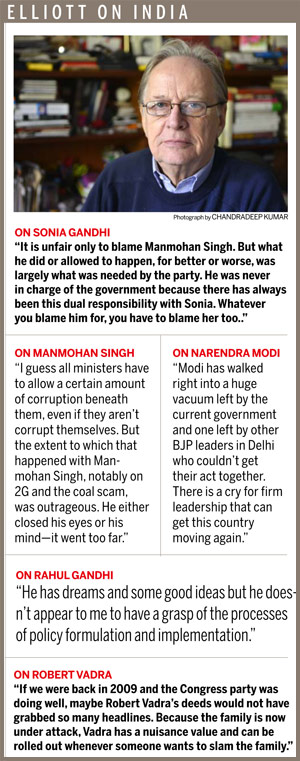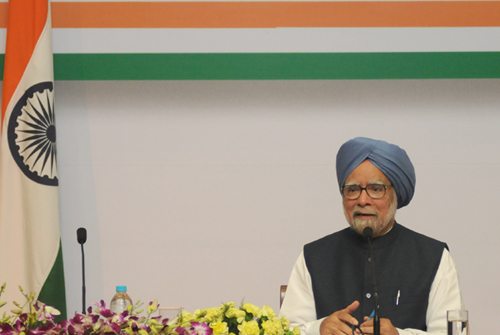
As he approaches the end of his ten years’ as India’s prime minister, Manmohan Singh says he believes that “history will be kinder” to him than the contemporary media and political opposition. That was a recurrent theme at a large press conference lasting about 100 minutes that he gave in Delhi today. It was only his third in ten years (and second since 2004), apart from exchanges with selected journalists on flights abroad.

He has revealed little in the past, so not much was expected this time (picture below). His opening statement attempted to record his government’s performance in a good light. Most of his answers to journalists’  questions were bland, and many were evasive. He did announce that he would not be a prime ministerial candidate in the coming general election. That was expected and it turns the focus onto a Congress Party meeting in two weeks’ time when, it is rumoured, Rahul Gandhi might announced for the role.

MMS pc Jan 3 '14Manmohan Singh’s headline catcher was a blunt personal attack on Narendra Modi, the Bharatiya Janata Party’s prime ministerial candidate, who he said would be “disastrous for the country”. A man who had presided “over a mass massacre of innocent citizens on the streets of Ahmedabad” had not displayed “the sort of strength this country needs, least of all, in its Prime Minister”.

That was a reference to the Godhra riots in Gujarat in 2002, where more than 2,000 are believed to have been killed with Modi as chief minister. The remark showed that Modi will continue to come under attack for his role then, even though he has been cleared of responsibility by the courts and said last week (without actually apologising) that he was “shaken to the core” by the violence with feelings of “grief, sadness, misery, pain, anguish, agony.”

The most telling theme of the press conference was the way that the prime minister shirked responsibility for corruption scandals, notably in the telecommunications and coal industries, that have dogged his administration with him being implicated for at least condoning what has happened.

First, he tried to dodge questions by saying the scandals had started in the 2004-09 United Progressive Alliance government and that people had re-elected him and the coalition in 2009,  so did “not seem to have paid heed to all these charges of corruption which are levied against me or my party”. That missed the point that the scandals had not fully surfaced in 2009, and that Singh’s role had not fully developed and emerged – firstly with him allowing an implicated telecoms minister to be reappointed (because his Tamil Nadu-based party was needed in the new coalition), and second with him being in charge of the coal ministry during some of that industry’s scandals.

So Manmohan Singh’s reliance on so-far unwritten history to say that he had done as well as he could was significant. Will it excuse him his failings because he had to cope with both a fractious coalition that blocked some of his policies, and with Sonia Gandhi as his political boss who ruled the roost? He talked today, as he has in the past, about “coalition compulsions” and hoped that history would say he had done the best he could in the “coalition circumstances”

Or will it say he lowered the status of the prime minister’s post by condoning corruption and ceding authority, which was constitutionally his, to Gandhi and her son Rahul when he ought to have stood up to them or resigned?

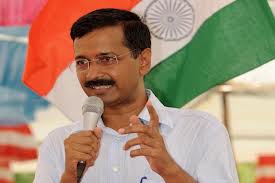
Arvind Kejriwal - Mint photoMaybe, rather vengefully, he hopes that history blames the Gandhi’s for wielding power over the government without being responsible constitutionally, or in parliament, for what was done. That would be a just verdict but, even then, Singh will surely be blamed for being weak and allowing it to happen.

That however is all to do with the past, and another far more significant event to do with the future also happened in Delhi today when Arvind Kejriwal (above) began work in the city’s newly elected assembly as chief minister, following the devastating success of his anti-corruption Aam Aadmi Party in recent assembly elections.

The implication of Singh’s  remarks is that coalition governments have to be corrupt in order to keep corrupt coalition partners happy. Kejriwal is setting out to prove otherwise, with Congress supporting his minority government!

While 81-year old Singh is looking to historians to produce their verdict on him, 45-year old Kejriwal is beginning a new young era in Indian politics with massive support because of the failings of the Gandhi-Singh government and the lack of hope that the BJP would be much better.

Posted by: John Elliott | December 24, 2013

Merry Christmas!

Merry Christmas! IMG_8507

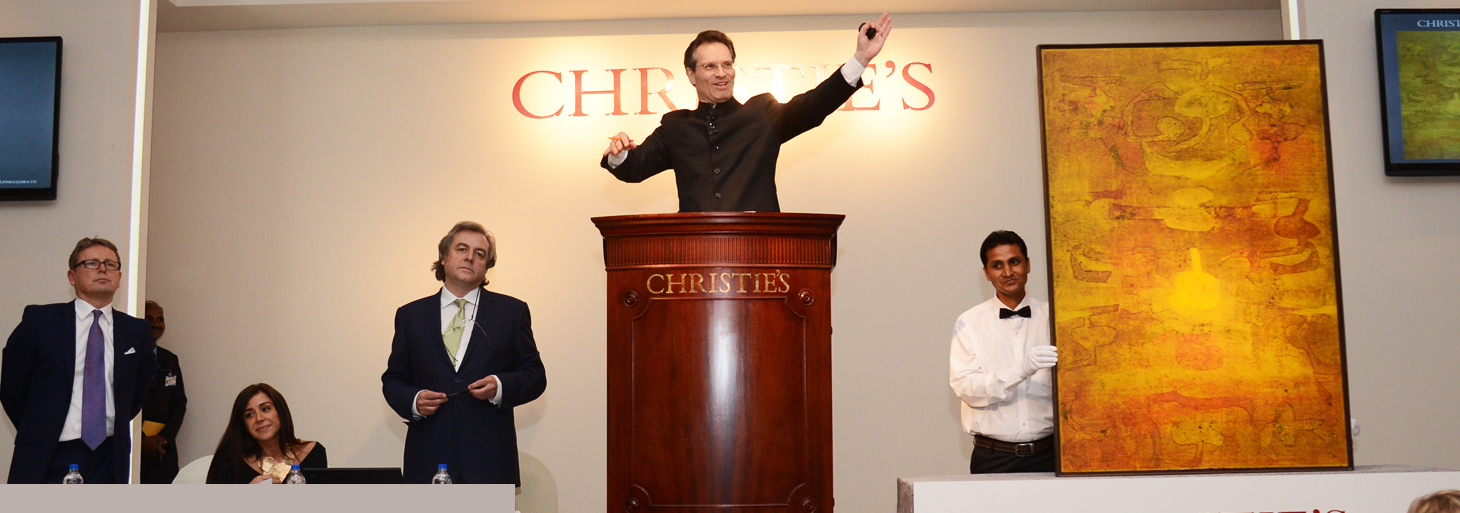
India’s slumbering modern art market came alive last night at Christie’s first auction in the country when astonishing prices were achieved totalling $15.45m (Rs96.5 crore), roughly doubling estimates. Collectors say that this was the result of extensive marketing by a big Chrisite’s team and the excitement of a live auction, though some of the top bids came by telephone from overseas.

There was also what the experts call a strong provenance – just over half the 83 lots were collected by the late Kekoo Gandhy who championed young, later famous, artists like M.F.Husain, Vasudeo S.Gaitonde and Ram Kumar in the 1940s and 1950s and then ran Mumbai’s Chemould art gallery.

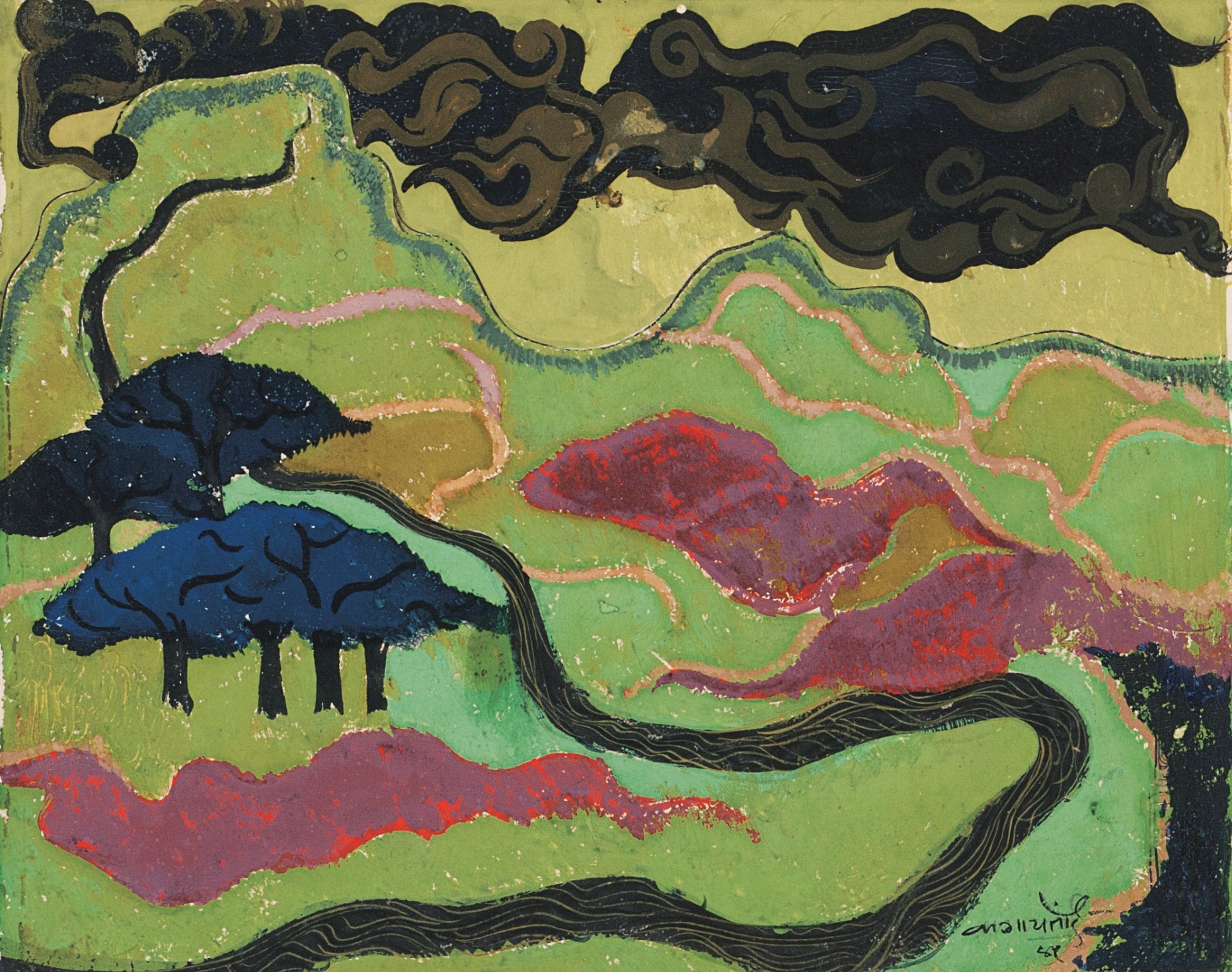
Lot 1 GaitondeOne of Gandhy’s Gaitonde works set the auction – held in Mumbai’s Taj Hotel – off to a spectacular start as the first lot. An untitled early landscape (left) of just 9in by 11in, it beat the estimated price range of Rs8 lakhs to 1.2 crore ($13,000-19,400) by around ten times and went for Rs80 lakhs – that’s Rs9.83 crores ($157,200) including buyer’s premium. It was a gouache with pen and ink on card, and had Chemould Frames label on the reverse side.

Another Gaitonde – a large oil on canvas abstract (below) from a different owner – produced the highest auction sale price of Rs20.5 crore (approx $3.3m), or Rs23.7 crore ($3.79) including the premium, roughly tripling the lowest estimate. This was a telephone bid from the US and it was the highest price ever paid in India for a modern work of art. It was a world auction record for the artist.

In the past decade, India’s leading modern artists of the same vintage such Husain, Mehta, F.N.Souza and S.H.Raza have all had their day topping Indian art prices. Now Gaitonde, who died in 2001 aged 77, is reaching the same price levels for his works that are mostly abstracts. The Guggenheim Museum in New York has a Gaitonde retrospective next year and that will no doubt persuade more collectors to bring more of his works to the market, sustaining high prices.

Lot 63 Gaitonde auction shot

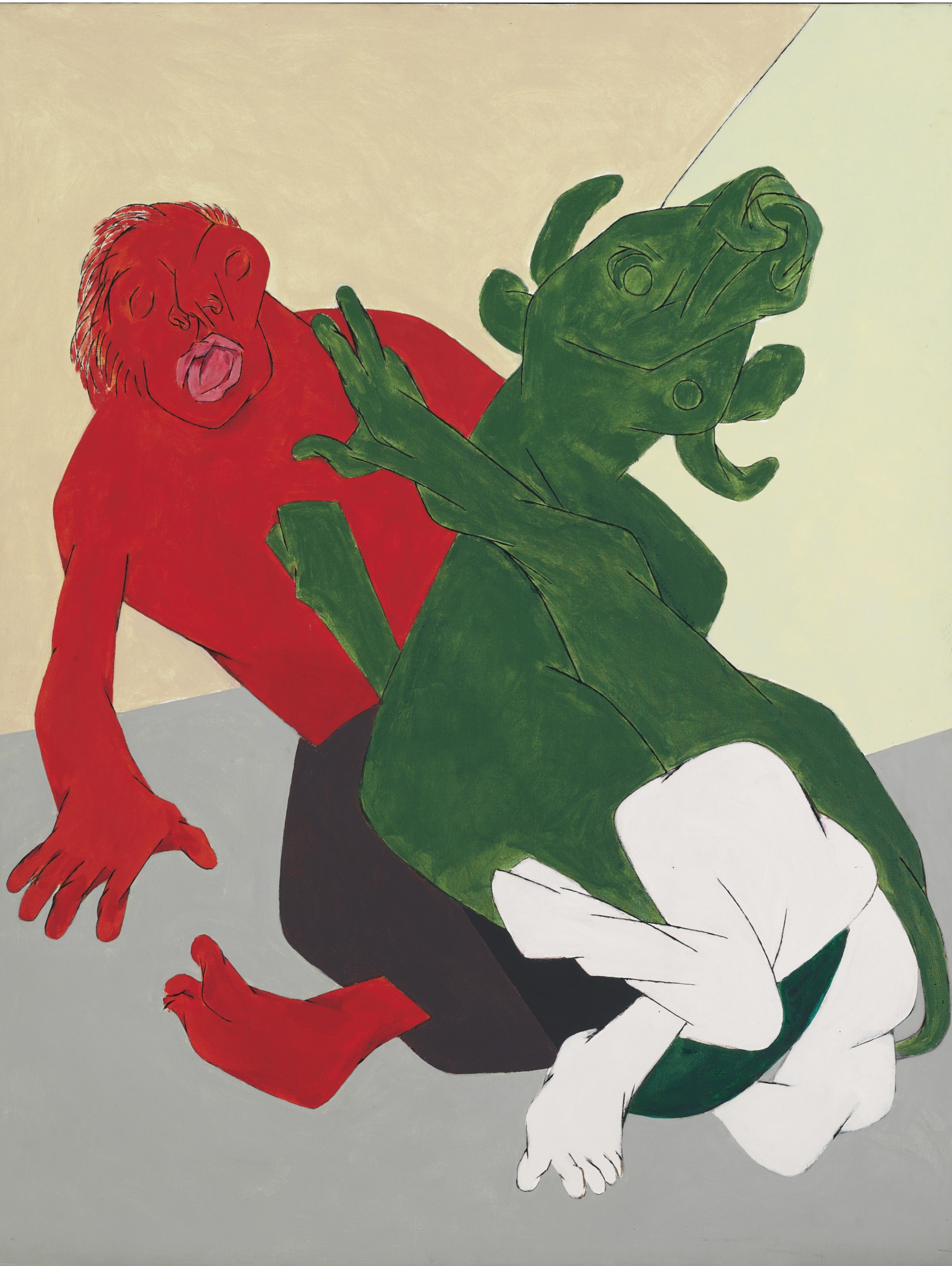
The second highest bid of Rs17 crore ($2.8m) or Rs19.78 crore ($3.17m) came for a Tyeb Mehta acrylic on canvas (below) in his dramatic Mahisasura series. These Tyeb works are always strong sellers, and this one depicted the Devi in her most potent form as a lion locked in a struggle with Mahisasura, the mythical Hindu demon-king who was half human-half buffalo.

This was the first time that two Indian works had been sold at above $3m in the same auction. Other leading artists with works in the auction included Husain, Ram Kumar, Raza, Rabindranath Tagore, Amrita Sher-Gil, Jamini Roy, and Nandalal Bose.

Hugo Weihe, the auctioneer and Christie’s international director of Asian Art, said that this showed that the market “has matured” and that good prices could be obtained for top quality works, with collectors distinguishing the best works from lesser ones. This has been his usual line during the past five years when the Indian art market has been hit by the international economic slowdown, but he said to me this morning that last night’s results prove that new high prices are paid for best works – which they were.

Christies arranged for 30 or so international collectors to be in Mumbai for the sale but Weihe says new buyers are also appearing – about 100 people registered for the first time for the auction. There were also buyers making bids on the internet on Christie’s website as well as by telephone.

Lot 64 Tyeb Mehta- MahishasuraThe emergence of new buyers is in line with the experience of the Delhi Art Gallery (DAG) which, having recently opened a new outlet in the old Fort business district of Mumbai, is finding that younger generations of old business families are beginning to buy.

Significantly, they are going for the established ‘moderns’ like those featured in this auction rather than risking their money on Indian‘s contemporary artists who are still fairing badly after a serious slump in prices.

The DAG is unusual in that it has large collections of modern art and stages big exhibitions that are well backed up with art books and literature. “It is a one stop shop for buying modern art,” says Amrita Jhaveri, a collector who opened Christie’s representative office in Mumbai 20 years ago and herself had a successful sale of part of her Indian collection totalling $6.7m with Sotheby’s in New York last march

Together the DAG and Christie’s have given the Indian art market a significant boost at a time when many smaller galleries have been down-sizing or closing in both Mumbai and Delhi.

Along with Saffronart, India’s leading internet-based art auctioneer, they have shown the results that can be achieved if a significant effort is put into involving potential buyers and searching for the best works – Christie’s had 50 staff working in India on the auction. Galleries and auction houses with less energy and cachet are finding times hard and are rarely willing to cut prices sufficiently for lesser works. “If people don’t make the effort, they can’t complain that the market is flat,” says Kishore Singh of the DAG.

Dinesh Vazirani of Saffronart says he believes the auction showed a “resurgence of enthusiasm” in the market which was needed to boost sales

Collectors were also wondering today whether it is easier for an international auctioneer such as Christie’s to sell in Mumbai than in Delhi because there are more people and business houses there prepared to pay with “white” money, as opposed to the black money sloshing around in Delhi.

Whether that is correct or not, what is sure is that Christie’s yesterday showed that the cachet of an international auctioneer, plus extensive marketing for top quality works brings in top prices.

It’s almost general election time in India and the two main political parties are on the move to prove their credibility. In the past 24 hours, India has uprooted cordial diplomatic relations with the US that have been carefully nurtured for the past decade or more. It has also passed the Lok Pal Bill creating an anti-corruption ombudsman that has been pending in various forms for 45 years.

It is no coincidence that these events come ten days after the new Aam Aadmi anti-corruption political party (AAP) dominated the results of assembly elections in Delhi – so both the government and main Bharatiya Janata Party opposition now need to prove their worth in order to stop AAP becoming successful nationally. Nor is the sudden emergence of Rahul Gandhi surprising as an energised parliamentary performer (in today’s Lok Pal parliamentary debate), just there are rumours that he might be named next month as the Congress Party’s prime ministerial candidate for the general election due in April-May. He needs to act fast to save his and his mother’s party from a humiliating defeat.

Devyani KhobragadeIt is also probably not a coincidence that the dramatic (some say excessively aggressive) diplomatic battle that India has waged this week against the US – suddenly cancelling various diplomatic privileges and removing security barricades that blocked a road adjacent to the embassy in Delhi – came on the first anniversary of a horrific rape of a young medical student that shocked opinion internationally.

Since that rape, there has been a major change in the way that offences against women are regarded, especially the way they are covered in the media. So it is scarcely surprising that Indian politicians backed the outrage felt by Foreign Ministry officials when US authorities last Thursday arrested Devyani Khobragade (above), India’s 39-year old vice-consul in New York, just as she was dropping her daughter at school. She was allegedly handcuffed and later strip-searched, underwent DNA swabbing, and held in a cell with others accused of crimes including drugs till she was released on $250,000 bail.

Relationship lacks supporters

There is a bigger issue here that concerns India’s current relationship with the US which, though enormously better than it was ten to 15 years ago, is floundering because of a lack of care in both countries and a weak Indian embassy in the US. The relationship has few if any committed supporters in the current Obama administration, and there are many officials and commentators in India who would like to take a more aggressive stance, which this case has provided. [Dec 19: John Kerry, US Secretary of State, phoned a senior Indian official on Wednesday evening and expressed his “regret” for the way the arrest had been conducted, but said the law should take its course.]

The US alleges that Khobragade is guilty of visa fraud over an India maid who used to work in her home and who had not been paid the statutory minimum wage. Kanwal Sibal, a former foreign secretary, has said that it is not unusual for foreign maids in the US to be paid less than the official minimum and that the American authorities accept the “contradiction between reality and the letter of the law”.

There are complications in this case that have yet to unravel including suggestions the maid and her family wanted to become US residents. India has accused the US authorities of fraudulently allowing the maid’s husband and children to enter the America last week two days before Khobragade was arrested, even though the maid had been reported missing by Khobragade some months earlier.

US Attorney Preet Bharara in New York has said the family were given visas and taken to the US because the Justice Department is “compelled to make sure that victims, witnesses and their families are safe and secure while cases are pending”. Bharara, a high profile India-born attorney famous for bringing sexual assault charges against IMF chief Dominique Strauss Kahn two years ago and other major cases against Wall Streert banks,  suggested that the family were being harrasssed in India and therefore needed to be evacuated. Salman Khurshid, the foreign minister, has described what happened as either a “conspiracy” or “irrational behaviour”.

More significant is India’s reaction to the humiliation that the woman diplomat received. There have been earlier controversial security  checks and harassment of senior Indian officials in the US which Ronen Sen, a former ambassador in Washington, said on television this evening does not happen in other countries. This has united India’s foreign service officials, led by Sujatha Singh, India’s new foreign secretary, in demanding the strongest possible condemnation of the US. She was in Washington for talks the day before the arrest and was apparently not consulted.

anna_speaking360x270The BJP is accusing the government – with some justification – of running a weak foreign policy over the past ten years, which has enabled the US to dominate the bilateral relationship. This raises a wider issue of India not asserting itself either in world affairs or with aggressive neighbours China and Pakistan, which a BJP government might well change.

It is therefore important for the government to try to build some credibility and the Khobragade case has given it an opportunity on the emotive issue of relationships with the US, while the Lok pal Bill will, Rahul Gandhi clearly hopes, help to smother memories of the massive corruption that has run through the Congress-led coalition government.

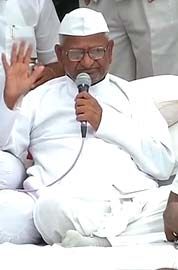
The Aam Aadmi’s party’s rise spurred Gandhi and the government to revive the Bill, which creates a new corruption ombudsman. The main parties have resisted the Bill for decades, and the government only agreed to produce legislation two years ago under intense pressure from Anna Hazare (above), a social rights activist, and from Arvind Kejriwal who has now broken away from Hazare to form and lead the AAP. Hazare seems to be a supporter of the BJP, which has amazingly co-operated the past two days with Congress to pass the legislation through both houses of parliament.

Rahul Gandhi is now setting himself up as the politician who ensured that the Bill was passed. In parliament, he called for six other anti-corruption bills covering subjects such as public procurement, foreign bribery, judicial standards, and whistle-blowers to be passed before the general election. That is inevitably leading to him being accused of trying to capture the limelight and credit – which of course he is – when it is Hazare and others who deserve to be praised.

Posted by: John Elliott | December 8, 2013

India state elections demand political change without the Congress

India is tired of the Congress Party and its dominant Nehru-Gandhi dynasty and will demand sweeping changes in the general election that is due to be held in just over four months’ time. It may not however just want a switch between the established Congress and the Bharatiya Janata (BJP) parties, but could demand something new in politics that will tackle the country’s endemic corruption, crony capitalism and inefficient government.

Arvind K IMG_0559That is the conclusion that can be drawn from election results today for four state assemblies. A completely new anti-corruption party, the Aam Aadmi (common man), won an astonishing 28 of the 70 seats in Delhi, which will make it the official opposition. Congress was decimated after 15 years’ rule,  winning just eight seats compared with 43 in the last election in 2008 – a humiliating result that was far worse than had been expected.

Congress also suffered a resounding defeat by the BJP in Rajasthan, down from 96 seats to 21 after five years in government. The BJP held on to power against Congress in Madhya Pradesh and Chhattisgarh. Vote counting in a fifth state, Mizoram in north-east India, is taking place tomorrow and could provide Congress with a victory.

The Aam Admi Party’s victory is significant because it demonstrates a desire for change and a break with the corruption and mismanagement of recent years. Its social activist-turned politician leader, Arvind Kejriwal (above), talks about a new sort of politics, and the party’s election symbol is appropriately a broom. Focussing on local as well as state-level issues, the party produced individual manifestos for each of Delhi’s 30 assembly constituencies as well as one for the state as a whole.

In recent months, Narendra Modi, the controversial chief minister of Gujarat and the Hindu-nationalist BJP’s prime ministerial candidate, has been campaigning rumbustiously around the country promising to provide the new style of efficient and clean government that India needs at a time of high inflation and relatively low economic growth and high inflation.

Rahul Sonia IMG_0558That campaigning pitch is now being challenged by Kejriwal’s party, which is offering a far more radical fresh start and style than Modi. How far it can extend beyond Delhi, where its anti-corruption campaign has been focussed, is open to question. It says it has active organisations in 22 of India’s 28 states, but it will be stretched to do well in many of them.

It will also face competition that does not exist in Delhi from established regional parties based on caste and other factors. In Delhi, it will have to show that it can transform itself from an anti-corruption movement into a working political party and play a meaningful role as the assembly’s main opposition, once a new government has been installed (this is delayed because the BJP, which led in the polls with 32 seats does not have a clear majority).

The results mean that Congress and the Nehru-Gandhis are facing a massive defeat – indeed rejection – in the general election. National polls do not necessarily reflect local results, but the scale of today’s defeats does seem to indicate what will happen next year when seen against the background of the national mood of despair about the current Congress-led United Progressive Alliance coalition.

This is a disastrous setback for Rahul Gandhi, heir to the party’s leadership who, once again, has failed to move voters despite extensive campaigning. He has had earlier personal leadership failures in Uttar Pradesh and Bihar state polls. He is a reluctant politician, who gives mixed messages. On the one hand he talks about reforming his party so that new leaders emerge from the grassroots, while at the same time, along with his mother Sonia and sister Priyanka, behaving as though he and they have a dynastic right to rule. It is that right that is now being rejected.

Delhi constituency voting list where Kejriwal (with his broom election symbol) defeated Dikshit (with the hand)

Delhi constituency voting list – Kejriwal (with his broom election symbol) defeated Dikshit (with the hand)

Rahul’s grass-roots ideas could  provide a credible answer to the Aam Admi, but he has not so far been able to achieve change in a party that is riven with crony patronage-oriented organisation and relationships. Speaking after Congress’s defeat this evening (seen above with Sonia), he told reporters in Delhi that political parties were “not giving adequate voice to the man in the street… and it is our job to do that”. He said that he would put all his efforts to ‘transforming the organisation of the Congress Party” and would now push those changes “aggressively”. Political analysts believe that, though he will do what he can before next year’s polls, his target is to make changes by the following general election.

Who will win next year cannot yet be forecast. It could be a BJP-led coalition led by Modi, though that will depend on the BJP winning sufficient seats in India’s northern states to persuade regional parties to join a coalition led by him. Or it could be a muddled coalition supported but not led by either the BJP or possibly the Congress. That is the best that the Gandhis’ party can hope for, but it would not be good for the country which needs strong economic and developmental leadership.

Although the BJP won in the four states, it did not have the resounding victory it had hoped for because of the Aam Aadmi’ s emergence in Delhi and a close-run contest with Congress in Chhattisgarh. There will now be arguments about how much Modi contributed to the successes, or whether they were due to strong chief ministerial candidates in Rajasthan, Madhya Pradesh and Chhattisgarh.

Sheila Dikshit, 71, who has been the chief minister of Delhi for the past 15 years, suffered the day’s biggest defeat because she lost her own central-Delhi assembly seat to Kejriwal, as well as losing the assembly to the BJP. She has generally tried to evade responsibility for Delhi’s significant problems in the past five years, deflecting criticism of the appalling and corrupt preparations for the Commonwealth Games in 2010 and continuing inadequate water and electricity supplies. She also blamed the police during a rape case a year ago that aroused international as well as national outrage. She is identified with the Gandhi family.

The state elections were pitched in the media as a contest between Rahul Gandhi and Modi, but Arvind Kejriwal, the outsider, has emerged as the winner with Rahul as the loser. Rahul is 43 and Kejriwal is 45 – if both have the staying power, one to transform his party and the other to build a new one, they could maybe begin the political change that India needs. Both have a huge task and could be overwhelmed by the entrenched political establishment but they have time on their side which Modi, aged 63, does not.

When a massive cyclone hit the eastern Indian state of Odisha (Orissa) at the end of October 1999, at least four district officials abandoned their posts in panic or rushed to their homes, and the chief secretary flew on a private visit to the US a few days later. Some 10,000 people were killed as a result of inefficient administration and a lack of preparation, together with inaccurate weather forecasts and a chief minister who was reportedly told by his astrologers that the cyclone would not be serious. That was typical of the lack of responsibility and preparedness, plus trust in the stars and a belief that everything will work out ok, which accounts for many of India’s dreadful disasters.

Villagers returning home - PTI photo

Villagers returning home – PTI photo

As a result of lessons learned in 1999, Odisha successfully protected human life from a serious cyclone that crossed the Bay of Bengal and hit the coast on Saturday night at more than 200kms an hour.

Some 950,000 people were evacuated from the area in the previous few days, and fewer than 25 people are believed to have been killed, even though fishing villages, homes, ports, and farming areas were devastated.

National and state level disaster management and other services worked well, and the country’s meteorological department accurately predicted Cyclone Phailin’s strength and focus area, dismissing criticisms from American experts who alleged that the storm could have been as serious as New Orleans’ Hurricane Katrina in 2005.

Odisha is generally known for being sleepy and ineffectual, but it has shown what can be achieved when someone takes charge with determination to succeed and forces officials and state politicians to carry out their duties. This runs counter to India’s record of badly handled natural disasters – seen most recently in the Himalayan state of Uttarakhand where environmental degradation and an indifferent state government led in June to more than 6,000 deaths after devastating floods. In another disaster yesterday, more than 120 pilgrims were killed during a stampede in Madhya Pradesh at a river where 50 people were killed during the same religious festivities in 2006.

Odisha’s evacuation plans were drawn up in time and infrastructure that was missing in 1999 such as cyclone shelters, satellite telephones and trained rescue staff had been prepared. This was backed up by effective national disaster management arrangements and modern weather forecasting and monitoring technology.

Naveen Patnaik Oct 13 '13Naveen Patnaik, Odisha’s chief minister (right) who presided over the activity, was elected a few months after the 1999 disaster by a state that wanted change. He had been a dilettante international socialite and author (mixing abroad with people such as Mick Jagger and Jacqueline Onassis, who had been his editor at Doubleday, his publishers) until he fell unexpectedly into politics a few years earlier. That  followed the death of his father, who had also been chief minister.

He now lives a semi-reclusive lifestyle in Odisha, relying on a few close advisers and cronies, and has managed to retain a “clean” image despite the state’s widespread corrupt and illegal mining.

Not enough has been done however to protect the coasts of Odisha and the neighbouring state of Andhra Pradesh that was also hit by Phailin – and there is now a risk of widespread floods. A report on the Wall Street Journal’s blog site suggests that they have failed effectively to implement a Rs14.9bn (about $240m) five-year cyclone disaster management programme that was set up in 2009 after a massive tsunami killed more than 15,000 people on India’s east coast in 2004. Recent government reports (see the project’s website) suggest that the programme is far behind schedule, especially in Andhra Pradesh where the government has been wracked by political crises over deep-rooted corruption and plans to split the state in two.

Patnaik now needs to ensure that his state-level politicians and officials continue to work effectively and honestly on relief, rehabilitation and stronger coastal defences. If he succeeds, he could be re-elected for a record-breaking fourth term in state assembly elections due next year. This will test his ability as a political manager because the usual reaction in India after such a success is to relax and let life takes its course. Moving nearly a million people in a few days was a massive task, but maintaining focus, and ensuring continuity of efficient and clean government, will be much more difficult over the longer term.

before the storm - AP photo

before the storm – AP photo

The past week will be seen as a milestone in Indian history. Lalu Prasad Yadav, one of the most famously corrupt and once-powerful regional politicians, is losing his Lok Sabha parliamentary seat after today being sentenced to jail for massive embezzlement. This followed an astonishing public outburst last Friday by Rahul Gandhi, heir apparent to the leadership of the Congress Party and the prime minister’s post, who opposed a government move to protect the regional power broker.

Rahul Gandhi watched byAjay Maken, a Congress gen secy, last Friday

Rahul Gandhi denouncing the ordnance, watched by Ajay Maken, a Congress Party general  secretary

Three questions arise from these two events. The first is the extent to which Gandhi was defying not just prime minister Manmohan Singh but also his mother, Sonia Gandhi, the Congress leader, and Ahmed Patel, her closest adviser and political manager, when he burst into a party press conference on Friday and denounced a government ordnance that would have protected Yadav as “complete nonsense”. The ordnance should, he said, “be torn up and thrown out“. Today he added: “My mother told me that the words that I used were strong. In hindsight, I feel maybe my words were wrong…but the sentiment I felt was not wrong”.

The second is whether Rahul is capable of following up his highly commendable though equally controversial act of political guerrilla warfare with more sustainable moves to clean up the country’s politics and governance – or are his drive and behaviour too erratic and unpredictable for him to be capable of continuity? Often in the past he has dived into situations and controversies but then not followed them up, disappearing from public view for days and weeks. Currently he is campaigning around the country for coming elections.

Lalu YadavThe third is whether Yadav’s (left) sentencing today is just a one-off, or will legal action against politicians with high-level connections in notable cases such as 2G telecoms and the Commonwealth Games now be pursued so that they too go to jail without protection from the top of the government and Congress Party.  Another Congress politician, Rasheed Masood, was on Tuesday sentenced to four years in jail, and will lose his Rajya Sabha seat, after being convicted of fraudulently nominating undeserving candidates to medical colleges while he was health minister in a 1990 government.

The most significant remark made by Rahul last Friday was that “if we want to fight corruption in this country, whether it’s us, the Congress Party, or the BJP, we cannot continue making these small compromises because, when we make these small compromises, we compromise everything”.  This meant that he considered his mother and her advisers, and the cabinet, had gone too far with such compromises when they decided to protect Yadav by introducing the ordinance quickly before a verdict on his corruption case was announced on Monday.

Criminalisation of politics

For decades, politics and the maintenance of political power has provided an excuse and a cover for the gradual criminalisation of politicsto such an extent 30% of the members of parliament elected in 2009 had criminal charges pending against them, half of them for serious offences such as rape, murder, kidnapping and corruption. The roles of democracy, governance and institutions, which were lauded 20 to 30 years ago as India’s special strengths, have been progressively undermined and replaced by arbitrary powers wielded, often corruptly, by individuals, be they ministers, bureaucrats, policemen, or regional politicians.

Rahul Gandhi seems to understand this and wants to make changes, unlike his mother and Manmohan Singh who have presided over a highly corrupt ruling party and government and have made “small compromises” such as keeping corrupt politicians in the cabinet so that their parties would continue to support the coalition government.

What is not clear is how far Rahul had or had not tried to make his opposition known while the bill and the ordinance were being considered, nor whether he was ignored by his mother and her advisers. Also not clear is what it was last Friday afternoon that propelled him into the undignified action of using his authority as vice president of the Congress Party to invade a party press conference and condemn a cabinet decision – while the prime minister was in Washington, about to meet President Obama. Also curious is the fact that President Mukherjee was receiving complaints about the ordinance and was, it is assumed, wondering whether to block it at just the time that Rahul spoke out.

Fodder scam

Yadav and 45 others including senior bureaucrats and politicians were convicted this week of embezzling Rs9.5bn (now approx $150m or £94m) that should have been spent on buying cattle fodder when he was the state of Bihar’s chief minister in the mid-1990s at the head of the Rashtriya Janata Dal party. Yadav only promoted his own Yadav backward caste, and he mis-ruled the state for 15 years with his wife Rabri Devi (she took over the chief minister’s post when he went briefly to prison early in the case). The court – located in Ranchi, capital of the state of Jharkhand that used to be part of Bihar – today also ordered Yadav to pay a fine of Rs2.5m.

The case has dragged on through the courts for years, but became politically sensitive when the supreme court ruled in July that members of parliament convicted of crimes would no longer be able to retain their seats while they appealed – a process that can take many years in India’s clogged and manipulated judicial system.

Sonia Gandhi has been fond of Yadav, 65, since he supported her in her early days in politics, and he has been part of her Congress-led coalition, serving as railways ministers in the 2004-09 government. She and the party now wanted to help Yadav because it might need his party’s support in forming a coalition after next year’s general election. So the government acted, within the constitution, when it tabled a bill in parliament that would have overturned the supreme court judgement. But this aroused widespread public opposition – and Rahul’s ire – when the cabinet decided on September 24 to implement the change immediately with an ordinance while parliament was in recess.

If Rahul is up to it, the events of the past week could transform his lacklustre political career which has been based till now solely on his dynasty inheritance. Now he has used dynastic authority for the first time to do what he and a large mass of public opinion thought was right on a major issue. The question now is whether he can and will build on that success.

Posted by: John Elliott | September 14, 2013

Narendra Modi steps into national political vacuum

modi1_jpg_1583447gIf Narendra Modi, the controversial Bharatiya Janata Party chief minister of Gujarat becomes India’s next prime minister, it will be because Sonia and Rahul Gandhi, together with their prime minister, Manmohan Singh, have left such a leadership vacuum at the end of nine years of increasingly ineffectual government that India is willing to take a gamble on a feared politician.

It will also be because the BJP’s national leaders have failed so dismally in the nine years to form any sort of coherent political opposition, and instead have led a gaggle of chronic disruption in parliament, that is was easy for Modi to step in.

Modi, who will be 63 next week, was anointed yesterday (right) by the BJP as its prime ministerial candidate in almost presidential style after he had spent months travelling around the country advertising his leadership qualities at public meetings.

He is India’s first new national leader to emerge since the 1980s, and he would almost be a shoe-in for the post of prime minister if it were not for the baggage that he carries of Gujarat’s Godhra riots in 2002, when more than 2,000 people are believed to have been killed, with 12,000 Muslims losing their homes. He has support in urban India, especially from the corporate sector, and he now has to widen the BJP’s electoral base across the country, and rebuild it in the crucial state of Uttar Pradesh. Then, if the BJP does well in the polls, he will have to prove amenable enough to attract other parties into a coalition. Neither task will be easy.

This means that neither of India’s two leading prime ministerial candidates for next year’s general election is ideal. Both of them, in very different ways, arouse either strong opposition or despair and, of course, the next prime minister might come from another party.

The other leading candidate is Rahul Gandhi, who the Congress Party does not seem to dare officially to name formally, probably in case he does not shape up during the coming months, or because he or Sonia Gandhi could nominate someone else, as happened in 2004. Leading Congress ministers are however talking about him as the prime ministerial candidate, and say they would be willing to serve under him – providing Congress gets enough seats to be able to lead a coalition government and virtually dictate who should be prime minister.

rahul-gandhi-287x300Neither Modi nor Gandhi is ideal because Modi is a divisive Hindu nationalist who, on his past record, could create fear and social unrest, though he has earned his new position by providing himself a capable politician and administrator.

Gandhi has no administrative experience, shies away from his public role, and rarely if ever speaks in parliament. He would not be in the running for any significant political post if he were not the son, grandson, and great-grand son of previous prime ministers Rajiv Gandhi, Indira Gandhi and Jawaharlal Nehru, and if he had not been chosen as her heir apparent by Sonia Gandhi, the current Congress leader and Rajiv’s widow.

I first wrote about after Modi’s national leadership qualities in July 2002, for a column in the Business Standard  after the Gujarat riots. I had been away in the UK and felt on my return that, while condemning the appalling massacre and Modi’s reported role, India had a new potential national leader. “Unlike most politicians, the Gujarat chief minister was arguing passionately for what he believed in, not for some short-term personal gain far removed from policy, but out of conviction,” I wrote. He was a strong public speaker and was standing his ground and presenting his case with rare confidence, force and élan. Whether one liked it or not, he had a commanding presence and looked like a logical heir to the BJP leadership.

Friends and contacts told me that I was wrong, and asked how a man who had presided in the state as chief minister during such ghastly bloody carnage could ever win popular respect and a wide following. Weren’t Gujarat’s people tiring of the violence, and wasn’t he in fact already finished, just waiting to be edged out of his job? The BJP, I was told, could not survive as a national party of government if he became one of its top leaders because it would be shunned by coalition partners. Yet, since then, he has led the BJP to re-election three times in successive five-yearly state assembly polls. I have written in similar terms on this blog three or four times in recent years and, each time, am met with incredulity that Modi could even become the BJP prime ministerial candidate.

Modi and mother - RediffHe comes from a poor low caste (Other Backward Caste or OBC), which could be an electoral asset if he can moderate his style. As a boy, he worked on a tea stall at a railway terminus in Gujarat till he became a political activist in the Rashtriya Swayamsevak Sangh (RSS) or National Association of Volunteers, the BJP’s hard-line parent organisation that was behind his anointing yesterday. That is a dramatically different social background from the patrician Gandhi dynasty. (Modi, right, with his mother)

In his campaign, Modi will attack the rampant corruption and bad governance of the Congress government, and stress the need for development and economic growth, as well as projecting the BJP’s basic Hindu nationalist line. Gandhi and the Congress will argue that the current government has worked well for the poor and implemented liberal polices such as the right to information, a rural employment guarantee scheme, a national food security programme, and land acquisition reforms. It will also stress its role in uniting India’s diverse communities and cultures.

It looks now as if lack of faith in Rahul Gandhi will drive voters to support the BJP, and that fear of Modi will drive others to vote for Congress. Both men could change those perceptions in the coming five months. Modi could soften his image and appear less divisive and more accommodating to the needs of the poor and religious minorities. Gandhi could toughen up and behave like a political leader with coherent policies who is earning his position and not assuming it as a right. On balance, I reckon Modi is more likely to change his image than Gandhi is to grow into his role.

See also earlier posts:

https://ridingtheelephant.wordpress.com/2013/01/17/businessmens-praise-for-narendra-modi-boosts-his-prime-ministerial-ambitions/

https://ridingtheelephant.wordpress.com/2012/12/21/narendra-modi-challenges-the-gandhis-idea-of-india/

https://ridingtheelephant.wordpress.com/2011/09/15/could-narendra-modi-be-the-leader-india-needs/

https://ridingtheelephant.wordpress.com/2008/12/05/mumbai-votes-for-narendra-modi-as-national-leader/

https://ridingtheelephant.wordpress.com/2008/11/03/has-india-got-an-obama-like-unifying-politician/

https://ridingtheelephant.wordpress.com/2008/12/03/will-the-current-crisis-lead-to-narendra-modi-as-pm/

https://ridingtheelephant.wordpress.com/2007/12/27/a-hindu-nationalist-win-in-gujarat/ 

Posted by: John Elliott | August 28, 2013

Sonia Gandhi’s $20bn bid for Political Security

Politicians in India usually give bangles, saris, electrical goods and even lap tops away at election time in order to woo voters. Sonia Gandhi has raised the bar this week with a $20bn-plus total food handout that has taken several percentage points off the value of the rupee and the stock market, and demolished successful efforts last Friday by Palaniappan Chidambaram, the finance minister, to halt the slide in the country’s economy.

Sonia Gandhi in Parliament

She did this on Monday night (above) by pushing through the Lok Sabha a Food Security Bill that is primarily aimed at giving her dynasty and the Congress Party political security by persuading India’s poor that Congress is their best bet for a better life.

Increasing food for the needy is of course something a government should be doing, but her eyes are on the general election due next April or May.  Ignoring opposition, it is believed, from key economic ministers and advisers, she hopes that bags of grain and rice will wipe away memories of slowing growth, rising prices, endemic corruption, somnolent government, and all the other economic problems that have beset the coalition that she heads.

This has driven India’s currency to record lows in the past two days – Rs69 against the dollar and Rs107 on the pound sterling. That compares with Rs63.3 and Rs98.5 that Chidambaram’s measures and statements achieved last Friday. He was trying to stabilise the rupee at a time when the currencies of developing economies were sliding. The rupee has been hit the hardest hit (black line in chart below), losing 20% of its value this year.

OB-YR738_rupee0_EA_20130828032912“Madam Gandhi must have been quite a force to reckon with,” historians will say, when hearing about such a sacrifice for the poor, and its impact on India’s uncomfortably high current account deficit, at a time of tumbling currencies!

Cynics would say that it would be brave for a dynasty that is set on perpetuating its rule to do anything else but to perpetuate the conditions that enable it to present itself as the guardian of the poor and under-privileged.

Is it instinctive for an elite to maintain conditions as they are, modulating progress so that the apple cart on which it is perched does not topple over? I am not suggesting that Sonia Gandhi consciously plots policies that would keep the poor poor, but that is the logic of what she has done in recent years, advised by her aid-oriented National Advisory Council that designed this bill, instead of pushing reforms and subsidy cuts that would spur economic growth (now down to near 5% from 9%).

And whether it is conscious or instinctive, as I wrote on this blog last year, Rahul Gandhi has been heard saying that the way to keep Congress in power is to channel subsidies and funds to the poor, irrespective of how wasteful that could be, while discouraging growth-oriented economic reforms that might do short-term harm to Congress’s pro-poor image.

food queuesThe Bill guarantees 5 kg of rice, wheat and cereals per month at fixed low prices to some 70% of the 1.2bn population.  Government estimates suggest that this will cost a total of Rs 1,24,723 crore per year (around $20bn and £12bn) in food aid, but other estimates go as higher.  Surjit Bhalla, a economics commentator, puts the figure at’ Rs 3,14,000 crore or around 3% of GDP.

Much of this hefty government budget for food allocation and subsidies is wasted or siphoned off by corrupt officials as the money travels down to villages. The government admitted in parliament this week that 20% to 30% of food is lost with leakages from the public distribution system.

The Food Bill is of course an easy high profile measure to introduce, emulating the way that politicians lay foundations stones without worrying about whether projects are actually built and well maintained. The much harder task would be to tackle what really ails the poor, which is malnutrition and the supply of clean-safe drinking water, improved sanitation, and piped sewerage or other hygienic systems to avoid outbreak of water-borne diseases.

Food schemes can be administered efficiently, as has been shown in the state of Chhattisgarh where the management of the public distribution system’s ration shops was shifted from private licensees to community-based organizations such as gram panchayats (village councils,) female self-help groups and co-operative societies.

“We organize a Chawal Utsav (Rice Festival) at each ration shop during the first week of every month, which helps to ensure that all food items are adequately stocked in each shop by the last day of the previous month,” Raman Singh, chief minister, told the Wall Street Journal. Food is delivered direct to the shops to help curtail leakages and the system is computerised. That policy was adopted in Chhattisgarh as part of a broad approach to economic change and was not a stand-alone policy like Sonia Gandhi’s, which has no chance of being widely administered so effectively.

Sonia publicly launched the Food Bill last week (as part of the Congress Party platform for coming assembly elections in the state of Delhi) on the birth anniversary of her husband, Rajiv Gandhi, even though he focussed in the 1980s as prime minister on more constructive economic growth policies. So this measure, while it demonstrates Sonia Gandhi’s political strength, is not really a credit to his memory. I wonder if he would approve!

Posted by: John Elliott | July 7, 2013

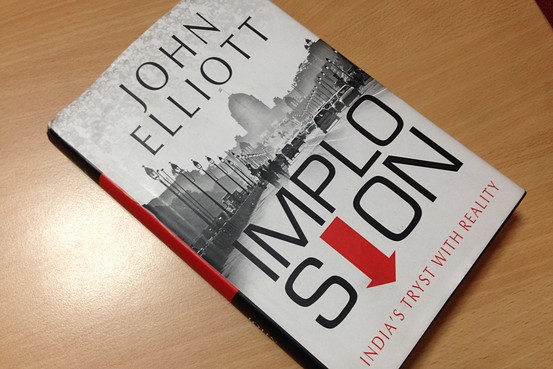
Elephant book on the way

Sorry there haven’t been any new posts recently – it’s because I’m completing a book that I’ve been writing on India, broadly derived from these Riding the Elephant posts. I hope to complete it in a few weeks, after which I’ll be back here regularly again.

cheers

John

« Newer Posts - Older Posts »

Categories