Posted by: John Elliott | May 21, 2013

China turns friendly with India – but why?

When China’s former premier, Wen Jiabao, visited  India in December 2010, he was full of talk about the two country’s joint aspirations, their friendship, their co-operation, and about how their two-way trade would almost double to $100bn a year by 2015. In a speech in Delhi, he said their civilizations had “once added radiance and beauty to each other and deeply influenced the process of human civilization,” – and then suddenly his tone and even his demeanour changed, and he put India firmly in its place as an unequal neighbour, taking China’s usual rigid line on the two countries’ decades-long dispute over its mountainous 3,500 kms (2,170 mile) border. “It will not be easy to completely resolve this question. It requires patience and will take a fairly long period of time,” he declared.

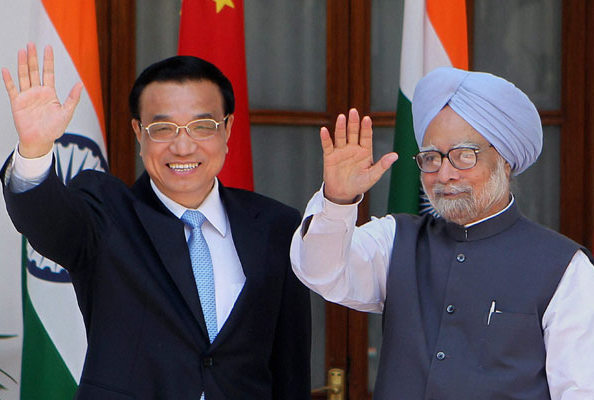
China’s new premier, Li Keqiang, has been in India since Sunday, perhaps significantly visiting Delhi and Mumbai at the beginning of his first trip abroad since taking up his new post in March. Unlike his predecessor, he has been consistent in his friendly and practical remarks about sowing “the seeds of friendship”, and saying that China was “committed to building friendly relations with India”. There was no sudden Wen Jaibao-style change of tack, which sounded in 2010 as if China’s powerful People’s Liberation Army (PLA) had drafted part of his speech.

.

.

In a joint media conference with Manmohan Singh yesterday, and at a businessmen’s meeting this morning, Li’s body language has been strikingly fulsome and consistent.

He talked in practical terms about how the two prime ministers had had “multiple in-depth and candid discussions” and that a “strategic consensus” had “deepened our strategic trust”. He repeated China’s usual line that the border issue was ”a question left over by history”, but added that the two sides had “agreed to push forward with negotiations”, which contrasted sharply with the line taken by Wen Jaibao and most Chinese leaders in recent years.

That change of mood is the most notable point to emerge from the visit, especially coming at the start of the China’s new leadership’s ten-year term in office. Li’s smiling sophisticated friendliness however contrasted sharply with a small but major confrontation triggered by China on the countries’ mountainous border a month ago, which prompts questions about China’s motives.

Does it really want to solve disagreements over the countries’ 2,000-plus mile disputed border, known as the Line of Actual Control (LAC), which has been undefined since India humiliatingly lost a war there in 1962? It has been resisting moves to clarify the border in recent years, despite past agreements that it should do so, and India, which habitually shrinks from diplomatic confrontation, has not pushed hard enough.

Or – and this seems more likely – does China have other targets? It probably wants to coax India into a border defence co-operation agreement, which is now being negotiated. This could stop India’s current construction of infrastructure and defensive installations to match China’s presence on the other side of the border. India ignored China’s construction work for years, and has only recently woken up to the need for roads and a substantial military presence, so it would be self-defeating for it to sign an agreement at this stage, especially before the border line is defined.

Teasing America

China is also probably teasing the US, which has been cosying up to India since 2005. Li today quoted a Chinese proverb that “a distant relative may not be as useful as a near neighbour,” clearly trying (no doubt fruitlessly) to wean India away from the US. The Beijing-based People’s Daily, a government mouthpiece, said this morning that the US “should not be jealous” of a strategic partnership between China and India because the two countries did not want to be America’s “enemy” – they just hoped for its co-operation.

China could also have decided that it sent the wrong signals with the recent border row, and that it should not fall out with its biggest neighbour at the same time as it is aggressively confronting Japan and the Philippines over possession of  islands in the East and South China Seas.

Li’s approach is specially confusing because it comes soon after 30 PLA troops pitched tents, in mid-April, 19 kms inside what India regards as its territory on the 16,000ft-high Depsang Plain in the Ladakh sector of the LAC. A procedure agreed in 2005 for solving such a confrontation was not operated by China so, after some apparently nervous indecision and delay, India moved troops and tents into a face-off and strengthened its previously soft diplomatic stance. After three weeks, both sides removed their troops, but the terms of the truce were not revealed.

This confrontation was totally unexpected in Delhi and was especially odd coming soon after China’s new president, Xi Jinping, had (on March 19) put forward five  proposals for improving ties with India and said that  “peace and tranquility” should be maintained on the border in order to help solve the border issue, a task that “won’t be easy”.

Dodging issues

Manmohan Singh is reported to have warned Li on Sunday evening that peace on the border was essential for relations to grow. He said at the media conference that he and Li had taken “stock of lessons learnt from the recent incident” – tactfully dubbing what had been a major incursion as merely an “incident”. Li apparently dodged the question when he was asked why and how the incursion had happened and, instead of pressing this, India agreed that two top “special representatives” should “consider further measures that may be needed to maintain peace and tranquillity along the border, and seek “early agreement on a framework for a fair, reasonable and mutually acceptable” boundary settlement. “Why embarrass him!”, Salman Khurshid, India’s foreign minister, said later. It was better to find out why the existing proceedure had not worked.

A long joint statement was issued with over 30 items ranging from the border and economic co-operation to media exchanges, easier visas and handling Afghanistan and, notably, recognition by China of India’s wish for a bigger role in the United Nations ‘ Security Council.

What this all means will begin to emerge when the special representatives meet in a few weeks’ time. Barring mishaps, India’s defence minister will then visit Beijing , followed later in the year by Manmohan Singh, whose declining reputation as prime minister has been boosted by Li’s visit and the possibility of improved relations.

To show it wants progress, China needs to hand over draft maps of its border proposals which it has resisted doing so far – presumably because, the longer the border is undefined, the easier it is for it to grab patches of territory. It also needs to soften the stridency of a claim to the whole of India’s north-eastern state of Arunachal Pradesh, which India will never voluntarily concede. For its part, India needs to find the courage to push for progress.

In summary, Li Keqiang’s visit has generated splendid bonhomie and talk of good intentions – India helped by blocking roads and surrounding the Chinese Embassy with heavy barbed wire defences to stop Tibetan protestors upsetting the mood. Issues of substance on problems over the border, and over China possibly blocking India’s river waters with new up-stream dams, have however been  dodged by talking about mechanisms rather than substance. That fits with India’s traditionally low key approach to foreign diplomacy, which plays into China’s hands. It now remains to be seen whether India will push for real movement, not just mechanisms, and whether China is willing to respond.

Pawan Bansal was forced by the government to resign on the evening of May 10 after a week of CBI inquiries and arrests, plus a stream of media reports on alleged links involving him, his family, the businessmen, and other dealings. On May 12, he repeated his statement of  a week earlier that “I have nothing to do with all this”

The latest corruption scandal to embroil India’s coalition government is scarcely a surprise. The nephew of Pawan Kumar Bansal, the railways minister (below), was to be paid Rs10 crore (about $2m) to fix a top railways board appointment. Such appointments have been fixed for decades, often financed with money from companies that would benefit, as was allegedly planned in this case.

I remember talking to people about this nearly 20 years ago after I heard about a public sector corporation chairman’s job that was available in return for a payment of Rs 2 crore – then about $450,000. A private sector company was offering to make the payment, and the candidate knew it would expect to be given every contract or other service that it demanded while he was the chairman. The fact that the company itself was delivering the payment would, of course, increase its hold over him.

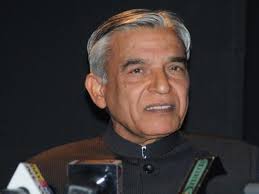
Pawan BansalMany public servants have to pay bribes to get their jobs. They range sometimes all the way from top ministry bureaucrats to public sector corporations’ board directors and on to income tax officials and traffic police – and that is partly why corruption has become so endemic in  India.

The top people need to cover their costs by making money on policy decisions and contracts they handle, as well as by helping their sponsor. Tax officials take bribes from defaulters and police charge a few hundred rupees to drivers at traffic junctions instead of formally booking them.

The more lucrative the job, the higher the price, and that is why in the current case companies were willing to pay $2m for their candidate to become the Railway Board’s Member (Electrical) because of the large-scale signalling and other contracts that the railways urgently needs to award to improve safety – the board’s annual budget for the current year is Rs.63,363 crore ($11.6bn).

The accusation is that Vijay Singla, Bansal’s sister’s son, arranged to receive bribes of Rs2 crore from Mahesh Kumar, a senior and successful railways engineer, to fix his appointment as the electricals’ board member. The money was to be paid through a contractor, Sandeep Goel, having been raised from a group of businessmen dealing with railways equipment who were promised business by Kumar. Half of the amount was to be paid before the appointment, and the rest after it was confirmed. However Kumar was appointed last week to the far less lucrative job of board member (staff), and was advised to wait by Singla till the electricals job possibly came free in a month or two.

Phone tapping

After investigations and phone-tapping for three months, the CBI raided those involved last Friday and recovered Rs 90 lakh ($180,000), which was allegedly the first instalment for the board job. Singla and eight others have been arrested including the businessmen. CBI officials are reportedly working on the assumption that it was inconceivable for Kumar to have agreed to pay as much as Rs2 crore if he was not confident about Singla’s ability to leverage his family ties and get him the job.

Such bribe-based arrangements have operated for top jobs when various governments have been in power, so the Bharatiya Janata Party opposition is on weak ground when it tries, as it is now doing, to make the railways scam sound like a massive new Congress-led government scandal.

It is also on somewhat weak ground on another current scandal over the Central Bureau of Investigation (CBI) being called in by a government minister over a case concerning coal industry corruption. Governments of all hues have controlled the conduct of many CBI for years, using it to torment and expose political opponents and save supporters from legal prosecution, though in this case the minister involved seems to have over-played his hand by calling a meeting instead of consulting informally.

The railways scandal was a shock when it broke last Friday because Bansal was regarded as a competent and apparently clean politician. Earlier the parliamentary affairs minister and before that a minister of state for water resources and finance, he has been trying to sort out serious safety and equipment problems since he was appointed railways minister last October.

Family businesses

Yet there is a report this morning that a rival BJP politician has named companies started by Bansal’s wife and other relatives since he first became a minister in 2006, plus links to railway catering companies and contracts. Reports  are also circulating about massive long-term extortion and corruption in both the railways ministry, and in the Railways Board which runs the system.

The minister tried to claim at first that he had no recent contacts with his nephew, who in any case could not influence his decisions. Media reports however suggest that Singla was involved in Bansal’s political work in the city of Chandigarh, his political constituency, as well as business deals going back some years to when Bansal was at the finance ministry.   Sons, daughters, nephews and wives and uncles frequently do run politicians’ business interests. That is part of the reason for the surge in recent years of political dynasties that broaden and protect the base of politicians’ riches and powers of patronage.

Relatives also frequently use their proximity to a politician to further their own separate business interests, cashing in on perceptions of their apparent proximity to power, with or without the politician’s knowledge. For example, it is not clear how much the Gandhi dynasty knew or was linked to controversial real estate deals that were revealed last October involving Robert Vadra, son-in-law of Sonia Gandhi who heads the governing coalition.

The basis of the railway minister’s defence is that he did not know about his nephew’s activities and that he would not have benefited financially, and therefore that the payments would not have influenced his decisions on board appointments. For now, the government has decided not to ask for his resignation.

Corruption is so widespread in India that public figures are perceived to be guilty until they prove their innocence – and the circumstantial evidence so far is stacked against Bansal, irrespective of whether he is innocent or not.

Originated as Reprivatisierung in Nazi Germany

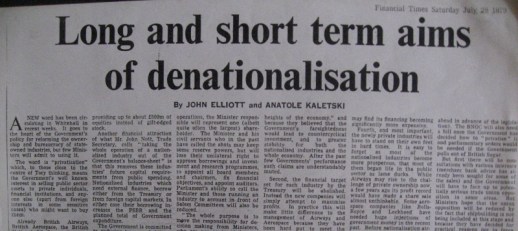
One of Margaret Thatcher’s most significant legacies is privatisation – not only for introducing the policy itself, but also for adding the word into the world’s every-day vocabulary. Her death this week seems a good moment to recount how we launched the word on July 28 1979 in The Financial Times.

The day before, I telephoned Nigel Lawson, who had just become Financial Secretary at the Treasury, for a background briefing on de-nationalisation, as it was then called. During the conversation, he used the word privatisation, which I had never heard before.

I was covering the industrial policy side of nationalised industries for the FT, and an economics correspondent, Anatole Kaletski (Kaletsky) , was writing on the finances. We launched the word in the first paragraph of an FT leader page feature, saying:

“A new word has been circulating in Whitehall in recent weeks. It goes to the heart of the Government’s policy for reforming the ownership and bureaucracy of state owned industries, but few Ministers would admit to using it. The word is ‘privatisation’ which, to those close to the centre of Tory thinking, means the Government’s well known interest in selling public sector assets to private individuals, financial institutions, and anyone else (apart from foreign  interests in some sensitive cases) who might want to buy them”.

No-one seemed to have heard of the word, and the FT features editor did not agree with my request to put our scoop in the headline, saying something like “no-one will know what it means”. Instead, with vintage FT cautious precision, the headline said, “Long and short term aims of denationalisation”.

.

People of course rapidly came to “know what it means”, and the word became internationally used, putting a positive and private sector spin on the more negative heavy-sounding de-nationalisation. Thatcher also intended it to mark the end of Britain’s see-saw policies, with Conservative and Labour governments alternately nationalising and de-nationalising industries.

Sadly, the briefing was non-attributable, so the article does not include any quotations from Lawson – though I did write, leaving a small trail, that he was at the “centre of the ‘privatisation’ exercise”. I also mentioned that Sir Keith Joseph, the Industry Secretary (Minister) and a strong right-wing influence on Thatcher, was concerned about how to protect consumers when public utility monopolies such as electricity and gas supply were sold off. He had briefed me on that earlier – the answer was to allow the creation of rival companies, as happened most notably in telecommunications.

Years later, living in India where the wrongs and rights of privatisation are hotly debated, I’ve wondered whether that was the first use of the word and where it actually came from. The origin, I have just discovered, is Nazi Germany in the 1930s. Udaya Narayana Singh, a linguist and professor at Santiniketan in West Bengal, discovered for me that “English Etymological Dictionaries show the coinage ‘privatization’ to have come into operation from 1959”.

So I googled privatization, with a ‘z’ instead of an ‘s’, and added 1959, which led to links suggesting that the word started in Germany between 1959 and 1965 when Volkswagen and other government companies were sold.

Nazi goodwill

Some sources have also claimed, wrongly, that Peter Drucker, a management theorist,  introduced the word in a 1969 book, but my search revealed that it actually first appeared in Nazi Germany in the 1930s as Reprivatisierung, which meant returning nationalised assets to the private sector.

“In return for business assistance, the Nazis hastened to give evidence of their good will by restoring to private capitalism a number of monopolies held or controlled by the state”, said an analysis in 1941, which also suggested the policy was aimed at strengthening the wealth and loyalty of capitalists, and strengthening what would become a “war economy”.

The word was brought into Britain’s Conservative policy-making by David (now Lord) Howell, who became a minister in the Thatcher government. He first used it in a Conservative Party policy pamphlet, A New Style of Government, in 1970 where he saw privatisation “not just as being about free market and competition but about social change generating public ownership”.

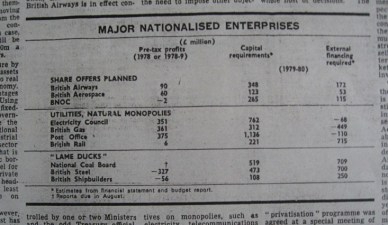
FT privat table July '79  IMG_8308_1_1

Along with a broad sweep of public opinion in the UK, he is now unhappy that, after raising more than £50 billion by selling off businesses such as British Railways, Airways, Aerospace, Gas, Steel, and Telecom, it went too far with what he has described to me as a “weird frenzied” breaking up of services such as water electricity and airports,. These businesses passed into the hands of large corporations, including some based abroad. That was never the intention says Howell, who regrets that the broader social change aims were lost. 

Thatcher’s war economy was different from Germany’s in the 1930s, and was aimed at destroying the power of trade unions and revitalising Britain’s leftward-leaning economy.  In her memoirs, she describes privatisation as “fundamental to improving Britain’s economic performance”.

Like most of Thatcher’s policies, privatisation went too far and continued for too long, becoming a mantra – internationally as well as in Britain – rather than a reasoned policy. A senior Treasury official explained to me in the 1990s how it was essential for him to have a continuing list of potential sales so as to maintain the political momentum. If that momentum was lost, it could be very difficult to restart, he said.

Consequently, despite the obvious successes like airways, aerospace and telecom (with new private companies overtaking what is now BT), there have been some disasters in the UK – notably railways, which were renationalised after serious crashes and mis-management, hospitals (under the Blair Labour government), and security (the G4S company had to be baled out by the British army at last year’s Olympics). The policy is still running – the government intends to privatise the Royal Mail, which has defied reformers since 1979.

Indian divestment

It has also developed into a world-wide craze for PPP – public-private partnership – which often blurs and confuses the conflicting priorities of providing adequate public services and making private sector profits. The private sector cannot be trusted to deliver public services in terms of quantity and quality – as has been seen in Britain with railways and hospitals, and in India with airports (where privatisation is often corrupted by land scams, though there have been successes) and highways (where companies shirk PPP responsibilities).

India has debated how far to go along the Thatcher path for over 20 years. More progress has been made on divestment (selling minority stakes) than on privatising control. Manmohan Singh, prime minister since 2004, has never been a fan, and does not favour selling off profitable businesses. That reflects both India’s old socialist approach, and (I suspect and hope) a healthy scepticism about how far parts of the Indian private sector can be trusted with the country’s family jewels.

This is all a long way from my phone call to Nigel Lawson in July 1979, and even further from Germany in the 1930s. It is a tribute to Thatcher’s leadership that what she started 34 years ago has become a continuing international trend. What happened in Britain however also reflects her inability – or lack of interest – in seeing the downsides of the reforms that she so passionately believed in. As she herself said, “the lady is not for turning”.

Posted by: John Elliott | April 4, 2013

Rahul Gandhi dreams– with a beehive of buzzing thoughts

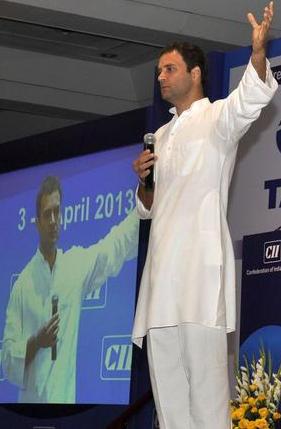
Rahul Gandhi, heir to the leadership of the Congress Party and maybe to the job of Indian prime minister, has dreams. Today he tried to spell them out for the first time to a large conference of businessmen, who knew he was breaking away from his usual political meetings and were indulgent and even captivated as he occupied the stage for about 70 minutes.

.

.

He had two main messages in a slightly disjointed speech and then two long rambling answers as he walked around the stage at the Confederation of Indian Industry annual conference.

One was that India’s future lay in taking politics down to the pradhans (village headmen) to give “a billion people the power to solve the problems” and facilitate development.

The other was that India was a “beehive” of voices and energy that excelled at managing complexities. “You are of the masters of complexities. Dealing with your business, your interactions with India and abroad gives you the power to conquer the world,” he said.

The instant view from an audience that had enjoyed Gandhi’s adlibbing was that he had done well, and some thought they saw leadership qualities. But as people chatted later, criticisms began to emerge about the lack of enough discussion of individual issues. He had set out his vision of a new India with devolved political power, better motivated people, and better roads, ports and education, but he now needed to talk about how these things will be achieved.

Gandhi is starting from a very low base in his current bid to win public acceptability. He has stayed largely invisible and silent for most of the nine years that he has been a member of parliament, and has created endless confusion about whether he wants to be prime minister or even a politician. That low base made it easy for today’s audience to be impressed by his freewheeling style and by what he said, which was sincere though sometimes naïve, laced with a few stories, some rather odd. This would all be fine if he was just starting out, say in his late 20s. But he is now 43, and vice president of the Congress, so should have gone further – for example having an answer to a question he was asked about water shortages and contamination. He should also have discussed how local empowerment could be achieved – by him, or whoever.

His two themes enabled him to dispel any idea that, as a dynastic heir, he could suddenly wipe away India’s problems – and also that Narendra Modi, the Bharatiya Janata Party’s Gujarat chief minister and Congress’s main adversary for the next general election, could not do so either.

“Give me all the power you want – give one individual all the power you want, give him everything, he cannot solve the problems of a billion people,” he said. Knowing that Modi has strong (and financial) backing from businessmen, Gandhi told his CII audience, “If you think there is a guy who will come on a horse charging through and set everything right, this is not going to happen”. Focussing again on Modi, who is a divisive politician, but without naming him, Gandhi added that it took a long time to reverse seeds of disharmony. “Anger, hatred and prejudice do not contribute to growth”.

Gandhi has travelled extensively across the country, including visits to poor rural and urban areas, and he has correctly identified the dynamism and ambitions that are waiting to be released. “Millions of Indians are brimming with energy”, he said. Talking about ambitious poor people he had met on a train to Mumbai looking for work, he added, “We are now sitting on an unprecedented tide of transformation. This tremendous movement of people and ideas are going to define this country in the 21st century”.

Mixing his metaphors to explain problems caused by the exclusion of marginalised groups such as the poor he said that “A rising tide doesn’t raise people who don’t have a boat. We have to build the boat for them. We have to give them the basic infrastructure to rise with the tide.”

He also had a swipe at China, suggesting it was a simple straightforward country compared with India’s beehive. “China is referred to as the ‘dragon’ and India as an ‘elephant’. But we are not an elephant, we are a ‘beehive’,” he said. The problem was that, unlike a “beehive which gives every member a voice”, India was “clogged” and the voices of most people were not heard – which brought him back to his empowerment theme.

This was all fine, but India has no shortage of such dreams and even policies. The problem is implementation of what everyone knows needs to be done and, on that, Gandhi had nothing to say apart from devolution to a billion-plus people via village headmen.

So he needs to go further next time – hopefully soon. Then perhaps people will stop saying Rajiv Gandhi (his father) when they mean Rahul, a mistake that happened twice today, once by the conference manager before he entered the hall, and once by the CII’s new president,  Kris Gopalakrishnan of Infosys, in the vote of thanks.

Posted by: John Elliott | March 19, 2013

Indian engineering excellence produces a new Reva electric car

On my first visit to India in 1982, an engineering enthusiast and perfectionist called Sudarshan Maini held up a small precision-tuned automotive component. “This is what we can produce in India,” he proudly told me.

It had been made by Maini Precision Products, a company he had set up nine years earlier in Bangalore to prove he could turn out international quality engineering components to tiny tolerances and attract export customers with levels of precision that were all but unknown in the country. By 1982, customers included Bosch and General Motors.

.
.

That enthusiasm and drive for engineering perfection led yesterday to the launch at Delhi’s India Gate (right) of the latest model of the Reva plastic-bodied electric city car (photo below), which Sudarshan’s youngest son, Chetan (below with the car), has spent 15 years pioneering.

The good-looking e20 four-seater is now produced by the Mahindra autos-based group. It replaces a more basic Reva and breaks new ground with all-electric power and zero emissions and solar power battery-charging ports. New technologies give drivers access to their car from a smart phone app to control air conditioning and locking controls, and to trigger a remote emergency battery charge system.

This is a story of frugal engineering innovation, in which the Mainis specialise, coupled with the commercial and design capabilities of Mahindra. Chetan Maini’s interest in electric cars began with model vehicles when he was a child. While studying at the University of Michigan in the US, he worked in 1990 on the General Motors’ award winning Sunracer solar powered racing car.

In 1994, he co-founded the Reva Electric Car Company in Bangalore, to produce what became India’s first electric car. Initially developed by Chetan in America, some components were sent out by his family from India to cut costs. Assembly started in 2001, with five people producing the first seven vehicles. To avoid having to build an assembly track for the small quantities, the car body’s tubular metal frame was put on wheels and pushed down the production line.

.
.

Eventually, the Reva (named after Chetan’s mother) needed more funds than the family were prepared to risk, and in 2010 the Mahindra group bought a 56% stake in a new company, Mahindra Reva Electric Vehicles, putting in a total investment of Rs100 crore ($18m). The Maini family holds a 24.6% stake.

The e20 is being produced at a new factory in Bangalore that is 35% powered by solar energy and can produce 30,000 cars a year – small by auto industry standards but substantial for electric vehicles. The immediate sales target is 400-500 vehicles a month, 150 to 200 of them in Delhi which Mahindra expects to be the biggest market. The batteries have a 100km driving range and take five hours to re-charge from any 15A power socket.

The dream is that the e20 could become the first electric car in the world to make a profit. Priced at Rs.5.96 lakhs (about $11,000) after environment-friendly subsidies available in Delhi, it is not cheap. The figure would be lower if the central government introduced national subsidies that were expected but failed to appear in last month’s Budget. Exports to Europe are planned in six to nine months (some original Revas can be seen on the streets of London), and Mahindra is also planning battery-power two-wheelers.

.
.

It seems sad for the Maini family, which had put so much effort and money into the project for 15 years, to have to lose control. “We had mixed emotions about letting go,” says Sandeep Maini, Chetan’s elder brother and now chairman of the Maini group, whose diversifications include higher levels of precision engineering for defence and aviation companies like BAE and Boeing.

“We didn’t have deep pockets – we were technical creators and we also needed competence to develop markets and car manufacturing processes,” he adds.

Mahindra met those requirements. Anand Mahindra, chairman of the family-controlled group, is committed to using frugal engineering to drive innovation. Having talked to various other companies, the Mainis felt that he had the most commitment to electric vehicles and appreciation of what Chetan, who is still involved as Mahindra Reva’s chief of technology and strategy, had been trying to achieve. “This is not just about selling a car, it is about telling people to change their lifestyle,” Mahindra said yesterday “We are working at creating an ecosystem that includes mobility solutions along with other environment-friendly innovations”.

The story shows what India can do. Three government ministers inevitably flocked around the launch at India Gate, seeking instant photo-opportunities and publicity, but they are not relevant to what has been achieved here with the original Reva (above), and the e20, by one young engineer, his supportive family, and now a bigger innovation-oriented family group.

The story of the development of the Reva has been told by Sudarshan Maini in a book published in 2013 by Random Business India – https://www.goodreads.com/book/show/28668191-reva-ev

Posted by: John Elliott | March 13, 2013

Would Rahul Gandhi like to close his family dynasty?

Is Rahul Gandhi preparing not just to renounce the Indian prime minister’s job, as his mother Sonia did in 2004, but also to organise events so that the chances of the Nehru-Gandhi dynasty continuing far into the future are greatly reduced?

It is beginning to look as if that might be what he ideally wants, with democratically elected grassroots members of his family’s Congress Party rising up through the ranks. If that is so, then his critics (including this blog) need maybe to stop regarding him as an indecisive, work-shy, reluctant politician, and consider whether he could eventually turn out to be a significant political reformer.

The peg for these thoughts is remarks he made to reporters and Congress MPs in the Central Hall of the Indian Parliament on March 5, when he indicated that he neither wants to be prime minister nor to marry and produce dynastic heirs.

“Asking whether you want to be prime minister is to ask me a wrong question,” he was reported to have said. “Today, I see how MPs feel without power and it is the same story in all the parties, be it the Congress or the BJP. I want to empower the 720-odd MPs in Parliament. I want to give voice to the middle tier, empower the middle-level leaders. There are some parties in India which are run by one leader, two leaders, five to six leaders and 15 to 20 leaders. My priority is that I want to empower the MPs as also the 5,000-odd legislators in various states,” he said.

Jawaharlal Nehru and the Gandhis – his daughter Indira, her son Rajiv and his wife Sonia, and their son and daughter Rahul and Priyanka

Jawaharlal Nehru and the Gandhis – his daughter Indira, her son Rajiv and his wife Sonia, and their son and daughter Rahul and Priyanka

There are varying versions of exactly what he said about marriage. The Indian Express  reported: “I feel we should all be detached from power. Only then we can contribute to the society better. You people ask me about my marriage plans. Sometimes, I think, if I marry and have children, I would want my children to take my position. Sometimes, I feel that status quo is better.” The Times of India and others quoted “If I get married and have children, then I will become a status-quoist and will be concerned about bequeathing my position to my children”.

The Express also reported that he regretted political parties were designed in a manner that prevented youth from acquiring key positions at a time when they were seeking a greater say in political affairs. “At one point, the pressure from the youth will be such that there will be an explosion,” he said.

Either way, Rahul Gandhi, who will be 43 in June, indicated that he is shying away from marriage. As I mentioned on this blog in January, the only girl friend publicly known about was a Colombian (or Spanish as he once reportedly said), but that was ten years ago and she is rumoured to have married someone else in Colombia.

The High Command

Coupled with Rahul’s frequently repeated criticism of the Congress Party’s “high command” culture (with Sonia currently in command), the logic of the remarks is that new people would rise up through the Congress Party. But it is not clear whether Rahul is envisaging them being ready to take over the top job in 20 years or so when he might retire, leaving nothing for the Nehru-Gandhi dynasty to do after dominating Indian politics since independence.

In his remarks, he only seems to have talked about giving power to MPs and “voice to the middle tier, empower the middle-level leaders”. That echoed his emotional speech when he was anointed the Congress vice-president in January and promised to work for the development of the party. Does it mean however that he envisages a dynastic glass ceiling above that middle-level?

Life, especially in politics, is of course not simple and no-one can predict that far ahead. Would Rahul ever be prepared to step aside? Despite a friendly and approachable manner, he can be dynastically haughty, and seems to enjoy the trappings of power and the exclusive privacy it provides. Just five days before his recent remarks, he was criticised when his cavalcade clogged Mumbai city traffic, with no apparent apology.

Family views

Even more importantly, what line would the family take? There is his personable and politically appealing sister Priyanka who has always been seen as an able fallback should Rahul step aside. Then there is Sonia Gandhi, who is 66 and has undergone treatment for what is believed to be cancer. She has said that she entered politics seven years after her husband was assassinated in 1991 in order to save the Congress Party from collapse, but she also saw herself as a dynastic bridge between her late husband and their son. Would she approve if Rahul aimed to secure the future of the party but not the dynasty?

Certainly, with its current national and regional leaders, the party needs the dynasty in order to hold together. Shekhar Gupta, editor of The Indian Express, summed up the situation well in a column two weeks ago when he wrote that, while the Gandhis were no longer vote winners for the party, they were essential for its discipline. When he asked a senior long-term Congress leader why the Gandhi family was still so important and had total sway over the party, the reply was: “They cannot help anybody win elections, but they keep the party together. Their word is law and the party needs that discipline”.

Rahul’s remarks have sharpened speculation about who would be prime minister if Congress won a leading coalition role after next year’s general election – with Palaniappan Chidambaram, curently the finance minister, being a current favourite, since he is by far the most experienced and competent minister in the government.

But that may prove to be academic because there seems little likelihood of Congress winning a leading role. This would bring the focus back to Rahul as the party leader, and the huge task he would have in transforming an organisation that is hamstrung not just by the Gandhi dynasty but by many others in the states – often appointed and encouraged by the Gandhis to hold top posts. He has already been facing opposition from established regional leaders who resent newcomers.

If Rahul means what he says, then he has a huge task, not just to halt his own dynasty but to change the way that the patronage and privilege-based Congress Party operates. Let’s see if he means it!

.

David Cameron, Britain’s prime minister, has ended his rather over-done public relations blitz in India with a sombre and respectful visit to the Jallianwala Bagh site of the 1919 Amritsar massacre, one of the worst atrocities of British rule, which he described as a “deeply shameful event in British history”  (see below*). He was the first British prime minister to go there, and he also visited the nearby Golden Temple (left), the Sikh faith’s most sacred shrine, with an eye (as UK correspondents accompanying him noted) on the sizeable Sikh vote in the UK.

Always just a bit too keen and eager, Cameron swept into Mumbai on Monday morning with the news that he wanted to build “a very special partnership” with India, and repeated that yesterday at a joint press conference with his host, prime minister Manmohan Singh.

He sounded rather like a senior prefect anxious to please the headmaster with an array of proposed achievements – instant visas for Indian businessmen, open doors for Indian students, and jointly developing a new-city corridor between Mumbai and Bangalore. He then sounded like an erring once-bullying husband anxious to rebuild family bonds when he said at the press conference that the “future of our two countries should be inextricably linked”.

.

The two countries aren’t of course inextricably linked, despite the colonial past, and Cameron won’t get very far pitching such lines at a government level.

Manmohan Singh was more interested at the press conference in pressing him for help investigating corruption allegations on a helicopter contract, while Ministry of External Affairs officials wanted him to stop ignoring India when he hosts Afghanistan-Pakistan talks, as he has been doing recently.

Cameron quickly promised co-operation on alleged corruption in an Italian owned (with UK involvement) Augusta Westland helicopter contract, and agreed a mechanism to keep India in the loop on his Af-Pak talks that are aimed, Indian sceptics believe, at unwisely courting the Taliban so as to try to stem Pakistani-born UK residents turning to terrorism.

The pitch goes down better with individual Indian businessmen and others, though there is still scepticism with people recognising that the main aim is to build on the strong role has in the UK with 1.5m Indian-born people living there and the Tata group being the UK’s biggest private sector employer.

Cameron made an impressive speech last night to an audience of a couple of thousand in the British High Commissioner’s home and garden in Delhi. Indian guests’ reactions ranged from “he was reminiscent of Bill Clinton” from a young lady academic economist, to “yes of course he’s over-egging it – he’s a pr man” from a more sceptical economics academic, and “he’s doing his job, he wants to create jobs in the UK so needs investment”, from a very seasoned journalist.

David Cameron with Bollywood star Aamir Khan and Delhi students

David Cameron with Bollywood star Aamir Khan and Delhi students

India is not going to build the “great relationship” (as Cameron rephrased it once or twice) with the UK and it is idle for him, in his eagerness to please, to over-pitch what can be achieved now that the role of world-wide colonial power and distance colony have been reversed into an offshore European island and rising one-day-to-be super power. Cameron is just one of the continuous flow of heads of foreign governments to India.

Francois Hollande of France was here on a much lower profile but effective visit until hours before Cameron flew in. Just before him came the king and the prime minister of Bhutan, a long-term friend and neighbour and more crucial to India’s interests than the UK or France. In the weeks before, there were presidents from two small but significant countries Mauritius (official India investment tax haven), Nepal (like Bhutan, a buffer state with China), and Vladimir Putin from Russia (India’s longest international partner).

Picture with article in The Economist, February 16, 13

Picture with article in The Economist, February 16, 13

So while there are many ways in which Britain and India can and will co-operate as old and future partners, it is silly to dress it up as something special, as Cameron also did in July 2010 when he arrived with a unprecedented posse of six cabinet ministers. This time he brought more than 100 businessmen which, he says, is the largest ever taken abroad by a UK prime minister.

India needs practical constructive partnership in developing the country and protecting its security, and it respects friends it can trust. Cameron’s best new offer was making visas available for Indian businessmen within 24 hours, instead of five days or longer as happens now, though that will be restricted to applications in Mumbai and Delhi. He also made news about students being welcome in the UK, though had nothing new to offer on that, despite many stories of students not managing to obtain visas.

Among other initiatives (listed in a joint statement). he talked about helping India develop new cities along a 1,000 km corridor between Mumbai and Bangalore, though the UK will not be offering the sort of multi-billion dollar aid provided by Japan for a Delhi-Mumbai corridor. It is primarily interested in obtaining contracts for British consultants, some of whom are already working on the Delhi-Mumbai project.

After all that, the best way for Cameron to get a partnership moving would be to generate interest about India in the UK, which is currently lacking.  A British Council study last year found that, despite a shared history of 200 years, “Neither country has invested actively in building a contemporary relationship. India does not know contemporary Britain and Britain has little idea of how the new India is emerging. Stereotypes exist and remain damaging.” Officials also say that most British small and medium sized businessmen find India too daunting to try to access because of its size, unstable policy environment and corruption. That is where Cameron could best focus when he gets back to London.

* photo of David Cameron’s note in the Jallianwala Bagh visitors’ book by Andy Buncombe, The Independent

There was an incredibility and inevitability about the announcement last night (Saturday) that Rahul Gandhi has been appointed vice president of India’s Congress Party, confirming his position as number two and heir apparent to Sonia Gandhi, the dynastic leader of the party and of the country’s United Progressive Alliance (UPA) governing coalition. It also made him an heir apparent to Manmohan Singh, the prime minister.

It was inevitable because Rahul Gandhi has been seen for years as having the right to rule India in his genes.

But it was also incredible because, aged 42, he has shown little ability or interest in fulfilling that destiny, yet last night was accepted without question by grown and able Congress ministers and other party leaders.

Manmohan Singh congratulating Rahul Gandhi yesterday

Arguably, some of those leaders would make a better job of being vice-president, but they and others see a Gandhi – and Rahul is the one to hand – as the best bet to hold the party together and provide the sort of iconic image needed for it to win at the polls and keep them in their posts of power and patronage

People danced in the streets outside the party headquarters and Sonia Gandhi’s Delhi home, hailing him as their leader and future prime minister as though salvation and election victory had just been announced, not merely the long delayed elevation of an apparently reluctant candidate.

The next general election, due by April next year, will be tough for Congress, which has performed poorly since it was elected for a second term in 2009 – as it will be for the Bharatiya Janata Party that might be led by Narendra Modi, who has the support of leading businessmen. The election is expected to lead to a hung parliament and another coalition government.

The announcement came at a party conclave in the Rajasthan city of Jaipur, which next weekend will host a large annual international literature festival that will air far more genuine and original debate and fervour than Congress’s party managers have allowed.

.

Rahul’s elevation was proposed by A.K.Antony, who seems to put more energy into being a dynastic loyalist than he does as minister for defence into equipping the country’s depleted armed forces. It was immediately greeted with acclaim.

Today Rahul made an acceptance speech to the conclave that was strong on emotion and on what is wrong with the corrupt and power hungry in India. It reflected  a famous speech made by his late father, Rajiv Gandhi, as prime minister in 1985, attacking Congress power brokers who he said handicapped ordinary party workers. Rajiv Gandhi failed to change the system and his son today offered nothing positive, apart from a pledge that he would work for the party and country.

.

That generated a rousing standing ovation from the audience and tears from some leaders, but Rahul has taken so long to accept this heir-apparent appointment, and has performed with such lacklustre since being made one of the party’s several general secretaries in 2007, that he seriously lacks credibility.

This was demonstrated by newspaper headlines this morning that said he would need to prove himself to the party in the general election. “Cong named Rahul No. 2, stops short of giving him poll leadership” said the Indian Express, while The Economic Times noted that “To get the party, he needs a victory”, adding that “his star has dimmed”..

As general secretary in charge of the Youth Congress, he has reorganized structures and local party elections, and has contributed to other organisational matters. But he has shown absolutely no grip or interest in policy. His problem is not just that he did disastrously in Uttar Pradesh state assembly elections last year.

More importantly, he has shown no continuity of purpose, often vanishing without trace from the public scene, and showing no follow-up interest when he visits poor areas. He rarely speaks out on major issues and crises, such as country-wide mass protests about corruption last year and recently on gang rape and the treatment of women. He makes adequate election-style speeches to crowds of thousands, – as he did today to the Congress meeting – but rarely engages in public debate or gives media interviews. That matches his mother’s reclusive approach, but he has seemed far more detached than her.

.

His private life is a mystery. Everyone of course has a right to privacy, but that reduces the more public a person becomes, and Rahul is possibly India’s next prime minister.

So little is known that Delhi buzzes with gossip about where he regularly vanishes – is it abroad as is often rumoured (Dubai, Bangkok, London?), or just to houses of friends in elegant roads near his central Delhi home?

Does he have a girl friend? The only one every seen publicly (above) was Colombian, or Spanish as he reportedly said in 2004, but she is rumoured to have married in Colombia. More recently, there has been talk of an Afghan girl friend.

Such questions and gossip would fade if, over the past eight years that he has been an MP, he had begun to become more accessible and play a visible active political and policy role.

None of this means that Rahul should not be prime minister, nor that the Gandhis should not be in politics if they prove themselves and leave room for others to emerge.

But whereas his mother has been a unifying force for the Congress party, Rahul has done virtually nothing to gain the title he received yesterday, and instead is blocking other young and able politicians’ careers.  He now has a year or so (less if the general election comes early) to prove himself and fulfil promises of personal commitment he made in his speech today.

Posted by: John Elliott | January 17, 2013

Businessmen boost Narendra Modi’s prime ministerial ambitions

Vib Guj NM closing 19_dsc_2643_595INDIA’S business leaders are joining ranks behind Narendra Modi, the controversial and egocentric chief minister of Gujarat and a leading light of the Bharatiya Janata Party (BJP), in advance of India’s next general election.

Their support was evident as the chairmen of some of the country’s biggest companies, led by Ratan Tata of the giant Tata group, lined up as speakers at the opening and closing sessions of last weekend’s “Vibrant Gujarat” event. Though none of the businessmen openly backed Mr Modi’s political ambitions (the only speaker who did was a regional politician from Russia), the implication was clear……………For my full article “Narendra Modi – Feeling vibrant” go to The Economist’s Banyan Asia blog, click here econ.st/WKbEK8

.

IN ADDITION……….Other states, including West Bengal this week, have followed Gujarat’s example since it’s first Vibrant conference in 2008, but none has had anything anywhere near as large and international, nor with such big names. Declarations of investment intentions past, present and future included Rs34,000 crore ($6bn) from Mr Tata and Rs100,000 crore ($18bn) from Mukesh Ambani.

The government claimed some astronomic – and mostly uncheckable – results at the end of the event: investment intentions for 17,719 projects including 12,886 in small and medium size businesses promising 370,000 jobs; 10.6m people visiting the trade show; 58,000 delegates in 127 seminars at the conference, including 2,100 delegates from 121 countries who struck 2,670 “strategic partnership intentions”.

cover story March 26, 2012 "Modi Means Business but can he lead India"

cover story March 26, 2012 “Modi Means Business but can he lead India”

There are arguments about how far Gujarat’s economic growth of around 9%, and social indicators such as reduction in poverty, compare with better states like Maharashtra and Tamil Nadu, but those and many other states do not have Gujarat’s efficient and largely corruption-free regime.

Since becoming chief minister since 2001, Modi has built on Gujarat’s long record as a leading industrial state, and on its entrepreneurial skills that for decades have produced successes ranging from the Ambanis to big companies in Africa and corner shops in the UK.

He has beaten the rest of India by linking virtually all the state’s 18,000 villages with metalled roads, regular electricity supplies (with industry subsidising small farmers by paying more), and internet connections, and has a big current drive on solar energy and wi-fi broadband networks. There is substantial land available ready for industry, which avoids land acquisition problems and delays of many other states and has also developed highways and ports.

Such a record impresses investors, despite the fact that, as a Time magazine (above) headline put it last March, Modi is India’s “most loved and loathed politician” . Investors are drawn by Gujarat’s continuity and execution of policy while being exasperated with the national government’s unstable reform agenda and poor record of implementing policies, and by many other states mixed record and rampant corruption.

Earlier posts on this blog on Narendra Modi:
Narendra Modi challenges the Gandhis’ Idea of India , Dec 21, 2012
Could Narendra Modi become the leader India needs? Sept 15, 2011
Mumbai votes for Narendra Modi as national leader , Dec 5, 2008
Will the current crisis lead to Narendra Modi as PM? Dec 3, 2008
Has India got a unifying politician like Obama? Nov 3, 2008
A Hindu nationalist win in Gujarat , Dec 27, 2007

Gandhinagar,

Posted by: John Elliott | January 3, 2013

Gang rape reveals the real India, and the glimmers of change

Friends abroad have emailed me in the past few days horrified that India could be such a cruel and unsafe place for women. They have been reacting to international news of the gang rape, and subsequent death, of a 23-year old paramedical student in Delhi, that led on to a flood of other rape reports. Similar international reactions were to be heard from two years ago when there were widespread reports of massive corruption, and mass demonstrations called for the system to be cleaned up.

To many people abroad, these events have come as a revelation that charming, culturally fascinating, apparently friendly and even saintly, though often chaotic, India could instead be a cruel, male-dominated, often selfish and heavily corrupt dishonest society, where the strong bully, assault and exploit the weak – a country that is struggling with the tensions and clashes of rapid economic and social change, but where governments find it hard to keep up and rarely achieve major reforms, and where people habitually tolerate their lot, hoping maybe for a better life next time.

.

.

The good news is that largely peaceful country-wide demonstrations over the past two weeks have frightened the government into action because the appalling rape – in a curtained bus driven round Delhi courtesy of a corrupt police force and inefficient state government. This atrocity released anger and frustration not just over assaults on women but also against the police, politicians and an ineffective legal system.

The government’s fright at what Palaniappan Chidambaram, a top government minister, unkindly described as the “new phenomenon” of “flash mobs” was evident when the police turned water cannon and tear gas on demonstrators in central Delhi just before Christmas. That cleared away violent rabble-rousers, but the demand for justice and change continued peacefully across the country and turned into mourning and candlelight vigils and protests when the 23-year old died of multiple organ failure on December 29. She died  in Singapore where she had been controversially flown by a government that was advised by intelligence agencies of a public backlash if her death were to happen in India after Delhi’s doctors had failed to save her.

This protest movement was genuinely spontaneous, unlike the earlier corruption demonstrations which had campaigning leaders and even more unlike most demonstrations and riots that are usually organised by political parties or other vested interests for short term gains. This time women suddenly found they could come out openly and talk and protest about assaults that they had largely kept quiet about in the past. An astonishing number of women have stories of being seriously harassed and attacked, often on buses.

There was no central single leader, so the government could not negotiate and talk its way out of trouble and into somnolence, as it has usually managed to do with crises for decades. Instead, it resorted to gesture politics, with a flood of sympathetic statements from hitherto silent or contemptuous politicians and the Delhi police chief, plus a security clampdown in the centre of the capital that closed many roads to curb unrest.

The government’s leaders, Sonia Gandhi and Manmohan Singh, even went to the airport around 3.30am last Sunday morning to meet the girl’s body with her family when she was flown in from Singapore. Two other political leaders went to the heavily guarded private cremation – one was Sheila Dikshit, the Delhi chief minister who, with assembly elections due this year, had been playing politics over the issue and was booed when she had visited the protestors.

.

.

Over the past ten days Sonia Gandhi, who rarely appears in public apart from election campaigns, has gradually led from the front (seen here on tv) reflecting the nation’s horror and grief, despite her own apparent poor health. Rahul Gandhi, her 42-year old son and political heir, has failed to make any significant appearance, which has been widely noted, negatively.

The 23-year old’s gang rape on December 16, and other cases involving strangers, are dominating the headlines, but statistics show that victims’ relatives and neighbours are often themselves the rapists, or connive in the crime. Police records show that out of 662 cases reported in Delhi during 2012, 189 involved friends or relatives, while 202 were neighbours. Among the victims, 286 were aged 12 to 18. Incest is widespread – “an uncle rapes a young girl but her father, the man’s brother, lets it happen,” says a friend. The police rarely help.

A 17-year old girl in Punjab committed suicide recently because she was being harassed after it had taken her 14 days to persuade police to accept her gang rape accusation. Another report says a policeman and his nephew raped a young woman who wanted to be recruited into the force.

A friend wrote yesterday on Facebook about how he and a woman lawyer living in west Delhi took an eight-year old girl to the police with her semi-literate frightened dhobi (laundryman) father, who lived nearby The father kept repeating “Iski beti kay saath kuch ladkay nein bura kiya” (some boys have done something bad to my daughter). The police at first were sympathetic, but after a day or two said: “When both her parents are at work, she crosses two roads and the train tracks to move around with boys of another locality. She is a very bad character, and if any boy does anything to her, she totally deserves it”. The girl was only eight!

Patriarchal society

India is a patriarchal society where women are now becoming economically equal with men, showing new independence in their careers and more liberated private lives, especially in urban areas. The social changes and tensions have turned what has for decades been known as eve teasing – men touching women provocatively in locations such as crowded buses – into something more aggressive. In addition, Bollywood films increasingly show women film stars virtually offering themselves on the screen, provocatively glorifying the prospect of instant sex rather than relationships.

In traditional male-dominated rural societies, and in recently urbanised areas of Haryana and Uttar Pradesh close to Delhi, local village community councils called khap panchyats rarely side with rape victims. Women are blamed for being provocative, or the intercourse is dubbed consensual – a line often taken by the police across India. Women can also be subjected to a humiliating “fingers test”, which defence lawyers use to deny rape citing frequent and consensual sexual activity.

.

.

When a spate of rapes happened in Haryana, a khap panchayat (like the picture, left) said the solution was for the young to get married, without any minimum age limit, so that their “sexual desires find safe outlets”.

Often young girls who belong to the Dalit (“untouchable” in the caste system) are raped in a form of lower caste oppression – prompting a local Congress politician to allege the rape reports were a “political conspiracy” by the state’s dalit-based party. In October, Sonia Gandhi visited a family in the area whose 16-year old daughter was gang raped and committed suicide. Mrs Gandhi promised action, but nothing has changed and rapes in the area have continued.

Rape of course is prevalent across the world. In Britain, according to a government action plan on violence against women and girls, 80,000 women are raped a year. That puts India’s 24,000 reported rape cases in 2011 in some sort of perspective, though the basis for statistics varies in different countries and India’s real total is almost certainly enormously higher because the fear of police and social harassment and indifference means many incidents go unreported. The real worry in India is that it reflects long standing social patriarchal attitudes and caste hierarchies that not only persist but have been exacerbated by social and economic changes.

There is therefore a huge need for a change of attitudes across society starting, with how families regard and protect their women and how old traditional societies can be weaned away from male domination. That will take a long time.

Meanwhile there is an urgent need to speed up the lengthy judicial system – fast track courts have just been set up for rape cases. The under-trained and under-supported police force needs reforming with a focus on caring for the public instead of pleasing local politicians and VIPs, but that will take a long time to happen, if it ever does. The government has appointed a panel headed by a retired judge to look at the laws, and a task force to advise on the safety of women and on police operations. The FICCI and CII business federations are considering how treatment of women at work can be improved.

New penalties for rape suggested to the government in recent days include execution and chemical castration, though these seem unlikely to be adopted. Five men accused of the 23-year old’s rape and vicious assault with an iron bar have been charged today with murder, rape and kidnapping, and charges against a sixth younger accused will follow.

Life in India will never be quite the same again because the young and newly aspirational middle class have discovered the power of mass street protests. Corruption has not stopped and new rapes are being reported daily, but the power of protest has been established, not by orqanised campaigners but by ordinary people of varied classes who want India to change, and will demonstrate again until it happens.

As someone said in one of the seemingly non-stop television discussion programmes of the past two weeks, “the days when gradualism was acceptable are over” or, to put it another way, the old attitudes of jugaad (quick fix) and chalta hai (don’t worry, it will work ok) can no longer be relied on by the government to avoid social protest and unrest.

« Newer Posts - Older Posts »

Categories