Posted by: John Elliott | December 29, 2012

Ratan Tata, India’s sensitive and visionary tycoon, steps down

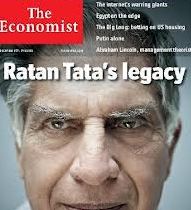
Ratan Tata’s retirement yesterday, on his 75th birthday, from the chairmanship of Tata Sons, India’s biggest conglomerate, marks the end of an era for Indian business as well as the group. No-one has bestraddled Indian business in the way that he has done, presiding over Tata’s $100bn-plus revenues, more than half from 80 countries overseas, with over 450,000 employees in 100 operating companies and interests ranging from tea to telecoms, software to hotels, wrist watches to defence rockets, and coffee (Starbucks) to power and steel.

There is no other Indian business figure of similar stature, and no one near to being able to take his place as a symbol of managerial ethics and success. Mukesh Ambani who runs Reliance Industries, which vies with Tata for the top slot, does not have the respectability, and his younger brother Anil is not even at the starting grid. Kumar Mangalam Birla has made a substantial success of one branch of the old Birla family group that matched Tata’s commercial importance 30 years ago, but he is ever more shy than the withdrawn Mr Tata.
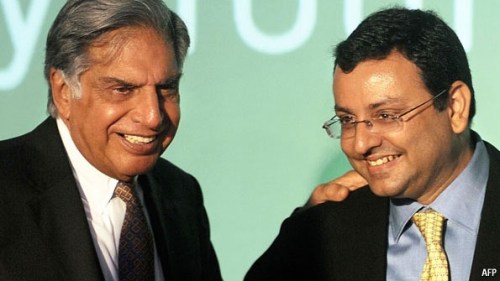
Ratan Tata and his successor, Cyrus Mistry

Ratan Tata and his successor, Cyrus Mistry

Rahul Bajaj likes to be heard, but has retired from his two-wheeler business and his sons are relatively low profile. Families such as Godrej, Mahindra, Singhania, and Munjal (Hero) are not dominant enough and mostly do not have the charisma, while others like the Jindals and Ruias (Essar) are in a different league. In new technologies, Azim Premji of Wipro could qualify but he has too narrow a base, while Narayan Murthy, one of Infosys’s founders, has retired to mentoring. Deepak Parekh of HDFC and a veteran chair of government committees could have qualified, but he too has largely retired.

This raises the question of what Mr Tata’s leadership has actually symbolised and provided, and what is the gap left by his retirement after 21 years in charge?

The answer can be found in the way that he has led the group itself. He took over in 1991, the year of India’s economic reforms, first uniting the loosely run group under the Tata banner, ousting elderly satraps, and then using opportunities unleashed by the reforms to spend $20bn on foreign take-overs and become India’s first group with $100bn revenues (2011-12). His dream for 2020-21 is $500bn.

He strove for a corruption-free group, and lost influence in Delhi and elsewhere as a result – he has always seemed uncomfortable with the complexities of political and corporate corruption that has grown enormously in India during his time as chairman. “I can say, with my hand to my heart, that we have not in fact partaken in any clandestine activity,” Mr Tata said last year when being questioned about his group’s involvement in a far-reaching telecoms scandal.  “I think there are many honest businessmen. There are many that bend. I am happy that I have not bent”.

But such a massive array of businesses could never fully match the “exemplary” ethics and values that he has said he would like to be his legacy. He unwisely hired and promoted Nira Radia, an influence peddler at the centre of a telecoms-linked political crisis in 2010, as his trusted public and government relations adviser.

His companies’ environmental record has also not always been as good as he would like it to appear, especially in the extractive industries, and his lack of concern was demonstrated by the construction of Dhamra Port in Orissa in 2008.

Watching him as a reporter since I first met him in the mid-1980s, when he was working his way towards becoming Tata Sons chairman, I’ve learned that he feels personal hurt deeply. This has made him ultra-sensitive and unforgiving over what he considers unfair media coverage (see below), and also unforgiving to senior executives who have displeased him. His public relations and statements have not always been as straightforward as they might have been, though it is perhaps because of the pedestal on which he stands that such criticisms are aired. His stature has been matched by his personal reticence. He has never married, but told CNN last year that he had been in love and almost did so four times, each time backing off “in fear or one reason or another”.

His biggest contribution has been to spearhead Indian companies’ foreign investments abroad, starting rather unexcitingly with the purchase of Tetley Tea in the UK in 2000. Much more significant was a take-over of South Korea’s Daewoo truck manufacturer in 2004. This was a trailblazer because it showed that someone in India’s largely unimpressive and uncompetitive manufacturing industry had the ability and nerve to venture abroad. I have always thought that this deal was a turning point in Indian industry’s self-confidence, which then grew rapidly in the mid-late 2000s.

.

It led on in 2007 to Tata Motors’ $2.3bn purchase from Ford Motor of Britain’s Jaguar Land Rover business, which has been a huge success.

(I am happy to admit I was wrong in March 2008 when I suggested on this blog that it might be unwise for Tata to have bought into the “history of trouble” at this last remaining lame duck of the UK’s once proud motor industry. That post, which initially ran on Fortune magazine’s website, drew the blog’s biggest ever readership of 49,000 in one day and 75,000 in three days, with critical comments.)

What I and other sceptics had not foreseen was that, by capitalising on design work started but not carried through by Ford, Tata had the energy, finance and managerial strength to produce impressive new models (above) and expand sales internationally, especially in China.

This demonstrated Mr Tata’s capacity to drive through his decisions, as he also did, against advice from senior colleagues, on his far less successful $11bn take-over in 2007 of Europe’s Corus steel business that has left Tata Steel heavily indebted.

He then spearheaded the sadly misguided concept and launch in 2009 of the Nano, the world’s cheapest car, which failed to take off. Aspirational Indian families, who Mr Tata dreamed of upgrading from unsafe over-loaded scooters, did not want to own the world’s cheapest product – it has now been re-launched slightly upmarket and is doing better. The Nano has often been praised as an example of low cost manufacturing, but its price was due to state government subsidies and squeezing component suppliers’ margins in addition to what is now fashionably called frugal engineering.

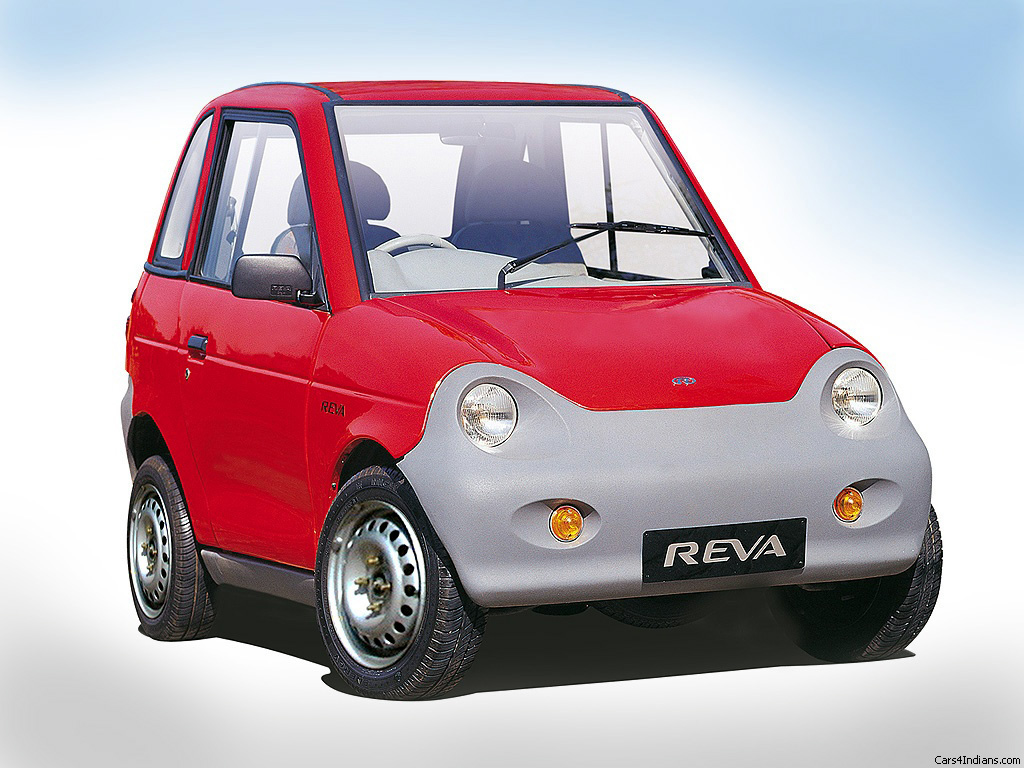
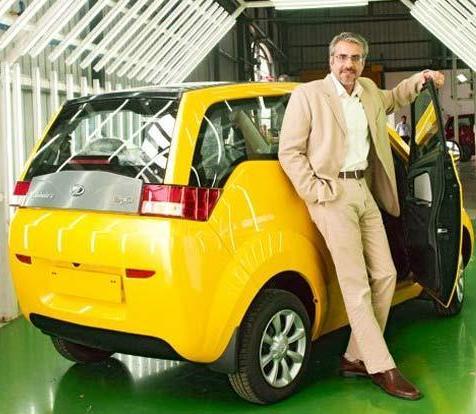
The story is well told in a Tata-promoted book, Small Wonder – the making of the Nano, which tracks the excitement and brain-storming of the car’s development, with revolutionary early ideas that were abandoned such as having soft shutters instead of doors and assembling it at small workshops around the country. Eventually, the car did not break any significant new ground and made frugal engineering an end in itself, whereas it should be used to develop new ideas at low cost – as has been shown for example by the plastic-bodied Reva electric car developed by the Mainee family of Bangalore and now part of the Mahindra group.
.

Tata Motors was the company where Mr Tata had most direct interest and influence and he spent yesterday, his last day at work, at its Pune factory.

But the company’s India operations need an overhaul now that it is no longer controlled by the patriarch, as do the steel and telecommunications businesses plus, according to some reports (left),the Taj hotels. The company that needs least attention is TCS, the group’s information technology cash cow.

My first experience of Mr Tata’s media sensitivity was over a profile I wrote on him in The Economist in 1996. It was heavily edited, and the published version compared him and his satraps with feudal rule in medieval England, headlined At the court of King Ratan. Unsurprisingly, he was not impressed, and I arranged to meet him to smooth things over.

A few years later, when I was involved with Fortune magazine, a visiting reporter wrote a long and unflattering article in April 2002 headlined one of India’s most beloved companies…is also a mess.  Mr Tata had spent time with the author, including a helicopter trip with him at the controls, and he was furious, feeling let down. That prevented any formal contact between Fortune and the group for most of the rest of the decade. Such blacklisting is not unusual. Last year there were reports that companies were being advised not to advertise with some Indian media outlets because of their coverage of the telecoms and Radia scandals.

Mr Tata’s final weeks have seen another media upset, which led him to curtail his availability for interviews . The Financial Times met him earlier this month and, in the first of three articles, quoted him blaming the government for speaking with too many voices and slowing investment decisions. He also gave an interview to Tata’s in-house communications executive where he said his successor would have the challenge in India of sticking to Tata’s ethics or “surrendering to a venal system”.

The two interviews were rapidly reported together in the Indian and international media, highlighting the word “venal”, which led to the in-house interview being quickly removed from the website (it is still on the DNA newspaper site). Tata also issued a denial that both implied (inaccurately) that the FT had used the word “venal”, and secondly denied, somewhat implausibly since it had been an in-house interview, that Mr Tata had ever said used the word “in any manner”. That prompted a column in the Business Standard listing other occasions where Mr Tata had denied saying that he had said.

Such upsets are inevitably remembered by those involved, but they should not and cannot detract from the record of iconic leadership that Mr Tata has provided over the last two decades. He has changed many parts of the group and led it abroad to many countries including the UK where it is the largest private sector employer. He did that at a time when other big Indian companies, which thrive by bribing the Delhi and state governments, were shy of venturing into unknown territories.

He now retires to be chairman of the Tata’s charitable trusts that own 66% of the group, having handed over as chairman of Tata Sons, the main holding company, to Cyrus Mistry, a 44-year old businessman linked to the Tata family by marriage and the Parsi religion, and to the group by an 18% family equity stake.

To answer my questions at the start of this article, Mr Tata’s leadership has symbolised ethics and vision, despite a few bumps, and the gap left by his retirement is the absence of an Indian businessman with a similar renowned image in India and abroad.

Posted by: John Elliott | December 24, 2012

Merry Christmas!

.

.

.

.

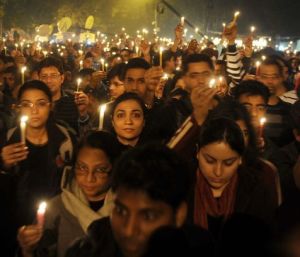
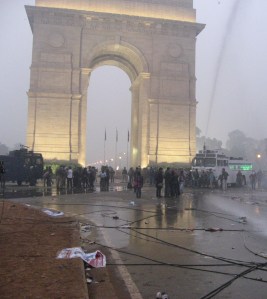
I have just returned from India Gate in central Delhi where police and paramilitary forces fired tear gas and water cannon at peaceful demonstrators, spectators including families, and mobile television studios at around 5pm at the end of six days of country-wide mass protests sparked by the gang rape of a young woman last Sunday night and subsequent government and police indifference.

This irrational vicious action undermined work done during the day by Sonia Gandhi and her son Rahul, as leaders of the Congress Party, to push the largely inactive and apathetic government into positive action and dialogue with representatives of the protestors. More than 140 people were injured in Delhi during the day , including over 80 from the security forces, one of them critically.

I was standing about 100 yards east of the India Gate monumental arch, chatting to a television crew, when two massive water cannon vehicles moved round the side of the gate and advanced on us, followed by lathi (long stick) charging police and security forces.

.

.

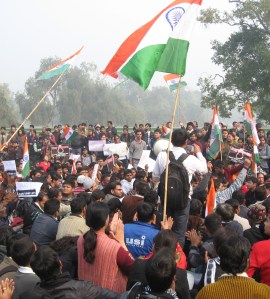
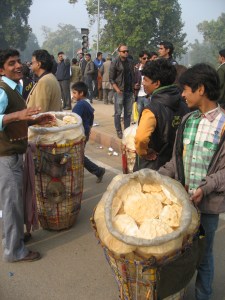
All around us hundreds of people – many of them young women – were clustered in groups, some singing and some listening to speeches on the theme of “Give us Justice”, while others watched television anchors and interviewers at work. Sellers of chai, sweet potato and other snacks were doing a brisk business.

.

.

No one expected that the security personnel, who were attempting to clear troublemakers a few hundred yards to the west, would come round the monument and move towards us. “Stay by our tv installation and you’ll be ok,” joked Jehangir Pocha of  NewsX.


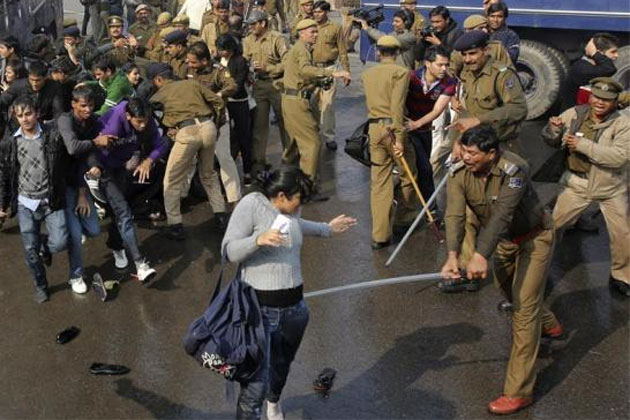
When it was clear that his television station’s trestle-table and equipment would not provide protection (click here for his live report), I turned and ran with the crowds till lathi charging police and paramilitary, lashing at anyone they could reach, caught up with us. It was then safer to walk back towards the enraged officials rather than appear to be running away, which is what I did with my hands half-raised saying “press, press”. The police dodged round me, wielding their lathis against whoever else was nearest.

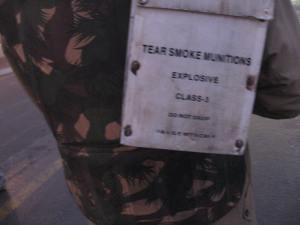
Later, they continued irrationally to beat people, including women, mostly those walking or running on their own – a verbal instruction to leave the area would have been enough. The sound of tear gas shells going off nearby to deal with other demonstrators, including those fleeing from India Gate, could be heard for some time.

.

.

I have often watched police and paramilitary brutality in India (and other nearby countries) but I have never before literally been in the middle of it.

If US drones on the Pakistan border fuel anti-American feeling, the police and paramilitary Rapid Action Force (RAF) did a good job this evening of turning ordinary people against them. Like the drones, the police and RAF personnel did not care how many innocent peaceful people they injured in their attempt to clear some violent demonstrators.

Some action was certainly justified. There had been trouble throughout the day west of India Gate on Rajpath, which had been taken over yesterday by thousands of protestors in astonishing and unprecedented day-long demonstrations.

.

.

Today, several lines of security forces backed up by the water cannon vehicles formed a barrier to block entry to Rajpath from the India Gate concourse. For several hours they were literally face-to-face with rabble-rousers, almost all men, who taunted and provoked them.

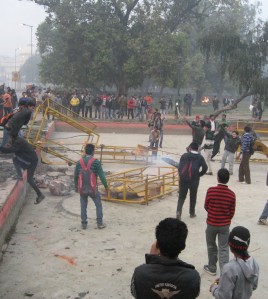
Some tear gas shells were fired around 3pm, but an hour or so later the trouble-makers had managed to advance along Rajpath, smashing police barricades and pelting stones. Later they started fires with wooden media observation towers and fencing, and smashed barricades. This enlarged the area engulfed with violence, but the incidents were isolated and involved just a few dozen of the several thousand people there who were basically peaceful protestors or spectators out for a Sunday afternoon.

IMG_7644 trimdAs dusk fell, it was understandable that the police would want to stop these violent destructive demonstrations and deal with the offenders. That could however have been contained and there was no need for the water cannon and lathi-charging that engulfed the crowd around me and many others further away.

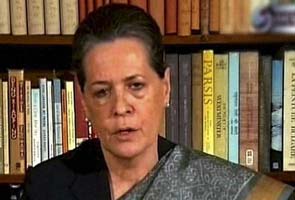
Sonia Gandhi first met the protestors outside her central-Delhi home just after midnight last night and then had a long meeting with a delegation this afternoon along with Rahul and a junior home minister.

She promised a speedy trial of six people arrested for last Sunday’s gang rape which took place in a Delhi bus, and also a review of laws affecting women and rape.

But along with promised other government measures, it was too little too late and the delegation refused to end the protests which, though sparked by the rape, are also directed at government inaction and indifference and – significantly given this evening’s official brutality – the country’s violent police and security forces who mostly see it as their job to beat and hurt the weak and defenceless, including women, instead of protecting them.

.

.

.
Posted by: John Elliott | December 21, 2012

Narendra Modi challenges the Gandhis’ Idea of India

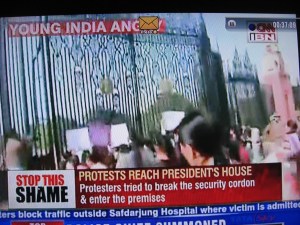
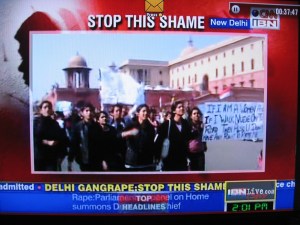
Anti-rape protestors reach the gates of the president’s palace

It is beginning to look as if the next general election could turn into a battle over the “idea of India” between the Hindu-nationalist, efficient, and growth-oriented approach of Narendra Modi, who was re-elected yesterday as the Bharatiya Janata Party (BJP) chief minister of Gujarat, and the more all-embracing secular and populist but less efficient and often corrupt model offered by the Congress Party and its dynastic leader-in-waiting, Rahul Gandhi.

.

.

“Rahul….represents the idea of India,” Salman Khurshid, India’s external affairs minister, said yesterday, commenting on television about Modi’s re-election with a phrase first used by Rabindranath Tagore.

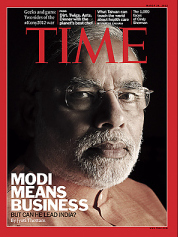
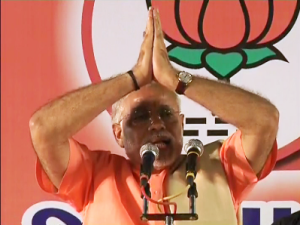
The inference was that Modi (left) does not represent that idea because of his aggressive nationalist image and because he seems to be more concerned with courting business investment than caring for the poor and minorities, whereas Rahul Gandhi and his mother Sonia, the Congress president,  instinctively lean towards the softer inclusive option of aid handouts rather than challenging economic reforms.

Modi has a long way to go to become the BJP’s prime ministerial candidate, and he has yet to show that he has any significant following outside Gujarat, where he has ruled since 2002; but the image of efficient administration that he offers could prove attractive at a time when there is growing impatience with the inadequacies of India’s government and administration.

That impatience has been shown this week with five days of countrywide demonstrations demanding action against rapists, following the gang rape of a 23-year old woman by five men in a bus while it was being driven round Delhi last Sunday night. The woman and a friend were dumped at a roadside near the airport and she is still critically ill in hospital.

.

.

Today those demonstrations reached the gates of the presidential palace (right and below) alongside the imposing buildings of the home, defence, finance and foreign ministers and the prime ministers office – all of which have to varying degrees symbolised the lack of leadership offered by the government of prime minister Manmohan Singh and Sonia Gandhi.

There is a huge gap between the way that India’s government and its officials run the country’s affairs and what is needed – and people, especially large sections of the country’s 300m middle class, are tiring of it. This week’s anti-rape protests echo the mass anti-corruption demonstrations that have built up in the past two years, but which have still not led to significant government action in either legislative or administrative reforms.

Measures to improve policing and protection of women have been announced today, but the initial police reaction was that rapists should be executed (supported by some demonstrators) and that women should not go out after dark and should carry chilli powder to throw at attackers. That is typical of India’s response to many problems – grab attention with headline-catching ideas that divert attention from basic reforms – in this case the attitudes of habitually cruel but also grossly under-trained and under-supported police.

..

..

Political parties have condemned the rape and called for action to protect women, but a study released yesterday by the Association for Democratic Reforms (ADR) showed that since 2007, 20 men accused of rape have represented those parties in state elections since 2007 along with 260 more men charged with other crimes against women, including molestation.

The Gandhi family has tried to build a more constructive image in recent months by backing some economic reforms, including controversial foreign investment in supermarkets. The government has improved its presentation, with 80-year old Manmohan Singh visibly looking less glum and with positive policies emanating from the finance minister, Palaniappan Chidambaram and others. Reforms passed by parliament have this week included long-pending banking and company legislation.

In Gujarat, Modi won his third assembly election victory with 115 seats, less than the 117 in 2007 and 127 in 2002, but nevertheless a convincing win. Congress marginally improved its tally with 61 seats compared with 59 and 52 before. It also won a state assembly election in Himachal Pradesh (with a leader named in a recent coal industry corruption scandal), where Modi campaigned for the BJP with little apparent effect.

BJP national leaders now have to decide whether and how to restrict or accept Modi’s national ambitions. He indicated his aims yesterday in a victory speech, which he delivered in Hindi instead of the Gujarati he used in the campaign. He was, he said, serving “Mother India” as well as Gujarat, and he apologised for unstated past “mistakes”.

.

.

Other BJP leaders have prime ministerial ambitions, and they all know that accepting Modi as a national leader would make it difficult to attract partners in their National Democratic Alliance (NDA) for the general election campaign- Nitish Kumar, leader of the Janata Dal (United) and chief minister of Bihar, has warned he would pull out.

That might mean that the BJP would have to run its campaign with very few allies and then hope that it would attract partners if it won enough seats to have a chance of forming a government. With Modi’s unproven track record outside Gujarat however, that would be a big gamble, though one solution might be to twin Modi with another more acceptable leader.

It is now up to Modi to build himself a more national image based on meeting peoples’ growing aspirations with effective government and economic growth, and without recourse to the emotive issues of religious intolerance and fear of (Pakistan-originated) terrorism that he used in the earlier state elections.

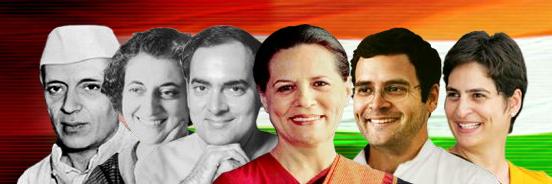
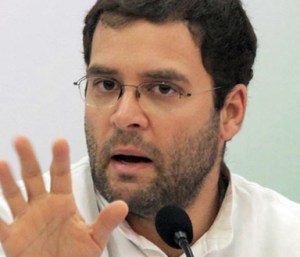
What is surely certain is that India is in a mood for at least some of the more constructive Modi ideas. It is less clear that it wants more of the Gandhis’ with Rahul (above). In the end, probably neither Modi nor a Gandhi will win, but the two men epitomise at least partiallythe debate of what is the idea of India and what India needs.

Posted by: John Elliott | December 18, 2012

Pakistan minister fuels a bad relationship with India

“I cannot understand the time, energy and cost spent in maintaining a bad relationship”, a leading Indian businessman said in Delhi yesterday when he opened a seminar on building a good relationship with strong economic ties between India and Pakistan, South Asia’s two fractious nuclear power neighbours.

Salman Bashir, a former Pakistan foreign secretary and now the high commissioner in Delhi, told the seminar that it was an “extremely delicate” job to manage the two countries’ bilateral relationship – it needed “vision” and “leadership” in both countries.

Pakistan's interior minister Rehman Malik (left), and India's home minister Sushilkumar Shinde

Pakistan’s interior minister Rehman Malik (left), and India’s home minister Sushilkumar Shinde

That vision and leadership was sadly lacking over the previous three days when Pakistan’s aggressive and voluble interior minister, Rehman Malik, visited India and spent time and energy ensuring that the relationship remained bad.

He came to Delhi to sign an agreement on visas for businessmen, tourists and others that should improve access between the two countries, and he also made various security-related pledges (that Pakistan might or might not honour). But he soured the relationship with repeated jibes and half-truths that played well in the Pakistan media (and probably earned him praise from the army), but infuriated his hosts and enabled India’s sensationalist media and foreign policy hawks to fuel anti-Pakistan sentiment.

Such behaviour at a time when political leaders of both countries are trying to build amicable relations is counterproductive. It strengthens anti-Pakistan public opinion in India, where there is deep distrust about the real motives of the country’s army and intelligence agencies.

The weekend’s events graphically illustrated the good and the bad in relations between countries, whose people have strong family and emotional ties, despite three wars and one near-war since 1947 plus potentially nuclear confrontations, and multiple deaths caused by a disputed border in Kashmir and Pakistan-generated terrorism.

Both countries’ top leaders, businessmen, and many others, want to move ahead and normalise relations, probably accepting that the primary issue of the disputed Line of Control quasi-border in Kashmir is unlikely to be settled in the foreseeable future. Informal talks in 2007 produced a soft-border solution with a withdrawal of troops and a degree of devolved government on both sides, but that was never approved by the army and other hard line lobbies in either country. It is not feasible now because India could not accept an open border when Pakistan is wracked by Taliban terrorism.

Economic potential

In India, Manmohan Singh, the prime minister has been saying for more than two years that India “cannot realise its full [economic] development potential unless we have the best possible relations with our neighbours – and Pakistan happens to be our largest neighbour”. That has led him, in the eyes of sceptics in India’s external affairs and home ministries and elsewhere, to be too accommodating when Pakistan is not taking real action against leaders of groups linked to terrorism such as attacks in Mumbai in 2008 and on the Indian parliament building in 2001.

The prime minister was almost certainly responsible for Malik being invited by Sushilkumar Shinde, India’s new home minister, even though others in the government opposed the visit, agreeing with former home minister Palaniappan Chidambaram’s view that India should not indulge Malik and provide a public platform for his habitual provocative behaviour.

Pakistan’s leaders and senior officials talk about the need to “let’s forget the past” and “put the past behind us”, and say that all the country’s leaders, including the army and military intelligence, see the need for neighbourly peace because of the heavy toll that ideologically based militancy and terrorism has taken on the country. Malik echoed that line in a rambling but carefully targeted hour-long extemporary lecture at Delhi’s Observer Research Foundation on Sunday. He talked about how extremism and terrorism – and a sensitive mix “of religion and poverty” – had begun when Pakistan “wisely or unwisely” joined the America in resisting the Soviet Union’s 1979 invasion of Afghanistan.

.

.

Salman Bashir told the seminar yesterday that Pakistan saw the need for good and stable relations” and that “we have the will to work the relationship” That echoes the views of Hina Rabbani Khar, Pakistan’s 35-year old personable foreign minister,  (right, in Delhi, July 2011) but her charm does not have such a lasting impact on Indian public opinion as Malik’s brash approach.

From the moment he landed in Delhi, Malik made a series of provocative statements. He inexplicably linked the Mumbai terror attacks with the 1991 demolition of a Indian mosque at Ayodhya (which sparked anti-Muslim riots), and claimed that an Indian army captain who was captured by Pakistan troops and tortured during a 1999 border war might have died because of the “weather”.

He also obfuscated and misled the Indian government about how Pakistan has handled allegations of masterminding the Mumbai attacks against Hafiz Saeed, leader of the Lashkar e Taiba terrorist organisation, who has been freed from jail by Pakistan courts.

Malik also cast doubt on terrorist evidence sent by India to Pakistan, prompting M.J.Akbar, an Indian editor and columnist, to note that Bashir, when he was foreign secretary, “dismissed Indian evidence provided by Home Minister P. Chidambaram as ‘mere literature’.”

Alongside all this, some progress is being made in normalising relations between the two countries. In addition to the visa agreement, India decided last year to allow foreign direct investment from Pakistan, and is awaiting the implementation of most-favoured national trading status (which it gave Pakistan 15 years ago). Bilateral trade officially totals only some $2.5bn a year, plus perhaps another $3bn in informal links routed through the Gulf.

There is a target of $6-8bn, but that is unlikely to be realised because policy decisions are rarely implemented fully or quickly and there are only two cross-border airline flights a week – a fact that illustrates the tortuous relations. Movement on other initiatives such as opening bank branches is slow, despite big demand in both countries for the other’s goods, as has been shown by the brisk business when Pakistani companies attend trade fairs in India

The best that can be expected in the foreseeable future is an improvement of these sort of people-to-people links and economic ties. There is no chance of the Line of Control being agreed in the foreseeable future, and military sensitivities on both sides make it difficult to settle two isolated border issues at Sir Creek on the maritime border (between Gujarat and Sindh) and the Siachen Glacier in the Himalayas.

But above all, there is a need for Pakistan to show it is dealing with those involved with terrorism in India, especially the Mumbai attack – as Manmohan Singh bluntly told Malik during a brief meeting. That might seem over-optimistic at a time when Pakistan is unable to quell terror attacks in its own cities, but Indians will not trust the Islamabad leadership till it demonstrates that it is sincerely doing its best.

Malik’s visit and prevarications had the reverse effect because he appeared to be taunting India. There seems therefore to be no end to what Sunil Munjal of the Hero group called “the time, energy and cost spent in maintaining a bad relationship”.

There has been a lot of heat and tension in India’s parliament over past week as the government has won grudging approval for its foreign supermarkets investment policy – a measure that is of little immediate economic importance but has led to accusations that Wal-Mart has been corruptly lobbying for it in India.

While parliament has been focussed noisily on this and various banking and other financial sector reforms (with the cabinet clearing more land and investment  initiatives today), the most important event that could affect India’s politics for a decade or more is taking place in Gujarat. Voting began there today (and continues next Monday) in the state’s assembly election. When the votes are counted on December 20, we will know whether Narendra Modi (below), the state’s chief minister, is likely to be the Hindu-nationalist Bharatiya Janata Party’s prime ministerial candidate for the general election due by 2014.

.

.

The bigger his expected victory, the more likely it is that this controversial figure, whose reputation is blighted by his widely suspected role in encouraging, or at least allowing, Gujarat’s Hindu-Muslim riots in 2002, will push aside more moderate BJP leaders and opponents and become the potential prime minister.

Modi’s time as chief minister is seen (with the help of a US-based international public relations agency) as having been good for the state’s development, though his focus has been directed more at urban areas and the emerging middle class than at including the rural poor in economic growth. His only real problem in Gujarat is a BJP splinter group that could reduce his vote and prevent him improving on the party’s current 117 seats in the 182-seat assembly.

Rahul Gandhi confusion

It is also beginning to look as if Rahul Gandhi really will emerge as the Congress Party’s prime ministerial candidate, though he will have to show more commitment to public life than he has so far if he is to be taken seriously. He spent one day on the Gujarat hustings – in his usual style of flitting in and out of political events that does his reputation no favours, though his minimalist role suited the Congress Party’s wish to shield him from any blame for Congress’s expected defeat.

A Congress spokesman said three days ago that Rahul would lead the general election campaign and that his mother, Sonia, currently Congress president and leader of the governing UPA coalition, would act as “patron” and “supreme leader”. That seemed to seal Rahul’s role, but it was contradicted a day later by another spokesman who said that Sonia would remain president and that the election campaign would be run jointly. Such is the confusion caused Rahul’s shilly-shallying over what he plans to do with his dynastic inheritance!

Rahul Gandhi’s formal party job was expected to be announced soon after a government reshuffle at the end of October, but that did not happen. The reshuffle was significant primarily because Kamal Nath was made parliamentary affairs minister in addition to his existing role at the urban development ministry. This was a clever appointment because Nath’s wide-ranging contacts and skills at handling all aspects of political and policy persuasion and fixing, have been widely recognised for years. He has not always been appreciated by Sonia Gandhi and prime minister Manmohan Singh, but now they need him.

He proved his skill when, working with the prime minister and others, he brokered deals to secure enough support the pesky supermarkets investment policy – officially known as FDI in multi-brand retail. The measure won votes in parliament’s lower and upper houses mainly because of tactical voting and walkouts by two Uttar Pradesh parties that had more to do with policy and other inducements offered to them than anything to do with retail FDI. For example, the Bahujan Samaj Party led by Mayawati won controversial low caste concessions for its Dalit political base, so voted for FDI in the Rajya Sabha (upper house), where the government would have lost without its support, having merely abstained (by walking out) two days earlier in the Lok Sabha.

Manmohan Singh staked the government’s political future on this measure, even though it will have only minimal economic impact for several years because investments will take some time to emerge and not all states will become involved. The measure is immediately significant only because it sends a message internationally about the government’s reawakening and determination to try to drive reforms.

This has been backed by Sonia and Rahul Gandhi, who have abandoned (or shelved) their ambivalence about reforms and have publicly backed the FDI and other measures. That enabled the prime minister to move ahead, but the government’s political problems mean that the international reaction has been marginal – the rupee remains stuck around a historic low figure of around Rs55 to the US dollar, though the stock market has recovered.

Wal-Mart’s troubles

The accusations about Wal-Mart bribing Indian policy makers arose after the American company filed a routine report with the US Senate that it had spent approaching $25m on various lobbying activities including “enhanced market access for investment in India”. That was instantly picked up by Indian politicians and others who blurred the line between legal lobbying and illegal bribing and claimed that Wal-Mart must have broken the law.

Kamal Nath, who would have been a lobbying target when he was commerce minister from 2004 to 2009, announced in his new parliamentary role that an independent inquiry would look into the activities of Wal-Mart, which is partnered in India for its wholesale and retail activities with the telecommunications-based Bharti group. Wal-Mart is already being investigated for breaking regulations with a $100m investment with Bharti. It also has an internal inquiry in progress in the US looking into possible corrupt dealings in various countries including India where some senior executives were suspended last month.

This shows two things, First, it is perhaps unfortunate that a company as internationally controversial as Wal-Mart, which is renowned for being tough with farmers and other suppliers, is at the forefront of supermarket FDI developments. Second, any hint of possible corruption grabs instant headlines.

When – as seems quite possible – India has to decide whether it wants the abrasive and controversial Modi to be prime minister, it will have to take account of his reputation as a rare non-corrupt politician.

This article appears on Asia Sentinel, a Hong Kong based news website – http://www.asiasentinel.com

Posted by: John Elliott | November 26, 2012

Writing in the wild at Kipling Camp

For a four-week writing retreat out of the chaos – and smog – of Delhi, it’s hard to beat Kipling Camp, a wildlife resort situated right in the middle of India adjacent to the Kanha national park.
That’s where I stayed from the end of October till four days ago, not writing my blog (which I am turning into a book), and not missing much in terms of real news in Delhi where the future leadership of both Congress and the BJP is still unannounced, and where endless controversies such as telecoms licences and the futile political crisis over retail FDI, trundle on.

Kipling was the first private wildlife camp in India when it was opened in 1982 by Bob and Anne Wright, best known for running Calcutta’s Tollygunge Club. Its name is appropriate – Rudyard Kipling featured the area in The Jungle Books, although he never actually went there.
Now completing 30 years, the camp caters for Indian and foreign tourists, who mostly head out at dawn to see tigers and other wildlife in Kanha, which is five minutes jeep drive away. Guests usually stay only for two or three days and then rush back to work, or continue their holidays elsewhere, but Kipling is worth much longer.

There is far more to be seen than the national park, which now can be difficult to enter because of a rigid booking system that limits the number of jeeps.
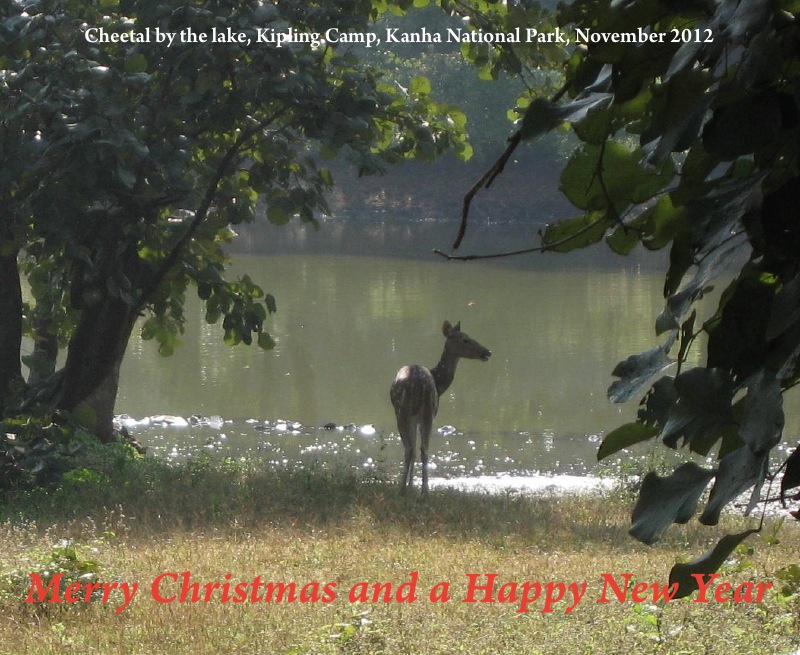
There are marvellous nature walks with birds to watch and photograph in adjacent forests and across the nearby Banjar River, plus day trips to forts and gorges, and Baiga tribal dancing some evenings (below). Cheetal wander through the camp and occasional alarm calls warn that a tiger or a leopard might be approaching.
On two nights while I was there, both appearedve  – the story is on Kipling’s new and very active blog:  “Around 11 pm, a large male tiger sauntered through the village fields and the forests around the camp. He stopped by our gate and we watched him by torchlight – he seemed very unperturbed ! The next morning we saw his pugmarks going in the reverse direction, as he walked by the camp and beside the village (right).
“During the day there had been a noisy and very busy marai (tribal fair) in the village – which goes to show how tolerant these big cats can be of human habitation, at least at night when they move about largely unseen and unnoticed.

“The following evening we were doubly surprised to find a leopard sitting on the road by the camp gate, its eyes shining like car headlights. Unlike the tiger, the poor leopard was pestered by cheetal alarm calls throughout the night.”
In the camp there’s Tara (left with me, and below), a 55-year old elephant made famous as Mark Shand’s companion in Travels on My Elephant, that takes visitors to afternoon swims in the river. Also Kim, a yellow Labrador that was a gift from Mark Tully and comes from a distinguished Tollygunge pedigree.
Just down the road is Mocha village with a few small bazaar-type shops, and a bustling rural market every Wednesday that has grown enormously in recent years as a few of the benefits of Kanha-related tourism have trickled down into the local economy.

The camp is now run by Anne and her daughter Belinda, who founded the Wildlife Protection Society of India (WPSI) – a link that gives Kipling a strong conservation theme.
They do not do much publicity or pr, so this blog post is aimed at helping to fill the gap, and to tell you all what you are missing if you haven’t been there.
As I said, don’t rush in and out, desperate to spot a tiger, but take a leisurely holiday in this idyllic forest haven in central India – and maybe even negotiate a long stay to write a book or some other task worthy of retreat.

Posted by: John Elliott | October 24, 2012

Happy Dussehra – marking the Triumph of Good over Evil !

.

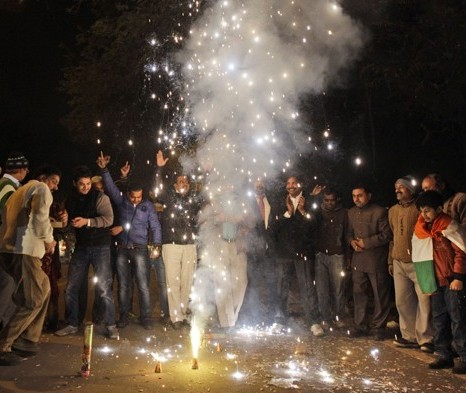
It’s the festival of Dussehra – ironically  marking the triumph of good over evil on an evening when India’s tv news channels have wall to wall coverage of the BJP president’s alleged corporate fraud – see my post below!

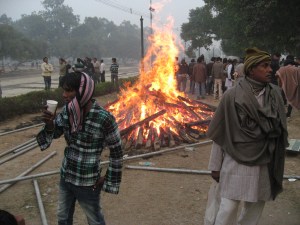
Ravana has just gone up in flames in Golf Links where I live in central Delhi – here are some pictures.

.

Happy Dussehra ! And have a marvellous festive time up to the Divali festival of lights, which this year is on November 13. 

.

India loves tamashas and Delhi loves political gossip, and both forms of entertainment have been in full supply over the past couple of weeks when the reputations of top politicians and others have been publicly attacked, mostly by Arvind Kejriwal (below), a politically ambitious anti-corruption campaigner. This flood of allegations – and the prospect of more to come – has widespread ramifications because it seems to be open season to reveal the suspected wrongdoings of the rich, famous, and powerful, using right to information laws.

A vast proportion of those who run the country’s government at all levels down to villages, plus people in business, are assumed to have done illicit deals during their careers, which they have successfully kept hidden – so far.

The main thread running through many of the allegations involves powerful people acquiring land far below market value, often for government projects, and then reaping large profits when the land is sold to private developers that are often involved in corrupt irrigation, real estate and other deals

The main target has been Robert Vadra, a brass ornaments trader who 15 years ago became the son-in-law of Sonia Gandhi, leader of the Congress Party and India’s governing coalition. Vadra has accumulated surprising wealth through land deals in the state of Haryana and elsewhere, often with DLF, a leading well-connected real estate developer.

Other targets include Salman Khurshid (two photos down), the Law Minister, whose usually urbane style collapsed under pressure when his wife’s charity for the disabled was accused, following a sting operation mounted by an India Today group television channel, of misusing Rs1.31 crore ($250,000, £150,000) funds. Kejriwal took up the allegations, and Khurshid said he would fight with “blood”, appearing to threaten him with physical harm and even death. A Congress spokesman advised those involved to be “careful in the use of language”.

Sharad Pawar, a veteran Maharashtra-based politician and government minister who is famed for using his wealth as a big investor in real estate and other business projects, has been accused along with his daughter and other relations, who are also in politics, of various land and irrigation scandals including Lavasa (bottom photo), a controversial countryside township project developed by the Hindustan Construction group.

Accusations of fraud and crony links, some involving Pawar, have also been made against businesses (including a string of apparently fake companies) associated with Nitin Gadkari, the president of the Bharatiya Janata Party (BJP), who comes from Maharashtra.

Even Rahul Gandhi, Sonia’s son and heir apparent, was dragged into one of his brother-in-law Vadra’s (left) land deals, where it was alleged he too had benefited from under-valued land.

The media has not escaped. Naveen Jindal, an MP and leading steel industry businessman, who has been accused of corruption over coal mining licences, staged a sting on an extortion-seeking television channel, Zee TV. The channel was allegedly offering to abandon a damaging news report if Jindal bought Rs100 crore (approx $20m, £11.5m) of advertisements – a widely practised form of corruption in the Indian media.

Ispat Industries, a company that was owned by a brother of Lakshmi Mittal, the world’s biggest steel maker and has now been taken over by another branch of the Jindal family empire, has been accused by the Hindu newspaper of bribing Virbhadra Singh, a former steel minister who is also accused of falsifying his apple orchard accounts with unsourced income.

The media has leaped with glee on the accusations, accelerating the development of stories and escalating the sense of crisis with continuous coverage on 24-hour tv channels. Many of the stories have already been known about, or suspected, but the media has never had the nerve to publicise them  – though the Vadra allegations did appear once in The Economic Times in March last year.

India’s Outlook news weekly magazine ran the Vadra story a week after The Economic Times and mentioned a point that has become headlines in the past few days – that leaders of the Congress Party and the BJP seem to have an understanding that they will not attack the personal affairs, including corruption, of each others’ leaders and their families.

Outlook wondered whether the BJP had not taken up the Vadra story because it did not want a counter-punch based on the widely gossiped business dealings of Ranjan Bhattacharya, who is married to the daughter of a close woman friend of Atal Bihari Vajpayee, a former BJP prime minister, and is recognised as his foster son in law. Bhattacharya grew from working as a hotel manager to an owner of hotels and other real estate between 1998 and 2004 when the BJP was in power.

Such an understanding not to attack each other has now been confirmed by Digvijay Singh, a senior Congress Party general secretary, who said on India’s CNN-IBN tv channel that Congress had evidence of corruption against Vajpayee, and against his L.K.Advani who was then Home Minister, but would “never use this”.

Currently, Congress leaders have refrained so far from attacking Gadkari outright over his company fraud allegations, though the government’s ministry of corporate affairs has started a “discreet inquiry”. The risk for Congress is a BJP counter-attack on the far more sensitive Vadra accusations.

One significant aspect of the Kejriwal revelations is that he has been prepared to challenge the Gandhi dynasty in public, albeit mainly with an attack on a not-very-respected son-in-law. Since she entered politics at the end of the 1990s, Sonia Gandhi has drawn a much tighter cloak of secrecy and silence around her and her family than earlier members of the dynasty ever managed. She has been criticised publicly, as has her son Rahul who has yet to prove himself as a potential leader, but this has generally been focussed on their political performance, not any suspected corruption.

Dipankar Gupta, a sociologist, has suggested in an article that the Vadra attack indicated the collapse of a “taboo” in Indian politics, though he only used “R for Robert” to indicate what he was writing about and did not use the words Vadra, Priyanka (his wife), Sonia or Gandhi dynasty, choosing instead rather curiously to refer obliquely to a “particular family”.

‘Code of silence’

Yogendra Yadav, a political pollster and pundit and member of Kejriwal’s India Against Corruption organisation, praised the revelations because they had “violated a code of silence observed in Delhi’s corridors of power”.

It remains to be seen however whether taboos and codes have indeed been broken. If they have, the dynasty could face trouble, and Congress’s defeat at the general election due by 2014 would become a certainty compared with the near-certainty that it is now.

Leading Congress government ministers including Palaniappan Chidambaram, the finance minister, and Salman Khurshid leapt to Vadra’s defence on television when the accusations were first made, but they backed off as details emerged of land and property deals that he had struck with loans and other help from DLF. Their silence since then is perhaps more indicative of the dynasty’s attitude to Vadra’s dealings than their early attempts at defence, which they presumably thought sycophantically would please Sonia Gandhi.

Kejriwal has been involved in civic and social campaigns for about 12 years, initially with an ngo called Parivartan focusing on local issues such as governance in a poorer part of Delhi, and on the right to information which eventually became law in 2005. By 2010 he became involved in anti-corruption campaigns and was one of the top activists with Anna Hazare, the Mahatma Gandhi look alike, who lead demonstrations that dominated politics last year Kejriwal has now split from Hazare and is planning to set up a political party.

The second and broader issue is what will happen next and what the revelations are doing to the fabric of India’s government and society, given the pervasive depth and breadth of corruption across government at all levels and the public and private sectors.

It seems unlikely however that these events will change the extortion, fraud, and crony-capitalism that has fuelled India’s economic and commercial success in recent decades, though it might make those involved more cautious. Many of Kejriwal’s leaks and accusations do not stem from any concerted attempt to seek truth and justice. Frequently they come from family or company rivalries or upsets – a family that tires of one of its members, an ex-mistress who feels snubbed, a revenge-seeking sacked employee, or a disgruntled ex bureaucrat are among rumours (not all correct) on the current disclosures.

Shoma Chaudhury, editor of Tehelka, a campaigning weekly magazine, suggests that the accusations against Vadra and leading politicians mean that a moat has been breached and that “something is shifting in Indian democracy”.

Kejriwal’s campaign is certainly significant if it is seen as a second and more focussed stage of last year’s Hazare anti-corruption campaign that drew massive support from India’s angry middle class and was primarily aimed at creation of a Lok Pal (corruption ombudsman), which has not yet happened. Much of last year’s fervour however has been dissipated, and many people are uneasy about Kejriwal’s guerrilla tactics, fearing maybe that their own secrets might be revealed.

Corruption is however now a major topic that cannot be swept away as individual scandals have in the past. But it will take years to introduce the changes that might significantly reduce it. A revamped judiciary (often itself corrupt) is needed so that cases are cleared quickly instead of taking 20 years or more.

Nandan Nilekani a former head of the Infosys information technology company who is introducing a biometric data base for the government, has produced a list of things to be done using technology plus regulatory and institutional reform to change the way government relates with the private sector as a buyer (defence and other equipment and services), seller (such as licences for natural resources) and regulator (telecoms and other industries).

That will be a very long haul.


There has been a stream of articles in India’s newspapers over the past week marking the 50th anniversary of country’s humiliating defeat by China in a brief Himalayan border war that shattered India’s self-confidence so devastatingly that the country has yet fully to recover. Headlines have included “The war we lost – the lessons we didn’t learn” and “Lessons from 1962 – India must never lower its guard”.

Yet India’s guard is still lowered and lessons have not been learned about anticipating an unexpected invasion – not just by the People’s Liberation Army (PLA) taking up positions on India’s side of mountainous borders, but more importantly by Chinese telecom companies possibly planting leaky and crippling bugs in networks and communications systems.

In a neat coincidence, just as India’s defence pundits were revisiting the failings of the early 1960s, the US Congress’s intelligence committee issued warnings in Washington that two Chinese telecom companies – Huawei and ZTE – were a threat to national security. The report said the companies could disrupt information networks and send sensitive data secretly back to China. Neither company had cooperated fully with the investigation, and Huawei had “provided evasive, non-responsive, or incomplete answers to questions at the heart of the security issues posed”.

Although Huawei and others suggested this was a protectionist ploy encouraged by American telecom companies to beat off low-cost competitors, the report triggered fresh complaints and renewed inquiries. Other countries are also worried, including Canada, Australia and the UK.

India is clearly vulnerable to these security risks from a country that is its biggest long-term defence threat.

Concerns that could one day lead to war include a 50-year old row over the 4,000-kms border (left – Outlook magazine photo and above) that China will not resolve, plus disputes over access to river waters and potential differences on sea lanes and other issues.

Over the past 10 years, Huawei has become a leading telecom provider in India, along with ZTE. It has a five-year $2bn investment plan and is the second biggest provider of networks after Ericsson, with a 25-30% market share, supplying all of the country’s top telecom operators such as Bharti Airtel, Vodafone, Reliance Communications and Tata Teleservices. It also supplies telecom systems to companies, and has a substantial share of the market for devices such as data cards and phones, and has a large research centre in Bengaluru (Bangalore).

It is not just telecoms where China is gaining a significant hold on India’s business and economy. Two-way trade currently stands at $60bn, heavily in China’s favour, making it India’s largest trading partner. The target for 2016 is $100bn. Orders for potentially sensitive power plant equipment exceed 44,000MW, triggering protective tariff demands by Indian manufacturers. There are also security concerns about Chinese bids for Indian power transmission grids. Other areas include engineering and construction projects.

There are also growing financial links. China has taken some of the pressure off the heavily indebted Reliance Group run by Anil Ambani. A $1.2bn loan was secured from Chinese banks in January this year to refinance a convertible bond at Reliance Communications. In 2010 Reliance Power ordered $10bn equipment from Shanghai Electric Group financed by Chinese banks, plus $1.9bn for telecoms refinancing.

The Indian government is publicly in denial about the security risks, though the army’s senior signals officer has apparently expressed some concerns. “Chinese manufactured telecom equipment are suspicious as you cannot know what’s inside. You cannot decode the units manufactured by them and thus pose higher risk and threat,” Lt Gen SP Kochhar is reported to have said at a communications seminar in Delhi last week. That echoed worries earlier in the year when Chinese hackers were reported to have invaded Indian Navy computer systems. Three years ago, there were worries when it was discovered that government-owned Bharat Electronics (BHEL) was sourcing encryption communications equipment from China for the Indian Air Force.

I have asked various officials and policy pundits about the risks in recent weeks and most duck the issue, offering no solution. Most take the same line as India’s telecom operators – that the products are irresistible because Huawei’s total costs of ownership are 25-30% lower than rival companies such Alcatel-Lucent,  Ericsson, and Nokia Siemens. India’s telecom imports from China in 2010-11 totalled $6.7bn, ranging from phones and attachments to networks.

India stopped BSNL, a government owned telecom operator, buying Huawei and ZTE equipment in 2009-10 because of security concerns, but then allowed purchases by the private sector companies after Huawai co-operated with testing and certification of equipment and offered access to sensitive electronic source codes. Speaking last week after the US report was published, India’s telecommunications secretary, R Chandrashekhar, said the telecommunications department “has no problem” because the two companies were working within Ministry of Home Affairs guidelines. He has recently presented an award to ZTE as India’s top broadband infrastructure company.

Shashi Tharoor, an MP and writer, who was previously a foreign affairs minister and a senior United Nations official, told me he was impressed not only about the low costs, but especially because Huawei had been more willing than their European rivals to give then government access to its source codes. He thought however that such manufacturers might need to be restricted for national security reasons – for example they are excluded from some critical networks and sensitive border states, especially in north-east India.

The Economist had a cover story headlined Who’s afraid of Huawei? in August that acknowledged Huawei’s ability “to sneak in malware and sneak out sensitive data”. Westerners fretted that its networks were “used by Chinese spooks to eavesdrop during peacetime and could be shut down suddenly during wartime” and saw the firm as a “potent weapon in China’s burgeoning cyber-arsenal”.

But, unsurprisingly for a free market journal,  it said that “techno-nationalism” was not the answer to fears of cyber-espionage. Noting that Huawei is a $32bn company operating in 140 countries with 140,000 employees, it said it “commands respect by delivering high-quality telecoms equipment at low prices”. It added however that, “given the power of the state in China’s version of capitalism”, the west was “right to be vigilant”.

That hits the point because China’s version of capitalism means that companies owe primary allegiance to Beijing, whether they are in the private or public sector, and will surely do the government’s bidding. Some supporters point out that the PLA, where Huawei’s founder, Ren Zhengfei, used to work, had severed any ties (including possible equity stakes). But a company does not have to be tied to the PLA to obey Beijing.

It is however hard to know what can be done, especially since European manufacturers source components from other Chinese suppliers that might be harder to check than Huawei and ZTE.

‘Too late to eliminate Huawei’

John Gapper, a leading Financial Times columnist, was probably right last week in an article headed It is too late for America to eliminate Huawei. He said that “the time to declare telecoms a strategic, protected industry like defence, was 20 years ago; now is the time to make a deal”.

He suggested that such a deal could involve Huawei opening up its very secretive books and ownership pattern by listing on London or New York stock exchanges, and separating its US (and presumably other country) divisions, as America demands for defence equipment manufacturers.

That might be part of the solution, but surely it would be better for India and other countries to ban Chinese high technology companies from all security and communications sensitive networks and gradually ease them out of as many other areas as possible. The chances of a war with China are remote in the foreseeable future, so India has time, if it starts now, gradually to remove the threat as contracts expire and technologies change.

« Newer Posts - Older Posts »

Categories