Posted by: John Elliott | October 2, 2012

Ratan Tata and Mahatma Gandhi reflected in anamorphic cylinders

I have also written about this art fair on The Economist’s  Prospero arts blog at http://www.economist.com/blogs/prospero/2012/10/art-india  

Ratan Tata, head of one of India’s largest groups (below), and Mahatma Gandhi, the independence leader whose birth anniversary is today, were two of the leading figures reflected in anamorphic mirror cylinders by Keralan artist Vincent Pallissery at Delhi’s current United Art Fair.

Pallissery was one of some 520 artists showing 2,700 works at the show that was path-breaking because there were no galleries involved. It ran for an opening evening and three full days in central Delhi’s Pragati Maidan show grounds and closed on Sunday.

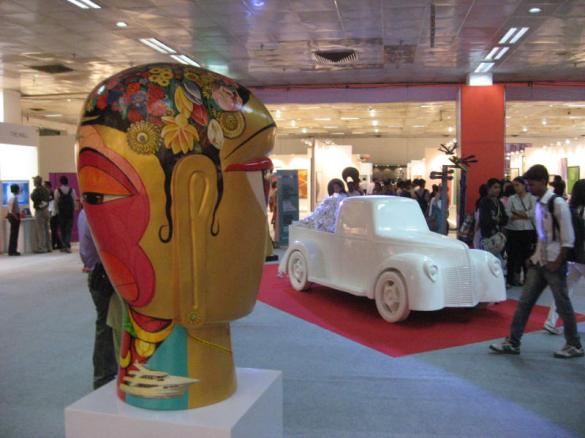
For sale at about Rs2.5 lakhs, Vincent Pallissery anamorphic works involve flat bases painted with unrecognisable designs that become recognisable images when they are reflected in cylindrical mirrors. Anamorphosis (or anamorphis) was first tried as an art form during the Renaissance.

It was famously used in Hans Holbein’s 15th century painting The Ambassadors and has also be used to transmit espionage and other confidential caricatures and erotic scenes without the carrier knowing what the flat painting depicts.

.Other works at the show, in addition to the one shown on the Prospero blog, included bright red chillies and other sculptures made from old truck and bicycle tyres by Subodh Kerkar from Goa.

There was a fibreglass pickup truck called “loot” by Manish Sharma from Rajasthan (below) that was auctioned for Rs13.5 lakhs (£15,900).

I thought the paintings (above) were very like Paritosh Sen and F.N.Souza but the artist, Vikash Kalra, insisted were his own inspired creations.

There was a recurring theme of road transport. Balbir Krishan, whose figurative paintings on the theme of homosexuality were attacked when they were shown at a public Delhi gallery last January, was also there.

“It’s been a very good opportunity for young artists like me to be with so many other artists from different regions in India, and to see their works and be able to talk,” said Rimsy Chopra, a 24-year old graduate of the Delhi College of Art.


Posted by: John Elliott | September 14, 2012

Manmohan Singh responds to critics with symbolic reforms

Stung by increasingly sharp criticism at home and abroad, the Indian government today announced a raft of foreign direct investment (FDI) reforms in supermarkets, airlines and other areas that ended three years of policy inertia. This followed a highly controversial decision yesterday to cut fuel subsidies, triggering a 12% increase in diesel retail prices and restrictions on the sale of cooking gas.

“If we have to go down, we have to go down fighting,” Manmohan Singh, the prime minister, said at the cabinet meeting that took the decisions, anticipating opposition from within his coalition which could reduce the government’s parliamentary majority. It was time, he said, “for big bang reforms”.

.

Complaining about the decisions that have caused a political furore tonight, a BJP spokesman said they had been taken “under foreign pressure” – and he was probably correct!

I hesitate to suggest that foreign correspondents based in New Delhi provoked Manmohan Singh into action, but there is no doubt that sharp criticisms in  The Washington Post, The Economist and Time magazine, among others, have struck home.

More importantly, there are growing risks of India being downgraded by international rating agencies because of a high fiscal deficit with economic growth slowing to as low as 5.5%.

The media reports have focused on the prime minister’s lack of leadership and action. Simon Denyer described him in the Post last week as “a dithering, ineffectual bureaucrat presiding over a deeply corrupt government” who “remained silent as his cabinet colleagues filled their own pockets” – a reference to the coal industry and other corruption scandals that have involved government ministers.

Manmohan Singh’s 80th birthday

Today’s decisions mean that the prime minister can look forward to kinder reviews on September 26, his 80th birthday.

They will also help to divert attention from the coal corruption scandal that has dominated the headlines in recent weeks.

The FDI announcements have been widely praised, but they are much more significant for their symbolism and impact on market sentiment than for any rapid direct economic effect. They show that the government is willing to dare coalition partners – notably Mamata Banerjee of the West Bengal-based Trinamool Congress – to oppose the changes and even withdraw from the coalition.

Taken with the fuel price hike, they also seem to show that Manmohan Singh is prepared to do things that may not necessarily meet the approval of Sonia Gandhi, his political boss at the head of the coalition, and her son Rahul, though their views are not known.

Food distribution

The main FDI change is that, after years of debate, supermarket companies (dubbed multi-brand retail) such as Wal-Mart and Tesco can have a 51% equity stake in Indian retail joint ventures. This could have an impact within a few years, but it is not relevant to the immediate recovery of India’s economy. The measure has been opposed by many parties for populist political reasons focussed on the impact that it could have on small shopkeepers and street-sellers.

The real opposition has however been generated by public sector agencies and middlemen, who dominate the inefficient and waste-ridden distribution system between farmers and the shops. These vested interests are the main target of the reform. To placate opposition, the government has said that individual states can decide whether to allow the FDI, which means that it will not happen in perhaps half the states, at least for some time.

There are positive requirements that the joint ventures must spend half their investment on rural-based distribution systems to serve the retail outlets that they are now to be allowed to open, and source 30% of their products from Indian small and medium sized firms.

Indian companies such as Reliance and the Future Group have failed to break the grip of the current distribution operators, so it remains to be seen how successful foreign retailers can be, working with their Indian partners – they will be helped by changes in distribution regulations that states opting in are likely to introduce.

Airlines

A decision to allow foreign airlines to take up to 49% stakes in Indian airlines (subject to regulatory arrangements) also needs to be seen in context. The government is not pushing something it specially believes in. It is partly reacting to market conditions, but has mainly been influenced by a change in the attitude of India’s leading private airlines, notably Jet Airways that has managed to block the initiative for some 15 years.

Jet seems to have withdrawn its opposition, and FDI is now favoured by airlines that urgently need fresh capital, notably Kingfisher which is near to financial collapse, Spice Jet and GoAir. Foreign airlines based in the Gulf are expected to be most interested in exploring possible stakes – led maybe by Emirates which already has a big 20% share of India’s outbound air traffic, and Qatar Airways.

The government also raised FDI limits for broadcasting and introduced it for electricity power trading exchanges, and announced small equity divestment plans of around 10% for five public sector corporations – Oil India, Hindustan Copper, NALCO (aluminium), MMTC (metals trading) and RITES (transport projects).

Rahul Gandhi next?

The next attention-diverting announcement will probably be a ministerial reshuffle, plus Congress Party changes including a new party post for Rahul Gandhi, dynastic heir to the party leadership, whose failure to impress so far has been matched only by that of the government.

This could come next week, according to media reports. It will then be up to Rahul to show whether this appointment is mere symbolism, or whether he can grow sufficiently in stature to become a prime ministerial candidate.

He might also tell people whether he believes in the sort of economic reform announcements made yesterday and today, or whether subsidies and other pro-poor policies are much more important because he thinks they are most likely to help his Congress Party do well in elections.

Posted by: John Elliott | September 11, 2012

India “is looking sticky” as the system crumbles

It is tempting to think that India is heading towards some form of implosion. The parliament didn’t operate for 75% of the monsoon session, doing little business, because of Bharatiya Janata Party opposition tactics.

Two major industries – coal and telecoms – have been swamped with corruption scandals that are blocking development and are primarily focussed on the prime minister Manmohan Singh’s office. Other industries such as aviation and airports, gas field contracting, and highway construction have simmering crony capitalist scandals that have yet to erupt fully. The power sector is in crisis, partly for lack of coal that is unlikely to improve, and its projects are riddled with corruption.

Most leading private sector companies working in such areas are involved on one or more of these scandals, and now there is a fresh possible fraud case emerging that some observers say could prove as big as Satyam, India’s fourth largest software and outsourcing company, which collapsed at the beginning on 2009. Satyam and its allied infrastructure company, Maytas (Satyam spelt in reverse), turned out to be just the tip of a vast iceberg of corporate cronyism based in Hyderabad, capital of Andhra Pradesh. Now Hyderabad’s Deccan Chronicle (DCHL) newspaper-based group  is in serious financial troublewith unexplained massive borrowings and possible charges of fraud.

.

Foreign observers are shocked and worried by the degree of corruption and how far and deep the tentacles reach, and about the impact this is having on India’s institutions and its overall performance. An old banker friend, in a superb British under-statement, emailed me yesterday that “India is looking sticky”. I replied: “Sticky indeed, but nothing much that we didn’t know about, just woodwork crumbling a bit and everything crawling out!”

Satyam had a dubious financial reputation for several years before the 2009 collapse, but it did not suit anyone to take much notice in bull market years. The Deccan Chronicle prompters and associates were arousing concerns eight years ago. The 2G telecom scandal that erupted in 2010 had been written about (see my blog) for more than two years. Land allocations and operating review terms in the 2006 franchise won for Delhi’s new airport by Hyderabad-founded GMR, and concern about the handling of Air India’s endless crises, were widely known at the time but largely ignored.

India’s current coal scandal – dubbed “Coalgate” – centres on the government approving licences on a negotiated allotment basis, without competitive tendering. This is not new. There has been a debate for some 20 years over the relative merits of “first come first serve” (introduced in 1957), and similar application-based awards, compared with competitive tendering.

Both systems have advantages and disadvantages in terms of project speed and pricing, and both can be manipulated, though the no-tender system provides more discretionary powers to politicians and bureaucrats, and enables unqualified speculators to win work and make quick profits. That happened on both the 2G “first come first serve” telecom franchises (manipulated to enable the minister’s friends to be “first”), and the coal allocations.

Big government losses

India’s Comptroller and Auditor General (CAG) has highlighted both the telecom and coal procedures, controversially alleging that the absence of tendering led to astronomically high losses for the government.  (It did similarly on the GMR airport deal, though with less political impact).

The CAG’s most recent estimate is that the government has potentially lost as much as $39bn (CAG’s Rs1.76 lakh crores at pre-2012 exchange rates) on coal in recent years. The Rs1.76 lakh crores may well be far too high, but even if the real figure is only a fraction of that, it would be significant.

Coal blocks have been issued to influential people, including politicians, many of whom (as happened on 2G telecom) sold them at huge profits without developing any coal extraction. Other bigger and established companies sat on their blocks, which they were supposed to be developing to provide coal for power and other infrastructure projects, waiting for coal prices to increase so they could sell the coal at a profit. Some of the allocations were done under a mine developer and operator (MDO) scheme that is ripe for misuse.

India’s Central Bureau of Investigation last week filed preliminary criminal cases (FIRs) against five companies and various individuals for criminal conspiracy and cheating – but that is only tinkering around the edges of what is involved.

Manmohan Singh (above) is under attack, with the BJP blocking parliament to demand his resignation (which won’t happen), because the coal ministry came directly under him from 2006 to 2009. The BJP also wants all the blocks cancelled, which would be devastating for the economy, so some way of penalising companies that start projects late while cancelling only the worst offenders is probably needed.

While he was in charge of coal, the prime minister did not take firm enough action to move to competitive tendering, despite proposals from various parts of the government that this should happen. I suspect that he saw merits in the allotment system as a way to speed up urgently needed but slow-moving infrastructure projects – a preoccupation of the prime minister’s office throughout the decade.

Should resign

But, as happened with telecoms, he failed to tackle the underlying corruption and crony business political links. There is no suggestion that he gained any personal financial benefit, though critics say he should have resigned rather than preside over such a system.

What all these events and scandals indicate is that India is now paying the price for two decades of economic growth that has been based heavily on illegal collusion between big business, politicians and bureaucrats – especially where scarce natural resources such as land, minerals, telecom space have been involved, plus other areas with government licences such as airports and ports privatisation and development.

There has of course been corruption-free growth, notably in software and information technology (apart from Satyam) and areas such as the auto industry where there is little government or public sector involvement. But even there, as the problems with the Deccan Chronicle group appear to suggest, corruption breeds on the greed and ambitions that have only had free rein for just over 20 years.

There is no end to this in sight – no end to the corruption itself, even though some of those involved may be more cautious, nor to the exposure of scandals through India’s right to information legislation backed by strong media and political interest. This is not implosion, but the system is beginning to crumble – and that needs strong government leadership that is sadly lacking.

See also https://ridingtheelephant.wordpress.com/2012/03/27/indias-coal-industry-under-attack-at-home-and-abroad/


Posted by: John Elliott | September 3, 2012

Make Sonia the Prime Minister – and change the BJP Opposition

Out of the Box (Off the Wall?) solutions for India’s political mess

Here are two ideas for breaking the current deadlock in India’s politics – make Sonia Gandhi the Prime Minister, and change the Opposition.

The first idea is mine and is unlikely to happen because it would be too much of a gamble for the Gandhi family, though my argument throws up some dynastic issues.

The second idea came from a frustrated foreign stockbroker and banker based in Mumbai, who wants an early general election, even though he knows it will probably lead to an even more directionless coalition government, because it would (probably) get rid of the debilitating Bharatiya Janata Party as the main opposition in parliament.

.

It is a measure of the plight facing India, its politics, and its badly led economy, that there is no credible and likely Congress Party candidate to be the next prime minister – hence my idea of Sonia – and that getting rid of the BJP in opposition is maybe the best thing that could happen politically.

Congress has a real leadership crisis, despite the fact that many commentators still believe that 42-year old Rahul Gandhi, heir to head both his family dynasty and the Congress Party, will emerge as a realistic prime ministerial candidate by the general election due in 2014.

Rahul however seems to have no intention of moving sufficiently into mainstream politics and the government job to warrant such a belief – and, indeed, currently has such a downbeat demeanour that it is hard to see him leading anything. He indicated in July that he was ready to play a larger role, but he has been notable since then mostly for his absence from day-to-day politics.

What he is prepared to do might become clearer later this month when long-awaited ministerial and party leadership appointments are expected. But he certainly is not at this time a realistic prime ministerial candidate – and there are no other obvious names, assuming Manmohan Singh, who is 80 later this month, retires in 2014.

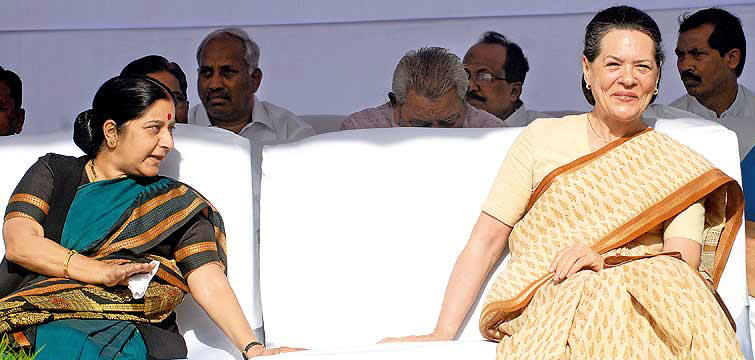
“PM that never was; the Oppn that shouldn’t be” pic and caption – of BJP leader Sushma Swaraj and Sonia Gandhi – in Outlook magazine where a revised version of this article appears as a column (see comments below)

Maybe Congress does not need a new leader. Since it expects to lose the 2014 election, it is probably logical for it not to name a prime ministerial candidate, but to go into the election campaign led by Sonia Gandhi, who is 65, and Rahul and current ministers. Then it can decide what to do about its leadership when a coalition government is being formed and it sees who potential partners would prefer to work with as party leader. The family could also decide, after seeing how well Rahul did in the election campaign, whether to bring Priyanka, Rahul’s more personable sister, into active politics as a potential leader.

It would be much braver however to announce – maybe in the middle of next year if not before – that Manmohan Singh is retiring immediately and that Sonia is becoming Prime Minister, as is her right as the president of the party and a member of parliament. When she declined the job in 2004, she arguably did not have the experience to take it on, but she has now gained that experience and would probably do a better job than Rahul, if only because she is in total command of the party and no longer has to prove herself.

.

.

An NDTV poll broadcast last night showed that 46% of respondents thought that Congress would do best to choose Rahul to lead it into the next election, with 33% going for Manmohan Singh and 21% for Sonia.

That is an extraordinary result from the 30,000 people polled (in about a quarter of parliamentary seats across 18 big states) because Rahul has shown absolutely no aptitude for front line day-to-day national politics, rarely speaks on current issues, and has no experience of government.

I wonder whether Sonia’s low support in the poll was mainly because she is not regarded as a candidate for the job, which she turned down in 2004. It could also partly be because she has been ill. She is currently visiting the US for medical tests, one year after an operation widely believed to have been for cancer, and she did not look well when I saw her in a Delhi art gallery ten days ago. But she has shown in the past few weeks that she can perform an active party leadership role both in parliament and outside, so would the opinion poll vote for her have been bigger if people thought she was a possible candidate?

Making her prime minister would also make her answerable publicly for the policies, notably on the economy, that she currently pushes from behind the scenes but never has to defend.

It would however almost certainly be too much of a gamble with the future of the dynasty. Everything that Sonia has done in the past 15 to 20 years shows that she sees her role primarily as a bridge between her late husband Rajiv and their son Rahul. She has worked to ensure that the dynasty survives, and has not tried to become India’s top leader. To this end, she has been much more candid and determined in naming her successor than any earlier member of the dynasty. And  she has virtually every other Congress leader – including Manmohan Singh – joining her chorus for Rahul to get his act together.

Given her Italian origins, that is a logical position. But my hunch is that she is probably Congress’s best chance of avoiding appalling defeat in 2014, despite the Italian issue.

If she failed, it would be a dangerous setback for the dynasty, and could encourage rumblings about Congress having a non-Gandhi leader. That of course would be a good development because near-automatic dynastic rule and family succession is not good for a democracy.

But dynasties don’t take such gambles with their futures, so it almost certainly won’t happen, and will one of those “What If……” questions for future generations – “What if Sonia had shaken off her cautious courtiers and had made herself prime minister by 2014?”

.

NEARLY six weeks after the Suzuki-Maruti car factory near the Indian capital of Delhi was attacked by over 1,000 workers and a senior manager was killed, the company says that it has not yet been able to establish the reason for the sudden and unexpected violence.

Osamu Suzuki (below), the 82-year-old chairman of Japan’s Suzuki Motor Corporation, which controls the Indian company, is currently visiting India and said on Sunday evening that “the cause is not clear to us”. Most chief executives would not be content to admit such a lack of knowledge so long after an outbreak of serious labour unrest, but this is neither a conventional nor stable area………..

…………..Mr Suzuki sought to demonstrate his respect for India and its legal system with the story of Radha Benode Pal, an Indian judge known for his anti-colonial nationalist views and one of eleven jurists on the post-war International Military Tribunal for the Far East who dissented from a guilty verdict for Japan’s top wartime leaders……………

For the full article “Suzuki’s labour troubles in India”, go to The Economist’s Business and Management blog, Schumpeter, by clicking here A routine meeting turned violent

.

And for more on modern Japan’s fascination with the strange story of Judge Pal, who drew parallels between Japanese and British colonisation, see this 2007 story in the New York TimesDecades After War Trials, Japan Still Honors a Dissenting Judge .

“All people of Mr Suzuki’s age recall Pal with gratitude as he restored a sense of self esteem in the national psyche badly gored by accusations of acts of barbarity in China and elsewhere,” says Aftab Seth, a former Indian ambassador to Japan  and a professor at Japan’s oldest university of Keio. “Many of those accusations were well grounded in fact, but the average Japanese civilian did not feel responsible in any way”.

Thousands flee home to north-east after social media distorts events

Indira Gandhi told me during a Financial Times interview in February 1983 that her government would wait until the situation in Assam cooled down before taking the next step to resolve a crisis in which some 3,000 people had just been killed. There had been controversial state assembly elections in the state and the government had sent in 75,000 troops to control the violence.

The Indian prime minister said that she had “no plan as such” to resolve the crisis. The problems of illegal immigrants from neighbouring Bangladesh dated back to Indian partition in 1947 “and we can’t just wish that away”. Bangladesh should, she added, take back migrants who had entered India when their country was being created (out of Pakistan) in a 1971 war. Beyond that, she said blandly, her Government would wait. (FT February 25, 1983).

.

Now nearly 30 years later, the problems of Assam and other north–eastern states remain, and it seems that the Indian government is still waiting until the situation cools down.

But the world is now different, as has been demonstrated in the past few weeks with what is probably been one of the biggest sudden mass migrations since the partition of India and Pakistan in 1947.

Tens of thousands of Assamese and other workers and students from north–eastern India have fled home from Bangalore and other cities in the south of the country because they feared mass attacks in retaliation for communal violence against Bangladeshi Muslim immigrants in the north-east. There have been some individual attacks, but the panic has been spread by reports and pictures faking anti-Muslim atrocities in Assam and nearby states that have been carried by mobile phone text messages and other social networks such as Facebook and Twitter.

There are many lessons to be learned from these events, not least the way that social media can be used to stir up trouble in international as well as local conflicts. India has (controversially) banned bulk text messages for two weeks, closed 250 allegedly offending web pages, and claimed that many of the false messages originated in Pakistan (which perhaps inevitably Pakistan has rejected).

There are also lessons about how increased labour mobility means that communities need to absorb newcomers, as well as about older problems such as the treatment of both ethnic and religious minorities (in this case north-east India’s Muslims) and migrants from neighbouring countries (such as those from Bangladesh). Sadly, political parties often prefer to make capital out of minorities as happened today in Mumbai(where two people were killed in a riot ten days ago). Today part of the chauvinistic Shiv Sena political movement staged a massive anti-immigrants demonstration in the city.

Distant sisters but One India

But perhaps the biggest new lesson for India is that the seven north-eastern states – often known as the seven sisters – can no longer be treated Indira Gandhi-style as a distant delayable problem.

Ever since independence in 1947, the Indian government has regarded armed insurgencies and other uprisings and illegal immigration issues in states such as Assam, Nagaland and Manipur as events that have virtually no impact on the rest of India, located as they are far away on the other side of Bangladesh. That is rather similar to the way that the growing threat from Naxalite (Maoist) rebels in central and eastern India used to be regarded as a distant irritant that did not need Delhi’s urgent attention – something that has been corrected in the last two or there years.

This is yet another example of something I have written about before on this blog – that India can no longer survive as it has in the past by simply turning muddle and adversity into some form of (often inadequate) success, assuming that everything will eventually function adequately. I last wrote about it commenting on last month’s power blackouts and railway disasters.

My theme is that the pace of events and economic development – and now of communications – mean that issues such as the north-east can (to use an English idiom) no longer be swept under the carpet, as they have been for decades. The escalation of the various forms of social media – and economic integration – should help to bind the country together, with the north- east being seen as part of the mainstream. But they can also split India apart, with the people from the north-east feeling so isolated and vulnerable in southern Indian cities that they flee home.

So the north-east has indeed come to Delhi, in a political sense. It has also come as a social and economic phenomena with a vast influx of mostly young, energetic and friendly people who have come to the capital and the southern cities for work, or as students.

.

“The staff come from the north-east”, is a remark frequently heard about a restaurant. This is not said in a derogatory way, but as a slightly dismissive description of a people who, looking more Chinese than most Indians, are indeed regarded as internal migrants from a distant part of the country and not as part of the mainstream, even though they have become an important part of these cities’ economies.

Yet when Mary Kom (left), a woman boxer from Manipur, won a bronze medal in the Olympic Games, India celebrated with a fervour that could not have been greater if she had come from Mumbai or Delhi.

As the BBC reported from Assam yesterday, the migrants who have fled home fear reprisals after the very-exaggerated social media reports of clashes in the north-east between indigenous tribals and Muslim settlers. Bengali-speaking Muslims were forced out of their villages after attacks by the indigenous, predominantly Hindu Bodo tribe that have put more than 300,000 refugees in relief camps.

In a battle that is basically over land, the Bodos accuse the Muslims of being illegal migrants from Bangladesh, but Nilim Dutta, a political analyst, said that most of Assam’s Muslims had lived there for generations. “Over time, the Bengali migrants prospered, just like immigrant communities all over the world. This created a sense of resentment among the native Assamese communities as they both competed for resources and jobs.”  There is also dissension between long-term Assamese and newer Muslim groups which is being exploited by local politicians.

Next February, it will be 30 years since Indira Gandhi said she was waiting – in an FT interview with Alain Cass, then the Asia editor, and with me (I had just been appointed south Asia correspondent and moved to Delhi a few months later).

Whatever steps have or have not been taken since then, the basic problems clearly remain. But the world is now different, as we have seen in the past few weeks, so surely the waiting game is over.

Posted by: John Elliott | August 15, 2012

Has India abandoned economic debate?

Has India moved beyond economic debate? Has the domination of economic policy by Sonia and Rahul Gandhi, together with regional members of the governing coalition (notably Mamata Banerjee of West Bengal), become so established that there is now no room for reformers to be heard? Is the government so much under the spell of these forces that India’s leadership has gone back to the 1970s when the private sector profit was frowned on (except when it lines the pockets of politicians)?

.

Prime minister Manmohan Singh did not sound like the 1970s in his Independence Day speech this morning (left), when he said that that a “lack of political consensus on many issues” had prevented the creation of an environment for rapid economic growth”.

The time had therefore come “to view issues which affect our development processes as matters of national security,” adding that providers of foreign capital needed to be confident that “there are no barriers to investment in India”.

But sadly the prime minister’s noble exhortations for a better India now carry no weight – he has been making statements like these for years with virtually no impact.

So my questions about India abandoning economic debate in favour of political ambition persist. They reflect conversations I have had with foreign business people here and (a few weeks ago) in the UK, where the growing belief is that the post-1991 “India story” has ended and that there is now no interest among some ministers in private-sector-led economic growth. Some see this in western terms as a debate between left and right wing political groups on the role of the private sector, but I think it has nothing to do with such ideology and is instead firmly based on vote winning and staying in power.

When I was first in India in the mid-1980s, there were vigorous debates about prime minister Rajiv Gandhi’s small reform steps. When I returned in 1995, Manmohan Singh and Montek Singh Ahluwalia, then running the Ministry of Finance as Minister and Secretary, were campaigning vigorously for the economic liberalisation launched four years earlier (even though Manmohan Singh’s patron, prime minister Narasimha Rao, was rapidly losing interest). There was a real debate about what should be done and how investors and industry should respond.

Now Manmohan Singh is rarely heard, apart from this morning’s sort of well-meaning epistle, and Montek Ahluwalia seems no longer to debate the positives of economic reform, but instead deplores the inability to get things done and curb wasteful expenditure on the sort of pro-poor policies pushed by Sonia and Rahul Gandhi.  No-one else is debating reforms – the Commerce Ministry is currently only boasting about how many states might want foreign direct investment in supermarkets, while the finance ministry has failed to argue forcefully for taxation and financial sector reforms, and the defence ministry stays even more silent on the urgent need to involve the private sector in defence production.

Is this because they know that they will get no support from Sonia Gandhi, who seems to have quietly abandoned the reforms agenda pushed in the 1980s by her late husband Rajiv who used to seem to be her policy guru? The Economic Times has revealed this week how she interferes with policy, virtually instructing ministers on policy issues, and how one minister abruptly lost his job after daring to reject her suggestions on tribal affairs legislation. (Aug 21: This Mail Today column looks at what Rajiv Gandhi did and might have done today )

.

There are few ministers in this government who are proactively trying to be effective. One of them is Jairam Ramesh, the Minister of Rural Development who, among other things, is trying to bring economic and political development to areas that have been controlled by Naxalite (Maoist) rebel’s.

Earlier this week I heard him talk about a pace-making pilot project he is personally encouraging at Saranda in Jharkhand. Yet when Ramesh was Minister for Environment and Forests (2009-2011) and tried to bring some order to a devastatingly corrupt area of government, he was pilloried by the private sector for blocking their projects, many of which they had of course “bought” illegal environmental clearances.

Palaniappan Chidambaram, the new Finance Minister, has appointed as his chief economic adviser, Raghuram Rajan (right), a former International Monetary Fund chief economist who has been Manmohan Singh’s honorary economic adviser. Rajan has criticised the Gandhis’ favourite and expensive National Rural Employment Guarantee Scheme (NREGS) as “a short-term insurance fix” for dealing with problems of the poor, but added: “If it comes in the way of creating long-term capabilities, and if we think NREGS is the answer to the problem of rural stagnation, we have a problem”.

That seems to run counter to Sonia and Rahul Gandhis’ view so it will be worth watching what Rajan says now he is employed by the government. His job gives him the stature to lead a debate about how the economy should move forward, balancing the needs of the poor with reforms that will lead to economic growth that benefits the poor.

Let’s see if he can prove this article wrong and show that India’s political leadership has not silenced genuine economic debate.

Posted by: John Elliott | July 31, 2012

Creaking India hit by power and railway failures

Power Minister promoted to Home Minister as power cuts hit half of India

Power supplies covering half of India’s 1.2bn population have been cut for up to eleven hours today in the third example since Sunday night of how the country’s under-invested and badly managed infrastructure is creaking its way to near-collapse.

.

Ten states in the north have been without power after the national grid failed, apparently because it was overloaded by at least three states drawing down more their authorised share of electricity.

This is said to be the world’s biggest ever power collapse and followed another massive shutdown on Sunday night when power covering a quarter of the population was cut after the state of Uttar Pradesh exceeded its quota.

Also on Sunday night, a fire on an express train killed 32 people. That followed two train collisions and 29 deaths in May.

These shutdowns and disasters are the result of chronic failure of India’s government, which has been in power since 2004, to tackle infrastructure problems that have been building for many years. The failure stems from Manmohan Singh, the prime minister, who has been restricted in what he can do on economic reforms both by Sonia Gandhi, the leader of the Congress Party and the governing coalition, and by coalition partners.

Then there are inefficient and non-performing ministers in charge of key sectors.

One of them is Sushilkumar Shinde (below) who has been responsible for electricity supplies as Minister of Power for three years and this evening has been promoted in a small cabinet reshuffle to be Minister of Home Affairs, despite the failures of the past two days (see last paras below).

.

He does not bear total responsibility for the grid failures because power supplies are managed by individual states  and form part of an overall energy crisis. Power generation has been seriously hit by coal shortages from badly-run government-owned Coal India that have led to some power stations cutting output and shutting down. Management of coal production has also been disrupted by corrupt mining licences. The basic failure to do more to address the power problems is however down to him.

Then there is Mukul Roy, the Minister for Railways, who spends most of his time working on party affairs in West Bengal, where his regional Trinamool Party is based, and rarely visits his Railways Ministry office in Delhi.

He was appointed in March to replace Dinesh Trivedi, another Trinamool member, who lost his job after he introduced a reformist annual Railway Budget that displeased his party boss, Mamata Banerjee. Trivedi’s plans included a major safety upgrade financed by across-the-board fare increases which have not gone ahead because Banerjee did not approve them.

Such is life with coalition politics – regional party bosses are more interested in their regional interests than the country as a whole, and the prime minister can neither control what such a minister does, nor dismiss him or her. The government has caught what is dubbed “policy paralysis” and economic growth has slumped from almost 10% to not much more than 6%.

Earlier this year, I wrote an article on this blog arguing that India could no longer survive as it has in the past by simply turning muddle and adversity into some form of (often inadequate) success, assuming that everything will eventually function adequately. Reliance on what is known as jugaad – making do and innovating with what’s available rather than looking for new levels of performance and excellence – is a brilliant solution for a deprived and under-developed society, but it is not enough in a country at India’s stage of development (even though it is now, rather belatedly, being picked up by management writers as a new panacea).

India overwhelmed

In the past few years, India’s pace of events has overwhelmed this approach, making it impossible for the country to cope with basic services, projects and development. This was graphically demonstrated with chaotic and corrupt preparations for the 2010 Commonwealth Games, but there are many other examples. The most evident involve public sector infrastructure, ranging from annual monsoon flooding that cripples Mumbai and chaotically inadequate services in Delhi’s satellite city of Gurgaon, to unhealthy water supplies, annual fog delays at Delhi airport, and building collapses – and now the record power shutdowns and rail disaster in the past two days.

Corruption plays a part in each one of these examples, most often with contracts and licences being awarded to undeserving companies that then perform badly. This prevents central and state governments adequately addressing key issues, and leads both the public and private sector to assume that they can buy their way into contracts and out of problems.

On top of that are social issues, including the use of agricultural land for industry which slows the development of both power and mining projects. These issues becoming more crucial and potentially disruptive as the poor see the well off capitalising on India’s economic growth..

Today’s power cuts stretched across India from the borders with Pakistan in the west to Bangladesh and China in the east, and southwards from the Himalayas to the middle of India.That area has a population of over 600m, but many do not have any access to electricity so the actual number of people whose homes lost power could be nearer 350m.

Trains were stranded across the country for up to 12 hours as the cumulative effect of the two shutdowns built up. Delhi’s highly efficient Metro railway closed, and roads were blocked by traffic light failures. Most businesses and many urban private homes have (expensive) generating sets that supply stand-by power, but these failed to keep the country running.

Shinde blamed the system collapse on some states drawing more than their share of electricity from the overstretched grid, and said he had “given instructions that whoever overdraws power will be punished.” Stealing power, whether it is a next-door neighbour’s or an overhead power line is standard practice in India. It is hardly surprising therefore that some states have been taking more than their allotted share from the grid at a time when an unusually  poor monsoon – with a draught in some areas – is increasing power demand. Temperatures rise to over 35 deg C, so there is also heavy demand for air conditioning. Threatening punishment is a typical official reaction when something goes wrong – the railway minister promised an inquiry into the fire, presuming that similarly would silence critics and enable him to return to his party affairs.

Sonia boosts Shinde

Tonight’s small cabinet reshuffle has been triggered by Pranab Mukherjee, the Finance Minister, becoming India’s President last week. Palaniappan Chidambaram, the highly efficient but abrasive Home Minister, has taken his place, returning to a post he held from 2004 to 2008. Chidambaram has strengthened the Home Ministry and the nation’s security since 2008, and it is unlikely that Shinde, who is favoured because he is trusted by Sonia Gandhi, will perform as effectively.

Shinde has been succeeded as Power Minister by Corporate Affairs Minister Veerappa Moily, who, for the time being, will do both jobs – and presumably will not be able to provide the single-minded focus that is desperately needed by the power industry.

Posted by: John Elliott | July 30, 2012

Supreme Court condemns India to the risk of Virtual Tigers

August 29:  The Supreme Court  indicated today that it intends to approve controlled tourism, reversing its previous stand after facing widespread criticism. It extended the ban till its next hearing on September 27 to give time for regulations to be drawn up .______________________________________________________________________

Is it better for a tiger sometimes to feel harassed by hordes of noisy tourists, or be killed by poachers? That is the simple question raised by one of the most ill-advised edicts ever issued by India’s Supreme Court, which last week backed a misguided conservationist lobby and banned all tourism in the core areas of the country’s 40-plus tiger reserves.

It may seem perverse to write about India’s tiger problems instead of about the spectacular opening of the Olympic Games in London three days ago, but there is a link. A spoof television sit com, Twenty Twelve, has been running on the BBC about a mostly incompetent Olympics Deliverance Commission. Faced with the risk of the opening ceremony’s massive firework display triggering the automatic firing of anti-bomber missiles stationed nearby, the commission eventually got something right and hit on the bright idea of using virtual fireworks that are broadcast on television around the world as if they were live – only the audience in the Olympic stadium knows they are not.

.

Imagine India being forced to show virtual tigers on big television screens in the middle of national parks because the 1,700 or so that still survive have been decimated. That is the risk if the authorities do not get real about how to save them – and that includes recognising that tourists are useful as a major deterrent to poaching.

The ban has been widely criticised because closing the areas will open them to tiger poachers setting traps, and to “timber mafia” illegally felling trees, without the risk of being spotted by tourists. These groups will bribe their way past under-paid forest guards, having bought-off their bosses up to top bureaucrats and politicians. Select visitors such as leading businessmen will pay their way into the areas for up-market parties, as well as organisers of night-time events. State governments will lose tourism revenues that help to pay for forest guards, and there is also a risk of Naxalite Maoist rebels, who operate in remote forest areas including some parks, expanding their activities.

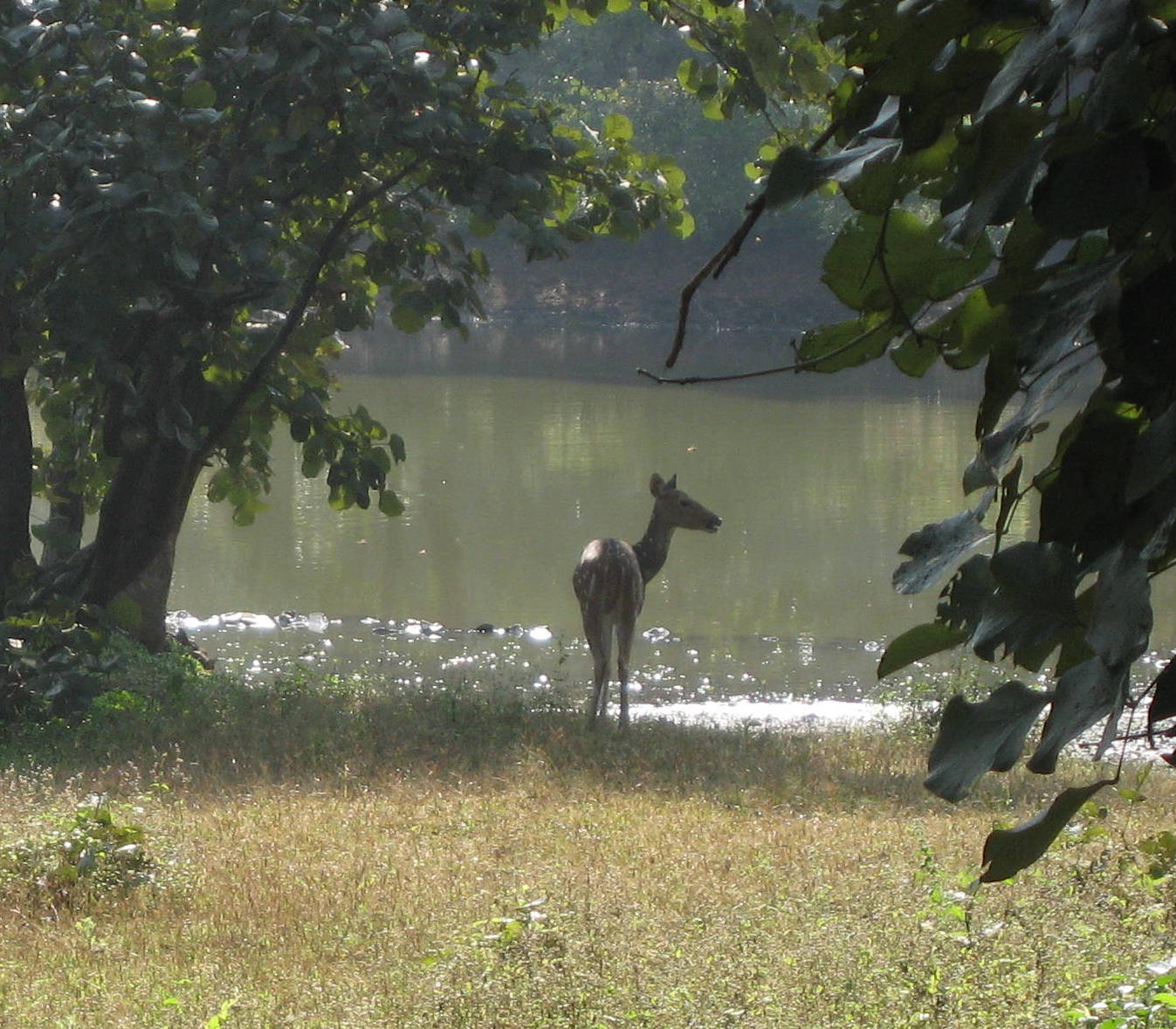
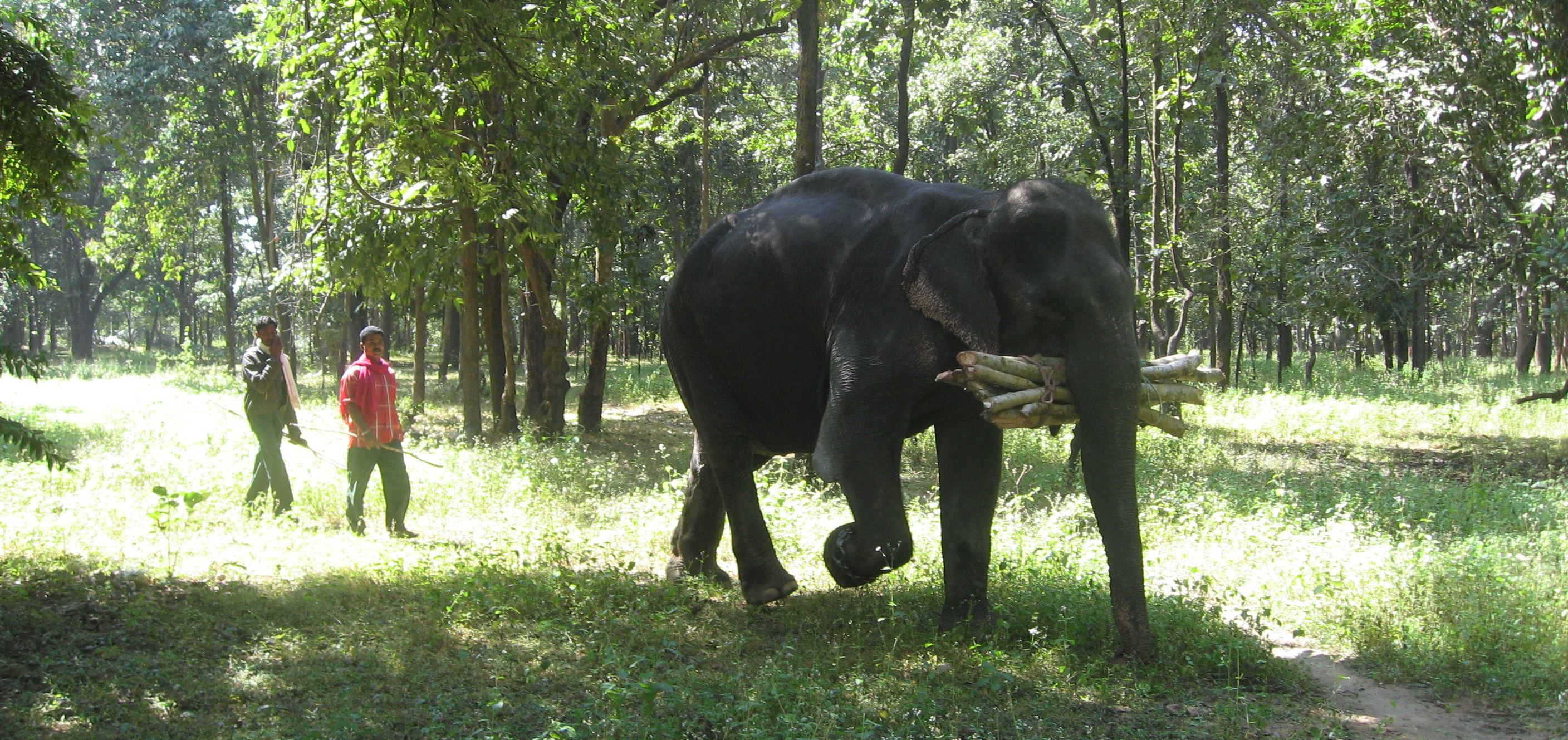
Wildlife tourism should be of course strictly controlled, as it has been increasingly in recent years – in many parks, tourists are already not allowed in some areas and the number of vehicles that can be deployed is limited (usually 50 a day). That has inevitably led to some corruption in vehicle bookings, but it has kept the numbers down and has reduced some of the worst harassment of tigers (see photographs above and near the end). There is also a need to restrict rampant hotel and other luxury construction surrounding core areas because these often block corridors that are essential for tigers and other animals to move from one area to another and link different breeding groups.

In Africa, tourism is used as a tool for conservation and there are several examples of well-regulated tourism, good protection and community-participation. I have seen this at Pilanesberg wildlife park near Pretoria, South Africa, (below) where discreet tourist facilities were strictly controlled and there did not appear to be any encroachment or unauthorised construction in adjacent areas.

.

The Supreme Court’s edict is a rare example of bad judgement. For many years, the courts have been handing down instructions for work that should have been done by central, state and municipal governments – ranging from ordering the removal of street garbage to cancelling fraudulent telecom licences in the recent 2G corruption scandal. Their judgements are usually sound, but they sometimes go too far, as critics think they did in cancelling the telecom licences, and as they certainly have done with the tigers.

Often the judgements stem from public interest litigations (PILs) that are filed by lawyers and others with a mixture of motives. In this case, a public information activist, Ajay Dubey, filed a PIL to ban tourism in the Jabalpur High Court in September 2010, asking for implementation of a 2006 amendment to the Wild Life (Protection) Act that stated that tiger reserves are “required to be kept as inviolate”. He argued that the directive meant that all tourism activities should be banned from the core areas of tiger reserves. The issue was further complicated by the fact that  the National Tiger Conservation Authority (NTCA)  had almost all the tiger reserves declared “core/critical tiger habitat” in 2007 to circumvent the 2008 Forest Rights Act that gave preferential access to traditional forest dwellers and tribals.

The Jabalpur Court rejected the PIL and ruled that “tourism is not prohibited in tiger reserves but is permitted subject to normative standards laid down by the NTCA”. It argued that the NTCA had not implied a complete tourism ban when it said that parks should be kept “inviolate for the purposes of tiger conservation”.

Dubey appealed against that judgement (in July last year) to the Supreme Court, which ruled that all states should designate buffer areas. Few states complied so on July 24 (this year) the court made an interim order that all core areas should be closed to tourism. This has led to many states declaring buffer areas in recent weeks, but conservationists argue that such states have breached wildlife and forest laws by ignoring requirements for prior consultation with villages and scientific fixing of buffer boundaries.

.

The Ministry of Environment and Forests has recently published eco-tourism guidelines, which include gradually closing sections of the core areas over five years, though there is little agreement in India about what eco-tourism means .

These guidelines are written up and posted on the website of the Centre for Science and Environment whose director general, Sunita Narain, had a role in the drafting. They propose local (undefined) community-based and low-impact tourism that is conservation-oriented and has educational benefits. Tourist facilities will pay a 10% levy from their revenues, and forest dwellers will have special rights.

Wildlife conservation experts say that it would take years longer than the guidelines envisage to implement these plans, especially in the development  of wildlife activity in buffer areas where multiple activities, including villages and agricultural land. Some critics say that the proposals will accentuate and spread conflict between animals and villagers that is already a serious problem in some areas.

The Supreme Court said it would review its interim order’s core area ban at its next hearing on August 22 ( when it extended the ban to August 29 and then to September 27).

It might not matter much if the ban only lasts these few weeks, especially in northern India where many parks are closed during the monsoon. The risk is that it might not be cancelled – and even if it is, the muddled ecotourism guidelines have a long term aim of closing the areas.

It is not impossible however for wildlife conservation to progress alongside regulated tourism, and that has been shown by the official numbers of India’s tigers going up from around 1,400 to 1,700 since a 2008 census when the situation was dire.

But the Supreme Court’s ban is not the way. The judges’ detachment from reality was demonstrated when they said last week that “the tigers are on the edge of extinction” – ignoring the 1,400 to 1,700 increase, which has happened with tourists inside the core areas.

.

It’s open season for criticising India’s top government ministers. Time too, you might say – why didn’t the attacks start much earlier in the current government which has been failing for most of the time since it was elected in 2009.

Pranab Mukherjee, publicly regarded until a few weeks ago as the veteran politician on whom the government depended for solving its problems, is now billed as a disastrous finance minister who has damaged India’s economic growth and international image. The switch – which is broadly fair – came immediately after he gave up the finance job two weeks ago to stand for election as India’s president.

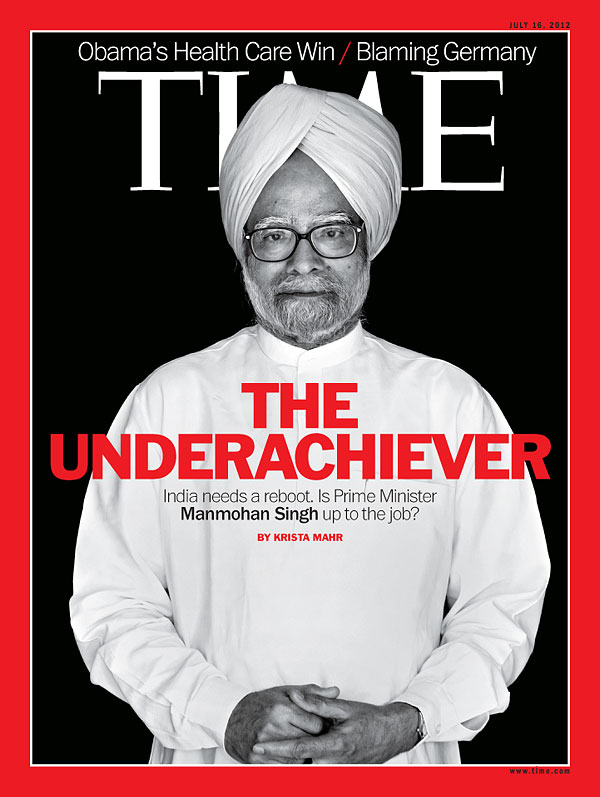
Time magazine this week has a cover story describing Manmohan Singh, the prime minister, as an “under achiever”. That is being seen as a major attack in image-sensitive India. It has generated condemnation from the Congress Party and massive tv coverage. (It does not have quite the same impact internationally because it is only on the cover of Time’s Asia edition – see pic below – and does not seem to be in the US edition at all – quite a common distinction for Time, Newsweek and Fortune magazine India stories).

Time anyway is a bit late with its article, which has no new material or analysis. Singh, 79, is now being billed in India as the government’s saviour. After being widely criticised as an ineffectual prime minister for a year or so, he is suddenly being lauded as the man who can wreak magic now that he is not fettered by Mukherjee’s political superiority and old-fashioned tax-and-spend protectionism and has himself taken the finance minister’s post.

Time does not always get it right of course. In 2002, it ran a famously unkind article headed Asleep at the Wheel on Atal Bihari Vajpayee, then the Bharatiya Janata Party prime minister. It was a great read and was fair in parts, but Vajpayee went on for another two years and is now regarded as one of India’s best prime ministers because he knew how to pull the political strings both inside his own party and in a coalition, even if he did nap in the afternoons.

Singh deserves some of the criticism because of the government’s lack of success and his own failure to assert himself and speak out about policies. His reputation has always been over-stated because he was not, as he is often billed, the architect of India’s 1991 economic reforms. He was the chief implementer of measures that were substantially prepared before he took office.

More importantly, he was acting under the political guidance and protection of prime minister Narasimha Rao (1991-1996), who the Gandhis like to airbrush out of India’s history (slotting in Singh as the key reformer) because he did not kow tow to the dynasty in the early 1990s.

.

Singh is nevertheless a leading economist with a established record as a distinguished public servant, and it is unfair that his reputation should now be sullied when he is the prisoner both of his political boss, Sonia Gandhi, leader of the Congress Party and the governing coalition, and of the coalition’s troublesome regional partners who indulge in corruption and obstructionism for personal and political gain.

Sonia Gandhi generally escapes criticism by staying largely out of sight. Her son and heir apparent, Rahul, did the same until his disastrous performance in Uttar Pradesh state assembly elections earlier this year that showed the family’s born-to-rule approach to electioneering is losing its sheen.

Criticisms of both mother and son are however beginning to emerge, specifically because they believe that the path to future Congress Party election victories is to channel subsidies and funds to the poor, irrespective of how wasteful that can be, while discouraging growth-oriented economic reforms that might do short-term harm to the pro-poor image. That has meant that the Gandhis and Mukherjee have been broadly on the same page, harking back to the early 1980s when Sonia’s mother in law, Indira Gandhi, was prime minister and Mukherjee was her finance minister.

Because of that bond, along with opposition from coalition partners, Manmohan Singh has had no chance – so the Time magazine article is off-cue, as was relentless criticism of him last year in my old newspaper, The Financial Times. A different character might have tried to break through such logjams but Singh is a deeply withdrawn man with, as India Today aptly points out, an “inability to communicate with friends and negotiate with foes”.

Reformers’ images boosted

Now however the mood has changed and the Gandhis seem to be staying silent while Singh’s image is boosted in the media along with his two main reform-oriented advisers, C.Rangarajan, chairman of his economic advisory council and former governor of the Reserve Bank of India, and Montek Singh Ahluwalia, who runs the Planning Commission and has been at the centre of economic policy-making, and close to Singh, since the 1980s. A month ago, Ahluwalia looked lost and powerless, but now industrialists are beating a path to his and Rangarajan’s offices to push for reforms and project clearances, which is a good signal.

India’s international image has consequentially improved, but this is a fragile recovery. The rupee, which has lost nearly 30% of its value in the past year, picked up a week or so ago but is now slipping slightly. The country’s international business image has taken such a battering that tougher measures are needed than Singh and his supporters can probably manage.

Plans announced by Mukherjee in his February budget retrospectively to tax multi-national takeovers (despite explicit opposition from the prime minister) are being re-examined, and a more business-friendly image is being cultivated.

There is a lot of talk about allowing foreign direct investment (FDI) in supermarkets, though it is unlikely to go ahead and would have little short-term economic impact, and an expected decision by Ikea to bring in furniture stores is being given undue media coverage. Some financial sector reforms might go ahead, plus foreign airline investment in Indian aviation, but that will attract very few airlines. Relaxing FDI limits in defence manufacturing, which would bring in foreign companies, will continue to be blocked by vested interests – along, probably, with higher insurance limits.

But all this is trifling compared with what is needed in the short and medium term to rebuild investment, raise fuel prices, sort out priorities for allowing land to be used for industrial development, solve appalling shortages of coal and power, cut wasteful subsidies and curb financial budget deficits.

These are tough areas for the reinvigorated Singh-Rangarajan-Ahluwalia trio to tackle. But until substantial progress is made, it is India as a whole that is the “under achiever”.

« Newer Posts - Older Posts »

Categories