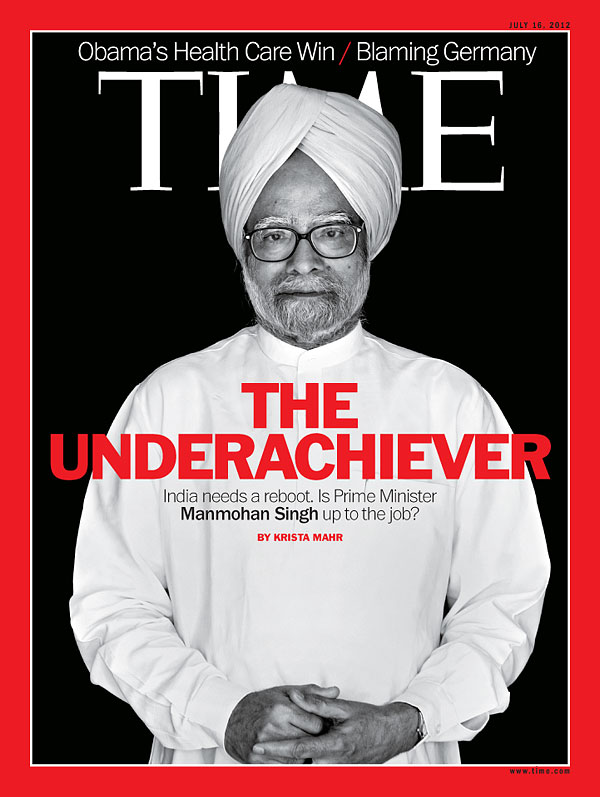
While most Indian media attention has been focussed on Pranab Mukherjee and what the end of his unproductive time as finance minister might mean for economic progress now that prime minister Manmohan Singh has taken over the job, a significant liberalisation move has been made by the usually moribund Defence Ministry.

.

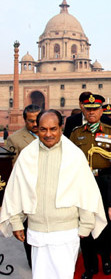
A.K.Antony (right), the defence minister, has shied away from as many reforms as he can since he took the job in 2006, slowing down plans that were being backed by his predecessor  – ironically Mukherjee. But ten days ago he allowed a landmark initiative to go ahead on the modernisation of India’s inefficient and often corrupt defence manufacturing industry when the Indian Army invited a private sector group to compete against the public sector for the design and development of an important internet-based advanced technology project, the Tactical Communication Systems (TCS).

The private sector companies involved are Larsen & Toubro (L&T), Tata Power SED and HCL – the first two are specialists in high technology precision engineering and HCL is a leader in information technology. They will compete against Bharat Electronics (BEL), a defence public sector corporation (DPSU).

This is the Indian private sector’s first significant opportunity to show that it has the capability to beat deeply entrenched public sector defence manufacturing companies that often rely on re-assembling imported foreign components as high cost Indian products without any significant gain in technological and manufacturing know-how.

That practice has become widely publicised in recent months following allegations made by General V.K.Singh, who retired as army chief of staff a month ago, that he was offered a bribe to back excessively over-priced Tatra army trucks . These trucks (no link with the Tata group) have been produced for the past 26 years by the public sector Bharat Earth Movers (BEML) with components imported from a foreign company. The army chief alleged that only 60% of the components had been indigenised in the 26 years – even the left-hand drive had not been changed. (The BEML executive chairman has been suspended, and the Ministry of Defence decided ten days ago to end the nominated contract system used, without any competitive tendering, for the Tatra trucks and many other public sector purchases.)

The TCS project, which is provisionally estimated to cost Rs10,000 crore ($2bn), is the first “make” programme under the government’s defence procurement procedure. This is aimed at bringing in private sector companies to develop India’s very limited ability to produce advanced defence equipment. The government will cover 80% of development costs and the remaining 20% will come from the private and public sector companies involved, which have to produce prototypes with at least 30% Indian made components.

Public sector pressure

Eventually, after more than two years of design, development and testing, it is intended that the government will award the production contract to one of the two contenders. At that stage however, if BEL is not winning, there will be intense pressure to give the public sector a significant role.

The US and other countries use the same sort of “make” procedure, and it was included in the government’s defence purchasing procedures in 2006. However the defence establishment has lobbied strenuously against it, especially on the TCS project which BEL wanted so that it could prove itself able to handle advanced internet communications technology. That however would have led to a massive amount of imports, probably without India gaining the technical and development know-how that should be generated by the private sector companies.

India’s manufacturing private sector has proved its international competitiveness in the past decade, especially in the auto industry, and some companies like L&T have been working in high technology space and missile manufacturing for decades. But the defence establishment, which includes the defence ministry, parts of the armed forces, the public sector corporations, foreign suppliers and defence agents, all connived to block private sector development.

Pressure however is growing and the Planning Commission has recently called for Indian companies to be prime contractors for all major contracts under the “make” and similar provisions.

India has an annual defence budget of $40bn, including capital expenditure of $15bn, and is the world’s biggest importer of defence equipment according to a report earlier this year, accounting for 10% of global arms imports between 2007 and 2011. Its defence imports are officially put at 70% of total purchases, but the actual figure is far higher at maybe around 85% if  component imports done by the DPSUs are included.

Antony is not a reformer. He has blocked the designation of about 12 big companies, including Tata, L&T, HCL and Mahindra, as defence “champions” capable of becoming internationally recognised systems integrators. He has apparently been persuaded by small and medium sized companies that they would be left out, whereas they would actually gain as suppliers to the 12. He has also bowed to defence establishment pressure and watered down offset plans that would force foreign suppliers to make up to 40% of their equipment in India.

Much as he may have wanted to, he had little opportunity of reversing procedures that led up to the TCS announcement because it would have caused an uproar, especially from the army that wants to break free from the public sector dominance. The battle is far from over however. The next “make” project in the pipeline is for a futuristic infantry combat vehicle (FICV) where the developers have yet to be named.

The defence public sector will continue to try to block further private sector advances on this and other projects and will often be successful while Antony is defence minister. And the private sector now has to prove that it can deliver to international standards.

Posted by: John Elliott | June 24, 2012

Can London champagne+goats really help poor Indian widows?

It says something about the way that India and other countries  fail to look after those in need that it has taken an Indian businessman based in London to alert the world to the plight of widows who are cast aside in their thousands by families after their husbands die.

Yesterday Lord (Raj) Loomba was lauded at a reception in Downing Street and a large banquet in the government’s Whitehall Banqueting House for bringing the problem to international attention. Nick Clegg, deputy prime minister and leader of the Liberal Democrats, who hosted the reception, said that Loomba had shone a light on an international problem that had not previously been identified. Loomba became a Lib-Dem peer last year and donated £150,000 to the party a few months ago.

Cilla Black, Cherie Blair, Lord Loomba – and a goat yesterday

Earlier in the day, Cherie Blair, wife of Britain’s former Labour prime minister, and Cilla Black, a famous singer and entertainer, led a group of supporters with 20 goats across London Bridge on a wet and windy walk to draw attention to the widows’ plight.

“For widows in South Asia and across Africa, owning a goat is often a lifeline – providing milk and sometimes meat for an impoverished family,” says Blair, who is president of the Loomba Foundation. “And though the Loomba Foundation hasn’t yet bought goats for widows, it’s certainly considering it”. “The goat is a symbol of wealth and prosperity and often a life-line for many widows in South Asia and across Africa”, says the Foundation website. This of course is mere symbolism, as is the provision of 10,000 sewing machines for widows announced last night, but people on yesterday’s walk told me that they saw it as a way of increasing awareness.

Is India’s social conscience so lacking that it has to be left to an Indian businessman seeking social recognition, and to a goat parade and elite events in Whitehall, to wake up the country to the widows’ plight?

Widows suffer in many parts of the world but the problem is especially serious in India where they are shunned and discriminated against, especially over inheritance, at all levels of society. This reflects a broad negative bias – the discrimination, and abuse and even killings, are on a scale unparalleled in the top 19 economies of the world, according to a recent poll by the Thomson Reuters Foundation.

The treatment of widows is worse in the north and in different areas such as West Bengal, which is among the harshest. Thousands of poor women retreat after their husbands die to ashrams in Vrindavan, a holy Hindu city between Delhi and Agra, and to Varanasi, the sacred Hindu city on the Ganges, where they are frequently treated abominably without adequate shelter and food (see this NDTV video). In 2000, when Deepa Mehta, a well known film maker, planned to record the widows’ plight in Vrindavan and Varanasi, radical political activists who did not want their traditions publicized or criticised drove her out and she made the film three years later in Sri Lanka

.

Viewed from London, this is a disgraceful social problem, which is why Loomba was celebrated last night at a level rarely awarded to an individual. Yet the celebration also illustrates how charity work is often undertaken by people looking primarily for self-aggrandisement and recognition, drawing the rich and powerful into often wastefully extravagant elite social gatherings that boost their own images as well as generating funds for causes.

Look at the Loomba Foundation’s website home page and you find only details of yesterday events and a very large picture (left) of Loomba with Cherie Blair standing in front of the Palace of Westminster with Lord Dholakia, a Liberal-Democratic Party deputy leader of which Loomba is a member.

Raj Loomba was born and brought up in Punjab and moved with his family to the UK in 1962 when he was almost 20. He built up a fashion and clothing business (Rinku Fashions), became involved in various charities, and set up the Loomba Foundation in 1997, initially to educate Indian widows’ children. A mild-looking man, he always been controversial, as a 2005 article in the Calcutta Telegraph showed – including a widely reported (and denied) allegation that widows had been left unfed in the heat of Delhi after they had been bussed in for a photo shoot with lunchtime dignitaries at his house in Prithviraj Road.

He has been inspired by his mother, who was widowed at an early age and by 2006 some 3,600 children had been educated in India. The current figure is 3,000, plus more in Africa where Loomba works with Sir Richard Branson’s Virgin Unite charity. Elsewhere the foundation is linked with the Prince of Wales’ Youth Business International helping widows start small businesses.

In 2005, Cherie Blair launched International Widows Day at the House of Lords in London and an international campaign gathered top international names. Then, last December, the United Nations General Assembly adopted a resolution officially recognising 23 June – the anniversary of the day Loomba’s mother became a widow – as International Widows Day.

That is a remarkable achievement, whatever the original motivation. Loomba’s friends have always known that his primary target was to become a member of the House of Lords, which he did in January last year via an earlier CBE. It is that single-minded focus that generates cynical criticism from Indians in both the UK and India because of the effort that has been put into gaining personal recognition.

But what most people at yesterday’s events in London probably did not realise as they sipped champagne is that this is not a problem that can just be addressed directly by government action, especially in India where there is neither the political will nor strong institutions and western-style social conscience to tackle such issues.

The treatment of widows is rooted deep in Indian’s patriarchal society and includes ancient Hindu practices such a sati, where a widow leaps onto a husband’s funeral pyre. It affects all classes from the poorest to the elite – though there are notable exceptions like Sonia Gandhi, leader of the Congress Party, and her mother-in-law Indira Gandhi as well as members of other dynasties where a widow can be a political asset.

There are basic mercenary motivations. Women are often bullied out of inheriting land, which passes down the male line in order to limit the fragmentation of land holdings through successive generations. There have been social movements to correct this and make helping widows a noble social act, but that is not a general approach.

What is needed is a change of attitude at all levels of society in India so that widows have automatic rights of inheritance and are empowered to make new lives and remarry. I doubt whether marking an International Widows’ Day by walking goats, feasting in Downing Street, and providing sewing machines will have much impact on that.

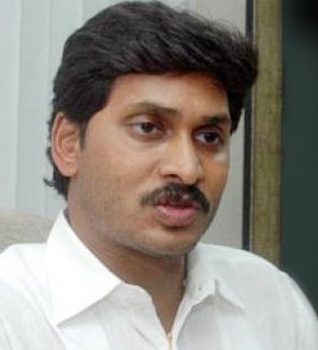
If Y.S.Jaganmohan Reddy (below), a young regional politician in southern India, had not tried to become the Congress chief minister of Andhra Pradesh state immediately after his father Y.S.Rajasekhara Reddy (YSR), who held that job, was killed in a helicopter crash in September 2009, he almost certainly would not be in jail now accused of massive corruption. And if the Congress Party had handled his succession bid more adeptly, it would not have suffered the drubbing from Jaganmohan’s new breakaway party that was announced in state assembly election results today.

.

Or to put it another way, if Sonia Gandhi, leader of Congress and of India’s governing coalition, had handled the ambitions of Jaganmohan (generally known as Jagan) more astutely, given the material benefits Congress had received from YSR’s and his son’s activities – and if she had not let the ensuing crisis exacerbate demands for Andhra to be split into two states – she might not be facing yet another regional crisis today.

It might seem idle to focus on the events in one state when the steady decline of India’s political and economic affairs, which I have been tracking on this blog for three years or more, has now reached a new tipping point with worsening economic news and chaotic presidential politicking. I am doing so however because the story of Andhra mirrors the story of India’s declining governance and economic prospects under the current government and Congress leadership.

India’s government failings have become so serious that I wondered why Mamata Banerjee, the mischievous West Bengal chief minister and a partner in the coalition, did not go further two days ago when she proposed prime minister Manmohan Singh as a candidate for India’s presidency, thus hinting he should be ousted from the prime minister’s job. Her suggestion of course was rejected by the Congress Party, which announced today it is backing finance minister Pranab Mukherjee for the post. But why not, I wondered hypothetically, suggest that Sonia Gandhi should become president and maybe Manmohan Singh vice president – wouldn’t that have directed Banerjee’s criticisms where they ought to have been targeted?

But to return to Andhra. Here is a state that five to ten years ago was a focal point of India’s booming information technology industry and a symbol of the new India that saw itself growing into a world super-power alongside China. Now it is a symbol of India in decline because of its all-consuming corruption based on political-corporate cronyism, with dynastic ambitions based on personal greed, and the lauding of companies that grow fat on fraudulent land and other deals. Significantly, that personal greed has opened up the corrupt dealings of the embryo YSR-Jagan dynasty. It has also exposed how India’s government manipulates the Criminal Investigation Bureau (CBI), which has focussed on investigating Jagan ever since he became a serious political problem for the Congress Party nationally.

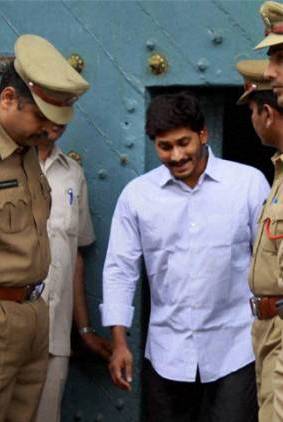
It is hard to believe that 39-year old Jagan’s jailing (below), which was ordered on May 28 for two weeks (later extended to June 25), was not intended to remove him, as it did, from canvassing in the run-up to the elections that took place on Wednesday. As a Business Standard editorial put it on May 31,  “while Mr Reddy may certainly turn out to be guilty, that the CBI has woken up to the strength of the case against him just as his party is in a position to threaten the Congress politically will strike many as further proof that India’s premier investigative agency can no longer even pretend to independence”.

Such are the ways of politics and corruption in India that those who stay loyal to their political chiefs and allies rarely go to prison, whereas trouble makers suddenly find their misdeeds, that had been condoned in the past, being splashed across the newspapers and the police knocking on their door.

Deservedly then, Congress has done appallingly in the results today for 18 state assembly seats and one Lok Sabha constituency where by-elections were caused by the resignations or disqualification of pro-Jagan Congress members. Jagan’s breakaway YSR Congress Party has won 14 of the assembly seats, and the Lok Sabha seat – albeit after voters were bribed with massive amounts of cash, jewellery and other gifts that helped swell the turnout to an astonishingly high total of around 80%.

The result upsets the stability of the current state Congress government and projects Jagan as the possible chief minister after the next state polls due in 2014. Jagan’s jailing probably boosted anti-Congress sympathy votes in his favour instead of preventing him from winning over the electorate, illustrating how badly Congress handles its affairs regionally as well as nationally.

.

Jagan was jailed after the CBI launched a disproportionate assets case and alleged that he had taken bribes totalling Rs1,172cr (approx $250m) in a series of deals during YSR’s time as chief minister from 2004 till his death.

A skilful regional politician, YSR had worked during his five years as chief minister for the state’s overall development and the rural poor, building an unassailable regional power base and combining that with loyalty to the Gandhi family. This was despite widespread allegations of significant family corruption involving him and Jagan with infrastructure contracts and land allocations in deals done that, reports suggested, were linked to payments to the Congress Party.

Sonia Gandhi and her fellow national party leaders appear to have done nothing to stop these activities, thus mirroring allegations now faced by prime minister Manmohan Singh that he knew about bribery in India’s 2G telecommunications scandal, and most recently, in allegations of massive coal industry corruption, yet did nothing to stop it.

Gandhi and Singh were so committed to YSR that they flew to Andhra for his funeral. There they received Jagan’s succession claim, which was immediately backed by politicians and businessmen who wanted YSR’s son to become chief minister to protect and continue the late chief minister’s deals. Sonia Gandhi resisted the claim, understandably thinking that Jagan was not the right candidate. This sparked a regional political crisis that eventually led to Jagan splitting Andhra’s Congress party and to the corruption investigations against him and other politicians and businessmen.

Jagan had built up media, cement and mining companies with the help of his father, whose corporate links included Satyam, a top software company that crashed in 2008 in a fraud scandal which began to open the lid on Andhra’s crony capitalism. YSR changed the pattern of traditional corruption where politicians and bureaucrats take bribes in return for favours. Instead, he secured the loyalty of supporters by providing business opportunities and land allocations in state irrigation and highway projects, real estate activities, special economic zones, and other schemes, in which the politicians then invested. Instead of just taking kickbacks, he, his family and political associates, became stakeholders – and the beneficiaries allegedly channelled funds into Sakshi, a newspaper business run by Jagan.

The deals spilled over into mining scandals in the neighbouring state of Karnataka. Earlier this month the Andhra government, which is trying to clean its image, cancelled a deal with Brahmani Steels, owned by a former Karnataka state minister and iron ore businessman who is being investigated by the CBI for illegal iron ore mining. YSR’s government allocated Brahmani around 14,700 acres for a steel project and airport along with extensive iron ore mine leases that have not been started. The government is also expected to cancel a major port project in known as Vanpic where 24,000 acres were allocated in return for investments in Jagan businesses.

If YSR had not been killed in the 2009 helicopter crash, it is reasonable to assume that these projects and the corruption and kickbacks would be continuing today, with a grateful Congress Party nationally valuing its firm and valuable friend. No doubt there would have been more corruption allegations and some deals might have come unstuck, but the current crisis would not have built up – and Jagan would not be in jail.

Posted by: John Elliott | June 12, 2012

Christie’s lifts Sotheby’s-led gloom on Indian art market

LONDON: Congratulations tinged with relief was the message being given by dealers and collectors at the end of Christie’s South Asian modern art auction here yesterday to the event’s main organizers, Hugo Weihe and Yamini Mehta.
Congratulations because, given the current climate of declining sales, the auction of some 112 lots had done well realising £4.1m ($6.38m) including buyers’ premium, with only about 15 lots not sold. Relief because the art market can now push aside a disastrous sale at Sotheby’s last Thursday.

Exceeding its own poor results in London last year, Sotheby’s produced sales of only £546,800 on June 8, which totalled just 26% of the total £2.1m low estimates. Out of 88 lots offered, 51 failed to find buyers.

Bonhams, which is a much smaller player in this market, scored a day earlier with sales of £1.1m, and only 21 unsold lots out of 71. It also established its own record price for an Indian work.

Christie’s achieved a 72% market share against its two competitors with its auction, where buying seemed to be dominated by telephone and internet bidders with only a handful of buyers in the auction room.

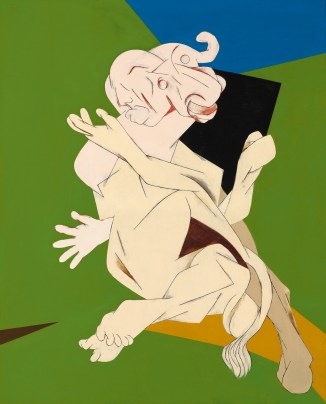
Its top sale was a magnificent Tyeb Mehta depiction of Mahishasura (above), based on a Hindu legend of a demon-king and a she-buffalo producing a son. It went for its lowest estimate of £1.2m (£1.38m – $2.15m with buyer’s premium) to a buyer named in the sales list as an “Asian Institution” but actually, I understand, leading collector Kiran Nadar for her Delhi (Noida) art museum.

That was a satisfactory result and it continued Christie’s domination of the artist’s work at auctions since he died in 2009. It showed that Mehta, who was less prolific than most other members of India’s Progressive Group of painters, is maintaining good prices, though it was far short of both the £1.8m bid that had been hoped for, and Mehta’s record £1.97m (including premium) achieved at the same auction last year.

After the last round of Indian art’s international auctions in March, ArtTactic, an analysis firm, said the market was experiencing another season of decline, with $10.4m total sales down 9% from last September and 27% below March last year. That followed a steady decline in the previous two years after the collapse of  a 2006-08 boom. It does not seem to have changed in the past few days with the three auction houses’ sales totalling £5.74m ($8.88m).

The auctions have coincided with the death a year ago of M.F.Husain, the doyen and probably the most prolific of India’s Progressives. His works produce mixed results because of their vast number and because they vary widely in quality, especially in later years. Several fail to find buyers in most auctions. At Christie’s yesterday, the highest priced Husain, Cinq Sens, depicting an iconic horse and male nude painted in 1958, failed to find a buyer with a top bid of £280,000 on an estimate of £400,000-500,000. Three others also failed, but a colourful rural group from the 1960s (above) was among six that sold and went for a £78,000 bid (£94,850 – $147,492 with premium).

Cinq Sens’ problem may have been that it was coming back to the market just two years after it was sold at Sotheby’s in New York for $782,000 (approx £480,000), which experts say is too quick for the current market unless prices are lowered.

Sotheby’s had the same problem last week with another Indian modern master, F.N.Souza, when it offered a stunning Woman with Mirror and Flowers (right) on an estimate of £180,000-220,000 that was roughly the same as Christie’s failed to achieve two years ago. Sotheby’s also failed to find buyers for its other two top priced works, one by Husain and the other a £300,000-400,000 work by Sayed Haidar Raza.

The Raza was priced unrealistically high, and was a rare failure for the veteran artist who has been celebrating his 90th birthday this year with good auction results and several exhibitions, one of which is on this month at the Grosvenor Vadehra Gallery in London.

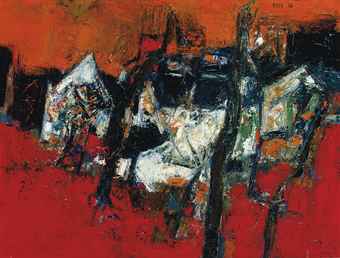
Eleven Raza’s sold in Christie’s yesterday, though some went below estimates, as did others in the auction, suggesting that sellers might have been advised to lower their expectations after the Sotheby’s debacle. The top Raza went for £400,000 (£481,250 – $748,344 with premium) to a buyer who also bought a smaller work (bottom) for $70,000.

The most dramatic was Crucifixion (above) from Raza’s early days before he focused on abstract shapes. It far exceeded a £40,000-60,000 estimate and was sold on a £85,000 bid (£103,250 – $160,554 with premium) to Kiran Nadar who bought the Tyeb Mehta.

Bonhams’ star sale was Vespers by Jehangir Sabavala, (left), a 48in x 36in oil on canvas, which had been estimated at £100,000-150,000 but led to competitive bidding by two buyers. It went for £210,000 (£253,650 with premium) – a world record for an Indian work at Bonhams.

The contemporary art market has been hit far more severely than the moderns in the past three years with auction prices for some artists such as Subodh Gupta dropping by as much as 80%.

Anders Petterson of Art Tactic warns that, with contemporary artists from other regional markets such as China, Southeast Asia and Middle East maintaining or increasing their auction presence since 2008, Indian contemporary artists “risk losing their voice in the international art auction market”. He says that the “diminishing market share for Indian contemporary art has created a vicious circle, affecting the perception of Indian contemporary artists and their position in the global market”.

That has led auctions to focus on the Progressives at the top end of the price ranges and on other modern figurative and abstract artists. The lesson of the latest auctions is that top prices are only achievable for quality works. However, persuading collectors to offer works for sale when prices are not generally good is difficult, and successful auctions need the wide-ranging contacts and tracking skills that Christie’s clearly has, along with Bonhams especially for Pakistani art.

Some dealers say Sotheby’s has better works at better prices lined up for New York’s November auctions. Meanwhile, the next tests of the market will be a Mumbai-based Saffronart on-line auction on June 19-20, with works estimated up to $700,000, and an auction focussed on south India art by Osian’s, a Mumbai and Delhi-based auction house, in Mumbai on June 21.
Posted by: John Elliott | June 4, 2012

Britain celebrates the Queen’s 60 years – in the rain

In praise of royalty rather than “fixed” presidents

.LONDON: Surely only the Brits could and would do it – turn out in their hundreds of thousands along the banks of a river in cold wet and windy weather, with the sun never fully breaking through the clouds, to honour their 86-year old monarch, Queen Elizabeth II, as she celebrates her diamond jubilee.

That is what happened yesterday here in London with a pageant of about 1,000 boats – ranging from the a royal barge to pleasure boats and small rowing craft and one-person kayaks. Carrying some 20,000 people, the boats paraded seven miles down river through the centre of the city to Tower Bridge watched by crowds of around a million.

Upstream from Chelsea, with a ceremonial vintage steam engine crossing a railway bridge to mark a stage in the pageant

Partly inspired by a Canaletto painting of a Thames pageant in 1752, it was the largest such event since that time and, an organiser said, may never be repeated because of changes in the river. The strong tidal force of the Thames was reduced for the day by the lowering of the giant Thames Barrier downstream near the river estuary to prevent the small boats being swamped.

.

“There’s Boris, there’s Boris!” shouted people near where I was standing next to Battersea Bridge in Chelsea, close to the start of the formal pageant. “How do you know?” asked someone. “Look at his floppy almost white hair – it’s him” came the reply, and everyone cheered “Boris Boris”. But it wasn’t supposed to be his day – Boris Johnson (left) has just been re-elected Mayor of London and was nowhere near the front royal end of the flotilla, yet it became his day too and he was repeatedly cheered along the route.

“Three cheers for the Dunkirk spirit” shouted an elderly guy with a naval-looking white beard a few yards from me as some small boats went past. “Three cheers for the Dunkirk spirit – our finest hour” and everyone joined in with the cheers as he repeated his clarion call three times.

Yet Dunkirk was not Britain’s finest hour. It was a retreat in 1940 from the German forces in France, but it can be seen as a victory because of the hundreds of civilian-owned boats crossed the English Channel and rescued over 300,000 troops marooned on French coast. To mark that achievement, some 40 of the boats were in yesterday’s pageant, and they were cheered.

That  Dunkirk spirit  of grabbing salvation from the jaws of defeat could be seen as a country in denial, just as the current four-day festival and holiday to celebrate Queen Elizabeth II’s diamond jubilee is in a sense a country in denial, given the economic crisis facing the UK and the rest of Europe.  Her reign has also seen society become wealthier though far more unequal – after tax, the richest 1 per cent now have 9 per cent of all income, compared with 3 per cent in 1977 (as the FT points out this morning).

.

There was  however no denying the mood of real celebration, partly no doubt because (as one of my sons says in a comment below) people wanted a reason to be happy when there is so much bad news around, and this was a genuine reason.

That was boosted with vague memories of Britain’s past years of glory. “Britain’s rules the waves” and “Land of Hope and Glory” were chanted every now and again in street parties across the country as well as along the Thames, though few people could get beyond the words of the first couple of lines (apart from a brilliant but rain-drenched choir on top of one of the river launches).

People draped themselves in Union Jack flags and waved and cheered for more than two hours from bridges and river banks along the pageant’s route. Military bands and other orchestras played on the boats and large tv screens relayed the events to the crowds. Eventually the crowds started to leave as heavy rain and sharp cold wind replaced mild drizzle, and low cloud even obscured the top of the Shard, a 87-floor 1000-ft office tower that will be Europe’s tallest building when it is completed.

.

The security was tight, applied gently by armies of 6,000 police and other officials and volunteers, who appeared more eager to help and chat than to order people around – what a lesson for countries where officials feel on such occasions that they have to prove their status with unhelpful and usually inefficient bullying.

But the bigger lesson is the stability and mood for celebration that an hereditary monarch of Queen Elizabeth’s stature can bring to a country. Some people yesterday honoured Boris and others remembered the small boats of Dunkirk, but no-one forgot that it was the Queen’s day – a monarch who has only got her judgement wrong once in the 60 years, and that was for just three or four days when she was caught off guard by Princess Diana’s death in a car accident in 1997 and didn’t respond personally as quickly as it became clear the nation thought she should.

I am no instinctive royalist, but isn’t such a system better than having a president chosen by politicians, as now happens for example in India where the president is indirectly elected through the states. The party in government there tries (as it is currently doing) to find someone who will be sympathetic to it if a general election produces a hung parliament because, at that point, the president (like the Queen) chooses who to invite to form a government.

The Queen with the Duke of Edinburgh, 91 on June 10

Ten years ago, when Britain’s Queen Mother died, I wrote in a Business Standard column that I’d prefer a royal head of state to a president “fixed” by the then Labour prime minister Tony Blair and his cohorts. The same applies even more to Britain with its Conservative prime minister David Cameron.

The Guardian newspaper however carries a salutary message in its editorial this morning. It praises the pageant for the scale and organisation, and for the reverence shown to the Queen, but warns: “A monarch a barge like a burnished throne, sailing up London’s river from Chelsea, home of oligarchs and plutocrats, to the City, home of the unpunished financial sector for whose misdeeds the rest of us are paying, cannot be a value-free act. Contemporary London offends as well as dazzles. So can the monarchy”.

The challenge for Britain’s royal family is to ensure that the Queen’s successor does not offend, but wins respect so that the monarchy survives and the choice of Britain’s head of state is not left to the equivalent of a Blair or a Cameron.

The Royal Barge

Indira Gandhi’s pro-cartoon line is not for schools

India’s government and the presiding Nehru-Gandhi dynasty have a problem – not the policy vacuum, sliding economy, weak leadership and bullying by coalition partners that are only too well known, but a new one that has been entirely of its own making in the past week.

The government is banning cartoons in school textbooks provided for teenagers because of uproar in parliament caused by MPs who are anxious to be seen to be protecting the interests of Dalits (“untouchables” in the Indian caste system) and other political icons.

.

There are two aspects to this political appeasement that was first announced last week by a terrorised-looking minister for education, Kapil Sibal (below) and then by a terrified-looking Pranab Mukherjee, the government’s leading politician, as they pleaded with screaming MPs to let them speak.

First, the decisions go against the views of former prime minister Indira Gandhi, mother-in law of Sonia Gandhi who now heads the dynasty and governing coalition, as The Indian Express has pointed out this morning…….

“Cartoonists have become an integral part of the intellectual life of a modern society,” wrote India Gandhi in 1983 in an introduction to a book of cartoons by Keshav Shankar Pillai who drew the 1948 cartoon that kicked off the row. “Some draw without intent to draw blood; some remove masks and hold a mirror to the face of society. There cannot be a cartoon without a certain amount of irreverence. But it depends on the cartoonist whether the irreverence aims at malice or irony… Shankar was not afraid to wound if there was a reason to do so,” she added, seemingly approvingly.

But maybe more significantly, Congress ministers are doing much the same as the Bharatiya Janata Party (BJP) did ten years when it was in power and Murli Manohar Joshi, who held Sibal’s post as education minister, hired Hindu-nationalist writers to eradicate Marxism and glorify India’s ancient Hindu past in school textbooks. He ordered, for example, the removal of a sensitive line written by historian Romila Thapar that “beef was served as a mark of honour to special guests” in ancient India, but that “in later centuries, Brahmans were forbidden” from eating it.

Is the way that Joshi was removing words that he didn’t like from textbooks any worse than Mukherjee-Sibal’s removal of cartoons? Joshi of course was insidiously feeding the Sangh Parivar’s nationalist line into children’s minds, hoping to indoctrinate future generations. But isn’t it just as dangerous in an open democracy for Mukherjee and Sibal to remove political cartoon commentary from textbooks as it was for Joshi to remove a reference to beef-eating?

.

If Indira Gandhi was content to see cartoons showing her setting fire to Congress leaders (right) when she split the party in 1969, how can Sonia Gandhi, her daughter-in-law, allow ministers to ban it from textbooks and Sibal to describe another one as “shameful”?

It seems that there are two icons that cannot be touched in modern India. One is the Dalit caste, which is an important vote bank, especially in Uttar Pradesh (UP) where Congress and the Gandhis did appallingly in recent state assembly polls. Top of the  untouchable (in modern terms) list is Bhim Rao Ambedkar, a revered Dalit leader at the time of India’s independence, who was glorified by Kumari Mayawati, a modern Dalit politician who was chief minister of UP till the recent elections.

In the cartoon that was withdrawn last week (top), Jawaharlal Nehru, India’s first prime minister, is raising a whip behind a snail on which Ambedkar, who at the time was thought to be drafting India’s constitution too slowly, was sitting. A Dalit MP called the cartoon “insulting to Ambedkar, Nehru and the whole nation.” Others talked of the risk that such cartoons would “poison young minds”.

.

“The demand that criminal action be taken against those who permitted the cartoon’s publication is reflective of a larger malaise among many of India’s politicians,” The Hindu newspaper said  two days ago. “Apparently, they think there is more political mileage in creating controversies over irrelevancies than addressing genuine issues facing Dalits such as backwardness and discrimination”.

The other icon is the Nehru-Gandhi dynasty whose current leaders have woven a web of protective untouchability around themselves that makes mocking the family unacceptable.

But the ease with which special interest groups can whip up emotions and political support goes far wider  in a society that seems to lack the capacity for self-deprecating irony and laughter and for accommodating divergent views. Such issues are maybe not surprising in a massive and rapidly changing country where the sense of humour and other attitudes vary widely, especially between urban and rural areas and vastly different levels of education.

That has been shown for several years by the establishment’s tolerance of opposition to the late M.F.Husain, one of India’s leading artists, for his depiction of Hindu goddesses, and its implicit support (courting the Muslim vote bank in the UP elections) for opposition to Salman Rushdie visiting the Jaipur Literature festival in January. In Mumbai, a leading rationalist faces jail for “outraging religious feelings” by pointing out in March that drops of water dripping from the feet of a statue of Jesus was not a miracle but leaks from a blocked drain.

This week’s events are all the sadder because MPs gathered last Sunday for a special session to mark the 60th anniversary of India’s parliament. In speech after speech, they extolled the virtues of an open democratic society that they pledged to defend. That was two days after they had disrupted parliament till the Ambedkar cartoon was withdrawn, and one day before they screamed and shouted again until the other cartoons were banned.

The MPs “showed a total lack of acumen and wisdom by wasting the nation’s time on a complete non-issue,” wrote The Hindu. “Worse, they have ensured that public life in India, already awash with hurt sentiments of one kind or another will now be inundated by a torrent of demands to ban more and more expressions of culture, art and knowledge”.

Hilary Clinton has just had first-hand experience of  the problems that the Indian government regularly faces with its unpredictably irascible – and it now appears maybe untruthful – coalition partner, Mamata Banerjee.

The story, which concerns whether or not Clinton raised the subject of foreign investment (FDI) in supermarkets when she met Banerjee yesterday, should evoke some sympathy for prime minister Manmohan Singh and his colleagues, whose policies are constantly upset by Banerjee, leader of the regional Trinamool Congress party and chief minister of West Bengal.

The Clinton experience did not however upset a two-day visit by the US secretary of state to India, nor did it overshadow a well-timed partial climb-down in parliament yesterday by finance minister Pranab Mukherjee over retrospective international tax plans that he announced in his Budget a few weeks ago.

.

Clinton has been on her way back from a difficult time in Beijing (dealing with China over the blind dissident Chen Guangcheng) and stopped off on Sunday in Bangladesh.

From there it was logical to have another stop-over yesterday in Kolkata (Calcutta), state capital of West Bengal, on her way to Delhi for what might be her last India visit as secretary of state.

She presumably wanted to meet Banerjee because of the way that the chief minister has used her clout as a key partner in India’s coalition government to block policies ranging from supermarkets’ FDI to national security policy and a river water sharing agreement with Bangladesh.

Before the two women met, Clinton said in a tv interview that she would “certainly raise the United States’ desire to try to open the market to multi-brand retail” with Banerjee.  (Wal-Mart and other US companies are seeking this FDI access). They seemed to get on well for photos (above) before their talks, and they discussed West Bengal’s cultural brand ambassadors, Rabindranath Tagore, the Nobel prize winning poet and artist, and Bollywood star Shah Rukh Khan. The talks lasted nearly an hour and covered development issues such as a deep sea port, the entertainment industry, and twinning arrangements with American cities and states.

After the meeting however, Banerjee stated categorically on television that the FDI issue was not raised. This prompted the US consul general’s office in Kolkata to put out a statement a few hours later equally categorically saying it was one of the subjects covered during “a warm, vibrant and energetic  discussion”. Banerjee reacted by instructing her finance minister, Amit Mitra, to issue a statement asking the US to retract the claim – which it has not done.

Clinton snubs Banerjee

This morning, when Clinton spoke at a  press conference in Delhi, it was significant that she made no mention of meeting Banerjee. Normally she would have thanked the chief minister for the meeting and for her visit to the state, but she snubbed her by not naming her or West Bengal.

So who is telling the truth, and can the two sides obfuscate themselves out of the differing accounts? This is of course a relatively minor issue compared with other subjects discussed in Delhi, where the two countries bridged their differences over Iran’s oil exports to India, which the US opposes, and over India’s demands for the US to be tougher over Pakistan-based terrorist activities. But it is an embarrassing clash, as well as being illustrative of Banerjee’s behaviour

It is of course inconceivable that Clinton would have authorised such an explicit official US statement last night if retail FDI had not been mentioned, so it can only be assumed that Banerjee has some sort of wriggle-room to explain why she says it was not. Basically however, she seems to have been throwing the sort of tantrum that is usually aimed at India’s government.

I imagine that there is now a risk that the disagreement will harden Banerjee’s resolve to block the FDI. Indeed, was she maybe preparing to withdraw her objections but did not want that to appear to be in response to a request from the US? And, if that is so, was last night’s US statement an over-reaction?

Posted by: John Elliott | April 25, 2012

India’s slide leads to an international down-grade

After 25 years the Bofors gun returns to haunt Congress and the Gandhi’s

It had to happen. India’s slide in the past two or three years from a self-perceived emerging economic super-power to its current crisis of appalling government performance, declining  economic statistics, and almost daily political crises has today led to a damning international verdict with ratings agency Standard & Poor’s deciding to cut India’s outlook to negative from stable.

S&P cites India’s large fiscal deficit and expectations of only modest progress on reforms, given political constraints and falls in both the stock market and the value of the rupee.

This reflects the basic problem of a lack of firm government and the international uncertainty that creates. Some economists however thought S&P’s action was premature, and Moody’s rating agency said it expected growth to be sustained, supported by “strong savings and investment rates”.

The S&P move puts at risk India’s long-term rating of BBB-, which is the lowest investment grade. It could hit the inflow of funds and thus the balance of payments if economic growth slips below current forecasts of around 7%. “The negative outlook signals at least a one-in-three likelihood of the downgrade of India’s sovereign ratings within the next 24 months. A downgrade is likely if the country’s economic growth prospects dim, its external position deteriorates, its political climate worsens, or fiscal reforms slow,” S&P credit analyst Takahira Ogawa said in a statement.

‘No need to be panicky’

Pranab Mukherjee, the finance minister, (below) responded blandly saying, “There is no need for being panicky.” The situation “may be difficult, but we will be surely be able to overcome”. That chimes with the reaction of Manmohan Singh, the prime minister (reported here last week), when he dismissed public warnings on the economy and reforms from some of his closest friends and economic advisers. He said they were “difficulties” that would be “overcome”.

.

Duvvuri Subbarao, governor of the Reserve Bank of India and a former economic adviser to the prime minister, warned at that meeting that 1991’s “twin deficits” were back again. The fiscal deficit was 7% in 1991 and is now rising at 5.9%, while the current account deficit at 3.6% is higher than in 1991, and short-term debt at 23.3% of gdp is now far above 1991’s 10.2%.

Mukherjee’s reaction shows that he and his colleagues seem to assume that India is cushioned from outside pressures as it was before the 1991 economic reforms, which of course is wrong now it relies on inward direct and institutional investment. Mukherjee is basing his optimism partly on hope that three bills on pension funds, insurance, and banking will soon be passed by parliament, but it will be a miracle if that happens.

‘Lack of political and intellectual courage’

Business people reacted with horror but not surprise at the S&P news. Kiran Mazumdar-Shaw, founder of Biocon, a bio-tech firm, and a leading entrepreneur tweeted:

“Lack of political and intellectual courage is leading to India’s economic and social decline – it’s time the government acted boldly…. FM’s cajoling statement has no credibility to back it… Time for Govt to wake up and take action not be in denial…The lack of political and intellectual courage is leading to India’s economic and social decline – it’s time the government acted boldly”.

She and others however know that the government is most unlikely to act boldly because it is on the brink of imploding in a mass of major and minor crises that neither the Congress Party, led by its president Sonia Gandhi, who heads the unruly government coalition, nor the government itself headed by the prime minister, seems to know how to stem let alone solve.

Foreign investors looking into India see a government that lacks coherence and leadership in planning and implementing policies and reforms that range from foreign direct investment to land acquisition. Yes at the same time, the government has the gall to snub foreign investors by threatening multi-million/billion dollar retrospective tax demands on major companies such as Vodafone – even the Bharatiya Janata Party would surely not have been so anti-foreign, despite its nationalist swadeshi approach, when it was in power from 1998 to 2004.

When this government was first elected, it was said to have a “dream team” of economic managers – the prime minister, finance minister Palaniappan Chidambaram, and Montek Singh Ahluwalia running the planning commission. None of these men however had either the contacts or string-pulling know-how to make things happen, and they were quickly constrained by the populist reform-wariness of Sonia Gandhi and Rahul, her son and heir apparent, plus their coalition partners.

Now the prime minister, at 79, seems tired of the “difficulties”, Chidambaram is running the home ministry, and Ahluwalia’s impact slips the weaker the prime minister becomes. Chidambaram’s successor at finance, Pranab Mukherjee, a veteran and agile political problem-solver, seems to be losing his touch – never a reformer, he is leading the tax attack on foreign investors and is creating levels of uncertainty and insecurity that no modern economy could survive.

Alongside that, Sonia Gandhi has had long-term health problems, though it is not known how serious they are (or were) and she has recently seemed to be fully back at work. Rahul has lost his credibility with disastrous Uttar Pradesh state assembly election results last month and with little else to show for eight years in politics.

A general slide

Numerous other ministers and party leaders are being felled or weakened by a series of catastrophes. One of the latest is not itself of major importance but is indicative of a general slide. Abhishek  Singhvi, a senior lawyer has resigned as a high profile party spokesman and chairman of the parliamentary standing committee on personnel, law and justice after cd and u-tube clips allegedly show him having sex in his office with a supposedly career-ambitious woman lawyer.

Yesterday came inexplicable reports that four ministers had offered to resign their posts to help rebuild the Congress Party for the next general election due in 2014. Those involved denied they had done so, but the widely reported news surely shows skewed priorities. Isn’t it more important to run ministries well and boost the government’s performance before the election than to move to the party’s offices – or have the ministers decided it is best to jump from a foundering ship and hope their future looks brighter in a party lifeboat?

It is not only the economy and policy making that is in trouble. India’s once proud army is being weakened, not only by corruption scandals that block big defence orders, but by a series of internal rows that range from the army chief going to court over when he should retire and a court case (dismissed this week) against the choice of the next army chief.

Today the government faces more trouble with headlines on a revealing footnote to history. This month is the 25th anniversary of the Bofors gun deal scandal that rocked the Congress government run by Sonia Gandhi’s late husband, Rajiv, and still reverberates through Indian politics and defence ministry decision-making.

Sten Lindstrom, a former Swedish police chief who was heading inquiries into Bofors in 1987, today has identified himself as the source for the Indian end of the story. In a current interview with the journalist who was then the recipient of his leak, he said there was “no evidence” that Rajiv Gandhi received a bribe, but that there was “a political payment”. There was also “conclusive” evidence against Ottavio Quattrocchi, the Delhi-based Italian representative of Snamprogetti who, together with his wife, was a close family friend of Rajiv and Italian-born Sonia.

Rajiv Gandhi ‘watched…and did nothing’

The damning revelation is that Rajiv Gandhi “watched the massive cover-up in India and Sweden and did nothing,” says Lindstrom. “Many Indian institutions were tarred, innocent people were punished, while the guilty got away”.

And so it is today. The guilty have escaped numerous corruption scandals, most recently on the Commonwealth Games, defence deals, and mining licences. Non-performing political leaders and ministers are not replaced. Loyalty to those at the top is what matters.

Now S&P has blown the whistle – but will it have any effect?

Friends and foes pile in on Government failures 

Two events in the past few days underline a sharp  decline both in the popularity of the Congress Party, which  leads India’s coalition government, and in the success of prime minister Manmohan Singh as an economic reformer.

People ranging from the voters of New Delhi to loyal economists and other policy allies have in effect warned that, unless something changes quickly, the government will be swept from power in 2014 and will go down in history as an administration that failed India just as it was on the brink of becoming an internationally significant economic success story.

The two events are elections for Delhi’s municipal corporations where the Bharatiya Janata Party swept the polls, and the launch of a book on economic reforms. At the book launch, the prime minister sat silently while economists and others did not laud him as he might have expected, but told him, in the words of one of those there, “your legacy is at risk” (texts and video here).

In Delhi, the BJP became the first party for 50 years to win a second consecutive term in office. Congress is trying to dismiss this as a nationally insignificant local election, but it follows a trend set by the party’s humiliating defeat in Uttar Pradesh state elections early last month plus losses in two others states and in Mumbai’s municipal elections.

More surprising, and much sadder, was the book launch where Manmohan Singh was surrounded by economists and policy makers who have worked with him for years since before the 1991 economic reforms that he launched as finance minister. The book is India’s Economic Reforms and Development – Essays for Manmohan Singh, an updated collection of essays (edited by Isher Judge Ahluwalia, I.M.D.Little – OUP – Rs395, $35, £16). It was first written in 1998 as a “festschrift” or celebration of the 1991 reforms. The new book tracks what has and has not happened since 1998.

A friend’s ‘destructive habit’

Unfortunately, I could not be at the launch, but The Economist’s South Asia correspondent has neatly caught the mood, echoing what I have heard from others. “The evening had the mood of an intervention: when friends and relations get together and, without warning, confront a loved one who has some sort of destructive habit that he won’t admit to. In normal life, it might be an addiction to drugs or booze. In India’s political life, and the case of Mr Singh, it is a desperate failure to push on with reform”.

Isher Ahluwalia presents the book to Manmohan Singh

The approach was set by Isher Ahluwalia, head of ICRIER, a leading economic policy institute, who warned that India had been taking strong economic growth rate for granted. She implied that the government has been sitting back and failing to take the steps needed to sustain that growth which was now “under threat from a deteriorating macro-economic environment and a downturn in the investment climate”.

Turning this into a potent social issue, she pointed out that Indians born in 1991 are now 21, and that half the population today is below 25. “This half of our population started life in India with 5.5 per cent growth which accelerated slowly and steadily to 8 per cent as they grew up. They are restive for more, not less”.

Unsustainable policies

Sharpening the criticisms, she pointed to the “unsustainability” of fiscal policies, incomplete financial sector reforms and infrastructure construction and regulatory frameworks, plus “macro-economic management in an uncertain international economic environment” and “challenges of overall governance”.

By this point, the prime minister must have wondered why he had, reluctantly I am told, agreed to attend the event. Ahluwalia is not only a leading economist but is also a family friend along with her husband, Montek Singh Ahluwalia, who runs the Planning Commission.

Raghuram G. Rajan, a leading Chicago academic and the prime minister’s honorary economic adviser, went further. After praising how the 1991 had changed India for the better, he warned of a “paralysis in growth enhancing reforms” that had been papered over by the high growth. This had made India “dependent on short term foreign inflows to a dangerously high extent, at a time that the international investor is increasingly sceptical about the India story”.

‘Coalition of the bad’

By the early 2000’s, he said, India had needed a second generation of reforms in areas that included higher education, public sector industries, and allocation of resources such as land and telecoms spectrum. “But powerful elements of the political class, which had never been fully convinced about giving up rents from the License Raj in the first place, had by then formed an unholy coalition with aggressive business people, whom I will refer to simply as the connected”. That led to “coalition dharma – a coalition of the bad”, which replaced the pre-1991 License Raj with a Resource Raj and led to “massive fortunes generated by the connected and by politicians”.

Duvvuri Subbarao, governor of the Reserve Bank of India and a former economic adviser to the prime minister, gently warned (above) that 1991’s “twin deficits” were back again. The fiscal deficit was 7% in 1991 and was now rising at 5.9% while the current account deficit at 3.6% is higher than 1991 figure and short-term debt at 23.3% of gdp is now far above 1991’s 10.2%.

Congress’s communist-style supremacy

Then T.N.Ninan, veteran editor of the Business Standard, mocked (without naming them) the way that Manmohan Singh has allowed Sonia Gandhi, president of the Congress Party, to dominate policy, saying, “we have copied the Communists, for whom the party is supreme and the government secondary” (a jibe that BJP leader L.K.Advani has also made). The prime minister was also hampered by  “presidential style chief ministers in the states” and coalition cabinet ministers who ran their own policies.

Through all this and much more, the prime minister sat silent for over an hour, speaking at the end only to say that he had agreed to come provided he did not have to speak. Many of those there found this stance not only inexplicable but worrying – had Manmohan Singh, at 79, really lost the wish to debate as well as the will to govern?

The book’s editors and contributors, the prime minister said, had” thrown a new light on old problems” and mentioned many challenges. “There are difficulties. Life will not be worth living if there are no difficulties. I am confident, with great determination, we will overcome.”

But where, one asks, is the “great determination”?

April 20 : No major reforms till after 2014 says chief economic adviser                            Don’t expect much to happen on reforms before the 2014 general election, Kaushik Basu, the government’s chief economic advisor, is reported to have told anxious US businessmen in Washington yesterday. “Relatively less important bills might go through Parliament but major economic reforms would hit the road block…. they are unlikely to happen before the next Parliamentary elections.” They would gather pace in 2015.


Posted by: John Elliott | April 4, 2012

Army intrigue and graft hits India’s defences

Unexpected troop movements near Delhi in January cause alarm

Concern about worsening relations between the army and government is graphically illustrated by a story that takes up the entire front page of The Indian Express this morning about two key mechanised military units moving unexpectedly towards Delhi at night in mid-January.

The government did not have the usual notifications about the alleged exercises, which have this morning been described by the government and army as routine training.

There has never been a fear in India of a military coup but, with a weak government and serious tensions with (and within) the army, the story raises issues that have caused serious concern today. Either some sections of the army – maybe the chief of army staff himself – were in a mood to cause alarm in Delhi, or the failure to notify the exercises amounted to a serious lapse of procedures.

There have been strenuous denials from the prime minister, defence minister, and many others that anything untoward or significant took place. The Indian Express is also being criticised for over-playing the story, especially since some of the facts had apparently been reported earlier elsewhere such as here  and there were some factual errors.  Despite that, the furore illustrates the current low point in army-government relations. 

The story raises questions about who in the army or government supplied the facts to the Express, and why. It harms the image of A.K.Antony, the defence minister, who has been facing a series of crises. It is possible that he is the target here, and also the target of other recent leaks concerning the army and the army chief, possibly organised by senior political rivals and defence companies hit by his oppostion to corruption.  Significantly, Shekhar Gupta, the editor, considered it important enough to put his name on the story along with other reporters, and to clear the whole of the paper’s front page.

India’s defence capability problems are getting worse and are often in the news for all the wrong reasons – despite occasional good events such as the launching today of the country’s first nuclear-propelled submarine. Most public sector defence equipment companies have been failing the country for years by not maximising the output of efficiently manufactured equipment. As a result, India’s defence capability has been crippled in many areas by outdated weapons, and the government has generally failed to act.

Now the government faces a bitter chief of army staff who has turned whistleblower on both India’s lack of defence preparedness and a controversial army truck contract, amid complaints from frustrated private sector defence companies that are blocked from obtaining contracts by a self-serving defence establishment.

You may notice that these two paragraphs are copied from the intro to last week’s article on the coal industry, with coal replaced by defence. I could of course repeat this trick many times but won’t. I’ve done it today because of the similarities of an ineffectual government and a deeply embedded public sector establishment resistant to change – the only difference being that many of the private sector players in coal are part of the problem whereas they are trying to be part of the solution in defence.

Top Indian defence companies in the Confederation of Indian Industry have appealed this week to the prime minister to set up a National Defence Manufacturing Commission within his office (PMO) that would do what the Ministry of Defence will not do and end the inefficient and often corrupt public sector domination of the industry. But they know this is unlikely to happen during the lifetime of the current government because of its lack of leadership both in the ministry and more widely.

Surely only a comedy film producer would accept a script where newspapers splash across their front pages complaints from a country’s army chief of staff about his battle tank fleet being “devoid of critical ammunition to defeat enemy tanks” and air defence being “97 per cent obsolete”, just as the president of the country’s most powerful potential enemy arrives in town.

Yet that is just what happened last week when General V.K. Singh, the chief of army staff, (above with Antony) hit the headlines while China’s president Hu Jintao was in Delhi for a BRICS summit along with fellow leaders from Russia (supplier of much of the defunct equipment), Brazil and South Africa – as well as the world’s top defence equipment companies attending Delhi’s big biennial DefExpo show.

A letter that Singh had sent to the prime minister on March 12 was leaked to the media on March 28. It named the tank ammunition and air defence problems and said the infantry had “deficiencies of crew served weapons” and lacked “night fighting” capabilities. Elite special forces were “woefully short” of “essential weapons”, and there were “large-scale voids” in critical surveillance and night fighting capabilities.

Earlier in the week, Singh had dropped another bombshell, claiming he had been offered a $2.8m bribe by another army general to buy what he claimed were faulty Tatra army trucks (Czech made for an Indian-owned UK-based company).

General Singh is a proud and frustrated officer because he has recently lost a long-running and widely publicised battle with the government over his age (60 or 59) and thus over whether he would retire this year or next – he will now go at the end of next month. Critics allege that he made the bribe and defence equipment statements to get revenge, and a gaggle of politicians and commentators called for his immediate dismissal.

But that reaction was unfair and was quite possibly partly encouraged by rival generals and defence companies anxious to devalue his bribe allegations. The battle over his age turned partly on who would succeed him as army chief and this involved, some observers say, rival Hindu-Sikh and caste loyalties. A different general would have taken over if he had stayed another year and that might also have favoured some companies more than others, as well as giving Singh another year to try to tackle corruption.

Some critics have said that Singh over-stated the army’s poor preparedness, but his remarks were not new (and he had nothing to gain by leaking his own letter). Two years ago, at the time of Delhi’s last biennial defence exhibition, I wrote here about exhibition conference papers which said that “most of India’s ground based air defences are obsolete” and that upgrades of basic artillery equipment were “ten years behind schedule”. The then chief of army staff had just said that 80% of India’s armoured tanks were night blind, and the draft of an imminent US report said that India’s arms purchasing “lacked political direction and has suffered from weak prospective planning, individual service-centred doctrines, and a disconnect between strategic objectives and the pursuit of new technology”.

Singh and Antony should be close allies because both are unusually free of corruption – something that cannot be said for a lot of other generals and politicians. But while Singh is a man of action and has tried to clean up some of the army’s corruption (thus antagonising other generals), Antony is a weak politician scared of taking decisions that might sour his clean image.

He had neither the will nor skill to deal with Singh’s age arguments when they started a couple of years ago, nor to speed up defence modernisation – though two days ago, under pressure, he did make some decisions to speed up arms deals. He is in fact believed to be in his current job only because he is trusted as a clean and loyal politician by Sonia Gandhi, head of the Gandhi dynasty and the ruling coalition who is thought to see him as a leading prime ministerial candidate if Manmohan Singh stepped down. In such situations, dynastic loyalty counts for more than ability.

India has an annual defence budget of $40bn, including capital expenditure of $15bn, and is the world’s biggest importer of defence equipment according to a recent report, accounting for 10% of global arms imports between 2007 and 2011. China was the biggest importer but its inward trade had declined in recent years because it has dramatically modernised its defence manufacturing industry, something India has singularly failed to do. India’s defence imports are officially put at 70%, but the actual figure is far higher, maybe around 85%, if imports made quietly by defence public sector corporations (DPSUs) are included.

That takes the story back both to the army chief’s bribe charge (involving Tatra trucks – not to be confused with Tata, India’s biggest conglomerate which also makes army trucks) , and to the Indian private sector’s wish to turn the figures round and make 70% of defence equipment in the country.

Tatra trucks controversy

Critics complain that, while Tatra all-weather all-terrain trucks (above on a Republic Day parade) are widely admired for their flexible-axle agility on rough ground, only 60% of their components have been indigenised in the 26 years that the trucks have been produced for the Indian army by BEML, a public sector company. The left-hand drive has not even been changed, and the trucks are said to be excessively over-priced.

Reports suggest that complaints about the trucks were suppressed by Antony and the defence ministry in 2009, though the army chief’s whistle blowing has led in the past few days to Central Bureau of Investigation inquiries into Tatra and its UK-based owner Ravi Rishi of Vectra (which represented Eurocopter in a bid for 197 army helicopters that was shelved in 2007). The army chief tried to stop the contract when he took over and is saidm to have backed a Russian-Indian joint venture, Ural of West Bengal, whose vehicles would reportedly cost less than half Tatra’s Rs8-10m ($170,000-$200,000) – other Indian companies might also develop rival vehicles.

Allegations of corruption and intrigue stretch beyond Tatra, Singh’s age, and the whistle blowing to other army scandals including Adarsh, a multi-storey block of flats built in Mumbai for top army officers and other public sector officials on land designated for war widows. This is one of many cases arising from the army being India’s biggest landowner with some 1.73m acres. Also linked are allegations that Antony’s office was bugged, and an unauthorised defence contract. These were covered in an unusual press release issued by the ministry that named the general allegedly offering the Tatra bribe to Singh.

Many defence public sector companies like BEML import unnecessarily large amounts of components from abroad and then assemble them into finished equipment, often operating in league with corrupt suppliers, intermediaries and officials who discourage research and development of potentially rival Indian products and components. Ajai Shukla, a defence journalist and former army officer, said on television two nights ago that the DPSUs “take the whole system for a ride” with defence ministry approving their plans without proper vetting or competitive tendering.

This forms a powerful lobby against the Indian private sector being allowed to expand and explains why the CII wants the prime minister’s office to preside above the defence ministry.

Antony is not a reformer. He has even blocked the designation of 12 big companies, including Tata, Larsen & Toubro, HCL and Mahindra, as defence “champions” capable of becoming internationally recognised defence systems integrators. He has apparently been persuaded by small and medium sized companies that they would be left out, whereas they would actually gain as suppliers to the 12. He has also bowed to defence establishment pressure and watered down offset plans that would force foreign suppliers to make up to 40% of their equipment in India. These moves have serious undermined reform initiatives started when Pranab Mukherjee, now finance minister, was in charge of defence till 2006.

So I’ll finish up with the same words that ended last week’s coal article – sadly, the chances of this government making such policy leaps are slim, as has been seen in so many other areas over the past few years. But it needs urgently to address basic issues that are devaluing its once proud army.

« Newer Posts - Older Posts »

Categories