In praise of royalty rather than “fixed” presidents
 LONDON: Surely only the Brits could and would do it – turn out in their hundreds of thousands along the banks of a river in cold wet and windy weather, with the sun never fully breaking through the clouds, to honour their 86-year old monarch, Queen Elizabeth II, as she celebrates her diamond jubilee.
That is what happened yesterday here in London with a pageant of about 1,000 boats – ranging from the a royal barge to pleasure boats and small rowing craft and one-person kayaks. Carrying some 20,000 people, the boats paraded seven miles down river through the centre of the city to Tower Bridge watched by crowds of around a million.
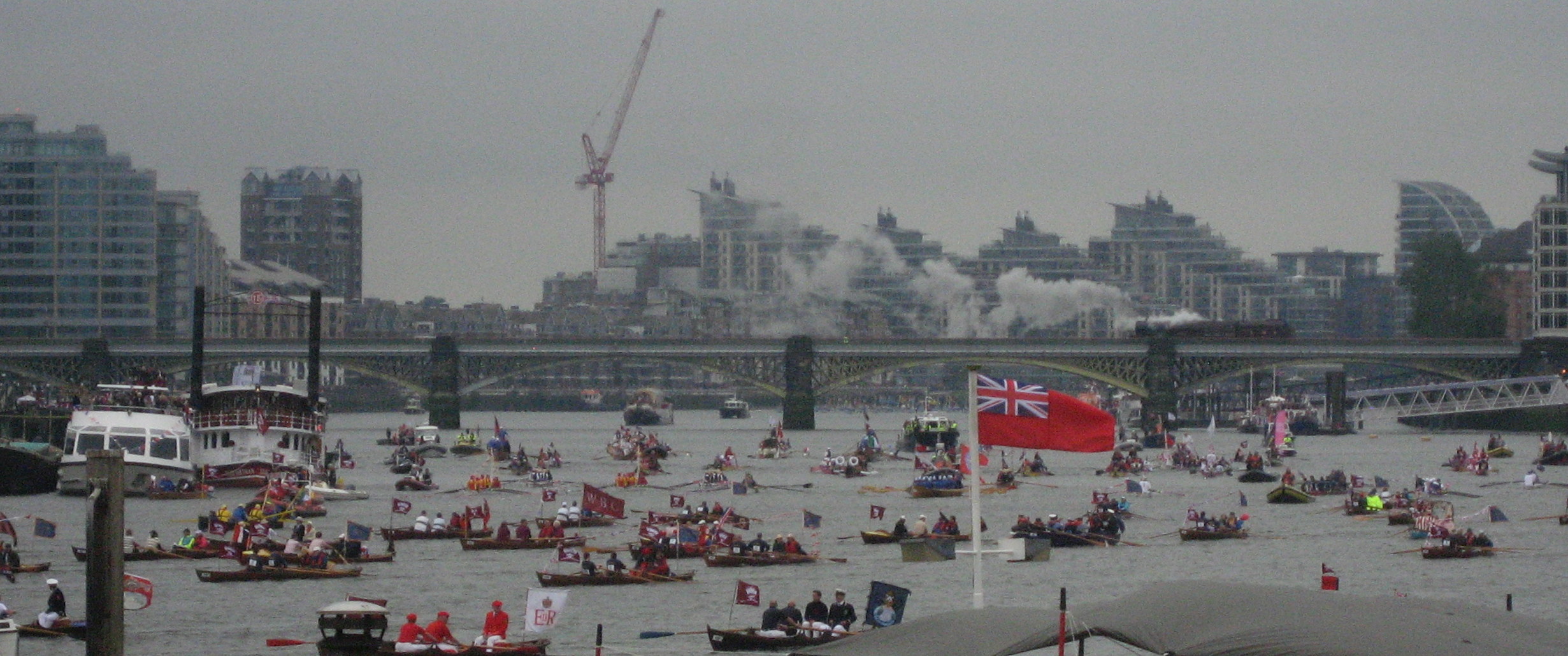
Upstream from Chelsea, with a ceremonial vintage steam engine crossing a railway bridge to mark a stage in the pageant
Partly inspired by a Canaletto painting of a Thames pageant in 1752, it was the largest such event since that time and, an organiser said, may never be repeated because of changes in the river. The strong tidal force of the Thames was reduced for the day by the lowering of the giant Thames Barrier downstream near the river estuary to prevent the small boats being swamped.
.
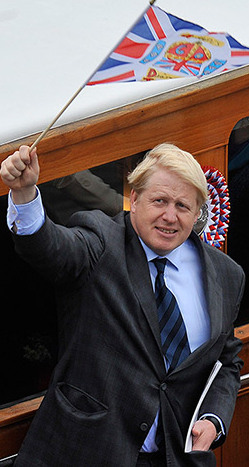
“There’s Boris, there’s Boris!” shouted people near where I was standing next to Battersea Bridge in Chelsea, close to the start of the formal pageant. “How do you know?” asked someone. “Look at his floppy almost white hair – it’s him” came the reply, and everyone cheered “Boris Boris”. But it wasn’t supposed to be his day – Boris Johnson (left) has just been re-elected Mayor of London and was nowhere near the front royal end of the flotilla, yet it became his day too and he was repeatedly cheered along the route.
“Three cheers for the Dunkirk spirit” shouted an elderly guy with a naval-looking white beard a few yards from me as some small boats went past. “Three cheers for the Dunkirk spirit – our finest hour” and everyone joined in with the cheers as he repeated his clarion call three times.
Yet Dunkirk was not Britain’s finest hour. It was a retreat in 1940 from the German forces in France, but it can be seen as a victory because of the hundreds of civilian-owned boats crossed the English Channel and rescued over 300,000 troops marooned on French coast. To mark that achievement, some 40 of the boats were in yesterday’s pageant, and they were cheered.
That Dunkirk spirit of grabbing salvation from the jaws of defeat could be seen as a country in denial, just as the current four-day festival and holiday to celebrate Queen Elizabeth II’s diamond jubilee is in a sense a country in denial, given the economic crisis facing the UK and the rest of Europe. Her reign has also seen society become wealthier though far more unequal – after tax, the richest 1 per cent now have 9 per cent of all income, compared with 3 per cent in 1977 (as the FT points out this morning).
.
There was however no denying the mood of real celebration, partly no doubt because (as one of my sons says in a comment below) people wanted a reason to be happy when there is so much bad news around, and this was a genuine reason.
That was boosted with vague memories of Britain’s past years of glory. “Britain’s rules the waves” and “Land of Hope and Glory” were chanted every now and again in street parties across the country as well as along the Thames, though few people could get beyond the words of the first couple of lines (apart from a brilliant but rain-drenched choir on top of one of the river launches).
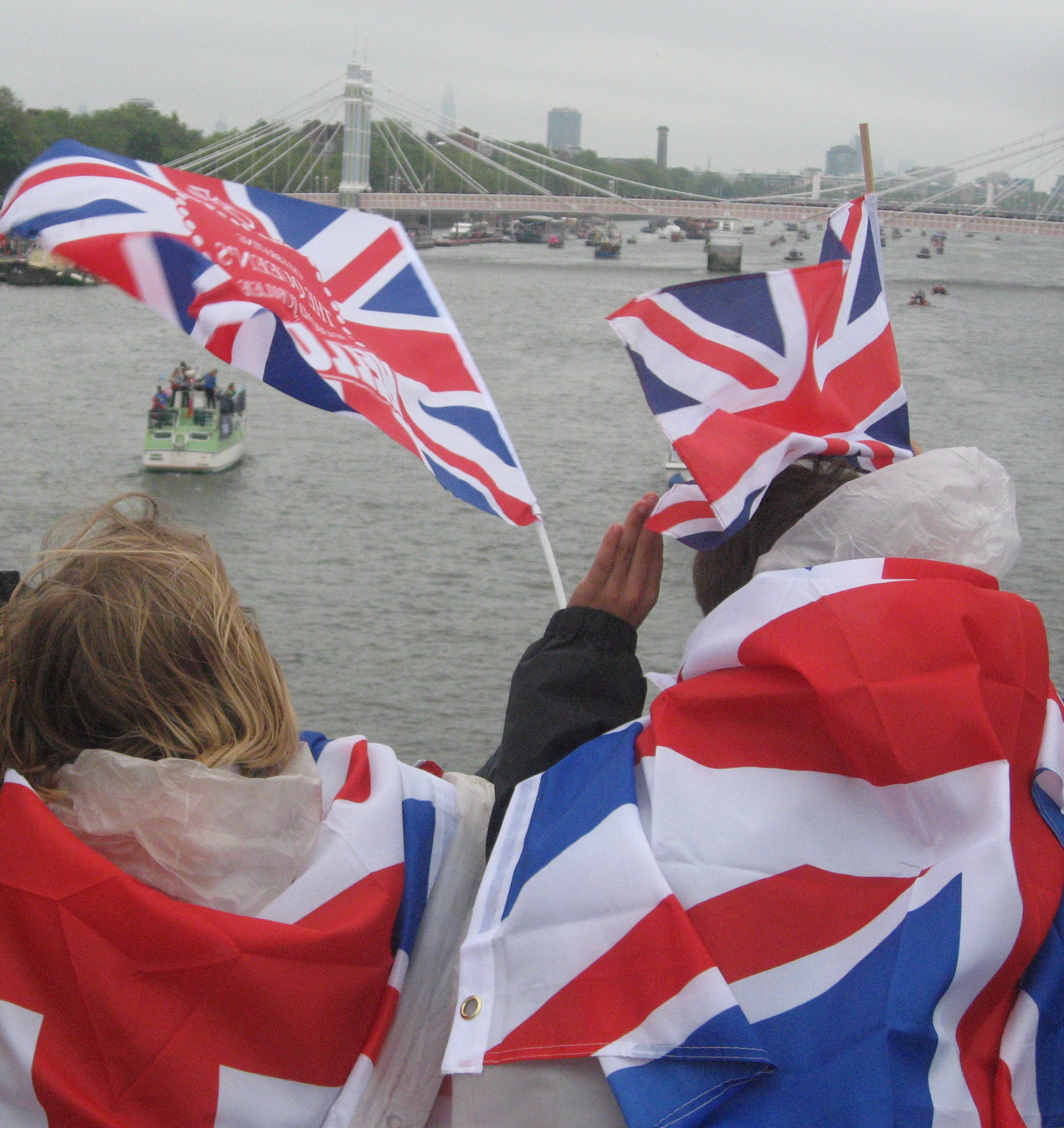
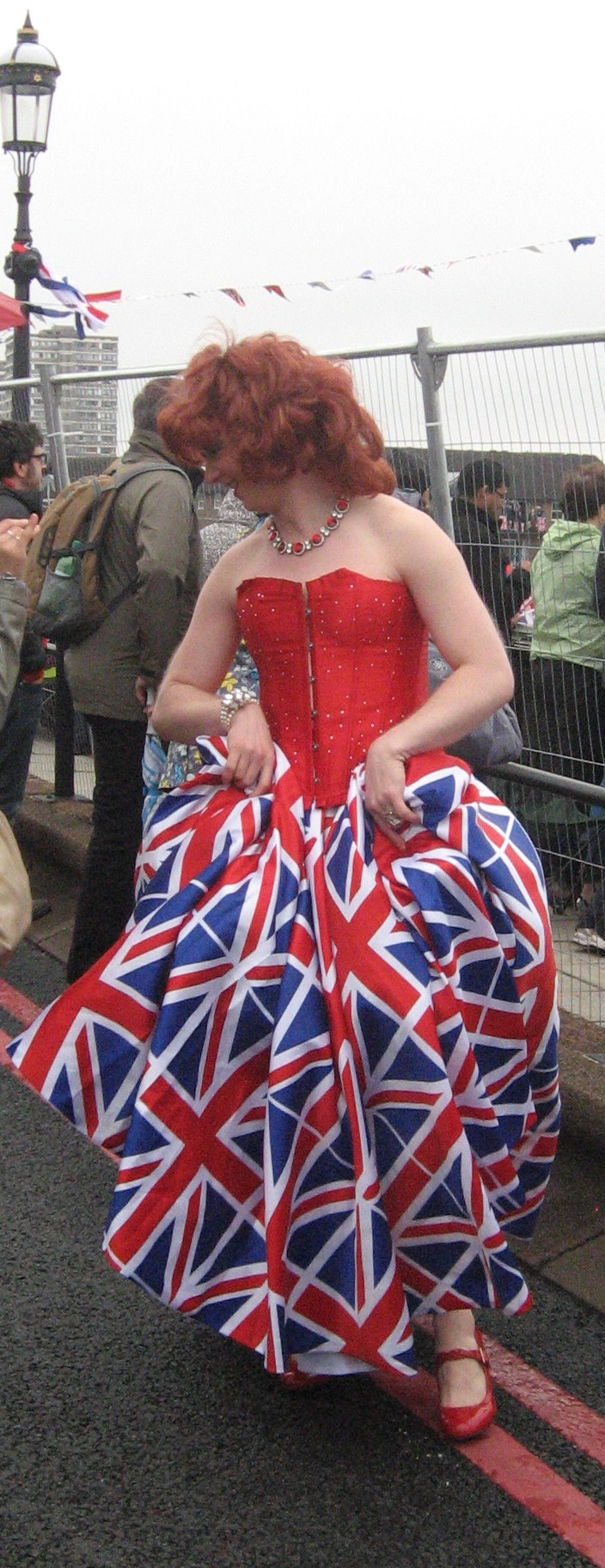
People draped themselves in Union Jack flags and waved and cheered for more than two hours from bridges and river banks along the pageant’s route. Military bands and other orchestras played on the boats and large tv screens relayed the events to the crowds. Eventually the crowds started to leave as heavy rain and sharp cold wind replaced mild drizzle, and low cloud even obscured the top of the Shard, a 87-floor 1000-ft office tower that will be Europe’s tallest building when it is completed.
.
The security was tight, applied gently by armies of 6,000 police and other officials and volunteers, who appeared more eager to help and chat than to order people around – what a lesson for countries where officials feel on such occasions that they have to prove their status with unhelpful and usually inefficient bullying.
But the bigger lesson is the stability and mood for celebration that an hereditary monarch of Queen Elizabeth’s stature can bring to a country. Some people yesterday honoured Boris and others remembered the small boats of Dunkirk, but no-one forgot that it was the Queen’s day – a monarch who has only got her judgement wrong once in the 60 years, and that was for just three or four days when she was caught off guard by Princess Diana’s death in a car accident in 1997 and didn’t respond personally as quickly as it became clear the nation thought she should.
I am no instinctive royalist, but isn’t such a system better than having a president chosen by politicians, as now happens for example in India where the president is indirectly elected through the states. The party in government there tries (as it is currently doing) to find someone who will be sympathetic to it if a general election produces a hung parliament because, at that point, the president (like the Queen) chooses who to invite to form a government.
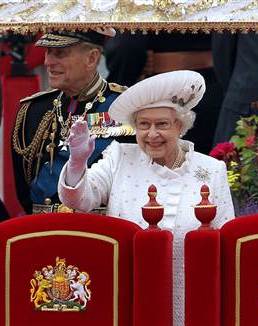
The Queen with the Duke of Edinburgh, 91 on June 10
Ten years ago, when Britain’s Queen Mother died, I wrote in a Business Standard column that I’d prefer a royal head of state to a president “fixed” by the then Labour prime minister Tony Blair and his cohorts. The same applies even more to Britain with its Conservative prime minister David Cameron.
The Guardian newspaper however carries a salutary message in its editorial this morning. It praises the pageant for the scale and organisation, and for the reverence shown to the Queen, but warns: “A monarch a barge like a burnished throne, sailing up London’s river from Chelsea, home of oligarchs and plutocrats, to the City, home of the unpunished financial sector for whose misdeeds the rest of us are paying, cannot be a value-free act. Contemporary London offends as well as dazzles. So can the monarchy”.
The challenge for Britain’s royal family is to ensure that the Queen’s successor does not offend, but wins respect so that the monarchy survives and the choice of Britain’s head of state is not left to the equivalent of a Blair or a Cameron.

The Royal Barge









 Riding the Elephant
Recent Comments