Posted by: John Elliott | January 23, 2012

This book is not for reading………

 Politics, religion – and police – invade the Jaipur Literature Festival

JAN 24: In a potent example of religious intolerance hitting India’s traditional freedom of expression, plans for Salman Rushdie to speak to the festival by video link were abandoned this afternoon. Muslim demonstrators managed to gain access to the premises and positioned themselves in groups around the various venues, while several thousand prepared to march to the location.

Some of the demonstrators began to push schoolchildren off chairs so they could sit down, and it was clear that there was a serious risk of violence if Rushdie appeared on the video. The owner of DiggiPalace (where the festival has been held since it started in 2006) decided, after hearing firm state government and police advice, that he could not risk the escalation in the tensely packed location and, with the organisers, cancelled the link.

Instead Rushdie gave a long interview on a tv channel. He said the events had shown that India was a place where “religious extremists can prevent free expression of ideas at a literary festival, in which the politicians are too, let’s say, in bed with those groups to wish to oppose them for narrow electoral reasons”, adding: “This decline in public standards, and in the liberty of ordinary Indian citizens to engage in discourse, to hear differing points of view, that’s the thing that makes me saddest”.
_________________________________________________________________________

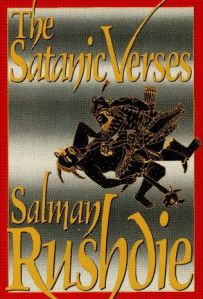
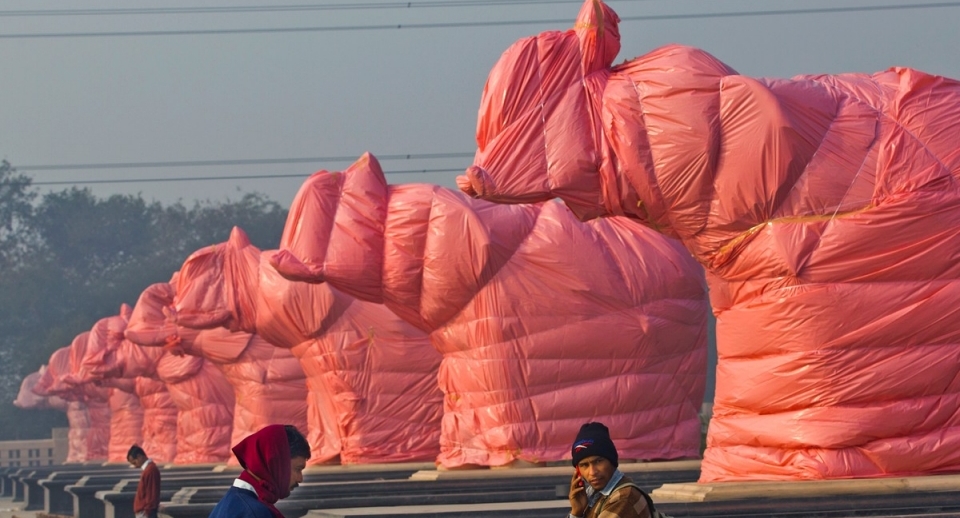
JAIPUR Jan 23: Last week I wrote about elephants that “are not for riding”, explaining how huge stone statues had been shrouded by India’s Election Commission to avoid influencing voters in the state of Uttar Pradesh’s coming assembly polls. This week it is Salman Rushdie’s book, Satanic Verses, that is not for reading at the internationally famous Jaipur Literature Festival, which Rushdie has not attended because, indirectly, of the UP elections.

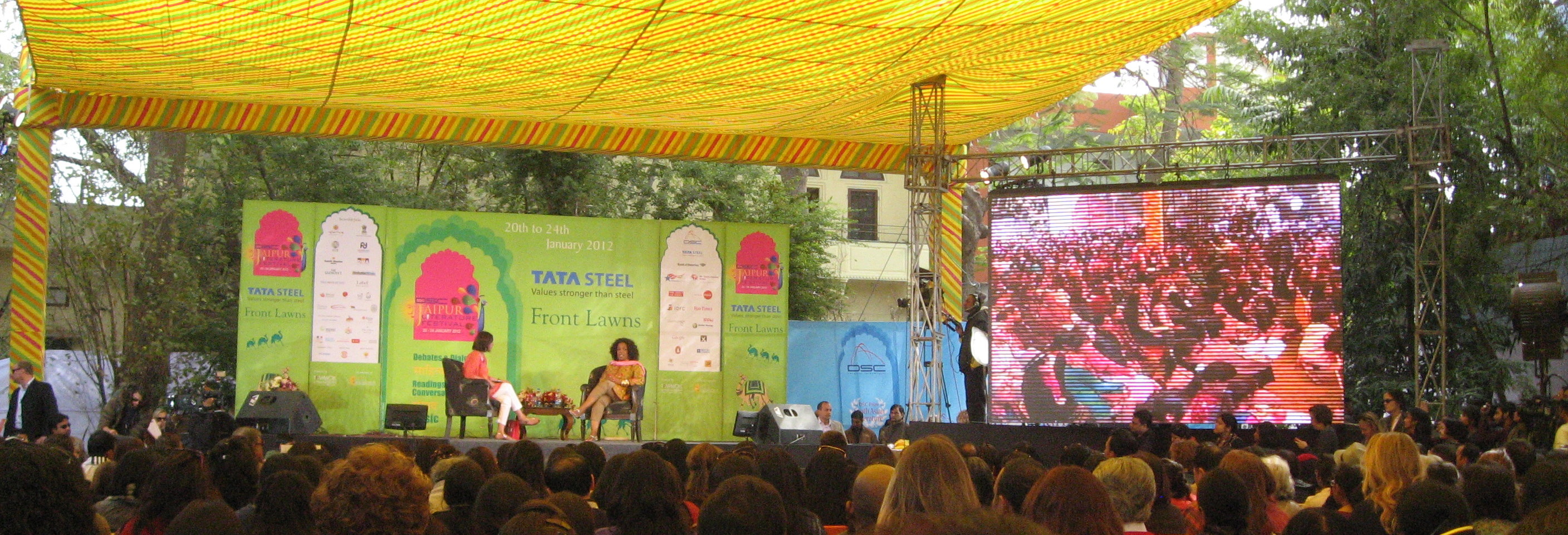
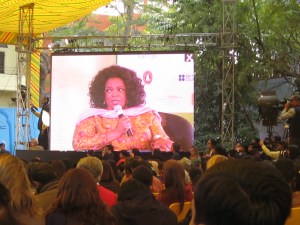
The Jaipur festival is one of the wonders of today’s India, growing haphazardly from a few hundred people in 2006 to one of the world’s biggest such events with 15,000-17,000 new registrations each day, and a total of 120,00 footfalls expected by the time it ends tomorrow evening. Here 260 writers, including many famous Indian and foreign literary names such as (from abroad) Richard Dawkins, Tom Stoppard, David Hare, and Ben Okri – mix with masses of book lovers and schoolchildren, combining often-brainy entertainment with conversations, vibrant music, and minor controversies – and this year with Oprah Winfrey, the American tv personality as a star attraction (above).

But the UP elections have this year invaded the crowded gardens and tents of Diggi Palace, the elegantly faded hotel that hosts the festival, because Rushdie was due to attend. In the past, there have been only minor protests about visits to India by this UK-based Indian author, who had a fatwa issued against him for insulting the prophet Mohammad with his 1988 novel, Satanic Verses that Muslims consider blasphemous. But when Rushdie’s visit this time was announced, it was condemned by an Islamic seminary based in UP, the Darul Uloom Deoband, which called for the visit to be cancelled.

That instantly became big news because Muslims are an important vote bank in UP and therefore need to be wooed by political parties. They could swing the result, which is especially important for the Congress Party whose potential future leader, Rahul Gandhi, is cutting his political teeth on the hustings.

Threats of mass demonstrations against Rushdie were issued by various Islamic organisations, and a reward of one lakh of rupees (Rs100,000 – $2,000) was offered for anyone who managed to throw an insulting slipper at him – Rs125,000 if they spat.

As the festival opened last Friday, police and other security forces – some in uniform and others in easily identifiable plasticky-looking leathery jackets – spread through the festival along with less obvious intelligence officials, and the entrances were closely guarded

Later in the day, after intelligence agencies allegedly reported an assassination threat against him, Rushdie announced that he would not be coming . That calmed nerves, which had been on edge with the organisers fearing mass demonstrations that could ruin the mood of the festival and even lead to injury if they became violent, and plans were prepared for him possibly to appear on a video link tomorrow.

But, within hours, the festival itself was plunged into controversy when four authors read passages, initially mild and then highly contentious, from Satanic Verses. This book is banned in India, which means that it cannot (lawyers tell me) be imported, bought or read in public, so the four authors and the festival organisers could have been instantly arrested and jailed, and the festival could have been closed, even though organisers had stopped the first of the two readings.

Legal action started

The police quickly issued threats of arrest, which remain, and legal complaints were lodged by Muslim groups in Rajasthan courts today against the four authors and the conference organisers.

Two foreign-based authors who read passages – including Hari Kunzru, who is British – have fled to avoid arrest, leaving a furious debate about what has happened.

The conventional view (with which I agree) is that the law is the law. So, if a book is banned, it is not the job of a broad-based literature festival – even though it stands for freedom of speech and expression and may disagree with the ban – to allow speakers to flout the law and thus face the risk of both jail for themselves and others, and the closure the event.

The alternative view is that, having invited Rushdie, the festival should have stood by him, encouraging him to come, and should not have stopped the first of the two Satanic Verses readings (the organisers did not know about the second till it was too late).

David Remnick, an author who was at the festival, has emerged as a focal critic with comments in the Indian media and an article headed A Writer Under Threat in the The New Yorker, which he edits. “Reading Rushdie’s own words seemed like a very necessary act of defiance to me and almost everyone else at the festival,” he wrote – “almost everyone” being I believe an untested, emotional and inaccurate assertion.

Such a view shows little understanding of the complexities of Indian life and the way that religious sensitivities and political ambitions inter-weave, with one cashing in on the other, often violently.

It is easy to defy the law from offices and homes in the US, UK and elsewhere – or during a brief stay in India – but it is neither practical nor sensible for a literature festival like Jaipur to put its future and the safety of thousands of people at risk.

Oprah Winfrey (above) remarked during her star performance yesterday that she had been struck by how, in India, “people don’t talk religion, they just practice it”.

She was of course correct, but the opposite of any statement is often also true in this country, and that is the case here. While a huge majority of the 1.2bn population do indeed practice their religions quietly, there is a  minority that use people’s beliefs to whip up unrest for their own often far-from-religious reasons – as has happened with Rushdie in Jaipur.

Posted by: John Elliott | January 17, 2012

These elephants are not for riding………..

Symbols of empowerment, too powerful for the Election Commissioner

.

These giant stone elephants sitting on their pedestals in a huge park outside Delhi were never for riding, and now they are not even to be seen. Built here and in Uttar Pradesh’s capital city of Lucknow, along with other massive stone and bronze monuments, stupas, and domes (below) at a reported cost of Rs4,500 crore ($1bn), they are designed to glorify Kumari Mayawati, the state’s controversial chief minister and be a symbol of empowerment for her Dalit low caste.

.

India’s Election Commission ordered last week that all the elephants, and statues of Mayawati, should be covered for the duration of the state’s current assembly elections – polling takes place next month. The chief election commissioner, S.Y.Qureshi, said this was done to stop Mayawati’s Bahujan Samaj Party (BSP) gaining “political mileage” from the displays – just, he said, as pictures of political leaders are removed from government offices during polls. Similarly, in 2004, banners carrying pictures of Atal Bihari Vajpayee, then the Bharatiya Janata Party prime minister, were removed during the general election campaign from highways he had commissioned.

.

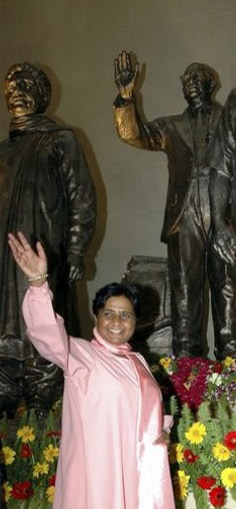
One can see Qureshi’s logic because Mayawati (left, with statues in 2009)  is the chief minister candidate in the elections and the elephant is her party’s symbol. (The fact that this maverick and autocratic politician, who brooks no opposition, obeyed him is a testament to the uniquely independent authority that the Election Commission wields in this unruly country).

But was Qureshi’s instruction sensible, and was it counter-productive? A retired top bureaucrat has told me that it was excessive and unnecessary because the statues were permanent fixtures, not photographs or banners hung on walls or highways. The expensive drama involved in covering them also drew attention to Mayawati, and may have led to sympathy from her supporters – she told them the authorities were discriminating against Dalits.

This is a key election contest. With a population approaching 200m, UP has traditionally been seen as a major factor in which party wins general elections, though that has lessened in recent years with the growth of coalition governments that depend on support from southern regional parties.

This time its state assembly election is in focus because Rahul Gandhi, the as-yet unproven heir-presumptive to the leadership of the Nehru-Gandhi dynasty, and thus to the prime minister’s job, is leading his Congress Party’s election campaign. If he does well and raises the number of Congress seats in the 403-seat assembly from the present 22 to 70-100, he will have succeeded and could be on his way to being the next prime minister quite quickly – if he wants the job, which is not known. If he only manages 40 seats or less, he will have failed. He will still be heir apparent, but will progress more slowly.

There is even speculation that if Congress achieves the higher figure, and maybe wins Punjab, the other most significant state now going to the polls, it might call a snap general election to try to shed debilitating partners in its current national coalition.

.

So the elephants are important, covered or uncovered, and they are also significant as a symbol of Mayawati’s success. She is a Dalit – the “untouchables” in the Indian caste system – and relies on this caste for mass support in elections. But she has done little during her four terms as chief minister to develop the state, especially in rural areas, though she has recently tidied up the city of Lucknow and improved some aspects of law and order.

Her main aim has been to impress her fellow Dalits by building up her own extravagant exclusive image and life-style, and by building the monuments that bring back memories of powerful Mogul rulers’ palaces and forts. With widespread and plausible allegations of massive corruption, she has licensed impressive bribe-clad highway and other projects, including a race track for a very successful grand prix motor race last October.

The statues near Delhi occupy an 80-acre park in Noida, a flourishing satellite city that lies within UP and is also the location for the grand prix track and its associated lucrative real estate developments. In addition to Mayawati, the statues are of Bhim Rao Ambedkar, a revered Dalit leader at the time of India’s independence, and Kanshi Ram who founded the BSP. Ram spotted and coached Mayawati to be not what she has become since his death in 2006, but a constructive leader of the lowest rated in India’s divisive social system.

.

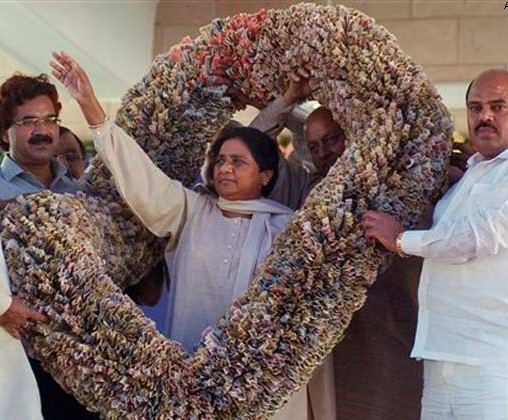
She was 56 on Sunday and had a relatively low-profile birthday. That contrasted with earlier extravagant parties, when Lucknow has been decorated with thousands of lights and Mayawati has worn expensive diamond and gold jewellery, with garlands of big-valuation currency notes, reported to be worth Rs18 lakhs -$40,000 (right – in 2010), and multi-tiered cakes weighing over 50kg.

The question is whether such excesses impress the desperately poor – do they feel empowered by such success of one of their own and say “look what one of us can achieve”, or does it appal them?

Many people throng to the parks on holidays and admire the elephants, enjoying the well maintained open spaces. But will they vote for her, or swing back to her main rival, the Samajwadi Party that ran earlier assembly governments (badly and corruptly)? And will they also give enough votes to the energetic Rahul Gandhi, whose political future will be much easier if he does well in UP? Pundits and opinion pollsters disagree on which way the result will go – we will know in early March.

Mukesh Ambani moves into media – Rajiv Bajaj plans a 4-wheel tuk-tuk

Last year may have been disastrous for politics, as I suggested in my blog last week, but India’s top businessmen weren’t wasting time while the politicians failed to govern effectively. This was shown yesterday when two of the country’s top industrialists, Mukesh Ambani and Rajiv Bajaj made announcements that could be game-changers. Both demonstrate the entrepreneurial drive that makes India a success, despite government failings.

.

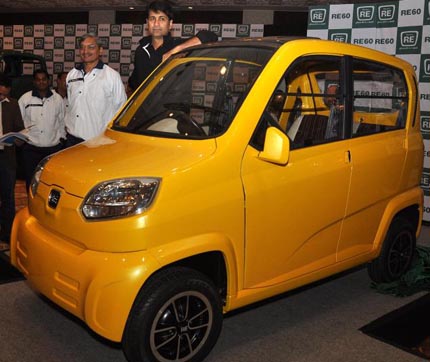
Both initiatives show lateral – or out-of-the-box – thinking. Bajaj (right) unveiled a smart little four-wheeler that side-steps Tata Motors’ over-hyped and small-sales Nano car by providing a new vehicle for auto-rickshaw (tuk-tuk) drivers.

His launch came just before the opening tomorrow of India’s biennial Auto Show which will demonstrate the international success of the country’s auto industry. Perhaps less desirably, it will also show how international manufacturers such as Lamborghini and Aston Martin, as well as older favourites Mercedes and BMW, are rushing into the country to sell unnecessarily large flashy cars to India’s status-conscious emerging middle class.

Ambani, who runs one of India’s two biggest groups, showed that he can still launch deals that catch people by surprise and extend his involvement over vast swathes of India’s economy – despite being hit by various setbacks that led me recently to suggest that his group had lost its sheen.

.

He announced an audacious move into the media business with a complex network of investments reported to be around $350m in the Network 18 television news and entertainment group, one of India’s largest (though currently debt-laden) media empires. The deal links up with another TV company Eenadu (ETV), in which Ambani earlier invested secretly.

This, according to reports, will provide him with preferential content for a new countrywide 4G data broadband network that he is launching later this year. It could also give him a professionally questionable hold over key parts of television news broadcasting. “Is Ambani the next media czar in our highly integrated future of information overdrive?”, the Business Standard asked this morning.

Indeed, the idea of Ambani as a media mogul has become a distinct possibility, adding to his clout within government and his large hold on industries ranging from oil and gas exploration to textiles and polyester. And it is not just one Ambani because Mukesh’s younger brother, Anil, also has media interests that include UTV (Bloomberg TV) and, according to rumours, parts of the India Today magazine-to-tv group. Mukesh Ambani is already believed to have a financial stake in another tv channel, NewsX, and there have been internet reports of  more indirect investments , including ETV.

Not a Nano

 
Bajaj has been working on his very small passenger vehicle for several years. He first told me in October 2007 that his aim was “not to produce a mainstream four wheeler” but something “that takes forward our skills and cost structure as a two and three wheeler manufacturer”. He was then diverted by an on-off liaison with Renault-Nissan into developing a rival to Tata’s Nano, but sensibly gave that up for the sector his company dominates – it is the world’s largest manufacturer of auto-rickshaws, producing 520,000 a year, more than half for export.

.

“Our marketing position is anti-car, we make 2/3/4 wheelers that consume less resources, cause less pollution,” he told me today. He plans to launch the 200cc RE60 within a few months.

That is a smaller market of course than the world’s cheapest car, which was the Nano target. The Nano failed however to take off and only made approaching 100,000 sales in its first two years compared with a 500,000 a year target.

 It was never the “one-lakh (Rs100,000) car” that Ratan Tata, who heads the group, envisaged, and it has few fuel-efficiency or design advantages over its nearest competitors. The branding was also wrong – Tata failed to remember that India’s image-conscious consumers do not buy-cheap but go for cost effective products. He also forgot that most of the families he was trying to rescue from motorbikes and scooters probably do not have parking space for a car, however small.

[[Jan 5: In Delhi for the auto show today, Ratan Tata told journalists that the company had “wasted an early opportunity” on the Nano, and added: “Whatever stigma is attached to the Nano, we will undo it….The basic concept is robust. This is not a ‘poor man’s car’. We have upgraded on the basis of market feedback. I believe we will see a resurrection of this product as we move forward.”]]

Tata is now repositioning the Nano (above, a CNG Concept version at the current auto show) as a smart almost iconic tiny car, both in India and abroad, and this is beginning to yield sales. Meanwhile Bajaj is providing something more socially useful – a four-wheeler mini-taxi to replace the tuk-tuk. The social significance of the Ambani move into tv and media has yet to emerge.

Posted by: John Elliott | December 30, 2011

A fitting end to a disastrous year in Indian politics

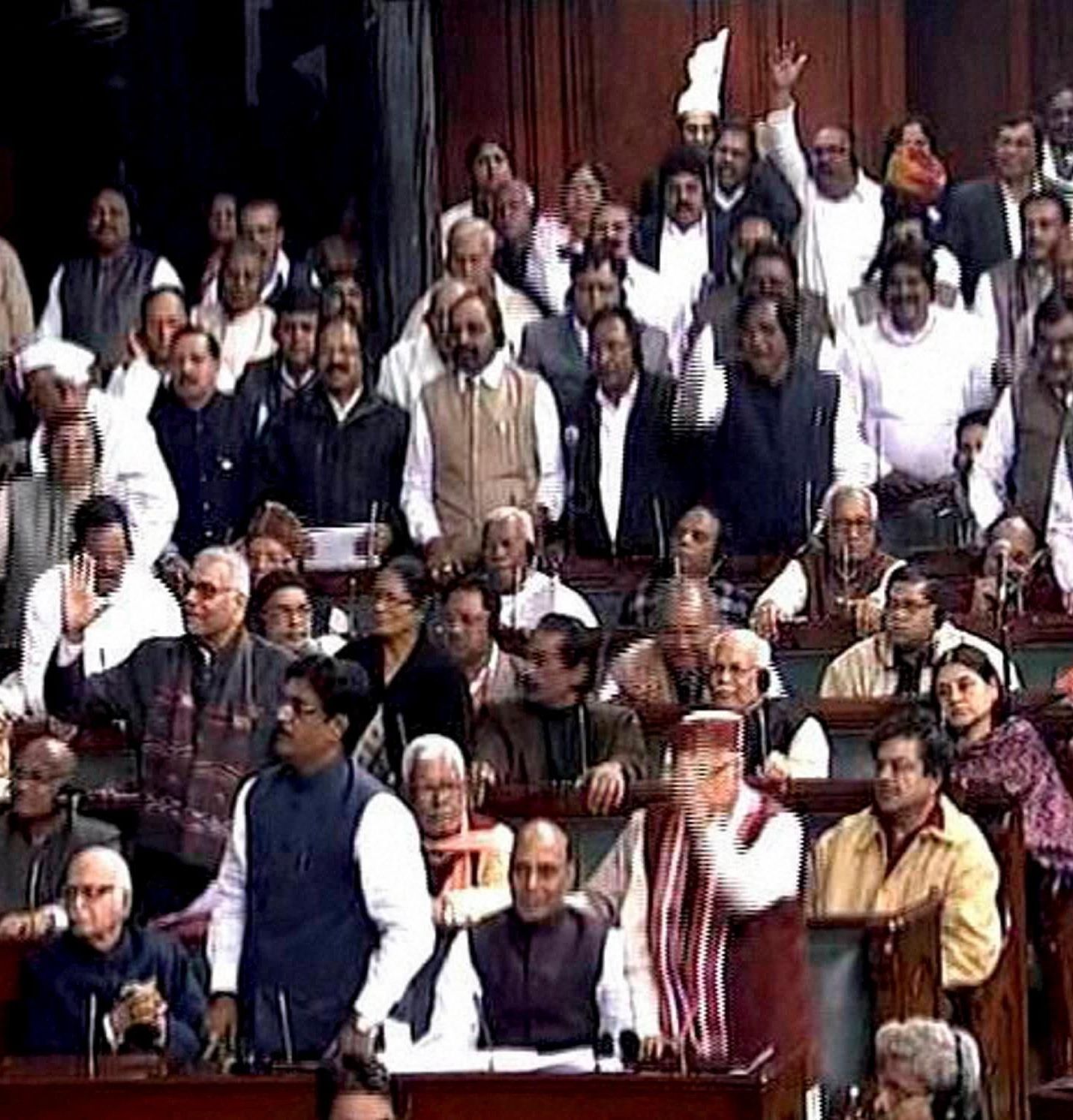
It was a fitting end to a disastrous year for corruption-ridden India’s floundering government, destructive parliamentary opposition, and self-serving politicians. At midnight last night, amid almost unbelievable scenes of chaos and uproar, legislation to introduce an anti-corruption Lok Pal (ombudsman) stalled in parliament with MPs on all sides shouting and screaming at each other about whether and when to vote on over 180 amendments.

This was just the latest of a series of examples this year of how coalition leader Sonia Gandhi and prime minister Manmohan Singh are unable to run an effective government. The examples range from their slow handling of corruption scandals, to their clumsy attempts to deal with a mass anti-corruption movement, and their failure to reinvigorate the country’s flagging economy, declining international image, and faltering business confidence.

The parliamentary opposition has made matters worse. Scenting blood with a stream of corruption allegations against leading members of the government, it has been in destruction mode – maybe thinking it can force an early general election (though it is itself in no fit shape to fight one). 

Consequently, India now has a coalition government that cannot govern, partly because of its own internal failings and contradictions, and partly because of a vicious opposition that has no new coherent policies of its own but wants power.

Making matters worse, are regional parties in the Congress-led coalition that have little interest in the nation as a whole – the worst offenders being Mamata Banerjee’s Trinamool Congress in West Bengal that is focussed primarily on demonstrating her own personal power, and Tamil Nadu’s discredited DMK party that has focussed on accumulating illicit wealth for its ruling regional dynasty. (Banerjee joined the opposition in disrupting the Lok Pal Bill last night, and the DMK has been the prime mover in this year’s devastating telecommunications corruption scandals.)

.

MPs are no doubt content today with their behaviour last night (right). Firstly, as has happened repeatedly since the 1960s, they have successfully avoided introducing a Lok Pal which could have impeded the extortion and fraud that run from their own offices and homes right through the economy and society. (Parliament is now in recess till the Budget session starts late in February or early March, when the government says it will re-present the Bill).

Secondly, they have plenty of ammunition to use in campaigns for five state assembly elections that take place in the next two months – both sides can claim that the other has shown is not interested in stemming corruption because it prevented an effective Lok Pal being introduced, and also stalled two other anti-corruption bills on judicial accountability and protection for whistleblowers.

The idea of a Lok Pal is far from simple. Action is certainly needed to stem corruption, and that needs effective independent investigation that does not currently exist, but it is arguable whether a Lok Pal ombudsman is the right answer. If the ombudsman and supporting bureaucracy is as strong and independent as Anna Hazare, the anti-corruption campaigner, would like, it could seriously undermine the authority of the prime minister and the entire government machine with devastating corruption investigations and accusations. But if it is as soft as the version that was being debated in parliament this week, it could have little effect. Either way it is highly likely that it would itself become corrupted – as Amitabha Pande, a retired senior bureaucrat, argues (click here).

But India likes debating symbols and creating icons rather than facing reality, and the Lok Pal has become an iconic symbol of a fight against corruption that few have wanted to wage.

The good news this year however is that the “few” are becoming more numerous, especially among the young and the middle classes, who have demonstrated during mass protests this year that change is needed. This pushed the government into preparing and tabling the Lok Pal Bill against deadlines dictated by Hazare.

Politicians of course hope that this groundswell of protest will die away, as such movements usually do in the tumult  and contradictions of Indian society. The government was wrong on that however when Hazare-led fasts and demonstrations in April (picture below) were replicated across the country in August. It has been gambling again this week that Hazare’s civil society movement is losing support, as seemed to be happening when he moved his latest fast and mass meeting from the winter cold of Delhi to warmer Mumbai and then faced health problems. But last night’s fiasco gives him the platform he needs for fresh protests during the state election campaigns, and then in Delhi when the weather becomes warmer.

.

What is clear is that something needs to change in 2012. India cannot repeat 2011 without doing serious damage to its economy and fabric of society. The exposure of corruption ranging from the telecommunications scandal, which reaches to top government ministers and the prime ministers office, to the 2010 Commonwealth Games graft that is rumoured to reach even further, plus mining scandals in many states, shows how deeply ingrained extortion and greed is in politics, government and business.

These exposures are of course good and necessary, but they have had a negative impact on government decision-making at a time when new right-to-information laws are revealing details of confidential government decision-making years after decisions have been taken. That has made bureaucrats and politicians scared to sign off on projects and policies, and has almost halted decision making from top-level to minor decisions in many areas.

That in turn has had a negative impact on the economy and has led many industrialists to complain about ineffective government.  Businessmen were also upset earlier this year when Jairam Ramesh, then the reforming environment minister, blocked projects that often corruptly flouted environmental rules. That led industry to exacerbate a declining investment climate by claiming Ramesh’s actions were driving them to invest abroad. Ramesh has now been moved and businessmen are instead complaining, quite rightly, that the government needs to do more to boost the economy.

The government has focussed on iconic policies such as foreign investment in supermarkets, which ministers unwisely and falsely built up as a major economic boost last month and then failed to implement (partly because of Mamata Banerjee tantrums.) Significantly, while pursuing such diversions, and dealing with the growing Lok Pal crisis, ministers have been paying insufficient top-level attention to issues that could cripple the economy such as, for example, drastic power shortages that are being exacerbated by insufficient coal supplies.

General election logic

In all this, Manmohan Singh has seemed to be able to exert little prime ministerial authority, except possibly in foreign affairs. Sonia Gandhi has suffered from ill health and was in the US during August for a rumoured cancer operation. It is still not known how well or ill she is, though she is now back at work at the head of the coalition. Much now depends on how successful her son and heir, Rahul Gandhi, is in the Uttar Pradesh (UP) assembly election which takes place in February. He is staking his political reputation on boosting the Congress Party’s currently small role in the state and, if he does well, is expected to play a bigger role nationally.

If Congress were to build a sizeable position in UP, it should then logically call a quick general election to try to boost its numbers in the Lok Sabha (lower house) and thus have to rely less on unpredictable coalition partners. But MPs hate having to risk losing their lucrative seats before the due date (2014), so that is a political gamble that it is unlikely to happen.

If an election were called however, it could pave the way for a more coherent and stronger government than the one that is now failing to govern India.

India has a government that cannot govern

Dec 30: Once again, as has happened many times since the 1960s, politicians have blocked the introduction of a Lok Pal anti-corruption ombudsman.

The Lok Pal Bill floundered at midnight last night when a day-long debate in Parliament’s Rajya Sabha (upper house) ended in chaos and uproar as MPs on all sides shouted and argued about what to do with 180 amendments that had been tabled.

The Congress-led coalition government is being accused of orchestrating the chaos to stop voting taking place, fearing defeat on key issues such as government on control of the CBI and the impact on states (see below) because it does not have a majority in the Rajya Sabha.  The Bharatiya Janata Party-led opposition is accused of scuppering the legislation by proposing amendments unacceptable to the government. Parliament is now in recess till the Budget session starts in late February or early March, when the government says it will re-present the Bill after studying the amendments.

Last night’s debacle showed, once again, that India currently has a government that cannot govern.

__________________________________________________________________________

Dec 28: It’s always best in India, when assessing events, to turn them upside down and see what they then look like, rather than accepting them at face value. So applying that test to headlines that dominated this morning’s newspapers, do politicians really intend to make sure that the Lok Pal (anti-corruption ombudsman) legalisation currently passing through Parliament actually does curb extortion and fraud, and do Mukesh and Anil Ambani, who control rival business both carrying the Reliance name tag, really intend to become friends after a high profile family love-in yesterday?

It would be good if both events were for real, and were not just manoeuvres aimed at quite different goals. India desperately needs governments at both the national and state level that seriously try to curb endemic corruption, and both India and the Ambani family would benefit if the brothers, who head two of the country’s largest conglomerates, co-operated.

Anil (left) and Mukesh Ambani

It seems likely however that the Congress Party, which heads the governing coalition, is more  interested in improving its overall anti-corruption image and in boosting the number of seats that it can win in February’s key Uttar Pradesh state elections than in tackling graft.

The Ambani brothers (left), especially Anil, undoubtedly hope that the pictures of a colourful family get-together yesterday will improve the numbers on their stock prices, their banking viability and, ultimately, their bottom lines, as well as protecting their fading image.

The Lok Pal legislation was passed by the Lok Sabha (lower house of parliament) late last night and will be debated – after extensive politicking today – in the Rajya Sabha (upper house) tomorrow where it could still be defeated by opposition parties. It has been on governments’ legislative agendas since the late 1960s, but has been constantly delayed by objections from MPs and others who feared they would be subject to ombudsman investigations.

.

The government has been forced to introduce the legislation now by a mass campaign led by Anna Hazare (right), a populist Mahatma Gandhi look-alike, who has built up the pressure with massive middle-class support since April when he staged a fast in Delhi.

Hazare has humiliated the government into a rare frenzy of activity and concessions, but virtually all politicians still want to curtail and control its independence and impact, and there are also genuine concerns about a loss of parliamentary authority.

Consequently, Hazare and his team of social activists and hangers-on have not won all that they have wanted – for example the extent of the Lok Pal’s investigatory powers and its authority over the prime minister and the Central Bureau of Investigation (CBI), and coverage of companies. Now there are demands from opposition leaders and individual states that the requirements for state level ombudsmen (Lokayukta) should not be binding.

Hazare’s campaign seems to be losing its impact now that parliament is debating legislation. A rally and fast in Mumbai has been abandoned today along with other planned protests, and 74-year old Hazare’s health is not good. This switches the focus to the government and how it introduces the Lok Pal (assuming it gets through parliament tomorrow) and backs it up with other anti-corruption measures. Many critics – in addition to questioning the government’s real commitment – fear that the Lok Pal will merely become another overstaffed and cumbersome part of a basically corrupt bureaucracy.  

.

As for the Ambanis’ love-in, there is heavy scepticism about how genuine and far-reaching this morning’s news really is. The brothers fell out after the death in 2002 of their father, Dhirubhai, who had founded the textiles to oil and telecoms group. They split the business in 2005, and then signed a peace pact last year after a bitter public fight. Since then Mukesh Ambani’s RIL group, though one of the two biggest in the country, has lost its aura of invincibility – and its shares have fallen nearly 30% over the past year. Anil Ambani’s ADAG group has built up massive debt and other problems, mainly in its telecom businesses which have some $6.5bn debt – an unsustainable figure – and its share prices have halved, though there has been some recovery in recent days on speculation of the better relations.

Both groups are the subject of official inquiries into business practices and the Ambani and Reliance names are losing their sheen. So a make-over is needed, especially by Anil Ambani. The Economic Times, which is renowned for displaying stories that please corporate friends, triggered that when it splashed the family’s party across its front page this morning, headlined Ambani Family Drama ends with Dandiya (folk dance). There were more pictures inside the paper, one of which showed the brothers talking to each other.

The party (above) took place in the family’s original Gujarat home town on the eve of Dhirubhai Ambani’s 80th birth anniversary today. The family usually get together on the anniversary but this event was carefully orchestrated and even choreographed. It started with Dhirubhai’s widow, Kokilaben, who has tried since her husband’s death to minimise the conflict between her sons and encourage them to co-operate, making an  unprecedented television statement on Monday night . She said that there is still “love among the brothers” and that her family were “all united”.

It has been known for some months that the brothers have been liaising on how to handle negative publicity and events. There has also been extensive speculation, which is widely believed to be correct, that Mukesh Ambani, who is building up an internet telecoms business, is negotiating to use telecom transmission towers belonging to his brother’s business, instead of hiring facilities from other companies. There are also reports that Carlyle and Blackstone, two US private equity groups, might buy into the towers business – presumably as part of a deal that could include Mukesh Ambani. But I have not found anyone in Mumbai who expects deals between the two men to go much further.

So, as with the Lok Pal legislation, one should not expect too much from the Ambani’s party publicity splurge that continued on television this evening. However, as with all families, it is good when the warring stops, and that does seem to have happened – just as it is good when the need to attack corruption becomes a national issue, even if governments are loath to act.

Posted by: John Elliott | December 24, 2011

Merry Christmas!

Merry Christmas to all of you who have come Riding the Elephant in the past year. Have a great holiday weekend and come back soon – Cheers  John

.


India hasn’t known quite how to mark the first centenary this week of the founding of its modern capital city, Delhi, by Britain’s King George V in 1911. Though many of the country’s elite continue to polish their English accents, and relish their links with long-dethroned maharajas and lesser royal families, it is not quite politically correct to celebrate things done by former colonial masters.

So, after much debate (while British High Commission diplomats kept their heads well below the parapet), it was eventually decided earlier this year to celebrate the historical “re-emergence” 100 years ago of Delhi as the capital – a sly dig at the British who had earlier moved the capital from Delhi to Calcutta in the late 18th century.

Yesterday morning I drove to the north-eastern outskirts of the capital and found 200 or so labourers shifting earth and chipping stone walkways to turn that “re-emergence” into new ornamental gardens.

They were working at Coronation Park, where statues of King George (above and below) and other dignitaries were dumped on brick plinths in the 1960s by a government that was unsure what to do with these embarrassing relics of a not-so-distant past – totalitarian regimes such as the Soviet Union and China (plus the US in Iraq) demolish such statues, but the world’s largest democracy was more self-consciously caring. (King George had previously stood under a canopy at India Gate on central Delhi’s grand Raj Path).

King George’s statue, and a ceremonial column with a plaque (right) that he unveiled in 1911 to mark his coronation a few months earlier, will be the notable features along with four other remaining British statues.

“How does it matter – it’s history,” says A.G.Krishna Menon, who heads the Delhi branch of INTACH, a conservation organisation that is running the work with Delhi authorities. “It doesn’t matter if it was the Moguls or the British. We are interested in conserving history and we can’t not do it just because it’s King George the Fifth”.

There have been no celebrations at Coronation Park this week, but events in the past few days have included receptions to launch a splendid book, Delhi – Red Fort to Raisina, published by Roli Books, and an associated exhibition. The book includes a wide range of photographs (see durbar below) of old Shahjahanabad, now known as old Delhi, mostly assembled by J.P.Losty of the British Library with essays by Salman Khurshid, a lawyer and writer who is currently India’s law minister, and others. There has also been an exhibition and music evening at the Indian Council of Cultural Relations and a grand maharajah’s dinner, appropriately in Delhi’s Imperial Hotel. More events are planned during the coning year.

The forsaken Coronation Park location was apt – not only was it largely hidden from view, but it was also the site of three imperial British durbars. The third of these huge celebrations of colonial pomp and power was the one in December 1911 when King George visited the country with his wife Queen Mary to mark his coronation a few months earlier. Addressing some 100,000 spectators of varying grandeur, he announced the new capital that was eventually built in the 1920s and 1930s some 15kms south in what is now New Delhi.

While Delhi was growing into a conurbation of approaching 20m people, grass grew around the crumbling imperial monuments, encircled (as I discovered when I last went there a decade or so ago) by a wall and rusty gate with a padlock that a bored attendant would sometimes open to curious (usually British) visitors. Several statues vanished, leaving topless plinths that added to the desolate symbolism. Some of the statues went I am told to welcoming destinations in the UK, Ireland and Australia – Rufus Daniel Isaacs, the 1st Marquis of Reading and a Viceroy of India in the 1920s, now stands in the English town of Reading.

the 1877 Delhi durbar

Conservators have sometimes tried to renovate the Coronation Park site. An attempt in 2007 was stopped because it was the 150th anniversary of what the British called the Indian Mutiny but is now seen as the First War of Independence, when the British demolished significant parts of Shahjahanabad near the Red Fort. Eventually Delhi authorities agreed that the park should be renovated and expanded, and that is what is now happening (below), with the main part due for completion next August.

The Delhi of today is a city of immigrants. Hindus and Sikhs who fled from Pakistan after independence in 1947 and turned it into a major business centre as well as a seat of government. Now it is home of millions who throng here for work, especially from the poorer states of Bihar and Uttar Pradesh, as well as multi-national companies and others that have helped build the chaotic under-resourced satellite city of Gurgaon and the neater satellite of Noida.

It is a city of energy, vibrancy, resourcefulness and skills – all more evident in old Delhi than the wide and elegant but rather anti-social avenues of the 20th century city. And it has a rapidly growing and efficient metro railway. But there is also worsening pollution, corruption, illegally dangerous buildings, poverty and the brash selfishness of the newly rich. Last year’s Commonwealth Games were a low point on many counts – prompting politicians and others to call this week for a renewal of the city’s values and pride.

But though often condemned by its residents, with the best-off usually saying they would prefer to live somewhere else, it is a place that people always come to with hopes and dreams. That has probably applied to all the eight (some historians say nine) cities that have been built here since it became the first capital of Muslim India in 1193 (plus an earlier one dating back to 5000 BC).

Soon King George V will be able to survey this vast mosaic from his restored lofty perch in Coronation Park (below), saved from the rubbish heap by conservationists’ sense of the city’s history.

Does India have too much democracy and would it be better off with less? The question is inevitably raised whenever comparisons are made with China, where totalitarian rule has enabled dramatically faster and more efficient economic growth and development than has been possible in India since the two countries began to liberalise controls 20 years or so ago.

Alongside that, does India have a strong enough political leadership, and does the current Sonia Gandhi – Manmohan Singh (below) split between party affairs and government work? The answer of course is “no” to the last two points, whereas the democracy point is debatable.

The past few days have been a good time to revisit such topics because of the petty politics, democratic chaos and official mismanagement surrounding the Indian government’s attempts (postponed indefinitely on Dec 7 ) to open up supermarkets to foreign direct investment (FDI). Opposition to the FDI has led to parliament being inoperative for two weeks (I wrote about this on December 1).

That has coincided with a visit to Delhi by one of Asia’s most effective critics of too much democracy, Mahathir Bin Mohamad, Malaysia’s former prime minister.

.

Mahathir (left), now 86, ran Malaysia for 22 years from 1981 till 2003, accumulating power at the expense of both individual freedoms and an independent judiciary and media. But he nevertheless maintained the semblance of democracy, winning five general elections, and he won acclaim for building his country into a strong and successful economy, and for bucking some of the demands and advice thrown at developing countries by the West.

“Sometimes democracy can paralyse decision-making because people oppose for the sake of opposition,” Mahathir told a Hindustan Times conference in Delhi last Friday, hitting the spot at a time when the government’s fractious coalition partners, especially Mamata Banerjee, chief minister of West Bengal, have been playing political games over the FDI plan.

“Democracy is the best form of government mankind has ever invented but it is important for the world to understand its limitations. India could be China if it were not for too much domestic politics and abuse of freedoms to protest and argue at will,” said Mahathir.

That is undoubtedly correct. India’s combination of noisy fractious democracy, plus its coalition governments and mostly pliable media, spells disaster for reforms that challenge vested interests, whether those interests are the rural poor rightly trying to protect their livelihoods or rich businessmen trying to protect their often illicit sources of wealth. Add widespread corruption to that mix and the result is often negative.

.

This contrasts sharply with Mahathir’s Malaysia where corruption got things done – a friend who did business in Malaysia in those years quickly found that success came by hiring a close Mahathir relation as an agent. A construction industry friend who was used to paying just once in Malaysia, laughed at problems his counterparts had in India. In such a democracy, he said, one should make staged payments as a project progressed, always keeping something in the kitty for new demands from the ever-changing ranks of politicians and officials.

So Mahathir’s truncated democracy was much more effective, as is China’s undemocratic authoritarian system. But India lacks something else that Malaysia also had, namely strong political leadership to manage the problems arising from the pushes and pulls of democracy

Communist-style governance

This was raised at the Hindustan Times conference by L.K.Advani (below), 84-year old leader of India’s main opposition, the Bharatiya Janata Party (BJP). Scoring a neat political point, he suggested that Manmohan Singh was a weak prime minister. He was, said Advani, “not able to exercise all the authority of a prime minister” because of his “acceptance of a communist model of governance, namely where it is the party chief who is more important than the prime minister”.

.

He mischievously likened that to the way he had been told to give precedence to the Soviet Union’s Communist Party chief Nikita Khrushchev rather than premier Nikolai Bulganin when the two leaders visited India in 1955. “I was surprised to hear this,” he said.

Advani then criticised Sonia Gandhi’s style, saying: “In a democracy you cannot have as number one a person who people do not know”.

Anand Sharma, the minister for commerce and industry, who is responsible for the retail FDI policy, has explained Sonia Gandhi’s behind-the-scenes role. Speaking in television interviews over the past few days. he has said that she does not interfere in the detailed running of the government but does let her views be known, and those views are then followed.

That however is not leadership, and it is not an effective way of running a government. Neither Gandhi nor Singh are natural leaders. The former likes to lead from behind while the latter believes it is neither his job nor wise to lead from the front. Singh has broken out just once – on India’s nuclear deal with the US three years ago, where he led from the front with Gandhi’s support. On retail FDI, he has tried the same tactic but Gandhi has not yet fallen in with him, mainly I guess because she has some sympathy with the view that it might not be good for poor farmers, and partly because she thinks the policy might have to be abandoned or at least shelved.

So given that there is no chance of India abandoning democracy, nor of accepting a Mahathir version, it is to Advani’s remarks that one has to turn for a solution to the current muddle.

The Gandhi-Singh duo is not working. India’s coalition government desperately needs a strong and able political leader. Until it has one, the worst effects of democracy will continue to prevent the country being run effectively.

Posted by: John Elliott | December 1, 2011

Wal-Mart & Co fuel Indian political crisis

Wal-Mart & Co won’t have India supermarkets any time soon.

December 7: This morning, after opposition protests stopped parliament operating for two weeks, the government announced that the FDI plans are “suspended” till a “consensus” is reached by all political parties and state chief ministers. This surely means that it will not be introduced before the next general election – which is not due till 2014, but arguably should be much earlier, given the government’s appalling record.  

See later blog post – Is India’s problem too much democracy or a Soviet-style prime minister? wp.me/pieST-1ve

_________________________________________________________________________

Dec 1: I’ve never understood why India wants international supermarket chains like Wal-Mart (especially) and Tesco to trample across the country, supposedly providing consumers with a good deal while actually giving a far from good deal to employees and to farmers and other suppliers. But I guess one has to be relieved that the Indian government has at last come to a decision, after over 15 years of being pushed around by vested-interest opposition from existing retailers, traders and other distribution middle-men, plus leftist political parties, and relentless pressure to open up from the US and elsewhere.

.

The decision to allow foreign direct investment (FDI) in supermarkets was however suddenly announced last week in such a cack-handed way – and at the start of the winter session of parliament – that it has caused a major political crisis. It is one of the very few major policy changes introduced by the government since the 2009 general election, and the crisis could easily have been avoided by waiting till the end of the month when the parliamentary session will be over. Instead, it has prevented parliament doing any business for eight of its 21-day winter session. Today there has been a nation-wide protest strike by retailers and wholesalers.
 
The reaction has been so strong that, taken together with the avoidable freezing of parliament’s business,  many politicians and commentators are suggesting that the government’s cack-handedness was intentional. They say it was at least partially aimed at deflecting attention from other crises and at preventing contentious anti-corruption Lok Pal legislation being debated quickly in parliament.
 
The protests have been basically driven by the Bharatiya Janata Party-led opposition that wants to seize on any issue to undermine the beleaguered Congress-led government’s weak leadership and fractured unity – especially ahead of state assembly elections next year. Conveniently, the BJP is also pandering to politically important traders’ and small shopkeepers’ lobbies that oppose retail FDI (though the party did briefly back the idea a few years ago) and which will be important in the state elections, especially in Uttar Pradesh.
 
The real fears however should stem from Wal-Mart’s appalling international record of treating suppliers harshly and employees shabbily. The latest opposition to its worldwide ambitions came in South Africa a few weeks ago, and there are frequent campaigns elsewhere against its expansion. Tesco is only a few shades better and its expansion around the UK is constantly opposed.

Any idea that Wal-Mart will treat farmers enormously better than the often crooked and corrupt traders and middlemen that they have to deal with currently is far-fetched, as are government claims that the advent of foreign investment will rapidly create jobs and bring down prices, helping to curb India’s currently high rate of inflation.

Contract farming

Experience has shown that farmers have problems with the bulk buying and contract farming that Wal-Mart and others will want because they find it difficult to sell below-standard produce that is rejected by their primary buyers. Anand Sharma, the commerce minister, was last week quoted saying 10m jobs would be created over three years, which is frankly ludicrous (maybe he was misquoted!). It will take three years at least for FDI to make any real impact on jobs and prices and it could be far longer, given regulatory and other hurdles that companies would have to tackle.

The retail sector’s restrictions on foreign investment began in 1997, six years after the start of India’s general economic liberalisation. It currently remains one of the most controlled areas, along with defence manufacturing and insurance. The 1997 change allowed 100% FDI in cash and carry (wholesale) stores, thereby effectively banning it from the rest of the sector. Almost a decade later, in 2006, it was allowed up to 51% for single-brand retail shops such as upmarket luxury brands (which had already been working as franchises), and that also facilitated Marks & Spencer. Multi-brand retail however was blocked to prevent FDI in supermarkets that sell farm produce.

.

By the mid-2000s, India’s general consumer market was opening up and Indian businesses, led by Mukesh Ambani’s Reliance Industries (RIL) and by Kishore Biyani’s Future Group (Pantaloon stores), started developing supermarket chains and other retail outlets.

Fearing they were losing opportunities to enter India, foreign multi-brand supermarkets began to move in. Wal-Mart joined up with the Bharti group (which was diversifying from telecoms) and Tesco went with the Tata group, in both cases restricted to wholesale cash-and-carry stores that could provide Bharti and Tata shops with supplies.

But this was not enough for companies like Wal-Mart, Tesco – and Carrefour that has tiptoed into India (the opening of its second wholesale store – above – in Jaipur, was disrupted by demonstrations and a fire earlier this week). Such companies have continued to pressure the Indian government, backed by the US government and international agencies, and that led to last week’s decision to allow 51% FDI in multi-brand supermarkets and 100% in single-brand outlets.

So the question to be asked it why, if big Indian groups like Reliance, plus Wal-Mart and others from abroad, were expanding in what is known as the (wholesale) back-end, is it necessary to open the (retail) front-end up to FDI? The answer is that no Indian company has the will to tackle the politically-ridden areas of farming, produce trading and distribution – Reliance was driven out of some of its early attempts, and Bharti abandoned a farm-to-fork enterprise (which I wrote about in Fortune magazine over-optimistically in 2006).

It is the back end that urgently needs to be developed because India has few freezer-based chains and the other logistics needed to carry farm and other goods – over 40% of produce sent from farms to urban areas is wasted, which is appalling for a country that is the world’s second largest producer of fruit and vegetables. Reliance has done relatively little, as has multi-national Hindustan Unilever and other possible candidates.

Reluctant to invest

Wal-Mart and Tesco meanwhile have not wanted to commit heavy investment because they have not been able to invest in front-end retail shops, where the profits are, and because there have not been enough shops to justify a supply chain. The government hopes that the 51% FDI limit in retail and 100% in wholesale will give sufficient incentive for foreign companies to invest heavily, building the linkages that India undoubtedly needs, and maybe spurring Indian groups to do more.

In order to try to appease the opposition, the government is limiting the concessions to the 53 largest cities that have populations of over 1m. It will then be up to individual states to decide whether they want to allow the stores, and to draw up planning and other regulations restricting their operations. At least 30% of goods will also have to be sourced from Indian small firms (last week the announcement omitted the word “Indian”, which raised the spectre of supermarkets being swamped with cheap Chinese manufactured goods).

These safeguards look sufficient to limit the impact that the foreign firms might have, and they answer my original point of not knowing why India wants to let Wal-Mart trample across the country. India undoubtedly needs to smarten up its appalling logistics and farm-to-fork distribution, and tackle the mafia of middlemen and traders. Wal-Mart however has such an appalling international image that it is arouses instant opposition and makes it easy – and understandable – for those who want to block progress.

As I write, it remains to be seen whether prime minister Manmohan Singh will ride out this crisis and enforce the new policy, or whether he will be forced to shelve the plans by his Congress Party, led by Sonia Gandhi and her son Rahul Gandhi whose reputation hangs on the coming Uttar Pradesh state elections. Neither Gandhi has yet spoken in favour of the FDI.

Posted by: John Elliott | November 24, 2011

Dynastic shift at Tata keeps the clan intact

Watch out Rahul Gandhi! Yesterday’s news that Noel Tata, a reticent low-key member of the Tata family, will not be the next head of India’s biggest and most respected business group shows that reluctant dynastic heirs do not always win by default. Gandhi of course is showing less reluctance now that he is wading into Uttar Pradesh’s coming state election campaign, but he is still an uncertain heir and questions are being raised about the wisdom of his dynastic succession at the top of the Congress Party – most recently by an international magazine, The Economist.

Gandhi has the advantage that he is backed by Congress’s current president, Sonia Gandhi, his mother, whereas Noel Tata was not backed by Ratan Tata, his half-brother who retires as chairman of Tata Sons at the end of next year. Ratan has said publicly that Noel, 54, who heads some of the group’s retail and other businesses and till yesterday evening was the seen as the front-runner, was not ready for the job.

Instead of Noel Tata, it is Cyrus Mistry, a 43-year old businessman, who is to take over from Ratan Tata at the end of next year. This does however keep the job within what is a complex extended Parsi family. Mistry (left) belongs to the Pallonji family and Noel is married to his sister.

He and his elder brother Shapoor are, with their reclusive father Pallonji Mistry, the largest single shareholders (with a combined 18% stake) in Tata Sons. The Tatas’ personal equity stake is small, though philanthropic Tata trusts hold some 66% of the group.

Mistry was yesterday appointed deputy chairman of Tata Sons. He will work alongside Ratan Tata, 73, heading a group that has a combined market capitalisation of nearly $80bn with 425,000  employees and revenues of $83.3bn covering businesses in India and abroad that range from tea, salt and hotels to steel, telecoms, autos and missiles. He graduated in civil engineering from London’s Imperial College and went on to the London Business School.

His appointment has been publicly welcomed by India’s business fraternity, with people who know him talking about his intelligence and good strategic judgement, though there were some private criticisms and also inevitable queries about his ability (as there once were about Ratan Tata). He was originally on the five-man committee set up last year to select Ratan Tata’s successor, so there will be questions about how  he came to get the job himself once other candidates had been put aside. There will also be questions about how the direct influence of his family on Tata companies will play out.

Presumably, Mumbai speculation suggests, his family saw the problem the committee was having finding a successor, especially given Tata’s (unexplained) lack of enthusiasm for Noel Tata (left), and decided to seize the opportunity to capitalise on its majority shareholding, shifting the dynasty from the Tata name to Palonji-Mistry. If Ratan Tata had backed Noel, it might have been difficult for Mistry, as Noel’s brother-in-law, to object and a Tata would have remained in charge.

Reports suggest that Ratan Tata respects Mistry’s business acumen, and there is also the advantage of his relatively young age. Mistry is currently managing director of the construction part of the Shapoorji Pallonji group, named after his grandfather who founded the business nearly 150 years ago. With revenues of some $2bn a year, which he has built up, it has been responsible for major projects in India and the Middle East and Africa. This means Mistry has been exposed to the ways of one of India’s rougher industries, though maybe not so much as his elder brother Shapoor, whose responsibilities include real estate. Both brothers are directors of various Tata companies, and Cyrus Mistry has been on the Tata Sons board since 2006.

Cyrus Mistry will therefore have useful experience for steering the Tata group’s basically clean reputation. This possibly gives him an advantage over Ratan Tata, who has always seemed uncomfortable with the complexities of political and corporate corruption that has grown enormously in India during the 20 years he has headed the group. “I can say, with my hand to my heart, that we have not in fact partaken in any clandestine activity,” Tata said two months ago when being questioned about his group’s involvement in India’s far-reaching telecoms scandal.  “I think there are many honest businessmen. There are many that bend. I am happy that I have not bent”.

So while the direct line of the Tata dynasty is being broken after three generations, control of the group stays within the extended Tata-Pallonji family and thus within the fold of the Parsi community and (Zoroastrian) religion.

Ratan Tata (right) will probably continue to head some of the Tata trusts, building up their charitable work, and non-family members might become chairpersons of major companies like Tata Motors and Tata Steel that are currently headed by Ratan Tata.

This looks a sound way to cover both dynastic succession within the clan, and shareholder power, bringing in a young executive who can gradually assert his authority, as Tata has done.

And the lesson for Rahul Gandhi? Start performing like the national leader India desperately needs. As The Economist put it, “the consequence of being in thrall to a bloodline is a weak party that lacks shared policies or common values”. Tata, which is far from weak, has managed its succession after some debate about admitting outsiders. Are Congress and the Gandhis strong and self-confident enough to do the same, should their heir apparent remain reluctant?

« Newer Posts - Older Posts »

Categories