Posted by: John Elliott | November 23, 2011

Topical ‘miniatures’ from Merseyside’s Singh Twins

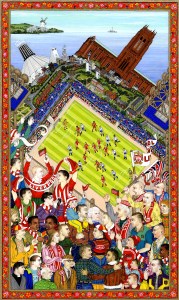
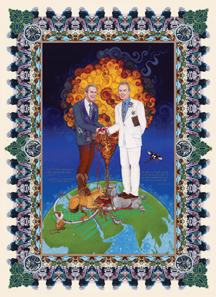
It seems such an unlikely success story – identical twins of Indian origin, born in the UK, become famous artists and depict their home city of Liverpool (left) and other more controversial scenes in the style of Mughal miniature paintings, inspired by the intricate and colourful miniatures seen as teenagers when their father drove them round India in a converted bus.

That is the story of the Singh Twins, Amrit and Rabindra, now in their 40s, who have just completed a month’s tour of India where they were feted in Delhi and Mumbai.

Mughal miniatures are usually small in size, just a few inches square, and rarely more than an A4 sheet of paper, but the twins produce works of more than 2ft by 3ft which mix miniatures’ traditional minute detail with a form of pop art. Alka Pande, a Delhi-based artistic curator and author, says the twins are “brilliant colourists who have taken Indian miniatures to a completely new level with reflections on contemporary life”.

Since the late 1980s, they have had solo as well as group exhibitions in many UK locations including the National Portrait Gallery (March 2010), as well as in the US and Canada. In India, there have been numerous shows including one at the National Gallery of Modern Art in 2002-03. In the past month, they have been showing The Making of Liverpool – portraits of a city (and an accompanying film) at Delhi’s Art Alive Gallery, and a series of Tarot card images at Mumbai’s Sakshi Gallery and at the British Council in Delhi with Gallery Nvya.

There are two main strands to most of their work – recording the lives of Indians as they merge with British culture, and attacking what they see wrong with society, especially increasing commercialism and the misuse of power and challenges to Indian culture.

“We saw our works as being important to challenge established cultural biases,” says Rabindra. “So we moved away from traditional miniature subjects to things like Indians living in the UK, against a background of Liverpool, with subjects like arranged marriages, celebrating our traditional heritage and making our culture positive rather than outdated, so celebrating both that and British culture,” they add in unison.

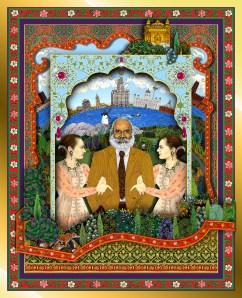
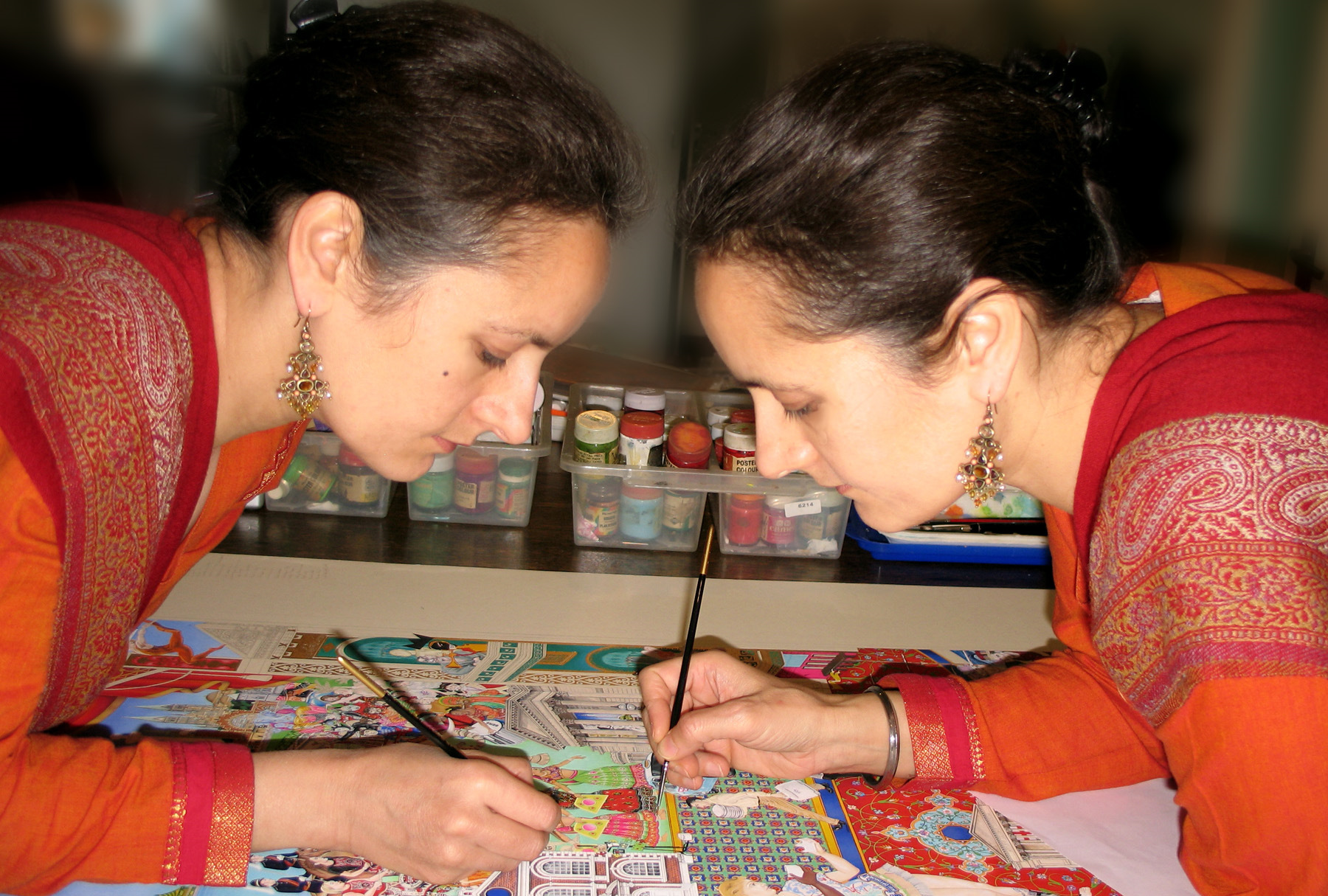
Their father, a Sikh, who accompanies them (together above) on all their trips, emigrated to the UK in 1947 and settled on Merseyside, practising as a doctor. They were heading towards medical careers when he took them to India in the converted bus in 1980. There they bought a book on Mughal miniatures that transformed their lives. At their Roman Catholic convent school there was no-one to teach them miniature art, so they copied pictures from the book. Their next stop was London’s Victoria and Albert Museum, where they photographed and enlarged miniatures so they could study the brush strokes.

These two petite and always identically dressed women make all their decisions jointly, sometimes arguing, but always agreeing on social and political views and on what to do. They occasionally paint separately but usually work together, sometimes forgetting later who did what on the bigger works.

It is difficult to tell them apart, though Rabindra is slightly more sparky. “We are ‘twindividuals’, she laughs, rebutting their college tutors’ view that they were not being individual enough. Amrit says they have only been apart for one week when one of them was in hospital. That, they say, means there has been no time for the complications of other relationships – which of course strengthens the uniqueness of the Singh Twins brand.

They have been fighting convention since they were at university in Liverpool, where they were told that Indian miniatures were not relevant and they should be learning from Matisse, Gaugin and Picasso. “We said that Gaugin and others had been influenced by India and other foreign works, and that we were being denied our own way of expressing ourselves,” they say. ”There was pressure to conform to Western ideas but we were challenging accepted notions of heritage and identity”.

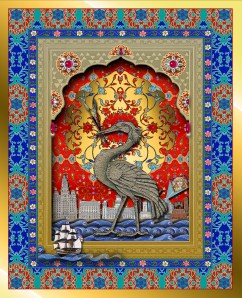
Their recent shows in India (above and top) are striking in artistic and technical detail, depicting scenes against a backdrop of Liverpool’s monumental skyline and showing what Pande calls the twins’ “quirkiness and humour”.

But they are mild compared with earlier controversial work. In 1998, the twins painted Nineteen Eighty Four, The storming of the Golden Temple, which depicted (left) the Indian Army invading the Sikhs’ Golden Temple in 1984.

The temple stands in a startling red pool of blood, and the late Indira Gandhi, the prime minister who ordered the attack, watches (with Bill Clinton and Maggie Thatcher) from the turret of a tank as men, women and children flee for their lives, or lie dead. Then there is Partners in Crime, Deception and Lies, (below) with president George W. Bush and prime minister Tony Blair standing cockily on a burning blood-strewn globe of the world after the invasion of Iraq.

Those two works are painted on mountboard with poster colours, gouache and gold dust, and 1984 is their largest work at almost 30in by 40in. Now they have moved on technologically.

.

The Liverpool works they took to Delhi were limited editions of giclee prints, individually produced and coloured by the artists with digital scans (approx 30in x 22in, priced at around Rs200,000 – $4,000, £5,000), and smaller hand-painted mixed media digital originals (about half the size and twice the price of the giclees).

The originals of 1984 and Partners in Crime are in the twins’ personal collection, but they have been reproduced in special editions – 1984 in an edition of 1000 prints and Partners in Crime in a signed and numbered giclee run of 25.

The 1984 work was seen by some in India as being violent and controversial, but the twins say that both works were taken, as was intended, “as a commentary on the stage of politics globally – and how political greed, corruption and abuse of power is a universal concern that effects and threatens us all”.

“Our role is political and social, documenting and commenting,” adds Rabindra. “The 1984 work is not just about the event, but about political greed and the misuse and corruption of power”.

Images © The Singh Twins

This article originally appeared in a shorter form on The Economist’s Prospero arts blog

Posted by: John Elliott | November 15, 2011

Few friends for India’s king of good times

.

It must have been a devastating shock for Vijay Mallya, India’s most flamboyant and image-conscious businessman, when the media and top business colleagues turned on him in the past few days over the plight of his loss-making debt-ridden Kingfisher Airlines.

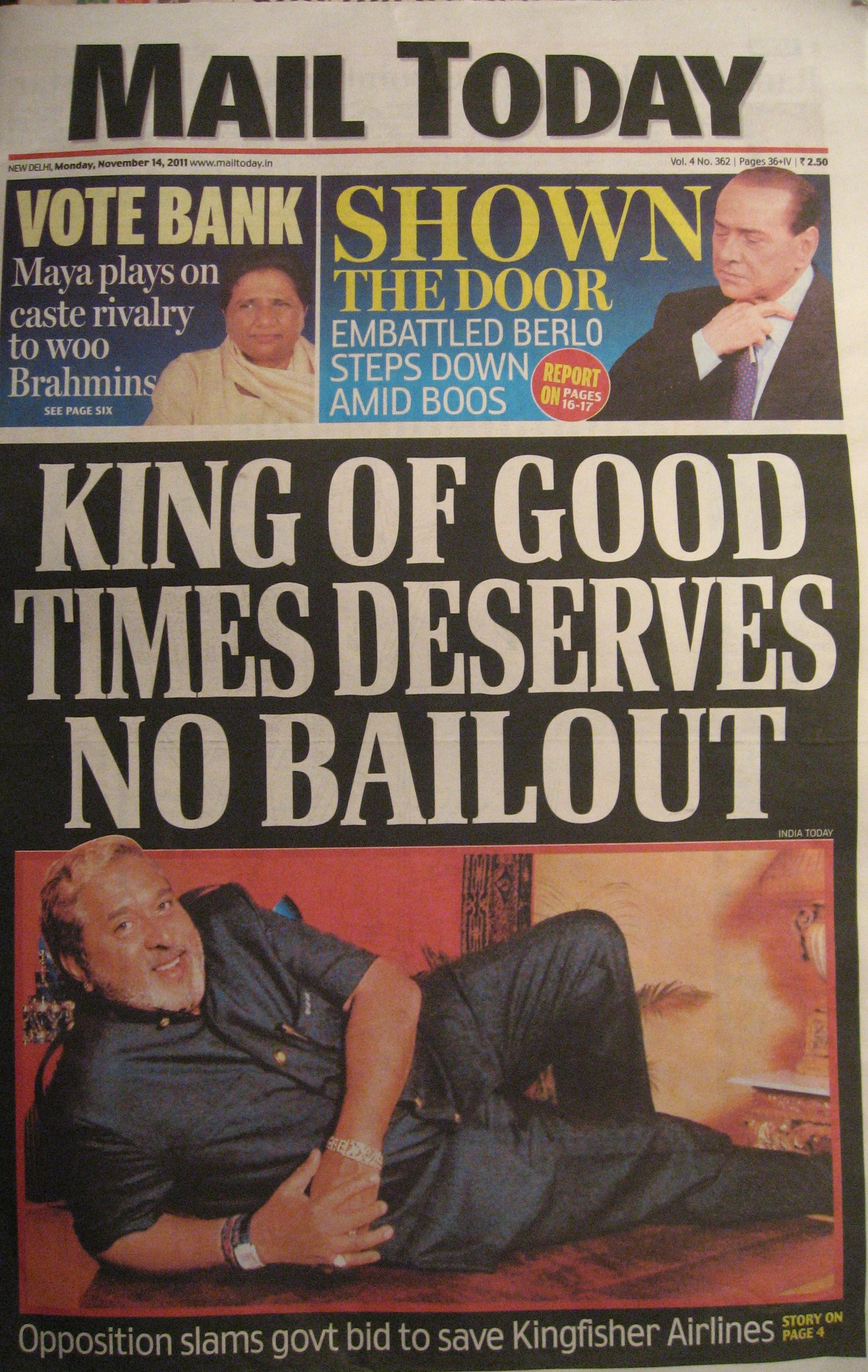
The Mail Today’s front page yesterday (left) was the unkindest cut, but others also piled in. The Times of India today says “it isn’t the government’s business to bail the airline out”, and the Indian Express simply says “No Bailout”. Rahul Bajaj of Bajaj Autos said he saw “no logic in bailing out any private sector company”, voicing a widely-held corporate view.

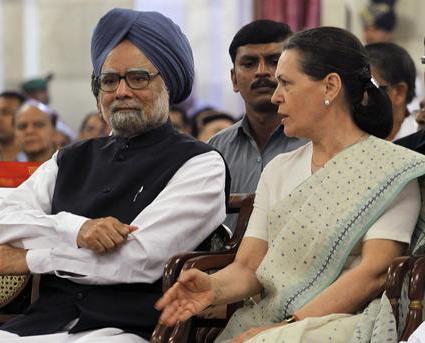
Mallya said today that he had not asked for a bail-out, though he did want some help, and he has been lobbying politicians in the last few days. It was in fact prime minister Manmohan Singh who, flying back from an international conference, kindly but unwisely told reporters two days ago that “we have to find a way to get Kingfisher out of trouble”.

The prime minister would do better if he took advantage of Kingfisher’s crisis to clean up the government’s administration of the aviation sector, which has been riddled for more than a decade with corrupt and crony links between the aviation establishment and the private sector. That establishment embraces successive aviation ministry politicians and bureaucrats, other branches of government, and Air India, the government-owned, chronically inefficient and cosseted airline (with includes the former Indian Airlines domestic carrier).

Ratan Tata, head of the Tata group, has said he was not able to start an airline joint venture (about ten years ago) with Singapore Airlines because he was not willing  to pay a minister a suggested Rs15 crore (then about $3.5m) bribe.  Crony links have grown since then – especially between 2004, when the current Congress-led coalition government came to power, and a ministerial reshuffle in January this year. (I alluded to the links on this blog three years ago).  During that period private sector airlines were encouraged, while Air India was decimated by a series of government decisions that included its nominal (still incomplete) take-over of Indian Airlines, questionable large aircraft orders, and foreign airlines being allowed to take over lucrative routes.

.

This is not to suggest that Mallya’s airline has benefited most from this cosy relationship, close though he is to many ministers and bureaucrats – six years ago The Economist said he was “famous for his racy, party-loving lifestyle” and for his not unconnected “skill at managing his relationships with government”.

Jet Airways, Kingfisher’s main long-term rival, has had its own deep associations for years. It benefited most from the Tata-Singapore link being scuppered by the government banning foreign airlines from investing in Indian carriers because this blocked a potential serious rival. The fact  that Jet had to lose two foreign airlines that were then its equity  partners was a small price to pay for seeing Singapore off.

Now Mallya is urging the government to end that foreign direct investment (FDI) ban on foreign airlines. Whether this would bring an airline into Kingfisher, given its present dire financial straits and Mallya’s erratic management style, is another question – Mallya says he has an offer from one would-be investor and there are rumours of others.

Today he has tried to stem the tide of bad news with a long televised press conference, where he appeared calm and confident. He produced no solutions to the airline’s problems, but  correctly claimed that Kingfisher’s performance is no worse than competitors’. Its primary financial problem is crippling interest on $1.3bn long-term debt, and it urgently needs fresh working capital.

All airlines, as Mallya said, are hit by sharp rises in fuel costs, a rapid decline in the value of the rupee, and rising interest rates (now near 14%). He is negotiating with exasperated banks, which want him to produce more equity, and the State Bank of India is advising on restructuring the debt. In addition to the FDI change, Mallya is also asking the government to allow airlines to avoid sales tax by importing fuel themselves rather than through state-owned oil companies, and also wants duties charged by individual states to be reduced.

.

Mallya’s primary business is the highly profitable United Breweries (UB) group, which he inherited from his father. It is the world’s largest spirits business and India’s biggest brewer – producing Kingfisher Beer that gave the airline its name.

The airline has never made a profit since it was launched six years ago as part of Mallya’s “king of good times” mantra.

Last month it ended its Kingfisher Red cut-price operation that it has run, somewhat reluctantly and with muddled branding, since it bought Air Deccan four years ago. It has also abandoned some loss-making routes, and has cancelled flights because it has been re-configuring aircraft interiors – all of which has helped to escalate the sense of crisis.

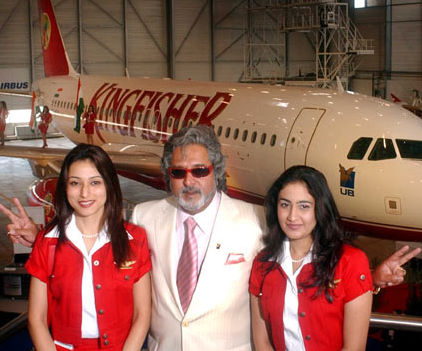
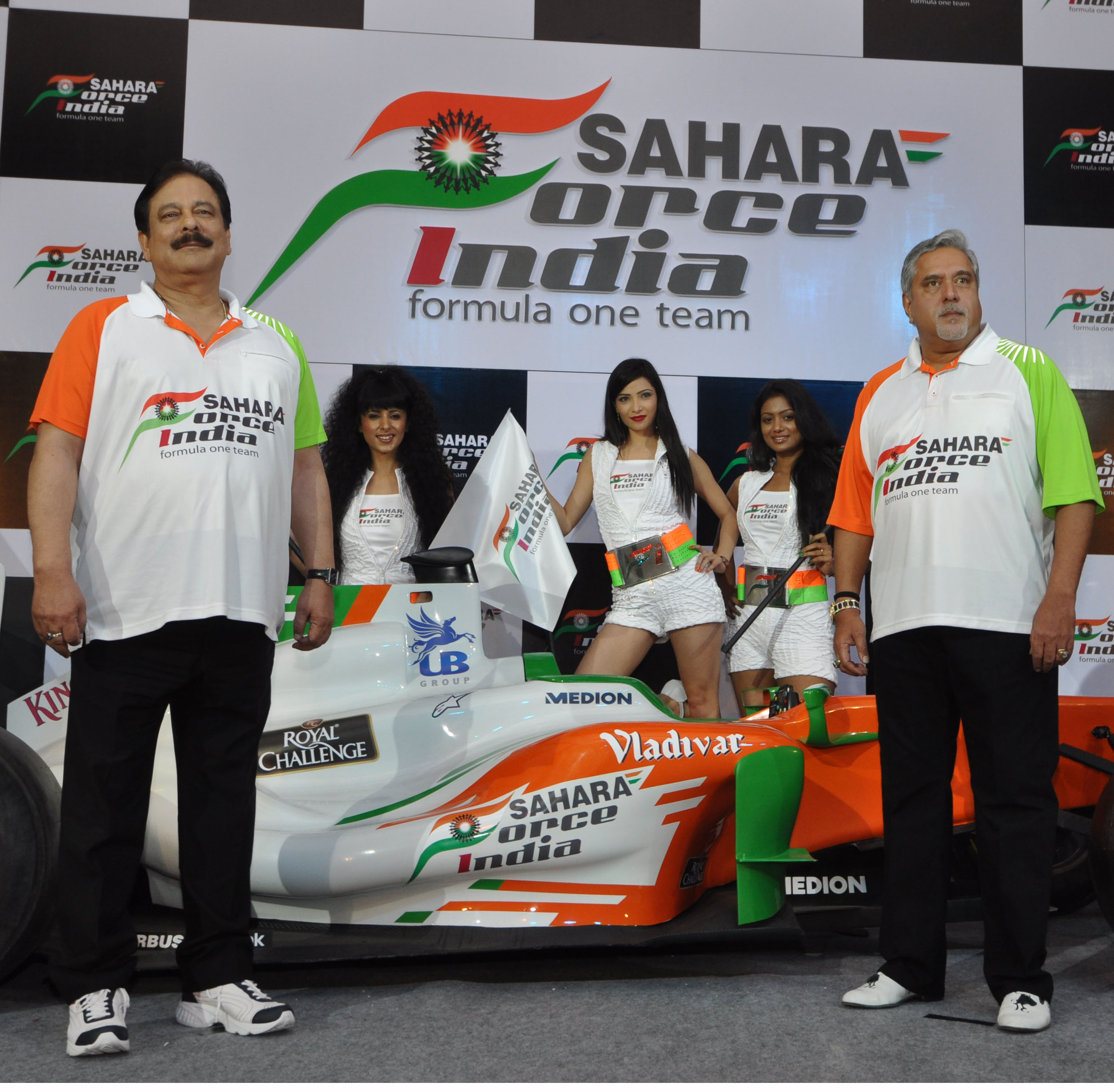
As I said, it must be devastating for Mallya, who partly models himself on Virgin airline’s Richard Branson, to find himself so publicly shunned. He has for years wined and dined politicians, bureaucrats, opinion formers and journalists on his private jet and yacht, and at a stud farm, IPL private sector cricket tournaments (he owns a team), and many beach and city homes in India and abroad, as well as on Kingfisher aircraft. Only a month ago he was visibly shaken  (above) when he had to admit India’s Sahara group as a 50-50 investor in his cash-strapped Force India Formula One racing team, now renamed Sahara Force India.

But what a marvellous chance his airline’s plight gives Manmohan Singh and Sonia Gandhi, the Congress Party chief, to begin to honour their pledges of tackling India’s endemic corruption and crony capitalism by dealing with Kingfisher transparently and openly. It could allow foreign airline investors to have minority equity stakes, and provide a level-playing field in India’s rapidly expanding aviation market – even if that leads one day to either or both Kingfisher and Air India closing down.

Posted by: John Elliott | October 30, 2011

India shows what it can do with a winning Formula 1

It is often said that everything and the opposite is possible in India, and so it has been shown today. Just a year after the Indian government’s humiliating and appalling preparations and administration of Commonwealth Games in New Delhi, the private sector this afternoon delivered a spectacular Formula 1 Grand Prix race on time, efficiently, and without any mishaps.

.

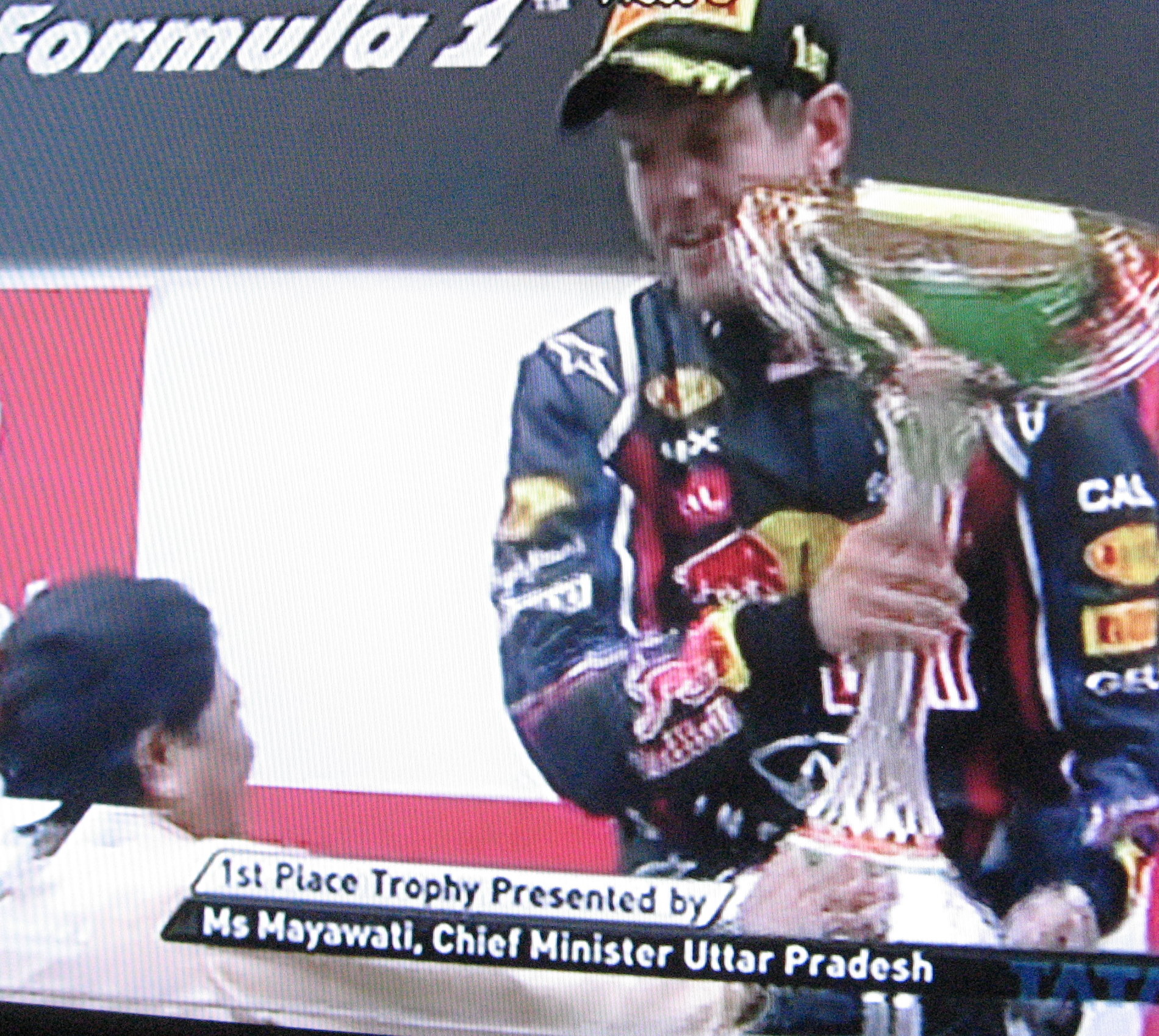
With a crowd of 95,000 and an international television audience said to total 150m, Sebastian Vettel (left) continued his winning F1 streak by driving his Red Bull Renault to victory at the end of a 90-minute 307km race.

Warnings about excessive dust blowing (and stray dogs walking) onto the new Buddh track in Noida, a Delhi satellite city, from nearby arid farmland did not materialise.

A rush in the final weeks to complete and tidy up the site appears to have worked and Vettel, along with other drivers, praised the track.

This showed what can be achieved when India’s bureaucrats stay largely out of the picture and politicians, probably taking a cut, allow the private sector to perform.

As is inevitable in India, there are stories of shady dealings, controversies, political rivalries and damaged egos. There is also serious concern about the way that the poor were ousted from their land to build the track and allied developments over the past year or so, and about low wages paid to the construction workers.

The Jaypee construction group which built and runs the race track has close links with Mayawati (presenting the trophy above), the egotistical chief minister of the state of Uttar Pradesh, which includes Noida – though the race has been seen as a Delhi event and a Delhi success, it is actually a success for one of India’s poorest states that is known more for corruption and lawlessness than business success and efficiency.

photo: Gurinder Osan - AP

The Jaypee group and other companies manage to straddle these potential contradictions. Jaypee housing and other projects linked to new highways that are also linked to the Buddh track (right) were at the centre of mass protests earlier this year against the transfer of land for business purposes.

Rahul Gandhi, heir apparent to India’s ruling dynasty, hit the headlines when he joined the demonstrators in May, protesting at the low levels of compensation that had been paid. As a result, Mayawati has had to amend the government’s land compensation policy and there have been court rulings blocking the use of some land for housing.

An article in Delhi’s Caravan magazine estimates that Jaypee will have made up to $30m in revenue from tickets, but will make a $35m loss on the race itself after sanction fees and other operational costs are paid – plus the $200m cost of the track itself. It suggests that while the track could turn in a profit within three or four years”, its real profits will come from real estate development. Sameer Gaur, a senior Jaypee executive and son of founding chairman Jaiprakash Gaur, has said that the group has around 1,500 acres of real estate to develop, which it obtained from the UP government on favourable terms.

.

Jaypee has had front-page newspaper advertisements (right) this week for luxury housing with associated hotels and sports city that it is planning alongside the track at Jaypee Greens where the F1 teams have been staying in a golf resort.

There have also been criticisms about the price of tickets ranging from $55 to sit on the grass to $22,000 for corporate boxes that are way out of reach for the vast mass of Indians, as were concerts by Lady Gaga and Metallica  (the latter was abandoned).

But it is inevitable in a country like India that there will be such disparities. Jenson Button, a British McLaren driver who came second today, has said that coming to India was “difficult” for the drivers, who had been stunned at the living conditions visible outside their luxury hotels. “You can’t forget the poverty in India. It’s difficult coming here for the first time, you realise there’s a big divide between the wealthy people and the poor people,” he said.

Anand Mahindra, one of India’s top industrialists who runs an autos-based group and is an avid tweeter, commented on Twitter today: “The F1 is a turning point. I see Indians becoming the most car-crazy&car-knowledgeable people on earth.. Now, let’s build those roads.”

And also, he could have added, let’s make sure that in future the private sector is given the chance to build and run India’s potential success stories. If bureaucrats and politicians had not stupidly decided for prestige reasons to locate the Commonwealth Games in the middle of Delhi instead of a place like Noida, and had not handed it over to corrupt politicians and bureaucrats, that could have been a success too. The possibilities are endless, if only governments are prepared to paint themselves out of the picture.

Mayawati, who loves grandiose projects,  runs a corrupt state in UP and that casts a stigma over all that she does. However, the success of the Grand Prix raises an uncomfortable question – is it better to have international success on Mayawati’s terms or the Commonwealth Games type of humiliation allowed by India’s Congress-led government?

Photo: Prashant Vishwanathan - Bloomberg

Posted by: John Elliott | October 25, 2011

Bhutan’s King brings his bride to celebrate ties with India

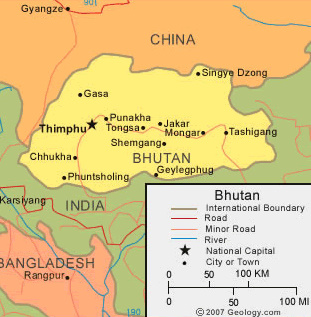
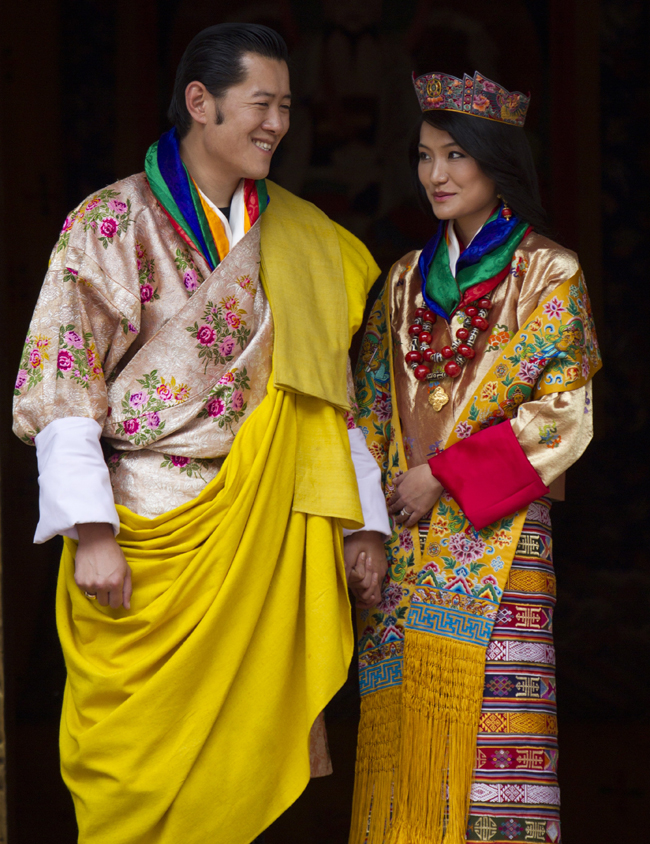
It is a measure of the close ties between the world’s smallest kingdom and largest democracy that Bhutan’s King Jigme Khesar Namgyal Wangchuk has come to India on a state visit with Queen Jitsen Pema less than two weeks after they were married in a spectacular ceremony in Thimpu, the tiny Himalayan country’s capital.

.

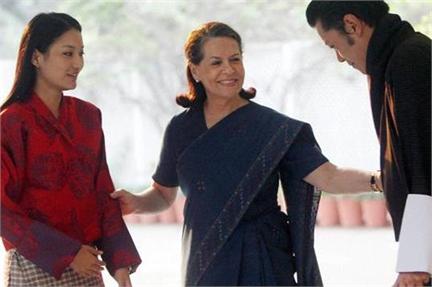
King Jigme – known in Bhutan as K5, the fifth king – has been holding official talks in Delhi for the past two days with prime minister Manmohan Singh (greeting him and the queen, left), Sonia Gandhi (below),  and other top ministers and officials. The president hosted an official banquet last night.

The 31-year old king and his 21-year old bride are in India for nine days, combining official duties  with a honeymoon railway journey through the Rajasthan cities of Jaipur, Jodhpur and Udaipur.

Sandwiched between the potentially hostile nuclear powers of India and China, Bhutan is a sensitive buffer state that has been fully aligned with India for over 50 years. It is therefore specially significant that King Jigme should be in Delhi so soon after his marriage and before a state visit next month to Japan. It shows that the links, which India guards jealously, will continue into the future.

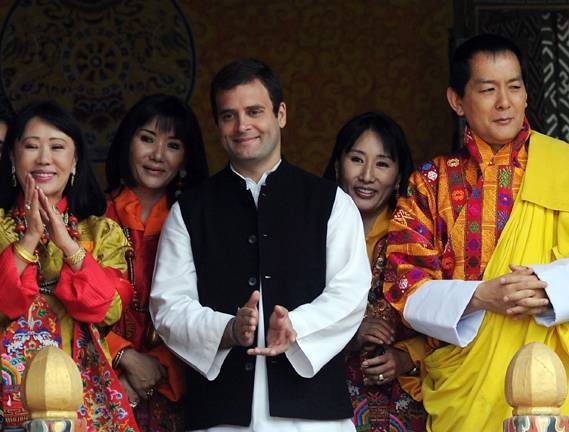
Rahul Gandhi, dynastic heir to the leadership of India’s Congress Party and a potential future prime minister, was one of the few official foreign guests at the wedding (picture below), reflecting friendship between the two families.

Bhutan has no formal relations with China, much to Beijing’s angst, though the two countries do meet for talks on their un-demarcated mountainous border where China is claiming two stretches of land for its region of Tibet. It is also reported to be establishing links in Bhutanese villages.
 
China has a much more militarily sensitive and hotly disputed border with India, where its claims include sovereignty over the state of Arunachal Pradesh to the east of  Bhutan.
 
Some Bhutanese officials speculate that links with China will be relaxed in the future, but this week’s visit by the royal couple shows where the king’s primary focus lies. These issues have been discussed by the King in meetings today with the head of RAW, India’s intelligence service, and the army chief.
 

.

In Bhutan, the King Jigme has the tough task ruling over a new democracy that was initiated in 2006 by his father King Jigme Singye Wangchuck, who then abdicated in his favour. Earlier, his father started the policy of aiming for Gross National Happiness, which involves maintaining traditional culture, good governance, and a sustainable environment, as well as economic prosperity (he explained the policy to me in an interview in 1987).

 
K5 has broken with tradition in one significant way by declaring that he will have only one wife, abandoning the Bhutanese form of polygamy where men and women, particularly in rural areas, sometimes take several sisters or brothers as partners. His father married four sisters and they all have the status of queen mother, but it is clear that he intends that Jitsen Pema (see above left, with him at their wedding) should be the only queen.
 

with Sonia Gandhi

When they have finished their state visit and holiday in India, the royal couple will return to Bhutan and continue a series of journeys around the country that they started after their engagement was announced in May.
 
 On Sunday evening, they told me that they had already visited about half of the country, including areas hit by a recent earthquake. “We have been struck by the warmth for my family and the great response we have received,” said the king.
 
That bodes well for them as they tackle the difficult task of leading this traditional country into the western ways of a democracy and consumer society, while also balancing Bhutan’s strong Indian ties with China’s looming presence just across the mountains.

Former King Jigme Sinagye Wangchuk at the wedding with three of his wives and Rahul Gandhi


Posted by: John Elliott | October 13, 2011

Sahara trumps Mallya in Formula One’s Force India

It’s as if they were born for each other. Two of India’s most colourful and controversial business tycoons came together last night to help the more flamboyant and cash-strapped of the two cope with deep financial problems. Both love the image of running airlines and mixing with film stars, plus the colour and drama of sports sponsorship – they own rival teams in India’s IPL cricket league. Both have long links with influential politicians, businessmen and other powerful figures, and both are used to digging themselves out of financial and other crises.

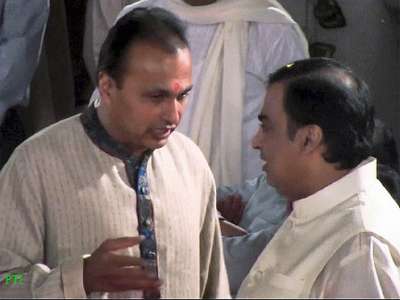
They are of course Vijay Mallya and Subrata Roy, who appeared together (left) at a press conference in one of Delhi’s lesser four-star hotels to announce that Roy is investing $100m in Mallya’s motor racing team, Force India.

The UK-based team, bought by Mallya and a foreign partner just four years ago, is currently ranking a creditable sixth in the Formula 1 constructor’s (team) championships, and Mallya urgently needed funds, which he could not afford, to boost its performance and train potential Indian drivers.

Mallya looked far from his usual ebullient self last night when he walked slowly onto the hotel stage to a cacophony of sound and flashing lights organised by Roy’s controversial and privately-held Sahara India Pariwar group. That was not surprising because Roy, who gives his full name as Saharashri Subrata Roy Sahara, has taken over the chairmanship of the renamed Sahara Force India.

Mallya remains “team principal” and managing director and will no doubt continue to appear prominently on international motor racing circuits. But that was a rare loss of face for a man who models himself on the Virgin group’s Richard Branson and whose brand-based United Breweries (UB) empire stretches from the world’s largest spirits business and India’s biggest brewer, to Kingfisher Airlines, one of India’s largest operators. Named after UB’s famous Kingfisher beer, the airline has never made a profit and last month it ended cut-price flights (started when it bought Deccan Aviation four years ago), to try to stem debt and accumulated losses of over Rs5,000 crore ($1.1bn).

Roy has also once owned an airline – Air Sahara, which he regarded as brand building for a massive para-banking and poor savers’ “chit fund” business and allied real estate developments. Roy’s empire is based in the Uttar Pradesh capital of Lucknow, where he has a 270-acre private estate in the centre of the city. His links have included Malayam Singh Yadav, a former UP chief minister, and other politicians plus Anil Ambani, one of two brothers who run separate Reliance group businesses, and a galaxy of film stars led by veteran Amitabh Bachchan.

Roy has been revamping his financial empire in recent years under the watchful eye of the Reserve Bank of India and Sebi, the stock market watchdog, but has a separate image gained by extensive sports sponsorships that led to him meeting Prince Charles during last year’s Commonwealth Games in Delhi.

Grosvenor House – and the Royal Mail

But possibly his most audacious coup – till last night’s Force India deal – came ten months ago when, for just $470m, he bought the prestigious Grosvenor House Hotel in London’s Park Lane. He got less favourable publicity however a few months later when he threw a party at the hotel to mark an issue of Royal Mail stamps carrying pictures of him and the Sahara group’s activities. The guest list included Cherie Blair, wife of the former British prime minister, but it was reported that such sets of stamps were not a singular honour and could be arranged with the Royal Mail for a few pounds.

Yesterday’s deal was put together quickly in time for India’s first Formula 1 Grand Prix race that will take place near Delhi on October 30. Mallya approached Roy for financial sponsorship a month or so ago, but Roy trumped that by offering an injection of $100m new funds in return for a 42.5% equity stake, the chairman’s post and the new brand name. Mallya’s equity stake, which he holds privately, comes down from 75% to a matching 42.5% (plus debt), and the balance is held by Michiel Mol, a Dutch entrepreneur and Mallya’s original partner.

The deal gives Mallya some breathing space – his group’s shares rose on the news that he had found someone to help fund the racing team. However, he has not been so successful attracting investors into the UB group. And Indian government policy does not allow a foreign airline to invest in Kingfisher, which is so strapped for cash that staff salaries are being paid late and some flights have been delayed today because unpaid bills have led a fuel supplier temporarily to suspended deliveries.

Aside from that, the main interest now will be how Mallya and Roy – at the same time so similar and so different – rub along together on the race tracks.

Posted by: John Elliott | October 6, 2011

Dussehra triumphs with Good over Evil

.

There’s been a nice irony in New Delhi tonight where top politicians led by prime minister Manmohan Singh, and Sonia Gandhi, the governing coalition’s leader, went to the old city’s Ramlila grounds to celebrate today’s Dussehra Festival (picture below on Headlines Today tv).

The festival marks the triumph of good over evil as King Rama defeats King Ravana, who had abducted Rama’s wife Sita to what is now Sri Lanka.

Displays of fireworks all over the country have this evening ended with ceremonial burnings of Ravana effigies, often in a trio with his son Meghnad and brother Kumbhakaran. I’ve just seen Ravana go up in flames in Golf Links, where I live in localDelhi– see the pictures here.

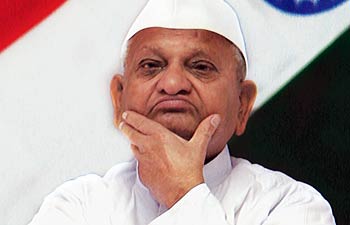
The Ramlila location in Delhi was accidentally symbolic because it was here a month or so ago that Ana Hazare, the Mahatma Gandhi look-alike who has led a massive campaign against corruption, defeated the government. First the politicians pleaded with him not to go on an extended hunger fast, then they jailed him, then pleaded with him to leave jail, then agreed to pick up some of his anti-corruption demands.

.

In this context Hazare, even though he has many critics, is on the side of “good” and the government symbolises “evil”.

Hazare was at celebrations in his village tonight where he said, ”We all need to burn the Ravana of corruption inside us”.

Record Hits

Meanwhile Riding the Elephant has happily celebrated  Dussehra because it has today brought the total number of daily hits to a record for the blog of over 1,100.

People visiting Elephant have mostly been searching for photographs of the festival that I’ve have been writing about here, with pictures from around Delhi, since 2007 (see links below). This has brought an amazing  total of around 2,000 hits on three old Dussehra posts over the last four or five days.

.

I guess it’s appropriate that my Dussehra posts have beaten popular articles that more often than not have covered what might be dubbed the “evil” side of India – the previous one-day record (764) was on December 8 last year , just after I had written about how leaked mobile telephone tapes linked to the ongoing 2G telecoms scandal revealed “media flaws that fit with modern India”.

Happy Dussehra!

 Riding the Elephant’s earlier Dussehra posts: It’s Dussehra!  October 17, 2010, Happy Dussehra!  October 9, 2008, The Gods will encourage you to gamble  October 23, 2007  – written for foreign visitors to India when this blog appeared on the Fortune magazine website

A boy gave final touches to Ravana effigies in Mumbai – Divyakant Solankiss/European Pressphoto Agency

Posted by: John Elliott | October 3, 2011

Dynastic secrecy protected by India’s tame media

 The omertà on Sonia Gandhi’s illness

At last, there is some high profile questioning about why the health of Sonia Gandhi, leader of India’s governing coalition, the United Progressive Alliance (UPA), has been kept officially secret since the beginning of August when she was reported to have gone to New York for an operation believed to be for cancer.

The question was publicly raised over the weekend in a cover story How ill is Mrs Gandhi? published by India Today, a weekly news magazine, which provides no new answers but in effect challenges the Gandhi family’s insistence on secrecy.

Coincidentally, Gandhi yesterday made her first public appearance (below) since returning from the US on September 8, when she attended events in Delhi that marked the birth anniversary of Mahatma Gandhi, India’s independence leader.

No one is questioning why Sonia Gandhi did not appear in public earlier after what is reported to have been an operation for first-degree cancer, but there is serious questioning abut whether – and why – India’s top politician should keep such an important illness and hospitalisation a secret. Alongside that, and maybe more significantly, why has the Indian media been loath to challenge that secrecy?

Gandhi’s singular political importance is beyond doubt. If there was any doubt earlier, it was confirmed while she was away by the UPA government’s erratic behaviour on the Anna Hazare anti-corruption movement and on-going telecoms scandal. On both issues, prime minister Manmohan Singh failed to exert the authority that should go with his job, while Rahul Gandhi, Sonia’s son and long seen as a future prime minister, failed to rise publicly to the challenge as heir apparent.

Other key politicians such as home minister Palaniappan Chidambaram and telecom minister Kapil Sibal mishandled their briefs (and seriously damaged their reputations), while the four leading Congress Party figures Gandhi named as being in charge (including son Rahul) made no public impression. She was clearly missed.

She has now been back for just over three weeks, and some sense of normalcy appears to have returned to the running of the coalition.

However, that begs a question. Did the disarray while she was away develop because the government was missing her sure touch and gift of sensing what needed to be done politically, or because ministers and officials were scared to make decisions that might arouse her (or Rahul’s) wrath later?

Or, as a political observer put it to me on Saturday, was it because the Gandhi dynasty has taken over normal  governmental channels of authority and decision making to such an extent that the cabinet and administration cannot work without its leader at the head.

Whatever the answer – and maybe it was a mixture of all three – Gandhi has managed over the past 13 years that she has been engaged in active politics to build such an exclusive and untouchable aura of privacy and secrecy, combined with ultimate authority, that few people dare publicly to question her role or criticise the supremacy of the dynasty that she heads. It could be argued that this displays a high level of dynastic insecurity and fear of being unseated, which in turn would explain why the illness was – and still is – officially a secret.

Gandhi is of course an elected parliamentarian, so it would be wrong as well as unfair to compare her with a dictator. The acceptance however of her pre-eminent position, and that of the dynasty, would be envied by many less democratically based rulers, as would her ability to rule with a minimum of public utterances – she appears in public relatively rarely, and never makes herself available for the sort of public questioning faced by national leaders elsewhere.

Even Cuba’s ruler, Fidel Castro’s illnesses were publicly discussed in 2006. Politicians in the US are accustomed to public exposure, while Manmohan Singh’s heart bypass operation in 2009 was announced. Earlier however the illnesses of Atal Bihari Vajpayee, the previous prime minister, were (and still are) largely kept private.

So even if one recognises that politicians like Gandhi will maintain as much privacy as they can muster, this still leaves the question of the Indian’s media’s largely hands-off response.

It is true that the media here rarely reports on the private liaisons and even offspring of top politicians, but that is surely different from failing to explore the country’s top political leader going abroad for a life-threatening operation – Gandhi’s visit to the US for treatment was first reported by the international news media, and was then only lightly covered in India.

There was a good debate on some of the issues on India’s CNN-IBN tv channel on August 12, and a more recent article  The omertà on Sonia Gandhi’s illness in The Hindu newspaper that mischievously, given Gandhi’s Italian origins, picked the Italian code of silence word omertà for its headline . The Business Standard newspaper also ran an editorial on Right to Information – Mrs Sonia Gandhi’s health is a matter of public concern on August 7.

Such scattered programmes and articles however scarcely amount to a real attempt to discover – either through an official spokesman or other sources – the nature and seriousness of the illness. Such disregard by the media of its proper role in guarding the public interest is surely not healthy for a democracy – nor on the other hand is the secrecy and aura that seems to have triggered that reaction.

Posted by: John Elliott | September 29, 2011

India staggers and stumbles on a long corruption trail

–   A truck driver was reported to have been beaten to death by officials in north India earlier this week for not paying a Rs500 bribe………

–   A former cabinet minister for telecoms, Dayanidhi Maran, is about to be charged for corruption in an ongoing telecoms scandal. He is the second ex-telecom minister to be charged in the case – the first, Andimuthu Raja (below), has been held in a Delhi jail since February pending trial, along with various others………

–   A crisis has split and preoccupied the top levels of the government in the past week over whether Pranab Mukherjee, the finance minister, tried some months ago in a ministry memo to implicate Palaniappan Chidambaram, his predecessor and now home minister, in that scandal. This has been partially and unsatisfactorily resolved tonight by a joint statement from the two men denying any rift………..

–   A close adviser to former prime minister Atul Bihari Vajpayee was arrested earlier this week and is being held in jail for alleged involvement in a “bribes for votes” scandal when India’s US nuclear deal was passed by parliament in 2008, as was a provincial Uttar Pradesh politician earlier this month…..  ……..

Prime minister Manmohan Singh and A. Raja

This is modern India – a proud but often dysfunctional country that aspires to be a world super power – just a month or so after it was caught up in an anti-corruption frenzy led by Anna Hazare, a social campaigner. A Mahatma Gandhi look-alike, Hazare marched, demonstrated, fasted, and humiliated the government with demands that a new corruption ombudsman, the Lok Pal, should have wide-ranging powers.

His campaign drew massive support from India’s middle classes, especially but not exclusively the young, who were protesting not just against corruption but at the way the country is run by self-serving national politicians down to police and other brutal officials on the streets and in rural areas.  

Chidambaram and Mukherjee

The current scandal, which involves telecom licences and spectrum that were issued by Raja to selected companies in 2008 at 2001 prices, was widely known about and criticised by the end of that year – see my blog article in November 2008. But no-one in the government seriously tried to stop it.

In the past week, it seemed to threaten Chidambaram’s ministerial job because of suggestions in Mukherjee’s Finance Ministry memo that, when he was finance minister in 2008, Chidambaram abetted what was being done by Raja.

Chidambaram and Mukherjee reportedly have differences that partly date from other scandals in financial services, and both looked grim when they appeared on the steps of the Finance Ministry this evening to make their joint statement. Tensions include reported bugging of Mukherjee’s office, which some people assumed was organised by Chidambaram’s Home Ministry.

.

Prime minister Manmohan Singh and his Congress Party political boss, Sonia Gandhi, have been working on the crisis which has threatened to spread beyond Chidambaram because so many parts of the government, including the prime minister’s office, and Manmohan Singh himself, knew what Raja was doing and did not stop him.

The point here is that many cabinet ministers have direct links to leading companies, including some involved in the scandal such as Reliance Communications run by Anil Ambani, and the Essar group run by the Ruia family. On the sidelines is Mukesh Ambani, who runs the separate Reliance Industries group. An active rival of his younger brother, he is also directly linked to ministers involved. Anil Ambani, it emerged today, is to be questioned by the Central Bureau of Investigation.

On top of all this, Subramanian Swamy (above), a campaigning lawyer and politician who triggered the Chidambaram-Mukherjee crisis, said last night that he will produce evidence implicating Robert Vadra, Sonia Gandhi’s son-in-law, whose business deals have received some publicity.

All this illustrates how corruption in India is now so widespread and deeply embedded that it can threaten the stability of the government. There seems little hope of stemming it – from officials’ street-level bribes and killings to national scandals – despite the Hazare movement.

Token arrests

Certainly nothing significant has changed yet. A total of 14 politicians, bureaucrats and company executives have been arrested and jailed in Delhi pending trial on the telecom scandal, as have others on allegations over last year’s Commonwealth Games (CWG) contracts and vote buying mentioned above. Elsewhere, politicians and businessmen involved in mining scandals have been arrested and jailed.

This is not however a genuine effort to demonstrate with arrests that corruption must stop. No significant politician or prominent businessmen, nor anyone the government wants to protect, has yet been jailed. Those arrested include people who the government is prepared to sacrifice (at least temporarily) such as Suresh Kalmadi, who presided over the CWG, and his henchmen, plus Raja who belongs to the Tamil Nadu’s DMK party and is dispensable, some political opponents, and three of Anil Ambani’s senior executives.

On a broader front, the government has removed MP’s patronage powers to issue land, telephone lines and petrol station licences to favoured friends and supporters – but that is only tinkering at the lowest and least important end of corruption. It has also been announced that prosecution of corrupt bureaucrats will be speeded up with stiffer penalties.

What has also happened, according to widespread anecdotal reports, is that officials at all levels of government are becoming so scared of facing corruption accusations that they are reluctant to take decisions. That is seriously delaying policy implementation in a government that already has a reputation internationally for muddled economic and industrial policies that discourage investors.

No-one in the government has emerged with the leadership ability or stature to tackle this malaise and turn the Hazare movement into a positive campaign for curbing corruption. Manmohan Singh has neither the authority nor ability to lead. Sonia Gandhi, who has recently returned from the US after a suspected cancer operation, is not a potential public leader. Her son and heir, Rahul, has failed in recent weeks, notably while his mother was in the US, to do more than play a bit part.

That leaves the government perpetually on the back foot doing damage control, and there is no sign of that changing any time soon. Indeed, it might worsen as more linkages with the telecom and other scandals emerge.

Posted by: John Elliott | September 15, 2011

Could Narendra Modi become the leader India needs?

India desperately needs a new political leader and it looks as if there is a chance it might get the person who many people fear and despise. He is Narendra Modi (elow), chief minister of Gujarat and the most charismatic politician in the Hindu-nationalist Bharatiya Janata Party (BJP), the country’s main parliamentary opposition.

.

This possibility moved forward this week when India’s Supreme Court decided not to proceed with a case against Modi that stems from his widely suspected role in encouraging, or at least allowing, Gujarat’s Hindu-Muslim riots in 2002. More than 2,000 people are believed to have been killed, with 12,000 Muslims losing their homes.

A local court now has to decide what to do. If it does not continue with the case, Modi will play a more national role in the BJP, and might then return to the party’s national headquarters, maybe as party president, after Gujarat’s state assembly elections next year. Despite infighting among the BJP’s current leaders, that would put him in pole position to be the party’s prime ministerial candidate in the 2014 general election, succeeding L.K.Advani, another hard-liner.

This possibility has been apparent for some time, but it has gained credibility this week, first with the supreme court decision, and then with the emergence yesterday of a US Congressional report that praised his work  (even though he has been refused a US visa because of the riots). It said 2014 might be a direct contest between Modi and the Congress Party’s Rahul Gandhi, who is heir apparent to Sonia Gandhi, the current Congress president and his mother. Rahul Gandhi is seen as a future prime minister and is believed to have been more active in top party decisions following the hospitalisation in the US last month of his mother, who returned to Delhi last week after what is believed to have been a cancer operation. There are rumours he might soon become the party’s top official, alongside her.

The two men could not be more different in style and experience. Modi is a powerful orator, wily politician, and able administrator as he has shown with the development of Gujarat since he became chief minister ten years ago. Gandhi is shy and unproven and, as the US report put it, “remains dogged by questions about his abilities to lead the party, given a mixed record as an election strategist, uneasy style in public appearances, and reputation for gaffes,”

My Modi forecast in July 2002……..

I first wrote about Modi in a column for India’s Business Standard in July 2002, after the riots. I had been away in the UK when they occurred and felt on my return, while condemning the appalling massacre and Modi’s reported role, that India had a new potential national leader.

I wrote that “unlike most politicians, the Gujarat chief minister was arguing passionately for what he believed in, not for some short-term personal gain far removed from policy, but out of conviction. He was a strong public speaker and was standing his ground and presenting his case with rare confidence and élan – and, whether one liked it or not, he had a commanding presence (some call it ego). To a bystander, he looked like a logical heir for L.K.Advani.”

Friends and contacts had told me that I was wrong. “How could a man who had presided over such ghastly bloody carnage ever win popular respect and a wide following? Weren’t Gujarat’s people tiring of the violence and wasn’t he in fact already finished, just waiting to be edged out of his job? The BJP, I was told, could not survive as a national party of government if he became one of its top leaders because it would be shunned by coalition partners. So Mr Modi had no future”.

However, I had experienced a different side of the man, as I explained: “I have only met Mr Modi once – before he went to Gujarat as chief minister – when we shouted at each other (as, it seems, one is expected to do) on Star TV’s Big Fight programme. He wouldn’t stop bellowing out his single-minded message in decibels that the sound system fortunately muted for television viewers, and I was trying to ask a question – all of which got lost in a fade-out for adverts.”

At the end of the programme, we had laughed and he asked if he’d spoken enough in English for me to know what he was on about. He hadn’t, I wrote, “but that didn’t matter because it was obvious anyway – strident Hindutva and, in the context of the programme’s subject, anti-Muslim rhetoric. I came away with the impression of a driven and (sometimes) charming politician – a potent mixture for a political leader.”

Policy implementation

Since then, Modi has been continually attacked for the riots, but he has won two state assembly elections and has led the state well. His sort of application and policy implementation are just what India needs after years of increasingly ineffectual leadership and lack of achievement by the current Congress-led government.

But it might not happen. The BJP has little support in parts of India, particularly the south, where it has just squandered a chance to expand by running a spectacularly corrupt oligarchic state administration in Karnataka. It therefore always needs to attract coalition partners, which it finds difficult because of its Hindu-chauvinist policies. It did however manage to build a coalition for its 1998-2004 governments by agreeing a policy programme that avoided anti-Muslim and other hard-line measures. Indeed those were years of relative communal harmony – a record ruined by the Gujarat atrocities.

The chances of it being able to rebuild that trust with Modi as leader has seemed remote ever since 2002. It remains so today, unless Modi is prepared to apologise for the riots. He is trying to move on by staging a three-day “social harmony” fast this weekend, but he still rejects all allegations against him, so seems unlikely to readying an apology.

When 2014 comes, Nitish Kumar, the development-oriented chief minister of Bihar and a BJP ally, could emerge as much more acceptable and moderate coalition candidate for prime minister. However, the BJP might be tempted to portray Modi as the sort of strong though divisive leader that India needs, especially if the Gandhis don’t smarten up the way that the current government operates and is run.

See also earlier posts:

https://ridingtheelephant.wordpress.com/2008/12/05/mumbai-votes-for-narendra-modi-as-national-leader/

https://ridingtheelephant.wordpress.com/2008/12/03/will-the-current-crisis-lead-to-narendra-modi-as-pm/

https://ridingtheelephant.wordpress.com/2007/12/27/a-hindu-nationalist-win-in-gujarat/ 


Posted by: John Elliott | August 24, 2011

Greed breeds social unrest in India and the UK

LONDON:  Two countries in ferment, two governments paying the price for years of mishandling the links between social and economic change….. One prime minister losing credibility day by day as he ducks decisions, another asserting school prefect style toughness that splits society….. Both countries’ problems exacerbated by the power of social media, which generate tensions and passions that no democratic government can control.

One should not overdo the similarities between the problems that have faced India and the UK in the past two or three weeks, but they make striking contrasts. They raise questions about whether Britain’s suppressed tensions and rapid reassertion of official authority provide a better answer to social unrest than India’s muddled responses to continuing mass protests.

Britain was suddenly hit by five days of urban riots in early August that led to widespread street fights, burning shops and mass arrests – all alien to the country’s traditions. Prime minister David Cameron is importing a tough top US policeman to advise him on how to handle gangs that rule in many urban centres, and floated the idea of blocking social media during riots. With over 1,400 people appearing in law courts on a variety of riot-linked charges and nearly 1,000 being held in jail, judges have fallen in line with Cameron’s disciplinary approach to social problems and have issued irrationally stiff sentences, some now being mercifully over-turned on appeal.

.

India has been hit by a far more predictable, indeed almost inevitable, middle class-led resurgence of anti-corruption demonstrations that began in April. With literally tens of thousands of people on the streets, the government has been rocking around indecisively, unsure how to handle such mass public displays of the nation’s growing despair with an ineffectual parliament and corrupt and malfunctioning administration. 

It was taken by surprise in April when Anna Hazare, a 74-year old publicity-savvy social activist, staged a hunger strike that generated country-wide mass protests in support of his demands for anti-corruption legislation. Invoking memories of Mahatma Gandhi (above), the leader of India’s freedom struggle, his aim was to wrest control from the government for drafting Lok Pal (ombudsman) laws that had been talked about since the 1960s.

The government bought Hazare off by agreeing to set up a committee with him and his supporters to draft the Bill. It assumed that it would eventually be able to ignore most of his demands because he would not be able to rebuild nationwide support five or six months later. Judging by previous experience, protestors’ enthusiasm and energy would be dissipated after one major upheaval and would not easily be revived.

I thought at the time that the government was being unwisely over-confident and was misjudging – as has now been seen – the strength of the deep middle-class opinion that was driving the protests. This was not a frenetic rabble, driven onto the streets by vested interests, but a largely young middle class revolt that had a life of its own, separate from the ambitions of attention seekers who thronged around Hazare.

.

The joint drafting committee failed to reach agreement and Hazare revived his movement in June, threatening a new hunger strike from the middle of this month. The government then messed up by jailing him when he failed to agree on the length of his fast and accompanying mass protests. It quickly reversed that decision and tried to release him, but he continued fasting in jail until terms were agreed for a 15-day public fast that started last Friday at old Delhi’s Ramlila festival grounds. 

Sonia Gandhi, who heads India’s governing coalition, has been ill in the US (having had, it is widely assumed, an operation for cancer) since the crisis began, and that seems to have contributed to the governmental muddle that was being run by a team of four nominated stand-ins at the head of her Congress Party, plus prime minister Manmohan Singh. Rahul Gandhi, her son and heir, reportedly insisted that the government cancel Hazare’s stay in jail when he returned from the US, but without her the administration seems rudderless (that is the subject for another later blog article!).

Hazare and his supporters are demanding a far stronger Lok Pal ombudsman than is possible in a parliamentary democracy, saying the post should have charge of top police and other investigative agencies and cover the prime minister. There are dangers here of India ruining the flawed but effective democratic balance that has sustained it since independence 64 years ago. The government is understandably resisting such proposals, but its ministerial and other spokesmen and negotiators have arrogantly infuriated public opinion, while at the same time trying, as they atre doing tonight, to find a solution that will end Hazare’s fast and the protests (picture above of Hazare in mass procession last weekend – AP photo).

But no-one is doing anything about dealing with those most responsible for the country’s endemic corruption, apart from sometimes arresting figure-heads when it suits the government politically.

.

The government has however shown flexibility, and that contrasts sharply with Cameron’s preference for the clip clop authority of firm government, with sound bites about rubber bullets and water cannons breaking up future demonstrations. Cameron (left) assumes he can stop a recurrence of urban unrest with strong arm police and judicial action, placing the blame for the riots on “slow-motion moral collapse” in a “broken society”.

He is showing signs of a blinkered upbringing among Britain’s elite. As Peter Hitchens, a right wing commentator scathingly put it: “He uses his expensive voice, his expensive clothes, his well-learned tone of public school [Eton] command, to give the impression of being an effective and decisive person”.

Cameron is seen by many as refusing to acknowledge that Britain’s problems are reflected across society – from those who recently ransacked and burned down shops, to members of parliament who last year were discovered cheating on their expenses, to top bankers who take unwarranted million pound salaries (some while their banks are still being baled out after the last financial crash by British taxpayers).

Both the UK and Indian governments are approaching their crises with simplistic answers. The UK’s is to get tough with rioters and looters – “teach them a lesson that it’s not acceptable” is a phrase I have heard depressingly frequently from friends in the UK this month. India’s solution is the Lok Pal Bill.

But neither solution will be enough on its own, and both might do more harm than good – Cameron’s disciplinary and elitist approach by increasing rather than decreasing resentment, and India’s by setting up a corruption ombudsman who will either be ineffective or will eat into parliamentary democracy.

The real issues that need to be tackled stem from greed and associated lawlessness – ranging from Britain’s unemployed rioters and rich members of parliament and bankers, to India’s corruptly wealthy politicians, bureaucrats and businessmen.

So deeper solutions are needed. The UK surely needs to address the plight of unemployed poor, as well as changing attitudes to authority, making the police more effective and acceptable at a grass roots level. India needs to punish the corrupt at the top of the system – right at the very top – and then work downwards through society to the villages where gangs and goons run fiefdoms.

These are difficult tasks, but I’m tempted to think that maybe India’s muddle is more sustainable than Cameron’s harsh society, which so many people in Britain today sadly support.

« Newer Posts - Older Posts »

Categories