India losing regional influence to China, just as its global role grows 

Indian newspaper reports on possible US Bangladesh involvement

Adani projects at risk in Bangladesh and Sri Lanka

Regime change has come to South Asia for the second time in a few weeks with the election yesterday in Sri Lanka of a once-Marxist president, whose party has not held the office before. This peaceful transfer of power follows the ousting in Bangladesh last month, after violent demonstrations lasting weeks, of Sheikh Hasina who had been an increasingly controversial prime minister since 2009.

Anura Kumara Dissanayake after winning the election to be Sri Lanka’s new president yesterday

Both changes potentially increase China’s influence and underline the dichotomy of India losing power and influence with its neighbours at the same time as it is increasingly recognized internationally as a rising global and economic power.

Just as Anura Kumara Dissanayake, leader of the leftist Janatha Vimukthi Peramuna (JVP), was claiming victory in a second-stage run-off of Sri Lanka’s presidential election, India’s prime minister Narendra Modi was riding high in the US, meeting President Biden and other world leaders.

Modi was at the four-nation Quad grouping with Biden and the prime ministers of Australia and Japan. He also had talks with the US president, boosted his domestic political profile addressing thousands of Indian Americans in New York, and will be at a United Nations conference today (Sept 23).

Dissanayake’s JVP (People’s Liberation Front) was on the fringe of Sri Lanka’s politics for decades, adopting anti-American and anti-India lines at various times. In the 1970s, it led protests against the US over the Vietnam war and operated underground after being banned then and in the 1980s. Since the early 2000s (when Dissanayake was briefly a government minister), it has been involved in mainstream politics and is now part of the National People’s Power (NPP) coalition.

Its primary policies are anti-corruption and tax cuts and at times in the past it has criticised Sri Lanka’s debt crisis caused by Chinese investment. At his swearing in, Dissanayake said Sri Lanka did not have any geopolitical concerns and he was committed to whatever was in Sri Lanka’s best interests. “We need international help — so whatever geopolitical fractures exist around the globe, we will not be afraid to engage all in the best interest of Sri Lanka. We will work with the world”,

Dissanayake succeeds Ranil Wickremesinghe of the United National Party (UNP), who became the president in 2022 after an economic crisis and mass protests led to the resignation of President Gotabaya Rajapaksa, part of a powerful, controversial and corrupt dynasty.
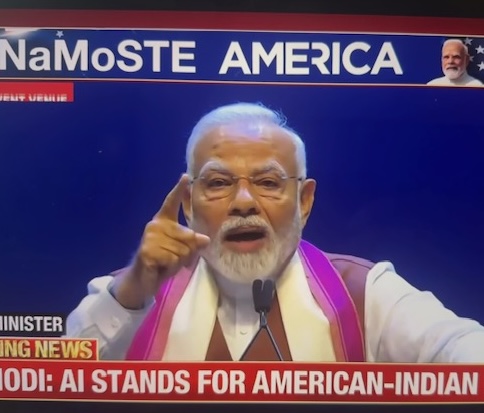
Narendra Modi addressing American Indians in New York yesterdayphoto from India Today tv

It is expected that Dissanayake will now call parliamentary elections. The risk then seems to be that, given his Marxist roots, there will be another South Asian government leaning away from India.

Coming rapidly after what was virtually a coup in Bangladesh last month, when India lost its direct influence with the resignation of its close ally, Prime Minister Sheikh Hasina, the Sri Lanka result is a double blow. Adding to its failures to deal with its neighbours, a pro-China government was elected in the Maldives earlier in the year.

That does not seem to affect India’s role on the world stage, which has increased significantly in the past ten years since Modi became prime minister.

Conversely, the more China strengthens its presence in the smaller South Asian countries, the more it is arguably necessary for the US and its allies to keep India as close onside as possible.

Biden illustrated his concerns about China’s regional role at the Quad meeting, where he is reported to have said (in what was supposed to have been a behind-closed-door meeting), that China “continues to behave aggressively, testing us all across the region”. That included South Asia. 

There has been considerable speculation in India about whether America’s concerns led to it being involved in the ousting of Sheikh Hasina. This surfaced internationally last month but did not have much traction, though the possibility has been widely rumoured in India. 

Yesterday it was set out in the Indian Express by Coomi Kapoor, a well-connected veteran columnist. She wrote that India was “realistic enough to trace the fingerprints of the US”.  Yunus was “a close friend of the Democratic party and of the Clinton Foundation”. 

Referring to Chinese defence and infrastructure projects (and also to Russian involvement), she wrote: “The US was unhappy with Bangladesh for permitting the Chinese to build Asia’s largest submarine base at Cox’s Bazar and construct the Padma bridge. Russia’s funding of a nuclear power plant at Rooppur was another black mark against Bangladesh, which is near Myanmar, a military dictatorship with extremely close ties to China.” (The submarine base was a reference to a naval base China has been building to house two submarines that Dhaka bought from Beijing in 2013, and maybe to service other Chinese subs). 

Kapoor added that Hasina had once claimed that US antagonism toward her regime was linked to its alleged (unsuccessful) efforts to gain a lease on her country’s St. Martin Island for use as a military base to monitor Chinese activity near the Strait of Malacca. This has been denied by the US.

Muhammad Yunus, Bangladesh government’s Chief Adviser

More widely discussed have been Washington’s persistent criticisms of her autocratic regime, her rigged elections (the latest in January), the radom imprisonments of opponents and critics, and the deaths of some 450 people during the student demonstrations that began in June and led to her downfall. 

Many observers however did not believe that these criticisms would lead to the US wanting to change a basically secular regime and risk Bangladesh becoming ruled by fundamentalist Muslim opposition parties.

Nevertheless, the speed with which the demonstrations escalated fed the rumours. In quick succession, Hasina fled at a few hours’ notice to India, Bangladesh’s army chief took over, and student leaders called for 84-year-old Muhammad Yunus, a respected but controversial Bangladeshi Nobel Peace laureate, to lead the government. Yunus immediately flew to Dhaka from Paris, where he was watching the Olympics, and was installed as chief adviser of the government along with other advisers. It all seemed so rapid and seamless that it led to speculation in India about whether there was outside involvement. 

No such suggestions are being made about the changes in Sri Lanka where India now needs to move adeptly to try to ensure that its substantial contributions to the vulnerable economy are valued.

Meanwhile, there are possible embarrassments waiting for Modi when he returns from the US involving Gautam Adani, India’s richest businessman and a close ally. 

Dissanayake has promised to scrap a wind power project funded by Adani, saying “this is clearly a corrupt deal, and we will definitely cancel it.”  Bangladesh owes Adani Power $500m unpaid dues for power supplied from an Indian plant which the new government says is one of various “opaque, expensive” deals it has inherited from Hasina. 
Sue Braverman accused by colleague of “performance art politics”

South Asian MPs back in force in new parliament and as Ministers

The ousting of Britain’s Conservative government this week is significant not just for the prospect of a more focussed Labour government to tackle the country’s chronic problems but also because it marks the end of the first administration where politicians of South Asian origin have played a leading but also often a significantly negative role.

The flow of members of parliament with parents of foreign origin looks set to continue, especially from South Asia that accounts for 26 Indian MPs in the new parliament according to one assessment posted on X (twitter).

In the outgoing government, two women ministers from the Conservative Party’s right wing have been widely criticised for pursuing their party leadership ambitions, courting the party’s grass roots members, rather than focussing on sound policies.

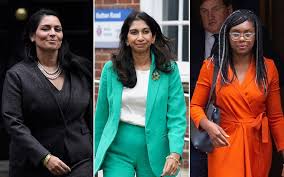
From the left, Priti Patel, Suella Braverman, and Kemi Badenoch

Priti Patel and Suella Braverman, both former home secretaries, pushed unsuccessful anti-immigration policies despite themselves being from immigrant families that benefitted from being accepted into the UK. They have become bracketed with Kemi Badenoch, who had Nigerian parents. She was a more constructive business and trade secretary though she also aggressively courted the mostly right-wing Conservative Party membership. 

Rishi Sunak was saddled with the task of managing the political debris he inherited from his prime ministerial predecessors Boris Johnson and Liz Truss. 

Sadly, even though he had built a sound reputation as chancellor of the exchequer (finance minister), he quickly showed that he lacked the political instinct and experience to lead and survive in a government torn by policy differences over a range of issues, notably immigration.

He called the election unexpectedly early without sufficient planning, and then had a series of fiascos. The worst was when he left France a day before other world leaders at World War Two’s 80th D-Day commemorations to return to Britain. That lead to massive criticism.  

His parents, of Indian origin, arrived in Britain from East Africa long after the war and it seems he failed to realise the importance of the event to those whose British parents were alive and maybe served in 1944. If there was a time when his origins counted against him (and I have never believed they were important), it was certainly then, significantly reducing his personal support in the middle of the election campaign. It prompted Nigel Farage, leader of the far-right Reform Party to say Sunak “doesn’t understand our history and culture”, a rare public reference to his background.

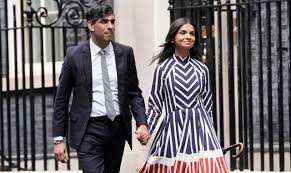
Rishi Sunak and his wife Akshata Narayana Murty leave Downing Street

Of the three women ministers, Braverman was – and is – the most brazenly focussed on the leadership. Born to Kenyan Indian and Mauritian parents, she adopted dangerously shrill anti-immigrant tone, breaching collective Cabinet responsibility and failing to solve the major and continuing problem of stopping boat people crossing the English Channel from France.

Such behaviour prompted Robert Buckland, a former justice minister to attack her indirectly when he said, after losing his seat in the general election: “I’m fed up with performance art politics. I’ve watched colleagues in the Conservative Party strike poses, write inflammatory op-eds and say stupid things they know have no evidence for instead of getting on with the job”.

British politics however is not rid of Braverman (who was sacked by Sunak), Badenoch, and Patel, 52, who was born in London to Ugandan-Indian parents. All three have been re-elected as MPs and all are likely contenders to take over from Sunak, who has agreed to remain as party leader and leader of the opposition till the succession is organised.  

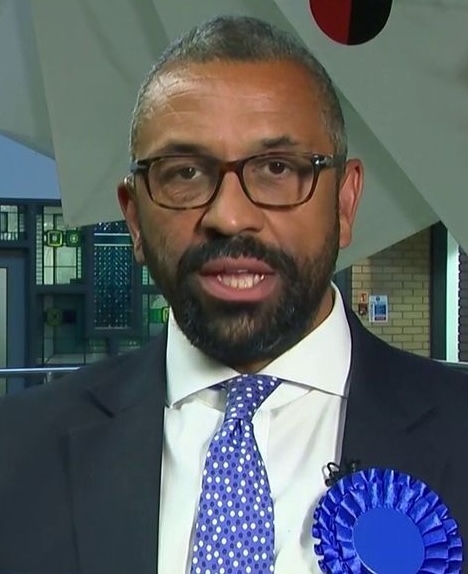
James Cleverly

Badenoch, 44, has the best chance of winning. The party might however go for more centrist candidates where the possible names include James Cleverly, also from an immigrant family with an English father and Sierra Leonean mother. He has built a solid repuation, first working with Boris Johnson and more recently as foreign secretary and home secretary and would be a strong contender against other middle-road possibilities.

Braverman (and possibly also Patel) is in favour of the Conservative Party admitting Farage, the charismatic politician whose Reform Party won an astonishing 14% of the votes in the general election, though only gained five seats in parliament.

The Conservative Party will now be split on how to handle Farage because he will always be trying to upstage them. But he has said his main target is Labour, where he wants to win voters at the next general election. Immigration will be the main policy battleground for this astute campaigner, following his earlier success as a crucial leader on Brexit.

Keir Starmer’s cabinet

In Keir Starmer’s new cabinet, there are three ministers with South Asian links, all getting posts in government for the first time. The new foreign secretary is David Lammy, 51, who was born in London to Guyanese parents, but had an Indian grandmother who was born in Calcutta and sent as indentured labour to Guyana. His mother went to the UK as part of the Windrush generation. 

Lammy, whose commitment to policies has varied in past years, has just been named along with his wife, portrait painter Nicola Green, as a surprise second on the up-market Tatler magazine Social Power Index – a rare event for a Labour politician.

Tatler” magazine’s power couple David Lammy and his wife Nicola Green

Starmer’s government has done extensive research and preparation on most major domestic issues, but it is weak on foreign affairs and Lammy has been on a steep learning curve after he was appointed shadow foreign secretary in 2021. He seems likely to visit India later this month.

He has had to row back from calling Donald Trump a “woman-hating, neo-Nazi sympathising sociopath” in a Time magazine article he wrote when the former president visited the UK in 2018. Recent trips to the US have included meetings with prominent Republican Party members, though there had been reports that he might have not been made foreign secretary

Shabana Mahmood, 46, whose family roots are in Azad (Pakistani) Kashmir, has been appointed the justice secretary. Brought up in Birmingham she has been a practising barrister specialising in professional indemnity cases.

Lisa Nandy, 44, whose father is from Calcutta and mother is British, has been made secretary of state for culture, media, and sport where she is likely to be a stauncher defender of the BBC than her Conservative predecessors over the past 14 years.

It looks as though what Sir Keir Starmer yesterday called “tribal politics” will not be prevalent in the new government, even though they are continuing to flourish in the Conservative Party’s search for a new leader. Without actually naming Boris Johnson or his successors, Starmer promised that the government would “turn its back” on “picking issues just for party politics”. 

Posted by: John Elliott | June 27, 2024

Modi’s election setback fuels recovery of the Gandhi dynasty

A united Opposition adopts Rahul Gandhi as its leader

Rahul’s sister Priyanka steps up to join him in parliament as an MP

Narendra Modi’s unexpected failure to achieve an outright parliamentary majority for his Bharatiya Janata Party in India’s recent general election will go down in history as the trigger for the revival of the country’s Nehru-Gandhi dynasty that seemed to be on a path of endless decline.

That is in addition to the election result being an historic personal setback for Modi’s now unreal dream of becoming an invincible Hindu nationalist leader facing virtually no opposition.

The revival became clear on June 25 when Rahul Gandhi, the dynasty’s heir apparent, was named leader of the Opposition in India’s parliament. Never before have other opposition parties, now working together for the first time in years, been willing to accept him as their leader.

How long the unity will last – and how successful a leader Gandhi will be – remains to be seen. But this is a new era in Indian politics, however much the government may be demonstrating continuity from before the election.

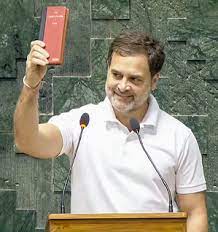
Rahul Gandhi being sworn in to parliament

Modi is facing the challenge, both in parliament and across the country, of managing opposition that he has never faced in his political career.

The BJP’s National Democratic Alliance (NDA) has just 293 seats in the Lok Sabha (lower house of parliament), while the I.N.D.I.A grouping that includes the Congress party has 232. Modi has to rely on two potentially unreliable regional NDA parties for a parliamentary majority.

“The space in the Indian political system has been blown open,” Gandhi told the Financial Times last week. “The idea of Mr Modi and the image of Mr Modi has been destroyed,” he added, with a tinge of exaggeration.

The Opposition leadership is – till now, power-shy – Gandhi’s first constitutional post after 21 years in politics. It is also the first time that he has accepted a formal role since 2019 when he resigned as president of the India National Congress party after years of election failures.

Aged 54, he has been groomed by his mother, Sonia Gandhi, to take on the mantle of her late husband and his father, former prime minister Rajiv Gandhi, who was assassinated in 1991. Italian born, Sonia has seemed to regard it as her duty to act as a bridge between the generations. She served for many years as the party president. 

Priyanka Gandhi Vadra, Rahul’s 52-year-old sister, has until recently remained mostly in the background, though she is a more instinctive and sharper politician. She sometimes has an air of dynastic entitlement and failed to make an impact in Uttar Pradesh state elections when she was in charge of the Congress campaign in 2022. She is now becoming a member of parliament for the first time and seems likely to emerge as her brother’s main support.

Rahul Gandhi with his sister Priyanka
Image Credit: ANI

Rahul entered politics in 2004, but his political performances have been erratic and his public appearances frequently underwhelming. He consistently resisted taking responsibility on a continuing basis and became famous for disappearing abroad at key times. He was regularly mocked by Modi and other opposition politicians as a privileged shehzada (prince) and there has been general despair about him ever growing up politically.

“Normally, after every election campaign, Gandhi used to board the next flight out of India to decompress”, Swati Chaturvedi, an experienced columnist, wrote this week. “The BJP waited eagerly for it [this time], created memes and content, yet despite the record heat in India touching 50 degrees in Delhi, Gandhi has not budged”. 

The changes have become visible in the past couple of years when Gandhi has made two long yatras (journeys), first walking 2,200 miles from the south to the north of the country 18 months ago, and then travelling from east to west earlier this year.

Observers have noted that Gandhi was developing a national profile and respect on this year’s yatra, even though he wasn’t (and still isn’t) in charge of the party officially – a non-Gandhi veteran politician, Mallikarjun Kharge, is the party president and his mother is chair of the Congress parliamentary party. 

“He has become a symbol for all those dissatisfied with the Narendra Modi rule. And the first choice of the minorities – wherever the Congress is in a position to get its act together,” Neerja Chowdhury, a veteran political columnist wrote in March.

This emerged especially in the politically sensitive state of Uttar Pradesh where Gandhi worked closely with Akhilesh Yadav, leader of the state-based Samajwadi Party, seemingly helping to pave the way for the Opposition leadership.

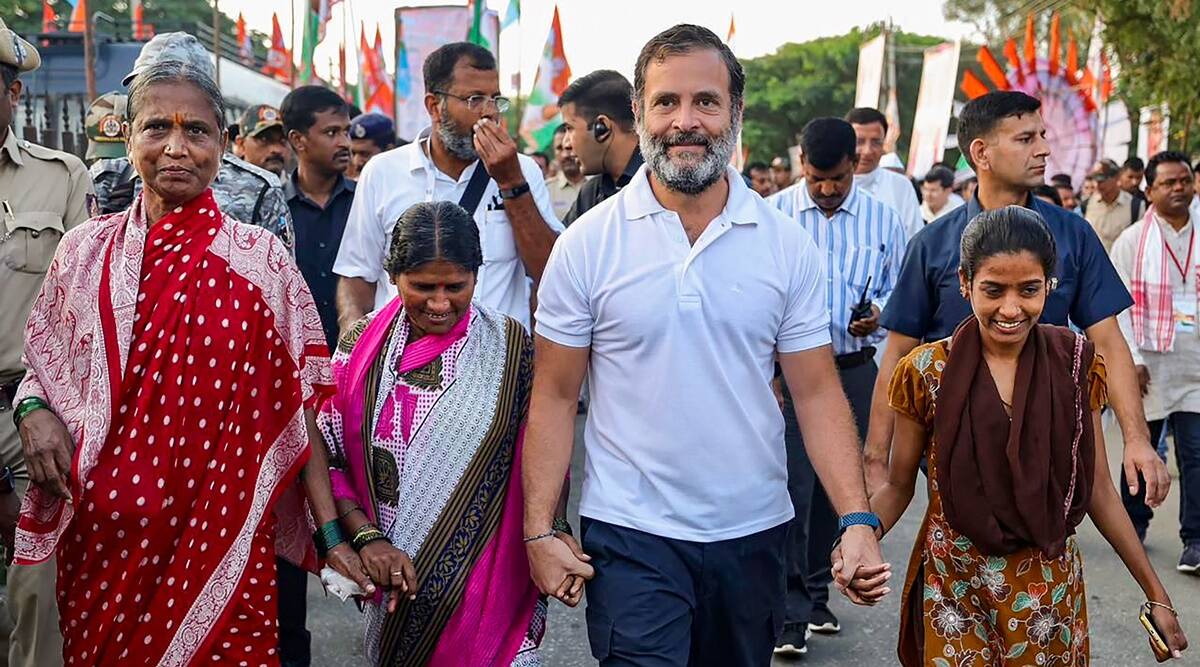
Rahul Gandhi on his first yatra in the southern state of Telengana

When I spoke to Gandhi in London just over year ago, he sounded confident and said that the Congress Party had the “ideological spine” and “foundational ideology” needed to defeat Modi.  Regional parties, now aligned with Congress, didn’t have “the necessary ideology” to tackle the BJP and its hardline mother organization, the Rashtriya Swayamsevak Sangh (RSS).

The regional party leaders probably wouldn’t agree with all of that, but there is no doubt that Congress is the only party that has the nation-wide reach needed to unite the opposition, even though its image has sunk in recent years. 

Gandhi made a good start in parliament with a short speech on June 26. Congratulating the BJP’s Om Birla on being re-elected speaker of the Lok Sabha, he said that Birla had the “duty of defending the Constitution of India” and was the “final arbiter of the voice of the people”. The Opposition now “represented…that voice significantly more” than it had in the last parliament. This was a plea for the opposition not to be silenced as it had been, and a warning that the BJP should not tamper with the constitution.

The Opposition now needs to develop positive policies for the future so that its political platform is not just opposing the Hindutva authoritarianism and nationalism of the Modi regime. 

Modi’s aim since he became prime minister 10 years ago has been to eliminate memories of the dynasty’s positive role in India’s development so that he could supplant Jawaharlal Nehru, Rahul Gandhi’s great grandfather, as the country’s greatest prime minister.

That looks far less likely to happen than it did just a few weeks ago.

**https://www.asiasentinel.com/p/resurgent-rahul-gandhi-girds-next-year-poll\

** India’s BJP hangs on to power but loses overall control

Posted by: John Elliott | June 4, 2024

India’s BJP hangs on to power but loses overall control

Big setback for Modi’s aim to establish himself as invincible leader

India will now have a coalition government

Narendra Modi is set to become India’s prime minister for a third term following counting of votes in the country’s mammoth general election. But the face of Indian politics has changed dramatically with an unexpected resurgence of opposition regional parties and the Gandhi-led Congress Party, and declining support for Modi’s Bharatiya Janata Party (BJP).

Modi will be sworn in as prime minister on June 8 (or June 9), but his dreams of winning a dominant personal victory as a supreme leader have been shattered in one of the most unexpected reversals for many years.

The result proves the strength and power of India’s often criticised parliamentary democracy with 642m people voting in this election. It also marks the failure of Modi’s ambition to remove the Congress party and its Nehru-Gandhi dynasty leadership from active politics.

Modi’s personal pitch of projecting himself with an almost priestly Hinduism religious role seems to have failed to attract votes – it even failed in the constituency that contains the Ayodhya temple where he presided in January and where the BJP parliamentary candidate lost to the state-based Samajwadi Party. In his own constituency of Varanasi, Modi won with a majority of just 152,513 votes, down from 471,000 in 2019. 

The hopes of Modi’s opponents that one day the political pendulum would swing against harsh autocratic Hindu nationalism has been vindicated. Till now, that seemed only a hope for the somewhat distant future – scarcely anyone had expected it to happen in this election.

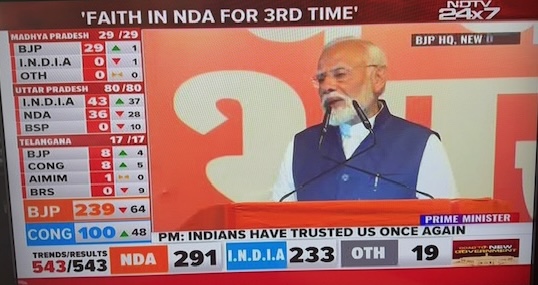
Narendra Modi addressing a BJP rally in Delhi on June 4 after the BJP’s losses had become clear

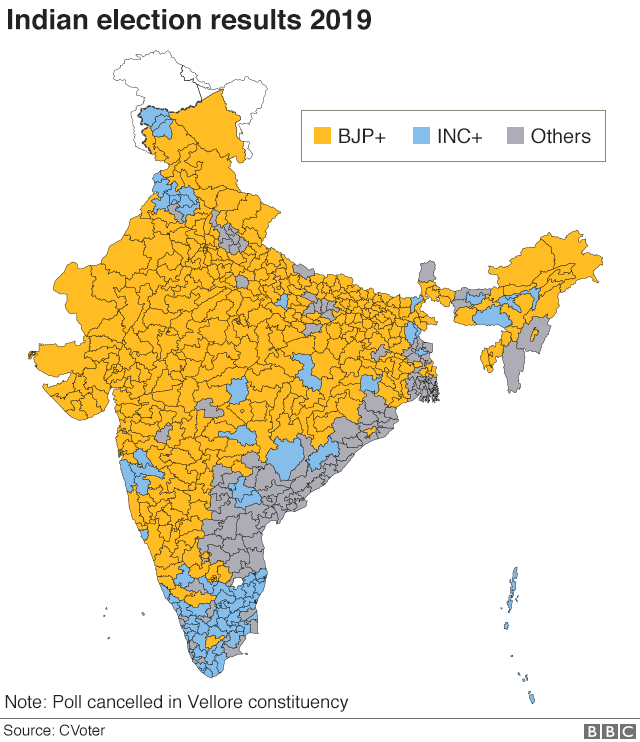
The results show the BJP’s National Democratic Alliance (NDA) with 293 seats in the Lok Sabha (lower house of parliament), and 232 for the I.N.D.I.A grouping that includes the Congress party. Other parties have 19 seats. 

Significantly, these figures include the BJP with 240 seats, down 63 from 303 in the 2019 election, and 99 for Congress, up 47 from 2019. 

There was only a 1% drop in the BJP’s vote share, but co-operation between opposition parties reduced competition in individual constituencies and led to its large loss of seats.

The BJP has therefore failed to reach the 272 majority mark so needs the active support of its coalition partners for the first time since it came to power in 2014. That will pose a personal test for Modi, who has run a centrally controlled government from his prime minister’s office with little notice being taken of alliance partners or other interests.

There were some suggestions as the results emerged that two regional coalition partners might switch to support the I.N.D.I.A, which would have removed the NDA’s majority and could have prevented Modi forming the government. That however is not to be happening. The parties are Bihar’s Janata Dal United (JDU) led by Nitish Kumar, which has 12 seats, and Andhra Pradesh’s Telegu Desam led by Chandrababu Naidu with 16. Both leaders have at different times supported and not supported the BJP, but both have pledged to join the government.

Part of the BJP’s problem was that there was no clear focus in its election campaign, apart from the presence of Modi, and there was a lack of firm polices for the future. This led to local issues and the role of regional parties becoming important in many constituencies. It was also the first time that Modi had faced a united opposition. Turn-out was low compared with earlier elections, suggesting that some BJP supporters had not voted, maybe because they felt that the government had not done enough to boost employment and curb price increases of basic goods. It is also possible that voters did not like extreme anti-Muslim tilt of Modi’s campaigning.

“Big decisions”

Modi put as brave a face as he could on the losses and is presenting the result as a victory for Indian democracy and a success for the BJP winning a rare third consecutive term with a sizeable majority over the I.N.D.I.A. Speaking alongside grim-faced fellow BJP leaders at a party rally when the results were clear, he said the government would now write a “new chapter of big decisions”.

That underlines the point that, while he might feel less confident about pushing Hindu nationalism and side-lining Muslims as a religious minority, and will be slowed down on that by coalition partners, he will now want to do more on economic reforms, social support systems for the poor, attracting foreign investment and building new technology-oriented industries. Some observers however suggest that he may not feel strong enough to carry out delayed and controversial reforms such as privatisation of state industries and changing labour practices.

In addition to failing to establish the country-wide endorsement for his leadership, the BJP only won one seat in southern states where Modi wanted it to establish a significant presence. It raised its percentage of the vote and gained one seat in Kerala but none in Tamil Nadu. It did however repeat its past success in Delhi where it won all the seven parliamentary seats, as it did in 2019.

In the state assembly election in Orissa, it won control for the first time, pushing out the state-level Biju Janata Dal led by Naveen Patnaik who has been chief minister for 24 consecutive years, the second longest of any chief minister in the country. 

The BJP’s biggest setbacks that helped to swing the overall result came in two states. The main surprise was Uttar Pradesh where the I.N.D.I.A won 43 parliamentary seats out of a total of 80, whereas the NDA has only 36, down from 64 in 2019. This is unexpected because Yogi Adityanath, the Hindu priest-turned-chief minister, was reported to have built a good image for the BJP by strengthening law and order and boosting both development projects and care for the poor.

The result is a victory for Akhilesh Yadav, leader of the UP-based Samajwadi Party, working with Rahul Gandhi of the Congress party whose political future looks more assured than it has for many years.

Observers suggest that Yadav and Gandhi successfully worried members of India’s lowest castes that reservation schemes which provide them with jobs and other advantages might be cancelled by the Modi government amending the constitution.

In West Bengal, the reigning chief minister Mamata Banerjee’s Trinamool Congress saw off the NDA challenge and her party won 29 of the 42 parliamentary seats compared with the BJP’s 12. This is a major setback for Modi who wanted to establish the BJP as a significant political force in the state.

The overall result is specially surprising coming after exit polls published when voting ended on June 1. These indicated a massive swing in favour of the BJP with between 355 and 380 seats. That led to a surge on the Indian stock market with prices reaching record levels and a crash when the actual results began to appear today.

Whether the markets needed to be worried depends on how well Modi runs the coalition and carries the BJP’s allies with him on plans for economic reform. The results will not impede the government’s plans if, as Modi has said, they lead to renewed efforts to continue India’s development as the world’s third largest economy.

Modi’s BJP will win when votes are counted on June 4

Do economic advances outweigh negatives of religious polarisation

As India enters the final stages of its general election with the expected Bharatiya Janata Party victory being announced when votes are counted on June 4, the questions whether Narendra Modi’s Hindu nationalist creed and authoritarian rule is good for India, along with the question “Where is India heading” will come into renewed focus. 

It is assumed that Modi’s BJP will return to power with a comfortable majority, though it is less certain that it will achieve the 303 seats (out of a total 543) that it won in the last general election in 2019, let alone reaching Modi’s loudly proclaimed target of 370.

This is partly because there has been no clear focus in the BJP campaign, apart from the towering figure of Modi himself. Maybe more importantly, the Congress and regional opposition parties have come together in the Indian National Developmental Inclusive Alliance (I.N.D.I.A).

This is the first time since he entered national politics as the BJP leader ten years ago that Modi has faced a united opposition, and it has injected both uncertainty and aggressiveness into his campaign. The result will indicate how far the vast mass of Indian voters react to the question about Modi being good for the country.

There are those who believe his rule is necessary and has proved to be good because economic and social development, and opportunities for the poor, are enormously better than they were before Modi came to power in 2014.

On the other hand, others condemn the fact that India is becoming an authoritarian, Hindu-centric country with weakened national institutions and where democracy is, according to some critics, threatened.

It is however widely recognised (even by many Muslims) that Modi has led the country into years of economic success. Growth figures of 6 or 7 per cent may not be the highest ever, and many of the achievements like new sales taxes, bankruptcy laws and social development were begun before he came to power, but Modi and his government have, especially in the last five years, provided the environment, initiatives and drive that were lacking in the past. This will continue with a range of reforms planned for the coming months.

The Modi “package”

People in India talk about having accepted the Modi “package” of authoritarianism and Hindu majoritarianism because of the way the country is progressing. “It’s what we need,” a 40-something businessman from a traditional Congress-supporting family told me at a social gathering recently. He intended to vote BJP in the general election for the first time. 

That partly reflects the failure in the past of the opposition parties to offer a viable alternative. But it also reflects recognition that India is an 80% Hindu country with a growing awareness of nationalistic pride as the country emerges on the world stage.

There is also a factor that is rarely mentioned – widespread antipathy among Hindus towards Muslims, not usually as individuals but in general. That sentiment has been exacerbated by what is called the “appeasement” of Muslims with favourable policies under past Congress governments. 

I have heard many examples, in London as well as India, where Indian liberals are horrified that old friends, for example from university in Delhi or elsewhere, air views that were not apparent before, supporting Hindu nationalism and the Modi regime and openly revealing anti-Muslim sentiments. It is as if having Modi in power has released views that till now would have remained hidden.

Even the harshest critics of the regime now acknowledge the achievements. An article in the Foreign Affairs journal by Ramachandra Guha, a widely respected commentator, in February was headlined “How Modi’s Supremacy Will Hinder His Country’s Rise”.

But it included acknowledgment for the government “supplying food and cooking gas at highly subsidized rates”, albeit branded as “Modi’s personal gifts”. Guha also mentioned promotion of digital technologies that “enabled the direct provision of welfare and the reduction of intermediary corruption,” plus substantial progress on infrastructure development “with spanking new highways and airports seen as evidence of a rising India on the march under Modi’s leadership.” 

Narasimhan Ram, a well-known former newspaper editor and Modi critic listed the negatives in a recent article in the UK’s Prospect magazine. They included: “targeted assaults on freedom of expression, media freedom, media independence and other fundamental rights”; using “anti-terror, sedition and other draconian laws to incarcerate journalists, students, human rights defenders… and troublesome critics of the government, often without bail or trial”; introducing “religion as a criterion for citizenship”, deploying “brutal force to suppress democratic protests”; and misusing anti-crime agencies “to go after and arrest political opponents, including ministers, chief ministers and legislators”.

The early successes helped Modi to achieve a massive victory in the 2019 election when border conflicts and terrorist raids linked with Pakistan provided a vote-winning backdrop. Modi’s first victory in 2014 had been fuelled by a widespread desire for a change from the years of Congress rule.  

Lack of clear focus

This time the focus is not so clear cut. Modi has personally towered over the election campaign with meetings virtually everywhere. His aim has been for his image to draw the votes, aided by his priest-like appearance that dominated the opening ceremony in January of the famous Hindu temple in Ayodhya.

But voter turnout over the past six weeks has been a few percentage points lower than in 2019, which has led to suggestions that Modi was failing to generate enough enthusiasm and that memories of his performance at Ayodhya were fading as a vote generator. “The temple issue peaked far too early and there is a law of diminishing returns when you repeat the same emotive issue in each election,” Coomi Kapoor, a columnist, wrote in the Indian Express.

Since voting began last month, Modi has sharpened his religious polarisation and Muslim rhetoric in campaign rallies, linking that with attacks on the Congress party. He has said that “Congress has hatched a deep conspiracy to snatch your property and distribute it among their special favourites”, by which he meant transferring wealth from Hindus to Muslims. He also said that Congress would “bulldoze” the new Ayodhya temple. 

The aim of these clearly incorrect remarks was to harness support for the BJP among Hindu voters, but the extent of such blatantly false allegations has been widely criticised, including by the Election Commission. In an apparent attempt to soften his image, Modi has given a series of carefully managed television interviews, which he has hardly ever done in the past, seemingly indicating his concern about where the election was heading.

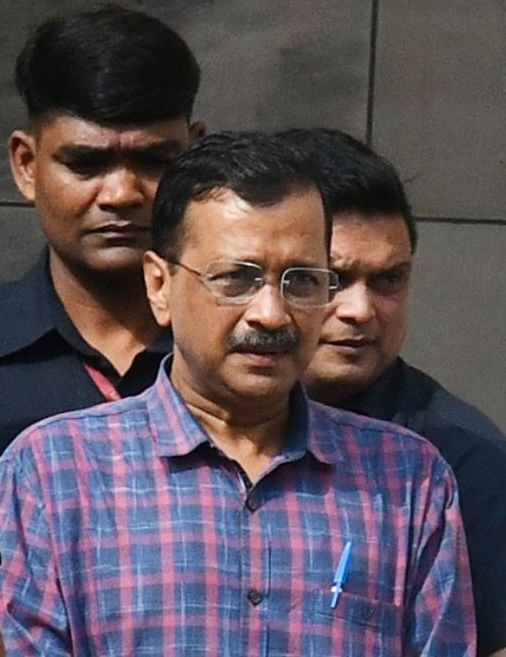
Arvind Kejriwal being arrested in March

Apart from the overall totals of parliamentary seats, there are two specific results which could seriously undermine Modi’s success. One is the southern states where the BJP may not do well, despite Modi having spent a large amount of time trying to achieve a breakthrough.

The other is Delhi where there may be an anti-BJP sympathy vote for the Aam Aadmi Party (AAP). A few days after the election dates were announced in March, the finance ministry’s enforcement directorate arrested Arvind Kejriwal, Delhi’s AAP chief minister.

The directorate was investigating long-running corruption charges on a liquor licence scam and had already detained the deputy chief minister. This was part of a Modi campaign to remove Kejriwal and break the AAP that dates back to the small party gaining power in 2015 when the BJP had expected to win. 

The supreme court released Kejriwal on bail on May 10 so that he could take part in the general election amid widespread condemnation for the way that the government was using the enforcement directorate and other crime agencies to undermine non-BJP parties in various states.

What seems to be certain is that Modi will be forming a new government next week and that there is no prospect of the focus on establishing a dominant Hindu nation being reduced – indeed, the reverse is likely, for better or for worse. 

Takes unprepared MPs and Ministers by surprise as inflation falls

Big Labour victory expected in polls on July 4th

The days of Britain having a prime minister of Indian origin are almost over, for several years at least. Rishi Sunak declared yesterday that there will be a general election on July 4, several months earlier than had been expected. There is little prospect of his Conservative Party being re-elected. 

Indeed, the chances of Sunak winning are no more likely than Narendra Modi doing seriously badly in India’s current election. Sunak may not lose as disastrously as most pundits are forecasting with his party being virtually wiped out, and Modi may not win as overwhelmingly as seemed likely, but the results are as certain as can be, and Sir Keir Starmer, leader of the Labour Party, can expect to become prime minister on July 5.

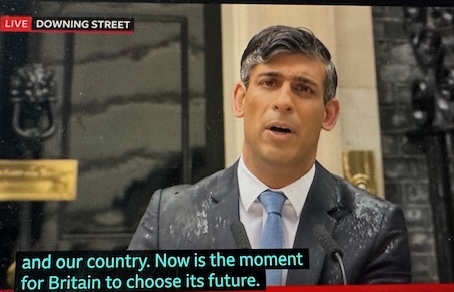
Sunak stood in pouring rain yesterday evening in Downing Street to announce that he was calling the election. His speech was heavily focussed on the economy and security at “this most uncertain of times”. The visual image was spoiled by Sunak being drenched in the rain and the audio by sounds of the Labour Party-favoured song “Things Can Only Get Better” being boomed out at the end of the street.

It has for some months seemed to be the time for Sunak and his government to pack up and go. He was elected by Conservative MPs to be their leader, and thus the prime minister, in October 2022. The task was to bring some sanity and responsibility to Downing Street after two disastrous prime ministers, the blatantly dishonest rule-breaking Boris Johnson who led the UK into a much-regretted Brexit, and the 45 days of disastrous economic experiments from Liz Truss.

Sunak inherited the effects of the Covid pandemic and Russia’s invasion of Ukraine. He had early successes, including a long-delayed Brexit trade protocol for Northern Ireland in March last year. He also maintained Britain’s prominent role supporting Ukraine.  

But his personal popularity has slumped in recent months, and he has cut a lonely figure, lacking political charisma. He has an earnest energetic style that focusses on details rather than pitching a positive overall image that could have public appeal. Opponents on the right wing of his party were ready to mount a coup to oust him at the beginning of this month when the Conservatives did badly in local and regional elections, but he just survived.

The election announcement was totally unexpected yesterday. Most ministers and all MPs were assuming they would continue with their jobs for several more months . Rumours that might not happen started circulating among MPs and some journalists around midday when news spread that the foreign secretary, Lord (David) Cameron, was cutting short a trip to Albania. The defence minister Grant Shapps delayed a foreign trip, and other ministers readied for a cabinet meeting in the afternoon.

It appears that Sunak decided to go now rather than in the autumn because the economy is looking more buoyant than it has for some time, and there is little prospect of the government being able to afford popularity- boosting tax cuts in the autumn.

.It was announced yesterday morning that inflation dropped during April from 3.2% to 2.3%, the lowest since 2021 (with an 11% high in 2022), though food and other key prices remain high. Economic growth is also picking up – faster than in Germany and France, though it is still below 1%. 

Sunak must have reckoned that this is the best that it is likely to get because he can claim to have fulfilled two of five pledges he rashly made in January last year. The three he has failed on are curbing the flow of immigrant boats crossing the English Channel from France and despatching some to Rwanda, reducing National Health Service waiting lists and reducing national debit.

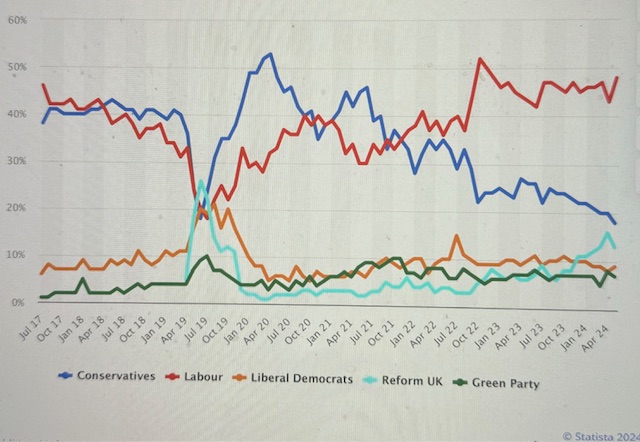
Popularity opinion polls show the Conservatives have been dropping sharply and are now down to 23%, way below Labour at 45%. Ominously for Sunak, the right-wing Reform Party (previously the Brexit Party) is on 11% with the Liberal-Democrats at 9%. Reform’s candidates will eat into the Conservative vote, strengthening Labour’s likely majority.

Labour’s problem however is that Starmer, who was awarded his knighthood after being the director of public prosecutions some years ago, does not have a strong public following. There is little evidence that voters see him as the essential prime minister that the UK needs. His competence is not in doubt, though he has not been tested in a ministerial post.

The Economist has a complex model with a range of options for the result centred on 381 seats for Labour (326 is needed for a majority) with the Conservatives on 192, the Liberal-Democrats on 22, the Scottish National Party on 27, and the right-wing Reform Party maybe 19. 

Commentary in the British newspapers yesterday evening was mostly critical of the decision to have the election now rather than towards the end of the year – the deadline is at the end of next January.

The FT headlined “A last gamble for a prime minister who has run out of road”, saying “with nothing on the horizon likely to dramatically improve, Sunak has decided to seize the economic moment”. The Economistsaid said “The prime minister’s decision makes little sense but it is good news all the same”, and The Times offered “Rishi Sunak surely cannot believe the Tories can win an election”. 

The Telegraph demonstrated its true-blue sympathies with a columnist writiing: “There are just 1,000 hours to save Britain. Rishi Sunak must expose Labour’s socialist agenda and give conservatives clear new reasons to back him.”

Crisis list

Whoever wins, there are numerous crises to be faced. A list has been drawn up by Sue Gray, a former top civil servant who is now Starmer’s chief of staff. Dubbed by a Labour MP as “Sue’s shit list”, it includes the potential financial collapse of the major Thames Water private sector utility, public sector pay negotiations, crisis-level overcrowding in prisons, universities finances “going under”, NHS funding shortfall, and bankrupt local councils.

The next government will also have to tackle how the public sector handles major crises, frequently burying them to protect those involved instead of finding solutions. There are two current examples in the news this week. One is an official report into the deaths of an astonishing total of 30,000 people as a result of contaminated blood transfusions given by the NHS in the 1970s and 1980s after childbirth, surgery, or major trauma. Other countries dealt with this crisis decades ago, but it has taken till now for an official report to be published. The other case involves the (privatised) Post Office, where hundreds of people running small post offices were wrongly prosecuted and convicted of embezzlement between 1999 and 2015 following cash losses that were being caused by a faulty Fujitsu computer system.

Sunak, whose parents moved to the UK from East Africa, has taken a huge gamble by going for the election now instead of waiting till the autumn or the end of the year, He probably hopes to minimise the size of the defeat, rather than actually expecting to win what would be a fifth consecutive victory for the Conservatives.

But he has never shown much skill at managing politics, so critics in his party and others are waiting to see whether this is his final big misjudgement because, if the Conservatives do seriously badly, he will be blamed for acting too hastily a few hours after the favourable inflation figures.

Posted by: John Elliott | April 19, 2024

Modi plays the foreign policy card as election voting starts

BJP bids to breakthrough in the south where it lacks support 

Vote counting on June 1 with BJP aiming to beat 2019 tally

The Iran attack on Israel couldn’t have been better timed for Narendra Modi, India’s prime minister. It enabled him to make national security a reason to vote for his Bharatiya Janata Party in India’s general election that starts today (April 19). “In times of global unrest, the necessity for a stable government with an unequivocal majority in India becomes even more pronounced”, he declared when he launched the party’s manifesto last weekend.

The theme of a strong government capable of tackling international crises fits well with India’s and Modi’s higher profile internationally, which is being increasingly recognised as significant by Indian voters according to recent opinion polls. This has changed the historic feeling that the country’s worth and culture were not given sufficient notice and credibility internationally under previous, mostly Congress, governments.

The foreign success angle is an especially useful electioneering theme in southern India where the BJP’s primary Hindutva nationalism platform has far less appeal than in the north.  

Spreading the BJP’s influence in the south during this election is a tough challenge that Modi has publicly set himself, not just to win votes but in order to spread the Hindu banner across India and unite the country as no ruler has ever done in history. 

Modi’s aim is to restore India to what he sees as the Hindu supremacy that existed before India was conquered and colonised by Muslim Mughal and Christian British invaders, while also eclipsing the Congress party’s Nehru-Gandhi dynasty in the story of India’s development. 

Voting begins

The seven-phase election with 968m eligible voters begins today.  Modi’s declared target is for the BJP to win 370 seats in the 543-member Lok Sabha (lower house), up from 303 that it won in the 2019 election and rising to 400 including political allies in the party’s National Democratic Alliance (NDA). 

It is generally accepted that to do this, the BJP needs to establish itself as a significant force in the south where it won only 29 out of 130 seats in 2019. That will not be easy.

The challenge begins in Tamil Nadu where voting takes place today and the BJP has little obvious appeal. The party received less then 4% of the Tamil Naidu vote in 2019 and won no seats so the state has been a major focus for Modi’s election meetings. 

Only in Kerala, where 18% of the population is Christian and 28% Muslim, does Congress have a significant presence – it did well in the 2019 election against its traditional rival, a regionally strong Communist party, the CPI(M).

These southern states are mostly governed by strong regional and often dynastic parties that, seeking support in Delhi, have traditionally allied with the BJP or the Congress which is no longer a significant force in most of the states.

The BJP recognises that it is Modi’s massive public appeal, not the party, that could win over sceptical voters across the culturally distinct southern states – Andhra Pradesh, Telangana, Tamil Nadu, and Kerala. Strong loyalty to regional languages means there is resistance against the BJP’s attempts to spread the use of Hindi. There is also powerful opposition to the government’s policies of centralisation that have marked Modi’s years in office.

The south is better economically and more developed, including literacy and women’s employment, than the north. It is also more productive and attractive to new foreign investors, It has not therefore needed to benefit as strikingly from the BJP government’s successful vote-winning work making significantly improved services available for the first time across the north.

This includes new and improved highways and village roads, along with housing and toilets schemes, provision of gas cylinders and electrical connections, plus 500m bank accounts and electronic transfer of billions of rupees to the poor. 

International image 

Ever since he became prime minister in 2014, Modi has pursued a high profile abroad, not just for the usual foreign policy reasons but to build his image within India as an important world leader. There is also the bonus of winning over the 18m people of Indian origin living abroad (the world’s largest diaspora) who can help fund BJP activities and influence the way their relatives and friends in India support the party.

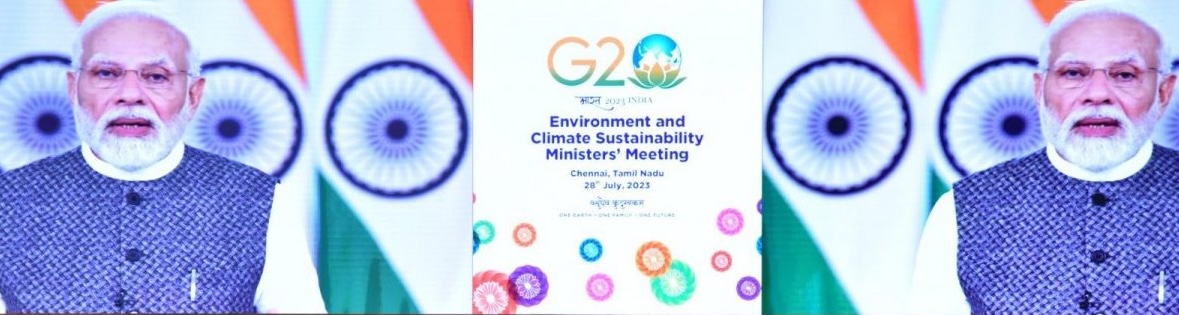
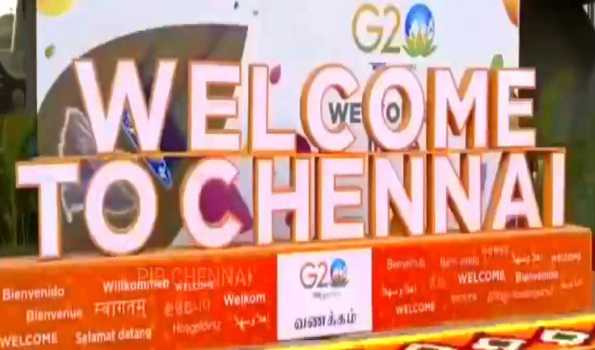
The backdrop to the G20 Environment and Sustainability conference hall in Tamil Nadu July 2023

From the start of his time as prime minister, Modi adopted a flamboyant profile on foreign visits including massive meetings with thousands of the diaspora, first in New York’s Madison Garden and London’s Wembley stadium and then in other capitals. He has built equally high-profile relationships with foreign leaders, notably Donald Trump in the US but also many others – including Xi Jinping in China that did not produce the intended positive effects.

India’s successful leadership of the G20 multi-national forum last year was turned into a country-wide celebration, not just an international event. Ahead of the Delhi summit last September, some 220 meetings were held in 50 cities, all decked out with placards of the G20 logo and the prime minister’s image, smartened-up streets and buildings, and a general celebratory air. For the first time ever, India’s international activities – and its official foreign visitors – were visible to a significant proportion of the population who would been scarcely aware of them earlier.

India’s standing in the world has also become a subject for discussion across India led by S. Jaishankar who was foreign secretary in Modi’s first term and has been a highly vocal minister for external affairs since 2019. He is the government’s most articulate voice both abroad and at seminars and conferences in India, selling the Modi message and putting much-criticised Hindutva in a historical perspective. His often blunt remarks show he must be fully trusted by the prime minister. 

Voters’ pride in their country is boosted by these messages about Modi’s – and therefore India’s – growing influence internationally, its membership of international organisations like the G20, and its ranking as an important global economy.

Evidence that this is being recognised was shown in a survey in May 2023 conducted by the Delhi-based Lokniti Programme of the Centre for the Study of Developing Societies (CSDS), and the NDTV television channel. It showed that 63% of respondents said they believed that India’s global status had risen since Modi became prime minister in 2014.

The same poll found that most Indians believed the country had progressed in furthering its cultural capital, its status as a world leader, and its attraction as a destination for foreign investment during those years.  

That is a more constructive and reassuring message than strong cross-border confrontation with Pakistan that was played out as a vote-winner in the last 2019 general election campaign. It is also less controversial than India protecting its citizens’ interests by allegedly being involved in the assassination of Sikh separatists in Canada, the US and Pakistan that has been reported recently. “Whenever we have had a weak government in the country, our enemies have taken advantage. Under this strong government, atankwaadiyon ko ghar mein ghus ke mara jata hai (our forces are killing terrorists on their own turf),” Modi is reported to have said on April 11. 

One often hears that Modi has “put India on the world map.” The prime minister clearly hopes that this helps to win votes today and in the remaining six phases of the election that ends on June 1.

A tribute to India’s “most misunderstood prime minister”

Written by “the last Pakistani left in India”

With Narendra Modi’s Bharatiya Janata Party virtually certain to win India’s general election for the third consecutive time in May, the decline of the Nehru-Gandhi dynasty and its domination of the once all-powerful Congress party will inevitably hit headlines, as it has repeatedly done for years.

So it’s running against the tide for two books to appear now supporting the reputation of Rajiv Gandhi, the most unsung of the dynasty’s three prime ministers. Maybe that is not surprising though, given the style of the author. Mani Shankar Aiyar, a diplomat turned voluble maverick and contrarian politician, is a rare but committed defender of Gandhi, having worked closely with him when he was prime minister from 1984 to 1989, and then in opposition for 18 months till he was assassinated in 1991.

No-one who knows Mani and has heard him speak, at length, will be surprised that he has spun these substantial volumes with a third on the way. The books are highly readable, laced with occasional jibes and often irreverent anecdotes. 

He describes a prominent Delhi journalist (now a columnist) as “she of the quill dipped in hemlock”. An American lady diplomat in prohibition-bound Pakistan invited him to her room for an illicit late-evening drink saying, “They’ll all be thinking we’re up to the other thing and we can just quietly have a nightcap!’  Aiyar comments: “I should perhaps have penned my first DIY book: ‘How to Live with Prohibition – and Learn to Love It!”

The books are notable not just for such snippets and the Gandhi focus, but also the history of Aiyar’s own life. That includes going, like Gandhi, to Cambridge after the elite Doon School in north India which, he says, “brought me up to be a good little Englishman”

There is also for an unfashionable affection for India’s troublesome neighbour Pakistan. A book review there has dubbed him “the last Pakistani left in India”, reflecting his fondness – for the people – that began in Karachi where he re-opened the Indian Consulate in December 1978 and stayed for four years. Since then, Aiyar has been a constant promoter of peace between the two nuclear powers.

What is striking in the books is that they give fascinating historical insights into issues and crises experienced by Aiyar that are still active today. 

Most immediate is Gandhi’s apparent decision to allow the gates of the long-closed Babri Masjid mosque in Ayodhya, in the northern state of Uttar Pradesh, to be re-opened. That led to its demolition by Hindu protestors and eventually to a BJP campaign to build a new grand temple on what was an old Hindu site. On January 22, Modi will preside at a ceremony marking the inauguration of the under-construction temple. Also topical is Gandhi’s much criticised endorsement (in what was known as the Shah Bano case) of Muslim Personal Law on women’s limited divorce settlement rights. This would be corrected under the Modi government’s proposed controversial Uniform Civil Code. 

Other issues range from the 1980s Sikh demand for an independent state called Khalistan that has recently surfaced in a diplomatic row with Canada, to a Swedish Bofors gun corruption scandal that enveloped Gandhi and still has echoes in alleged high level graft on foreign defence deals.

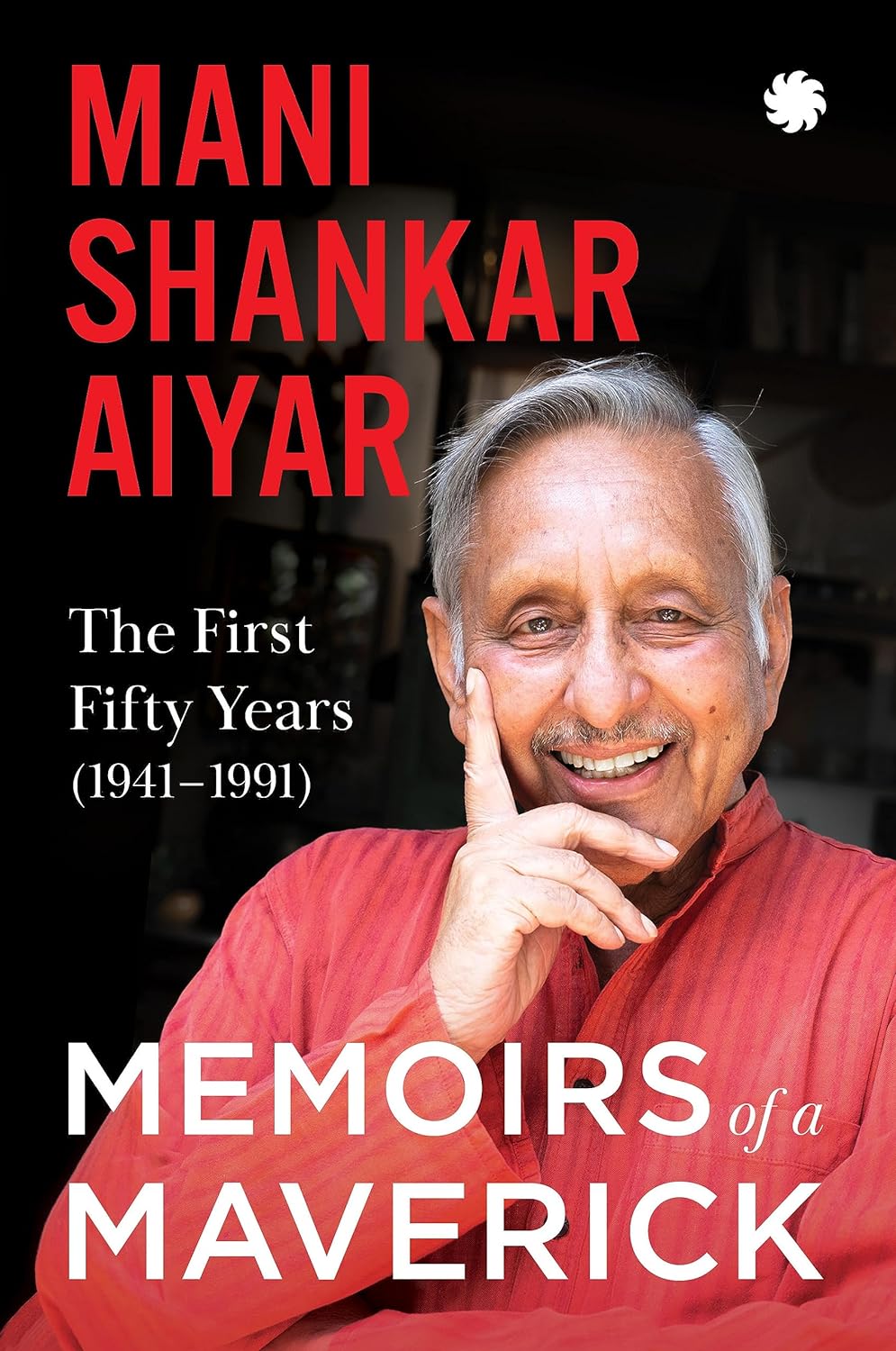
The first of the books, Memoirs of a Maverick – The First Fifty Years, is Aiyar’s own autobiography and was published in August. It includes a long section on Gandhi’s time in office, which has been expanded in some detail in his second book that is out this month. Called The Rajiv I Knew and Why he was India’s Most Misunderstood Prime Minister, it goes into more detail on what Aiyar calls a “political biography” about Gandhi’s record both in power and in opposition. 

A third volume, now being edited, covers Aiyar’s 21 years in parliament, five as a hard working cabinet minister (including petroleum & natural gas and youth affairs & sport). It then goes on to what he describes as his “marginalisation in the [Congress] party since 2010” – something that he feels deeply. 

That marginalisation was a waste of a talent that Aiyar displayed as petroleum minister. As I reported (much to his surprise) in The Economist in 2005he transformed “a government department better known for the illicit allocation of petrol-pump licences to politicians’ families and friends into a significant player on the international stage”. He promoted an Asian gas grid and began moves to bring natural gas to India from Iran, Myanmar and Turkmenistan.

Aiyar argues that Gandhi’s “principal legacy to the nation was the constitutional imperative of Panchayati Raj that would by now have blossomed had he remained at the helm of the nation for a few more decades”. Aiyar made this system of village self-government a personal crusade and at one point had ministerial responsibility for its development.

Economic reforms

The books deservedly give Gandhi credit for initiatives he launched, challenging widespread criticism on economic controls that helped to pave the way for major reforms launched by a later Congress government in 1991. The imagination of India’s educated youth was captured for what could be achieved and interest was boosted in stock markets.

On foreign policy, Gandhi developed relations with China, took mis-steps in Sri Lanka over Tamil separatism, but worked well with the Pakistan’s military dictator-president Zia ul-Haq and then with Benazir Bhutto when she became prime minister. If Gandhi and Bhutto had lived and stayed in power, more could maybe have been achieved.

Gandhi had many critics and opponents who tried to scupper his well-meaning initiatives and Aiyar picks out one prime villain – cousin Arun Nehru, a politician who he describes as “rough, brusque, dominating and a bully”. 

Nehru ensured that Gandhi became prime minister within hours of his mother Indira Gandhi being assassinated (by Sikh security guards) in 1984. At the time it seemed that Nehru’s aim was keep the family in power, but Aiyar suggests his real purpose was to increase his own power by dominating the apparently (but not always) mild Gandhi. Aiyar accuses Nehru of playing a central role in organising the bribes that led to the Bofors scandal and also for his role in unlocking the Babri Masjid gates and the Shah Bano case. 

The thesis is that Gandhi had faults and made mistakes, some naive and some where he was misled by advisers. I was the Financial Times‘ correspondent in Delhi during most of the years Gandhi was in power. Perhaps inevitably, Aiyar sometimes overstates his case but I agree with him that Gandhi’s intentions were good, and that he left the legacy of a country ready for the major 1991 economic reforms, paving the way for what India is achieving today. That is important at a time when it is rare to hear positive comments on the fading dynasty’s contribution to the country’s development.

Memoirs of a Maverick – The First Fifty Years (1941-1991) By Mani Shankar Aiyar JUGGERNAUT Delhi Kindle and paperback

The Rajiv I Knew and Why he was India’s Most Misunderstood Prime Minister by Mani Shankar Aiyar, JUGGERNAUT Delhi, Kindle and paperback

Posted by: John Elliott | December 24, 2023

Merry Christmas!

Posted by: John Elliott | November 14, 2023

Sunak sacks troublesome Braverman and reinvents ex PM Cameron

Desperate attempt to get a government that works 

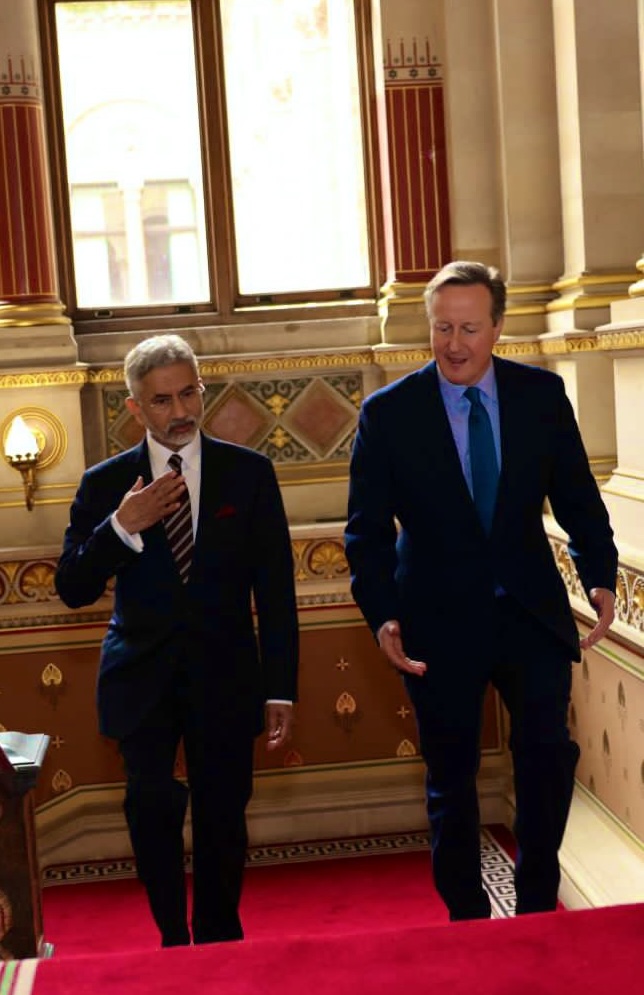
Lord Cameron meets Indian foreign minister Jaishankar

After weeks of declining popularity and effectiveness, Britain’s prime minister Rishi Sunak has made risky changes to his cabinet that will create major political problems for him through to the general election expected late next year. The moves, which include the astonishing return of the somewhat discredited former prime minister David Cameron to the cabinet, could however strengthen the stability and authority of his government.

The problems and the stability both come from Sunak sacking Suella Braverman, the eruptive, headline-grabbing and arguably irresponsible home secretary, whose frequent controversial remarks climaxed with statements that exacerbated tensions at massive pro-Palestine demonstrations over the weekend.

David Cameron leaving No 10 Downing Street after being appointed Foreign Secretary

Braverman was sacked, a Downing Street spokesman has suggested, because of her (shrill) tone more than her policies and because she ignored collective cabinet responsibility. She was not it seems offered a new post and will now try to seal her role as a populist focal point for the turbulent right wing of the Conservative Party.

She might well become an active leadership challenger for Sunak, but he would have looked weak to the point of incompetence if he had not dared to sack her. He now faces potential unrest in the Conservative Party around the country where many ordinary members back her right wing views on blocking immigration and tougher police action.

Her successor, James Cleverly, has risen in prominence as foreign secretary in the past year. He has brought respect and rationality to the role after three predecessors generally regarded as failures – Liz Truss (later briefly prime minister), Dominic Raab (now out of politics) and Boris Johnson (whose reputation as prime minister lies in tatters).

That left a vacancy as foreign secretary which Sunak could have filled uncontroversially with an existing member of the cabinet. Instead, he has brought the former prime minister David Cameron into the government, astonishing all political observers and MPs, and the international community. Cameron is not an MP so has been made a member of the House of Lords.

That appintment drove Braverman’s sacking off the day’s media top headlines, but it will be widely ridiculed by the Labour Opposition and others. Cameron’s foreign policy moves as prime minister remain highly controversial, notably Britain’s Brexit from the European Union that followed the referendum he called in 2016 assuming it would be in favour of remaining in Europe.

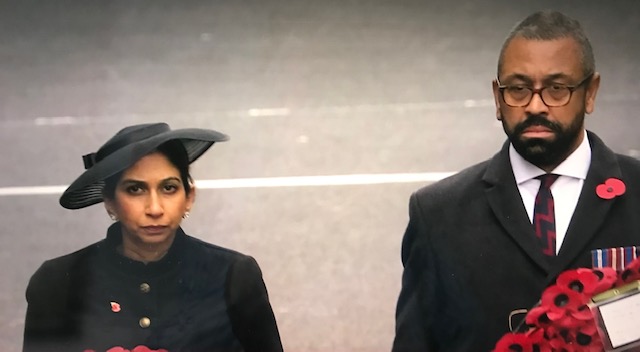
Suella Braverman and James Cleverly laying wreaths at the Remembrance Day ceremony in London on Sunday

He resigned in 2016 (having been prime minister since 2010) on the day the Brexit referendum result was announced and has been in the political wilderness since then. He has been looking lost without any role – nor any apparent prospect of one till Sunak came to the rescue. He was urged by Boris Johnson to try to become secretary general of NATO in 2017, but failed to secure the job and it seemed his public life was finished.

Since then his reputation has been harmed by lobbying he carried out for Greensill Capital, a scandal-hit financial services company that collapsed in 2021. His “significant lack of judgment” was criticised by a Treasury Committee. He has also lobbied for Chinese investment in Sri Lanka and elsewhere.

The reason Sunak has given him the job, rather than more obvious cabinet candidates, is presumably that Cameron is widely experienced politically and is well known internationally. He will gain respect for UK policies in foreign capitals and multi-national organisations, which is especially relevant in the current Middle East crisis, even though he was involved as prime minister in controversial decisions including support for a NATO-led military intervention in Libya in 2011 that toppled Moammar Gadhafi but led to chaos. In 2013, he tried and failed to gain Parliament’s backing for UK airstrikes against President Bashar al-Assad’s forces in Syria.

David Cameron’s first appointment was with India’s foreign minister S.Jaishankar who is visiting London

Foreign relations are an area where Sunak has little experience and, indeed, has at times seemed not to want to be involved. He did not go the UN general assembly earlier this year and tried to avoid the climate change Cop 27 summit last November. 

Politically, Cameron is in the centre of Conservative Party politics and his appointment will be welcomed in what are known as “the shires and “blue wall” areas where Tory voters might switch to other parties at the next election.

For India, the appointment is good news because Cameron tried, albeit with little success, to strengthen two-way trade and investment when he was prime minister. He made three visits to India in that role and hosted Narendra Modi in London in 2015. His last publicised visit was as a private individual in December 2016, when he was paid a rumoured £200,000 to speak at a Hindustan Times conference.

It remains to be seen how far Cameron tries to move British policy towards China, where a balance needs to be struck between limited co-operation on key issues and protecting security concerns on inward investment. As prime minister, he talked about a “golden age” in UK-China relations and welcomed Beijing’s investment in key UK nuclear power and iother infrastructure projects. He tried after stepping down to set up a $1bn UK-China investment fund, but that was abandoned two years ago because of deteriorating relations with Beijing, though he has remained active in this area.

Cameron will support cautious moves that Sunak has been making recently to grow closer to Europe, backed by Jeremy Hunt, who remains Chancellor of the Exchequer (finance minister).

Braverman leapt to national prominence in July 2022 when she announced on a late night political tv programme her candidacy to success Boris Johnson (who had not by then resigned as prime minister). She immediately broke convention by refusing to resign as attorney general, an early indication of her scant respect for parliamentary convention.

Braverman making her “the hurricane is coming” speech at the Conservative Party conference, October 2023

Her candidacy was not treated seriously, and she was quickly eliminated from the contest, but the move launched her rapid elevation with her extreme anti-immigration and pro law and order statements. 

Earlier this year, Braverman attracted widespread criticism when she said floods of people who come to the UK across the Channel in small boats “possess values which are at odds with our country” and there were “heightened levels of criminality”. She told The Guardian her claims were based on briefings from unnamed senior police officers, not data. 

A claim that Albanian people arriving in the UK by small boats were exploiting modern slavery laws was challenged in an analysis seen by the Guardian.

She became home minister under prime minister Liz Truss last year, but resigned just before Truss fell from office after being accused of breaching confidential guidelines. Sunak surprised commentators by reappointing her to the same job when he became prime minister – presumably because it was safer to have her in the cabinet than outside because of her outspoken right-wing views.

Suella Braverman with her husband and parents – photo The Times Nov 13 ’23

Throughout her time as Home Secretary, there has been a debate about whether her controversial speeches are made from conviction or are simply part of her campaign to become the next prime minister by winning support from grassroots Conservative members who align themselves with what she says.

She has a complex ethnic identity as the daughter of a Hindu Tamil mother from Mauritius and a Goan Christian father born in Kenya – they emigrated to the UK in the 1960s. She is a Buddhist, belonging to the sometimes controversial Triratna sect, and her husband is Jewish. They live in what a family friend has described as “a very Jewish part of the country in Hertfordshire,” adding: “She does have a strong relationship with the Jewish community. People have been very quick to say she is Machiavellian, but she sees this as a values issue.”

Despite this very wide multi-cultural background, Braverman delivered an incendiary speech at the Conservative party conference in October saying “multi-culturalism has failed because it allowed people to come to our society and live parallel lives in it”. 

‘The hurricane that is coming’

She also made a speech that had chilling echoes of a famous “rivers of blood” warning made in 1968 by Enoch Powell, a leading Conservative politician about how Britain would be swamped by immigrants “The wind of change that carried my own parents across the globe in the 20th century was a mere gust compared [with] the hurricane that is coming,” she said. “Because today, the option of moving from a poorer country to a richer one is not just a dream for billions of people. It’s an entirely realistic prospect.” 

In the last few weeks she drew criticism when she claimed that destitute people living rough on city pavements had made a “lifestyle choice”. 

Her remarks have escalated since pro-Palestine mass demonstrations have been held in London each Saturday involving over 100,000 people. Contrary to the evidence for anyone who watched the marches, she has said several times that they were “hate marches”. 

At the end  of last week she ignored requests from the prime minister’s office to tone down an incendiary article in The Times in which she said “we have seen with our own eyes that terrorists have been valorised, Israel has been demonised as Nazis and Jews have been threatened with further massacres” She also accused the London police of “playing favourites” towards Left-wing protesters. 

With this article, Braverman was behaving as no Home Secretary has done in living memory, stirring up hatred and undermining the police instead of showing calm leadership. It was an especially controversial time because it coincided with the weekend’s annual Remembrance ceremonies for those fallen in two world wars and other battles. She wanted the marches cancelled but the London police chief said that was neither necessary not justified by current laws.

She said she would not hesitate to change the terror laws “if there’s a need” in order to combat “utterly odious bad actors” exploiting gaps in the legislation to stir up anti-Semitism

‘No-one better than Suella…..’

The problems Sunak now faces were illustrated by Sir John Hayes, a prominent right-wing MP and a member of a group that wrote to the prime minister  this morning asking him not to sack Braverman. “There’s no one better than Suella Braverman to help Rishi Sunak deliver what he has made a defining (immigration) policy for him and the Government. I am sure they will collaborate to do so,” he told The Times (UK)

On policy, her main setback has been that she has failed to solve the major problem of stopping boat people crossing the Channel from France. The supreme court will rule on Wednesday on the lawfulness of the government’s controversial plan to deport plane-loads of these asylum seekers to Rwanda. Both Sunak and Braverman have seen this as a key policy. It will now become the first challenge for Cleverly – and an opportunity for Braverman to stake out her future policy priorities. 

The significance of her role as home secretary, and of her dismissal, goes far wider than the boatpeople. At a time of rising populism internationally and growing nationalism, her extreme views strike a chord among Conservative Party grassroots. She may have damaged her acceptability with her recent strident behaviour, but she remains a leading right-wing candidate to replace Sunak as party leader if, as seems likely, he loses the next election.

« Newer Posts - Older Posts »

Categories