Posted by: John Elliott | February 25, 2023

Strong sales at Pundole auction and India Art Fair

Gond tribal art by Jangarh Singh Shyam hits record high

Work just painted by 97-year old Krishen Khanna sold in art fair

Sales of Indian modern art are hitting new highs in the wake of the pandemic. A $16.34m auction at Mumbai-based Pundole on February 23 produced record prices for several artists. A couple of weeks earlier, the annual India Art Fair in New Delhi that yielded substantial sales with virtually all galleries reportin substantial results for the second year running.
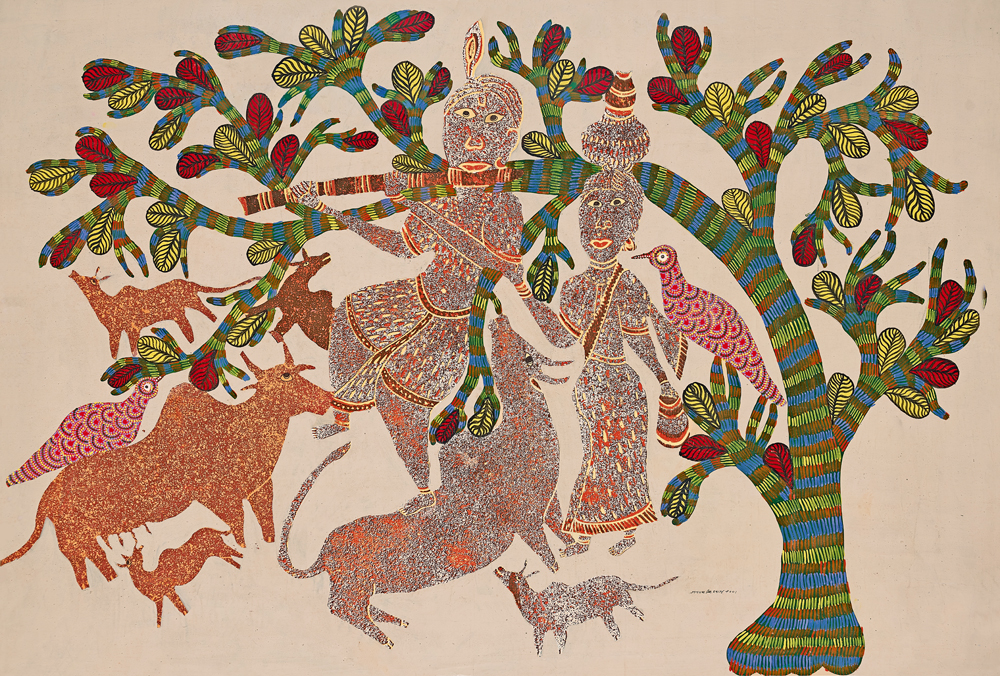
The most surprising record at the Pundole auction was a Rs 65 lakhs hammer price (just over $91,000 including buyer’s premium) for a Gond tribal canvas (above) by Jangarh Singh Shyam, probably India’s leading Adivasi artist.

Painted in 2017, a few months before he died, the 27in x 40in serigraphy and acrylic work depicts a traditional scene of Lord Krishna dancing with his gopi (follower), surrounded by a popular Gond rendering of brightly coloured animals, birds and trees. The artist’s previous record of $31,250 was at Sothebys in 2010.

There has been some interest in Shyam’s work in the intervening years and a renewal of interest in tribal art with acquisitions by International institutions such as the Guggenheim and the Chicago Cultural Institute, among others, says Rob Dean, a director of Pundole auctions. This has encouraged a new group of Indian collectors.

Among other records set in the auction was for one for a very different style and age – a 28in x 20in oil on canvas by Raja Ravi Varma (right), which sold for Rs38 crore ($5.3m including premium). A second work by the same artist went for Rs16 crore. The previous Varma record of Rs20 crore ($2.99m) was set in 2016, also at a Pundole auction.

Varma, who died in 1906, sought commissions from the rich and powerful in colonial India. He now has a steady flow of buyers who go for his colourful and grand mix of European artistic styles and Indian life.

The unsung hero of the India Art Fair was Krishen Khanna, a leading veteran Indian artist in the ‘modern’ style. Now in his 98th year, Khanna had a new work (below) in his iconic Bandwalas series that he had painted over the previous month in his home outside Delhi, working on the 36in x 24 in canvas for two hours a day.
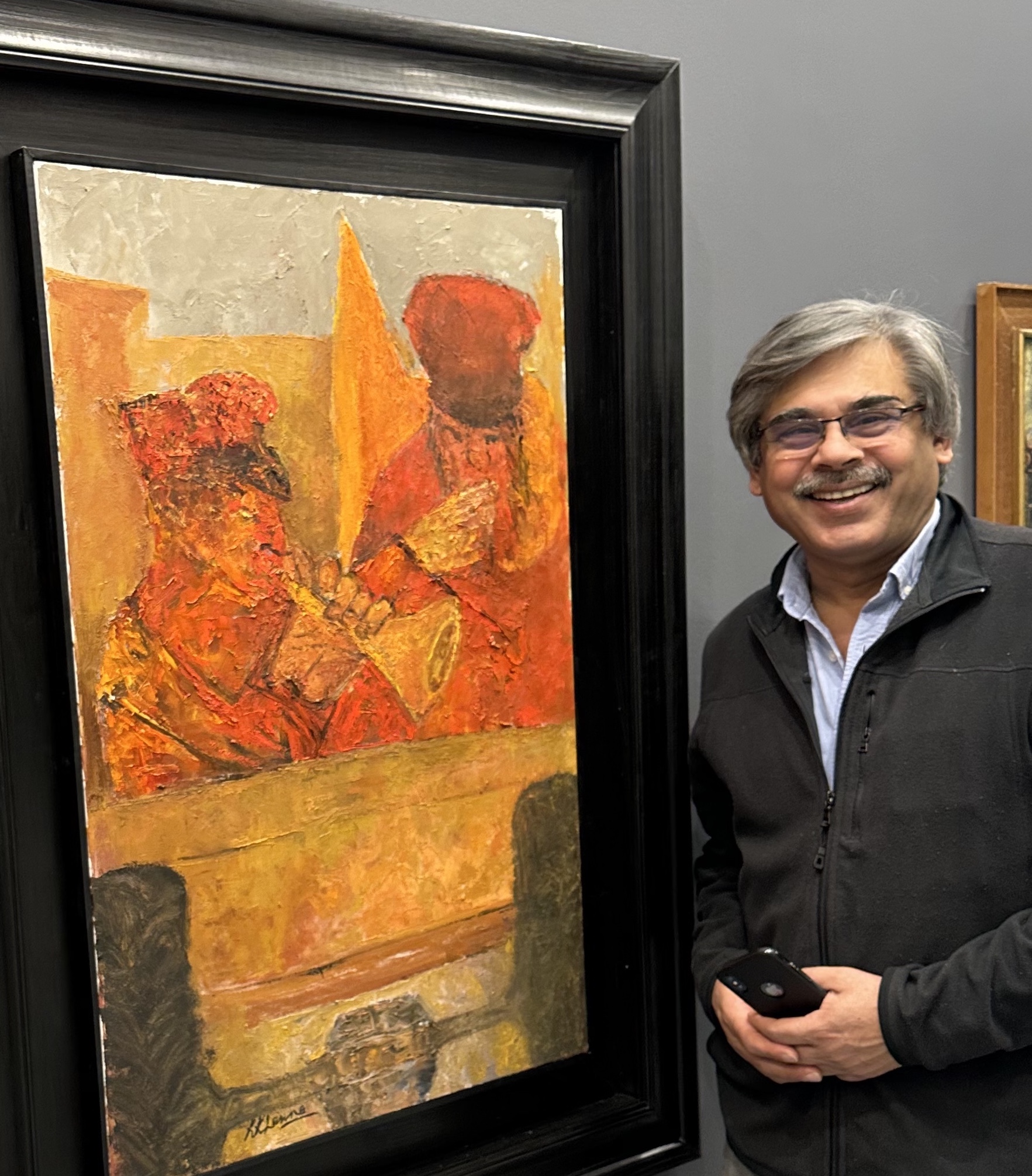
Krishen Khanna’s son Karan with the “Bandwalas in a Truck”

Shown on London’s Grosvenor Gallery stand, “Bandwalas in a Truck” sold quickly on the preview day for Rs45 lakhs ($54,450), marking a triumph for the only surviving and active member of the famous Progressive Artists Group that began in Bombay in the mid-1900s and still dominates South Asian auctions.

The fair, with 71 galleries, was generally voted the best of the series of 14 annual events that began in 2009 when it was spun off from a public relations firm. Initially called an Art Summit, it was located at Delhi’s old Pragati Maidan exhibition grounds in a brutalist building with a leaky roof that had to be sealed, a far cry its current smart professional tents at south Delhi exhibition grounds.
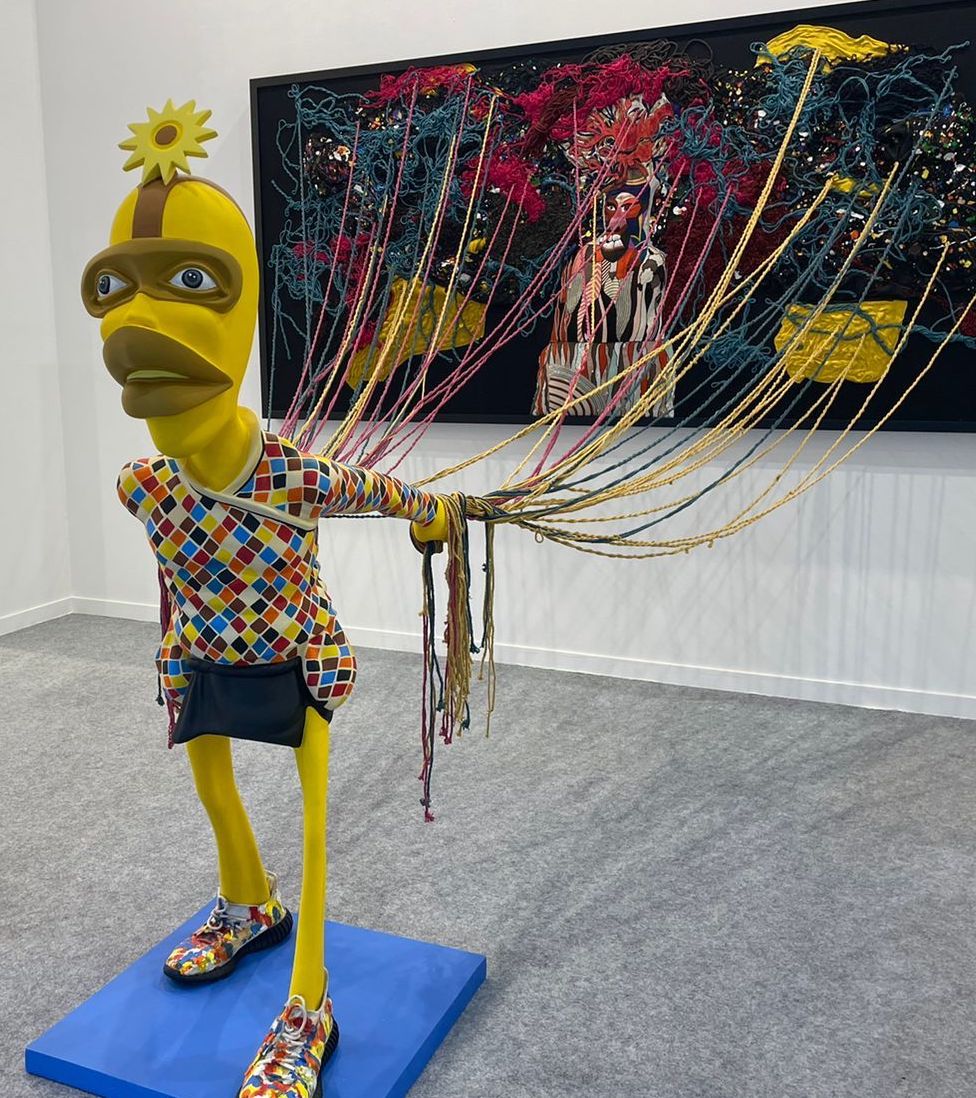
“Ineffable” by Viraj Khanna sold for Rs13 lakhs ($15,700) on the Tao Gallery stand, one of several textile works at the art fair

There were fewer international galleries than before the pandemic – eight compared with a record of 16 – partly because of economies and cutbacks on regional fairs. Delhi is still building a reputation as a place for galleries from outside South Asia to sell both their own Indian artists as well as foreign names.

One that returned after missing a few years was Paris-based Galleria Continua. Maurizio Rigillo, one of the founders, told me “we are happy with coming back”. The gallery reported individual sales from $5,000 to nearly $900,000 by leading Indian artists including UK-based Anish Kapoor with one of his trademark red concave mirrors that was said to have been sold for $750,000.
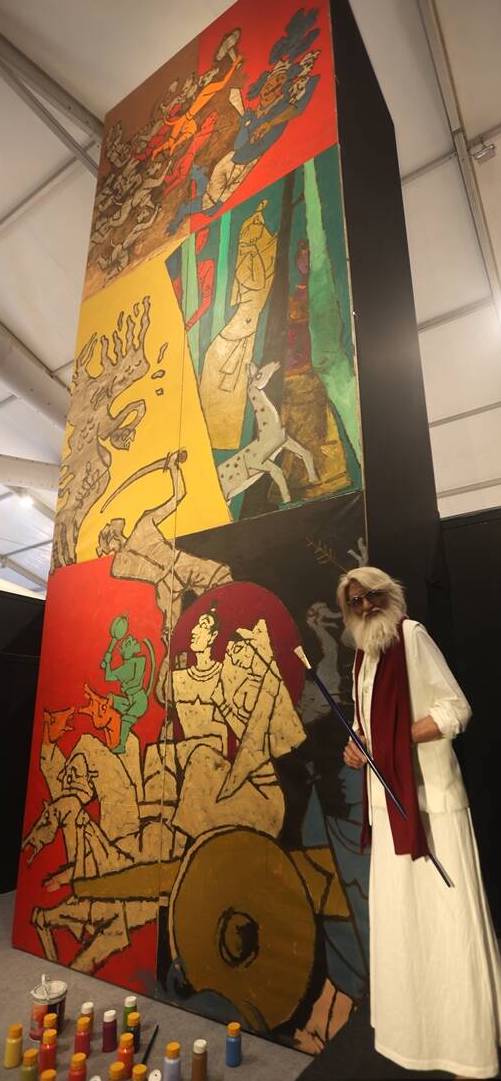
A 30ft high acrylic on canvas by M.F.,Husain on the Crayon Art stand depicting the Ramayana epic, with a figure resembling Husain – rumoured to be priced at $3.5m but unsold

Most galleries reported substantial sales on the preview day. Among those from India that did well was Delhi-based Vadehra, which sold a five-part artwork by Rameshwar Broota for $ 200,000 to a private UK collection and two works by Balkrishna Doshi for $100,000 to the Kiran Nadar Museum of Art. “We are very happy” said Parul Vadehra. Another leading Delhi gallery, Nature Morte, sold a work by Tanya Goel for over $60,600 but failed to find a buyer for an aggressive looking glass and brass wall sculpture by Subodh Gupta.

The fair organisers stopped revealing total sales figures and the number of footfalls a few years ago, but Jaya Asokan, the fair director, told me that there were 2,000 to 3,000 more visitors on the first two days than previously. There were not significant numbers of foreign buyers though there were curators and managers from the Venice Biennale, Sao Paulo, the London Tate, the Oxford Ashmolean and elsewhere.

There was little sign of much interest in crypto currencies’ non-fungible tokens, recently the rage, though the blockchain Tezos was giving away 3,200 NFTs as part of a “computational convergence” presentation showing where art and technology meet.

Asokan makes the point that India is “a self-sustaining market” with younger as well as established artists and buyers. She put the range of individual sales as Rs50,000 ($605) to over Rs7 core ($850,000).

This showed that, while auction houses specialising in Indian art are finding it difficult to maintain a strong flow of top lots ranging up to the current record auction price of $6.44m, there is considerable demand for works from new buyers at lower levels, as well as established collectors.

“Alien Sphere” – part of a series by Jayashree Chakravarty on the Akar Prakar stand. Made of Nepali and other papers, cotton fabric, seeds, jute, acrylic paints, tea stain and more – unsold but museums in London and Paris showed interest. A 192in x 72in oil, acrylic, cotton, tea stain, grass, seeds, roots, jute and synthetic glue on canvas, Rajbari, by the same artist sold for Rs1.3 crore .

Explaining the lack of readily available top auction lots, one specialist told me, “Works at the top levels go into collections and don’t re-sell so go out of the market”.

The current $6.44m (including buyer’s premium) record was paid for a work by V.S.Gaitonde, one of the most sought after Progressives, in a Mumbai-based Pundole auction a year ago. Pundole is perhaps the most respected Indian auction house and yesterday’s results shows that it has pulling power.

Saffronart, the Mumbai-based market leader, has an auction on March 16 where the highest estimate is Rs32 crore ($3.95m) for a Gaitonde oil on canvas, but the next highest is only Rs7 crore ($850,000).

Sotheby’s and Christie’s appear to be lagging behind at their New York auctions later next month with top estimates of $1m-1.5m – Sotheby’s for an M.F.Husain work and Christie’s for one by Manjit Bawa.

But there can be surprises, and fresh trends as has been shown with the growing interest and visibility of tribal art, plus artists like Manjit Bawa and others attracting growing attention.
 

Posted by: John Elliott | February 18, 2023

Modi challenged on media freedom and crony capitalism

Raids on BBC offices lead to allegations of tax evasion

Modi’s friend Gautam Adani aims for investor confidence recovery

It didn’t start as a good week for Narendra Modi’s image. India’s proud and autocratic prime minister is seeking controversy-free respect internationally at a time when India is heading the G20 group of leading nations with a Delhi summit in September.

Instead, two events undermined both the government’s denial that it curbs press freedom and its claims that corruption, including crony capitalism, has been curbed.

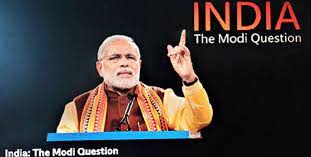
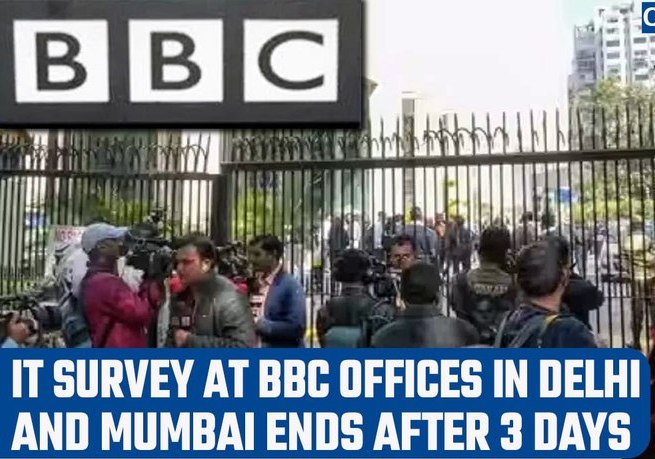
On February 14, Modi scored what looked like the biggest own-goal of his prime ministership when a three-day raid by tax authorities – euphemistically called a “survey” – began on the BBC’s offices in Delhi and Mumbai. The raids are seen as retaliation for a two-part BBC series, “India: The Modi Question” broadcast last month, which focussed on maltreatment of Muslims under Modi’s rule, first as Gujarat state chief minister and then prime minister.

The raids were the latest of a series of attacks on media that do not toe the government line. Computers and mobile phones were seized and the BBC said that some staff “faced lengthy questioning” and were “required to stay overnight” in their offices.

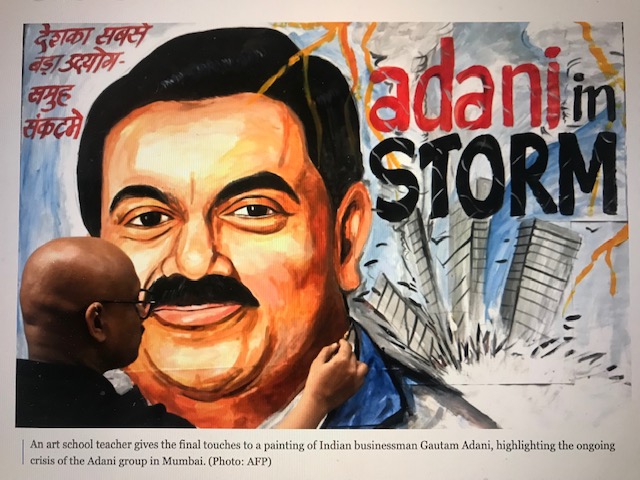
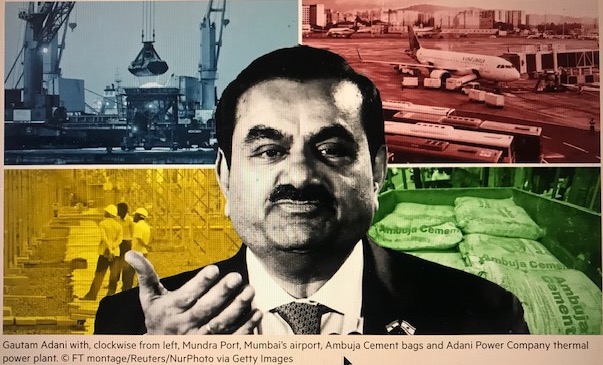
At the same time, a corporate scandal surrounding the massive business empire built while Modi has been in power by Gautam Adani, a close ally and supporter and one of Asia’s richest men, has continued to unfold. This has followed a US “short seller” financial research firm’s allegations, which are denied, of massive debt linked to stock manipulation and fraud.

George Soros, the 92-year-old financier who has criticised Modi in the past, said yesterday that Adani’s troubles would “significantly weaken Modi’s stranglehold on India’s federal government” by “opening the door” to a democratic revival in the country. That led to a furious reaction from government ministers because Soros was in effect forecasting that an Adani-linked corruption scandal would unseat Modi’s BJP government at next year’s general election.

But the week has not turned out so disastrously for Modi.

Yesterday (Feb 17) the finance ministry announced that it had found tax discrepancies at an unnamed media house, clearly the BBC. A ministry statement said that declared income and profits were “not commensurate with the scale of operations in India”. The findings “indicate that tax has not been paid on certain remittances which have not been disclosed as income in India by the foreign entities of the group”. That turned what looked like a revenge attack into a tax-dodging case, though it is not yet possible to assess the validity of the charge.

Many foreign companies in India have for decades faced allegations of transfer pricing and it looks as if the BBC, which says it is co-operating with the inquiries, is in for lengthy harassment by the tax authorities, watched over by Modi and his powerful home minister Amit Shah.

Defending the raids, a BJP spokesperson said earlier this week that the BBC “has become the most ‘Bhrasht Bakwaas (corrupt and rubbish) corporation” and alleged that it had a history of working with “malice against India”.

Other politicians have linked the BBC films and the Adani scandal, along with the Soros comments, as evidence of a co-ordinated attack on Modi and his government, possibly embracing the opposition Congress Party where Soros is reported to have connections.

That looks far-fetched, especially over the BBC series, which I have heard was commissioned more than two years ago after an editorial meeting decided that it was “time we did something on Modi”.

Interviewing had started by September 2021 and continued into last year. The series then took an unusually long time to appear on tv screens and were only broadcast in the UK – subsequent viewing in India and elsewhere was mostly on YouTube, which the government tried noisily to block and instead increased public and media attention and viewing demands.

Modi and Shah probably calculated that the BBC raids would matter little after an initial flurry of headlines in India and in the foreign media.

They were right to the extent that, respected though the BBC has been in India for decades, the raids will have been scarcely noticed away from the political and liberal bubble of Delhi and other leading centres.

There has been little public criticism by foreign governments. Anxious not to confront Modi, a US spokesman merely repeated support for a free press, while the UK dodged the issue. There will inevitably be many in these and other countries who are appalled by attacks on the media, but there will be no lasting damage to diplomatic relationships.

Tax raids have been used by many Indian governments to threaten opponents and others who have fallen from favour. Under the Modi government however they have become more sinister because they are frequently aimed at curbing media freedom.

BBC’s past troubles

The BBC has been in trouble before, though it has never been raided. It had to shut its operations first between 1970 and 1972 after it broadcast two negative documentaries, and again in 1975 when Mark Tully, its widely respected correspondent, was expelled along with other media reporters during prime minister Indira Gandhi’s two-year State of Emergency.

In 2017, the BBC was banned from filming in India’s national wildlife parks for five years after a film on Kaziranga reserve in Assam, famed for having the world’s largest population of one-horned rhinoceroses, was condemned for doing “irreparable damage to India’s reputation”.

After the recent BBC series, I have heard that the government suspended approval of at least two documentaries. It wasn’t clear that much more would be done unless the BBC broadcast anything else controversial. “The BBC will be closely watched,” a government official told me three weeks ago, albeit without indicating that would include tax issues as well as broadcasts.

Adani scandal

The scandal surrounding Gautam Adani has been an accident waiting to happen for years. Adani comes from Modi’s home state of Gujarat and has been supporting his political friend for decades. A first generation entrepreneur, he began importing polymers in the 1980s and expanded into coal.

The business began to develop when Modi became Gujarat chief minister in 2002 and has grown exponentially since he became prime minister – in the past five years, it has risen in value by 2,500% with dominant positions in ports, airports, electricity coal, and growing stakes in areas ranging from defence equipment manufacture to solar energy and farming. A leading television channel (NDTV) was bought last year – allegedly to quieten the channel’s criticism of the Modi government. Net worth touched $127bn before the report led to a crash and a $120bn decline in market value.

Ministers insist, that the growth has been achieved legitimately with tendered contracts and without any favouritism. That is not seen as credible, though it is not unusual for those close to friendly politicians to benefit when they are in power, both nationally and in individual states. The difference with Adani is the astronomic speed of his expansion and the lack of any attempt to distance himself from Modi.

Crony capitalism is widely condemned, but it is tolerated as part of daily life at all levels of the Indian economy. Adani’s closeness to Modi could however pose the sort of problems for the prime minister forecast by Soros if fresh links emerge later this year of specific major corruption.

Media focus

Inquiries looking for such links will probably focus attention abroad, including Australia where Adani has controversial coal mines, and on defence equipment ventures. Foreign reports alleging corruption have in the past fuelled media coverage in India. The FT in particular, which has been reporting on Adani daily, has a track record of relentlessly pursuing high profile suspect companies.

Forbes has reported on Vinod Adani, the low-profile elder brother of Gautam Adani, who it says had a leading role in the group’s growth with an alleged web of companies in offshore territories that have apparently not been disclosed to regulatory authorities.

Adani has been fighting back this week in order to stem the slide in company shares and rebuild investor confidence. He is reported to have halved the group’s 40% annual revenue growth target, delaying fresh capital expenditure, and to have told advisers he plans to improve oversight of the private family companies that control his business empire. A financial controller would be appointed to bring the sort of oversight required in publicly quoted companies to his various trusts and privately held businesses. Few of his companies are scrutinised by stock market analysts and those in India are wary of being overly critical.

Because of his exclusive Modi link, it has been assumed that Adani would thrive while his patron was in power but that he would become vulnerable when Modi eventually went.

The Hindenburg report has accelerated that process and the question now is whether Adani can overcome the crisis – and, if he can’t, at what point Modi will decide that he has to desert his friend in order to survive politically.

With the BBC raids unearthing tax allegations, and with Adani making positive moves on investor confidence, the week has finished better for Modi than seemed likely. But there are more than 50 weeks till the general election!

Posted by: John Elliott | January 28, 2023

BBC series on Modi leads to police action on students

“India: The Modi Question” reopens old wounds with little new information

Hits at Modi just as his profile grows with India’s G20 presidency

It wasn’t supposed to be like this. 2023 was to be the year that India’s prime minister Narendra Modi would flourish on the world stage as the head of the G20 group of nations, eclipsing criticisms of his authoritarian rule and sailing on as an international statesman to his third general election victory next year.

The election win for his Bharatiya Janata Party looks safe, for now at least, but the prime minister’s international image during India’s current presidency of the G20 has been hit by the BBC’s horrific new two-part tv series, “India: The Modi Question”, that focused on treatment of Muslims. That has been exacerbated by the government’s attempts to stop screenings of the two one-hour documentaries,.

There have been daily reports this past week of escalating and excessive police activity and arrests in universities across the country to stop students tuning in.

The irony is that international media and tv reports of this action have graphically underlined some of what the series depicted about Modi’s authoritarian rule since he was chief minister of Gujarat in 2002 and then became prime minister in 2014.

The power was cut off earlier this week in Delhi’s Jawaharlal Nehru University, allegedly to prevent students from screening the series . Action was also taken in three other of the capital’s universities where police used security legislation to ban gatherings of more than four people. The documentary was screened in Kerala by the Congress Party and by students in Hyderabad and Kolkata.

Initially, after the first BBC episode was aired on January 17, it seemed that the government wanted to avoid high profile diplomatic and other confrontations. A spokesman dismissed the episode as “a propaganda piece designed to push a particular discredited narrative,” adding: “The bias, the lack of objectivity, and a continuing colonial mindset, is blatantly visible”.

The government got the film, which the BBC tactfully did not broadcast in India, removed from Twitter and Youtube but then the universities and police created the ongoing crisis.

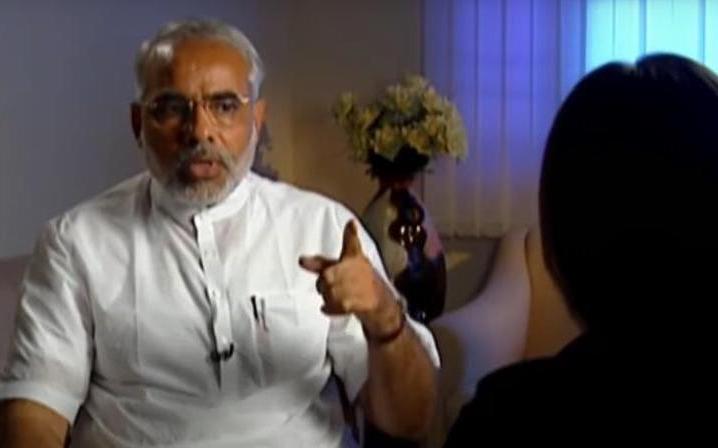
Modi rejecting questions from BBC correspondent Jill McGivering in 2002, saying they were based on “false propaganda” and adding “You British should not preach us human rights”

The big unanswered question is why the BBC ran the series without any news peg, raking up well trodden facts and allegations with little new and little reasoned analysis – it could have explored other negative aspects of Modi’s rule in relation to Muslims, and it could have at least mentioned positives in terms of economic and other developmental reforms.

Instead it mainly relied on old television footage plus powerful interviews with victims of violence and police harassment, and their relatives.

There is also a series of rebuttals of all allegations by an erudite Modi-supporting Anglophile, Swapan Dasgupta. A widely respected journalist-cum-BJP politician, Dasgupta this week said the BBC had “undermined Indian constitutions” so the government had to act. There was “an ecosystem in the West that works to undermine the Modi government, and the BBC documentary is a part of that.”

Godhra riots

The first episode covered the riots in the Gujarati town of Godhra, which erupted in February 2002 after a train carrying Hindu pilgrims was set on fire, allegedly by Muslims, killing 59 people.

Modi was accused of ordering the police not to stop the riots as Hindu mobs attacked Muslims, beating them to death and burning their homes. Figures of the dead vary, totalling maybe 1,000 or even as many as 2,000. The BBC film included accusations – and denials – that Modi met police chiefs to tell them not to act.

Questions and disputes about Modi’s alleged complicity in the riots as chief minister have generated controversy for the past 21 years. A series of court cases culminated in the Supreme Court last June dismissing an eight-year old appeal against a 2012 closure report clearing Modi that had been filed by a special investigating team. This was widely seen as closing the issue – till the BBC series appeared.

The second episode covered the time since Modi became prime minister and showed scenes of extreme police brutality against Muslims, together with lynchings over bans on cow slaughter, the government’s changes to the constitutional status of Muslim-dominated Kashmir with internet shutdowns and mass arrests, and communal violence in Delhi over citizenship rights legislation.

The main aim was clearly to blame Modi for action against Muslims, but the horrific scenes also harmed India’s international reputation with repeated images of the sort of police violence that has been commonplace for decades.

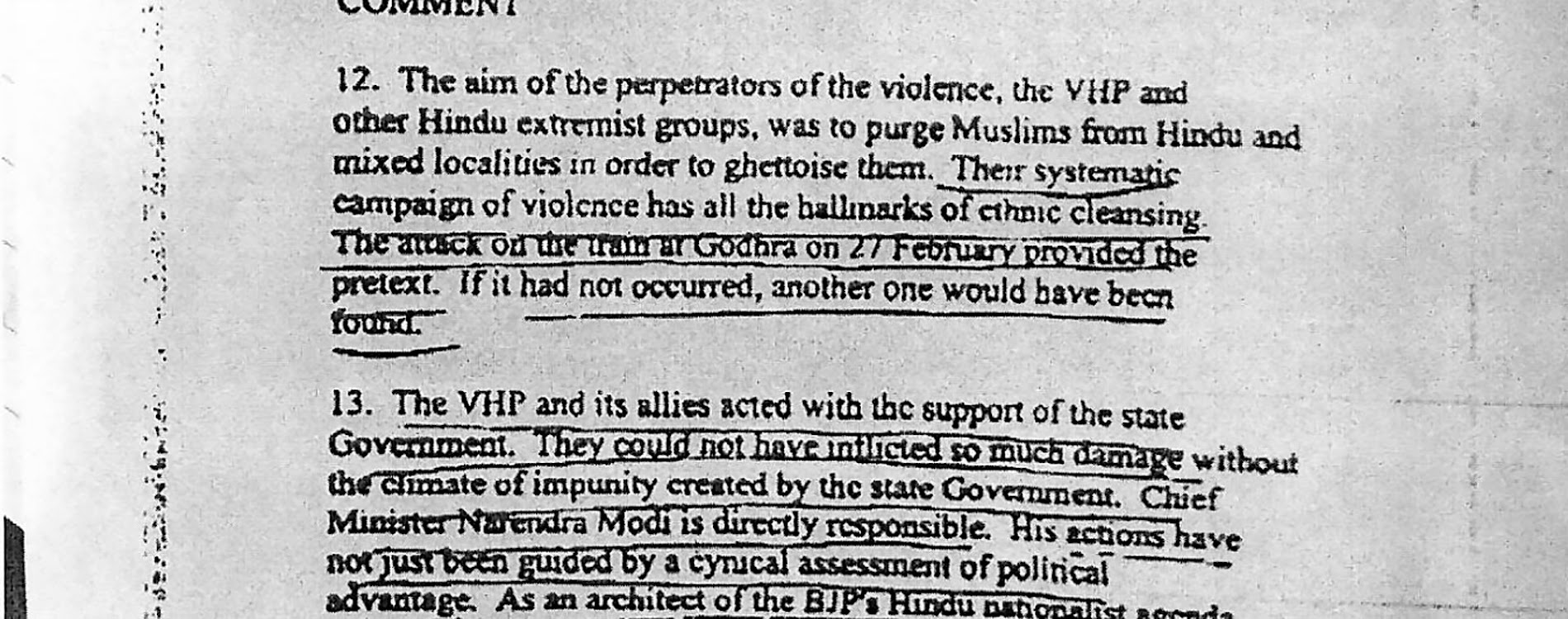
Extract from the High Commission report saying “Modi is directly responsible” – from “TheCaravan

The only new item in the series was an unpublished secret 2002 report by the British High Commission (embassy) in Delhi for the Foreign Office in London. This found Modi “directly responsible” for what it described as a “systematic campaign of violence” by Hindus against Muslims “that has all the hallmarks of ethnic cleansing” (.

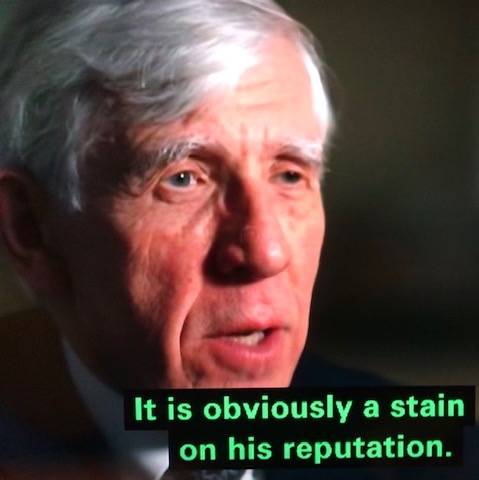
This was backed up by Jack Straw, who was the Labour government’s foreign secretary at the time. He ordered the report and says on the BBC that it was “obviously a stain on his [Modi’s] reputation. There is no way out of that.” Straw’s Lancashire constituency had a large Muslim electorate which may, an anonymous BBC source told India’s Telegraph newspaper, have influenced him.

Jack Straw on Modi and Godhra

Conspiracy theorists see the series as a plot to undermine Modi in the eyes of the G20 nations, though both the UK and US quickly distanced themselves. British prime minister Rishi Sunak said he “did not agree with the [BBC’s] characterisation” of Mr Modi”.

(Some might link that conspiracy theory with the coincidence of the Adani group, owned by Gautam Adani, a close Modi ally and one of the world’s richest men, being accused of fraud this week by a US “short seller” financial research firm . The group, which has a current $2.4bn public share offering, have lost at least 20% of their value).

Others see the BBC series as an attempt to upset current negotiations on a long-awaited trade deal (FTA) between India and the UK, which is targeted for March, maybe in a first-stage form. A BJP spokesman has claimed it was a Pakistan plot, while others might even blame Modi’s many American critics in Washington.

Contacts I have spoken to guess there was no plot and that the series may have been pitched to the BBC by its producers who, having got the scoop of the High Commission report, argued that Godhra deserved a fresh look after Modi was exonerated last June.

India would surely be justified in complaining that the BBC abandoned balanced reporting when it commissioned what emerged as a campaigning film pegged to a 21-year old story. Some contacts suggest that the BBC Board cleared the series after India failed to respond over a considerable time to an invitation to comment. Protests are building up among the British Indian diaspora calling for action against the BBC.

Indian government officials feel that the international media do not give the country – and Modi – credit for positive developments. They argue that there is also a failure to recognise the significant generational changes taking place as the old elite typified by the Congress Party and its Gandhi dynasty are replaced by new generations with proud Hindu-oriented nationalist attitudes.

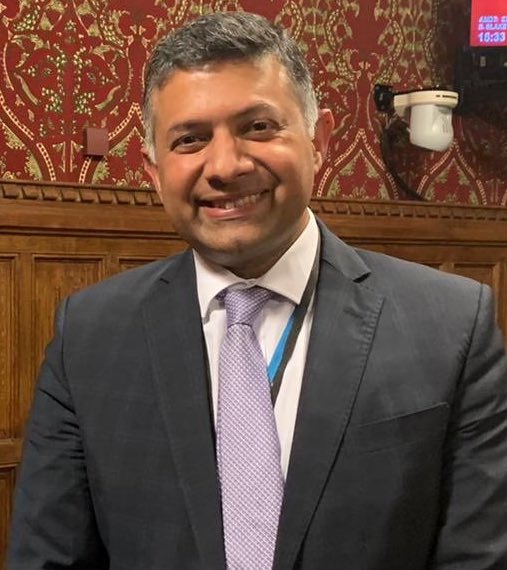
High Commissioner Vikram Doraiswamy

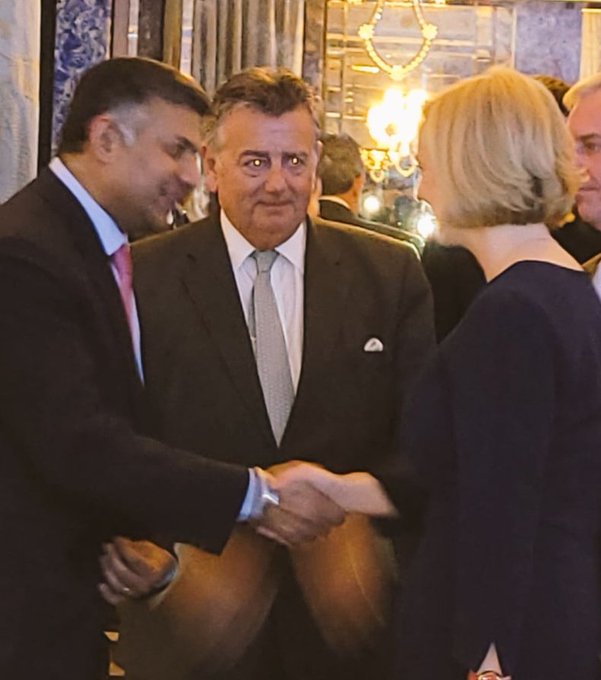
Little has been said openly by Indian officials, but the new high commissioner in London, Vikram Doraiswami, mounted a strong defence of the country’s “largely peaceful social transformation” when he hosted a reception in the City of London’s Guildhall on January 26 to celebrate India’s Republic Day.

In a dig seemingly directed at the BBC, he said that this transformation was taking place in a “democratic evolutionary framework and, frankly, certainly not in what some sections of the media might make you think”.

“What we Indians sometimes see passed off [in the media] as a normal India is about as accurate as for Indians to expect to see people in armour placing heads and hung-drawn-and-quartered bodies around the city of London – it is about as archaic”,

The problem of course is that, even though Modi has been toning down the communal messaging, the new nationalism is frequently reported internationally through the prism of Godhra and authoritarianism together with the problems of Muslims and other minorities.

For that view to change, a new image needs to be projected, which has not been happening this week when students have been hassled and detained for watching a BBC film.

Posted by: John Elliott | December 24, 2022

Merry Christmas!

To all friends and followers of this blog, Seasons Greetings and All Best Wishes for 2023, with this fun painting of an imaginary aircraft by Ram Kumar Shyam, a Gond tribal artist from Patangarh village in the Indian State of Madhya Pradesh

Posted by: John Elliott | October 25, 2022

Prime Minister Sunak faces a mass of economic and other crises

First non-white PM as old colony’s offspring produce new UK leaders

Britain hopes Sunak is the strong ethical and efficient leader it needs

“Let’s see what an intelligent, young, multi cultural, economics-fluent leader can do for us,” said Nick, one of my sons who is in his 40s, when it was clear that Rishi Sunak, 42, would become Britain’s third prime minister this year, the youngest for decades, and the first non-white occupant of 10 Downing Street. Of Indian descent with a Punjabi family that emigrated first to Kenya and then the UK, Sunak is also the first Hindu prime minister – and the first to have worked for Goldman Sachs and have an MBA.

The news that he had won was officially announced at 2pm London time yesterday – 6.30pm in India where it added to the celebrations as coloured lights were lit and firecrackers noisily let off across the country to mark the big annual festival of Diwali.

As happened when Kamala Harris became America’s vice president, Sunak’s rise is seen as proof of India’s growing importance internationally. Narendra Modi, India’s prime minister, tweeted “Warmest congratulations @RishiSunak!” and looked forward to strengthening India- UK relations.

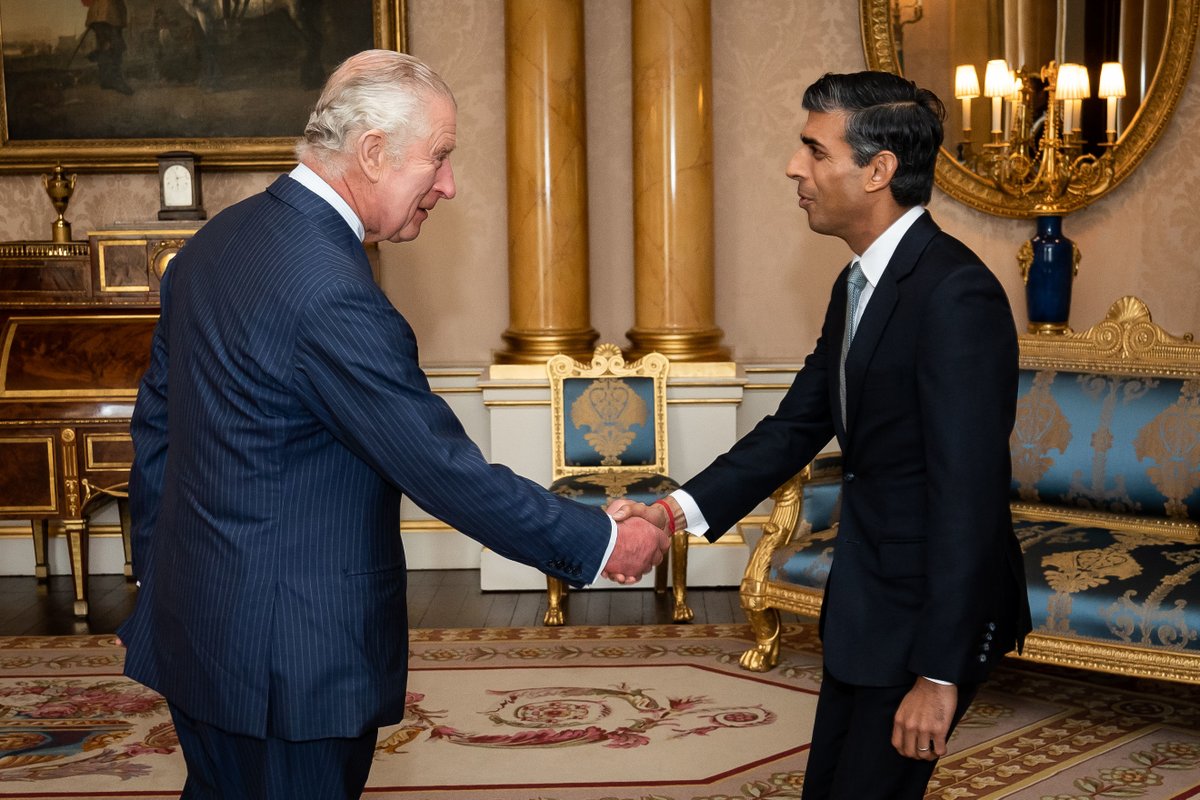
Sunak became party leader last night and this morning he had a formal meeting with King Charles, who invited him to form a government as prime minister. He returned to 10 Downing Street, one door away from No 11 where he lived as Chancellor of the Exchequer for just over two years till he resigned in July, to begin appointing his cabinet.

King Charles greets Rishi Sunak to invite him to form a government

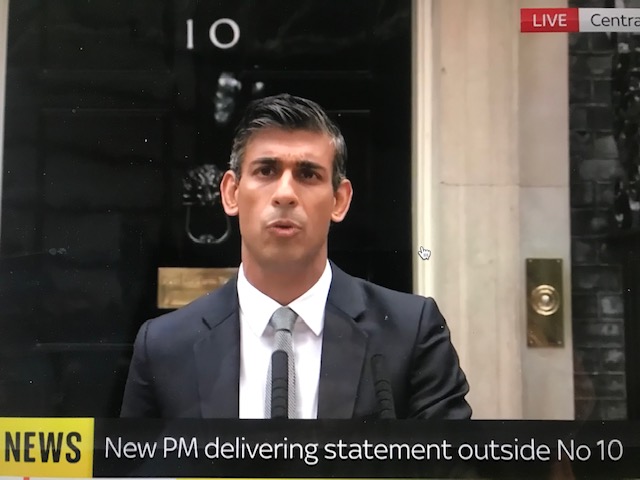
He has a massive list of urgent issues to tackle and has pledged that “there will be integrity, professionalism and accountability at every level of the government I lead”. Standing in Downing Street after meeting King Charles, he warned of “difficult decisions to come” and said “I will unite our country note with words but with action”.

Financial and economic problems include a fiscal gap of some £40bn, an approaching recession, and a cost of living crisis with inflation around 10%, the highest for 40 years. That stems from Brexit and the Ukraine war’s rising energy costs, escalated by the right-wing economic agenda of Liz Truss, the outgoing prime minister. The national health service is failing to cope with demand and the public sector is facing shortages and a spate of wage-related strikes led by railway workers that could escalate into a confrontation between the government and trade unions.

Foreign policy issues include Ukraine where Johnson and Truss (as foreign secretary) led one of the toughest responses to the Russian invasion, plus  confrontations with China. Unresolved Brexit problems include legislation challenging trade barriers that threaten stability in Northern Ireland, and there is also the looming question of Scotland’s independence.

All recent prime ministers have failed the “do for us” test mentioned at the top of this article. Both Boris Johnson and David Cameron in different ways failed because they believed too much in their (Eton-educated) leadership gifts, while Theresa May could not handle the cut and thrust of politics and diplomacy. Truss, who defeated Sunak for the prime minister’s job last month, thought she could buck the markets and public opinion with right wing tax and borrowing dreams that Sunak had correctly warned would cause economic chaos.

Those prime minister’s had spent years in politics before entering 10 Downing Street, whereas Sunak only began in 2015 when he became a member of parliament – though he was quickly spotted as a future prime minister by Cameron and others. He is therefore bringing a fresh approach, but he has much to learn about how to get the government machine to deliver on policies, and he also needs to learn how to project himself and his family.

Rishi Sunak speaking in Downing Street after meeting King Charles

As prime minister, he has to overcome the negative publicity burden of the wealth and privileges that he has enjoyed for years. He and his fashion designer wife Akshata are worth some £730m, thanks mostly to the wealth of her father, Narayana Murthy, co-founder of Infosys, one of India’s three leading IT companies.

If he was more adept at politics, Sunak would in 2015, or soon after, have cancelled the US green card that he obtained when he worked at Goldman Sachs and as a hedge fund analyst. He would also have cancelled his wife’s UK non-domicile status as an Indian citizen that saved her paying taxes totalling as much as £20m.

Personal embarrassments

Both the green card and tax became personal embarrassments earlier this year, as did a £3,500 suit he wore at a leadership meeting and his £500 Prada shoes on a construction site. He talked on television about how many types of bread his family enjoyed when many voters could not even afford one loaf, and he was building a large swimming pool in the garden of his elegant north Yorkshire country house when the plight of the poor was spreading across the country.

It looks as if he has learned from those mistakes. But he has critics among MPs and a larger proportion in the party membership, not least because he arguably triggered the mass cabinet resignations that led to Johnson’s downfall in July when he quit as chancellor of the exchequer (finance minister).

His right-wing credentials are also not as firm as some on the right would like, prompting a slanted Daily Telegraph headline last night that described him rather unfairly as “A man riddled with contradictions trying to shed his ‘slippery’ image”

The article said that “not everyone knows what he truly stands for” on issues such as Brexit, which he supported, and the free market which he moved away from with state intervention and increased corporation tax as a result of the covid pandemic.

Rishi Sunak with friends and supporters on Monday night

On policy, Sunak is strong on the economy and financial markets because of his professional background and his experience as chancellor under Johnson. He will continue with the abandonment of Truss’s policies that was started by Jeremy Hunt, who became chancellor a week ago and is expected to stay in the job. Sunak believes in low taxes and has said he would reduce the bottom rate of income tax from 20% to 16%, but only when prudent without fuelling inflation, perhaps in seven years’ time.

But he has absolutely no experience appeared on foreign policy, international relations or national security, nor on vast swathes of domestic policy ranging from the national health service and home care, to the police, and transport.

When he appeared in public debates during his contest with Truss however, he appeared as a fast-learning and efficient policy manager who was prepared to devise positive answers to problems without resorting to Truss-style popular tax cuts.

The hope now must be that he has not had to make too many promises to would-be cabinet ministers in order to obtain their support for his candidature – he eventually received nominations from 185 MPs. That success prompted his main rival Boris Johnson to withdraw two days ago followed by Penny Mordaunt, currently leader of the commons, who gave up just before the 2pm deadline yesterday.

A united cabinet

He has to balance different needs as he try have a united cabinet that has talent in the top jobs as well as representing different wings of the party and rewarding friends and allies who supported his bid to become PM.

On climate change, Sunak is likely to follow the trend set by Johnson and a pledge to bring all greenhouse gas emissions to net zero by 2050, a target Truss might have weakened. He has said he would make the UK energy independent by 2045 with increased power from offshore wind, rooftop solar and nuclear sources and improved home insulation – a key detail many politicians forget. It remains to be seen if he lifts the blockage put by Truss on King Charles, a devoted climate change activist, attending the Cop27 summit in Egypt next month.

He could face problems with the Conservative Party’s right wing on strikes and law and order. Suella Braverman who has been a strident home secretary and backed Sunak, would want an uncompromising tough line if she kept her job. Labour unrest however will not be solved with new laws that could escalate unrest and exacerbate economic problems.

There could also be a clash over a pending India-UK trade deal where Braverman opposed easing access to the UK for Indian students and key workers. Sunak is likely to back easier access because he has said he wants to make it easier for British students to travel and for companies to work together “because it’s not just a one-way relationship, it’s a two-way relationship, and that’s the type of change I want to bring”.

Sunak’s most pressing problem is to unite the party which is riven by personal rivalries and policy differences. That will not be easy, but it is essential if it is to have any chance iof winning the next general election due in 2024. There will be calls from opposition parties for an immediate general election, but Sunak can probably ignore them if he can hold the party together to tackle what he described in his 84-second victory statement last night as “a profound economic challenge”.

Rishi Sunak in the lead to become PM next week

Boris Johnson wants to return to Downing Street

When Britain voted in 2016 to leave the European Union, it was expected that it would be hit by economic problems while it rebuilt its international trade and investment links. A loss of international prestige was also seen as likely. But what no-one envisaged was that its usually sane and stable politics would become so dysfunctional that it would be jokingly likened to Italy.

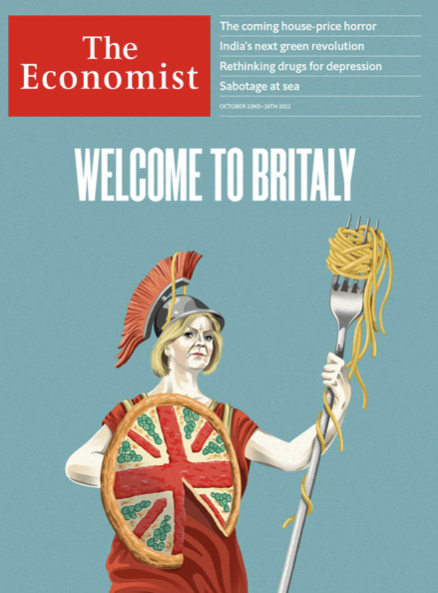
The Economist magazine has picked up on the joke with a spaghetti and pizza laden image of a Truss-like Britannia on its cover and an article headlined “Welcome to Britaly – A country of political instability, low growth and subordination to the bond markets”.

Another joke at the start of this week likened Liz Truss to a lettuce that only has a shelf life of a week.

The lettuce won because Truss didn’t last the week and announced her resignation as prime minister yesterday after just 44 days in power, the shortest period ever for a British prime minister.

Now to add to the sense of dysfunctional politics Boris Johnson, whose resignation from his unethical and flippant reign as prime minister led to the current crisis, is said to be considering standing in the ballot to succeed Truss. He would be doing that, say his supporters, “in the national interest” and is reported to be returning early this weekend from a Caribbean holiday.

The truth is that he might have a good case because there is no other obvious candidate who could unite the bitterly divided Conservative Party and have a remote chance of winning the general election that is due in 2024.

Meanwhile, pressure is growing for a general election to be called immediately by the new prime minister, who is due to be named by next Friday.

To be considered in the ballot for the post, contestants must gain the support of 100 or more Conservative members of parliament by 2pm on Monday. Since there are 357 MPs, that means only three contestants will go to a ballot starting later Monday afternoon. When two contestants are left, the party’s 170,000 members will be able to vote in an internet ballot (after an indicative vote by MPs), unless one of them withdraws.

Rishi Sunak, who was backed by a majority of MPs in the summer but lost to Truss in the members’ vote, is reported to ahead with the support of 100, followed by Johnson. Next comes Penny Mordant, who also stood in the summer and has been a credible Leader of the House of Commons for the past month.

Johnson has made it clear since he was ousted as prime minister that he assumed one day he would return to the job, but seemed to think that would not be till next year at the earliest. He had hoped to spend time earning big money with speeches and journalism that would help finance his and his family’s lifestyle. Clearly though, the chance to return now is too good to miss.

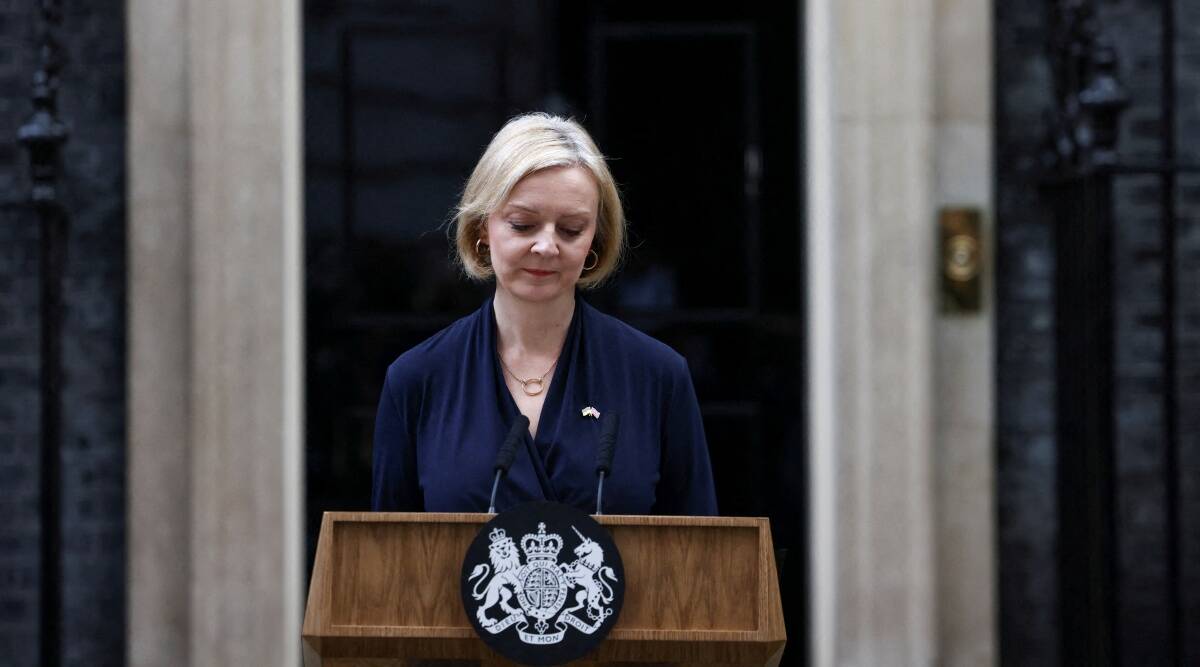
Liz Truss announces her resignation after 44 days as prime minister

Sunak’s position means that South Asian-origin politicians are continuing to be prominent in the politics of the country that welcomed their parents as immigrants. It was Sunak and Sajid Javid who triggered Johnson’s downfall when their resignations as cabinet ministers in July led to a mass of other ministerial walkouts. Sunak produced sound economic policies in the subsequent leadership contest, but the Conservative members voted for Truss’s unreally rapid right-wing low tax high growth dreams.

Suella Braverman may put her name forward this weekend but has little chance of success. She jumped to prominence when she entered the contest against Sunak, Truss and others in the summer and was appointed home secretary in Truss’s government. She pursued tough immigration laws and attacks on the rights of public protest and trade union action that led to a reportedly heated row with Truss in Downing Street on October 19 and subsequently resigned.

Under its “Britaly” headline, The Economist noted that, in 2012, Truss and Kwasi Kwarteng, who resigned as chancellor of the exchequer (finance minister) on October 14, were two of the authors of a pamphlet called “Britannia Unchained”, which used Italy as a warning of what could happen if economic policies did not change.

“Bloated public services, low growth, poor productivity: the problems of Italy and other southern European countries were also present in Britain,” said the magazine. “Ten years later, in their botched attempt to forge a different path, Ms Truss and Mr Kwarteng have helped make the comparison inescapable.”

Truss became prime minister on September 6 and held the post for the shortest period of any British prime minister ever. Together with Kwarteng she was determined quickly to pursue their right-wing economic policies. But this was disrupted two days later when Queen Elizabeth died and normal politics were suspended till the state funeral on September 19.

Liz Truss and Kwasi Kwarteng in the House of Commons while their mini-budget is under attack

Later that week on September 23, Kwarteng produced his bombshell economic package – a mini-budget – with $45bn tax cuts supposedly funded by unspecified borrowing and without the usual economic assessment by the Office for Budget Responsibility. He failed to alert the markets to what he was planning and refused to produce a new medium-term strategy for the economy assessing his mini-budget till November 23, but later agreed on October 31.

That disdain for conventional policy making was too much for the markets and Britain was hit by a financial crisis and a collapse of the pound that even triggered a rebuke from the International Monetary Fund.

It was also too much for the bulk of the Conservative Party that feared losing votes in the Labour Party’s heartlands because the proposals included cutting the top tax rate for high earners, introducing other tax cuts that would benefit the better off rather than the poor, and removing a ceiling for bankers’ bonuses.

Normal politics were again adjourned while the Conservative and Labour parties held their annual conferences, and parliament resumed on October 11. It then took just ten days for Kwarteng to be sacked and for Truss’s government to unravel to the point where she took the formal constitutional step yesterday of telling King Charles that she was resigning.

She then announced that publicly in Downing Street in front of the famous No 10 door, saying correctly that she had been elected by Conservative Party members with “a vision for a low-tax, high-growth economy that would take advantage of the freedoms of Brexit”. She now had to recognise that “given the situation, I cannot deliver the mandate on which I was elected by the Conservative Party”.

The key word there is Brexit because Truss and Kwarteng wanted to justify their support for Britain leaving the European Union by introducing a low tax economy that would attract domestic and foreign investment and lead to high economic growth alongside strict controls on immigration.

Jeremy Hunt starts cancelling Kwarteng’s mini-budget measures

The theories that she had espoused in the 2012 pamphlet with Kwarteng, a very bright old Etonian with seemingly even greater self-belief than Johnson, did not take account of the consequential financial uncertainty that would deter investment and block the immigration the country needs to fuel economic growth.

Braverman, with an almost manic right-wing approach exacerbated the growing crisis. She emerged as the heroine of the ageing right wing Conservative Party membership that elected Truss. Advocating a new public order legislation in parliament on September 18, she said, “I’m afraid, it’s the Labour Party, it’s the Lib Dems, it’s the coalition of chaos, it’s the Guardian-reading, tofu-eating wokerati, dare I say, the anti-growth coalition that we have to thank for the disruption that we are seeing on our roads today.”

Jeremy Hunt, a former health and foreign secretary who was defeated for the prime minister’s post by Johnson in 2019 and failed to qualify as a contestant this summer, is now the rock on which the government’s stability rests till a new prime minister is named. He took over the finance minister’s post from Kwarteng and has cancelled virtually all the mini-budget’s controversial proposals.

Braverman was succeeded on October 19 as home secretary by Grant Shapps, who Truss had sacked as transport secretary when she became prime minister. That surprising choice underlined Truss’s weakness and the collapse of the Brexiteer’s power because both Hunt and Shapps were “remainers” in the Brexit  debate.

By the end of next week, there should be a new prime minister who will try to bring the Conservative Party’s warring factions together and run a stable government ready for the 2024 general election. But the rows and uncertainty over what Britain should do following Brexit are far from over for the simple reason that there has never been any broadly agreed public policy on what could and should be achieved.

Daughter of economic migrants opposes advantages her parents enjoyed

Immigration and other snags develop as Truss government in crisis

LONDON Oct 13: Cutting a somewhat insignificant looking figure on a late night television show when prime minister Boris Johnson was about to resign three months ago, Suella Braverman announced to a bemused television panel that she would stand in the contest to succeed him. She was the first candidate publicly to state her intentions, but neither Robert Peston, the ITV interviewer, nor subsequent media reports seemed to take the then little-known attorney general very seriously.

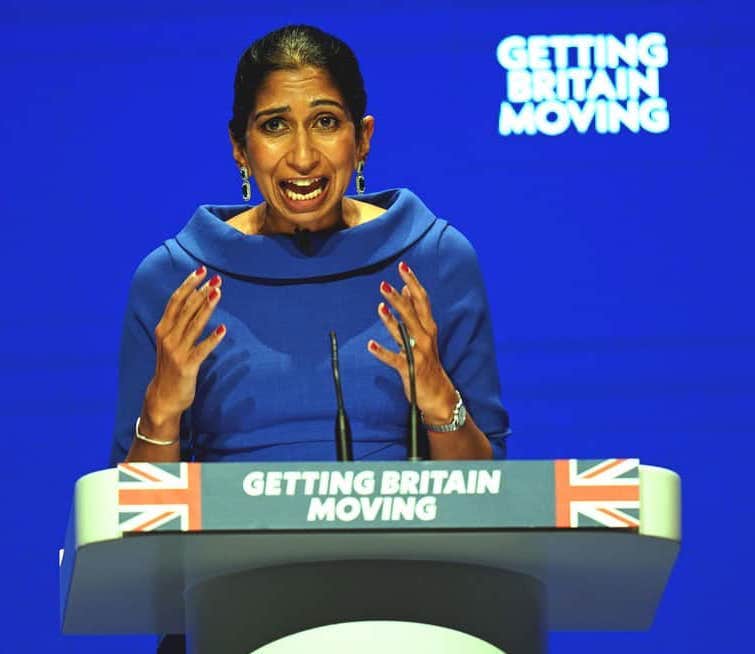
Suella Braverman at the Conservative Party conference

Born to Kenyan Indian and Mauritian parents who moved to Britain in the 1960s, Braverman has however has proved to be ambitious and ruthlessly controversial and outspoken.

That has led to her playing a seemingly leading role in slowing progress on the current India-UK free trade deal (FTA) negotiations by opposing the sort of economic migration that her parents enjoyed.

Though quickly eliminated from the leadership contest that eventually produced Liz Truss as a crisis-prone prime minister, Braverman’s strengthened her post-Brexit popularity with the anti-immigration and anti-woke right wing of the party during the campaign. That led to her being made home secretary, one of the four top posts in the cabinet at the age of 42, even though she lacked the experience of most predecessors.

Along with Priti Patel, who she followed as home secretary, Braverman is far to the right of other top politicians of South Asian descent, notably Rishi Sunak and Sajid Javed.

Denying opportunity

Her stance horrifies many others from the subcontinent because she is denying would-be new immigrants the success that she is able to enjoy as a result of the opportunities given to her parents when they were economic migrants. She has said she is proud of what her parents achieved – her mother became an NHS nurse and local councillor in north London, and her father worked for a housing association.

Along with Patel, Braverman’s motives are widely thought to stem as much from political ambition as ideology, Both pander to the Conservative Party 80,000 largely right-wing members who elect the leader. They want to show they are “whiter than the whitest of Cheltenham colonels,” I was told, controversially but maybe aptly, by a friend of Indian origin.

Last week during the Conservative Party’s chaotic party conference, Braverman horrified government insiders with a Spectator magazine interview where she opposed the inclusion of more open immigration in , for Indian students, key workers and others in the trade agreement that Truss and Narendra Modi had been aiming to sign by Diwali. That festival is celebrated at the end of next week and the target now has slipped to later in the year, unless some sort of interim deal is concocted.

Braverman also infuriated British universities with complaints about students’ extended families and said she wanted to drive down immigration, even though Truss’s economic growth needs immigrants to help fill over one million job vacancies.

Other cabinet ministers cashed in on the conference’s free-for-all and rebelled against Truss, who had been weakened a few days earlier by a disastrous mini-Budget and a financial crisis, but Braverman was perhaps the most disruptive. She has gone quiet publicly since then and last weekend joined a chorus of party leaders appealing for unity behind Truss.

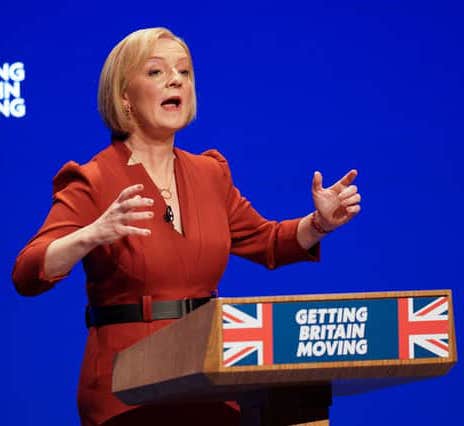
Liz Truss at the Conservative Party conference

In the Spectator interview she said she had “concerns about having an open borders migration policy with India” because she didn’t “think that’s what people voted for with Brexit”.

In the context of the trade agreement, she said there could be flexibility for students and entrepreneurs, though she had reservations. “Look at migration in this country – the largest group of people who overstay are Indian migrants. We even reached an agreement with the Indian government last year to encourage and facilitate better co-operation in this regard.”

The remark about India not abiding by the agreement to take back over-stayers is in line with Home Office grumbles over several years. It brought a predictable response from the Indian government that said it was was committed to facilitating the returnees and awaited “demonstrable progress” from the UK.

Braverman talked about immigration in other interviews and has complained about the number of dependents who accompanies students. – “family members who can piggyback onto their student visa.”

Lord (Joe) Johnson, who was universities minister in his elder brother Boris Johnson’s government, said her ideas on foreign students “bode ill for her period as Home Secretary if this is going to be her approach to, frankly, one of the most promising export industries that the UK has”. Without international students, the government could “kiss goodbye” to its ambition for Britain to become “a science superpower”.

Deal “in peril”

The reverberations from the interview continued and led to a story in the UK’s Times newspaper on October 12 headlined “Indian trade deal in peril after Suella Braverman migrant comments”. This quoted anonymous sources from India saying the “relationship has taken a step back” while a British source alleged Indian officials were “apoplectic”.

In parallel, India’s Economic Times ran a headline that the deal was “stuck over access to skilled workers”. It said India had hardened its position demanding easier immigration into the UK amid the concerns raised by Braverman. A Delhi trade department spokesman was quoted saying India would not “sacrifice quality for speed”.

There are many other issues as yet unresvolved in the trade negotiations where subjects range from access in India for Scottish whisky and British cars. A stumbling block is the UK wanting effective protection such as international arbitration for UK investments and freedom to store business data overseas, both of which India resists.

Liz Truss begins a conversation with India’s new High Commissioner Vikram Doraiswami in Downing Street

But apoplectic or not, relations between the countries seem as cordial as ever, at least at top levels.
India’s has a new high commissioner (ambassador), Vikram Doraiswami in London who arrived three weeks ago and has been extremely active with a country-wide tour.

Those he has met include King Charles, at a reception in Scotland, Liz Truss in a Downing Street reception (on Oct 11), plus with regional leaders and Keir Starmer who heads the Labour Party.

Ultimately, the trade agreements prospects could rest on whether Truss has enough prime ministerial authority to over-rule her home secretary in the interests of a deal that would be good for the British economy.

Usually a prime minister would be able to do that but these are not usual times, Truss’s future is in doubt, and it might just be easier to let issues slide for now.

Braverman will not however have won the admirers and supporters she desires among the party leadership with her outbursts in the past week and could maybe have even reduced her chances of stepping into No 10 Downing Street if Truss loses the job that she now holds precariously.

Posted by: John Elliott | September 17, 2022

Thousands queue for up to 24 hours to honour Queen Elizabeth

Queen’s Lying in State is a focus for grief, respect and new friends

King Charles works on UK unity and survival of the House of Windsor

It was of course inevitable that Queen Elizabeth II would one day die, but it seemed as if it would never actually need to happen, certainly not till after she reached the age of 100 in four years time. When the monarch suddenly did go on September 8, it caused a shock that tens of thousand of people have been now coming to terms with by joining a long queue for up to 24 hours to spend just a few moments at her Lying in State.

This need to come to terms with what has happened is one of the main reasons why so many have travelled to London from across the country to show affectionate respect and say goodbye to the only British head of state most of them have known – more than 80% of the country’s 57m population were born after the Queen inherited the crown from her father King George VI in 1952.

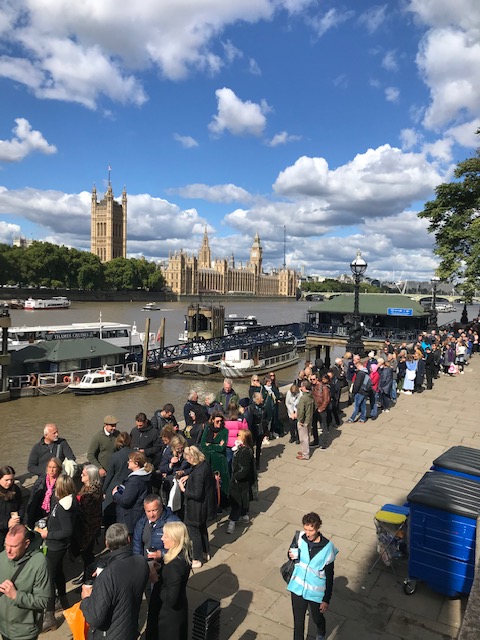
“Respect” was the reply I heard most often on the 16th morning when I asked people in the queue (left) on the River Thames path at Lambeth why they had come. Many had got up at 3am or earlier to walk five miles through the day for just a few moments at the Lying in State. (high speed video here)

Making new friends and sharing food is all part of the overall experience that makes it memorable and worthwhile, even if it means walking slowly through a bitter cold night – organised and helped by police, security contractors, volunteer civil servants and young scouts and guides.

David Beckham, the former English football captain and star, summed it up when he said on BBC tv: ”We all want to be here together and we all want to experience something where we celebrate the amazing life of our queen. Something like this is meant to be shared together eating Pringles, sherbet lemon and doughnuts and drinking coffee”.

In the queue, Ben and Diana told me they remembered when they were children watching the Queen being crowned in 1953 on their families’ first black and white televisions. “We need to make this gesture to say goodbye”, Ben said, “We are here for Charles and William too, to give them succour and show our support for them now as their grieve and in the future,” Diana added referring to the new King and his son and heir.

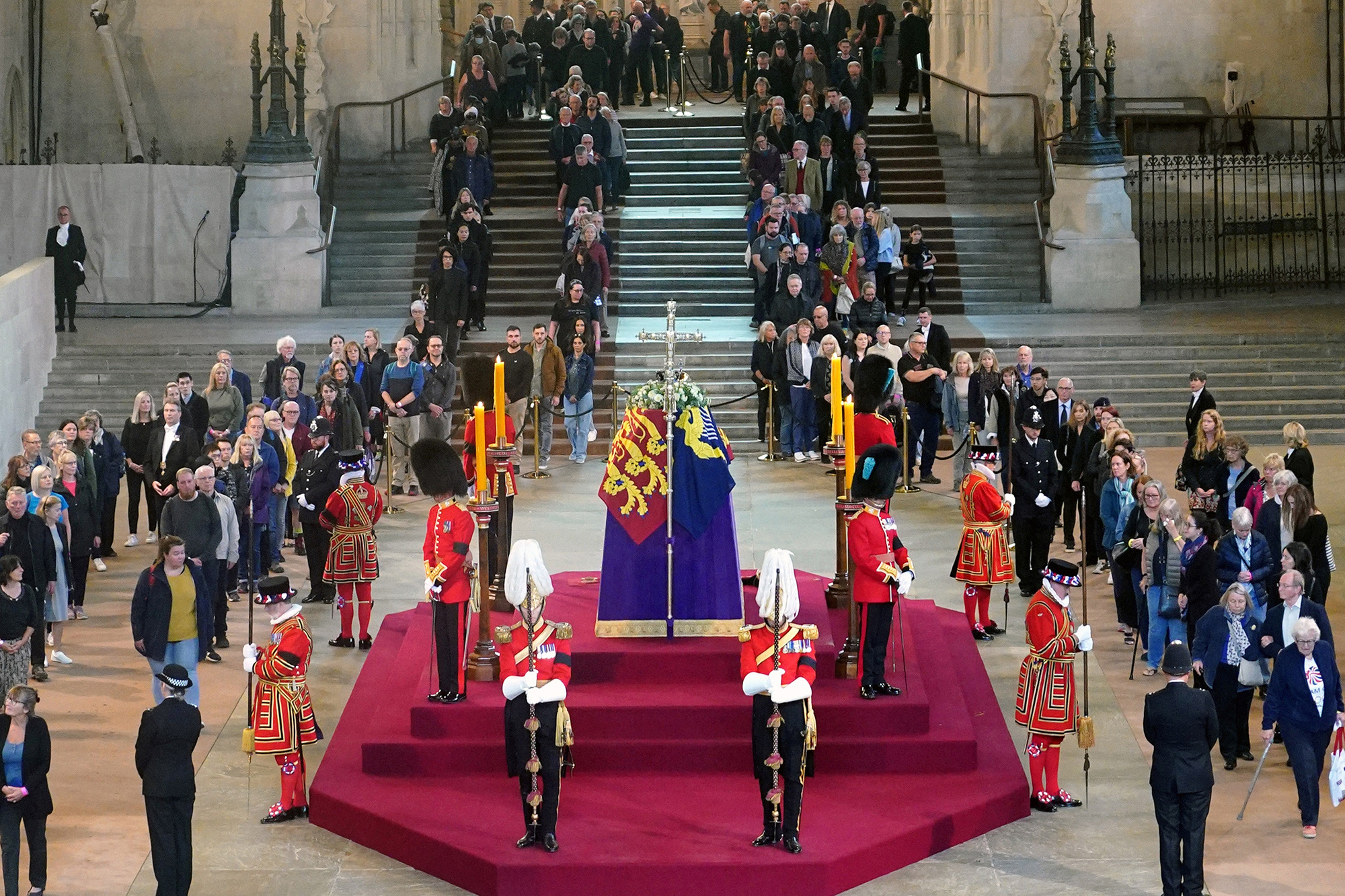
The Lying in State (Yui Mok/Pool via REUTERS)

Everyone seemed relaxed and cheerful, even though most had been in line since 5am or earlier and probably had five hours or more to go. They could see the Palace of Westminster, where the Queen was lying in state, across the Thames, but knew there were three or four more hours ahead including a final park where the queue stretches airport-style in circulating parallel lines.

Woo Seung Shin, originally from. Korea, had linked up with six other people he’d never met before They’d got on so well they’d set up a What’sApp group called Queen’s Guys and Dolls (below). “We’ve been together ten hours,” said Sonya Madden, a Hong Kong banker turned fashion designer. “That’s the equivalent of four or five dates”.

Shin was there because he’d met the Queen personally and talked with her as head of a Korean scientists and engineers association in 2004 when his country’s president had visited the UK.

The Queen’s Guys and Dolls new WhatsApp group

The mood changes and the crowd becomes quieter in the final minutes after crossing a large tented security checking area. Then people finally enter Westminster Hall, as I did soon after the Lying in State began on the 14th.

Arriving at the top of a wide flight of stairs, you see a dramatic sea of light and a pool of colour with the Queen’s coffin in the middle of a breath-taking image of purple, gold and red. It is raised on a high plinth with the spectacular Imperial State Crown and symbolic orb and sceptre, with white flowers, draped in the Royal Sovereign flag. On steps around the plinth stand helmeted guardsmen and brightly coloured Beefeaters (who guard the Tower of London), heads bowed.

Down the stairs, people file slowly past the coffin, some crying, some making the sign of the cross, some bowing, while others gaze and savour what is probably a once-in-a-lifetime experience.
“She never put a foot wrong, I felt I knew her,” Morna from Hereford had told me in the queue.“She never gave up on us, I wanted to say thank you,” someone else said.

Yutao from Guangzhou in China who has lived in the UK for eleven years and had heard about the Queen before he and his partner arrived, simply said, ”We wanted to show our respect”. That point was repeated by another young man who told me, “You’d be annoyed in ten years time, looking back, if you hadn’t come”.

Prince William greets people queueing for the Lying in State Sept 17 (Reuters/Phil Noble)

Thousands of people are today travelling into London for the climax on Monday when the funeral takes place in Westminster Abbey and the coffin then leaves, first drawn on a gun carriage and then by car, for burial in Windsor, an hour or so’s drive away.

The area around the Palace of Westminster which houses the parliament and the ancient Westminster Hall, has become a closely controlled security zone in the past week. Pedestrians are free to walk along designated pavement corridors, but streets are sealed to traffic with heavy barricades.

There are expected to be 10,000 police in what has been described as London’s biggest ever security operation to protect the 500 heads of state, prime ministers and other dignitaries who are expected to attend the funeral – including President Joe Biden, and President Droupadi Murmu from India but not Vladimir Putin who was not invited because of Ukraine.

The queue on Lambeth Bridge being recorded by Rosie Woods, a professional artist

Xi Jinping was invited, despite China’s actions in Hong Kong and with the Uyghurs. He is sending vice president Wang Qishan who was initially barred by Speakers of the two houses of parliament, but later allowed, to visit the Lying in State because China has put sanctions on some MPs.

When the Queen’s mother died in March 2002, I was in London and wrote in a column (for India’s Business Standard) that the massive adulation for her memory “showed how useful high profile deaths and funerals can be for dynasties”. Throughout history they had “provided occasions for families to re-establish their supremacy and national importance”. Political parties can gain from them and “the death of a revered royal enables the family to present itself to its people at its best”.

That is what is being achieved here with (again quoting from 2002) “carefully calibrated pomp and grand precision”. The events then, as now, had “left no-one in any doubt that Britain can still do at least one thing well – stage grand pageants that draw the people onto the streets and bind the country together.” The royalty had “a greater role to play at a time when the British identity is waning and disillusionment with politicians is growing because it is the one institution that can bind the country together”.

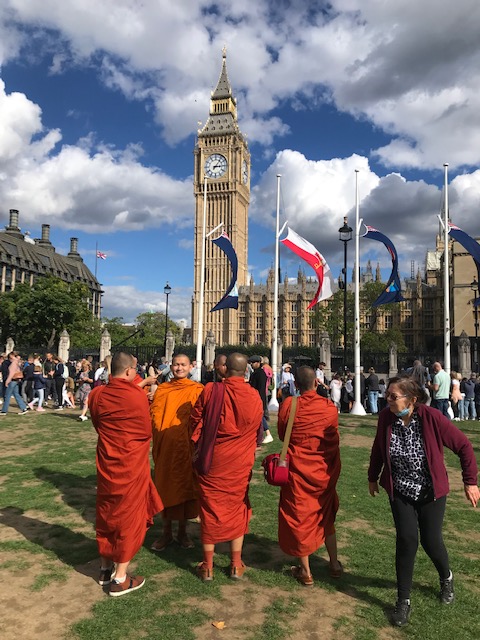
Buddhist monks chanting in Parliament Square Sept 16

There is less instant respect overall now than in 2002 for the House of Windsor monarchy, and King Charles has to prove its value in order to preserve the dynasty. His main aim, along with establishing his own charisma and popularity, is to unite the UK at a time when Scotland is threatening a second independence referendum that could cause ructions in Wales and Northern Ireland – all places he has visited in the past week.

Now there is a national need to be distracted from current problems at a time when Britain’s prospects in the near term are not bright. After the suffering of the covid pandemic and more recent economic upheavals of Brexit, energy prices are soaring, recession is looming and the pound at its lower level since 1985 – and there is a new untested prime minister, Liz Truss, who took office just two days before the Queen died.

So far he has done well with Queen Camilla but, inevitably, not that everything has gone to plan. Aside from squabbles about how visiting dignitaries should be treated, the King has twice revealed his known imperious impatience with details in the past few days.

On the first occasion, an ink stand was stupidly placed on a cramped table between the King and the documents he had to sign, so he impatiently wiggled his wrist to demand it should be removed. Then, a day or two later, he forgot the date that had to go with his signature, and the pen he was given leaked. “I can’t bear this bloody thing . . . every stinking time,” he exclaimed, walking off – all recorded close-up on television.

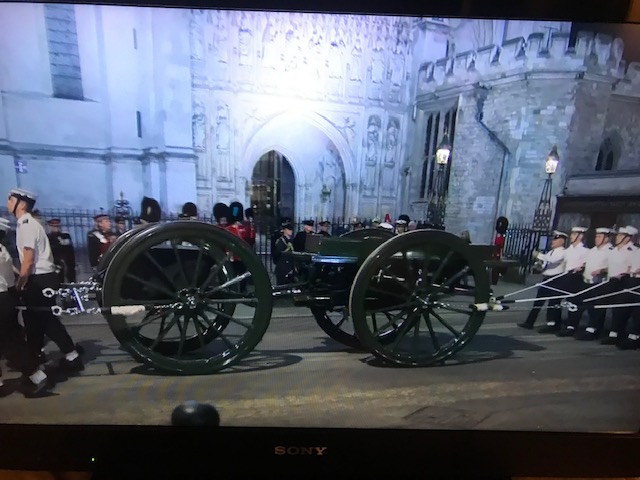
Night time rehearsal in Westminster – the gun carriage that will carry the coffin in the funeral procession on Monday

That has led to him being mocked on TikTok (where there are other attacks on the family) and on twitter. There is only a flicker of sympathy for the immense pressure he has been under when, having just lost his mother, he has done all the travelling, speeches at religious and civic occasions, and greeting crowds.

Now there is a weekend of meeting people involved in all the ceremonies, visiting the Lying in State queues with Prince William, and greeting foreign leaders before the funeral on Monday.

The celebratory pilgrimage has brought tens of thousands not just to the Lying in State, but also to nearby Green Park where masses of flowers have been laid since last weekend, and to the area around Buckingham Palace, the main royal residence. More are pouring into the capital to be here during the weekend and on Monday.

They are all showing their “respect” for the Queen but Charles, while dealing with his own personal grief, is also working to ensure that the second part of the saying “The Queen is dead, long live the King” comes true for him.

This is a slightly extended version of an article commissioned by India’s TheWire.in https://thewire.in/author/vrbneo

Posted by: John Elliott | September 10, 2022

India removed emblems of empire on the day the Queen died

Narendra Modi initiates moves to erase “symbols of slavery”

King Charles faces challenges as old colonial links are shed

In a coincidence that illustrated the great changes that Queen Elizabeth II had to deal with during a long reign, her death on September 8 came just a few hours after India, a leading member of what was once called the “British Commonwealth”, began removing some of the last emblems of British colonialism from central Delhi.

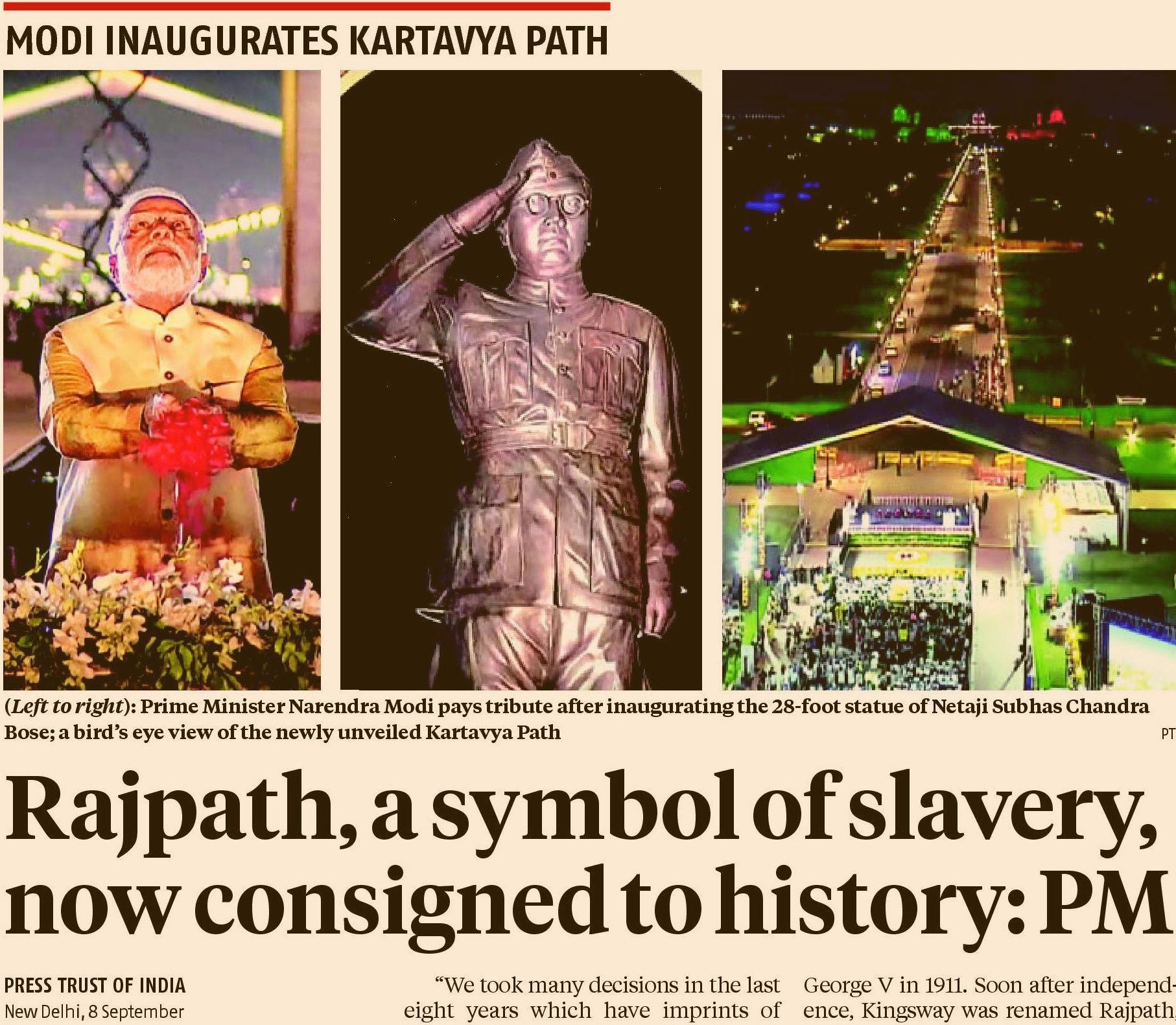
Erasing what prime minister Narendra Modi called a “symbol of slavery”, the name of Delhi’s revamped ceremonial road from the presidential palace to India Gate was changed from Rajpath to Kartavya Path, which means Path of Duty. It had been called the Kings Way before independence and Modi said at the renaming ceremony on September 7 that both the old names “symbolised the power of the ruler”.

The new Kartavya Path “represented the sense of duty as well as the spirit of public ownership and empowerment”. He congratulated the nation “for their freedom from yet another symbol of slavery of the British Raj”.

The Business Standard front page Sept 9

This is not a move against the UK or the Commonwealth, but about removing the relics of British rule as India’s modern history is rewritten to shift Jawaharlal Nehru (and also Mahatma Gandhi) from their revered positions as the primary independence heroes.

Modi wants to be seen as India’s pre-eminent post 1947 leader and to eliminate the Nehru-Gandhi dynasty’s already fading Congress Party.

The new hero of independence is Netaji Subhas Chandra Bose, a political leader who sided with the Japanese in the second world war as a move against the British.

His 28ft statue was unveiled this past week on Kartavya Path under a Grand Canopy that used to cover a statue of King George V. “At the time of slavery, there was a statue of the representative of the British Raj. Today, the country has also brought to life a modern, strong India by establishing the statue of Netaji at the same place,” said Modi. The Indian Navy has also dropped the red cross of St George in a new version of its ensign (it was also dropped earlier, then restored).

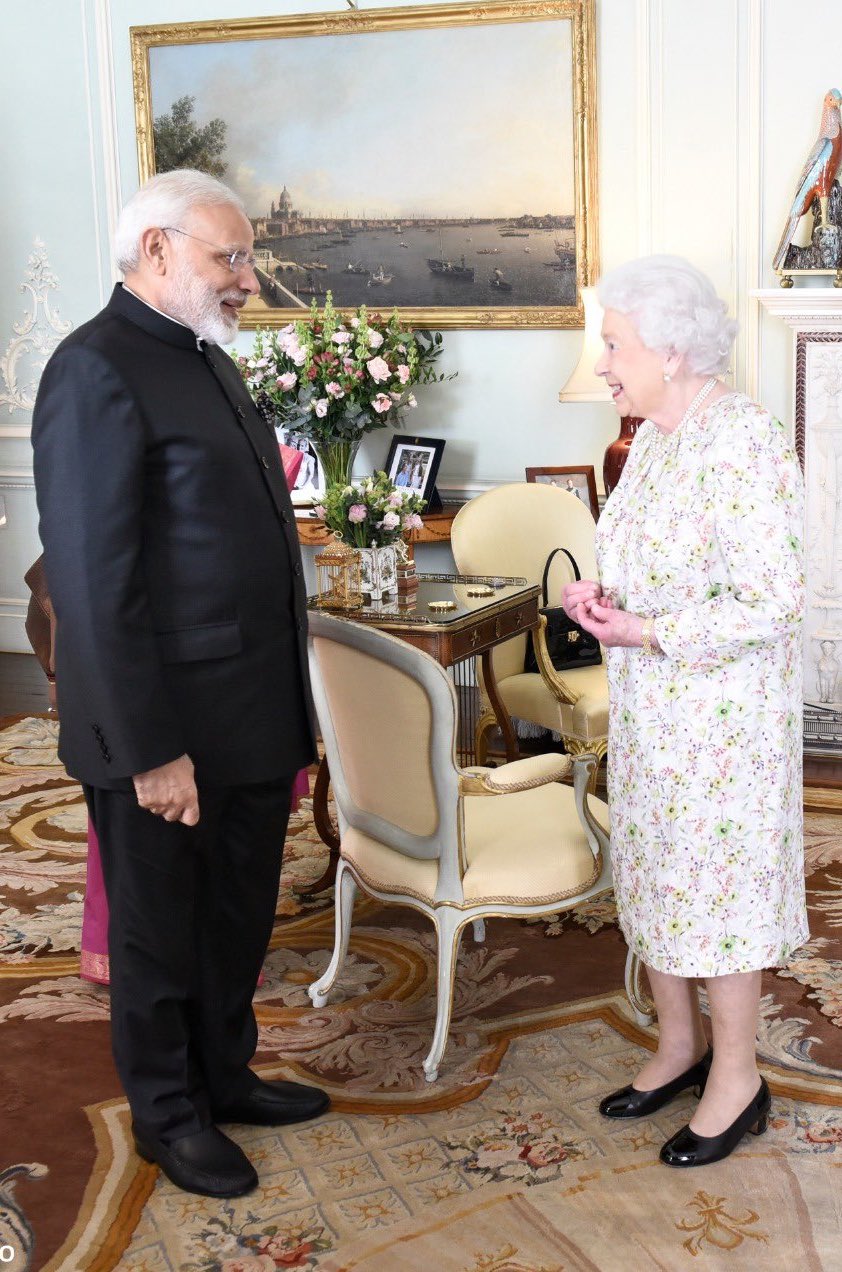
Narendra Modi meets the Queen on a visit to London

Such moves illustrate the challenges that King Charles III will face in steering a path through the domestic political gyrations of the 56-nation Commonwealth, which his mother loved and preserved.

“In any list of her achievements, her role in smoothing the transition from empire to post-colonial Commonwealth must stand among the highest,” says a tribute on the website of the Commonwealth’s Round Table journal.

When the Queen succeeded her father King George VI in 1952, she became head of state of more than 30 countries, or realms as they are know in Commonwealth parlance. While she was Queen, 17 replaced her with their own heads of state and many of the remaining 14, which include Canada and Australia, are likely eventually to do so too.

In 1952, India was the only country in Britain’s old empire that was not only independent (from 1947) but had also become a republic (in 1950). Jawaharlal Nehru, the country’s prime minister, initiated moves that ensured the Queen immediately inherited the role as head of the Commonwealth.

In 2018 when the biennial Commonwealth summit (known as Chogm) was held in London, Modi is believed to have also played a significant role in ensuring that the then Prince Charles, who had visited him in Delhi for a dinner a few months earlier, was adopted as the future leader. With hindsight, it seems that achieving this smooth succession was the Queen’s primary aim for the summit.

Questions at a Chogm press conference about whether there had been any objections to Prince Charles drew answers that indicated not all the countries had at first agreed. The Ghana president, Nana Akufo-Addo, revealingly said there was “a strong consensus”. Theresa May, the British prime minister, said it was “unanimous” which, of course, did not mean there were not any dissenters during the discussions.

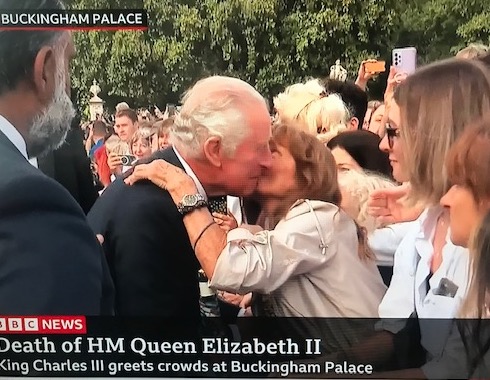
King Charles and his wife toured along the crowds lined up outside the palace – and a few managed more than a handshake

Earlier suggestions that the role could rotate around the member countries did not have much support, and there was no other international figure of sufficient stature. The decision could have been delayed, but the British government and royal family lobbied effectively against that happening.

The frictions King Charles will face were illustrated when the Duke of Cambridge, now the Prince of Wales, toured the Caribbean in March. Barbados had replaced the Queen with an elected president four months earlier, and the Jamaican prime minister publicly told the duke and duchess that his country too would be “moving on”. Reparations for the slave trade under British rule were demanded in the Bahamas.

It looked as if the British foreign ministry had not done an adequate job discovering and preparing for what would emerge. The duke said the tour had “brought into even sharper focus questions about the past and the future”.

Who the Commonwealth chose as leader “wasn’t on my mind,” he added, thinking ahead to when he becomes king and the question of him succeeding his father will arise. “What matters to us is the potential the Commonwealth family has to create a better future for the people who form it.”

The Commonwealth has never emerged as a major internationally significant and influential institution, and it is widely regarded as a waste of time and money. Even Narendra Modi seemed to lose interest after the 2018 Chogm and did not attend this year’s summit in Rwanda. In 2018, there was an idea that India should play more of a leadership role but that has not developed, even though the Commonwealth has the advantage of being a rare international organisation where China does not qualify for membership.

As an organisation it is most valued by over 30 small states with populations under 1.5m. They see it is a forum where they can meet and mix with world leaders and where they can also find a voice and call on expert advice and support. On a different level, there are valuable events like the Commonwealth Games and many associated organisations dealing with issues from human rights to climate change.

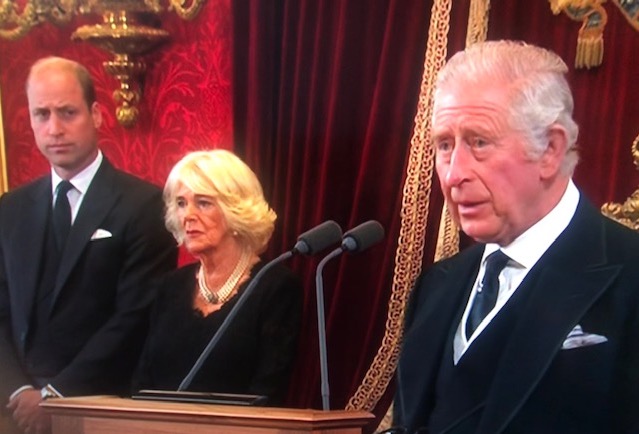
The Prince of Wales (left), the Queen Consort Camilla and King Charles III at his Proclamation ceremony Sept 10

Sunday (Sept 11) has been declared an official day of mourning in India and the Queen is revered in most of the other countries. There are exceptions however in Africa, notably it seems in Kenya. There have been reports, including one here on CNN, that she does not deserve to be mourned because she was sovereign during the repression of the Kenyan Mau Mau rebellion in the 1950s.

But the monarch has less power than many other heads of state and is not supposed to intervene – something the new king might find difficult, given his past record of speaking out, especially on climate change and the environment.

Referring to the Queen, the Round Table said, “Although her role necessitated discretion and is shrouded in secrecy, it is well known that on several occasions (such as on the question of sanctions against the apartheid regime in South Africa) she fought the Commonwealth’s corner with her then UK prime ministers,”. She also dropped a gentle hint against a vote for independence when Scotland had a referendum in 2014.

That then is the challenge facing the new King – finding a way to fill the role performed with tact and skill by his mother so that he is accepted as the leader, and then holds the Commonwealth together as individual countries like India determinedly sever relics of colonial rule while others become republics and remove him as head of state.

Posted by: John Elliott | September 5, 2022

Truss beats Sunak to be Britain’s PM but not by a huge majority

Record ethnic mix likely in Truss’s top Cabinet jobs

Truss faces massive crises that will test her abrasive character

Rishi Sunak has been beaten – more narrowly than many had expected – by Liz Truss to become leader of Britain’s Conservative Party and the country’s fourth prime minister in six years.

Truss’s 81,326 votes against Sunak’s 60,399 showed a majority of approximately 21,000, which is less of a landslide than recent media commentary has suggested. It means that she has less authority over MPs, who originally backed Sunak, and less support among party members than she would have wished in order to enforce her radical right wing policies.

Liz Truss making her victory speech

The fact that only about 11,000 voters need to have switched sides to make Sunak the winner reflects the result of five televised “hustings” where he clearly won over the audiences with his willingness and ability to give clear cut answers. Truss kept her replies vague and did not develop her ideas.

It is fair to conclude that if more party members had known more about Sunak when they voted over the past month, the result might have been different.

Ethnic mix in Cabinet

Britain will not – for now at least – have an Indian-origin prime minister, but it looks likely that there will be an historic broad-based mix of ethnic backgrounds at the top of Truss’s cabinet.

If media forecasts are correct, the three leading Cabinet posts will go to Kwarsi Kwarteng, whose parents come from Ghana, as Chancellor of the Exchequer, James Cleverly with a British father and Sierra Leone mother as Foreign Secretary, and Suella Braverman with Kenyan Indian and Mauritian parents, as Home Secretary. They have all held less senior cabinet posts in the past. In Johnson’s government the Chancellor and Home Secretary posts were taken by Indian-origin Sunak and Priti Patel.

Also probably included in Truss’s Cabinet will be Nadhim Zahawi, the current (temporary) Iraqi-origin Chancellor, who may go back to his old role as Heath Secretary. There might also be a job for Pakistan-origin Sajid Javed, one-time Chancellor and later Health Secretary, who triggered Boris Johnson’s exit as prime minister when he resigned in July, quickly followed by Sunak.

Liz Truss and her husband Hugh O’Leary as her victory is announced

This reflects the growing social mix of British society. It far exceeds the 15% of the UK population who come from a minority ethnic background, while in parliament there are currently 65 MPs from those backgrounds, just 10% of the total (an increase of 25% over the 2017 general election).

There will always be suggestions that Sunak lost because of his Indian origins, and there may be something in that because Conservative Party traditionalist members are almost certainly less likely to want a non-white person as prime minister than the general electorate.

The main reason however is that Truss’s unwavering true blue tax-cutting rhetoric, and developing right-wing image as an experienced politician, appealed in the tortuous month-long election campaign to more grass roots party members.

Sunak appeared as a super-efficient well-groomed policy manager. He knew exactly how to run the country during an economic crisis and had an answer to every contingency, something Truss carefully avoided. He shunned quick popular tax cuts.

It all seemed rather unreal because, while Britain faced news of escalating crises with rocketing energy prices and inflation, plus a drought and the prospect of water shortages, the two contestants fought over their primary differences – Truss’s tax cuts that in reality will worsen inflation and scarcely help the poorest and most destitute, while Sunak condemned that as lunacy and proposed interventionist policies that Truss will now be forced to adopt.

Johnson’s jaunts

Meanwhile the government became sterile and Johnson enjoyed his final weeks in power. In addition to visiting Ukraine, where he is a popular hero, his jaunts included flying in a jet fighter, joining a dawn police raid, and announcing distant nuclear power plans. He even suggested people should buy a new £20 efficient kitchen kettle to save £10 a year on their electricity bills. That was his solution for families facing rocketing energy bills that have just risen from an average of around £2,000 a year to over £3,400 and are then forecast to nearly double to more than £6,000 in six months’ time.

Rishi Sunak’s wife and mother at one of the hustings

Sunak’s defeat compares with the voting among Conservative MPs in July where he led Truss with 137 votes to her 113. Those figures probably reflected Truss’s lack of popularity among MPs, many of whom will have welcomed Sunak’s role in triggering the 50 or so Cabinet resignations that led to Boris Johnson’s downfall.

The grass roots party members knew him less well and only gradually realised his potential. Nearly half of them wish Johnson was still prime minister according to opinion polls, so will have resented Sunak’s role. At the start of the campaign, his position was undermined by heavy criticism from Truss’s supporters for being ‘disloyal’ to Johnson – he replied that policy and other differences became too great for him to remain in the cabinet.

Then there was the issue of his immense family wealth totalling some £730m, mainly stemming from his wife Akshata, daughter of Narayana Murthy, co-founder of Infosys, one of India’s three leading IT companies. Akshata, who was little known before the campaign started had retained non-domicile status and used it to escape some £20m UK tax. During the campaign however she emerged as a visible and enthusiastic supporter.

Sunak also had a much weaker political and policy team around him than Truss, who managed to garner traditional Conservative support, though that seemed less evident in the more prosperous south of the country than in the north. She quite quickly gained personal confidence, keeping the debate focussed on her popular tax cuts and rejecting interventionist policies that she is now likely to announce.

Truss’s family story

She traded heavily on her apparently poor northern childhood roots in order to distinguish herself both from Sunak’s childhood in Hampshire, a well off country in the south, and from his immense wealth. In fact, they both come from professional middle class families and Truss was born not in the north but in Oxford. Her father was a mathematics professor at Leeds university and her mother was a nurse and teacher, while Sunak’s East African Indian father was a doctor and mother a pharmacist.

Truss , age 47, now faces a series of crises that need immediate attention. They will test her reputation for abrasiveness and whether she is uncharacteristically willing to consult and be flexible.
Reports suggest that no-one who knew her when she was young expected her to get this far, though there is a general view that she is always determined to win and succeed. A quick YouGov opinion poll today however showed only 14% of people thought she would make a better leader than Johnson.

On the economy, there is double-digit inflation and a cost of living crisis with public finances heavily stretched, rising debt and a prospect of a long recession. That worsened this morning with gas prices rising sharply after Russia banned supplies to Europe. Early action to freeze energy prides is espected.

Foreign policy issues include Ukraine where Johnson – backed by Truss as foreign secretary – led the toughest response to the Russian invasion, and the West’s simmering confrontation with China. Unresolved problems stemming from Brexit are led by a confrontation with the European Union over trade barriers that threatens stability in Northern Ireland, and there is the question of Scotland’s independence that would cripple the United Kingdom. On all of these issues, Truss has till now struck confrontational stances that would not ease solutions.

The National Health Service is in a crisis. Hospitals are barely able to cope with a post-Covid demand, but the subject that scarcely figured in the leadership election debates is serious labour unrest that looks like leading to the worst rash of trade union strikes since the 1970s. The railways are being hit with a series of crippling one-day stoppages that have also hit bus services and the country’s largest port. Other groups threatening action include teachers, lawyers, ambulance drivers, refuse collectors, and telecommunication and airport workers.

Trade union strikes

Both Truss and Sunak have aired confrontational policies to restrict public service workers’ freedom to strike. If Truss stays on that track, without introducing attempts at labour conciliation that have been absent under Johnson, she could face an early showdown with the unions this winter. Co-ordinated action is due to be debated at the annual Trades Union Congress next week.

Meanwhile, Johnson still harbours hopes of returning as prime minister. There are even reports that MPs who support him are thinking of triggering a new leadership crisis before the end of the year.

“I will deliver a bold plan to cut taxes and grow our economy, and to tackle energy crises,” Truss told party members after her election was announced today. The policies will begin to emerge tomorrow when she enters Downing Street and begins to appoint Cabinet ministers. That will happen after she has visited the Queen at Balmoral in Scotland where she will be invited to form a new government.

Sunak of course must be regretting today that it is Truss who will receive that invitation but, given the scale of the immediate crises, he can console himself with the thought that the prime minister’s post might be up for grabs again in two year’s time.

This is a slightly extended version of an article commissioned by TheWire.in https://thewire.in/world/liz-truss-rishi-sunak-new-prime-minister-uk-analysis

« Newer Posts - Older Posts »

Categories