Over-long election campaign continued during Covid surge
Mamata Banerjee sets an example to other opposition parties
Narendra Modi has lost his bid to extend the Bharatiya Janata Party’s power to West Bengal after leading a high profile and unnecessarily long state assembly election campaign, where he addressed mammoth unprotected political rallies as the Covid surge swept across the country.
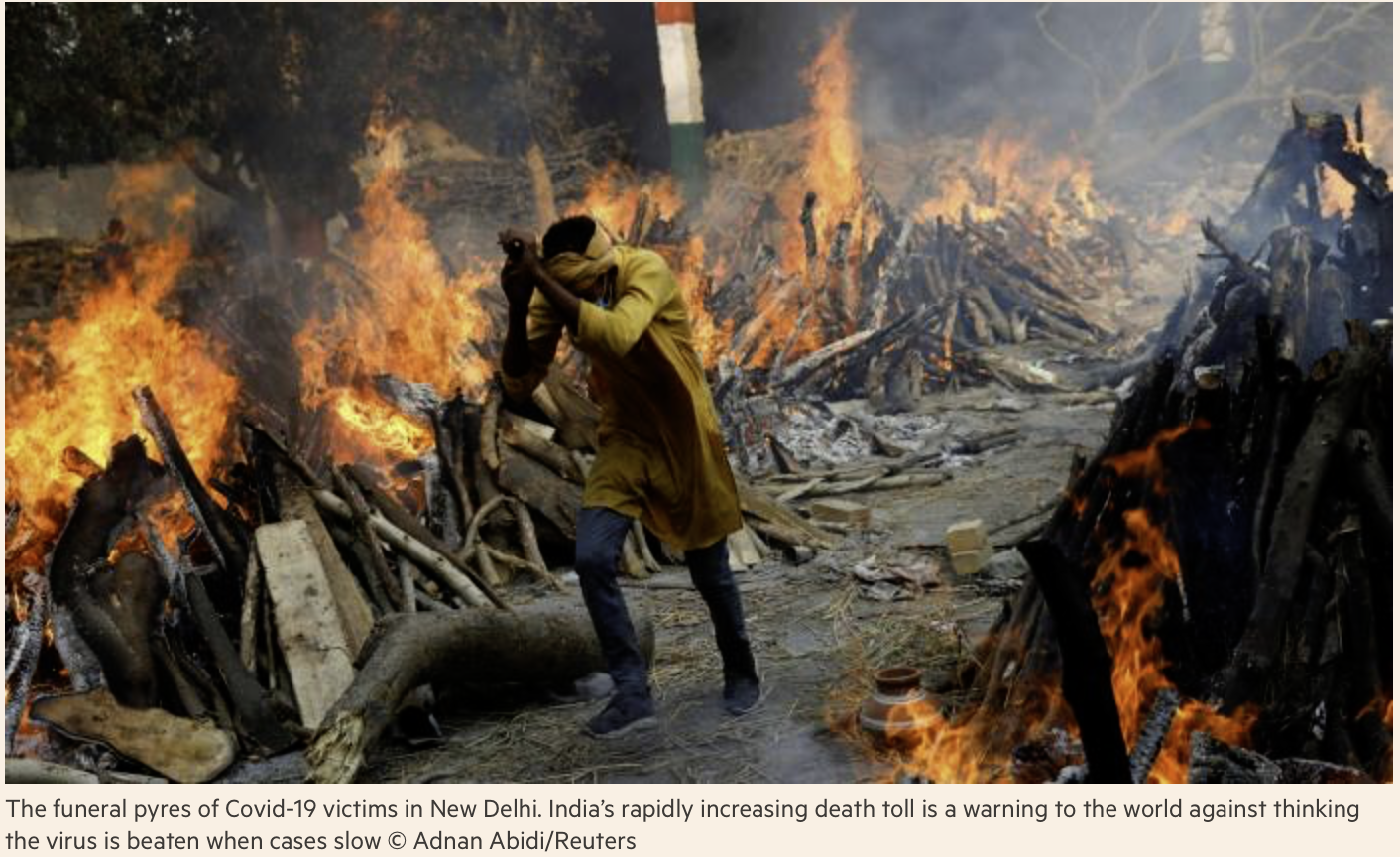
This diverted him from running the national government at a key time in the pandemic that is now producing record official numbers of some 360,000-400,000 new cases a day and 3,500-4,000 deaths.
The human tragedies stem from the national and state governments failing to prepare for a new surge. They then allowed large scale rallies and a religious festival to take place, which acted as super-spreaders and influenced opinion against mask wearing and distancing.
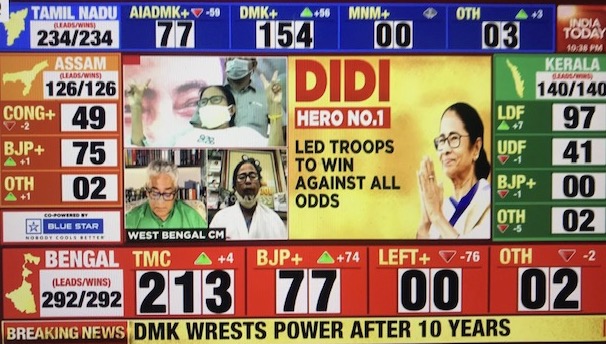
The Trinamool Congress (TMC), a state-based party led by Mamata Banerjee, which has been in power since 2011, won in West Bengal winning 213 seats in the 294–seat assembly. Banerjee narrowly lost her seat and will need to be stand in a by-election, unless there is a recount, which has so far been refused.
Mamata Banerjee campaigning after injuring her leg
The BJP won just 77 seats, though that was a significant improvement on its tally of just three seats in 2016 state election. It did well in the 2019 general election after extensive use of social media and substantial groundwork done by its allied organisations.
For Modi and his close associate, home minister Amit Shah, the primary focus since the end of last year has been to drive Banerjee out of power and demonstrate that the BJP is continuing to win new territories for its Hindu nationalist creed. They undermined her organisation by poaching its leaders and launched vicious personal attacks in their speeches.
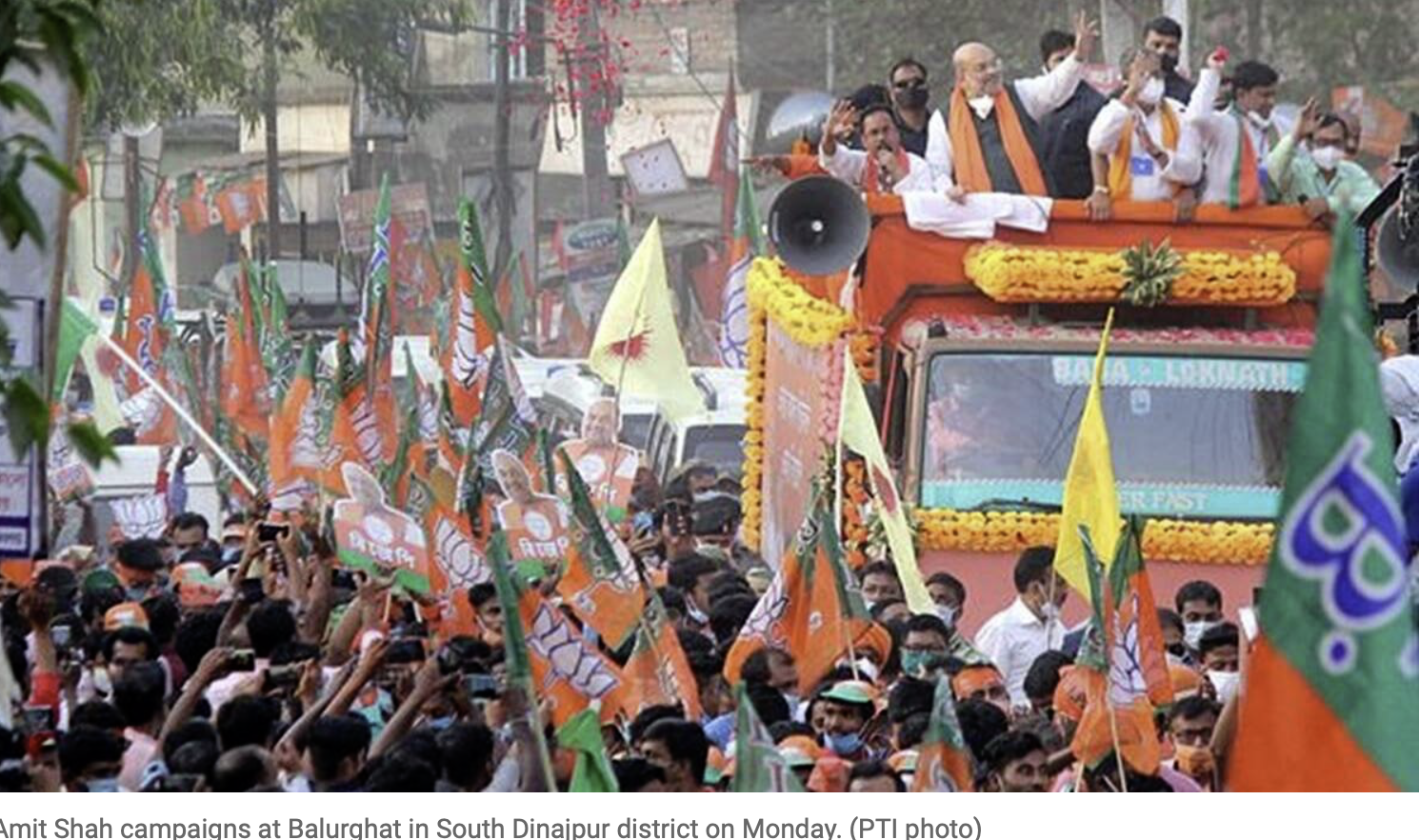
Together they spoke at some 70 rallies during a five-week campaign of eight phases, with Modi only calling off his electioneering and returning to Delhi on April 22 when India’s daily total of new Covid cases topped 350,000.
Critics say the campaign could have been much shorter, which could have lessened the rallies’ role as super-spreaders. But, they allege, the Election Commission arranged the eight phases to allow Modi time to visit every area just before voting day.
Prasant Kishore, a professional election strategist who has advised many parties and politicians including Modi, managed the TMC’s successful campaign. Speaking on television channels as the votes were being counted, he accused India’s officially independent Election Commission of being “completely partial and an extension of the BJP”. It gave the BJP “systemic support”.
He also suggested that Modi and Shah had over-estimated the potential impact of their polarised campaign, dividing Hindus and the minority Muslims. “Polarisation can motivate 40 to 50% of the vote, and that is what they got, not the 70% that they would have liked,” said Kishore.
India Today tv during the count .
For the BJP to have failed to win after its high profile campaign significantly dents Modi’s reputation as an iconic vote winner at the same time that he and his government are being criticised in India and abroad for mishandling the Covid crisis.
Subrahmanyam Jaishankar, the foreign minister, held a virtual meeting with India’s ambassadors on April 28, telling them to counter the international media’s “negative” and “one-sided” reports. On Twitter, he said that the crisis has “strengthened global solidarity with India”.
The West Bengal result (analysis here) will encourage regional parties opposed to the BJP to strengthen their activities. The opposition lacks a national leader because of the Congress Party’s faltering Gandhi dynasty. Banerjee could now act as a rallying point for other regional parties, though she seems unlikely to make it herself as a national leader.
Often called Didi (elder sister in Bengali), she is a feisty 66-year old populist politician who spent part of the campaign ostentatiously in a wheel chair after injuring her leg.
Amit Shah campaigning on April 19
The TMC is built around her personality, without much structure or any distinctive political creed. In 2011, she ousted West Bengal’s Communist-led Left Front that had been in power for 34 years, and now she has defeated the rightist BJP.
Originally in the Congress, she broke away and formed the TMC in 1998 and went on to become chief minister in 2011. She has been a national minister for railways and for coal and mines under both Congress and BJP prime ministers.
The BJP also failed to do well in results of other state elections announced today, winning only in Assam.
In Tamil Nadu, where the contest was between two state-level parties, the staunchly pro-Tamil DMK defeated the incumbent AIADMK that has been in power for ten years and has the BJP as an ally. The DMK is opposed to the BJP’s Hinduvta policy. It wants jobs protected for Tamils and sustained teaching of the Tamil language.
In neighbouring Kerala, a Communist-led coalition, which has managed the pandemic better than most states, was re-elected, defeating a coalition that included the Congress. The BJP won no seats.
Overall, the day’s results show that the BJP’s crushing tactics do not always work. Communist parties are now virtually wiped out in West Bengal (they won only one seat) and exist only in Kerala, and the Congress has failed yet again to matter.
Surge forecast to peak in May and continue till June or July
Finance minister’s husband attacks government performance
India is facing the prospect of the crippling Covid-19 pandemic surge increasing with massive numbers of cases and mounting deaths till it peaks in mid-May, and then continues till June and July. The official number of new cases has been rising at more than 300,000 a day for the past seven days – over 2m a week – though the real total is far higher.
This is an unimaginable catastrophe as families cope with the tragedies of the virus, the desperate lack of medical advice, shortages of hospital beds and equipment, and the ill health that can follow, and the deaths.
April 22, India record international total of over 300,000 cases – source John Hopkins University
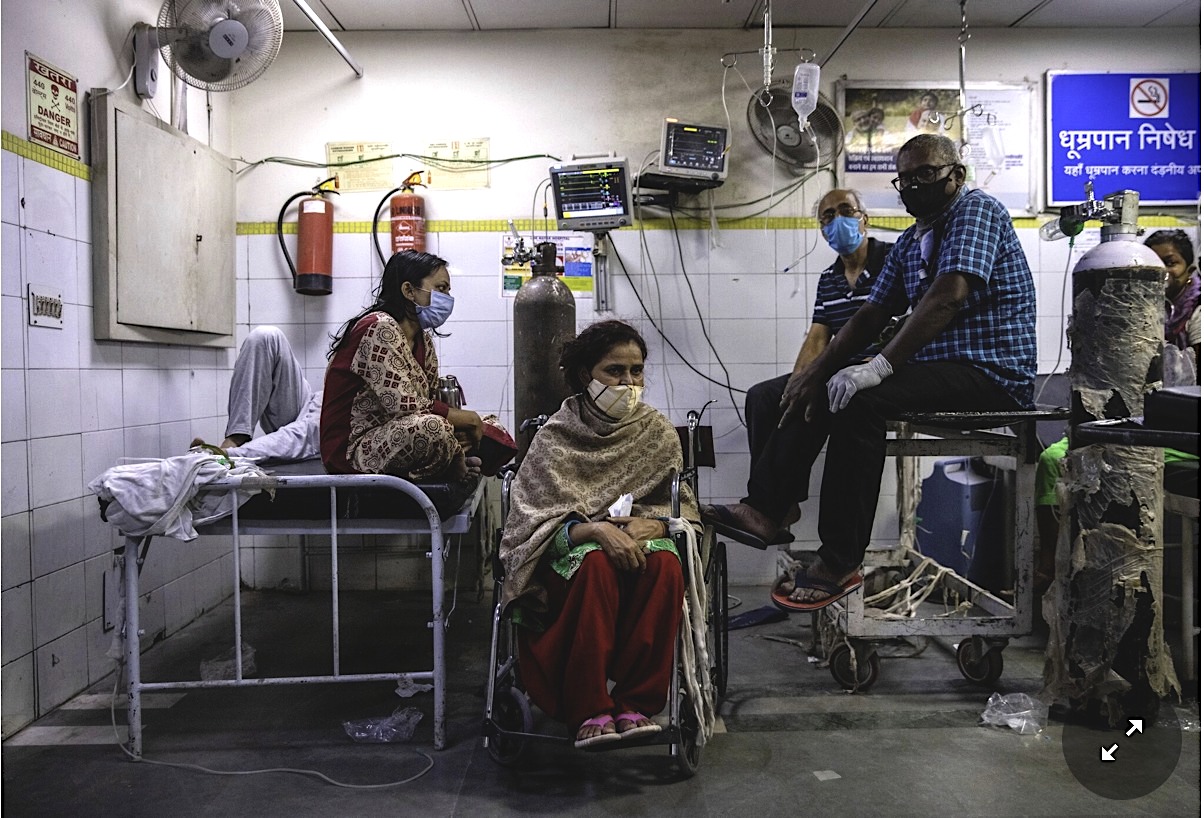
Scenes that have been viewed around the world on television tell of the extreme panic and desperation as families trudge from the over-loaded crowded chaos of one hospital to another, seeking medical help, oxygen cylinders and other facilities, and then mourn as their relatives pass away, sometimes lying in cars, ambulances and hospital corridors.
The peak could be reached by “possibly mid-May” with new cases going up to 500,000 or more a day, NITI Aayog, a government policy commission, told a review meeting held last week by Modi with chief ministers of states. After that, the wave would “take time to subside — be ready till June/July”.
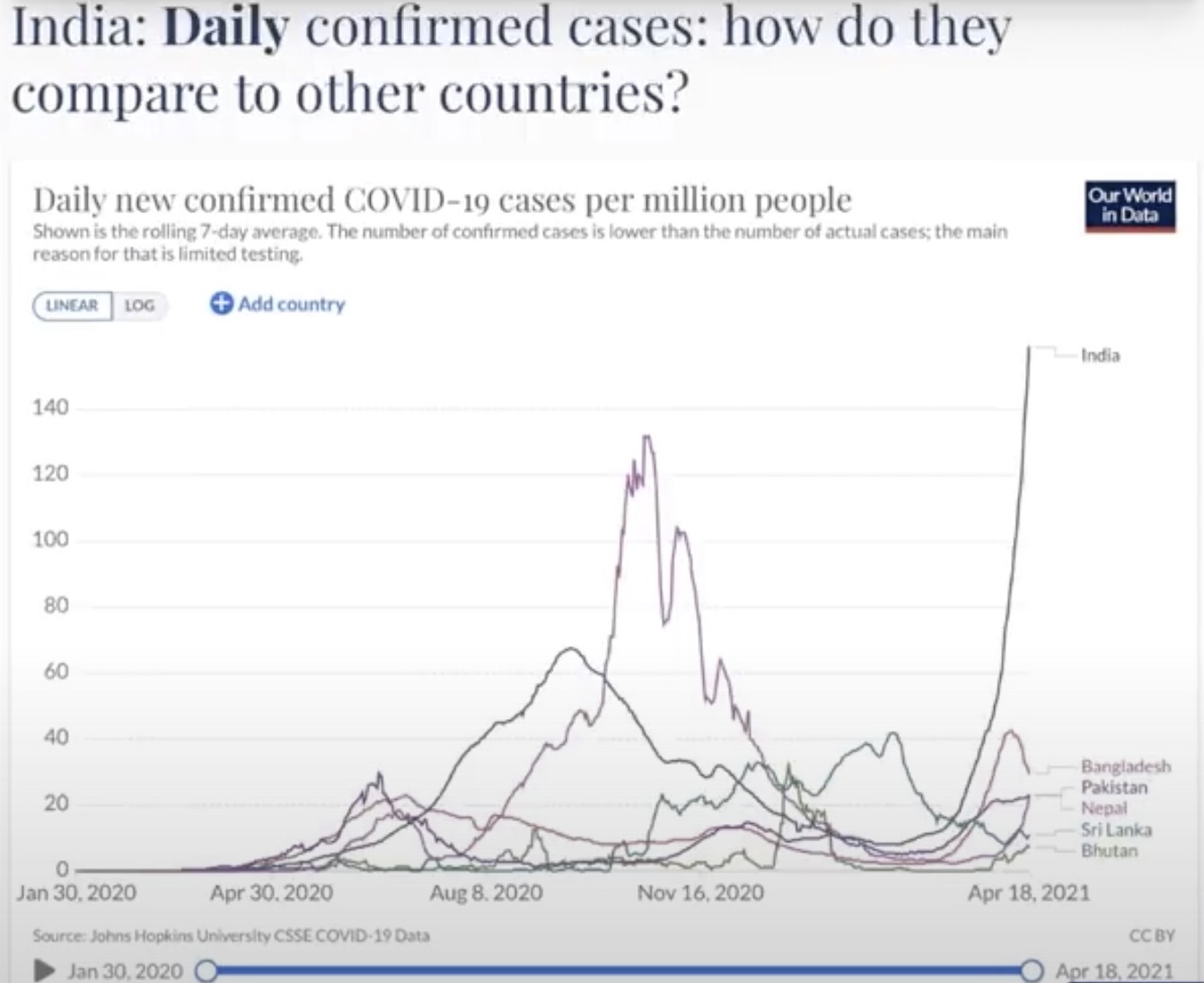
In the context of India’s 1.3bn population, the figures are proportionately lower than other parts of the world, though they are far higher than elsewhere in South Asia. India’s total deaths figure of nearly 200,000 is only the fourth largest in the world and the total of 14.5m recovered is by far the largest – though none of these figures are reliable.
Such comparisons become irrelevant when set against the misery and social upheaval that is being caused by the implosion of the country’s ill-prepared health service. How much damage that will do to India’s stability remains to be seen.
Usually, India rides out such crises. The Modi government has escaped much blame for the economically devastating demonetisation of 2016, and last year’s flight of millions of migrant workers when the country was locked down in March.
Narendra Modi address large crowd in Kolkata March 7 2021 – @NarendrModi
“The prime minister’s popularity, political capital and communication skills seem to indemnify him from the impact of the ineptitude, incompetence and heartlessness of this government,” Parakala Prabhakar, the economist husband of finance minister Nirmala Sitharaman, said in his weekly YouTube broadcast on April 21.
Prabhakar has voiced criticisms in the past, but not to the extent of this carefully aimed attack. “The government and the ruling party are adept at outrage management,” he said. “They understood that the initial sharp yelp after the pain will quickly be followed by the country becoming numb to suffering”. Popularity and political capital however had “a habit of running out without giving notice”
Modi will now try to ease himself away being blamed. He has said the surge is like being “hit by a storm”, comparing what has happened to a natural event beyond the control of governments or anyone else, like the floods and earthquakes that people in countries such as India regard as part of their lives.
India has far more cases than the rest of South Asia – source John Hopkins University
He presumably hopes his followers will pick up that theme and say to each other, “Modi says it is like a storm, so it will pass, no?”
This is not the India that Modi set out to build when he became prime minister. Nor could he have ever envisaged that he would have to ask other countries’ prime ministers and presidents, as he has done in he past week, for the oxygen, vaccines and other equipment that his government, and state governments, have failed to provide. Relief is being flown in by at least 15 countries including the US ($100m supplies), the UK and Australia, though the impact may be slow and uncertain.
The shortages are undoubtedly being exacerbated by panic buying (and a black market) of items such as oxygen cylinders and the Remdesivir drug, and that is the result of fear and uncertainty caused by a lack of adequate medical advice and hospital facilities.
As Prabhakar indicates, Modi should surely take the lead in shouldering the blame for what has happened. Constitutionally, health is the responsibility of the states, not the central government, but Modi’s government has been in charge of vaccines (which it has just devolved to the states) and it is a prime minister’s duty to lead and set an example, which he failed to do till last week.
Other countries’ prime ministers have made many mistakes in the past year since the pandemic began. Few however have Modi’s iconic leadership stature, which gives him increased responsibility to lead the country’s people competently.
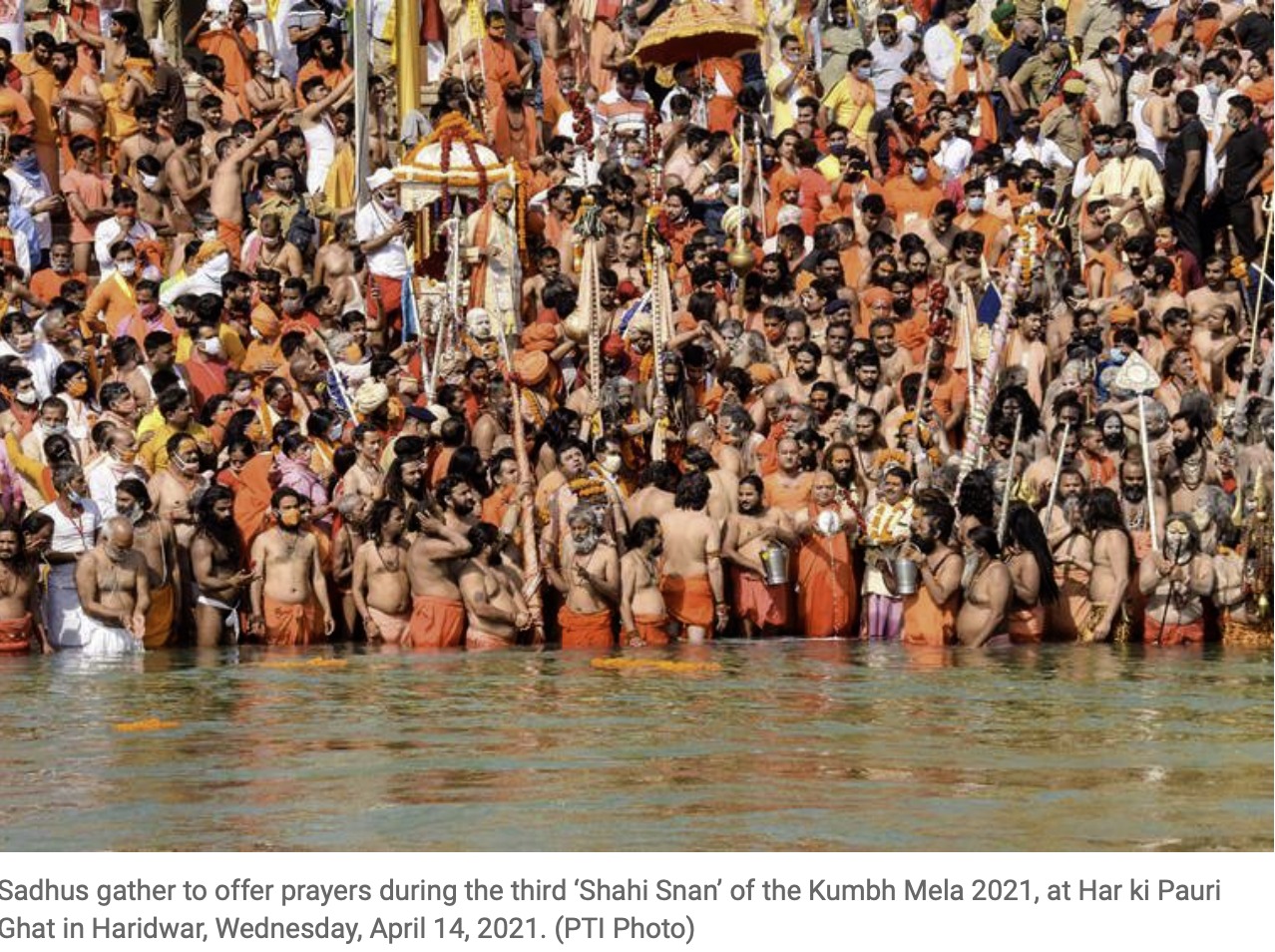
Modi and his government have focussed on politics and election campaigns with large mass and unprotected rallies, while millions of pilgrims have attended the Hindu religion’s vast Kumbh Mela that is now being wound down, having seen more than 10m worshippers since January.
The crowds seemed to believe they were safe till some of their leaders caught the pandemic and over 1,700 people tested positive between April 10 and 14. Compulsory PCR tests are being ordered for pilgrims returning to cities like Delhi, but that will be almost impossible to administer effectively.
“Kumbh is at the bank of the River Ganga. Maa Ganga’s blessings are there in the flow. So, there should be no corona,” declared Tirath Singh Rawahe, the chief minister of Uttarakhand where the current Maha Kumbh Mela takes place in Haridwar every 12 years.
Modi welcomed crowds at political rallies instead of restricting them till last week. Campaigning in West Bengal on April 17, the day a record-breaking 234,000 new Covid cases were registered along with 1,341 deaths, Modi said that he had “never seen such huge crowds” at a rally, but he did not call for social distancing or masks.
Patients wait in a Delhi hospital – Danish Siddiqui Reuters/NYT
Politicians from other parties did the same in the Bengal and four other state assembly election campaigns that are drawing to a close this week. (The count will take place next Sunday May 3, but it is unlikely that Modi’s BJP will suffer much from the pandemic because voting in all the states apart from West Bengal ended on April 6 before the full scale of the emergency had emerged).
There was no attempt by national and state governments to curb the assembly of massive crowds, and virtually no precautions at events such as an England test and other cricket matches in Gujarat in early March, when Modi was preoccupied with having the world’s largest stadium re-named after himself in front of massed spectators.
There is now a glimmer of possibly good news as the number of new cases appeared to have plateaued in Maharashtra, which includes India’s commercial capital of Mumbai and accounted for 60% of India’s total cases in March. Elsewhere, curfews and other restrictions are being turned into lockdowns across the country in small containment zones, cities and states.
The official daily all-India figures – record figures of 362,770 new cases on April 27 with 3,286 deaths – understate the total. State governments and hospitals obscure figures and there are inevitable administrative failings as well as a tendency for families not to report illness and death.
“From all the modelling we’ve done, we believe the true number of deaths is two to five times what is being reported,” Professor Bhramar Mukherjee, an epidemiologist at the University of Michigan, has said.
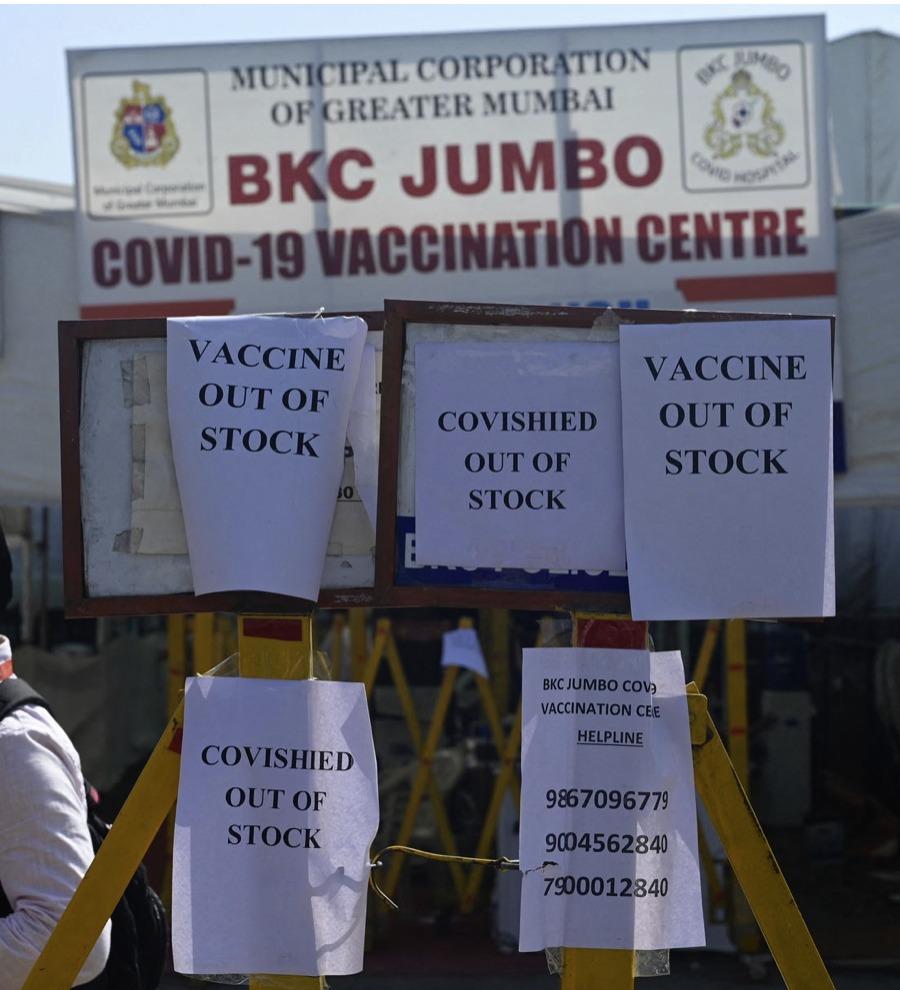
Mumbai vaccination centre April 20, 2021. Indranil Mukherjee/AFP via Getty Images
AFinancial Times analysis earlier this month, based mostly on local news reports of cremations in seven districts across Gujarat, Uttar Pradesh, Madhya Pradesh and Bihar, showed that, while at least 1,833 people had died of Covid, only 228 were officially reported. In the Jamnagar district of Gujarat, 100 people died but only one death was reported.
Mukherjee told The Wire.in that infections would peak in mid-May when India could see 800,000 to one million new cases daily. In terms of deaths, the peak would be two weeks later at the end of May with an expected 4,500 daily deaths.
This means that India is facing two and maybe three months of the pandemic surging across the country faster than medical facilities and vaccines can cope. “No state has adequate infrastructure to deal with the surge in cases. (The) number of deaths may increase due to lack of treatment facilities,” NITI-Aayog said in its presentation.
The problems began at the beginning of the year when, after several months of a declining rate of new cases, India thought it was escaping the second surge that hit Europe and the US. This led to complacency and a growing disregard for safety precautions such as mask wearing and social distancing.
“India is bending the COVID infection curve: since mid-September, barring localised surges, infections are slanting fashion to support investment and consumption demand”, a bullish article in the Reserve Bank of India’s Bulletin declared just before Christmas, noting “the absence of the dreaded second wave”.
In January, Modi told the World Economic Forum, “In a country which is home to 18% of the world population, that country has saved humanity from a big disaster by containing corona effectively.”
No attempt was made during the winter to build up buffer stocks of vaccines and other medicines and equipment.
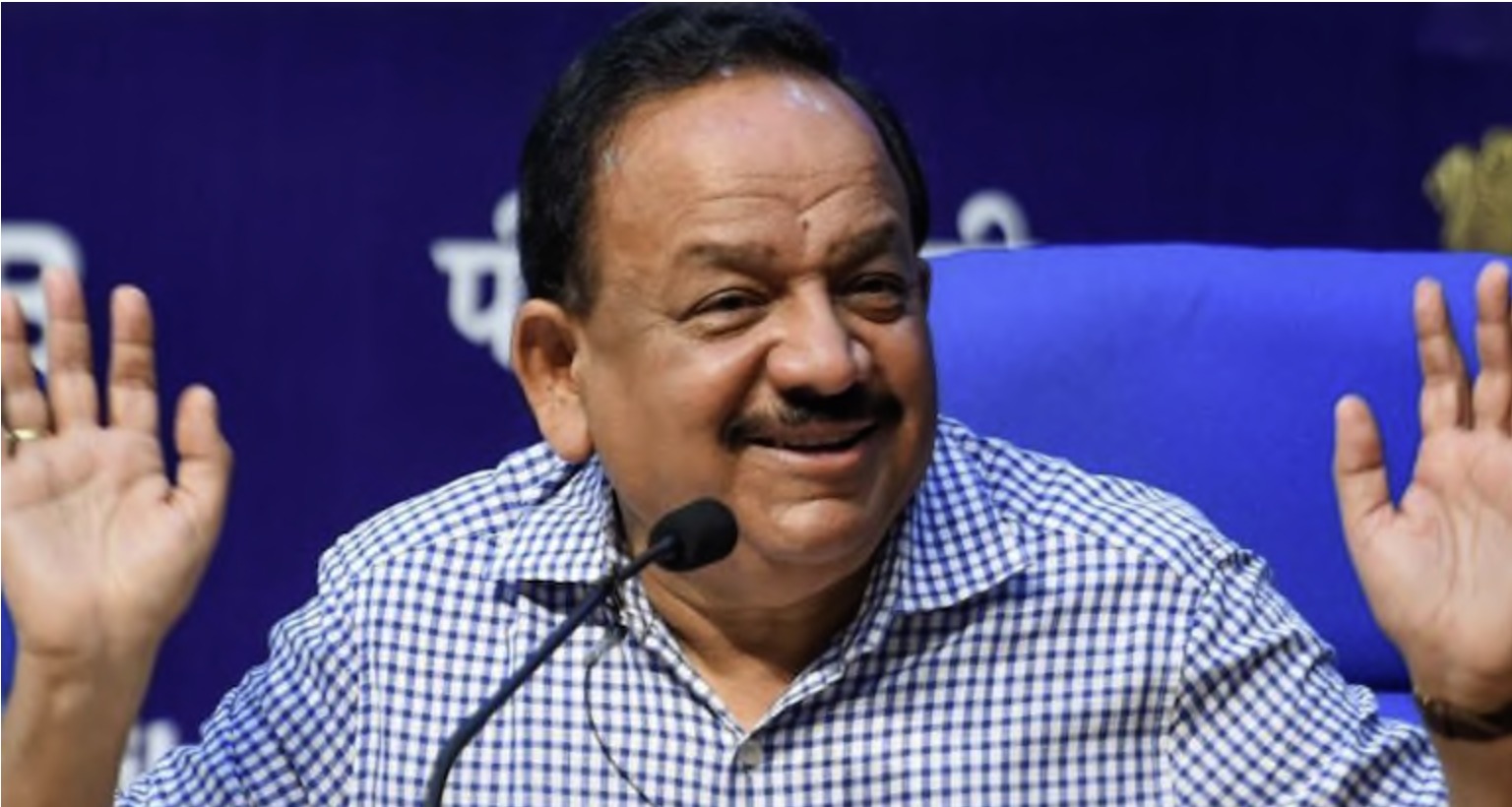
Harsh Vardhan declaring the “endgame”, India Today March 7 2021
In February, just as the numbers were beginning to rise again, many states started dismantling Covid facilities, believing they would no longer be needed, and 60m Covid vaccines were sent abroad to help other countries. That meant the states were far from ready for the surge, and there was a national shortage vaccines.
“We are in the endgame of the pandemic,” health minister Harsh Vardhan declared on March 7, ignoring an already obvious surge. “Unlike most other countries, we have a steady supply of Covid-19 vaccines”.
Taken together, these developments underline four trends:
– an over-riding relentless desire for political power, especially in Modi’s BJP, that diverts political leaders and government from their primary jobs – in recent weeks and months, tackling the pandemic;
– a lack of respect for legal or social rules and norms, and the absence of a sense of community, leading to disdain for pandemic precautions such as distancing and mask wearing;
– deep religious beliefs that led to millions of people attending the mega festival despite Covid, with political leaders as well as gurus saying that worshipping in the sacred River Ganges would negate pandemic risks.
As an FT editorial remarked on April 26, “In the global struggle against the virus, the chain of humanity is only as strong as its weakest link.”
Krishen Khanna on Judas and the supper’s ‘tragedy and victory’
Saffronart exhibition of ‘betrayal, sacrifice, friendship’
India’s long links with Christianity, and the country’s acceptance of all religions, has been illustrated for generations by Indian artists’ fascination with the Last Supper, the pivotal meal that Jesus had with his disciples on Maundy Thursday, the eve of his crucifixion.
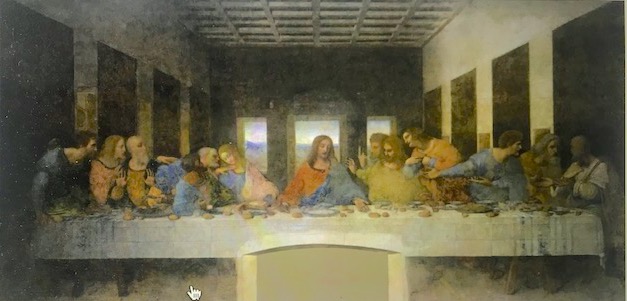
For Christians, the supper has religious significance, but it is the drama of the evening that has inspired others who have painted their own interpretations – following the lead of Leonardo da Vinci’s late 15th century epic mural (above) in Milan. Searching the web produces a mass of parodies from a pole dancer on a table, and people playing table football, to a Looney Tunes version.
More seriously, an on-line exhibition of 36 new paintings by Indian artists, mostly not Christian, is now being staged by Saffronart, the Mumbai-based auction house. As has happened with earlier works, the artists have produced a variety of settings and characters to replace the disciples, sometimes including fellow artists and politicians.
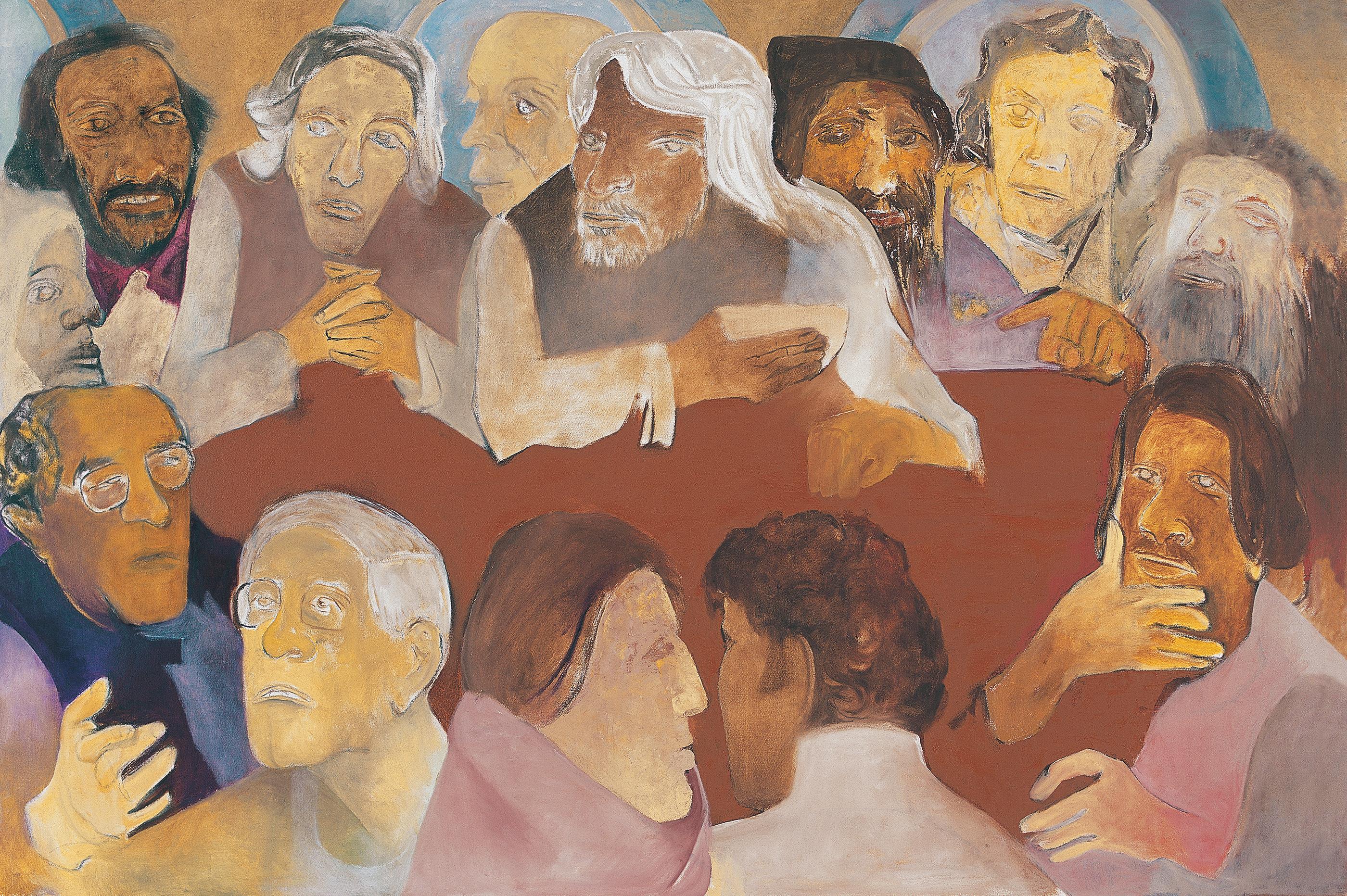
Krishen Khanna’s 40in x 60in oil on canvas, “The Last Bite”, with leading artist M.F.Husain in Jesus’s seat surrounded by fellow artists – Khanna facing Husain
“Indians are fascinated with story-telling and India is a secular country accepting religions across the board historically,” says Dinesh Vazirani, Saffronart’s co-founder and ceo.
“Key themes of betrayal, sacrifice, friendship, and community” appear in the Biblical accounts of the supper, explains Ranjit Hoskote, an Indian poet and art critic in an introduction to the exhibition. “They dwell on human weakness yet also emphasise the human ability to hope”.
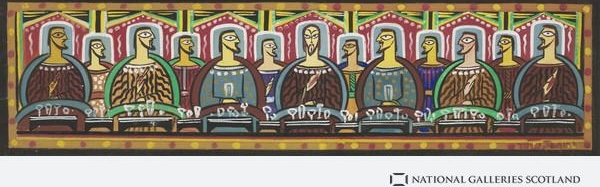
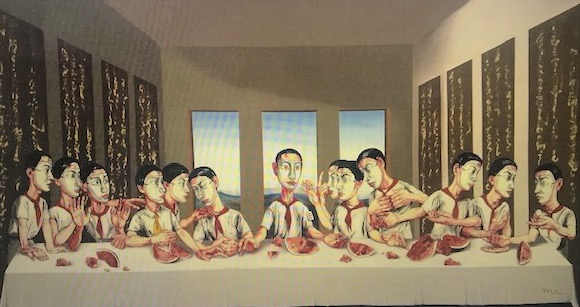
With that as the stimulus, modern Indian artists who have interpreted the drama go back to Jamini Roy, who died in 1972 and painted a work (below) in the 1930s. Works were being produced in the 16th and 17th centuries in other countries, and famous recent artists include America’s Andy Warhol and China’s Zeng Fanzhi from Wuhan (picture at bottom of this blog).
Krishen Khanna, 95, who has a work in the current exhibition titled The Last Bite (above) and Francis Newton Souza, who died in 2002, have been among the most prolific in India. They were friends and both belonged to the Mumbai-based Progressives group that was formed in the mid 20th century – as did M.F.Husain, who also produced works, one of which sold for $1.1m in October 2017.
Khanna has told me that he was introduced to the da Vinci when he was five and his father brought a copy back from Milan. “He explained the painting to me and that was my introduction to the Bible in a sense,” says Khanna who, though Hindu, has developed a detailed knowledge of the religion.
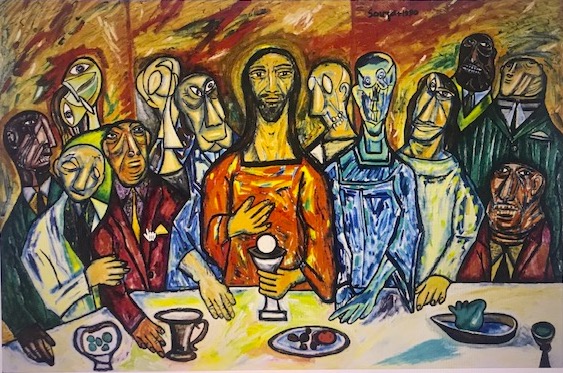
F.N.Souza’s famous rendering of The Last Supper with a conventional image of Jesus surrounded by distorted lopsided faces typical of the artist’s earlier works
He went to Christian schools “where we were told we could sit aside while Christianity was being taught, but it fascinated me to listen, maybe more than the others and see what happened and how clever Christ was”. His wife is a Bengali Christian, though he thinks his schooling had a greater influence on him.
Khanna focuses on the role of Judas, who betrayed Jesus, seeing it as “almost a universal phenomenon, with the supper showing him going back on what he really believed in”. That, he says, is “something that is happening here today in India”.
“The whole thing rests on Judas’s betrayal and Christ knew that it was going to happen.” Indian artists, he says, “understand what is going on and see it is a question of tragedy with victory at the end”.
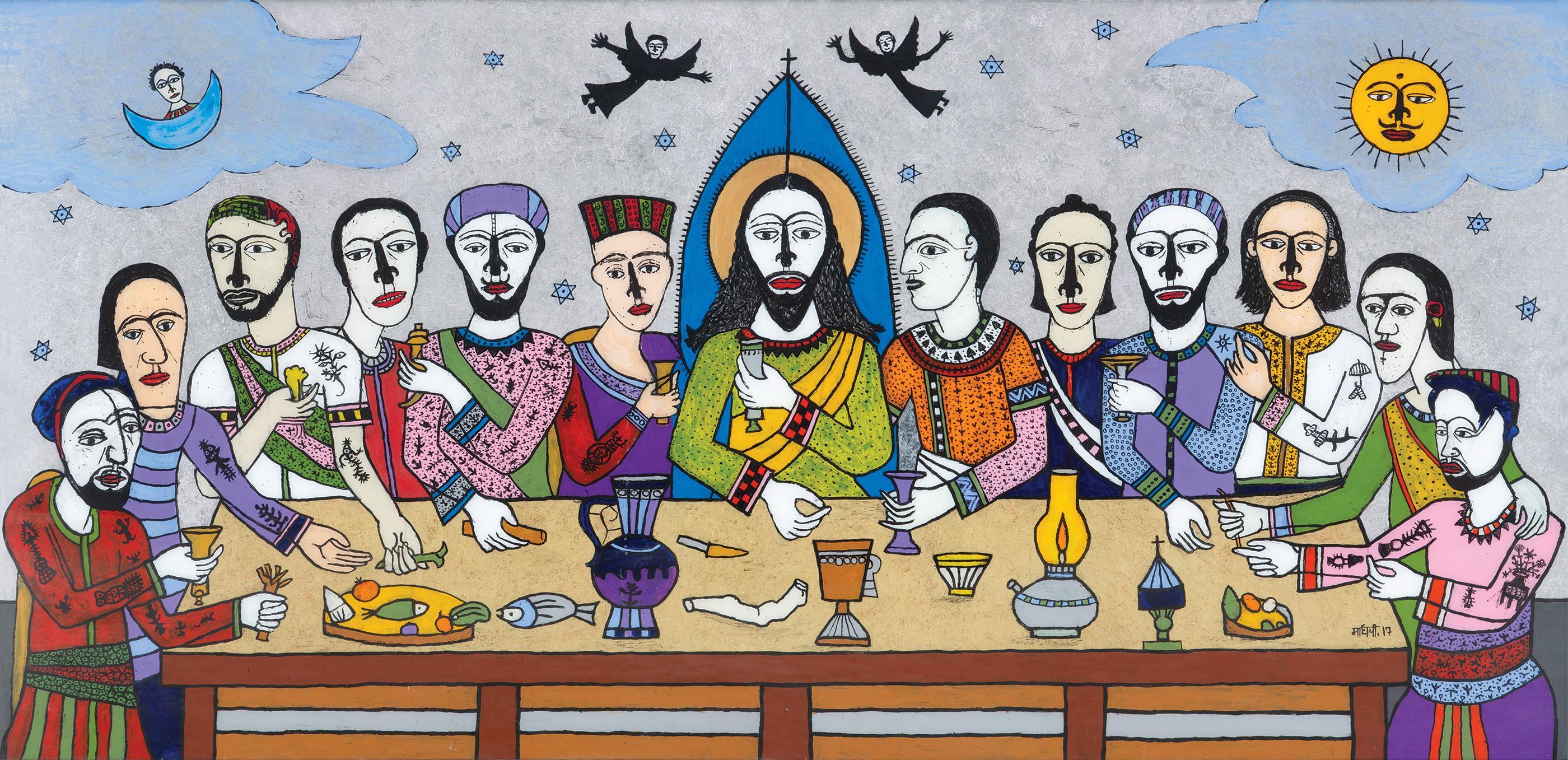
Madhvi Parekh’s untitled 60in x 120in reverse acrylic on acrylic sheet is a folk art styled work of unknown characters
In his painting, which was done more than ten years ago and is not for sale, Husain is seated in place of Jesus, surrounded by contemporary artists. Khanna says that is because Husain was “quite central to the art scene, a pivotal figure and quite the leader in attitude, looked up to by most of his peers”.
He adds, somewhat mischievously however, that “there is no specific Judas in the picture and I leave it to anyone who knows the situation to apportion that place”. The table is square, which Khanna explains, “leads the eye from the bottom to the top where Christ is in the middle – a more identifiable and sacrosanct place than in the da Vinci”.
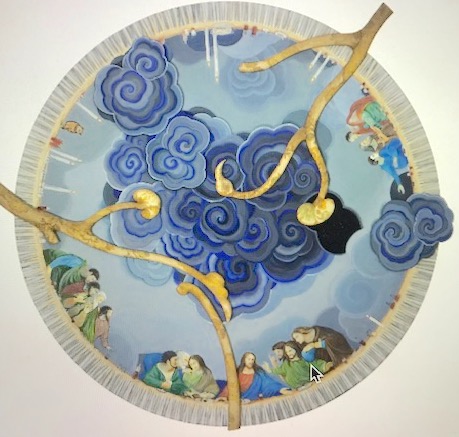
Jesus and his disciples look down from a domed ceiling in this 48in diameter acrylic and fabric on canvas, by Jagannath Panda, titled The Last Supper.
Souza was born a Roman Catholic in Portuguese Goa, but lapsed, which led to him producing many tortured paintings around a religion “that fascinated and revolted him in equal measure,” according to one interpretation.
His best known Last Supper (above) was painted in 1990 and was owned for some time by the Japanese Glenbarra Museum, which offered it for sale in a Sotheby’s Mumbai auction in November 2019. It fetched a hammer price of Rs6.86 crore ($960,000) but the sale did not go through following a dispute during the auction over whether Souza was the sole artist or was helped by his then muse (who triggered the dispute). Another work owned by the Glenbarra had been sold two years earlier for Rs2.6 crore ($390,000) in a Pundole Mumbai auction.
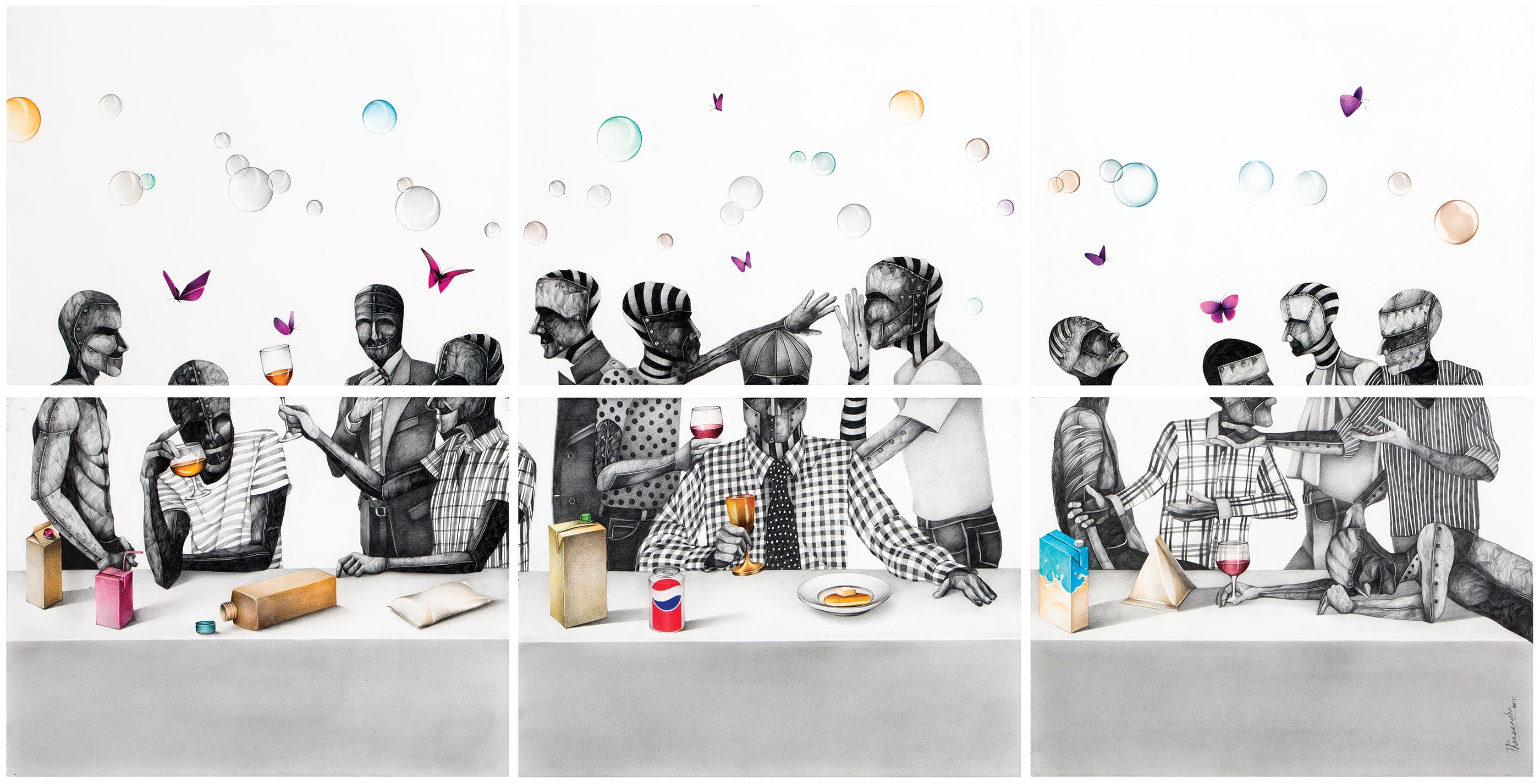
This six-unit 44in x 89in mixed media on paper untitled work is by Phaneendra Nath Chaturvedi who, the catalogue says, “unapologetically unmasks the men and women he draws in his large-format works to reveal the grotesque, robotic creatures he believes they really are”.
Prices in the Saffronart show range from about Rs10 lakhs ($13,500) up to Rs 1.1 crore ($150,000) for a large bronze sculpture of Jesus’s head in front of a cross and Rs90 lakhs ($120,000) for a large 48in x 120in oil on canvas by Thota Vaikuntam of his characteristic south Indian Telangana villagers. Also following a familiar theme, is G. R. Iranna with rows of Buddhist monks in yellow robes eating from bowls of rice.
Husband and wife artists Manu and Madhvi Parekh, are both well known for their Last Supper works and both appear in the show. Manu, who is a follower of Souza, has 13 panels showing heads and shoulders of public figures standing in for the disciples, among them artists, actors, and politicians. Madhvi’s is a more dramatic work akin to folk art with a variety of figures (above). Another artist, Veer Munshi, also favours a cluster of fellow artists.
There are many other renderings in the Saffronart show, but not all of them live up to the depth of understanding and interpretation shown by Khanna. Assembled by two curators, Tanuj Berry & Saman Malik, they do however amount to what many might see as an unlikely collection in today’s India.
Chinese artist Zeng Fanzhi’s The Last Supper, an 86in x 55in oil on canvas that set a record in 2013 for Asian contemporary art at a Sotheby’s auction in Hong Kong, selling for HK$180.44m (US$23.3m), more than double its US$10m estimate
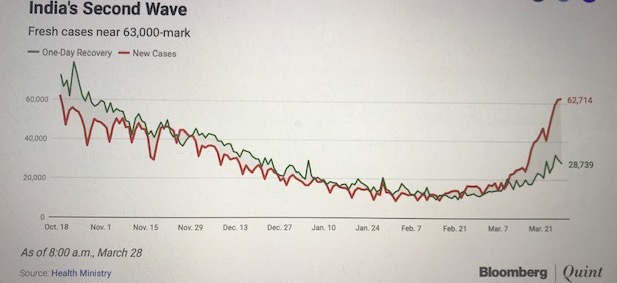
India has been hit by a fresh surge of the Covid pandemic in the past month with a 51% weekly increase in new cases. This is the biggest spike since last October, with around 60,000 or more cases being reported daily, five times more than in early February and twice as many as three weeks ago.
It comes at a time when massive crowds are attending political rallies for assembly elections that are running through April in six states, as well as a vast Kumbh Mela festival at Haridwar in north India. Last Monday there was the colourful Holi festival. Leading politicians, who are calling for people to socially distance and wear masks, are often themselves ignoring the measures.
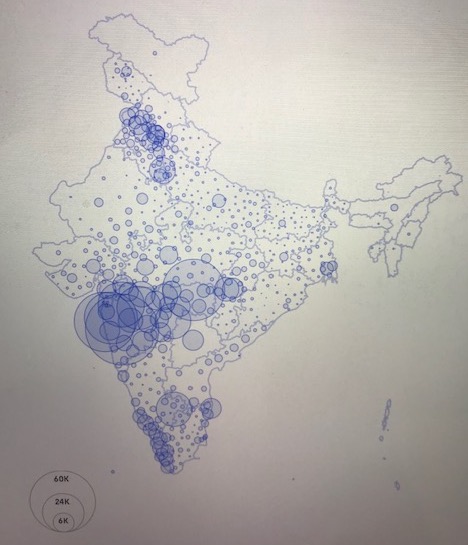
On March 28, over 68,000 new cases were reported, [81,000 on April 1] two-thirds of them in Maharashtra, spreading out from Mumbai, India’s commercial capital, and two other key cities, Nagpur and Pune. Maharashtra is now the worst hit state along with Punjab and Gujarat in what is being described as India’s “second wave” with a rising number of deaths. Delhi has also been hit by a fresh surge along with Bengaluru in Karnataka, reflecting the impact on busy urban conurbations.
Hospitals are scarce and are becoming over-loaded. According to last year’s Human Development Report, India has just five beds for every 10,000 people, ranking an appallingly low 155 out of 167 countries in the index.
“No state and no part of the county should be complacent. Trends show that the virus is still very active and can penetrate our defences,” V.K.Paul, a senior government official, said yesterday. The situation was “going from bad to worse”. Echoing a message heard in many countries over the past few months, he added, “When we think we have controlled it, it strikes back”.
This is a major blow for a country whose total caseload exceeds 12m, a massive figure that needs however to be seen in the context of India’s total population of over 1.3bn.
The government announced on March 29 that it has detected 795 positive cases of the UK, South African and Brazilian variants, half of them in the past fortnight. Together with the surge, this has dashed hopes, which developed at the turn of the year, that India was gradually achieving herd immunity. That would involve sufficient people being infected, and having antibodies, to reduce the chances of the virus spreading rapidly again.
At a time when new cases were declining, the optimism was based on insufficient understanding about the length of protection that antibodies would provide, especially with the arrival of the fresh mutants.
As optimism grew at the beginning of the year, precautions were abandoned with reduced wearing of masks, increased travelling, and a gradual opening up of the economy.
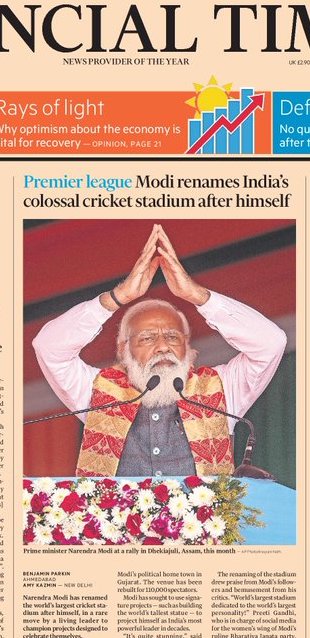
Illustrating the problem, the surge in Gujarat was partly attributed to an India-England test match and a T-20 match early in March at the world’s largest newly-inaugurated stadium in Motera, Ahmedabad. The stadium was named after Narendra Modi, India’s prime minister, who attended the match. (see FT front page below).
The crowd at the England-India test match in the newly named Narendra Modi stadium – AP photo/Aijaz Rahi, Indian Express
“India is not an easy place to maintain precautions”, says Kiran Mazumdar-Shaw, founder and chief executive of Biocon, one of India’s largest biotech companies. “It’s just not possible to do social distancing. Also people have been getting very mild symptoms so felt there was less worry about“.
The situation is especially poignant, reflecting the country’s complexities and contradictions. Brilliant brains developing and applying technology have led to it playing a leading role on vaccines. A Pune-based company, Serum Institute of India (SII), which is the world’s largest producer, has been turning out the internationally problem-prone Astra-Zeneca version. It is also starting trials of Novavax. Another company, Bharat Biotech, has successfully developed Covaxin with two Indian government institutes.
Two-thirds of the vast population are however too poor and preoccupied with the basic necessities of life to focus on receiving a vaccination or taking other precautions. Rural India has not been hit as badly as might have been expected, partly because villages are less crowded and many people work outdoors.
The better off, living in urban areas, are too busy with their lives and there is an habitual lack of community concern, plus widespread distrust of the vaccinations. Randeep Guleria, head of AIIMS, a large government-run hospital in Delhi, said in a recent Print.in on-line interview that only 60% of his staff had been willing to be vaccinated.
Masks are rarely seen in rural areas and their usage is patchy in towns and cities, apart from some up-market locations, or where they are compulsory such as on air flights and where police are actively monitoring urban traffic. While 90% of people are aware of their importance, only 44% actually wear them according to a health ministry survey, though that seems a surprisingly high percentage.
It was different a year ago when the pandemic began. Modi created a crisis across India when he ordered a national lockdown on March 24 at a few hours notice. Tens of millions of migrant workers immediately started fleeing home from major cities.
In rural areas like deepest Madhya Pradesh, where I have spent several weeks this year, the poor immediately protected their home areas. “Local people, especially the tribals, did not comprehend the threat of Covid, but they still took some action to protect themselves and their families,” I was told. Villagers stood guard on river bridges blocking people from crossing so that whole areas remained secure. Some of the travelling workers were quarantined in schools and other public buildings.
A year later, it is not likely that the same fear and response will be repeated. The mood has changed and the fear seems to have evaporated, though it remains to be seen whether it revives as the seriousness of the current surge becomes clear.
There is a debate nationally, and in individual states, about whether to have fresh lockdowns of whole conurbations, or to avoid them, given the economic disruption and hardship that was caused last year. Average household incomes fell by 9.2% last March and 27.9% in April. Employment this February was 7m less than last year.
The FT front page Feb 25, 2021
The alternative could involve smaller local containment zones that are already operating, plus increased social distancing and mask-using, more testing and tracing, and more vaccinations. The health ministry has asked 47 districts across the country to increase RT-PCR testing so that fresh cases can be identified and tracked faster.
Meanwhile the government is increasing the focus on vaccinations and is being criticised internationally for restricting exports – so far over 60m vaccines have been sent abroad. Those exports are now being curbed at the request of the government so that they can be used for a fresh drive in the country.
Initially the government targeted health care and other vulnerable workers, but has now moved on to older people aged over 60 and those over 45 with other illnesses. That will be extended to everyone over 45 on April 1, covering 25% of the population. So far some 50m people have been vaccinated, most with just one dose.
Mazumdar-Shaw says the focus should quickly move on to the young. Many of them live in extended families with older relatives, who may not be fully protected from mutated infections by their first jab. “We need a two-pronged attack targeting these younger people and also stepping up testing in areas like Maharashtra and Punjab where there are fresh surges,” she told me.
“India needs to manage its pandemic with large scale vaccinations so it is right to stop exports for a few months till we get production levels up. Our vaccine production is just about adequate to support our current vaccination rate of 2.5m per day. Production is expected to double by end of May, so exports should only resume post May”.
It is ironic that India is now being criticised for curbing exports because it was not rated as a supplier last year when Astra-Zeneca emerged as the world’s first major producer (along with Pfizer whose product is not being used in India because it requires deep-freezing facilities).
International agencies such as the World Heath Organisation’s COVAX, which aims to ensure that world-wide vaccine supplies are evenly spread, rapidly found that production in Europe, the UK and the US was inadequate for global needs. It turned to the Serum Institute, which had taken a commercial risk and started producing Astra-Zeneca’s vaccine for the Indian market at the beginning of the year.
It is now planned that the entire April production of 60m doses will be supplied to the government as a temporary move until the supply situation improves with a boost to production.
So far, India has only vaccinated about 4% of its vast population. It seems unlikely that it will ever cover everyone. But while the programme progresses, it is human behaviour on distancing and masks that can contribute most, along with prompt government action containing the worst-hit areas.
Under Lionel Barber, the FT failed to report pro-Brexit trend
Barber wins with switch to digital, Nikkei, 1m-plus paying readers
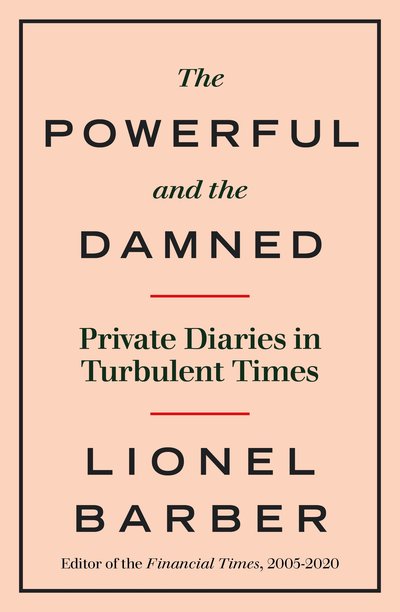
BOOK REVIEW: The Powerful and the Damned: Private Diaries in Turbulent Times, Lionel Barber. WH Allen (Penguin Random House), £25 hardback, India Rs799 paperback
Lionel Barber thrived in his first ten years as editor of the Financial Times. Nikkei, the Japanese media group, found it could work well with him so it asked him to stay on when it bought the title in July 2015. In February 2019, he was told it was time to step down.
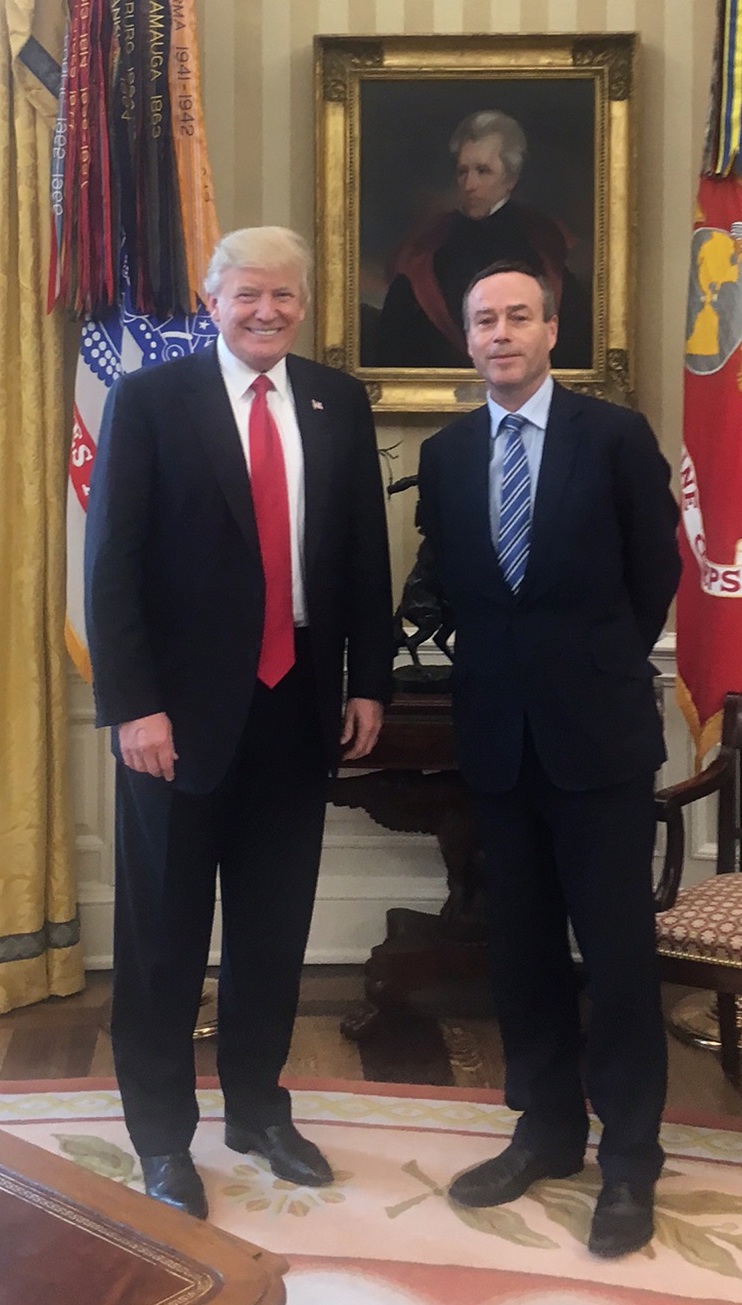
March 2017 at the White House
That led Barber to a 14-year reign as editor that was remarkable for what was achieved, which he triumphantly lays out in his memoir subtitled Private Diaries in Turbulent Times.
He names sources who must have thought they were speaking to him confidentially, and acknowledges the FT’s devastatingly inadequate coverage of pro-Brexit views before the referendum.
An accomplished journalist who held senior FT jobs in Brussels, London and the US before becoming editor, Barber is known for his film star good looks (some say he could be a James Bond actor), and for his lack of both self-doubt and modesty, as the book shows.
Now aged 66, he has quite a lot to boast about. He took the FT from a low point with 400,000 circulation (80,000 on line) in a falling market to over one million paying readers around the world. That was achieved by turning the salmon-pinkish daily UK-oriented broadsheet newspaper into what he describes as a “sustainable profitable business based on digital transformation” – in effect creating a virtually new brand for the digital age.
He also restored ”the gold standard in the FT’s reporting and commentary”, building on traditions begun by Sir Gordon Newton, the newspaper’s greatest and longest-serving editor (1950-72). “I preside over a broad church, maintaining accuracy, authority and quality”, says Barber.
Digitisation and the gold standard are frequently mentioned as the keys to success. Barber realised at the start that he would be “an agent of change…leading the transformation of a print-based product mainly funded by advertising to a fully digital, award-winning news organisation” with content that readers were prepared to pay for.
That required more leadership than he could provide alone so he picked journalists and promoted to key positions to work with him implementing the changes – and then to help manage the challenges of the Nikkei takeover, as well as reporting crises that included the 2008 financial crash along with the Brexit referendum and Trump’s presidency.
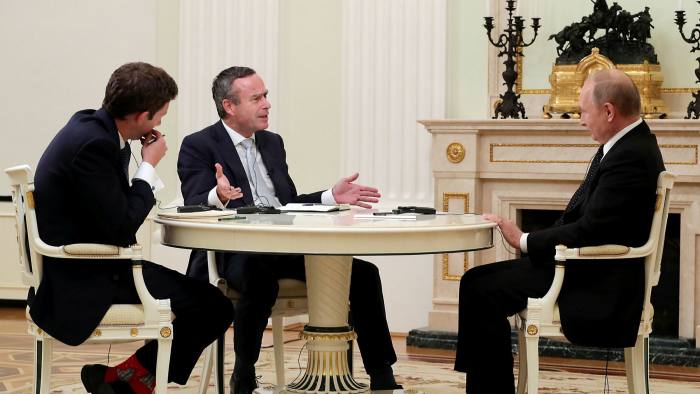
The Kremlin, June 2019
Barber glories in tracing his two or three times-a-week meetings with the world’s Powerful and Damned leaders of governments and business. “I was an interlocutor to dozens of people in power around the world,” he declares.
Partly listed at the front of the book, they range from Donald Trump and Vladimir Putin to Shinzo Abe and Narendra Modi (but not Xi Jinping). Showing too much obeisance for an objective journalist, he says that he was “granted interviews” by crown prince Mohammed bin Salman of Saudi Arabia, as well as two British princes. Heads of governments, banks and companies rank lower – with them, as the FT editor, he was “privileged to gain access”.
“It’s a totally legitimate question to debate the balance between access and distance,” Barber told The Guardian in an interview last November. “I am very aware that I enjoyed unique access to thugs and to very rich people. But it was my job to understand power, and how power is exercised, and I’m not easily seduced, believe me.
But his lofty editing had a negative impact on Britain’s 2016 narrow referendum vote to leave the European Union.
He admits that the FT failed to tune in to growing support for Brexit among UK voters before the referendum. “We could have done a better job reporting on the depth of disaffection, especially among older voters and the ‘angry white males’ who have seen their incomes either cut or stagnate,” he says.
Roula Khalaf, his British-Lebanese deputy who succeeded him as editor, had “the great idea of dispatching FT foreign correspondents to the four corners of the UK to test voter sentiment” – something that had been done earlier during general elections. “Three [correspondents] returned to London with the same message: Vote Leave. We missed the signal among all the noise!” Barber admits. That shows a serious lapse of editorial leadership.
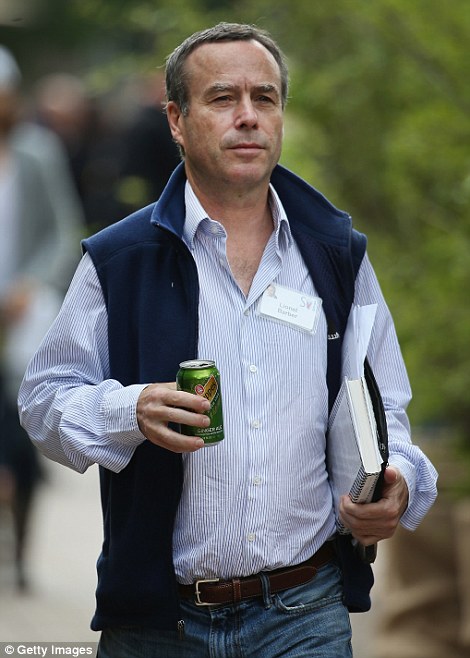
At the top finance and business Sun Valley conference, Idaho, July 2015
There were of course other more vital reasons for the Brexit vote, ranging from prime minister David Cameron’s tone-deaf hubris in calling the referendum to Boris Johnson’s lies and deceit, which helped to mislead an electorate that was never adequately informed about what was at stake. More widely there were issues such as globalisation, disillusionment with ruling elites, and mass immigration, especially after Angela Merkel allowed nearly a million migrants into Europe at the end of 2015.
Barber was living in the stratosphere of high level contacts and was, it seems, not reaching down to discover was actually happening. The editorial stance was so determinedly pro-EU that the story was not adequately and even-handedly covered by reporters. There was excellent commentary from top columnists such as Martin Wolf, internationally recognised for his economic and other analysis. But that was a top down approach, reflecting the rarefied world where Barber spent his time when he was not at his desk.
That contrasts, for example, with the way that the FT reported the growth of trade union power years earlier. I joined the FT in 1966 and, two years later, Gordon Newton promoted me to run the labour and trade union coverage. He told me to make the FT the top newspaper on the subject, replacing the Daily Telegraph that had the best coverage. By then, the FT had moved on from being just a financial newspaper and, as Newton had put it, was designed for “those who make or influence decisions on business, finance and public affairs in the world”.
We covered strikes in detail, splashed across the front page and inside the paper, reporting and analysing the trade union and workers’ cases as well as the employers’, earning respect from both, even though a lo ofm it was not what readers wanted to hear.. At no time was I ever asked to tone down or adjust the often trade union-empathetic lines we were taking.
I’d left the FT long before Barber became editor, but it was clear to me as a reader that he was failing to organise such coverage on Brexit. He was subsequently awarded France’s Légion d’honneur – officially “for services to journalism”, but really for his loyal pro-EU stand. He was criticised, as a supposedly impartial editor, for accepting the award. Jacob Rees-Mogg, a leading pro-Brexit Conservative politician, said he had been rewarded for “furthering the interests of a foreign government”.
Barber admits that the Daily Mail accused him of being a “weapons-grade social climber and name-dropper extraordinaire, with a statesmanlike aura”. That critique has been widely echoed in reviews and comments since Barber’s memoir was published last October
But his successes included steering the FT through its first four or so years of Japanese ownership, which cannot have been easy. He established a rapport with Nikkei and, seemingly, ensured his and his successor’s editorial freedom.
It is curious therefore that one of Japan’s biggest corporate stories – the arrest in Tokyo, jailing, then bail and dramatic escape of Carlos Ghosn, the former head of Nissan and Renault – gets just a five-line footnote in the book without any discussion. There was plenty of coverage in the FT, though I thought at the time that it was skewed against Ghosn.
Barber jetted around the world, often with his wife Victoria, for his meetings and parties, and also for “pro-consular visits”, as he calls them, to capitals where dutiful correspondents arranged appointments and tours.
In India, former prime minister Manmohan Singh is seen as a “softly spoken Sikh” involved in economic reforms, while former finance minister P.Chidambaram is “bumptious” (“arrogant but effective” is a more usual description). Congress leader Rahul Gandhi “seems either shy or diffident and overburdened by leading his party”. Narendra Modi was “a lot sharper”.
No qualms – top sources named
Barber has no professional qualms about naming top background sources that he met in presumably private meetings, illustrating the contradictions and tensions of bridging closeness to power with journalistic reporting and objectivity. That is a theme that recurs throughout the book, sharpened by Barber’s desire to show off. He had built up an impressive list of contacts and friends during his years as a correspondent, but they may be surprised to find themselves directly quoted, given that such conversations usually take place off the record and without any attribution.
The regular contacts include numerous bankers, businessmen and officials such as Mario Draghi, now Italy’s prime minister and formerly head of the European Central Bank, and the late Sir Jeremy Heywood, formerly Britain’s cabinet secretary.
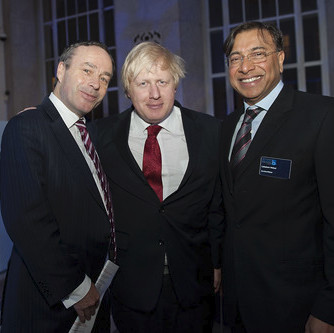
At an FT conference in 2013 with Boris Johnson, then Mayor of London, and steel tycoon Lakshmi Mittal
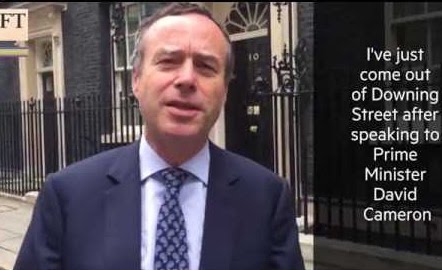
In November 2015, when Modi is visiting London and appearing with Cameron at an overseas Indians’ mega rally in Wembley Stadium, Barber suggests during a meeting in Downing Street that the UK should relax Indians’ visa-entry rules. “Cameron pushes back, referring to bogus higher education colleges or job seekers who stay on. ‘We don’t need more taxi drivers’ ” – not a slight that Cameron would have wanted Modi to see in print.
A contact told Barber that Barack Obama, on a 2008 trip to London, said of Britain’s prime ministers, “On [Tony] Blair: sizzle and substance. On [Gordon] Brown: substance. On Cameron: sizzle.”
Royal protocol is breached when he reports that Prince Andrew gave him “a nod and a wink, wink” at a Buckingham Palace lunch in September 2014 when he asks whether the Queen would make a statement against Scottish independence just before voting day in the 2014 referendum. She does, and Barber expands on the story in a book publicity article in The Times, which ran the headline “Queen ‘planned move to foil Scots independence’ before 2014 referendum”. l
Unusually for such a supremely self-confident guy, Barber eventually left the post at the top of his form and did not stay on, like many politicians and company bosses, till his position crumbled. When Tsuneo Kita, Nikkei’s chairman, had made his first visit to the FT offices in July 2015, he asked Barber to remain editor. In February 2019, Kita told him that his time would be up at the end of the year.
£500,000 payoff
That appears to have been earlier than expected because (company accounts show) he received a £500,000 “loss of office” payment that brought his total salary for the year to more than £1.9m – and strong objections from National Union of Journalists’ members on the paper.
There are some marvellous one-liners in the book. A North Korean ambassador to the UK, who comes to lunch, asks the cost of buying a discarded FT laptop.
When Reed Hastings, the boss of Netflix, was asked by a sharp reporter to explain his business model, he replied, “We actually compete with sleep”.
John Gapper, a veteran columnist, poked his head round Barber’s door on his last day in the office and said, “You saved the FT”. Gapper was correct, he did. The FT is thriving, so this memoir could have benefitted from a little more modesty to soften such a name-dropping ego trip.
Ambitious plans for widespread public sector privatisation
Farmers’ protests grow again after Republic Day tractor rallies
India’s annual Budget has today attempted to re-boot the country’s Covid-hit economy with plans that double spending on healthcare, sell-off most government owned businesses, raise foreign direct investment limits in the country’s large insurance market, and accelerate infrastructure development.
Beset with continuing mass protests by tens of thousands of farmers on highways entering Delhi that challenge its authority, the Narendra Modi government is using the Budget speech to try to recover the initiative and launch what Nirmala Sitharaman, the finance minister, called the post-Covid “dawn of a new era”. India, she declared, was “well poised to truly be a land of promise and hope”.
Sceptics will say that India has for decades been described as being poised for greatness but that hopes are rarely realised. While the plans for a boost in government spending may be achieved, attracting foreign investment will be a challenge and the plans for privatising the public sector will arouse extensive trade union opposition and take years to fulfil.
Private sector companies, which have been loth to invest, would have liked more stimulus. Critics said the measures would have a slow impact and that more immediate policies should have been introduced to help the poor and stimulate demand.
The Narendra Modi government has not been good at delivering economic growth, which had declined to an 11-year low of 4.5-5% even before the pandemic hit. Modi then devastated activity with millions of job losses when he introduced a sudden lock-down last March, triggering what is expected to become a 7.7% contraction in the economy for 2020-21.
The annual Economic Survey published on January 29 forecasts an ambitious 11% GDP growth for the coming financial year (2021-22) with a ‘V’ shaped recovery, but adds that it will take at least two years for the economy to return to pre-pandemic levels. These figures are in line with other forecasts including the International Monetary Fund (IMF), which last week put this year’s contraction at 8% with 11.5% growth in the coming year, falling back to an optimistic 6.8% in 2022-23 when India would have regained its position as the world’s fastest-growing large economy, beating China.
Privatisation policy
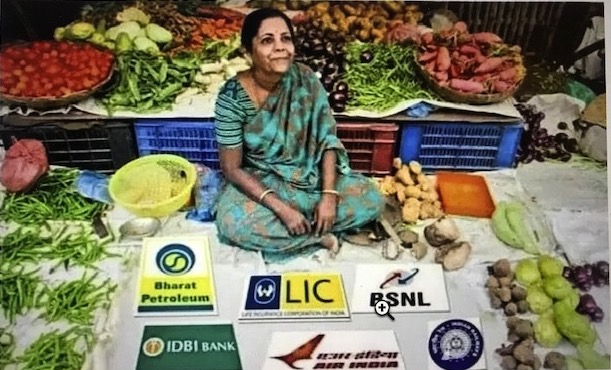
The Budget’s plans for widespread privatisation are the most ambitious for more than a decade since the last BJP government. They involve selling a controlling interest in government-owned companies, expanding on proposals launched last May in one of 2020’s five mini-Budgets. Sitharaman said today that the government proposes privatising two public sector banks and an insurance company in 2021-22, as well as the IDBI development bank that is already under way.
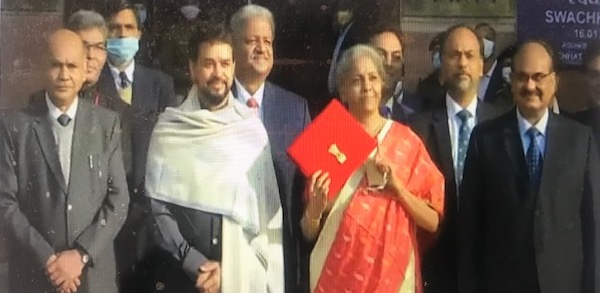
Finance Minister Nirmala Sitharaman carrying her Budget bag
Beyond that, details contained in an annexure to today’s speech say that the government will only have a “bare minim presence” in four sectors: atomic energy, space and defence; transport and telecommunications; power, petroleum coal and minerals; and banking, insurance and financial services. Last May’s announcement suggested that there would be investments in one to four enterprises in each of these areas. In other areas, says today’s annexure, government owned businesses “will be privatised, otherwise shall be closed”.
There have been no full privatisations – where the government sells a controlling stake – for many years, though several are now being attempted including Air India, the state owned container and shipping corporations, Bharat Petroleum (BPCL), Bharat Earth Movers (BEML) and the IDBI. Financial stakes have been sold for many years in various government corporations – known as disinvestment, with the government retaining control.
Sitharaman said the foreign direct investment (FDI) cap for the insurance sector would be increased to 74% from the current 49%. She allocated Rs200bn rupees ($2.74 bn) to recapitalise state-run banks that are saddled with bad loans and have been a drag on growth. A new financial institution will be set up to fund infrastructure projects along with a long-debated asset reconstruction company to take over banks’ bad loans.
The challenge for Sitharaman has been to balance the government’s escalating debt burden while stimulating the economy. The finance minister said that the current year is expected to end next month with a fiscal deficit of 9.5% compared with 7% that had been forecast earlier. The forecast for 2021/22 is 6.8%, which is higher than had been expected.
The government’s main focus is to overcome the effects of the pandemic that has led to a total of over 10.75m cases (168,235 currently active) among the 1.4bn population. This is the second biggest caseload internationally after the US. There have been over 150,000 deaths.
The Budget plans to boost healthcare spending to Rs2.2 trillion ($30.20 bn) – including Covid vaccinations – to start improving the seriously inadequate public health system. India has been spending about 1% of GDP on health, which is among the lowest for any major economy.
The survey is basing its hopes on a successful roll-out of anti-Covid vaccines, which have so far been given to some 3m front-line healthcare workers using the AstraZeneca- Oxford version, along with Covaxin, developed in India by Bharat Biotech of Hyderabad and the Indian Council of Medical Research (Delhi) that has yet to clear phase three trials
Farmers
The Budget contained several measures to help farmers, though they will be hit by a cess on petrol and diesel. The Economic Survey strongly defended the government’s new farm laws, which have led to more than two months of large-scale protests by farmers from the Sikh-dominated Punjab, Haryana and elsewhere on the highways into Delhi. The survey claimed that the laws, currently suspended by the Supreme Court, would “herald a new era of market freedom which can go a long way in the improvement of farmer welfare”, but farmers fear it will lead to market domination by large corporations and the ending of government minimum price guarantees.
On Republic Day (January 26), the farmers staged mass tractor rallies into Delhi that led to violence and the invasion of the Red Fort. According to widespread reports, the violence was at least partly triggered by government loyalists planted in the crowds, which opened the way for the police to attempt to close down the protests on the highways.
Since then, the police have tried to impose their authority, heavily barricading highways. The groups have however reassembled and the determination of their leaders appears strong, despite numerous court cases started after the January 26 violence.
The government now has to face the fact that, aside from the Budget, its most immediate “new era” tasks are to find an agreed solution for the farmers’ protests and to pursue a mass Covid vaccination campaign. Of the two, the vaccinations look the easiest, despite widespread concern about their efficacy.
Talks aim at compromise but farmers have refused to budge
Narendra Modi and Mukesh Ambani do not often face mass protests. The Indian prime minister has sailed through most of his political career with few upsets, and now enjoys mass support across the country after nearly seven years in power.
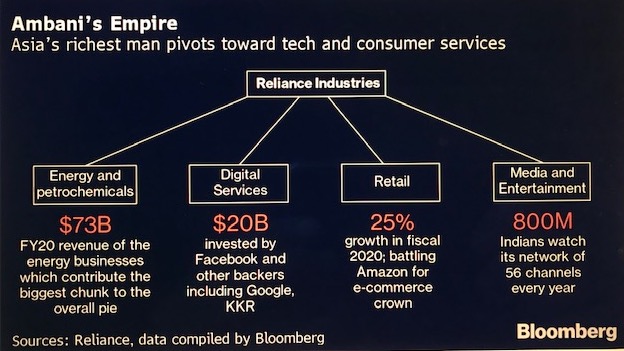
Mukesh Ambani has steamrollered through his career since he and his younger brother Anil inherited the Reliance business empire after the death of their father Dhirubhai in 2002. The brothers split in 2005 and Anil is now near bankruptcy, but Mukesh is one of the richest men in the world, wooed by international corporations for a share in his Reliance Industries (RIL) ventures.
Yet both Modi and Mukesh Ambani have been challenged by India’s protesting farmers, tens of thousands of whom have been camped for more than eight weeks on the edges of Delhi, blocking highways into the city. (Last January, there were several weeks of mass demonstrations in central Delhi over citizenship laws regarded as anti-Muslim, but the farmers’ protests are bigger, more focused and entrenched, and more disruptive.)
Mukesh Ambani and Narendra Modi
The demand is the repeal of three agricultural reform laws that were introduced first as ordinances last June and then as legislation in September with little consultation or serious parliamentary debate, curtailed by the pandemic restrictions.
The government has held nine unsuccessful rounds of talks with farmers’ leaders – the tenth is tomorrow (January 20) – but is refusing to repeal the measures, which replaced optional model reform laws.
Impatient with the deadlock, India’s supreme court intervened last month. It unilaterally suspended the laws and set up a panel (which meets today) to find a solution.
The government may have seen this as a way out of the impasse, but the farmers’ leaders have rejected the initiative and are becoming increasingly embedded on the Delhi highways with canteens, schools, entertainment and support from their families. [Jan 20: Fresh 18-month suspension proposed] A massive tractor rally into Delhi is planned to coincide with the annual Republic Day parade on January 26.
The primary fear is that the laws unscramble long established government-based trading systems for farm produce, including minimum price limits, and could lead to all-powerful oligarchic private sector corporations, like Reliance, gaining commercial clout over mostly small farmers.
A farmer prays to mark the birth anniversary of Guru Nanak Dev, founder of Sikh faith, during the protests – photo REUTERS/Danish Siddiqui
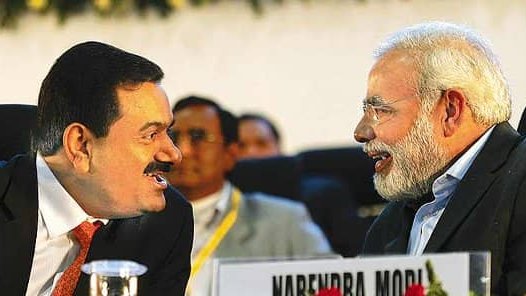
This links up with accusations that the Modi government favours large businesses, especially Ambani and Gautam Adani who heads the rapidly growing Adani group with activities that embrace agriculture. Like Modi, both businessmen’s families come from Gujarat and both are seen as a challenge by the farmers, especially Ambani who is about to combine being India’s biggest retailer with a growing telecom-based e-commerce business.
Power and telecom cables linking 1,500 towers carrying Ambani’s market-conquering Jio telecom services were cut earlier this month in Punjab, the state at the centre of the protests where Sikh farmers are providing the movement’s backbone. Sikhs have an admired sense of community (with international links) that is lacking in many other areas and they do not subscribe to Modi’s Hindu nationalist agenda that thrives elsewhere in north India.
The Jio vandalising is significant because it amounts to a direct attack on the allegedly crony Modi raj. Protests have also hit Ambani’s Reliance Retail, which has had half its 100 Punjab stores shut since October, when protests began in the state. A 50,000 sq ft Walmart store – another symbol of big business – has been closed by pickets. “We are scared of the protesting farmers,” a senior Reliance Retail official told Reuters.
The Ambani family has been close to governments since the late 1970s and their influence on decision making, ranging from trade quotas and customs duties to the formation of governments, has been widely reported. In the early years, this helped to build a textiles to petrochemicals, oil refining and exploration empire.
Ambani’s father stayed as far away as possible from consumers, preferring proximity to governments and the public sector, but Mukesh has branched out into retail and telecom. More recently there have been a series of telecom policies that have hit Jio’s rivals since the service was launched in 2016 with unprecedented low prices and special introductory offers.
Gautam Adani with Narendra Modi
Adani’s fortunes have escalated since Modi became chief minister of Gujarat in the early 2000s when he reportedly provided facilities and support. The most audacious success came in 2018 when rules for privatising six airports were relaxed so that companies with no aviation experience could bid. That suited the inexperienced Adani who won the six bids and has now taken control of Mumbai airport, making him a leading operator.
He is also India’s biggest operator of private ports and is significant in thermal power generation, power transmission and gas distribution. “A one-rupee investment in Adani Enterprises (at the time of) our first IPO in 1994 has returned over 800x ,” Adani told a JPMorgan investors meeting last September.
There are plans for $6bn solar plants. A massive $30bn of bonds and debt (according to Dealogic) does not seem to deter investors. Total France yesterday announced a $2.5bn investment in Adani Green Energy, which will include a role in solar power transmission
That pales beside the $27bn that Ambani has secured in the past year, belying foreign investors’ earlier wariness about linking up with the reputedly tough tycoon. The investments are in Jio and include $5.7bn from Facebook for on-line grocery delivery and $4.5bn from Google with planned development of a smartphone, plus $9bn from leading private equity firms and wealth funds including Silver Lake and KKR from the US and others in Saudi Arabia and the UAE.
After a shaky start when supermarkets began appearing in India in the early-mid 2000s and protestors attacked some of his first Reliance Fresh stores, Ambani has become India’s biggest retailer.
This corporate clout originally worried small kirana stores and now worries the farmers, especially in Punjab and neighbouring Haryana where an existing government-run mandi (local markets) system is strongest. The private sector can buy direct in many areas of the country but the farmers fear that Reliance and others will drive down prices and maybe enter contract farming. There is also a fear in other parts of the country – illustrated by sugar cane farmers in Uttar Pradesh – that the government’s price support for produce might end.
Reliance insists it has never done corporate farming and has no plans to do so, nor has Reliance Retail “entered into long-term procurement contracts to gain unfair advantage over farmers or sought that its suppliers buy from farmers at less than remunerative prices, nor will it ever do so.” That of course is open to interpretation and, unsurprisingly, failed to impress the farmers, even when Reliance said it believed in “building a strong and equal partnership” with farmers.
More than half India’s 1.4bn people live in rural areas and are linked to agriculture, which needs far wider reforms than the government’s proposed new laws. Once renowned as the grain and food bowl of India, the plains of Punjab and Haryana have been over-farmed for decades, depleting water supplies and the quality of the soil. That is fuelling the farmers’ frustrations and needs to be addressed along with other measures to boost productivity, develop farm-to-shop supply chains and curb widespread wastage
The government should clearly deal with these wider concerns, not just focus on controversial legal initiatives. Eventually the protests will end, but the government might come to regret allowing the dissent to fester. In the Punjab, the resentment against big business, and Modi’s involvement, will only grow.
Boris’s approval rating slumped because of poor performance
UK weaker as it leaves the EU for an uncertain future
This article was commissioned by the India’s Wire.in news website
This is the weekend that Boris Johnson thought the main task of his prime ministership would be done. Having fulfilled the “Get Brexit done” slogans that won him a general election victory in December 2019, he would bask in the glory of “Getting back control” when Britain breaks from the European Union on January 1, and coast along triumphantly in Downing Street for the next four years.
Instead, Britain is in virtually total Covid-19 lockdown, and his most difficult task is just beginning – steering the country through the new uncertainties of the pandemic as fresh and more virulent mutants erupt around the world, having first been identified in the UK.
International flights have been stopped by many countries, including India, which must raise a question mark over whether an official visit to India planned for Johnson as the chief guest on Republic Day (Jan 26) can go ahead.
So far, the prime minister’s management of Britain’s Covid crisis has been disastrous. His inability to grasp and debate detail has become a widely acknowledged embarrassment, and his even more serious inability to take difficult unpopular decisions on time has proved calamitous in terms of both the economy and lives lost, as well as damaging his public image.
His approval rating has slumped from plus 40% in April, when voters supported him at the start of the pandemic, to minus 19%, with 56% saying he is doing badly, according to a reliable YouGov poll.
Yet there is no real possibility of replacing him, even though there is a rising tide of backbench Conservative MPs who are critical of the government’s erratically announced Covid lockdowns, as well as many opposed to him personally. Most of the Cabinet have been appointed because they are loyal Brexit supporters, not because of any talent or experience, while seasoned pro-European ex-ministers languish on the backbenches.
“It is far from clear….that a government that has mishandled much of its response to coronavirus is capable of steering a traumatised country through the extraordinary period of change ahead,” is the Financial Times post-Brexit verdict.
A perfect storm
A week ago, the country was hit by what is termed a perfect storm. Just a few days after Johnson and his scientists had heralded the start of Pfizer-BioNTech vaccinations as the beginning of the end for the pandemic, the new 70% more virulent strain was found to be cascading around London and south-east England.
The year-end European separation that Johnson craved was catapulted forward eleven days as countries banned flights from the UK, the Channel Tunnel was closed, and France and Belgium blocked rail and road links. Massive tailbacks of lorries built up on a scale predicted for Brexit. Britain was isolated.
The near-panic that spread across the world about the new strain was caused by Johnson and his beleaguered health minister, Matt Hancock, over-playing the risks when they were preparing a new Tier 4 for England’s lockdowns. Hancock said the new mutant had put the pandemic “out of control” and warned that the unexpected Tier 4 could last “for months”. (Has any government minister before ever admitted his work was “out of control” and not had to resign!)
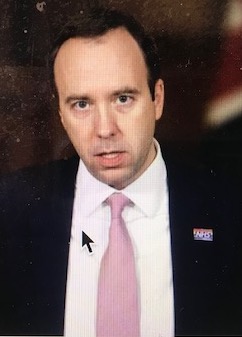
Matt Hancock, under pressure
One interpretation of those remarks is that the British are an unruly race – what else would you expect from a country that broke rules as it built its empire – and needed to be scared into accepting restrictions on their freedoms, especially over Christmas. The government therefore delayed announcing Tier 4 till the last minute, and intentionally exaggerated the warnings in order to convince people to abandon carefully planned Christmas celebrations and stay at home.
Alternatively, Johnson was trying again, as he has often in the past, to avoid increasing the lockdowns so ministers and officials decided to bounce him into it with the dire warnings. The odd thing though is that the government knew about the new strain back in September but seems to have done nothing about it.
The Covid crisis has also revealed Johnson’s lack of concern for conventions and institutions, a trait that he shares with Donald Trump and Narendra Modi. Earlier, he rejected a recommendation from his official adviser to sack Priti Patel, the abrasive home minister, for bullying her staff. Recently he ignored official advice not to make a £5m donor to the Conservative Party and Brexit campaign a peer, despite allegations about the donor’s crony behaviour. There were also official complaints that he was appointing too many new peers when public policy is directed at reducing the size of the House of Lords.
Crony deals
A company run by the Conservative Party’s former director of communications received £819,000 for work on focus groups and polling. The manager of a pub near Hancock’s constituency home offered his services to the minister via WhatsApp and supplied the government with tens of millions of vials, despite having no prior experience of producing medical supplies. The government is now preparing fast procedures for emergencies.
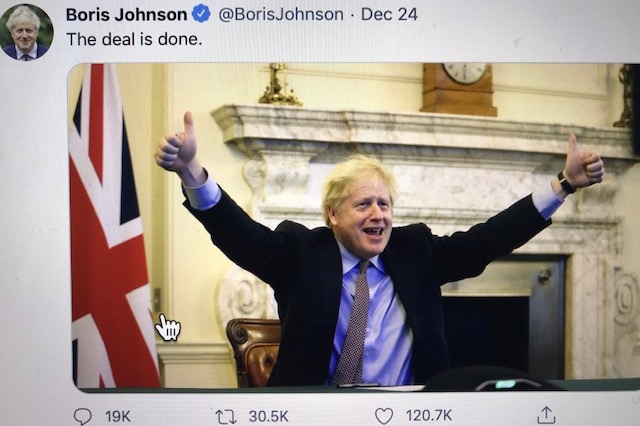
Johnson’s shortcomings and failure to understand detail were displayed again when he announced the terms of the Brexit trading deal on Christmas Eve. He said the deal did not saddle Britain with any “non-tariff barriers” for trade which, as the BBC put it, was “manifestly wrong”. Government websites have lists of “tens of millions of new customs declarations, export health checks, regulatory checks, rules of origin checks, conformity assessments,” exclaimed the BBC.
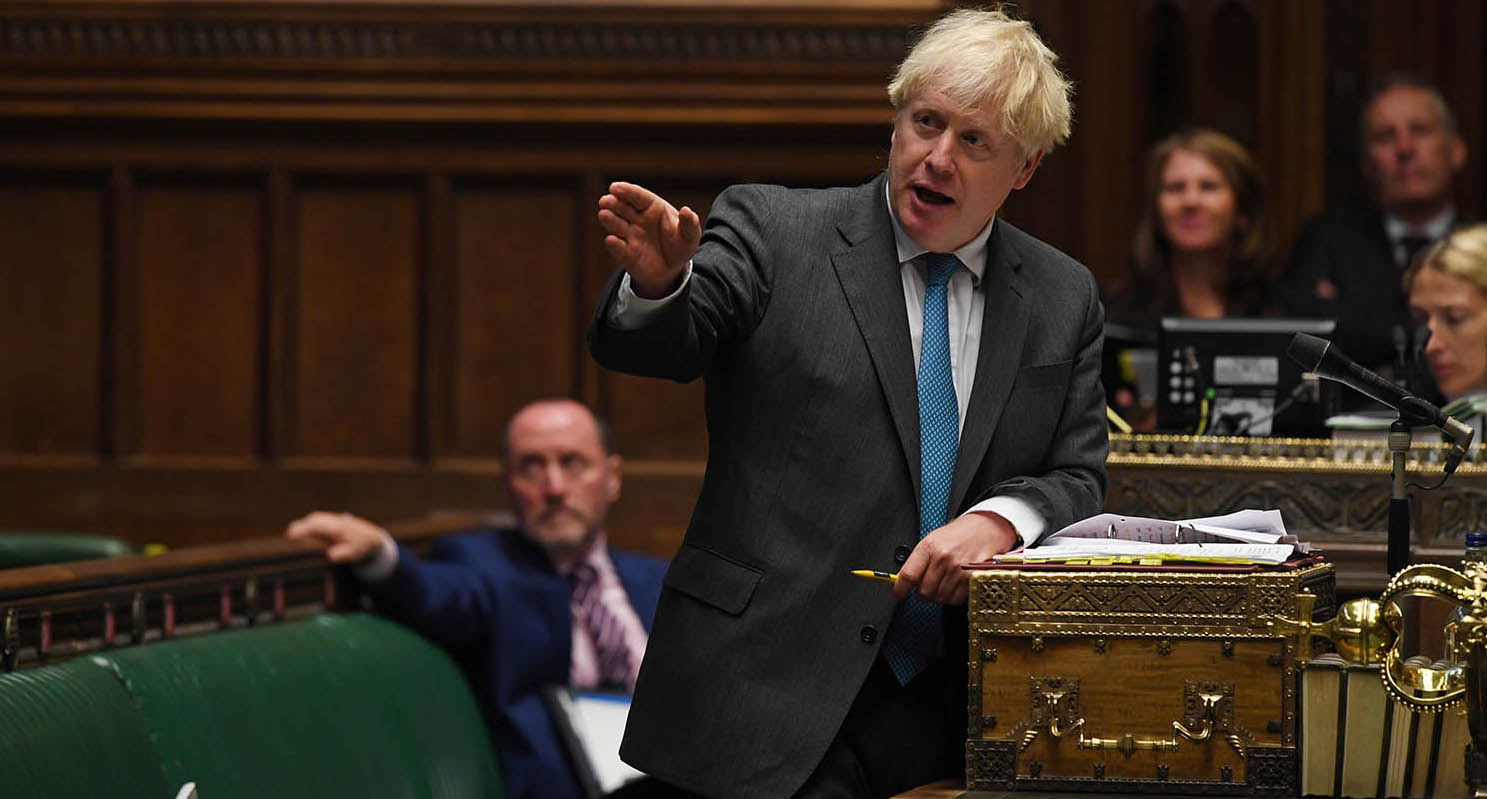
Johnson defends his performance during Parliamentary question time Jessica Taylor/Handout via REUTERS
The UK and EU’s have a trading relationship totalling some £660bn ($880bn) and the new Brexit trade deal runs to 1,246 pages. There is little time available for members of the British parliament to absorb the contents by the time they vote on December 30, when the deal seems certain to pass with the Labour (Opposition) Party officially supporting it.
The agreement provides for zero tariffs and quotas on all goods, including agriculture and fish, but excludes services. What Johnson is ignoring, as he claims a victory in the negotiations, is that the EU gave way on few key points, and that it will now be tougher and more costly to do business in both directions between the UK and Europe. “Britain will begin its ‘independence’ facing unsatisfactory frictions in the roughly half of its trade that is with the EU, especially in services,” says the FT.
In the days to come, Johnson will be pursued over details that he will not be mentally equipped to handle. It is, nevertheless, a victory for him – firstly because he has achieved his stated wish to take Britain out of the EU, and secondly because Brexit has enabled him to build a roller-coaster of a political career that ended up in Downing Street.
He claims to dream of this being a new dawn for a new UK, but Britain will be far less important internationally. There is a risk that (pro-EU) Scotland’s demands for independence will grow, and that the Brexit rules on Northern Ireland’s trade will lead the province’s focus to drift southwards to the Republic of Ireland, which is in the EU.
Sikh farmers’ protest
He will not however be able to avoid the issue if he goes ahead with the Republic Day visit, when will he relish being seated with President Ram Nath Kovind and Narendra Modi on the platform watching the mass parade. He must be thinking that it would be a pity to have to use the Covid pandemic as an excuse to miss such pomp, even if that would let him slip away from upsetting Indian voters in Britain by not fully backing the farmers’ cause.
As Dominic Raab, Britain’s foreign secretary (minister), said on a recent visit to Delhi, the Indian diaspora meant that “your politics” is, in some sense, “our politics”.
Best wishes to everyone who follows this blog – from Kipling Camp in sunny Madhya Pradesh! Keep coming back and let’s hope for an easier time in the New Year! John
Foreign Secretary Raab sent to Delhi to deliver positive messages
Indo-Pacific to be Britain’s new post-EU focus
It’s hardly a career compliment for a foreign minister to be sent abroad during crisis talks on his country’s key international relationship, but that is what happened to Dominic Raab, Britain’s foreign secretary (minister), this week when Boris Johnson sent him to New Delhi for three days to prepare for a new relationship with India.
The positive spin is that Johnson is showing he has already moved ahead on the UK’s post-Brexit foreign relationships, without waiting for the current crisis negotiations to succeed or fail ahead of the December 31 deadline when Britain finally cuts loose from the European Union.
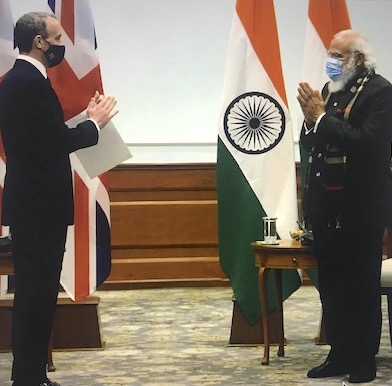
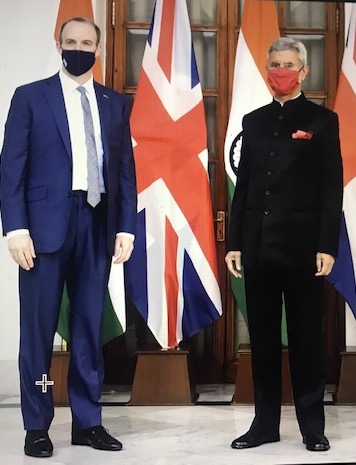
Raab met prime minister Narendra Modi today (Dec 16) and talked about Covid vaccinations, among other subjects – the Serum Institute of India is to produce over a billion doses of the vaccine that is being developed by Oxford University and AstraZeneca. Yesterday Raab met S.Jaishankar, the foreign minister .
Dominic Raab and Narendra Modi
The symbolism for a developed relationship is in place. Johnson has accepted Modi’s invitation to be the chief guest at Delhi’s annual Republic Day parade on January 26. Assuming it goes ahead on the ground, he will be able to revel in being on the top dais watching the parade of massed bands, guns, camels, dancers and jet fighters. And he has invited Modi to attend a G7 conference that the UK is hosting next year.
There is talk of an “enhanced trade partnership” being agreed next year ahead of a full free trade agreement that will be tougher to negotiate. Raab and Jaishankar, who was a top diplomat before becoming a minister, set a ”10-year UK-India roadmap” covering a predictable agenda of “people, trade and prosperity, defence and security, climate, and health”.
Britain’s relationships with Europe will clearly be difficult whether there is a trade deal or not this week, so Johnson has decided that Asia will be a primary focus, real or presentational. The UK’s established links stretch from Pakistan and India across South East Asia to Australia, and it has already signed a trade agreement with Japan. It has strategic and defence links with the region, which will grow next year when a naval Indo-Pacific deployment will include the new Queen Elizabeth aircraft carrier that is expected to sail into waters claimed by China.
Johnson would like the G7 to spawn a G10 of democracies and has invited Australia and South Korea to join next years’s G7 conference along with India. Rabb said the UK would consider joining the US, India, Japan, Australia’s Quadrilateral Security Dialogue, usually known as the Quad, that is developing into an alliance dedicated to resisting China’s territorial advances.
Dominic Raab and S.Jaishankar
India, given the two countries’ history, is a big welcoming target despite growing criticism and resentment there about Britain’s old colonial excesses.
The question now is what it will all mean in practice apart from Britain replacing its old EU trading basis with bilateral India arrangements. There are already close links, and regular dialogues are taking place on all the subjects listed for the ten-year focus. Climate change will be a priority, maybe with green financing arrangements ahead of the COP26 climate change conference to be held in the Scottish city of Glasgow next November.
There will be considerable activity on the pandemic. India supplies more than 50% of the world’s vaccines and 25% of the NHS’s generic drugs. A new hub is being set up for sharing knowledge on clinical trials and regulatory approvals.
Such developments would however have taken place without Johnson’s search for new friends, and the UK has launched many such initiatives in recent years with far less success than had been hoped for. David Cameron, when he was prime minister, visited India three times, once with a plane load of senior ministers, officials, and businessmen but failed to make much impact. He also appeared with Modi at a mega overseas Indians rally in London’s Wembley stadium.
Then came the fallow years with Theresa May as prime minister. She made a disastrously stressful visit to India in November 2016. She became caught up in differences over her rigid student visa regime and learned that she could not do that on visas and expect open doors for goods and services.
After the visit, it seemed that she tried to avoid dealing with India – even refusing, I was told, offers of foreign office briefings on the country.
Johnson is certainly interested and knows the country well – his former wife, Marina Wheeler (they divorced earlier this year), had an Indian mother.
But he will face difficulties. A Sikh MP asked him in parliament last week whether he would support Indian farmers who are currently protesting against Modi’s new agricultural laws. He ducked the question by, apparently mistakenly, giving a conventionally neutral answer on India-Pakistan relations.
Asked by journalists about the farmers, Raab said that he had talked about the protests with Jaishankar because, with the Indian diaspora in the UK, “your politics” is, in some sense, “our politics”.
Johnson will brace up well with Modi and, if they have nothing else to chat about, they can mourn the defeat of their common presidential friend, Donald Trump. They both admired him, and the compliment seemed to be returned, so they can speculate about his plans for disruption away from the White House.






 Riding the Elephant
Recent Comments