Posted by: John Elliott | December 3, 2020

Modi and Shah hit by mass farmers protests on Delhi highways

Demands for repeal of reform laws rushed through parliament

Opposition centred mainly on Punjab and also Haryana

Narendra Modi’s authoritarian rule – supported by his home minister Amit Shah – is facing what look like its biggest challenge since 2014 with thousands of farmers staging more than a week of mass protests, blocking highways on the outskirts of New Delhi, India’s capital. They are demanding the repeal of recent agricultural legislation that introduces reforms affecting the selling and pricing of their crops.

The farmers have refused to be tempted into the city for a controlled demonstration and have stayed where they have most power – on the highways, blocking as many as seven main routes into the capital. Some have joined by wives, widening the base of the protests, along with food canteens and entertainers. They are reported to be in no hurry to go home – seasonal crop harvesting and sowing have just been completed in the state of Punjab that is leading the protest along with neighbouring Haryana.

Shah, uncharacteristically, tried to mediate earlier in the week, but more than three hours of talks with 35 representatives from more than 20 farmers’ organisations failed when they rejected creation of a small committee to examine the issues. Today there have been more than seven hours of talks (the farmers took their own food and refused the government’s) with 40 organisations but no final solution has been found. Talks will be resumed on December 5. [Dec 5: four hours of talks have failed to lead to a breakthrough – more talks Dec 9]
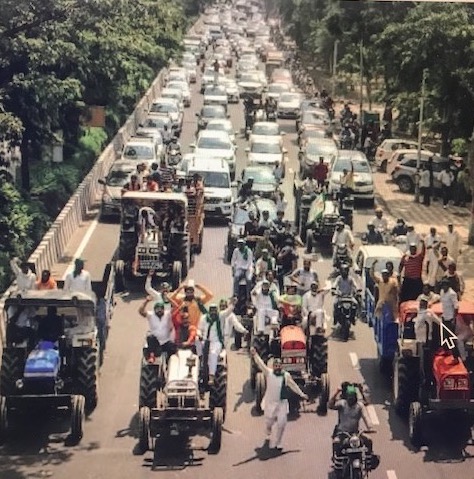
Meanwhile the protests on the highways (right) and elsewhere have been gathering momentum, mostly peaceful after some early clashes with police and paramilitary forces.

The basic demand has been for the government to recall parliament and repeal three laws that it passed last September. That would be a huge climb-down that Modi and Shah clearly want to avoid, so the government is offering ways to ease some of the farmers’ concerns, which might lead to the laws being amended.

The reforms are needed and have been proposed by successive government in varying packages for some 20 years – the Congress Party, which is supporting the current protests, included them in its last general election manifesto.

The aim is to bring agriculture into line with India’s primary reforms that began to open up the economy in 1991. The reforms have been partially implemented in southern states, but there has been repeated opposition in the north because of the sensitivities of India’s hundreds of millions of farmers, many with tiny holdings, and because of vested interests ranging from large farmers to government market agents.

The BJP government cannot be blamed for what it is trying to do. Indeed it should be praised for trying to solve an old problem that has been holding back development of agriculture, which involves half of India’s 1.38bn people.

It can however be blamed for the insensitive way that it issued executive orders in June and then rushed approval of the three bills through parliament in September as part of a Covid-19 reform package when hearings were encumbered by the pandemic shutdown. Modi and Shah ignored calls for the usual detailed consideration and debate, assuming that they would not face significant opposition.

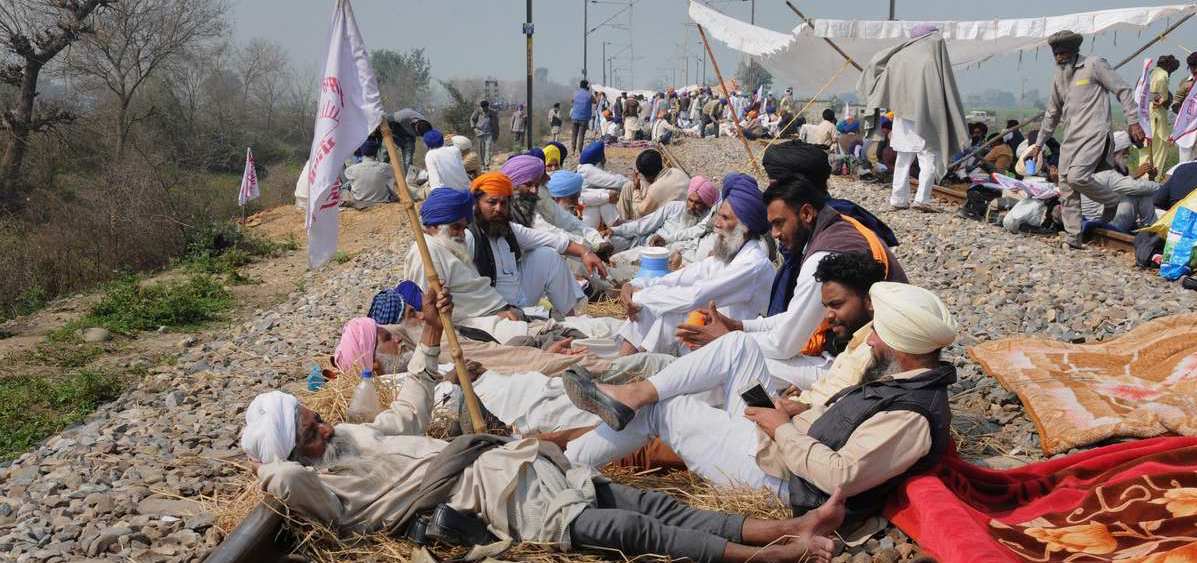
The issues are emotive but the protests so far have been primarily party political, driven by Punjab which has a Congress state government. The state’s highways and railways (below) were blocked from September by members of 31 organisations representing nearly one million farmers before the protests spread to Delhi

Khalistan

Modi seems to have not realised that Punjab has proud characteristics that differentiate it from other states and that affect how it should be handled. It is the home of the Sikh religion and, as Shekhar Gupta, a leading editor pointed out in ThePrint.in last week, it “is not part of the Hindi/Hindu heartland” that instinctively backs Modi. Sikhs do not subscribe to the nationalist Hindutva. 
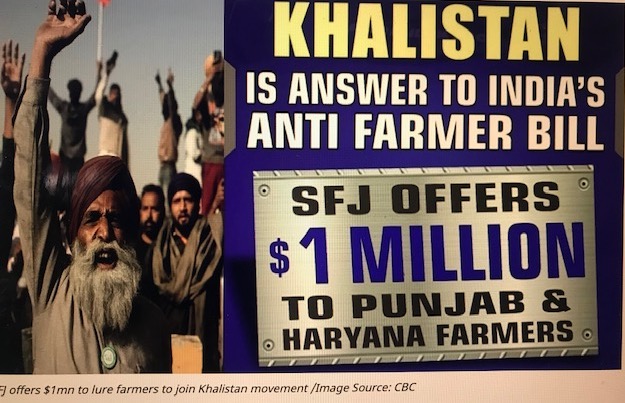
It had the bloody Khalistan independence movement in the 1980s, which was wiped out as a terrorist force at the beginning of the 1990s, but still has some appeal.

Khalistan’s banned Sikhs for Justice (SFJ)  banners have been seen (left) on the highway protests . The government should therefore be taking care to ensure that the current protests do not result in a revival of social unrest among the youth – earlier generations provided the foot soldiers for the Khalistan movement. 

The state has a youth unemployment rate of 26% and farmers fear they are losing their identity and ability to act as a political force. The youth have not till now had “a focal point around which to coalesce their grievances,” Pratap Bhanu Mehta, a prominent political scientist, wrote in the Indian Express. This “might be sustaining the farmers’ agitation and driving it to a greater show of strength”.

The idea behind the legislation is to remove restrictions on the sale of produce so that farmers can avoid bureaucratic and often corrupt mandis (local public sector markets) that have a statutory monopoly in many, but not all, states. This should boost both food processing, which currently only absorbs 10% of production, and exports that only account for 2.3% of world trade. 

“These reforms have not only broken shackles of farmers but have also given new rights and opportunities to them,” Modi claimed last week in his Mann Ki Baat (monthly radio talk).

Under India’s complex quasi-federal constitution, agriculture is a state subject but the central government also has powers, which it used for the September legislation. Two of the bills allowed farmers to bypass state-mandated mandis and sell to whomever they like, and provided a structure for contract farming with direct farmer-to-buyer deals. The third bill lowered government control on production, sale and distribution of key commodities.
Individual states have the right to reject or amend new laws, which some have done. In Punjab and Haryana, however, the states’ governors have not approved amended laws, presumably on instructions from the central government.

The farmers’ unions are now complaining that they were not consulted. They are understandably concerned that private sector buyers will deal with them more harshly than the current mandis where influence can be peddled, and relationships developed between the farmer and commission agents who often become family moneylenders.

They are also concerned that they will lose the protection of food grains’ minimum support prices that guarantees prices the government pays – in Punjab and Haryana, the government’s Food Corporation of India buys 85% of the main wheat and paddy. Modi has publicly stated several times that the support price system will not be removed, but the fear remains. The farmers’ organisations want this enshrined in law, which the government does not want to do, but it seems that ministers are discussing ways to spread the minimum price protection to private sector deals.

Modi has often been criticised for his poor execution of policies. This time it is his hubris and insensitivity that has opened the way for the issue to be politicised by the opposition and vested interests.

Posted by: John Elliott | November 21, 2020

Book Reviews: Bhutto friendship, dynasty and Pakistan divided

The Fragrance of Tears – My Friendship with Benazir Bhutto by Victoria Schofield, Head of Zeus–An Apollo Book, London, 2020

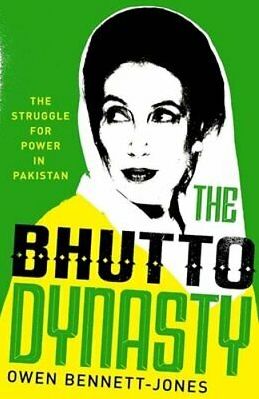
The Bhutto Dynasty – The Struggle for Power in Pakistan by Owen Bennett-Jones, Yale University Press London and Penguin-Random House India, 2020 

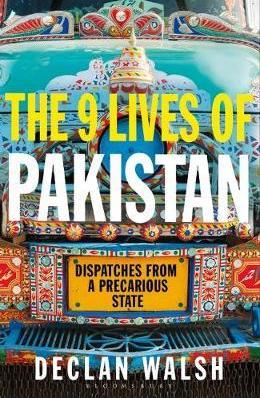
The Nine Lives of Pakistan – Dispatches from a Divided Nation by Declan Walsh, Bloomsbury Publishing London 2020

Rule by self-serving dynasties and military dictators or religious zealots rarely leads to stable government and a prosperous country. Combine all three and the result is almost inevitably negative. That has been the plight of Pakistan since it was created in 1947, split in two with the creation of Bangladesh in 1971, and then faced the additional burden of becoming a buffer state on the edge of communism after the Soviet Union invaded Afghanistan, leading to years of turmoil and terrorism.

Three new books examine aspects of this history, two of them through the prism of the Bhutto family, which has provided two prime ministers – Zulfikar Ali Bhutto and his daughter Benazir – plus her husband Asif Zardari who became a surprisingly resilient president after her assassination. Benazir’s and Zardari’s son Bilawal is now limbering up uncertainly as the head of the family’s Peoples’ Party of Pakistan (PPP), awaiting his turn, if the military is willing. The third book looks more broadly at the country and its people, including the Bhuttos and many others.

Victoria Schofield, an historian and author, has written a carefully crafted personal memoir of her 33-year long friendship with Benazir. This is a delicately painted human story of a friend who became prime minister twice between 1988 and 1996 but is often seen as one of the more disappointing South Asia dynasts. 

Owen Bennett-Jones is a former BBC journalist who has specialised in Pakistan for many years.. He has produced a well-researched and detailed biography of the dynasty, written with a reporter’s eye for detail.  He originally planned a book on Benazir, the first woman prime minister of a Muslim country, after producing a series of BBC podcasts on her assassination in 2007. He then expanded the scope to cover the dynasty, including Zulfikar and their ancestors, tracing the family’s origins back twelve centuries to Hindu Rajput (warrior caste) origins when their name was probably Bhutta or Boota. An “a” at the end of a family name often became “o”, we are told, “as part of the process of colonial anglicisation”.

Declan Walsh, an (Irish) New York Times reporter who was expelled in 2013 without knowing why after nine years in Pakistan, has written a highly readable and compelling portrait that digs deep with a light touch into this little-understood country. Most of the chapters are pegged to lives of nine significant people who range from a human rights lawyer and a businessman turned Bhutto supporter (shot for offending extreme Islamic sensitivities) to a Baluchistan separatist leader and a famous spy. Many others crop up at various stages, including the Bhuttos and another spy who eventually explains that Walsh was expelled for getting too involved in the unending tumult and intrigues of Baluchistan. 

Walsh captures Benazir brilliantly when he visits her in Dubai: “She sat in a gilded armchair, tapping on her BlackBerry, picking from a box of chocolates. A Mercedes was parked outside. ‘Do help yourself Mr Walsh’, she purred, at once imperious and intimate.” It is a sketch I recognise instantly from meeting her in a London Barbican flat (no chocolates and an ordinary chair) and the family home in Karachi (a low arm chair and a coffee table with cakes).

It is easy to take a negative view on Benazir, even though she was regarded in the west as something of a heroine. She can be seen as a spoilt and occasionally fierce-tempered feudal autocrat with a dynast’s strong sense of entitlement, who fell in too easily with the corrupt ways of Zardari after their arranged marriage and failed to turn the advantages of her upbringing, including five years at Harvard and three at Oxford University, into a positive force for change when she became prime minister.

Schofield opens up a more personally sympathetic view of a woman with a sense of duty and, increasingly, of dynasty. Her memoir gently tracks Benazir’s life from Oxford University to Pakistan at the time of Zulfikar’s trial and hanging in 1979, then into active politics, marriage, periods of house-arrest and exile, prime ministership, and an eventual triumphant final return from exile to re-enter active politics – and assassination a few weeks later. Throughout, Schofield was involved to varying degrees as friend, assistant, letter-writer, lobbyist, companion at important events, and family confidante and guardian.

The relationship begins at Oxford University in 1974 when Schofield arrives as a fresh undergraduate and is introduced to Benazir, who invites her to “come and have tea”. Those are the “salad days”, recounted in a chapter laced with a social calendar of amply annotated notable names, both women becoming presidents of the Oxford Union. 

Later, in May 1978, Schofield receives a letter from Benazir that, as she says, changed her life, leading to a concern for Pakistan, and also Kashmir, that continues today. It was an invitation to visit Pakistan just after Zulfikar had been condemned to death for alleged murder. Schofield goes, presumably for a few weeks, but stays for nearly a year, broken only by a brief Christmas visit home. 

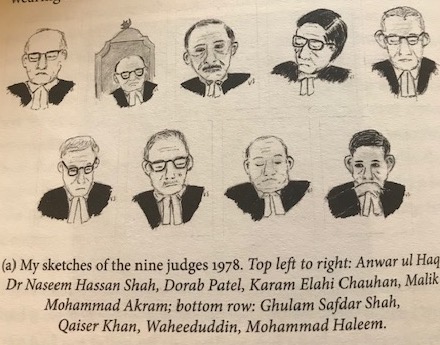
The judges at Zulfikar’s trial – drawn by Victoria Schofield in the courtroom

She joins the team defending Zulfikar, typing and carrying briefs including his own submissions and letters to world leaders, and she becomes a companion for Pinkie, as Benazir was known to her friends. This is the most interesting part of the book because Schofield is there, in Pakistan, sharing the hopes, the anxieties, and the eventual despair when Zulfikar was executed, developing contacts and friends and occasionally writing for The Spectator

Back in the UK, she joined the BBC and wrote a book on her experiences, Bhutto: Trial and Execution, that was published by Cassell. It was, she readily admits, greeted as “biased”. Tariq Ali, she tells us, said she was “a chum so made no attempt to objectivity”. (Oddly, Bennett-Jones makes no mention of Schofield or her book.)

In later years, Benazir is frequently living a distant life from her friend. But the relationship becomes so close that, when Schofield offers to help with the Bhutto children after Benazir’s assassination, Zardari says, “Yes of course you must stay in touch with them. You know they smell her on you”.

Schofield brings Benazir to life with so much insight that one longs for a little less discretion and a few more personal revelations and discussions on policy. Her story, spanning 33 years, is remarkable. It must be rare for an outsider to draw so close to a top politician and national leader and not only sustain but develop the relationship over a long period without being drawn into the political maelstrom – and without any attempt to cash in on the closeness, even though Schofield clearly enjoys the contacts and experiences. She is careful with what she doesn’t tell us, steering the path of a memoir rather than a biography and of a loyal friend and supporter avoiding controversy. 

Benazir’s assassination

Both the Bhutto books begin with a chapter on Benazir’s assassination during an election rally in Rawalpindi, and Walsh also describes it. Schofield tells how she heard about it on a train in Lincolnshire when Rita Payne, a BBC producer, called with the news. Walsh was on a plane flying into Karachi.

Bennett-Jones opens with Benazir being warned that morning by the general who headed Pakistan’s Inter-Services Intelligence (ISI) that “someone would try to kill her that day”. 

Bhutto told the general that he should arrest the suicide bombers. He said he could not because it would expose his sources, though he would “do his best”. While they were speaking, two 15-year old boys were being readied by the Pakistan Taliban to be the suicide bombers. They “had to bathe to ensure they were clean for when they entered paradise” though, as it turned out, one of them completed the deed so the other one fled. 

That detail comes in the first two paragraphs of Bennett-Jones’ introduction, which also illustrates Benazir’s fatalistic approach – Zardari told her not to go out but she replied that “some things I have to do”. After she was shot, her back-up car quickly drove away, police vanished, the road was hosed down clearing pools of blood and glass, and inquiries yielded little. Bennett-Jones continues the story with a detailed chapter that contains new information, revealing a plot that originated with Osama bin Laden and al-Qaeda in 1989 and also involved the Pakistan Taliban, maybe with encouragement, or at least, condoning, from the ISI. The US had earlier refused to help improve her security, and there was an eventual cover-up.

She ‘dated men’

Moving back in the story, both Schofield and Bennett-Jones tell us that Benazir roared around Oxford in a yellow sports car, an MG. Schofield however is silent on her much-gossiped relationships, and Bennett-Jones provides just two words – she “dated men”. It would have also been interesting to hear more from Schofield about the steps that took Benazir to an arranged marriage at the age of 31 when she was back in Pakistan. I was frequently there for the Financial Times and know (from one of them) that she cast her eye over three or four possible husbands before allowing the family to find a candidate. 

In many ways Zardari, who came from a feudal Sindhi family and was known around Karachi as a fun loving, party-going polo player, was a disaster. The Bhuttos apparently thought he’d be harmless, never foreseeing how he would lead the couple into charges of massive corruption. He was labelled “Mr Ten Per Cent” because his alleged take on investment projects, for which he was jailed.  

Benazir seems to have been content with the match and Bennett-Jones tells us that “he delivered for her”. He quotes a US ambassador who said (while discussing how she had tried to justify their corruption) that “she was completely in love with him; she could never deny him anything”. Benazir however told Hilary Clinton at the time of Bill Clinton’s Lewinsky scandal that “We both know from our own lives that men can behave like alley cats”.

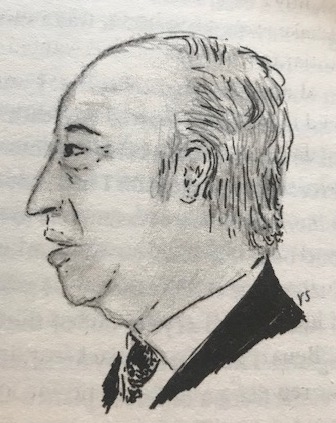
Zulfikar, drawn by Schofield in the courtroom

Bennett-Jones lists the negatives on her rule, quoting a veteran bureaucrat who said she allowed the “destroying of financial institutions, rampant corruption, loot and plunder, widespread lawlessness, political vindictiveness and senseless confrontation with the senior judiciary and the president”. Others said she was too pro-American (she certainly had friends and supporters there) and was insufficiently committed, early on, to Pakistan’s nuclear programme. 

Her father’s biographer said she was too focussed on glorifying Zulfikar’s memory and not enough on helping the poor. On the nuclear issue, Bennett Jones analyses and does not dismiss a report that Benazir took nuclear secrets in an overcoat pocket on a trip to North Korea – it is known that that the countries shared know-how, but the overcoat story is contested.

Looking back over those years, it is a story of missed opportunities. Perhaps the greatest was that Benazir and Rajiv Gandhi, then the Indian prime minister, did not survive for long enough to try to begin bridging the gap between their two countries. Both the Bhutto books tell us how they first met soon after Benazir became prime minister at the end of 1988 and had hopes that they could leave the past behind and begin to move ahead. But it was not to be – neither country’s establishments wanted the youngsters’ enthusiasm (Rajiv was 44 and Benazir 35) to become policy. And it never has.

A slightly shorter version of this review, focusing on the Bhutto books, will be appearing in the December edition of “The Round Table, The Commonwealth Journal of International Affairs”. It is on the website https://www.tandfonline.com/eprint/UVQD6N8YIAKT4HDIHVW7/full?

Downing Street in crisis as two top advisers told to leave

Punished for leaks about Boris’s partner – and much else

Boris Johnson is being urged by members of parliament and others to recast the way he runs his government following recent infighting in Downing Street, which led two days ago to the departure of his two controversial and divisive main advisers, Dominic Cummings and Lee Cain.

Britain is in a crisis over Brexit and the coronavirus, so one would expect the prime minister of this epitome of a stable democracy to be hard at work running his government, negotiating with the European Union and overseeing anti-pandemic measures.

Instead Downing Street, the heart of the British government and the prime minister’s home, has had an escalating crisis which led the prime minister on Friday (Nov 13) to tell his two old allies from the Brexit campaign to leave and not return, though they would be paid till the end of December.

The style with which Cummings, who was Boris Johnson’s chief advisor, walked out of the front door of Downing Street after being dismissed illustrated the ego and disdain for authority that helped to cause the crisis.

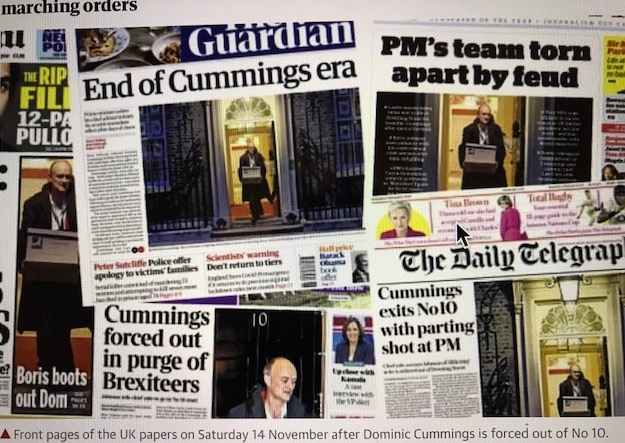
He provided virtually every British newspaper with a front page picture (above) of him leaving, carrying a cardboard box of his belongings – including, some reports suggested, Johnson’s and other secrets that he could leak. Cummings knew there would be photographers waiting on the pavement opposite, and he was later pictured going to his London home carrying a bottle of champagne in a plastic bag.

Trump’s exit a factor

The defeat of President Trump, who has been Johnson’s role model, means that the prime minister has in the past week lost the three men who have sustained him since he took office last year.  Encouraged no doubt by Cummings, he liked Trump’s style and welcomed his support for Brexit. He is also said to have admired – and aped – the president’s disregard for truth and convention, his disdain for opponents, and his style of riding roughshod over officials and critics.

There have been some suggestions that the imminent passing of the Trump era led Johnson to hasten Cummings’ departure, which was already being discussed, maybe to happen early in January after Britain seals its departure from the European Union (EU). 

Joe Biden deplores Brexit and wants Johnson to strike an exit trade deal with the EU. He has warned that negotiations on a US-UK trade deal would hit problems if Johnson’s option of a no-deal Brexit on December 31 led to trade barriers that endangered peace in Northern Ireland.

Boris Johnson being greeted in Downing Street in July 2019 by the then cabinet secretary, Sir Mark Sedwill – Dominic Cummings (far right and box)

Johnson was among the first foreign leaders Biden spoke to this week, which bodes well. But it would be difficult for him to draw close to the new president with Cummings – and Cain, the head of communications who got a warmer send-off from Johnson – sniping in the corridors of Downing Street and leaking to the media.

Cummings’ possible departure has been discussed since he undermined the government’s coronavirus lockdown by driving 250 miles to his north England home in May when he should have been isolating at home. 

He has survived till now because Johnson relied on him for policy and direction, allowing him to wield power over the choice (and dismissal) even of cabinet ministers and their aides, plus influence over pandemic scientists, and maybe even over contract awards – there are reports of pandemic projects being awarded to firms where he had links. Cummings’ central ambition was to dramatically transform the machinery of government, making it more centralised and efficient, which he has failed to achieve, though he did orchestrate some top civil service dismissals and set up a high tech cabinet office control centre.

Leaks

The immediate reason for yesterday’s drama appears however not to have been important policy and diplomacy issues, but evidence that Cummings and Cain had been feeding the media with stories not just about Johnson, coronavirus lockdowns, and Brexit, but about his fiancé, Carrie Symonds, who lives “above the shop” in Downing Street with their six-month old baby son, Wilfred.

Johnson ordered a leak inquiry after The Times and Sky News reported late on October 30 that England’s second nationwide shutdown – which he had been resolutely resisting – would be ordered for the following week to stem escalating coronavirus cases and the risk of mass deaths.

November 14th front pages – The Guardian

This had been discussed at a Downing Street meeting that day but Johnson, who preferred regional restrictions, wanted more time to make a decision. The leaks however bounced him into announcing the shutdown on October 31. He was reportedly furious, and the inquiry is believed to have indicated that Cummings and Cain had instigated the leaking to force his hand.  

There have been other leaks in recent weeks alleging Johnson had not recovered from his serious Covid-19 attack and hospitalisation in April, that he could not concentrate for long, and was not up to the job. There were also reports in the past two days that Cummings’ allies complained about Johnson “dithering”, saying they had to go for decisions to Michael Gove, the Cabinet Office minister who has wide-ranging duties that include Brexit.

“Princess nut nuts

Johnson’s fiancé Symonds, the leaks said, “bombards him with texts setting out her opinions on policy up to 25 times per hour”. It was also reported that Cummings loyalists’ nicknames for her included “Princess nut nuts”.

“A source said she was labelled a ‘princess’ for allegedly being high maintenance and acting regally”, reported the normally pro-Conservative Daily Telegraph. “The first ‘nut’, according to the source, alluded to her being ‘crazy’ – there is no evidence for that – while the second ‘nuts’ reference comes from a belief among the ‘Brexit Boys’ clique that she bears some facial similarity to a squirrel”

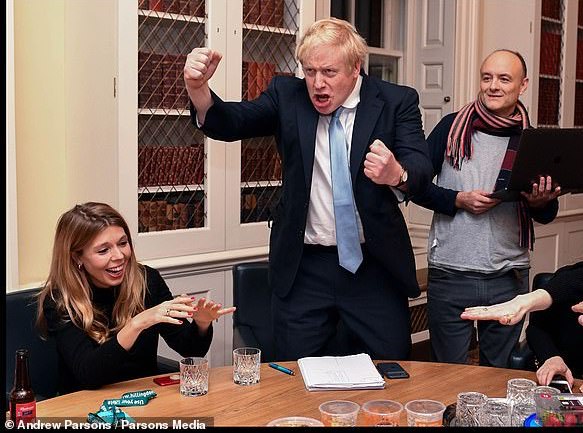
Boris Johnson with his fiancé Carrie Symonds and Dominic Cummings as general election results roll in, December 2019 – Daily Mail photo

Symonds has kept a very low profile since her son was born, so it is not surprising that Johnson was furious when her name appeared in newspaper stories – in some cases with such similar wording that it looked as if there had been a single source.

There were reports that Symonds, who has a background in public relations and headed the Conservative Party’s press office for a year before joining up with Johnson, led objections in the past week to Cain being made the prime minister’s chief of staff – a post which is vacant and was informally filled by Cummings. 

Cain wanted the job when he saw his power being eroded by Johnson’s  appointment of a former journalist and television reporter, Allegra Stratton, to be his new press secretary. Stratton left journalism earlier this year to work for Rishi Sunak, the Chancellor of he Exchequer (finance minister), and Johnson was impressed with the positive image that she successfully produced for him and his work.

Press conferences

Starting in January, Stratton will give daily government press conferences in the style of America’s president’s spokespeople. This has never happened before in the UK and would make her the effective mouthpiece for the whole government, strengthening Johnson’s (and Cummings’) aim to centralise power in Downing Street. Her appointment was therefore controversial beyond Downing Street’s power squabbles.

Cain’s bid faced the combined opposition of Symonds and Stratton plus, according to some reports, Priti Patel, the Home Secretary, and Munira Mirza, Johnson’s low profile but very influential director of the Number Ten Policy Unit, who earlier worked for him when he was Mayor of London. Together, they are said to have objected to Cain’s brutal style and to the “laddish culture” that he and Cummings led, though Symonds intervention here is controversial since she has no official role. 

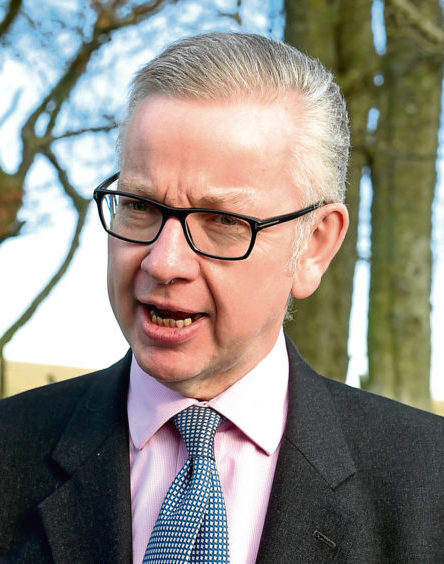
Lurking in the background is Michael Gove (below), who scuppered Johnson’s first bid for leadership of the Conservative Party in 2016 after the Brexit referendum and stood himself, unsuccessfully. They had been allies, but Gove said Johnson could  “not provide the leadership or build the team for the task ahead”. Gove stood against Johnson in 2018 and was again defeated, but was given a central ministerial job in the Cabinet Office.

Cummings worked for Gove earlier at the education ministry and the two men are known to have been close, whereas there has not been a similar allegiance with Johnson, even though they all worked together on the Brexit campaign.

That leads to the question whether Cummings – and Cain – could have been behind the media leaks without at least tacit approval from Gove, and that leads to a myriad of conspiracy theories about Gove’sultimate aims and survival tactics. He is now somewhat isolated at the centre of the government and, some reports suggest, will be moved. 

Stratton intends to have a more open and cordial approach to the media, reversing Cain’s and Cummings’ combative style and, hopefully, improving the presentation of government policy which has been chaotic throughout the pandemic with mixed messages and policy reversals. Public trust in the anti-pandemic measures, and in Johnson as prime minister, has been declining rapidly. Conservative MPs, who have been despised and ignored by Cummings, have grown vocally impatient.

The questions now are, first, how well Johnson can cope without Cummings to advise, focus and steer him into decisions, and then whether the departure of his old Brexit campaigners can free him up to develop as an effective prime minister. 

His immediate tasks is to adjust to his new media arrangements, pick an experienced politician or bureaucrat to be his chief of staff, and present an image that gives an impression of sound and stable government.

Both Cummings and Cain – and Johnson – were expert campaigners, first for Brexit, then for Johnson’s party leadership bid, and then for last December’s general election, but none of them has shown an ability to turn those skills into governing. Yet the two advisers have provided Johnson with what has been described as an “ultimate human shield, the lightning conductor for all the hostility from Whitehall and politicians”.

Johnson sent out

Watching British television over the past year, it has looked as though Cummings and Cain cleared Johnson out of the office as often as possible, sending him on campaign-style visits to schools, shops, factories, hospitals, and construction sites. Dressed up in an array of protective overalls, suits and hats, he smiled and chatted on camera to children, workers, patients and engineers, jogging up and down as he delivered his message of the day. Back in the office, they and Gove were presumably doing the detailed work that he has shunned throughout his career.

Some critics suggest that Johnson has never wanted to actually do the prime minister’s job. They say he enjoyed decades of being billed as a possible future prime minister and thrived on the campaign trails. He will revel in being a former prime minister, but the hard work is neither what he wants to do, nor what he is cut out for. 

If that assessment is correct, he now needs to be surrounded by able people who will ensure that, when he eventually leaves the job, he will not be remembered as Britain’s most unsuccessful prime minister during its worst peacetime crisis.

This article was written for India’s news website https://thewire.in/world/boris-johnson-uk-allies-dominic-cummings-lee-cain

Posted by: John Elliott | November 12, 2020

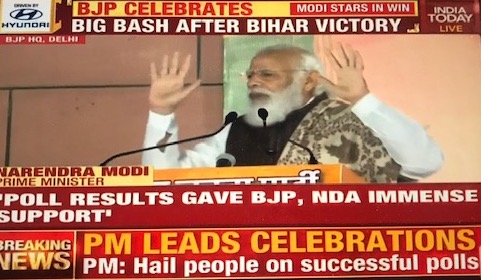
Modi’s BJP wins in Bihar for the first time

Son of jailed Lalu Yadav just beats the BJP on seats, promising jobs

BJP wins key by-elections in Madhya Pradesh and Gujarat

Narendra Modi’s Bharatiya Janata Party has expanded its nation-wide grip in India this week by gaining a dominant role for the first time in Bihar’s state assembly, while also producing good results in other state by-elections.

The Bihar election was also notable for the success of a young dynastic politician, Tejashwi Prasad Yadav, the 31- year old son of Lalu Yadav, the state’s notoriously corrupt former chief minister who has been convicted in multi-million rupee “fodder scam” cases dating from the 1990s and is in jail.

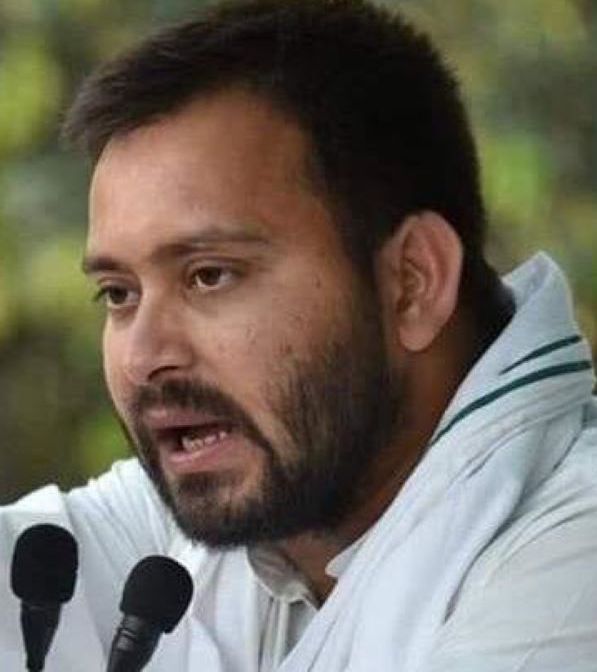
Tejashwi Yadav (below) now heads his father’s Rashtriya Janata Dal, which won 75 seats in the 243-seat assembly, five fewer than in the last election, but one more than the BJP’s 74 – though the BJP’s National Democratic Alliance (NDA) won the election with 125 seats compared with Yadav’s broad based Mahagathbandhan (MGB) coalition’s 110.

Yadav achieved that score primarily by offering the hope of jobs in a state that was hit hard by the migrants’ crisis stemming from the coronavirus pandemic. Modi introduced a sudden national shutdown in March and millions of migrant workers deserted the cities to trudge home, some 2.5m of them to Bihar.

Nitish Kumar, who heads the regional Janata Dal United (JDU) party, remains chief minister for a fourth term at the head of the NDA coalition, even though his party won only 43 seats, 28 less than at the last election in 2015.

The BJP seems likely to replace him some time soon. He switched his government’s alliance from the Congress Party to the BJP in July 2017, and failed as chief minister to live up to the development record of his earlier terms in office. There was little economic development in terms of roads, bridges and electric power and virtually no job creation, though health services improved.

Five years ago, when I visited Bihar during the election campaign, Shaibal Gupta, who runs the locally based Asian Development Research Institute, said the state needed to expand from its largely government-funded economy, and from farmers producing mostly for their own consumption, to productive private sector business activity. That meant the government should encourage entrepreneurial activity.

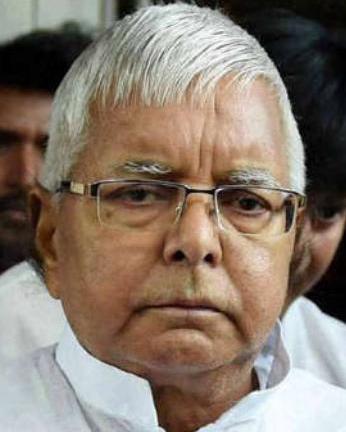
Lalu Prasad Yadav

This did not happen, and the massive number of migrants returning home earlier this year dramatically illustrated the lack of local jobs. Speaking two weeks ago while voting was taking place, Gupta said “in the absence of any industry or private sector and given the state’s poor governance model, providing jobs is the most significant factor that will determine the outcome of the election”. 

Yadav’s success in winning so many seats is significant because it shows that voters will support a dynasty with a familiar name, providing the message is one of hope – in this case a promise of the jobs that are being demanded by the youth in one of India’s poorest states.  (That is something Rahul Gandhi consistently fails to do with his family’s Congress Party, which won only 19 seats as part of Yadav’s MGB coalition).

Yadav, who was not taken seriously as a politician till relatively recently, has a long way to go re-packaging the family reputation and establishing himself. He tried to sideline the memory of his father’s crimes – syphoning Rs950-1500 crore (estimates vary) from the state government’s animal husbandry department.

His line was that his father, who later became a Congress government railways minister, had introduced dramatic social change for the poor and low castes during the years that he (and his wife Rabri when he was jailed) were in power. 

Now, said Tejashwi Yadav in a whirlwind tour of election meetings, was the time for economic development, which he would introduce.  He promised the creation of one million government jobs, though the BJP said it would generate 1.9m employment opportunities. 

In other state assembly by-polls the BJP, which has not done well in some recent state elections, won 19 out of 28 seats in Madhya Pradesh, routing the Congress Party. It won all eight seats that were vacant in Modi’s home state of Gujarat, and six out of seven in Uttar Pradesh, along with other successes elsewhere.

Modi claimed that the Bihar and other results endorsed the way that the pandemic had been handled. Certainly the results are at least partly an endorsement of his national leadership, and yet another illustration of how he manages to maintain national support and praise even though the economy has slumped and there have been 8.7m coronavirus cases. In Bihar however, the cry was for jobs and development, and the BJP will be judged on whether that happens.

Biden will give India more chance to re-set China relations

India needs flexibility to rebuild its fractured relationship with China, but the Trump administration has been restricting the options with high decibel confrontational statements about uniting against Chinese aggression.

For this reason if for no other, a Joe Biden presidential victory would be good for India and, ultimately, good for Asia which does not benefit from China-India conflict.

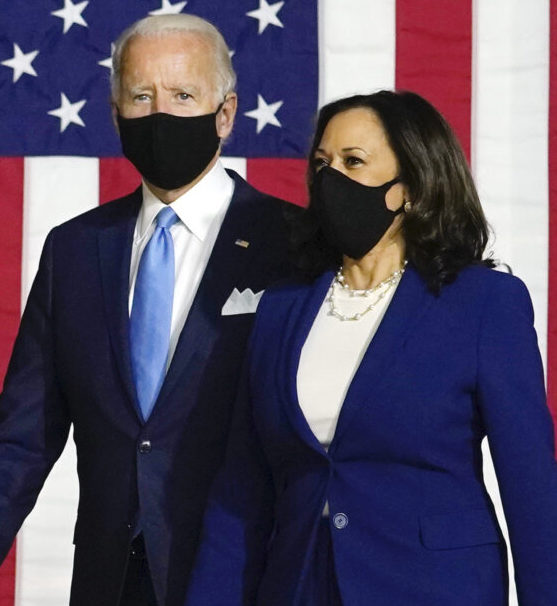
Biden, and his vice president Kamala Harris (who has an Indian mother), would continue the broad co-operative policies that have developed between the two countries over the past 20- years, and which Biden pushed when he was vice president.

But they would be far less tolerant of Narendra Modi’s extreme Hindu nationalism and of the treatment of Muslims.

Harris has spoken against Modi’s cancellation last year of Kashmir’s Article 370 special rights. She also criticised S.Jaishankar, the foreign minister, when he opted out of a meeting in Washington ten months ago that would have included a pro-Kashmir Democrat member of the US Congress.

This could make the early months of a Biden presidency difficult, though there would be common ground on other issues and Biden has spoken about wanting to work with India against terrorism and on China and trade.

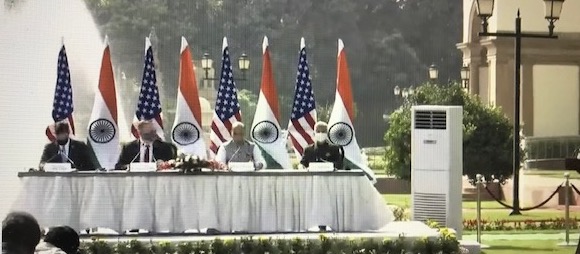
The “2+2” media conference at Delhi’s Hyderabad House on Oct 27

The risks of a fresh Trump presidency that would exacerbate relations with China has just been demonstrated by Mike Pompeo, the US Secretary of State, who declared during a high profile visit to Delhi that “the United States will stand with the people of India as they confront threats to their sovereignty and to their liberty.” 

He was accompanied for what is known as a “2+2 dialogue” by Mark Esper, the US defence secretary. Esper signed a long delayed defence co-operation agreement that enables India to share sensitive American intelligence such as maps and satellite images that should boost the accuracy of missiles, armed drones and other military action along its 3,488-km undefined border with China (known as the Line of Actual Control – LAC).

The agreement is the latest development in what is now called the India-US Comprehensive Global Strategic Partnership that was begun by President Clinton nearly 20 years ago when the first of four defence “foundational agreements” were signed. The four now cover information exchange, logistics sharing, and access to communications equipment as well as this week’s agreement.

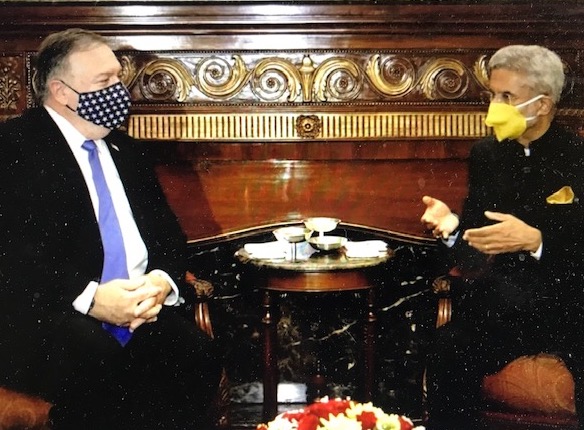
Mike Pompeo and S.Jaishankar at their Delhi talks

India’s former Congress government resisted being drawn into America’s embrace, frustrating US officials who regarded the country as a tiresome and unreliable potential partner.

Modi’s government has been willing since it came to power in 2014 to make progress, and recent events on the LAC have further sharpened its interest in accepting co-operation.

This will continue whoever becomes US president, but that does not mean that India needs the Pompeo rhetoric, which stems from Trump’s aim to isolate China over the origins of the Covid pandemic as well as trade.

India an “ally”

Two weeks ago, Pompeo said in a US television interview that India “absolutely need the United States to be their ally and partner in this fight” (though India has never accepted the “ally” tag).

China had massed “huge forces against India in the north. The world has awakened,” he added. “The tide’s begun to turn. And the United States under President Trump’s leadership has now built out a coalition that will push back against the threat.”

In Delhi yesterday, Pompeo referred specifically to 20 Indian soldiers being killed at Galwan on the LAC in June during an unprecedented violent brawl with Chinese forces. The US “stands with India to deal with any threat”, he said – without of course defining “stands with”, which would probably be little in real terms.

India clearly welcomes its defence agreements with the US at time when its army and air force are seriously underequipped with modern weaponry and support technologies.

But it also has to develop a new relationship with China because the Himalayan confrontation has effectively ended a long period of mostly stable diplomatic relations and economic trade and co-operation.

Peace and tranquility

For the last 30 years, we have built a relationship predicated on peace and tranquillity along the border,” Jaishankar, who is a former top diplomat and was ambassador in both Beijing and Washington, said in a recent internet discussion. If “peace and tranquillity” (a phrase that is recognised by both sides) was not ensured, and agreements about border security were not honoured, he added, then other parts of the relationship could not remain the same.

Nirupama Rao, a former top diplomat who held the same foreign service posts as Jaishankar, said in another discussion that the longer a new relationship with China was delayed, the closer India would inevitably become to the US.

The Quad countries

That is clearly what Trump and Pompeo want. The secretary of state went on from Delhi to Sri Lanka, the Maldives,, Indonesia and Vietnam, rallying support.

Joe Biden and Kamala Harris

India has been drawn into a closer involvement in a US-driven alliance called the Quad, which also includes Japan and Australia and is aimed at maintaining a ”free and open Indo-Pacific” against the aggression of China’s president Xi Jinping. India is significantly expanding its annual Malabar naval exercises with Japan and the US n the Indian Ocean to include Australia so that all four Quad countries are involved.

Biden would not be soft on China. He has called Xi a “thug” and has taken a harder line than Trump on issues such as Tibet and the treatment of Uyghurs Xinjiang, as well as supporting Taiwan.

But his administration could be expected to take a more measured approach on India and accept that, though the two countries are firmly linked, India needs space to develop the new China relationship without rhetoric from whoever becomes secretary of state. (India also needs space, which Trump reluctantly tolerated, to maintain its decades-long relationship with Russia, which is a major arms supplier, and with other countries such as Iran).

Modi would probably not agree with this pro-Biden analysis because he has developed a strong relationship with Trump and has triumphantly shared platforms with him at mass rallies in the US and in India. The two men are extrovert populists who share many of the same values, though there have been sharp differences on trade and other policy issues.

Overall, Modi (and maybe Jaishankar) would certainly like Trump to win, but India overall would be better off with Biden.

“We can start a war but its end is not in our hands” – India defence minister

Himalayan snowbound brinkmanship could last through the winter

Sixty years ago, Jawaharlal Nehru, independent India’s first prime minister, thought he and China’s premier Zhou Enlai could work together as equals on the world stage – until he learned otherwise in 1962 when India was humiliatingly defeated in a brief Himalayan war by China invading its territory and then withdrawing.

Now it looks as though Xi Jinping, China’s president, may be teaching the same lesson to Narendra Modi, who has displayed Nehruvian-style ambitions since he became prime minister in 2014, parading a desire for equal ranking in carefully choreographed photo shoots when the leaders have met. 

Xi Jinping with Narendra Modi in Gujarat September 2014 – on Modi’s 64th birthday

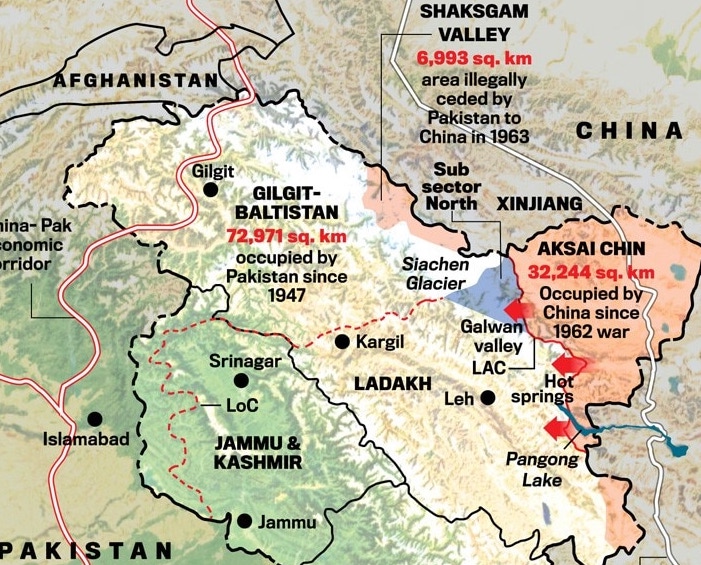
China’s People’s Liberation Army (PLA) has taken territory in India’s Ladakh region on the undefined 3,488-km border, known as the Line of Actual Control (LAC), occupying areas that were earlier regarded as ‘disputed’ and left vacant by both sides.

It claims it has been acting defensively, but the two countries are teetering on the brink of armed conflict after three months’ of military confrontation. 

Whether they will go to war at Himalayan heights of 14,000-16,000ft is, for the first time since 1962, a real risk if current attempts to defuse the crisis fail. Xi, it has been widely assumed, wants to teach lessons – including putting a brake India’s economic development – without war, but that can become accident-prone.

The Global Times, an aggressively controversial government-linked newspaper, said on September 11 that the Chinese people did not want war. They should however have “real courage to engage calmly in a war that aims to protect core interests” at a time of “territorial disputes with several neighbouring countries instigated by the US to confront China”.

Reports suggest that the PLA has over 40,000-50,000 troops in position on the LAC with supporting missiles and aircraft, and India has indicated it has matching forces. At some points, the two sides are a few hundred yards apart or less: elsewhere they have commanding positions in heights overlooking each other’s military installations.

The PLA has been signalling that “China is risen and you have to accept that China is the pre-eminent power in Asia, and you better understand your place in this hierarchy,” Gautam Bambawale, a former Indian ambassador to China, has told the Financial Times. “They are saying the 21st century isn’t an Asian century. It is merely and solely a Chinese century.”

Kashmir Observer map

The FT article, published on line last night, dealt with China’s actions in various locations with an apt headline: “China’s great power play puts Asia on edge”, with “Domestic insecurity, ambition and the pandemic blamed for Beijing’s belligerence” as a subhead.

“The potential flashpoints are familiar: Taiwan; disputed islands in the South China and East China Seas; and India’s Himalayan border,” said the article. “What is unusual is that tensions have risen in unison and some commentators have warned that there are risks of military flare-ups potentially involving the US.”

In the past, incidents on the LAC have been defused, including a ten-week confrontation at Doklam on the Bhutan border in 2017 when India stood unexpectedly firm instead of quietly backing off (though China held on to land it had gained). So it is a mystery precisely why these two nuclear powers have allowed over half a century of carefully managed co-existence to collapse into the current crisis. 

The immediate reason for the Chinese action may well have been to block road building by India in the strategically important Galwan valley close to the LAC. 

That led to an ugly and unprecedented brawl between both sides’ troops on May 23, with the first deaths on the LAC since 1975. Further escalation led to the exchange of 100-200 warning shots on September 7, again the first since 1975.  

On a broader front, it has been widely assumed that Xi wanted to teach Modi not to draw too close to the US and its allies.

An Indian village near the China border

That includes Japan and Australia in a loose but increasingly significant link-up called the Quad.

Xi now probably sees an opportunity to curb India’s emergence as an economic rival and world power by forcing it to boost spending on long-delayed defence equipment and infrastructure.

That will mean diverting India’s scarce funds from other more constructive developmental projects when the economy has been devastated by the Covid pandemic that is now spiralling out of control into the country’s vast rural hinterland.

The Chinese goal could well be to compel India “to divert our resources into military spending, pushing us away from the economic trajectory where India looked to besting China in the coming decades,” says Manoj Joshi, an experienced defence analyst.  

Some experts believe that China does not wish to invade more territory than it has already done. Instead, it is engaged in “a battle of financial and military manpower attrition” that will be “hugely manpower intensive and costly” for an “interminable period”, according to Rahul Bedi, a veteran defence correspodnent writing on TheWire.in.

That long-term view is borne out by what happened when the two countries’ foreign ministers, S.Jaishankar and Wang Li, agreed a five-point plan to avoid future clashes at a meeting on September 10 on the sidelines of a regional conference in Moscow. 

The five points include talks between militaries on the LAC and a continuation of decades-long inconclusive talks between top government representatives, but there is no indication that China will withdraw from territory it has occupied – nor that India will pull back from heights it has gained. 

There was no sense of urgency, which indicates that the stand-off could well last through the winter, hardening the positions of both sides and making a resolution difficult.

War’s end…..

In the past week, both sides have been exchanging tougher statements. China has been demanding that India withdraws from the current positions, but today in parliament, India’s defence minister Rajnath Singh, said “No force in world can stop Indian forces from patrolling on Ladakh border”.

He warned China “we can start a war, but its end is not in our hands.” 

One thing is for sure: the crisis is not of India’s making. Since it was defeated by China in 1962, it has been wary of provoking its militarily and economically more powerful neighbour. “India showed timidity since 1962”, Kanwal Sibal, a former foreign secretary told the RUSI London think tank in a webinar today. That gave China “confidence they can handle India”.

Modi has tried constantly for six years to establish effective working relations – he has had as many as 18 meetings with Xi. But he has adopted a stronger stance on the LAC, first at Doklam in 2017 and now with the current crisis. To look weak would undermine his strongman nationalist image of invincibility honed in dealings with Pakistan.  

Equally sure is that the current confrontation fits with Xi’s determination to establish his country as a world power, ignoring and over-riding international objections, as his recent subjugation of Hong Kong has shown.

“Friction with China is a given”

“Friction with China,” is a given says S.Jaishankar, a career diplomat and former ambassador in Beijing who is now India’s foreign minister. Talking recently about his new book, The India Way, he said relations between the neighbours were made more complex because both were rising world powers.

India has fought back in recent weeks with economic action against Chinese companies including banning the video app TikTok and some 60 other apps as well as stiffening foreign direct investment controls, banning Chinese companies from bidding for some government contracts, and acting against Chinese Huawei involvement in telecom systems

But whatever the outcome of the current stand-off, the historical parallels of miscalculations stemming from Nehru’s suave hubris and Modi’s egotistical nationalism cannot be ignored.

It is unlikely Modi will find it politically credible to sit chummily on a decorated swing with Xi as he did in his home state of Gujarat six years ago today in September 2014. 

Maybe he should have learned a lesson on what was the first visit by a Chinese president for eight years. Planned as Modi’s 64th birthday party – today he is 70 – it was upset by over 1,000 troops facing off against each other in Ladakh, a foretaste of what is happening now.

Strong interest in a Japanese collector’s Pundole on-line live auction

Lone record Husain bid at AstaGuru arouses curiosity

Record prices have been realised in the past week for Indian modern art with over $5m being paid for a single work at a time when the country’s auctions are continuing to defy the Covid-19 pandemic with strong results.

The new country record was set with a bid of Rs32 crore (Rs320m)  – $5.02m including a 15% buyer’s premium – for an untitled 60in x 40in oil on canvas (below) by V.S.Gaitonde, one of India’s leading modernists, at a live on-line auction staged by Pundole, a leading Mumbai gallery.

The Pundole auction room with a Jagdish Swaminathan painting that was bought for a record of Rs10.92 crore ($1.5m)

Avoiding the need for safe distancing between bidders, but creating the buzz of a live auction, Pundole staff and the auctioneer took bids over the telephone and on line in an otherwise empty auction room for two evening sales this week.

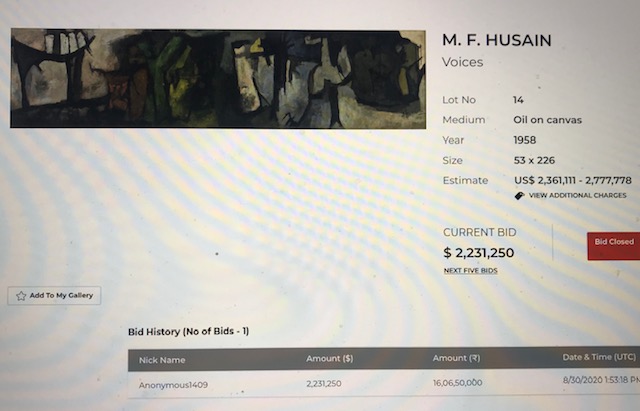
A week ago, a work by M.F.Husain hit a new record for the artist of $2.56m (including the premium) on a bid of Rs16.06 core ($2.23m) at a two-day on line sale staged by AstaGuru, a Mumbai auction house. 

V.S.Gaitonde’s untitled oil on canvas that set a new $5m record for Indian paintings

Unusually, there was only one bid for this work (below), which led to some speculation among dealers that it might not have been a genuine sale but had been bought in at a high price to boost the auction’s image.

This has been denied by Siddhanth Shetty, a member of the family that runs AstaGuru, who told me “it was a genuine sale”. One commentator has suggested that the buyer probably came from outside India, and some market sources indicate Hong Kong. 

Gaitonde and Husain are leading members of the Progressives group, who rose to prominence in the mid-late 1900s and still dominate the top end of the auction market because collectors regard them as safe and reputable.

The previous country record of $4.45m was achieved by another Progressive, S.H.Raza, at a Christie’s auction in New York in March 2018.

The Husain work on the AstaGuru website as bidding closed with one offer

It has taken two years for a new record to be set because the market has been generally flat, but investor and collector interest seems to have been stimulated by the pandemic, as was shown earlier in successful July and March auctions.

Pundole’s auction took place on two evenings this week (September 3 and 4) with 104 works came from a Japanese collector, Masanori Fukuoka, who began buying Indian art in 1990.  All the works sold for a total hammer price of Rs70 .06 crore – $10.96m including the premium.  

Fukuoka ranks among leading international collectors and has built the Glenbarra Museum to house the works adjacent to his home in Himeji, a city in the Kansai region of Japan.

“The Seashore” by Arpita Singh which achieved a hammer price of Rs4.5 crore, 50% above the top estimate

Unlike many collectors, he has always made his works available for viewing at his gradually evolving museums, though local interest has been limited. Like others, he has lent works to exhibitions in many countries. 

Consisting of what has been described as a “few thousand” works at its peak, the collection on display at Himeji has been reduced in size. Fukuoka has also reduced his focus from around 60 artists to about ten, as well as diversifying into Japanese ceramics.

In addition to the Gaitonde, the auction also produced a record of Rs10.92 crore ($1.5m) including the premium for an untitled 68in x 68in oil on canvas by Jagdish Swaminathan (see auction room photo above), more than three times the top estimate. A sculpture of the head of a bull by Tyeb Mehta, a leading Progressive famous for his canvas works, fetched Rs3.7 crore ($500,000). Good prices were also achieved for paintings by more recent artists including Arpita Singh (photo above) and Jogen Chowdhury. 

The AstaGuru auction was unusual because it consisted only of works by Husain with 34 out of 36 on offer selling for a total of $7.77m.

Husain painted Voices (above), a 53in x 226 oil on canvas, in 1958, early in his Husain career. The work was being offered in an auction for the first time, and greater interest had been expected than the single bid that won at the sale. 

The focus now switches to Saffronart, Christie’s, and Sotheby’s auctions later this month, which will test whether the interest of the last few months is sustainable – there is a Gaitonde at Saffronart with a top estimate just under $5m.

Posted by: John Elliott | August 5, 2020

Modi dominates foundation ceremony of Ayodhya Hindu temple

Historic event symbolising the rise of Hindu nationalism

Temple on site of Muslim mosque razed by Hindu mobs in 1992

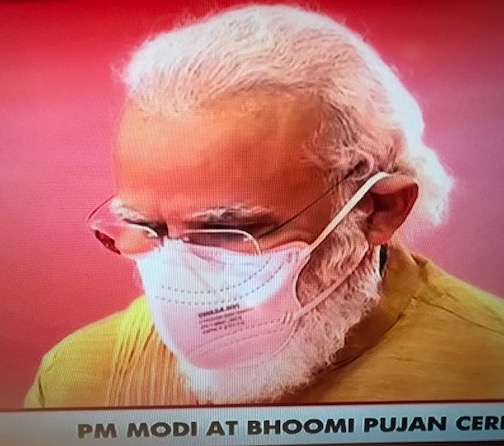
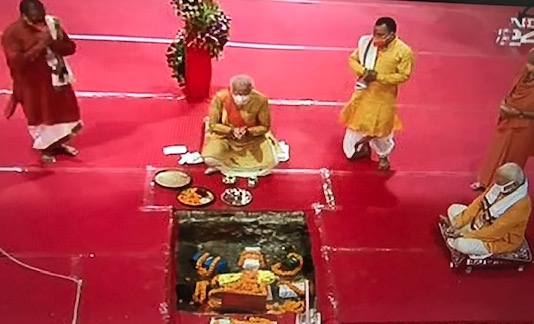
Narendra Modi staged a widely televised political coup this morning when he laid a silver brick as a symbolic foundation stone for the construction of India’s controversial Ram temple at Ayodhya on the site of a mosque demolished in 1992.

Modi head IMG_0046He was the central figure of the ceremony, establishing Hinduism’s historical role and its dominance at the expense of other religions, notably Islam.
He was not just demonstrating his government’s drive for Hindu nationalism, but also recognising the pivotal role that the temple has played in the rise of his Bharatiya Janata Party from political insignificance over the past 40 years.

“India is emotional, decades of wait has ended,” Modi said after the ceremonies. “Lord Ram lived under a tent for years, now he will reside in a grand temple”

It may seem perverse for Modi to stage the ceremony during the Covid pandemic – he and others at the ceremony wore masks and repeatedly washed their hands.

Modi ceremony IMG_0049

the foundation stone laying ceremony

Today’s celebrations in the Uttar Pradesh temple town will however give hope to hundreds of millions of Hindus among the 1.3bn population that is being ravaged by coronavirus. It will also strengthen Modi’s and the BJP’s image during a crucial state assembly election that is due (unless it is postponed) in neighbouring Bihar in October.

Construction of the temple is significantly scheduled for completion before the next general election ion 2024.

Ayodhya is the most sacred town for Hindus, who believe it was the birthplace of Lord Ram, one of their most revered deities. In December 1992, marauding Hindu mobs motivated by BJP leaders demolished a little used Muslim mosque, known as the Babri Masjid, that had been built on the site of a Hindu temple – a not unusual occurrence down the centuries.

Ram-Temple-2

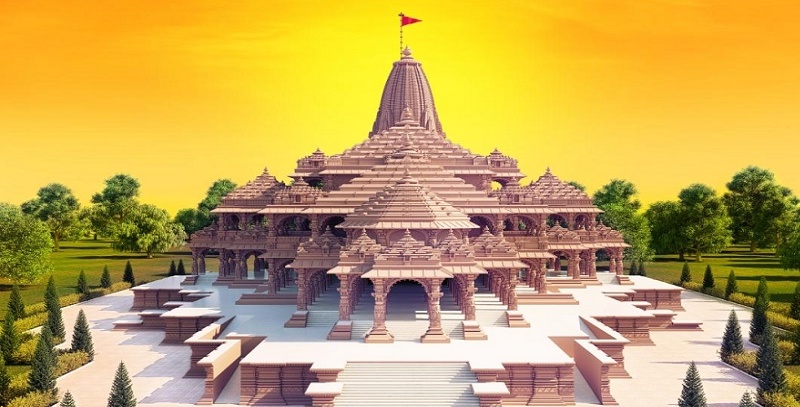
A model of the temple that will now be built

The site has been disputed since the 18th century and the demolition turned Hindu and Muslim leaders’ rival claims into a major controversy with three decades of political infighting, riots, attempts at conciliation, and litigation. Last November, the supreme court ruled that nearly three acres of the land should be used to build a temple, and that five acres should be allocated elsewhere for a mosque. This is what has been implemented today on a 57-acre site that will become a Hindu complex.

Modi has been criticised for playing such a central role in a specific religion’s ceremony when he is prime minister of what is constitutionally a secular state respecting all religions. But that is academic given Modi’s nationalist approach, and it seems as if the construction of the temple is being broadly accepted across India. Leading Muslim figures attended the ceremony.

“We must rebuild our temples and viharas as one people. With mutual respect, love and inclusion. We must recreate them as not just places of worship, but also as centres of knowledge and social cohesion, as they were in ancient times,” says Amish Tripathi, the head of India’s cultural centre in London and an author of books on Ram. “It is a statement to the world that we will not die. We are sanatan [everlasting]. We are eternal. And most importantly, we are united. All 1.3 billion of us”.

The Ayodhya movement has been important in developing in new “national assertiveness” and “cultural pride” with Modi as “its icon,” says Swapan Dasgupta, a leading commentator and BJP MP.  “The monument to lord Ram, built on the site of an ancient temple, could yet become a powerful symbol of resurgent nationhood”.

Modi prostate IMG_0075

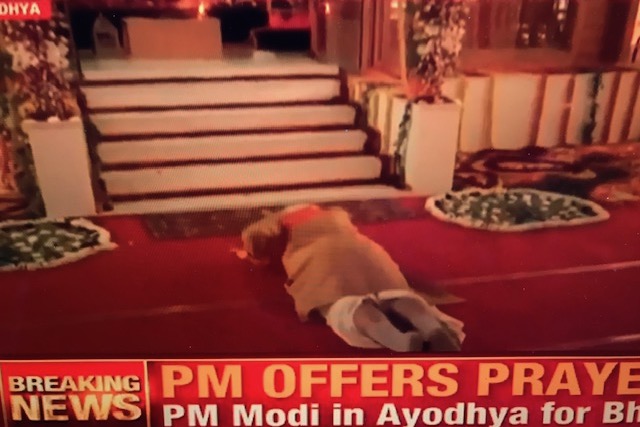
Modi prostrates himself at a temple on arriving in Ayodhya

The Congress Party has seemed unsure how to react, though it has been trying to appease growing Hindu consciousness ever since the the late 1980s when the then prime minister, Rajiv Gandhi, allowed locks on the mosque to be opened.

Yesterday his daughter, Priyanka Gandhi who is a general secretary of the party, supported construction of the temple, saying she hoped it would become “a marker of national unity, brotherhood and cultural harmony in accordance with the message of Lord Ram and with his blessings”. That was echoed today by Rahul Gandhi, her brother, and the reluctant former Congress president.

Kashmir anniversary

Significantly, today is the first anniversary of another act of Hindu nationalism – the constitutional coup that the government staged on August 5 last year when it controversially reduced the standing of India’s northern state of Jammu & Kashmir. Accompanied by a lengthy security clampdown, this cancelled J&K’s status as a full state and ended special constitutional rights and privileges, opening the way for what is seen locally as an erosion of the Kashmir identity.

Most other aspects of Hindu nationalism have been muted since the pandemic struck in March, diverting attention both from growing opposition to citizenship legislation that discriminated against Muslims and from a sharp decline in the country economy that the government was failing to arrest.

A new education policy has however just been launched, which strengthens the teaching of the Hindu language in schools.

Amit Shah, the hardline home minister and Modi ally who was driving the nationalism agenda, has been less active in recent months and was hospitalised earlier this week, having tested positive for coronavirus. He therefore missed today’s ceremonies where Modi was accompanied by Yogi Adityanath, UP’s chief minister, along with the state’s governor and the leader of the Rashtriya Swayamsevak Sangh (RSS), the hard line umbrella organisation that embraces the BJP.

Covid numbers

India’s Covid numbers seem horrific, though less so when compared with other countries relative to the size of the population. Official figures show approaching 2m confirmed cases and nearly 40,000 deaths. Both figures are widely regarded as seriously understated, especially the deaths figure which is only 2% of the total confirmed cases compared for example with some 15% in the UK.

The government has taken a tough line in combating the virus, though Modi has been criticised for a sudden shutdown in March that triggered a mass movement of migrant workers from major cities.

Today that is being left aside as Modi did what he has often done before, making himself the televised star in an important national event – an event that will be widely seen as the reassertion of Hindu India.

Posted by: John Elliott | July 24, 2020

Indian art auctions beat pandemic gloom

“Progressives” dominate the top sales, providing comfort and safety

Stay-at-home buyers plug into auctions and boost sales

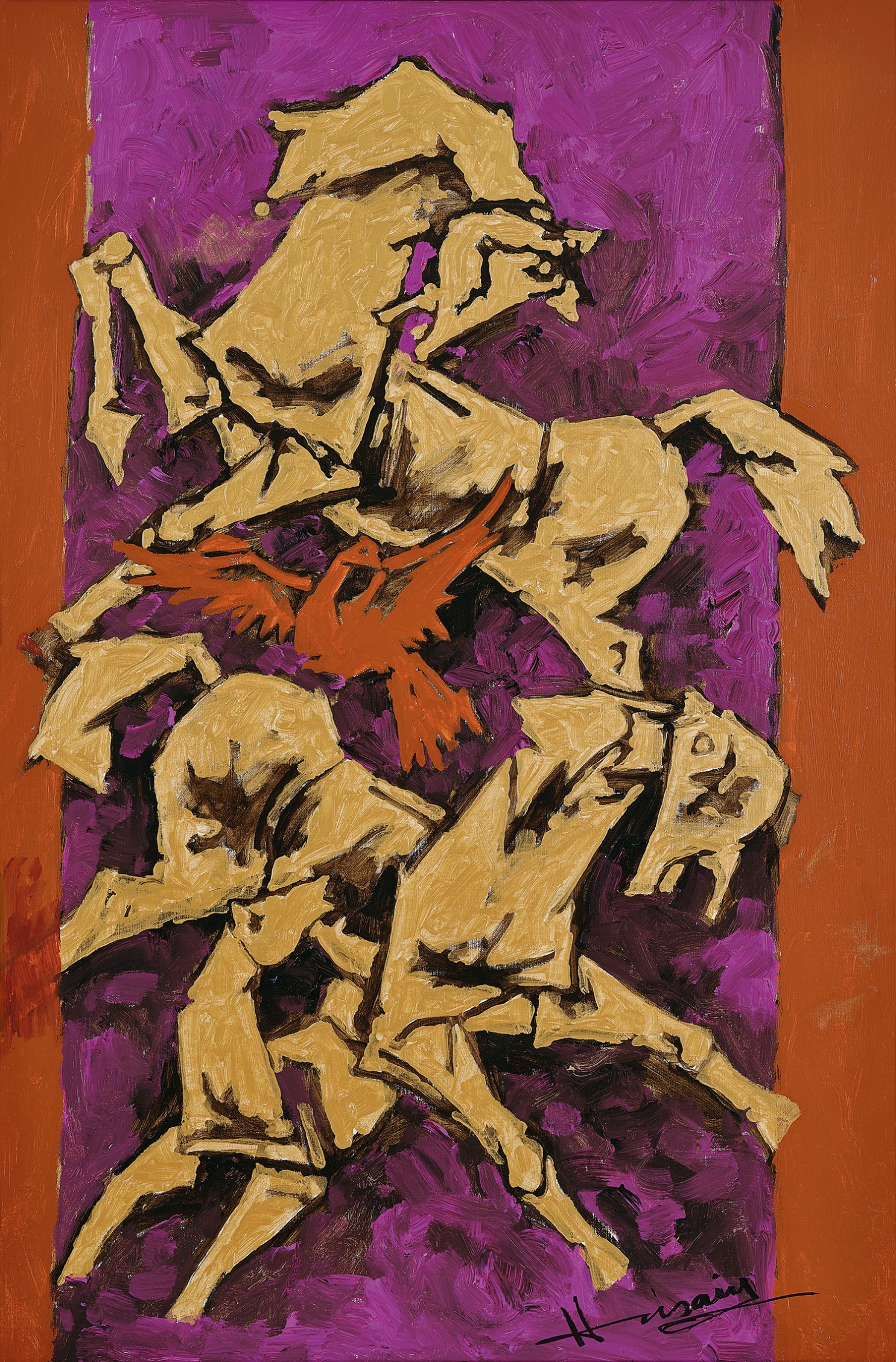
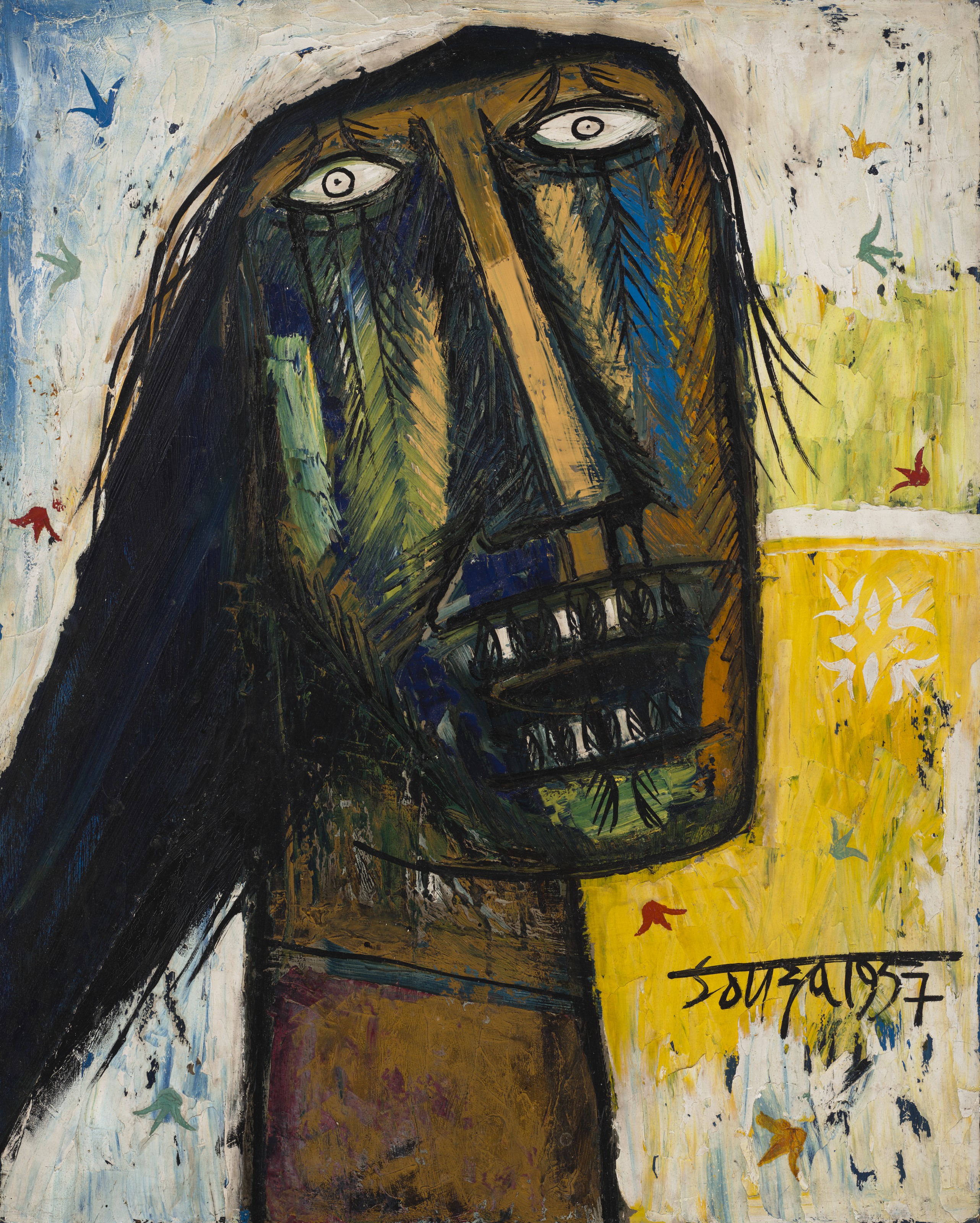
Tyeb Mehta’s figures continue falling, M.F.Husain’s horses prance, F.N.Souza’s faces grimace and S.H.Raza’s Bindus sit squarely in their boxes. The dominance of such works by these highly respected members of Bombay’s mid-late 20th century Progressives Group, with their recognisable brands, has grown during the Covid-19 pandemic as auction houses have sought the safety of focussing on the top selling known names.

Christie's Top Lot 29 Tyeb Falling Figure

Tyeb Mehta’s Unitled falling figure that led the Christie’s sale at a hammer price of $800,000

The Progressives accounted for all but one of the 13 highest prices achieved in the latest of the summer auctions staged by Christie’s on line from New York that closed on July 22 with $4.83m total sales (including buyer’s premium).

As many as 30 out of the 64 lots in the catalogue were from the Progressives compared with just 18 out of 75 in the same auction a year ago.

Such caution seems not to have been necessary because on line sales of South Asian art have been buoyant since the shutdown began in March. The pandemic has not made potential buyers shrink from spending their money, and instead seems to have made them more interested in doing so, providing estimates and reserve prices are kept within reach.

“People are sitting at home, so they are engaged,” says Dinesh Vazirani, who founded Mumbai-based Saffronart with his wife 20 years ago as an on-line auction house. “They are looking at being at home long-term so their homes are becoming more important, and they are realising that art is a long term asset.”

AstaG Lot 40 Husain, Untitled (Horses) circa 1990, Winning Bid - INR 1,64,38,507. Image couresty of AstaGuru.

M.F.Husain’s Untitled horses sold in the AstaGuru auction for $225,185 hammer price

The Progressives also accounted for the eight highest hammer prices totalling $3.54m in the season’s top auction run on-line by Mumbai-based Asta Guru.

That was half the total of $7.04m achieved in the auction, where a similar proportion of the total 50 lots were from the group, roughly in line with the same auction in March last year.

They have also dominated other sales, with Saffronart, the market leader, devoting a two-day auction earlier this month to ten of Raza’s lower priced works with sales of $451,557. In its summer auction last month , the top five works were by Progressives and sales totalled $2.73m, though with only 71% of the lots selling.

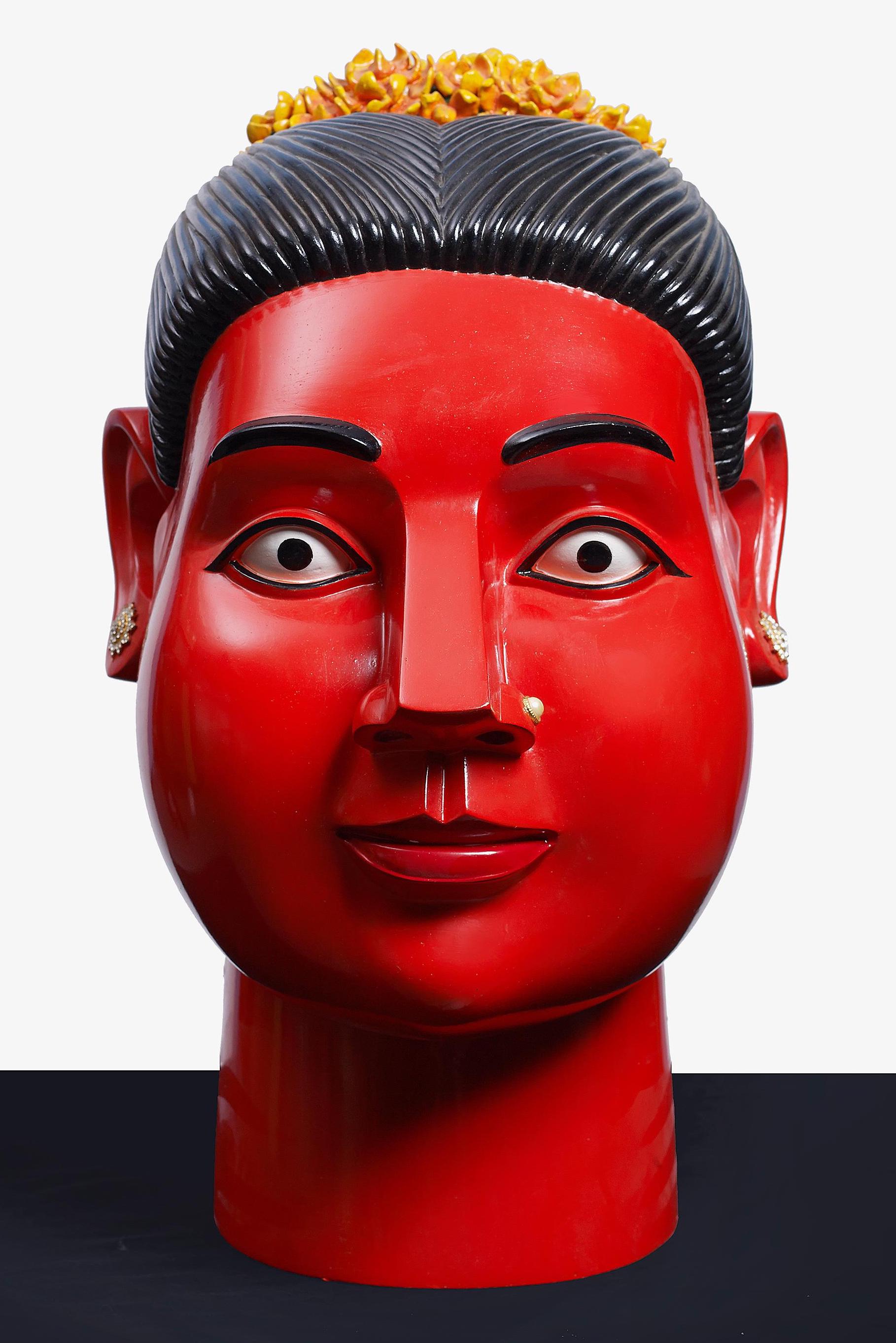
Saffronart has been staging weekly and other smaller and varied auctions, including REDiscovery “art and collectibles” that closed yesterday (July 23). Sales totalled $355,661, with good prices for the art, including a G. Ravinder Reddy work (see below).

Christie's Lot_41__Souza_Frightened_Head_

F.N.Souza’s Frightened Head was among the top Christie’s lots at a hammer price of $200,000

Vazirani says these auctions bring in new buyers and have helped to build the firm’s total of $10m sales (including some done privately) since the shutdown began in March.

Siddhanth Shetty, part of the family that runs AstaGuru, says that a third of the lots in its auction went to new buyers at a time when people were “looking for a hedge against traditional [stock] markets”.

The overall result is that South Asian auctions are as strong as they have been in recent years. This is not a repeat of the sharply escalating boom of the early 2000s, but there are continuing solid sales with the “tried and tested” Progressives, as Vazirani puts it, providing the lead.

The Christie’s auction, which closed on July 22, was its first purely online sale for South Asian art and the catalogue was only slightly smaller (by about ten lots) than its usual sales. It sold 56 out of 64 lots and the total hammer price was 13% above the lowest estimate, which was a satisfactory but not astounding result. Nishad Avari, who ran the auction, says that the results showed the switch to an on-line format had not been significant.

AstaG Lot 46 - S H Raza, Panch - Tatva, 1997, Winning Bid - INR 1,81,12,500. Image courtesy of AstaGuru

S.H.Raza’s Panch-Tatva that sold for a hammer price of $248,116 in the AstaGuru auction

The top lot was Tyeb Mehta’s Falling Figure (above), a 59x49in oil on canvas painted in 1965 with a rather more blurred image than others in his series.

It was being auctioned for the first time, which is always a draw, but bidding failed to reach the top estimate of $900,000 – it sold for a hammer price of $800,000 ($975,000 including buyers’ premium). This was the highest result in Christie’s first-ever Asian Art Week Online which involved 22 countries and had $8.95m total sales.

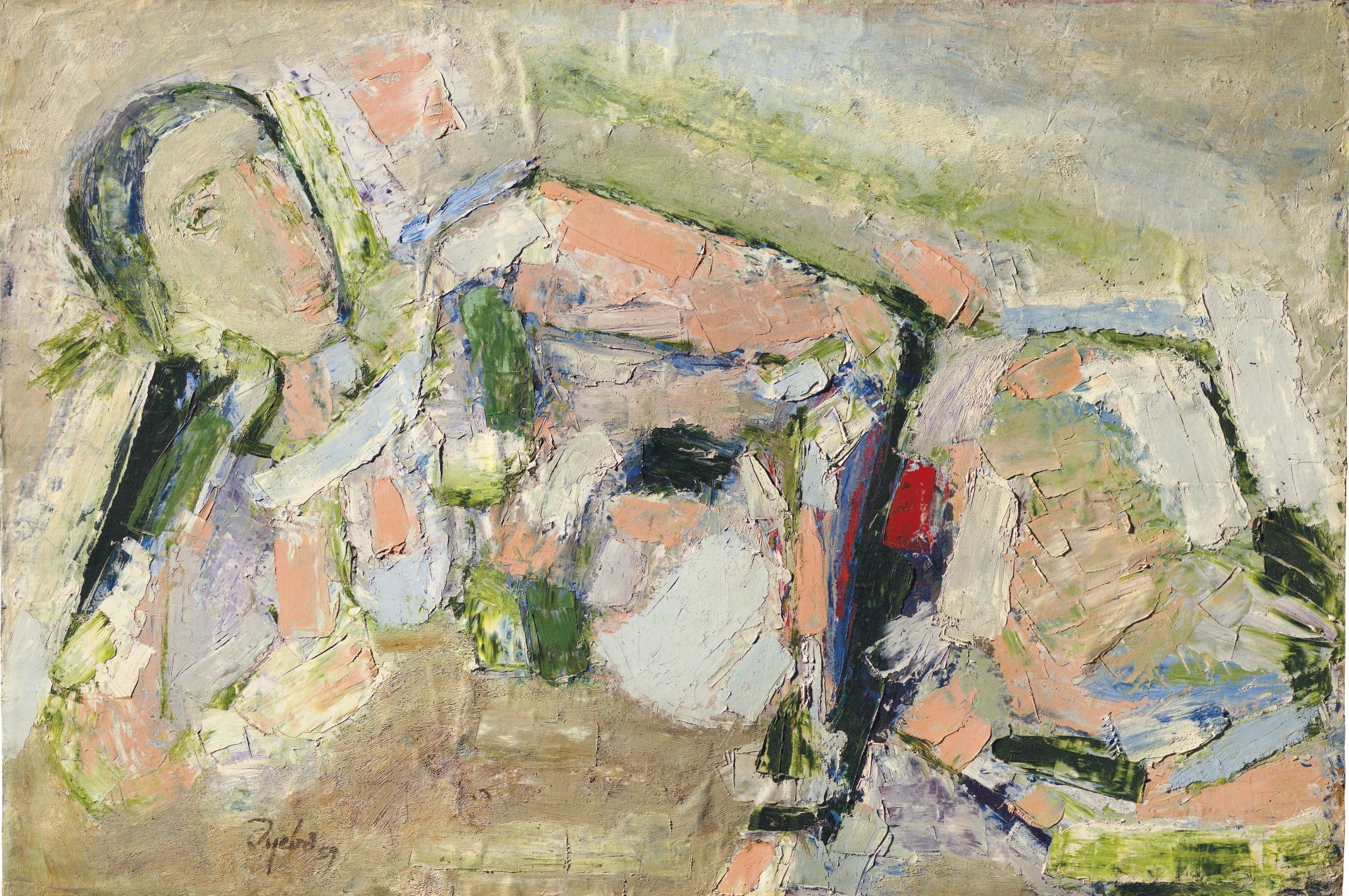
The big surprise was that an attractive and unusual Tyeb reclining nude, which was one of the highlights, failed to sell (photo below). The bidding stopped at $220,000 compared with an estimate of $250,000-$350,000. An oil on board measuring 24x36in, it was smaller than most of Mehta’s works that come to auction.

Sfrnart G R Reddy_HighRes

G. Ravinder Reddy’s painted polyester resin on fibreglass works are always popular in auctions – made in 2008 and 18.5in high, this  sold for $66,811, beating the top estimate, in the Saffronart REDiscovery auction

Christie’s prices fell away sharply after the leading Mehta work. The next highest prices were for Woman at Work, a striking 20x20in oil on canvas by Husain that fetched $300,000 (including premium), well above a top estimate of $180,000, and Frightened Head, a typical Souza 30x20in oil on board (above) that went for $250,000, matching the top estimate.

AstaGuru, which beat all the other auction houses with a $12.7m sale in 2018, had more success with its top sales – six sold at hammer prices above $390,000 led by Landscape, an early 36x23in oil on canvas by Akbar Padamsee, which sold for $589,504 (plus 15% premium). That was followed by one of Raza’s Bindus at $569,999 and a striking Souza, Yellow Buildings, at $538,874.

The next big tests of the market will come in September when Sotheby’s, which first beat the Covid gloom in March with a $4.82m auction, has a live auction in London as well as an “affordables” on line sale.

Saffronart has an auction room-based on-line auction in Mumbai, and Christie’s has an on line auction of the deBoer collection (postponed from March). There is also to be an auction by Mumbai-based Pundole.

It seems that there is no shortage of buyers, providing the auction houses can continue to provide works that meet the demand with attractive estimates. That however is becoming more difficult as top works move into private collections and museums, making sourcing increasingly difficult.

Christie's Tyeb_Mehta_Reclining_Nude

Tyeb Mehta’s Unitled reclining nude that failed to sell at Christie’s   auction when bidding stopped at $220,000


Sticks and stones were weapons in a dangerous escalation

Talks in progress to avoid further conflict between nuclear powers

Troops have been killed for the first time in 45 years during clashes on the undefined Line of Actual Control (LAC) that divides India and China. The confrontation took place  in Ladakh, high in the Himalayas, and led to 20 confirmed deaths of Indian soldiers, and possibly more than 40 Chinese according to unconfirmed reports,

The deaths happened during hand to hand fighting – described by the Indian army as a “violent face-off” – which is not uncommon on the 3,488-km-long LAC. Indian media reports say that the weapons included iron rods, clubs armed with nails, barbed wire and stones (video – click here). There were suggestions that some deaths occurred when troops fell from a narrow ledge into a freezing river at the 16,000 ft high location.

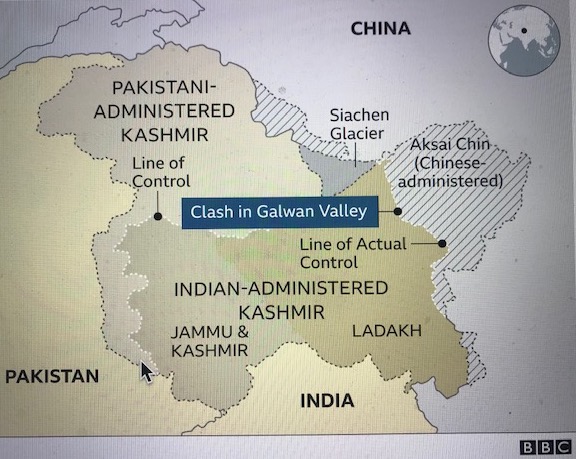
map IMG_9542This was not a war situation between the two nuclear powers, nor were shots fired, but urgent diplomatic and military talks have been held between the two sides in an attempt to avoid further conflict.
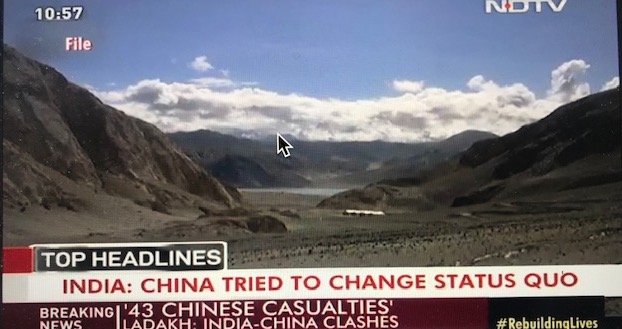
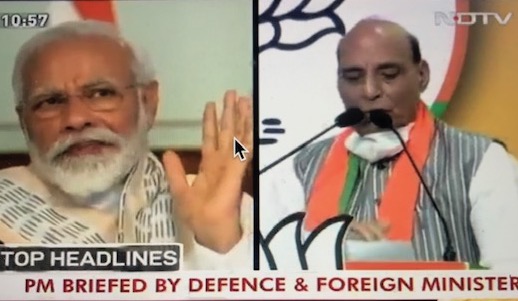
The confrontation graphically illustrates the precarious state of security and international relations on India’s borders, especially at a time when Xi Jinping, China’s internationally ambitious president, is increasing his country’s territorial and other claims.

There are regular firings and deaths on India’s (defined though not permanent) Line of Control (LoC) with Pakistan, but Indian and Chinese politicians and army chiefs have been proud of the fact that no shots have been fired, nor deaths caused, on the 3,488 km LAC since the early 1970s.

It looks as if Monday night’s clashes were not pre-planned at a senior level, though this is not clear. India said there had been “an attempt by the Chinese side to unilaterally change the status quo”. China’s foreign ministry said India had been “provoking and attacking Chinese personnel” after crossing into its territory.

For more than six weeks there has been a stand-off at three locations along the LAC after China established posts in the disputed border area. Both countries moved additional troops to the area and there was hand-to-hand fighting at two locations in Ladakh and Sikkim last month. The main focus has been at the Galwan River where Monday night’s confrontation took place, and at the Pangong Tso glacial lake at 14,000 ft in the Tibetan plateau.The Galwan River was one of the early triggers of the 1962 India-China war, when India was humiliatingly defeated but India has always regarded it as an undisputed section of the LAC.

Military talks, supported by diplomatic contacts, last week led to an agreement that the two sides would disengage from their confrontational positions. India said China had withdrawn from some positions at Galwan.

China has objected to India building roads and air strips in the area, including the Galwan Valley. A Chinese military spokesperson on June 16 claimed “China always owns sovereignty over the Galwan Valley region”. On May 5, Beijing accused the Indian army of trespassing into its territory in its “attempt to unilaterally change the status” of the border in Sikkim and Ladakh.

NDTV valley view IMG_9534

India countered that it was not trespassing, but carrying out routine infrastructure-development activities along its side of the disputed LAC. It blamed China for its aggression in building up bunkers on its side, hindering normal patrolling by Indian troops.

The last serious confrontation between the two countries took place three years ago in June-July 2017 with a 73-day stand-off – the longest ever – at Doklam, a Himalayan plateau in Bhutan at a border tri-junction. Chinese troop movements and road construction on the plateau threatened the security of India’s adjacent narrow Siliguri corridor that connects its north-eastern states with the rest of the country. That prompted India to move its troops onto the plateau to block China’s advance, triggering the stand-off.

Narendra Modi, India’s prime minister, stood firm and eventually after more than two months there was an understanding that enabled both sides to claim an advantage, though nothing was settled and China established a permanent position on the plateau.

Modi and Xi Jinping held an historic summit in April 2018 at Wuhan, made famous this year for starting the COVID-19 pandemic. This was intended to secure a basis for avoiding conflict and was followed by a similar meeting in India last October.

The current potential crisis needs to be seen against the backcloth of increased aggression by China internationally. Nepal, which borders both countries and is increasingly coming under China’s influence, has this week passed legislation that changes its maps and lays claim to land that is part of India.

On a wider front, Xi Jinping has been conducting aggressive policies ranging from a security clampdown on Hong Kong to trade differences with Australia, while also pushing its territorial claims in the South China Sea and over Taiwan.

Modi RajnathSinghIMG_9536

Narendra Modi and defence minister Rajnath Singh

With India, Xi’s aim may be to teach Modi a lesson for growing too close to the US and possibly siding with other countries, including Australia, over setting up an international inquiry on the Wuhan sources of COVID-19.

Relations between the two countries are usually stable providing India does not grow too close to the US and its allies. Modi has tried to strike a balance between increased defence and other co-operation with the US, and stable economic and diplomatic relations with China. He will be even more anxious to do this now when the country is coping with rapidly growing cases of COVID-19 and serious economic problems.

He is struggling with a precarious form of diplomacy, especially at a time when President Trump expects loyalty, not balanced relations, and Xi Jinping does not want a US ally on China’s border.

The deaths on the LAC show how precarious that is.

« Newer Posts - Older Posts »

Categories