Posted by: John Elliott | May 20, 2011

Bhutan’s King Jigme tells parliament he is to marry

THIMPU: There will be another royal wedding later this year to rival the colour and pageantry of Britain’s Prince William and Kate Middleton’s a marriage a few weeks ago.

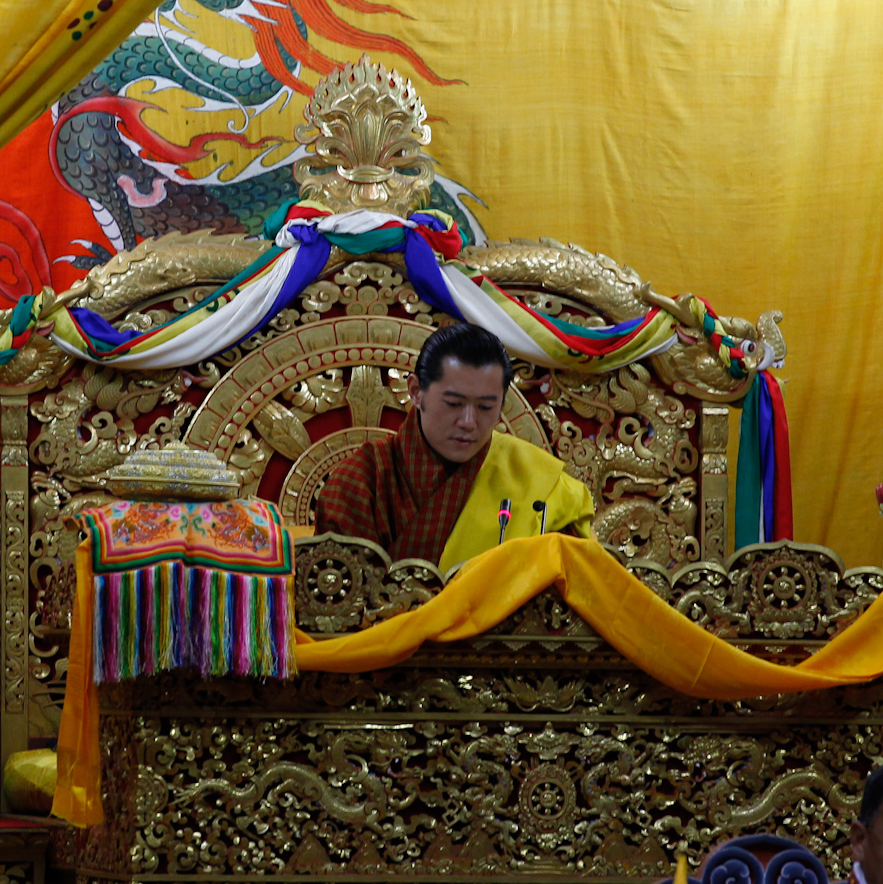
Bhutan’s 31 year-old King Jigme Khesar Namgyel Wangchuck (below) this morning told his country’s parliament that he would be getting married “later this year”.  

.

Like Kate, his wife-to be, Jetsun Pema, is a commoner, the daughter of an airline pilot but with distant royal connections, who was educated in India and the UK as well as Bhutan.

The wedding will take place in October when this tiny remote Himalayan kingdom of just 700,000 people, squeezed between India and China, will celebrate the marriage of a young man who combines the revered status of a monarch with informality, modesty and active concern for his country’s development.

King Jigme – known in Bhutan as K5, the fifth king – is steering his country into a developed democracy which also meets the goals of Gross National Happiness (GNH). The happiness aims – focussing on goals such as good governance and protecting the environment as well as economic growth, was set some 30 years ago by his father – King Jigme Singye Wangchuck – who told me about them in a 1987 interview

The wedding announcement came at the opening of the parliament’s seventh session – parliamentary democracy was only introduced in 2008 when Bhutan took the huge step of moving from an absolute to a constitutional monarchy.

The king, who was crowned in November 2008, arrived in a procession (chibdrel) to the tune of long trumpets or horns. He knelt and kissed the parliament’s floor three times, then ascended his large golden throne. To the accompaniment of deep-throated slow chanting, a welcome ceremony (Zhugdrel Phuensum Tshogpai) was conducted with the members of parliament being given food, drink and token envelopes of money.

The programme said that at 11am “His Majesty the Druk Gyalpo [Dragon King] addresses the Parliament”, adding curiously in brackets: “If it pleases His Majesty to address the Parliament” – a remnant of an absolute monarchy, I imagine, where the King cannot be commanded!

Speaking without notes, the king dealt with issues such a tourism, industry, agriculture and hydro-power, adding that traditional values needed to be strengthened and combined with democracy to protect “our small society”.

.

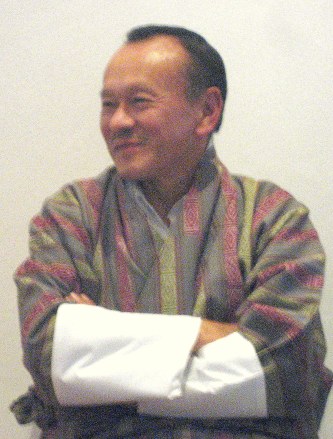
He then had a “small announcement” for the people – it was, he said, “time for me to marry”. He had chosen Jetsun Prema (together left, in an official photo), who was in his eyes “beautiful, humble, kind and compassionate” as well as “warm and kind in heart and character”.

Later he told me that he had felt quite nervous announcing his planned marriage – it was easier to talk about matters of state that such a personal event, he said.

Jetsun Pema was not in the ornate parliament building, but watched the ceremony from her home on television, waiting for her fiancé’s mobile phone call after the deed was done. Later, in the evening, she made her first appearance as her future husband’s fiancée, at a dinner to open Mountain Echoes, an annual India–Bhutan literary festival that starts tomorrow under the patronage of the Queen Mother, Ashi Dorji Wangmo Wangchuck.

The wedding, the king said, should not be a “grand celebration” but would be “simple in keeping with our age old traditions”. He was urged however by Tshering Tobgay, the leader of the parliamentary opposition, to have a large ceremony that could be enjoyed by people from all over the country. William and Kate’s wedding was also billed as being modest and not grand, in keeping with Britain’s economic constraints, but that did not stop it being a spectacular event watched by hundreds of millions of people on television around the world.

King Jigme‘s wedding will not capture the same television audience, but the setting of Bhutan and the elegance of its Buddhist buildings and national costumes and traditions, ensure that it will have grandeur and style, plus the king’s instinctive informality.

Pictures from Royal Office for Media, Bhutan

Posted by: John Elliott | May 13, 2011

Communist defeat and land disputes dominate Indian politics

It’s been a great few days for hyper-activity in Indian politics, but whether it will lead to much improvement in the way that different parts of the country are ungoverned is hard to say.

The headline event of the week was supposed to have been today’s state election results, in which West Bengal’s communist-led Left Front has been decisively ousted from power after 34 continuous years of mostly undistinguished rule. Tamil Nadu’s regional DMK party, which has been using India’s telecom and other ministries as a multi-million dollar ATM machine for much of the past decade, was swept from power, and there were mixed results elsewhere.

.

His jaunt switched public attention from the election results to next year’s assembly polls in Uttar Pradesh (UP), where Noida is located.

Gandhi is staking his as-yet unproven political abilities – after personal setbacks in Bihar assembly elections last year and far from good results today – on restoring the Congress Party’s poor standing in UP. To do that he needs to rival Mayawati, the current Dalit (“untouchable” in the caste system) chief minister, as the champion of the poor and under-privileged.

Together these events have brought Mayawati and two other regional women leaders into the spotlight – all temperamental, controversial and determined.

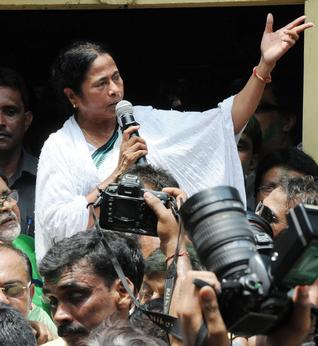
In West Bengal, Mamata Banerjee (above, today), leader of the Trinamool Congress (TMC) that she broke away from the Gandhi’s’ Congress in 1997, achieved the overwhelming victory that was widely expected, winning 227 of the  assembly’s 294 seats and reducing the Left Front from 235 to just 62. Even Buddhadeb Bhattacharjee, the Left Front’s chief minister since 2000, lost his seat along with other key ministers.

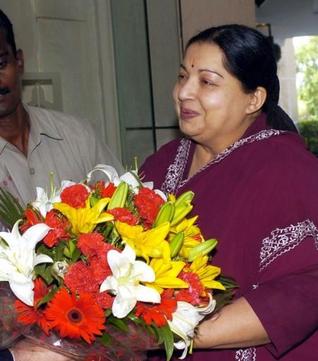
In Tamil Nadu, Jayalalitha Jayaram (below), leader of the regional AIADMK, swept the DMK from power with her biggest ever victory, winning 202 assembly seats against the DMK’s 32. Jayalalitha has had an extravagantly self-indulgent and corrupt reputation when she has been chief minister twice in the past (1991-96 and 2001-06), but she has run effective administrations. She has also not indulged in such extensive nepotism and plundering of the central government coffers as the family and associates of Muthuvel Karunanidhi, the outgoing chief minister, when they have been India’s ministers for telecommunications, environment, shipping and other departments.

.

The events have also underlined the importance of India’s most urgent and inflammatory social and political issue – the use of agricultural land for industrial and other projects. Banerjee built her political platform in West Bengal opposing land being used for a Tata Motors factory at Singur and a chemical complex at Nandigram.

The villagers’ protest that Rahul Gandhi joined is over the price they and others are receiving for land that will be used for private sector townships to be built near new UP highways.

India’s coalition government, presided over by Sonia Gandhi, Rahul’s mother, has been working on new legislation to set down basic land acquisition and compensation rules for projects that are in the national interest. Drafting of two parliamentary bills was however blocked last year by Banerjee, whose TMC is a coalition partner, because some clauses on compulsory land acquisition that ran counter to her stand at Singur and Nandigram. This meant that prime minister Manmohan Singh was not able to fulfil a promise he made earlier last year to Rahul Gandhi that legislation would be introduced in parliament.

.

So while Gandhi was aiming his protest at Mayawati and her UP state government, he was in reality protesting against the failure of the government run by his mother and Manmohan Singh to move ahead with the new laws.

It is also questionable how successful such sudden public appearances are in boosting his political image.  He was shepherded around in Noida by Digvijay Singh, an experienced senior Congress politician (seen together, left).

He did not appear with government ministers the next day when they told the media in Delhi that the shelved land legalisation would be quickly revived. He  can of course take credit for triggering that statement, but a motor bike jaunt and courting arrest are curious ways for a party general secretary (the post he currently holds) to influence his own party’s ministers.

Overall, the Congress Party has not come out well from today’s election results, though as a government it has the advantage of a weakened DMK as a coalitioon partner . It is also back in power after in alliance with Banerjee in West Bengal and she will offer its assembly members posts in her government, but she will demand a consequential greater representation in the national government’s cabinet and will not be an easy partner. In Tamil Nadu, Congress was in alliance with the crushed DMK. In two other states’ elections, an alliance of parties it leads in Kerala won by a far smaller margin than it should have achieved, and only in Assam did it do well. It also suffered a significant defeat in a parliamentary by-election in Andhra Pradesh where it faces a serious split.

The focus will now be on how Banerjee, a populist street fighter with no real administrative experience, runs West Bengal. It is an agriculturally rich state where there has been growth of software and other service industries, but infrastructure and other investment is urgently needed. The rural poor, who have been largely ignored for years by the Left Front,  need development of basic services and an end to violent clashes between the Left and TMC gangs.

“This is a new independence day for West Bengal….it is not for me – it is a mission of the people,” Mamata, as she is generally known, said tonight. Let’s see.

Related post: https://ridingtheelephant.wordpress.com/2011/05/09/west-bengal-hopes-for-a-communist-rout/

Posted by: John Elliott | May 9, 2011

West Bengal expects a Communist rout this week

KOLKATA: A small rural village some 170 kms from here was yesterday a focal point for journalists covering the final stage of regional assembly elections that are expected later this week to end 34 years of often-brutal rule by the Communist-led Left Front government in the state of West Bengal. [MAY 13: See COMMUNIST DEFEAT ] 

.

Four months ago, armed cadres (activists) from the main communist party, the CPI(M), shot and killed nine people during a mass demonstration in the village against young men being taken away to be taught how to handle guns. (Some of the shots were fired from the roof of the local CPI(M) leader’s large house – right.)

The journalists – I was one of them – were there, in Netai village, to check that there was no sign of unrest before polling takes place in the area tomorrow. Paramilitary forces patrolled the roads and nearby densely wooded countryside, known locally as jungle, and the area was tense with little of the noisy electioneering that has been happening elsewhere in West Bengal.

Netai is near Lalgarh, a town in West Midnapoor district that became famous in 2009 when it was occupied by armed Maoist Naxalite rebels. The Naxalites had taken over the area from CPI(M) cadres and were then themselves ousted by security forces.  The Indian government had till then had done little to halt the Naxalite advance, which had spread across a third of India’s remote and forested areas; but it suddenly became concerned that the rebels had conquered a semi-urban area so close to Kolkata.

Since then, there have been repeated armed clashes between the different groups, and with violent gangs belonging to the Trinamool Congress (TMC), West Bengal’s main opposition party that will almost certainly be running the West Bengal government by the end of this week.

The mass demonstration staged by the villagers of Netai against theCPI(M) illustrates how tired the people of the state are of being squeezed between the warring forces. Campaigning for the Congress Party in the state two weeks ago, India’s home minister Palaniappan Chidambaram said the CPI(M) had “encouraged its cadres to acquire arms and spread violence”  and had created a “killing field”.

People are equally tired of the CPI(M)-led Left Front government which, after some pace-making land reforms 30 years ago, has become a cruel self-serving and corrupt administration that ignores the developmental needs of the people.

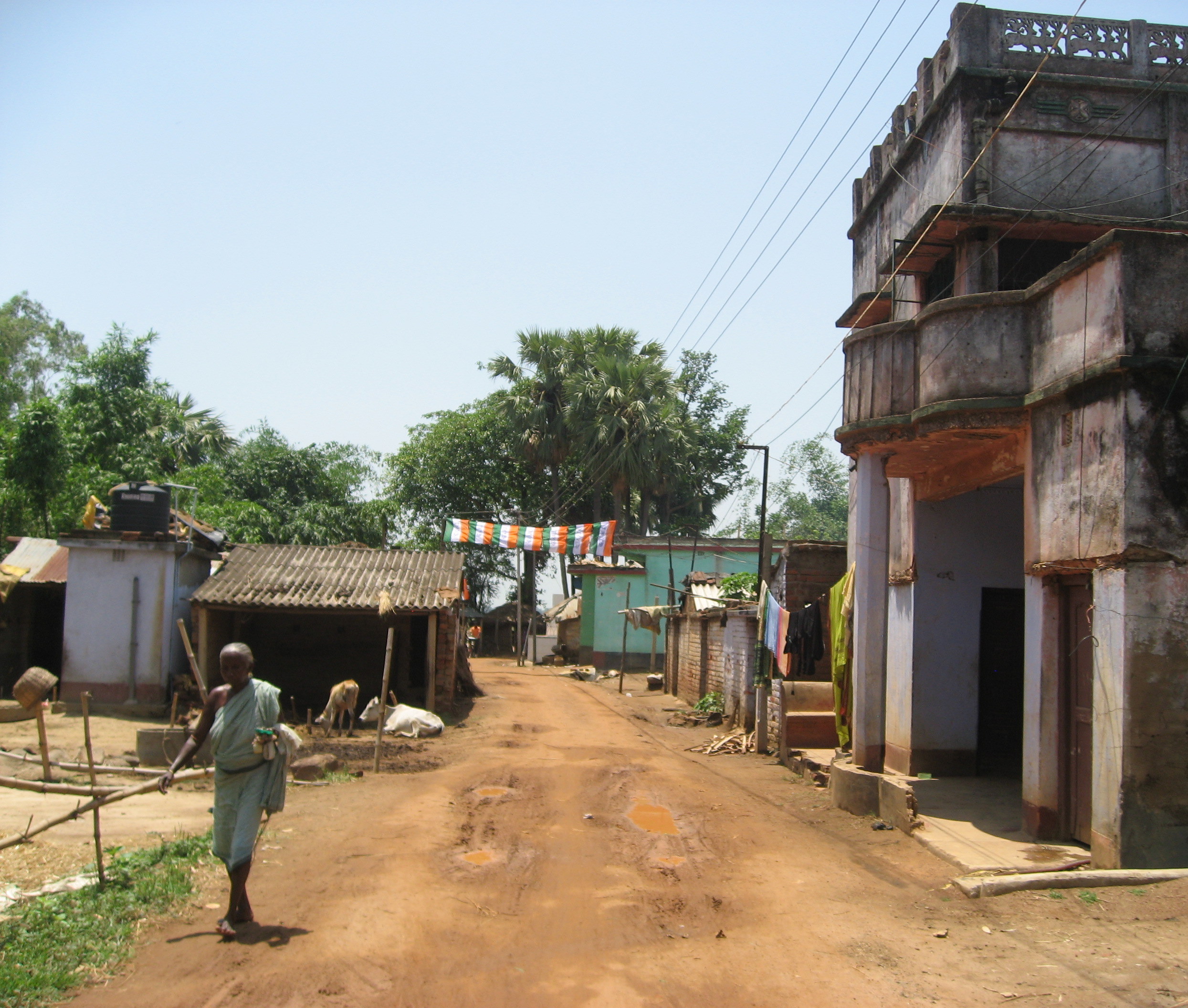
“We want peace and an end to terror,” I was told two years ago when I visited the state during India’s general election. Yesterday, a villager in Netai told me: “We have no proper drinking water, no deep well and the health centre does not function.” The local primary school was inadequate. Netai is in a prosperous multi-crop agricultural area but with a dusty un-made dirt road linking it to Lalgarh and inadequate basic amenities, the people cannot progress.

This is typical of the lack of development in villages across West Bengal. The electorate first showed their opposition to the CPI(M) and its aggressive ballot rigging in India’s 2009 general election when, for the first time in 30 years, they voted heavily for the TMC and the national Congress Party.

.

The election count takes place on Friday May 13, and the Left Front is expected to be routed after high voter turn-outs of over 80%.  The forecast is that it will collapse from 235 seats in the 294-seat assembly to below 100 and possibly to below 70. [May 10: Exit polls published this evening support these forecasts]

That would be a devastating blow for India’s Left, which is also expected to do badly in assembly elections in Kerala, its only other power base.

But no-one I spoke to in West Bengal over the weekend expected much better performance from the TMC, whose fiery leader, Mamata Banerjee (see poster, right, by Netai memorial)is known more for her sharp temper and egotistical control of the party than for being able or willing to focus on basic development issues. She is currently India’s railways minister, a job she has largely ignored because of her focus on West Bengal politics

In 2008, she led opposition to a $35m Tata Motors car plant at Singur near Kolkata,  saying she was saving poor people’s agricultural land being used for industry. That proved a good political slogan which has helped her build up her winning political base, but it did nothing for development and Tata is now making its (not very successful) tiny Nano car in Gujarat. A year earlier, a battle between the Left Front and TMC for control of another area at Nandigram led to a proposed chemicals special economic zone moving elsewhere.

West Bengal urgently needs industrial development to adjust its agricultural-skewed economy so, assuming she wins, Banerjee will need to find a way of sanctioning new industry projects without upsetting the rural poor.

She could do this by deftly providing villages like Netai with the basic amenities they lack, while implementing compensation packages that adequately secure a future for those who have to move to make way for industry.

She won’t find governing easy. To begin with, her supporters are expected to wreak vengeance on CPI(M) cadres for past violence, and some observers forecast a killing spree that Mamata might decide should run its course. Then her policies will be opposed by the CPI(M) politicians and by the many bureaucrats who have enjoyed a lazy lucrative life over the past 30 years.

No-one is forecasting a sudden change for the good after the election results are announced, but at least there will be change – and that for the people of West Bengal is a step forward.

Posted by: John Elliott | April 28, 2011

India takes a NAM-style route on $11bn fighter contract

.

India used to be a proud leader of the old Non-Aligned Movement (NAM), standing notionally between the US and Soviet blocs, but always tilting towards Moscow.

It is therefore both apt and heartening to hear today reports that the government is taking a truly NAM-style route on an $11bn contract for fighter jets by rejecting bids from both America’s Lockheed Martin F-16s and Boeing F-18s and Russia’s MiG-35s.
 
This is a diplomatically brave decision that most observers never expected after India signed its nuclear power deal with the US in 2008. Numerous US officials from President Barack Obama downwards have lobbied hard for the $11bn multi-role combat aircraft (MRCA) contract, indicating that it was expected as a nuclear thank-you. What seemed most likely therefore was that Lockheed or Boeing would be included – even though, as India knows, its supplies are unreliable – until the end of the process. Then the US would not give up until it had driven other bidders out of the contest.
 
The US offerings however did not match up to required standards during flight testing – nor did the MiGs. The F-18 failed tests in the cold and high Himalayas of Ladakh, and the F-16, flown by Pakistan, is long in the tooth. The Griffin fighter from Saab of Sweden has also been rejected.

The contest is now between Typhoon jets (above) from the four-nation EADS Eurofighter consortium (Germany, Spain, UK and Italy) and Rafale from Dassault of France. India’s MoD is believed to have been impressed with the Typhoon, while the IAF has strong links with Dassault, whose Mirage fighters have been successfully in service in India since the early 1980s and are now being upgraded.
 
Rejection of the US companies therefore shows a degree of sophisticated detached decision-making from the Ministry of Defence’s minister, A.K.Antony. Together with his senior acquisition officials, he seems determined to clear a logjam of pending defence contracts, and to do so in a way that shows rare integrity in a country that has become internationally infamous for widespread corruption. The “clean” record of Antony, and of at least some of his top officials, is important because there are bound to be allegations of corruption, especially since there was a scandal in the early 1980s over the Mirage deal.
 
Curiously the US ambassador to India, Timothy Roemer, chose today to announce his resignation – “for personal, professional and family considerations”. That is being widely interpreted as a reaction to the loss of the MRCA contract, as well as the failure of the India-US nuclear deal to generate increased defence co-operation between the two countries, plus nuclear power plant contracts for US companies.
 
However, I am told that Roemer’s resignation has been expected for some weeks because, as a senior Democratic politician, he is returning to the US to work on Obama’s re-election campaign. He has said there are also family reasons (his sons’ education) for his return, but it was surely silly to announce the departure today.
 
Billion $ sops

In any case the defence industry expects sops to be announced for the US very soon, notably a $5bn order for ten Boeing C-17 heavy-lift transport aircraft with an additional order for a further six aircraft, both being placed through the negotiated government-to-government foreign military sales (FMS) route without competitive tenders. Lockheed is also expected to receive further negotiated orders for its C-130J Hercules transport aircraft, six of which are already contracted. Russia might be disappointed that its MiGs have been rejected, but it already has substantial orders for current and future jet fighters.
 
Despite the personal and political angle for his departure, Roemer cannot have helped America’s cause when he was reported recently by WikiLeaks saying the India’s aerospace industry was “two to three decades behind the US and other western countries”, adding that Hindustan Aeronautics (HAL), the government’s aircraft manufacturing company, was “untested and suspect” as a partner for advanced aircraft. All that is true but it must have upset HAL and the defence establishment.
 
However, to come back to my main point, the decisions do show an unexpected independence from US influence that had not been expected when the nuclear deal was struck. It has not been a good year so far for India with all the current corruption scandals, but this indicates that, in international diplomacy, it is keeping the US firmly in its place.

Posted by: John Elliott | April 25, 2011

An Indian Easter – Gods, Qawwals and Gurus

Religion does not often feature on this blog, not with peaceful stories anyway, so it is probably appropriate to be writing about my Easter Sunday that started with an Archbishop of Canterbury tale and continued with news of the death of Sri Satya Sai Baba, 84, India’s most revered guru. It ended with two hours of magical Sufi singing in a Delhi park (below) by a Qawwali group from Pakistan that defied fundamentalist Islam and bound together the peoples of the two neighbouring countries who have more in common than their quarrelsome leaders let on.

The tale stemmed from a six-year old girl writing to God asking him “how did you get invented?”. The letter reached the desk of Archbishop Rowan Williams, head of Britain’s Anglican church, who amazed her family by personally replying with a simple explanation. He said it was a “difficult question” but he thought God might say: “Nobody invented me – but lots of people discovered me and were quite surprised….. Then they invented ideas about me, some of them sensible and some of them not very sensible. From time to time I sent them some hints – especially in the life of Jesus – to help them get closer to what I’m really like”.

Yesterday morning a friend emailed me saying it was nice that the Archbishop could write in simple language! That goes for theologians of most religions, I guess. Gurus have a gift for simple language and often mislead their gullible followers – ranging from the very rich to the very poor – in a country such as India where religion is deeply ingrained in the culture and daily life – a far cry from the nation dominated by unbelievers where the Archbishop reigns. It is indeed easy to be cynical about India’s many saffron-robed “god-men” who often turn out to be self-serving con men that cash in (literally) on the emotional, and sometimes physical, weaknesses of their adoring congregations.

Sai Baba

Sai Baba (below) however was different from most other gurus. He claimed he was more a living god than a mere god-man, being a reincarnation of an earlier revered guru who died in 1918 and preached a humanist creed spanning both Muslim and Hindu religions. From his base at Puttaparthi in south India, he built a worldwide following of 30m devotees and wealth of an astonishing Rs40,000 crore ($8.8bn £5.5bn) – a legacy that is already being fought over by his family and trusts.

His many his philanthropic activities helped him overcome controversies that included allegations of sexual abuse and of misleading followers by performing apparent miracles such as producing holy ash, and gold chains out of the air.

The BBC website summed up the conundrum of his life: “To his devotees, Sai Baba was an avatar, an incarnation of God in human form, who appeared on Earth to preach his inspirational message in one of India’s poorest corners. To his critics, he was a fraudster dogged for years by controversial allegations of sexual abuse yet protected from prosecution by virtue of his powerful political sway.”

But the strength of his appeal was underlined by an Indian friend who told me: “For Hindus, religious figures like this provoke a larger sense of personal trust, faith  and surrender which make life more manageable and bearable”.  Yesterday, Indian television stations had continuous coverage of his life with messages of sorrow and admiration from virtually every politician in India including the prime minister, vice president, and leaders of political parties. Hundreds of thousands of followers are expected at his funeral on Wednesday.

Qawwali

Later yesterday, the strands of my day came together when, in an audience of some 4,000 people, I listened to Bhakti (devotional) music at an open-air concert organised by Seher, a Delhi-based cultural organisation.

The high spot was two hours of Qawwali – a popular form of Muslim music that goes back nearly seven centuries – performed by three famous brothers (Sher Miandad (left), Faiz Fareed Ali Raza and Fakhar-uz-Zaman from the Pakistani province of Punjab.

Sung in a chanting and often raucous style, Qawwali is immensely popular in India and Pakistan. It reflects the Sufi mystical side of Islam and binds the two countries together, though it is shunned by the fundamentalists who are gaining ground in Pakistan.

The songs told how the human soul is greater than the hypocritical lessons of many religious preachers – “When you fly on from this world, no-one will ask your religion or community”. The archbishop and Sai Baba would agree.

Posted by: John Elliott | April 20, 2011

India is at a turning point that might go wrong

Will the groundswell of opinion against rampant corruption and poor governance that has built up across India, particularly among young people in their 20s and 30s ago, prove to be a turning point for the way the country is run?

That groundswell, verging on anger with corrupt politicians and other officials, led to mass protests two weeks ago in support of a hunger strike by veteran social activist Kisan Baburao “Anna” Hazare, and in support of proposed new anti-corruption Lok Pal (ombudsman) legislation.

The government caved in to Hazare’s demands that social activists should help draft the legislation. But government and opposition politicians, who are anxious to undermine his authority and popularity, are now sniping at him and his advisers, and allegations of unethical behaviour on land deals have been thrown at his two top lawyers,  former law minister Shanti Bhushan and his son Prashant.

.

The attacks might prove to be shortsighted because Hazare (left) was simply the symbol of the country’s frustrations – the main demand of the crowds who gathered in cities across the country was for corruption at all levels of daily life to be curbed.

In the almost three decades that I have known this country, there have been two major turning points. One was the new young approach triggered by Rajiv Gandhi when he became prime minister in 1984: he was not immediately successful, but he paved the way for later change. The other was in 1991 when prime minister Narasimha Rao authorised his finance minister Manmohan Singh and commerce minister Palaniappan Chidambaram to unleash and reform the country’s shackled economy.

Those changes made the 2000’s a decade of “yes we can” (to quote Barak Obama’s election mantra), as Indian businessmen and others discovered they could become world-class successes. Sadly, at the same time, politicians, bureaucrats and others realised that their “yes we can” was an ability to escalate graft, fraud and extortion to such an extent that corruption has pervaded every area of society, and bad governance has thrived.

I have often listed recent examples of corruption on this blog, and here are two more from the past few days – through the voices of a former senior bureaucrat and a newspaper editor about corrupt links between government and industry, and the media. 

There’s also been some progress in the law courts where five top executives from telecom companies have been refused bail and sent to jail pending trial of cases in the big 2G licences and spectrum scandal.

In a new book, The Darker Side of Black Money that is being published this week, a former director general of the government’s Economic Intelligence Bureau, B V Kumar, says that most business houses “maintain” MPs to influence government policies or decision making. “Some of the large industrial houses also fund politicians who are in the Opposition as a hedge to ensure that any decision that may be given in their favour is not opposed by them. They also treat such funding as a long term investment”.

This is of course not a surprise to people close to the way that the government and big companies work, but it is remarkable coming from such a retired official. Nor is this next statement surprising, though again it is significant because it comes from Sanjaya Baru, an economist who has been a spokesman and close adviser to prime minister Manmohan Singh and is now editor of the Business Standard daily.

Delivering a memorial lecture on Media, Business and Government in Delhi on April 17, Baru said that there are “growing links between politicians, political parties and the media and entertainment business” nationally and in individual states.

In Tamil Nadu, the ruling DMK party (which is at the centre of the current multi-million dollar telecom scandal) “dominates print, tv and film production and distribution” through companies controlled by the party’s main political family. Baru added that the same had happened with the family of a former Congress Party chief minister in Andhra Pradesh, where the main opposition party also had similar media interests. In Maharashtra, the family of agriculture minister Sharad Pawar had also “acquired substantial stakes in media and entertainment”.

These media and other investments by the regional politicians will of course have been made with money raised through bribes and extortion. The politicians are then protected from criticism about the way they behave in newspaper, tv and other media outlets that they own, and they and their families reap both the financial and political benefits.

Businessmen join protests

Many people I have talked to in the past two weeks believe that such self-serving politicians have to go. How fast that will happen, no one has any idea. Top businessmen, who went without being noticed to Hazare’s Jantar Mantar protest, talk now of maybe going in a group if there is a repeat event some time in the future.

They know of course that Hazare, and the Lok Pal legislation which is aimed at catching corrupt officials, will not be anywhere near sufficient to address something that has eaten into the lives of hundreds of millions of people – including those who joined the recent protests. An article in the current issue of Outlook magazine questions the hypocrisy when corruption is so pervasive. “Do we, the Indian middle class, see the corruption within us?”, it asks, wondering whether the protesting students “want to look closely at how dad can afford to send them to business school abroad?”

So could the Hazare movement trigger a third moment of change in India? The need is certainly there, as it was when Rajiv Gandhi became prime minister and when the 1991 reforms were announced. But such an event needs a leader able to tackle such deeply entrenched social and political habits and attitudes – maybe a high profile leader like Rajiv Gandhi (though he lacked experience), or someone more behind-the-scenes but powerful and adept like Narasimha Rao.

India however has no national politician capable or willing to break the mould and introduce the governmental, legal and attitudinal reforms that are needed.

Manmohan Singh is too hemmed in by his coalition and the dominant role of Sonia Gandhi, leader of the Congress Party and of the coalition, to take the initiative.

.

Sonia Gandhi herself (right, celebrating India’s cricket World Cup win) is not taking a lead and her son, 40-year old Rahul who is widely assumed to be a future prime minister, is showing no signs of wanting to move into an accountable political role. Indeed, he underlined how he likes working in a low-key way as a Congress Party general secretary when he said last week, in reply to provocation from a retired senior judge, that “becoming a hero….is of absolutely no interest to me” – ignoring the point that the country needs a leader not a hero.

So it is Hazare, and not a politician, who has stepped into the role of a catalyst for change. That is upsetting many political leaders and others who are now trying, with public statements and allegations of unethical behaviour, to undermine his popularity and the reputations of the social activists’ Lok Pal Bill drafting team.

Some of the criticisms are understandable, especially concern that India’s democratic system, however faulty, should not be challenged or undermined by unelected unaccountable social activists such as Hazare, several of whose close supporters have their own political agendas and probably see him as a malleable route to power and influence.

But what the tens of thousands of people who staged the protests two weeks ago want is change, not squabbling. There is a chance here for Manmohan Singh to step out of the Gandhi shadow and assert himself as a leader, or for Rahul Gandhi to show he has a true successor to his late father’s reforming zeal. If nothing is done, 2011 might go down in history as the year that politicians failed the country and allowed non-democratic forces to grow.

This hasn’t been the beginning of a Middle East style jasmine revolution, and Tahrir Square has not come to central Delhi, but protests against corruption that spread across more than a dozen cities in India this week showed how people are tiring of the fraud, extortion and crime-ridden politics that dominate the way the country is run.

Anna Hazare (left)

The protests mushroomed over four days in support of a hunger strike by a 73-year old publicity-conscious social activist, Kisan Baburao “Anna” Hazare, who wants to wrest control from the government for drafting Lok Pal (ombudsman) anti-corruption legislation that has been talked about since the 1960s.

[APRIL 9: Hazare ended his fast this morning after the government gave in to his demands by formally notifying creation of the committee drafting the Lok Pal legislation with co-chairmen and equal representation from civil society and politicians. These events have been widely welcomed though there is concern about the Lok Pal’s potentially undemocratic role giving undue power to unaccountable activists that would undermine parliament and the judiciary.]

The basic problem is that politicians and bureaucrats are not seen as being accountable and frighteningly few are seen as being “clean”, while corruption is endemic in the police and has spread alarmingly in the judiciary over the past decade or so.

Last night I heard from bankers and others how young professionals were going after work from their offices to the Jantar Mantar site to add their voices to the complaints, as also happened in other cities. Extensive television coverage, plus messages on Twitter, Facebook and mobile phone texts, have helped to build support and spread information across the country about the cause and protest meetings.

The demonstrators know that corruption goes right to the top of the government and political parties. While no-one accuses prime minister Manmohan Singh of gaining financially from corruption, he has benefited because his acceptance of what is happening in his government means that he remains in his job. Kapil Sibal, the government’s negotiator with Hazare, has been drawn in because, as telecom minister, he recently tried unsuccessfully, for political reasons, to excuse Andimuthu Raja, the disgraced former telecoms minister (pictured below) who led the country’s biggest ever corruption scandal.

Even the Congress Party leadership under Sonia Gandhi, who also heads the governing coalition and appealed unsuccessfully earlier today to Hazare to end his fast, is not exempt. Rumours and gossip are gathering momentum behind the scenes about where bribes paid on last the Commonwealth Games and other major scandals finish up in Delhi, and where that money is then invested.

A Delhi university student displays 'Fathers of corruption'

In a rare and unexpected example of someone almost admitting guilt, Sharad Pawar (pictured left), the veteran agriculture minister and leader of the Maharashtra-based Nationalist Congress Party, resigned this week from a committee on the Lok Pal legislation. He had just been named by Hazare as a politician who “is known for possessing large amounts of land in Maharashtra” – a wordy euphemism that neatly encapsulated years of rumours.

The flow of corruption stories is seemingly never-ending, as are reports suggesting that the government is trying to shield leading politicians in the telecoms and Commonwealth Games scandals.

For several weeks, a series of revelations have shown how unsafe the countries airlines have become because of fraudulent licences given to unqualified pilots. There have been stories about illicit land deals involving Muslim charities and an army golf course, and about Karnataka politicians misusing a student bicycle scheme. WikiLeaks tapes on a 2008 parliamentary vote-buying scandal have embarrassed Singh and the government.

The head of India’s Central Vigilance Commission – appointed inexplicably by Singh – had to resign from his job last month because of old unresolved corruption allegations. Accusations of insider dealing in the US (and other allegations) against Indian-born Rajat Gupta, the former world-wide head of McKinsey who has resigned from several top posts in recent weeks, has added to the image of a society in trouble.

The moment was therefore ripe for Hazare’s protests, which were well timed because the Congress Party is in the middle of assembly elections in five states where voting could be affected by the publicity.

Especially significant has been the involvement of young professionals. The protests came just a few days after young India celebrated the country’s cricket World Cup victory until the early hours last Saturday night  and Sunday morning.

 Those public revels would have been unthinkable for their parents’ generation, such is the change that has swept across India in the past 20 years. But what is clear today is that this is not just a generation that parties, it is also a generation that is impatient with the way that the country is run.

.

By the middle of this afternoon when I visited the main Delhi protest area adjacent to the traditional Jantar Mantar meeting ground, what started as a dedicated anti-corruption movement had developed into a jumble of professional protestors, banner-carrying youth jumping and chanting for cameras, with speeches from the saffron clad gurus, actors, lawyers and others who flock to be seen at such events. Later it swelled into several thousands and spread to India Gate on Delhi’s processional Raj Path. Support also came from leading businessmen assembled at the CII business federation’s annual meeting in Delhi.

A few weeks ago, I argued in this blog that the sort of protests that unseated governments in the Middle East could not do the same in India. I said that, while corruption was a potential issue for such protests, millions of people enjoyed the spoils right down through the system to village level, so it arouses condemnation and protest demonstrations, but not potential revolt.

The demonstrators that I saw this afternoon were not out to expel the government, and many will not even really want to change how it operates. But what is significant is the involvement of young professionals, who do not generally share in the gravy train and who are saying that corruption must end.

 The politicians need to listen, clean up their act and give a lead. The government’s concessions tonight show that they are worried, and vulnerable.

Posted by: John Elliott | April 3, 2011

India celebrates a great World Cup victory

India celebrated in carnival style till the early hours of this morning after its great World Cup victory in Mumbai last night against Sri Lanka – the first time it has won the tournament since 1983.
 

.

Across the country in streets, parks and other open spaces, people danced, sang, chanted and blew trumpets till long past midnight, some watching large television screens and others by small tv sets in poorer areas.

India and Sri Lanka were widely regarded as evenly matched before the game began. Sri Lanka batted first and scored an unexpectedly high total 274 runs for six wickets in its 50 overs, setting a difficult target for India that began badly.

India lost one wicket before any runs were scored and its star player, Sachin Tendulkar (below), was quickly out for just 18 runs, which meant he could not go for his 100th century. But steady scoring by two other players, Gautam Gambhir and captain Mahendra Singh Dhoni, gradually built up the 275 with six wickets in hand.

.

The celebrations far exceeded those last Wednesday night after India beat Pakistan. Those lasted for an hour or so, but last night in Delhi, where roads in the centre of the city were clogged, revellers were still partying after 3am, as they were elsewhere in the country.

That put the India-Pakistan rivalry and victory in context – beating its neighbour was an essential and important step for India, but only a step towards last night’s world victory.

See also:   India beats Pakistan at cricket but unites for peace talks   http://wp.me/pieST-1hh March 31 ’11

Posted by: John Elliott | March 31, 2011

India beats Pakistan at cricket but unites for peace talks

India captain Mahendra Singh Dhoni celebrates with Yuvraj Singh

India is noisily celebrating its victory an hour or two ago over Pakistan in the semi finals of the cricket World Cup.

As soon as the match finished last night (March 30), the sky around my central Delhi flat was full of flashes and blasts from fireworks and young people began driving around cheering on motor bikes. Others danced in the streets, and children came out with their own firecrackers. The same has happened across the country which had spent the afternoon and evening glued to television screens.

To win any cricket match in India is important, especially a tournament’s semi-final, but to beat Pakistan is enormous for this country,  just as a reverse result would have been for Pakistan.

It was the India’s fifth consecutive World Cup win against Pakistan. Each such match combines the toxic mixture of rivalry and relationships which both divide and unite these two neighbours that have fought three wars and one serious border battle since independence. But unlike the decades of sometime violent rivalry between for example England and Germany over football, the cricket rivalry between India and Pakistan can have positive results, as has happened here.

There are two main winners from the day’s cricket – in addition to India which won when Pakistan was 231 runs all out, failing to beat India’s 260 for nine. India now goes on to the final against Sri Lanka on Saturday.

One winner is Manmohan Singh, the Indian prime minister, who invited Pakistani prime minister Yousaf Raza Gilani to the match.

The other is the relationship between India-Pakistan, which has been fractured and bitter since a deadly attack on Mumbai in November 2008 that was blamed on terrorists who travelled from Pakistan.

Manmohan Singh desperately needed this fillip after months of declining fortunes when his inability to lead his shockingly corrupt coalition government has done serious damage to his reputation and, maybe, his authority.

He is not however by any means totally to blame, and has been unfairly criticised by the world’s media, firstly because he is the prisoner of the pulls and pushes of greedy coalition government partners. Secondly, it is Sonia Gandhi, leader of the Congress Party and of the coalition, who ultimately calls the policy shots but keeps herself carefully out of the political firing line so does not share the accountability or blame.

.

In foreign affairs however, the prime minister can sometimes strike out on his own, as he did with the 2008 India-US nuclear deal, and as he has done before on relations with Pakistan.

After India’s win in the World Cup quarter-finals last Friday against Australia, he personally decided to invite Gilani to today’s match in Mohali, just 200 kms from the Pakistan border in the Indian state of Punjab.

The invitation triggered saturation coverage on tv and in newspapers of the diplomatic and sporting pros and cons of the move. There was some criticism of the initiative on both sides of the border. India’s Bharatiya Janata Party was against formal talks until Pakistan took more positive action against those accused of involvement in the 2008 Mumbai attacks. L.K.Advani, the veteran BJP leader, said Gilani was welcome for the cricket but not much more.

Opposition was reported from one or two top Congress leaders, but that was apparently silenced when Sonia Gandhi let it be known she would attend the match and meet the Pakistani prime minister. Coincidentally, there were two days of constructive talks between the two countries’ home ministries in Delhi just before the match.

Nirupama Rao, India’s foreign secretary, said after the talks and a dinner hosted at the cricket ground (above) by Manmohan Singh, that the day of sportsmanship had “set a good trend”, and Gilani had invited the Indian prime minister to visit Pakistan.

Her smiles at a press conference said almost more than her words about what seems to have been a relaxed mood at the dinner and the talks between the two prime ministers. The signature of the event, she said, was about “peace, reconciliation and healing wounds”.

India won the World Cup on Saturday night April 2 – see India celebrates a great World Cup victory http://wp.me/pieST-1hM

Posted by: John Elliott | March 27, 2011

Gates and Buffett show rich Indians how to help the poor

It’s easy to be cynical about people like Bill Gates and Warren Buffett doling out millions and even billions of dollars to poor and needy communities world-wide, having made their fortunes working the world markets – one in information technology and the other in finance. It’s also easy to be cynical about Indian businessmen lining up, as they have done in these past few days, at the Gates’ and Buffett’s beckoning, to consider doling out some of their sometimes ill-gotten gains for good works.

Gates and his wife Melinda have been in India this past week, along with Buffett who amazingly was visiting for the first time. They toured health projects (below) that they are funding in Bihar, India’s poorest state which has very high maternal mortality rates, and then met about 70 top industrialists from family companies to advocate philanthropy and discuss the sort of “giving pledges” that they encourage in the US.

.

The founder of Microsoft, and the world’s second richest man, Gates has set up the $37bn Bill and Melinda Gates Foundation with his wife to focus primarily on health care and on other development issues such as education. Buffett, 80, the third richest and probably the world’s most famous financial investor through his $200bn Berkshire Hathaway group, pledged in 2006 to give 99% of his shares and wealth to charitable causes. Much of that has gone to the Gates Foundation. Out of $17.5bn donations that the foundation has made so far, $1.25bn has come to India with $800m going to Bihar.

Apart from Tata, India’s biggest group, which is majority-owned by charitable trusts, and one or two other smaller examples, India’s wealthy old-style business families have traditionally built prestigious temples and sometimes schools, often in their home towns, but little else.

The new mega-rich, who have emerged in information technology, real estate and elsewhere since the economy opened up 20 years ago, have not yet grasped the idea of giving outside their own geographical areas or business sectors, though some have made high profile donations to their universities (notably Harvard and Yale). Several talk about wanting to create wealth first for themselves and their families. The mostsignificant exception is Azim Premji of the Wipro IT group, who in 2010 made a $2bn donation for education and social projects that possibly reflected the charitable traditions of his Ismaili Muslim faith.

In addition to Premji, the 70 industrialists at the Gates-Buffett meeting included the heads of top family-controlled businesses such as the suddenly-rich and amazingly-expanding GMR airport and infrastructure company that announced Rs1,540 crore ($340m) a few days ago for an in-house charity, real estate developer DLF, Bajaj (two wheelers), Godrej (diversified manufacturing), Bharat Forge (engineering), HCL (software), and Dabur (pharmaceuticals).

Bill and Melinda Gates with Azim Premji (centre left) and Warren Buffett in Delhi

This has started a new debate. Ajay Piramal, who runs a large pharmaceuticals group, thought the event set an example and encouraged discussion. “People are looking for role models,” he said in Mumbai’s DNA newspaper. “Now I’ve started talking about the [charitable] work we do, which I haven’t really done earlier”.

Most important in all this, I guess, is the motivation of the ‘givers’, and how effectively their money is used. I’ve heard how the Gates Foundation reflects its huge wealth by being top heavy, over-staffed, bureaucratic and dominated by its US-headquarters, and by paying US-level salaries that disturb developing countries’ pay structures.

There are even allegations, partly stemming from advocacy of genetically modified seeds, that the Gates have wider business oriented motives – “Monsanto in Gates clothing” as a US lobbyist puts it. Critics say the foundation has been unsympathetic to local problems, such as overcoming the rural poor’s instinctive resistance to vaccines, assuming that they react to philanthropic funds in the same ordered way that big companies react to investment. Much of that was certainly true when the Gates couple began their work 12-15 years ago, and some is still valid as the ranks of support staff have shown this week.

But on Tuesday afternoon I listened to Melinda Gates, first in a rural health seminar and then in a ten-minute one-on-one interview, and I came away with my scepticism giving way to a realisation that she and her husband really are helping to stimulate change in India and elsewhere. I asked her about head office domination, and she demurely replied that “Bill and I do make all the decisions,” but added “we are taking a lot more input than we used to”. I think that meant listening more and delegating some authority – the India office is to include health experts as well as policy and administrative staff.

I asked how, given their world-wide focus, they choose where to go with funds, and what to do – and why they came to in India with its buoyant economy, 8-9% growth and massive corruption.

India was an obvious place I was told because half the 1.2bn population is extremely poor, because of a crying need for better health care, and because of technological expertise in producing low cost health products such as vaccines. The aim, working with government agencies and other organisations, is to “do things that society has a hard time doing” and acting as a “catalytic wedge where governments can’t or won’t experiment”.

Asking for an example, I was surprised by the simple answer: “You won’t see a government trying for 18 months to teach women not to let their babies get cold”, which the foundation has done. That is the beginning of the focus on “everyone’s right to a healthy and full life”; helping babies in the poorest areas survive the first 30 days of their life by being warm – and vaccinated.

The foundation began in India with a $338m HIV prevention campaign, which is now being handed over to the government having achieved some success with a decrease in the rates of sexually transmitted diseases among those most at risk. There has also been work on polio eradication that has contributed to a dramatic drop in new cases, and there are plans for a diarrhoea oral vaccine for children. In Bihar, the foundation has been particularly successful because of co-operation from the state government, which in the past six years has been turning round decades of economic and social decline. The target is to cut mortality rates for mothers and children under five by 40% by 2014.

One has to respect the Gates for devoting this part of their lives to making life better for the world’s poorest and most deprived. It does not cost them anything of course because, as Buffett said, handing over largesse “has not changed my life in any shape or form“ – he was “giving away something that has no value to me but has value to other people”. Also, Berkshire Hathaway did not lose anything either when his shares were transferred to charitable foundations.

Buffett also had an instant answer when asked about the ethics of India’s hordes of black money being given to charities: “A child receiving a vaccine is not going to question the source of the money”. Premji whimsically thought that some people “might want to give away unofficial money”.

Whatever the source, the poor are definitely benefiting, and the Gates’s-Buffett combine is driving change in places like Bihar as well as Africa and elsewhere. Let’s hope the Indian businessmen who have enjoyed parading in their philanthropic shadow this week ensure their money reaches places that need it.

« Newer Posts - Older Posts »

Categories