Hidden away in the timid and inconclusive but mildly populist annual Budget speech that Pranab Mukherjee, India’s finance minister, delivered on Monday, were a few tiny sops for the country’s blighted environment. Just Rs 600 crores ($130m) was allocated for clean energy and cleaning rivers, and there were some customs duty cuts for solar lanterns and for “laundry soaps which conserve water and are gentle on the soil”.
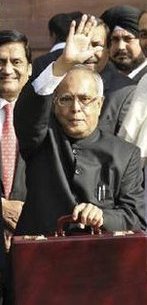
In a caring tone, but with words and a focus that smacked of the early 1980s when he was first finance minister, Mukherjee (left), 75, added: “The solar lantern enables our countrymen in far-flung villages to partake of developments in green technology”.
The thoughts matched the emphasis of the speech on boosting agriculture and improving the food supply chain with a Rs14,700 crore ($3.3bn) allocation, but they displayed a time warp that ignored all that has happened – much good and some bad – in the 20 years since India’s economic reforms of July 1991. The speech failed to tackle primary post-reforms problems of galloping corruption and appalling governance, both issues that are at the centre of major scandals and controversies.
A braver more inspired finance minister than Mukherjee could have said:
“We are approaching the 20th anniversary (on July 24) of the momentous opening up of India’s economy. In the past 20 years, India has come a long way……but we have left half our population under-fed, under-educated and with poor health care, and we have become a corrupt and badly run country, which is causing concern among investors. We must mark the anniversary with a new approach to these social issues, and I intend to today to map out a series of legislative and other changes that will be as significant as those of July 1991.”
Then, he could have added: “Corruption and mal-administration has done our environment much harm and I salute today my young (56) colleague Jairam Ramesh, the minister for environment and forests, who is doing more than most in the battle for the future of India. He is trying to bring order, stable policies, and clean government to this vital area, which is a lesson for us all in what needs to be done in many areas of government.”
Mukherjee of course did not say that, nor could he. He is the government’s most important, skilful and risk-averse politician, which stops him making big statements that might rumble into controversy. More importantly, no-one in the government dares speak up for Ramesh because he has trodden on so many powerful toes, as I wrote in an earlier article when I voted him India’s most significant ministerial achiever in 2010.
Changing government
I explained how he has tried to impose clean and effective policies and how this has upset many powerful environmental spoilers, both politicians and businessmen. Ramesh’s success – and his problem – is that he has been actually changing how the government works, whereas Mukherjee mostly tiptoed around ideas and committees and possible future changes.
I am returning to Ramesh here because, since I wrote that piece in January, he has been blamed for spoiling India as an investment destination by creating uncertainty here and abroad about project approvals.
He has cancelled or questioned environmental approvals for steel works planned in Orissa by Posco of Korea and a politically influential branch of India’s Jindal business family, an aluminium works run by Indian-controlled Vedanta of London, a multi-storey block of flats called Adarsh in Mumbai built for top army officers and other public officials under a recently exposed corrupt and environmentally-unauthorised deal, and a partially built “hill station” (a romantic euphemism for lucrative urbanisation of rolling hills) called Lavasa in Maharashtra that, he says, had no environmental approvals.
Critics rounded on him, trying to rein him in, and starting a phoney economic debate about whether economic growth or protecting the environment was more important. They included Montek Singh Ahluwalia, the country’s top economics bureaucrat who runs the Planning Commission. Ironically, Ahluwalia has worked with Ramesh in promoting economic reforms since the 1980s.
Even India’s august central bank, the Reserve Bank of India, appeared to condone reports that a major reason for a decline in foreign direct investment (FDI) inflows was “environment sensitive policies……in the mining sector, integrated township projects and construction of ports”.
The RBI later explained that it was only quoting what was being said in the commercial capital of Mumbai, allegedly by people linked with institutional investors but more probably those involved in Lavasa and the other projects. The RBI said it would now do some concentrated research on why FDI had declined. That the RBI should have uncharacteristically entered the fray shows the fear that Ramesh has struck among top companies, even though all he is doing is implementing environmental regulations that have been in force for years.
“It is time for India to make some tough choices,” Ramesh said recently at Delhi’s Foreign Correspondents’ Club (FCC). “We can’t pollute our way to prosperity. We have to find a way that is ecologically sustainable. In 1991, the focus was on fiscal stability. 20 years later it is ecological sustainability, so we face tough political choices”.
India story unravelling
It is true that India’s performance is wobbling. “Foreign institutional investors do fear the India story is beginning to unravel, asking if we are losing control of the process,” a senior government official told me. Although economic growth is still around an internationally high figure of 8-9%, industrial growth slowed at the end of last year and FDI inflows fell more than 30% in 2010 to $24bn.
“If foreign investors see local companies having problems (with the environment regulations), then they stay away,” said another official, arguing that Ramesh was affecting investment. But that is surely wrong, as has been proved by BP’s recent $7bn-plus natural gas deal with Reliance Industries.
Of course, the FDI inflows would have been bigger if Posco had started its $12bn steelworks (though it does not have any iron ore mining rights for the project). Ramesh however has not been at work for long enough to affect inflows significantly. What he has done however is to expose how the rule of law, usually said to be one of India’s investment strengths, is frequently undermined by companies, government officials and politicians in India.
Foreign investors’ real worry is the current series of corruption scandals that are hitting the Indian media seemingly every day, and making them wonder if the Indian system is coming apart. These scandals cover army generals, senior judges including even a former chief justice, and sport as well as business and, most recently, the chairman of a government-owned aluminium company (NALCO) accepting $500,000 bribes in gold bars.
World Cup chaos
Bad governance – and repetitive failings that could be avoided – are also making India look unreliable. To take a simple example, look at the chaos over the organisation of the Commonwealth Games last November with late (as well as corrupt) projects and chaotic ticketing and other arrangements. That has now been repeated on the current cricket World Cup, with Kolkata’s famous Eden Gardens cricket stadium not being ready in time and chaotic ticketing arrangements for matches in Bangalore that led to police viciously beating angry crowds.
Ramesh is undoubtedly enjoying the fuss he has caused. For 20 years, he has been a sometimes controversially outspoken figure on India’s economic reforms scene and was, until five years ago, always an economic adviser and never a minister. In his current job, which he has held since the 2009 general election, he has had a chance to make a significant difference, not only to domestic environmental policy where he has also tried to rescue wildlife conservation from the grip of corrupt officials and traders. He has also transformed India’s approach to international climate change negotiations, co-operating as he proudly says with both the US and China to make sure India plays a role in finding a solution.
He has had to strike some high profile compromises on most of the controversial projects mentioned above, and this has cast doubt on whether he is in fact making the major changes to environmental protection that he claims. Answering that allegation, he says he has laid down strict conditions on all the projects. “All I am doing is implementing the laws of the land and looking afresh at old regulations that need changing,” he said at the FCC.
And he is still a success, despite the compromises. Biswajit Mohanty, who runs the Orissa-based Wildlife Society of Orissa and rarely praises governments, is outspoken in his praise .
“He is the best environment minister we have ever had, and probably the best we will ever have,” he says.
Who else in the government deserves such an accolade for trying to push through change? Not many, and certainly not Mukherjee in his time warp.

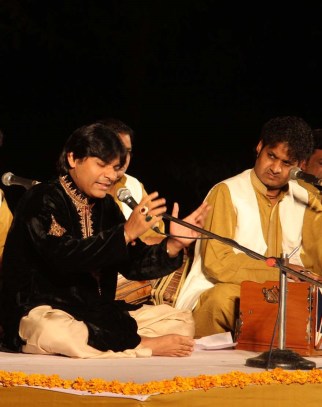 The high spot was two hours of Qawwali – a popular form of Muslim music that goes back nearly seven centuries – performed by three famous brothers (Sher Miandad (left), Faiz Fareed Ali Raza and Fakhar-uz-Zaman from the Pakistani province of Punjab.


 Riding the Elephant
Hi everyone – Riding the Elephant has just passed a total of two thousand centuries, to put it in World Cup terminology – that’s 200,000 hits since I took it over from Fortune.com in August 2008 . It hit that score on Tuesday night when I was putting up my post on David Cameron’s diplomatic gaffes, and is now over 200,700 – the current total is in the column on the right.
So thanks to all of you who have joined the growing list of readers in the past year – including quite a few from The Independent (UK-based) newspaper bloggery, where shortened versions of my pieces now appear at the same time as they go up here. Earlier, some posts appeared on FT.com’s India page.
Thanks also to those of you who followed me here from Fortune.com in 2008, and to everyone else who has piled in to read the total since then of nearly 250 (this is the 249th) posts or articles.
It took a year after August ’08 to clock up the first 50,000 hits (or views as they are called in the blog world), but just seven months till February last year to double that figure, and just over another year to double it again.
Average views have gone from about 60 a day in August 2008 to over 200 a year ago and nearly 300 a day in the past three months.
The busiest single day, with 764 hits, was December 8 last year just after I had written a piece headlined Radia tapes highlight media flaws that fit with modern India on the country’s mini-Wikileaks scandal that was uncovering power links between businessmen, politicians, lobbyists and journalists, all merging their ambitions and motives behind the scenes. The Economist magazine ran a piece that included a link to my post and that brought in floods of readers.
The bulk of the hits – about 27,500 in the past year and 62,000 since 2008 – come to the home page . After that, the statistics show how some posts keep pulling in viewers ages after they were written and it’s not always the most serious posts that generate the most attention – a mischievous headline can always help.
Heading the list since 2008 with over 9,000 hits (see table below), is a promotional piece on an anthology of foreign correspondents’ articles that I co-edited and Penguin India published three years ago to coincide with the Delhi-based Foreign Correspondents’ Club’s 50th anniversary.
Next, with over 5,000 views, is a piece on Jawaharlal Nehru period photographs. Readers are presumably partly pulled in by the headline – Nehru was lost for years in a trunk, which wasn’t of course quite true – find out why by clicking below.
Top hits since 2008 – (click on the titles to read the pieces)
Top hits for the past 365 days include most of those above plus more topical subjects (listed below) that reflect interest in India’s on-going corruption scandals and controversial big companies, as well as the modern Indian art market that I write about occasionally.
So keep coming back……lots more to write about – je
Share this:
5 Comments
Posted in Contemporary art, India, India corruption, India politicians | Tags: “Foreign Correspondent”, Commonwealth Games, David Cameron diplomatic gaffes, India, India analysis, India blogs, India comment, India current affairs, IPL scandal, Jawaharlal Nehru period photographs, John Elliott in India, modern Indian art, Nehru was lost for years in a trunk, Radia tapes, Riding the Elephant, S.H.Raza, South Asia blogs