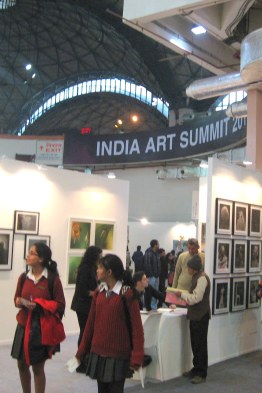
It’s a great weekend for the arts with a big Art Summit in Delhi and a Literature Festival in Jaipur. Both events are expecting to pull in crowds of 60,000 to 70,000 between today and when they close – the Art Summit on Sunday and the Jaipur festival next Tuesday.

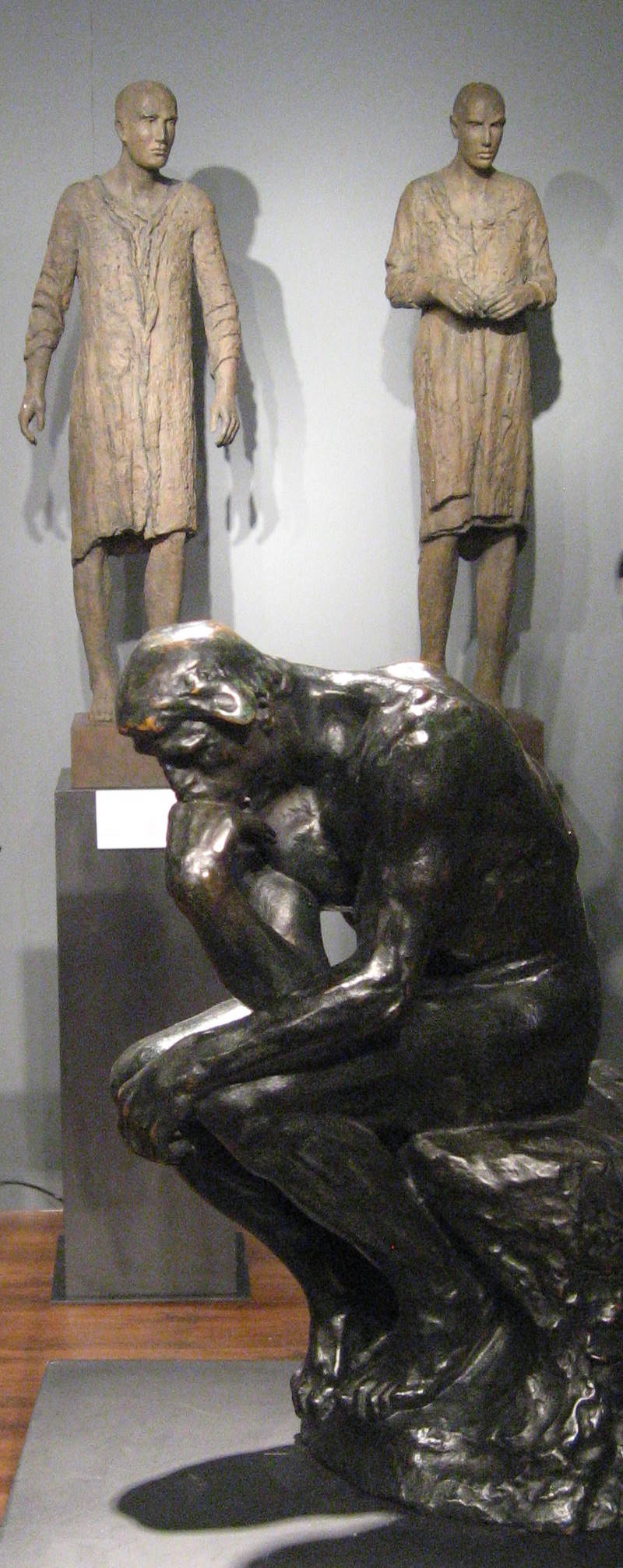
Rodin’s $1.17m ‘The Thinker’ + Henneke Beaumont $60,000 figures

The Art Summit has had a tremendous first two days, with most of India’s leading collectors mingling with people from international galleries and auction houses and hundreds of local art buffs. Many of the 85 Indian and foreign galleries reported substantial sales. It is therefore clear that the Summit has put Delhi on the international map as a centre for international as well as Indian modern and contemporary art, with foreign galleries bringing masters such as Pablo Picasso and Auguste Rodin (right, on Robert Bowman Sculpture stand) and contemporary artist Damien Hirst to attract publicity and tempt India’s richest collectors.

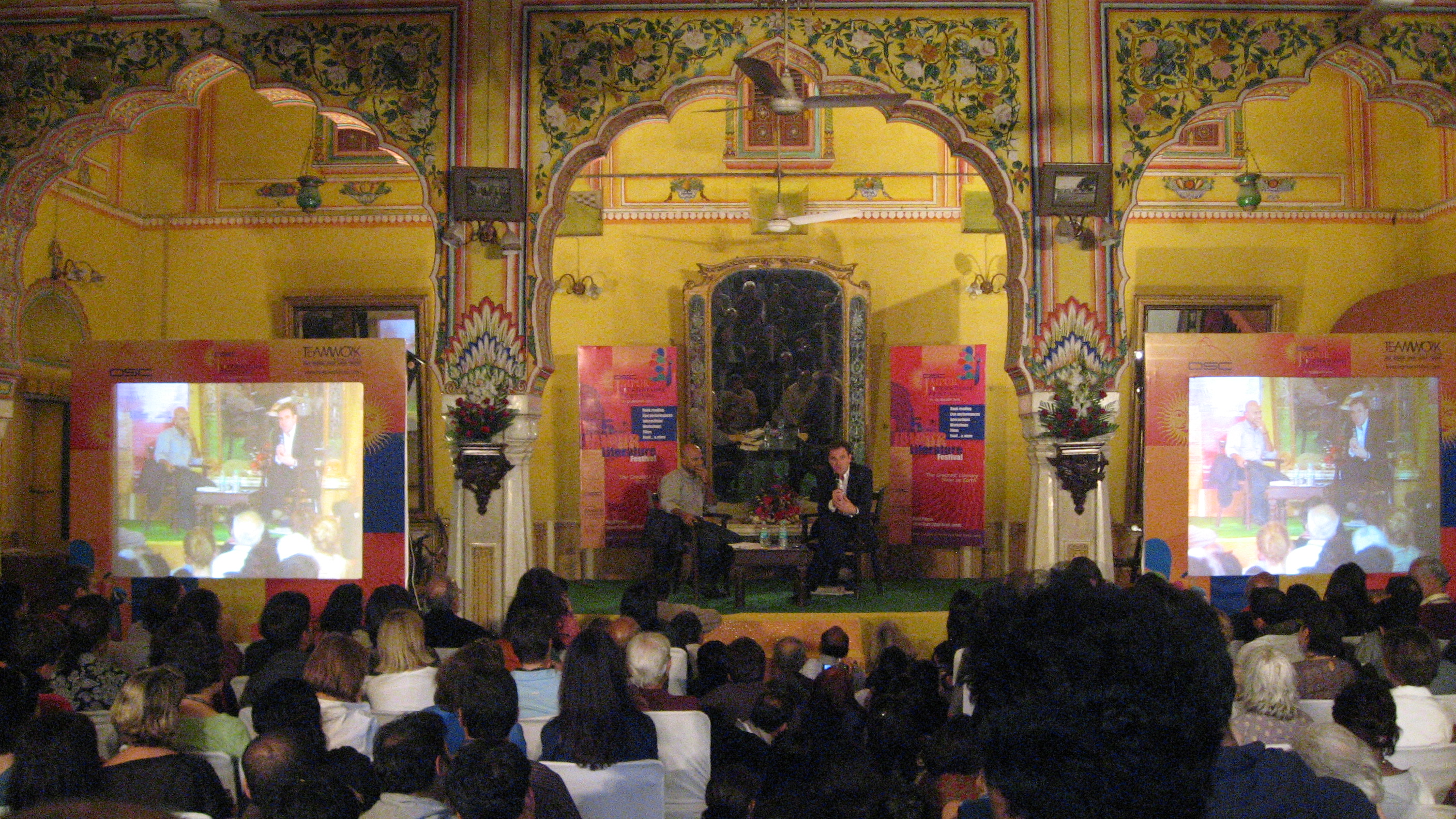
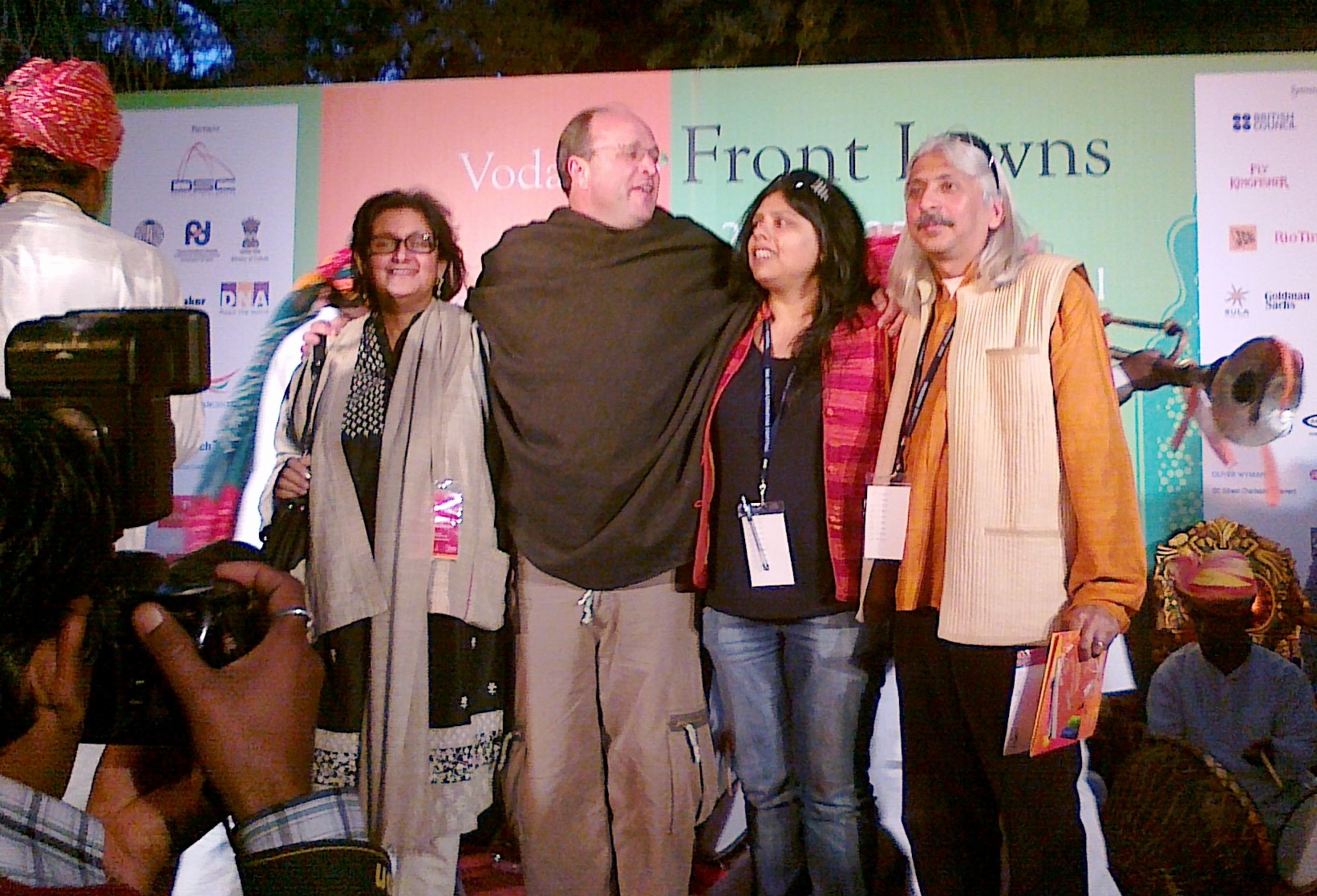
The Jaipur festival, which opened this morning, was originally conceived as an Indian celebration of local language as well as Indian English writing, but it now brings in top leading international authors – this time they include Nobel prize winners Orhan Pamuk from Turkey and John Maxwell Coetze from South Africa. Foreign visitors include literature festival organisers from Edinburgh, Berlin, Australia, Poland and elsewhere, as well as countless publishers and literary agents. I’ll be there on Monday to moderate a session on Branding India, so more from Jaipur then.

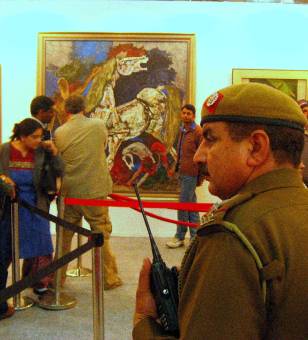
The especially good news at the Art Summit is that works by 95-year old M.F.Husain, India’s leading living modern painter, are on display for the first time for several years in a major public show. Three of his works were withdrawn this morning after right wing Hindu fanatics continued their campaign against the artist because of his depiction of Hindu deities. At least one gallery, and the summit organisers, had threatening phone calls and messages yesterday, so the organisers decided that to avoid the risk of trouble, despite a heavy police presence. Senior government and other officials were consulted during the day and the works were going back on display this evening, demonstrating what Jawhar Sircar, the government’s secretary for culture, described as India’s freedom of expression being supported by its “strength of pluralism and elasticity”.

Anish Kapoor explains….

The best point about both these art and literature events is that they both attract people who would not usually have access to top art works, or to meet and listen to leading artists and literary figures. At the Art Summit, they include Anish Kapoor, the sculptor, who will speak at a summit session tomorrow, and this morning took visitors round an exhibition of his works at the National Gallery of Modern Art –  explaining (right) that “red is my favourite colour”.

The access point is especially significant for the Art Summit (it should be called an Art Fair) which is being held for the third time in the fading concrete jungle of Delhi’s Pragati Maidan exhibition grounds. Many Delhi residents, who would be nervous going into an art gallery, feel comfortable at Pragati Maidan because they are used to going there for trade, book and autos fairs.

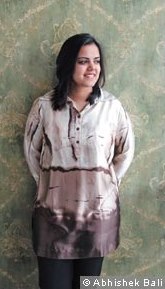
Neha Kirpal – FT photo by Abhishek Bali

Neha Kirpal, a 30-year old pr executive (left) who conceived the Art Summit three years ago and now directs it, reckons that 40% of the Rs26 crore($5.4m, £3.3m).sales at the last event (in August 2009) went to first time buyers. There were over 40,000 visitors. This time prices of works by 570 artists shown by 84 galleries from 20 countries range from Rs20,000 ($440) to Rs7 or 8 crore (about $1.5m).

That confounds critics who suggest the Summit has become a champagne-bubbly event for the rich and elite. There are of course fringe events at galleries all round Delhi, which are mostly accessible by invitation and where champagne does flow.

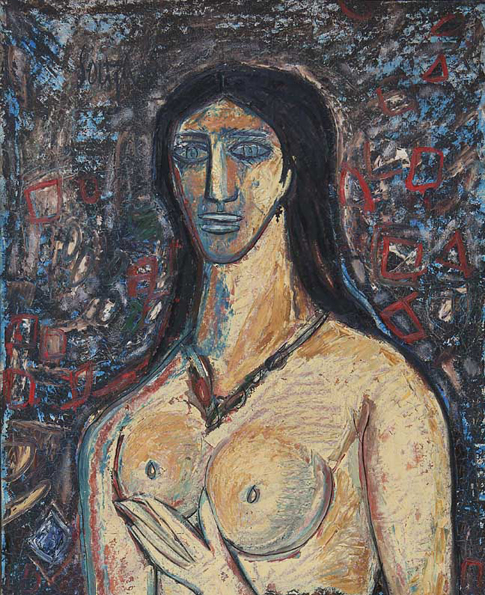
The best so far was the opening three evenings ago of the refurbished Delhi Art Gallery in Hauz Khas, with an amazing exhibition of more than 250 works by the veteran Progressive artists’ group that includes names such as Husain, F.N.Souza and Hari Ambadas Gade. The gallery has published a big book of the works (below) and the show is on until March 8 and is an essential visit to see how modern Indian art has evolved since independence.

The Progressives are a recurring theme around the fringe events, reflecting the fact that India’s modernist painters are the safest buy at a time when the market is still recovering from the economic slump of two or three years ago.

F.N.Souza on cover of Delhi Art Gallery book

Another party was held by the Saffronart on-line auction house, which opened a new gallery in Delhi’s Oberoi Hotel last night with a rare show of Vasudeo S. Gaitonde’s works. The Vadehra Galley has an exhibition of Tyeb Mehta’s works and has published a book of what is on show. The Kiran Nadar Museum of Art – one of two big privately-funded art centres in Delhi – opened in a new location, and Oxford University Press earlier this week launched a new book by Yashodhara Dalmia, a curator and art writer, called Journeys of Indian Artists – Four Generations of Indian Artists in their Own Words.

Neha Kirpal’s big achievement over the last couple of years, in addition to adapting Pragati Maidan’s decrepit infrastructure (including rainproofing the roof with a plastic cover) for an international show, has been to bring India’s jealous and status-conscious art fraternity behind the Art Summit, and to get government backing with minimal interference. That is partly because she and her organisation have no stake in the art market, so can keep jealousies at bay.

Her work has helped to stimulate a debate about how India‘s art activities should be improved with better run and funded government museums, more encouragement for private sector initiatives, a stronger educational and academic base, arrangements for foreign acquisitions and other issues. These were debated this evening in an open forum where the summit’s energy generated demands form action – and a proud statement from Mr Sircar that “the Husain pictures are back up on show”.

Posted by: John Elliott | January 20, 2011

India’s Government has a spineless reshuffle

The Indian government’s political weakness was demonstrated last night when prime minister Manmohan Singh and Sonia Gandhi, who presides over the Congress Party and the coalition, carried out a reshuffle of medium-senior ministers without generating any new energy. The weakness was most evident in the failure to retire ageing ministers, sack those most involved in corruption, and promote able young parliamentarians in their late 30s and early 40s who would add dynamism to a tired administration and rudderless party.

Overall, there was some good news in the reshuffle and some not so good news.

The good news was that Praful Patel, a leading and wealthy Nationalist Congress Party (NCP) politician, was removed as Aviation Minister, and that his NCP leader, Sharad Pawar, lost responsibility for Consumer Affairs, Food and Public Distribution, though he retained Agriculture and Food Processing Industries.

This means that the plight of Air India and problems of new airports can be tackled afresh by someone not sullied by actionless pr spin and rumours of long links with private sector airlines. Moves can also be started to curb food price inflation, now running at around 18% under Mr Pawar’s ineffectual care.

More good news was that Murli Deora lost Petroleum and Natural Gas, where he was seen to have mishandled blockages on Vedanta, a controversial mining company, taking over Scotland-based Cairn Energy’s Indian gas field business. His successor, S. Jaipal Reddy, an experienced and respected politician, will not have the overlay of Mr Deora’s close business links – especially (reportedly) with Reliance Industries.

Jairam Ramesh stays

It is also good that Jairam Ramesh, Minister for Environment and Forests, holds on to his job and can continue to bring some order to a hitherto corrupt and uncontrolled area of government. He has clashed with many ministers including (unsurprisingly) Mr Pawar and Mr Patel over projects they have been promoting, but is now showing more willingness to find a way for big deals to go ahead without breaking environmental regulations.

Kapil Sibal also stays with education and telecoms as the Human Resource Development Minister, and at Communications and Information Technology.

Less good news is that Mr Patel, who moves to the unexciting slot of Minister of Heavy Industries and Public Enterprises, has got a seat in the cabinet, which can only be seen as a pay-ff for him and his boss losing Aviation and Food.

Other key moves were Kamal Nath, who was demoted last year from Commerce and Industry to Road Transport and Highways, slipping sideways to Urban Development, where much needs to be done in terms of urban planning and renewal. It is not clear however if he has the energy and incentive to tackle it. Nath was named in the recent Radia tapes leaks as someone who could “make his 15%” on highway contracts..

Salman Khursheed, who was first a minister in the 1980s, has given up Company Affairs but has taken on Water Resources, where major work is needed to secure future supplies, in addition to his existing charge of Minority Affairs

C.P.Joshi, a Rajasthan  politician, takes over at Highways, where he has the difficult job of reviving the pace of road construction. Vayalar Ravi adds Aviation to his existing Overseas Indian Affairs portfolio. It is too early to guess how well either minister will do, though they are sure to spend less time than their predecessors camouflaging their work with media leaks and briefings.

Ajay Maken, a younger politician from Delhi, becomes Minister for Youth Affairs and Sports, replacing the veteran bureaucrat-turned politician M.S.Gill, who presided somewhat ineffectually over the recent Commonwealth Games preparations with their widespread corruption. There were also changes at the Steel and the Mines ministries.

The major portfolios of Finance, Home, Foreign Affairs and Defence were unchanged in what was the first cabinet reshuffle since last year’s general election. Mr Singh is talking about a bigger reshuffle in a couple of months time, when it is assumed some of the demands from state-based parties such as Tamil Nadu’s DMK for lucrative prestigious posts might be met.

Lack of political skills

The reshuffle came at a time when Mrs Gandhi and Manmohan Singh seem to be losing energy and authority, not because they are disagreeing with each other but because they lack the guile and political sure-footedness needed to run a multi-party coalition and tackle endemic corruption and poor governance.

Rahul Gandhi, Sonia’s son and a future dynastic prime minister, is failing to emerge as a national leader and shoulder the responsibilities that might be expected of a 40-year old heir apparent. He is an MP, but spends his time touring the country, trying to build up the Congress Party’s regional organisation and making occasional public statements, but not shouldering any accountable responsibilities.

The Gandhi-Singh joint weakness is demonstrated by the failure to retire even M.S.Gill, a septuagenarian who has been moved to Statistics and Programme Implementation to do a job that is best done by a young politician gaining experience of government.

A group of 14 businessmen, a judge, and a former central bank governor warned in a public letter earlier this week that corruption and bad governance threatened India’s growth. “We are alarmed at the widespread governance deficit almost in every sphere of national activity covering government, business and institutions,” said the letter.

Last night’s reshuffle did do something to tackle these worries by moving ministers renowned for corporate cronyism. But, while that might improve the running their old ministries, it did nothing to tackle the government’s overall problems because they all got new jobs in potentially lucrative (kick-back) ministries.

Posted by: John Elliott | January 13, 2011

‘If Salman Taseer had been Indian he would still be alive’

India’s ‘House of the People is a House of Dynasty’

Two important books have been launched in Delhi this week, one on Pakistan and the other on India. Both have been written by serious respected authors and both have strong history that is relevant at a time when Pakistan is sliding deeper into irrational religious-based murder and terrorism, and India’s massive economic success is being undermined by rampant and debilitating corruption and poor political leadership.

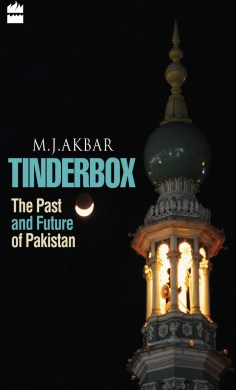
Both books had launches with brief seminars and cocktail receptions. The first was for Tinderbox, the past and future of Pakistan by M.J.Akbar, a leading newspaper and magazine editor. MJ, as he is generally known, is the author of several books including a biography of Jawaharlal Nehru, India’s first prime minister.

The launch was attended by top politicians, academics and others, and speakers included India’s vice president, the finance minister, and opposition leader. Few kind words were said about Pakistan and, though the criticisms were generally well-meaning, coming as they did from an anxious neighbour, they would sound condescendingly critical to an outsider.

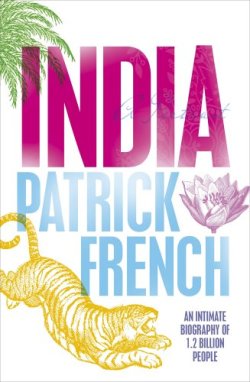
The second launch was for India – A Portrait by Patrick French, a younger and well-known London-based author who has strong links with India and first made his name 16 years ago with a memorable portrait of Sir Francis Younghusband, an early-1900s British explorer and spy. More recently, he proved his skills with a trenchant biography of V.S.Naipaul, the controversial writer adopted as an icon in India. This was a lower-key launch, somewhat trivialised by unfocussed questions. Patrick is now on a book tour round India, which ends at the Jaipur Literary Festival in ten days time, so has plenty of opportunity to spell out the strengths of his country portrait that runs from independence in 1947 to today.

I’ll be reviewing his book later next week for an Indian newspaper and will put that review up on this blog. Here, I’ll just mention that Patrick’s main contribution to knowledge of the current political scene is a devastating detailed analysis of the escalation of dynastic politics.

“India is going back to monarchy,” commented Outlook magazine (right) under the headline “The Princely State of India” when it ran lengthy excerpts recently. Patrick wrote that Parliament’s Lok Sabha (House of the People), was becoming a “Vansh Sabha – a House of Dynasty”.

Led by the ruling Gandhi dynasty, more than a third of the Congress Party’s MPs elected in 2009 came into politics through a family link. Even worse, literally all the MPs (not just Congress) aged under 30, and more than two-thirds of those under 40, were from hereditary families. More on that next week.

Returning to the Pakistan book, the most memorable quote at the launch came from MJ, who opened a powerful and reasoned speech with the bald statement: “If Salman Taseer had been an Indian Muslim, he would still have been alive today”. Speaking as an Indian Muslim himself, MJ was referring to the governor of the Pakistan province of Punjab, who was gunned down last week by one of his guards for supporting a Christian woman sentenced to death under draconian blasphemy laws.

Taseer was no saint. He had a chequered professional and private life, and would never have become a leading politician if the current Pakistan president, Asaf Ali Zardari, had not made him the Punjab governor. He was an independently minded character and this led to his death because he bravely stood out against Islamic extremism. His killing has made him a hero figure, and the dreadful way in which his opponents applauded his death has assured him a tragic place in the history of Pakistan’s decline. No Muslim cleric would preside at his funeral and lawyers (his own profession) threw flower petals approvingly at his killer.

Picking up MJ’s remark, that would never have happened in India, despite the country’s deeply ingrained history of ethnic cruelty and violence, and recent evidence that Hindu extremists have been responsible for some of the country’s terrorist attacks.

The irony, as MJ (below) points out in his book, is that in 1947 Muslims opted for a separate homeland because they believed they would be “physically safe, and their religion secure”, in a new nation. “Instead within six decades, Pakistan had become one of the most violent nations on earth, not because Hindus were killing Muslims but because Muslims were killing Muslims”.

MJ starts his “history of an idea” in the 1750s with the collapse of the Mughal Empire’s Muslim rule. That created a “mood of anguish” among the north Indian elite and led, “out of a fear of the future and pride in the past”, to the search for a new Muslim space. “Indians and Pakistanis are the same people; their nations were the first to win freedom from the mightiest empire in history,” he writes.

“Why then have the two countries moved on such divergent arcs since 14 and 15 August 1947? The idea of India is stronger than the Indian; the idea of Pakistan is weaker than the Pakistani. Secular democracy, a basis of the modern state, was the irreducible ideology of India, while the germ of theocracy lay in Pakistan’s genes.”

Among India’s Muslims, MJ is possibly the most erudite critic of 1947 partition. That leads to damning remarks such as “Pakistan is an idea that is regressive. India is an idea that is progressive”. This of course, sadly, has been proved right as India’s economy booms and Pakistan’s stability declines.

But India has deep problems too. There is a map of Pakistan on the inside cover of MJ’s book that highlights the areas to the north and north-west that are under Taliban influence. That’s quite scary, but so are maps of India that highlight areas under Maoist Naxalite control, which amount to a third of India’s districts.

Pakistan is suffering from a deeply flawed political system and corrupt often brutal administration that cannot cope with rising Islamisation. Despite its many successes, India is suffering from a deeply flawed pattern of economic growth and corrupt often brutal administration, which is failing to cope with the growing aspirations of the poor, leaving room for a Maoist rebellion.

As MJ points out, Pakistan’s slide into Islamic extremism began in the late 1970s under the then military dictator General Zia-ul-Haq. That’s over 20 years ago. What will India look like in 20 years time if it does not tackle its own weaknesses?

“Truth”, a top opposition politician said yesterday, “is very inconvenient – the more you suppress it, at some stage it comes out”. Arun Jaitley, one of India’s top lawyers and a former Bharatiya Janata Party (BJP) minister, was referring to a verdict from India’s appellate tax tribunal that bribes were paid 25 years ago to an Italian businessman on a Bofors gun deal. That businessman was (and may still be) close to the Gandhi family that ran the Congress government in the 1980s and still does so today.

Mr Jaitley’s remark has a wider resonance for the Congress Party and government, which was hit in 2010 by a series of corruption scandals that dwarf the $50m bribes believed to have been paid in the 1980s on India’s Bofors gun deal when Rajiv Gandhi was the prime minister.

Jairam Ramesh

It neatly provides me with a new intro to a blog post that I had started writing about who made the most difference in India in 2010.

Certainly, I was suggesting, not prime minister Manmohan Singh nor his lady boss, Sonia Gandhi (Rajiv’s widow) and her heir-apparent son Rahul.

They have stood aside allowing messes like the Commonwealth Games preparations and a host of corruption scams to go ahead. They have won international applause for hosting the leaders of the US, China, Russia, France and the UK in Delhi during the past few months, but banquets, trade deals and investment memoranda do not run countries.

Now, sensing the political price they might have to pay later this year in five state assembly elections for allowing such rampant sleaze, they are proposing new regulations and procedures that look good but are likely to have little effect in the current state of Indian society and politics.

Pranab Mukherjee, the veteran finance minister, does not qualify either. Aside from the finance job, his political skills have kept Mrs Gandhi’s undisciplined and often corrupt coalition government in business, thus allowing offending politicians and officials to get richer and remain free.

In a negative sense, the biggest achiever could be Niira Radia, a lobbyist and public relations consultant, whose wheeler-dealing has flooded across media headlines in a “truth comes out” torrent of leaked audio tapes. This has exposed a massive telecoms-based scandal and revealed networks of politicians, officials, fixers – and a few journalists. It has personally embarrassed Ratan Tata, India’s top businessman and one of Ms Radia‘s main employers, as well as various contacts and associates such as N.K.Singh, a rich and controversial former top Finance Ministry and Prime Minister’s Office bureaucrat, Tarun Das, creator and former head of the Confederation of Indian Industry, and Pradip Baijal, a proud former senior telecoms bureaucrat.

Some observers suggest that Nitish Kumar, recently returned after state elections for a second term as chief minister of Bihar, made the most difference by turning round that beleaguered state. Or maybe it should be Kapil Sibal, the human resources minister who is tackling the country’s grossly inadequate education system and is now also cleaning up the telecoms administration. But these are still works in progress – Mr Kumar has to embed change in Bihar, and Mr Sibal has to implement good intentions and plans.

Jairam Ramesh – economic reformer

My choice is Jairam Ramesh, minister for the environment, who has used more than two decades of personal experience as an economic reforms adviser to bring some order and ethics to a previously policy-starved and corrupt area of government.

He has, to return to Mr Jaitley’s words, showed that “truth comes out”, not by directly accusing those involved of evading and bending environmental laws and administration, but simply by rigorously implementing those laws and personally reforming the administration.

Consequently, the truth has come out about how Vedanta, a London-based mining and metals group headed by India-born Anil Agarwal, has breached environmental regulations with bauxite mining and other projects, and a proposed university in Orissa. A long-delayed $12bn iron and steelworks project planned by Posco of Korea has come unstuck, also in Orissa, because of possibly faulty environmental and land-use approvals. A politically influential branch of the Jindal business family has been told it has ignored requirements on another Orissa steelworks. A partially built “hill station” (a romantic euphemism for lucrative urbanisation of rolling hills) called Lavasa in Maharashtra, which is promoted by powerful political and business interests, is also (as the Indian media terms it) “under the scanner”.

Mr Ramesh’s approach has also helped the truth to come out about massive illegal mining in other states such as Karnataka and Jharkhand, tied in most cases to corrupt politicians.

His success can be measured by looking at who he has upset – Sharad Pawar and Praful Patel, both powerful politicians and fixers from Maharashtra and currently ministers (respectively) for agriculture and aviation, Kamal Nath, minister for highways, the coal and steel ministries, chief ministers of various states, and the companies named above plus dozens of smaller mining operators.

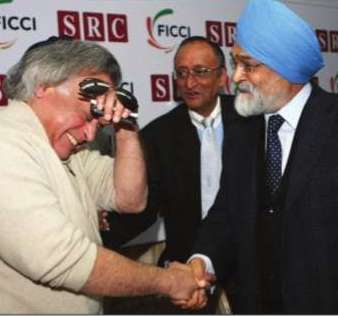
Montek Singh Ahluwalia (right) and Jairam Ramesh – PTI photo

He also has more respectable critics, notably Montek Singh Ahluwalia, who runs the Planning Commission, works closely with the prime minister, and has been a government economic adviser since the 1980s.

Mr Ahluwalia objects to Mr Ramesh’s plans for “no go” coal mining areas, suggesting this would hit economic growth.

The two men have been rubbing shoulders professionally for over 20 years (seen together, left, this week laughing at their first public meeting since Mr Ahluwalia’s remarks). They know that neither is anti-growth and that both are committed economic reformers. “We cannot deforest our way to prosperity and we cannot pollute our way to prosperity,” says Mr Ramesh.

Mr Ahluwalia’s remarks do however reflect the opposition that Mr Ramesh has stirred up. There are rumours that this has triggered a campaign to have him removed from the environment ministry in a cabinet reshuffle that might happen in the next few weeks, but that seems unlikely to be successful, given his high-level backing. “I am not doing something that is alien to what the prime minister and the Congress president [Mrs Gandhi] want me to do,” he said recently.

In the first year as minister, Mr Ramesh (below) seemed to be blocking every dubious project, courting controversy, secure in the support of Mrs Gandhi and, usually, the prime minister. I assumed then that, once he had established his new approach, he would start to be more accommodating and that now appears to be happening, forced maybe partly by the force of opposition.

He did for example compromise last month with Mr Patel about a new airport for Mumbai, achieving he says 80% of what he wanted. He might also let at least part of the Posco’s plans go ahead later this month. He has approved an environmentally controversial Indo-French nuclear power project in Maharashtra, and is reviewing coastal development zoning to allow some development while protecting vulnerable coastlines.

Overall he says, projects are divided into “yes”, “yes but” and “no” categories, with 95% being approved, which is “down from 99.99% earlier”. Only 5% receive a “no”. In addition to less controversial work he has done on wildlife conservation, he is planning two new environmental assessment authorities and tribunals. He also plans to amend forest laws to benefit tribal communities that have been driven by bullying officialdom into the hands of Naxalite rebels.

’Ultimate strategic maverick’

So I have no doubt that he is the public figure who has made the most difference in the past year. Perhaps the best tribute came last week from Lumumba Di-Aping, Sudan’s United Nations representative and a leading climate change negotiator. Having clashed with Mr Ramesh, who has also been courting controversy over climate change, he said he is “the ultimate strategic maverick”.

“He is a leftie on the right, he is a global nationalist and at the same time, he is unaccountable to anyone but to the pursuit of the national economic interests of India. That is the only thing that shapes his ultimate strategy”.

Mr Ramesh doesn’t like being called a maverick because, he says, all he is doing is implementing the laws. Nevertheless, it is a good tribute and surely puts his powerful political and business opponents in their place, which can only be for the country’s good.

Posted by: John Elliott | January 2, 2011

Riding the Elephant’s 2010 in review

The stats people at WordPress.com, where Riding the Elephant lives, mulled over how the blog did in 2010 and gave this high level summary of its overall blog health:

Healthy blog!

The Blog-Health-o-Meter™ reads Wow.

Crunchy numbers

Featured image

The Louvre Museum has 8.5 million visitors per year. This blog was viewed about 93,000 times in 2010. If it were an exhibit at The Louvre Museum, it would take 4 days for that many people to see it.

In 2010, there were 44 new posts, growing the total archive of this blog to 235 posts. There were 257 pictures uploaded, taking up a total of 104mb. That’s about 5 pictures per week.

The busiest day of the year was December 8th with 764 views. The most popular post that day was ‘Radia tapes’ highlight media flaws that fit with modern India .

Where did they come from?

The top referring sites in 2010 were asiasentinel.com, ft.com, blogs.ft.com, facebook.com, and twitter.com.

Some visitors came searching, mostly for indira gandhi, riding the elephant, dussehra, nira radia, and fatima bhutto.

Attractions in 2010

These are the posts and pages that got the most views in 2010.

1

‘Radia tapes’ highlight media flaws that fit with modern India December 2010
14 comments

2

“Foreign Correspondent” – a best selling anthology September 2008
(the picture above – of foreign correspondents in 1991 pushing luggage trollies in strike-hit Kathmandu – is from the book.)

3

History repeated as Delhi judders leaderless towards the Commonwealth Games July 2010
17 comments

4

Nehru was lost for years in a trunk ……… October 2008
1 comment

5

The Gods will encourage you to gamble October 2007
3 comments

Happy New Year!


Posted by: John Elliott | December 23, 2010

Arty tigers raise awareness about saving iconic animals

Just in time to brighten up the city for Christmas and New Year celebrations, a ‘herd’ of colourful life-size fibreglass tigers are appearing around Delhi, emulating the Elephant Parade that adorned the streets of London in the summer.
 
Currently on public display at Rashtrapati Bhawan (the presidential palace), they will go next week to various locations for three months.
 
Called Art for Tiger, this is a charity campaign that aims to raise awareness of the plight of the tiger, and generate funds for the Ranthambhore Foundation which does good works around Ranthambhore national park. 

No-one knows how many tigers there are left in India, and poaching is rampant. The last official census in 2006-07 produced 1,165 at the low end and 1,657 at the top, and has been averaged out as 1,400, but the total is probably lower now.

Painted in a huge variety of styles and colours by well-known artists who include Anjolie Ela Menon, Paresh Maity, and Farhad Husain, the tigers have been acquired by 58 companies and other organisations for donations of Rs150,000 ($3,300). About half the Rs8.7m (nearly $200,000) raised will go to the trust, after payments to the artists and other costs.


WPSI’s elephant in London’s Green Park

Saving wildlife from a seemingly relentless path to extinction has suddenly become fashionable and socially acceptable. A week or so ago, the Indian tv station NDTV broadcast a 12-hour Telethon with film star Amitabh Bachchan as the Save the Tiger brand ambassador and others. This raised Rs48.6m (just over $1m) to finance rapid response teams for tiger emergencies.

London’s elegant Elephant Parade raised £4m ($6.2m) after the sculptures were auctioned, and the bulk of the proceeds went to various Asian Elephant conservation organisations.

The Art for Tiger organisers, led by Swapan Seth, who runs an advertising agency, Aparajita Jain of Delhi’s Seven Arts Gallery, and Nandita Baig, a social activist, now plan to stage events in other Indian cities with more ambitious fund-raising targets.


Elephant in Bond Street

Belinda Wright, founder director of the Wildlife Protection Society of India (WPSI), which received funds from the London elephant auction, is glad that conservation is becoming socially acceptable and even fashionable “providing the fireworks are reflected in positive action on the ground”.

“Through all the glitz, hopefully messages of substance are making people stop and think about important environmental issues, including the terrible consequences of loosing iconic species such as the tiger and elephant”.

That’s a good message for the New Year –

                              Merry Christmas!


Posted by: John Elliott | December 17, 2010

China and India quarrel despite $16bn economic carrots

The contours of the likely future relationship between India and its larger, more successful and more globally ambitious and aggressive neighbour China have begun to emerge as Wen Jiabao, the Chinese premier, this morning finished a two-day visit to Delhi and flew on to his ally Pakistan.

Economic and cultural ties will grow and trade will boom between the world’s two fastest expanding economies, but China will continue indefinitely to rattle India’s nerves in a variety of ways, not least by becoming closer to Pakistan and claiming territory in India’s northeastern mountains.

That was demonstrated by Mr Wen’s visit, which did nothing to improve relations and instead showed, as China’s ambassador to India put it earlier this week, that the two countries’ relations are “very fragile and very easy to be damaged”. 

looking different ways in a 'very fragile' relationship - photo AP

Mr Wen brought a weirdly large posse of 400 businessmen, and presided with Indian prime minister Manmohan Singh (above) over a flourish of $16bn business deals and joint agreements. His main speech, at the Indian Council of World Affairs, was full of talk about joint aspirations, friendship, co-operation and almost doubling two-way trade (despite considerable tensions) to $100bn a year by 2015. There was even a personal tribute to Mahatma Gandhi that rivalled President Obama’s similar line last month.

But he put India in its place as an unequal friend when he took a rigid line on the mountainous 48-year old border dispute saying it needed “patience” for a “long period of time”, with “sincerity and mutual trust”- and offered no help on other irritants. He also maintained China’s recently toughened pro-Pakistan line on Kashmir, which brought a tough response by a newly emboldened India (more on that below).

It is however important to note that Beijing will not see this economic carrot and diplomatic stick approach primarily as a China-India strategy because India is merely a (rather large) pawn in its overall ambition to become a super power, alongside and maybe one day replacing the US. That ambition necessitates keeping India, which is on course to become the world’s second biggest economy, in check because China is determined that it should not become a rival in terms of world power.

That analysis stems from a number of recent conversations with experts in Delhi, and over a longer-term elsewhere. In the late 1980s and early 1990s I was in Hong Kong watching (first as a journalist and then working in the territory’s government) Beijing’s manoeuvres as it prepared to take over the territory in 1997, dangling the UK for more than a decade on the end of a rope over the post-1997 constitution, just as it is dangling India now on the border and other issues. That is a classic China negotiating (a misnomer if ever there was one) tactic.

China’s line on India

A key to the analysis came from something a Chinese official recently told an Indian contact. He said India needed to understand three things:
– First, political differences would not impede economic growth and trade relationship between the two countries.
– Second, India should not meddle with its neighbours – meaning presumably that China will meddle in places like Myanmar, Sri Lanka, Nepal and Bangladesh, but that India should neither object not try to counter its efforts.
– Third, India must accept China’s growing links with Pakistan which would continue –presumably because arming a nuclear Pakistan is a key way to keep India in check.

This means that, while China is content to see India’s prosperity grow and to participate itself in that growth, India should not try to become a regional power, much as the US might like it to do so. It also probably means that, though China is surprised and rather taken aback by India’s rapid economic and industrial advances over the past decade, and has also been rattled by growing close ties (and last year’s nuclear deal) between India and the US, it knows that it is way ahead in terms of overall development and regional power.

In 1995, I wrote one of the first India-China comparative reports (for the Rajiv Gandhi Institute of Contemporary Studies). That was a time when there was reason to question whether India or China would win the race to liberalise and build their economies. But that debate is now redundant, even though it continues to fill conference halls and newspaper columns. China has won in terms of development, efficiency, world-reach and significance, as any visitor can instantly see.

People used to warn that China might implode because of its authoritarian lack of democracy, but it has not done so despite social unrest and riots across the country as well as in the western and southern regions of Xinjiang and Tibet. India, on the other hand is slowed down by its widely corrupt democracy, and faces social unrest in the north-east, where China meddles, and with a growing Maoist Naxalite threat that covers a third of the country’s districts, making many areas ungovernable.

India’s progress is seriously impeded by the widespread inefficiency and corruption in both the central and state governments, as has been seen recently in the Commonwealth Games and the current Radia tapes scandal (which knocked Mr Wen’s visit off top headlines). Corruption of course is dealt with differently in the two countries: some of the Indian politicians and bureaucrats currently accused and under investigation would face the risk of being executed – shot – if they were in China. In India, they usually wriggle free.

China has growing military might and an expanding defence manufacturing base (see  China clones, sells Russian fighter jets by Jeremy Page  in The Wall Street Journal reporting from Beijing, though a counter-view datelined Moscow appeared later in The Washington Post). In India, the army and some other forces use obsolete equipment, and are often not trained to use more modern gear when it arrives. The public sector defence establishment fails to re-equip the forces because of a mixture of corruption-related blockages and fears of letting India’s efficient private sector into the market. 

It is therefore scarcely surprising that, though India would like to be regarded on a par with China, it does not rate. But it has to find a way of coping with its large neighbour which, in recent months, has become more aggressive regionally over the South China Sea being a “core asset” and in a clash with Japan, as well as with India because of its pro-Pakistan policy.

Friend or Foe?

When he made the fragile relations remark, China’s ambassador warned that India’s government should “provide guidance to the public to avoid a war of words”. That is reminiscent of the economic policy hectoring that India repeatedly hears from the US, but was rather more significant coming in a different context on the eve of Mr Wen’s visit.

Nirupama Rao, the foreign secretary and a former ambassador to Beijing, immediately replied that “Chinese friends” should get used to dealing with the “vibrant…noisy, nature” of India’s democracy. Yesterday, India was not prepared to repeat its usual acceptance of Beijing’s One-China policy, which recognises Beijing’s right to rule Tibet and Taiwan. This was because of China’s hardening pro-Pakistan stance, which has included a rather childish innovation of only stapling China visas into Kashmiris’ passports, and other similar irritants.

The long-term question of course for India and for the rest of the world is whether China will be a “Friend or Foe”, to quote the title of an excellent 14-page special report in last weekend’s Economist. Does China’s new (rather clumsy) regional belligerence indicate that the “foe” angle is gaining supremacy in Beijing, as the country becomes more economically powerful and sees the US courting its neighbours? The Economist‘s foreign editor asks whether a story about a fifth century warring Chinese king, who seeks revenge for earlier defeats, is an alarming parable about China’s ambitions.

The answer to  that question will run for decades, and it will affect the whole world, with India on the front line. So it is surely good that India is beginning instinctively not to kow tow.

Earlier India-China posts on this blog: 

China out-guns US in friendliness at Delhi conference http://wp.me/pieST-XL  March 21, 2010

China aims to block India’s place in the sun http://wp.me/pieST-JP  August 13, 2009

New Delhi in lockdown over Olympic Torch run http://wp.me/pieST-18  April 17 2008

 Demand from China kills India’s vanishing tigers http://wp.me/pieST-Z Feb 13, 2008


Posted by: John Elliott | December 3, 2010

‘Radia tapes’ highlight media flaws that fit with modern India

There’s been an awful lot of sanctimonious talk on Indian tv and in the media in the past week or so about the shock horror of discovering that Niira Radia, a prominent business lobbyist (who I last mentioned here), has used well known journalists and editors as messengers and influence peddlers on key issues such as coalition government ministerial jobs and allocation of telecom licences.

One leading editor said on television how shocking it was that the lobbyist was working for a big family controlled corporation to try to arrange that friendly politicians were given useful cabinet posts – and said this had never happened before.

That is rubbish – Dhirubhai Ambani, founder of the Reliance group, was doing it decades ago, long before his son, Mukesh Ambani, and Ratan Tata of the Tata group hired Ms Radia. As Hamish McDonald has recorded in his Reliance-Ambani’s history (with different wording in some editions) , in 1979 “Dhirubhai put his resources behind Indira Gandhi’s efforts to split the Janata coalition”, and did a similar exercise in 1990 (financing a campaign with other industrialists). In the late 1980’s he “swung the appointment” of a Reserve Bank of India deputy governor. Mukesh Ambani is reputed, on one of the Radia tapes, to have referred to the Congress Party as “apni dukaan” (our shop).

Another editor claimed Radia’s attempts at cabinet-fixing was the biggest story for a decade, which was just silly. He was using that argument to pillory Barkha Dutt, a leading NDTV anchor, whose excitable nature energises her chat shows and reporting, but sometimes interferes with her judgements. She is one of the journalists being attacked and was being criticised by Manu Joseph, editor of Open Magazine, which (along with Outlook magazine) has been running leaked audio tapes of Ms Radia’s conversations with influential contacts. Mr Joseph criticised Ms Dutt for not reporting on Ms Radia’s manoeuvrings. She agreed she maybe should have done so, but said – and I agree – that this was scarcely a serious professional misdeed.

Nor is it new or amazing that journalists get involved, either naively and innocently, or for financial or other gain, in listening to lobbyists and sometimes carrying out their wishes – though that has increased as the growth of tv news channels has turned journalists like Ms Dutt into celebrities. Another editor in the firing line, Vir Sanghvi, who has had a series of top jobs in the Hindustan Times group, was caught up in this – and he did seem to be taking dictation from Ms Radia on issues to do with the Ambanis. His explanation was that he also listened to what opponents of Radia’s client had to say.

India’s media not ‘free’

This sad tale surely casts doubt on the widely held assumption that India’s media is one of the most free in the world. Tina Brown, a British-born US magazine editor, who now runs the Daily Beast news website and edits Newsweek, believes (according to a blog on the Daily Beast) that Indian journalism is “vibrant, rich, and healthy”, in contrast with journalism in the West, which “is believed to be in the grip of an existential and financial crisis”.

The financial crisis point in the west is of course true. It is also correct that print media in India is expanding fast, but much of it is not very profitable for a variety of reasons that include domineering tactics used by market leaders such as the Times of India group.

It is also far from “vibrant rich and healthy” in terms of ethics – so much so in fact that I would argue that it is far from free because many editors and journalists are fed, in one way or another, by powerful businessmen and politicians. This influence means that editors are not free of outside influence, and it stops the Indian media being a watch dog curbing errant politicians and businessmen. The most interesting first question to ask, when a politician’s or businessman’s alleged misdeeds are exposed, is not whether the allegations are correct but who fed and encouraged the journalist or editor to write and run the story.

That is especially relevant in the current spate of corruption scandals and exposure of media links. Attacks on someone like Ms Radia do not run and run unless they are being encouraged by, for example, an opponent of one of her clients. In such cases, fingers usually point to one of Dhirubhai Ambani’s two estranged sons, Mukesh and Anil, though there are of course many others in the game.

None of this is new

But none of this is new. Nine years ago, in an article in the British Journalism Review, I wrote:

“A large proportion of what appears in the print media is ‘planted’ by vested interests – notably national and local politicians (who are becoming more arrogant in their use of power), bureaucrats (who are underpaid and becoming more avaricious), businessmen (who cash in on the above), and police (underpaid and greedy).

“Working in a highly status conscious society, editors and reporters are not so irreverent towards authority as their counterparts in many other countries – and they are far more flattered by the attention of people in important positions. They are thus more vulnerable to accepting ‘plants’ and to being persuaded not to run controversial stories. Most journalists ……welcome the bribes that are offered by politicians and businessmen with “brown paper envelopes” and other gifts…… One company, which is known to be the most adept at managing political and public opinion, is widely believed to even have journalists (as well as politicians and civil servants) on its payroll”

I also told this story: “When I was first in India for the Financial Times in the 1980s, S.P.Hinduja, the elder of the infamous Hinduja brothers, failed to persuade me to ghost-write articles for him, hinting at fat fees. When I returned in 1995, he and his brothers tried, again unsuccessfully, to get me to ghost-write a book on governments that they had dealt with around the world. Together with other journalists, I was later given a small tv set after a press conference [held in Mumbai’s Taj Hotel where I was staying] by the Hindujas’ cable tv company. I returned the set so fast [once I had got back to my room and saw what I had been given] that I forgot to note down what model it was, so could not put a value on the implied bribe.”

Such cameos, I wrote, were not in themselves very dramatic; but they illustrated one aspect of the sharp decline that had taken place in the standards of Indian journalism over the previous ten to 20 years. Most newspapers had become more trivial; many reporters had stopped checking stories and putting them in context; very few editors monitored the quality of news reporting; sub-editors did little sub-editing; and proprietors asserted more control over consumer-oriented content, usually through their advertising directors.

Paid news

That has worsened dramatically in recent years with the advent of “paid news”, where politicians and businessmen pay papers to run favourable news in their columns. This surfaced as a scandal in 2008-09 with the same sort of breast-beating that is happening this week. In last year’s elections, there were many reports of politicians paying for news coverage – and of newspapers and tv stations offering favourable coverage in return for substantial negotiable payments. The chief minister of Haryana state even admitted it (see this Outlook report in December 2009 for the details).

The Bennett Coleman group started paid news five years ago in its Times of India and Economic Times titles, and was followed by others including the Hindustan Times and the Bhaskhar group, India’s largest local language newspaper publisher. This was taken a stage further with a system called Private Treaties, where Bennett Colman acquires smallish financial stakes in companies in return for running favourable editorial and advertising.

Just as the media is now self-flagellating over the conversations and motives of Ms Radia with Ms Dutt and others, so it agonised earlier over paid news. The Press Council produced a report earlier this year saying that “the phenomenon of paid news has acquired serious dimensions,” and that “it is undermining democracy in India.” Aroon Purie, who runs the India Today media group, said a few months ago that paid news was self-destructive and one day would mark the “death of journalism”. But nothing has been done because those involved did not want anything done.  

It is therefore surely outrageous for journalists and editors to be parading through the television studios on the Radia story, claiming sanctimoniously that journalism has sunk to a new low, when many of them have been deep in that process of decline for years and the others have done little to improve general standards.

People close to India’s media know  it is “insular” and “corrupt”, as the Daily Beast blog I mentioned above says. Rajdeep Sardesai, who runs India’s CNN-IBN news channel and is a leading programme anchor, said at a seminar in Delhi this morning that journalists are “carried away by the wish to be power brokers” in a society where politicians and “corporate India will do anything to suborn the system”.

You might therefore say that India has got the media, and the Radia-style lobbyists, that it deserves. If that is so, it is unlikely to change until the society in which it operates also changes – and there sadly seems to be little prospect of that happening any time soon.

‘Finally, the art world’s most theatrical exponent is coming home – Return of the Prodigal’  

‘An artist returns to his roots’    ‘Anish comes home’

With these headlines Anish Kapoor, probably the world’s most famous (and richest) modern sculptor, has been welcomed back to India where he was born 56 years ago. He has lived in the UK since 1973 and is now a British subject. That mix, and his international fame, led Jawhar Sircar, India’s secretary for culture, to address him aptly at the opening of an incredible exhibition of his works in Delhi on Saturday as “Son of India, pride of Britain and wonder of the world of art”.

Anish Kapoor with Sonia Gandhi

Sonia Gandhi, leader of India’s governing coalition, opened the show – a rare accolade – and a dinner was hosted in the evening by Sir Richard Stagg, the British high commissioner. So both countries happily staked a claim, and Sir Richard expansively said the exhibition was probably Britain’s most important cultural event in India since independence in 1947.

Mrs Gandhi’s speech was significant not just for praise she levied on Anish Kapoor, saying that few artists had so successfully “captured the imagination of the world”. His works “explored illusion and reality, darkness and light …and simultaneously capture the mystery of artistic creation and the mystery of being”.

She also highlighted a current debate among India’s artistic fraternity about the need to make art more accessible to people. That would partly include commissioning public art, which is sadly lacking in India apart from distinguished old (and some new) monuments and statues. “It is a matter of regret that our public spaces have so little public art of any real distinction,” Mrs Gandhi said to spontaneous applause, adding she hoped that “we may one day see Anish Kapoor’s installation in one of our cities”, as well works by leading Indian artists.

Mrs Gandhi’s “hopes” often lead to action, and talks are in fact already under way about Mr Kapoor producing a major sculpture for a prominent site in India, maybe a city centre or possibly an airport.

Shooting into the Corner – 2009

He has mentioned this in media interviews, but his works are costly – a curiously tangled 370ft high steel structure, The Orbit (below) that he is building for the London 2012 Olympics will cost £19m ($30m, Rs1.35bn, Rs135 crore). Indian-born Lakshmi Mittal, who lives in London, is donating £16m and will be rewarded by the work being officially called Arcelor Mittal Orbit after the world’s largest steel company that he runs.

One of his most famous works is Cloud Gate, a £14.3m, 100-ton sculpture in Chicago (below)which is said to be the most visited public art work in the world. It is a rounded bean-like stainless steel structure that reflects its surroundings, passers-by, buildings and the sky, and has a ground-level arch to walk through.

So will an Indian-based company produce funds for a work in its home country? Other Indian businessmen based abroad – Anil Agarwal and his currently notorious London-based Vedanta metals group for example, or the Hinduja family – might not be so acceptable as Mr Mittal. Corporate backing for the current Kapoor exhibitions, which are being staged simultaneously at Delhi’s National Gallery of Modern Art (NGMA) and a Mumbai Bollywood film studio, came from Louis Vuitton and the Tata group, but neither of them seems a likely candidate.

Mr Kapoor was listed in The Times of London’s Rich List last January with wealth of £20m. The Times said his company, White Dark, showed an operating profit of £17.2m in 2008, up from £8.4m the previous year, and that he has homes in London’s Chelsea (a “glass, stone and shimmering stainless steel” structure says The Times), the Bahamas, and elsewhere.

.

Possibly his most important exhibition was at London’s Royal Academy (RA) last year. He was the first artist to be given all the galleries to display his works that ranged – as do those now in India – from smallish shimmering and reflective glass and steel shapes, through piles of pigments (below and on show in Delhi), to large symbolic mounds of muddy-looking dark red wax.

Inevitably the question that Mr Kapoor is asked most is what influence India has had on his work. In London last year at the time of the RA show, I heard that he was not very proud of being Indian, indeed that he played it down, preferring the life and accents of the UK.

Arcelor Mittal Orbit

But that, I discover, is not correct – even though, when I asked him walking around the NGMA on Saturday to explain “the Indianness” in his work, he replied “that is the one question I shall avoid answering”. Later, chatting at dinner in the high commissioner’s garden, he was more expansive, explaining that he didn’t want to tackle the question because it was “a struggle as a non-western artist not to be labelled” with one’s country of origin. “I’m Indian, My sensibility is Indian. And I welcome that, rejoice in that, but the great battle nowadays is to occupy an aesthetic territory that isn’t linked to nationality,” he told an Indian tv channel recently.

He is however clearly very conscious of his roots – being born in Mumbai to an Indian (Punjabi) Hindu father and a Baghdadi Jewish mother, educated at India’s ultra-elite Doon school, and working on an Israeli kibbutz, before going to art school in London UK. He is now a Buddhist.

He said on Saturday that he has ‘”internalised and mythologised” India, and undoubtedly the richness of India is reflected in the bright basic reds, blues and yellows of much of his work. “Red is a colour I’ve felt very strongly about,” he said in a 2003 BBC interview . “Maybe red is a very Indian colour, maybe it’s one of those things that I grew up with and recognise at some other level. Of course, it is the colour of the interior of our bodies. Red is the centre.”

The important point in all his sculptures, Mr Kapoor told me, is not whether there is “Indianness”, but what he and others see ”looking in”. In an excellent BBC film that is being shown at the NGMA, he says his work is “always about human relationships” within the space that he creates or modifies. That comes out most eloquently I think at the NGMA with pictures and models of landscapes and city scapes that he has transformed with massive sculptures – like a huge red trumpet-like funnel on a hill overlooking the New Zealand coast.

Shooting into the Corner, where an iron canon (above) shoots sticky chunks of red wax across a room repetitively every 20 minutes, also illustrates the “looking in” point. Mr Kapoor has dismissed this in the past as “almost a cliché – the artist just throws a bag of paint at a canvas and there it is”. When I watched it with an Indian friend and a crowd of other visitors at the RA last year, we were bemused, not quite seeing the point.

Cloud Gate, Chicago 2004

But now the cannon is firing in Mumbai, just after the second anniversary of the city’s devastating 2008 terrorist attacks, and it is being seen as symbolic of repetitive shooting and horrors of terrorism. On an Indian tv channel yesterday, Mr Kapoor toughened up his interpretation and said that the red colour was “full of darkness and danger”. He admitted it was “truly political” but with “no agenda”, adding that “art could take on the context of the bigger world”.

Similarly, visitors did not understand a massive tracked train-like block of blood-red wax, weighing more than 20 tons, that squeezed and oozed its way through doorways linking RA galleries. But the Jewish Chronicle last year, saw “references to blood and railways” that “must surely have a link to Holocaust” trains that carried Jews to death camps.

All this must please Mr Kapoor, and we will now wait to see what he produces for India, once corporate benefactors have been signed up. Meanwhile one can ponder the Arcelor Mittal Orbit at the London Olympics. I reckon it’s a steel Tower of Babel, with all the peoples of the world tangled up in knots, but coming together for the mega sporting event – there will no doubt be other interpretations.

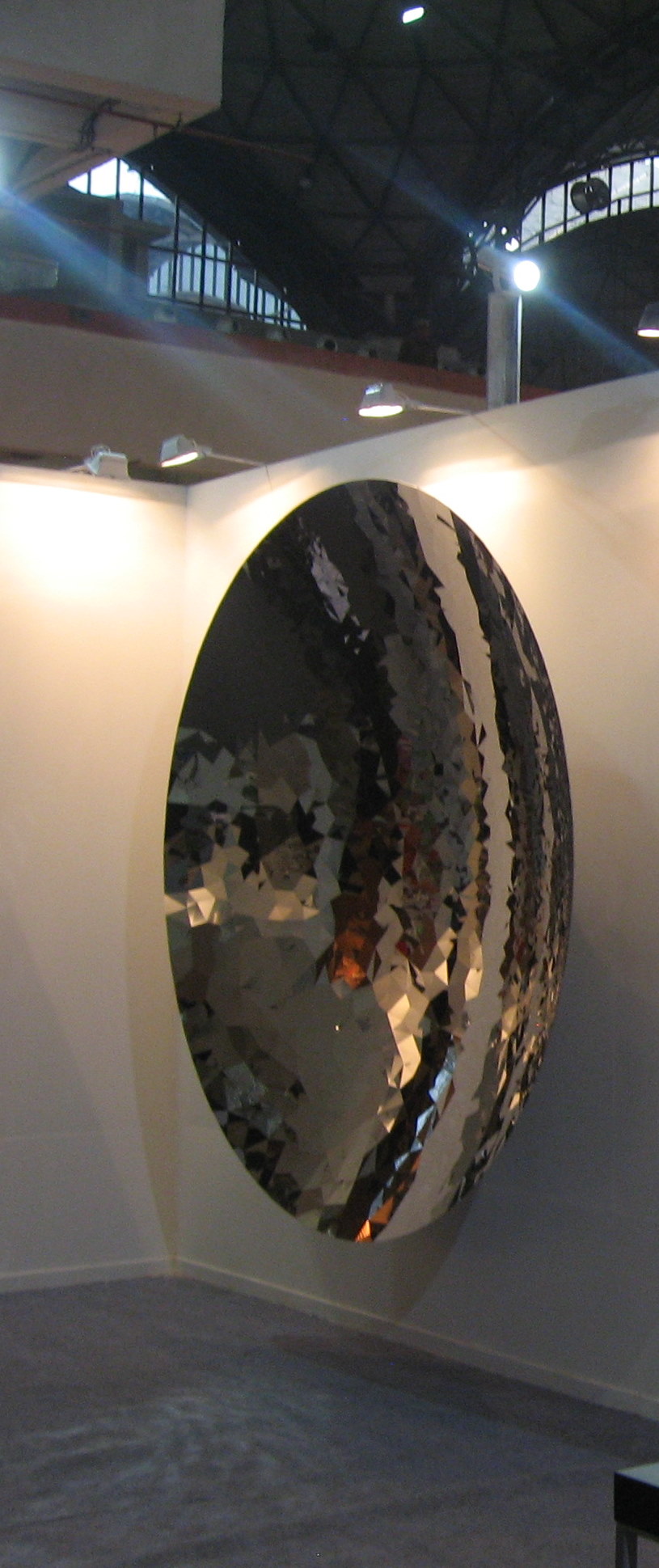
Anish Kapoor with giant curved mirror sculpture in London’s Kensington Gardens – photo: Peter Macdiarmid/Getty Images

If anyone had any doubt about the Indian electorate’s ability to turn its back on corrupt non-performing politicians and vote decisively for development and good governance, yesterday’s overwhelming state assembly election result in Bihar should dispel them.

Nitish Kumar yesterday – AP photo

A coalition led by chief minister Nitish Kumar, 59, and his regional Janata Dal (United) party swept the polls with 206 out of 243 seats, routing both the Rashtriya Janata Dal party led by Lalu Prasad Yadav, an earlier highly corrupt folk hero, and the Congress Party, led in the Bihar election campaign by Rahul Gandhi, who is tipped as a soon-to-be prime minister.

It was a day when the financial markets were rocked by the arrest of eight top public sector banking and housing finance executives for a real estate loans scam, the hugely corrupt state chief minister of Karnataka refused to resign, and (probably thousands of) people listened to audio recordings on the internet linking an on-going telecom spectrum scam to top businessmen, journalists and politicians.

For Nitish Kumar, a socialist and former railways minister, to win so overwhelmingly on such a depressing day showed that there are at least some public figures in India whose primary aim is to do the job they were elected to do, rather than to liaise with big business and others to generate personal wealth.

Since he became chief minister in 2005, Mr Kumar has worked on a development agenda, improving economic growth, health services, education, infrastructure, governance, and law and order. This followed 15 years of mis-rule by Lalu Yadav, who thought that all he needed to do was to raise the image and self-confidence of his backward Yadav caste, while lining his own and his family’s pockets with millions of illicit dollars.

Starting from such a low base of neglect, it has been relatively easy for Mr Kumar to show statistical progress, but his job will be harder over the next five years because of raised expectations in a state that is still desperately poor and under-developed. His success also marks him as a possible prime minister of a future coalition government, but Bihar must hope he remains focussed on the state’s problems.

He has already managed to reverse comparisons between Bihar, which used to be regarded as one of India’s worst basket-cases, with Karnataka, which used to be respected because of the huge software and information technology successes in its capital of Bangalore (Bengaluru), led by companies such as Infosys and Wipro.

Karnataka political basket case

Now it is Karnataka that is a political basket case, hit by successive self-serving and corrupt administrations. The current Bharatiya Janata Party (BJP) state government, led by chief minister B.S. Yeddyurappa, has been a disaster, dragged down by highly publicised illegal mining deals and land scams linking politicians and businessmen, and by Yeddyurappa’s nepotism on land deals and other issues. Yeddyurappa rarely bothers to deny such allegations, and was quoted a few days ago saying that he is only behaving (corruptly) as other chief ministers have in the past.

This is the BJP’s first state government in a southern state, so is specially important for the image of a party that used to pride itself on not being corrupt. The national leadership has been trying to oust Yeddyurappa, but several of the leaders have close links with key players in the state and the party now seems to have given up. The wisdom of that decision will be tested in coming local polls.

Elsewhere in the country, evidence of corruption and telecom policy fixing has been pouring into the newspapers, television programmes and the internet, generated by the forced resignation of Andimuthu Raja, the communications minister, that I wrote about last week  over a multi-billion dollar scam that has brought parliament’s proceedings to a halt for ten days.

Niira Radia, yesterday

A public relations consultant and corporate consultant (government policy fixer) called Niira Radia (right), who is a close adviser to the heads of India’s two biggest groups, Ratan Tata and Mukesh Ambani, lobbied on behalf of these and other clients with Raja.

Tapes of her conversations have been leaked for some time and are now easily accessible on Outlook news weekly’s website, where her conversations with Ratan Tata, Mukesh Ambani, top journalists, and television anchors and others on cabinet-fixing and telecom rivalries can be read and heard. Mr Tata’s involvement in this collection of names has caused most surprise.

Meanwhile Sonia Gandhi, leader of the Congress Party and India’s coalition government, has begun to speak up against corruption (coincidentally, no doubt) just a few days after I commented last week on her silence. Predictably she is trying to draw a distinction between Congress’s and the BJP’s records to try to avoid a swing against her party in future elections. On a broader front, she noted that “graft and greed” was increasing and was putting at risk “the principles on which independent India was founded”. She called for “greater probity” and transparency in government.

There is of course no hope of stopping corruption in India any more than in any other country. As Geoffrey Goodman, a veteran British journalist, pointed out in a comment on this blog last week, it is “a malaise of instant gratification, greed and the collapse of belief in moral values……the price we are paying for the global revolution in technology and the huge movement of peoples across the globe with massive social, economic and cultural change”.

In some countries, bribes speed up economic activity, but in India they are more about creating wealth for politicians, bureaucrats and businessmen who buy and sell patronage, favours and gifts with little care for any end result apart from personal power and gain.

That is the trend that Nitish Kumar has broken in the formerly sick state of Bihar. His success and victory is a rare example of good governance. Maybe the IT companies of Bangalore should move to Bihar, showing up the failures of Karnataka’s politicians and rewarding a state that is making positive progress.

« Newer Posts - Older Posts »

Categories