If anyone had any doubt about the Indian electorate’s ability to turn its back on corrupt non-performing politicians and vote decisively for development and good governance, yesterday’s overwhelming state assembly election result in Bihar should dispel them.

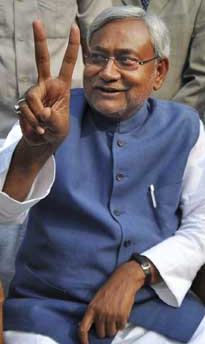
Nitish Kumar yesterday – AP photo

A coalition led by chief minister Nitish Kumar, 59, and his regional Janata Dal (United) party swept the polls with 206 out of 243 seats, routing both the Rashtriya Janata Dal party led by Lalu Prasad Yadav, an earlier highly corrupt folk hero, and the Congress Party, led in the Bihar election campaign by Rahul Gandhi, who is tipped as a soon-to-be prime minister.

It was a day when the financial markets were rocked by the arrest of eight top public sector banking and housing finance executives for a real estate loans scam, the hugely corrupt state chief minister of Karnataka refused to resign, and (probably thousands of) people listened to audio recordings on the internet linking an on-going telecom spectrum scam to top businessmen, journalists and politicians.

For Nitish Kumar, a socialist and former railways minister, to win so overwhelmingly on such a depressing day showed that there are at least some public figures in India whose primary aim is to do the job they were elected to do, rather than to liaise with big business and others to generate personal wealth.

Since he became chief minister in 2005, Mr Kumar has worked on a development agenda, improving economic growth, health services, education, infrastructure, governance, and law and order. This followed 15 years of mis-rule by Lalu Yadav, who thought that all he needed to do was to raise the image and self-confidence of his backward Yadav caste, while lining his own and his family’s pockets with millions of illicit dollars.

Starting from such a low base of neglect, it has been relatively easy for Mr Kumar to show statistical progress, but his job will be harder over the next five years because of raised expectations in a state that is still desperately poor and under-developed. His success also marks him as a possible prime minister of a future coalition government, but Bihar must hope he remains focussed on the state’s problems.

He has already managed to reverse comparisons between Bihar, which used to be regarded as one of India’s worst basket-cases, with Karnataka, which used to be respected because of the huge software and information technology successes in its capital of Bangalore (Bengaluru), led by companies such as Infosys and Wipro.

Karnataka political basket case

Now it is Karnataka that is a political basket case, hit by successive self-serving and corrupt administrations. The current Bharatiya Janata Party (BJP) state government, led by chief minister B.S. Yeddyurappa, has been a disaster, dragged down by highly publicised illegal mining deals and land scams linking politicians and businessmen, and by Yeddyurappa’s nepotism on land deals and other issues. Yeddyurappa rarely bothers to deny such allegations, and was quoted a few days ago saying that he is only behaving (corruptly) as other chief ministers have in the past.

This is the BJP’s first state government in a southern state, so is specially important for the image of a party that used to pride itself on not being corrupt. The national leadership has been trying to oust Yeddyurappa, but several of the leaders have close links with key players in the state and the party now seems to have given up. The wisdom of that decision will be tested in coming local polls.

Elsewhere in the country, evidence of corruption and telecom policy fixing has been pouring into the newspapers, television programmes and the internet, generated by the forced resignation of Andimuthu Raja, the communications minister, that I wrote about last week  over a multi-billion dollar scam that has brought parliament’s proceedings to a halt for ten days.

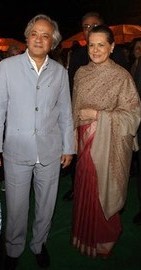
Niira Radia, yesterday

A public relations consultant and corporate consultant (government policy fixer) called Niira Radia (right), who is a close adviser to the heads of India’s two biggest groups, Ratan Tata and Mukesh Ambani, lobbied on behalf of these and other clients with Raja.

Tapes of her conversations have been leaked for some time and are now easily accessible on Outlook news weekly’s website, where her conversations with Ratan Tata, Mukesh Ambani, top journalists, and television anchors and others on cabinet-fixing and telecom rivalries can be read and heard. Mr Tata’s involvement in this collection of names has caused most surprise.

Meanwhile Sonia Gandhi, leader of the Congress Party and India’s coalition government, has begun to speak up against corruption (coincidentally, no doubt) just a few days after I commented last week on her silence. Predictably she is trying to draw a distinction between Congress’s and the BJP’s records to try to avoid a swing against her party in future elections. On a broader front, she noted that “graft and greed” was increasing and was putting at risk “the principles on which independent India was founded”. She called for “greater probity” and transparency in government.

There is of course no hope of stopping corruption in India any more than in any other country. As Geoffrey Goodman, a veteran British journalist, pointed out in a comment on this blog last week, it is “a malaise of instant gratification, greed and the collapse of belief in moral values……the price we are paying for the global revolution in technology and the huge movement of peoples across the globe with massive social, economic and cultural change”.

In some countries, bribes speed up economic activity, but in India they are more about creating wealth for politicians, bureaucrats and businessmen who buy and sell patronage, favours and gifts with little care for any end result apart from personal power and gain.

That is the trend that Nitish Kumar has broken in the formerly sick state of Bihar. His success and victory is a rare example of good governance. Maybe the IT companies of Bangalore should move to Bihar, showing up the failures of Karnataka’s politicians and rewarding a state that is making positive progress.

Posted by: John Elliott | November 22, 2010

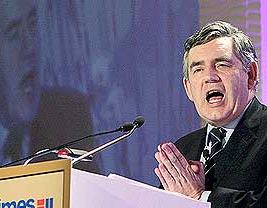
A smiling Gordon Brown joins the international speakers’ circuit

A new smiling and entertaining Gordon Brown emerged on the international speakers’ circuit on Saturday when the former gruff British prime minister spoke on global economic crises at a big policy conference in New Delhi. As a beginner on the circuit, where his political friend-turned-foe Tony Blair has made many millions of pounds, Mr Brown did well.

Headlined “Lessons from the Last Global Crisis”, his strong theme was that, as a fast growing “knowledge super-power”, India should play a leading role in the G20 and other economic assemblies at a time. The world needed much more international co-operation to stem future crises and India should speak out on the international stage.

This is the theme of a book that he said he is writing, and it also links with his suspected ambition to head an international financial institution.

.

“Your role at G-20 is absolutely critical. India is right at the centre of the discussions,” he told the Hindustan Times’ annual Leadership Summit (right). “Do not under-estimate your strength and your leaders’ ability to make a difference and to influence world affairs if you wish to do so”.

Mr Brown was of course right about what India should do; but this is not something the country has done very effectively in recent years, and it will be a challenge for its political leaders and diplomats to carve out an influential niche.

This was probably discussed earlier on the day when Mr Brown was the chief guest at a lunch hosted by Manmohan Singh, India’s prime minister. There is a rapport between the two men, even though India was not high on Mr Brown’s list of priority countries when he was in office. Mr Singh is a former economics academic and has led India’s economic liberalisation for most of the past 20 years, while Mr Brown was Britain’s finance minister for ten years. (Britain’s prime minister, David Cameron, does not have such resonance. Manmohan Singh could not recall his name when he spoke to the conference, even though Mr Cameron came to India with a flock of minister in July, as the Financial Times has has reported).

Mr Brown did not have the relaxed informal polish of former US vice president Al Gore, who also spoke on Saturday, but Mr Gore has been pounding the speakers’ circuit with a scary climate change message for many years.

Mr Brown was visibly trying very hard to be smart and relaxed. His hair had been brylcreamed into some sort of order, and he was genuinely amusing, even though he fluffed some of his jokes by delivering half the punchline first.

Iraq invasion

He also seemed to let slip his lack of interest in armed forces, which critics say led to under-funding of British troops in Iraq and Afghanistan. Talking about leaders who had courage, he explained that “by courage” he did “not mean military battlefield bravado”, but the will power to stand up for “strong beliefs” that had been shown by leaders such as Mahatma Gandhi and Nelson Mandela.

That was a good line for an Indian audience, but a British Labour Party veteran tells me that the slighting use of the word “bravado” may stem from Mr Brown’s early days on the radical Clydeside Left of the Labour Party, where armed forces were regarded with suspicion because military action and warfare were broadly seen as by-products of capitalism.

Mr Brown has travelled a long way since then, as his support for the Iraq invasion showed. Asked about the British involvement, he neatly distanced himself from Mr Blair and the US, while not opposing what had happened. He said he did not regret the invasion because Saddam Hussein had “broken enough rules” to be attacked; but he thought that it was for history to decide if the timing was right, or whether more diplomacy should have taken place first. He admitted that the job of reconstruction had been “badly done” with “no plans at all”.

Mr Brown may not have been a first choice for the conference, where other international speakers included the Dalai Lama as well as Mr Gore. Rumours suggest other possible speakers had included Richard Holbrooke, America’s Afghanistan and Pakistan trouble-shooter, and even David Miliband, the former British foreign secretary, who was recently beaten by his younger brother to take over the Labour Party leadership from Mr Brown.

If those speakers did decline, it was good news for Mr Brown – and for the conference – because he spoke with sufficient humour and passion to deserve a prominent spot on the lucrative international speakers’ circuit, and he had a strong message to deliver about international financial crises. He came to Delhi from Harvard university where he had been speaking on international development.

There are various estimates of what Mr Brown was paid, but around $75,000 (£50,000) seems the most likely for the 50 minutes he spent making the speech and answering questions. That is far below both the $300,000 that Al Gore commands and Tony Blair’s $400,000-500,000. A spokeswoman told the Daily Mail that Mr Brown’s fee would help to cover the running costs of a company set up to pursue his writing and lecture tours. 

The event also gave him a chance to deliver another dig at Mr Blair, who has just published his political memoirs. “Who said what to who doesn’t add much to history,” said Mr Brown, adding that he is writing a book on his theme of financial crises and the need for international co-operation. Also, he said, there would be no memoirs “because I feel young”.

Posted by: John Elliott | November 15, 2010

India’s corruption crisis escalates

Nov 17, 2010: Corruption scandals have escalated into a potential political crisis since I wrote this post two days ago.

Yesterday, the Supreme Court criticised Manmohan Singh, the prime minister, for the government’s 16 months of “inaction and silence” over the wide-ranging telecoms scam that led to the sacking this week (see below) of the minister, A. Raja. Mr Singh now has to find a way of explaining that he could do nothing because the Congress Party, headed by Sonia Gandhi, did not want to upset Mr Raja’s DMK political party, which is part of its coalition government, so the minister was given free reign.
The Commonwealth Games corruption saga has gone a stage further with two arrested officials reportedly fingering Suresh Kalmadi, who heads the organising committee and is himself being investigated along with others involved.
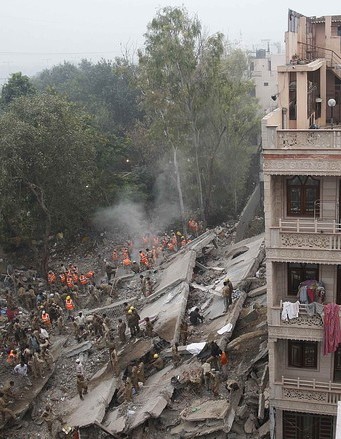
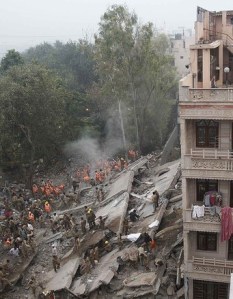
Massive corruption in Delhi’s state and municipal authorities, which hit the headlines in the chaotic run-up to the Games, has been highlighted by the collapse of a badly constructed illegal residential building, killing 67 people  (photo below). The building owner was arrested yesterday but top officials including Sheila Dikshit, the chief minister, and Tejendra Khanna, the Lieutenant Governor, tried to dodge responsibility for building standards and the Municipal Corporation of Delhi.

Global Financial Integrity, a US policy think tank, is reported today to estimate that $213bn (at least $462bn at today’s prices) was illegally transferred overseas from India between 1948 and 2008. That is not the total amount of black money raised from corruption because some was obviously kept in India, but it may indicate the scale of India’s lost resources.

_____________________________________________________________

Another corrupt Indian politician sacked, but can anything ever change?

Nov 15: A top business executive visiting Delhi for the annual World Economic Forum (WEF) conference asked me last night why the 800m or so Indians, who he assumed got no benefit from India’s massive corruption, didn’t mobilise a movement to stop it. I replied that many were themselves benefiting from the bribes and extortion that affect all levels of the 1.1bn population, because corruption had become so embedded in the country’s political and business culture.

That was not of course a complete answer. I should have said that, though they might not mobilise against corruption, there was evidence that the electorate rejects corrupt governments if individual politicians are seen or perceived to have benefited personally and not just used the money to fund their political parties. The most often-quoted example of that is the defeat of the Rajiv Gandhi-led Congress government in 1989 after it was believed that he and (or) his family and friends had been personally involved in a Bofors gun contract bribes a few years earlier.
.

This I suspect is partly the reason why the Congress Party and its coalition government has in the past week forced the resignation of three politicians who, though they deny the charges, have been involved in highly corrupt deals to the tune of billions of dollars in telecoms, real estate and international sport.

Ashok Chavan, one of Congress’s supposedly bright younger politicians, was sacked last week as Maharashtra’s chief minister for being involved for nearly ten years in a scam involving up-market Mumbai flats bought from an army charity by well-connected public figures, including top army generals, at around one-tenth of property market prices.

The second was Suresh Kalmadi, who lost a minor Congress Party post as partial punishment for heading the bribe-ridden Commonwealth Games organising committee. Two of his close aides were arrested today and charged with forgery and cheating in connection with a London publicity and films contract – but this is only the tip of the games iceberg.

Manmohan Singh, the prime minister, is reported to have insisted on the dismissal of the third politician, Andimuthu Raja, the telecommunications minister, who “resigned” last night.Mr Raja had been resisting demands for more than two years that he should lose his job for favouring friendly telecom companies in 2008 when valuable 2G mobile telecom spectrum was sold at 2001 prices leading to vast and probably illicit profits.

It has been estimated by India’s Comptroller and Auditor General (CAG)  that Raja’s various deals and favours lost the government revenues totalling as much as an incredible $30bn. Even if that figure is a vast over-estimate, it still looks like being the biggest corruption scandal ever to hit India, and one whose tentacles entangle many top political and business figures.
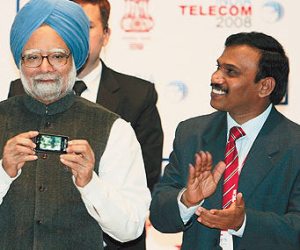
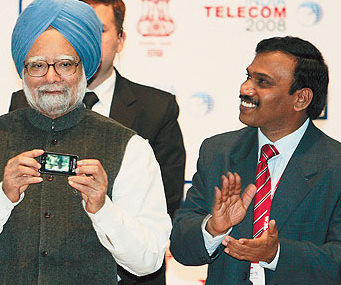
A.Raja applauding Manmohan Singh in happier days

The companies specially favoured by Mr Raja were Loop, Datacom, Unitech, Swan and Shyam.  The CAG report [published November 16] says Swan was secretly in league with Anil Ambani’s Reliance ADAG telecom company, which also received separate favours along (to a lesser extent) with a Tata telecoms company. Two of the others (Unitech and Swan) sold stakes to international telecom groups, Telenor of Norway and Etisalat of the UAE, which must have known their history. They had no prior telecom experience and had become friendly with Mr Raja in his previous post as environment minister (Mr Raja was one of a series of corrupt environment ministers who for a decade used the ministry as a cash cow).

As I wrote on this blog in November 2008, Unitech paid $350-400m for its spectrum allocation, and then sold a 60% stake to Telenor of Norway for $1.3bn, making a profit of about 700% in less than a year just for owning the spectrum without any customers or experience.

High profile corruption in India dates back decades. Historians quote an army jeeps’ contract scandal involving Krishna Menon, a famous and powerful Congress politician, in the 1940s as the first post-independence example. I can remember gossip about a French Mirage fighter deal when I first came to India in the early 1980s. Throughout this history, no-one has been punished for long and no-one is ever forced to pay back the illegal funds.

One more recent development is that politicians not only take bribes for letting things happen (or for stopping them to please competitors), but also become investors in the companies or projects that they help. Money accumulated abroad often comes back into India via (usually Mauritius-based) private equity funds.

The late Pramod Mahajan, a top Bharatiya Janata Party politician and “collector”, was widely believed to have investments in at least one leading private sector airline. Other current politicians are rumoured to have similar airline, airport, real estate and other investments. Andhra Pradesh politicians’ alleged involvement in Satyam, the Hyderabad software company that collapsed two years ago, and its sister Maytas property company, has been widely reported.

My WEF visiting executive was especially shocked last night when I told him that large numbers of people knew of such scams. I explained that Mr Raja’s activities had been gossiped and reported for years, and that I first heard about Commonwealth Games corruption more than two years ago. Very few politicians are “clean”, I said, and those that are have to tolerate what goes on around them in the political and government structure in order to get things done.

Manmohan Singh is widely credited with being “clean”, yet he has not been able to do anything about corrupt ministers and bureaucrats. He is now being criticised for not dealing with Mr Raja earlier. There was a story circulating a year or so ago that Mr Raja, when questioned by him about the telecom auction, replied that he worked (and “collected”) for his Tamil Nadu-based DMK political party chief. If the prime minister had any complaints, he should contact him.

Apparently, it was Mr Singh who finally decided over the weekend that Mr Raja had to go, even though the minister’s DMK party is an important member of the Congress-led coalition.

So does this mean that India is finally going to try to turn the tide on corruption?

Ratan Tata lost airline deal for not paying $3.5m bribe

Some people insist that they do not pay, and consequently lose business. Ratan Tata, who heads the Tata group, today said he lost a chance to set up a domestic airline  “maybe ten to 12 years ago” as a joint venture with Singapore Airlines because he would not pay a Rs15 crore (then $3.5m) bribe for the necessary government approval.

But will the government that Mr Singh presides over jointly with Sonia Gandhi, leader of the Congress Party, try to tackle the greed and selfishness that lies behind the problem?

Of course they will not, and it is not even clear which one of them regards the issue as their responsibility. As a result, there is a lack of national leadership on this, as on so many other issues, as Mr Singh’s reticence and lack of clout is combined with Mrs Gandhi’s mostly hidden presence. But Mrs Gandhi does have the power to do something about issues that concern her, as she has shown from time to time with edicts that are obeyed – one of the most famous and effective was a statement that the poor should not suffer by agricultural land being used for industrial development.

So why does she not lead a similar campaign on corruption? The answer is probably that the subject is just too big and overwhelming, that too many powerful people around her are deeply involved, and that all political parties including Congress need to collect funds.

But if no political leader is prepared to speak up and try to stop the rot, what hope is there – apart of course from those rare times when politicians judge that the risk of being voted out of power by a disenchanted electorate outweighs the advantages of collecting and becoming personally and politically rich.

Posted by: John Elliott | November 9, 2010

Obama ends his India visit on a high, but challenges it to change

Manmohan Singh meeting Barack Obama at Delhi’s presidential palace

President Barack Obama met many of India’s hopes and aspirations towards the end of his three-day visit to Mumbai and Delhi, but he also challenged the country to change attitudes and policies if it really expects to be accepted as an emerging world leader.

In a powerful speech to India’s Parliament yesterday, the president came down firmly on India’s side in relation to Pakistan terrorism and involvement in Afghanistan, and also broadly backed its ambition to become a permanent member of the United Nations Security Council.

But as soon as he had drawn applause from the assembled members of India’s two houses of parliament over India’s future membership of the council, he bluntly stated: “Now, let me suggest that with increased power comes increased responsibility”. That especially applied to those (implicitly, like India) “that seek to lead in the 21st century”.

He said this meant ensuring that “the Security Council is effective”, and went on to a list of issues that India might not find easy to meet. Though India shares Obama’s expressed wish to prevent the spread of nuclear weapons, it has always refused to sign the Nuclear Non-Proliferation Treaty (NPT), which Obama specifically mentioned.

Obama also challenged India to forsake its friendship with Iran, when he suggested it should join the US in condemning the country’s nuclear weapons’ ambitions. He went on to say India should condemn the military regime in its neighbouring country of Burma (where rigged elections have just been held), especially the regime’s  suppression “of peaceful democratic movements”. India will be loath to do this because of regional priorities, including China’s growing role in the country.

Obama then seemed gently to be chiding India about some of its domestic failings, such as corrupt politicians, elections, and development schemes, and its poor education system. He said democracy should “deliver for the common man” and that “every person deserves the same chance to live in security and dignity, to get an education, to find work, and to give their children a better future” – something that hundreds of millions of Indians do not have.

The US views on NPT and Iran were not new, but it was significant that Obama linked them directly to India’s desperate wish to become a permanent member of the council after it finishes a two-year temporary membership. How and when the UN will be reformed, and the council membership opened to new countries, is not clear. It could take years, during which time the US will be able constantly to remind India of the Obama conditions.

But these strictures did not detract from a general welcome for the Obama speech at the end of what overall can be seen as a successful presidential visit. Obama has clearly been captivated by India, as has his wife Michelle. He also has a specially close relationship with Manmohan Singh, the prime minister, who he respects.

Following contracts and other initiatives announced when the visit began two days ago,  a wide range of joint agreements have been signed. India is obtaining increased access to high technology in the space and defence fields, even though the US has not got all it wanted in terms of either defence contracts and agreements or enlarged foreign direct investment access to India’s defence, retail and other industries.

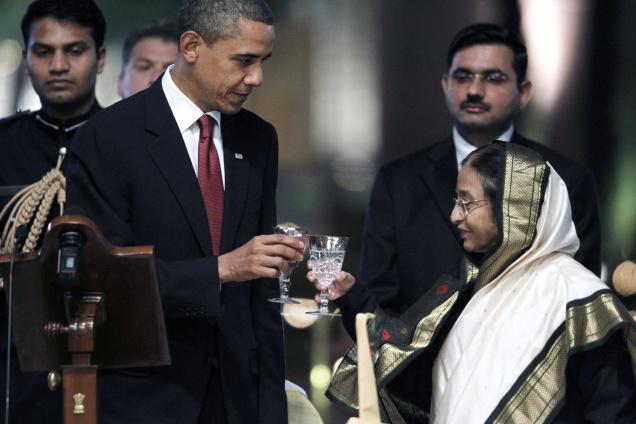
President Obama toasts President Prathiba Patil at a State banquet – AP photo

Manmohan Singh also refused to agree with Obama that India should re-start talks with Pakistan on border and other issues.

Speaking at a joint press conference a few minutes after Obama had made the talks request, the prime minister firmly said that “you cannot simultaneously be talking and at the same time the [Pakistan] terror machine is as active as ever before”.  Once Pakistan moved away “from this terror-induced coercion, we will be very happy to engage productively with Pakistan to resolve all outstanding issues.”

A joint communiqué was issued, echoing the earlier statements. It marked the massive progress made since 2001 when President George W. Bush and prime minister Atal Bihari Vajpayee took tentative steps towards what they hoped would be a lasting partnership between the two hitherto-distant countries. Within a couple of years, that led to what was called the Next Steps in Strategic Partnership (NSSP).

The visit ended with a formal banquet (above) in the presidential palace’s formal Mughal gardens. As Obama flies on to Indonesia, he will be satisfied that he has been able to announce 50,000 or more jobs back home (some say 72,000) stemming from Indian contracts with US firms. India has discovered that the president is steeped in admiration for its ancient history, as well as for its independence leaders such as Mahatma Gandhi. Both countries have laid the groundwork for immensely closer relations in the coming years, even if they do not always agree on matters such as Iran and Burma.

Posted by: John Elliott | November 7, 2010

Obama opens up after a dull first day in India

President Barack Obama’s three-day visit to India began to take shape today when a series of events in Mumbai and Delhi have shown different sides of the world’s most powerful politician.

Last night a London friend messaged me on Facebook asking how he was doing on his first day in India. “Not brilliant so far,” I replied, “dull droning speeches, and he trotted out pre-packed list of job-creating contracts for US companies. Seemed his mind was in the US not in India”.

Billboard welcome in Mumbai - photo AFP/GETTY

But I updated that today as he ended his time in Mumbai and flew to Delhi for the more political side of his trip. “He’s done better, much better, at Q&A sessions with school kids and students, away from his dreadful tele-prompter,” I wrote, “very focussed and relaxed – though inevitably not satisfied everyone on Pakistan”.

Yesterday’s sessions were far too stage-managed (in contrast to the lack of direction two weeks ago). Almost as soon as he arrived in Mumbai, his aides trotted out a $10bn package of 20 contracts – some old, some new, and some not yet concluded – which Obama later said would bring more than 50,000 jobs to the US.

Those that were not new included two for GE – an $820m order for Indian Air Force (IAF) fighter engines announced a month ago and $750m power station gas turbines announced (by Anil Ambani’s Reliance Energy) a week or so ago. Still awaited are an IAF $4.1bn Boeing Globe-master transport aircraft order, and a big railway locomotive contract that has two US bidders (including GE). The most recent order was from Spice Jet, a private sector airline, for $2.7bn Boeing aircraft – but airlines are adept at trotting very long-term orders out at headline-grabbing times.

Obama’s US worries

The contract list and its job-creating potential therefore need to be taken with a pinch of salt. With hindsight however, they did enable Obama to clear the decks of his worries about his drubbing last week in Congressional elections, and about allegations in the US that his trip is costing American taxpayers $200m a day.

.

Job creation in America was his main theme yesterday and he aimed at least a third, if not a half, of a speech to businessmen at audiences in the US, stressing how his trip was generating jobs. “The whole focus,” Obama had said just before leaving Washington, “is on how are we going to open up markets so that American businesses can prosper, and we can sell more goods and create more jobs here in the United States.”

Obama and his wife Michelle also paid homage at Mumbai’s Taj Hotel yesterday to those who lost their lives in the November 2008 terrorist attacks. The Taj was the focal point of those attacks along with the Oberoi Hotel, where Obama addressed the business meeting.

But his speaking style was deadpan at the Taj, where he lacked emotion, and with the businessmen, where he lacked verve. This was vastly different from the inspirational orator who won the 2008 presidential election. He spoke from notes at the Taj, but was blighted by his two teleprompter screens at the business meeting and at his main address to students this morning where, as we have seen on tv for months, he swings his head from side to side, drops the end of his sentences, and fails to inspire.

He did however impress Indian businessmen. Anand Mahindra, who runs the Mahindra autos-based group, has tweeted: “He was energetic, attentive, curious&made the right intellectual connections. Has the makings of a great President but needs to win a 2nd term! Above all, I appreciated his informality & sense of humour. Frankly I believe leadership and a sense of humour are inseparable”.

.


When Obama answered questions from students this morning at a free-ranging “town hall” style meeting at St Xavier’s School in Mumbai (right – FT photo), he appeared thoughtful, and focussed on his young audience and on what they could aspire to in the future.

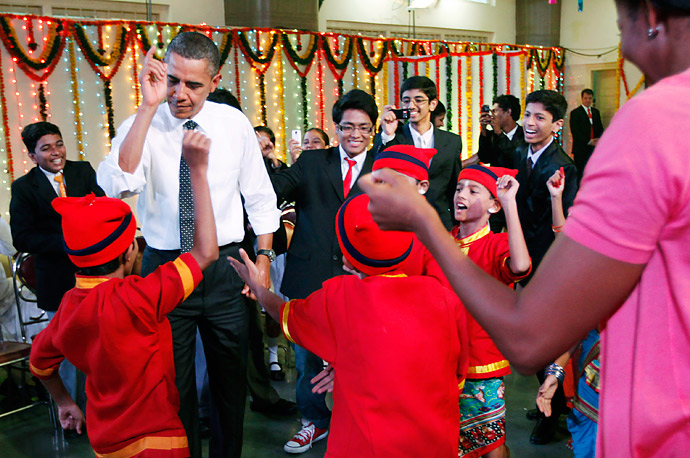
A little earlier he had danced (above – AP photo) with young children during the Diwali festival – emulating Michelle Obama who enchanted schoolchildren yesterday. He also talked on a video-link up with villagers in Rajasthan about how e-conferencing can help them develop and sell their crops.

With the students, he dealt with questions well, walking around the crowd with a microphone and swigging water from a plastic bottle, having been introduced by Michelle Obama who encouraged the audience to realise they had the chance to influence what happens to future generations.

Pakistan an irritant

Yesterday he was criticised by commentators for not nailing Pakistan’s responsibility for the Mumbai attacks when he spoke at the Taj. Today he was criticised for again not condemning the country enough, when asked by a student why the US did not treat Pakistan as a terrorist state.

However his remarks were apt for both occasions. At the Taj, he talked about the horrors of terrorism in general and how it had to be fought. With the students, he gave a tutorial on the need to give support and friendship to Pakistan because terrorism was a “cancer that could engulf that country”. He also significantly said that India-Pakistan talks could maybe start on “less controversial issues”, meaning that Pakistan should not insist – as it has again today – that the disputed territory of  Kashmir should be tackled first.

He will come back to terrorism and Pakistan again tomorrow, first when he speaks at a midday press conference and then in an address to the Indian parliament later in the day. That will be after he has had extensive talks with political leaders, who will be urging him to be more firm with their increasingly unstable neighbour.

Obama is also expected formally to announce tomorrow that three Indian public sector defence and space organisations – the DRDO defence research establishment, ISRO space research organisation, and Bharat Dynamics defence equipment manufacturer – will be removed from a list of international entities that are banned from buying US high tech equipment useable for both civilian and defence purposes. The US is also to back India’s bid for a membership of the 45-member Nuclear Suppliers Group (NSG).

These moves all follow on from President Bush’s 2008 nuclear deal with India and should have been implemented long ago. The delay in implementing them is, in Indian eyes, an example of how it cannot fully trust America.

India’s politicians and opinion formers will however never basically accept that the US’s avowed friendship with India is real and genuine until it finds a way of toughening its support-based influence on Pakistan, along with a more pro-India stance.

Obama has said that the US and India have one of the “defining relationships of the 21st century” – India is waiting for him to prove it.

Until he does so, the US will not get all the job-creating defence contracts it wants – notably an $11bn IAF fighter jet order – nor will it get defence communications and other agreements it is promoting because Delhi deeply distrusts Washington.

Tackling that is possibly Obama’s prime target tomorrow. He would win eternal praise if he backed India’s bid to become a permanent member of the UN Security Council, but the counter-terrorism and the Pakistan issues are paramount.

It looks as though Washington has the sort of Monsoon Wedding last-minute event management that India displayed with just-in-time results on Delhi’s recent Commonwealth Games.

In just ten days time, President Barack Obama will arrive in India for a three-day visit, but no-one involved seems able or willing to say officially, or even semi-officially, where exactly he is going, nor more importantly precisely what he hopes to achieve. The word from Washington is that officials there have only just started drawing up a “wish list” for the White House.

[[Oct 28: The White House has announced details of the trip – click here for brief report and click here for White House press briefing.]]

Indeed the White House seems to be behaving so much like the India’s procrastinating Commonwealth Games’ organising committee that despairing US diplomats in New Delhi have begun talking to journalists about the visit (albeit anonymously), without waiting for firm or final steers from Washington.

But what they are saying lacks detail, especially on the substance of the trip, and is indeed in tune with lines taken by Suresh Kalmadi, the games chief organiser, that it will all be marvellous when it happens.

The next ‘big thing’

In the last couple of days I’ve heard a very senior official say that the “next big thing” in the two countries’ relationship is to “deepen and broaden” the closeness that was achieved by President George W. Bush with his deal that opened up India’s nuclear power industry to international high technology. Wow!

Another official used a very broad brush to talk about co-operation on anti-terrorism and Afghanistan, while the lack of progress on defence deals led another to say that defence co-operation was based on people exchanges as well as equipment purchases.  Wow again!

Yet another official, faced with questions on the two countries’ sensitivities on trade and investment, ducked out by saying the aim was how to take the talents of people, universities and business to develop the relationship. Wow again, new wording on an old theme!

So what has gone so wrong with the run-up to the visit that it makes the invasion last July by Britain’s David Cameron, accompanied by an unprecedented troop of cabinet ministers, look a raging diplomatic success?

Basically it seems to be the fault of Obama’s advisers, who have insisted on an information blackout that has allowed mostly negative stories to circulate, focussing on what Obama will not be doing instead of what he will.

The officials seem to be terrified that what is planned for India will worsen Obama’s dismal prospects in America’s Congressional elections next week. In short, Obama is a president in decline and is more concerned, inevitably, with what happens in the US next month than how India sees his visit.

Rejected destinations

So he is not going to Hyderabad or Bangalore, India’s high tech capitals that were eagerly visited by Clinton and Bush, for fear of being seen back home admiring call centres and  the other information technology outsourcing that is stealing US jobs.

He isn’t going to Amritsar, the capital of the Sikh religion, because his advisers didn’t want him to look to Americans at home like a Muslim when he covered his head on a visit to the Sikhs’ holiest shrine, the magnificent Golden Temple. A survey has shown that 17% of Americans think Obama is a Muslim –  and that, in an age of terrorism, is not an electoral plus. (Actually, there was no real reason for him to go to Amritsar, but he was persuaded to do so by Sant Singh Chatwal, a Sikh hotelier in the US who has thrived on his closeness to the Clintons and other Democrat leaders.)

Obama has also reportedly decided against going to the India-Pakistan border at Wagah near Amritsar because of the risk that, in a speech on South Asian peace, he would have upset one or both of the two countries, probably over the disputed territory of Kashmir.

There are even reports that businessmen attending functions in Mumbai, where he starts his visit, are having to fill in questionnaires declaring their trade and investment links with the US. If true, that’s presumably so that those with sensitive businesses such as outsourcing can be kept away from the front line of  introductions. In Mumbai he is staying at the old Taj hotel, which was disastrously attacked by terrorists in November 2008.

Obama does of course start off a big disadvantage compared with Bush, whose popularity in India was only matched by his unpopularity in most other countries. Bush clearly loved India, and his visit was a triumphant mix of substance, built around the nuclear deal, and big-event stage management. Earlier visits by Bill Clinton were successes – those who watched him were impressed by his showmanship, and those who met him by his focus and apparent sincerity.

Obama seems from a distance to have neither’s easy charm, nor their fascination with India. It also looks unlikely that the sort of big-ticket items that the US would like will be forthcoming.

Few deals

Little progress is expected on big defence deals and agreements. American would love to bully its way into an $11bn contract for 126 multi-role combat fighter jets against competition from Europe and Russia, but it’s a least a year too early for that, and France’s president Nicolas Sarkozy and Russia’s prime minister Demetri Medvedev are both visiting later this year with similar ambitions. Two key defence agreements on co-operation for logistics support and communications, which the US has been pushing for a long time, are not ready because India does not want to be subject to close Pentagon surveillance.
 
Obama is expected to seal a $3.5bn contract for ten Boeing C-17 transport aircraft, but that has been in the works for a long time. He can also extol recent contracts for Boeing’s long-range maritime reconnaissance aircraft and a $2.1bn order for P-81 maritime reconnaissance aircraft. These contracts mark a significant shift towards America in India’s defence purchasing. They are the result of Bush’s nuclear deal – and Russia, India’s other big defence supplier, has also been doing well recently. 

A deal on dual-use high tech trade sanctions might be signed, which will help India, and there will also be deals and significant discussions in other areas, notably clean energy including shale gas, agriculture, food security, and legislation making foreign nuclear industry suppliers liable to accident damage claims  (India signed an international treaty on this today in Vienna).

In more secret talks, there will be India and America’s concerns about China’s growing role in the world, how that links with US support for Pakistan, and the future of Afghanistan. 

The US has been pressing India to relax its foreign direct investment (FDI) restrictions on multi-brand retail (jargon for supermarkets), insurance, and defence manufacturing. Wal-Mart’s top executives are in Delhi this week lobbying on retail, and are backed by some sections of the Indian government, including the sometimes-influential Planning Commission. But there are powerful vested Indian interests against any move on retail FDI, as there are on insurance and defence.

So let’s see how the visit pans out. It is clear that the public relations approach is partly to play down expectations so that what does happen looks significant rather than the reverse. And none of the current uncertainties reduces the importance of the developing and strong India-US relationship.

The fact that the American president is visiting will of course, barring slip-ups, create a momentum of its own, once he arrives. That will mostly silence the critics – just as the razamataz of an Indian wedding silences the in-laws and leads to a great tamasha.

Posted by: John Elliott | October 17, 2010

It’s Dussehra!

.

It’s the festival of Dussehra and I’ve just been to watch a huge effigy of Ravana going up in flames in Golf Links where I live in central Delhi – here are some pictures.

This is the start of a festive season that leads on to Divali, the festival of lights, which this year is on November 5. 

.

Tonight, there have been fireworks displays, ending with a ceremonial burning of effigies celebrating Ravana’s defeat by King Rama. Ravana was a rival king, who had abducted Rama’s wife Sita to what is now Sri Lanka – signifying victory over hubris and ego, as I explained  in a post three years ago for some foreign visitors to Delhi when this blog appeared on the Fortune magazine website.

In the days before Dussehra, scenes from the ancient Ramayana epic have been enacted across India, especially in the north where every city has a large park area known as a Ramlila Ground.


.

Posted by: John Elliott | October 15, 2010

The games end well – in a week of other incredible India scams

So the Commonwealth Games are over, finishing on a high at a closing ceremony last night. This colourfully marked the end of the games’ eleven increasingly good days as a stumbling administration got its act together, and Delhi people realised there were splendid events worth watching and gradually filled the initially very empty stands.

I went to the games on Tuesday – to a marvellous afternoon of sevens rugby at a Delhi University ground (below). There weren’t any tickets officially available, and I guess it’s better if I don’t say who sold me mine near the gate when I arrived there – but I only paid the standard Rs250 (about $5.50) for a ticket marked ‘complimentary’. The stands were at least one-third empty, but young Indian spectators along with expatriates roared their approval as New Zealand’s All Blacks won gold in the final against Australia.

.

But what is it that makes India spoil such internationally significant successes? I’m prompted on this thought partly by the end of the games, which could have been so much better, and also by two other events this week.

.

There has been a fresh crisis in the spectacularly successful though scam-ridden IPL private sector cricket league, and an appalling display of corrupt self-serving mis-governance by unruly politicians in Karnataka, whose state capital of Bangalore (now  Bengaluru) used to be seen internationally as the centre of modern Indian excellence.

The latest Outlook magazine [Oct 17] has a cover story (left) suggesting Karnataka is India’s most corrupt state, “Every government is more corrupt than the last” says an official investigator, Justice N.Santosh Hegde.

It is not enough simply to dismiss these three examples, as some foreign commentators do, by simply saying it is all because of India’s way of doing things. The problems run deeper in society than that. It is of course partly a lack of managerial focus and, in the case of the games, the unwillingness or inability of professional experts to challenge the often corrupt dominance of self-serving top officials and politicians. That then links with the over-riding drive of greed and corruption that bedevils progress in India.

It is now unfashionable to criticise the Commonwealth Games. The mood in India is upbeat because the country came second to Australia with 38 gold medals, just beating England,  and won a total of 101 including silver and bronze.

But at least four official investigations are now being started by government agencies, with reports of over 30 cases of alleged corruption being examined, so it remains to be seen how many of those responsible for massive mis-use of public funds (budgets exceeded $6bn) are caught and punished. Those in charge obviously hope to use the current euphoria to sweep away memories of the bribes and disasters, but politicians of non-government parties are unlikely to let this happen.

.

Some of those involved are mounting public relations offensives to rescue their reputations – led by Sheila Dikshit, Delhi’s chief minister (left) who presided ineffectually over much of the chaos in the city, and Suresh Kalmadi, (below) head of the Commonwealth Games Organising Committee who is a primary target for the investigators. Dikshit’s state government and its agencies had a $3.5bn budget that was enormously bigger than Kalmadi’s and vastly over-spent. 

The games could have been so much better if only those involved had managed them well and not indulged in such all-pervasive corruption that delayed contracts and projects and led to massive cost over-runs. That would have then avoided the last minute completions and allowed time for all the facilities to be tested before the games opened. Most of the glitches such as problems with ticket sales, security equipment, food in the venues, and poor transport faculties, would have been avoided.

.

Then there is the India Premier League (IPL) cricket league with its fast-paced Twenty-20 cricket matches, which as I wrote in April, must go down in history as India’s most popular and celebrated scam.

The league’s April crisis uncovered all sorts of shady investments and linkages and led to the ousting of Lalit Modi, who ran the league and is now reportedly evading arrest in the UK.

This week’s news is that the BCCI, India’s national cricket board, which itself has for years mired in murky politics and corruption, has unilaterally suspended two teams, the Rajasthan Royals and Kings XI Punjab, because of unclear foreign shareholdings. Some investors involved suggest this could spell the end of the league, but whether it does or not, the BCCI’s decision smacks of vindictiveness and what, in other areas, would be called insider dealing.

Karnataka blight

But perhaps the saddest event is the political crisis in Karnataka where regional politicians have been trying to unseat the Bharatiya Janata Party (BJP) state government’s chief minister.

They are not doing so because of any policy differences, but simply because of business-based rivalries, particularly involving scams in the state’s rich mining industry that surfaced last year and centre on the Reddy family of businessmen-politicians. Two brothers, Janardhana and Somashekara Reddy (below), who have been state government ministers and have become enormously rich in a decade with their  Obulapuram Mining company, are at the centre of the crisis.

Outlook magazine lists current state government ministers who have been involved in illegal mining, land scams and other crimes including rape.

.

Karnataka used to be one of India’s most successful states, initially setting trends for social and education development in the early decades of independence.

Then its capital, Bangalore, grew in the 1970s around the success of public sector engineering companies such  as Bharat Heavy Earth Movers, Hindustan Machine Tools, Bharat Heavy Electricals, and others. In the 1980s and 1990s it emerged as India’s first internationally famous centre of technological excellence, spearheading the development of information technology, and spawning firms such as Infosys and Wipro as well as hosting foreign companies like Texas Instruments.

 When I first visited India in 1982 as the FT’s industrial editor, Bangalore was the first city I visited and it remained a source for good positive stories into the 1990s.

But the rot had already set in, with political corruption growing from the 1980s as the city boomed, boosting real estate development and the price of land. A dramatic change was evident in 2005 when I went back to look at infrastructure projects. These included an airport and highway that had been delayed partly by rival politicians making huge profits from land speculation. Deve Gowda, a former Karnataka chief minister who had briefly been India’s prime minister in the mid-1990s, was in the lead at the time, just as the current chief minister, B S Yediyurappa, and his family are now.

Now it is iron ore and other mining that could be making the state rich, but instead is pulling it down into greed and corruption-based politics, while the information technology and other industries that initially made Karnataka a success expand elsewhere, and the poor remain poor.

Posted by: John Elliott | October 4, 2010

Kalmadi booed at Games’ opening for non-delivery not corruption

The boos, the cheers, and then the huge response to the thrills of last night’s brilliant gala opening of the Commonwealth Games in Delhi said it all. The message surely was that the past few weeks have been hideous, but let’s now greet what is good and enjoy the splendour of Delhi’s mega international sports event.

Boos, plus jeers and whistles, broke out twice against Suresh Kalmadi, head of the Commonwealth Games Organising Committee. He was not however being booed for corruption. The noise, which took everyone by surprise, reflected the pent up anger and frustration of Delhi-ites who see this blustering responsibility-dodging part-time politician as the focal point for failures that have blackened India’s international image in recent weeks.

If Kalmadi had delivered, and the misery had been avoided, he would not be the unpopular character he has now become. His corruption would not have been highlighted, and he would not have been booed.

.

The biggest cheers from the 60,000 audience were for the Indian and Pakistani athletes when they paraded into the arena and for A.P.J.Abdul Kalam, a mildly eccentric boffin who was India’s last and hugely popular president.

The best picture on television, aside from the spectacle, was of Prince Charles, who was there to open the games.

Reuters photo

He stared sideways (right) at Kalmadi as the boos built up, with a long quizzical look that said “so how are you going to fix this one?”. (The answer emerged today when Kalmadi told a tv reporter he didn’t hear the boos).

There have been some criticisms in Delhi today that most of the displays were little more than India has put on in the past, and that the show looked far neater on television than it did on the ground; but to dismiss the success so roughly would be churlish. You can’t change India’s traditional dances and ceremonies but you can portray them on a new and massive scale, which was done last night.

Hovering above the stadium was the huge aerostat helium balloon (above) , with a constant change of pictures around its rim, which added high tech glamour.

The other good news was that a section of the Delhi Metro serving the Jawaharlal Nehru Stadium, where the opening took place, was opened earlier in the day. It was another example of India’s chaotic ability to fix things at the last minute, and it worked. I travelled on the line yesterday afternoon and, though the stations were still littered with builders’ debris and there were hold-ups because of signalling problems, literally thousands of people (below) were using the trains to get to the opening.

.

Getting to and from the games however was difficult and took hours. I watched on television, but a friend who was there has told me about getting there “through swampy unfinished gardens, passing over a pungent gush of sewage and wading through discarded plastic bags“. There was  an “abandonment of attempts at crowd control” plus “broken steps, streaked and scruffy (often empty) private rooms, not enough garbage bins – and yes, filthy toilets”.

Kalmadi (below) is rightly being blamed for most of these and many other problems that have plagued the run-up to the 11-day event, including late completion of facilities and filthy conditions at the games village flats.

He has had a notoriously corrupt reputation for years and there have been many reports of jobs being given to relatives and friends. Yesterday’s boos stemmed from the fact that he and his friends have not delivered and that, as the pressure mounted in recent weeks, he has tried to walk away from problems.

.

But he and his committee have only been responsibly for a fraction of the Rs30,000- crore ($6.6bn) or more that some estimates suggest have been spent preparing for the games (not of course including the metro railway).

The rest has been spent by five or six other authorities, mostly involved in running Delhi. These authorities, not Kalmadi, were responsible for building and renovating venues and many other works and involved massive corruption and delays. One of them for example is responsible for the footbridge that collapsed two weeks ago (and was quickly replaced by an army bridge).

The basic problem is that there have been too many people nominally in charge, with no real top-down co-ordination and leadership. Those responsible include Sheila Dikshit, Delhi’s chief minister (who received loud applause last night), Jaipal Reddy, Minister for Urban Development, and M.S.Gill, Minister for Sports – none of whom have the calibre or authority to lead such a mega event.

On top of all that, Manmohan Singh, the prime minister, and the Prime Minister’s Office (PMO) should have taken an early lead, but he has played his usual role of standing back from the fray and the PMO lacks punch. They should have been encouraged to step in by Sonia Gandhi, leader of the governing coalition and Congress party. As I pointed out on this the blog in July, her late husband Rajiv Gandhi took charge of Delhi’s 1982 Asian Games but she and her son Rahul have not deigned to become involved.

So as we watch the games unfolding, and having enjoyed watching Kalmadi being booed last night, let’s remember that responsibility for the faults that led to the crisis goes right to the top of the government and coalition.

It would be a pity if Kalmadi is the only person to be pilloried after the games. But, having watched a little how India works, I doubt if anyone else signficant will be  nailed. Long term lessons about accountability, management and performance, are unlikely to learned.

Posted by: John Elliott | October 3, 2010

Ambani & Sons – revived from the Polyester Prince they pulped

There are several ways for an author to measure the success of a book, the most obvious being reviews, circulation, and royalties. Three others apply to The Polyester Prince, Hamish McDonald’s first book on Reliance, one of India’s two biggest groups, which was published in Australia in 1998, but not in India because of intense legal and other pressure from the Ambani family that controls the group.

Firstly, the non-appearance of the book in India boosted its value to such an extent that five copies are currently on sale on Amazon.com for between an astonishing $350 and $999, and two are on Amazon.co.uk for £250 and nearly £800. The book was originally priced in Australia at Aus$29.95.

Secondly, a scruffy and badly printed pirated version has been on sale for the last couple of years on the streets of Mumbai and Delhi (for around Rs300).

Thirdly, the first book and its subject have been regarded important enough for Mr McDonald to have written, and found an eager Indian publisher (as well as one in Australia), for this second work Ambani & Sons, which includes 16 of the original chapters plus six more (and a short epilogue) that bring the story more or less up to date.

This is a significant book because it details the controversies when Reliance Industries (RIL) was being built up by Dhirubhai Ambani, the founder who died in 2002. Unlike most other Indian businessmen, who prospered mainly by manipulating the country’s pre-1991 economic controls, he combined ruthless fixing of government decisions with strong and effective management.

Pramod Kapur of Roli Books, the publisher of Ambani & Sons, persuaded Mr McDonald to sanitise parts of the book by removing or trimming some controversial passages from The Polyester Prince. Many of them however still appear in a new Australian edition, Mahabharata in Polyester.

An alleged physical attack on Tina, a film star whose pending  marriage to Anil Ambani, Dhirubhai’s younger son was being opposed by the Ambani family, has gone from the introductory chapter, along with an attempted murder allegation (though the latter appears later).

Several references to the Gandhi family and their acolytes and senior ministers (including Pranab Mukherjee, now finance minister) have been toned down or deleted, along with reference to a “parting gift” given in March 1977 by the then prime minister Indira Gandhi. Just before a general election (that she lost), she exempted polyester yarn (a major Reliance input) from import duties, giving “a gift of Rs37.5m to Dhirubhai”.

Hamish McDonald

The most disappointing deletion is how Mr McDonald started work on The Polyester Prince but, after some initial co-operation, was blocked by Reliance and eventually received legal warnings –culminating in the Indian edition being abandoned by Harper Collins, the publisher.

But this does not detract from the value of Ambani & Sons. The book successfully chronicles the rise and rise of the Ambani’s both in terms of huge commercial success, and in terms of how government was suborned and policies bent, stock markets manipulated, competitors unethically harassed and undermined, opponents pursued with vendettas, and business partners and suppliers treated roughly. Politicians, bureaucrats, editors, journalists and others were corrupted and used to achieve monopoly or dominant market share at the expense of competitors.

The book’s new section reports that this is continued by Dhirubhai’s two sons, Mukesh and Anil, in the separate businesses (RIL and R-ADAG) that they run following their very public spats and eventual split five years ago. The book cites manipulating government officials and decisions on land for special economic zones and a seaport, and on other project approvals, plus possibly illicit use of some land in Mumbai where Mukesh Ambani, India’s richest man (worth $27bn), and his wife Nita are building an outrageously ostentatious multi-storey home.

The early years are chronicled in detail because Mr McDonald was in India for part of the time as the correspondent for the Far East Economic Review. Now living in Australia, he has inevitably had to be more broad brush with the new chapters.

There could for example have been more study of Reliance fixing government policy on mobile telephony, and the broader significance of the Ambani-sponsored Delhi-based Observer Research Foundation which, as the book says, cultivates influential figures such as Brajesh Mishra who ran the prime minister’s office and much else in the 1998-2004 Bharatiya Janata Party (BJP) government.

 There is little mention of Anil Ambani’s financial inventiveness and controversial stock market flotations, nor analysis of the significance of Mukesh Ambani’s problems with ventures in retail shops and stores, petrol stations, farm produce and special economic zones. Would Dhirubhai have allowed such calamities to develop, or were they inevitable when Mukesh Ambani moved out of RIL’s core areas, and in a changed economic era? Certainly the problems show that Mukesh Ambani’s clout has limitations.

The rights and wrong of doing business Ambani-style are still being debated. As the book mentions, some argue (amazingly) that busting government regulations, such as India’s old economic controls, is justifiable if they were bad regulations and were subsequently changed. That is an argument controversially put forward by Arun Shourie, a writer and former BJP minister, at a meeting to commemorate the first anniversary of Dhirubhai’s death.

But whatever the moral judgments, there is no doubt that the brothers – especially Mukesh Ambani – are emerging from the past in terms of image, and are being accepted internationally at the top table of business and government.  Perhaps to underpin that, Mukesh Ambani is rumoured to be writing his own book focussing on his father’s achievements

It is noteworthy that he has just been chosen by P.R.S. ‘Biki’ Oberoi as a white knight and 14.8% investor in East India Hotels (EIH), which runs the hotel chain and needs both cash for expansion and a guarantee of a long-term future. The Ambanis have not been seen in the past as reliable or comfortable joint venture partners, so this will be watched as a test case, as is a joint venture struck two years ago with Marks & Spencer, a British store group that nominally has control with a 51% equity stake.

And the Ambanis have not tried to stop publication of Ambani & Sons –  indicating perhaps a new level of maturity as well as acceptance.

* Ambani & Sons – The making of the world’s richest brothers and their feud by Hamish McDonald, Publisher: Roli Books, New Delhi

* Mahabharata in Polyester – The making of the world’s richest brothers and their feud by Hamish McDonald, Publisher: New South (University of New South Wales Press), Sydney

This book review also appears today in a slightly shorter form in the Mail on Sunday, a Delhi newspaper – http://epaper.mailtoday.in

« Newer Posts - Older Posts »

Categories