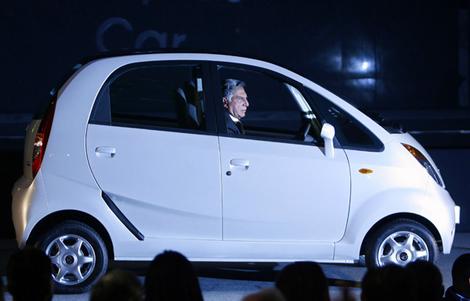
Violence is becoming more prevalent as Indian workers protest against their lot – usually over the transfer of agricultural land to industry and property speculators (which has finally led to Tata Motors moving its Nano car production out of West Bengal).

But not for many years has the ceo of a business been killed by angry workers (in the past there have been killings on tea estates in the north-east). Yet that is what happened on September 22 in Delhi’s satellite city of Noida, when Lalit Kishore Chaudhury, the chief executive of Graziano Trasmissioni India, an Italian auto parts company, was beaten to death at his office.

A dreadful tragedy for Mr Chaudhury’s family, the killing is also a blow for India’s image abroad. “Is this what happens when executives upset their workforce,” company headquarters overseas will be asking. “Is there no police protection quickly available when situations become violent?”

Yet  Oscar Fernandes, India’s Labour Minister, chose yesterday to criticise foreign managements in remarks widely reported this morning.  “Indian govt backs workers who killed boss” was the headline on the AFP news agency story.

“This should serve as a warning for the managements,“ he said.

“It is my appeal to the managements that the workers should be dealt with compassion. There are disparities in the wages of permanent employees and contract workers. The workers should not be pushed so hard that they resort to whatever happened in Noida.”

That was crass, and surprising coming from an experienced (Congress Party) politician. We have not yet heard what the problems were at Graziano that led to such a serious labour dispute and Monday’s extreme violence – but, whatever they were, Mr Fernandes could have done better. He made a valid point about gaps between wages of contract workers and permanent employees, but yesterday was not the time to say it.

He has now been firmly criticised by top businessmen and industry federations, and has apologised. More than 100 people have been jailed, some charged with killing and others with rioting.

But that is not the end of the affair. It appears that the company warned the government about its labour problems that have been rumbling for nearly a year, and apparently received no help. So what till recently seems to have been a successful auto parts company, part of the Oerlinkon Graziano group, has been seriously let down.

Foreign companies will have learned of another peril of investing in India.

Posted by: John Elliott | September 22, 2008

“Family Silver” at risk on Hyderabad metro project

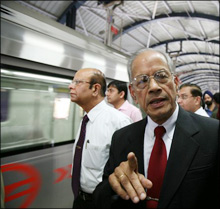
At last a top official has spoken out about a possible land scam, blowing a whistle (almost) before it allegedly happens. The Economic Times reported on September 21 that E. Sreedharan, md of the Delhi Metro , has alleged that there is a possible land scam on the proposed Hyderabad Metro railway project. He also expressed concern about the slow progress of the Mumbai metro.

Both projects are build-operate-transfer (BOT) partnerships with private sector companies. In a letter earlier this month to Montek Singh Ahluwalia, deputy chairman of Planning Commission, Mr Sreedharan (seen below right) cautions against using the BOT deals for building metro railways.

..................................

…………………………….

On a BOT project, the developer bids for and obtains land for the project, which he then builds and operates, usually for about 30-35 years, and then transfers ownership back to the government.

Update September 23 2008: The Andhra Pradesh State government has refuted Mr Sreedharan’s allegations about the Hyderabad Metro. It has demanded an apology and threatened legal action. But local community groups and some politicians have supported Mr Sreedharan and repeated the charges. Mr Sreedharan’s Delhi Metro has been a consultant on the project but that ended on Sept 23.

The problem – illustrated by Mr Sreedharan’s allegations – is that developers frequently ask for far more land than is needed for a project so that they can make massive profits out of land development and speculation, cashing in as the project pushes up surrounding land values. That was clearly why so many companies were interested in developing Delhi and Mumbai airports, and why so many rushed last year into Special Economic Zones (SEZs).

The Economic Times quoted Mr Sreedharan’s letter:

“The Hyderabad Metro project is being cited as a successful example of BOT approach. Here, I would like to caution that the example of Hyderabad Metro is quite misleading as the negative viability gap funding has resulted solely on account of 296 acres of prime land being made available to the BOT operator for commercial exploitation.

“This is like selling family silver. Apart from the fact that this might lead to a big political scandal sometime later, it is apparent that the BOT operator has a hidden agenda which appears to be to extend the metro network to a large tract of his private land holdings so as to reap a windfall profit of four to five times the land price”.

He also criticised the Mumbai Metro for “moving at an extremely slow pace” – a hint that the developer is not primarily interested in building a railway:

“World-wide the experience has been that no metro project has succeeded so far on BOT basis. …Our sole example of Mumbai Metro-I has not given us the required confidence in the BOT route”.

The Mumbai Metro is a joint venture between Reliance Infrastructure, controlled by Anil Ambani, and the state-owned Mumbai Metropolitan Regional Development Authority (MMRDA).

The Hyderabad project has been won by a consortium led by Maytas Infrastructure of Hyderabad, with the state government only having an 11% stake. The formal concession agreement was signed last Friday . It seems to have been a controversial decision, with Mytas and its partners defeating foreign companies that have vast metro experience.

Update December 26, 2008:  Maytas is controlled by the Raju family, which also controls Satyam, a leading software company. The Rajus  have run into corporate governance trouble for trying to get Satyam to take over Maytas (Satyam spelt backwards).

Update July 8, 2009:  Maytas Metro contract cancelled following fraud scandal collapse of Satyam in January 2009 .

Mr Sreedharan speaks with authority, having built and run the fast-expanding Delhi Metro on time and within budget. That is a wholly government-controlled project, and it shows what governments can achieve if they hire efficient and non-corrupt top officials.

Let’s hope Mr Alhuwalia, who has special responsibility for infrastructure development, listens to him, and looks into projects where more “family silver” may be lost.

Posted by: John Elliott | September 21, 2008

Islamabad hotel devastation “a battle for the soul of Pakistan”

Symbolically,  the devastation last night of Islamabad’s Marriott Hotel by a massive truck bomb is one of the worst events to happen as the battle between the Islamic militants and the Pakistan establishment escalates. More than 50 people died and over 200 were hurt

For years the Marriott – earlier a Holiday Inn – has been a landmark providing some sort of normalcy in an increasingly dangerous country. With splendid views of the green Margalla Hills, it has for decades been a regular for foreign visitors, even though it has been hit by bombs twice in the past. Many foreign journalists have stayed – I was there with my family in the 1980s, as well as on many work assignments before and since. It seemed a fixture on the Islamabad landscape.

Reports suggest the bombers’ real target may have been the prime minister’s residence nearby, where President Asif Zardari was having dinner with ministers, but the truck driver saw massive security cordons and drove a few hundred yards to the Marriott instead. Others suggested it was because there were CIA officials staying in the hotel.

Earlier Zardari had made his first speech to the parliament, pledging to fight terror and not talk to those who perpetuated it. The bombing was a devastating answer to that.

Coming just a week of bombs hit three markets in Delhi, and following other attacks both in northern Pakistan and other Indian cities, this demonstrates how this region is being targeted by militants who originally fought their battles in the West.

India has a strong democracy and economy to help it weather such attacks. Pakistan does not – it has never had enough stability to develop either in its 61 years of independence. That is why the Marriott attack is significant.

A BBC report last night  on the blast from Syed Shoaib Hasan in Islamabad had an emotional but graphic conclusion about the war between Pakistan’s militants and government:

“It is no more a stop-start battle of wavering ideals. It is now, without doubt, a battle to the death for the soul of Pakistan”.

Posted by: John Elliott | September 20, 2008

India opens up for The Economist, Time, Newsweek, Fortune and others

At last the Indian government has begun to take a sane approach over foreign news publications being allowed to publish and print in the country – it announced on Thursday that foreign news magazines can come, though sadly not yet newspapers.

Previously this has been blocked by vested interests in general news and current affairs publishing that have not wanted to face India-based foreign competition for readers, advertising and staff in either newspapers or magazines. (Foreign general interest publications have been allowed for some time.)

Those vested interests are mainly big publishing houses such as the Times of India’s Bennett Coleman group, plus one or two more ideological lobbyists such as N.Ram of the Hindu group, and the political Left.

The reason (excuse would be a better word) has been that Indian minds should be protected from such foreign influence – an insulting idea at any time, and a nonsense in an era of rolling international tv news and the internet.

As a result, till this week, foreign news publications could only publish and print facsimile copies of an edition published abroad. This has meant that they have not been allowed to insert Indian advertising into a local edition, which has made such editions financially unviable. The alternative has been to produce a new publication, with a maximum 26% foreign direct investment (FDI) but with only 20% of the editorial content from abroad.

Consequently most stayed away, with some exceptions, as people tested the policy.

Three foreign daily newspapers have appeared here in different forms, and one has failed:

– The Asian Age and Deccan Chronicle group has been publishing a slimmed down version of the International Herald Tribune for some time from Hyderabad, basically busting the policy but uninterrupted by the government which did not seem to know how to stop it.

– The India Today group last year launched Mail Today with 26% FDI from publishers of the UK’s Daily Mail, producing a lively look-alike of the UK product, primarily with local content but with some from the UK.

– The Wall Street Journal has helped (without any FDI) to produce the HT Media group’s excellent business daily, Mint, which was launched last year with restricted content from the Journal and has raised the bar for Indian standards of business journalism.

– The Financial Times tried from the mid-1980s to establish itself – first through a relationship, and then a 13.85% equity stake, in the Business Standard. It also tried to print a foreign edition. But it was blocked on both counts by supposed-friends as well as foes.

Among magazines, Fortune and Forbes have both been in talks for a year or so with Aveek Sarkar of Calcutta’s ABP (Anand Bazaar Patrika) group and TV-18’s Network-18 group to produce their publications. Till this week, these would have had to have 80% local content and different titles, and it would have been extremely difficult for them to produce magazines that matched their US versions.

That will now change. The government’s statement said that news magazines editorial “content would be allowed to be up to 100% identical to the foreign magazine concerned and the India publisher would be free to add local content……and local advertisements.” Foreign titles are also being allowed.

That dramatically changes the commercial viability of opening up in India, even though some of the old rules will still apply – the publishers will have to be Indian registered companies holding no more than 26% foreign equity, with the businesses and editing run primarily by Indian nationals.

So Fortune and Forbes can use their foreign titles and have as much foreign content and local advertising as they like.
 
Watch out for The Economist, Time, Newsweek and Business Week moving in too. Some will editionalise for India. Others, presumably including The Economist that produces the same edition (slightly rearranged) all over the world, will not.

I wonder if this would have happened if the Communist-led Left Front were still supporting the Congress-led government! They were a front for commercial interests and have lost their clout.

Freed of those shackles, the government announcement said: “The decision will provide Indian readers access to foreign magazines at cheaper rates in comparison to the same magazines imported at much higher rates. The Indian reader would be benefited immensely as he/she would be able to keep abreast with the latest events and happenings on the global scale”.

Isn’t it amazing that the government has suddenly discovered this! The next step should be to allow foreign newspapers – soon.

Posted by: John Elliott | September 17, 2008

Posco on a learning curve about India’s “social process”

ORISSA: I was talking on the phone this morning to Kamal Nath, India’s Minister for Commerce and Industry, about the $12bn integrated steelworks planned for Orissa by Posco of Korea. I am writing an article about Posco’s problems – the project is running at least 18 months behind schedule and construction will probably not start till early next year, so I wanted to hear Mr Nath’s view.
 
He made an important point: “This is one of the flagship foreign investment projects in the country but in India one has to weave one’s way through the procedures. That is not just a legal process or a financial process – it’s a social process.”

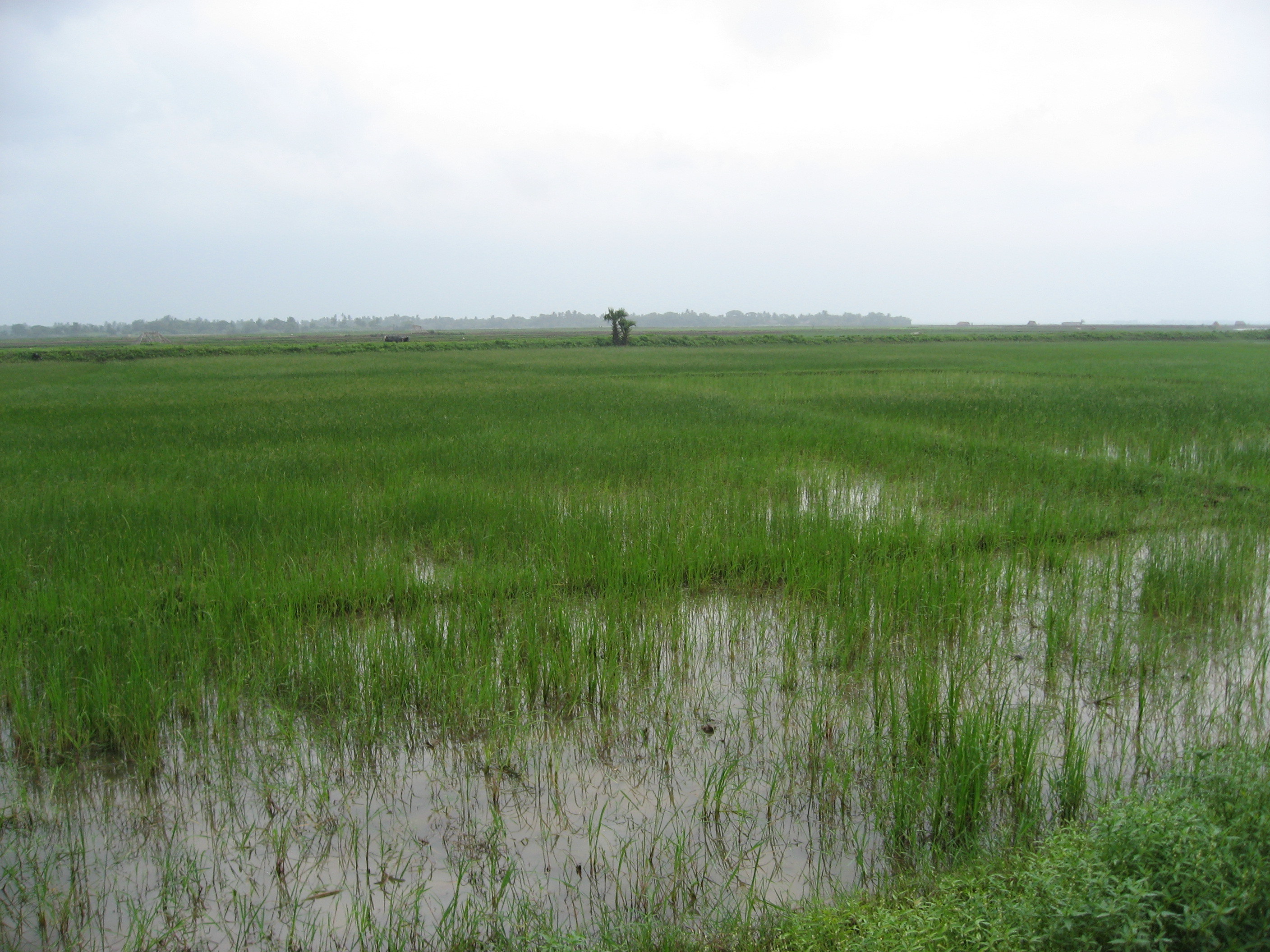
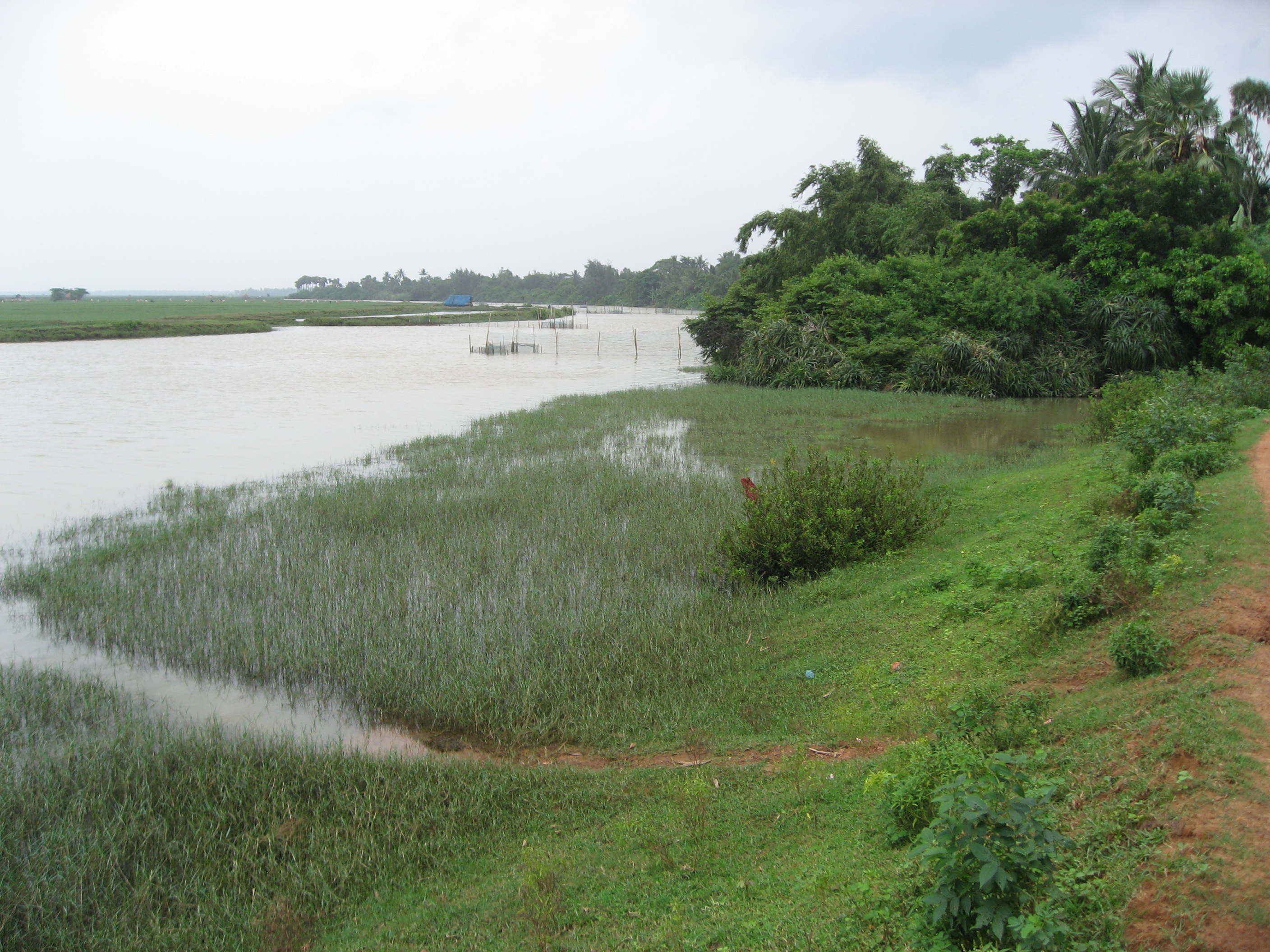
The Posco site at Paradip in Orissa

The Posco site at Paradip in Orissa

He added that “in a democracy all the stake-holders have to have a voice – and in India they have a particularly loud voice – so Posco has been through that learning curve”

Posco has indeed been on a steep learning curve since it signed an agreement in June 2005 for the project, as I discovered when I visited the company, and the site, in Orissa a few days ago.

It came to India looking for iron ore reserves and downstream customers to bolster its position as the world’s fourth largest steelmaker. It expected to move ahead quickly with the first ever integrated project undertaken on a greenfield site by any steel company outside its home country – and the biggest-ever foreign direct investment in India.

Instead, it has found itself mired in a mass of seemingly interminable delays – similar to those that have hit Lakshmi Mittal’s Arcelor Mittal projects in Orissa and Jharkhand. Posco is still waiting to get access to most of the steelworks site at Paradip – where staff have twice been briefly kidnapped and one protestor was killed during a violent demonstration at Dhinkia village – and to its proposed mining area .

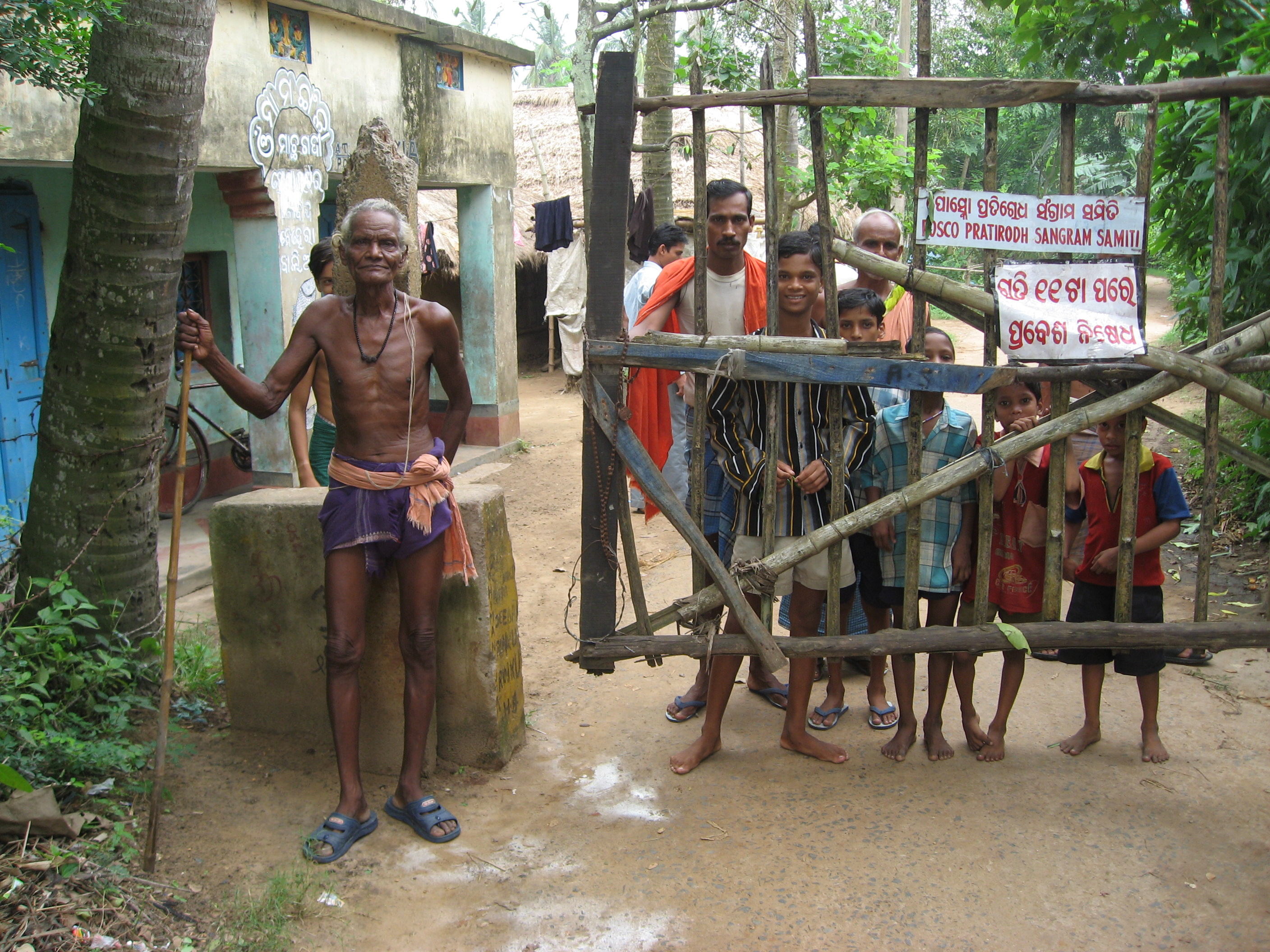
Villagers block entry to Dhinkia village on the Posco site

Villagers block entry to Dhinkia village on the Posco site

 Some progress was made last month when the Supreme Court authorized moves that will lead to it getting its land, but the delays continue.

It’s not just foreign companies that have been on that learning curve. Mukesh Ambani’s Reliance Industries (RIL) and others learned last year that they couldn’t steamroller SEZ projects through unwilling land owners. A Mumbai court has said there should be a referendum of 4,000 landowners on Reliance’s proposed site. The company is appealing against the order, but (updated Sept 21) villagers are being formally asked their views in a referendum-style survey. This is a good example of Mr Nath’s “social process” at work – the first trime it has happend in India

The Tata group is facing similar problems on its Nano car site in West Bengal and a steel project in Orissa. (It’s not turning out to be a very good year for Tata. It has also got environmentalists, led noisily by Greenpeace, opposing its plan for a port on the Orissa coast at Dhamra which is likely to disturb rare Olive Ridley turtles – a fact Tata is loath to accept). And it’s ironic that Mr Tata, who is chairman of the government’s Investment Commission that has been helping companies like Posco and Mittal, can’t ease Tata Motors’ plight.

It is easy to dismiss the Nano site row as a political battle between West Bengal’s ruling Left Front government and Mamata Banerjee’s Trinamool Congress, with Tata Motors cast as the unwitting victim. But that is too simple. There are questions about how much land Tata and its component suppliers actually need, which is not surprising given that many land developers in the past have often bought cheaply and then not used all their land for the designated purpose. That is what rightly arouses resentment among rural communities.

In many parts of the country there are empty sites where the poor should and could still be living. Tata Steel has one at Gopalpur in Orissa, where it hoped to start a steel plant on 3,000 acres in the 1990s but abandoned it in 2000 (partly because of local opposition) – it is lying idle awaiting Tata’s latest idea for an SEZ.

the Posco site alongside Dhinkia village

the Posco site alongside Dhinkia village

What is happening to Posco, Tata and Reliance now is actually good for the long term, even though it is causing the companies short-term problems and causing regrettable social disturbances and deplorable killings. The system for using agricultural land for industry has to be improved so that land owners and others who live and work in rural areas are not just swept aside.

As Mr Nath said, all stake-holders have to have a voice – and in India they have a particularly loud voice. Posco has learned that, and is now doing its best slowly and gradually to win local support.

Posted by: John Elliott | September 11, 2008

America’s payback for India nuclear deal begins

It hasn’t taken long for India to publicise its intentions to reward the US for help in getting the nuclear deal between the two countries through the International Atomic Energy Authority (IAEA) and the 45-nation Nuclear Suppliers Group (NSG) in the past few weeks.

As the deal enters its final stage of gaining approval from the US Congress, India’s External Affairs Ministry has this afternoon issued a statement saying:

“Government is taking steps to realize commercial cooperation with foreign partners in this (civil nuclear) field.
We have informed the USA about our intent to source state of the art nuclear technologies and facilities based on the provisions of the 123 (India-US) Agreement from the US.
Government is also moving towards finalizing bilateral agreements with other friendly partner countries such as France and Russia.
While actual cooperation will commence after bilateral agreements like the 123 Agreement come into force, the Nuclear Power Corporation of India has already commenced a preliminary dialogue with US companies in this regard.”

The significance of that statement is not that India has started commercial nuclear talks with different countries but that it is already talking to US companies.

This is how it is going to be from now on with nuclear and defence deals. It is inconceivable that the US will not win any orders that it wants.

India’s defence minister A.J.Antony has been in Washington this week discussing orders and said US companies would have a “level playing field”, but the US’s Secretary of State Condoleezza Rice has made remarks indicating that she expects American companies to reap rewards.

Russia is currently India’s biggest defence supplier followed by Israel (which is reported to be about to receive India’s biggest ever defence joint venture order – worth $2.3bn – for Israel Aerospace Industries and Rafael to work with India’s DRDO research and development organisation on surface-to-air missile).

The US is determined that this will change. If an order that it wants is going elsewhere, it will surely step in to stop it with political pressure backed up by negative information and disinformation.

That has already happened on a $600m order for 196 Army helicopters that India cancelled last December, just as it was about to be placed with Eurocopter, part of EADS, the European defence company. The US was very miffed that the order was not going to Bell, part of Textron, and put intense pressure on India till the cancellation came through. The US spotted a flaw in the helicopter tests – Eurocopter had (stupidly it seems, with hindsight) sent a civilian and not a military craft for testing, but no-one worried at the time and it was a non-issue till the US made it one at the last minute. The US also made corruption allegations involving Indian agents – something that could be done on virtually every defence deal, but usually isn’t.

In the past, India refused to place defence orders with the US because of a fear that deliveries would be stopped if the US disagreed with Indian policies or military action.

That has gradually changed in the last couple of years and the US has secured some smaller orders for $960m Lockheed Martin (NYSE: LMT) Hercules military transport planes and a $50m amphibious warship. A $2bn order for eight Boeing (NYSE: BA) P-8i reconnaissance aircraft is being considered by India, and the US this week said it hopes to sell $170m Boeing Harpoon missiles.

But its biggest target is an order now pending for 126 multi-role fighter aircraft (MRCA) that Boeing and Lockheed are chasing with F-18s and F-16s. The competitors come from Russia, France, Europe (EADS), and Sweden, but it is inconceivable that the order will not go to the US. My guess is that the alternative is not for India to buy from someone else, but not to place the order at all.

The US cannot be quite so exclusive on nuclear orders – and it doesn’t need to be because there is a lot of nuclear work to spread around, with India expected to invest about $27bn in 18 to 20 new nuclear power plants over the next 15 years.

Russia is currently building two 1,000 megawatt reactors at Kudankulam in Tamil Nadu as part of a deal signed in 1988. Reuters reported this afternoon that Indian officials say the two countries would begin discussions on a multi-billion dollar deal to build four more nuclear reactors in Kudankulam – a deal that has been delayed till now because of the international nuclear restrictions on India.

But the US will make sure that its companies – especially GE (NYSE: GE) and Westinghouse Electric (even though it is owned by Toshiba of Japan) win orders.

That is the reality after the nuclear deal goes through. Does the US ever do anything internationally that (apart from securing oil) does not yield jobs and profits for US companies?

Posted by: John Elliott | September 6, 2008

Dynastic excesses make Zardari Pakistan’s new president

This surely is a case of dynastic politics gone mad. Asif Ali Zardari, who has today been elected president of Pakistan, has no political experience and no record of public service. Instead, he is widely regarded as one of Pakistan’s most self-serving and corrupt public figures – a reputation he earned as “Mr 10%” when Benazir Bhutto, his late wife, was prime minister in the 1990s.

The BBC this morning describes him as  “the most mistrusted politician in the country”. The Financial Times has recently reported that he was suffering last year from dementia and severe depression. When he looked like a possible prime minister after his wife’s assassination last December, a Pakistani businessman visiting Delhi told me it would “make Pakistan a more expensive place to do business”.

Dynasties are rarely good for a country’s political development. While individual family members sometimes provide stable political leadership, the automatic succession by relatives blunts the operation of democracies and can, as in Pakistan today, promote the wrong candidate.

While Rajiv Gandhi and Sonia Gandhi have both proved to be constructive leaders of India’s Congress Party, there are other more able politicians in the party whose rise to the top has been blocked – currently by the assumption that Rahul Gandhi, Rajiv’s and Sonia’s son, will soon be prime minister. This is not to say that Rahul Gandhi should not become a political leader, but that he should work his way to the top instead of being anointed.

Elsewhere in India, dynasties are booming as politicians at all levels bring their sons, daughters and other relatives into political life. Often this is done to protect the family’s illicit riches, and to sustain powers of patronage.

But I can think of no example in India to match the damage that Zardari’s dynastic assumption of power can do to Pakistan. His rise to the top began in the 1980s when he was a Karachi playboy, well known and popular on the polo party circuit. He came from a little known family based in the Bhutto family’s home area of  Larkana, and was selected by Bhutto’s aunt as a safe arranged-marriage husband.

People who knew him before his marriage say little against him. But his reputation has been in continual decline since then. In addition to widely believed allegations of corruption, he was also accused of authorising the murder of Benazir’s brother, Murtaza,  in 1996 – which, of course, he denied. He spent eleven years in jail on corruption and murder charges, but was released in 2004 as a result of US-encouraged talks between General Pervez Musharraf, the then-president, and Bhutto. The charges have now been waived. 

I under-estimated his rise to power after Bhutto’s assassination. In a blog titled Dynasty Brand Bhutto lives on in Pakistan, I suggested that Zardari’s chance of weakening the dynastic blood line had been offset by the installation of Bilawal, his and Bhutto’s 19-year old university student son, as chairman of the family-controlled Pakistan Peoples’ Party (PPP).

But Zardari cleverly had himself elected co-chairman, and has played a skilful political game. He has sidelined Bhutto loyalists in the PPP, while cashing in on his status in the Bhutto dynasty. That has led to his election today as Pakistan’s president – an event that was unthinkable just a few weeks ago.

Pessimists now fear that Zardari will play politics and promote his relatives to form a new dynasty, rather than leaving the elected government to govern. That would lead to chaotic and corrupt government at a time when urgent moves are needed to stem a rising tide of Taliban violence and turn round the ailing economy – inflation stands at 25% and the rupee is declining.

Optimists hope that he will work with the US (where he has built up some close links), and with Pakistan’s army, to tackle the Islamic militancy and improve relations with Afghanistan – and that he will back policies to tackle the economic crisis and harness foreign aid to develop the country’s poorest regions.

Nothing Zardari has done in his life so far justifies such optimism. The US and the army however have no option but to work with him. The alternative is another military coup.

Posted by: John Elliott | August 18, 2008

Don’t celebrate Musharraf’s resignation

The end of Pervez Musharraf’s reign as president of Pakistan is not something to celebrate. It has been inevitable for some months that he would have to go, unwillingly, but it is not necessarily going to lead to an improvement in the running of Pakistan’s government, nor in the security of the country and region.

The only justification for a military dictator to take over a country is if he provides better government than the leaders he replaced, and if he later hands the country back to democratic rulers who are better.

Musharraf has done neither. He began by governing the country better with liberalised economic policies, the empowerment of women, and attempts to improve education. But he leaves Pakistan a weaker democracy, with an economy that is failing to weather current international economic problems, and with a dire internal security situation.

The lawless tribal areas on the Afghanistan border have become a hiding place for al-Qaeda and Taliban terrorists, the strength of militant fundamentalists has increased disastrously in many areas of Pakistan, and the army is losing its authority. Musharraf failed to cope with these problems, partly because he spent too much time pretending to do what America wanted in its “war on terror”, while also pandering to local pressure groups.

Now he is being replaced by the same old feudal and industrial elites who mis-governed the country for most of the 1990s before he took over – Nawaz Sharif, who he ousted 1999, and Asif Ali Zardari, the widower of the late Benazir Bhutto who was prime minister before Sharif. Together these two politicians form a shaky coalition that has no common philosophy or policies beyond benefiting the politicians involved.

It would have been better if the politicians had linked up with Musharraf in a united government, but that was politically impossible. Consequently, Musharraf has been trying to hold onto office, no doubt fearing what would happen to him if he left. That has given Pakistan months of rudderless government during which the security and economic situations have worsened disastrously.

I believe Musharraf genuinely wanted to do better than the politicians who preceded him but that the problems became too big and, like all dictators, he didn’t know when to bow out.

But don’t follow the euphoria of the Pakistan stock market, where shares rose sharply this morning, and celebrate his going. The only good news is that the uncertainty about what he would do and how he would go has ended.

Mourn instead that another phase of Pakistan’s appalling post-independence politics has ended in a hideous mess, and that those who now lead the country are no better than those who went before and seem ill-equipped to grapple with current crises.

Posted by: John Elliott | August 14, 2008

Welcome to Riding the Elephant’s new home

 
Hi folks – welcome to Riding the Elephant in its new home and design (which I’ll probably change every now and again). It’s great that those of you who read the blog during the 15 months it was on Fortune.com have followed Elephant here – and good that others of you have found us for the first time.

As a journalist, India is a country that fascinates me. But it also sometimes horrifies, and that leads to a mix of what I hope are constructive posts.

In the early months last year, I infuriated some Indian readers (almost always those living abroad, and frequently in the US) because I dared to make negative comments on some aspect of the country and its icons. I think some of these readers deserted the blog – they certainly threatened to, and even told the editor to sack me – but I hope they’ll come back now, and that we can have a more open debate than was possible before.

My posts will not always be as long as the 700-800 word columns that I used to write – those columns are still available here – see below and in the side column. I’ll also probably answer comments – especially critical ones – which was not the system on Fortune.com

I’m currently on holiday in London (and Colombia later this month) so am not totally focussed on what is happening in India. Otherwise I would be commenting on three events – the long awaited Government help for the Bhopal gas victims (which might or might not help), the also-long awaited (partial) approvals for Posco and Vedanta’s mining projects in Orissa, and the crazy decision of the Mumbai authorities to make Marathi their official language.

More on all that later………………

Posted by: John Elliott | August 12, 2008

This Elephant has moved from Fortune.com

Elephants, an expert friend tells me, migrate seasonally looking for greener pastures. For this elephant it was a long season in one place – 15 months since I started my blog on Fortune.com in April last year.

But it came time to move on, and the Elephant has now migrated (elephants can move quite fast!) to its new WordPress home here on https://ridingtheelephant.wordpress.com  I’m not sure about greener though – it was good and rewarding in the old location, tended by editing mahouts in Fortune.com’s New York office who sharpened my intros, tidied up my English (yes, English), and caught errors. From now on, it looks like being me, unedited.

Mostly the blog has been fun. I can claim a few correct forecasts. One, just over a year ago, was that Vijay Mallya, the liquor “king” turned Kingfisher airline owner, would not let G.R.Gopinath’s dream of providing air flights for the masses survive long after he had bought a stake in Air Deccan, Gopinath’s budget airline.

Gopinath is now starting a separate air freight airline and deserves India’s congratulations and thanks for what Deccan did, even though Mallya’s hubris, and economic realities, have not allowed the dream to survive.

The warring Ambani brothers, who are using their companies – Mukesh’s RIL and Anil’s ADAG groups – to settle their irresponsible feud, have frequently appeared here. Recently Mukesh Ambani publicly displayed how ruthless he can be when he stopped his brother merging Reliance Communications with MTN of South Africa to form an international telecom player that would have been bigger than Mukesh’s businesses.

Whatever the legal rights or wrongs, that was a vicious and mean thing to do and should be taken as a warning by any international company thinking of doing deals with the brothers, especially Mukesh. On July 20, The Financial Times’ Lex column said “The family will now pay a high price for this behavior, since it pushes up the cost of doing business for all Reliance entities. The danger is that companies keen to do business with one brother start to fear vindictive behavior from the other.”

I’ve also written about many big multi-nationals such as General Electric, Boeing and Lockheed Martin. In India, the Tata group and its boss Ratan Tata have frequently appeared. One of the Tata posts sparked the most fury among Elephant’s readers, who snapped and snarled because I dared to say that Tata’s Taj hotels are not as good as they are cracked up to be (they often aren’t).

I also said I understood how Jaguar dealers in the US were doubtful that Tata Motors was the right home for that once iconic brand (the dealers have changed their mind – for me, the jury is still out). That post generated 196 comments – far more than any other. Many writers may have not read the post fully and were infuriated by isolated comments – some even demanded I should be sacked. Rational argument went out of the window and, judging by their silence since then, a few carried out their threats to boycott the blog.

I misjudged one Tata story – on the plight of rare Olive Ridley turtles on the Orissa coast. I wrote that Tata was running into trouble with Greenpeace and other environmental groups because the turtles’ nesting habits are threatened by the new port project at Dhamra. Sadly I was wrong. Greenpeace has failed to substantiate some of its accusations (which I queried) and, instead of building a broad-based campaign against Tata, has gone quiet. Other laudable and focused environmental campaigners seem to realize they have lost, now that port construction is well under way. This gives Tata a chance to prove its environmental credentials and ensure that everything possible is done to protect these rare creatures. I wonder if it will genuinely do so. Anyone who has ever seen the turtles crawl out of the sea at night to lay their eggs, and then slide back under the waves (as I have done on the Pakistan coast near Karachi), would want to do everything possible to preserve them.

There’s always a tendency, when writing about India, to suggest that events here are unique, which of course they are not. I realized recently that the behavior of India’s politicians – evident in last week’s confidence vote won by the government – was common in Britain 250 years ago.

Matthew d’Ancona, the editor of the London–based Spectator magazine, wrote in the Sunday Telegraph earlier this month about Gordon Brown, the beleaguered British prime minister [Gordon Brown is still up for it]  who he thinks has become “Namierite”. That is a reference to Sir Lewis Namier, an 18th century British historian, who argued that most political activity is explained “not by the power of ideas and ideals…..but by the complex interaction of factions and connections, the quest for personal advantage and naked careerism”.

In “The Structure of Politics at the Accession of George III,” Namier wrote: “Men… no more dreamt of a seat in the House in order to benefit humanity than a child dreams of a birthday cake that others may eat it… the seat in the House was not their ultimate goal but a means to ulterior aims.”

I’m not saying (before angry commentators rise up in fury) that Indian politics are stuck in the groove of 18th century Britain. I’m simply pointing out that politicians are the same everywhere (is the U.S. any better?). So congratulations to all the Yadavs, to Mayawati, to Jayalalitha, and yes, to perpetuators of India’s mushrooming dynasties. You are heirs to a great tradition!

« Newer Posts - Older Posts »

Categories