Posted by: John Elliott | December 29, 2009

Tharoor twitters on India’s clumsy visa curbs

Some politicians have an uncanny knack of saying the right thing publicly at the wrong time. Shashi Tharoor, a former top UN official who is now India’s junior foreign minister – and a famous Tweeter (as I wrote in September) – is a leading example. He only became an MP earlier this year and his new political career will probably suffer if he doesn’t curb his tweeting.

For now however, let’s praise him for pointing out how illogical the Indian government has been by clumsily toughening its tourist and business visa rules just because a suspected terrorist visited India several times over several years months on such visas.

.

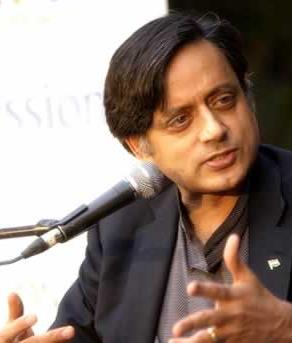
“R we going 2allow terrorists 2make us less welcoming?” Tharoor (left) asked, in tweet-speak on his Twitter page which has over 540,000 followers (readers).

“Imprt to recognize that security must not become an excuse 2change our cntry 4d worse…… Making it more difficult 2 visit India, return here frequently or stay long hurts large nbrs of innocents, costs us millions of$ & alienates……

“Dilemma of our age: tough visa restrictions in hope of btr security or openness &liberality to encourage tourism& goodwill? I prefer latter.”

According to reports, Tharoor was reflecting reservations in India’s External Affairs Ministry about the Home Ministry’s visa restrictions which, after weeks of muddle, seem to mean that foreigners holding long-term multiple entry visas must leave the country for at least two months every three months, and stay away for the same period if they leave voluntarily earlier.

The government has added that exceptions could be made for travellers who submit itinerary details to the visa authorities, but that would undoubtedly lead to endless hassles with India’s often obstructionist foreigners’ registration offices (FRROs) which are already overcrowded, inefficient and often unfriendly.

The restrictions have been suddenly introduced because a suspected terrorist, David Headley (or Daood Sayed Gilani), who has been arrested in America, travelled frequently to India on a business visa in the run-up to terror attacks in Mumbai 13 months ago. He allegedly also ran a small business in Mumbai. Other visa-busting cases include low-wage Chinese workers who have been employed on tourist visas. This all led to a knee-jerk reaction by the Home Ministry which introduced the new rules.

But the misuse of these visas by long-term residents has been widely known for years. When I appeared on an Indian tv news channel (NDTV’s 24/7) last week, K. Padmanabhiah, who was the home secretary in the 1990s, admitted he had known about long-stayers on tourist visas who went to the states of Nagaland  and Kashmir “to write books”. I suggested that since this proved the Home Ministry had known about the visas being misused for many years, there was no excuse for a knee-jerk reaction now.

Both the UK and US governments have complained, mainly about a lack of policy clarity and consistency. The US Embassy’s website talks about “inconsistent implementation of the new rule.”

These rules risk worsening India’s long-established reputation as an uncomfortable and unfriendly tourist destination where officials are more interested in hassling travellers and foreign residents than in smoothing out their problems.

The rules are also illogical. How will having to leave the country curb would-be terrorists, who can easily travel to a nearby country and operate from there or, more probably, bribe an Indian official to be allowed to return immediately? And why must a visitor leave for two months? Why not just apply for an extension?

As G. Parthasarathy, a retired senior ambassador, remarked on television yesterday, terrorists who attacked Mumbai last year did not come on visas, nor did others who staged earlier attacks and an aircraft hijacking.

In any case, what is point in introducing such restrictions in a country where the bureaucracy is so easily buyable – as Parthasarathy also said, corrupt officials even sell passports and “every policeman is on the take”.

Problems of harassment begin when would-be visitors try to obtain visas abroad. In the past  few months I have heard several stories of problems. One visitor says that India’s Paris and London visa offices do not require the same supporting documents, while others complain of endless delays.

A story from the UK tells of sheer misery of a young visitor who was inefficiently pushed around for nearly three weeks by India’s visa officials in London. An  internet application system did not work, an application was lost, officials gave conflicting messages, the applicant was told to contact the wrong office, a pre-paid courier service for returning the passport was not used, and the passport was almost returned to the wrong address.

Virtually every country of course treats visitors appallingly. I hear many complaints for example about how unhelpful and arrogant the UK’s outsourcing company in Delhi can be, and the US seems to do its best to deter visitors. In a Gulf countrya few weeks ago, an immigration official rudely tossed my passport back at me when I suggested that a $28 fee was high for a 36-hour stopover.

But that is no reason for a country like India, whose culture is to be open and welcoming, and which needs to develop its tourism and international business links, to behave as the home ministry is now doing.

Tharoor was right in what he said, though he was of course inadvisedly breaking ranks. As his boss said yesterday, he should air his comments within the government, not on Twitter. But let’s hope he survives so that he can continue tweetingly to mock irrational government.

Posted by: John Elliott | December 24, 2009

A Christmas message from the King of Bhutan

“The image of a shared planet must always be present in our minds – and especially in the minds of those who are in positions of leadership.    

“Only when we are willing to bear the embarrassment of being a little innocent will we be able to say – ‘Let us place the interest of humanity, not national populations and constituencies, above all else’ “……….    

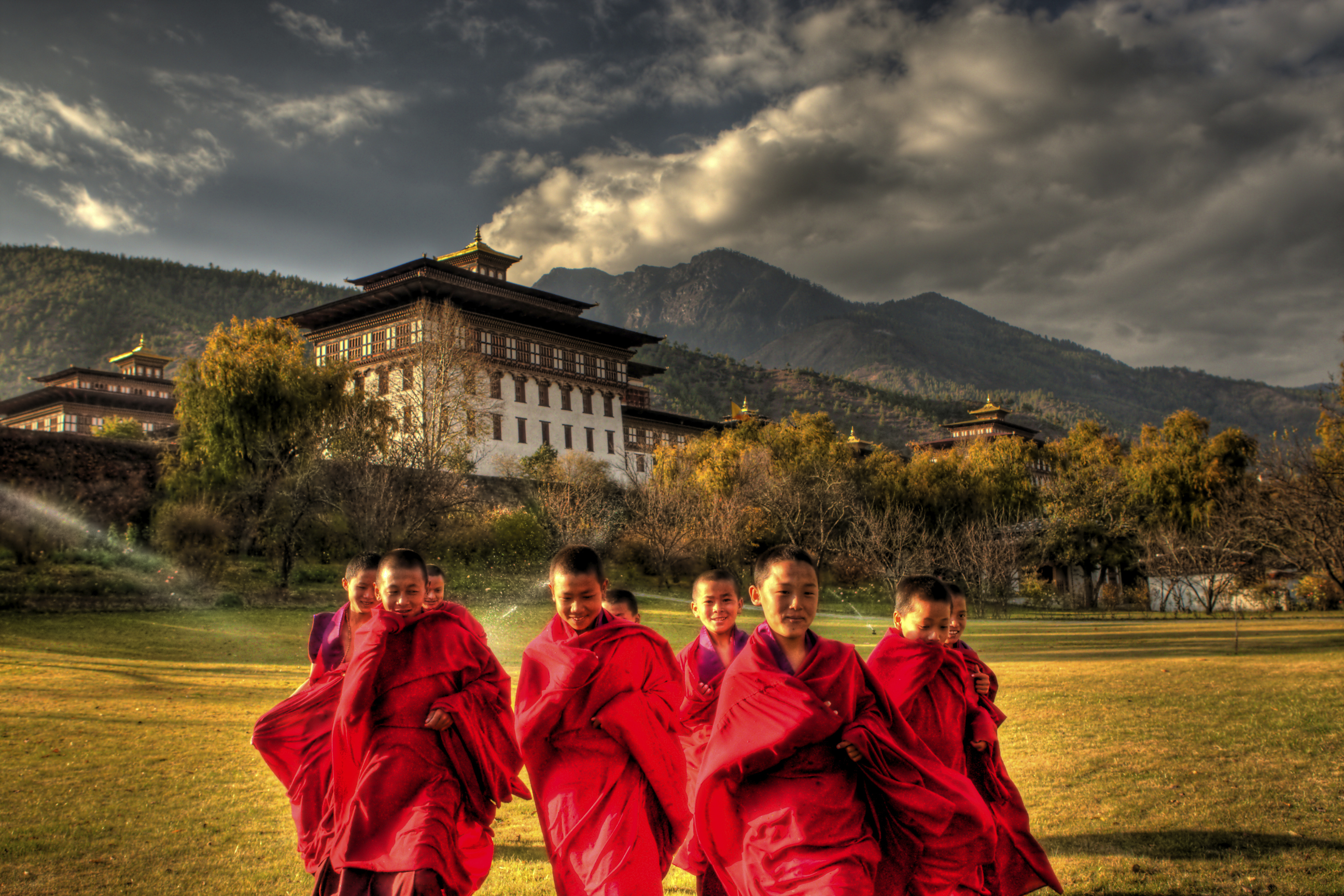
novice monks in Bhutan

   ………….King Jigme Khesar Namgyel Wangchuck hadn’t of course intended it to be a Christmas message when he spoke in Delhi last night   

This 28-year old Buddhist monarch was explaining the “development with values” goals of Gross National Happiness (GNH) that were set some 30 or so years ago by his father, King Jigme Singye Wangchuck.    

The then king’s aim was to try to keep the tiny Himalayan kingdom of Bhutan, which is sandwiched between China and India, as a peaceful, harmonious and independent nation – as he explained to me when I interviewed him 22 years ago.    

But it is a good message for Christmas from the King, who has been on a visit to India, and was giving a lecture titled “Changing World and Timeless Values” in memory of Madhavrao Scindia, a former Congress party leader.    

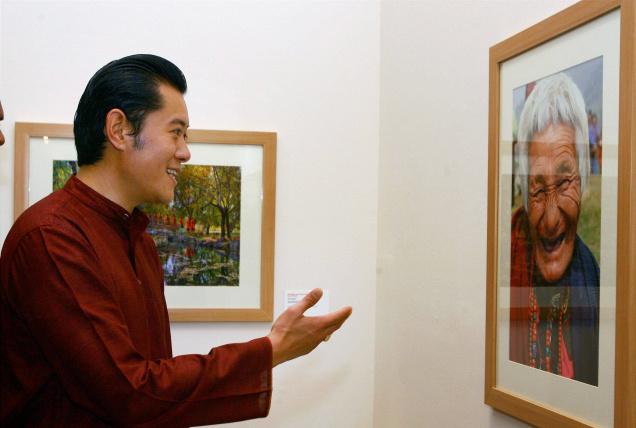
Bhutan's King looking at one of his photos yesterday

Earlier yesterday he opened an exhibition (left) of photos from Bhutan, many taken by him, including those above and below.    

In a neat turn of phrase coming just after the Copenhagen climate change summit, he added: “We need shared human endeavour not just negotiated change”.
 
“I believe that any real and lasting solution to global issues can only come through a universal wave of human empathy, desire and passion for the common good,” he said.   

“Governments might mediate problems at the global level, but its effects are felt by people, like you and me…….we tend to forget that in protecting our own constituencies, we jeopardize the world and thus ourselves and our own future generations…….Let us place the interest of humanity, not national populations and constituencies, above all else. Let us take political risks and strong decisions in addressing the needs of humanity.”  

 Merry Christmas! – John      


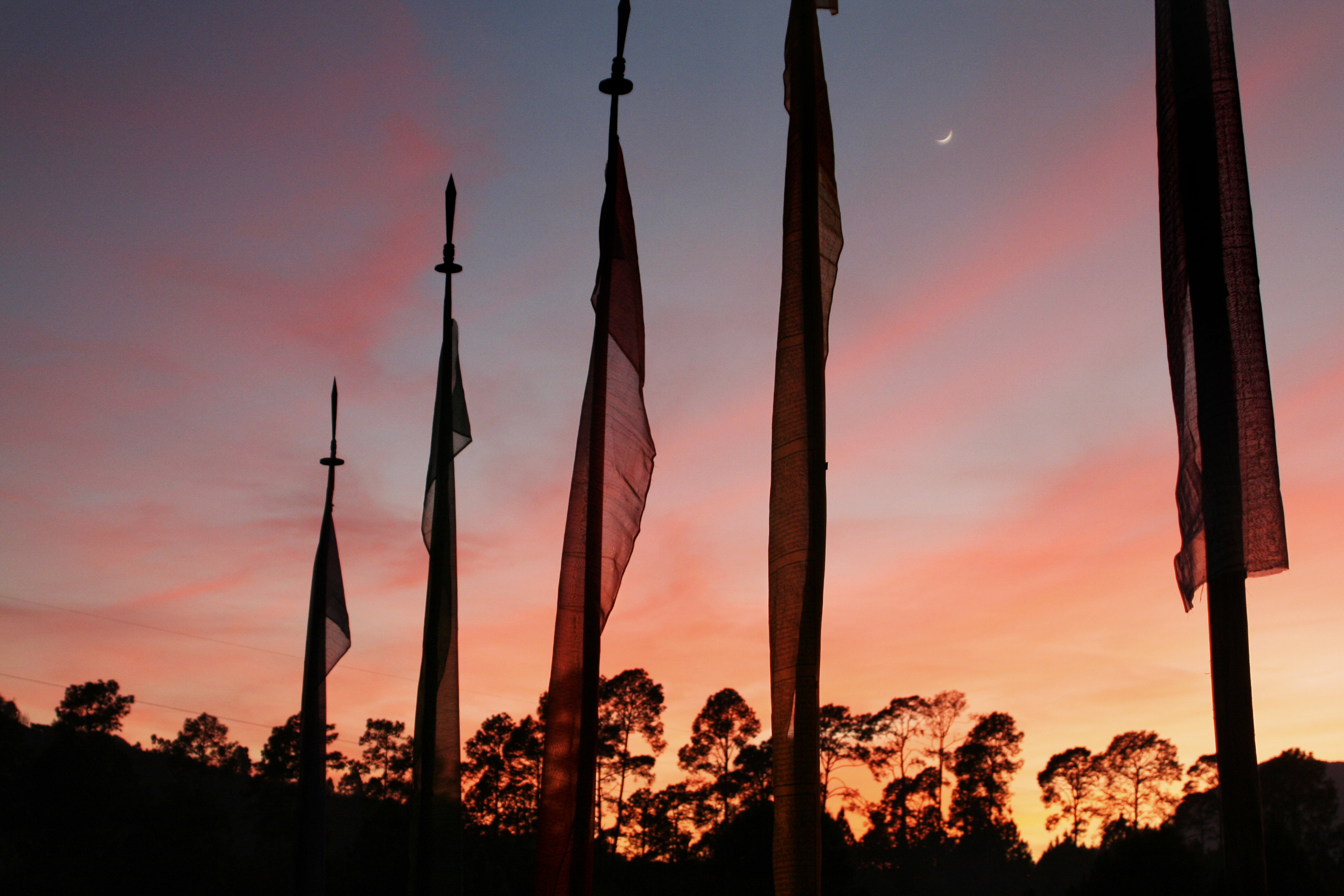
Buddhist prayer flags in Bhutan

Dec 26 – I have edited some of  the quotations above to bring them in line with the text of the King’s speech which is on Facbook  at http://www.facebook.com/profile.php?id=853040356&ref=ts#/notes.php?id=43817623259 – je  

Posted by: John Elliott | December 18, 2009

Hyderabad sinks from software to scams

India’s southern city of Hyderabad is becoming one of India’s most potent symbols of the greed and corruption that link politicians and businessmen. For the third time in a year, the state has been rocked by a crisis that exposes those linkages – this time over whether Andhra Pradesh should be split in two with the creation of a new state of Telangana based around Hyderabad (white area in map below).

This is a far cry from the glory and international fame of the past 15 or so years when this prosperous capital of the state of Andhra Pradesh became an international symbol of India’s dramatic growth in software, second only to Bangalore as a thriving location for information technology investment. Companies located there include Google and Microsoft, and Bill Clinton visited as US president.

The first of the state’s crises came a year ago with the collapse of Satyam, a leading Hyderabad-based software company that was owned by the family of its then chairman, Ramalinga Raju. The Rajus were closely linked with various politicians, including the state’s Congress chief minister, Y S Rajasekhar Reddy (YSR), who died in a helicopter crash in September, as well as his predecessor, Chandrababu Naidu.

Politicians are widely believed to have invested their black money in both Satyam and in Maytas Infrastructure, an associated company that received favours on contracts from the state government and drained funds out of Satyam. Both companies (Satyam has now been sold) are now being investigated for massive fraud, and Raju has been detained in jail since January.

Next came YSR’s sudden death and an immediate attempt by his politically inexperienced 37-year old son, Y.S.Jaganmohan Reddy, to become theief minister.

Businessmen like Raju came from Andhra’s coastal regions. They mostly belong to the Reddy and Kamma upper castes that must now be ranked along with India’s more famous business castes and communities such as the Marwaris of the north and the Chettiars of the south.

The Telangana people’s wish for some sort of constitutional identity has been around for over 50 years, and has been fudged and rebuffed by successive Indian governments. But last week (December 9) the central government gave way and agreed to create Telangana in order to end a fast by a local politician and activist, K. Chandrashekhar Rao (KCR), leader of Telangana Rashtriya Samiti, who was risking his life to revive his crumbling political image.

That humane but politically clumsy decision led to violent demonstrations in Hyderabad, plus resignation threats by about half the members of the legislative assembly. This paralysed the state government and sparked follow-on bifurcation claims from other states all over India.

But observers of India’s frequently muddled and confusing political scene need not fear any imminent Balkanisation of India’s 28 states. Having prevented the death of the fasting politician, the government is back to fudge, and hopes to stall the Telangana claims indefinitely, maybe even until the state’s next assembly elections in 2014. Meanwhile, other states’ claims to be split will be examined, and some may push ahead a little – but there is no crisis, despite blanket and over-excited media coverage.

Unlike most other bifurcation claims, the battle over Telangana is about wealth, not language or ethnic divisions, nor dramatic differences in geography. It would also the first time that the capital of a state has gone with the new entity – normally the breakaway has to start afresh.

The people of coastal Andhra have benefited economically since the days of British rule when there was extensive investment in irrigation, but the Telangana region lagged behind under the thumb of the Nizam of Hyderabad. When Hyderabad began to flourish in the 1990s as an IT centre, wealthy landowners from the coastal region flocked to the city to develop real estate and infrastructure projects, lining up with local politicians such as YSR and his cronies to secure contracts and licences. This is the wealth that they fear the creation of Telangana would put at risk.

The reputation of Hyderabad and Andhra has been severely damaged by this series of crises. It is causing concern among both Indian and international investors who had not known – or had ignored – the political-business linkages and scams.

The state now has an uncertain political future. The death of YSR has removed an able political leader who was an effective Congress chief minister. Now the Congress Party is split over who his successor should be, as well as over the Telangana issue.

Posted by: John Elliott | December 11, 2009

India to protect the environment from damaging development projects

“We are not going to compromise ecological security in the name of development……The Ministry of Environment and Forests is going to be quite fundamentalist on these issues” – Jairam Ramesh, environment minister

India’s energetic and enthusiastic environment minister has many critics, which is not surprising given his appetite for wading into controversies. As if his battles over India’s climate change policy (see my blog post two days ago) are not enough, he is now building up an assault on environmental approvals and wildlife conservation that will bring him up against tough and often rough political and business opponents who are accustomed to flouting regulations.

As I wrote in that post, Jairam Ramesh is India’s first non-corrupt, policy-oriented and knowledgeable environment minister for a decade. He is determined to clean up a ministry that has been allowing India’s environment and wildlife to be plundered and to decay in the ten years it has been headed by nominees from a regional Tamil Nadu-based party, the Dravida Munnettra Kazhagam (DMK). And he is backed by Sonia Gandhi, president of the ruling Congress Party, and Manmohan Singh, the prime minister.

“Not since Indira Gandhi have we seen so much positive focus on wildlife issues,” says Belinda Wright of the Wildlife Protection Society of India, referring to the country’s former prime minister.

Jairam Ramesh at Sariska tiger reserve, July 2009

Two announcements made by Ramesh on Wednesday (December 9) at a Wildlife Institute of India conference in Delhi underline how meticulous and tough he is hoping to be.

First, he said that he would not allow two coal-mining projects linked to an Adani Group 2000MW power project, and located 10-12kms from near Maharashtra’s Tadoba Andhari tiger reserve, to go ahead. Initial environmental approval (terms of reference or TOR) was granted last year, but the mines would be within a proposed buffer zone of the reserve. Sonia Gandhi took up the cause in August and Ramesh said on Wednesday they could not go ahead.

This pits him against powerful business and political forces. The Gujarat-based Adani trading and infrastructure group has notoriously strong government links (especially on coal imports where it dominates). Its power project is located in Gondia, the home town of Praful Patel, India’s business-oriented aviation minister, who has complained to Ramesh about the decision.

According to reports, Patel has said that while protection of environment is important, industrial development too was equally important.

Ramesh challenged that when he said on Wednesday, while referring to this project, “We are not going to compromise ecological security in the name of development……..The Ministry of Environment and Forests is going to be quite fundamentalist on these issues”.

He also intends to stop a 231km river-linking canal project between Madhya Pradesh and Uttar Pradesh. “I was shocked to find that Panna Tiger Reserve is involved in the Ken-Betwa river link which is the only project (on inter-linking India’s rivers) that has progressed so far,” he said.

When Ramesh was appointed in May, many observers assumed that his job was to speed up big project approvals, which have for years been hampered by often mischievous and corrupt environmental blockages. That speed-up has been an unfulfilled aim of the prime minister’s office (PMO) for most of this decade.

But Ramesh’s pro-environment approach is stalling or stopping several projects, not speeding them up  – so I asked him how he could explain this apparent dichotomy.

“No dichotomy,” he said in a quick e-mail reply. “Both the Congress president and the prime minister deeply concerned with environment and forest issues as well. Balance is crucial – sometimes it is a NO and sometimes it has to be a YES, BUT”.

That brief answer is packed with messages. He acknowledges the need to speed up project approvals, but is striking a balance between that and protecting the environment – as he showed in the remark about “not going to compromise ecological security in the name of development”. And, as I said, he has the backing of Sonia Gandhi and Manmohan Singh.

On Wednesday, he outlined some of his other plans:

–      Amending 1972 wildlife legislation early next year, which would include “steeply increasing penalties which are laughable” so that they match those in, for example, foreign e change and money laundering legislation. Also protecting biologists and other academics from the ire of “bad” wildlife officials.
–      Making wildlife management a more attractive civil service career, maybe by creating a formal specialisation within the Indian Administrative Service (an issue, he said, first raised by Indira Gandhi in 1972).
–      Providing state government’s with a direct stake in tiger conservation and the government’s 26-year old, but ailing, Project Tiger. Maybe by providing them with funds to boost the occupations and livelihoods of local people who are moved out of sanctuaries to nearby areas – possibly with the help of the World Bank.
–      Improve the handling of human-animal conflict, which currently often turns local people against wildlife conservation.

He also had some dire statistics to hand out. Of Project Tiger’s 38 areas, only 12 are in “relatively good condition” while nine are “satisfactory but could be better” and 17 are in a “very very precarious state”. Last year the government said the total number of tigers in India was down to 1,400, and that was probably an over-estimate.

World Bank project “institutionalised corruption”

Ramesh’s initiatives are welcomed by wildlife experts, apart from the possible involvement of the World Bank, which is condemned by many environmentalists in India. 

Belinda Wright  blames it for “financing the devastation of huge swathes of tiger habitat without any accountability or comment,” and adds: “Along with its fossil fuel projects, dams and highways, the Bank is not – and never has been – good news for the tiger”.

It does seem odd that India is bending to pressures to allow the World Bank to become involved in wildlife conservation. The Bank has no expertise that is not already available in the country, or that could be brought in from specialist conservation organisations abroad, and its record in forest management is dismal.

“The Bank’s forestry programmes in India single-handedly institutionalised corruption in the Forest Department, and took it took its eye off the ball as far as protection and forest management is concerned,” says one environmentalist.

As I mentioned in my post two days ago, Ramesh is sometimes criticised for being too prone to fall into line with the wishes of the US government. It would be a pity if that leads him to allow the World Bank into an area where it arguably is not needed – unless he can put together a cogent argument about why the bank’s involvement would be good for India.

Just saying, as some observers are doing, that Robert Zoellick, the World Bank president, is pushing for a role in India because he is personally interested in tigers,  is surely not enough.

Despite that controversy however, Ramesh has to be regarded as one of the main stars of the current government – and just what India’s environment needs.

Earlier posts on wildlife and the environment on this blog:
India to protect environment from damaging projects Dec 11, 2009
Jairam Ramesh sets pace on climate change and environment Dec 9, 2009
Serious contamination 25 yrs after Bhopal’s gas leak – new study  Dec 1, 2009
Posco on a learning curve about India’s “social process” Sept 17, 2008
Greenpeace targets Tata over rare sea turtles May 29, 2008
Demand from China kills India’s vanishing tigers Feb 13, 2008


“India has not caused the problem of global warming. But try and make sure that India is part of the solution. Be constructive; be proactive” – prime minister Manmohan Singh to Jairam Ramesh, May 29, 2009    

The debate in India about what to propose at the Copenhagen climate change conference has become a battleground about how open and go-ahead India should or should not be as it grows into an internationally significant economy.    

On one side are economic policy reformers who want India to adopt a positive leadership role, driving reforms that are good for both the country and for its stance in international negotiations. At Copenhagen, this means voluintarily making positive proposals to reduce damaging emissions, while refusing to accept legally binding targets or inspections.    

On the other side are officials (some retired) from the external affairs, environment and other ministries who want India to remain, old-style, on the fringes of international debate, irritatingly complaining about the the developed world’s faults while looking for hand-outs from  anyone who happens to pass by. Primarily they fear that US policies are aimed at impeding India’s economic growth. At Copenhagen, that would mean telling the developed world to put its climate change house in order before asking for much from developing countries, while also demanding substantial financial aid for climate change technologies.    

.

  Leading for the reformers, with strong backing from Manmohan Singh, the prime minister, and Sonia Gandhi who leads the ruling Congress Party, is a new figure in India’s ministerial ranks. He is Jairam Ramesh (left), India’s first committed environment minister in a decade who, after spending most of the past 20 years or so as a government adviser, has suddenly emerged as one of the main drivers of policy in India’s new government. In terms of energy and application he ranks alongside Palaniappan Chidambaram, the home minister, and Kapil Sibal, the human resources minister.    

Most of Ramesh’s ministerial predecessors over the past ten years or so have seen the Ministry of  Environment and Forests as a cash cow to be milked for their own and their political party’s coffers, and have had scant interest in developing or implementing policy.  

Ecology before Development  

Ramesh has changed that in just seven months, strictly applying environmental regulations to industrial and other projects instead of issuing approvals for the highest kickbacks, and trying to improve wildlife conservation and the ministry’s work in other areas.    

Speaking at a wildlife conference in Delhi this morning, he announced that he has rejected a coal mining project than would have damaged a wildlife sanctuary and said: “We are not going to compromise ecological security in the name of development”.  

On climate change, he relies on the support of Montek Singh Alhuwalia, a veteran government economics adviser who runs the Planning Commission, as well as the prime minister.    

In parliament last Thursday, Ramesh said: “On the international arena, when I took over as minister for environment and forests on the 29th of May, the prime minister’s instructions to me were: ‘India has not caused the problem of global warming. But try and make sure that India is part of the solution. Be constructive; be proactive’.”    

The speech, which is well worth reading, has become a focal point in the debate between the progressives and the rest.    

Ramesh began by stressing that it is in India’s own interest to tackle climate change, irrespective of Copenhagen, because of the country’s primary economic dependence on monsoons and massive potential damage from shrinking Himalayan glaciers and other factors.    

He then said that the Planning Commission had concluded that, since India’s emission intensity had declined by 17.06% between 1990 and 2005, it could do a 20-25% reduction between 2005 and 2020. He then hardened the 20-25% into a proposal, declaring: “My personal belief is that India must negotiate from a position of strength; that India must negotiate from a position of leadership.”    

That generated a stream of criticism, especially from retired senior government officials who act as negotiators in India’s Copenhagen team – there appears to be a generational divide on this issue with, for example, younger MPs backing Ramesh.  

Negotiators rebel  

Claiming they had not been consulted, two of the negotiators refused to fly to Copenhagen, and made sure that got into the newspapers, till they had received assurances from Ramesh that, among other points, the 20-25% was not to be binding. (A foreign diplomat said to me over the weekend that in the west they would have been removed from the team for breaking ranks!). There were allegations that Ramesh, who is reputed to be “pro America”, was doing what the US government wanted by bringing India into line.    

Consequently, India’s position at the Copenhagen is now in a muddle, which may not be cleared up until the prime minister arrives at the summit at the end of next week.    

Ramesh clearly does not have the respect of the officials, who presumably assume that his views – and maybe he himself – can be swept aside, as he has been before. This is the first time in a career of 20 years in the corridors of power, focused mostly on economic policy, that Ramesh has had the opportunity himself to deliver – and the problem with being an adviser for so long is that one is always seen in that role.    

I have always regarded Ramesh as an economic reformer with nationalist edges. I first met him in the mid-late 1980s when he was advising Abid Hussain, a member of the Planning Commission that was then being run by Manmohan Singh. In 1991 Ramesh was an adviser in the Prime Minister’s Office of Narasimha Rao as India’s economic reforms were unleashed. In 1996 he was in the Finance Ministry with the then finance Minister Palaniappan Chidambaram, acting as his adviser and office gate-keeper.    

After that, his jobs included representing foreign companies investing in India, and then heading the economic policy unit of the Congress Party and advising Sonia Gandhi. He held junior and not very influential ministerial posts for commerce and power in the 2004-09 Congress-led government.
 
Ramesh has suffered till now from neither being a member of India’s civil service nor having a political base, so he has been a soft target when his abilities, high personal visibility, ebullience, and sometimes arrogant lack of tact have eclipsed and annoyed older more staid players. That led him to be ousted from the PMO in 1991, and into many skirmishes since then, which continued in the 2004-09 government.    

Now, aged 55, Ramesh has come into his own, and the intellect and commitment that impressed Husain in the 1980s, and others in the 1990s, are coming to the aid of India’s environment.    

.

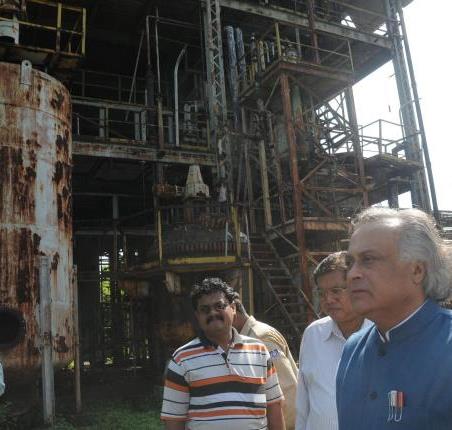
Ramesh watchers and critics are however waiting for him to trip himself up, as he did briefly when he visited the Union Carbide Bhopal gas leak site (right) in September and picked up some potentially toxic waste, saying “I’m still alive and not coughing”.    

In his parliamentary speech last week, he gently advised some young MPs: “Do not be too bold at such a young age. It will create many problems for you. Go with the grain of conventional thinking before you become too much of an out-of-the-box thinker. Thinking out of the box in our country does not pay in the long run. You have to be in the box and occasionally get out of the box and come back into the box.”    

That seems to be a lesson he has yet fully to learn himself, so let’s see whether he finishes inside the box or out of it by the end of next week.
 
One thing is certain however. India will benefit enormously if he emerges from Copenhagen with the enhanced political strength that he needs to tackle India’s wider environmental problems – work that will upset far more powerful people and interests than a few semi-retired official negotiators.

BHOPAL: For a itetudy in government and corporate inertia and indifference amid massive human suffering, come to this stylish old central Indian city where, 25 years ago tomorrow (Wed) night, a gas leak at a Union Carbide pesticide factory (left ) led to the death of over 5,000 people and continuing ill health of over 500,000 in one of the world’s worst industrial disasters.

The site remains virtually as it was 25 years ago, with gaunt steel structures and dilapidated factory buildings still standing, as governments and pressure groups argue about what should be done to clean it up along with nearby chemical dumpsites. Court cases continue in India, the US and elsewhere, while Dow of the US, which has taken over Union Carbide, runs for cover.

The state government dreams of turning the site and decaying structures into a 70-acre Rs116cr ($23m) landscaped memorial “like Nagasaki or (New York’s) Ground Zero”, according to Babulal Gaur, a 79-year old Bharatiya Janata Party (BJP) minister (and former chief minister) who is responsible for relief and rehabilitation in the government of Madhya Pradesh, where Bhopal is the capital. The key structures (below) are the Sevin and MIC plants which  blew that night.

I interviewed Gaur this morning, and he told me that the factory site’s “soil is very clean and the water is very clean”. Any water problems in the area were caused by nearby Indian Oil petrol tanks (which are to be moved), not the gas plant. Health problems were caused by the poor living, as they usually do, in “unhealthy conditions”, not the by the aftermath of the gas leak. That reversed a statement he made five years ago that the then Congress Party state government was downplaying the effects and that the BJP “would hold Dow responsible”.

This supreme example of a politician in denial was confounded three hours later when a new independent report was published, which alleged that there is far greater contamination from 1984 than had been previously expected on both the site itself, and in nearby residential areas’ groundwater.

Published by the Delhi-based Centre for Science and Environment (CSE),  an independent organisation that specialises in pollution testing and environmental issues, the report   says that pesticides  and other dangerous cemicals are present at over 500 times Indian standard levels in some areas (see interactive website map).

The disaster happened on the night of December 2nd 1984, when water accidentally entered a methyl isocyanate (MIC) storage tank (right), triggering an uncontrollable chemical reaction and blasting a cloud of toxic gases across nearby slums. People died instantly, coughing and choking, while the gases burned into the survivors’ eyes and lungs to cause early death and ill health, with weakened immune systems and respiratory problems that now continue into a second generation.

According to official figures, some 5,000 people have died, though some estimates go as high as 30,000, while over 570,000 (and maybe as many as 1m) have suffered health disorders.

I came to Bhopal a couple of days after the disaster in 1984 to report for the Financial Times. There was a continuing acrid tang in the air. Bloated carcasses of dead animals lay in the streets, and funeral pyres were till burning. It rapidly became clear that the accident had happened because Union Carbide had tired of its Indian investment that had not come up to over-egged corporate expectations. Wanting to close it down, it had allowed safety standards and management control to decline disastrously, along with staff morale.

Dow, together with its Union Carbide subsidiary, denies responsibility for victims’ health or the state of the site, following an overall settlement reached in 1989 with the Indian government. The claims totalled $3 billion, but the Indian government settled for $470m (then worth 7.5 billion rupees) plus a further $43m that has still to be fully distributed.

Down the years, there have been many allegations of corruption and of other payments involving the Indian government and its agencies, state level officials and politicians, and Dow. Two years ago, Dow admitted it had been fined $325,000 by America’s Securities and Exchange Commission (SEC) because employees in India had bribed officials.  “We know that Dow subscribed to the BJP election funds,” Sathyu Sarangi, a leading Bhopal activist who runs a successful ayurvedic-based medical clinic for gas victims.

Today’s CSE report seriously undermines the state government’s apparent attempt to protect Dow by saying that there are no continuing ground and water effects, nor health problems, resulting from the 1984 leakage.

The CSE says that groundwater in areas up to 3kms from the site contains pesticides 40 times India’s acceptable standards. This contradicts reports by three government agencies that say there are no continuing serious effects. The CSE took test samples last month and says various pesticides (some not covered by government standards) are present in health-endangering concentrations.

Sunita Narain, who runs the CSE, differentiated between the government claiming that toxicity on and near the site was not acute, which might be correct, and the CSE’s claims that there is nevertheless chronic toxicity. “Of course, if you go inside the site, you would not die,” said Narain, “but if you live there for ten years, you will suffer effects”. These effects could not be assessed till more long-term studies were carried out.

The CSE’s findings will be partially corroborated and partially questioned in about ten days’ time by the Delhi-based government-controlled Central Pollution Control Board (CPCB), which took soil samples at the same time as the CSE on October 28, and also took water samples two weeks earlier. Among its findings are “very high” levels of chloroform in ground water.

Plans by both the state government, and local pressure groups to make the key structures a centrepiece of the memorial are questioned by CPCB officials have told me that they would have to be dismantled in order to clean the site. The officials also query state government plans to open the site to the public, which was planned for this week but has been delayed because (the government claims) of rules restricting its actions during a current Bhopal municipal election campign.

The CPCB officials say the site is still contaminated, including pools of mercury in some areas, despite 400 tonnes of waste lying around the site being moved into a warehouse in 2005, though the government has allowed local people (above, gathering wood) to roam the site for years.

India’s government wants to end the impasse on all fronts, partly for humanitarian reasons and partly so that Dow can rapidly expand investments that are currently curtailed and under attack by activists. However, the Madhya Pradesh state government is resisting Delhi’s attempts to set up an overall “empowered commission” to co-ordinate progress.

Part of the problem is Dow’s refusal formally to accept responsibility for what Union Carbide allowed to happen.

Sathyu Sarangi told me yesterday that a “compromise could be reached” if Dow, maybe without acknowledging legal responsibility, made provision for health damages and monitoring of patients, and agreed to clean up the site and surrounding areas, which it is resisting. “That would be some sort of compromise that we would consider”, he said.

However not all the activists are in a hurry – which is scarcely surprising since they have built a life-style around the disaster. Abdul Jabbar, a leading local activist, points out that it took India 90 years from the first mutiny (or war of independence) in 1857 to achieve independence. “We will wait,” he says.

‘A fine tribute to a class of journalists lucky to be around at the right time’ — British Journalism Review

.

One of the most frequently visited posts on this blog has been something that I wrote in September last year on Foreign Correspondent:  Fifty Years of Reporting South Asia, an anthology of more than 50 years of articles by members of the Foreign Correspondents’ Club of South Asia, where I was then the president, to mark the club’s 50th anniversary.

Amazingly, the post has drawn Riding the Elephant’s third highest number of direct hits (around 2,250),  after Nehru Was Lost For Years In A Trunk  (nearly 3,000) and Tina Ambani Pays Record $25m At Christie’s Indian Art Auction (almost 2,500) .

That’s a long-winded way of getting round to say that an updated edition of the anthology is now available in paperback (Rs450*).

It’s a unique round-up of India’s past 50 or 60 years of history, as seen by foreign correspondents through the years – selected by three of us who are current correspondents on the basis of being interesting, well written and informative reportage that provides a broad sweep of the sub continent’s history.

‘The book left me wanting more’ – Mint

We have added four articles to the hardback edition’s total of about 80. They deal with events in Sri Lanka and Pakistan, and the terrorist attacks on Mumbai a year ago, plus the assassination of prime minister Indira Gandhi in 1984 that we didn’t find in time last year.

It is sadly significant that the articles deal with South Asia’s increasingly serious security worries.

The article on the Mumbai terrorist attacks was written by a team of Wall Street Journal reporters led by Peter Wonacott and Matthew Rosenberg, graphically describing the horrific events. The good news is that there has not, so far at least, been a repeat of such an attack In India, and that the horror triggered the appointment of Palaniappan Chidambaram as India’s home minister – the first effective politician to hold the post for most of this decade.

The continuing decay of Pakistan was reported by James Astill of The Economist in February this year, when Richard Holbrooke, America’s not-very-successful (as is now apparent) special emissary to Pakistan and Afghanistan began to investigate the region’s problems. It is now becoming clear that Holbrooke is not the man for the job as Pakistan slides into deeper crisis, which is leaving a vacuum in Washington.

The last article in the book, by Emily Wax of the Washington Post, reported in May this year on the defeat of Tamil Tiger separatist-driven terrorists in Sri Lanka – and the dismal failure of the country’s Sinhalese-dominated government to pave the way for a permanent peace on the island.

This is a gloomy ending for our anthology, but it underlines the increasing risks and threats that the region faces alongside India’s growing economic success.

* The book is being published by Penguin India only in the Indian subcontinent, but some copies are emerging on international book-buying sites that will send anywhere in the world – to find them, search the title on Google.

Twice in the past week or so Manmohan Singh, India’s prime minister, has alluded to the poor state of governance in India’s states. In between those speeches, events in Karnataka, Jharkhand and Andhra Pradesh have graphically demonstrated how massive corruption and links between regional politicians and businessmen are turning state governments into gravy trains fuelled by extortion and fraud.

Coincidentally, they mostly have connections with iron ore and other mining licences and contracts that involve some of the most widespread corruption in the country. This is happening in areas where Naxalite rebels are gaining ground as the livelihoods of local tribals and other poor communities are disrupted. This points to the way that state government corruption is exacerbating India’s most threatening social issue and its most serious internal security problem.

“Sitting here in Delhi we can endlessly debate the qualities of national leadership,” the prime minister told the Hindustan Times Leadership Summit ten days ago. “But real change in India will come when we get the right kind of state level and local leadership – a forward-looking, modern and compassionate leadership that strengthens the foundations of our great Republic. The focus of the debate on leadership for building a new India should, therefore, shift to the States.”

Yesterday, at a World Economic Forum conference in Delhi, he repeated that there was “inadequate appreciation of the need to reform (governance) processes at state and local level”.

Just look at what has been happening in various states to see how far leadership is from what the prime minister rightly says India needs. There is of course widespread corruption in India’s national government, but it is not so pervasive as in some states.

Karnataka

In Karnataka, where India’s showcase IT city of Bangalore is the capital, two businessmen known as the “Bellary mining brothers” have caused a political crisis, now temporarily patched up, by undermining the power of the Bharatiya Janata Party-led state government’s chief minister. They have been trying to install ministers and top bureaucrats who favour their businesses.

In the past few years, Janardhan Reddy and Karunakar Reddy have become politically active and rich from businesses in and around the state’s Bellary mining town. They have direct links with national BJP politicians, especially Sushma Swaraj, who is a candidate to lead the party and become a potential prime minister in the future. Their riches are illustrated by a report that they have presented a Rs45 crore ($9m) diamond encrusted gold crown to a temple.  

Andhra Pradesh

The brothers have also had business links with Jaganmohan Reddy, son of Y.S.Rajasekhara Reddy (YSR), the chief minister of the neighbouring state of Andhra Pradesh, who was killed in a helicopter crash two months ago. The two families are not directly related (one is Hindu and the other Christian), but they come from a clan that dominates politics and business in the region. The joint businesses are reported to include large tracts of land and a steelworks. 

Since YSR’s death, his son has been trying to become chief minister of the state’s Congress-led government. Jaganmohan has had heavy backing from local businessmen who struck deals with his father and want to maintain their power over the state government. This is being resisted by the Congress’s national leadership, but the pressure has been relentless.

Jharkhand

In Jharkhand, one of India’s poorest and worst-governed states (hived off from Bihar in 2000), Madhu Korda, a former chief minister, has been arrested for alleged corruption ranging between $400m and $800m. This story illustrates the scale of money available in the states, especially from mining.

Born in a remote village, Korda was working as a labourer in iron ore mines and the metal trade till 15 years ago when he entered state politics. He became a state assembly member and minister in 2000, and in 2006 engineered a political crisis that brought down the state government and made him chief minister of a coalition for the next two years. Earlier this year he became an MP.

Assets that Korda amassed along with associates in those 15 years are reported to total some $375m and include mines in Liberia, South Africa and Thailand as well as India, plus bullion companies in Mumbai, a planned special economic zone near Delhi, many properties around India, and large-scale money laundering through Dubai and elsewhere abroad.

Much of his wealth came when he was mines minister from 2000, which opened the way for widespread extortion and bribes in what is one of the world’s most mineral-rich areas. One controversial project on which he is believed to have been paid well involved the Chiria mines that four private sector companies – Arcelor Mittal, Jindal Steel, Essar Steel and Tata Steel – wanted to wean away from government owned SAIL.

One report said he charged up to $400,000 to $4m (Rs2-20 crore) for signing a mining memorandum of understanding between the Jharkhand government and companies, and $6m-$16m (Rs30-80 crore) for recommending mining leases. Also similar amounts as “speed money”. 

That is in addition to daily collections through the region’s well known coal mafia on all loads travelling out of the area’s public sector mines that are reported to feed $3m (Rs14 crore) a month to the state’s chief minister.

When Korda became chief minister, Aditi Phadnis, a political reporter, wrote in India’s Business Standard newspaper that the state was “sitting on a volcano of left wing (Naxalite) extremism, pluralistic politics and enormous riches on account of natural resources”. She added that “efforts are now on to rig up an architecture that will restrain him from further damaging Jharkhand’s institutional structure”.

Whatever that “architecture” was, it didn’t work. The Naxalite threat has escalated, crime and lawlessness has increased, and Korda built on the riches he had gained while mines minister.

Tamil Nadu

My final example concerns the continuing story that I first reported in a post a year ago headed “India’s telecom minister ‘should be fired’ for a company’s 700% profits”. The minister is A. Raja, from Tamil Nadu, who last year allotted lucrative telecom licences to real estate companies that had befriended him when he was earlier environment minister – without tenders and at low prices valid four to seven years earlier. He belongs to the regional DMK party which is an important ally in India’s Congress-led government and he bluntly rejected appeals last year from Manmohan Singh to correct his ways.

In recent weeks the story has resurfaced, with calls for Raja to be dismissed as telecom minister – a job that Manmohan Singh reluctantly gave him for a second term after May’s general election.

When Pranab Mukherjee, India’s veteran finance minister, was asked about the case at the Hindustan Times conference, he obfuscated and said that “allegation of corruption does not mean that it is a proof of corruption” – which led to quiet sniggers in the conference hall.

What hope does Manmohan Singh have of getting his “the right kind of state level and local leadership” !

Posted by: John Elliott | October 31, 2009

Indira Gandhi – a flawed legacy 25 years after her death

Twenty-five years ago today, I was in Mussorie listening at lunchtime with other British journalists and diplomats to Tibetan refugee children singing to Princess Anne, who was visiting from the UK. The car drivers turned their radios on and heard the news – on Pakistan Radio – that Indira Gandhi, India’s prime minister, had been shot. We wondered if it was true, or did Pakistan Radio put such disinformation out every day? No phone or other communication links were available, but we all eventually decided it must be true and started a seven hour (or more, I forget) drive back to Delhi, our cars being plastered with newssheets mourning her death in towns on the way south.

U1697972

Mrs Gandhi electioneering in 1971

An era had ended. One of India’s most notable politicians and strongest leaders was dead, shot by her Sikh security guards, leaving a legacy that will long be debated but is generally regarded more negatively than positively.

Mrs Gandhi increased socialist economic controls started by her father Jawaharlal Nehru, and opened the doors to widespread corruption that leading politicians and bureaucrats now routinely practice day by day by.

She also sowed the seeds for both her own death and that of her son, Rajiv Gandhi, by encouraging a militant Sikh leader in Punjab and separatist Tamil activity in Sri Lanka. She also increased separatist sentiments in Kashmir.

If Nehru was greater than his deeds, as many people say, Indira was not as great as she should have been, and her deeds were more damaging than she probably intended.

Nehru’s controversial post-independence policies of economic centralism and peaceful relations with China are now generally regarded as well-meaning but misguided. Mrs Gandhi’s mistakes however are generally seen less charitably as the actions of an insecure woman, desperate to build power and relying too much on her malevolent power-hungry younger son, Sanjay Gandhi, who encouraged her to declare a two-year State of Emergency in 1975.

Strangely, Mrs Gandhi is seen more favourably abroad as a great though flawed leader who did her best to manage a massive poverty-stricken fractured country.

It is easy to catalogue her failings and the damage that she did to the country that she undoubtedly loved. Maybe she did not realise the long-term impact of actions that she took for short-term political reasons – more often than not stemming from her paranoia and concern about her power base.

But there was more to her than that. She tried more than any government before or since to protect India’s environment, which has been progressively plundered since independence in 1947, most recently by a series of corrupt environment ministers (until the current minister, Jairam Ramesh, was appointed in May).

Mrs G BBC pic

She is also remembered for strengthening the confidence of Indian women, and for her ability to reach out to people and to care – a gift that her daughter-in-law Sonia Gandhi, and her grandchildren Rahul and Priyanka, now display.

In her final years, she started tentative reforms to open up the economy and unravel the central controls that Nehru and she had put in place. These reforms were continued hesitatingly by Rajiv, who succeeded her as prime minister and was killed in 1991, and then by the 1991-96 Congress government led by Narasimha Rao (with Manmohan Singh as finance minister), and by subsequent administrations.

She also initiated (after a disastrous false start by Sanjay Gandhi) a very successful small car joint venture, Maruti, with Suzuki of Japan, which triggered a gradual modernisation of India’s engineering industry that is paying dividends now with the country’s internationally competitive auto companies.

Her legacy also lives on in other ways, 25 years after her assassination.

Internal and regional problems of the sort that Mrs Gandhi dabbled in for short-term political gain have expanded enormously and, judging by recent Naxalite developments in West Bengal, some politicians still play her dangerous game of trying to capitalise on the ambitions of rebel movements.

In foreign relations, India has moved on from its reliance on the old Soviet Union, which Mrs Gandhi described as a friend that had never let the country down. As was illustrated by a speech made in Delhi this morning by former president George W.Bush, India now straddles wider international relationships, especially with the US that has recognised its nuclear weapon status. Speaking at a Hindustan Times conference, Bush described that agreement, perhaps a little euphorically, as India’s “passport to the world”.

But India’s regional relationships have not grown out of the hegemony practised by Mrs Gandhi in South Asia. Here it is being outgunned by China, which is exacerbating border disputes between the two countries and raising the spectre of a short border war in 1962 that India lost.

Finally, the Nehru-Gandhi dynasty is firmly entrenched – a fact that was reflected in the vast number of large sycophantic advertisements placed in newspapers today by government ministries to mark the anniversary.

Sonia Gandhi controls both the Congress Party and the current government, and Rahul is preparing to take over. Such dynastic succession brings a form of political stability to India’s turbulent and fractured politics, but it also blocks the emergence of other leaders at the top.

Even worse, it has now spawned a cascade of dynasties across the country involving families that rarely have the Nehru-Gandhi family’s sense of service, but instead are primarily interested in maintaining wealth that comes from prestige, patronage and corruption.

This dynastic surge is partly both the cause and effect of a sharp decline in the standards of Indian politics that began in Mrs Gandhi’s time. Standards  have worsened enormously in recent years as personal greed has replaced politicians’ concern for the country – especially in regional parties, whose role expanded dramatically after the 1980s as Congress declined.

Posted by: John Elliott | October 29, 2009

“Incredible India” is a diversion from reality

My headline is not a comment on India in general, though it could be because of all the disasters and shortcomings that this amazing country does little to correct. It’s actually a comment on the country’s very successful “Incredible India” tourism advertising campaign, which has been running internationally for several years and has lulled the government and others into believing that Indian tourism really is growing successfully.

But it isn’t, despite the advertising campaign. I can remember the government talking about achieving 6m foreign tourist arrivals more than a decade ago yet, incredibly, they only grew from 2.2m in 1995 to 4.5m in 2006 and then to 5.1m last year – and a huge proportion of those arrivals are businessmen and overseas Indians visiting home, so are not genuine tourists.

When Raymond Bickson, managing director of the Taj hotels chain, presented these figures at a World Travel & Tourism Council conference in Delhi yesterday, he added dramatic rises to 10m in 2011, and 18m in 2016. Next year of course the Commonwealth Games planned in Delhi will inevitably boost the figures, generating more false self-congratulation, but who can seriously think the total will more than double by 2011 – unless of course slow preparations for the Games means that they are postponed for a year.

top_hedder trimmed

For a country of India’s size, with its massive potential for different types of tourism ranging from visiting old monuments to climbing maintains, these statistics are awful, especially when compared with China, which went from 20m foreign tourists in 1995 to 53m in 2008, , according to figures provided by Bickson. Singapore similarly rose from 6m to 10.1m while Mexico, Turkey and Ukraine had around had 22m-25m last year.

As Suhel Seth, a branding specialist, pointed out at the conference, India’s basic problem is that “tourism is seen as an elitist industry by those in power, not an employment and revenue generator”.

That indeed has been the problem for decades, but there are also other reasons – not least that the big tourism companies, especially hotel chains, are far happier building  splendid up-market hotels for the big-spending elite, than in tackling the lower end of the market. That is now beginning to change, not least with low-end Taj group hotels, but not enough to broaden the base of foreign tourist arrivals.

Then there is the biggest tourism deterrence – aviation – with mostly lousy airports and late flights. Sadly, but perhaps unsurprisingly, Praful Patel, the aviation minister, who should have been at yesterday’s conference, cancelled at the last minute –  presumably he was involved in post-assembly election manouvrings for his Maharashtra-based political party, the NCP.

If he had been there, he would have heard Bickson complain about the absence of a comprehensive civil aviation policy, about tough norms for granting international flight licenses, a ban on foreign airlines investing in the Indian airlines, the high cost of aviation turbine fuel, and inefficient airport infrastructure including a lack of aircraft hangars, hotels, and cargo facilities

But even worse than Patel’s cancellation was that of Kumari Selja, the minister for tourism, who also failed at attend. If she had been there, she would heave heard what are by now ancient calls for tourism to be given the status of an industry and improved infrastructure, for visas to be issued to visitors on arrival, and for a crisis management system on natural calamities and terrorism, plus other initiatives.

Kamal Nath, minister for highways, did turn up and usefully suggested setting up of a cabinet committee on tourism to co-ordinate policies and action between various ministries and departments. He also offered to improve road links to designated tourist spots. Jyotiraditya Scindia, minister of state for commerce, reiterated that tourism was a big employment generator and pointed out that unlike other sectors, for every single direct job it created, eight indirect jobs were created.

Branding IndiaThe conference was titled Energizing the Future, but I didn’t detect much energy, nor sign that India’s lamentable tourism record is about to change.

That is a pity because the Incredible India campaign generated interest and praise around the world after it was launched in 2002 by a team led by Amitabh Kant, a tourism ministry joint secretary. Kant had earlier been responsible for turning the state of Kerala into a leading international tourist destination, and he has written about his work in Branding India – An Incredible Story  that was published a few months ago.

But branding is not enough – widespread government action is required, and there is no sign of that.

« Newer Posts - Older Posts »

Categories