Posted by: John Elliott | August 2, 2009

Britain agonises about the futility of its war in Afghanistan

When I was in Britain in June, the country was consumed with a frenzy over how members of parliament had fiddled and fixed their expenses claims, sometimes illegally. I have been back again over the past month and again the country is deep in agonised debate, but this time it is over a much more serious issue – whether British forces should be engaged in a war against the Taliban in Afghanistan and, if not, whether and how quickly they can get out.

Britain’s basic problem is that its government, which has ruled for too long, is coasting erratically towards a general election due next year and is riven with internal dissension and personal rivalries. Prime minister Gordon Brown has hordes of critics and enemies and very few supporters, and he lacks the authority or charisma to assert any form of leadership on major issues (apart from the economic crisis where he performed well last year).

Afghanistan dominates the front pages of newspapers and tv screens. Helmand, a province that few in Britain would even have heard of just a few weeks ago, is on everyone lips, and just about everyone I have met has a view – predominantly that Britain should not have gone to Afghanistan in the first place, that the war is unwinnable because there is no definable victory target, that the government doesn’t know what it is doing, that troops are under-staffed and under-equipped, and that it is criminal that British soldiers should die there to no purpose.

The government has failed to lead the debate or events. Worry about a dire lack of helicopters triggered a war of words a few days ago between the army chief and government spokesmen. The government went to court this past week to cut financial compensation awarded to wounded soldiers just as dead soldiers’ coffins were flown home to emotional receptions. And London police were even banned from wearing badges supporting the British troops.

Nearly 200 British troops have been killed (more than in Iraq), and many many more have been injured since the western invasion of Afghanistan began after the 9/11 attacks on New York and Washington.

Gordon Brown argued a few days ago that the “tragic human cost” had not been “in vain”, and said how important it was to try to make the country ready for a general election later this month. He was speaking after a five-week military victory at Panther’s Claw in Helmand, where Taliban insurgents had been killed or driven away.

He claimed land had been made “secure for about 100,000 people”, that the Taliban had been “pushed back”, and that a start had been made on breaking the “chain of terror that links the mountains of Afghanistan and Pakistan to the streets of Britain”. He and others said that Panther’s Claw had housed camps training future terrorists as well as heroin poppy fields, and that, this time, the army would stay and hold on to the area, instead of moving on elsewhere, as they had in the past, allowing the Taliban to return.

But what Brown did not say is that Panther’s Claw is a tiny tiny part of a country and will no doubt be infiltrated again by the Taliban, and that (as one army commander admitted), the plan to hold on to the area means there will not be enough troops to mount other attacks.

Nor, of course, did Brown say that the Taliban has simply been driven elsewhere where fresh training camps will quickly be set up, and that flattening a few poppy fields scarcely has any impact on the drug trade. More importantly, killing Taliban fighters and terrorists does not reduce the number in the “chain of terror” that wants to attack Britain – it increases it.

It is scarcely surprising therefore that a poll in the Independent newspaper this week showed a majority (58%) believed that the war is unwinnable, with 52% saying troops should pull out immediately. By nearly two-to-one, the view was that the Taliban cannot be defeated militarily while 58% said the war was “unwinnable”. That compares with a poll in The Guardian earlier in July that had 42% wanting immediate withdrawal.

The tragedy is that the military campaign is futile. Afghanistan is a mountainous country that has seen off British and Russian invaders in the past, and it cannot be conquered militarily and returned to some form of stable government. It is splintered into too many ethnic and religious groups, whose interests are complicated by rival political factions, war lords and endemic corruption, and by the involvement of Pakistan, for such a simple solution. And the more Britain and the US fight the Taliban, the more they encourage young Muslims elsewhere to joint extremists groups and become potential terrorists.

Western politicians are now talking about building links with the “moderate Taliban” and of increasing development aid. That of course is laudable but it will not end this war that should never have started.

Eventually, Britain will have to withdraw, and America too.  But not before many more young soldiers lose their lives.

And the lessons? Attacking Osama bin Laden’s supposed Afghanistan bases after 9/11 was a logical act of revenge for America, but turning it into an eight-year war has been futile. The primary focus for attacking terrorism should be in Britain, and elsewhere in the west, so as  to reduce the risk of Muslim youth becoming disenchanted extremists and terrorists.

This post is also on the FT website at http://www.ft.com/cms/s/0/7b3658a4-80b9-11de-92e7-00144feabdc0,dwp_uuid=a6dfcf08-9c79-11da-8762-0000779e2340.html

and on Hong Kong-based http://www.asiasentinel.com/index.php?option=com_content&task=view&id=1993&Itemid=212 where there are more comments in addition to those below

Posted by: John Elliott | August 1, 2009

A Year of Elephant Rides – with over 50,000 hits

A year ago today my Riding the Elephant blog began its independent existence here after 15 months on Fortune magazine’s website.

Since then, there have been about 53,000 hits, or visits as they are called in web jargon, some on the old Fortune website posts that are now here on this blog – so thank you all for finding Elephant and for coming back.

I’ve written a total of nearly 80 posts on subjects ranging from India’s politics and Pakistan’s troubles to the Indian modem art market, the Jaipur literary festival, and Tata’s Nano car.

The consistently most popular has been a piece I wrote for Fortune in June 2008 on Tina Ambani, wife of Anil who runs one of India’s two warring Reliance business groups, spending a record $2.5m on a painting by F.N.Souza at a Christie’s auction in London.

Whether it is the Ambani or Souza name that pulls in readers every few days I am not sure, but the fact that an article on Mukesh Ambani, the elder of the two squabbling brothers, building an outrageously expensive multi-story home in Mumbai is the third most popular might provide the answer.

Second comes a piece on Jawaharlal Nehru period photographs. The pull there I guess is my mischievous headline – Nehru was lost for years in a trunk, which wasn’t quite true – find out why by clicking here.

The fourth is a promotional piece I wrote on an anthology of foreign correspondent articles that Penguin India published last year to coincide with the Delhi-based Foreign Correspondents’ Club’s 50th anniversary – (with a link to Penguin India for local purchases, or you can buy it from outside India).

After those four, the most popular have been a range of pieces that reflect the past very active year on the Indian subcontinent. While Pakistan has sunk into an ever deeper crisis, and the Sri Lankan government has defeated (for now, at least) the Tamil Tiger guerrillas, terrorist attacks have increased.

India has elected a new government that looks as if it is going to make a better job of running the country than the past stable but deeply divided coalition. The Nehru-Gandhi dynasty has emerged stronger from the election, and the country has been hit far less seriously than many others by the international financial crisis. The corrupt and bullying tactics of the country’s main communist party, the CPI(M), have at last led to it losing its 30-year-plus grip on the state of West Bengal and national politics.

Elsewhere, corruption rampages on in many areas of Indian life – mentioned explicitly or implicitly in stories here on subjects such as Satyam computers, highway construction, telecoms, aviation and foreign direct investment.

I was on holiday, mainly in the UK, for most of July and will not be back in India till August 7, so have not been writing as much as usual. But I’ll be back more frequently soon, with something almost immediately on Britain and Afghanistan, and then other planned pieces on privatisation and how some of the new ministers are faring.

So do keep reading – and please comment more. The main thing missing over the past year is a regular flow of comments!

I was planning to write a post last month (but was diverted by other subjects) about how the Indian government, led by home minister Palaniappan Chidambaram, seemed at last to be getting to grips with the spread of the country’s violent Maoist-inspired Naxalite rebellion.

Tough action was then being taken at Lalgarh, a tribal region just 100 miles from Kolkata (Calcutta), where there was a long siege till the rebels were driven out of the area by para-military forces.

In the past few days, however, there have been reports that show the task of controlling the Naxalite insurgency has scarcely begun. First there was news that the rebels had predictably drifted away from Lalgarh into nearby forest areas, belying reports that they had been defeated.

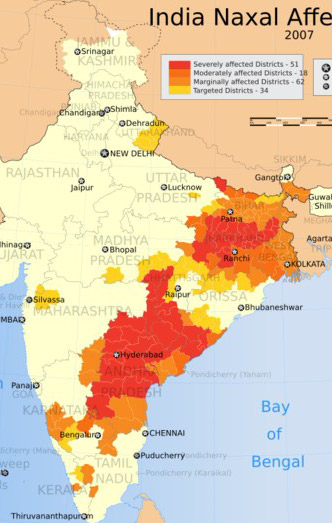
india_naxal_affected_districts_mapsvg_editedThen, last weekend, more than 30 police were killed in a remote Naxal-held part of the state of Chhattisgarh. First two police were killed, then many more when a truck carrying reinforcements was blown up by a landmine.
It sounds like an all too familiar story – terrorists moving on to new areas when under attack, as the Taliban have done recently from Pakistan’s Swat area, and security forces travelling by road when they should be in helicopters, which is why eight British soldiers were killed at the end of last week (and many more earlier) in Afghanistan.

The left-wing extremism challenge to India’s national security has previously aroused little real concern in the country – and scant notice overseas – despite the fact that there is some Naxalite activity  in more than 200 of India’s 600 administrative districts and that about half that number are seriously affected.

The rebels control large swathes of remote and often densely forested areas – especially where tribal people risk losing land to development projects – that stretch (see map) from the Nepal border down through West Bengal, Jharkhand, Chhattisgarh, Orissa and Andhra Pradesh.

This frequently threatens land communications between the west and eastern sides of the country because the Naxalites landmine roads and blow up railway tracks.

Last year they accounted for over 900 deaths. Prime minister Manmohan Singh dubbed them the “single biggest internal security challenge ever faced” by India – but few people seemed actively concerned.

I have always assumed that the reason for the complacency – both in India and terrorist-sensitive countries such as the US and UK – is that the Naxalites have never seriously attacked a centre of power.

There have been (unsuccessful) assassination attempts on state chief ministers, but they have not killed a prime minister, nor a national leader, as both Khalistani Sikhs and Tamil Tigers did in the 1980s and 1990s, nor have they mounted large-scale terror attacks on the capital of Delhi and the commercial capital of Mumbai as Islamic terrorists have in recent years.

The Naxalite areas are also a long way from Delhi, and from the focus of the country’s national politicians, who are primarily preoccupied with Kashmir and Pakistan to the north and west, and with the politics of western and southern states.

“Congress and the BJP devote little attention east of Bihar because the eastern and north-eastern states have few votes, or mostly vote for regional parties, so the Naxalite problem is not receiving the political attention it deserves from the cabinet,” says Ravi Visvesvaraya Prasad, who heads C4ISRT Group, a Delhi-based defence and security think tank.

And even when, as is happening now, the central government does try to take action, it is hampered by the fact that security is a state government subject, so cannot be directly tackled nationally by Delhi.

The problem is becoming more serious because the Naxalites no longer just focussed on remote jungle areas, but are threatening economic development and maybe even urban centres. They played a significant role two years ago in the opposition to a now-abandoned special economic zone at Nandigram in West Bengal, where they are exploiting a vacuum left by the CPI(M)-led Left Front that has ruled the state for over 30 years but lost seats in the recent general election.

It was clear when I walked around the Barrackpur constituency on the outskirts of Kolkata during the election campaign that there was massive resentment about the CPI(M)’s failure to develop the area and protect agricultural land, and about the way it manipulated elections to stay in power.

“We will have an armed movement going in Calcutta by 2011, that’s for sure,” Maoist leader Kishenji claimed in a BBC interview earlier this month.  “Oppression by the establishment Left and its police” at Lalgarh had given the Naxalites their first major base in West Bengal since the mid-1970s. “We have struck a place which is the weakest spot of the state and which automatically makes it our stronghold (and our) first major guerrilla zone,” Kishenji added. Though the area was freed by security forces after Kishenji made these remarks, the Naxalites are still active – they ransacked a CPI(M) leader’s house last weekend.

The insurgency started as a peasant revolt in West Bengal 40 years ago. It is significant that they are now back where they began – thanks largely to CPI(M) misrule. Resentment is growing both over the state government’s attempt to industrialise agricultural land that it had originally allocated to the rural poor under much-praised land reform – as happened both at Nandigram and Tata’s abandoned Nano car factory at Singur – and over the repressive and violent way in which the CPI(M)’s cadres maintain power.

Two years ago, India’s then ineffectual home minister described the Naxalite problem as “under control”. Chidambaram fortunately has dumped that approach and recognises that a mixture of tough police and para-military action needs to be accompanied by constructive economic development.

But the problem will not be solved till it is recognised as a major security threat – one that could be exploited by India’s less-than-friendly neighbours Pakistan and China.

(July 15: I have made some minor amendments in italics below following comments sent by a member of a Delhi law firm)

India’s foreign direct investment (FDI) rules are in a muddle that no one in the government currently seems able, or willing, to try to solve. No minister or bureaucrat has publicly acknowledged this, though it was indirectly confirmed on Monday when finance minister Pranab Mukherjee failed even to utter the words “foreign direct investment” or the acronym FDI in his budget speech – surely the first time this has happened since the main thrust of economic reforms began in 1991.

The muddle stems from complex and bewildering changes that were announced in three “press notes” by the industry ministry in February,  just before the recent general election campaign began.

The story illustrates the murky interface between government and big business in a country which still has the trappings of a semi-controlled – and business-manipulated – economy, 18 years after 1991.

Opposed by many in the finance ministry – including former finance minister Palaniappan Chidambaram – and by the Reserve Bank of India (RBI), the changes were pushed through by Kamal Nath, then the minister for commerce and industry, and were endorsed by Mukherjee when he became finance minister in December. Nath’s aim may have been partly to honour personal commitments he had made on relaxing FDI bans and limits in areas such as retail, which he had not been able to implement because of opposition.

Since then the changes have been neither formally clarified by the industry ministry, nor notified by the RBI under the Foreign Exchange Management Act (FEMA). Yet they are supposed to have become effective from the announcement dates, which is inevitably causing problems for would-be foreign investors – and worry about whether the changes would ever be enforceable in law.

“Ownership and control”

The changes shift the focus of FDI limits from straight foreign equity percentages to an assessment of whether or not an Indian company has both “ownership and control” – a concept introduced for the first time in Indian regulations by the second of the press notes.

The intention is to allow a foreign-invested Indian company – providing it is both Indian majority-owned (in terms of equity holdings) and Indian controlled (in terms of board membership) – to invest in downstream subsidiaries or associate businesses without the original FDI foreign stake counting against the new company’s FDI limit.

In FDI jargon, this legitimises cascading investments which have been used to bring foreign capital into sectors such as telecoms that need heavy investment. FDI limits here are bypassed by progressively adding foreign investment through tiers of subsidiary joint ventures so that, though official limits are exceeded overall, the rules are not technically broken.

Officially, the aim of the changes is to boost the inflow of FDI, which rose 85% to $46.5bn last year according to a recent UNCTAD study, and to make it easier for Indian companies to raise private equity and other foreign capital.

Officials and friends tell me the aim was also to end uneven application of rules in different sectors such as insurance (where there is officially a 26% FDI limit), telecoms (74%) and media (various). This included, according to some experts, clearing up lingering doubts (despite official approval) about whether Vodafone Essar has exceeded its limits with controversial holdings by two small minority shareholders, as well as indirect FDI allowed by insurance legislation, (even though insurance is formally excluded from press note two).

The timing of the changes was curious, coming at the fag end of the government’s five-year term in office when there was little chance of the new rules having much effect on FDI decisions before the election. The changes were not only complex – their presentation in three departmental “press notes” was bewildering. Wouldn’t it have been better to have put the idea in the Congress Party manifesto and announced it now?

Nath made his usual swashbuckling remarks that, probably intentionally, added little to understanding. Since the election, no one has tried to clear the air. Anand Sharma, the new commerce and industry minister, has indicated that he does not intend to review the policy changes, and Mukherjee has backed them since he became finance minister last December.
 
Who is the government favouring?

Inevitably, the timing of the announcement, and the conflicting views within the administration, have led to wild rumours of why the changes were done – wild, but widely believed. As I reported on this blog in February, The Economic Times dubbed the policy “irrational” and asked, “for whom is the government doing this?”. A friend, who has long watched companies bend government policies, emailed me that “this is meant to recycle politicians’ and bureaucrats’ money (and) fund elections”.   

Finance ministry and RBI officials have opposed the changes mainly because they believe they will bust existing equity limits. Supporters of the policy however say that this does not matter providing the company involved stays within Indian control. If it does remain Indian, they say, what is the harm of extra FDI?

“Foreign money is only foreign money if it’s owned and controlled by foreigners – otherwise it is not,” said one contact, trying, and failing, with such tautology to persuade me that the policy is sound. Surely, I replied it would be easy to dress up a semblance of Indian control in a foreign-run business, as has been done in some insurance joint ventures.

The government has said in various statements that areas where FDI is totally banned such as nuclear, multi-brand retail, lottery and betting, and foreign airlines in Indian carriers will not be affected, but this has not been formally spelt out. So what is to stop companies like, for example, Bharti Enterprises and Wal-Mart setting up an Indian controlled joint venture for their wholesale business and then forming a subsidiary for currently banned multi-brand retailing and dressing it up as Indian owned and controlled?

The same could surely be done by, say, EADS and Larsen & Toubro with their recent joint venture in defence where there is a 26% FDI limit, or by Vijay Mallya with a foreign carrier for his cash-starved Kingfisher airline and, or Mukesh Ambani for some of his Reliance Retail joint ventures.

It is not clear what happens in joint ventures where the equity or the board membership is split 50-50, nor whether FDI in both an Indian controlled company and its offshoot are counted if the offshoot is foreign-controlled.

The finance ministry has already mounted some challenges through the FDI regulatory body, the FIPB. It objects especially to the new policy being applicable retrospectively, which in effect would give an amnesty to past rule infringements. Bharti and Tata telecom companies have for example, according to media reports, been refused waivers for fines levied earlier for breaches of FDI rules. Bharti might also have problems clearing its proposed merger/takeover of South Africa’s MTN because of high FDI equity levels in its existing operations

The finance ministry is also objecting to a request from India Rizing Fund, an Indian controlled defence sector private equity fund with foreign money, that its investments should be exempted from the 26% rule under the new policy.

Basically, the changes smell. Maybe I’m being unfair but, given the mishandling and noting some those involved, it’s an inevitable conclusion – and will remain so till someone says something understandable to a layman, and not just to consultants who make money inventing and then applying policy quirks for their clients.

When Sonia Gandhi, India’s Congress Party president and leader of the ruling United Progressive Alliance (UPA) government, praised the country’s 1969 bank nationalisation at a conference in Delhi last November, there were gasps of surprise and horror from businessmen in her audience.

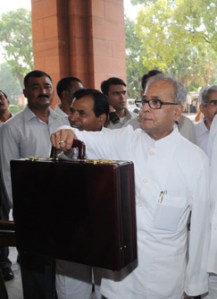
D-1890Today, the same remark has been made by Pranab Mukherjee, the finance minister (right), in his Budget speech but, by the time I am writing this post (four hours after the speech ended) I have not heard any murmurs of horror from commentators on television programmes.

Maybe that is because this is what one should expect from the 73-year old minister who, I remember, gave me a distinctly frosty and uninspiring interview when I first arrived in India as the FT correspondent in 1983 and he was serving his first term as finance minister.

Mukherjee has no track record as an economic reformer, and today’s speech does nothing to show that he is one, beyond nudging forward distant plans for a general sales tax. But he is the government’s most able political tactician, so one would expect him to at least balance the politics, the books and the personalities, even if he couldn’t rise to the occasion with a reform agenda for India’s new government in the way that his predecessor, Palaniappan Chidambaram, would have done.

Mukherjee has done the politics by looking after farmers with loan concessions, plus more help for the rural poor and other social and infrastructure spending, and he has also handled the personalities (Sonia Gandhi, daughter-in-law of Indira Gandhi who nationalised the banks, was sitting next to him in parliament, and he also quoted the revered Mahatma Gandhi).

But he hasn’t balanced the books, which is probably why the stock markets have fallen sharply, and why no-one has so far found it very easy to say whether it was a really good or really bad budget. The government’s total expenditure has been increased by 36% (including defence by about the same proportion and highway building by 23%). And the central government’s forecast fiscal deficit (excluding the states’ individual deficits) is up substantially at a record 6.8% of gdp, compared with 3.2% in 2007-08, because of measures taken to fend off the international economic crisis.

Both the 36% increase and 6.8% deficit are seen by many experts as too high, especially when there is no guide as to how Mukherjee expects to bring down  the deficit, apart from aiming to get the country back to 9% economic growth from its current 6%-7%. There has also been dismay that he is relying on government expenditure to boost the economy, rather than providing more of a stimulus for the private sector.

Mukherjee also said virtually nothing on divesting minority stakes in public sector companies, and only put a target of Rs1100 crore ($240m) on what might be raised by 2010. Here he was being sensible because I don’t think any Indian finance minister has ever reached his dis-investment target, and Mukherjee knows that it is a highly controversial programme and he might only be able to sell off 10% stakes in two or three corporations by the end of next year.

But it’s worth quoting what he said because it shows the basic strongly mixed-economy approach – not only his, but also that of Manmohan Singh, the prime minister who has never been a keen public sector reformer, and Sonia Gandhi, with her soft leftward-leaning liberalism. He said:

  • “The Public Sector Undertakings are the wealth of the nation, and part of this wealth should rest in the hands of the people. While retaining at least 51% Government equity in our enterprises, I propose to encourage people’s participation in our disinvestment programme. Here, I must state clearly that public sector enterprises such as banks and insurance companies will remain in the public sector and will be given all support, including capital infusion, to grow and remain competitive.”

And on Indira Gandhi’s bank nationalisation he said (ignoring the fact that Gandhi did it more for short-term political than long-term socio-economic reasons):

  • “Never before has Indira Gandhi’s bold decision to nationalise our banking system exactly 40 years ago – on 14th of July, 1969 – appeared as wise and visionary as it has over the past few months. Her approach continues to be our inspiration even as we introduce competition and new technology in this sector.“

The fault here of course is that he seemed to be closing the door on urgently need financial sector reform, and said nothing about the need to make public sector businesses more efficient, shedding surplus labour and management. Nor was there any discussion of the benefits (albeit very limited) of selling off public sector minority strakes – but that is par for the course because there is, as I have argued before, little real discussion of the pros and cons of policy in India.

One final omission – he said nothing on foreign direct investment (I have checked with a word search in the speech for those words and FDI), which might seem surprising. But it isn’t because the government’s FDI policy is in a mess, thanks to Mukherjee endorsing confusing and controversial changes introduced before the election by Kamal Nath, then industry minister, but opposed by Chidambaram. More on that soon………

Posted by: John Elliott | June 18, 2009

Has the modern Indian art market found its bottom? – updated

(updated with information from the Financial Times dated June 20-21 on works in the Sotheby’s sale inserted in italics below)

Judging by the relative success of sales at Sotheby’s, Christie’s and SaffronArt in the past ten days, it looks as if auctioneers and serious collectors of modern Indian art have found common ground at what some experts believe is the bottom of the market.

FNSouza 43x31 Death and the Maiden Sotheby's sold '08-09

Prices have collapsed overall by 40% or more over the past year or so, and some contemporary artists are down to 25% or less of their peak, but it seems that big collectors have decided it is time to start buying again now that auctioneers have severely curbed sellers’ expectations.

Sotheby’s auction on June 16 included 27 works that were originally bought in its New York auctions in March and September last year by an art fund – but “never paid for”, says the Financial Times quoting “trade sources”.

The FT adds that “Death and the Maiden” (above), a 43inx31in oil on canvas by F.N.Souza, which was estimated at £30,000-50,000 and sold for £46,500 ($76,800), had been secured in September last year by the art fund at $182,500 (then approx £102,000) – a fall of more than 50%.

Lot 59 Chowdhury

Sotheby’s reached a sale total of only £2.07m or $3.37m (including 20-25% buyers premium), but it was significant for the buoyant bidding, especially for a remarkable ink and pastel on paper (lacquered), Day Dreaming, by Jogen Chowdhury (above but pictured larger last week in my first auction post – click here) .

Painted in 1979, this went for a hammer price of around £310,000 (£373,250 including 20% premium) to a private US (presumed Indian) collector. That was an auction record for Chowdhury and was about three to four times the £80,00-£120,000 estimate.

The highest price of £335,000 (£403,250 with premium) – also three to four times estimates – went for Orange Head, a striking though rather fierce F.N.Souza (below) 86inx62in oil on canvas that was painted in 1963.

Souza Sotheby's London June '09 Lot 62
Orange Head by F.N.Souza

Bought by a private US (presumed Indian) collector, this work was also being re-offered after the art fund default. The price was an amazing 50% above the $400,000 (then approx £228,000) bid last September.

“This indicates that the focus among buyers is shifting back to selective artists in the modern Indian art market,” says Anders Petterson of ArtTactic, a London-based art analysis firm. Other works by Souza and M.F.Husain, India’s two leading veteran modern masters, also sold well including Husain’s untitled 1953 oil on canvas (below) that a US investor bought well above estimates at £109,250. Sotheby’s top ten lots are said to have been bought by established Indian and international collectors.

The Sotheby’s event followed a successful though smaller on-line auction by Mumbai-based SaffronArt last week, where more than half the 61 lots sold (out of 85 on offer) went above top estimates. The auction reaped Rs104m or $2.2m/£1.3m (including 10-15% buyers premium).

Earlier last week Christie’s set the trend with a good and lively London auction , with £2.43m (US$3.96m) sales – about 80% of the total 97 lots on offer and 90% of their total

Husain Sotheby's London June '09 Lot 53
untitled by M.F.Husain

estimated value. But both Christie’s and Sotheby’s sales were far below last year’s levels, when Christie’s London auction for example’s netted £5.4m . More than a third of the Sotheby’s works were miniature classical paintings from the 1700’s and 1800’s.

“”There has been a sea-change in perceptions and mind-set from even three months ago,” says Dinesh Vazirani, one of SaffronArt’s founders. “Serious collectors are seeing an opportunity and some old collectors from 2002-03 are buying again, but not investors who are scared to come in”.

SaffronArt’s buyers were mainly Indian, about 60% of them living in the country and 40% abroad. Its highest price of Rs14.9m or $317,000 (including premium) was paid for a 1984 untitled oil on canvas by V S Gaitonde.

SubodhGupta 66x90in oilcanvas sold $201k Rs94m Saffronart June 10 '09 Lot_21_edited
untitled by Subodh Gupta

Other sales included a 66inx90in oil on canvas untitled work by Subodh Gupta (right) which fetched Rs9.5m ($201,250). This was seen as a good price for current market conditions, but was far below Gupta’s record $1.2m paid in Hong Kong in May last year for a similar sized painting of a man pulling a luggage trolley.

Gupta is one of India’s leading contemporary artists. The steep fall shows how contemporary artists have been hit harder by collectors’ and investors’ loss of confidence than established modern artists such as Husain, Souza, Gaitonde and Ram Kumar, whose early works were the top sellers in the current auctions.

ArtTactic’s indicators (below) have significantly improved this year – more for modern than contemporary art – suggesting, Petterson says, that current price estimates have come down to attractive buyer levels, which “could be a sign that confidence is returning”.

IndiaAuctionIndicatorJun09_edited

As Vazirani points out, the current buoyant mood after India’s recent general election, with economic growth picking up and a slow-down in bad economic news, has helped boost buying – in addition to the fact that auctioneers have drastically cut their estimates in order to attract buyers.

That will be tested next at an auction in Mumbai on June 30 by Osian’s, India’s other leading auction house, of 58 modern and contemporary works. It includes Roadside with Temple, a vivid 4ftx6ft (approx) oil on canvas (below) by Atul Dodiya, a leading contemporary artist, estimated at Rs6.4m-8m ($133,330-$166,670).

“Sotheby’s tactic significantly to reduce the estimates (for some works between 60-70%), has paid off,” says Petterson. “The market seems to have found a temporary bottom, which has clearly reduced the price uncertainty……long-term buyers are seeing opportunities at current price levels”. However Petterson cautions that this should not be taken as a definite recovery in prices.

AtulDodiya RoadsideTemple 4ftx6ft approx $133-166k Osians June '09
Roadside with Temple by Atul Dodiya

Britain seems almost to enjoy revelling in bouts of national hysteria that appear cataclysmic for a time, but quickly fade away. Some 12 years ago, it was the death of Princess Diana that led to extraordinary expressions of public grief and dire criticism of the royal family.

Now, in a very different setting, Britain – where I have been for the past week – is wallowing in a daily drip-by-drip exposure by The Daily Telegraph of members of parliament’s expenses to pay for all sorts of homely things from house conversions, mortgages (sometimes for houses already sold), hi fi equipment, tuning a piano, and a baby’s cot, to gardeners, servicing a swimming pool, a girl friend/assistant’s “life improving” classes,  potted garden plants, Remembrance Day wreaths, and maintaining a moat (as in water round your castle) and so on.

Senior ministers have resigned from the government because of the revelations, and Britain seems to believe it is in the middle of a constitutional crisis. That is of course partly because support for the current Labour government is eroding fast, heightening the sense of crisis, and because the expenses revelations have hit all political parties.

In 1997, after Diana’s death, it was the monarchy that people said would have to change – and it has, but only a very little. Now people are talking about changing the way that parliament operates and is controlled – as if that would stop MPs claiming as much as possible on expenses!

Constitutional reform

There are even suggestions that Britain needs to tidy up its act with a written constitution instead of running its affairs on a semi-informal basis.

The prime minister – yes it’s still Gordon Brown (who charged for his brother to clean his private flat) – is himself suggesting constitutional reform, plus a more immediately practical “parliamentary standards authority”.  He has been followed by other party leaders, David Cameron (Conservatives) and Nick Clegg (Liberal Democrats), who want to make things look different by introducing fixed-term periods for parliaments, removing a prime minister’s right to choose the timing of a general election. (The same idea is often raised in India which, post-colonially, follows the British parliamentary model).

As Ted Vallance, a history academic, points out in the (recently much duller) New Statesman, that idea has been around since the 17th century when efforts were made to rein in Charles the First. “The current debate on parliamentary reform reveals little more than a political class desperate to save its own skin,” Vallance writes, under the heading Burning down the House. “Bereft of genuinely innovative ideas, Gordon Brown, David Cameron and Nick Clegg are ransacking the ideological storehouse of British history”.

The party leaders are themselves as guilty as ordinary MPs, and seemingly have no practical solution to offer on how to tighten the system. So they are heading for dramatic constitutional and parliamentary reforms which, while maybe worthwhile issues for long-term debate, are currently just useful time-consuming red herrings.

Cameron, desperate to make political capital ahead of a general election due next year, has called for “a massive, sweeping, radical redistribution of power” (until, of course he gets hold of that power).

The MPs deserve some sympathy, or at least understanding,  brazenly corrupt though some certainly have been. They are only paid just under £70,000 a year (Rupees 52 lakhs or $115,000). This is, of course, enormously more than Indian MPs are paid, but it is not much after tax for a family, especially in London – and maybe with a second home in a possibly far-away constituency,

Jonathan Raban, a journalist, points out in the London Review of Books that MPs have been operating under the guidance and jurisdiction of officials in the House of Commons Fees Office. His article, headed Trouble at the Fees Office, explains that MPs have an “additional costs allowance” of up to £23,083 a year, which they can claim by presenting bills for various expenses:

“The safest way of getting it (the money) is to dump sheaves of bills at the Fees Office to prove that you’ve spent far more than the amount of the allowance and are therefore entitled to it in its entirety. Given the thicket of ambiguous rules and regulations set out in The Green Book: A Guide to Members’ Allowances, it’s not surprising that most MPs seem to have followed the example of Margaret Beckett (a senior Labour minister sacked in the last few days by Brown), who confessed: ‘I just grabbed together the relevant things and bunged them into the Fees Office and left it to them to sort it out.’ ”

Haven’t we all done that to claim expenses? It’s what I do every year when I send all sorts of bills to my tax accountant, leaving him to decide whether, for example, my recent air fare to London can be counted against tax.

British media at fault

The British media has behaved appallingly and is substantially responsible for the perceived crisis. The Telegraph, which received the details in a leaked package weeks ago, has spread out its revelations over more than a month instead of packaging them over a few days. This has built up a feeding frenzy with a public that loves to despise those in authority – and, which understandably, doesn’t think much of the often self-serving people who rule the country.

Other newspapers, and the tv channels, which usually don’t like picking up their rivals’ scoops have joined the frenzy, with scarcely anyone standing back and putting the issues in perspective, or explaining how the excesses have come about.

So, now I’m back in Delhi, let’s try to do that. The Telegraph disclosed on Wednesday that Shahid Malik, the communities minister, simultaneously charged in his applications for the costs of office space in both his constituency and London home – claiming “more than £6,500” (just under five lakhs of rupees).

As Indian MPs (and those who finance them) would testify, that’s not serious corruption by anyone’s standards. It certainly shows that the system of MPs’ allowances needs to be tightened – and some MPs may indeed deserve to be criminally charged for excesses.

But, as someone said on a British tv chat show recently, “the MPs have behaved more like idiots than scoundrels” – and that surely should not be regarded as a constitution-changing political crisis.

LONDON June 10 ’09:  Christie’s had a good and lively South Asian art auction in London today, with £2.43m (US$3.96m) sales – about 80% of the total 97 lots and 90% of their total estimated value, with buyers from New York, Dubai, Hong Kong and Singapore, as well as London.

A 35x75in M.F.Husain oil on canvas (below), painted 1960 in his Ragamala series, fetched the top hammer price of £330,000 (approx US$539,000 or Rs26m), though that was substantially less than the £400,000-£600,000 estimate. Other Husain’s went well – with the veteran artist watching happily from the back of the auction room.

2nd MFHusain 35x75in sold Christies £330,000 hammer 7814 lot 63

Further June 10 updates are in italics below

LONDON June 9 ’09:  An art auctioneer needs to persuade people to offer high grade pictures for sale, and then has to make the price and quality range attractive to pull in potential buyers.

That may sound a blindingly obvious statement, but it wasn’t true of modern and contemporary Indian art auctions a year ago, and certainly not two or three years ago. Hordes of buyers – mostly Indians living abroad (NRIs), and some at home – were then rushing, herd-like, chasing escalating prices to buy almost any available slice of fashionable Indian art that would enable them to display their wealth on the walls of their homes and offices. Profit-seeking sellers were happy, and prices rose to unsustainable levels, often with little regard for quality.

Now the international art market has slumped along with the economic crisis, and Christie’s and Sotheby’s are pitching low rather than high in their price ranges and forecasts for current London auctions – Christie’s June 10, and Sotheby’s next week – also Mumbai-based Saffronart with an on-line auction this week.

FNSouza 30x23in £30-60k Portrait of an ElderTheChurch Christies Lot 51They are all hoping that the best works will get very good prices at the top end of the market, as happened with contemporary Chinese art at recent auctions in Hong Kong, and that low prices will pull in new buyers.

“It’s very hard to get good works,” Hugo Weihe, Christie’s Asian art director, told me yesterday, though he was much more confident after the auction: “This shows there is a serious discriminating market and people who will buy,” he said

Some works come from unlikely sources. Two F.N.Souza paintings in Christie’s auction have come from owners who had absolutely no idea of their value. Portrait of an Elder (right), a 30inx23in oil on board, sold for £30,000 – the estimate was £30,000-£60,000 . One owner was alerted by a Souza being shown recently on Britain’s Antiques Roadshow tv programme.

Weihe is optimistic that new collectors will come in, along with buyers from India who are visiting Europe for the summer. Christies had Usha Mittal, wife of steel tycoon Lakshmi Mittal, as the co-host for their private view last night, hoping the couple would entice big spenders from the top end of London’s Indian community. Last year Tina Ambani, wife of Anil Ambani, who runs one of India’s two Reliance groups, was the draw with works from her Harmony Art collection and charity

Sotheby’s is more restrained in its publicity, relying on exclusive lunches for its most promising buyers.

Lot 59 ChowdhuryZara Porter Hill, the India and S.E.Asia director, is convinced she has a major draw with Day Dreaming, (above) a magnificent largish (about 5ft x 6ft) Jogen Chowdhury ink and pastel on paper, lacquered, of a reclining female figure. Estimated at £80,000-120,000 (US$118,000-177,000), it is way below Chowdhury’s record (hammer) price of Rs14m (around $300,000) , which was four times estimates and was achieved in the hey days of mid-2006 for a 4ftx4ft oil on canvas.

All three auction houses are having to cope with dramatic falls in prices of 40% upwards over the past year. Results from a survey last month (May) by ArtTactic, a London-based art analysis firm, showed that average auction prices for modern Indian art have fallen by just over 30% since March last year, while contemporary art fell more than twice as much at just over 70%. 

SubodhGupta LeapofFaith8ft hi £70-100k $110-158k Christies Lot 69_editedBuyers are said to be looking for established modern artists with “proven historical value” such as V.S.Gaitonde, M.F.Husain, F.N.Souza and Akbar Padamsee. All these artists figure in the current auctions but, in the past year or so, only their best works have done well. Several Souzas and Husains for example did not sell at Christies in London last year..

ArtTactic’s overall  confidence indicator for Indian art has fallen 71% since May last year. Just over a third of respondents said modern Indian art would rebound in one to two years, and 50% estimated it would take two to five years. A higher proportion – 66% – thought contemporary art would take two to five years and almost a fifth said five to ten years..

Subodh Gupta, one of India’s leading contemporary artists, has a 8ft high pile of stainless steel pails at Christie’s (left) marked at £70,000-£100,000 and it sold for £82,000 ($134,000), but he got £600,000 (then $1.2m) for a large installation of stainless steel  kitchen pots and pans at the same auction last year. His paintings have dropped dramatically from approaching $1m to $200,000 at successive auctions
 
Both London auctioneers have cut the number of works from around 110-120 last June to around 90, and are putting conservative estimates on many works.

Prajakta Palav 67x61in £2,5-3,500 Sothebys Lot 85A third of the Christie’s works, which also include paintings from Pakistan and Sri Lanka, are estimated at up to just £5,000 ($8,000), and only 18 works are above £50,000.

Sotheby’s are in broadly similar ranges, and there are only 50 modern and contemporary works – including an untitled 67inx61in water-colour and acrylic on paper (left) by Prajakta Palav, a young Mumbai artist, in the low price range at £2,500-£3,500. The rest are Indian miniature paintings from the 1700’s and 1800’s.

Neither gallery is pushing works above £200,000 ($300,000), so there are none in the million-dollar-plus range seen last June when works by Gupta Tyeb Mehta, and Souza hit personal records from $1.2m to over $2m at the Christie’s London auction.

Lost Kingdom of Navin by Navin Rawanchaikul, a Thai-born Indian-Pakistani artist, depicting Indian art scene faces in a Bollywood billboard style – 6ftx11ft, £30,000-£40,000, at Christies

Lost Kingdom of Navin by Navin Rawanchaikul, a Thai-born Indian-Pakistani artist, depicting Indian art scene faces in a Bollywood billboard style – 6ftx11ft, £30,000-£40,000, at Christies


Posted by: John Elliott | June 2, 2009

Nath inherits a muddy murky highways programme

India’s Ministry of Surface Transport is well known as a cash cow for the political party in power, and thus for the minister in charge if he is so minded, because of the massive contracts involved. But T.R.Baalu, who was the minister in the last United Progressive Alliance (UPA) government, surprisingly did not manage to make a success of India’s 33,000km highway building programme, and did not ensure that a large number of contracts were placed and completed, during the five years that he was in charge.

Now Kamal Nath, a prominent Congress party politician who has been close to the Gandhi dynasty for 30 years, has been given the portfolio. Judging by his appearances on television the night he was appointed, and since, he seems happy with the job, even though its prestige and scope is far far less than the commerce and industry ministry that he ran for the past five years. My guess is that he will hold the post for a couple of years to get the ministry moving and do what he can with the full potential of the highways programme.

This is a story that shows how the muddle, contradictions, arguments and corruption that curiously generate much of India’s success, can also sometimes block progress. It demonstrates the need for strong leadership at the top, which was lacking in the last UPA government, but which prime minister Manmohan Singh now has the stature to provide.

NHDP_editedThe mostly-four lane national highways programme did well when it was initiated by the 1998-2004 Bharatiya Janata Party-led NDA coalition government. Contracts awarded while the BJP was in power led to some 6,000kms (3,750 miles) being completed by the end of 2005 at a cost of about $7bn, mostly on the Golden Quadrilateral that links India’s four biggest cities. There were of course massive delays because of slow land acquisition, corruption, bureaucratic lethargy, and extortion by gangsters and Naxalite (Maoist) rebels – but it was a success.

By the end of April this year however, the total completed had only gone up to just over 11,000kms, and awards of new contracts had slowed to such an extent that work was only started on 9,700kms compared with a five-year target of 16,000kms. The programme, which has attracted  few foreign construction companies because of the problems of operating in India, has now lost the momentum and drive of the BJP years, and urgently needs to be revived by Nath.

Baalu, who was in charge of shipping as well as highways, was one of two ministers from Tamil Nadu’s DMK political party that prime minister Manmohan Singh did not want to appoint again last week. Singh successfully excluded Baalu, but had to agree to let the other minister, A.Raja, go back to his old job at telecoms, which is another ministry favoured by bounty-seeking politicians. Both Baalu and Raja have been frequently accused of inefficiency and corruption.

Baalu was much more interested in dredging the controversial Sethusamudram Canal between Tamil Nadu and Sri Lanka. This involves lucrative contracts and later there will be trans-shipping and port work which, it has been officially acknowledged, could benefit a trawling and fishing company in which two of his wives and sons are reported to have shares. Earlier Baalu was  a controversial environment minister and, in the mid-1990s, a well-connected junior minister in the petroleum ministry that handles high-value oil imports.

He regularly tried to influence and even dominate the detailed functioning of the National Highways Authority of India (NHAI), whose financially-sensitive responsibilities include drawing up initial lists of tenderers, and issuing partial and final completion certificates, as well as placing contracts. He changed the NHAI chairman five times in as many years when his wishes were not carried out – because, as a BJP spokesman euphemistically put it, of “his own whims and fancies”.

Private Sector BOP focus

There are several reasons for the poor performance and they are not all Baalu’s fault. Initially the Congress-led UPA government did not seem to want to promote the programme because it had been such a success for the previous BJP prime minister, Atal Bihari Vajpayee, who took personal credit. Manmohan Singh ordered widespread six-laning of major four-lane highways, but there was little enthusiasm.

Much of the Vajpayee government’s success had been due to heavy government funding. This was needed to get the construction programme moving quickly on highways that would not yield profits, as well as on those that could be operated as private sector toll roads.

The Planning Commission however did not like this approach and switched the emphasis to private sector financing, stopping primary government funding and allowing only built-operate-and transfer (BOT) contracts. That virtually halted new contracts from the end of 2005.

A government Committee on Infrastructure was formed, serviced by the Commission, partly to keep a check on Baalu and his ministry, and partly to enforce the BOT system. This increased bureaucratic wrangling, and the committee took about two years to agree on a new model concession agreement (MCA) and prepare associated forms of contract and procedural documents.

This new approach did not take sufficient account of support financing that contractors need on highways with unprofitable tolls, and subsidies offered to encourage investments were inadequate.

In policy terms, the Commission had arguably taken highway construction out of the government’s “inclusive” approach to economic growth, where money is spent on uneconomic but socially desirable projects, and put it into the “exclusive” growth area where the private sector is expected to invest and reap profits.

The move was also disastrously timed because last year’s economic crisis pushed the cost of financing up to 15-16%. Contractors lost interest in raising funds, and few were willing to bid for the BOT contracts. When tenders were invited last year on 60 projects, no bids were received on 38 and, of the 22 that were tendered, only 12 led on to fully-financed contracts. The NHAI has now amended designs to reduce construction costs and has put the 38 out for fresh tenders along with 22 more.

Companies complained not only about inadequate support funding, but also that the NHAI was inflexible in its approach and handed over sites without adequate land clearance. The NHAI wanted to increase concessionary “viability funding”, but was blocked by the BOT-oriented infrastructure committee, though this is now being relaxed. (One source has told me that bureaucrats prefer government-run projects rather than BOT because it increases the opportunities for corruption both during construction, and on the collection of tolls).

Rival state projects

Complicating matters, state governments in Karnataka, Tamil Nadu, Gujarat. Uttar Pradesh and elsewhere have begun their own highway construction programmes, often without taking account of the national networks that they sometimes duplicate. State government ministers and bureaucrats see the potential for personal and party fund-raising, and are offering softer project terms than the NHAI’s. As a result, they were getting bids from contractors last year that were shunning the NHAI.

Nath now inherits a highways programme that is beginning to show signs of recovering from years of bureaucratic and inter-government wrangling, unhappy contractors and massive corruption, in addition to all the usual delays that  hit projects – plus the impact of the economic crisis.

He has said in the past few days that procedures should be eased  and, most importantly, that new sources of funding should be found. He has the political clout to make this happen and turn round the muddle left by Baalu – and he comes in an opportune time because economic and business confidence is recovering.

After the debacle of the special economic zones that Nath tried to introduce across the country in the last government, he now has a chance to prove himself on the highways.

Posted by: John Elliott | May 28, 2009

Some good names in India’s new cabinet

There are some new and interesting names in the appointments announced this evening for India’s new government after eleven days of haggling (for today’s earlier post click here).

They indicate a new constructive approach, driven by prime minister Manmohan Singh, especially on commerce and industry, education, the environment, and highways. (Click here for full list).

Four are specially notable:

ANAND SHARMA, minister for commerce and industry – on a big and surprise promotion, having previously been minister of state in external affairs and information, he is likely to take a less combative stance over WTO negotiations than his predecessor, Kamal Nath – and be a more straightforward, and maybe caring, economic liberaliser. He is also a Congress Party spokesman.

KAMAL NATH, minister for road transport and highways – previously commerce and industry minister, so this is definitely not a promotion, in fact it looks the reverse – but the sector needs tough action to revive stalled highway construction, and he has the political strength to do it.

KAPIL SIBAL, minister for human resource development – a good promotion and appointment (suggested on this blog) for this top lawyer who was previously minister for science and technology where he applied himself with the commitment that India’s dilapidated education system needs. Also a Congress spokesman.

JAIRAM RAMESH,  minister of state (with independent charge) for  environment and forests – previously in industry and power, and a top party adviser, he is likely to break the track record of many of his predecessors and bring in straightforward policies aimed primarily at streamlining environmental controls, instead of pursuing other agendas. He might be tough resisting international demands on climate change.

Others include:

MURLI DEORA, remains  minister for petroleum and natural gas;

AMBIKA SONI, a Gandhi family confidante becomes  minister for information and broadcasting;

A. RAJA remains minister for communications and information technology despite the prime minister’s wish not to give him any job at all;

SHASHI THAROOR, former top United Nations official who failed to get the secretary general’s job, is a minister of state in the ministry of external affairs;

SALMAN KHURSHEED, a minister in the 1980s and 1990s, and former Uttar Pradesh party chief, returns to the central government with double tasks as minister of state (with independent charge) for corporate affairs (he is a lawyer) and minorities;

PRAFUL PATEL remains minister of state (with independent charge) for civil aviation, despite the sector’s problems.

And Surprising – and Expected:

S.M.KRISHNA – a surprising choice as minister for external affairs, announced last weekend, he is an almost forgotten 78-year old former chief minister of Karnataka. He is credited with building up Bangalore, Karnataka’s state capital and IT centre, in the 1990s, but it is difficult to see him building much respect or access abroad – and, given his age, will not want to travel much.

MAMATA BANERJEE, leader of the West Bengal Trinamool Congress that routed the state’s communist-led Left Front in the election, was a shoe-in for railways minister last weekend. She showed her priorities are to defeat the communists in 2011 assembly polls when she broke with tradition earlier this week and took over her ministry from an office in Kolkata, not the Delhi headquarters. She said would “give little time to Delhi” and announced railway goodies for West Bengal.

« Newer Posts - Older Posts »

Categories