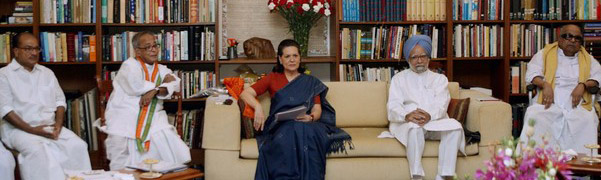
It’s rare to find something positive to say about Britain’s honours system but, as 59 of India’s new ministers  were being sworn in this morning, I realised that India’s new Council of Ministers is really being partly used as an inefficient form of such a system.

Think how many of the total of Council’s 79 ministers could have been left out of the list if they could have been sent instantly to the Lords (getting into India’s upper house, the Rajya Sabha is much more cumbersome and slow), or given a knighthood or some other gong, instead being awarded jobs to run the country.

The thought seemed even more valid as the country has waited all day (it is now 7pm) for an announcement on the ministers’ jobs – an announcement that has apparently been delayed hour after hour by persistent lobbying for top posts.

Farooq Abdullah, the veteran and sociable Kashmir politician, whose real ambition is to be India’s president or deputy president, could have become Lord Abdullah of Srinagar instead of minister of new and renewable energy.

Also, with fewer plaudits, Vilasrao Deshmukh, who was sacked as Congress’s chief minister in Maharashtra after last Novembers terrorist attacks could have had a knighthood instead of the ministry of heavy industries and public enterprises when he is not even an MP, leaving room for someone more interested.

Similarly accommodated could have been other politicians who Congress needs to consolidate its position in various states ahead of coming assembly elections, such as Maharashtra’s polls in September-October. India’s Bharat Ratna and Padma awards, made annually on Republic Day, do not have the same flexibility for stroking bruised egos.

Some of those left out will no doubt become governors of states, but that is usually seen, to use an English expression, as being “put out to grass”.

Consequently, the choice of ministers for what was originally billed as an efficient can-do government has been blurred and sabotaged by regional, caste, and other lobbying.

Prime Minister Manmohan Singh and Sonia Gandhi, leader of the Congress Party and the United Progressive Alliance coalition, have spent eleven days trying to balance efficiency and youth on the one hand with prestige and greed (much of it dynasty-based) on the other – also bringing in, as I just mentioned, politicians who can use their prestige as central government ministers to strengthen Congress in the states at the expense of smaller regional parties.

Sadly however, central government efficiency does not seem to have won, though there are nearly 30 new faces, many young, which is good – and heavily dynastic, which is not.

The overall result does not look like being as focussed as had been expected – though a fair verdict will have to wait for the ministerial jobs to be announced, and for those appointed to show what they can do. Singh today described the cabinet as “energetic” with a mixture of youth and experience, but Gandhi admitted it had been “difficult” to finalise.

M. Karunanidhi, the 86-year old DMK leader and Tamil Nadu chief minister, has run rings round Singh and Gandhi as he has pushed the bounty-seeking interests of his party and dynasty-based entourage. He has only 18 MPs in the UPA, which totals 322 including supporters, so is not a crucial ally: yet other appointments have been held up for several days over the past week as the twists and turns of his warring family and other MPs were splashed across newspaper headlines and tv screens.

 Eventually a cabinet job has gone to A.Raja, previously a much-criticised telecoms minister, who Manmohan Singh had been determined to exclude. And M.K.Alagiri, one of Karunanidhi’s sons, is also in the cabinet even though he is a first-time MP.

Once that drama was over, Singh and Gandhi were swamped with intense lobbying from other states which were rightly jealous of the ridiculous time and attention given to Karunanidhi, and some regional party leaders who were jealous of some of the ministers announced last Friday.

Posted by: John Elliott | May 26, 2009

40,000 hits – thanks everyone

Hi folks – Riding the Elephant has just passed a total of 40,000 hits since I took it over from Fortune.com on August 1  last year – the current total is in the column on the right.

That’s roughly an average of 130 hits a day – and this month it’s 230 a day.

So many thanks – keep reading!
cheers
John Elliott

It is of course a coincidence, but the pace of corporate news in India is accelerating while the new government, whose election last week sparked a surge of corporate optimism and a stock market boom, dithers over which ministers to appoint to which jobs.

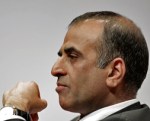
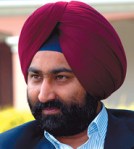
In the news this morning are two family businessmen, both market leaders, who have wanted to internationalise their businesses – Sunil Mittal, founder chairman of Bharti Airtel, and Malvinder Singh, who inherited his chairman’s and ceo’s position at the top of Ranbaxy Laboratories.

 Sunil Mittal - a Forbes photo

Sunil Mittal - a Forbes photo

One now looks like succeeding, while the other appears to have failed

A year ago Mittal started audacious merger talks with MTN, a leading South Africa telecom company, but was ousted by Anil Ambani, whose Reliance-ADAG empire includes Reliance Communications. Ambani’s bid was then mischievously foiled by his estranged brother, Mukesh Ambani of RIL, who claimed prior rights to Reliance Communication’s shares in any deal.

Also a year ago Singh amazed India’s corporate world by selling control of Ranbaxy, which his family founded in 1961, to Daiichi Sankyo of Japan for around $2bn, while staying in charge as chairman and ceo.

Now the fortunes of these two men have been reversed:

–  Mittal, who already runs the world’s third biggest mobile phone business, is back today with a bid for a new deal that could eventually [italic inserts here and below added May 26 to indicate a merger is not the initial aim] give him control of MTN and the potential to become internationally significant.

–  Singh and his brother yesterday left the Ranbaxy board along with two other executives in what looks like a Daiichi coup.

 Malvinder Singh - a BusinessWorld photo

Malvinder Singh - a BusinessWorld photo

Singh’s apparent ouster is a sad end for the family’s links with Ranbaxy, which has spearheaded the Indian pharmaceutical industry’s international growth. However, he has other interests – in Fortis healthcare and hospitals, and Religare financial services. He remained chairman, ceo and md when Daiichi bought control, but the share price has slipped by over 60% since then ands a $150m loss is forecast for the year.

More significantly, there are continuing US drug regulatory problems with over 30 Ranbaxy products, and it looks as if the Japanese, after watching from the sidelines, decided to signal to the US that Daiichi has taken charge.

Yesterday’s changes, with an Indian executive promoted to ceo and a Japanese Daiichi executive coming in as chairman, were billed as “amicable” – but Singh, who was to have held the jobs until 2013, did not appear at the announcement press conference.

It has never been clear how seriously, nor for how long, Singh wanted to straddle the two potentially ill-fitting roles of being a hired top executive in a Japanese group, and a healthcare and financial services entrepreneur, but clearly the mix didn’t gel.

Mittal is much more sure of what he wants to do. Having batted successfully for years against the powerful Ambani brothers, he has made Bharti the undisputed market leader, and the world’s third largest mobile services operator – it announced 100m customers ten days ago. He has said he now wants to expand globally, and clearly his Bharti Enterprises group is primarily eyeing the world’s next big telecoms growth area of Africa.

Like Singh, he is willing to sell some of the Bharti stake to achieve his ambitions, but he will not cede India-based control. Last year’s talks eventually foundered on MTN’s plan to base the merged group in South Africa, which Mittal would not accept, even though it looked as though he would have been in control.

Now he plans to acquire a 49% $4bn stake in MTN which, along with its shareholders, would get 36% in Bharti for $2.9bn. The initial result of this cash and shares deal would be what the companies call “a partnership….to create an emerging market powerhouse”, with revenues of over $200bn.  That would give Bharti “participatory and governance rights in MTN enabling it to fully consolidate the accounts of MTN”. A full merger, presumably Delhi-based,  would be a “broader strategic objective” for later.

A year ago Mittal seemed not to have ring-fenced his MTN talks well enough, nor fully mastered the intricacies of South Africa’s politics and focus on black economic empowerment. That left a gap that allowed Anil Ambani to burst in.

Mittal’s pride was hurt – he had just ended a year as president of the CII, a leading Indian business federation, and had won many top businessmen awards. He was also facing delays building up a retail and wholesale store business in India with Wal-Mart (which would have been opening its first wholesale outlet today in his home state of Punjab, were it not for widespread religious riots in the state).

Yesterday’s announcement cautioned that talks were at an early stage and might not lead to a deal, let alone a full merger, but Mittal has presumably organised his pieces better on the South African chessboard. 

He has secured exclusive talks until July 31 to seal a deal, which would have to clear various regulatory hurdles. These include India’s foreign direct investment (FDI) regulations that the last government controversially eased just before the general election, though both finance ministry and Reserve Bank of India officials later filed objections.

The MTN deal would be fine under those changes which, despite the officials’ objections,  look like being maintained by the new government under Pranab Mukherjee as finance minister.

An earlier version of this post is on www.ft.com/world/asiapacific/india

The prime minister and 19 ministers were sworn in Friday evening May 22. The first six cabinet appointments were announced Saturday afternoon – see [confirmed Saturday] inserts below. More names and positions are expected next Tuesday.

__________________________________________________________

It is ironic – and very revealing – that prime minister Manmohan Singh and Congress Party leader Sonia Gandhi have had more problems handling demands for lucrative ministerial posts from the DMK, a regional ally from Tamil Nadu, than in filling the most senior jobs in India’s new cabinet.

Following allegations of non-performance and corruption against some DMK ministers in the last government, the prime minister has been specially keen to exclude two of the party’s former ministers in charge of communications (including telecommunications) and surface transport (including highways), and also to get competent performers into such key infrastructure ministries.

M. Karunanidhi (right), with Manmohan Singh, Sonia Gandhi, Pranab Mukherjee, A.J.Antony, at a UPA meeting this week - a Reuters pic

M. Karunanidhi (right), with Manmohan Singh, Sonia Gandhi, Pranab Mukherjee, A.J.Antony, at a UPA meeting this week - a Reuters pic

That led to an impasse with the DMK, though it has been reported this evening that Congress is giving way on the two ministers, T.R.Baalu and A.Raja, and has offered to have them back in the cabinet, but not in infrastructure posts because of poor performance and controversies on highways and telecoms.

Earlier in the day, it looked as if a few posts such as communications, labour and possibly coal or mining might be left vacant (technically under the prime minister’s direct charge) for as long as a week or so in the hope of a compromise.

The shamelessness with which the DMK has publicly pursued its partially dynastic demands is both horrifying and comical. M. Karunanidhi, the 86-year old DMK leader and Tamil Nadu chief minister, initially demanded five cabinet berths with jobs for at least four of his family, including two of his sons and a daughter (by two of his wives).

Karunanidhi fasting over Sri Lanka last month - an AP pic

Karunanidhi fasting over Sri Lanka last month - an AP pic

Of the family candidates, grand-nephew Dayanidhi Maran, who was an effective telecommunications minister in the last government till Karunanidhi withdrew him in a family feud, is being offered the job again. But that is reported to have caused Karunanidhi problems with his more immediate family, and with the two others the government did initially not want.

One can almost sympathise with such a veteran politician for facing so much relentless pressure from his family near the end of his political career.

Meanwhile it looks as if Pranab Mukherjee will move from his old job as foreign minister and take over the finance ministry [confirmed Saturday] –  a job he first held 25 years ago. He has never been billed as a committed economic reformer, though he did try, unsuccessfully, to liberalise defence manufacturing when he was in charge of that ministry at the start of the last government. He is a respected and very able politician, which should help with the implementation of the government’s pro-poor and other policies.

That has left a gap at the external affairs ministry which, as I write, does not seem to have been filled. S.M.Krishna, a 77-year old former chief minister of Karnataka and governor of Maharashtra, is currently reported to be in the running for the job [confirmed Saturday].

 Kamal Nath is reported to have declined the portfolio, choosing apparently to stay as commerce and industry minister.
 
Another reported candidate for foreign affairs has been Kapil Sibal, formerly science minister, though it would be an unusually huge jump in status. He looks likely to be human resources minister (which I tipped him for a few days ago), in charge of sorting out India’s ailing education system.

Palianappan Chidambaram, is remaining home minister [confirmed Saturday] where he is in the middle of revamping the security services, and A.J.Antony is staying at defence [confirmed Saturday]. Antony is seen as a safe choice, even though he has allowed trade unions and others in the defence establishment to stall opening up manufacturing to the private sector.

But the most significant event in the past few days has been the way that Congress’s allies in the United Progressive Alliance (UPA) have relentlessly pushed for lucrative rather than merely prestigious jobs – and that Congress has tried with only limited success to resist some of their demands.

Congress has 206 MPs in the 543-seat Lok Sabha (lower house) out of a total of 322 for the UPA and its supporters – but, even with such a high Congress figure, Manmohan Singh and Sonia Gandhi have had to give way to the Trinamool Congress and the Nationalist Congress Party (NCP) as well as handling the DMK’s demands.

Mamata Banerjee, leader of the Trinamool, who routed the communist-led Left Front in West Bengal, is being given the railways ministry [confirmed Saturday], even though she is not the most effective candidate.

The Maharashtra-based NCP’s Sharad Pawar is reported to be getting his old agriculture job back [confirmed Saturday], also Praful Patel at aviation – even though there has been criticism of the way those ministries have been run.

The DMK fought so long and hard for the jobs it wants that it seriously slowed down the selection of ministers.  That is why only 19 ministers have been sworn in tonight. There will another swearing-in session next Tuesday.

In India’s coalition governments, politics are always dominated by the ministers’ ability to raise money, as well as by ambitions  for power and prestige. Sadly, it does not look like being very different with the new government.

An earlier version of this post is on www.ft.com/world/asiapacific/india

FOR MORE POSTS ON INDIA’S GENERAL ELECTION TYPE General Election IN THE SEARCH BOX – OR CLICK General Election BELOW

Posted by: John Elliott | May 20, 2009

Wall Street Journal wins on India’s 20-year approval cycle

Can Rahul Gandhi, heir apparent to be India’s prime minister, begin to make the sort of changes that people dreamed about when his father Rajiv Gandhi became prime minister in 1984?

The thought is prompted – odd though it may seem – by The Wall Street Journal (WSJ) on Monday becoming the first foreign newspaper to be published in India with full government permission, some 21 years after the Financial Times first approached the government for clearance.

When Rajiv Gandhi became prime minister in 1984, I wrote an article that began with a story of how the government had the year before placed a £50m order for goods wagon air brakes that had first been mooted 25 years earlier in 1959. The next paragraph talked about the power failing in Connaught Circus as a new Wimpy burger bar opened shop.

Now, more than two decades later, the story hasn’t changed. The WSJ has come in 20 years after foreign newspapers became interested in India. And in 2004, the government ordered $1.45bn British Hawk jet trainer aircraft that I had first written about as a potential order twenty years early. Power supplies still fail in Connaught Circus.

Rahul Gandhi of course isn’t becoming prime minister, as his father did in 1984. But the mood of expectancy that India’s new government will usher in a new era – epitomised by Gandhi’s emergence at or near the top – is much the same.

The key question is whether this government will be able to begin to break at least some of the grip wielded by vested interests, both Indian and foreign, that try to throttle advances until they have won whatever it is they are after.

The order for railway trucks’ gear had been blocked for over 20 years because rivals tried to defeat the preferred, and eventually successful, British contractor. The Hawk order was similarly delayed, at the end by the US, which had also been stalling the railway contract.

In both cases, bureaucrats and ministers were constantly “persuaded” by competitors not to make a final decision, officially by rivals producing endless technical and other adjustments but obviously also by other inducements.

The story is the same with foreign newspapers. In 1988, the Modi and Hinduja business groups approached the FT for a printing joint venture. Those approaches came to nothing, but the FT did become interested in India. It is however still waiting for permission, having been blocked by both foes and supposed friends since then  – click here for that story and here for a follow-up on foreign magazines, with Forbes magazine  launching its India edition this week.

The WSJ’s appearance is therefore a long overdue partial defeat of vested interests, led by The Times of India’s Bennett Colman business group that has tried to block foreign entrants, especially the FT, for two decades. (Bennett Colman even prints a thin supplement called Financial Times every week to secure the title.)

Owned since 2007 by Rupert Murdoch’s News International, the WSJ is being printed and distributed by The Indian Express group in Mumbai and Delhi. In line with government rules, it has set up an Indian company, Wall Street Journal India Publishing, which is wholly owned by Murdoch’s Dow Jones business that he bought ion 2007.

But the government has not entirely shaken off the media vested interests’ influence, and there are still rules that restrict circulation and profits.

Although 100% foreign (FDI) ownership has been allowed since January (before it was only 26%), the paper printed here must be a “facsimile” edition. That is an intentional use of a word from a slightly outdated technology to establish that it has to be a precise copy of an edition published abroad with no change in advertising or editorial. This makes it far less commercially viable than it might be because the paper cannot have India-specific content.

Dow Jones received permission to bring in either its US or Asia edition and decided, after much agonizing, on The Wall Street Journal Asia from Hong Kong – but today’s edition (the first I have been able to buy this week from my local newsstand) has only one India story tucked in at the bottom of an inside page, though there are others on Pakistan and Sri Lanka

Pricing is difficult, unless the paper is to be a loss leader, which Murdoch seems to tolerate because of his love of the print media – his London Times loses £1m a day.

The figures in India however will not be very big – Murdoch’s government-approved investment is just Rs21m ($450,000). The paper is priced at Rs25 (roughly 50c or 30p), seven to ten times that of India’s main business dailies such as The Economic Times, Mint (produced for two years with Wall Street Journal syndicated content) and Business Standard, so it will probably have little appeal below senior management.  

The restrictions show that the Indian media’s vested interests still have a grip on government policy, and thus on the competitiveness of foreign rivals, though the extent of their luddite influence is waning.

The question now is whether the new government can begin to change India in the way that optimists hope.

As I suggested last Sunday,  a starting point would be to ensure that bounty-chasing regional parties such as the DMK and NCP do not get lucrative posts such as telecoms, highways and aviation, which urgently need the firm hand of a minister genuinely interested in progress and efficiency. One could add environment, power, petroleum, and others to that list in addition to external affairs, home, finance and defence.

Vested interests – ie rival companies – will of course always have a big influence, and politicians of all shades of honesty and dishonesty and personal greed will always be on the take,

But India needs a government that cuts into what I have typified here as a 20-year long hold on decision-making!

Posted by: John Elliott | May 17, 2009

A Line-up for the Congress-led Cabinet – and its tasks

Following the Congress Party’s astounding election victory at the head of the United Progressive Alliance, prime minister Manmohan Singh can put his personal stamp on the cabinet formation, which he is planning now with Sonia Gandhi, the party leader.

He has much more authority than when he formed the last cabinet in 2004, and is not cluttered with so many allies, so has a real chance to choose quality and performance-potential, rather than having to reward bounty-seekers with lucrative posts.

On the broad economic/social front, the government needs able and committed ministers who, in addition to dealing with the financial crisis, will address what one might call non-headline reforms  such as education, health, infrastructure, and the environment as well as the usual headline subjects such as foreign direct investment, public sector privatisation and divestment, and financial sector reforms.

A new industrial policy is also needed to accommodate the needs of the poor instead of focusing primarily on big business and mega projects.

Among the new ministers there will be a focus on minorities, and on young MPs such as Jyotiraditya Scindia, Sachin Pilot, Jitin Prasada and Milind Deora (all in their 30s), though most of them will be in number two positions.

Here’s some ideas, and what I’ve been hearing, of who might be chosen  (jobs last time in brackets).

I’ve drawn a line below between jobs which are sure to go to Congress MPs and those that might be open to political allies – though the allies have, as I said, far far less clout than last time.

There are a few gaps – send your suggestions – click comments at the bottom
 
FOREIGN AFFAIRS – Pranab Mukherjee (as now) – he’s tipped for this.
 
HOME – Palaniappan Chidambaram (as now) – he’s tipped for this – with a map on handling terrorism promised in 100 days
 
Or swap those two – Mukherjee would be a politically friendly and effective Home Minister – while Chidambaram’s intellect and energy could be put to developing a coherent foreign policy which India desperately needs
 
FINANCE – Montek Singh Ahluwalia (Planning Commission) – to bring a reformist’s focus – Manmohan Singh would like him, though Mukherjee (Finance Minister early 1980s) is said to want the job.
Support Ahluwalia with an experienced politician as minister of state – maybe Prithviraj Chauhan  (minister of state Prime Minister’s Office). 

HUMAN RESOURCES – Kapil Sibal (Science) – tasked to bring the same momentum to this key ministry, which includes education, that he brought to science and technology
 
DEFENCE – A.K.Antony (as now)

COMMERCE AND INDUSTRY – Kamal Nath (Commerce and Industry) though he hopes for a big move
 
Or put Nath in Defence, Sibal in Commerce and Industry (tv programmes are tipping him for this) and bring Mani Shankar Aiyar (Petroleum then Panchayat Raj), who has lost his seat, into Human Resources with a Rajya Sabha seat.

__________________________________________

RAILWAYS – Jyotiraditya Scindia (Telecoms junior minister), whose late father Madhavrao Scindia was a famous railways minister – unless Mamata Banerjee, Trinamool Congress has to have it.
 
RURAL DEVELOPMENT – Rahul Gandhi is tipped for this because it’s his subject – combine it with Panchayat Raj – or Mani Shankar Aiyar.

POWER – Jairam Ramesh (Industry and Power junior minister and  key election strategist).

AVIATION – S Jaipal Reddy (Urban Development) to use his vast government experience to bring some order to this chaotic influence-peddling sector
 
HIGHWAYS AND SHIPPING – Sushil Kumar Shinde (Power) – to put some energy back into the mismanaged sluggish highways programme.

TELECOMS – Sharad Pawar (Agriculture) – good for wheeler-dealing

AGRICULTURE – A.K. Antony (Defence) – if not in Defence – a clean politician though not a great decision-maker

SPORT – Salman Khurshid (not an MP last time), unless M.S.Gill (Sports) continues – though Rahul Gandhi is being tipped for this– his father Rajiv Gandhi organised preparations for the Asian Games in 1981-82.

HEALTH – ENVIRONMENT – LAW – PETROLEUM – COMPANY AFFAIRS  and OTHERS – not allocated

Candidates I would leave out
 
RAHUL GANDHI, despite the possible posts above – he has said he wants to continue to focus on the Congress Party transformation so let him do so for a couple of years – it’s a priority.
 
LALU PRASAD YADAV (Railways), because his party has only four MPs and is not very effective, but Sonia Gandhi likes him so he may have to have something, maybe Railways.

SHASHI THAROOR – the ex-United Nations new MP from Kerala because he’s hot for the trot and should learn the ropes first for a couple of years.
 
PRAFUL PATEL and as many DMK MPs as possible because of poor performance in the last government, notably in aviation, highways, and telecoms.

This post is also on www.ft.com/world/asiapacific/india

FOR MORE POSTS ON INDIA’S GENERAL ELECTION TYPE General Election IN THE SEARCH BOX – OR CLICK General Election BELOW

Where else in the world could you have a clear general election result within three hours of vote counting starting! India did that this morning with its electronic voting and counting system.

Based on both actual results and leads by the end of the day,  the UPA coalition led by the Congress Party is back in power.

It looks like getting an amazing total of 262 seats, almost at the half-way mark of 272 needed for a majority in the 543 Lok Sabha (lower house) elected seats with extra allies.

The BJP has conceded defeat, with its NDA grouping getting only 157 seats. L.K.Advani, 81, has said he wants to resign as the party leader. .

Congress alone looks like getting 206 seats, which is its best result since 1991. It is a stunningly better result anyone expected – around 180 was the most that even the most optimistic Congress leaders hoped for.

This significantly reduces the power of regional parties, which had hoped to be able to have a big influence on the new government’s formation and policies.

Congress will now be able to:

1.  Form a much more stable government than it has had for the past five years – and enormously more stable that had been forecast by election pundits.

2.  Appoint a much better quality cabinet, without having to accept as many highly corrupt ministers from regional parties as Manmohan Singh had in the last government – especially in lucrative infrastructure and transport ministries.

3.  Implement economic policies without being held back by the communist-led Left, as it has been for most of the past five years – the election result will pull in foreign and domestic investment and help the economy to ride the current international crisis.

The Left is doing very badly in both West Bengal and Kerala, its two major power centres, and elsewhere. It looks like winning only 24 seats overall compared with 59 last time and will not be a significant force in the new parliament.

Manmohan Singh is the first Indian prime minister since Jawaharlal Nehru to be returned to power in a consecutive government after serving a full five year term.

Even though he has had little real authority, with Sonia Gandhi, leader of both Congress and the NPA, being in overall charge, his air of respectable stability has contributed to the election result.

The result also shows that Congress is re-emerging as a real national party. Credit for that will go mainly to Rahul Gandhi, Sonia’s son and heir apparent for the party leadership and prime minister’s job, as well as to Manmohan Singh.

Rahul was specially influential in Congress’s campaign in Uttar Pradesh (UP), the Nehru-Gandhi dynasty’s traditional political base. Congress is winning in some 21 seats in UP, its best result for 25 years in a state where it had been virtually written off.

That has contributed to the failure of Mayawati, the Dalit (“untouchable” in the caste system) chief minister of UP, to emerge with her BSP political party as  a significant country-wide politician and potential prime minister.

The Indian and international media have vastly over-hyped the national importance of this egocentric politician, but the voters have thought differently – her party is winning only in 20 seats compared with ambitions for 30-40 or more.

The regional Trinamool Congress, linked with Congress,  is doing historically well in West Bengal, taking more than half the parliamentary seats from the CPI(M)-led Left Front that has imposed its rule – often a rule of terror – throughout the state for over 30 years.

As was clear when I went walking round West Bengal villages with Dinesh Trivedi, the Trinamool candidate in Barrackpur, people are no longer scared to come out and criticise the CPI(M). And that could well lead to the Left losing its 32-year long rule of the state assembly in 2011.

In Orissa, the Biju Janata Dal (BJD) party led by Naveen Patnaik is doing well, comfortably beating its rivals both for control of the State assembly and its MPs.

It looked after the polls as if Patnaik was not doing as well as it had appeared when I visited the constituency. But his BJD is winning comfortably – being rewarded for a good image, especially of caring for the poor, even if his state government achieved little in real terms.

It’s been a dramatic day of unexpected election results – with three major trends:

–  the re-emergence of a self-confident Congress, especially in UP;

–  a major reversal in fortunes for the Communist Left, marking the end of its 32-year iron grip on West Bengal;

–  Rahul Gandhi proving himself as a national politician, earning a role at the top.

An earlier version of this post is on www.ft.com/world/asiapacific/india

FOR MORE POSTS ON INDIA’S GENERAL ELECTION TYPE General Election IN THE SEARCH BOX – OR CLICK General Election BELOW

Posted by: John Elliott | May 12, 2009

India’s Voting Ends – after four weeks of hot air

By tomorrow (Wed) night it will all be over. The fifth and final weekly stage of voting in India’s general election ends at 5pm and the results of exit polls, which have been bottled up progressively since voting started on April 16, will be announced a few hours later.

The count takes place on Saturday. India will then have a new government after a day or so – or a week or two, depending how the parties’ numbers fall around a hung parliament. That government will last for a year or two, or four or five depending how the parties link up – and jockeying for position on those link-ups has already started.

It’s been a dispiriting few weeks – or an inspiration, depending how you look at it. On the positive side, some 420m voters, poor and rich, have cast their votes in temperatures rising above 40 degrees C, and there has been relatively little violence. Leaders of all parties, large and small, have had masses of exposure on television, in the print media, and via internet and text messages, so everyone knows who is on offer.

No issues

However, there have been no national issues or debates at all:
– not on the economy at a time of international crisis and a domestic slowdown,
– not on resisting terrorism, just six months after the Mumbai attacks,
– not on social and developmental policies, even though half the country (or more) is ill-nourished, under-educated and has inadequate access to health care,
– not on how to handle industrialisation, when there is growing opposition from the poor to big companies and projects taking their farm land,
– not on India’s relations with its neighbours at a time when India should be having a constructive influence on crises in Pakistan, Nepal and Sri Lanka,
– and not on India’s nuclear deal with the US that caused so much political uproar and almost brought the outgoing prime minister and government down last year.

Who’s fault is this? Many people blame the media, and rightly so because it has done virtually nothing to raise the level of debate.

But why blame the media alone when it is party leaders who ensured that airtime and front-page headlines are dominated by diversions and personality cults, and made no attempt to debate issues?

Gandhi family pr campaign

Here the Gandhi family is surely most to blame. They have been on a skilful public relations offensive for weeks to raise the profile of Rahul Gandhi, the 38-year old heir apparent to the party’s leadership and the prime minister’s slot, and then to paint in his much more charismatic and astute sister, Priyanka, as a charming sound-bite expert.

Nice though it has been to watch, Priyanka has had far too much exposure on just about everything – including whether Rahul will take the top job now or later, and whether she will enter politics. Then there is the future of prime minister Manmohan Singh, whose position was queried, confirmed, re-queried, and re-confirmed for far more days than necessary.

Not to be outdone, the Bharatiya Janata Party paraded its prime ministerial heir apparent – Narendra Modi, chief minister of Gujarat where over 2,000 people were killed in anti-Muslim riots under his watch in 2002. That led to more column inches and airtime on his rights and wrongs – and how court cases against him were being reopened.

Then a 1980s Bofors gun contract corruption case suddenly hit the headline and was played up by the BJP because it embarrasses the Gandhi dynasty – but no one debated the massive bribes that continue to be paid on defence contracts.

More diversions

The BJP launched an idea to bring back billions of dollars of black money into India from abroad that wasted more headlines and then faded away. The BJP said it would bring money back, which of course will never happen but is a good headline subject – but it did not discuss how to stop it going out in the first place, which would be very embarrassing for money laundering politicians.

Another Gandhi, 29-year old Varun, emerged as an arch anti-Muslim Hindu nationalist. This embarrassed the BJP, which has him as a candidate, and infuriated both Narendra Modi, who wanted to orchestrate the BJP’s balance between extremism and moderation, and the ruling Gandhi dynasty that suddenly realised this maverick cousin could blur their moderate image among masses of less-educated voters.

Then there have been endless statements, re-written statements, denied statements, and revised statements from all the various prime ministerial hopefuls, and different parties, about who will link up with who after the polls, and under whose leadership. The media loves this because it soaks up many column inches and airtime and saves them having to think about policies, though it was largely irrelevant till the last day or two when ideas of likely poll results have become known.

The outgoing government is of course happy with all this because it saves it having to defend failures of the past five years and debate remedies for the future.

I went hunting for issues and found local ones. In West Bengal, there was opposition to the state’s 32-year long communist rule and attempts to industrialise land given to farmers in earlier years under land reform. In Mumbai South constituency, I met an independent candidate who wanted to change politics after the terrorist attacks, but few voters seemed to care. They went off for a long weekend and only 43% turned out to vote. In old Delhi I found voters, especially Muslims, disenchanted with their highbrow member of parliament.

I also found evidence of extensive corruption and ballot rigging – ranging from the communists fixing polls in West Bengal to Congress allegedly persuading candidates for rival small parties to defect or just do nothing, and the BJP paying prominent Muslims to stand for election to split the Congress vote.

Finally, there has been an extraordinary amount of attention paid by the Indian and international media to Mayawati, the charismatic and idiosyncratic Dalit (“untouchables” in the caste system) chief minister of Uttar Pradesh. Her colourful behaviour makes great copy, so the fact that she has virtually no chance of achieving an ambition to become prime minister of a coalition is ignored. Controversial figures like Mayawati with masses of corruption cases against them do not get picked to lead coalitions.

So does this lack of policy focus and national issues matter? I’d say yes because it disillusions voters and devalues the system.

_________________________________________________________________________________________

This post is also on FT.com http://www.ft.com/cms/s/0/2ffd6c16-3f09-11de-ae4f-00144feabdc0,dwp_uuid=a6dfcf08-9c79-11da-8762-0000779e2340.html

 __________________________________________________________________

FOR MORE POSTS ON INDIA’S GENERAL ELECTION TYPE General Election IN THE SEARCH BOX – OR CLICK General Election BELOW

Posted by: John Elliott | May 7, 2009

Muslim frustrations challenge Congress in Old Delhi

CHANDNI CHOWK: In a general election dominated by local issues, one of the most personalised contests has been waged in old Delhi’s Chandni Chowk constituency, where voting is taking place today. The debate is simple and straightforward – which of two public figures can fix things best to improve the area’s inadequate and dilapidated public services, and which can make a sizeable Muslim community feel cared for?

018209_editedIs it Kapil Sibal (left, with garland), the 60-year old MP for the past five years and India’s minister for science and technology? He appears on tv screens almost every night as a leading Congress Party spokesman, and has the national clout needed to achieve progress, but is criticised for not caring enough for the constituency.
     
Or is it 45-year old Vijender Gupta (below), the Bharatiya Janata Party candidate, who has for the past two years been chairman of the Municipal Corporation of Delhi’s powerful standing committee, which has extensive executive powers over a conurbation of some 16m people? He has prowled the Byzantine corridors of city politics so knows how to get things done, but has little track record in Chandni Chowk.

img_3803_editedIdeally, they would both win and merge their considerable talents. They would be a rather good team – the urbane globe-trotting lawyer and national politician who has become one of India’s most focussed and effective science ministers, and the energetic people-savvy urban fixer – but that is not possible.

As voters go to the polls, the odds are on Sibal – “The Candidate” as he is known by his team, which is credited by observers for running an effective campaign that has outclassed Gupta’s efforts. He has had a difficult job because the recent redrawing or “delimitation“ of constituency boundaries has massively enlarged the constituency from 400,000 voters, focussed in and around old Delhi’s famous and once elegant old walled city and the teeming bazaar-packed Chandni Chowk thoroughfare, to a much higher total of 1.4m.

The new boundaries have reduced the Muslim population – Congress’s traditional supporters – from 34% of the vote to 14%. The constituency now includes urbanised villages and more modern areas like Rohini, twelve stations away on the metro railway, where Gupta has been actively involved in local development as the local MCD representative.

img_3840_editedThe old Chandni Chowk area is a microcosm of India. Many of the people seen on the streets are not local voters –shopkeepers live in more comfortable areas of Delhi, and the porters and other labourers, who carry huge loads on their heads, pull overloaded trolleys, and drive bullock and horse-drawn carts, are immigrant labour from Uttar Pradesh and Bihar.

Local families’ homes mostly lie behind the street fronts, far back among small alleys and lanes that lace through the area. Some are more visible, including a famous old haveli, known as Chunnamal (below), which has a 200-foot long frontage onto the main Chandni Chowk thoroughfare. Owned and still occupied in fading grandeur by the Pershad family, it is so large that there are 130 mostly tiny shops in the alleyways underneath.

img_3818_edited1But for me, as a foreign journalist, the most interesting facet is that the area reflects the frustrations of India’s Muslim minority, which feels “just a vote bank” in elections. Talking to a Muslim family in one of the many old havelis, I heard about these frustrations – expressed specially strongly by young people who are becoming better educated and more ambitious and impatient, but who despair of Congress. “It suits Congress to keep us backward and unrepresented,” said their father, a retired politician. “They think they can then count on our vote”.

There was special frustration that two of the constituency’s Muslim candidates, who are standing for smaller parties, have been scarcely visible in the campaign, especially Haji Mustaqeem, the candidate for the BSP, which is led by Mayawati, the high profile idiosyncratic chief minister of Uttar Pradesh (UP). Mayawati, who sees herself as a prime minister, is trying  to expand from her Dalit (low caste) UP base into other areas.

Mustaqeem “does not speak much – he just walks, taking quick steps,” the Indian Express reported a few days ago. “He’s been bought off,” a young Muslim journalist told me, adding other names who, he alleged, the Congress Party had paid, or rewarded in other ways, not to stand. The party would obviously deny this, but it fits in with widespread reports of elections being influenced by money. A BSP candidate in another Delhi constituency has gone further than Mustaqeem and backed the Congress candidate.

Removing or neutralising these candidates means that most Muslims have to vote Congress, since few would go for Gupta’s Hindu-nationalist BJP – or not vote at all. I wondered why Muslims did not organise themselves to implement a constitutional right to register at polling booths as non-voters. That however is a cumbersome process, but it would be different if India’s electronic voting machines had a “no vote” button.

As we talked, my hosts dreamed of a Mayawati emerging, either as a Muslim leader or of a party like the BSP or the Samajwadi Party that would form a reliable national alliance and make Muslims a significant force and not just a vote bank. They did not however think there was much chance of a national Muslim leader because they said, repeating the phrase, “he would be bought off”.

img_3795_edited1I have been with both Sibal and Gupta electioneering in the old city area over the past few days. In temperatures of 40C and more, both have walked the lanes and narrow alleyways of bazaars and tenements. Gupta (left) was relaxed as he was garlanded, and showered with orange and pink flower petals from balconies and roof tops, in Saddar Bazaar, led by three noisy drummers who beat out his path. “Local development is the main issues”, he told me. “People are angry the MP did not turn up for five years but I will be available and accessible and easily approachable”.

That is the main – indeed the only – complaint about Sibal, but I heard it everywhere, including from his supporters. “No doubt he is a good leader but he never visited here – though I’ll vote for him,” said a shopkeeper on the main Chandni Chowk thoroughfare. “He must become a patient listener,” said another.

Sibal signing a science agreement with Condoleezza Rice

Sibal signing a science agreement with Condoleezza Rice

In a way, Sibal’s personal achievements set him an impossibly high bar as a leading lawyer, a government minister, tv commentator, and even a poet – a collection of poems titled I Witness of his personal musings about contemporary society was published last year and sold out almost immediately. Many people – especially Muslims – told me that they had expected more when he became their MP and are disillusioned.

Sibal says he is available and has visited the constituency about 500 times for various events. “Even if I went every day I’d only meet maybe 20,000 in a year – there would still be people who had not met me,“ he said. He has used his influence as a central government minister to organise construction of a new local reservoir that will double the area’s water capacity, and has worked on a development plan for the historic Jamma Masjid area, as well as using his own science ministry’s resources to help road construction, healthcare and other developments.

Gupta has successfully turned unpopular increases in school fees into a significant election issue – he is patron of the Delhi Parents’ Association that has been campaigning against fee hikes for several months. His record as the MCD committee chairman includes boosting Delhi’s spending budget and various allowances for councillors, as well as increasing provisions for the aged.

Whoever wins will have a constituency that expects more of its MP. Just 30 to 40 minutes drive from parliament and ministerial homes, voters expect the winner to be visible, and regularly. It is ironic that a constituency located far away, where an MP would have to make long weekend journeys to fulfil his local duties, probably gets more attention than one so near the centre of the capital – one that was once itself the heart of the city.

This is a slightly extended and illustrated (and unedited) version of an article in Mint, an Indian business newspaper – http://www.livemint.com/2009/05/06223658/Chandni-Chowk8217s-Muslim-m.html?h=A1

FOR MORE POSTS ON INDIA’S GENERAL ELECTION TYPE General Election IN THE SEARCH BOX – OR CLICK General Election BELOW

Posted by: John Elliott | May 4, 2009

CPI(M)’s critics come out as West Bengal votes

Major issues literally came pouring out into our path when I went electioneering in the Barrackpur parliamentary constituency of West Bengal with Dinesh Trivedi, the Trinamool Congress candidate a few days ago. 

The apparently massive rejection– I was going to say disenchantment but it is not a strong enough word – of the Communist Party of India (Marxist), whose Left Front government has run the state for 32 years, was expressed by many people, especially women, during three hours I spent walking around the Amdanga area with Trivedi, a former Rajya Sabha MP who is standing for the Lok Sabha in Barrackpur for the first time.

“I wish you to win. I want peace and an end to terror,” said Arpita, an 18-year old student who will be voting for the first time on Thursday, when West Bengal goes into the second of its three election stages. “We want a peaceful election. Here people force us not to vote”. Many others expressed similar views with stories that alleged the CPI(M) threatened violence against whose who would vote. People said the government had failed in terms of development – in one scheduled caste village there was no electricity, even though it was adjacent to a road. 

I went to West Bengal – as I did earlier in Orissa – to see if votes would be swung by clashes over the socially crucial issue of using agricultural land for industrial development. In Orissa, problems over controversial Posco, Tata and other projects seemed to have little impact in the election.

Pro-Tata poster with Nano factory in background - pic taken Nov '08

Pro-Tata poster with Nano factory in background - pic taken Nov '08

Here in West Bengal however, Tata’s car factory at Singur (above), and plans for a chemicals special economic zone (SEZ) at Nandigram play large, along with localised issues such as demands for a separate Gorkhaland state in the north of West Bengal and police violence against tribals.

This is firstly because, unlike Orissa, these two now-abandoned development projects became, and remain, a primary battleground between the two major political parties – the CPI(M) and the Trinamoool. Secondly, Singur and Nandigram showed the CPI(M) at its worst when its cadres used force to gain control and to try to force implementation of the projects. Consequently, they have provided a base for wider opposition, especially in rural areas, as was shown by the women of Amdanga.

In such places located far away from the two projects, the Trinamool has focused local attention on Singur with a horrifying poster (below) of Tapasi Malik, a young girl protestor who was raped and burned there by two CPI(M) officials in December 2006. 

img_3726_edited5


The open way that people dared to come out of their homes to meet us seemed to illustrate a significant anti-CPI(M) tide, at least in these rural areas.

Many Kolkata observers suggest the Left’s 35 Lok Sabha seats in West Bengal (out of a total of 42)  will come down by about 15. An official at the CPI(M) headquarters said it would only lose three to five seats, and a strong supporter said seven. The Trinamool, led by Mamata Banerjee, was tipped to be the main beneficiary, with its Congress Party ally benefiting less.

I heard many reports, both in Barrackpur and elsewhere, of CPI(M) ballot rigging. Trivedi has done research that shows the party has prepared dual election lists for this election – he has tabulated evidence of over 8,000 names – despite the introduction of electronic voting. This allegation was supported by others who said that, when they went to a booth in the past, they were turned away by officials saying “your vote has already been cast”.

Other people told me that the CP(M) can switch perhaps 10% of the votes providing it has about 40% of the locality on its side and controls the bureaucrats in the voting booths. I was also told that two past leaders of Congress used to be good at counter-fixing, but that they are no longer available.

It could be argued that these issues show that the general election is being fought in Bengal, as elsewhere, on local and not national concerns. That would however be wrong because, alongside the CPI(M)’s rough and often violent power tactics, there is the crucial national issue of how India can provide land for industrial development without the agricultural poor being deprived of their traditional livelihoods – though this of course is not being debated by the parties in the election campaign.

What happened at Singur and Nandigram, and in Orissa, underlines the urgent need to repeal the 1894 Land Acquisition Act and replace its powers of compulsory acquisition so that sharecroppers and landless labour, as well as landowners, receive adequate compensation. A way also needs to be found for these stakeholders to have some lasting investment as compensation, which cannot be quickly lost or frittered away, for losing land that has been held for generations – a problem which was clearly evident when I visited Singur last November.

Secondly, governments need to note that society has changed and it is no longer possibly suddenly to push through disruptive development projects such as the SEZs that were promoted without adequate policy preparation by commerce and industry minister Kamal Nath, and were then enthusiastically picked up by influential business groups.

There is also a lesson for political parties: you cannot expect easily to take away that which you have given. Specifically, as Rajat Roy, a local journalist and former newspaper editor, pointed out to me, it was a major misjudgement of the CPI(M) to believe that it could compulsorily acquire rich agricultural land from people to whom it had given that land as part of its widely-admired land reforms over the past 30 years.

CPI(M) supporters counter this by saying that the government has distributed 30,000 acres under land reforms in recent years, which far outstrips that needed by the projects, and that the government has to use some agricultural land because it accounts for 78% of West Bengal’s land area – far more than in many other states. That may be true, but the Singur and Nandigram land was part of a highly fertile belt that stretched down the state on either side of the Hooghly River.

Mamata Banerjee addresses a Nandigram meeting - pic Frontline magazine

Mamata Banerjee addresses a Nandigram meeting - pic Frontline magazine

The first major project on this rich agricultural land was a new town at Rajarhat built about nine years ago on the edge of Kolkata. This was followed by Tata’s would-be Nano small car factory at Singur, which was then followed by the SEZ at Nandigram promoted by the Salim group of Indonesia.

Rajahart was built without protest, but Trinanmool’s Banerjee then saw Singur as a platform for opposition in 2006. After many months of secret negotiations with Tata Motors, she returned to oppose the car project again at the end of 2007 when Nandigram had blown into a focal point for opposition.

Uday Basu, a veteran Statesman journalist, told me that she “cleverly turned the land grab issue into populist politics”. She had – and has – no primary policy agenda but then “hijacked the Left’s old land-for-the-poor policy”. He foresees bloodshed if the Trinamool does so well in the general election that the CPI(M) feels vulnerable for the 2011 assembly elections, and for Kolkata municipal corporation elections due next year.

All this is quite a change for Buddhadeb Bhattacharya, chief minister since late 2000, who became the darling of the west in his early reformist years when he seemed to be successfully industrialising the state. This attracted foreign companies and enriched local business houses, especially those involved in real estate that are now locked into the CPI(M) system.

Editors of foreign titles such as the FT, Economist and Fortune, and other visitors, would rush eagerly to Kalkota (not usually on their travel itineraries) to meet this new paragon of liberalisation.

Rudrangshu Mukherjee, an editor at Kolkata’s Telegraph newspaper, remembers that Henry Kissinger likened Bhattacharya to China’s great economic reformer, Deng Xiaoping, when the two met in November. Henry Paulson, then US treasury secretary, and Dick Parsons, then chairman of AOL Time Warner, had been there the previous week  – all of them after attending conferences in Delhi.

Kissinger of course was nearer the truth than he realised because Bhattacharya clearly thought he could take over land occupied by the rural masses in the style of China’s leaders. Many people would say that this brought out the CPI(M) in its true colours. The voters of West Bengal now have a chance to pass their verdict.

This is a slightly extended and illustrated (and unedited) version of an article in Mint, an Indian daily newspaper – http://www.livemint.com/2009/05/04000418/Massive-rejection-of-the-CPM.html – starting with the same walk that I reported here last week.

FOR MORE POSTS ON INDIA’S GENERAL ELECTION TYPE General Election IN THE SEARCH BOX – OR CLICK ON General Election BELOW

« Newer Posts - Older Posts »

Categories