SOUTH MUMBAI: Meera Sanyal, the ABN-Amro banker who is standing as an independent general election candidate for South Mumbai that goes to the polls today, must know that she will not win the Lok Sabha seat – but, she tells me, “I already have won”. 

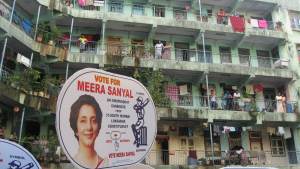
Meera Sanyal - with her batsman election symbol

Meera Sanyal - with her batsman election symbol

And so she has, in the sense that she has made a personal mark on politics, nationally as well as in Mumbai. She has raised the profile of independent candidates and helped to give voice to a groundswell of exasperation with India’s often corrupt and ineffective politicians, as well as raising economic and other local and national issues than the main parties were virtually ignoring.

The exasperation has been expressed most graphically by the six or so slippers and shoes that have been thrown at politicians this month, as well as by a crop of initiatives devoted to improving the way politics operates – for example the Public Interest Foundation’s Forum for Clean Politics, which is headed by Bimal Jalan, a former Reserve Bank of India governor of the and now a Rajya Sabha member.

The question now is whether these initiatives will continue to grow after the general election, and have a significant impact on future polls. Sanyal certainly seems to be planning to continue and sounds as if she is at the start of a new phase in her career.

The 47-year old daughter of an admiral, she has been country head since the end of 2007 of ABN-Amro (now part of RBS) and is on sabbatical till the polls are over, when she will return to work if she does not win. Her family says she has been talking about entering politics for a long time because of a wish to contribute to public life, but it was the November 26 terror attacks that made her act. She says she felt directly involved, partly because her office is directly behind the Oberoi, and especially because Ashok Kapur, founder and chairman of Yes Bank who originally recruited her into ABN-Amro, was among those killed in the Oberoi hotel.

She reckons she has filled a “vacuum of leadership” in the election by responding to a feeling among people that politics must be changed. “Politics should be the highest of professions as it was in the time of Mahatma Gandhi, Jawaharlal Nehru and Muhammad Ali Jinnah,” she says.

She likes to add a business tone to her comments and talks about Congress and the BJP “losing market share” which, in a company, would mean they were ”selling the wrong product” or “not attracting the right talent” – the inference being that she has both the product, in terms of policies, and the talent to fill the gap left in the market.

She criticises the main parties for not talking about major issues such as the economy, especially the fiscal deficit of approaching 11% and claims her remarks have made them focus more. Her one-page manifesto flyer also calls for national policies on subjects ignored by the main parties such as education and the environment. For Mumbai she calls for action on infrastructure investment, stronger security against terrorism, affordable housing, water, providing open spaces in new land developments, and election of a city mayor.

img_3742_edited1I walked with her earlier this week around south Mumbai’s Lower Parel area where mills and other factories have closed in recent years. This is a difficult constituency – both for Sanyal and for Milind Deora, the 33-year old current Congress Party MP, who is defending his seat. The boundaries have been significantly redrawn beyond the well-off areas in the south of the city that elected Deora last time. There are now 1.9m voters, 35% of whom come from slums and have been represented since 2004 by Deora’s main opponent, Mohan Rawle, a veteran MP for the Maharashtra-based chauvinist Shiv Sena party.
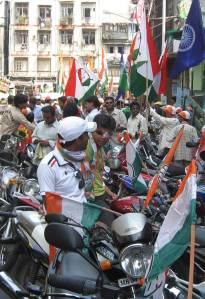
Motorbikes ready for the Congress motorcade

Motorbikes ready for the Congress motorcade

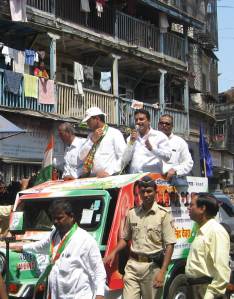
There was a mood of almost naive euphoria among Sanyal’s small team of volunteers as they sang “we shall overcome” to the tune of the American civil rights song – contrasting vividly  with Deora’s noisy motorcade of local party heavyweights that was led by over 100 motor cycles. “Being together is enough of an event,” said one of Sanyal’s helpers, who despaired of the quality of India’s governments. People came to the windows and balconies of their blocks of flats to look down as Sanyal called to them through a loud hailer. Some smiled and waved while others looked indifferent.

Known to be personally ambitious in her banking career as well as professionally competent and effective, Sanyal clearly has her eye on something bigger than tramping the streets canvassing for votes. She told me that if she loses, she will stand again in the next general election “and the next and the next and the next”. Some people have suggested to her that she should stand for the Maharashtra legislative assembly later this year, but she says she will not do so, though she will encourage others.

Significantly she does not rule out joining a political party – “of course not” she replied when I asked her. That answer puts many of the new-style professional independents’ initiatives in perspective: they would become party candidates if they could but, knowing that is unlikely, are making their mark as independents.

Milind Deora (centre with cap)

Milind Deora (centre with cap)

Murli Deora, a veteran Mumbai politician and a current government minister who is the Milind Deora’s father, gave me the establishment’s practical reply to such ambitions. He acknowledged that Sanyal is “a successful banker and has a lot to contribute to the country”, but added: “It would be a little difficult to give her a seat straight into parliament – one would have to wait a little and do some work”.

Deepak Parekh, chairman of HDFC Bank, who has publicly backed Milind Deora rather than Sanyal, said candidates should be backed by a party, adding, “we need strong national parties to give continuity and stability”.

Sanyal of course does not really disagree with that, but says that “if parties were to practice inner party democracy, then people like me wouldn’t need to stand as independents”. Put another way, the dynastic and vested-interest links that dictate who is chosen by the main political parties block would-be new entrants such as Sanyal as well as Captain G.R. Gopinath, the airline entrepreneur who is a candidate in Bangalore, and dancer Mallika Sarabhai who is standing against L.K.Advani, the BJP leader, in Gujarat.

When Manmohan Singh, the prime minister, visited Mumbai two weeks ago he said that independent candidates were ‘spoilers’. Many of them probably are, but I wonder if he would like it to be any different. He must feel more in tune with people like Sanyal than many members of his cabinet, and would have made a perfect independent candidate himself if Narasimha Rao, the Congress prime minister, had not got to him first in 1991 and made him finance minister.  

This is a slightly extended and illustrated (and unedited) version of an article in Mint, an Indian daily newspaper – see http://www.livemint.com/2009/04/30005201/Expression-of-exasperation-set.html

 FOR MORE POSTS ON INDIA’S GENERAL ELECTION TYPE General Election IN THE SEARCH BOX – OR CLICK ON General Election BELOW

Posted by: John Elliott | April 27, 2009

Allegations of how the CPI(M) rigs West Bengal elections

BARRACKPUR: I’ve just been in a rural part of West Bengal’s Barrackpur constituency hearing devastating criticism of the Communist Party of India (Marxist), whose Left Front government has run the state for 32 years and is now being challenged in the general election by a local alliance of the local Trinamool Congress, led by Mamata Banerjee, and the Congress Party.

I have heard many allegations in the past about how the CPI(M) uses rough undemocratic tactics to fix elections, but have not before had a chance to learn first hand about the way that local people say its cadres control the state.

Dinish Trivedi - and a CPI(M) wall painting

Dinish Trivedi – and a CPI(M) wall painting

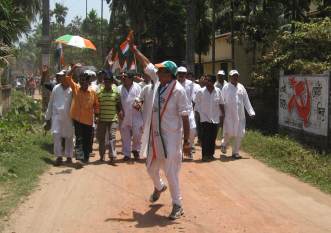
I spent three hours walking yesterday with Dinesh Trivedi, a veteran politician who is standing as a new Trinamool candidate in Barrackpur, a suburb of Kolkata (Calcutta) which has had a CPI(M) MP for 19 years.

Trivedi has decided that the best way to campaign is to walk – despite the 40 degrees C midday heat – through the streets and village roads and paths so that people, who say they have previously been too scared to vote, gain courage from seeing a friendly candidate. There was no sign of any CPM(I) canvassing, though the party’s banner was painted on a massive number of rural walls.

As word of our approach spread, women and men came out of their houses to the roadside to tell us they have been scared to vote in elections – echoing what we had earlier heard in a local town.

“Will I be able to vote?” asked Kiran Ghosh. “For the last many years we have not gone because when we go and put one foot inside the voting booth, the officials says your vote is cast, go away, so we come back home”.

img_3729_edited

“My [grown up] children don’t go to vote because they will be beaten up,” said Rekhi Ghosh, an elderly scheduled caste woman.

“They usually come at night a few days before voting and threaten us if we go to vote,” said Abdul Razzak. “They say they will cut you in two if you vote – and they poison the water”.

According to these and other stories, the CPI(M) has used such tactics to scare the poor into submission for many years. In the 2004 general election, local police guarded the voting booths as they have done for years – and the police are run by the CPI(M) state government, which meant that voting was blocked. The situation improved in 2006 state assembly elections when central police forces were present at all Barrackpur’s 1,328 voting booths, and it is intended that this should happen this time.

“If you don’t bring central protection here, there is no point in us trying to vote,” said Jayanta Chowdhoury, explaining that the Harmad Bahini – the CPI(M)’s militia – have check posts near some polling booths and turn back voters.

Trivedi has researched voting records and says he has found that faked voting has been rampant, despite India’s modern electronic voting system. “We searched the internet and then went house to house and have found 8,000 duplicate votes,” Trivedi said, showing me 47 pages of records with double entries against names and electronic voting numbers for over 8,000 of the 1.1m electorate.

Also evident on my walk was the Left Front government’s appalling record on infrastructure and basic services. Village roads which should be made of concrete, were rough, unmade and potholed. A scheduled caste village had no electricity, even though it was adjacent to a village road and was not in a remote but just 60kms from the centre of Kolkata.

This is an area that has suffered heavy job losses as old jute, textile and engineering factories have been run down and closed. There is also huge potential for the development and agricultural and allied businesses.

But the Left Front government seems to have done nothing. This supports the opposition’s claim that the CPI(M) is primarily interested in maintaining its hold on the state, and is not interested in development and care for the poor – a subject I shall return to in a few days with a broader based column on West Bengal and the general election.

_________________________________________________________________________________________

This post is also on the FT.com India Election page – http://www.ft.com/cms/s/0/ee0e2608-330d-11de-9316-00144feabdc0,dwp_uuid=950714d0-12eb-11de-9848-0000779fd2ac.html

 __________________________________________________________________________________________

Posted by: John Elliott | April 23, 2009

Orissa’s reclusive enigma looks set for an election victory


img_3682_edited1BHUBANESHWAR, ORISSA: The helicopter landed in one of the most desolate and poorest parts Orissa’s Puri constituency in the usual swirl of anti-social blinding dust that heralds the arrival of top politicians on India’s general election trail. But that did nothing to deter the enthusiastic welcome of the crowds gathered to see their chief minister at Rulango in Dalang on Monday evening – and the man who alighted from the aircraft had none of the arrogant power-strutting swagger of many Indian politicians.
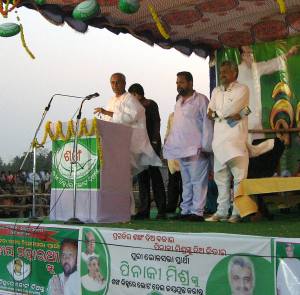
Instead, Naveen Patnaik, the 62-year old chief minister of Orissa, emerged as a very slightly stooping man with a friendly smile but sometimes stern eyes, who carefully kept those around him at a distance, but did so shyly without causing offence.

img_3699_editedHis smile was genuine as he went to the platform and read the first part of his speech in the local Orya language, which he cannot speak easily, and then, apologising, turned to his more comfortable Hindi. His manner was that of a kindly headmaster addressing an end of term pupils’ meeting as he spelt out his government’s successes, rarely raising his voice but receiving cheers at all the right moments.

“Nice to see you again”, he said to me as he walked away from the platform. I asked what his main issues were. “He’ll tell you,” he replied, waving at the agent of Pinaki Misra, the local parliamentary candidate. I reckoned that was one of the longest interviews Patnaik has given to a foreign correspondent. He is famous for saying little and rarely meeting journalists – and indeed rarely meeting anyone outside his small inner political circle. Almost a recluse in Bhubaneswar, he socialises little and reportedly even vets guest lists when he spends evenings with his two closest political friends and allies, member of parliament Jay Panda and Orissa minister A.U.Singh Deo.

Once a friend of Jacqueline Onassis and Mick Jagger, Patnaik unexpectedly abandoned a grand and exclusive international jet setting life-style for Orissa politics after the death 12 years ago of his father, Biju Patnaik, a popular politician and former chief minister. Known to his friends as Pappu, he did not seem to have the grit to remain in politics for long. Yet he now has a chance of breaking records by winning a third successive term as Orissa’s chief minister, having managed to carve out an image that appeals to the electorate, even though the state has sunk while he has been in power to become India’s poorest with 39.9% of the people below the poverty line. That is worse, amazingly, even than Bihar.

Searching for issues

I decided to come to Orissa to write about India’s general election and the state’s assembly election (the second and final stage of voting takes place today) because I thought the sleepy low-performing state was full of urgent social and other election issues.

My list included tribal clashes last year with attacks and killings of Christians, violent demonstrations and deaths over the use of agricultural and tribal land for big steel and other projects such as those planned by Posco, Tata and L.N.Mittal, plus a growing Naxalite threat (with 29 people killed on Orissa’s first polling day last week). Also on my list of course was Patnaik, who unexpectedly broke his Biju Janata Dal (BJD) party’s 11-year alliance with the Bharatiya Janata Party (BJP) last month and, to quote a journalist friend, “seems to have the state in his grip”.

That seemed a basket of important subjects – religion, land, lawlessness, dynasty, and coalitions – till I spoke to a friend in Bhubaneshwar and asked what the issues were. “Rice politics”, he replied, explaining that much of Patnaik’s popularity is based on having reduced rice to Rs2 a kilo for roughly half the state’s 37m population. “With rice, BJD schemes to get third-time lucky,” said a newspaper headline. Now Congress and the BJP have been promising to reduce that to Rs1.

It is of course, I thought, the same the world over. Between elections, all sorts of issues grab public and political attention, but when it comes to the time to vote in the next government, it is the price of food in the shops that counts. Yet when I arrived in Orissa I discovered that even though rice is perhaps the determining factor for many of the poor, there are few policy clashes. “The election is being fought without any issues,” says Sudhir Pattnaik, editor of Samadrushi, an Orya magazine. “There’s no difference between the parties”.

The BJP has certainly lost ground because of the anti-Christian riots at Kandhamal last August, with thousands of Christians still sheltering in relief camps, but that is being offset to some extent by criticism of the way Patnaik dumped the BJP.

Abhaya Sahu

Past social unrest over big projects does not seem to be an issue, except in the localities affected. Abhaya Sahu, the CPI official who led the anti-Posco movement, has been in jail since last October but no one seems concerned, even though the CPI has a seat-adjustment deal with the BJD. And the Naxalite attacks seem to be tolerated, even though the government has allowed the Maoist influence to stretch to 18 districts in recent years.

Instead, the major focus is on Patnaik and whether he can survive, and maintain his party’s present in India’s parliament, without the BJP. He has made many enemies because, behind the kindly exterior, he can be a brutal operator and has sacked at least ten ministers and a clutch of senior bureaucrats, sometimes for corruption or other misdemeanours.

Despite the need to collect funds on big projects to fund the BJD – and reports of links with some leading businessmen planning big projects – these sackings have enabled Patnaik to build something of a corruption-free image among the poor. I asked Pyarimohan Mohapatra, a former top bureaucrat who is Patnaik’s main adviser, how they managed to accumulate party finances. “We don’t ask for donations but I will say thank you if [someone] comes and offers at the time of elections,” he replied, smiling. He claimed this approach had drawn businessmen to the state.

However, many projects have not gone ahead. A total of some 50 memoranda of understanding (MOUs) have been signed by the BJD-led coalition for projects involving iron ore and steel, bauxite and aluminium, and ports, but what would have been India’s largest foreign investments – by Posco and Mittal – are stalled by government delays and, in Mittal’s case, by the company deferring its plans. Tata has also not gone ahead, though two other Indian steel groups – Bhushan and Jindal – are beginning projects. Mohapatra denies this shows failings by the government, and also points to improved rural and village roads, expanded irrigation, a growing horticulture business, and other rural schemes to show that the government has had successes.

In the assembly, the BJD currently has 61 seats, supported till last month by the BJP’s 32, with Congress’s 38 leading the opposition. Observers expect the BJD figure to go down because of the break from the BJP, and the consequential split vote that could benefit Congress.

Mohapatra however forecasts the BJD will go up to an astonishing 85-93, reducing the BJP to 12-14. That is partly based on an opinion poll he commissioned before the split which showed that 79% of those voting for the BJD-BJP alliance in 2004 were really supporting the BJD and only 21% the BJP. This gave Patnaik the confidence to break away when the BJP and its allied Sangh Parivar organisations became a political embarrassment, after the Kandhamal riots.

In the outgoing Delhi parliament, the BJD has 11 MPs while the BJP has seven from the state and Congress three. Mohapatra forecasts the BJD will go up to 13 or 14 which will make it a significant though maybe not a major player in coalition forming. Mohapatra says the BJD will not support any government led by either Congress (for historic reasons) or the BJP, and will insist on pro-Orissa policies, notably an agreement to boost extremely low royalties paid to the state for mining its high-grade iron ore.

Congress has been running a badly organised campaign, and the BJP seems to be on the back foot, which increases the probability that the BJD will get at least somewhere near Mohapatra’s forecasts, giving Patnaik a third successive term in office. If  however he does confound his critics and becomes chief minister again, he will be under pressure to do more than he has in the past to lift the state from the bottom of India’s poverty league.

This is a slightly extended and illustrated (and unedited) version of an article in Mint, an Indian daily business newspaper – see http://www.livemint.com/2009/04/23003734/Patnaik8217s-fortunes-remai.html

FOR MORE POSTS ON INDIA’S GENERAL ELECTION –  WRITE General Election IN THE SEARCH BOX – OR CLICK ON General Election BELOW

Posted by: John Elliott | April 17, 2009

India’s effective Satyam rescue shows the way to go

Tributes are flowing in for the way that the Indian government organised Tech Mahindra’s $565m rescue of Satyam, the country’s fourth largest software company. The rescue came this week, just four months after Satyam crashed with the exposure of India’s biggest ever corporate scam – perpetrated by the Hyderabad-based Raju family that founded, and nearly ruined, the business.

Friends in Britain have said to me that they doubt whether some western governments would be so adept at staging such a quick and efficient  rescue. “We believe in capitalism – we’d have let it crash”, said a London-based journalist. That is partly true, though the British and US governments are both showing themselves willing to pump money into banks to maintain financial stability, and into auto companies to save jobs.

But what the Indian government has pumped in is far more effective than money, and the result shows how well the country can manage crises when top people do not allow themselves to be diverted by bureaucracy or vested interests.

It began with a decision by Manmohan Singh, the prime minister, that Satyam was too important to India to be allowed to fail, and that its rescue should not be delayed by official inquiries into India’s biggest corporate fraud. That was followed by the recruitment of a new board of directors with real clout – including Deepak Parekh, India’s most dependable top banker, Tarun Das, who presides over the Confederation of Indian Industry, and Kiran Karnik, former head of the software trade body NASSCOM.

The Company Law Board then approved significant waivers that enabled the new directors to auction Satyam without having to file restated accounts (they are still not available because of the Rajus’ fraud), without holding what would have been a highly disruptive general shareholders’ meeting – and with the introduction of a vetting procedure that rated bidders on their track records.

This vetting procedure was objected to by B.K.Modi, the publicity conscious head of his family’s telecom-based Spice group, who lost interest in bidding for Satyam after the Company Law Board unsurprisingly rejected his appeal.

That left three viable bidders who were willing to risk Satyam’s unclear finances and possible law suits – Larsen & Toubro, one of India’s top engineering groups, and W.L.Ross, a New York private equity investor, as well as Tech Mahindra, which is part of the Mumbai-based Mahindra & Mahindra autos-to-infrastructure group and includes BT of the UK as a 31% shareholder.

So is the Satyam rescue an example of what could be done again in India and elsewhere, or was it a one-off?

It looks like a one-off because Satyam became a very special case.

All the activity, from Manmohan Singh’s intervention downwards, was triggered by fear of the damage that its collapse could have done to the software and outsourcing technology industry, which has played a crucial role in building international recognition of India’s economic success over the past decade or so.

It was seen as a potential disaster to allow one of the biggest companies in this sector, with top international customers such as GE, Cisco, Nestlé, and Telstra, to fail because of the sort of endemic corporate corruption for which India’s older industries are famous. That is why the prime minister and others moved so fast and firmly – though of course the potential loss of 45,000-50,000 jobs was also important, especially with a general election approaching.

But it need not be a one-off. It might not often be possible to tap top people like Parekh and Das, but Satyam’s example does surely show the benefit of trying to re-launch (not just save) businesses that are full of talent but have been brought down by bad management.

The secret is to change the top management. That has been done by bringing in Tech Mahindra as both a new owner and manager (it’s also been done by US president Barack Obama with GM).

Anand Mahindra, who runs his family group, has taken what a  competitor described to me as “a punt”.  Satyam’s broad-based international software skills will sit well alongside  Tech Mahindra’s telecom software expertise, and Mahindra reckons it has the top management need to produce a successful merger.

The big question now is whether the investigating authorities will pursue the fraud with the same energy that has been used to save the company – or will the Rajus’ political and bureaucratic friends help to slow down the case, fudge evidence, and whittle away the charges?

If this happens, India’s international reputation should surely suffer more than if Satyam had never been saved.

Other Satyam columns on this blog:

–  https://ridingtheelephant.wordpress.com/2009/01/19/satyam-will-not-trigger-changes-in-indias-companies%e2%80%99-dna-and-culture/ 

–  https://ridingtheelephant.wordpress.com/2009/01/12/satyam-rebuilding-begins-but-indian-corporate-fraud-runs-deep/

–  https://ridingtheelephant.wordpress.com/2009/01/07/satyam%e2%80%99sraju-lifts-the-lid-on-indian-corporate-fraud/

–  https://ridingtheelephant.wordpress.com/2008/12/17/markets-kick-satyam-into-line-%e2%80%93-but-india%e2%80%99s-reputation-for-corporate-governance-is-hit/

–  https://ridingtheelephant.wordpress.com/2008/09/22/%e2%80%9cfamily-silver%e2%80%9d-at-risk-on-hyderabad-metro-project/

______________________________________________________________ 

this post is also on the FT.com India page – http://www.ft.com/cms/s/0/2a1fb916-2f05-11de-814a-00144feabdc0,dwp_uuid=a6dfcf08-9c79-11da-8762-0000779e2340.html

__________________________________________________________________________________


Posted by: John Elliott | April 14, 2009

Punjab militants link with Taliban as Pakistan backs Sharia law

Added September 22 2009: While many people felt  the risks for Punjab were over-stated in the NYT report below, they have just been repeated by the Financial Times in a report – Militants regroup in Punjab, say officials  – with up-to-date information on Taliban militants from the Swat area taking refuge in Punjab, which, said one official “is ready to pop”. _________________________________________________________________

There is a worrying story in this morning’s New York Times  that Taliban activists are linking up with militant groups in Pakistan’s Punjab province and have been jointly staging terrorist attacks such as those on the Sri Lankan cricket team in Lahore last month and the attack on Islamabad’s Marriott Hotel last year. [See also this NYT story April 17] 

This underlines the seriousness of the Taliban gaining control of the Swat valley north of Islamabad, and yesterday’s approval by Pakistan’s parliament for Sharia law to be implemented in the entire Malakand division of the North West Frontier Province (NWFP). Malakand includes not just the Swat valley, but districts such as Chitral and Dir as well as Buner, just 60 miles north of Islamabad, where there has been recent Taliban violence.

The Swat Sharia deal, negotiated in February, arguably only reinstates a form of Islamic law that has been practised earlier in the area, where it is being welcomed by some because of its quick and efficient justice.

But the more important point is that the Pakistan government has in effect ceded control in return for an end to Taliban violence and killings – with a vague and unrealistic hope that extreme Taliban policies such as banning schools for girls, publicly flogging offenders and human rights abuses would end.

That makes it a government surrender and a military victory for the Taliban’s Sharia rule of law that the extremists will no doubt want to replicate elsewhere, as the violence in Buner district shows.

Apart from the MQM political party, which walked out and abstained in the Assembly yesterday, no other party opposed the Sharia vote. The Taliban had threatened that anyone opposing the law would be executed.

The risk is that the Taliban will then want to expand its Sharia influence in other areas of NWFP and then across Pakistan.

To destabilize Pakistan, destabilize Punjab first

The New York Times says today that Punjab police officials and local residents are warning that, if the government does not take decisive action, the poorest parts of the province could be the next areas facing an insurgency. “I don’t think a lot of people understand the gravity of the issue,” a senior police official told the newspaper. “If you want to destabilize Pakistan, you have to destabilize Punjab.”

Militants already control several areas of the province. The article says that barber shops, music stores and Internet cafes offensive to the militants’ strict interpretation of Islam have received threats in at least five towns in southern and western Punjab, including the city of Multan. Traditional ceremonies that include playing drums and dancing have been halted in some areas.

I have heard it argued in Delhi that the Taliban would be resisted by Pakistan’s Punjabis, who are culturally different from the NWFP’s Pashtuns, and that the prospects of the Taliban’s Sharia regime gaining a hold near to Pakistan’s India border are therefore remote. But that argument surely does not apply if the Taliban and Punjabi militant groups are combining forces.

Writing in the The Times of India last week, G Parthasarathy, a former Indian high commissioner in Pakistan, warned that India would “have to face up to the reality of the growing radicalization across its western frontiers, rather than entertaining illusions that civil society or political parties in Pakistan have the ability, or will, to take on the radicals”.

So how long will it be before a Swat Sharia situation develops in India? Would the Taliban-Punjabi militants target an area in Kashmir, adding to the terrorist activity there and elsewhere in the country?

Posted by: John Elliott | April 10, 2009

Another shoe thrown – another Indian politician a target

Congress buckles under flying shoe

One of George W. Bush’s most significant positive legacies (there aren’t many) is that the Iraqi journalist who threw a shoe at him last year opened up a new way for the desperate to express their abhorrence of politicians.

Naveen Jindal

Naveen Jindal

I was writing this post, with the headline “Congress buckles under flying shoe”, when the tv reported that a shoe has been thrown today at another politician – this time it was at Naveen Jindal, a Congress MP and industrialist and a popular figure on Delhi’s party and polo circuits, who was the target of an angry retired (reportedly drunk) school teacher in Rajasthan.

This looks like becoming a feature of India’s current general election campaign and is surely to be welcomed, providing no shoe lands too painfully on its target, and the throwers are not roughed up by the police and goons who guard the politicians.

I say this because many politicians and political parties deserve to be publicly humiliated for the appalling, self-seeking, and often corrupt way that they have run the country for years.

Jarnail Singh

Jarnail Singh

When Jarnail Singh, a 36-year old Sikh journalist, threw a shoe on April 7 towards Palaniappan Chidambaram, India’s home minister, he could never have thought he would hit his target so successfully. He says he aimed to miss Chidambaram – which he did – because the minister was only an intermediary target  for Sikh anger.

The real target were Congress Party leaders who had named two politicians, Jagdish Tytler and Sajjan Kumar, as general election candidates. These two men  both have cases against them stemming from violence that led to the deaths of 3,000 Sikhs after prime minister Indira Gandhi was assassinated by her Sikh security guard in 1984. Added to this, it looked as if a court case against Tytler was about to be dismissed.

Yesterday Congress amazingly buckled and cancelled the two men’s candidatures. The party, headed by Sonia Gandhi, was reacting to protests that spread across the Sikhs’ home state of Punjab in support of Jarnail Singh’s shoe-throwing.

So who has come well out of the shoe throwing so far?

– Certainly Jarnail Singh, a usually quiet 40-year old journalist, who became a national hero yesterday, and who then reacted well, almost apologising for what he did and saying “impulse got the better of me”.

– Also Chidambaram, who said he understood Singh’s motivations and asked for no more action to be taken. He also admitted that Congress governments had not done enough to charge those responsible for the 1984 killings – a specially significant statement coming from a home minister.

– But surely not the Congress leadership which, even though it took the right decision in dropping the two men, should not have chosen them in the first place – and now looks weak and indecisive by cancelling their candidatures when they suddenly became a general election liability.

There is much that is wrong with the way that India’s government’s political parties, government and legal systems work. The Sikh protests have led to extensive television and newspaper discussion of these problems – not only of the way that those accused in the 1984 killings have gone free, but also of how people have rarely been charged successfully for other outrages such as the Gujarat 2002 massacre.

That is surely good.

Posted by: John Elliott | April 8, 2009

Religious intolerance surfaces in Indian election

See also https://ridingtheelephant.wordpress.com/2009/04/10/another-shoe-is-thrown-another-indian-politician-a-target/  _______________________________________________________________________

It’s curious how the Nehru-Gandhi dynasty is having unintended and totally unexpected impacts on India’s general election campaign which officially begins on April 16.

Varun Gandhi, grandson of former prime minister Indira Gandhi, has refocused the Bharatiya Janata Party’s fundamentalist electoral platform over the past three weeks, and now the memory of the anti-Sikh riots that followed the assassination of Indira Gandhi in 1984 has focussed attention on a less-than-savoury side of the Congress Party.

Both events, coincidentally, are highlighting extreme Hindu views regarding Muslims and Sikhs.

Shoe thrown at Chidambaram

Shoe thrown at Chidambaram

The dynasty has been hoping that the election focus would be on Rahul Gandhi, prime-minister-in-the-making, and on his mother, Italian-born Sonia Gandhi, leader of the Congress Party and the current coalition government, so that they would together get the credit for leading Congress to victory in a new coalition government. But these other events have now burst onto the stage.

Dealing with the second event first, a Sikh journalist threw a shoe during a press conference yesterday at Palaniappan Chidambaram, the home minister, because the Congress has allowed Jagdish Tytler, a controversial politician, to stand as a candidate in the election. [On April 9, two days after the shoe throwing, the Congress Party withdrew Tytler and another candidate from the general election in response to growing criticism].

Tytler has been accused for the past 25 years of being one of the instigators of vicious riots staged by Hindus against Sikhs after a Sikh security guard shot Indira Gandhi. The specific Tytler allegation relates to a Sikh temple being set on fire, causing the death of three people.

I was in Delhi at the time and saw how Sikhs feared for their lives as 3,000 were killed and the riots spread – riots that were undoubtedly encouraged by Congress politicians and not quelled for several days by the party’s leadership that included Rajiv Gandhi, who became prime minister (and was assassinated in 1991).

Jagdish Tytler

Jagdish Tytler

Sikh anger over those events has been reawakened by the Central Bureau of Investigation (CBI) last week asking a Delhi court to clear Tytler of charges against him and to close the case that has been running through the courts for years. The court will give its verdict on April 9  [deferred till April 28] but, whatever it says, many Sikhs are convinced that the CBI was working under the instructions of the Gandhi-led government that wanted to clear Tytler so he could stand as a candidate.

If those suspicious are correct, the government’s plan has misfired, as became quickly evident today when protests against Tytler spread across the Sikh’s home state of Punjab, disrupting traffic and blocking railtracks.

Leading Sikhs defended the journalist. The SGPC, known as the Sikhs’ parliament, offered him a job and legal expenses, and the Shiromani Akali Dal,  a Sikh political party, offered him a two lakhs of rupees ($4,000) reward and offered to make him a parliamentary candidate.

Reports suggest that Manmohan Singh, India’s prime minister and a Sikh, is far from happy about the candidature of Tytler, who seems to have some hold over the party’s leadership. The government has today reacted to the protests by reconsidering his role.

The fact that Congress has not dealt with prosecutions stemming from the 1984 riots while it has been in power over the past 25 years seems to show an appalling bias. This strengthens the feeling of hurt and estrangement that fed the Sikhs’ call for Khalistan (a form of independence or autonomy for Punjab) through the 1980s.

Varun Gandhi filmed on a video

Varun Gandhi filmed on a video

The Varun Gandhi episode involves the 29-year-old son of an estranged member of the Gandhi dynasty who has become a prominent and cherished member of the BJP. Seen till now as a mild, soft-spoken young man who wrote poetry, he has suddenly become the poster boy of the BJP’s extreme nationalist wing since he was filmed allegedly verbally attacking Muslims  and Sikhs (even though he is mother is a Sikh). He claims videotapes were doctored.

It is not clear whether his attack was planned with BJP leaders. Initially it was seen as detrimental to the BJP’s cause at a time when the party is trying to play down its nationalist Hindutva doctrine and make broad economic and developmental appeals to the electorate.

But the BJP has now decided to ally itself with Varun, and some leaders have visited him in jail, where he is being held for his inflammatory speeches. This is because, like it or not, Gandhi is playing to many BJP supporters’ deeply held anti-Muslim views, and he has rallied them to the BJP‘s cause – leaving other politicians to tut tut on the sidelines and regret that Gandhi had been quite so outspoken.

All this shows how nothing is ever simple in India. While Varun Gandhi’s mother is a Sikh, his late father Sanjay (Rajiv’s brother) was half Parsi and half Hindu. And Jagdish Tytler, born to a Hindu father and Sikh mother in what is now Pakistan, was brought up after his parents died by a prominent Christian educationalist.

You’d think that such diverse backgrounds would breed tolerance!

_______________________________________________________________

This post is also on the FT India page – http://www.ft.com/cms/s/0/5bb5a80e-243e-11de-9a01-00144feabdc0,dwp_uuid=a6dfcf08-9c79-11da-8762-0000779e2340.html

_____________________________________________________________________

Posted by: John Elliott | April 4, 2009

India’s electoral system does work


It’s amazing that Indian democracy works. I am not talking about the staggering figures of 714m eligible voters in 543 constituencies with 828,000 polling stations and 1.36m electronic voting machines, administered and protected by six million officials and security forces – statistics that are trotted out in awe by foreign correspondents every election to grab the attention of their newsdesks.

My point is how surprising it is that the vast mass of India’s electorate tolerates this exercise, and accepts the result,  even though it will do them little good. Every five years, and sometimes more frequently, around 60% of those eligible troop into polling booths and vote for aspirant parliamentarians and politicians who are most unlikely to have any interest in improving their lot.

Many will not know or have heard of the candidates because constituency MPs rarely exist here in the way that they do in the UK, where most local MPs tend their local area, hold “surgeries” to help answer people’s questions and meet their needs, and generally become a local figure.

There are only a few such MPs in India – Mani Shankar Aiyar for example in Tamil Nadu. Usually, party power brokers allocate seats at the last minute. The successful candidates then blast their way noisily round their constituencies, making speeches full of empty promises, laced with gifts (when the Election Commission is not looking), and then get elected, or do not.

Parties’ policies seem to matter little, despite detailed manifestos. There is of course a sharp divide over the BJP’s Hindu-nationalism and the Left Front’s soft communism, even though both of these are at least partly curbed in coalitions.

The decline in economic growth and rising prices in the shops, plus terrorist attacks, may count against Congress; but there seems little to choose between the parties on these subjects. Both the BJP and Congress for example have strong liberalisation policies, with the BJP perhaps carrying a little more conviction because both Sonia Gandhi and prime minister Manmohan Singh have reservations. And both parties would be tough on terrorism and security.

The first election I reported was in 1984 when Rajiv Gandhi and the Congress Party won on a huge sympathy wave after Indira Gandhi’s assassination. The elections of 1989 and 1996 produced unclear results as the dominance of Congress declined. Congress won again in 1991 on another sympathy wave after Rajiv was assassinated.

Then the Bharatiya Janata Party, under Atal Bihari Vajpayee’s skilful leadership, came back firmly in 1999 at a time when Sonia Gandhi had yet to pull the Congress Party back together. In 2004, the Congress-led United Progressive Alliance won a totally unexpected victory because voters had tired of the over-confident BJP and its leading regional allies.

But while the system works, and is some ways getting stronger, it risks being devalued. On the positive side, the expansion of the urban middle class means that more people are able to decide for themselves how to vote without being herded or bullied by caste groups or gang bosses. On the other hand, the system is slipping into hands of political dynasties and regional party leaders, whose personal agendas often mean they care less for democracy or India than past MPs, and politicians with criminal links.

The Public Interest Foundation’s www.nocriminals.org website shows that one in five MPs elected in 2004 had pending criminal cases against them, either awaiting trial or on appeal after conviction – about half the for murder, violent robbery or rape.

They included 40% of Maharashtra’s MPs, 35% of Bihar’s, and 28% in Uttar Pradesh (UP). Among them were five out of nine MPs in Sharad Pawar’s Maharashtra-based Nationalist Congress Party (NCP), and eight out of 19 in Mayawati’s UP-based Bahujan Samaj Party (BSP). It is well known that criminals use politics to help run their gangs and fix government decisions and contracts.

Dynasties generally have a negative impact on politics because they block a party’s development and prevent new leadership emerging at the top. This is not to under-value the contribution made by the Nehru-Gandhi dynasty, not to ignore the potential of young dynastic MPs such as Omar Abdullah (now chief minister of Jammu and Kashmir), Jyotiraditya Scindia, Sachin Pilot, Manvendra Singh, Milind Deora, as well as Rahul Gandhi. These men seem to have positive agendas for improving the lot of the poor and how India is run, though they have yet to prove themselves as able politicians and leaders – and their existence means that outsiders have been denied positions.

There are also numerous sons, daughters and other relations being brought into politics by politicians who do not have such high ideals and seem to be there mainly to sustain a family’s prestige and patronage – and, I suspect, to ensure that illicit assets and money accumulated by their fathers or uncles is kept in the family. It would be good if disillusionment with such patronage led to them losing in elections.

The growth of regional-based parties like Mayawati’s BSP is more worrying because few of them are interested in national policies. They line up with whatever national government suits them (though some do shun the BJP), and this time are working as a (not very stable) third front that could try to step in if neither Congress nor the BJP has enough seats to lead a coalition.

They habitually seek cabinet posts for ministries that are most lucrative in terms of kickbacks – defence, telecoms, highways, aviation and power for example – and seek influential ministers of state posts such as in the finance ministry. National parties also, of course, covet these jobs and there have been Congress Party defence and power ministers in the current government, but these politicians have had a national focus.

Yet, despite all the lack of focus and sincerity – and the corruption, caste-influenced voting, and occasional violence – the system works. That is shown when swings happen and poor-performing MPs lose their seats, and governments are ousted, or elected by unexpectedly large majorities. But the downsides make the system vulnerable. The main thing India needs strong leadership to develop the economy and resist terrorism. For that, it needs a stable government – the risk is that it might not get it. 

this is an article that appeared in the weekend Lounge section of Mint, an Indian daily business newspaper – see http://www.livemint.com/2009/04/03200858/The-system-does-work.html?h=A3  including a Radio Podcast of the script.

Posted by: John Elliott | April 1, 2009

Manmohan Singh marks the limits of liberalisation

There is a revealing line hidden away in the text of a Financial Times’ interview with Manmohan Singh, India’s prime minister, that is published today. Asked about “the future of capitalism, especially in India”, he replies: “We are a mixed economy. We will remain a mixed economy. The public and private sector will continue to play a very important role”.

This is significant because it underlines his continuing belief in India’s public sector and his long-held reservations about wholesale privatisation.

Manmohan Singh during the interview

Manmohan Singh during the interview

The prime minister preceded that line with the phrase “capitalism with a human face”, which  he has used several times (sometimes saying “reforms with a human face”) over the past 15 or so years. (I first heard it in 1995 as the title of a book by Sam Brittan, the FT’s veteran economic commentator).

This underlines the fact that the prime minister has never been the arch liberaliser that the international media likes to make him. He was not the architect of the 1991 economic reforms – the basic plans were drawn up between the end of Rajiv Gandhi’s 1984-1989 Congress government and 1991. But he did become an enthusiastic – and caring – implementer.

Narasimha Rao, prime minister of the Congress government elected in 1991 in the midst of a dire financial crisis, picked him as finance minister because, it is said, he reckoned that if the reforms succeeded, he (Rao) would get the credit, but if they failed he could blame ex-bureaucrat-Singh. As it turned out, Mr Rao’s calculation was wrong because the reforms were a success and Mr Singh got the credit – despite the government’s loss of nerve in 1994-95 after unfavourable regional election results.

On privatisation, Mr Singh’s Congress-led United Progressive Alliance (UPA) government has been held back for most of the past five years primarily by the Left Front that supported the coalition till the end of last year.

But Mr Singh was content to live with some of the Left’s approach because he does not believe in privatising profitable public sector businesses (PSUs, as they are known in India – U stands for undertakings). The corollary is that he believes in privatising loss-making PSUs, which of course is unreal because they rarely find a buyer.

He does favour selling – “divesting” in PSU jargon – minority stakes, and on that he was held back by the Left. But, along with the Left, he has not seemed keen on allowing in strategic investors – which usually means a specialist private sector company that aims eventually to acquire a majority stake.

He did not seem very disappointed when, just after the current government’s Common Minimum Programme was put together in 2004, he said that no profit-making PSU would “normally” be privatised. To underline the change of policy from the former Bharatiya Janata Party-led government, the Disinvestment Ministry was scrapped and merged into the Ministry of Finance.

It is refreshing to find an economic reformer who does not charge blindly up every liberalising alley, but instead analyses what is good and practical for the country. Too often governments around the world have privatised everything they can, without analysing the pros and cons.

A senior British Treasury official once told me that it was essential to have a constant stream of privatisation candidates so as to “maintain the momentum” of the policy. If that momentum was lost, he said, it could be difficult to restart it.

In India, of course, there is no momentum to be maintained. A few companies were privatised under the 1999-2004 BJP-led government, but since 2004 there has only been minimal restructuring, some by a specialist reconstruction board (the BRPSE).

It is surely good that the prime minister takes his stand on a literally mixed economy. It does mean of course that PSUs remain over-manned and often poorly managed, but at least there is something of a debate on the issue.

Too often India’s industrial policy, as I have written before, is developed by enthusiastic ministers working with equally enthusiastic private sector interests – for example on foreign direct investment rules, special economic zones, and airport privatisation (where Indian private sector companies are primarily interested in low-cost land acquisition and property development, not running top class airports).

There now needs to be a debate on where India is going on privatisation, maybe with the prime minister setting out how far he would like to go, and in which industries.

___________________________________________________________

this post is also on the FT websitehttp://www.ft.com/cms/s/0/0c43f820-1eb2-11de-b244-00144feabdc0.html

____________________________________________________________________

Posted by: John Elliott | March 23, 2009

Tata’s “One-Lakh” Nano – let’s cool the hype

I’m travelling out of India so hadn’t intended to blog on the launch today of Tata’s tiny Nano car, but am doing so because, surely, the hype has gone too far.

On the FT website there’s a piece by Suhel Seth, a well known figure in India’s social, media, and business circles, excitedly titled “Why India Needs a Nano”.

the Nano

the Nano

Arguably it’s something of an insult to India because it suggests that the country needs this small car because “in these troubled times, India needs a symbol of hope; a symbol of the possible”.  It will not just be the launch of a car – “instead it will be the launch of a million possibilities”. This is sheer hype from my friend Suhel, who I believe advises Ratan Tata.

I don’t want to be a spoilsport, but what is all the fuss about?

There have been many small cars before around the world – a little Fiat 600 and a even smaller front-opening BMW Isetta 300cc three-wheeler “bubble car” (below)  were for example familiar sights on  Europe’s roads 40 or so years ago

OK, so the Nano’s basic ex-factory price will be one lakh rupees – that’s Rs100,000 – roughly $2,000 at current exchange rates.

And this means that Ratan Tata, who heads the Tata group and has direct managerial responsibility for Tata Motors, is personally honouring his promise to produce a car for that price.

bmw-isetta

But every buyer will have to pay more than one lakh rupees even for the basic model – probably nearer $2,500, though that is of course still less than India’s next cheapest car, Maruti’s 25-year old 800cc model which retails for about Rs190,000 upwards.

More significantly however, not many of this basic model will be built, simply because it will  not be profitable. The economics of the exercise dictate that Tata Motors must focus more on higher priced models that can fetch higher prices, which it will do immediately.

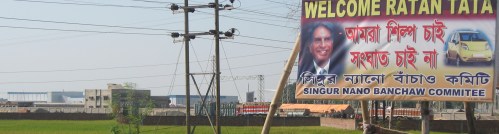
And, unless Ratan Tata announces it later today, we do not know how these cost savings add up, nor the surely considerable contribution made to the low costs by the extremely favourable investment incentives that it was first offered for its blighted West Bengal factory at Singur and now has in Gujarat where the car will be made later.

These incentives on land price and tax and other concessions are of course available in other states for new factories, but would presumably not have been offered for Tata Motor’s main plant in Pune. (I will return to these figures later when I am back in India)

Nano interior

Nano interior

So let’s be realistic. Sure, Tata is today unveiling an exciting new small car – smaller than anything else on the India market. Other manufacturers – including India’s Bajaj Auto with Renault – are working on a similar size car, so Tata does seem to be heading where there will be a big demand.

That’s great, but the One Lakh  Ratan Tata promise has become a branding gimmick and is well below the on-the-road price of most 0f the Nanos that will be produced.

And a proportion of the savings has come not from brilliant engineering or innovation but from state government subsidies, which will cost the tax payers of Gujarat in lost government revenue.

Secondly, if Ratan Tata really wants to do something for India, wouldn’t he have done better to develop a tiny car with serious fuel emission and fuel economy innovations, instead of simply a low cost brand that will further clog India’s already crowded roads?

So, on balance, is Tata really doing India many favours today?

___________________________________________________________

This post is also on the FT.com website – see http://www.ft.com/cms/s/0/2b47c97e-178f-11de-8c9d-0000779fd2ac,dwp_uuid=a6dfcf08-9c79-11da-8762-0000779e2340.html

____________________________________________________________________

« Newer Posts - Older Posts »

Categories