Rarely can investors have forced a company to conform with international business ethics so swiftly and effectively.

Yesterday evening (India time), after local stock markets closed, Satyam Computer Services, one of India’s leading software companies, announced it was spending $1.6bn of Satyam’s surplus cash to buy out two Maytas real estate and construction companies controlled by the Raju family that founded and controlled Satyam.

Late yesterday (US time), it cancelled the deal after being hit both by the New York stock market that marked its price down 55%, and by vitriolic attacks from investors and analysts.

Such are the effects of globalization, especially in a downturn when investors look harder at deals that might be glossed over in a boom market. Satyam’s corporate governance has been questioned before but rarely has an Indian company been brought into line so rapidly and publicly.

The deal, which does not seem to have been discussed with shareholders outside the Raju circle,  was challenged in this morning’s Indian business papers. The Business Standard said Hyderabad-based Satyam was “under fire”, and Mint asked quizzically “Will Maytas help Satyam turn around?”.

The markets were harsher, and Satyam’s shares (American Depository Receipts) lost 55% in New York amid a chorus of criticisms from foreign institutional investors that own a majority in the company. (The ADRs recovered half that loss after the deal was cancelled).

“This clearly raises questions about what kind of corporate governance you have in other Indian companies. That could hurt foreign investment”, Reuters reported Sachin Jain, a Jefferies & Co analyst, as saying.

Satyam reacted rapidly and cancelled the deal, less than 12 hours after it was announced. “In deference to the views expressed by many investors, we have decided to call off these acquisitions,” Ramalinga Raju, Satyam’s founder chairman, said in a statement.

Satyam had announced it planned to enter the depressed construction industry, where the Raju family has had interests for some time, by buying privately held Maytas Properties for $1.3bn and 51% of Maytas Infra for $300m. Ramalinga Raju and his associates own 36% in Maytas Infra and 35% in Maytas Properties.

Raju, who was chairman of NASSCOM, India’s prestigious software industry federation, in 2006-07,  claimed that the Maytas companies would help “de-risk”  Satyam against a downturn in the software business.

But as Reuters reported, analysts questioned the motives of Satyam’s top executives and pointed to a potential conflict of interest because they hold stakes in both companies.

Clearly the deals made little sense when technology outsourcing companies are preserving cash to help weather the global economic slowdown, and when the construction and real estate businesses are harder hit than IT.

“The company has lost investor confidence. Rescinding the offer does not restore that confidence,” said Janney Montgomery Scott analyst Joe Foresi. “The credibility of Satyam’s board of directors and its management is at rock bottom,” said Global Equities Research analyst Trip Chowdhry.

There’s a lesson here for many other Indian companies – foreign investors are no longer the over-excited and unquestioning buyers that they used to be.

And a message for India’s old-style business families: Put questionable deals on the back burner – they may be legal but the markets won’t like them.

See three later reports on this blog:
https://ridingtheelephant.wordpress.com/2009/01/19/satyam-will-not-trigger-changes-in-indias-companies%e2%80%99-dna-and-culture/
and
https://ridingtheelephant.wordpress.com/2009/01/12/satyam-rebuilding-begins-but-indian-corporate-fraud-runs-deep/
and
https://ridingtheelephant.wordpress.com/2009/01/07/satyam%e2%80%99s-raju-lifts-the-lid-on-indian-corporate-fraud/
and an earlier one:
https://ridingtheelephant.wordpress.com/2008/09/22/%e2%80%9cfamily-silver%e2%80%9d-at-risk-on-hyderabad-metro-project/

It will never be as famous as the Model “T” Ford, nor the Volkswagen Beetle, but the little Maruti Suzuki 8OOcc car that was first sold 25 years ago today is the most significant vehicle ever produced in India.

The Ambassador is of course India’s most iconic saloon, but it is a symbol of the manufacturing industry’s failings, whereas the Maruti has been the catalyst for India’s modern and internationally competitive auto industry.

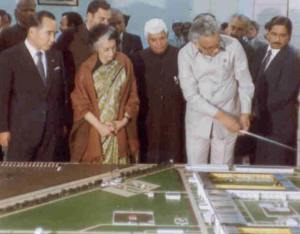
Today is the 25th anniversary of Indira Gandhi, then the prime minister, releasing the first ten 8OOcc cars to their customers at Maruti-Suzuki’s Gurgaon factory on the outskirts of Delhi in 1983 – where she was shown (below) the factory plan by V. Krishnamurthy, the company chairman.

.

.

I was there, as The Financial Times’ new south Asia correspondent, and the next day reported Osamu Suzuki, chairman of the Japanese company, saying: “It is difficult to have a good operation in India”. He added that it would be achieved “providing the Indians do not expect to make too many of their components too quickly”.

Demonstrating the new start that Maruti marked, the imported management style decreed “the recruitment of shop floor workers with an average age of 20 who have never worked anywhere before, wear grey overalls, do physical exercises every morning and prompt time-keeping”.

It’s obviously worked because a total of 2.7m of the 800’s have been produced and it is still being sold – for Rs215,000 ($4,500), having been launched in 1983 for Rs52,500 ( then about $5,000).

I remember people in Delhi wondering how they would fit a driver into such a small car along with their families (they did!), and complaining about how it nipped in and out of  the traffic around stodgier vehicles (similar to earlier complaints in Britain about the iconic Austin-Morris Mini)

the Maruti 800

the Maruti 800

“The 800 made India a country that is now on wheels”, R.C.Bhargava, who was managing director years in the 1980s and 1990s and is now the chairman, told me today.

Originally an  Indian government-Suzuki 50-50 joint venture, the company is now Suzuki controlled and is producing 750,000 cars of all shapes and sizes. It is the clear market leader with a 40% market share.

Bhargava worked on the launch with Krishnamurthy, the founder-chairman who had been a top bureaucrat and now, in his 80s, heads the government’s National Manufacturing Competitiveness Council. [In March 2010, Bhargava produced a book on the company’s history The Maruti Story]

Krishnamurthy was told by Indira Gandhi to revive the bankrupt Maruti car venture that had been started by her late son Sanjay Gandhi, and produce a “people’s car”.

She didn’t get what she wanted because the 800 became a car for  the middle classes and  was followed by larger models. But she did get a hugely successful joint venture with Suzuki which began to unlock India’s hidden manufacturing strengths that had been bottled up by post-independence economic policies.

O.Suzuki’s remark about not making many components quickly in India stemmed from the fact that there were virtually no component suppliers that could begin to make acceptable parts. There were also no concepts of quality or production control. Maruti changed all that, sparking a revolution that is now spreading across India’s manufacturing industry, which is why today’s anniversary is so important.

“Maruti brought to India the concepts of tight cost control and process engineering,” Gautam Thapar, chairman of Avantha (BILT, Crompton Greaves etc), told me for a Fortune magazine article two years ago.  “It brought the first wave of modern component technology with the concept of Indian entrepreneurs and Japanese companies together supplying Maruti as an anchor client”.

Baba Kalyani, chairman of Bharat Forge, the world’s second-largest forging company,  agreed: “It brought in a completely new breed of component manufacturing with modern products and processes. A new culture started”.

Not only were there no adequate component suppliers in 1983, but there was no concept of partnerships between a manufacturer and its suppliers. “A supplier was treated almost like a servant,” said Bhargava

Maruti changed that with a supplier development program, taking 25% equity stakes in some companies from Japan and elsewhere. Clusters developed in three locations, one of them around Maruti’s factory in Gurgaon on the outskirts of Delhi. Workers and suppliers were sent to Japan to learn management and production techniques and this interchange continues today – Maruti design engineers worked in Japan on the Swift that was launched in 2005.

Maruti has never had the recognition it deserves as the catalyst for India’s modern motor industry, nor for its wider impact on manufacturing. Krishnamurthy and his team created something of far more lasting importance than other more famous names – you see the result on Indian roads every day.

Posted by: John Elliott | December 12, 2008

Chidambaram takes the first steps to improve security

The government yesterday began to give some of the lead that India needs following the Mumbai terrorist attack of two weeks ago. Speaking in parliament, home minister Palaniappan Chidambaram and foreign minister Pranab Mukherjee spoke impressively about what India needs to do internally to strengthen security and externally to deal with terrorism organisations based in Pakistan.

They were backed up by prime minister Manmohan Singh – and by his one-day heir apparent, Rahul Gandhi, who made the important point that security services should spend less time providing flamboyant (my word) services for VVIPs and more time looking after ordinary people.

Announcing that India has asked Pakistan to hand over 40 people it believes have been behind militant attacks, Mukherjee ruled out military action against its neighbour as a solution when he asked why India was not attacking Pakistan. “That is no solution,” he said.

That may look like a climb-down from some of his earlier remarks, but it is the reality – the risks of attacks escalating into a potentially horrific confrontation between two nuclear powers make it almost unthinkable that India would send rockets across the border to hit terrorist camps. Such an attack would increase the likelihood of attacks in retribution and would only wipe out people actually in the camps, not the many located elsewhere.

In any case, with the US and United Nations putting pressure on Pakistan to rein in terrorist organisations, and with Pakistan beginning to respond, there is less need for India to scare the world with threats against its neighbour.

Looking ahead, Chidambaram mapped out a range of security measures, including a new National Investigation Agency, plus strengthened intelligence gathering and security troop training and deployment, and advanced technical equipment.

He wants to present legislation setting up the agency to parliament next week. First however he has to win support from individual states such as Uttar Pradesh, whose chief ministers like to be able to control and influence police activity in their states and do not want a national organisation interfering in their highly politicised (and therefore inadequate) police forces. More justifiably, they also want to be able to resist interference from what might one day be a domineering central government.

Chidambaram was careful not to be too specifically critical of the appalling performance by security agencies because he needs their co-operation. He said that India’s basic intelligence structure seemed sound, but there was a need to make intelligence gathering and sharing “more effective and result oriented”.

So far so good. Now comes the much more difficult job of pushing changes in structures, attitudes and working practices down the line. We can only wish Chidambaram well!

Posted by: John Elliott | December 9, 2008

State elections prove Indian democracy works

If anyone doubts that India’s democracy works – and many foreign critics do – yesterday’s assembly election results from five states surely proves them wrong. Voters in three states kept governments (and assembly members) who had done well, while those that had not performed were thrown out.

In Delhi, Congress won comfortably, led by Sheila Dikshit who has made history by being chief minister for three terms – assuming Sonia Gandhi approves her name, which she must do (she kept Dikshit waiting ten days before confirming her last time). Dikshit has performed well in a horribly difficult post, and the Bharatiya Janata Party (BJP) put up a poor candidate to oppose her. The BJP also traded too heavily – with a blood-spattered advertisement carrying the words “Fight Terror: Vote BJP” – on anti-national government sentiment that followed the Mumbai terrorism.

I don’t think this negates the significance of Narendra Modi, the controversial BJP chief minister of Gujarat, being picked in a Mumbai opinion poll last week as the best national leader after the terrorist attacks (see my last post). The BJP’s Delhi candidate was weak and elderly, and its message was too negative, whereas Modi gives constructive leadership and hope to his supporters.

Congress also won in Rajasthan, where the aristocratic BJP chief minister Vasundhara Raje, failed to run an effective government and connect with the people. This result was also significant in terms of terrorism because Jaipur, the state’s capital, was hit by a series of bomb blasts in May.

And in Madhya Pradesh, a mild-mannered BJP chief minister, who has a good developmental record, defeated the bitterly divided Congress Party.

The results challenge one of the most over-stated generalisations (and simplistic lazy media reporting) of Indian politics – that elections are usually dominated by an “anti-incumbency” wave that throws out sitting governments. What these elections have shown is what in fact usually happens – good governments and political leaders win and bad ones lose. The expectation that anti-incumbency will dominate election results is based the depressing assumption that most governments in India are bad.

The Congress Party, which leads India’s coalition government, did much better than expected, especially after being criticised heavily for the Mumbai attacks. The problem now is that many of its leaders may mis-interpret the polls and feel less impelled to sharpen up their act. That would be a mis-reading of the polls, which rewarded performers and threw out those who failed.

Meanwhile Mayawati, the Dalit (low caste) leader of the Uttar Pradesh-based Bahujan Samaj Party (BSP), increased her minority stakes in some states. This will encourage her ambition to make the BSP a national party, catering for all castes, alongside Congress and the BJP.

Some politicians are good!

The NDTV 24/7 tv channel ended one of its news programmes last night with presenters laughing about a remark by a politician that “some politicians are good”. They were trying to explain how there had been high turnouts in the elections, despite the anti-politician mood that followed the Mumbai attacks.

It was a nice sign off line – especially when one of the politicians on the programme laughed that he “wasn’t sure” when asked to endorse the remark.

The emphasis of course was on the word “some”, which always means “not many” when said with a certain inflection.

Rahul Gandhi “getting into his stride”

One of the least noticed quotes of the day came from Digvijay Singh, a veteran Congress Party general secretary, when he was asked what contribution Rahul Gandhi, Congress’s anointed prime-minister-in-waiting sometime-in-the-future, had made to electioneering when his mother, Sonia Gandhi, had been kept away by ill health. Singh acknowledged that Rahul had made a contribution and then, as the camera turned away from him, smiled mischievously and said “he is getting into his stride”.

Lessons for the general election

No-one can sensibly draw conclusions from these results about how the general election, due by next March or April, will turn out. Nationally, Congress will have a problem because of the economic down-turn and security worries. But the BJP will need to put up constructive policies to cash in on those failings. Regional parties, which ultimately could decide who leads the next coalition government, also need to note that success breeds success.

Posted by: John Elliott | December 5, 2008

Mumbai votes for Narendra Modi as national leader


Narendra Modi

Narendra Modi

An opinion poll published this morning by Mumbai’s DNA daily newspaper shows a majority of respondents in the city favouring Narendra Modi, the controversial Bharatiya Janata Party (BJP) chief minister of Gujarat, as most likely “to provide the kind of leadership required to bring about real change” following last week’s terror attacks in the city. (To find the DNA survey report  – see pic below – click here and search Archive for Dec 5)

Nationally  Sonia Gandhi, the leader of the Congress Party and of the governing coalition,  came out tops with 23% of the vote, closely followed by prime minister Manmohan Singh with 22%, L.K.Advani, the BJP’s national leader at 18%, and Modi with just 14%.

mumbai-vote-for-nmodiBut the result was reversed in Mumbai. There Modi led with a dramatic 47% while Advani, Singh, and Gandhi got 10-13% each.

 This is significant because it shows the views of the educated middle class of the city that has been hit most often by terror attacks in recent years, culminating in last week’s commando-style invasion of the Taj and Oberoi hotels, a Jewish centre, and other targets.

As I suggested in a post on December 3, there is a demand across the country for new strong leadership. If the current national leaders do not perform, it is quite possible that the country will turn to the BJP in next year’s general election. Many will then want Modi – a powerful orator and capable administrator – to provide a nationalist hard-line lead.

Such a development would of course be opposed across the political spectrum – including by some BJP leaders – because of Modi’s arch Hindu-nationalist leanings and his record over Gujarat’s Godhra massacre six years ago. He would therefore have great difficulty stitching together a coalition with regional parties .

But the Mumbai vote, in an opinion poll conducted for DNA by IMRS Advisory, a market research firm, cannot be ignored. It is a warning to more moderate leaders to change or risk being swept aside.

• I was on America’s National Public Radio on December 3 answering questions about the events of the past week – you can find it on http://www.npr.org/templates/story/story.php?storyId=97750541


Posted by: John Elliott | December 3, 2008

Will the current crisis lead to Narendra Modi as PM?

The most depressing aspect of the debate that is swirling around India in the aftermath of last week’s Mumbai terrorist attacks is that no-one has an answer to the problem of what to do about the dire failings of India’s government and security services.

No-one has an answer because of the corruption-driven incompetence, and complacent inefficiency, that pervades all levels of government from the security agencies and government ministries down to officials running local fire brigades. This is so deeply entrenched that there is no simple answer.

How can you quickly introduce change in a society where, as I have written before, few politicians have any care for the future of the country, when caste and prestige rivalries block co-operation at all levels of government, and when selfishness dominates public life.

On the 24/7 television channel last night, Vikram Mehta, chairman of Shell companies in India, talked about a “collapse of decision making” and “systemic failure”. He spoke of the horror, watching last week from his Mumbai flat, the slow response of fire fighters at the Oberoi Trident Hotel – they took three hours to arrive at the site and pump water.

In the past day or two we have heard how warnings of an attack from the sea on Mumbai targets, including the Taj Hotel, came in the days and weeks before the attack from sources ranging from US intelligence officials  to local Taj waterfront boatmen. Even Ratan Tata, head of the Tata group that owns the Taj, says he was warned – the hotel’s front entrance was partially barricaded but, he added, simply, the terrorists came in the back door.

So it is not just national and state governments that are to blame. It is the whole country that seems to regarding security merely as a ritual (as I wrote on Sunday) – even though there have been 12 major terrorist attacks this year.

But even more worrying than the failures is the fact that no-one has any viable answers. The despair and anger against politicians, bureaucrats, and procedures – and the corruption that governs many policies and actions – is so deep that people are clutching at straws.

After delivering a damning indictment of the government machine last night, Mehta had no instant solution because there isn’t one. He fell back on what is a nice thought, but nothing more, saying “we need 40 or 50 young people as politicians to be in parliament and hold the balance”.

On the same tv program, Milind Deora, the 31-year old MP for South Bombay where most of the attacks took place, said he was “ashamed to be a politician”. Commenting on the way that politicians had reacted with indifference and a lack of leadership to the outpourings of grief and anger in Mumbai over the past few days, he said it was as if “they had rubbed mud in our faces”. The son of India’s petroleum minister, Deora is the sort of young MP that Mehta had in mind, but what can he and a handful of other similar young politicians do!

Palaniappan Chidambaram, the new home minister, is to produce an initial security plan on December 10. That might address some of a list of ten points listed in the Times of India on December 1, maybe including: unifying coastal and Indian Navy security operations, removing “turf walls” between the various security agencies (easier said than done), setting up National Security Guard (NSG) units in major cities, reviewing VVIP security so that it does not help politicians “strut around and flaunt their status” (something I mentioned recently), create a quick-response disaster and crisis management system, and introduce measure to de-politicise and improve policing.

It will be near impossible for Chidambaram however to execute many such reforms quickly, certainly not with a general election due by next March or April. Politicians and officials – including senior officers from the armed forces and security forces – will realise that he will probably not have the same job after the election so will delay changes, hoping he is replaced by a softer option that they can ignore.

Narendra Modi

What is needed is leadership from the top, and that cannot happen with this government because of the dual-leadership role performed by Manmohan Singh, the prime minister, and Sonia Gandhi, the government’s de facto political leader. She does not have the stature and there is little point Singh trying because Gandhi’s courtiers will warn her that he is becoming too self-important and is challenging her role.

So what to do?

I have heard two extreme ideas this week.

One is to have a state of emergency or even military rule. That is surely unthinkable.

The other is that the country needs tough rule by the Bharatiya Janata Party (BJP) led by its highly controversial Gujarat chief minister, Narendra Modi.

I wonder how long it will be before the failings of more acceptable politicians leads to Modi becoming prime minister?

Posted by: John Elliott | November 30, 2008

Chidambaram is a good choice as India’s Home Minister

This is good news, at last.

Palaniappan Chidambaram has been made India’s home minister, replacing Shivraj Patel. He is one of India’s most focussed and analytical politicians, and he was a wasted resource at the Finance Ministry, now that the international financial crisis has switched the economic focus to Manmohan Singh, the prime minister, himself a former finance minister, and his office (PMO), along with Montek Singh Ahluwalia who runs the Planning Commission.

Chidambaram had security responsibilities as minister of state in the 1980s, so he knows his way around the security apparatus. He is also a top international lawyer, so can bring that skill and knowledge to the job.

He is not the most tactful of politicians, nor always the most polite, but these are not traits that are needed at this time. What is needed is that he establishes himself as the sole top authority on security and that he commands those down the line to follow his directions and perform. He then needs to put effective security systems in place and ensure they are implemented efficiently

This would be a tough test for any minister and Chidambaram needs to be allowed to get on with it, without interference from the PMO or other departments.

News that has emerged in the past day or so indicates that an attack from the sea had been expected for some time before Wednesday night’s terrorist assault on Mumbai, and that the waterfront Taj Hotel had warnings that it was likely to be a target.

This indicates that there was disastrously poor direction and management from the Home Ministry and PMO down to the targeted buildings. There were reports this afternoon that M.K.Narayanan, the national security adviser who works in the PMO, offered to resign, but PMO sources say he is staying.

Dynastic considerations

As an aside, it is worth noting that dynastic considerations (see my last post) have not played a part in these changes. Patil was protected for a long time because Sonia Gandhi saw him as a Nehru-Gandhi family loyalist – whereas Chidambaram, who was once part of a breakaway Congress party, is an outsider.

I wonder who is influencing Sonia Gandhi to make such a decision.

And who persuaded her to allow Sheila Dikshit, Delhi’s Congress chief minister, to play a leading role as the apparent chief ministerial candidate in the current Congress Party’s state assembly election campaign? Usually Congress politicians have to wait for the elections to be over before being announced by what is euphemistically known as the “high command”

Is Sonia Gandhi’s son Rahul, who is a general secretary in the party, influencing such events? It’s good news if he is.

“Security in India is a ritual and rituals don’t need to be efficient”, a friend said to me this afternoon (Nov 27) as we talked about the continuing terrorist activity in Mumbai.

That came home to me as I walked through a crowded market adjacent to Delhi’s Janpath this evening. There were barricades and check points at either end of the market, but there was no checking – at one end a policeman was strutting around aimlessly, and at the other end a policeman, holding an electric scanner, was playing with a small child..

When I was in Mumbai a few weeks ago there was little visible security at the Taj and Oberoi hotels that are at the centre of last night’s terrorist attacks. One could walk in with being checked – in the case of the Taj through three different entrances. In Delhi, cars at some hotels have to open their boots (trunks) for inspections that are so cursory they are a waste of time.

Security is also something that politicians use primarily as a prestige badge of importance, employing government (or private agency) security staff and fleets of jeeps and cars to follow them around and boost their image. Regional politicians are the worst – especially some chief ministers of Punjab and Haryana, one of whom I have seen arrive at Delhi’s Khan Market with ten jeeps and saloon cars packed with AK-47-toting guards for a visit to a bookshop.

Security is also a political weapon. Those in power promote allies’ security grades (which earns them more public displays of importance), and demote it for opponents, with little care for individuals’ actual security risk.

But what security is not is a serious business of protecting people efficiently in a way that would minimise the chances of terrorist attacks like those in Mumbai last night.

Compounding the problem is India’s disastrous home minister who is widely regarded as useless, but seems to keep his job because he is trusted by Sonia Gandhi, the leader of India’s Congress Party and the ruling coalition – dynasties like the Nehru-Gandhis often appoint people to sensitive posts more because of their family loyalty than their competence.

A televised address to the nation this afternoon by Manmohan Singh, the prime minister, made some of the right noises, but Indian ministers are always better at statements than execution.

He said instruments like a National Security Act would be “employed to deal with situations of this kind”, laws would be tightened, and a planned Federal Investigation Agency would “go into terrorist crimes of this kind and ensure that the guilty are brought to book”.

He even made the inevitable criticism of un-named neighbouring countries (Pakistan and possibly Bangladesh) and said that the “use of their territory for launching attacks on us will not be tolerated” – not that India is likely to be able to do much about it.

Nothing will really change – and India will not begin to get efficient protection against terrorism – till security stops being a ritual and a political tool and becomes a serious business.

Posted by: John Elliott | November 27, 2008

Mumbai Taj and Oberoi attacks go to the heart of India’s pride

There is something specially symbolic about a terrorist attack on a major hotel, especially one which is a haven for foreign visitors.

Two months ago it was Islamabad’s Marriott Hotel that was hit by a massive truck bomb in one of the worst attacks to happen as the battle between the Islamic militants and the Pakistan establishment escalated. For years the Marriott – earlier a Holiday Inn – had been a symbol of some sort of normalcy in an increasingly dangerous country. No more!

Tonight the majestic and historic Taj Hotel on the waterfront in Mumbai has been besieged, and some of its splendidly gracious corridors and rooms set on fire, in one of several terrorist attacks on the city.

Flames rising from a wing of the Taj hotel - Reuters pic

Flames rising from a wing of the Taj hotel - Reuters pic

The Oberoi Trudent hotel, on the other side of the peninsula that constitutes south Mumbai, was also attacked along with other targets including a popular restaurant near the Taj.

There is the additional factor that foreign passport holders – especially American and British – seem to have been targeted, and some held hostage.

There is the tragedy of the deaths totalling over 80, with more than 200 injured, as I write.

This takes terrorism to a new level in India, which has been accustomed to various types of attacks for some 25 years – including the killing in 1984 and 1991 of prime minister Indira Gandhi and her ex-prime minister son Rajiv, plus attacks on the parliament in Delhi and Mumbai railway trains in more recent years.

There has been obviously careful and highly competent planning of the attacks, plus the combination of bombs and shooting in two of India’s most famous hotels, and the targeting of foreign tourists.

For Indians the Taj – now a favourite top price business and tourist location – has a special signficance because it was opened by Jamshed Tata in 1902 as a hotel where Indians could go and avoid British-only rules that applied elsewhere.

India has tonight become a much less safe place to be than it seemed just a day ago. That of course is what the terrorists intend.

Posted by: John Elliott | November 24, 2008

Is it time to re-examine Tata’s Jaguar and Land-Rover purchase?

It has been reported over the weekend that Tata Motors is asking the British government for a £1bn loan to rescue Jaguar and Land Rover (JLR) from financial collapse because of falling demand and the company’s problems raising finance to cover debt.

The story originated in The Sunday Times (UK) and has this morning been reported world-wide, though without confirmation (or denial) by the company, which has only confirmed it is involved in industry talks with the government.

We have been here before. As I pointed out when Tata – headed by chairman Ratan Tata – bought the two companies for $2.3bn earlier this year, it was buying into 40 years of troubles. In 1968 British Leyland was formed by the UK government to rescue ailing car companies – including Jaguar and Rover – and most have since collapsed.

[Added Dec 10 ’08: See http://www.nytimes.com/2008/11/18/business/economy/18car.html?_r=2&em=&pagewanted=all for more details of the history, including  how the British government had committed £11bn at today’s prices by the 1970s to save BL, and Ford spent another $10bn later before it sold Jaguar to Tata]

I was highly sceptical last year about Tata’s purchase and was viciously attacked by readers, mostly overseas Indians (NRIs) living in America, for saying Jaguar in particular might be a bad fit.

It is not the fault of Tata management that the world is in financial crisis. Other far larger car companies – notably GM and Ford – are in far worse straights.

But the appeal for help does underline how Tata has over-stretched itself with JLR, and in buying the Corus steel company for £11.3bn. Now the market value of Tata Motors – and Tata Consultancy Services, the group’s cash cow – have fallen sharply.

This seems therefore to be a good time for a reappraisal of whether Jaguar and Land Rover are worth rescuing – and whether Tata (which has its own problems in India with falling demand and its delayed low-cost Nano car project) is the right company to do it.

The British government should surely analyse that before it makes a decision, reportedly expected in two weeks’ time.

Should it be using British taxpayers’ money to bail out the Indian owner of two companies that several other owners have failed to turn round in the past 40 years?

« Newer Posts - Older Posts »

Categories