Posted by: John Elliott | November 23, 2008

“Bed and Bhai” rules India’s aviation

It was an extraordinary session yesterday afternoon at the Hindustan Times’ Leadership Summit when  three men, who between them more-or-less control India’s airlines, assembled on the stage and play-acted their way through a 45-minute session. They told us little, but revealed a lot about how well they get on together

There was Naresh Goyal, founder chairman of Jet Airways, who has got on famously with successive aviation ministers for years. Also Vijay Mallya, founder chairman of Kingfisher Airways (named after his United Breweries’ beer), who gets on well with all sorts of people, including ministers. Between them the two have 55-60% share of India’s air traffic.

And there was their ringmaster –  the urbane minister of aviation, Praful Patel, the government’s top Teflon Man, who controls Air India which has an 18% market share. He is clearly a good friend of Goyal and Mallya, though he mostly kept himself teflonically detached on the stage.

The theatre started well. The moderator had said that Jet and Kingfisher were now “in bed together” –  a reference to the two airlines co-operating to make savings. The two men would “not go to bed because we still like girls,” commented Goyal.

Goyal respectfully greeted “Patel Bhai” (bhai = brother). A few minutes later Patel said: “I hope you don’t misunderstand when Naresh Goyal said Praful Bhai” – scarcely surprisingly given the phonetic connotations, and that bhai can mean an underworld don in Mumbai.

The only slightly serious moment was when Patel asked them to lower airfares, now that fuel prices have come down dramatically, and they both said No. I suspected that was scripted, though Patel has hit back this morning with a story in the Business Standard that Air India will be reducing its prices – subsidised by the government which will inject more equity into the ailing carrier and will no doubt give more to bale it out if necessary.

The air fares point led to more jokes yesterday. Mallya said there was a similarity between his drinks and airlines businesses –“they both make you fly”. Goel commented later that he only had an airline to run, whereas “Vijay can live on the liquor” if reduced airfares lost him income (Kingfisher Airlines has never made a profit).

But the most interesting part of the session was the way that Patel managed (as he always does) to talk about India’s airline problems as though they were someone else’s responsibility, without acknowledging they are really his failings. The problem, he said, is infrastructure and a lack of a world-class “hub” like Dubai or London. The country needed more efficient airports, and it needed a school for pilots. Without those things, he seemed to be saying, don’t expect things to get better,.

Patel proudly said that there are now 400 passenger aircraft flying in India compared with 100 in 2004, without of course acknowledging that he has done little to make their operations efficient on the ground.

In the four years that he has been aviation minister, he could have done much more to improve the infrastructure at countless chaotic inefficient airports around the country, instead of just basking in the glory of having privatised (through highly questionable procedures) Delhi and Mumbai airports. And the government could have encouraged the formation of a pilot school.

The audience loved it. All good theatre but no substance!

Posted by: John Elliott | November 21, 2008

Sonia Gandhi leads Congress to the Left for the next election

We heard in Delhi this morning the gist of the Congress Party’s manifesto message for the next general election that is due by March-April next year but could come sooner.

It will be that India has been served well by the party’s mixture of protectionism and liberalisation, including state ownership, that has been implemented in various forms by the Nehru-Gandhi dynasty for 60 years.

Most importantly, this approach has protected India from the financial contagion that is wreaking havoc with the US and European financial systems and economies. Trust Congress therefore, and vote them back into power!

This became clear when Sonia Gandhi, the Congress president and leader of the ruling United Progressive Alliance (UPA) coalition government, addressed the annual Hindustan Times Leadership Summit in Delhi.

There’s always been a suspicion that, at heart, she is what in Britain we would call an “old Leftie”, instinctively worrying (rightly) about the plight of poor farmers rather than pushing industrialisation, and very much at home with the softer of India’s communist party leaders.

Bank nationalisation defended

She confirmed that this morning when, with only the slightest hint of humour, she defended what many people regard as undefendable – nationalisation of India’s banks that her mother-in-law, Indira Gandhi, implemented in 1969.

“Our prudence has been most marked in the case of the financial sector,” said Sonia Gandhi. “If you allow me the liberty of showing what is to you the proverbial ‘red rag to the bull’, let me take you back to Indira Gandhi’s much reviled bank nationalization of 40 years ago. Every passing day bears out the wisdom of that decision. Public sector financial institutions have given our economy the stability and resilience we are now witnessing in the face of economic slowdown”.

Vir Sanghvi, a leading editor and columnist who was chairing the session, referred jokingly to her “Brezhnevian” remark (a reference to the old Soviet leader) but seemed convinced that her speech had been mapping out a Trust Us theme for the manifesto.

Indirectly condemning what has happened in the US and elsewhere, Gandhi said: “The poor had nothing to do with the hubris of the rich”. They had “nothing to do with the fancy-sounding financial instruments” that had ensnared so many. “Should the avarice of a few be allowed to inflict misery on the many?”

The “inviolable” objectives should be: an open society and economy, but not an unregulated one; the freedom to pursue prosperity but not at the expense of social justice; individuals’ rights to fulfil their potential but not with “conspicuous consumption” that overwhelmed “simplicity and restraint”.

Her defence of bank nationalisation horrified many businessmen. They knew she was not advocating further nationalisation, but they were worried that she should choose that example to defend India’s position. Many would like the government-owned banks, which dominate the sector, gradually privatised so that they can shake off decades of cumbersome and costly inefficiencies, but that doesn’t now look likely any time soon.

One famous tycoon rolled his eyes to the heavens and said to me, despairingly: “Her role model is not her husband (Rajiv who pushed liberalisation in the 1980s) but her mother-in-law”.

A commentator pointed out that Indira Gandhi’s views on protecting the poor rather than opening up would have been absorbed by her daughter-in-law during Sonia Gandhi’s early formative years in Delhi in the late 1960s and 1970s. So it was not surprising that she referred to the banks, even though she also backed her husband’s liberalisation efforts.

But another businessmen angrily said: “Doesn’t she realise Indira Gandhi only nationalised the banks to gain control of the country’s financial institutions to use them to her own ends”.

Not everyone was anti. M. Damodaran, who headed SEBI, India’s stock market watchdog till earlier this year, said it was “music to his ears” to hear someone defending the merit of government ownership of important financial institutions that could guard against wide disparities of wealth. “I’ve been almost a lone voice saying this for 40 years,” he said.

Two other company heads also saw the need for some state control. One said the State Bank of India had saved their company. Another, now heading a big foreign multi-national in India, said a mixture of state and private sector control was needed in a country like India.

The Gandhi message is powerful. The Congress-led government has (though she didn’t put it quite like this) prevented India’s greedy would-be private sector bankers from behaving like those in the US and elsewhere, who personally pocketed millions of dollars a year and led the international system into disaster.

That of course will not resonate with India’s vast rural electorate in the same way that it would in the cities or in the West, but it is a useful line when the government cannot claim to have done much to improve the lot of the poor in the past four years.

The economic crisis is beginning to flush out some of the frustrations felt by India’s top entrepreneurial businessmen, who are saying how appalled they are by the way much of the country is run.

This began to emerge this week in the wings of the otherwise mostly-boring annual World Economic Forum (WEF) in Delhi – a Geneva-based public relations-driven institution that has thrived in the boom times but showed this week it has yet to learn how to structure its events in a crisis.

Most people did not want to admit there are serious problems – especially Palaniappan Chidambaram, the finance  minister, and Montek Singh Ahluwalia, head of the planning commission. There were of course exceptions – including speakers in software outsourcing, real estate and airlines.

Broader worries came from two of India’s top IT entrepreneurs. One, talking in the wings of the conference, was Nandan Nilekani, a founder and now co-chairman of Infosys, a software market leader. The other was Pramod Bhasin, founder and ceo of Genpact, a top ranking call centre and BPO operation that began life as a GE company.

Bhasin made his remarks in a WEF session and then repeated them to me afterwards. Commenting that India “is in serious crisis – in denial” he said that “politics are not getting any better and public services don’t work”. India was good as “repositioning” itself but could not “execute” what it decided.

“Fraying at the edges”

“Can we get power organised – water to the right places – roads, drainage,” he asked rhetorically, adding his punch line: “This country is fraying at the edges.”

.

.

Nilekani is thoroughly enjoying himself now that he has shed his line management responsibilities at Infosys and has joined the ranks of international opinion formers and commentators – a ranking that opened up after he inspired the title The World is Flat for Thomas Friedman’s best-selling book.

The world of course is not flat – at least not in the usual sense of a level playing field, as Mani Shankar Aiyar, a politician and polemicist, memorably told Friedman at the book launch in Delhi three years ago.

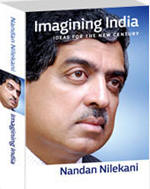
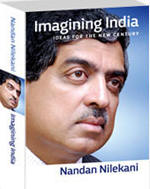
Nilekani is in a way picking up Aiyar’s theme in his new book “Imagining India – ideas for the new century that is to be published on November 24. He looks at what he calls “horizontal” themes. These are basic failings such as poor education, health, environment, and infrastructure that need to change if India is to begin to operate in a flat world. More on all that next week.

Meanwhile, though Nilekani is clearly an optimist, he was scathing in an article he wrote in the Times of India last Sunday.  It was headed, courtesy of Barack Obama,  “Yes We Can”, but one section should have been sub-headed “No We Don’t”.

“Play a waiting game with an Indian, and you will always lose,” wrote Nilekani.  “Indians – inured to serpentine queues, traffic jams, foundation stones laid for bridges never built – have long adapted to an economy that moves slowly and that has, in key reforms, struggled over the last mile.
 
“India’s policy makers and politicians have been great at forming agendas and presenting blueprints, and our five-year plans have been nothing if not exhaustive. Our big weakness has been in execution…….

“This response-led strategy has not been a good model for growth. It has made chaos the rule in our crumbling cities, our highways that meander into deadends and mud roads, and in schools with failure rates of 100%.

“In essence, while the Indian economy has changed over the past 25 years, the state has not. Our public institutions function under the same rules and incentives as they did in 1980 and under standards that date back to colonial India. What is required is a fight to remove long-rooted interest groups and bring about fundamental changes to our governance.”

When I haven written things like things like this in the past, especially when this blog was on Fortune.com, I was assaulted verbally by irate readers – mostly it seemed NRIs living in north America.

Let’s hope that the cries for change from Nilekani and Bhasin, both highly successful entrepreneurs based in India, are heard and picked up. If you want to join the debate, please comment here – and on Nilekani’s blog – welcome to the blog-sphere Nandan!

Nilekani’s Penguin promotion

ps: Nilekani’s blog is part of a website forum where he hopes Imagining India’s issues and ideas will be taken forward. The site has a detailed breakdown of the book, and leads on to a site (Indiaplaza) to buy copies online. Nandan’s book also marks the launch in India of Penguin’s Allen Lane imprint, which is designed to cater for ideas. Promotional plans around the book include a tieup with a coffee chain and a contest on ‘Imagining the India of your dreams’, and a link with a mobile service provider.

A month ago we all knew that the world’s financial crisis was hitting India when the unthinkable was splashed across newspaper front pages – Kingfisher Airlines was talking to its bitter rival Jet Airways about co-operating in order to curb the drain on its funds.

This week Vijay Mallya, Kingfisher’s chairman, has done it again by talking to Diageo, the world’s largest liquor group, about selling maybe a 15-20% stake in his United Spirits company. His aim is to raise $400-500m (or more). He hopes to find a way of using that to help his ailing airline, which is said to be leaking $2m a day, even after the recent cuts in aviation fuel prices.

He has defaults, payment disputes, and over-due payments for charter aircraft, airport handling and oil supplies – and (along with other airlines) has to cope with an appeal from the prime minister’s office (PMO) not to lay off staff.

Now he is trying to raise more cash by persuading the government (Financial Times report) to allow foreign airlines to invest in Indian carriers – something Jet Airways has successfully persuaded the government not to do for years.

Vijay Mallya’s low spirits

United Spirits, a wholly-owned subsidiary of Mr Mallya’s UB group, is the world’s third largest liquor company and is regarded as a major UB cash cow. For a foreign rival to be allowed a slice of its equity illustrates graphically what is happening to companies like Kingfisher Airlines that over-reached themselves in the boom.

No-one is saying publicly what people at United Spirits think about a major rival cashing in on their business because of the airline’s misery. Rumours suggest they are far from happy and wish their ebullient – but currently depressed – boss would forget his airline and his cricket and Grand Prix racing teams. They would like him to forgo ego trips for a bit and focus on the core beer and liquor business that he has built up in the past 25 years from his father’s inheritance.

In any case, it is far from clear that Diageo will buy a stake. The story appears to have been planted on The Economic Times yesterday morning to inject some buoyancy into UB’s share price.

Diageo commented, rather stiffly I thought, that it was “reviewing a possible collaboration” with United Sprits, but – significantly – there was “no certainty at this stage that these discussions will result in a transaction”. That suggests that the story is very premature

Some reports say that valuation of a stake is the main stumbling block but there are other problems – not least how the two businesses would co-operate  – specifically, how Diageo would achieve its major aim of using United Spirits’ excellent distribution networks and supporting relationships for its leading Johnnie Walker whisky and Smirnoff vodka brands that compete with UB.

But why would anyone would want to buy around 15-20%? Such a stake would carry no clout under Indian company law, where 26% is the key figure to have some say in company decisions – as DoCoMo clearly realises (see below). Go for 26% Diageo, or don’t go at all!

 Tata’s getting worried too

Ratan Tata is also getting concerned about the impact of the crisis on his group, especially after splashing out in the past year or two with Tata Steel the buying Europe-based Corus steel company, and Tata Motors picking up the UK’s Land Rover and Jaguar brands. With both purchases, he was gambling on a buoyant world economy boosting demand for steel and for cars at the luxury end of the market.

Now the tide has turned. Two weeks ago Tata Motors had to prop up a Rs41.5bn (approx $1bn) rights issue designed to refinance a $3bn loan for its $2.4bn purchase after investors, including leading Indian and foreign institutions, shied away. It has also cut back production.

Mr Tata has  warned senior management “to be sensitive and conscious of the difficult financial circumstances existing today”. A spokesman said they had been “requested to be proactive to focus on cash flow and conserve expenditure wherever prudently possible”.

Media reports say – no doubt correctly – that Mr Tata has gone considerably further in a memo to senior staff and warned that failure to manage the crisis could lead to “irretrievable positions”. Acknowledging the problems faced in raising funds at home and abroad, he said companies should put any planned acquisitions on hold unless they were strategically critical.

That sobering news was quickly offset in pr terms with an announcement that DoCoMo, the Japanese telecom company, is paying $2.7bn got a 26% stake in Tata Teleservices, one of India’s least successful mobile operators. Though less than Tata would have got for the stake a year or two ago, that is a good price and a welcome injection of funds for the group. Presumably it had been planned for some time, unlike Mr Mallya’s reach for a Diageo lifeline.

It’s good to see a newspaper coming out with a clear line – and one which is equally clearly right. Mint, a leading India business daily, ran a front page comment this morning headed “Raja should be fired”, pointing out that decisions taken by A.Raja, the telecom minister, “have cost the government dear”.

Mr Raja’s “mistake” (a kind euphemism if ever there was one) was that he did not auction new spectrum (needed for mobile communications). Instead, he allocated it early this year to companies that applied, on a first-come-first-served basis, for fees that were fair in 2004 when there were only about 50m mobile phone subscribers in India – now there are 310m so the fees should be much higher.

The Business Standard ran an editorial on October 31 headed “Licensed to make a killing”, and mentioned how spectrum had been “handed over” to a few “select” (another neat choice of words) firms.

Two of those companies, Unitech and Dynamix Balwas’s Swan Telecom, had absolutely no telecom experience but have now made huge profits out of the allocations.

When the awards were made, I asked a contact why such infrastructure and real estate companies were entering telecom. I was told that Mr.Raja had previously been environment minister – a job that brings contact with real estate companies, which become close to ministers and officials so that they obtain all the permissions and advantages that are available. So what could be more logical than to see such companies following Mr Raja to the telecoms ministry – and benefitting so royally.

Unitech paid $350-400m for its spectrum allocation, and then sold a 60% stake to Telenor of Norway two weeks ago for $1.3bn, putting a valuation of $2.1bn on the company. That’s a profit of about 700% in less than a year – and just for owning the spectrum without any customers or experience.

Swan similarly paid about $340m and sold 45% of its equity for $900m, giving the company a valuation of $2bn – a six-fold increase. In both cases, the extra funds more than filled coffers depleted by the dramatic turn-down in the real estate market.

The alarming point about this story is not just that a cabinet minister has been conducting these events, but that nothing is being done to stop him. Mr Raja was chosen for his ministerial slot not by the prime minister, Manmohan Singh, but by the chief minister of his Tamil Nadu-based DMK political party – such is the way in coalitions that depend for their continuation in office on the support of regional parties that have no national perspectives.

Manmohan Singh has publicly said that spectrum should be auctioned, but can do nothing to rein in Mr Raja – such is the way in coalitions.

What a way to run a would-be super-power!

bhutan-img_3176-trimmed12

A couple of years ago I was contacted by an American journalist who thought that an article I wrote in the Financial Times in 1987 was the first to record the Himalayan kingdom of Bhutan’s search for “Gross National Happiness”. Some sources suggest the phrase was coined in 1972, but my report (above) of an interview with the then 32-year old King Jigme Singye Wangchuck certainly happened around the time that he was developing his utopian idea.

“We are convinced we must aim for contentment and happiness,” the king told me. He put gross national happiness above the more usual economic targets of GNP, and listed the GNH. parameters: “Whether we take five years or ten to raise the per capita income and increase prosperity is not going to guarantee that happiness, which includes political stability, social harmony, and the Bhutanese culture and way of life”.

The king rarely gave interviews. I arranged mine after meeting the veteran globetrotting Foreign Minister, Lynopo Dawa Tsering, at a SAARC conference in India and promising to write about development. I was also warned not to ask the burning question of the day – which of four girlfriends, all sisters, he would marry! I stuck to the deal, but a Time magazine reporter didn’t a few months later, and foreign correspondents became an unpopular commodity.

.

After a couple of years, the monarch married all four and today, one of their sons, 28-year-old Oxford-educated Jigme Khesar Namgyel Wangchuck (left) is being crowned in Thimphu, the capital, as the world’s youngest monarch of one of the most remote and appealing nations on earth. His father began moves to give up the throne two years ago so that his son could take the country on to the next stages of development.

Tucked away between two giant neighbours, India and China, towards the eastern end of the Himalayan mountains, Bhutan has been edging its way towards a democratic and consumer society since the mid-late 1980s. As a country, it is much wealthier than it was then because nearly 90% of its exports now come from selling hydropower to India, but most of its population remain poor and 98% of them still work in subsistence agriculture.

When I met the shy, unassuming but dignified king in Thimphu’s grand and ornate Tashichho Dzong, he was clearly concerned and anxious about how to develop the country – how to open it up, but not so fast as to be disruptive, while maintaining Bhutan’s traditions and peaceful Buddhist culture. In a paternalistic way, he was agonisingly aware of the enormity of his inheritance – and that his decisions could make or break his tiny nation. It needed protecting from what could become uncontrollable and avaricious outside influences.

““Independence through an independent culture”, was one of the aims he said, because he wanted to avoid neighbouring Nepal’s pitfalls of wasted resources, mass tourism, drug abuse, and rampant corruption. How wise! The king of Nepal, who used to out-rank him in regal stakes because he was revered as the reincarnation of a Hindu god, has been ousted by Maoist rebels, whereas Bhutan last year held peaceful democratic elections under a still revered monarchy.

“We are fortunate in developing late at a time when other countries, which went through our present stage of development 30 or 40 years ago, are becoming aware of what they have done wrong. Many have developed a modern society but none has kept its string traditions and culture which we want to do”. For example, he added, “corruption began when development started in 1961, maybe not seriously compared with other countries, but serious by our standards”

In 1987, Bhutan’s first ever newspaper, Kuensel, had just been launched, replacing a typed newssheet. Leapfrogging Caxton’s technology of clanking mechanical presses, it replaced a typewriter-written news-sheet and was being produced on partly solar-powered Apple Mac computers with laser printers. Now there is FM radio, television and a just-launched daily paper.

Foreign tourists were allowed in the 1980s but were strictly controlled (they still are). A sacred mountain and one of the world’s highest peaks, the 24,700ft Gankar Punsum had just been closed after two years to climbers because local people claimed a deity living on top was being disturbed and was causing hailstorms and bad crops. In India today, when tribals living in Orissa’s mineral rich mountains make such a claim, I suspect vested interests are making up stories to block a company’s development plans. In Bhutan, in 1987, I took the story at face value.

Ethnic Bhutanese men wear, as they did in the 1980s, colourful knee-length tunics and women have similar long dresses, adding a distinctive style to the country. Two of my sons who came on my trip also recall amazing archery and horseriding skills, prayer flags fluttering on the hillsides, the dzongs that combine the role of a town hall with a monastery – and fantastic cheese.

Sustaining the environment – and not smoking in public – have been added to the list of happiness items, and a GNH index of some 30 items if being prepared. Economic growth is rising at some 20% a year, but unhappy problems of drug use, unemployment and crime are all increasing, as is corruptions at all levels, while deprived Nepali-speaking Hindus, who live in the south of the country, still make up some 20% of the population.

Happiness will not be an easy goal for the new King as he tries to maintain the identity of his kingdom in a relentlessly globalising world. As one of my sons, Nick, remembering idyllic days on our trip in Bhutan, put it to me last night: “How would it be possible to let the good in without the bad. How to stop people taking advantage of you too”.

Posted by: John Elliott | November 3, 2008

Has India got a unifying politician like Obama?

I was invited on India’s NDTV 24/7 news channel earlier this evening to discuss “has India got a unifying politician like Obama”. I only managed to speak once in the 18 minutes we were on air so, having pestered friends for their views earlier in the afternoon, here’s a post on the subject.

The first question is whether Barack Obama is indeed a “unifying politician”. Winning a huge majority, if that happens tomorrow, does not make him unifying in the sense of the question. It surely means simply that America wants a totally different type of president to tackle its current economic and Iraq-generated crises. Obama would probably not have been able to achieve such a victory if George W. Bush hadn’t made such a hash of his eight years in power.

Obama, in my view, is a skilful politician who managed to stick to a (usually emotional preacher-like) message, rarely got drawn into details, cleverly didn’t make race an issue, and – as a totally new and black figure in American politics – radiated change and hope.

A journalist friend in London was slightly more positive: “Obama represents hope across a huge divide, not just within the US, but also globally. So he is not a fall back, but a symbol of the future……he is (however) bound to end office disappointed and many people will feel betrayed”.

But let’s move on to whether India “has any unifying politician”. Our tv discussion was diverted by a Bharatiya Janata party (BJP) television-star politician, Smriti Irani, into the divisive acts of Raj Thackeray and Maharashtra’s politics, while Sachin Pilot, one of the Congress Party’s young stars, discussed the potential of the country’s youth vote bank. Others talked about how India was so divided, and how Rahul Gandhi, the dynastic heir-apparent to the Congress leadership, said recently that he intended “to give power” to “”millions of Barack Obamas”.

But are there any Obamas now, or have there been in the past? Clearly Jawaharlal Nehru was a uniting figure in the very different early years of India’s independence. Forty years or so later, Atal Bihari Vajpayee, the former BJP prime minister, had a national appeal despite his party’s divisive politics.

Both men also had powerful charisma, but there is little of that around now – except for Narendra Modi, the arch Hindu-nationalist BJP chief minister of Gujarat, whose policies are far too extreme to unite people.

Prime Minister Manmohan Singh has a quiet unifying dignity – not, in a way, unlike Obama’s – but he does not have the outgoing energy to turn that into leadership.

Then there is Mayawati, the Dalit (lowest caste) leader, who is chief minister of Uttar Pradesh (UP) and an exalted heroic figure for those who follow her. She skilfully managed to pull top-caste Brahmins into her electoral bag in the last UP elections, so has done some unifying but, for now at any rate, she does not have the managerial and leadership qualities to roam nationally.

Basically, there aren’t many people to choose from because most politicians are in their jobs, as I’ve often written, for their own self-serving reasons – to become rich, and more powerful, and then richer, and to share what they win with their heirs.

That does not produce good leaders – look at how many cabinet members in the current government ignore their portfolios to pursue their own regional and personal interests. The thought of having to tackle, and work with, such people day by day must surely deter many would-be politicians.

Then there is the plethora of dynasties, topped-off by the Nehru-Gandhi family, with leading politicians in all parties pushing and pulling their offspring into the game, shutting off posts for those outside the family and the immediate coterie.

Every now and again, dynasties do produce well-meaning politicians such Rahul Gandhi, Sachin Pilot, and a group of other young MPs, currently in their 30s and early 40s, who could become the leaders of tomorrow. None of them however has Obama-like unifying qualities.

The existence of these dynasties must be a great deterrent – along with the sleaze and corruption – to young people who think about entering politics. What is the point, if you know you can never get past the nearest dynasty’s glass ceiling?

Posted by: John Elliott | October 31, 2008

At last, India begins to open up insurance to more FDI

At last India’s coalition government is moving ahead with economic reforms that were blocked till two months ago by Leftist parties as the price for support that gave the United Progressive Alliance (UPA) coalition its parliamentary majority – support that now comes from a motley collection of other regional parties.

Last month the government relaxed rules for foreign investment in news magazines, and today finance minister Palaniappan Chidambaram announced it is introducing a Bill into parliament in December to increase the limit on foreign direct investment (FDI) in insurance companies from the current 26% to 49%.

The bill will probably have to go through a committee stage, so will not be passed in the coming parliamentary session. That means it may not become law before the next general election, which is due by April but might be held earlier.

But at least the government is making a move on a measure that has been delayed for many years, and which is urgently needed because it will enable India’s insurance joint ventures to boost their capital bases with increased funds from their foreign partners. Taking the limit to 49% will also encourage foreign companies in these joint ventures to put more muscle into their insurance activities here.

When insurance FDI was first mooted in  the mid-1990s, foreign companies such as the now seriously-ailing AIG imperiously announced that it would never come to India unless it was allowed 75%, or some such majority figure.

Every time the AIG’s proud then-chairman Maurice Greenberg visited India and trumpeted such majority-ownership figures, he put back the introduction of the reforms by many months. Eventually, without a murmur, AIG came in (with Tata) at 26%, showing that big foreign stakes are not always needed to attract foreign investors. But it has taken too long for that figure to be raised, and the expansion of the industry has suffered as a result.

India has over 40 registered life and general insurance companies – see http://www.irdaindia.org/ – and a considerable number of joint ventures with foreign firms that include Metlife, Prudential Financial, New York Life, Allianz, ING, Standard Life , Sunlife, AXA Life and Fortis that have tied up with some of India’s biggest business names including Birla, Bajaj, Bharti, ICICI and HDFC, as well as AIG with Tata.

A study published  earlier this year by New York Life and its partner, Max India,
pointed to the potential when it found that only 24% of Indian households have life insurance. It estimated that there were 21m households “that could be a lucrative target for life insurance marketers.” That is the size of the business that the Left was helping to block.

Of course, it is not just the Left parties alone. They have been – and still are – the standard bearers for insurance trade unions operating in India’s big and very over-manned and inefficient public sector insurance companies, and they in turn are backed by the companies’ top management and staff.

Significantly Mr Chidambaram – for more than a decade a champion of substantial insurance FDI – has also announced legislation to allow the government-owned Life Insurance Corporation (LIC), the country’s biggest player, to double its capital base to Rs1bn (roughly $20m). That should help to buy off a sizeable chunk of the opposition.

It seems almost too good to be true. The ageing dictator of the Maldive islands has given way to someone he has in the past jailed as a dangerous rebel and political prisoner, paving the way for democratic rule – and without any hint of dynastic succession.

That is something that other much bigger south Asian countries have failed to achieve peacefully -not Pakistan or Bangladesh, where dynasties ring the changes with military rule – nor, in a different way, Nepal where the King had to be thrown out of his palace. The monarchy of Bhutan – where a new King will be crowned next week – is the only exception with its moves to democracy, but they were volunteered without any political pressure.

Elsewhere on the subcontinent dynasty rules, notably in India with a welter of political families emerging behind the dominant Gandhis. Dynasty has even spread to the rebel Tamil Tigers of Sri Lanka whose leader, Velupillai Prabhakaran, is said by security analysts to be trying to induct his 22-year old son, Charles Anthony Seelan, as his successor – currently he runs the Tigers’ tiny air force.

So the Maldives is striking out on its own, much to the surprise of even close observers. Maumoon Abdul Gayoom, 71, who has been the autocratic president of the Maldives for 30 years, has allowed a six-party coalition led by 41-year old Mohamed (Anni) Nasheed of the Maldives Democratic Party (MDP) to beat him by 54.2% to 45.8% of the vote in this week’s second round of polls. Mr Gayoom failed to win a clear victory earlier this month.

Mohamed Nasheed and President Maumoon (seated) when the result was announced - AP picture by Sinan Hussain

Mohamed Nasheed and President Maumoon (seated) when the result was announced - AP picture by Sinan Hussain

The remarkable thing is that Mr Gayoom seems firstly to have misjudged his chances of winning and then, having lost, to have realised it was time to go – a rare event for any top leader in politics or in business.

In the past, he has repeatedly blocked moves towards democracy and has fixed election results – this time he didn’t do that enough. In 2004, when pro-democracy protests turned violent, he declared an emergency that led to the imposition of some international sanctions.

Maybe he has learned from what happened to the Nepalese monarchy, which was swept from power because King Gayanendra handled the opposition so crassly, and also from the debilitating chaos of Pakistan and Bangladesh. Faced with growing political unrest, the beginnings of Islamic extremism, economic problems, and criticism about his alleged corruption, he seems to have decided he still has a chance of a peaceful retirement. Or maybe he dreams of Mr Nasheed failing and him being recalled.

“I don’t like being beaten in sports. I don’t like being beaten in politics. But it is a fact of life that sometimes you win, sometimes you lose,” Reuters has reported him as saying yesterday. “In that spirit, I accept this verdict of the people.” The outgoing and incoming presidents held a joint press conference (see picture) after the results were announced, and both pledged to ensure a smooth transition to full democracy.

Mr Nasheed has said his predecessor would not have to face criminal charges and could have a “comfortable stay” in the Maldives, though some political activists want him to be tried for corruption and mis-rule. He has been widely condemned for his lavish life-style, while most of the 300,000 (Sunni Muslim) population live in poverty – contrasting sharply with the top-end luxury resorts on the archipelago’s many islands. Male, the capital, is said to be the world’s most congested city with 90,000 people living in a square mile.

A maritime engineer from the UK’s Liverpool University, after being at Dauntsey’s public (i.e. private) school in Wiltshire, Mr Nasheed became a journalist in the Maldives. He has been frequently locked up in jail and work-camps for a total of six years.

Now he has to manage the Maldives’ difficult transition to democratic rule and face almost certainly unrealisable expectations. He will be under pressure to introduce reforms to improve housing and health care, tackle extensive drug use and rising crime, and to release political prisoners that number 300 according to human rights activists.

And, maybe most difficult of all, he will have to find ways of satisfying the personal and political ambitions of his coalition partners, including one conservative Islamic party. How he manages to handle these reportedly greedy supporters will determine whether or not the Maldives is better off with its new democratic rule.

Posted by: John Elliott | October 24, 2008

Two Indias – Raj Thackeray’s and the moon shot

MUMBAI: Two events in India on Wednesday demonstrated sharply how this country really is two (or maybe many more) different places, with different values, different aspirations and goals, and different fears– what an academic friend calls India’s multitude of “temporal rhythms”.

While the country’s first moon mission was being launched in southern India with great pride and international acclaim, hordes of angry rioters were burning buses in Bihar, protesting against anti-Bihari migrant violence that had been incited by a regional politician in Mumbai. Achievement on the moon mission was measured in terms of scientific excellence: in Mumbai and Bihar it was by measured by riots and death.

The contrast is vivid. Soon after the chief scientist at the space launch proclaimed “our baby is on its way to the moon”, Reuters reported that a 10-year-old boy was hit by a stray bullet and killed when police randomly opened fire on protesters in Bihar.

What is it that allows the politician – Raj Thackeray, 40-year old leader of one of the two factions of the Maharashtra-chauvinistic Shiv Sena political movement – to wreak such havoc, not only in his home area but far away in Bihar?  And in a country that is so advanced in so many ways? I know the question is not new, and is constantly being asked (especially by people from abroad), but Wednesday’s events make it worth raising it again.

The trouble started at the weekend when Thackeray, leader of the Maharashtra Navnirman Sena (MNS), attacked people from Bihar who were applying in Mumbai for Indian Railways jobs. There have been many past attacks on Mumbai taxi drivers and other workers from north India, and the weekend’s assaults led to four days of strikes, shop and school-shutdowns, violence and deaths in both Maharashtra and Bihar. 

Raj Thackeray on his way to a brief stay in jail - Oct 21, 2008

Raj Thackeray on his way to a brief stay in jail - Oct 21, 2008

Thackeray is the nephew of Bal Thackeray, who founded the Shiv Sena, a Maharashtra-based chauvinistic party in the 1960s. Bal Thackeray, who made no secret of his beliefs in the value and justification of anti-democratic violent protest, started by trying to push southern Indian workers out of Mumbai and to raise the status of Maharashtrans.

Finding that this had little political resonance because the southerners were not a coherent political force, he switched in the 1970s to fighting Communist parties that were trying to recruit workers in Mumbai so that they could expand their power base from West Bengal, once the country’s political and commercial centre.

On that he was backed by the then all-powerful Congress Party, but it also faded as an issue when an anti-Communist trade union leader, Dutta Samant, became the dominant labour figure: so Thackeray returned to opposing people from the south.

He also broadened the Shiv Sena’s political base by making it a virulently anti-Muslim, allying with the Hindu-nationalist Bharatiya Janata Party (BJP) that ran India’s national government from 1998 to 2004. He took extreme positions on various issues, for example opposing Pakistan cricket teams playing in the state.

He has been responsible for many outbreaks of violence over the past 40 years, and has done nothing for the governance and growth and viability of Mumbai as a financial and commercial centre, though he has raised the status of Maharashtrans. He has been both tolerated and feared by politicians in Maharashtra and Delhi, who allowed him to set political agendas that they tamely followed for fear of losing out politically.

Bal Thackeray on his 82nd birthday, Jan 22, 2008 - photo by Arun Patil

Bal Thackeray on his 82nd birthday, Jan 22, 2008 - photo by Arun Patil

Raj Thackeray broke from his uncle and set up his rival group because he feared he would be eclipsed by Bal Thackeray’s son when Thackeray, who is now old and frail, faded from the political scene.

A couple of days ago I suggested in my last post that India would never attain super power status while it had politicians who played to their regional power bases instead of caring for the national interest. The subject I cited involved two cabinet members in the national government, who are based in Maharashtra, backing Raj Thackeray’s opposition to Jet Airways’ redundancies. That shows how he has inherited his uncle’s ability to set the agenda.

Raj Thackeray’s rise has been tolerated by mainstream politicians in the Congress Party and a Maharashtra-based breakaway, the Nationalist Congress Party (NCP). They have hoped that he would draw voters away from the BJP, and split the Shiv Sena’s political base, thus boosting their prospects in state and national elections.

But encouraging such potentially explosive new political figures is a dangerous game, because they can become too big and powerful to be controlled. The most dramatic example of this is Jarnail Singh Bhindranwale, the leader of the Punjab’s Khalistan independence movement in the late 1970s and early-1980s. He was originally encouraged by Indira Gandhi, the former prime minister, to split the vote of a regional Punjab political party, but his rise eventually led to her assassination.

The word now is that Delhi is considering whether Raj Thackeray should be stopped. It is trying to persuade Maharashtra’s Congress and NCP-led coalition government to jail him for months, in the hope that this would reduce his power and will to fight. Acting somewhat reluctantly on instructions from Delhi, the state government on Wednesday filed 54 legal cases against him on grounds of inciting riots and action prejudicial to national integration, and briefly arrested him. How ironic that politicians who tolerated such illegal activities when it suited them, should now initiate legal action – ironic, but not surprising in politics.

Commentators are however saying, understandably, that putting him in prison will do no good because he believes there are votes to be gained protecting Maharashtran’s jobs by hounding those who have come to the state for work, especially to Mumbai. They argue that he will only stop (or at least adjourn) his tyranny when he realises it will lose him votes.

That means that Maharashtra’s politicians need to condemn him publicly and point out the damage he is doing, not only to the state but other areas such as Bihar – if they have the courage to do so, especially with elections looming.

How sad if, as Sumit Mitra says in a supportive comment on my last post, I am “pointlessly fretting”.

« Newer Posts - Older Posts »

Categories