Posted by: John Elliott | August 10, 2007

Wal-Mart plans a slow ‘hockey stick’ curve in India

Wal-Mart is going slow in India. Its executives of course won’t admit this, but it is showing no hurry to begin selling in a country where its every move seems to meet opposition.

This was not the scenario envisaged by its Indian partner, Sunil Mittal of Bharti Enterprisers, when he decided to link up with Wal-Mart (WMT) at the end of last year in preference to Britain’s Tesco. Mittal switched from Tesco because he hoped to move ahead faster with Wal-Mart, chasing Reliance Retail – part of one of India’s biggest groups that is headed by Mukesh Ambani.

Reliance has now opened about 230 smallish neighborhood supermarkets and plans to open more than 30 hypermarkets by next March and 500 by 2010, so the Wal-Mart/Bharti combine has no chance of catching up this decade, if at all.

Wal-Mart does not seem unduly worried. Raj Jain, its president for emerging markets who has just been appointed to head the India operations, told me earlier this week that it would grow in India with a “hockey stick curve” – slow at first and then accelerating.

On August 6, it announced that it had formally signed its joint venture agreement with Bharti to develop wholesale cash-and-carry stores but – and here came the signal of going slow – these stores would not open until the end of next year and there would only be 10 to 15 in the following six years.

I chided Jain over the speed, saying 10 or 15 stores was minuscule over so many years for the world’s largest retailer, and was much slower than had seemed likely when the initial MOU was signed with Bharti last November. Replying, he produced his hockey stick curve and said there “could be three times as many” outlets in that period, once they’ve gotten the first ones right. He could have added, I suppose, that at least he will be ahead of Tesco and France’s Carrefour, which have backed off until the potential for opening up in India’s expanding retail market is clearer.

So why the go-slow? Jain listed three reasons (though he didn’t like the word slow). First, of course, there is India’s current regulatory regime that bans Wal-Mart from retailing, but allows it to do wholesale activities and advise Bharti on retail stores planned for opening early next year. The chances of that ban being relaxed have reduced significantly since last year, and there is no discernible chance of it being removed before India’s next general election that is due by 2009.

Next is the current state of India’s escalating real estate market, with record prices being achieved in all areas, including the sort of shopping sites that Reliance and others are taking and that Wal-Mart and Bharti will want. Jain believes (probably over-optimistically) that current “prohibitive” prices will “have to correct and stabilize in the next two to three years”. He said they will “wait and see, rather than rush in”, adding that real estate developers are only now learning what retailers need. Until now, he said, many had unrealistically assumed that they only had to build a mall and wait for it to fill up.

Third, India currently has few established supply chains, and few cold stores or refrigerated vehicles to preserve produce on its way to market. Farmers and small manufacturers are not geared up to supply stores, and there are few food processing companies. All that has to be developed.

In addition of course, there have been the street protests against Wal-Mart and Reliance. (Other expanding retail chains with less emotive names such as Pantaloon’s Food Bazaar, Spencers, Birla’s Trinethra, and Subhiksha seem to generate less heat). Jain says the opposition, led by traders and other middle-men, is cashing in on a “lack of understanding” among owners of small mom-and-pop shops (called kirana stores in India) because Wal-Mart will be offering better quality and lower prices than are available now. “Any change will always require a certain reaction,” he says.

Yesterday, the reaction was evident when several hundred protesters staged demonstrations in Delhi and elsewhere, burning effigies of demons whose heads carried the names of international retail groups. The demonstrations were far smaller than the organizers had hoped – but that is not surprising, given that Wal-Mart is being so inactive. Wal-Mart is focusing far more on China, where Jain was working. Here in India, it looks to me as if it has no intention of speeding up the hockey stick curve until the regulatory regime allows it to open retail stores. I wonder if Sunil Mittal is wishing he’d stayed with Tesco.

Posted by: John Elliott | August 7, 2007

Smart money for India’s rural poor

India’s Finance Ministry and Planning Commission are looking into ways of using electronic smart cards to transform the distribution of relatively small amounts of government money to India’s 220 million people who live below the poverty line, and maybe to 200-300 million more who are only marginally better off. This would make it much more difficult for bureaucrats, politicians and middlemen to siphon off the funds as they move down the distribution chain.

“We already have the technology today to do this and it would be feasible to use it for putting money in the pockets of the rural poor within 18 to 24 months,” K.V.Kamath, managing director of ICICI Bank, a leading Indian financial institution, said in Delhi last week.

The Smart card system would not have been possible a few years ago because there was not sufficient telecom connectivity. But India now has 190 million cell phone users – rising by more than six million a month – plus 40 million fixed lines. This increased connectivity to remote areas opens up various possibilities for smart card use.

In a parallel technological development, ICICI is introducing biometric smart cards that enable people to identify themselves by their thumbprints at ATM and other terminals. It expects to have 220,000 cards in use by next March (justifying a claim Kamath sometimes makes about ICICI really being a technology company that’s into banking).

Other banks, including Citibank, are experimenting, but are not so far advanced. Adding to the potential network, state governments are opening 100,000 internet kiosks in rural areas, often linked by cell phone circuits, by the end of this year. India’s electorate, totaling 650 million, voted electronically in the 2004 general election, which demonstrated the practical potential of information technology, and national identity and social security numbers are being progressively issued, which could be used to access digitized data.

Put all that together, and India is on its way to transforming banking for the 70% of its 1.1 billion population who live in rural areas, once ways of ensuring security for mobile phone and smart card transactions have been worked out. Ideas about how the government could use the technology to improve what the experts call the “social delivery mechanisms” of poverty programs emerged in Delhi last week, when the debate at the launch of a book on economic reforms switched to India’s most crucial problem – how to deliver hand-outs and development aid without a large proportion leaking.

Lord Meghnad Desai, a professor at the London School of Economics, suggested a dollar a day could be delivered via smart cards – he later amended that to a more modest dollar a week, which would add about 14% to low-paid laborers’ weekly wages. N.K.Singh, a former top bureaucrat, whose collection of Indian Express newspaper articles was being launched as a book called “The Politics of Change,” later suggested that the cards should not just be used for the odd dollar, but for all government payments to the poor.

Currently billions of dollars a year are distributed by elected village officials and low level bureaucrats, who routinely take some of the money for themselves, sometimes denying money to authorized recipients. In some states, as an experiment, 200-rupee monthly payments are being credited to destitute old age pensioners’ post office accounts, reducing the opportunity for leakage. The idea now is that aid recipients would be allocated smart cards credited with the handouts. The cards would be swiped through small electronics terminals and authorized officials would hand out the money. That would still leave room for the officials to bully recipients and deny them their full allocations, maybe demanding a commission, but it would be simpler to administer than post office accounts and far less leakage-prone than the current system.

Palaniappan Chidambaram, the Finance Minister, agreed at last week’s meeting that smart cards could be used in this way. Yesterday he told me that a good starting point could be to issue smart cards for the government’s popular Rural Employment Guarantee Scheme, which has been allocated a minimum of $3 billion this year. “The technology is proven. We should quickly move to implementation,” he said. Some senior officials are concerned about how to persuade tens of thousands of bureaucrats, who gain by administering current programs, to give up their lucrative work. Chidambaram is not sure that this is a problem, but some of his officials tell me the process could take several years. The technology, it seems, is almost ready, but the bureaucrats may not be so keen.

Posted by: John Elliott | July 19, 2007

Hastening slowly on India’s highways


Writing about India’s 15,500-mile highways program is an exercise in portraying a glass that is half full and half empty. It is half full because, after decades of inactivity, real progress has been made in the last eight years. But it is half empty because that progress is far less than it should have been, especially in the last three years – mainly as a result of government lethargy.

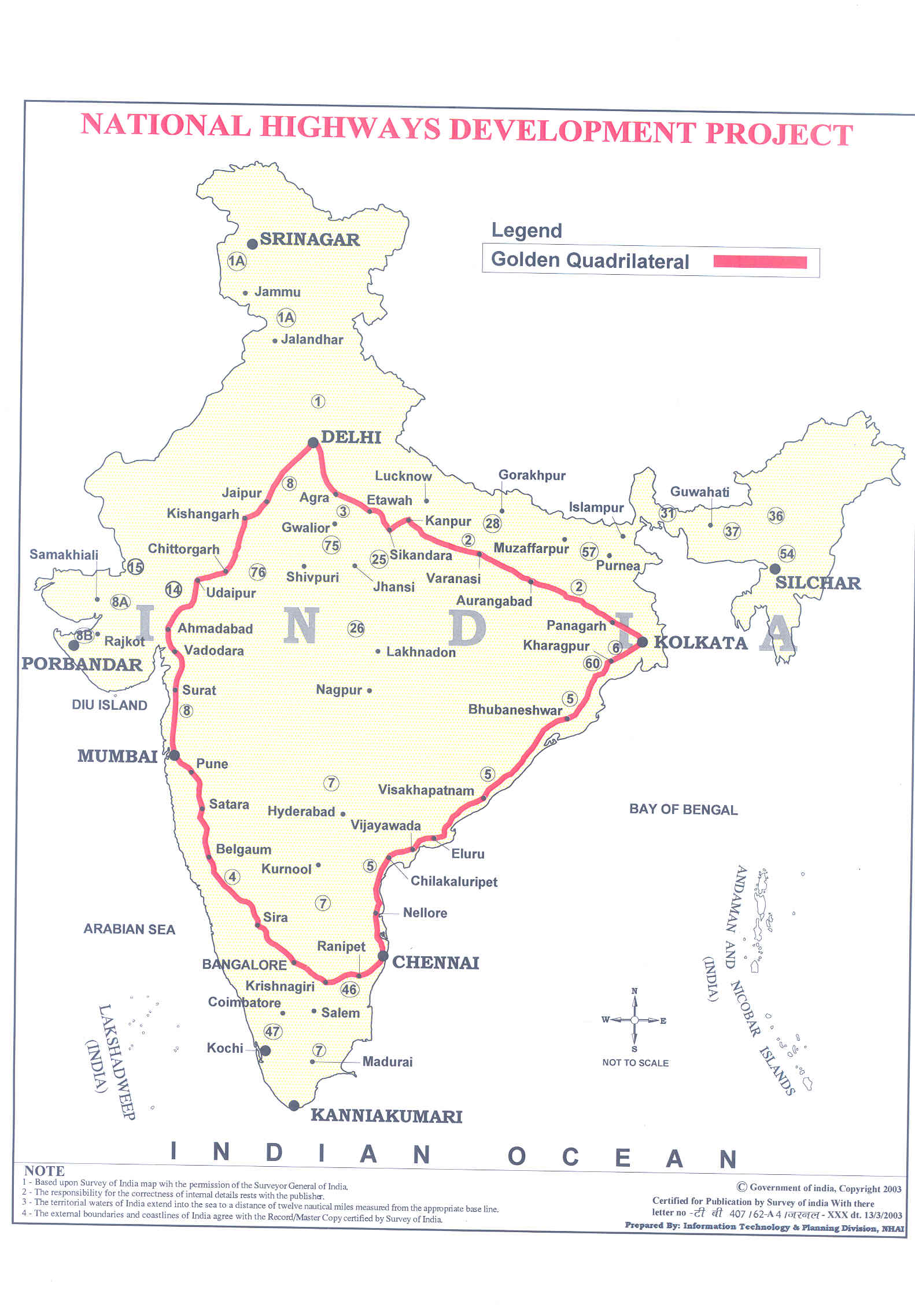
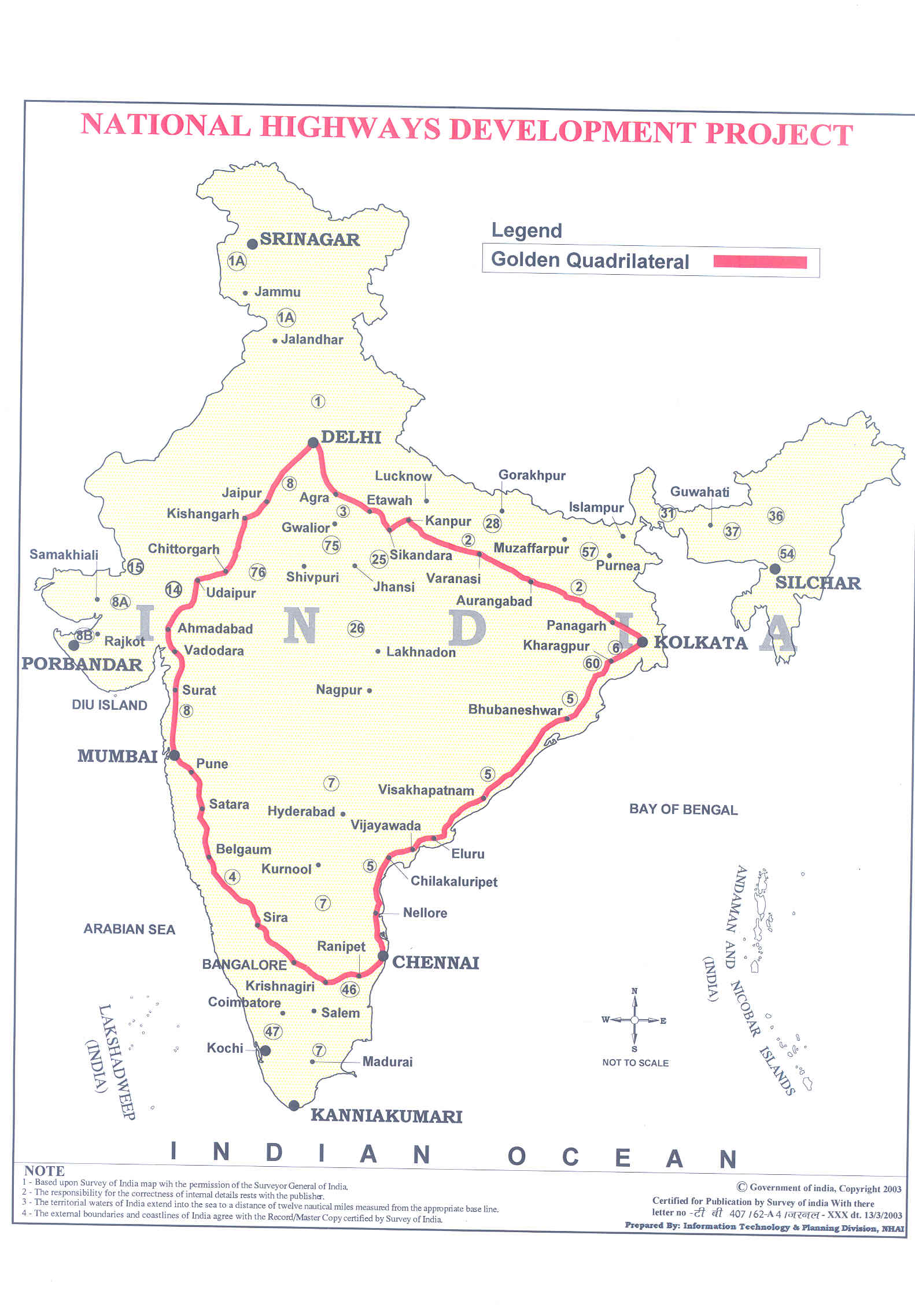
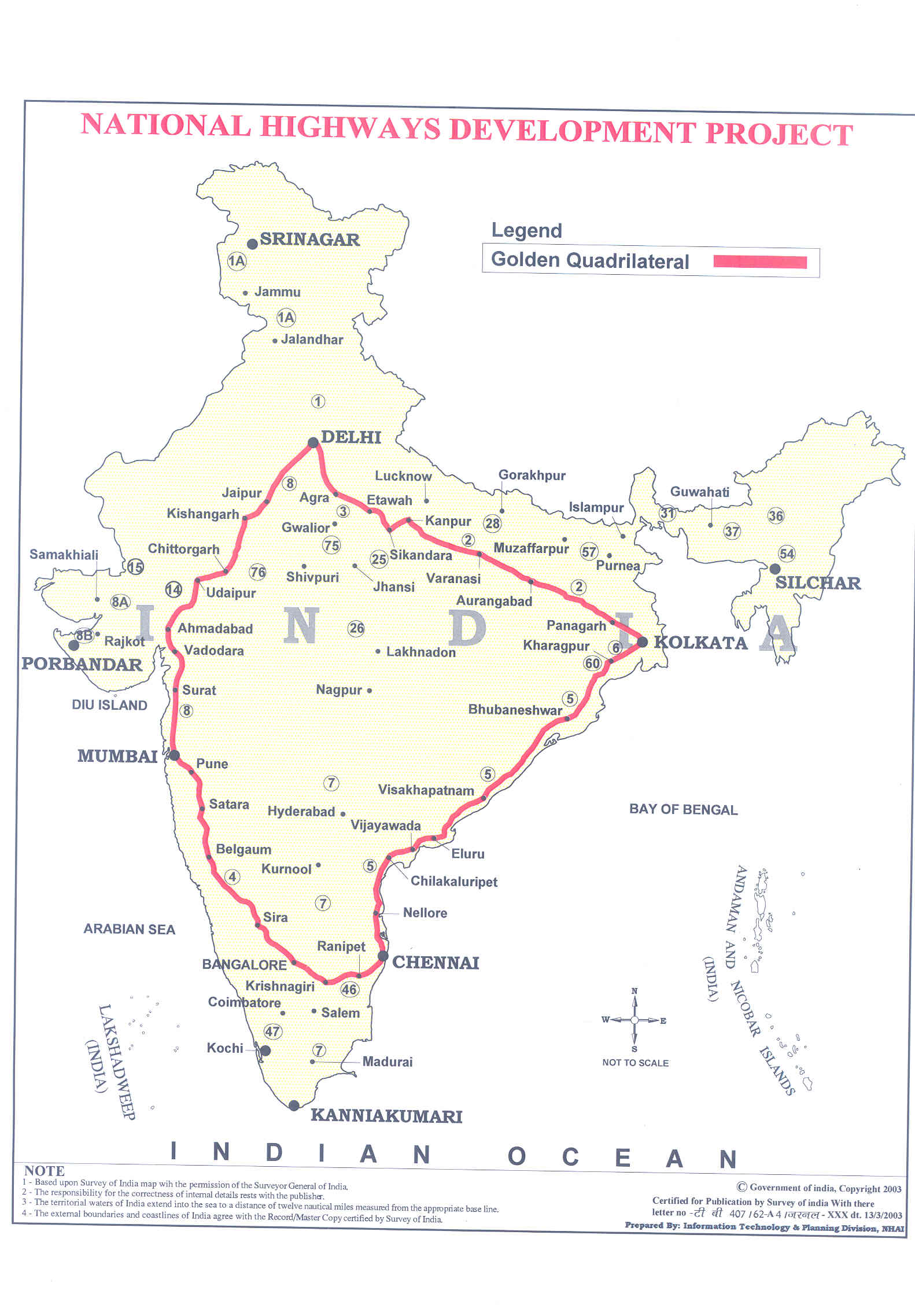
A couple of years ago I wrote an article in Fortune that basically praised the improvements to India’s highway system. Though far from perfect, there had been far more progress than anyone would have thought possible a few years earlier. Some 3,750 miles (6,000 kms) of highways had been built between 1999 and the end of 2005 at a cost of about $7 billion, mostly on the Golden Quadrilateral highway that links India’s four biggest cities of Delhi, Mumbai, Chennai and Kolkata.

My New York editors were slightly more skeptical and headed the piece “On The Road To Repair,” which was fair because progress had been bumpy, like the roads (an inevitable pun). Massive delays had been caused by slow land acquisition.

Corruption and bureaucratic lethargy were widespread, as was extortion by gangsters and Naxalite (Maoist) rebels in some areas. Foreign companies had generally stayed away, and not all those (mostly from Asia) that had won contracts were successful – a Chinese contractor had its contract terminated for lack of progress, and Russian firms had problems.

Little has changed in the two years since my article appeared, though new roads have been built (more on this below). My foreign friends are unimpressed, complaining about muddle and jams on the Delhi road to Agra and life-threatening drivers (and animals) on both that road and the highway to Jaipur and beyond. Many Indian friends typically refuse to believe that anything good could be done by the government, and it is fashionable for the Indian media (justifiably) to draw attention to the problems, while usually ignoring the achievements.

But India’s highway program has been a success, especially in the early years when the energetic Minister of Highways, Maj. Gen. B.C. Khanduri, a (then 71-year-old) retired army engineer who is now chief minister of the state of Uttarakhand, was in charge. He had enthusiastic backing from Atal Bihari Vajpayee, the Prime Minister, whose pictures were plastered in banners across completed and partially completed highways proclaiming, rightly, a success by his Bharatiya Janata Party (BJP) government.

Ironically, here is where a new set of problems emerged. When the BJP unexpectedly lost the 2004 general election, Sonia Gandhi, who heads the Congress-led coalition government, and her ministers did not want to draw attention to their predecessor’s successes.

Manmohan Singh, the prime minister, is an enthusiast and has ordered widespread six-laning of four-lane highways, but T.R. Baalu, his Minister of Road Transport Shipping and Highways, seems more interested in promoting a shipping canal between his home state of Tamil Nadu and Sri Lanka than in building highways elsewhere.

The National Highways Authority of India (NHAI) is an outpost of stifling bureaucracy and its press relations are virtually non-existent – statistics on progress are handled by a well-meaning librarian who has to consult his finance department for values of contracts.

There has also been extensive infighting between the NHAI and the Planning Commission, which has been trying to transfer funding from the public to the private sector. The Vajpayee government was arguably over-generous in its use of public funds.

That has led to battles over new public private partnership (ppp) terms and a model concession agreement is now in use that lays down new requirements on early land acquisition and other conditions. The size of contracts has been enlarged to an average of 60 miles, with several up to 120 miles, many times previous levels.

The hope is that this will attract more foreign firms, which would add expertise and speed up construction, though Indian companies counter that foreigners are not needed. Most non-Asian firms are mainly interested in handling specific tasks like toll road management or acting as minority partners, and that will not bring in the necessary funding.

As a result, the general impression is that the National Highways Development Project is doing badly because progress on the final 200 miles of the Golden Quadrilateral, started in 1999, has been very slow.

Only 760 miles have been completed on 4,500 miles of highways that will run from north-to-south down the length of India and east-west across the country. Even so, the total length of contract awards and finished projects are at last increasing: the number of new contracts awarded and miles of completed roadwork are expected to double, to 8,700 miles and 4,350 miles, respectively, in the next four years.

I still argue that the project is an overall success, but most of the credit for that goes to the old BJP government. The current administration needs to show more Ministerial enthusiasm, attract more foreign investors and contractors, cut the bureaucratic squabbling and push for completions on time.

Posted by: John Elliott | July 13, 2007

India’s crowded skies get more chaotic

“We’re always on time” said the airline attendant. “You’ll be okay for your connection,” I had been told an hour or so earlier when I had phoned to see if 25 minutes was a sufficient layover between flights. Amazingly, the check-in desk information was reassuringly the same.

Where was I? Obviously not India, where flight delays of anything from 30 minutes to two hours have been common this year. I was in South Africa, and the super-confident (low-cost) airline was Mango.com. It was flying me from Cape Town to Johannesburg, where I had a 35-minute gap between the arrival time and the check-in desk closing for my South African Airways flight to Mumbai. And yes, the flight was on time.

It’s a pity it is not like that in India, where debilitating delays have been caused by the Aviation Ministry. In three years the government agency has allowed an excessive number of new airlines and let existing carriers expand their fleets without improving airport facilities. Last year, India’s airports handled 90 million passengers, a third more than the prior year. Currently there are 300 to 320 aircraft in use and orders for new planes will double that figure by 2012.

But there has been little improvement in airports’ ground handling, or the space available for aircraft to park. This is causing major delays in landings and takeoffs, which frustrates passengers and pushes up airline losses. (Unlike in the United States and elsewhere, the Indian government and the airlines don’t release data about airport delays, but the problem is apparent to almost any visitor.)

Praful Patel, the urbane Minister of Aviation, wowed journalists about three years ago with a fast-talking video presentation of how airports around the country would look when they were rapidly modernized. Delhi and Mumbai airports were handed last year to private sector contractors, but progress has been slow and there’s been little improvement elsewhere.

Patel now says the extra flights and lower ticket prices that have been generated by the airline growth are worth the pain. That’s typical of old India – you have to struggle for your achievements!

Patel’s next dream is to transform India’s two inefficient and unpopular airlines – Air India and Indian (formerly Indian Airlines) – by merging them later this month into a new National Aviation Company.

I (like many other people) don’t understand how merging two failures without changing the ownership or top management can achieve anything except compound failure, but Patel is confident – and he isn’t yet talking about pain. Fortunately, there are enough private-sector airlines, like Jet and semi-merged Kingfisher-Deccan, to use instead. But, sadly, airports are a monopoly and there is no choice – apart from traveling by rail.

India could pay a steep price if it doesn’t fix its air transportation soon. Last month the Financial Times reported that the Lord Mayor of London warned Gordon Brown, now Britain’s prime minister, that “business executives will only do business with us if they find it easy to use our airports – and at the moment it is not.” He was especially critical of Heathrow airport which, as I discovered again last week, is even worse on its bad days than Delhi or Mumbai. But Britain’s regional airports are relatively good: India’s are not.

Posted by: John Elliott | July 6, 2007

HSBC hit by Delhi real estate prices

HSBC seems to be finding it hard to survive in India’s increasingly costly bazaars. Almost unbelievably, the world’s fourth-largest bank has closed its ATM booth in central Delhi’s prestigious Khan Market because, senior executives tell me, it does not consider it economically viable to pay the admittedly astronomical six lakhs of rupees ($15,000) rent a month that its landlord wants for the 150 square feet of potential (now shuttered – see pic below) retail space.

.

.

It is moving its money machine, and its usually sleepy guard, to cheaper location, possibly in a nearby gas station that will be far less accessible for local shoppers and tourists who used the old ATM. The bank’s customers can still use their cards to withdraw cash at a (rather luxurious) Citibank ATM just a few yards away from the former HSBC location, at no extra cost.

Despite a strong business strategy that led to its Indian operations declaring a 67% increase in annual profits two weeks ago, the bank is losing high visibility in one of Delhi’s leading middle class and expatriate markets.

That struck me as odd when I flew into London’s Heathrow airport this morning and saw HSBC logos plastered all over the docking gates, where (as in other airports) they have been for years. That cannot be cheap advertising, even compared to Khan Market, and I have never understood why HSBC associates itself with the hassle and misery of arriving at such airports – though I guess HSBC’s senior executives are pleased to see the name displayed so prominently.

But coming back to Khan Market, HSBC’s experience is the result of India’s real estate boom, which is hitting prime sites in Delhi and elsewhere. Cushman & Wakefield, a real estate consultancy, said late last year that Khan Market was India’s costliest retail location and the 24th highest in the world.

A survey by Richard Ellis, another consultancy firm, found in April that office space in Connaught Circus, at the heart of central Delhi, was the seventh highest priced internationally after locations in London, Tokyo, Moscow and Mumbai, India’s commercial capital. Office rental values for prime Delhi sites have risen 80-130% over the past year, largely because of a lack of quality real estate.

Ironically, the property boom means that HSBC is being hit harder than mom-and-pop shops in the parallel boom that is hitting India’s current rapid retail developments. (An article I have written in Fortune’s current international edition suggests there is room for both the moms and pops and big retailers for years to come).

While HSBC has allowed itself to be driven out, owners of other small shops are getting rich by leasing their sites out to foreign and Indian brand names that seem to care little how much they pay for the location. The old owners find they can make far more money leasing their sites to names such as Zeiss, Adidas and Levi than they could ever do selling, for example, medicines and electrical goods.

The high rents are bad news for regular shoppers who value the friendly service of the old style shops. It is also bad news for the image of HSBC.

Posted by: John Elliott | July 3, 2007

Booming Mumbai floods, lacking ‘political will’

“Political will” is a curious phrase. It is most often deployed in India – and elsewhere – by foreign countries (frequently America but sometimes Europe), and by newspaper columnists, to berate a government for not introducing policies that they favor.

So it was no surprise to find Richard Lambert, director general of the Confederation of British Industry (CBI) – and my old boss at the Financial Times where he was editor in the 1990s – using those words a short time ago to call for India’s financial market reforms to be speeded up. “The only question is whether India has the political will to drive through the changes needed to turn Mumbai into one of the world’s great financial centers,” he wrote in an FT column.

Lambert’s words have come back to me over the past few days because Mumbai’s business is booming – the key Bombay Stock Exchange (BSES)  Sensex hit an all-time high of over 14,600 on Monday and banks are reporting record business. But the mood over the weekend was dramatically different. “Mumbai Sinks, Again” thundered Sunday’s Times of India on top of a picture of people standing on the roofs of cars stranded deep in water, while others paddled rubber dinghies.

Five people were killed in the city’s floods on Saturday. There have of course been floods across southern India and elsewhere in the region during the past week, with numerous deaths – over 40 people were killed over the weekend in the state of Maharashtra where Mumbai is the capital.

But the repeated inability of Mumbai’s dilapidated infrastructure to cope with heavy monsoons is not just the result of changing weather patterns: it is also the result of state governments that have not had the political will to build a city that works.

Mumbai is in a perfect location geographically to become one of Asia’s leading international financial centers, but to see how far it has to travel, first compare its dismal airport (where a boundary wall was washed away yesterday for the second time in two years), its clogged highways, slow port facilities, unreliable power supplies and badly organized property developments, with the efficiency of Hong Kong – which marked the 10th anniversary of its return to Chinese sovereignty over the weekend.

Mumbai needs to transform its infrastructure so that it begins to look and function like the sort of modern city that will attract people who work in international financial centers. In parallel, the central government should begin reforms that were recommended earlier this year by a grandly-titled High-Powered Committee on Making Mumbai an International Centre,” headed by Percy Mistry, a former World Bank economist and Hong Kong banker who now runs a consultancy in the UK.

The report’s recommendations included the creation of an overall financial regulator to replace a growing number of independent authorities, plus partial privatization of public sector banks and insurance companies, the formation of active bond and derivative markets and the introduction of full capital account convertibility.

Mistry mysteriously resigned from his High Powered Committee just before the report was published, apparently because he disagreed with public sector bankers on the committee who were insisting that the report’s criticisms of their operations should be watered down. And that brings us to the flip side of political will” – political compulsions,” which are cited by politicians to explain why they cannot carry out reforms.

Sadly, political compulsions usually defeat political will, especially in the sort of coalition governments that India will have for years to come because potentially reformist parties are pulled back by the compulsions of their partners. Some of those partners, like the Left in the current coalition, are ideologically opposed to many reforms. Other parties are encouraged to block change by vested interests – in this case the huge public sector financial establishment of banks and insurance companies that watered down Mistry’s report and which, backed by their powerful trade unions, are slowing down its reforms.

So while the political will desired by my old FT boss may be lurking somewhere in the minds of the government’s reformers, it is constantly defeated by political compulsions generated by opponents. Doing something about Mumbai’s floods might even be easier – with luck before the next monsoon.

Posted by: John Elliott | June 29, 2007

Politics in India is big business !

It’s one of those weeks in India when stories keep tumbling out that show how life is really lived by many of those who run the country – and how business is politics, and politics is business. Judging by comments that have been posted on my blogs since I began Riding the Elephant, few people will be surprised, but it’s worth spotlighting the coincidence of three stories.

First, a banking row. R.P.Singh, the chairman and managing director of government-owned Punjab & Sind Bank, has publicly asked for Congress Party-nominated directors to be removed from the bank’s board of directors. He alleges they have been resisting arrangements for recovery of bad loans from customers close to them.

“They are in league with defaulters of the bank and they want settlements of debt to be done on very paltry terms,” he told me yesterday. He said that the bank had been reducing its high levels of non-performing assets, but some defaulters had been “upset with the recovery process” and had approached the bank through the nominated directors for concessionary settlements. The bank had refused special arrangements and this had led the nominated directors to launch complaints against Mr Singh and his colleagues in a tv program on June 19, alleging they were flouting rules – which Mr Singh denies.

Such political pressure on public sector banks is nothing new in India, nor in some other Asian countries. The Economic Times, a leading business daily, commented yesterday morning that the issue “brings to the fore the tendency of the government of the day to pack PSU (public sector company) boards with ill-qualified political nominees”, adding: “The fact is ministers have long regarded PSUs (public sector companies) under their watch as personal fiefdoms”. But it is rare for a bank chairman to come out in the open about the sort of pressures he and his executives face –and to receive support from the Ministry of Finance, which Mr Singh says has happened in this case.

Next, India’s new presidential candidate. After a long period of indecision, the Congress Party, which heads the current coalition, government, selected Pratibha Patil, the low profile 72-year old governor of the state of Rajasthan, to be its candidate in indirect presidential elections. As well as being a regional politician, she used to practice law and has a reputation for socially valuable works. She seems set to win and become India’s first woman president because Congress and its supporting parties have the votes required, and she has the personal backing of Sonia Gandhi, the Congress leader.

But that initial good news has been followed by other reports about her past that include allegations that a women’s co-operative bank she set up in her Maharashtra home town of Jalgaon was closed in 2003 by the Reserve Bank of India because of a series of irregularities, including Patil’s relatives receiving favorable loans. There have also been reports of irregularities at a sugar mill that she promoted and other stories.

The Congress Party has said that Patil will respond to the charges after the June 30 closing date for presidential nominations. Meanwhile, prime minister Manmohan Singh has been reported saying that she had “done nothing wrong”, and that many Maharashtra sugar mills had failed for environmental reasons. A party spokesman said the loan allegations were “just stories”.

Finally, a very rich chief minister. Mayawati, the leader of the low caste Bahujan Samaj Party was last month elected to power for the fourth time as chief minister of Uttar Pradesh, India’s largest state. This week she has declared assets totaling 52 cores of rupees – that’s $12.68 million – five times the amount she declared in 2004 elections. Included is property worth nearly $10 million, mostly in Delhi, and jewelry worth $122,000.

This is a huge amount for someone who began life as the daughter of a poor government clerk. Mayawati has said that the assets were “accumulated through donations and gifts from party workers across the country” after she had been “framed” in 2003 with legal cases that alleged she possessed undue wealth and that she was involved in corruption on a Taj Corridor tourism infrastructure project linked to the famous Taj Mahal mausoleum in Agra.

She denied the charges at the time and the cases have yet to be heard – soon after Mayawati regained the chief minister’s job, the UP governor refused permission for police authorities to proceed with the Taj Corridor case. This week Mayawati denied she had done anything wrong and said the donations had been made to her personally as well as the party. It must be nice to have such generous supporters!

The $12.68 million became public because Mayawati has had to declare her wealth in nomination papers for election to the UP state assembly. (She did not stand in the recent state assembly elections, so must now win a seat to remain chief minister).

She seems not to worry about such publicity. In 2003 she threw a mind-boggling 47th birthday party in a film-set type location with over 100,000 sweet cakes, 5,000 bouquets of flowers, and a massive 50kg birthday cake. What an interesting and rewarding life these politicos lead!

Posted by: John Elliott | June 22, 2007

Family succession and bonding, Infosys style

“Choose partners you can grow old with” – Nandan Nilekani

Is Infosys, one of India’s top three IT giants, really a family company, controlled not by blood relations but by the bonding of five of its seven founders who still work there, own 16.5% of its stock, and are taking turns running the show?

The mischievous thought was put to me by an executive in another more obviously family-controlled IT major, because S. Gopalakrishnan, the COO, has taken over this afternoon as CEO from Nandan Nilekani, who has moved slightly upstairs as executive chairman alongside Narayana Murthy, the first CEO and now non-executive chairman and chief mentor.

That leaves two other founder-directors – S.D. Shibulal, who has stepped up today as COO, and K. Dinesh – waiting in the wings. Shibulal looks like a shoe-in when Gopalakrishnan (always known as Kris) decides to join the elders – though they are all much of an age, between 52 and 55, apart from Murthy who is 60. But no one, of course, is saying Shibulal is next in line, and all stress that the decisions are based on ability and potential.

“We have said many times we are a professionally managed company,” says Nilekani, adding that leadership at Infosys has been exercised, since it was founded in 1981 in Murthy’s Pune home, on the basis of “being first among equals.” Gopalakrishnan had been chosen “not on the basis of the job being passed to another founder but as the best person for the job”.

No-one quite believes that of course – Gopalakrishnan was the only candidate considered for the promotion when the Infosys board decided late last summer that it needed an executive chairman, and Nilekani said that he wanted to broaden his beat to focus on big client relationships, large-scale initiatives, and other client work.

A nominations committee of non-executive directors, headed by Claude Smadja, a former managing director of the World Economic Forum who runs an advisory firm, then took three months to confirm Gopalakrishnan’s appointment. Nilekani will now be a very executive chairman, so it remains to be seen how effectively Gopalakrishnan, who is a much lower profile character than either of his predecessors, emerges alongside him as the public face of Infosys.

In addition to being COO, Gopalakrishnan has been Infosys’s president and a joint managing director since 2006. Known for his technological strengths, he has been responsible for customer services, technology, investments and acquisitions, and heads the Infosys consulting activities.

On the broader blood relations issue Nilekani says that “family members of the founders can’t work here.” Murthy told me that neither his son nor daughter, now both in their 20s, will join the company.

That must be a relief, given the dynasty that is beginning to emerge at Wipro, one of India’s other top IT giants. Azim Premji, the 62-year old chairman, controls over 80% of the stock and his 30-year old son, Rishad, is joining at the end of this month from the London consultancy office of Bain & Co, to work initially on financial services.

Family-controlled companies have dominated India’s business scene for generations and, though some of the top names have changed over the years, they remain a major force, controlling more than 15 of the top 20 businesses (excluding banks and public sector corporations).

Many of these family groups become embroiled in serious rifts and splits, most recently Reliance Industries (the Ambani brothers) and the Bajaj scooter-to-sugar group.

But the close-knit team of people at the top of Infosys seem to share their roles in the $3 billion company with no such animosity, jealousies, or infighting – despite their varying stakes that range (curiously in the order of the succession so far) from Murthy’s family with 5%, to the Nilekanis with 3.46%, the Gopalakrishnans with 3.36%, Dineshs with 2.51% and Shibulals with 2.21%.

As he walked into the annual shareholders’ meeting this afternoon where the changeover was approved, I asked Nilekani (over the phone) how they all manage to get on so well – or were there fights that their personal public relations skills managed to bury.

“No,” he said laughing, “we all have the same values…. we are all from the same simple middle class backgrounds…. and we have enormous bonding.” His last line capped it all: “The important thing as an entrepreneur is to choose partners you can grow old with.”

Posted by: John Elliott | June 20, 2007

Mukesh Ambani builds a monument to his wealth

Mukesh Ambani, chairman of Reliance Industries (RIL), one of India’s two largest business groups, has been wowing people with his drive and ability for many years, especially since his father died five years ago and he and his brother Anil split the family business empire in 2005. Now he has amazed his peers, competitors, and observers again, but this time less laudably, by building a gigantic 570-foot high home in one of the plush areas of Mumbai.

According to a recent article in the Mumbai Mirror, a local daily, the 570-foot tower will cost $500 million and comprise 27 floors with car parks and maintenance areas, entertainment spaces including a small theatre, health and exercise rooms with pools, guest rooms, gardens, helicopter pads – oh yes, and four floors of family accommodation for him, his wife, three children and his mother. It is rumored there will be a staff of 600 (or maybe just 400, say some!) and it will be called Antillia after a phantom Atlantic island.Mukesh's Tower

Even for the world’s 14th richest businessman, that is an appalling display of conspicuous consumption. And it is especially so when his estimated $20 billion of wealth makes him the richest businessman in a basically poor country, with people living in slums not far from the Antillia construction site.

The tower rises above Peddar Road April 2009

The tower rises above Peddar Road April 2009

Outrageous displays of wealth are of course nothing new here. Many of the old maharajahs who ruled much of the country before independence (some continue to live as if they still do) deserved ridicule for their sumptuous lifestyles in massive palaces, with hordes of servants, women, cars and elephants to care for their every need. ut business people have usually been more discreet, and their homes, while extravagant, have been relatively modest in scale.

When I first came to India in the 1980s, I was always told – and saw for myself – that the rich usually avoided public displays of wealth because they did not want to attract the attention of the tax authorities. That no longer seems to apply.

Lakshmi Mittal, Indian-born but with wealth acquired abroad as the world’s largest steelmaker, broke normal bounds in 2004 when he bought a vast and not very pretty $110 million pile in London’s exclusive Kensington Palace Gardens. In Delhi, he bought an old bungalow in the exclusive Aurangzeb Road and rebuilt it, though within the two-or-three story height required in that road.

Sunil Mittal (no relation), who runs India’s largest mobile telecom business, also kept within normal bounds when he built a house in the even more exclusive Amrita Shergil Marg, which is slightly bulkier and more stately than most of its neighbors, but not outrageously so. Others have built sumptuous homes on the outskirts of Delhi, as have families like Hinduja and Godrej on Mumbai’s Juhu beach.

But none of these is anywhere near as publicly extravagant as the Ambani tower. Bankers and business people are puzzled as to why he did it, because his public image is that of a hard-working and modest – though ruthlessly ambitious – company boss. Most are highly critical but will not speak on record – and a Reliance spokesman declined to comment. Some suggest it is part of his determination to outshine his younger brother Anil. It is also said, more practically, that land is so scarce in Mumbai that one has to build upwards rather than across a large plot – but that does not justify 27 floors for a family of six!

Whatever the reason, it puts into perspective a speech made by Manmohan Singh, the prime minister, on May 24. He attacked corruption and asked businessmen to discourage “vulgar displays of wealth.”

Posted by: John Elliott | June 14, 2007

India’s defense R&D lacks talent

There could probably be no more telling indictment of an organization than the fact that people are not willing to work for it, and it therefore lacks the talent needed to perform. That is partly what seems to have happened to the Defence Research and Development Organisation, India’s leading scientific defense body, which has gained a reputation over many years for failing on research and development and for being more focused on organizing its own perpetuity.

This morning’s Indian Express, a leading Indian daily, has a headline that makes the point – “More quit DRDO than join, applications fall by 70% in three years” with a sub-head “DRDO’s brainwave – hike salaries six-fold, need more benefits, perks, including sabbatical, royalty.”

Reporting information given to a government pay review body, the newspaper said that there were only 31,810 job applications last year compared with 110,224 in 2003, mainly because there were better career opportunities and professional challenges elsewhere. That is scarcely surprising. Entry level salaries are only $200-$325 a month – a fraction of the levels that are easily available in the private sector.

It is also symptomatic of the changes in attitudes that have swept through India, as economic reforms have dramatically boosted job and pay aspirations. No longer do university graduates seek safe lifetime job havens in the public sector, but rather go for instantly higher pay in private companies, often not bothering to study first for the PhD and other higher degrees that marked out top scientists and engineers in earlier generations.

But it is also the DRDO’s poor image that deters graduates, when India’s booming information technology industry offers high flying jobs and success stories in India and abroad. Headed for many years by Abdul Kalam, now India’s President, the DRDO has some 50 laboratories that are involved in projects ranging from combat vehicles and armaments to submarines and aircraft. But instead of being a center of excellence, it frequently fails in both technical and financial terms to meet the needs of the military which then buys abroad.

DRDO’s main successes have been surface-to-surface missiles called Agni and Prithvi, but it has failed to produce smaller missiles for the army and navy, which have been bought instead from Israel.

After more than 20 years of work, it has also failed (partly because of U.S. sanctions blocking component deliveries) to produce India’s planned light combat aircraft (LCA) that would replace Russian MiG21s. Other failures have included a main battle tank, called the Arjun, which is still undergoing trials after 30 years’ development – so Russian tanks are filling the gaps.

Defense production reforms that are now being introduced will enable private sector companies, both foreign and Indian, to link up with the DRDO on equal terms to develop and produce defense equipment. That might help revive the DRDO, though it seems more likely that firms will use their access to spot and hire the brightest talents, making the current situation worse.

« Newer Posts - Older Posts »

Categories