Posted by: John Elliott | June 10, 2007

Mallya challenges Gopinath’s low-price Deccan dreams


G.R. Gopinath, a former Indian army captain, has earned a place in India’s aviation history for founding cut-price Air Deccan, which since 2003 has introduced air travel to tens of thousands of railway passengers unable to afford full fares. But Deccan, which has grown into India’s second largest airline, has had heavy losses – as well as chaotic flight delays and cancellations – and it now looks as if Gopinath’s trailblazing will soon end.

The trigger for the change came on June 1 when Vijay Mallaya, who founded full-price Kingfisher Airlines in 2005 and is one of India’s most egocentric and charismatic businessmen, bought a 26% stake in Deccan for $137 million, defeating Anil Ambani of the Reliance-ADA Group, which had been negotiating a take-over.

Mallya now hopes to gain control by buying up to 20% more with an open stock market offer (in line with stock exchange rules). He then plans to start rationalizing the two airlines’ operations that together have a 30% market share and 71 aircraft, challenging Jet Airways, the much-admired market leader that has 60 planes.

That might shock Gopinath, who told me that Mallya’s arrival was as a “strategic investor” and was “not a take-over.” Mallya had said, “let me invest and you run the airline,” so Gopinath expected Deccan’s “existing values” to continue.

But when I asked Mallya during a telephone interview (he was in Miami) whether he’d be “in charge,” he laughed and replied: “With a majority stake that’s pretty inevitable isn’t it?” He repeated his known view that “the low cost model doesn’t work in India,” and added:

“There is no question of cut prices continuing in India – everyone wants to raise fares. Deccan is widely regarded as a market spoiler and that will stop!”

India’s domestic carriers have been plunged into a downward price spiral, driven initially by Gopinath’s passion to fly people who had never been in the air to destinations never before served by an airline.

There has also been a massive growth in capacity, which rose 50% last year. New airlines such as SpiceJet and Indigo have joined the no-frills league and others like Jet (which recently took over Air Sahara) and government-owned Indian (formerly Indian Airlines, now merging with Air India, an international carrier) have plunged into the cut-price war.

Kapil Kaul, regional CEO of the Centre for Asia Pacific Aviation, estimates annual losses at $500 million, based on an average deficit of around $15 for each of 33 million passengers carried last year. Deccan recently lost $50 million in just three months.

“Fares are half the levels of five years ago, while fuel is up three times and manpower costs have doubled,” says Ravi Nedungadi, president and chief financial officer of United Breweries Holdings (UB), a leading liquor and beer company that is Mallya’s main business. That is unsustainable and the general industry view is that prices should go up. Several airline operators talk about at least covering the $15 losses, though few think bigger increases are possible quickly. “We hope for a greater rationality of pricing,” says Saroj Datta, an executive director of Jet.

Gopinath agrees that “whatever we need to do to be in profit, we will do it” but adds: “we will still have a low fare policy.” He and Mallya hope to make savings of $75 million in the coming year by rationalizing routes and other operations – both their airlines fly the same Airbus and smaller aircraft. They will also delay some aircraft purchases, though Mallya plans to grab headlines at the Paris Air Show later this month with a big Airbus order.

Mallya will also want to make more Deccan changes, ending uneconomic rock-bottom fares aimed at attracting poorer passengers, and raising fares on less popular routes. That is where a clash with Gopinath could start. There is already speculation about how long the two men can work together. Mallya is famed for his domineering though informal management style and likes the limelight.

Gopinath also likes to be in the news, though in a more low-key fashion. Gopinath even said recently (correctly, most people thought): “We are from different planets – he is from Venus, I am from Mars.”

Mallya’s 26% stake in Deccan Aviation, which owns Air Deccan, has been bought by UB, which last month acquired Scotland’s Whyte & Mackay whisky company for $595 million. Executed through an issue of new shares, the 26% makes him the largest single shareholder, but Gopinath says he can call on about 35% with the support of two co-promoters and friends. Two venture capital firms have about 22%, and the rest is public. So Mallya needs to increase his stake by about at least 10% through the open offer or later open market purchases.

Nedungadi says UB has a “muscular presence” on the board of its group companies “to give direction and energize synergies.” A new professional CEO is to be appointed at Deccan, to replace one who left recently. He will report to the board headed by Gopinath as executive chairman and Mallya as deputy chairman, but not to Gopinath directly.

The industry betting on a full merger of the two airlines within a couple of years and Mallya is already talking publicly about the “Kingfisher-Air Deccan group” – not Gopinath’s dream at all!

Posted by: John Elliott | June 7, 2007

Doors to open for India’s defense industry jewels

The Indian government will soon make defense production history by naming a small number of leading Indian private sector companies as raksha udyog ratnas – literally defense industry jewels – that will be allowed to compete for big research, development and production projects on equal terms with the public sector.

A Ministry of Defence (MoD) committee headed by Prabir Sengupta, a former secretary for defense production, yesterday (June 6) presented its report on the subject to A.K. Antony, the minister of defense. The names will be published soon, when they have been cleared by a co-ordination committee. They will include parts of the Tata group, Larsen & Toubro (L&T), Godrej, and Mahindra & Mahindra, plus a handful of others. A few are already involved in very limited sub-assembly work ranging from parts for rockets to a nuclear submarine hull.

The ratnas will be allowed to design and manufacture major weapons platforms and systems including equipment developed by the DRDO, the country’s leading but unproductive research establishment which has previously worked with the public sector. They will also be allowed to manufacture foreign defense systems and to carry out government-funded research and development. This is a big step forward, though it remains to be seen how quickly and effectively India’s massive and powerful public sector defense establishment mobilizes to obstruct progress and protect its jobs and booty.

The country has a huge defense budget, including an allocation of $10.5 billion this year for capital expenditure on military equipment – $4 billion for the air force, $2.8 billion for the army and $2.5 billion for the navy. About 70% of the budget is spent abroad because the Indian public sector cannot deliver in terms of quality or speed on either research or production. And only about 30% of the orders placed in India – or 9% of the total – goes to the private sector. Indian companies have consequently been wary of undertaking large-scale investment programs because they have been uncertain about what the MoD would actually let them do.

Only two primary contracts have been awarded so far. They went last year to Tata Power and L&T, when each company won a $20 million rocket launcher order for the army’s Pinaka defense missile system. Till then, primary integration work had been done by the public sector with some components supplied by the private sector. Russia is India’s biggest foreign supplier followed by Israel, then other European countries, with the U.S. having only a tiny role because of restrictions on what it can sell. A major effort is now being mounted by the U.S. to replace Russia as the lead supplier, especially if current talks between the U.S. and India on a nuclear pact lead to restrictions being relaxed. More than 20 U.S. companies exhibited four months ago at the biennial Aero India air show in Bangalore. Names such as Boeing (BA), Lockheed (LMT), Honeywell (HON), General Electric (GE), Raytheon (RTN), Northrop Grumman (NOC), Pratt & Whitney, United Technologies, Bell Helicopter Textron, and General Dynamics are among the most active. Some have already tied up with Indian companies such as Tata and L&T, or are talking about doing so – and the new ratnas will be prime targets, because of their privileged roles.

India’s defense private sector has been left behind by the wave of liberalization and deregulation that has affected virtually every other area of manufacturing in the past 15 years. Moves to change that began in 2002, when it was announced that the private sector would be allowed to do more work, and that foreign investment stakes of up to 26% would be allowed in joint ventures.

But only about 30 private-sector manufacturing licenses have been issued to around 20 companies and little work has been awarded. And only a handful of small foreign joint ventures have been signed. Foreign companies are not prepared to hand over new technology when they are only allowed 26% stakes – though one joint venture for aero engine components, between Snecma of France and government-owned Hindustan Aeronautics (HAL), has been allowed as a 50-50 split. The MoD now has a chance to introduce real reforms, though opposition from trade unions and leftist political parties is beginning to appear. Whatever happens, those vested interests will have to be appeased, and that will slow the pace of reform – as always.

Posted by: John Elliott | May 31, 2007

GE India’s chief retires

Jeff Immelt, GE’s chairman and CEO, is in India on one of his regular mid-summer visits, braving as he has done before, 40oC-plus pre-monsoon temperatures. This time though it’s not just the usual round of government ministers and officials, businessmen and journalists because tonight (June 1) he will be hosting a dinner in Delhi to mark the retirement of Scott Bayman, India’s longest-serving expatriate company boss. Bayman has headed GE here for 14 years, starting in 1993 with $100 million turnover and a few hundred employees, and reaching $3 billion and over 13,000 employees this year, with all GE’s global businesses present in the country. He’s handing over to Tejpreet Chopra, who currently heads GE Commercial Finance in India. Last night Immelt said that GE is on track to reach targets of $8 billion for both turnover and assets by 2010.

scott_bayman2.jpg

The story began in 1992 when Jack Welch, Immelt’s predecessor, declared India, along with China and Mexico, a priority GE country. Bayman arrived a year later and says he has survived two GE Chairmen; six (Indian) governments and five prime ministers.” Through it all, he has remained an optimist. Fourteen years is a long spell for anyone, and it is especially remarkable (if I may say so as a Brit) for American businessmen, whose patience with what Bayman tactfully describes as a “confusing and difficult place to quickly enact change and make rapid progress” usually runs out quickly. But instead of bemoaning the struggles with successive government policies, Bayman says: “You know what? In those years no one – not one prime minister, not one government – has turned its back on liberalization. Sure, each has its own priorities or its own spin, but the general direction and the commitment has not changed.” He’s had great successes and some setbacks. He was in at the start of India’s massive call center and business processing wave with the creation in 1998 of GECIS – “a roaring success from the beginning”. The business was hived off in 2004 and now, known as Genpact, has 27,000 employees in ten countries and has filed for an IPO on the New York stock exchange. In 1993, GE Capital was set up as a non-banking finance company but the government’s unbending banking regulators have prevented it from becoming a full bank. He’s especially proud of GE’s Jack F. Welch Technology Center that was opened in Bangalore in 2004, where 5,000 people are now employed plus another 1,200 in Hyderabad. That has been built, he says, with “great engineers and scientists and people with great capacity for work”. His “greatest disappointment” was GE’s withdrawal from the household appliance market eight years ago when he had to face up to the fact that its products were uncompetitive.

Bayman also had to sort out (with Bechtel) the future of a famously blighted power project at Dabhol in Maharashtra after the collapse of Enron, the lead partner. He negotiated a deal with the Indian government that enabled GE to recover its $150 million equity investment, which may make it easier for him to see the bright side of India’s biggest inward investment disaster. He admits, in a neat under-statement, that Enron “did too good a job at negotiating a contract that was going to be difficult to live with,” but says that the compensation “could not have happened in other countries, where we wouldn’t have got any dollars back.”

Speaking at a business conference last week, Bayman remembered how difficult it was working in India when he arrived. “You never knew if you would have a dial tone when you picked up a telephone receiver. If you had a dial tone, there was a question of whether the connection would be made to the number dialed. If connected, you never knew how long you would stay connected.Cars were in scarce supply and required a full down payment nine months before delivery. Color televisions had to be purchased on the gray market and were not available in any significant quantity or variety. Computers and laptops attracted high duties and had to be registered in a traveler’s passport when taken in and out of the country.

Now he rates India’s ”telecom revolution” as one of four “big events” that have happened in his 14 years – “a poster child for privatization and deregulation”. His second big event” is the creation of a new class of consumers, driven by the emergence and growth of software, backroom processing, technology and financial services industries. Employees in these industries are highly educated and relatively younger than the workers in other industries. Ten years ago, this group likely would have lived in their parents’ homes and been under-employed or unemployed. Today, this group earns a good wage and has a propensity to spend. And, with the opening up of the economy, now has a wide choice of products and services to buy.” Third, he picks Indian industrialists’ massive growth in self confidence about their ability to compete on the global stage. Fourth is civil aviation. “Today, we are experiencing the benefits of open skies agreements with increased non-stop flights from more Indian cities to more cities around the world. Choice has brought competition and the consumer is benefiting.” Here his overwhelming optimism that all is – or quickly will be – well gets the better of his judgment, and he dodges the chaos and massive delays at most of India’s airports, saying: “Watch the impact as public-private partnership goes to work. This is India. We wait for the demand, for the crisis before we respond. Once we strike out on a course of action, we know how to get it done,” he says. Perhaps his optimism comes from the fact that GE plans to invest in consortiums developing the airports.

He hasn’t always been so optimistic. In 2002, he slammed India’s manufacturing industry saying: “Manufacturing is not India’s core competency. Can it be? Probably not, at least in the short run. Let’s face it, there are just too many barriers that all of us cannot control. Don’t get hung up in thinking manufacturing can be a core competence of India. It isn’t going to happen.” He now admits hewas wrong – dead wrong.” Indian industrialists “no longer worry about multinational companies; they are or want to be MNCs…..They no longer talk of level playing fields. They argue for open markets, free trade and view the globe as their marketplace. Indian companies now think globally.” His main lesson? “You need patience and persistence. This is a difficult place to get things done quickly”.


The completion of the Indian government’s first three years in office seems to have galvanized the Prime Minister, Manmohan Singh, into some critical reflections about what is wrong with Indian society. Three weeks ago he spoke about India’s crony capitalism, and this week he has been unusually outspoken about growing corruption in government and business. Addressing a conference about rural roads on May 23, he said that corruption on construction projects had “spread like cancer to every corner of our vast country” and was a major reason for poor quality roads. Today he returned to the subject on a broader canvas when he told a Confederation of Indian Industry (CII) conference “the cancer of corruption is eating into the vitals of our body politic,” adding that “corruption need not be the grease that oils the wheels of progress.”
 
As with crony capitalism, this is unusual territory for prime ministerial speeches. But Manmohan Singh is an unusual prime minister. He has been an academic economist, a top bureaucrat (finance secretary and governor of the reserve bank), and a minister (finance) ,and he is known to be shocked by the corruption and sloth in government and by the way ministers are oiled by business on the crony circuit. He shares power with Sonia Gandhi, the leader of the Congress Party and of the governing United Progressive Alliance coalition, who picked him for his job. That severely limits his opportunities to implement ideas and policies that are opposed by other ministers.
 
So he sensibly chose a business audience to underline worries he has voiced in the past because, in the supply and demand economics of corruption, they supply the money and other favors demanded by politicians and bureaucrats. He may not be able to do much about the demand, but he can, and did, try to persuade the supply side to curb its activities. “There are many successful companies today that have refused to yield to the temptation – others must follow,” he told his audience. And in a dig at businessmen who enter politics, he said that they should “erect a Chinese wall between their political activities and their businesses” – which, of course, they rarely do.
 
The subject of his speech was making India’s booming economy more equitable so as to increase support for economic change. He launched a ten-point program which included a plea to businessmen to “resist excessive remuneration” and discourage “vulgar displays of wealth.”

After the speech, stories were recounted by businesspeople of how impossible it is to work without paying bribes – especially where land acquisition, construction projects and occupancy of buildings are concerned. “Lakhs of rupees have to be shelled out for the most minor approval,” said one businessman involved in setting up a new office building – a lakh is 100,000 so that translates into thousands (or maybe tens of thousands) of dollars.

Corruption is rife on big defense contracts as elsewhere in the world. Other cases – which rarely if ever lead to convictions – range from illicit allocations of petrol station licenses and army meat contracts to large scale diversion of public funds and bribing to influence government decisions at all levels. These often involve politicians holding high office in the states and in central government. On public construction contracts, huge amounts of money are siphoned off by officials and contractors, and poor quality materials are used to cut the contractors’ costs and generate more work when repairs are needed. In a subsequent speech at the conference, Palaniappan Chidambaram, India’s Finance Minister, said that in the past five years $5.5 billion funding on a roads program had been 93% committed, but only 55% of the designated road works had been completed because of corruption, plus some uncompleted works.

This clashes with the findings of some opinion surveys, such as Transparency International, which suggest that the impact of Indian corruption is declining. That is probably because the surveys usually cover foreign companies, who find that demands for bribes have decreased as government controls on businesses have reduced over the past 15 years. But corruption is rife, as the prime minister said, wherever the private and public sectors meet (and sometimes within the private sector on contracts between companies).
 
Coincidentally, a report published today by Transparency International on judicial systems internationally said that, while India’s upper judiciary was “relatively clean” (with some exceptions), corruption is “systemic” in the broader justice institutions because of a “high level of discretion in the processing of paperwork during a trial, and multiple points where court clerks, prosecutors and police investigators can misuse their power without discovery.” The primary causes of corruption were found to be delays in the disposal of cases, shortage of judges, and complex procedures, all exacerbated by a preponderance of new laws.

Sunil Mittal, the CII’s new president and founder and chairman of the Bharti group that runs India’s largest mobile phone business, welcomed Singh’s speech, but called on him to “simplify regulations so that the need for such practices reduces and vanishes within our lifetime.”

The use of the words “the need for” was significant. The sentence would been satisfactory without them, but by using them Mittal was instinctively underlining the fact that businessmen feel compelled to pay politicians and bureaucrats in order for their companies to operate and grow. Until the Prime Minister can deal with the demand side, there seems little chance therefore of the supply being cut much. 
 

Posted by: John Elliott | May 23, 2007

Manufacturing success in Nokia’s India SEZ

While the government dithers about how to solve a crisis that has developed over India’s controversial Special Economic Zones (SEZs), a few companies are showing how small zones can spread development and attract foreign direct investment (FDI), without falling into the clutches of politicians, bureaucrats, and protestors (see Blog – Special Economic Zones Are About People, Not Just Development).

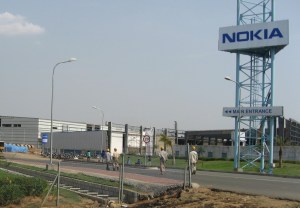
In southern India, Nokia, the Finnish mobile handset company, is leading the development of an electronics hardware zone where, along with eight of its suppliers, it will mop up more than $200m investment and employ some 20,000 people within two years. Located an hour’s drive outside the Tamil Nadu state capital of Chennai on the  highway to Bangalore, one factory is already being run by Nokia, and Foxconn of Taiwan, one of its suppliers, has another one nearby. Both have shown in less than a year that India is capable of manufacturing precision goods economically and to international standards.

the Nokia factory

the Nokia factory

Nokia chose the 200-acre SEZ site in 2005 in preference to others elsewhere in India, and some abroad, because the state of Tamil Nadu offered it an SEZ location that would free it from some government hassle. The site is near the coast with seaport and airport connections, though these often cause more hassle than they solve for importing components by sea and air – especially Chennai airport, which cannot cope efficiently with its passengers, let along cargo. Such infrastructure problems, plus high power costs, make it difficult for India to compete with China, though the problems are offset by exemption from import duties and some corporate tax holidays.

A  key advantage is that there will be a cluster of companies in what is known as  the Nokia Telecom SEZ, with suppliers such as Foxconn located next to Nokia, supplying the domestic market as well as exporting.

As the developer, Nokia has a 99-year lease from SIPCOT, Tamil Nadu’s industrial investment agency that acquired the land some years ago, thus avoiding the sort of clashes with farmers that are now happening elsewhere when agricultural land is needed for industry. In addition to Foxconn, which  makes printed circuit boards and other components, the companies include Salcomp, Aspocomp and Perlos from Finland, and Jabil Circuit, Laird Technologies, Wintek from the U.S.

A report published today by ICRIER, a Delhi-based economics think-tank which is working on SEZ policies for the government, says that companies like Nokia and Foxconn had previously been “reluctant to come to India” because they “work on thin margins and manage operations on scale and efficiency” – so SEZs did generate investment and provide jobs that would not have otherwise happened.

While its factory is being built, Foxconn started  production a year ago in a nearbyformer Panasonic building making components and mobile phones, mostly for Nokia, plus networks. This is in a sort of semi-SEZ, called an export-oriented unit, where 50% of output has to be sent abroad (or into an SEZ).

Proud of its virtual anonymity as a supplier to internationally known brands, Foxconn has found the transition from Taiwan to India far less difficult that one might expect for a company from that super-efficient high-tech country. It has found that its Taiwanese-style  uniformed employees perform both manual and highly automated tasks well once  they have been trained, consistently maintaining international standards that  were rare in India’s manufacturing industry a few years  ago.

Next year Foxconn will move into the Nokia SEZ and will also have another factory in a separate zone a few kilometers away where it is a co-developer with SIPCOT and Motorola. Singapore-based Flextronics also has a similar operation nearby, already in operation. These are graphic examples of how India can sometimes make manufacturing work well, especially when there is an enthusiastic state government involved.

The only blot on the landscape is that the Finance Ministry would like to impose a precise export requirement, as a percentage of production, in addition to a current requirement that SEZ companies should become net foreign exchange earners by 2009, exporting more than they import. Goods passed within the SEZ, or from an outside export oriented unit into an SEZ, count as exports for this foreign exchange calculation, but in a highly bureaucratic tweak of policy, they do earn tax exemptions applicable to exports.

The Ministry suspects (rightly) that there will be little exporting from many of the  mammoth zones elsewhere that are attracting land-grab developers, so a primary aim of an SEZ will not be met. SIPCOT companies argue that any new export requirements should not affect their year-old agreements with the Tamil Nadu government. They have told the government that their ability to compete with operations in China could be jeopardised.

Meanwhile farmers’ protests are continuing against large SEZs, especially in West Bengal where there were clashes between police and protestors last Sunday at an SEZ site called Nandigram. The government has not yet come up with any major policy initiative, which means that the other main advantage of SEZs – the development of private-sector funded large-scale infrastructure – has yet to materialize.

Posted by: John Elliott | May 15, 2007

Dynasties Rule, ok?

India is a country of dynasties. They dominate politics at all levels. They are present in many top companies, and they even pervade Bollywood – and they are constantly in the news.

Within the past few days, Rahul Gandhi, heir apparent to the leadership of the powerful Nehru-Gandhi dynasty that runs the Congress Party, has suffered a serious personal setback in Uttar Pradesh (UP) assembly elections where Congress did badly.

A bitter dynastic row among politicians in the southern state of Tamil Nadu has led to the sudden resignation of Dyanidhi Maran, the country’s able communications minister.

Arguments in Bajaj, one of the best known business families, are leading to a split that is now being finalized by Rahul Bajaj, the family head. And only last month the media was swamped by the wedding of Abhishek Bachchan – film star son of one of India’s most famous stars – to Aishwarya Rai, a female film star.

The ups and downs of dynasties are not just the stuff of gossip and news headlines. They are so pervasive that they affect how India and business are run, and by whom – much more so than say in America, despite the presence there of political and business families like the Kennedys, Bushes, Fords and Rupert Murdoch.

Whether this is a good thing for India is highly questionable. Certainly political dynasties provide continuity and recognizable names and faces for the uneducated to support. Sometimes successful leaders emerge. Sonia Gandhi, current head of the Congress, has saved her party from political disaster and possible splits, and brought it back to power at the head of the current coalition government. But, more often, family members enter politics to protect (often illicitly) wealth accumulated by their fathers and other relations and to sustain the gravy train.

In companies, strong leaders also sometimes emerge. Ratan Tata has successfully built up Tata, one of the country’s two largest groups. Both Kumar Mangalam Birla and his late father, Aditya Birla, have done similarly with their businesses, and there are also successes in the younger generations of families such as Bajaj, Mahindra and Thapar.

But there are many failures as well – as has been demonstrated by the gradual decline of several other parts of the Birla family’s empire, which was once a dominant force. The business fortunes of other old families have also faded since the early 1990s when economic liberalization made them compete or decline.

Life in dynasties is never simple – human greed and ambition make sure of that. Maran had done a good job running the government’s telecommunications ministry but has become caught up in jealousies over dynastic political succession. He got the government job because Muthuvel Karunanidhi, Tamil Nadu chief minister and his grand uncle, nominated him following the death four years ago of his father, Murasoli Maran, who was industry minister.

But last week a Maran-owned tv station published an opinion survey suggesting that Karunanidhi’s younger son was ahead of an elder brother in political succession stakes. Infuriated, the elder brother organized a violent attack on the tv station’s offices, where three people were killed. These events deepened a family rift and Karunanidhi, whose DMK party is part of the Congress-led coalition government, forced Maran to resign.

The Bajaj story basically it comes down to what happens in many business families after two or three generations, when younger family members want to enjoy and run their own slices of the wealth.

Sometimes such splits are managed relatively quietly and well. The Birlas have been gradually separating their massive empire since the early 1980s with little publicity, but the Ambani-controlled Reliance group split in a very public second generation row two years ago. Now Rahul Bajaj is trying to resolve his sons’ and cousins’ ambitions without too much public rancor.

So yes, dynasties do rule, and it sometimes is ok. But they are often protected from some of the impact of market forces, both political and business, so are unduly resistant to change. They block the emergence of new leaders in political parties, and they demotivate top executives who have little chance of reaching the top.

It is for example inconceivable that anyone but a Birla (with one exception, now in the courts) or a Bajaj would head those families’ empires. The only notable exception is Ratan Tata who is believed to be considering whether it would be best if a non-family member succeeds him in a few years’ time.

It is also inconceivable that the Congress Party will for years to come have any leader other than a member of the Nehru-Gandhi dynasty, which has been in charge for most of the past 60 years. And Rahul Gandhi, Sonia Gandhi’s 36 year old son, will not lose his heir-apparent status because of his party’s drubbing in the UP elections, even though he led and dominated the Congress campaign.

Such dynastic longevity is of course good for the families involved, and for those who cluster sycophantly around them. But dynasties stymie development and, when they are as pervasive as they are in India, their impact overall is more negative than positive.

Posted by: John Elliott | May 14, 2007

Reliance Retail arouses Wal-Mart style opposition

Wal-Mart (WMT) is not alone in facing opposition to its plans for retail stores in India. In a foretaste of what could happen when it starts operations here next year, some 300 wholesale middle-men and street vendors armed with bamboo sticks last Saturday raided three stores run by Reliance Retail, the country’s fastest growing supermarket chain.

Claiming that the stores were killing their jobs, they smashed glass windows and ransacked a soft drinks bar in Ranchi, capital of the northern Indian state of Jharkhand. Their protests had been building for a couple of weeks and they were angry when, as they marched through the city, they found that the stores had been closed as a precautionary measure. People who went shopping today (May 14) found themselves protected by the Jharkhand Armed Police (JAP), a paramilitary force that fielded 20 guards at each outlet.

This was not the dream of Mukesh Ambani, chairman of Reliance Industries (RIL), one of India’s two largest business groups, when he launched a $5 billion country-wide chain of supermarkets five months ago. So far about 140 Reliance Fresh neighborhood stores covering a total of more than 370,000 square ft have been opened in 17 cities, directly linked with farms for the supply of fruit and vegetables.

This has especially upset middlemen who have traditionally handled the produce between farms and shops. Street vendors, who sell fresh produce from barrows, are also affected but Reliance allows them to buy direct from its depots in order to offset their protests.

Opposition to Reliance has built up in four states and, as often happens in India, vested interests and political parties are encouraging the action. In Ranchi, a group of wholesalers are said to be behind the protests and today they were backed by George Fernandes, a veteran politician and former defense minister who arrived in the city and pledged his support “against injustice.” In West Bengal a leftist political party will lose a political base if government-run wholesale markets are run down. In the southern states of Kerala and Tamil Nadu, local politicians are believed to be in the lead.

Unwittingly however, this has focused attention on an issue which the Indian government has conveniently ignored until now – that there is no real difference between the threat to existing jobs posed by foreign retail groups – which are banned from direct investment – and Indian groups like Reliance which operate without investment restrictions.

Both offer much-needed efficient retailing to India’s bazaars with new levels of quality and low prices. Both will also eventually replace many of the existing small players, who range from wholesalers and other middle-men to mom-and-pop shops and street vendors. The immediate risks to jobs have been exaggerated – many mom-and-pop shop owners say they do not lose business when a Reliance Fresh store opens nearby – but in the long term there will be job losses.

This is the problem that the government should be tackling instead of tinkering with regulations that currently allow companies like Wal-Mart to set up wholesale operations linked to Indian partners’ retail stores. Arguably, if companies like Reliance can modernize the retail industry themselves, there is no need to allow foreign direct investment in at all. Or, if FDI is needed but there is concern about job losses, then the speed at which both Indian and foreign groups open up could be restricted. Either way, a coherent policy is needed.


Posted by: John Elliott | May 7, 2007

Prime Ministerial worries about crony capitalism

“Are we encouraging crony capitalism….Are we doing enough to protect consumers and small businesses from the consequences of crony capitalism?” Where would one think such remarks might come from – probably a leftist politician or an anti-capitalist lobby group? In fact, neither: the words came a few days ago in a speech by Manmohan Singh, India’s prime minister, who is rarely controversial but sometimes quietly raises questions about the way the country functions. He said that he had been “struck recently by a comment in the media that most of the billionaires among India’s top business leaders operate in oligopolistic markets, and in sectors where the government has conferred special privileges on a few.” That sounded, he added, “like crony capitalism” – and he was of course right. Big Indian business groups do wield massive power and do have close government links, but the word oligarchy is not in the sort of common usage that it is for example in Russia and the Philippines – hence the newsworthiness of what he said, which was prominently reported in Indian newspapers.

The media comment that Singh was referring to had come in an editorial comment in Mint, a new Indian business newspaper, which noted that many of the U.S. and European businessmen in Forbes magazine’s 2007 list of the world’s rich, like Bill Gates and Warren Buffet, had “made their billions from pure creations of the human mind.” In India and elsewhere in the world, by contrast, the billionaires mostly had industries that depended on natural wealth, where supply constraints were common – such as land, mining and metals and telecom.

One can’t take Mint‘s distinctions too far. Many of America’s wealthiest, from the Rockefellers onwards, benefited from crony government lobbying and influence. It’s been brains as well as contacts for India’s richest businessmen such as the Ambani brothers who inherited the (now split) Reliance business empire, Kushal Pal Singh of DLF – a property company – and Sunil Mittal of Bharti telecoms, all of whom are challenging or beating the brainy IT billionaires in companies like Infosys and Wipro for the top rich slots. But the newspaper has a point. Land, mining and telecoms, as well as oil and gas exploration, airline operations and, most recently, special economic zones, are all subject to government decision and thus, as Prime Minister Singh fears, crony capitalism and oligopoly since the early 1990s.

What Singh was trying to achieve with his speech is not clear, and no one close to him is explaining. But the views are not new. As a former top bureaucrat, he has often been rightly horrified by the way that many parts of India are run, and by government failings. He is also a rare caring politician concerned about the impact that government policies such as economic reforms have on the poor and relatively helpless. When, as finance minister in the early 1990s, he was introducing India to wide-ranging economic reforms he publicly voiced concerns that private sector monopolies should not replace the public sector monopoles. Now he is said to be worried that government ministers are favoring certain business groups instead of encouraging competition – not, of course, that this is anything new.

There is an intriguing historical twist here. Singh was speaking in Delhi at the inauguration of new premises occupied by the Institute for Studies in Industrial Development, which has for years specialized in studies of the concentration of economic power. Its chairman is Chandra Shekhar, a former prime minister now aged over 80 who is seriously ill in a Delhi hospital. People close to both men say that Singh was paying a tribute to Shekhar by raising an issue that has concerned them both. Nearly 40 years ago, Shekhar was a prominent member of a group of Congress Party politicians called the Young Turks who, in 1969, persuaded Indira Gandhi, the prime minister, to nationalize India’s leading banks. The banks should, the Young Turks argued, come under what was euphemistically called “social control” so that they would no longer (theoretically!) bend to the wishes of large dominant businesses. Critics said that such families regarded the banks as their fiefdoms. A particular target was the Birla family, which was then India’s largest and most influential business house. “Ask the Birlas if you want to discover who’s going to be in the Cabinet,” was a frequent remark at the time, suggesting the Birlas fixed top government jobs.

The 1969 bank nationalization is now seen as the beginning of a series of bad government decisions that slowed down India’s economic development for decades – and the new banks were scarcely less crony-prone than those they replaced. But it was crony capitalism that Singh was addressing last week, not the rights or wrongs of nationalization, and he urged the institute to “provide answers to these important questions” – an academic formula he has used before when worrying publicly about major issues.

There is of course little chance that his remarks will lead to any change. Some top businessmen – notably Reliance’s Ambani brothers – and ministers will no doubt be objecting strongly to the allusions (though none has said so publicly). They might even be tempted to complain to Sonia Gandhi, president of the Congress Party that leads India’s coalition government. Singh is, however, well protected because it was Gandhi’s mother-in-law who moved against crony capitalism in 1969 and he was, after all, only complimenting one of her old Young Turks.

Posted by: John Elliott | May 3, 2007

Wal-Mart meets opposition even before it arrives

India usually waits for foreign investors to set up shop before taking to the streets in opposition – as companies like Coca-Cola (KO) and Kentucky Fried Chicken have discovered in the past. But Wal-Mart’s (WMT) reputation precedes it to such an extent that protests have started even before it opens up. There were small but vocal street demonstrations when Michael T. Duke, Wal-Mart’s vice chairman, visited India in February to look at retail prospects.

Last week’s opposition became more vocal when Wade Rathke, a leading United States-based anti-Wal-Mart activist, came to oppose the company opening a wholesale business – showing how protest groups have gone international to fight globalization.

Wal-Mart was selected at the end of last year by Sunil Mittal, founder and chairman of Bharti Enterprises, India’s leading mobile phone company, to be his partner in a country-wide wholesale-retail venture. He had intended to link up with Tesco of the UK, but Wal-Mart offered a more impressive and faster investment rollout.

Rathke heads a U.S. community organizations’ group called Acorn, whose activities have included opposing Wal-Mart’s entry into Florida. He told a conference of traders and political organizations last week that he wants to “stop the corporate hijack of Indian retail,” and said the government should introduce blocking legislation that would catch big Indian-owned retail companies as well as foreign direct investment (FDI) by Wal-Mart and others.

Read More…

It’s a good idea that has gone wrong and, so far, it has created more problems than it has solved. India’s latest attempt to introduce a network of China-style Special Economic Zones (SEZs) has led to a crisis over the use of rural land for industrial development, and government efforts to solve the problem have failed to stem the opposition.

In an attempt to boost industrial investment, India’s parliament passed legislation in February of last year that offered companies dramatically enhanced tax breaks to encourage them to develop zones. A flood of applications for over 400 zones followed, of which over 230 quickly received initial approval and over 60 were formally notified, though only a handful have successfully started.

Protests quickly built up, mainly over the use of rural agricultural land. In the state of West Bengal politically-backed opposition escalated to such an extent that 14 people were shot and killed by police during a demonstration in March. By that time, sensing loss of essential rural support in state-level elections, Sonia Gandhi – leader of India’s coalition government – had said agricultural land should not normally be used for SEZs – a difficult objective to fulfill – and the government had frozen all new SEZ approvals.

That pleased the protestors, but would-be investors objected to the delay, and persuaded the government to lift the freeze in early April. Concessions were proposed, including limiting the maximum land area allowed for each zone to 5,000 hectares (12,500 acres), and requiring that at least half of an SEZ should be used for manufacturing and other core activities.

This looked fairly impressive when it was announced, but there is still opposition from people who risk being displaced – illustrating that Gandhi’s Congress Party needs to devise policies that protect the poor while enabling India’s surging economy to continue to grow. As a first step, a new rehabilitation policy is being finalized this week which will probably cover people displaced by all major industrial projects, not just SEZs.

The lesson for investors is to be wary of plans that depend on state governments delivering sensitive land. The new SEZ rules say that the developer should do the land acquisition, but that is being criticized because it will make helpless rural people vulnerable to big business pressures.

Land transfer in India is never as easy as it looks, especially now that the gaps between India’s well off and the desperately poor are becoming rapidly wider. This means that changes of land use will become even more controversial, especially when those to be displaced believe that local politicians, officials and businessmen plan to make big personal profits at their expense.

The main issue is the plight of farmers and landless laborers, plus tribal people who live in remote areas, many of whom have had their land for generations. The authorities claim that they will be fully compensated, and the April announcement said an SEZ should provide one job for every family displaced.

But that scarcely begins to tackle the scale of the problem, especially for those who have never had proper legal ownership documents. The landless and those without ownership rights fear they will be shunted out and forgotten, while those with some paperwork fear they will be cheated by local officials and their henchman, as often happens in rural India.

As plans developed late last year, there was special concern about some large projects, including two mammoth schemes planned in Mumbai and Haryana (just outside Delhi) by Reliance Industries (RIL), controlled by Mukesh Ambani and one of India’s two biggest groups, where farmers are still protesting.

In West Bengal, the state government led by the Communist Party of India-Marxist (CPIM), ran into trouble with two projects. One was a 10,000-acre SEZ at Nandigram for Indonesia’s Salim group to build a chemicals complex, and the other was a Tata Motors factory at Singur (not in an SEZ) for a planned “one lakh ($2,300) car”.

Then West Bengal opposition politicians moved in. First, Mamata Banerjee, a former central government minister and leader of an anti-communist party called the Nationalist Trinamool Congress, realized she could use the growing dispute to rebuild her faltering career as a regional leader. Other opponents of the CPIM united to fight the Nandigram plans, culminating in the shooting.

The Tata dispute has now cooled down, and the project is going ahead, but Nandigram has been shelved. Protests have also built up over the use of rural land elsewhere. Steel projects planned for example by Posco of Korea and by Arcelor Mittal – the world’s biggest steel group, controlled by Lakshmi Mittal, a London-based, Indian-born entrepreneur – are facing serious delays.

Last year, the applications for SEZs were eagerly promoted by state governments and by Kamal Nath, the minister for commerce and industry, who unrealistically hoped that they would account for $5-6 billion of foreign direct investment by the end of this year. But the finance ministry was never happy because it felt that excessive tax concessions were being offered for little return. Other critics said there would be little additional investment because companies would switch factories planned for other areas into the tax havens.

Looking back, it is clear that Nath rushed out a headline grabbing policy that excited developers of all sorts – not just industrial and service sector companies. Neither he nor the companies took enough time to care about people who would be displaced.

The result is a classic example of how India’s democracy, usually touted as a key attraction for investors, can slow down policy development and investment plans.

As any company trying to do business in this ultimately rewarding but continually frustrating country quickly discovers, Indian democracy doesn’t just mean that decisions are taken by elected bodies from parliament downwards.

Everyone in vocal India wants a say, and those with political and financial muscle usually get more of a say than others. In this case, politicians sided with the poor who were getting a raw deal.

« Newer Posts - Older Posts »

Categories