Posted by: John Elliott | May 15, 2007

Dynasties Rule, ok?

India is a country of dynasties. They dominate politics at all levels. They are present in many top companies, and they even pervade Bollywood – and they are constantly in the news.

Within the past few days, Rahul Gandhi, heir apparent to the leadership of the powerful Nehru-Gandhi dynasty that runs the Congress Party, has suffered a serious personal setback in Uttar Pradesh (UP) assembly elections where Congress did badly.

A bitter dynastic row among politicians in the southern state of Tamil Nadu has led to the sudden resignation of Dyanidhi Maran, the country’s able communications minister.

Arguments in Bajaj, one of the best known business families, are leading to a split that is now being finalized by Rahul Bajaj, the family head. And only last month the media was swamped by the wedding of Abhishek Bachchan – film star son of one of India’s most famous stars – to Aishwarya Rai, a female film star.

The ups and downs of dynasties are not just the stuff of gossip and news headlines. They are so pervasive that they affect how India and business are run, and by whom – much more so than say in America, despite the presence there of political and business families like the Kennedys, Bushes, Fords and Rupert Murdoch.

Whether this is a good thing for India is highly questionable. Certainly political dynasties provide continuity and recognizable names and faces for the uneducated to support. Sometimes successful leaders emerge. Sonia Gandhi, current head of the Congress, has saved her party from political disaster and possible splits, and brought it back to power at the head of the current coalition government. But, more often, family members enter politics to protect (often illicitly) wealth accumulated by their fathers and other relations and to sustain the gravy train.

In companies, strong leaders also sometimes emerge. Ratan Tata has successfully built up Tata, one of the country’s two largest groups. Both Kumar Mangalam Birla and his late father, Aditya Birla, have done similarly with their businesses, and there are also successes in the younger generations of families such as Bajaj, Mahindra and Thapar.

But there are many failures as well – as has been demonstrated by the gradual decline of several other parts of the Birla family’s empire, which was once a dominant force. The business fortunes of other old families have also faded since the early 1990s when economic liberalization made them compete or decline.

Life in dynasties is never simple – human greed and ambition make sure of that. Maran had done a good job running the government’s telecommunications ministry but has become caught up in jealousies over dynastic political succession. He got the government job because Muthuvel Karunanidhi, Tamil Nadu chief minister and his grand uncle, nominated him following the death four years ago of his father, Murasoli Maran, who was industry minister.

But last week a Maran-owned tv station published an opinion survey suggesting that Karunanidhi’s younger son was ahead of an elder brother in political succession stakes. Infuriated, the elder brother organized a violent attack on the tv station’s offices, where three people were killed. These events deepened a family rift and Karunanidhi, whose DMK party is part of the Congress-led coalition government, forced Maran to resign.

The Bajaj story basically it comes down to what happens in many business families after two or three generations, when younger family members want to enjoy and run their own slices of the wealth.

Sometimes such splits are managed relatively quietly and well. The Birlas have been gradually separating their massive empire since the early 1980s with little publicity, but the Ambani-controlled Reliance group split in a very public second generation row two years ago. Now Rahul Bajaj is trying to resolve his sons’ and cousins’ ambitions without too much public rancor.

So yes, dynasties do rule, and it sometimes is ok. But they are often protected from some of the impact of market forces, both political and business, so are unduly resistant to change. They block the emergence of new leaders in political parties, and they demotivate top executives who have little chance of reaching the top.

It is for example inconceivable that anyone but a Birla (with one exception, now in the courts) or a Bajaj would head those families’ empires. The only notable exception is Ratan Tata who is believed to be considering whether it would be best if a non-family member succeeds him in a few years’ time.

It is also inconceivable that the Congress Party will for years to come have any leader other than a member of the Nehru-Gandhi dynasty, which has been in charge for most of the past 60 years. And Rahul Gandhi, Sonia Gandhi’s 36 year old son, will not lose his heir-apparent status because of his party’s drubbing in the UP elections, even though he led and dominated the Congress campaign.

Such dynastic longevity is of course good for the families involved, and for those who cluster sycophantly around them. But dynasties stymie development and, when they are as pervasive as they are in India, their impact overall is more negative than positive.
Posted by: John Elliott | May 14, 2007

Reliance Retail arouses Wal-Mart style opposition

Wal-Mart (WMT) is not alone in facing opposition to its plans for retail stores in India. In a foretaste of what could happen when it starts operations here next year, some 300 wholesale middle-men and street vendors armed with bamboo sticks last Saturday raided three stores run by Reliance Retail, the country’s fastest growing supermarket chain.

Claiming that the stores were killing their jobs, they smashed glass windows and ransacked a soft drinks bar in Ranchi, capital of the northern Indian state of Jharkhand. Their protests had been building for a couple of weeks and they were angry when, as they marched through the city, they found that the stores had been closed as a precautionary measure. People who went shopping today (May 14) found themselves protected by the Jharkhand Armed Police (JAP), a paramilitary force that fielded 20 guards at each outlet.

This was not the dream of Mukesh Ambani, chairman of Reliance Industries (RIL), one of India’s two largest business groups, when he launched a $5 billion country-wide chain of supermarkets five months ago. So far about 140 Reliance Fresh neighborhood stores covering a total of more than 370,000 square ft have been opened in 17 cities, directly linked with farms for the supply of fruit and vegetables.

This has especially upset middlemen who have traditionally handled the produce between farms and shops. Street vendors, who sell fresh produce from barrows, are also affected but Reliance allows them to buy direct from its depots in order to offset their protests.

Opposition to Reliance has built up in four states and, as often happens in India, vested interests and political parties are encouraging the action. In Ranchi, a group of wholesalers are said to be behind the protests and today they were backed by George Fernandes, a veteran politician and former defense minister who arrived in the city and pledged his support “against injustice.” In West Bengal a leftist political party will lose a political base if government-run wholesale markets are run down. In the southern states of Kerala and Tamil Nadu, local politicians are believed to be in the lead.

Unwittingly however, this has focused attention on an issue which the Indian government has conveniently ignored until now – that there is no real difference between the threat to existing jobs posed by foreign retail groups – which are banned from direct investment – and Indian groups like Reliance which operate without investment restrictions.

Both offer much-needed efficient retailing to India’s bazaars with new levels of quality and low prices. Both will also eventually replace many of the existing small players, who range from wholesalers and other middle-men to mom-and-pop shops and street vendors. The immediate risks to jobs have been exaggerated – many mom-and-pop shop owners say they do not lose business when a Reliance Fresh store opens nearby – but in the long term there will be job losses.

This is the problem that the government should be tackling instead of tinkering with regulations that currently allow companies like Wal-Mart to set up wholesale operations linked to Indian partners’ retail stores. Arguably, if companies like Reliance can modernize the retail industry themselves, there is no need to allow foreign direct investment in at all. Or, if FDI is needed but there is concern about job losses, then the speed at which both Indian and foreign groups open up could be restricted. Either way, a coherent policy is needed.


Posted by: John Elliott | May 7, 2007

Prime Ministerial worries about crony capitalism

“Are we encouraging crony capitalism….Are we doing enough to protect consumers and small businesses from the consequences of crony capitalism?” Where would one think such remarks might come from – probably a leftist politician or an anti-capitalist lobby group? In fact, neither: the words came a few days ago in a speech by Manmohan Singh, India’s prime minister, who is rarely controversial but sometimes quietly raises questions about the way the country functions. He said that he had been “struck recently by a comment in the media that most of the billionaires among India’s top business leaders operate in oligopolistic markets, and in sectors where the government has conferred special privileges on a few.” That sounded, he added, “like crony capitalism” – and he was of course right. Big Indian business groups do wield massive power and do have close government links, but the word oligarchy is not in the sort of common usage that it is for example in Russia and the Philippines – hence the newsworthiness of what he said, which was prominently reported in Indian newspapers.

The media comment that Singh was referring to had come in an editorial comment in Mint, a new Indian business newspaper, which noted that many of the U.S. and European businessmen in Forbes magazine’s 2007 list of the world’s rich, like Bill Gates and Warren Buffet, had “made their billions from pure creations of the human mind.” In India and elsewhere in the world, by contrast, the billionaires mostly had industries that depended on natural wealth, where supply constraints were common – such as land, mining and metals and telecom.

One can’t take Mint‘s distinctions too far. Many of America’s wealthiest, from the Rockefellers onwards, benefited from crony government lobbying and influence. It’s been brains as well as contacts for India’s richest businessmen such as the Ambani brothers who inherited the (now split) Reliance business empire, Kushal Pal Singh of DLF – a property company – and Sunil Mittal of Bharti telecoms, all of whom are challenging or beating the brainy IT billionaires in companies like Infosys and Wipro for the top rich slots. But the newspaper has a point. Land, mining and telecoms, as well as oil and gas exploration, airline operations and, most recently, special economic zones, are all subject to government decision and thus, as Prime Minister Singh fears, crony capitalism and oligopoly since the early 1990s.

What Singh was trying to achieve with his speech is not clear, and no one close to him is explaining. But the views are not new. As a former top bureaucrat, he has often been rightly horrified by the way that many parts of India are run, and by government failings. He is also a rare caring politician concerned about the impact that government policies such as economic reforms have on the poor and relatively helpless. When, as finance minister in the early 1990s, he was introducing India to wide-ranging economic reforms he publicly voiced concerns that private sector monopolies should not replace the public sector monopoles. Now he is said to be worried that government ministers are favoring certain business groups instead of encouraging competition – not, of course, that this is anything new.

There is an intriguing historical twist here. Singh was speaking in Delhi at the inauguration of new premises occupied by the Institute for Studies in Industrial Development, which has for years specialized in studies of the concentration of economic power. Its chairman is Chandra Shekhar, a former prime minister now aged over 80 who is seriously ill in a Delhi hospital. People close to both men say that Singh was paying a tribute to Shekhar by raising an issue that has concerned them both. Nearly 40 years ago, Shekhar was a prominent member of a group of Congress Party politicians called the Young Turks who, in 1969, persuaded Indira Gandhi, the prime minister, to nationalize India’s leading banks. The banks should, the Young Turks argued, come under what was euphemistically called “social control” so that they would no longer (theoretically!) bend to the wishes of large dominant businesses. Critics said that such families regarded the banks as their fiefdoms. A particular target was the Birla family, which was then India’s largest and most influential business house. “Ask the Birlas if you want to discover who’s going to be in the Cabinet,” was a frequent remark at the time, suggesting the Birlas fixed top government jobs.

The 1969 bank nationalization is now seen as the beginning of a series of bad government decisions that slowed down India’s economic development for decades – and the new banks were scarcely less crony-prone than those they replaced. But it was crony capitalism that Singh was addressing last week, not the rights or wrongs of nationalization, and he urged the institute to “provide answers to these important questions” – an academic formula he has used before when worrying publicly about major issues.

There is of course little chance that his remarks will lead to any change. Some top businessmen – notably Reliance’s Ambani brothers – and ministers will no doubt be objecting strongly to the allusions (though none has said so publicly). They might even be tempted to complain to Sonia Gandhi, president of the Congress Party that leads India’s coalition government. Singh is, however, well protected because it was Gandhi’s mother-in-law who moved against crony capitalism in 1969 and he was, after all, only complimenting one of her old Young Turks.

Posted by: John Elliott | May 3, 2007

Wal-Mart meets opposition even before it arrives

India usually waits for foreign investors to set up shop before taking to the streets in opposition – as companies like Coca-Cola (KO) and Kentucky Fried Chicken have discovered in the past. But Wal-Mart’s (WMT) reputation precedes it to such an extent that protests have started even before it opens up. There were small but vocal street demonstrations when Michael T. Duke, Wal-Mart’s vice chairman, visited India in February to look at retail prospects.

Last week’s opposition became more vocal when Wade Rathke, a leading United States-based anti-Wal-Mart activist, came to oppose the company opening a wholesale business – showing how protest groups have gone international to fight globalization.

Wal-Mart was selected at the end of last year by Sunil Mittal, founder and chairman of Bharti Enterprises, India’s leading mobile phone company, to be his partner in a country-wide wholesale-retail venture. He had intended to link up with Tesco of the UK, but Wal-Mart offered a more impressive and faster investment rollout.

Rathke heads a U.S. community organizations’ group called Acorn, whose activities have included opposing Wal-Mart’s entry into Florida. He told a conference of traders and political organizations last week that he wants to “stop the corporate hijack of Indian retail,” and said the government should introduce blocking legislation that would catch big Indian-owned retail companies as well as foreign direct investment (FDI) by Wal-Mart and others.

Read More…

It’s a good idea that has gone wrong and, so far, it has created more problems than it has solved. India’s latest attempt to introduce a network of China-style Special Economic Zones (SEZs) has led to a crisis over the use of rural land for industrial development, and government efforts to solve the problem have failed to stem the opposition.

In an attempt to boost industrial investment, India’s parliament passed legislation in February of last year that offered companies dramatically enhanced tax breaks to encourage them to develop zones. A flood of applications for over 400 zones followed, of which over 230 quickly received initial approval and over 60 were formally notified, though only a handful have successfully started.

Protests quickly built up, mainly over the use of rural agricultural land. In the state of West Bengal politically-backed opposition escalated to such an extent that 14 people were shot and killed by police during a demonstration in March. By that time, sensing loss of essential rural support in state-level elections, Sonia Gandhi – leader of India’s coalition government – had said agricultural land should not normally be used for SEZs – a difficult objective to fulfill – and the government had frozen all new SEZ approvals.

That pleased the protestors, but would-be investors objected to the delay, and persuaded the government to lift the freeze in early April. Concessions were proposed, including limiting the maximum land area allowed for each zone to 5,000 hectares (12,500 acres), and requiring that at least half of an SEZ should be used for manufacturing and other core activities.

This looked fairly impressive when it was announced, but there is still opposition from people who risk being displaced – illustrating that Gandhi’s Congress Party needs to devise policies that protect the poor while enabling India’s surging economy to continue to grow. As a first step, a new rehabilitation policy is being finalized this week which will probably cover people displaced by all major industrial projects, not just SEZs.

The lesson for investors is to be wary of plans that depend on state governments delivering sensitive land. The new SEZ rules say that the developer should do the land acquisition, but that is being criticized because it will make helpless rural people vulnerable to big business pressures.

Land transfer in India is never as easy as it looks, especially now that the gaps between India’s well off and the desperately poor are becoming rapidly wider. This means that changes of land use will become even more controversial, especially when those to be displaced believe that local politicians, officials and businessmen plan to make big personal profits at their expense.

The main issue is the plight of farmers and landless laborers, plus tribal people who live in remote areas, many of whom have had their land for generations. The authorities claim that they will be fully compensated, and the April announcement said an SEZ should provide one job for every family displaced.

But that scarcely begins to tackle the scale of the problem, especially for those who have never had proper legal ownership documents. The landless and those without ownership rights fear they will be shunted out and forgotten, while those with some paperwork fear they will be cheated by local officials and their henchman, as often happens in rural India.

As plans developed late last year, there was special concern about some large projects, including two mammoth schemes planned in Mumbai and Haryana (just outside Delhi) by Reliance Industries (RIL), controlled by Mukesh Ambani and one of India’s two biggest groups, where farmers are still protesting.

In West Bengal, the state government led by the Communist Party of India-Marxist (CPIM), ran into trouble with two projects. One was a 10,000-acre SEZ at Nandigram for Indonesia’s Salim group to build a chemicals complex, and the other was a Tata Motors factory at Singur (not in an SEZ) for a planned “one lakh ($2,300) car”.

Then West Bengal opposition politicians moved in. First, Mamata Banerjee, a former central government minister and leader of an anti-communist party called the Nationalist Trinamool Congress, realized she could use the growing dispute to rebuild her faltering career as a regional leader. Other opponents of the CPIM united to fight the Nandigram plans, culminating in the shooting.

The Tata dispute has now cooled down, and the project is going ahead, but Nandigram has been shelved. Protests have also built up over the use of rural land elsewhere. Steel projects planned for example by Posco of Korea and by Arcelor Mittal – the world’s biggest steel group, controlled by Lakshmi Mittal, a London-based, Indian-born entrepreneur – are facing serious delays.

Last year, the applications for SEZs were eagerly promoted by state governments and by Kamal Nath, the minister for commerce and industry, who unrealistically hoped that they would account for $5-6 billion of foreign direct investment by the end of this year. But the finance ministry was never happy because it felt that excessive tax concessions were being offered for little return. Other critics said there would be little additional investment because companies would switch factories planned for other areas into the tax havens.

Looking back, it is clear that Nath rushed out a headline grabbing policy that excited developers of all sorts – not just industrial and service sector companies. Neither he nor the companies took enough time to care about people who would be displaced.

The result is a classic example of how India’s democracy, usually touted as a key attraction for investors, can slow down policy development and investment plans.

As any company trying to do business in this ultimately rewarding but continually frustrating country quickly discovers, Indian democracy doesn’t just mean that decisions are taken by elected bodies from parliament downwards.

Everyone in vocal India wants a say, and those with political and financial muscle usually get more of a say than others. In this case, politicians sided with the poor who were getting a raw deal.

Posted by: John Elliott | May 1, 2007

Reliance might be tempted by India’s art boom

It hasn’t taken long for India’s fastest growing retail chain, Reliance Retail, to catch up with the country’s fastest appreciating consumer durable – modern Indian art. Launched last year by Reliance Industries (RIL), one of India’s two largest business groups, local Reliance Fresh supermarkets have been rolled out at a rapid pace, electronics shops were started last week [April 24] and 50,000 square-foot hypermarkets are expected soon.
 
No surprise then that Nita Ambani, wife of Mukesh Ambani who controls RIL, has apparently suggested that “affordable” modern Indian art should feature as part of the company’s offerings.
International demand for modern Indian art has boomed in the past few years, pushed initially by demand from non-resident Indians (NRIs) in the United States who were (and still are) anxious to display their new-found wealth where it can be seen – on their walls.
 
Now modern art is becoming a “must have” commodity for many 30- and 40-something executives in India with surplus cash from lucrative occupations in the IT and allied sectors, as well as older collectors and some business houses.
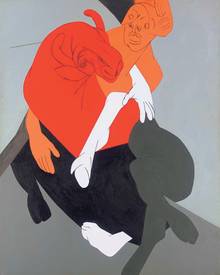
Tyeb Mehta's Mahisasura
Tyeb Mehta

Prices have gone up more than 20 times in the past six years, and at least nine works by artists such as F.N.Souza, V.S.Gaitonde and Tyeb Mehta (Mahisasura, on the rght) have fetched between $1 million and $1.55 million each in New York and Indian auctions over the past 18 months.

These are mostly veteran figurative artists, many in their 70s or older, but new generations are following, led by contemporary artists such as Subodh Gupta and Atul Dodiya whose representations of modern Indian life – especially Gupta’s paintings and installations of pots and pans and bicycles – have been wowing experts in Europe and the US.

Modern and contemporary Indian art sales last month at Christie’s and Sotheby’s auctions in New York totaled some $24 million, but India can’t yet challenge China’s modern art prices, nor its coordinated displays like Hong Kong’s ArtWalk, which brought several thousand people to special shows a few weeks ago.

Art galleries have mushroomed across India’s main cities as demand – and prices – have risen and at least three art investment funds have been launched. So great is the activity – and the profits – that even the income tax authorities have become interested – and suspicious.

On April 17, two leading auction houses, plus fund organizers and galleries in Mumbai and Delhi were raided by the Indian government’s tax inspectors. In a coordinated exercise, about 30 organizations were targeted. Groups of six to a dozen tax enforcement officials arrived unannounced at peoples’ homes, offices and galleries, demanded access and took away records for examination.

New buyers are at the mercy of gallery owners and artists, who demand high prices – even if the artists are little known and their work is not of sustainable quality. So what could be nicer than a chain of customer-friendly outlets that provide quality works by emerging artists, with good impartial advice, at what could be described as “affordable” prices – maybe from Rs10,000 to Rs100,000 (roughly $200 to $2,000) – plus limited edition prints of more expensive works?

That is the challenge that Mrs. Ambani, who advises on the softer side of Reliance’s businesses such as retail store designs, has set for her husband’s executives, according to copmpany sources.

One solution would be for Reliance to carve out a sizeable floor area in its hypermarkets, but demand would vary widely from one area to another, and the prices would inevitably exceed the budgets of most hypermarket customers. So an alternative being considered muight be to open a chain of Reliance art shops. That could bring affordable art to a broader public than currently frequents more upmarket and expensive galleries.

It would also enable Mrs. Ambani to upstage her sister-in-law, Tina Ambani, who is married to Anil, Mukesh Ambani’s younger brother. The two men split their mammoth group in 2005 and there is now intense rivalry.

The wives are said never to have got along with each other which, many businessmen in Mumbai believe, hastened the split. Tina has led the family’s art interest and her annual Harmony Art show was opened in Mumbai at the end of March by Palaniappan Chidambaram, India’s finance minister, with 250 works by 128 artists.

So maybe now we’ll see what the other Mrs. Ambani can do.

« Newer Posts

Categories