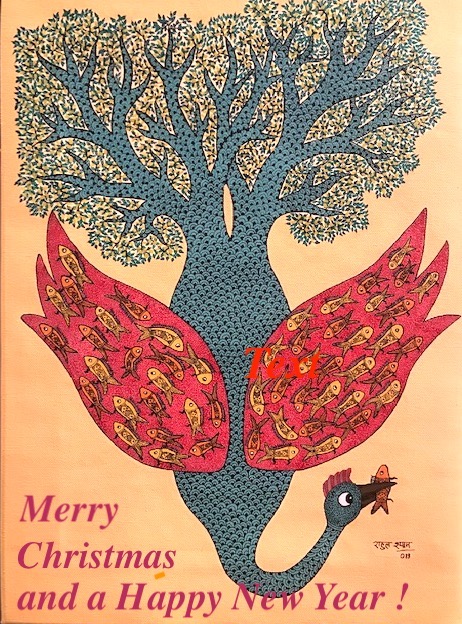
To all friends and followers of this blog, seasons greetings and all best wishes for 2022 – with this splendid painting of a Red-naped Ibis by a Gond artist from the Indian state of Madhya Pradesh
Farmers defeat the Government after a year occupying highways
Protests to continue till laws repealed and prices guaranteed
India’s prime minister Narendra Modi likes to spring surprises, and he’s produced three in the past three weeks. The first two were at the COP26 climate conference when he reversed policy with a 2070 target for zero emissions and then scuppered a resolution on cutting coal usage.
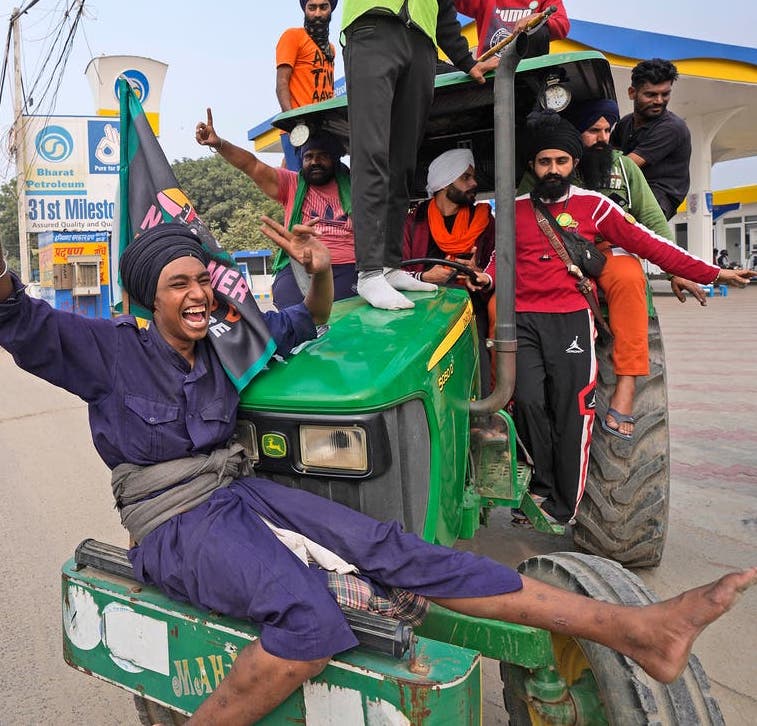
Today (Nov 19), in the third, he has announced that he is cancelling controversial agricultural laws that have led to 12 months of mass protests by farmers on highways around Delhi with violent police confrontations.
The farm decision is an uncharacteristic capitulation ahead of key state elections early next year, following poor results for Modi’s Bharatiya Janata Party in various recent by-elections. It undermines his political strong man image, but presumably he is confident that his national appeal will enable him to rid out the reversal.
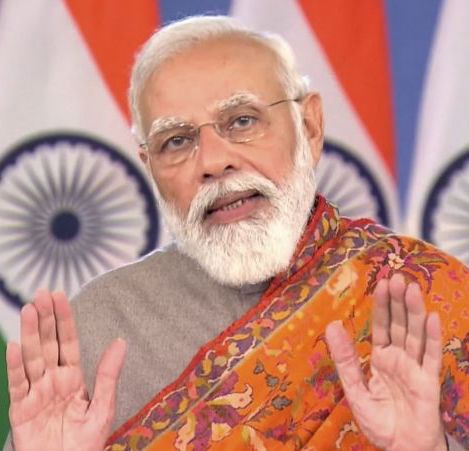
Palaniappan Chidambaram, a former Congress government finance minister, made the primary political point when he tweeted, “PM’s announcement on the withdrawal of the three farm laws is not inspired by a change of policy or a change of heart. It is impelled by fear of elections!”
It was Modi’s personal arrogance that allowed the crisis to develop. He could have compromised after protests began to build up in November last year against the laws that had been suddenly rushed through parliament during the pandemic.
The laws were intended to enable farmers to sell their produce on the open market and also to become part of private sector contract farming. These arrangements operate in many parts of India, but had been resisted in the north where there are fears of contracts pushing down prices and of losing a government-backed minimum reserve price system.
Farmers’ leaders have welcomed Modi’s move, but say they will not be ending their protests till the laws have been repealed and the government has agreed to maintain the reserve prices. A rally is planned for November 26 to mark the first anniversary of the protests.
Modi showed over the past year that he did not understand the distinctive unity and determination of the Sikh community, which has been at the heart of the protests. Sikhs do not naturally subscribe to his Bharatiya Janata Party’s aim of recreating India as a Hindu nation, and the events have sharpened a sense of Sikh identity that was dramatically evident in the 1980s when there was a rebel call for an independent state of Khalistan.
Modi chose the primary Sikh festival of Guru Nanak Jayanti to announce in a television broadcast that the laws would be repealed – and to apologise for introducing them.
“Today, while apologising to the countrymen, I want to say with a sincere and pure heart that perhaps there must have been some deficiency in our efforts, due to which we could not explain the truth like the light of the lamp to some farmers,” was how he worded it, speaking in Hindi.
State assembly elections are due to take place by March next year in Punjab, the Sikhs’ main state, and, more crucially, in the large state of Uttar Pradesh (UP) which has a population of over 230m. Along with neighbouring Haryana, both states have had mass protests on highways leading into Delhi.
A poor result in UP would be seen as a serious setback for Modi and his home minister Amit Shah, and for Yogi Adityanath, the state’s tough chief minister and a controversial Hindu priest-turned politician who is seen by some as a future national party leader.
In Punjab, the BJP is weak but could now build a new base with Captain Amarinder Singh, the state’s veteran Congress chief minister, who was recently sacked from his post by the Gandhi family that dominates the Congress party. Singh is looking for a new political base and has been urging BJP leaders to abandon the laws.
Rushed laws
The laws were rushed into force last year without any parliamentary debate. Ordinances were passed in June and confirmed as legislation in September as part of a Covid-19 economic recovery package. Modi and Shah ignored calls for the usual detailed consideration and debate, assuming that they would not face significant opposition.
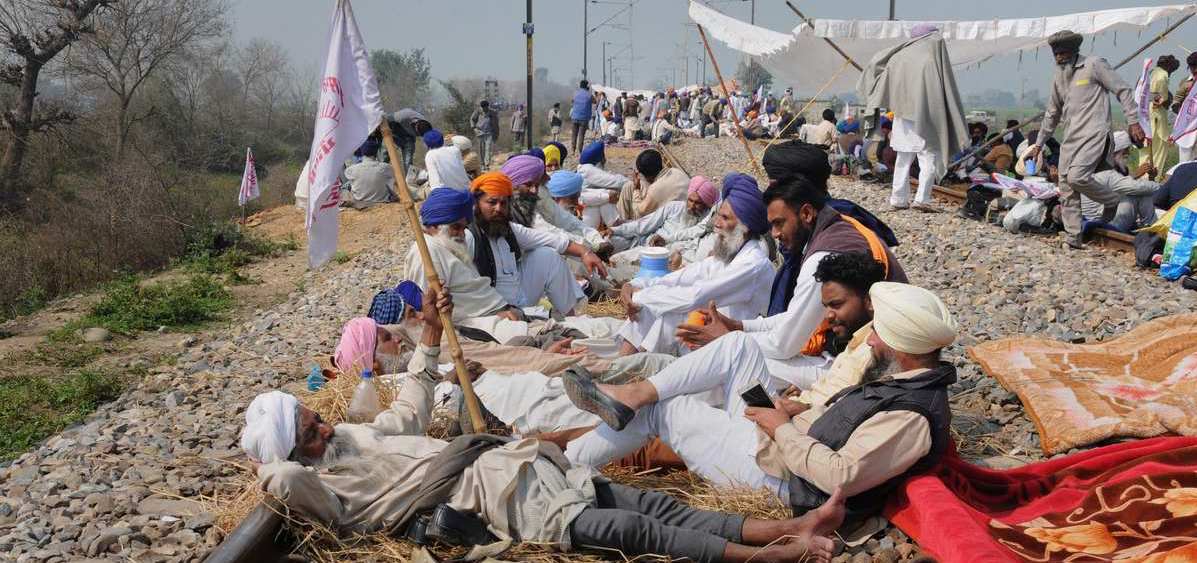
Sporadic protests grew into mass sit-ins on highways approaching Delhi in November and eventually led to several hundred deaths. Eleven rounds of talks between farmers’ leaders and the government led to deadlock because the farmers demanded that the laws should be repealed but the government was only prepared to amend them.
On Republic Day in late January, farmers staged mass tractor rallies into Delhi that led to violence and the invasion of the city’s Mughal era Red Fort. According to widespread reports, the violence was at least partly escalated by government loyalists planted in the crowds, which opened the way for the police to attempt to close down the protests on the highways that had grown into small townships in many areas with canteens and even schools.
The supreme court suspended the laws in January but still has outstanding cases calling for their repeal. There have been demonstrations and criticism of the government’s tactics in the US, UK and elsewhere abroad.
Agricultural reforms are urgently needed and have been proposed by successive governments for some 20 years – the Congress Party, which has been supporting protests, included the current measures in its last general election manifesto.
The measures have been partially implemented in southern states, but there has been repeated opposition in the north because of the sensitivities of hundreds of millions of farmers, many with tiny holdings, and because of vested interests ranging from large farmers to government market agents that benefit from the current trading systems for produce.
More than half India’s 1.4bn people live in rural areas and are linked to agriculture, which needs far wider reforms than the government’s proposed new laws. Once renowned as the grain and food bowl of India, the plains of Punjab and Haryana have been over-farmed for decades, depleting water supplies and the quality of the soil. That is fuelling the farmers’ frustrations and needs to be addressed along with other measures to boost productivity, develop farm-to-shop supply chains and curb widespread wastage
Modi has today tried to regain the initiative two or three months before the state assembly polls, But, while there were widespread celebrations on the highways today, his problems are far from over and the unity against the government does not look like reducing.
This article is on the Asia Sentinel news website https://www.asiasentinel.com
Posted in India
Modi praised for climate reforms then upset Glasgow Pact
Suggestions that China led India into negative stance
With hindsight, no-one should have been surprised when India unexpectedly insisted at the end of the COP26 negotiations last weekend that the Glasgow Climate Pact should only call for coal power to be “phased down” not “phased out”, thus upsetting a text that the organisers innocently assumed was agreed with universal support from nearly 200 countries.
Coal is so central to India’s economic, social and political life that, realistically, it was unthinkable for it to have agreed to phase it out. It is currently offering 40 new mines to private sector companies – on forest land that will be destroyed – and is increasing imports,

Not only does coal fuel 70% of India’s power generation and employ millions of people directly and indirectly, it also enriches the frequently graft-based political-business nexus. Top private sector companies such as the Adani group, which is close to prime minister Narendra Modi, operate as major importers as well as having a growing role in the country’s vast and environmentally-damaging opencast mines.
Blindsided
Leaders of other countries and the conference organisers seem to have been blindsided by Narendra Modi’s appearance at the start of the summit where he sounded a committed and balanced advocate of climate action, even though his date for net zero emissions was 2070, not the 2050 pledged by the UK, US and other high-income countries, nor 2060 chosen by China, Russia and Saudi Arabia.
Even my old newspaper the Financial Times, usually an unrelenting Modi critic, ran an editorial on November 2 saying that it “was encouraging and a vital step in limiting global warming” for the world’s third-biggest emitter and most populous country to have set a target to reduce its emissions to virtually zero.
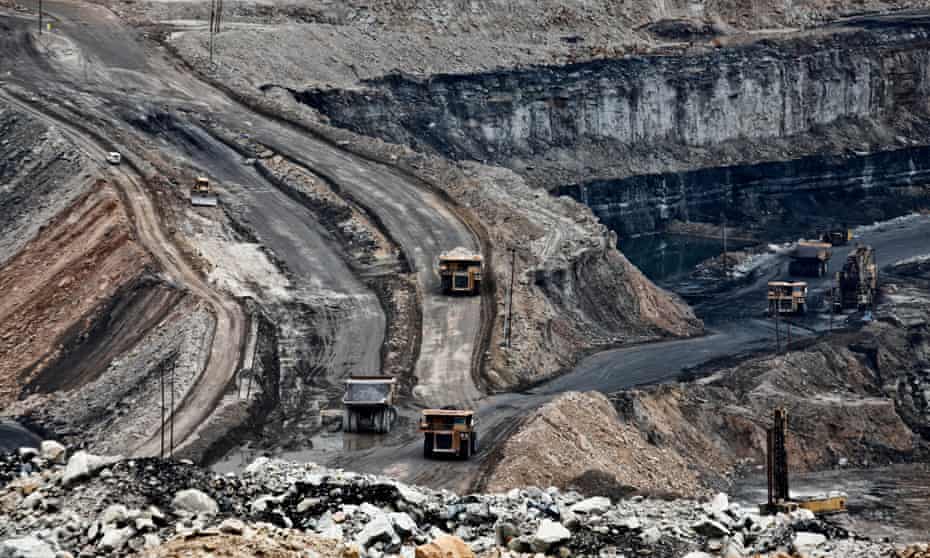
India is the biggest producer and user of coal after China, but it is currently suffering from serious shortages because of inefficient mining and mismanagement of supplies, plus a post-pandemic surge in demand. Prices are rising, so it would have been politically highly risky the government to agree to phasing the fossil fuel out. “If the government had done that in Glasgow, and Delhi and Mumbai had shut down because there was no coal to run power plants, how would that have played out politically?”, one analyst asked me rhetorically.
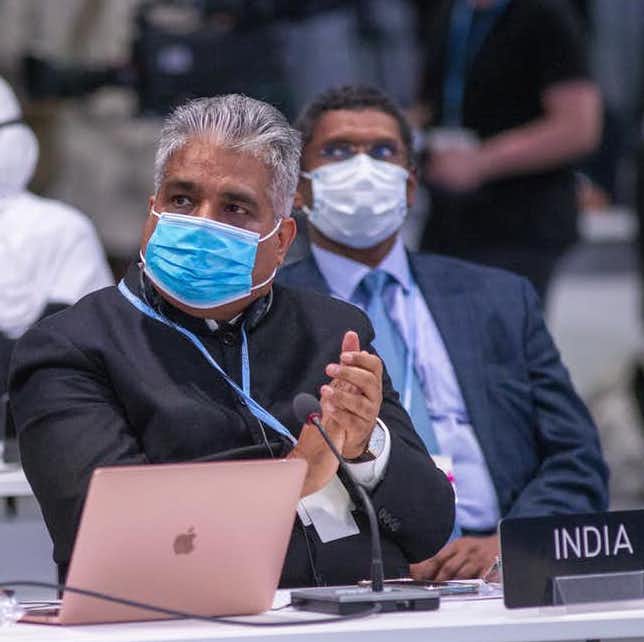
There is also a suggestion that India was conned into insisting on phasing down by China; a move that might have appealed to Modi at a time when the two countries have had an 18-month long military confrontation on their Himalayan border. Indian government sources in New Delhi are now briefing journalists that India should not be blamed for the change, and Bhupendra Yadav the environment minister, spoke about it later (Nov 20).
“A perennial problem in Indian efforts at COPs in the past has been its tendency to provide cover for China,” according to the Business Standard, a leading Indian newspaper. “New Delhi allowed itself [in Glasgow] to play the bad guy and willy-nilly defend Beijing’s policy choices”.
India’s initiatives
Modi was taking an important step when he proposed the 2070 target because he was abandoning India’s previous pose of grumbling about developed countries while refusing to stake out its own contribution. The 2070 initiative reversed the established line of refusing to name a date and was apparently decided in his prime minister’s office without even the environment ministry knowing what was planned.
India is also committed, as Modi said in Glasgow, to obtaining 50% of India’s electric power from non-fossil energy resources by 2030 (building 450 gigawatts of solar and other renewable capacity) and, by the same year, reducing the carbon emissions’ intensity of the economy by 45% from the 2005 level. But it appears not to have signed a zero deforestation commitment.
It is not clear when Modi decided on the coal move – possibly it was not till after he had returned to Delhi, and maybe felt the heat from private sector miners and realised the political risks during coal shortages and the need for increased imports.
This was the first time that coal had been mentioned in a COP agreement and early drafts of the Glasgow Pact contained an commitment to phase out unabated coal (unabated means coal that is burned without emission-reducing carbon capture and storage technology).
Modi left the job of announcing the unpopular move of overturning what was to have been the final draft to Bhupendra Yadav, who should not have been under-estimated by other countries – he has a reputation as a shrewd lawyer and has written a book on environmental legislation.
China intervened
China seems to have intervened first, indicating it was prepared to de-rail the proposed pact. It argued that demands on countries to meet the primary average global temperature rise to 1.5 deg C. should be adjustable according to their need to eradicate poverty. India agreed with this and moved into the lead, with Yadav announcing the demand for a redraft in a plenary session last Saturday.
India and China are now being widely criticised for the disruption, though they would argue that, while they are among the biggest coal polluters, Australia and South Korea lead on a per capita basis. India’s per capita emission from coal power is considerably less than the global average.
Coal is mostly mined inefficiently by Coal India, a monopoly-oriented public sector corporation that has for decades resisted modernisation and accounts for some 80% of supplies. Most of the remaining 20% comes from Australia, Indonesia and South Africa, making India the world’s biggest importer.
Economic reforms have for years pushed for coal mining to be opened to the private sector. After a hiatus a decade ago caused by mining licences being corruptly awarded without open tendering, some 40 mines are now being operated by companies for their power and steel plants.

This is now being expanded with the private sector tendering for 40 new mines with another 40 to follow later, involving a total of 55 billion tonnes of coal that can be sold on the market. Many of the mines are located on long-protected forest land which will be destroyed, along with habitats for local people.
This brings increased worries about environmental laws and regulations being broken or ignored because of the political clout of private sector companies that can stretch from the prime minister’s office down to environmental and other local government officials.
Lack of leadership
Part of the problem throughout the preparations for COP26 was a lack of British leadership. Alok Sharma, the COP president and a former Conservative government minister, has been admired for his stoicism but he is not enough of a political figure to break deadlocks.
That would have been fine if Boris Johnson had been fully focussed, but he has a short attention span and his lack of involvement was illustrated when he went on a Costa del Sol holiday a week before the Glasgow events began instead of lobbying internationally for a positive outcome.
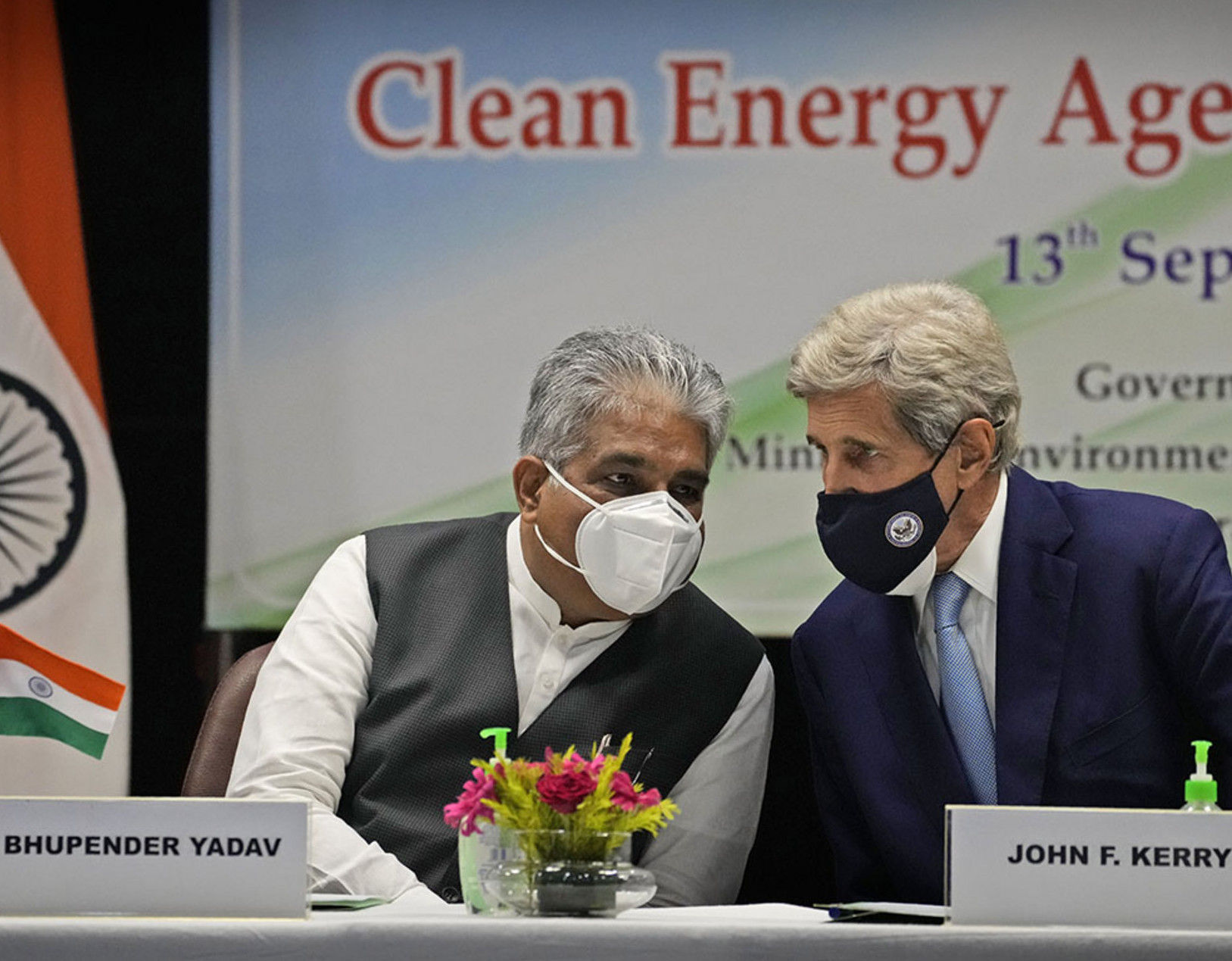
John Kerry, the US climate envoy admitted as the events closed that he had not expected problems. “Did I appreciate we had to adjust one thing tonight in a very unusual way? No. But if we hadn’t done that we wouldn’t have a deal. I’ll take phase it down and take the fight into next year,” he said.
This article is on the Asia Sentinel news website https://www.asiasentinel.com
Posted in BJP government, Climate change, India, India China, India-UK, Modi abroad, Modi goverment, Narendra Modi | Tags: Adani coal, Bhupendra Yadav COP, COP26, COP26 Boris Johnson, COP26 coal, COP26 Glasgow, COP26 Modi, FT India COP26, Glasgow Climate Pact, India China COP26, India coal, Modi coal, Modi FT praise
Auctions maintain the pandemic’s buoyant trend
Strong bids go over $1.6m led by Sotheby’s
South Asian modern art auctions have maintained a strong trend set last year during the early stages of the pandemic with sales totalling over $30m in the autumn round – led by Sotheby’s with two London auctions totalling £ 8.4m ($11.6m), Mumbai-based Saffronart with two totalling $8.6m, and Christie’s in New York at $7.8m.

There were no big-ticket sales above $2m but a steady stream of activity at lower prices, notably for works new to market and a strong provenance, with many exceeding sensitively moderate estimates
In the Christie’s auction, where 74 buyers and bidders participated from 12 countries, an unusually high figure of 70% of the sales exceeded the top estimates, twice the usual amount.
This was led by The Embarkation, a 42in x 32in oil on canvas (left) by Jehangir Sabavala (1922-2011), that sold for $1.59m, more than five times the low estimate. It established a new auction record for the artist, a prominent modernist from a Mumbai Parsi family, almost doubling the last record set at Christie’s in September last year.
Painted in 1965, it depicts four ghostly figures in long yellow robes about to board two ships, and marked a significant trend in Sabavala’s work,
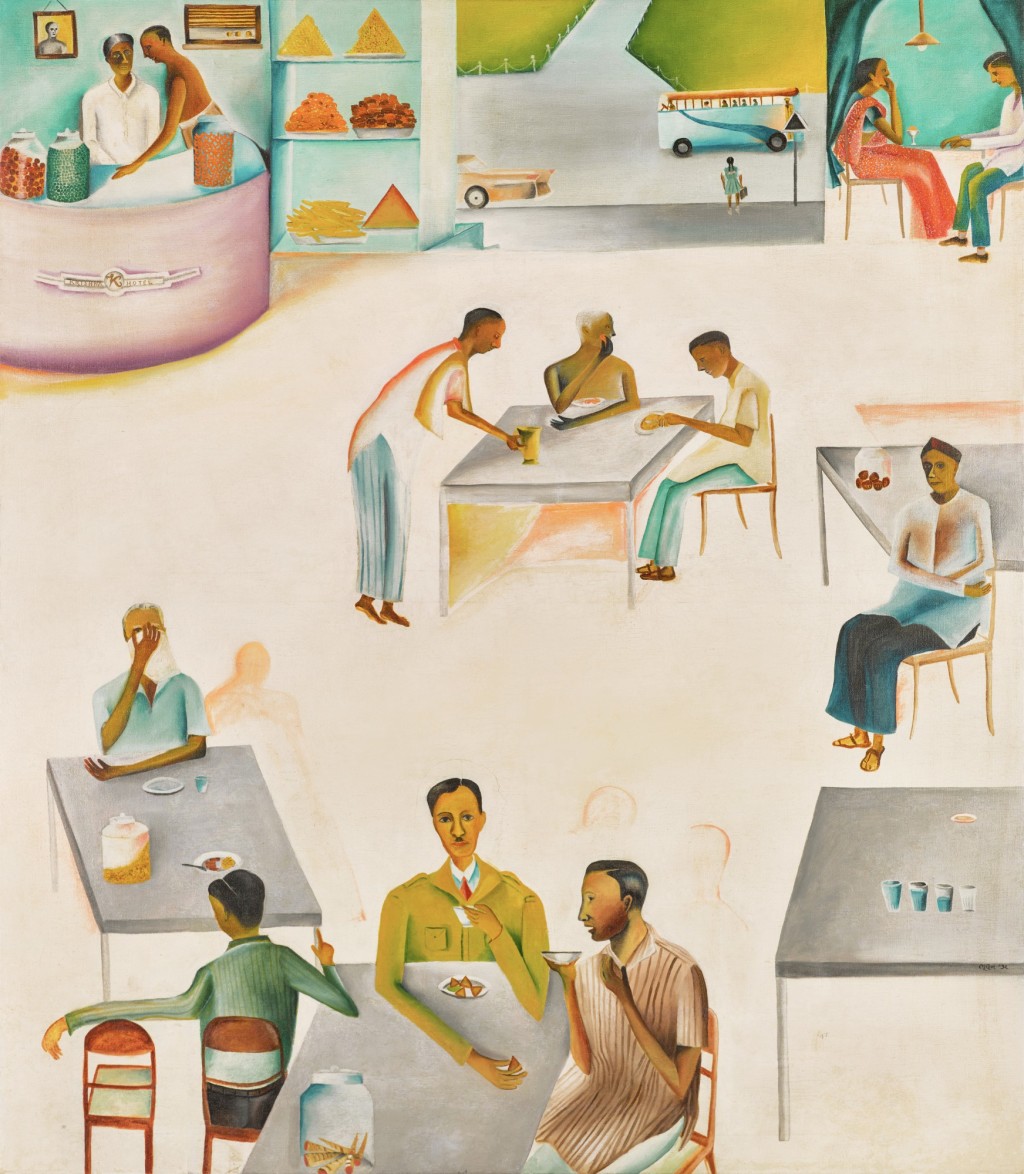
Works by Bhupen Khakhar (1934-2004), an often controversial gay painter who has appeared frequently in auctions since a retrospective in London’s Tata Modern five years ago, have done well.
A record auction price of £2.54m was set at Sotheby’s two years ago and this week one of his less explicit works, a 48in x 42in oil on canvas titled Krishna Hotel (right), exceeded its lower estimate by more than five times at Sotheby’s in London. It sold for a hammer price of £1m (£1.23m including the premium) after a final tussle between two bidders
‘Krishna Hotel’ marked the start of Bhupen Khakhar’s Tradesmen series of paintings that showed scenes of people’s daily lives. It had not been seen publicly since 1971 after it was bought by an American architect, Christopher Benninger, who worked in India and became a friend of Bhupen.
The same artist also did well in Christie’s New York September sale where a brilliantly coloured 36in x 36in oil and gold paint on canvas of a tree in a walled garden sold for $990,000 (£720,000) including buyers’ premium against a low estimate of $350,000.
Sotheby’s had two auctions this week. Its main South Asia modern and contemporary sale produced a total of £5.4m ($7.4m) against £2.7m-£4m estimates. A third of the buyers were new to Sotheby’s and a similar figure were aged under 40.
Aside from the Bhupen Khakhar, Sotheby’s works included a rather dark landscape (red building) by F.N.Souza, a leading member of the Progressives group that came together in the mid 2000s. Acquired by its owner for the dollar equivalent of £100 in Detroit in the 1980s, it doubled estimates at £922,500 (including the premium).
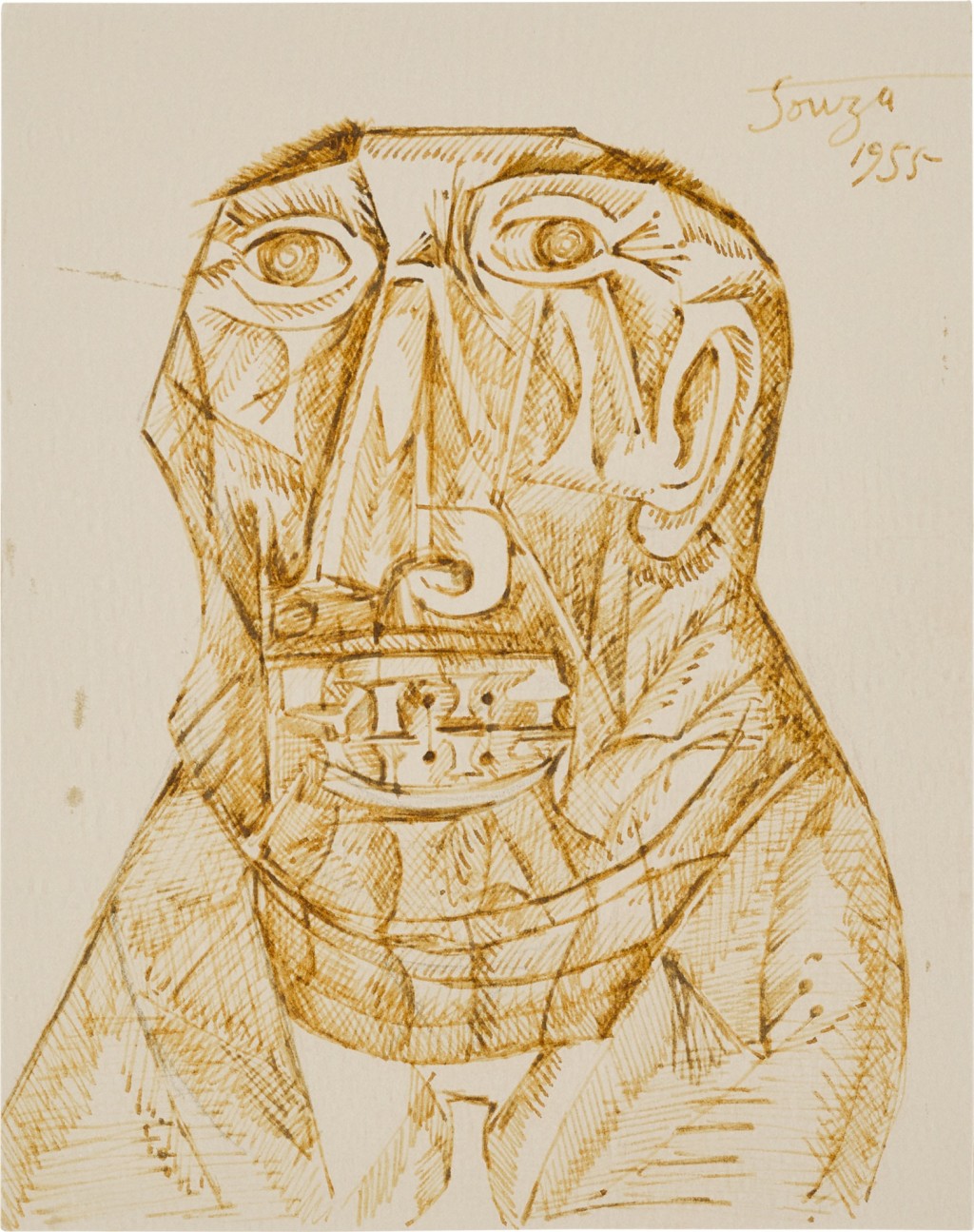
An 8in x 6in ink and pencil on card drawing by Souza of a head (above) dubbed Gentleman of our Times also did remarkably well, selling for £12,600 including the premium, more than four times the top estimate.
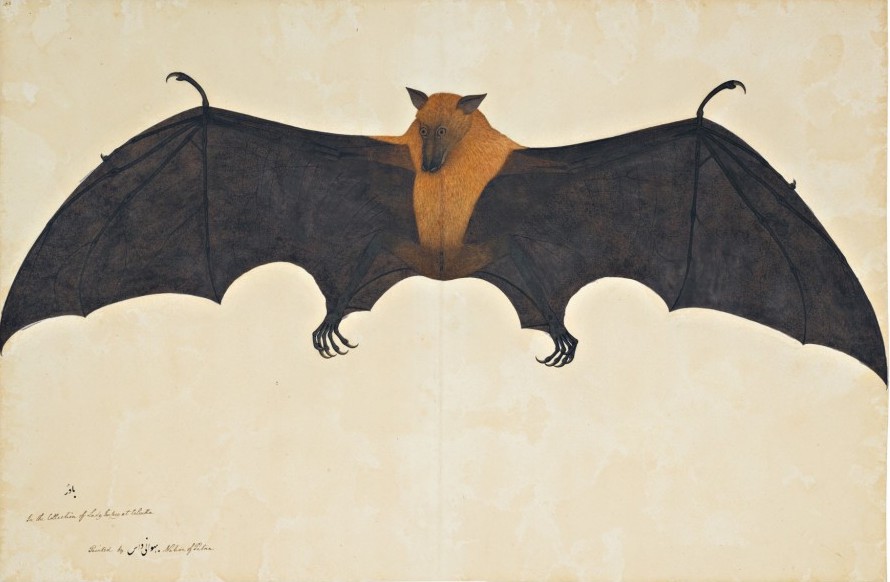
The second auction called In an Indian Garden had a collection of company school paintings from the British colonial era with sales of £3m ($4.2m), nearly double the low estimate. A Great Indian Fruit Bat dated 1778-83 (above) topped the bidding at £644,200, more than double the low estimate
Saffronart is primarily an on-line auction house but also has live auctions and it ran both in tandem earlier this month, achieving sales of Rs45.72 crore ($6.2m) live and Rs17.9 crore ($2.4m) on line over two days.
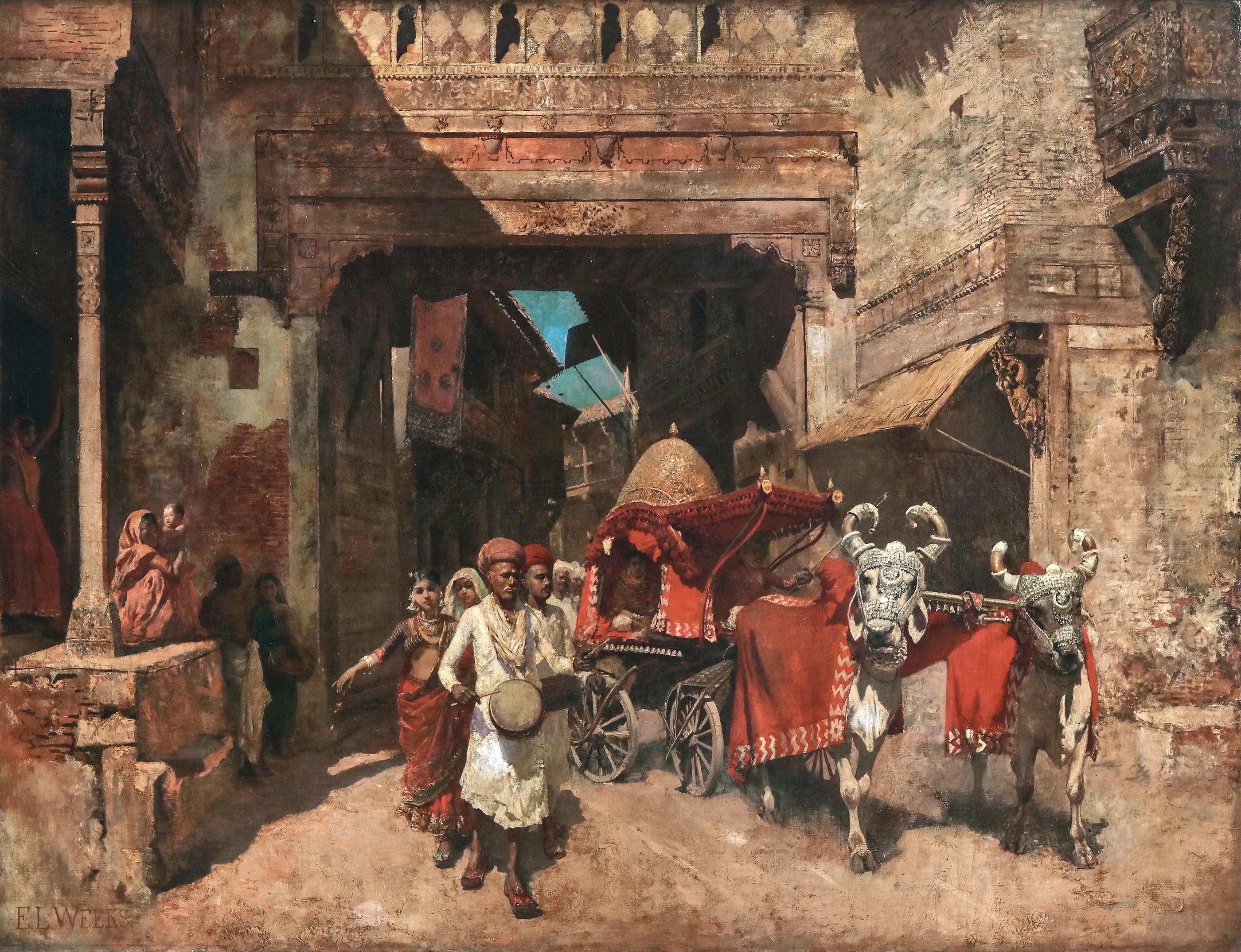
Among the biggest surprises in its live auction was a spectacular 56in x 75in oil on canvas (above) portrayal of a wedding procession in Ahmedabad – not by an Indian painter but by Edwin Lord Weeks, a late 19th century American Orientalist artist who worked extensively in India.
Perhaps more important for recording historic detail than for artistic imagination, it more than doubled the low estimate at a hammer price of $900,000 that might have gone higher if a would-be bidder had reacted a second before the lot was closed. Including the buyers’ premium, the price was Rs7.99 crore ($1.08m).
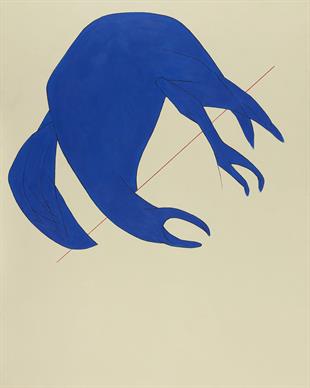
Curiously, Saffronart’s on line sale included Blue Bird, a 49in x 39in Tyeb Mehta acrylic on canvas (left) with a top estimate of $1.35m – a level that’s more usual in a live auction. It did not draw its first bid till just seven minutes before the closing time and then rose slightly to sell at Rs7.54 crore ($1.02m) including the premium. Another work by the same artist, a dark figure of a woman oil on canvas, failed to draw any bids.
In addition to those international auction houses, India’s online Artiana had a five-day auction this month that totalled $2.39m.
Bonhams in London, though far down the value list at a total of just £706,000 ($900,000), was notable for being the only auction house to produce a paper catalogue – the others cashed in on a pandemic trend set last year and saved money by only sending out pdf copies, even for live auctions.
It withdrew three paintings by S.H.Raza, a doyen member of the Progressives, because of delayed authentication, but Bombay Street Scene, an early Raza 12in x 19in watercolour on paper, fetched more than seven times the top estimate at £75,250 ($103,728) including the premium.
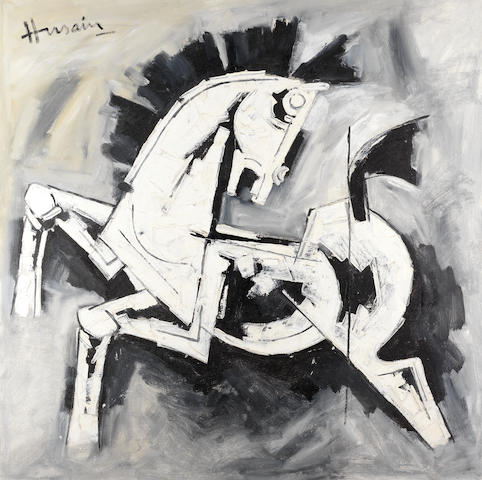
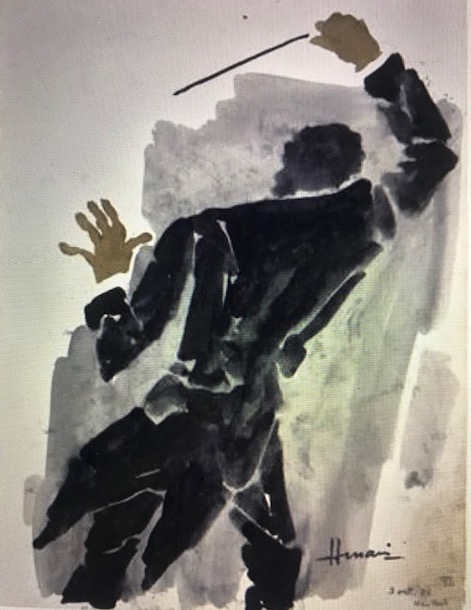
A prancing horse (above) by M.F.Husain (1915-2011), one of the best known Progressives, sold for £106,500 ($146,805) including the premium, well above the top £60,000 estimate – enhanced perhaps by its provenance – it was given by Husain to Mohammed Rafi, a renowned singer.
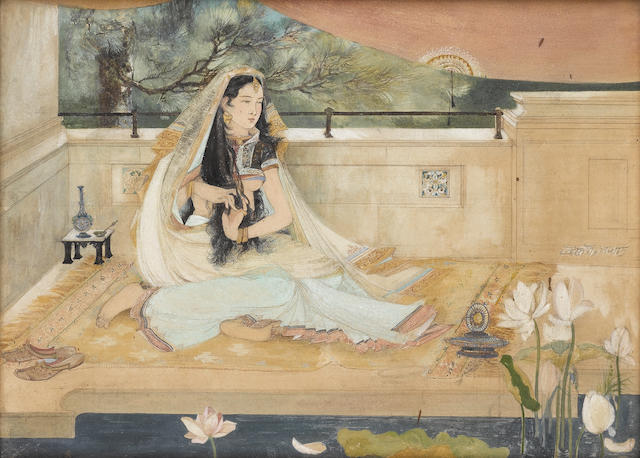
A 9in x 12in pencil pen and ink and watercolour, An Inmate of the Harem, (below) by Devi Prasad Roy Chowdhury sold at ten times the low estimate at £20,250 ($27,913) including the premium – a happy ending in the final week of the season’s modern art auctions.
This article is on the Asia Sentinel news website https://www.asiasentinel.com
Posted in India, India modern art, Indian art auctions | Tags: Artiana Indian art auction, Bhupen Khakhar, Bhupen Krishna Hotel, Bonhams Indian art auction, Christie's Indian art auction, Edwin Weeks Wedding Procession, Harem Chowdhury, India art auctions exceed $30m, Jehangir Sabavala Embarkation, Saffronart Indian art auction, Sotheby's Great Indian Fruit Bat, Sotheby's Indian art auction, Sotheby's Indian Garden
A good recovery from disastrous second wave
Complacency is spreading about Covid conquered
India is good at dealing with crises when a monumental effort is made to focus minds on a single short-term target. It has problems however with staying focussed and with continued standards of delivery and quality.
That is the story of the country’s impressive achievement of delivering 1 billion Covid vaccinations, which was reached yesterday (Oct 21) with 75% of the 1.4 billion population receiving the first jab. China reached 1 billion in June and has now delivered 2.2 billion.
A second jab has however only been accepted by 30% of India’s eligible population. That is mainly because there is a widespread lack of interest after the first dose and also, probably, a lessening of official interest in driving the delivery. The average daily jabs’ figure has gone down from 8.4m in August to around 5m.
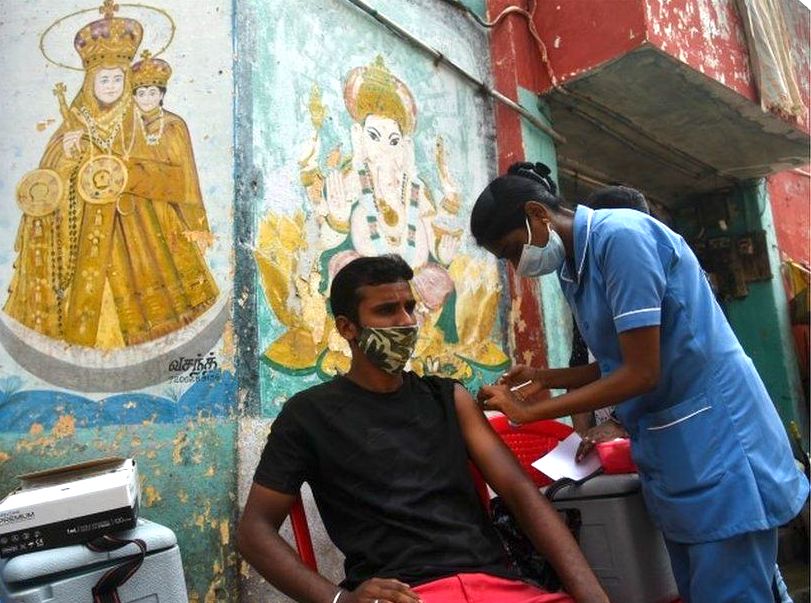
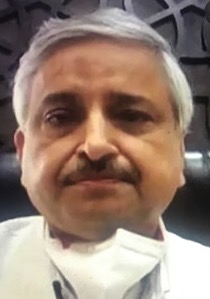
“People say to me ‘Covid has gone so I do not need a second jab’,” says Dr Randeep Guleria, director of AIMS, Delhi’s biggest hospital and a pandemic expert. “It takes a lot of convincing….we need to establish with people that one shot is not enough”.
Some states have been distributing gifts to fully vaccinated people. In Gujarat, free medical kits and ropeway rides have been to those who have both doses.
Like prime minister Boris Johnson, who recovered politically from Britain’s disastrously unfocussed government performance on the first wave of Covid last year with an efficient vaccination drive, so Narendra Modi in India can boast about the one billion jabs after political indifference, government inefficiency and an appalling health system led to a crippling second wave early this year with hundreds of thousands of deaths.
As one report put it this morning, “after months of acute shortages, a raging second wave, an opaque system of placing vaccine orders and technical glitches, India finally seems to be on track to at least partially inoculate its adult population by December”.
For Modi it is good politics – his photo adorns every vaccination certificate and he has been involved in extensive publicity in the past 24 hours, including a broadcast that has ignored earlier problems. On September 17, a daily record of more than 20m doses was reported to mark his 71st birthday.
Such feel-good publicity diverts attention from killings in Kashmir and Hindu-Muslim unrest elsewhere in the country, and an arms build-up on the Himalayan border with China.
With a total of 34m Covid cases, more than 450,000 people have died in India from the pandemic, according to government figures that are widely believed to be considerably under-stated. Total deaths have been estimated at one million and more.
It will now be difficult to rebuild the drive and focus that enabled the billion jabs to be achieved at an average of 3.6m a day since they began last January.
Extensive co-ordination has been needed stretching from the prime minister’s and state chief ministers’ offices, and the Serum Institute of India (SII) factories where most of the vaccinations are produced, down through state organisations, hospitals, medical centres and charitable and other volunteer organisations and local village helpers.
“It’s a huge step making a cold chain from the manufacturer to the site of delivery,” says Guleria. A billion syringes and needles were needed along with trained manpower to deliver and monitor any acute adverse reactions.
Logistics solutions have included drone supplies to some remote locations. IndiGo, the country’s leading private sector airline, is reported to have carried some 1,700 tonnes in over 4,500 flights, 68% of the total vaccine doses.
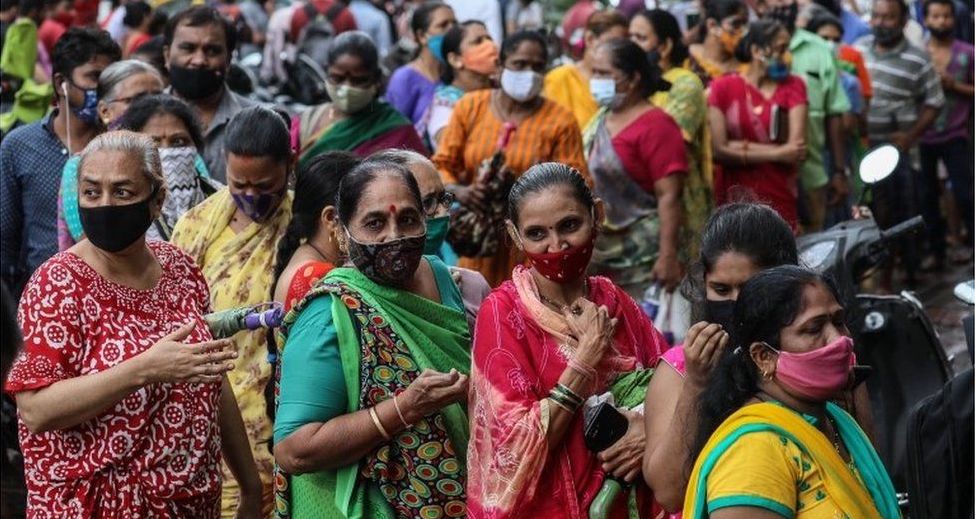
Persuading people to accept the jabs has been a major problem with widespread rumours throughout this year on social media about the risks that range from simply becoming sick to blood clotting and infertility. Guleria says that people were waiting “for some six months to watch for side-effects” among those who were jabbed.
The Serum Institute is now producing 220m Oxford-AstraZeneca vaccines, known in India as Covishield, a month. The ceo, Adar Poonawalla, expects this to rise to 370m by January. The company would by then be able to build up exports that were stopped by the government earlier when supplies were scarce in India.
Ultimately, the success depends on what the telecoms industry calls last mile delivery, which is a challenge in India with 60-7% of the population living in rural areas, many of them remote locations where there is frequently mistrust of officials.
“We belong to the same tribal (Mayalali) community as the residents in these (Jawadhu) hills. It bonds us. It also makes them trust us,” 52-year-old T. Chennammal, one of three volunteer health nurses in a remote area of Tamil Nadu, told The Hindu newspaper.
Chennammal and her fellow nurses have walked miles on pathways to remote villages, administering vaccines for plantation workers, traders, village elders and farmers covering at least two villages every day.
The people in that area are lucky because the nurses regularly visit to do health checks and provide medicines. That is not the case in many other places, which is why Modi’s target to have everyone vaccinated with two jabs by the end of the year is a tough challenge.
Poonawalla’s vaccines are readily available but the demand has to be created and deliveries completed.
This article is on the Asia Sentinel news website https://www.asiasentinel.com
Tata takes on $2.5m a day losses and profits-averse business culture
Decades of disruptive government interference blocked progress
Tata’s planned $2.6bn takeover of Air India has significant ramifications beyond the basic news of what must be the biggest loss-maker ever to have been privatised anywhere since Britain’s Thatcher government coined the phrase in 1979 for what had previously been called de-nationalisation.
First, it shows that Narendra Modi’s government, while facing intense criticism internationally for its harsh Hindu nationalism, is capable of pushing through a deal that has eluded previous governments since 2001. That could bode well for economic reforms, including further privatisations that are planned along with other government asset sales
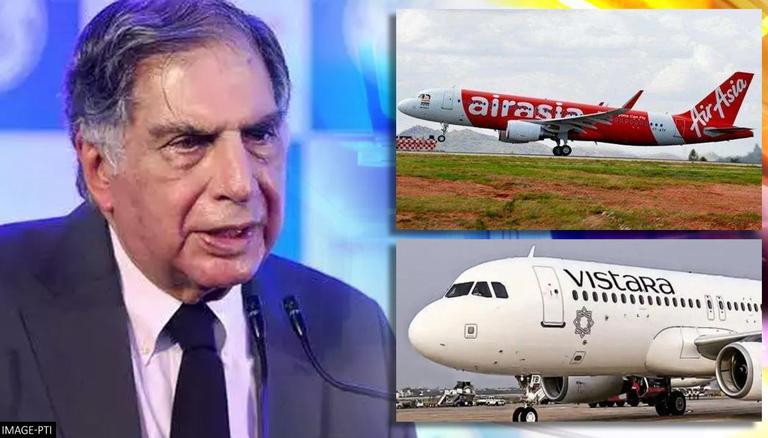
Secondly it demonstrates the continuing clout of Ratan Tata, the 83-year old former chairman of Tata Sons whose businesses include software, steel, retail, hotels, cars and chemicals. He clearly still holds sway as chair of Tata’s charitable trusts that have a 60% controlling stake, having ousted his first choice as his Tata Sons successor in a boardroom coup five years ago this month.
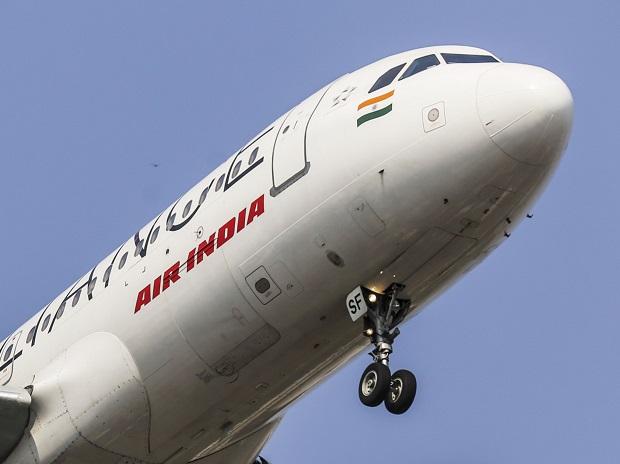
It also points to a new era for India’s aviation after decades of public sector mismanagement and government interference, often corrupt. Private sector airlines will no longer have to compete with the heavy subsidies doled out by the government, while politicians, bureaucrats and senior staff will have to curb their plundering of the airline for their personal benefit.
The airline is currently losing Rs200m ($2.6m) a day and Tata has agreed not to shed any of some 13,500 employees for a year. Reports suggest an injection of $1bn or more will be needed – along with changing the business culture and rebuilding a faded brand.
A letter of intent was handed to Talace, a Tata subsidiary, today (Oct 12), following the $2.4bn deal’s announcement on October 8. Details are set to be finalised by December when Tata would take over the airline along with $2bn of its total $8.2bn debt. It is paying just $388m in cash to the government, which is shouldering the remaining $6.2bn debt. The group is looking for a new ceo for the airline.
There have been problems for decades – in 1987, Ratan Tata and another top industrialist, Rahul Bajaj, were put in charge of Air India and Indian Airlines, then the domestic carrier, by prime minister Rajiv Gandhi to try to introduce private sector methods and profitability. They failed.
Problems escalated in 2007-08 when the airlines were merged by Praful Patel, then aviation minister, without any change of top management nor any attempt to align and rationalise operations. Patel, who belongs to Maharashtra’s National Congress Party, also ordered 110 aircraft that were arguably not needed with the merger. He has been questioned by investigatory agencies over various money laundering deals plus questionable sales of traffic rights to foreign airlines done while he was, with hindsight, one of India’s most notorious (and suave) aviation ministers.
“Air India is notionally India’s national carrier, but its real role for decades has been to line the pockets and make life comfortable for those directly involved in its affairs – from ministers and bureaucrats, who get kickbacks on aircraft and other orders and benefit from freebies and powers of patronage, to top executives, pilots and other staff who often don’t work but do block change,” I wrote on this blog in 2009 when Patel was in charge.
In that article, I quoted the then new chairman listing many of the problems he faced, which continue despite some inprovements:
Despite all that, and his own experiences in the 1980s – and subsequent unsuccessful attempts to start an airline – Ratan Tata has been determined to take back the carrier that was founded as Tata Air in 1932. That was when India was still part of the British empire. The founder was J.R.D.Tata, his iconic predecessor as Tata chairman.
“It was an exclusive world that exuded discreet power, spelt high society, glamour, and wealth. If you had a job in Air India as a pilot, you were the most eligible and sought after bachelor. If you were an airhostess, you were a young goddess in the skies as unattainable as an Urvashi. That was then, when JRD Tata ran the airline,” says Capt Gopinath, former founder of a private sector airline.

Tata Air was nationalised in 1953 by prime minister Jawaharlal Nehru, six years after independence, because he wanted key national assets to be in the government’s hands.
Tata gains around 130 aircraft (with valuable landing and parking slots in India and overseas) that it will need to align with its two existing airline interests – Vistara, which is a joint venture with Singapore Airlines, a long-standing Tata partner, and a stake in Malaysia’s AirAsia budget airline. Both are making losses.
Some observers, including India’s influential Business Standard, have said that Tata has been “generous” in the deal, given that various of the airline’s profit-making side businesses have already been off-loaded. The government has also been desperate to sell, having failed in 2018 because of a lack of interest when it wanted to maintain a statutorily-influential 26% financial stake.
There was just one other bid, from Ajay Singh who heads SpiceJet, a successful private sector carrier, but some reports have suggested he was only doing the government a favour because it needed a second bidder in order to let Tata win.
While Ratan Tata has driven the desire to regain control, the task of turning round the unwieldy, over-manned, massive loss-maker and creating a new culture will presumably be down to Natarajan Chandrasekaran, chairman of Tata Sons and a career executive, who headed TCS, the group’s leading information technology company, till the 2016 coup.
This is the third daring takeover driven by Ratan Tata. A $2.3bn acquisition of Jaguar Land Rover from Ford in 2008 has done well, despite some problems. Cars fascinate him and the UK-based business gained financial strength plus management commitment and focus that had been lacking. But a $13.6bn acquisition in 2007 of Britain’s Corus steel company, which was pushed through despite opposition from some colleagues, was a loss-making failure.
Privatisations
For the Modi government, the deal is a major achievement. The previous Congress government, headed by Manmohan Singh as prime minister from 2004, was not enthusiastic about selling control of government assets and made little effort to tackle Air India’s problems, leaving Patel in charge for nearly seven years.
Privatisation involves the government moving ownership into the private sector by selling off a controlling financial stake and Air India is the first case in India since 2004 – after the previous Vajpayee BJP government had privatised 12 corporations. Divestment, as it is practiced in the country, involves minority stakes being sold without any change in management. Both privatisation and divestment are usually opposed by vested interests, as happened with Air India, notably by trade unions and top management and other vested interests that do not want their status and benefits to be upset.
The Modi government’s pending divestment initiatives include an initial public offering for Life Insurance Corporation of India (LIC), along with privatisations where the government is selling controlling stakes in Bharat Petroleum Corporation (BPCL), BEML that makes earth moving equipment, and the Shipping Corporation of India, along with steel and electronics businesses and a helicopter operator.
The Air India case should help to encourage buyers for those businesses because it shows that the government does have the will to finalise deals. It might also help large-scale monetisation plans announced earlier this year, which involve handing operation of businesses over to the private sector while the government maintains control.
But first Tata has to finalise its deal with the government in the next two months and maintain currently favourable reactions among the staff. Then it will gain control and hope that its due diligence has not missed any more of the sort of problems that the chairman outlined in 2009.
This article is on the Asia Sentinel news website https://www.asiasentinel.com
Modi criticised in Washington for curbing democracy and freedoms
AUKUS shunts India away from military resistance to China
Two key changes in India’s links with the US have emerged in the past ten days. During a high profile visit to Washington, prime minister Narendra Modi has faced thinly veiled criticism of the way that his government is reducing the scope of India’s democratic freedoms, while the new AUKUS security alliance between the US, UK and Australia announced on September 17 points to a reassessment by the Biden administration of India’s potential military usefulness in the Indo-Pacific.
The criticisms, which came mainly from vice president Kamala Harris, and were less forcibly voiced by president Joe Biden, were rebutted by Modi when he addressed the UN general assembly yesterday (Sept 26).
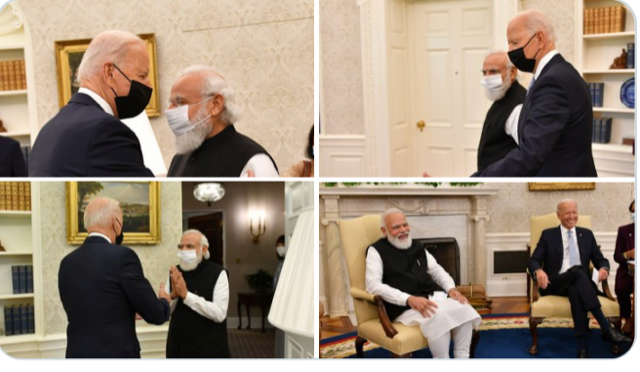
But the reassessment of India’s security role will probably be welcomed because the country is traditionally reluctant to become tied to security alliances, especially when it is trying to find balance in its complex relationship with an increasingly aggressive China.
This has led to questions about India’s potential effectiveness in the Quadrilateral Security Dialogue, known as the Quad with the US, Japan, and Australia, which has been developing as a counter-force against China’s expansionism in the past four years.
Now, with AUKUS’s high technology defence agenda against China, initially involving the development of nuclear submarines for Australia, the Quad can focus on broader less strategic military issues, as it did when the leaders of the four countries met in Washington on September 24. That fits with India’s agenda.
Modi, whose 71st birthday was widely celebrated by his Bharatiya Janata Party across India just over a week ago, has been accustomed to being enthusiastically greeted in Washington since he came to power in 2014.
To begin with, he met a surprisingly receptive Barack Obama, and then there was his rumbustious soul mate Donald Trump. Modi and Trump would hug each other (below in 2017), and even staged what amounted to joint political rallies in each other’s countries in 2019 (Houston with Indian Americans) and 2020 (Ahmedabad) with the Indian prime minister seemingly endorsing Trump for re-election.

There is now a basic antipathy in Washington for Modi’s brand of nationalism, which is focussed on building a Hindu homeland where Muslims do not have equal ranking, and where freedoms of speech and expression are harshly curbed. Obama said during an October 2017 visit that Muslims should feel integrated, something that “should be cherished and nurtured”, but that was to a private audience at the end of his trip after leaving Modi.
Given that background, Modi’s first face-to-face meeting with Joe Biden on September 24 went well. There was no hug, but the two men grasped each other’s arms and produced all the usual platitudes about shared interests. The president even mentioned family ties with 4m Indian Americans in the US and his relatives with the Biden name who have been found in India.
However, after saying that the meeting marked “a new chapter in the history of US-India ties”, he stressed the need for “democratic values” and added that the messages of “non-violence and tolerance matters more than ever before”.
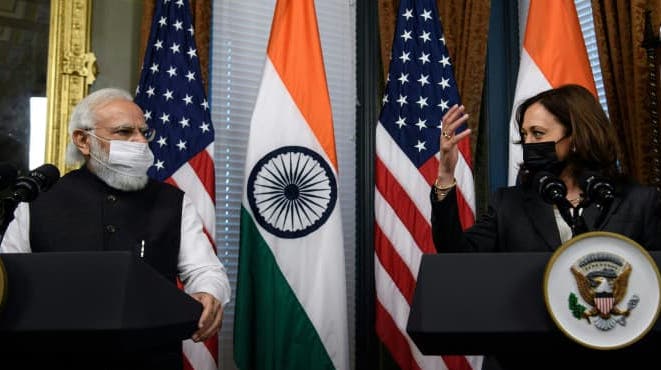
Kamala Harris (who has an Indian mother) was more outspoken during a public part of her meeting with Modi (above). This echoed her earlier criticisms of the government’s policies on issues such as Kashmir.
Turning to look straight at Modi (video here), she said: “As democracies around the world are under threat, it is imperative that we defend democratic principles and institutions within our respective countries and around the world and that we maintain what we must do to strengthen democracies at home.”
Directly challenging Modi’s approach, she said “I know from personal experience, and from my family, of the commitment of the Indian people to democracy and to freedom, and to the work that may be done and can be done to imagine and then actually achieve our vision for democratic principles and institutions”.
Modi failed to attend a subsequent Quad meeting held by Harris, which went ahead with the prime ministers of Japan and Australia. Modi may have stayed away because he resented what Harris had said in public, but there were also suggestions it was because he had already had his own meeting with the vice president, which officials later said had been constructive.
His response was robust when he spoke at what looked (on television – pic below – and noted on Twitter) like a rather sparsely attended meeting of the UN general assembly in New York.
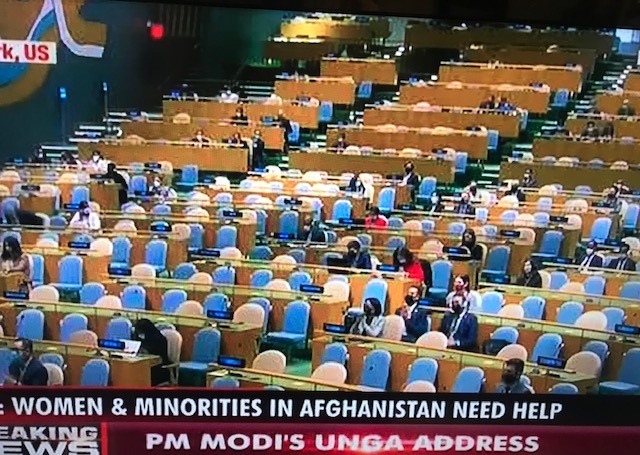
Sidestepping Harris’s points, he cited his own rise from helping his father run a tea stall to becoming prime minister as an example of Indian democracy . India, he said, was the “mother of all democracies” and its diversity was “a symbol of our strong democracy, where dozens of languages and hundreds of dialects are examples of a vibrant democracy”.
The Quad was first set up in 2007 without much impact, but it has been gradually revived since 2017 and is now seen as a key bulwark against China’s aggression with the task of “maintaining stability in the Indo Pacific”.
Six months ago the four leaders came together for the first time in a virtual meeting – earlier contacts had mostly been between officials. The Washington meeting (photo below) was the first time they had met face to face. They discussed issues such as trade, the Covid pandemic, climate change, and stability in the Indo-Pacific, plus the need for Afghanistan to develop without becoming a hub for terror and condemnation of Pakistan’s role in supporting terror groups.
Responding to China’s aggression, they agreed to “recommit to promoting the free, open, rules-based order, rooted in international law and undaunted by coercion, to bolster security and prosperity in the Indo-Pacific and beyond”. But their future work will be on non-military areas ranging from vaccines and infrastructure to semiconductor supply, cyber security and satellite data – all areas targeted by China.

The AUKUS deal has underlined Australia’s superior status compared with India because, though the US sells high technology defence equipment to India and has an agreement on developing nuclear power plants, it has resisted behind-the-scenes requests for nuclear submarine technology.
“An American offer of nuclear propulsion technology, such as the one made to Australia, would be welcomed in New Delhi,” says Ajai Shukla, a leading defence analyst. “However that would carry the quid pro quo of alliance burdens, a price that India, unlike Australia is unwilling to pay.”
That goes to the nub of India’s conundrum. While it welcomes growing links with the US, including large defence orders, it resists being drawn too far into a western net, partly because it is wary of provoking China into renewed Himalayan border confrontations after major skirmishes, and deaths, last year. It also wants to continue placing major defence orders with Russia, which the US has tried, and failed, to stop.
India is therefore much more comfortable in the Quad, as modified by AUKUS, and the Biden administration probably respects that. The Harris-Modi clash over democracy and freedoms will however be less easily accommodated since Modi will not be softening his Hindu nationalism and all it entails and Harris’s line is seemingly unshakeable.
This article is on the Asia Sentinel news website https://www.asiasentinel.com
Legacy of anti-Taliban Massoud lives on – my August 2001 interview
Ahmad Shah Massoud condemned Pakistan in his last tv interview
Afghanistan’s north-eastern province of Panjshir that became famous when its local warlord, Ahmad Shah Massoud, held out against both the Soviet occupation of the country in the 1980s and the Taliban in the 1990s, is becoming a focal point for resistance against the new Taliban rulers who have a grip on the rest of the country.
Ahmad Shah Massoud’s son Ahmad Massoud and brother Ahmad Wali Massoud – along with Amrullah Saleh, a former Massoud aide and Afghanistan’s senior vice president – have formed the National Resistance Front of Afghanistan in the Panjshir valley and have warned of possible war. There are already reports of fighting.
Twenty years ago, on August 13, 2001, I conducted the last television interview given by Ahmad Shah Massoud, the internationally famous 48-year old leader of the Northern Alliance, the main Afghan resistance group that prevented both Soviet troops and the Taliban gaining a foothold in the valley.
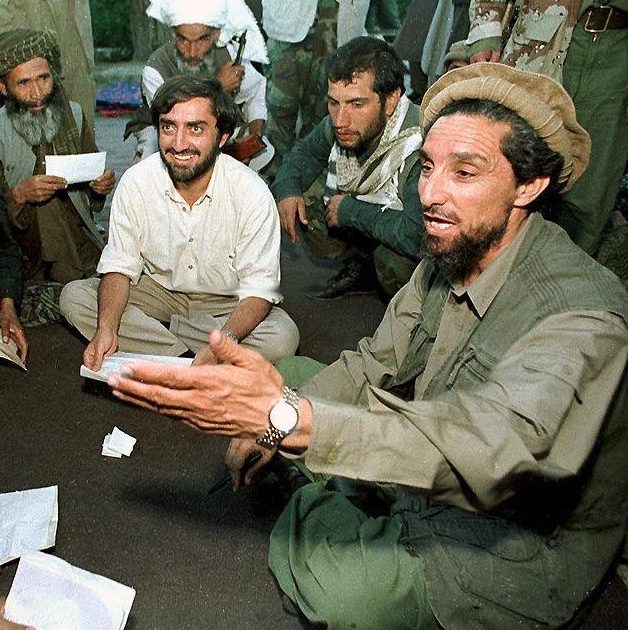
His main message was condemnation of Pakistan for its primary role supporting the Taliban – a role that Pakistan continues to play today, negating efforts for peace in the region.
“In the field of military affairs, it [the Taliban] is mainly controlled by Pakistani advisors and Generals, and in the foreign affairs department it is basically run on the advice of Pakistanis,” said Massoud. Pakistan wanted “to become the axis of all Islamic countries in the region”, though that was “beyond its capacity”.
Four weeks after the interview, on September 9 2001, Massoud was assassinated by al-Qaeda terrorists posing as Arab television reporters, just two days before the 9/11 attacks on New York and Washington.
He was then the deputy president and defence minister of the UN-recognised Islamic Government of Afghanistan that opposed the Taliban government based in Kabul. He was assassinated to prevent him being backed by America as a stabilising force and Afghanistan’s potential new leader after what was to become 9/11.
With such a history, it is maybe not surprising that the Massoud clan should emerge as the focal point for resistance – and for media attention – as the Taliban asserts its power after sweeping through the rest of the country.
Massoud’s brother, who was earlier Afghanistan’s ambassador in the UK, has called on the Taliban to form an inclusive government. In a video interview with the Financial Times he warned, “If you conquer the [presidential] palace by force, it doesn’t mean you conquered the hearts and minds of the people”.
His 32-year old son has told the told The Washington Post that war was “unavoidable” if the Taliban refused dialogue and added, to the Dubai-based Al Arabiya tv channel, “We confronted the Soviet Union, and we will be able to confront the Taliban.”

The Taliban said yesterday that “hundreds” of its fighters were heading to the Panjshir Valley, 70 miles north of Kabul, “to control it, after local state officials refused to hand it over peacefully”.
Saleh tweeted last night: “Talibs have massed forces near the entrance of Panjshir a day after they got trapped in ambush zones of neighboring Andarab valley & hardly went out in one piece. Meanwhile Salang highway is closed by the forces of the Resistance”.
My 2001 interview, for Aim Television, a Delhi-based tv programme company, took place at a Northern Alliance base near the valley. Massoud was flanked by two aides.
One of them was Saleh, now 48, who has in the past week claimed to be the country’s “legitimate caretaker president” after president Ashraf Ghani fled the country.
In 2001, Saleh was the friendly ‘minder’ for our trip. More importantly, he was Massoud’s link with international intelligence agencies including the CIA and MI6. He was also in touch with allies in neighbouring Tajikistan, which was our base for flying covertly in and out of the country in aged Russian-made helicopters. Saleh later became head of the country’s intelligence service and interior minister. India at the time was a major supporter via Tajikistan.
The other aide was Abdullah Abdullah, then Massoud’s foreign minister. Since last year Abdullah, 60, has been the leader of the High Council for National Reconciliation (HCNR). He is now in Kabul with former president Hamid Karzai and others negotiating with the Taliban.
Abdullah is more pragmatic than Saleh and will be seeking ways to remain relevant. He has extensive international diplomatic links, but is surrounded by more formidable operators.
Saleh – famed for surviving suicide attempts – has a far-flung network of intelligence contacts and has gone out on a limb in the past week declaring he would “never be under one ceiling with Taliban”.

“I will never, ever and under no circumstances bow to the Taliban terrorists. I will never betray the soul and legacy of my hero Ahmad Shah Massoud, the commander, the legend and the guide,” he wrote on Twitter.
More co-operatively, Mohammad Zahir Aghbar, Afghanistan’s ambassador to Tajikistan and a Massoud family ally, told The New York Times they would work the Taliban if there was an inclusive government.
Massoud’s son has also said an “inclusive government” would be acceptable but warned in an interview with the UK’s Daily Telegraph, “We are telling them that as soon as war breaks out in the Panjshir Valley, then there is no going back,”
He spent most of his youth abroad, including high school in Iran and a year at Britain’s Sandhurst military academy before gaining degrees in war studies and international politics at London University. Till a few weeks ago, he was living in the west London suburb of Ealing,
His father was brought to international attention by Sandy Gall, an ITN tv newscaster and foreign correspondent, who travelled across Afghanistan in the early 1980s to find the man who had been described to him by French and British officials as an ace Mujahideen leader fighting the Soviet occupation.
In our interview, Massoud added to that reputation by speaking with the assurance and self-confidence of a statesman who knew what his goals were and how they could be achieved. Fluent in French, he cut a suave stylish figure (as does his son wearing the same Pakol Afghan hat)) that belied his reputation as a ruthless anti-Taliban leader.
He stressed that, though “the problem of Afghanistan does not have a military solution”, it was essential for him to achieve “a military balance and equilibrium” in order for the Taliban to lose the support of Pakistan and be removed from power. He claimed at the time to control a third of Afghan territory, significantly more than the 5% figure announced by the Taliban.
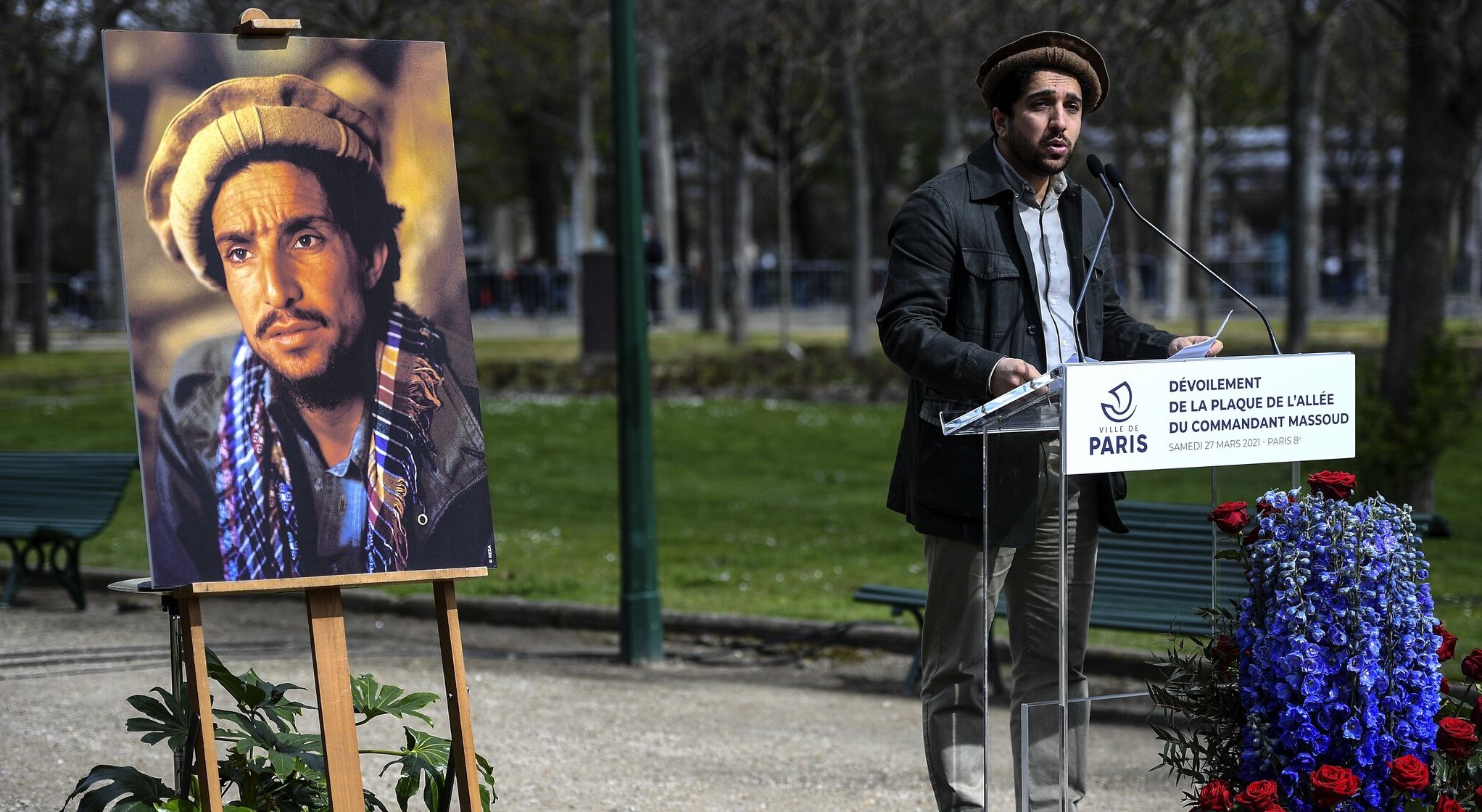
Referring to what is generally known as Pakistan’s desire for strategic depth, he said it wanted to become “the axis of Islamic countries” in the region. “Afghanistan is their first step to Central Asia. With these intentions, Pakistan has established madrassas within Pakistan for students from Central Asian countries, where they study and these students are trained by them for furtherance of Pakistani goals in Central Asia. Pakistanis are increasing their influence in the whole region and will not be only satisfied with Afghanistan. Of course, this is their first step and they will not confine themselves to just Afghanistan.”
Pakistan wanted to reduce Afghanistan “from the level of a state to tribalism”. It had “never wanted to see that the Taliban has a regular and an organised army.
He said that Pakistan “used the Hizb-e-Islam of Hekhmatyar to threaten and murder Afghani scholars” – Gulbuddin Hekmatyar was a ruthless Mujahideen leader who became Afghanistan’s prime minister on two occasions in the 1990s and is now in the Kabul negotiations alongside Karzai and Abdullah.
Pakistan wanted to show that Afghans were “uncultured and uncivilised” and that, having ”always led a tribal life”, they had ”become accustomed to tribal habits and will always remain so”. Pakistan’s strategy was “to destroy the identity of Afghans”. It wanted “to bring down Afghanistan from the level of a state to tribalism.”
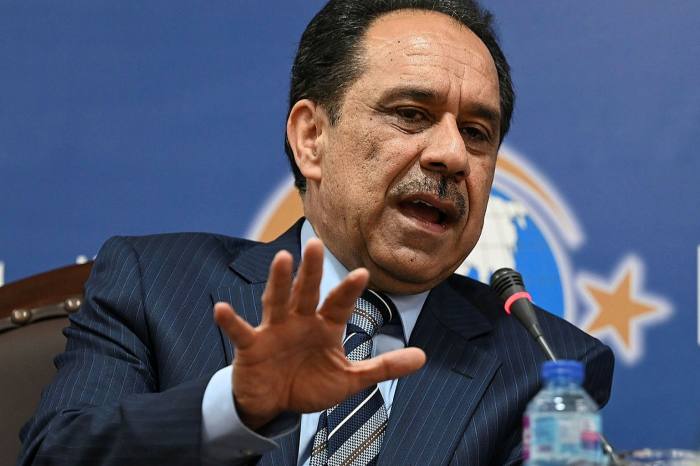
Publicity for the interview was mostly lost in the mass of international news coverage after 9/11 because Massoud was not of primary interest. The text was originally published in The Hindu, a leading India newspaper, on September 12, 2001, and is now available on the Indian Ministry of External Affairs website (with my name removed from the credit line)
The whole saga was reported on September 29 2001 in an Indian magazine by Nandan Unnikrishnan, a journalist who was the programme producer and is now at the Delhi’s Observer Research Foundation.
Though the Panjshir Valley was never conquered during the years of the Soviet occupation and Taliban rule, the river banks were still strewn with crippled Soviet tanks and other armaments on my last visit, with Sandy Gall, in 2003.
Defence technology has changed dramatically in the past 20 years, which must have reduced the valley’s impregnability. It is far from clear whether the current Massoud resistance grouping is equipped to beat off the Taliban if aggression in the media does lead to fighting because local officials refuse to recognise Kabul’s diktat. There is also risk of the valley being isolated without links, that were controlled by Massoud in earlier years, north to Tajikistan and other central Asia states.
Longer term though, the Massoud legacy and the gathering of anti-Taliban leaders in the valley could provide the core for resistance to an extremist Kabul government.
This article is on the Asia Sentinel news website https://www.asiasentinel.com
US defence secretary said Britain more useful “nearer home”
British foreign secretary tries to re-state a UK role in the region
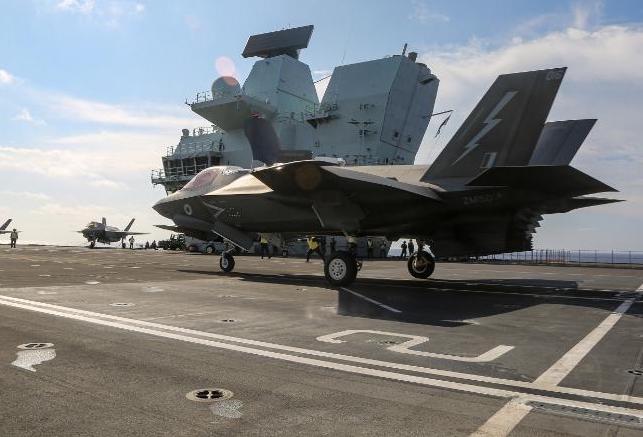
It was to have been a triumphal demonstration of Brexit Britain’s continuing global reach into Asia and the Pacific, with the proud new aircraft carrier HMS Queen Elizabeth showing that the UK can play an international role in challenging China’s widening power.
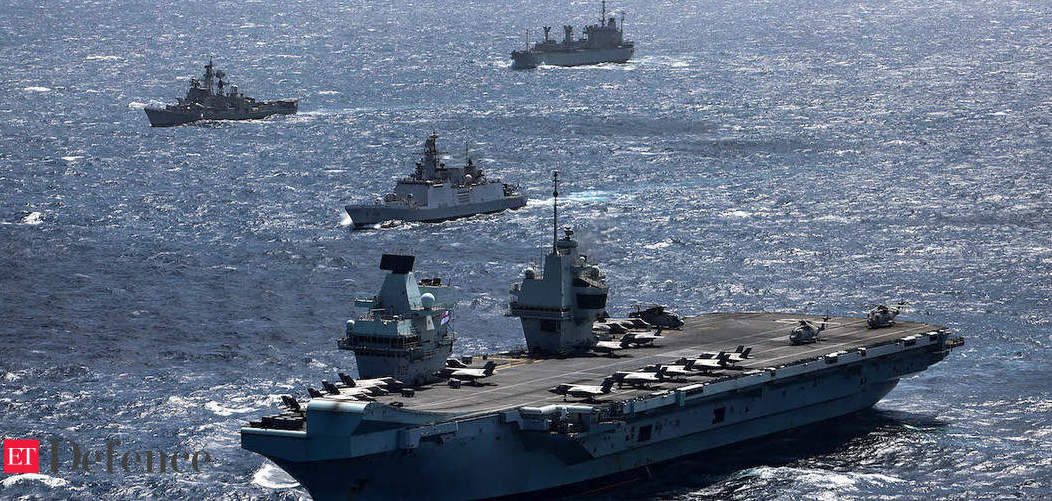
Heavily guarded by a US destroyer and a Dutch frigate and equipped with American F-35 air fighters, the £3bn QE has however just sailed through the contested South China Sea, where Beijing claims extended territorial waters around newly developed islands that have become fully-fledged military and air bases.
There was apparently no major incident, despite high profile hype dating back three years about Britain establishing “freedom of navigation” rights. The Ministry of Defence and Royal Navy websites have had little update information and even Boris Johnson, the hubristic prime minister, has avoided hailing “Rule Britannia”.

The QE is of course doing worthy work “showing the flag” at a time when Boris Johnson has announced Britain’s post-Brexit “Asia Tilt”, which basically means negotiating trade deals to replace what has been lost from the European Union.
But the Royal Navy is much diminished after years of budget cuts. Ignominiously, one of its destroyers charged with protecting the QE on its 16,000 nautical mile voyage had engine problems early on and had to retreat to an Italian port for repairs (leaving only one of the navy’s six ships in its class actively afloat).
Then, just as the QE was approaching waters claimed by China, US defence secretary Lloyd Austin punctured Britain’s Asian ambitions, implying they were misplaced. He applauded the “historic” voyage but added, “Are there areas that the UK can be more helpful in other parts of the world?” With scarce resources the US and its allies should “work out the best way to share military burdens”, hinting that Britain’s best way was nearer home.
The Financial Times was the only media outlet to spot and highlight those words in the speech that was made by Austin in Singapore at an event sponsored by the London-based International Institute for Strategic Studies. The FT report brought tweets of protest from the IISS moderator, a former British staffer on the newspaper, who claimed this was not Austin’s main message and that no one else had spotted the remarks.
The line however looks sound and could well have been a warning to Johnson not to allow his Global Britain hype to lead to a clash that could not be won in an area virtually controlled by China.
The report has gained credibility with repeated mentions in The Times, The Guardian, the Hong Kong-based South China Morning Post and elsewhere, that would not have appeared without prior checking with US sources,.
Dominic Raab, Britain’s foreign secretary, tried on August 4 to re-set Britain’s case, saying that Austin’s remarks had been “over interpreted”. Raab talked about the UK’s diplomatic and other Asia Pacific roles working, for example, with Indonesia on counter-terrorism and Vietnam on anti-trafficking – bypassing the point that that such laudable work does not need an aircraft carrier protected by other nations’ ships.
The Observer newspaper, the Sunday version of the rabidly anti-Boris Johnson Guardian, ran an article of August 1st saying that “Sailing into imperial delusions is no way to run foreign policy”. It mocked defence secretary Ben Wallace for declaring the aim was to “fly the flag for Global Britain”.
China reacted angrily warning (in its aggressive Global Times mouthpiece) that the QE flotilla should “remain restrained and obey the rules”, adding that it was “likely to escalate attempts to expel the warships at any time.”
In August 2018, another British warship sparked a diplomatic row when it sailed intentionally too close to the Paracels and was tracked at close range by Chinese ships and aircraft. That was ordered by the then defence secretary, gaffe-prone Gavin Williamson (a Boris Johnson favourite and now a disastrous education secretary), who referred in a 2019 speech to the QE’s future freedom of navigation voyage. Britain, he said, would boost its post-Brexit global military standing and “enhance our lethality” in response to the threats posed by Russia and China.
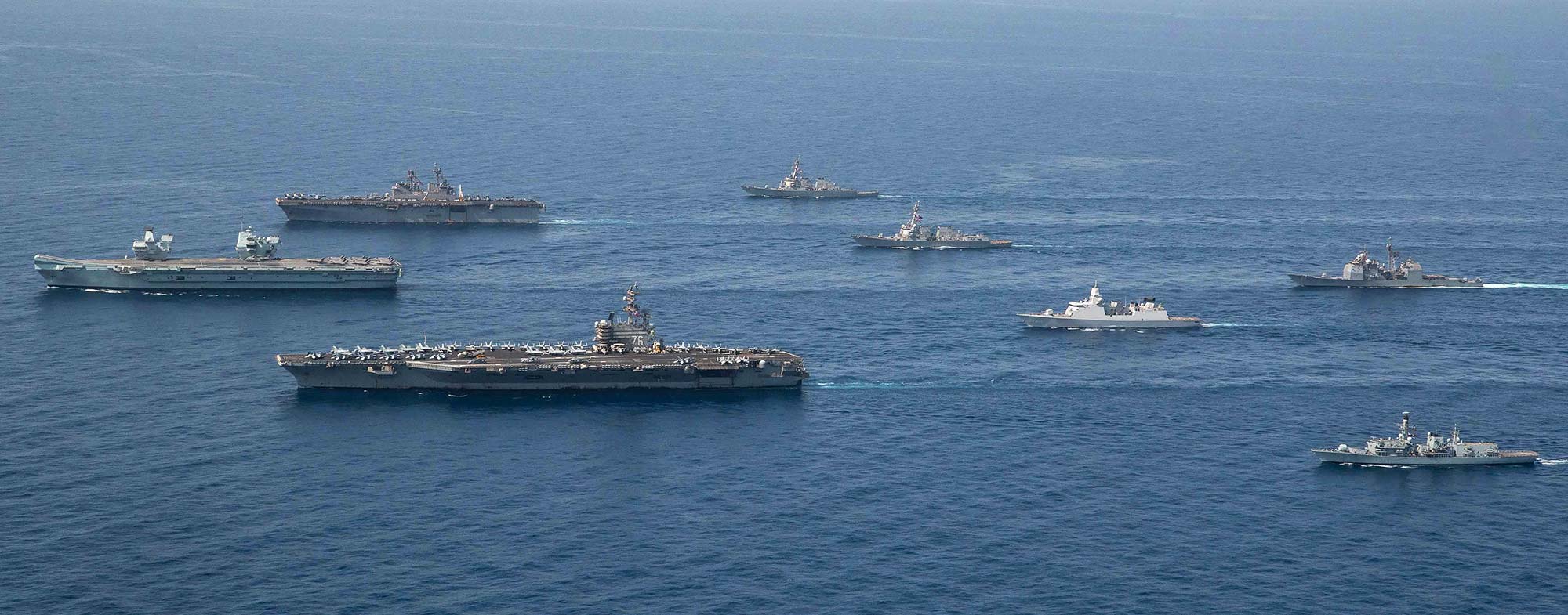
Germany also seems to have had second thoughts about provoking China with a frigate that set out this week on a seven-month voyage that will include the South China Sea. Beijing asked Germany to define the ship’s purpose, exposing splits on the issue in Angela Merkel’s government, and withheld permission for it to call in at Shanghai.
Quad exercises
India – which did exercises with the QE strike group in the Indian Ocean – is joining the throng. It has four ships, two armed with missiles, setting out for a two-month deployment in southeast Asia that will include exercises with the US, Japan and Australia, its partners in what is called the Quad security alliance.
India will no doubt be careful not to challenge China’s South China Sea claims – it has enough problems dealing with the two countries’ 15-month long confrontation in the Himalayas where China is steadily encroaching on what India regards as its share of disputed territory.
At the heart of all this naval activity – which includes American and Chinese ships – lies the world’s dichotomy about how to deal with an aggressive China under its president Xi Jinping. Britain has failed to affect China’s brutal clampdown on freedoms in its former territory of Hong Kong, and its complaints about treatment of the Uighurs in Xinxiang province are ignored along with protests from other countries.
As has been shown over the QE, China will issue threats to those who sail too close to the heavily armed islands that it has expanded in recent years, despite international protests, to the point where they control the area.
It will not however be worried by the deployment of one ship from Germany, a few from the UK and its allies, and a few more from India. These countries are underlining international determination not to let China block key shipping lanes but no nation – maybe apart from the US – can muster the force that would be needed to deter Beijing.
Britain however is not giving up. It has announced that it will permanently assign two offshore patrol vessels to work with other countries in the region – just a token gesture from the country that once “ruled the waves”.
This article is on the Asia Sentinel news website https://www.asiasentinel.com
Posted in India
Saffronart leads auction results with $28m sales this year
Christie’s and Sotheby’s far behind at about $7m
The auction market for modern Indian art has been doing well during the Covid pandemic, but the big international auction houses, Christie’s and Sotheby’s, are not playing a leading role.
In the past four months, prices above $5m have been achieved on two works, establishing world records for Indian modern art and for their artists. Both works were sold by Mumbai-based Saffronart.
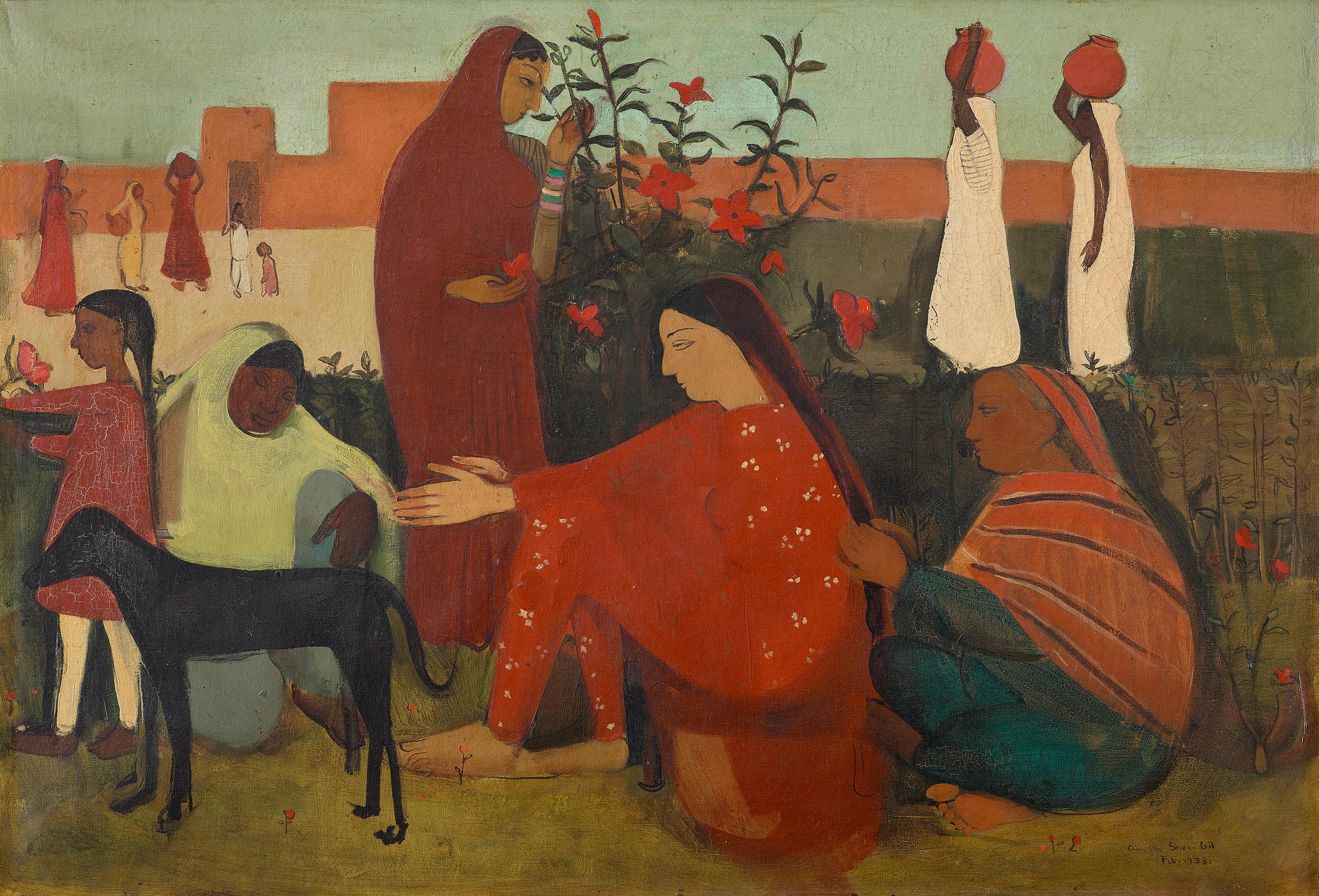
One was a rare figurative work, In the Ladies’ Enclosure, by Amrita Sher-Gil (above) that went in a live auction yesterday (July 13) for a hammer price of Rs32 crores ($4.35m) – Rs37.8 cores ($5.14m) including buyers’ premium.
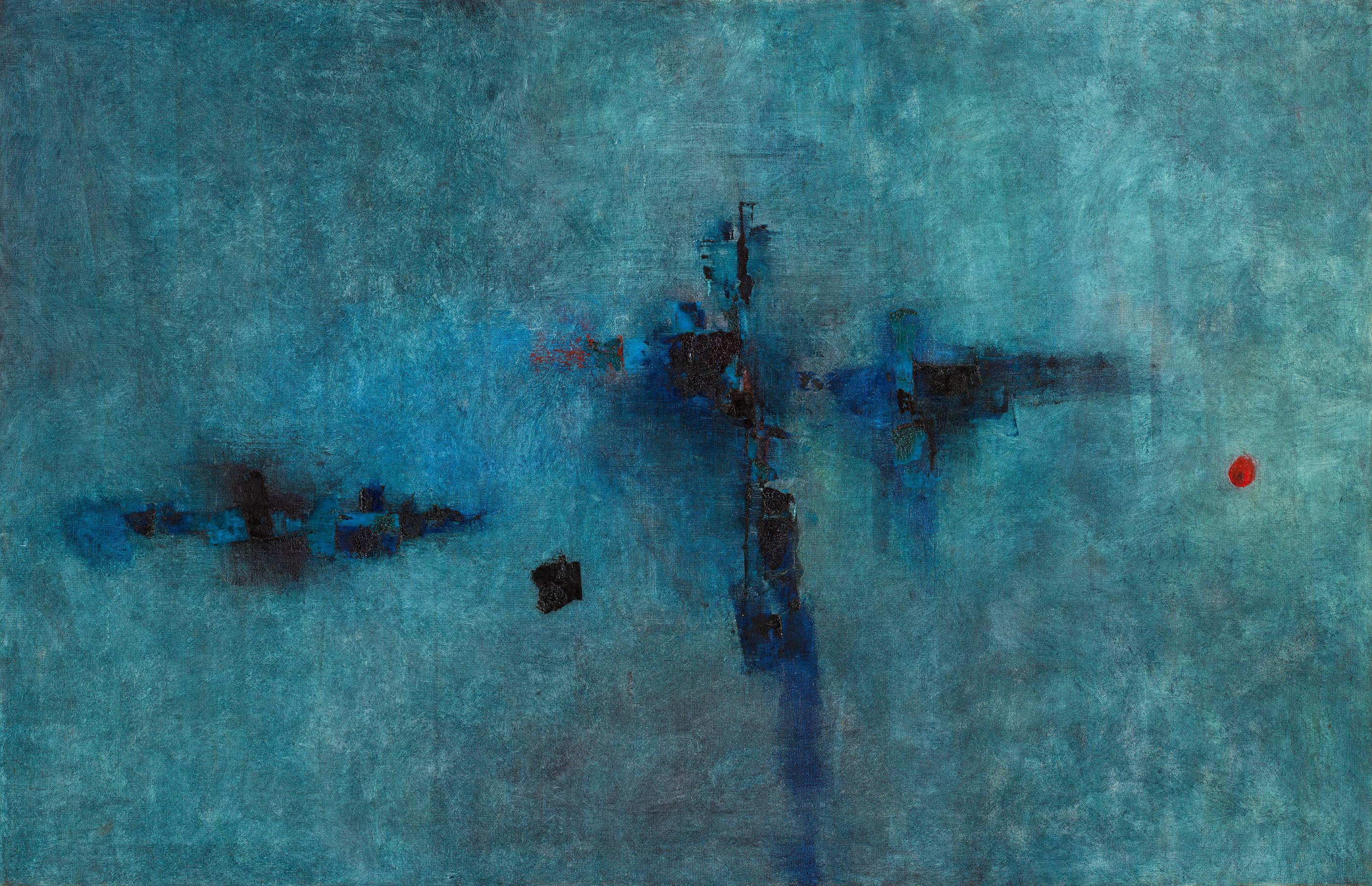
In March, an untitled 50in x 80in oil on canvas by Vasudeo S. Gaitonde (below) exceeded its top estimate and sold for Rs 39.98 crore ($5.55m) including the premium That set a new India record price, beating the $5.2m achieved for another Gaitonde in a Mumbai-based Pundole’s auction last September.
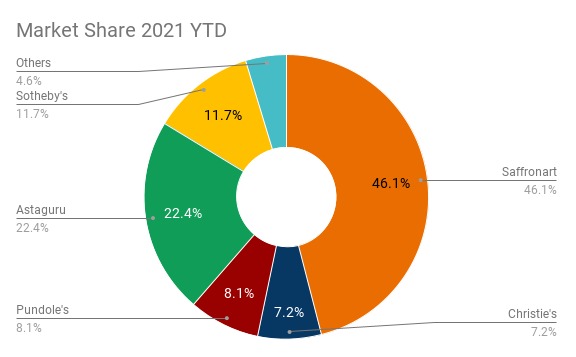
Saffronart’s total for 2021 so far is now $28m compared with $7.1m for Sotheby’s and approaching $7m for Christie’s (including an important after-auction deal of a rare Sher-Gil work – see image below). Both Sotheby’s and Christie’s auctions took place in New York in March, but Christie’s did not stage its annual London South Asian auction in June, apparently because the pandemic impeded liaison between countries.
India-based auction houses, including Mumbai-based Astaguru and Pundole’s as well as Saffronart, now account for over 75% of the India moderns auction market (see pie chart below)

Of the two $5m-plus sales, the Sher-Gil was the more remarkable. Gaitonde has for years achieved top prices in modern art auctions, which are dominated by members of his Bombay Progressives Group.
Saffronart however had one of his works in a 24-hour on-line auction today (July 14) that did not excel. It sold at a hammer price below estimates of Rs12.79 crore, ($1.74m) – Rs15.35 crore ($2.09m) including buyers’ premium.
Sher-Gil has a rarity value internationally because her works have been declared “national treasures” by the Indian government, which means that those in India cannot leave the country. Many of her paintings were self-portraits – three of them established her in the auction market in 2015 when they each sold for over $2.5m.
Her previous record of $2.9m was set at a Sotheby’s Mumbai auction in 2018 for The Little Girl in Blue, a small 19in x 16in oil on canvas. Dinesh Vazirani, founder and ceo of Saffronart, says yesterday’s sale was the “culmination of years of coming into her own as an artist of repute”.
Yesterday’s work was a 21.5in x 31.5in oil on canvas painted in 1938, depicted a group of women in a field. Sher-Gil’s artist nephew, Vivan Sundaram, writes in a catalogue essay that “the figures are ‘portraits’ of people known to Sher-Gil, all living in the family estate at Saraya, Gorakhpur [Uttar Pradesh], over long periods of time”.
There were four bidders, all on the phone, with two remaining at the end. Kiran Nadar, India’s most prominent collector, is believed to have won for her Delhi art museum which is open to the public and has many top works.
Sher-Gil died in 1941 at the early age of 28 and there are only 172 documented works, 95 of which are in Indian museums, notably the National Gallery of Modern Art. Born in Budapest to a Hungarian-Jewish opera singer and a Sikh aristocrat in 1913, she was brought up in India and then Paris from the age of 8 but maintained Hungarian links.
Saffronart’s live auction yesterday produced total sales value of Rs54.25 crores ($7.4m), with 93% of 30 lots sold. Today’s on line auction had sales of Rs29.3 crores ($3.98m) with 86% of 70 lots sold.
Attention will now focus on the autumn when in addition to Saffronart, Christie’s plans an auction during New York’s Asia week and Sotheby’s will have one in London, providing opportunities for reassessments of market share.
This article is on the Asia Sentinel news website https://www.asiasentinel.com
 Riding the Elephant
Recent Comments