Congress routed as Modi uses hope and nationalism to win the youth

Rahul Gandhi loses Amethi and sister Priyanka has little impact

Narendra Modi won a massive general election victory yesterday that returns him for a second term as India’s prime minister and gives him a fresh chance to show that he has the executive ability to push through urgent changes in India’s economic development while also reining in the divisive aspects of his party’s Hindu nationalist agenda.

The Bharatiya Janata Party (BJP) has defied almost all forecasts by winning 303 seats in the Lok Sabha, up from 282 in 2014 [figures updated May 25]. This has boosted its share of the vote from 33% to 37.4% (more than 50% in the Hindi heartland states) and has increased its clear majority. Its coalition, the National Democratic Alliance (NDA), has won a total of 353 seats with 45.5% of the vote, underlining Modi’s powerful parliamentary position.

Modi will be sworn in, and the new government will be formed, on May 30, with fresh faces expected in senior ministerial positions. This will be quickly followed by a series of new policy announcements in a 100-day action plan covering the economy, industry, education, health and other areas. Modi was criticised for not doing this when he became prime minister five years ago.

modi-shah victory

Narendra Modi and Amit Shah arrive for the victory rally at BJP headquarters

Addressing a victory rally in Delhi last evening, Modi struck a moderate nationalist tone saying, “If someone has won, it’s Hindustan that has won, it is democracy that has won, it is public that has won.”

The victory raises questions of how far Modi and Amit Shah, his chief ally and the BJP president, will drive their authoritarian Hindu nationalist agenda which, in the past five years, has weakened institutions, made many Muslims fear for their safety, and led to restrictions on personal and media freedom. There are specific fears about constitutional changes in Kashmir and the treatment of Muslim migrants from Bangladesh.

Modi countered these fears yesterday when he said that the BJP was committed to the constitution and to federalism. “The spirit of our democracy and constitution gives us the responsibility to run country by taking everyone along,” he declared.

The result is devastating for the Gandhi dynasty and its Congress Party, which increased its seats by just eight from 44 to 52, far short of the minimum 100 that it had been hoping for and not enough to be automatically named the opposition party in parliament. Its United Progress Alliance (UPA) has won only 91 seats with 27.1% of the vote, bolstered in southern India by the DMK in Tamil Nadu, winning 23 seats, and Congress defeating its traditional Communist rival in Kerala.

Rahul Gandhi has lost his seat in the family’s traditional Uttar Pradesh (UP) constituency of Amethi to Smriti Irani, a formidable television star-turned-politician, though he won in Kerala where he was also a candidate. The only Congress victory in UP, which has 80 seats and was once the party’s stronghold, was won by Sonia, Rahul’s mother.

His charismatic sister, Priyanka, who was expected to rescue the party by boosting votes, having formally entered politics for the first time, had no visible impact. She appeared to be successful at electioneering but failed to turn this into votes.

Congress’s defeat is unlikely to change the Gandhi’s dynastic role at the top of the party because there is no potential leader with the nerve to challenge Rahul or the ability to lead – the family holds the party together but also prevents it moving forward. [On May 25, Rahul Gandhi offered his resignation, which the party leaders rejected, but Gandhi was reported to be insisting he would step down].

Congress candidates were roundly defeated in the three states of Rajasthan, Madhya Pradesh and Chhattisgarh that the party won in state assembly elections last November. It has also lost badly in Karnataka where it is in power. The BJP can now be expected to try to unseat the Congress governments in these states. It will also build on a powerful position it has achieved in West Bengal in advance of the state’s assembly elections in 2021.

rahul_5ce697f16dbdb

Rahul Gandhi acknowledges the BJP victory and concedes his seat loss in Amethi

Modi has proved himself to be a savvy as well as a powerful politician.

The victory is primarily due to that and to the organisational abilities of Amit Shah, who has been elected as an MP for the first time and will now play a bigger role in the direction of the government, either as a minister or from the party headquarters. He is 14 years younger than Modi, who is 69 in September, and will be seen as Modi’s heir apparent, or maybe even eventually his rival.

In counts for state assembly elections that took place alongside the general election, the BJP has had less success. It has been defeated heavily in Odisha by the state-based Biju Janata Dal (BJD) winning 112 seats against its 23 and Congress’s 10. This will be the BJD’s fifth consecutive term in power under its chief minister Naveen Patnaik.

The BJP has lost  three seats and won none in Andhra Pradesh, where Y.S. Jagan Mohan Reddy, the son of a former controversial chief minister, led his relatively new YSR Congress to an unexpectedly large victory. YSR has won 152 seats against 22 secured by the Telegu Desam Party (TDP), headed by Chandrababu Naidu, a veteran politician and the outgoing chief minister. In the north-east of India, the BJP is winning overwhelmingly in Arunachal Pradesh, but failed to secure seats in Sikkim.

There will be many debates about how Modi has managed to achieve almost nationwide personal support after being widely criticised for leading a divisive government and for failing to provide jobs and address other economic issues. Maybe referring indirectly to his disastrous demonetisation of bank notes in 2016, Modi said today that he may “have made mistakes”, but he did “not do things with bad intentions”.

He has also been criticised for conducting a brutally scare-mongering election campaign that demonised Pakistan and used a terrorist attack, and India’s military response, to galvanise patriotism that fed into the BJP’s Hindu nationalism.

Pavan Varma, a former senior diplomat and now a prominent politician belonging to a BJP ally, explained on a television discussion last evening how this approach appealed. He said that Modi understood the aspirations of India’s youth, with 65% of the population under 35. The youth, he said, “identify with Modi’s nationalism” because they wanted prosperity and “a country of which they could be proud”.

Rahul Gandhi, though some 20 years younger than Modi, has failed to understand this and has therefore not been able to galvanise the young with his softer all-inclusive non-nationalistic approach.

When he was elected five years ago, Modi said he wanted ten years to implement change. He has now won his second five years and has a big enough parliamentary majority to build what he described today as the “New India”.

This is something that many people fear will end tolerant secular traditions, but voters have nevertheless given it their support. It is now for Modi to show that what he plans is good for the country.

The new “Modi” edition of my book, IMPLOSION: India’s Tryst with Reality”, analyses the record of Modi’s past five years. It is available in Indian bookshops and here – Amazon India https://amzn.to/2HldJQ3 . Amazon US  https://amzn.to/2CmQwZE  Amazon UK https://amzn.to/2FinQTm
India awaits another shake-up as exit polls suggest another Modi win

Modi sidesteps election rules with media-blitz visit to sacred shrine

As we wait for Thursday’s likely confirmation of yesterday’s exit poll forecasts that Narendra Modi has been re-elected for anther five years at the head of his Hindu nationalist Bharatiya Janata Party government, an excerpt from the new “Modi” edition of my book IMPLOSION: India’s Tryst with Reality has been run on the Scroll.in news website.

It is timely because it reminds us how Modi came in with hope, and as a great shock to the Delhi establishment. Soon the hopes came undone as he failed to rein in excesses of his rabidly anti-Muslim colleagues and as other aspects of Hindu nationalism became clear.

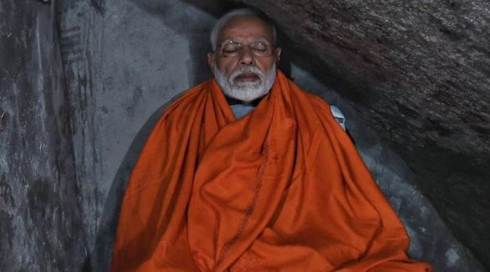
narendra-modi cave

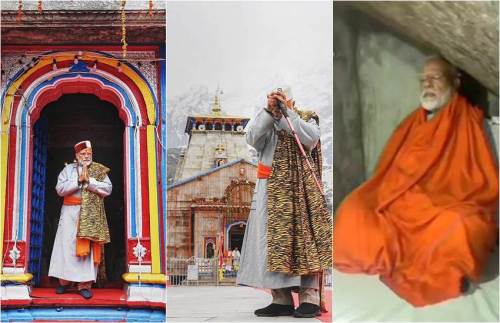
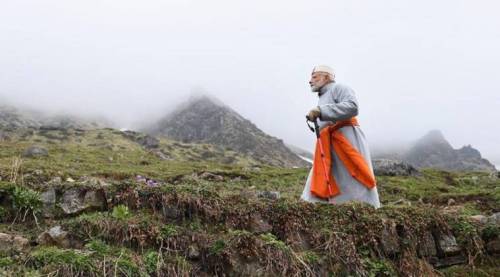
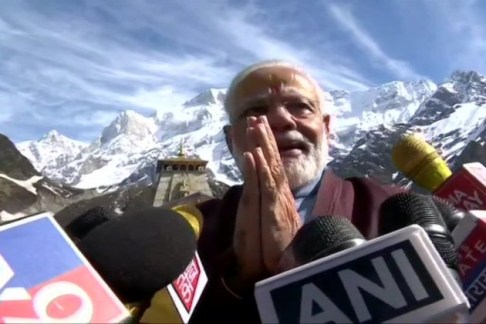
On the eve of yesterday’s final voting in the current election, Narendra Modi astonishingly obtained the (tame) Election Commission’s approval to sidestep the no-campaigning rule with a media-blitzed visit to the sacred Kedarnath shrine where he visited the temple, meditated in a cave (above) and then talked to the media (other photos below)

At the end, I ask whether the Achhe Din (good life) achievements of the Modi government in the following years have been sufficient to justify the changing political and social landscape. Many people would say they do not, but it seems India’s voters disagree – and the country now waits to see how much of a shock his re-election will be, assuming the exit polls are correct.

Here’s the excerpt:

“Delhi was in for its biggest shakeup for decades. Virtually everything to do with government was about to change, not just ministers and policies but also how the people at the top reacted to events, who they associated with, and even the language they spoke – many leading politicians, including [Narendra] Modi, preferred (or felt bound) to speak Hindi.

As a journalist in London, I had seen and reported wholesale changes and the shock in the outgoing leftist establishment when Margaret Thatcher demolished the ruling Labour government and led the Conservative Party to victory in 1979. Thatcher brought in a totally new style, not just new policies and decision-making priorities but a new political environment.

modi-stick-759 cave trek

Modi was as driven as Thatcher and his arrival was quite different from what had happened when Vajpayee became the BJP prime minister in 1998, as Tavleen Singh, a newspaper columnist, has explained: “The courtiers simply moved to his court and then back to the court of Sonia Gandhi when he lost the election in 2004.” Modi brought in top bureaucrats from his home state of Gujarat, and little-known politicians were given important ministries. The long-established elite of India’s capital lost much of the clout and closeness to the centres of power that they had enjoyed during the Congress and Nehru-Gandhi dynasty’s decades in power.

It was no use liberal Congress sympathisers and foreign observers complaining, as they had been doing for months, about a politician with Modi’s questionable history and RSS membership becoming prime minister.

A large man proud of his 56’ chest, and with a carefully trimmed white beard, this was a personal victory. Modi had run a presidential style campaign that projected his oratory and charisma. It was a personal victory, but the vote was not mostly for the divisive Hindu-centric and anti-Muslim approach of BJP hardliners and the RSS that would emerge.

PM_Modi_630_630 mediaModi was elected primarily by aspirational young voters who wanted a prime minister who would end the years of failure, obfuscation and corruption, and the gradual imploding of institutions, organisations and procedures… Modi had created the impression that he alone among all of India’s politicians could introduce and implement what the country needed. How well – or badly – he has met expectations is examined in a new last chapter added in this edition.

During the election campaign, Modi capitalised on his poor low-caste background, as he has done repeatedly since then. When he was a boy, he ran a tea stall at a bus terminus in Gujarat until he joined the RSS in his teens. This was a striking personal pitch, although his origins were no more poor or hopeless than those of Manmohan Singh, who was born in a rural village in a part of Punjab that is now in Pakistan. The difference was that Modi clambered up the rough political ladder of the RSS and BJP, while Singh moved into the rarefied economists’ intellectual and international world of Oxbridge universities, the finance ministry, Reserve Bank of India and the Planning Commission.

Modi said just after the election that, although he had been elected for a five-year term, he needed ten years to transform the country.

At face value, that meant ten years building up economic growth, development and jobs, but it rapidly became clear that it also meant embedding Hindu nationalism and building the RSS’s vision of a strong Hindu India to the detriment of Muslims.

pm-modi- 3 pics

Modi first showed this early in December 2014 when he failed to reprimand Sadhvi Niranjan Jyoti, a controversial new woman minister, who implied at a political rally that non-Hindus (ie, Muslims) were illegitimate, saying, “Aapko tay karna hai ki Dilli mein sarkar Ramzadon ki banegi ya haramzadon ki. Yeh aapka faisla hai” (“You have to decide if you want a government peopled by the children of Ram or one full of bastards”).

An MP from the northern state of Uttar Pradesh, which has some of the worst Hindu-Muslim conflict, she had made similar remarks earlier, but eventually apologised. Modi dismissed opposition parties’ demands for her resignation.

Another BJP MP praised the assassin of Mahatma Gandhi, the Independence leader who is regarded as the father of the nation, as a “patriot”.

Najma Heptulla, the minority affairs minister, said that all Indians were Hindus, and quickly explained she had been speaking “not in relation to the [Hindu] religion but in relation to identity as nationality.” There were mass conversions of Christians and others to Hinduism, and a government minister turned 25 December, the traditional Christmas religious and public holiday, into a working day for many bureaucrats.

The health minister voiced concerns about advocating condoms to counter HIV-AIDS and preferred “promoting the integrity of the sexual relationship between husband and wife” which, he said, was “part of our culture”. He went on to attack liberal values by saying that adolescent sex education should be banned in schools.

Mythology as medical fact

Modi’s and his colleagues’ deep roots in the culture were illustrated when, voicing widely recognised mythology as medical fact, he told an audience of doctors and scientists five months after the election that plastic surgery and genetic science were used thousands of years ago in ancient India. That, he said, was how the Hindu god Ganesh’s elephant head became attached to a human body, and how the warrior Karna was born outside his mother’s womb.

The theme of Modi’s speech, at the dedication ceremony of a hospital in Mumbai sponsored by the Mukesh Ambani family of the Reliance Industries group, was that India needed to improve its (grossly inadequate) healthcare facilities. He went on to quote the ancient Mahabharat epic and said that “big contributions” of ancestors in such areas needed to be reiterated.

“We can feel proud of what our country achieved in medical science at one point of time. We all read about Karna in Mahabharat. If we think a little more, we realise that Mahabharat says Karna was not born from his mother’s womb. This means that genetic science was present at that time. That is why Karna could be born outside his mother’s womb,” he said. “We worship Lord Ganesh. There must have been some plastic surgeon at that time who got an elephant’s head on the body of a human being and began the practice of plastic surgery.”

This went much further than extolling India’s widely recognised achievements in pioneering alternative ancient herb and plant-based medicines such as Ayurveda. It surprised people because the prime minister did not acknowledge that such mythology lacked western-style proof.

Schools in Gujarat were given textbooks that claimed cars were invented in ancient India. At the Indian Science Congress in Mumbai in 2015, which was inaugurated by Modi, a speaker said the world’s first aircraft was invented with 40 small engines by Maharishi Bharadwaj, a revered Hindu sage in ancient India.

Modi and many in the RSS presented such claims to resurrect past Hindu glories, implicitly discrediting secular liberals. A primary aim is to support the drive for Hindutva by establishing that Hindus were the original inhabitants of what is now India. Speaking at the event, Prakash Javadekar, who was then the environment minister, tried to bridge the credibility gap by saying that ancient Indian science was based ‘on minute understanding of observations of centuries and based on experience and logic’. He added, ‘that wisdom must be recognised’ and ‘has a relevance today’.

In the years that followed, these themes continued and the negative side of the BJP rule became evident in more threatening ways – described in the new last chapter. There was crude gang enforcement, with lynchings and killings, of bans on cow-slaughter and beef-eating, and objections to Muslim-Hindu liaisons.

There were restrictions on freedom of expression and growing efforts to control of the media, with the government and the party acting in unison on Hindutva.

The “idea of India” choice was becoming clear – would the Achhe Din achievements of the Modi government in the following years be sufficient to justify the changing political and social landscape?”

This new “Modi” edition of IMPLOSION: India’s Tryst with Reality” analysing the outgoing government’s record is available in Indian bookshops and here – Amazon India https://amzn.to/2HldJQ3 . Amazon US  https://amzn.to/2CmQwZE  Amazon UK https://amzn.to/2FinQTm
 

Posted by: John Elliott | May 16, 2019

Modi’s most socially challenging positive initiative

Swachh Bharat challenges society on toilets and cleanliness

Image spoilt by egotistical launch and exaggerated claims of success

Narendra Modi has been much criticised during his time as India’s prime minister for the massive number of schemes he has introduced with excessively flamboyant launches, and for the way that he has exaggerated claims of success. He ought however to be personally credited for the scheme that is the most socially challenging, which could eventually have the greatest impact on people’s health and daily lives.

It is the much derided Swachh Bharat Abhiyan (Clean India Movement) toilets and cleanliness campaign. Modi launched it with gusto in October 2014, having earlier mentioned it in his first Independence Day speech from the ramparts of Delhi’s Red Fort in August that year. He emphasised the need for separate boys’ and girls’ facilities in schools and earned praise for including such a personal word as toilets in such an august arena.

Image tab;eModi has not been just trying to make people become more cleanliness-conscious, or to stop urinating behind a tree; his challenge has been to change deep cultural and social habits that are partly based on the endemic caste system. The previous Congress government did launch a toilets campaign, though without Modi’s drive and commitment.

Inevitably, Modi set a totally unrealistic target of every Indian having a toilet in less than five years – by Mahatma Gandhi’s 150th birth anniversary this October – and for the country’s general cleanliness to improve dramatically.

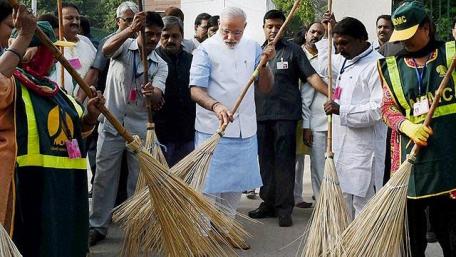
He characteristically launched the scheme with a television egotistical flourish, personally sweeping up rubbish with a long broom in Valmiki Basti, a Delhi neighbourhood where Gandhi once stayed. In the first of what became his monthly Mann ki Baat (meaning What’s On My Mind) radio broadcasts to the nation, Modi asked people to “pledge to remove dirt from our lives”. He ordered thousands of bureaucrats to go to work and clean their offices, and said that the Delhi symbolic street sweeping should be repeated in other state capitals where the BJP was in power.

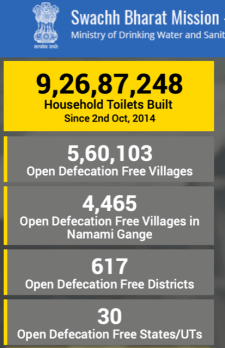
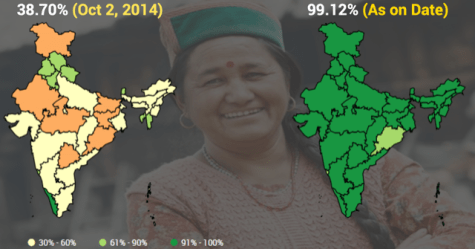
By over-doing the launch theatrics, Modi invited criticism, and Swachh Bharat has been much mocked for not measuring up to his claims. Statistics on the government’s official website showed this week (May 14) that 99.1% (below) of the country was open defecation free, which cannot be correct. A total of 92.7m household toilets (above) had been built since October 2014, making 560,000 villages, 617 districts and all 30 states open-defecation free.

Swachh-Bharat-Modi sweep

Clearly, these figures are unreal because there is not the slightest chance that there is no-one defecating in the open in most villages. There are many local reports (as I have seen myself in Madhya Pradesh and elsewhere) of toilets not being fully constructed and equipped, and not having access to water. Contractors and officials (inevitably) benefit through bribes and extortion, and many of the concrete huts built to house the toilets are used for storage.

A survey carried out last year for the government in Rajasthan, Bihar, Madhya Pradesh and Uttar Pradesh by two research organisations and reported by IndiaSpend showed that, while more Indians living in villages owned a latrine than four years ago, 44% of them still defecated in the open, according the IndiaSpend fact-checking website. As many as 23% of those who owned a latrine defecated in the open, which was the same as in 2014. The report suggested that this was because deeply entrenched beliefs about caste “impurity” associated with emptying latrine pits.

Image

People across all castes and classes and all levels of education, who keep their homes clean, have little concern for – and indeed add to – vast piles of rubbish and general dirtiness of communal and public areas. All sweeping and cleaning is considered the task of the lower levels of Hindu society and there is little or no concern that people who work with sewage, toxic chemicals, and rotting garbage are injured and stigmatised, and even die of asphyxiation when cleaning sewers by hand.

One of the aims has been to tackle malnutrition. International agencies believe that poor sanitation is a probable reason in developing economies for children’s impaired growth or stunting.

In India, 39% of children suffered in 2016 from such ailments, according to a WaterAid report, especially in Uttar Pradesh, Bihar and Odisha where there has been less than 60% sanitation coverage. Also, some 100,000 children die each year from diarrhoea related diseases.

There has considerable speculation and scepticism about why Modi is so concerned. Two authors, Assa Doron and Robin Jeffrey, asked him about this when researching their book, Waste of a Nation: Garbage and Growth in India.

Modi’s Gujarat motivation

Modi replied that two experiences in his home state of Gujarat had influenced his attitude toward social change and sanitation. One was when the collapse of a badly built dam during heavy monsoon rains caused massive floods at Morbi in 1979, killing thousands of people, and the other was panic (triggered by a false alarm) over suspected bubonic plague in the city of Surat in 1994.

Modi was 29 when the flood hit Morbi and was active in the RSS. “A huge cleaning up operation was undertaken, and I was part of it,” he wrote to Doron and Jeffrey. “We ensured that the town was restored to pre-disaster levels and an epidemic was averted.”

By the time the plague panic hit Surat in 1994, Modi was a powerful political organizer, recently returned from a tour of the US, and soon to become the BJP’s state general secretary. He said that he educated people “not only about personal hygiene but also about social hygiene”.

The scare was “a game changer” because “people’s sensitivity towards hygiene increased and the municipal corporation’s decision-making capacity improved.” Modi concluded that, if change could happen in Surat, it was possible elsewhere, so focused as chief minister on improving the hygiene and sanitation practices in urban as well as rural areas.

“I knew that one of the important reasons for girl children dropping out from schools was the lack of toilets,” Modi wrote. “Swachh Bharat is the culmination of all the experience I had before I became the PM. It is not a scheme thought overnight, but my dream since my RSS Pracharak days.”

swachh-bharat-mahatmaThere have been political attractions for Modi and the Hindu nationalist BJP because Swachh Bharat emphasises patriotism. Modi has also used the campaign to try to co-opt the legacy of Mahatma Gandhi, thus undermining the Congress Party that has always identified itself with him. There is an image of Gandhi’s spectacles on the Swachh Bharat logo (above). It also fits with Modi’s promises of vikas (development) and appeals to millions of Modi-supporting overseas Indians who, as Doron and Assa put it, “squirmed at the state of public sanitation when they visited with children, friends, and associates”.

The effect of the general cleanliness campaign has also been patchy, with only some signs of a few cities becoming cleaner. Modi linked this with a campaign to clean the River Ganges, where there has been only little progress.

Perhaps the most rewarding part of the campaign however is what has been achieved by installing toilets in schools because future generations will now grow up accustomed to using them and not defecating in the open.

“There should be separate toilets for girls. Next year when we stand here, every school should have toilets for girls and boys,” Modi said in his 2014 Independence Day speech. That did not happen, but a national cause with massive benefits for the future had been launched.

This article originally appeared on the London School of Economics’ South Asia blog       It is adapted from the economic and social schemes chapters in  the new “Modi” edition of my book “IMPLOSION: India’s Tryst with Reality” that analyses the current government’s record. Amazon India https://amzn.to/2HldJQ3 . Amazon US  https://amzn.to/2CmQwZE  Amazon UK https://amzn.to/2FinQTm
 

Posted by: John Elliott | May 12, 2019

Modi could bring India “five (or ten) years of pain”

Mixed views from non-aligned voters on the BJP for five more years

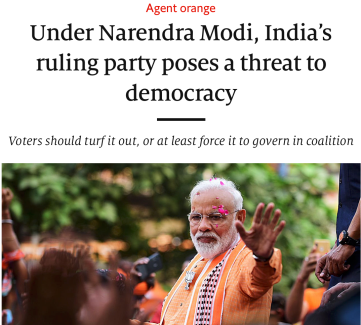
The Economist damns Modi’s BJP as the deadly ‘Agent Orange’

“India is in for five and maybe ten years of pain, then Hindutva will backfire and the country’s vast diversity will reassert itself”.

That comment, which I heard recently from an experienced Indian journalist, sums up the views of those who fear that India’s current general election will lead to five more years, and maybe longer, of the authoritarian Hindu nationalist government headed by prime minister Narendra Modi and his hard-line acolyte Amit Shah, currently president of the Bharatiya Janata Party.

The remark presupposes that Modi and his BJP-led National Democratic Alliance will win the election, when votes are counted on May 23, with a big enough majority to be able to govern without recruiting more moderate regional parties.

It assumes that Modi’s primary message – that he alone is capable of protecting India from the external forces, notably Pakistan – has over-ridden concerns (at least in key north India states such as Uttar Pradesh) about his government’s failure in the past five years to create jobs for aspirational youth, protect farmers and the poor, and meet his 2014 Achhe Din promise that “good times are coming”.

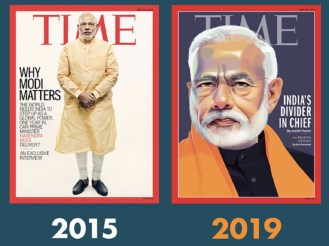
Moi Time mag

Time magazine swings from lauding Modi in 2015 to criticising him in its latest edition

The opening remark may of course not be justified.

The BJP might lose heavily in UP against a mahagathbandhan (grand alliance) of two regional parties and might not manage to offset that with gains elsewhere, notably in its former stronghold of Madhya Pradesh and in West Bengal which Modi has targeted.

That could mean it does not win the 200-220 or so seats it needs for the NDA coalition to build a 272 majority figure in the 543-seat Lok Sabha. It would then need to gain the support of other parties that might insist on a softer version of the Modi style of government and Hindutva, maybe even with Modi stepping aside. The alternative would be for the BJP to go into opposition, though it is difficult to imagine Modi adapting in parliament to the role of an opposition leader.

At this stage, it is unrealistic to try to forecast the result. The election has not been fought on the record of Modi’s government or on the opposition’s policies, but has become a rancorous and acrimonious battle that has sharpened religious and other divisions. Modi has replicated his centralised presidential style of government by making himself the focus of the election campaign as the chowkidar (night watchman) who alone can protect the country.

Time magazine ran a cover (above) on May 9 dubbing Modi “India’s Divider in Chief”, with an essay provocatively headed “Can the World’s Largest Democracy Endure Another Five Years of a Modi Government”.

It tried to cover its back with a second article headed “Modi Is India’s Best Hope for Economic Reform”, but there have been widespread reports in Delhi that Modi was horrified by such a public blow to his carefully nurtured international image, especially in an American magazine (though it was not the cover in the US edition). A BJP official started an on line petition protesting at the critical article.

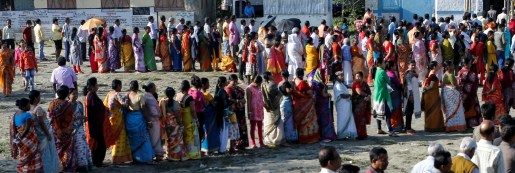
voters

Voters queueing at a West Bengal polling station – photo: Reuters/Rupak De Chowdhuri

In an aggressive and unruly election, there have been many official complaints that political leaders have broken the code of conduct, but a pliant Election Commission has rejected most of those relating to Modi – another example of the prime minister undermining India’s respected institutions that has been a regular feature over the past five years.

The BJP is flush with funds to spend on electioneering and on attracting smaller parties into its coalition. Much of the money has come from companies, some through a new electoral bond scheme that has favoured the BJP.

The Tata group’s electoral trusts, headed by Ratan Tata, the former group chairman and a Modi fan, alone contributed a much bigger sum of Rs500-600 crore to political parties in the current election, which was more than 20 times its amount in 2014. The reliable Business Standard has estimated that the BJP received Rs300 to Rs350 crore out of that total this year, with the Congress possibly getting around Rs50 crore and smaller amounts going to regional parties. Such heavy party funding is not gratuitous: it is an insurance for the future and buys favours.

There have however been signs that the BJP is worried about the likely result and there have been recent indications that Modi is losing his grip. In the past few days, he has even been swung irrationally to criticising Rajiv Gandhi, father of Rahul the current Congress president, for what he did when he was prime minister in the 1990s and calling him bhrastachari number 1 (corrupt number 1).

Then, boasting two days ago on television about an air strike he ordered in Pakistan territory, Modi even suggested (to much mirth on Twitter) that clouds in the sky would help protect India’s fighter jets from Pakistan’s radar.

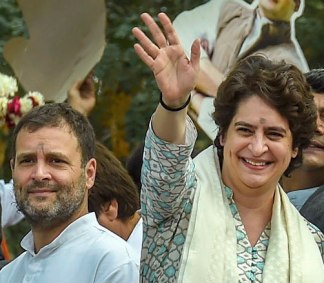
Rahul Gandhi and Priyanka Gandhi Vadra

Rahul and Priyanka Gandhi at the start of the election campaign

Congress produced a sound programme-based manifesto and Rahul Gandhi has fought an earnest campaign, casting aside some of his earlier lack of focus.

He has failed however to engage the government on its shortcomings and has also failed to establish himself as a viable future prime minister. His sister Priyanka (above), who has been playing a prominent role for the first time, has helped to motivate Congress activists and may help to pull in votes, but there is little sign of cohesion or potential leadership among its allies.

Spread over seven phases, voting for the 900m electorate began on April 11 and ends next Sunday, May 19, when exit polls will be published indicating the possible result. The sixth phase has taken place today (May 12) with voting in seven states including Delhi where the BJP is focussed on defeating candidates from the regional Aam Aadmi Party (AAP) that has built up a good record running the city state’s government.

Security not jobs

“Don’t give vote for development to BJP candidate….vote for him because Narendra Modi made the country’s border secure”, Amit Shah was reported saying this week.

That remark was based on a fallacy built up by Modi that no previous government had sent the army to strike against terrorist forces in Pakistan as he did on September 28, 2016 (followed on February 26 this year by the air force entering Pakistan and engaging in combat for the first time since 1971). Modi’s persistent claim that the 2016 attack was the first ever has been contradicted by the Congress Party that has announced the dates, and one attack in 2011 has been reported in detail.

But Modi’s claims, which have created divisions between top army officers who back his demands and those who deny them, are widely believed. “Modi has the guts to strike Pakistan: no-one has done it before,” I was told last month by an erudite middle-class professional in the Maharashtra city of Pune.

I went to this firmly pro-Modi city to promote a new “Modi” edition of my book IMPLOSION: India’s Tryst with Reality and to explore how deep the support runs. Scarcely anyone in a rotary club meeting that I addressed would give any credibility to my line that the Modi years were “not what was needed”.

A slight criticism of Modi’s Swachh Bharat toilets and cleanliness campaign (that I basically praised) brought one angry industrialist in the audience to his feet in protest. Everyone seemed committed to the line that Modi had done well with economic reforms – and those that disagreed were not prepared to say so publicly.

One businessman spent over 30 minutes telling me in detail how almost everything Modi had done – even the disastrous demonetisation of 86% of bank notes in 2015 – was a success. I heard later however that, like many others, he would not admit his true feelings to anyone in case his criticisms were fed back to Modi or Shah, triggering harassment by taxation and other officials on him and his company.

This brought home to me what I had often heard in Delhi, but never completely believed – that widespread fear has grown since 2014 of reprisals being taken against people who criticise Modi. The public face of that has been criticism of anything to do with defence policy being dubbed as “pro Pakistan”, while the private angle is general harassment.

Book review rejected

This has also led to an increase in self-censorship by the media. An editor in the IANS news agency, which is controlled by Anil Ambani, one of Mumbai’s prominent Reliance brothers and a Modi crony, refused to run a review of my Implosionbook because it had “some serious stuff against Modi”. Elsewhere I was told that my “Not What Was Needed” analysis of the Modi years made me unwelcome.

During my almost three weeks in India, I heard mixed views. In more liberal and broad-minded Mumbai, the business reaction varied widely, though with a majority view that there was no realistic alternative to five more BJP years

In rural Madhya Pradesh, I heard from a villager how he was against the BJP because the cash economy had been disrupted by Modi’s demonetisation and  a campaign to spread the use of bank accounts.

Orange

The Economist editorial and “Agent Orange” headline

On the outskirts of Delhi, I heard how the AAP had improved schools and health clinics, and simplified electricity bills, while the local BJP assembly member had stopped being accessible and helpful once the party came to power in 2014. “They have anger inside them – we don’t dare disagree with BJP supporters,” I was told.

The view from eastern UP was that the BJP had done well with national schemes to electrify villages and finance construction of homes, as well as repairing local roads. The writing-off of farmers’ loans was also welcomed, though the loans had not always been spent on crops – my contact financed his sister’s wedding.

Internationally there is a mixture of horror at the Modi Shah Hindutva excesses and a feeling that Modi provides the best option for economic development, despite the negatives. There is serious concern about corporate cronyism (which goes against Modi’s unrealistic claim to have clamped down on corruption), and about the government’s apparent lack of concern for established regulations, citing issues such as corporate taxation and e-commerce regulations.

Agent Orange

The Economist was far blunter (above) than Time magazine. It ran “Agent Orange” as a strap headline above a main header saying, “Under Narendra Modi, India’s ruling party poses a threat to democracy – Voters should turf it out, or at least force it to govern in coalition”.

Agent Orange carried a message of savage condemnation because it was a poisonous herbicide or defoliant used in Vietnam as a part of America’s scorched earth tactics to destroy jungle and food sources, and to reveal guerrilla hideouts (earlier used during the 1950s by the British in Malaya). The chemical, dioxin, caused hundreds of thousands of deaths in Vietnam and led to birth defects in subsequent generations.

The Economist’s apparent inference was as toxic as the chemical: Modi and Shah are obliterating broad swathes of India’s traditional secular life, endangering Muslims with what is dubbed a majoritarian approach, destroying basic freedoms, and devastating the country for future generations.

This is the core issue now being widely debated by both Modi’s committed critics and by those who think India needs another five years of his leadership on economic and structural development, but fear the Hindutva consequences. The question is how embedded Hindu nationalism has become in India’s way of life – and how great the pain would be for those who are not committed Hindu nationalists.

new “Modi” edition of my  book “IMPLOSION: India’s Tryst with Reality” analyses the current government’s record. Amazon India https://amzn.to/2HldJQ3 . Amazon US  https://amzn.to/2CmQwZE  Amazon UK https://amzn.to/2FinQTm

India’s image abroad expanded and Godhra memories subsumed

Effective on China but played Hindu nationalism on Pakistan

Narendra Modi has run an egocentric approach to foreign policy since he became prime minister nearly five years ago. He has successfully expanded India’s image abroad, but aggressive Hindu nationalism has become a negative driver of policy on Pakistan.

He has made himself the government’s only significant player on international affairs, and has revelled in the personal exposure he has gained by visiting some 60 countries and attending high-profile and frequently choreographed meetings with world leaders. For him, that has had the useful side-effect of subsuming the memories of Gujarat’s 2002 Godhra riots, when he was the state’s chief minister, which led to a personal boycott the US, UK and other European countries.

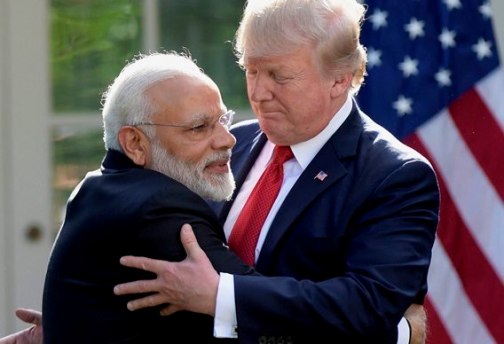
India’s international profile has been raised, and relations have been strengthened, with nations ranging from the US and Australia to Japan and Vietnam. Modi has also established good personal rapport (to varying degrees) with top leaders such as Xi Jinping in China, Japan’s Shinzō Abe, and President Barack Obama in the US, though the association with Donald Trump is inevitably more bumpy.

Real outcomes from most of the activity are however hard to pin down, though India has boosted its involvement in the Middle East and in international organisations such as the G-20, South East Asia’s ASEAN, and the BRICS five-country relationship. Modi also ensured that India played a key role in securing the Paris Climate Accord in December 2015, and initiated moves that a year later led to an international alliance on solar power.

Donald Trump, Narendra Modi

Donald Trump gets Narendra Modi’s famous hug in Washington June 2017 – AP photo

An Indian prime minister’s key foreign policy priority is managing relations with China and the US, where Modi has weathered inevitable challenges. The main problems concern the immediate neighbourhood, where he has generally failed.

After initial attempts to build a constructive relationship with Pakistan, he has run an erratic and aggressive policy that has been directed increasingly at gaining political capital at home with his domestic nationalist audience, rather than constructive diplomacy. This has become more apparent as the current general election has approached, and has developed into Modi’s primary aim of developing patriotic fervour to boost the appeal of the Bharatiya Janata Party’s Hindu nationalism.

It was widely speculated in Delhi last year that Modi would create a crisis with Pakistan before the election. He did not need to do so because one was created on February 14 when a terror attack in Kashmir, organised by the Pakistan-based Jaish-e-Mohammed (JeM) militant group, killed 40 paramilitary troops. India’s jet fighters crossed into Pakistan territory on February 26 to strike at an alleged terrorist camp, and engaged in aerial combat, for the first time in nearly 50 years.

Pakistan and India have different versions of which country gained the most out of that historic event, but Modi has successfully used during his election speeches to claim that only he, and not the leader of Congress or other opposition party, is able to keep India secure. Anyone who disagrees is accused of being pro-Pakistan and unpatriotic.

Modi needs Pakistan in order to present himself as a tough and successful leader because he has not been able to do so with India’s other neighbours – Bangladesh, Sri Lanka, the Maldives, Nepal, Myanmar and Bhutan – where he has had to tolerate increased influence by China.

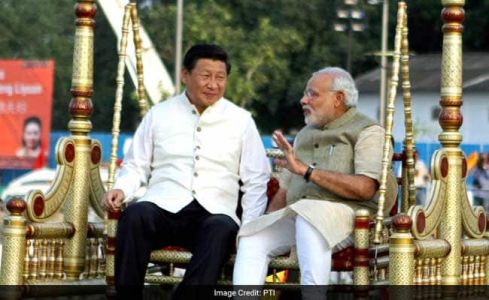
modi-xi-jinping - PTI photo April '17

Xi Jinping and Modi, Ahmedabad, Gujarat April 2017

The rise of Xi Jinping as China’s powerfully assertive president has presented Modi with far more challenges than any previous prime minister has had to face since India’s defeat in the two countries’ short border war in 1962. Xi was installed as China’s president a year before Modi became prime minister and has adopted an aggressive stance on both territorial ambitions and global reach, and has objected to India growing closer to the US over the past decade. Modi set out to develop a visible and close relationship with Xi and, while this may have been successful on a personal level, it is difficult to detect any diplomatic gains for India.

The biggest challenge came during the longest-ever confrontation between the two countries’ armies in the summer of 2017 at Doklam, a Himalayan plateau in Bhutan at a border tri-junction with China and India. Chinese troop movements and road construction on the plateau threatened the security of India’s adjacent narrow Siliguri corridor that connects its north-eastern states with the rest of the country. That prompted India to move its troops onto the plateau to block China’s advance, triggering a stand-off that lasted for just over ten weeks.

No shots were fired but Modi stood firm during those 72 days against this extreme provocation which, his aides claim, would have led previous governments to withdraw troops, fearing a war. Eventually after more than two months there was an understanding that enabled both sides to claim an advantage, though nothing was settled.

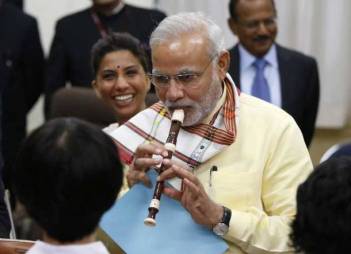
Modi -soprano recorder - Reuters photo Tokyo Sept '14

Modi plays a recorder with schoolchildren, Tokyo September 2014 – Reuters photo

India withdrew troops to its nearby state of Sikkim, but did not tie down details on final positions. Reports indicate that China has continued to embed itself long-term on the plateau north of the confrontation line, instead of backing off as India tried to argue had been agreed.

Xi’s giant Belt Road Initiative (BRI) involving infrastructure and investment projects to link Asia with Europe includes a $50bn China-Pakistan Economic Corridor (CPEC) with a highway through parts of Pakistan that India claims. Because of that highway, India has arguably over-reacted and boycotted the entire BRI. What it should have done was to have joined other countries in recognising the BRI and, while objecting to the CPEC, pick which projects might be of benefit. Modi could have used his relationship with Xi to try to make that work.

China has for years opposed India’s desire to become a member of the United Nations Security Council and Modi, like his predecessors, has spent too much energy pursuing this distant goal. More recently, China has blocked India’s membership application at the Geneva-based Nuclear Suppliers’ Group, which Modi’s government has irrationally pursued with maximum publicity, virtually asking to be repeatedly rebuffed. In addition, China has been blocking India’s initiatives at the UN to clamp down on Pakistan-based Islamic terrorists.

China blocks India

“China is determined to reduce India’s sphere of influence, its footprint,” a former top security adviser has told me, adding that China would not give way to India on any issue, other than when it wanted to do so, and on its own terms. That happened when, eight months after the Doklam crisis, Modi and Xi recalibrated their countries’ relationship onto a more co- operative footing at a summit held in April 2018 in the Chinese city of Wuhan.

India had realised it was best not to antagonise China by siding too obviously with the US and its allies, while Xi realised that the Doklam provocation had almost gone too far. Contacts between the two countries improved after the meeting and there have been no major events on the disputed Himalayan border, known as the Line of Actual Control.

While it would have been diplomatically and politically difficult, if not impossible, for any prime minister to improve India’s standing in relation to China during these years, Modi has unnecessarily allowed the country’s role with its other neighbours to deteriorate. He started off with a widely-praised flourish when he invited South Asia leaders to his swearing in ceremony in May 2014. They all attended, including Nawaz Sharif, Pakistan’s prime minister, who (fruitlessly) welcomed a ‘new page’ in the two countries’ relationship.

South Asia failings

With other South Asian neighbours, Modi tried to counter China’s advances by showing how India can be friendly and useful. China has continued however to increase its role in these countries, where it is welcomed as a counter-balance to what is generally regarded as Indian officials’ domineering assumed superiority. It outclasses India in terms of diplomatic heft, the size and scope of investments, and delivery of projects. Modi has failed to energize the Indian government, and especially the external affairs ministry, to counter this and challenge the advances.

China’s inroads into Bangladesh since 2014 are perhaps the most remarkable because they have happened despite Modi strengthening relations with the country. In June 2015, he signed a long-delayed cross-border land-swap deal involving 162 small enclaves that were left behind in the two countries’ territories when boundaries were drawn in 1947.

But in February 2018, China’s Shanghai and Shenzhen Stock Exchanges secured a 25% share in the Dhaka Stock Exchange, overriding strong objections from India that wanted the Mumbai-based National Stock Exchange to buy the stake. Gateway House, a Mumbai think tank, has estimated that China’s investment could rise ten-fold to $31bn – Xi Jinping promised $20bn during an October 2026 visit.

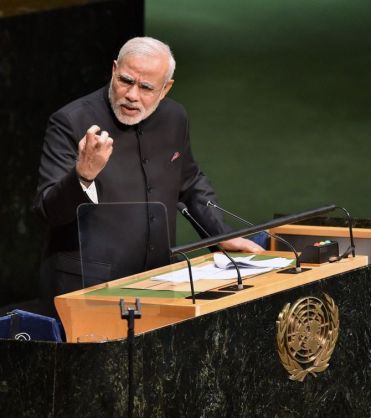
69th session of the United Nations General Assembly

Modi addressing the UN, September 2014

Bangladesh has declined some of China’s infrastructure suggestions, and Indian companies do have projects, but China is also becoming significant in Bangladesh’s defence forces, selling two submarines much to India’s horror as well as other army and air force equipment and training.

Relations improved with Sri Lanka after the island’s pro-China president, Mahinda Rajapaksa, lost power in a 2015 election (though he is still politically active). China has however continued its investment role, even though Sri Lanka has been caught in a debt trap experienced by other countries that fall for China’s apparently generous but unserviceable investment projects. In the nearby Maldives, China virtually ousted India from any influence, but parliamentary and presidential changes of government since late 2018 provide India with an opportunity to recover a positive role. With Nepal, Modi is proud of having provided immediate earthquake relief and other initiatives, but China is well-entrenched.

The final country in China’s sights is Bhutan, where Beijing has outstanding border issues and does not yet have formal diplomatic recognition – a situation worriedly guarded by India that has historically exercised dominant and not always subtle influence on the land-locked Buddhist kingdom. Bhutan’s relations with China are developing rapidly, and there is no reason to expect that India will be any more able to stop Beijing gaining diplomatic recognition and extensive influence than it has been in restraining its moves elsewhere on the subcontinent.

US challenge

With the US, Modi has had to balance India’s growing relationship, which he regards as a priority, against the need not unnecessarily to upset China. India is seen in Washington as a potential buffer against China, but the US ties have not been easy, especially after Trump became president. By the time Modi came to power, the Washington administration was tiring of India’s non-performance on defence issues and of the previous Manmohan Singh government’s failure to develop agreed nuclear power projects. Officials also regard it as unreliable in a crisis.

Trump expects India to become a confirmed ally against China, which is not likely to happen. He also expects the US to become India’s major supplier of defence equipment beyond what has been achieved in recent years. Tensions have recently escalated over trade and investment policies and the US is revoking India’s zero-tariff status within the Generalised System of Preferences on $5.6 billion of Indian exports.

Overall, Modi’s achievements do not match up to the image he has portrayed, especially in its neighbourhood. India has not become a significant player in world affairs, and it remains wooed (most of the time) by America, confronted by Pakistan, and constrained by China.

This article originally appeared on the London School of Economics’ South Asia blog https://blogs.lse.ac.uk/southasia/2019/04/25/long-read-modis-foreign-policy-and-performance/

It is adapted from the foreign policy chapters in a new “Modi” edition of John Elliott’s  book “IMPLOSION: India’s Tryst with Reality” that analyses the current government’s record. Amazon India https://amzn.to/2HldJQ3 . Amazon US  https://amzn.to/2CmQwZE  Amazon UK https://amzn.to/2FinQTm

BJP focus on national security and Narendra Modi’s image

Modi appeals to new voters to dedicate their vote to the IAF pilots

Voting begins today in India’s massive general election with opinion polls suggesting that Narendra Modi’s Hindu nationalist coalition might just scrape through with a tiny majority in the Lok Sabha. Regional non-aligned parties could win almost as many seats in the new parliament as the Congress Party’s coalition.

It does not however, at this stage, look as if the opposition and regional parties will muster enough votes to rein in the authoritarian religion-based Hindu nationalism espoused by prime minister Modi and Amit Shah, the Bharatiya Janata Party (BJP) president.

With an electorate of some 900m casting their votes over seven phases, polling ends on May 19 and the votes will be counted on May 23. By then, a variety of possible poll results will have been published. Nothing is certain at this stage.

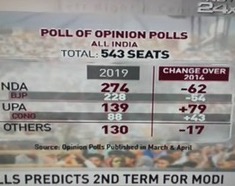
NDTV poll

The NDTV ‘poll of polls’

The BJP has been showing signs of desperation to try to drum home its messages that Modi protects India’s security, especially against Pakistan, and that it is curbing corruption. It hopes this will divert attention from its record on the creation of jobs and other development issues.

In a series of moves that challenge India’s model code of conduct for elections, the finance ministry’s enforcement directorate has raided the premises of eleven opposition leaders in the past month, revealing hordes of black money that are always present at election time. There have been no raids on BJP and its election allies. The leaders included Kamal Nath, a veteran Congress politician, who is chief minister of Madhya Pradesh.

Modi has breached Election Commission instructions by appealing to new voters, “Can your first vote be dedicated to those who carried out the air strike,” referring to an Indian Air Force strike on an alleged Pakistan terrorist camp on February 26.

Two BJP regional leaders have called the Indian army “Modi ki sena (Modi’s army)” and said that Modi had sent “his air force” to attack an alleged terrorist base in Pakistan on February 26. This fits with Modi’s message, but is in direct contravention of the Commission’s edict that the attack and the Pakistan confrontation should not be used in the election campaign.

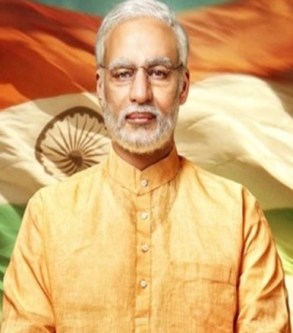
Modi-BIOPIC-1

Film star Vivek Oberoi in the Modi biopic lead role

Modi and his government have undermined many of India’s respected institutions during the past four years, including the commission. But no politician has previously tried to politicise the role of the army and air force,

The BJP also planned a Bollywood biopic film of Modi’s life that was due for release this week. This was blocked yesterday by the Commission that has been heavily criticised for not being tough enough on the BJP’s breaches of the election code.

“The Election Commission of India, once a formidable force during elections as poll monitor, is now being heard less and less, or only for its feeble interventions,” the Indian Express has said in an editorial.

The indication of voting intentions came in a “poll of polls” published this week by the NDTV television channel. It found that the BJP would win 54 fewer seats than it did in 2014 when Modi swept to power, but that its coalition, the National Democratic Alliance (NDA), would achieve 274 seats, just topping the 272 needed for a majority in the 543-seat Lok Sabha (lower house).

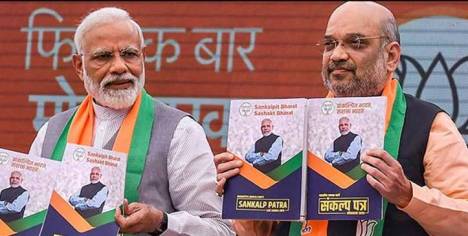
bjp-manifesto-2019-820

Narendra Modi and Amit Shah launch the BJP manifesto

Congress would double its dismal 43-seat tally in 2014, but would still only reach 88 seats with its UPA coalition winning a total of 139, while regional parties would get 130. That would be a bad result for Congress, which is hoping that its new leadership of Rahul Gandhi and his sister Priyanka will rally Congress activists and win over voters.

The poll of polls supports views of other observers and is also not far off what, according to one source, the political parties are forecasting privately – the BJP saying it would get around 200 seats, and Congress fearing it will fall below 100. Both main parties would do badly in the key state of Uttar Pradesh, according to the polls, with regional parties taking nearly half the 73 seats that the BJP won in 2014 and Congress going up from just two to four.

Congressmanifesto

Rahul Gandhi launches the Congress manifesto with his mother, Sonia, and former prom minister Manmohan Singh

Both the BJP and Congress have published their manifestos, with the BJP focusing especially on its Hindu nationalist agenda, national security and building a vision for 2047 when India reaches 100 years independence. Congress focuses more on support for the poor and ways of off-setting the BJP’s Hindu nationalism. Both parties talk about boosting India’s manufacturing industries – a key factor in job creation – without saying how it would be done.

Behind all the noise, voters basically have to decide whether Modi’s NDA government has done enough of what has been needed to fulfil his Achhe Din promise that “good times are coming”.

Overall it looks as if it has not. Policies and initiatives have produced far less than was required in the broad running of the economy, the creation of jobs, and reform of the government machine – and far less than the  prime minister promised in his 2014 presidential style election campaign.

As a committed Hindu nationalist, Modi had a ten-year vision to build a strong India that would be respected worldwide as a modern version of an ancient Hindu civilisation after a thousand years of Muslim and British invasions and rule.

But Modi has not met many of the targets, expectations and hopes of those who voted for him, and has instead led an increasingly authoritarian and centralised government with restrictions on media and personal freedoms, and with growing mob violence by vigilante gangs who feel protected by the regime.

The choice therefore is between the BJP which, despite its Hindu nationalist approach, has the promise of a more focussed economic programme, providing Modi improves his implementation, and the softer option of the Congress-led UPA, which is unlikely to have the same economic drive and focus.

The result of the election will decide whether or not India is to grow into a Hindu nationalist country.

A new “Modi” edition of John Elliott’s  book IMPLOSION: India’s Tryst with Reality has just been published by Harper Collins with a special section analysing the current government’s record.    It is available as a paperback in India’s bookshops and on Amazon India at https://amzn.to/2HldJQ3 . A Kindle edition is on the Amazon India site and in the US on https://amzn.to/2CmQwZE  and the UK https://amzn.to/2FinQTm


Society jeweller Nirav Modi in London jail as his art works are sold

Part of Narendra Modi’s attack on high level corruption

Over $8m was raised yesterday (May 26) in Mumbai for India’s tax revenue department when an alleged $2bn bank fraudster’s art collection was successfully auctioned. This was the latest example of Narendra Modi’s bid to demonstrate his government is attacking corruption and punishing defaulting businessmen.

Good prices up to $3.7m were achieved in the Saffronart auction for top works by two famous modern painters and by another from the 19th century, as well as other modern and contemporary artists.

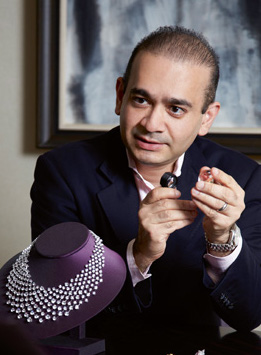
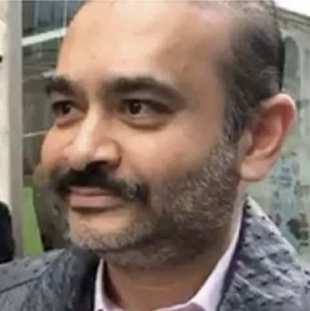
niravmod jewelThe collection belonged (through a shell company) to Nirav Modi, a billionaire diamond jeweller and trader (right), who is now languishing in London’s Wandsworth prison awaiting extradition proceedings. In India, he is charged with money laundering and corruption.

Modi, 48, fled from India in January 2018 when a $2bn (Rs13,000 crore) fraud centred on the government-owned Punjab National Bank emerged. He and his uncle, diamond trader and retailer Mehul Choksi, were the main beneficiaries of cash advances criminally obtained from overseas branches of Indian banks.

Saffronart conducted the live auction for central Mumbai’s tax recovery office, having beaten Christie’s and two other India auction houses, AstaGuru and Pundole, to get the commission; the first ever staged for the tax department. Saffronart won partly on its ability to carry out the auction quickly, which the government presumably wanted so that it can demonstrate during the current general election campaign that it is beating fraudsters.

Lot_37The total value of the auction sales was Rs59.37 crore or $8.73m (including buyers’ premium), which was at the top end of estimates, and 55 of the 68 lots were sold including most of the important works.

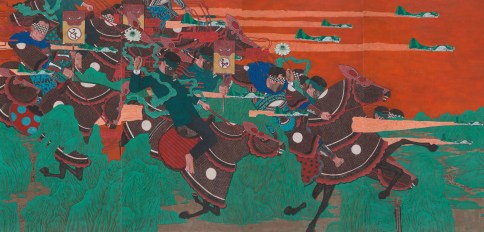
The top lot, (left) which fetched a hammer price of Rs22 crore or $3.24m (Rs25.24 crore or $3.71m including buyer’s premium), was a dense red 60in x 40in oil on canvas by Vasudeo S. Gaitonde, a leading Indian modernist.

It had the cache of having been shown in the Guggenheim Museum in New York and the Guggenheim Collection in Venice. The price achieved was less than an over-optimistic but undisclosed estimate made for the tax department by Mumbai’s Sir Jamsetjee Jeejeebhoy (JJ) School of Art that had probably been influenced by the Rs25.5 crore ($4.38) record price achieved at a Christie’s Mumbai auction in September 2016.

The other most important work was a south Indian royal scene (below) from the late 1800s by Raja Ravi Varma, who died in 1906, having built a reputation for merging European artistic styles with Indian life, seeking commissions from rich and powerfulpatrons. A 42in x 57in oil on canvas, it fetched a hammer price of Rs14 core or $2.1m (Rs16.10 crore, $2.47m including buyers’ premium). The hammer price was below the artist’s record price of Rs20 core reached at a Pundole auction in Mumbai in 2016, but was close in dollar terms.

Lot_13

Worries that collectors might not bid because the works were tainted by being owned by a fraudster proved wrong.  Some critics originally suggested that the collection included several fakes (a growing problem in auctions), and that Modi had poor taste. Neither turned out to be true. Whether he collected art simply to show off his wealth and display his artistic interests to his important friends and customers, or whether he was a genuinely involved collector, many of the works in the auction showed that Modi had a discerning eye or at least listened to knowledgeable experts.

Both Varma and Gaitonde are regulars in most Indian auctions, as was another notable name in the collection, F.N.Souza, who was clearly a favourite of Modi because ten of his paintings were sold. Contemporary artists included Jitish Kallat and Subodh Gupta, and there were five lots by Chinese artists (see below) that sold at good prices.

Lot_61

A large four panel 74in x 158in water and mineral colour work on paper by Chinese artist Ge Guanzhong that fetched a hammer price of Rs13 lakhs ($19,118)

Saffronart have their regular spring on line auction over the next two days, as does rival on-line AstaGuru, so there was a fear that some bidders might be tempted to wait for those sales, though that appears not to have happened. The annual South Asian spring auctions have also just been held in New York with Christie’s achieving sales of $5.84m and Sotheby’s $3m last week, so there has been plenty of competition.

Modi was a celebrated and internationally known jeweller with top society and film world customers and rave articles in the Financial Times about his watch collection and an Indian architectural magazine about his art works.

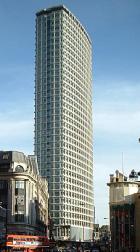
Centre_Point_LondonTracked down earlier this month by the UK’s Telegraph newspaper, it emerged that Modi had started a new diamond business after he fled to London.
He has been living, perhaps appropriately, in Centre Point (left), a luxury tower block of flats at the eastern end of Oxford Street that was regarded, when it was built for offices in the mid-1960s, as an outrageous example of rampant capitalism and property speculation.

He was arrested when he was  trying to open a new bank account soon after the Telegraph story appeared, and is now in jail (and demanding bail) while India’s request for extradition and his counterclaim for political asylum pass through the courts.

Curbing corruption and preventing black money flowing abroad have been a major focus for Narendra Modi’s government so the fact that Nirav Modi and his uncle managed to flee, having bled the Punjab and other government banks of $2bn, was a serious embarrassment. A new Fugitive Economic Offenders Act that came into force last year allows the government to confiscate properties and assets of alleged economic offenders who go abroad to evade prosecution

nirav-modi ox st

Nirav Modi when he was spotted in Oxford Street earlier this month

While it took a British newspaper to find the jeweller, the government has taken what action it could over the past year. Banks clamped down on the jewellery retail outlets to such an extent that the business collapsed. Modi’s 30,000sqft luxury seaside house near Mumbai that violated coastal planning regulations was demolished by authorities using explosives (video here) earlier this month.

The Finance Ministry’s Enforcement Directorate (ED) and the Income Tax Department have a total of 173 paintings, of which Modi was the effective owner, and eleven vehicles that include Rolls Royce, Porsche and Mercedes models. The ED have said that the paintings belong to Camelot Enterprises, one of Modi’s companies, and were comandeered by the tax department as part of their efforts to recover tax dues of over Rs95 crore.

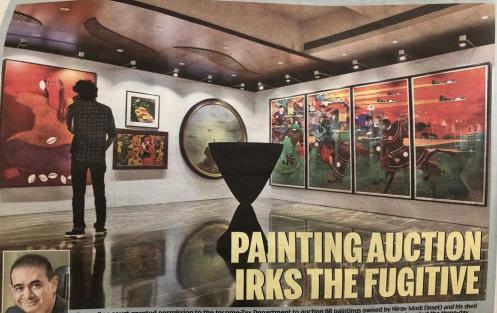
Modi’s lawyers took unsuccessful legal action on March 25 to stop the auction, alleging that Camelot only owned a few of the works and that the tax department did not have the right to sell the full catalogue.

Narendra Modi no doubt hopes that his namesake’s extradition proceedings, and those of Vijay Mallya, a failed liquor and airline businessman who is also holed up in London, will proceed fast enough for him to be able to claim that he is punishing corrupt and fraudulent businessmen, especially those who flee abroad.

WhatsApp Image 2019-03-26 at 05.41.18

A report in the Asian Age newspaper about Nirav Modi’s unsuccessful attempt this week to halt the auction

New “Modi” edition of my book IMPLOSION: India’s Tryst With Reality just published – Amazon India https://amzn.to/2HldJQ3 , Kindle UK https://amzn.to/2FinQTm , Kindle US https://amzn.to/2CmQwZE

New “Modi” edition of IMPLOSION: India’s Tryst with Reality

Modi’s performance – and non-performance – analysed in detail

The key decision facing India’s electorate as they vote in the coming weeks is whether Narendra Modi’s National Democratic Alliance (NDA) government has performed well on his 2014 Achhe Din promise that “good times are coming”.

The raucous election campaign is dominated currently by the high-decibel battle between Modi and the Congress Party’s Rahul Gandhi over whether the tag Chowkidar (guard) is positive or negative, especially over corruption. There has been little focus on substantive issues such as a lack of jobs.

But, behind all the noise and personal attacks, the real issue is to balance what Modi has – or has not – achieved on broad development and economic issues against what has been a Hindu nationalist attack on institutions and a serious decline in social cohesion.

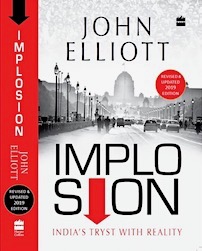
Implosion cover for blogIn a new “Modi” edition of my book, IMPLOSION: India’s Tryst with Reality, which has just been published by Harper Collins India, I come to the conclusion that the presidential-style prime minister has indeed not done enough to meet the targets, expectations and hopes of 2014.
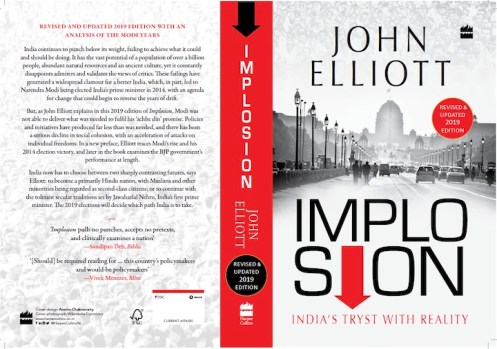
The headline for a new section of five chapters is The Modi Years: Not What Was Needed.

This is because, alongside the growing social concerns, there has been a lack of improvements in the broad running of the economy. Policies and initiatives have produced far less than was needed or promised.

In my conclusions however, I say that the choice is not so simple because, despite his many shortcomings, Modi has begun the job of making India function better. In ten or twenty years’ time, 2014-19 could well be seen as a period when big developments were begun in health and cleanliness, skills and the digital economy.

Modi said in 2014 that he would need a second five year-term to see through what he started. To bolster his prospects of being elected, having failed to deliver enough, he and his ministers have been announcing a flood of initiatives since the end of last year.

There seems to be little prospect of the Congress Party under Rahul Gandhi and its mostly regional allies uniting into an effective reforming government.

Grandstand less

The key question therefore is whether voters will accept India becoming a Hindu-centric country and a more authoritarian and intolerant society in order to have a BJP government driving change – hoping that Modi realises he needs to grandstand less and actually manage the implementation of policies.

Put simply, the choice is between gambling on the hope that a Hindu nationalist government will drive economic and other reforms, or accepting the gentler more inclusive Nehruvian idea of India but with less reforming coherence and drive.

IMPLOSION is available in India’s bookshops as a paperback – or on Amazon.in at https://amzn.to/2HldJQ3  where there is also a Kindle edition  

Internationally, a Kindle edition is on Amazon.co.uk at https://amzn.to/2FinQTm and Amazon.com at https://amzn.to/2CmQwZE

Implosion '19 jacket


Posted by: John Elliott | March 10, 2019

Voting in India’s election starts April 11 – result May 23

Modi on a patriotic nationalist roll to deflect attention from failures

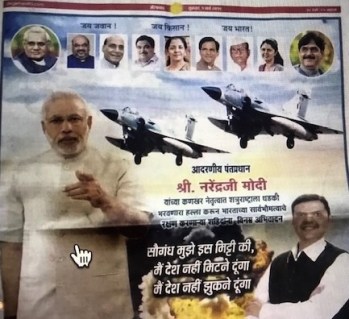
Election Commission bans BJP posters showing Modi and warfare

Narendra Modi looks as if he is on a roll for India’s coming general election, where voting starts on April 11. India’s recent air strike on a terror camp in Pakistan and subsequent fighter jet battle have eclipsed the opposition Congress Party’s state assembly victories last December, enabling him to pitch, in his usual presidential style, that he alone can keep India safe.

It is still possible that this will change before voting ends on May 19 and that Modi’s failure to deliver on many of his 2014 election promises will become the focus – issues such as a failure to create jobs and solve the problems of farmers and other rural voters.

IMG_4225

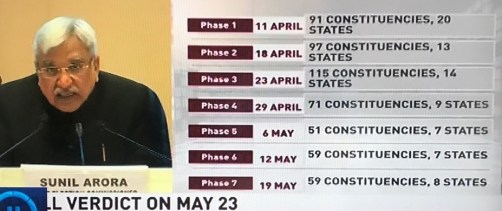
Sunil Arora, the chief election commissioner, announcing the plans

His Hindu nationalist Bharatiya Janata Party (BJP) campaign seems however to have far more momentum than the opposition combine of the Congress Party, headed for the first time in an election by Rahul Gandhi, and allied mostly-regional parties. Gandhi’s personable sister Priyanka has also entered national politics, as a party general secretary, which will help the campaign.

The massive election programme involving 900m eligible voters (Europe’s entire population is just 740m) and nearly one million voting stations was announced yesterday (March 10) by the Election Commission.

Electronic voting will take place on seven dates ending on May 19, and the count will be held on May 23, with the trends emerging quickly, though final results might not emerge till May 24. The current term of the Lok Sabha (parliament’s lower house) runs till June 3.

IMG_4231

An example of military political posters banned by the Election Commission (and below) – posted on Twitter by Yogendra Yadav, a political analyst and activist

Assembly polls are also to be held during the same period in Andhra Pradesh, Arunachal Pradesh, Odisha (Orissa), and Sikkim, but not in Jammu and Kashmir where the security situation is specially sensitive following the cross-border clashes.

Shortly after the dates were announced, Modi issued a series of tweets saying that “the festival of democracy, elections are here” and urging a big turnout, especially from first time voters.

Social media will play a big role and the Election Commission is bringing it into its model code of conduct, which comes into force today, in an attempt to curb excesses. Candidates and political parties will have to provide  details of their social media accounts and expenditure, and political advertisements will require pre-certification.

Modi’s main theme looks like being patriotism and nationalism, built especially on India’s jet fighters crossing the Pakistan border on February 26 and engaging in combat for the first time in nearly 50 years. That was in response to a terror attack in Kashmir on February 14, when some 40 paramilitary troops were killed. There are however doubts about whether India’s jets actually hit their target at Balakot (left) and killed as many as the 250 people claimed by Amit Shah, the BJP president. The Indian Air Force said it had no numbers.

The Election Commission has however said that political parties’ advertisements should not use images of military personnel in their election campaign (above and below). “The armed forces of a nation are . . . neutral, apolitical stakeholders in a modern democracy,” the commission said, urging parties to exercise “great caution” in invoking the military during the election campaign.

IMG_4232

The state assembly elections that Congress won in December, ousting BJP governments, were in Rajasthan, Madhya Pradesh and Chhattisgarh. This was a low point for Modi and the BJP and there was widespread speculation in Delhi about whether he would engineer a crisis with Pakistan to boost his nationalist image.

The terror strike did that for him, enabling him to develop his theme that anyone – including Congress politicians – who criticises the government, or questions the air force’s success on February 26, is being unpatriotic.

The image of a strong Hindu nationalist India will be pushed by Modi to try to deflect doubts about what his government has actually achieved in terms of job creation and other programmes. He also wants to deflect allegations of cronyism and corruption, notably in a French Rafale jet deal that he commissioned.

Modi is frequently criticised for undermining institutions, and has been accused by the opposition of arranging for the usually-revered Election Commission to delay the announcement of the election dates so that he could make a splurge of potentially vote-winning announcements.

Mega announcements

The NDTV television channel estimated last night that Modi made 28 trips in the past month to announce 157 projects (plus 60 more in January), several of which had already been announced in the past. They ranged from three new and extended metro railways in the key north India state of Uttar Pradesh, to a highway in in the southern state of Kerala, and a sewerage system in Maharashtra to the west. In the past 15 days, Modi’s Cabinet cleared a total of 96 decisions affecting groups such as farmers, the poor, ex-servicemen and government employees.

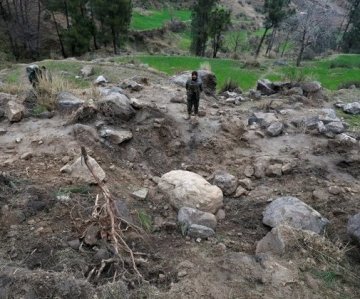
Reuters Balakot crater

Pakistan’s soldier stands at the edge of a crater, after the Indian aircrafts strike on February 26, according to Pakistani officials, in Jaba village, near Balakot – REUTERS/Akhtar Soomro

The election provides a sharp choice between Modi’s Bharatiya Janata Party and its aggresive  and divisive Hindu nationalism, and the softer approach of the Congress Party and its allies in the United Progressive Alliance (UPA).

The choice however is not simple because the BJP has a much stronger economic reform agenda than Congress and its regional allies. That may change when manifestos are published, but the BJP is more reform oriented.

In 2014, Modi was elected by appealing to India’s aspirational youth, with 50% of the population below 25. There are as many as 15m eligible voters aged between 18 and 19 in this election.

Opinion polls

Opinion polls taken before the air battle gave the BJP and its allies in the National Democratic Alliance (NDA) coalition about 250 to 265 seats in the 543-seat Lok Sabha, just short of the 272 needed for a simple majority. That is considerably less than the 336 seats that the NDA won in 2014, but is better than the BJP had feared at the end of last year and it would be easy for Modi to entice smaller parties to make up the 272.

The same opinion polls gave Congress’s United Progressive Alliance (UPA) coalition 150 to 170 seats, indicating the big gap that Gandhi and the other party leaders have to bridge. Gandhi has failed so far to entice friendly parties into formal alliances in some states, notably Uttar Pradesh (and Delhi, though that might be reviewed). This means that the anti-BJP vote is splintered, making it easier for Modi to win seats.

Poll pundits suggest that if the BJP’s NDA dropped below 200 seats, it would have problems attracting new allies with Modi as prime minister, which could lead to moves within the party to remove him. That prospect was being widely discussed at the turn of the year, but now seems less likely. Nitin Gadkari, the minister for highways and shipping, who is a more approachable inclusive politician than Modi, was then being rumoured as the likely alternative candidate.

Some politicians in southern India wanted the timing of yesterday’s announcement, fixed for 5pm, changed because the period between 4.30 and 6 pm would, they said, be Rahu Kaal or an inauspicious time for the start of any activity. In Vedic astrology, Rahu is an unpredictable planet, and Rahu Kaal lasts for about 90 minutes at different times throughout a week.

Modi’s opponents will be hoping that the timing was indeed Rahu Kaaled

see also

from 2014   https://ridingtheelephant.wordpress.com/2014/04/06/the-mystery-of-rahul-gandhis-unpredictable-beard/

and 2011 https://ridingtheelephant.wordpress.com/2011/09/15/could-narendra-modi-be-the-leader-india-needs/

Posted by: John Elliott | February 28, 2019

India Pak aircraft fight across border – first time since 1971

Nuclear powers allow Kashmir dispute to fester from crisis to crisis

Modi makes pre-election political capital out of Pakistan conflict 

For decades, India and Pakistan have allowed their dispute over Kashmir to fester, risking the sort of crisis that has led to the current land and air confrontation escalating hostilities to a level not seen for nearly 50 years.

Viewed dispassionately, that is a grossly irresponsible stance for two nuclear powers to take, yet international pressure has never tried consistently to force a settlement, and India has resolutely refused to allow any third party to intervene.

That has not seemed unbearably risky for most of the 20 years since a limited war at Kargil on the Line of Control (LoC) in 1999, though there have been dangerous confrontations, notably following a terror attack on the Indian parliament in 2001 and on two Mumbai hotels in 2008. A BJP-led government did not let the Indian air force or army cross into Pakistan during the Kargil fighting, though it massed troops on the border after the parliament attack. Congress did not take any publicised retaliatory action after the Mumbai attack.

Mirage

Current events changed that when, in response to the February 14 terror attack in Kashmir by the Pakistan-based Jaish-e-Mohammed (JeM) militant group, the Indian Air Force on February 26 attacked inside Pakistan territory for the first time since the two countries’ last full-scale war in 1971. Twelve Mirage (above) fighter jets, supported by a fleet of Sukhoi fighters and other aircraft, took part in the attack and, India claimed, destroyed a big JeM camp at Balakot. Unsubstantiated reports put the death toll at 300.

Pakistan responded yesterday morning (Feb 27) by trying to attack sites in India, and that led to the first encounter between the two air forces since 1971. Both sides lost one crashed fighter.

An Indian pilot was captured and was shown on social media being protected from angry Pakistani villagers, who pummelled his bloodied face and struck him with blows, Reuters reported. India protested – and demanded his release – after Pakistan’s information ministry posted a video on Twitter with the pilot, blindfolded, saying “I’ve got hurt and I would request some water”. [Later he appeared in a video praising the Pakistan army’s treatment, and Pakistan then announced he would be released.]

This level of conflict after a gap of nearly 50 years took the escalation to dangerous levels. Imran Khan (below), Pakistan’s relatively new prime minister, who is close to his county’s powerful military, then broadcast to the nation. Presumably responding to international pressure, he remarked, “where will this go if there is escalation”. He appealed for talks with India and added “better sense should prevail”.

India inevitably condemned the Pakistan attack and there were conflicting reports from both sides of what it had achieved. India also handed over a dossier alleging Pakistan’s and the JeM’s involvement in February 14 terrorism.

Imran KhanAlso significant was a statement issued after a meeting of leaders from 21 Indian opposition parties that praised the Indian Air Force, but expressed “deep anguish over the blatant politicisation of the sacrifices made by our Armed Forces by leaders of the ruling party”. National security should “transcend narrow political considerations”, they said. The prime minister should have “followed convention and held an-all party meeting”.

Modi has been blatantly politicising the crisis since February 14 to gain maximum political advantage in the run-up to India’s coming general election. Since the India air attack, he has made various public appearances declaring, “India is in safe hands”. Today (Feb 28) he is scheduled to address hundreds of thousands of party workers through his NaMo app, where he will no doubt repeat the “safe hands” pledge as an electioneering slogan.

The question is whether the fighting is over, for now, and whether India will allow the current crisis to lead to talks, before or after the general election – and then how far any talks will go. There is strong pressure on India’s social media and frenetic television panel discussions for more action to be taken against Pakistan, both because it struck back and for the way it has treated the captured pilot. But Modi might decide to wait for international pressure to build up on Pakistan to take more action against the terror groups.

In many ways, it has suited both counties not to try down the years to solve the intractable issues involved – though there is a simple solution which, eventually, will probably be what both sides will one day agree with a few adjustments. That is to make the existing 776 km Line of Control (LoC) in Kashmir the permanent border.

Pakistan’s aggression is driven not by its democratically elected government but by the army, whose dominant role is boosted by the conflict and potential conflict, and by the Inter-Services Intelligence (ISI) that aims to destabilise India by assisting with terror attacks.

That suits China, which is Pakistan’s patron and, to put it simply, approves of India being destabilised – providing the military conflict does not escalate beyond the level of the past two days. Significantly, it has appealed for both countries to exercise restraint.

Peace Attempts

India at one level would like peace. Earlier prime ministers, notably the Bharatiya Janata Party’s Atal Bihari Vajpayee and Congress Party’s Manmohan Singh, both had ambitions to make that happen, though their efforts were disrupted by terror attacks and cross-border incidents triggered by Pakistan.

When General Pervez Musharraf was Pakistan’s president, a possible agreement was reached in the 2000s for a ‘soft border’ with relaxed visa restrictions, cross-border travel and trade, and liaison arrangements on economic policy and other matters. This was, however, not approved (and might never have been) by the Pakistan army, nor by hard-line lobbies in either country. The talks faded away when Musharraf faced political problems in Pakistan and, in 2008, was ousted from office. Such a soft border solution is now not feasible until Pakistan closes down the Islamic terrorist bases used to attack India.

Modi tough line

Modi has not shared his predecessors’ persistent wish for peace and, after a few friendly gestures towards Nawaz Sharif, the former Pakistan prime minister, decided that taking a tough line on both Muslim Pakistan and the security situation in Indian Kashmir suited his purposes because it pleased his Hindu nationalist vote bank.

That ended a formal and broadly successful ceasefire on the LoC that had been introduced in 2003. Official figures show that the number of incidents came down from 3,401 in 2003 when 795 civilians, 314 security forces and 1,494 militants were killed to 118 incidents in 2012.

Modi’s rule has changed that and the Home Ministry’s number of terrorist incidents has risen from 222 in 2014 to 614 last year, while the number of security force personnel killed has gone from 47 in 2014 to 91 in 2018 – nowhere near so bad as 2003, but much worse than the intervening years.

The Modi government has made no significant moves to stem this decline, nor to engage in constructive talks on Kashmir. The hope must be that the current crisis will involve heavy and continued international pressure that forces the two sides to come to some sort of deal that will remove the nuclear risk.

For that to happen however, Pakistan will first have to be forced, again by international pressure, to close the terror camps.

« Newer Posts - Older Posts »

Categories